Exciting Games Help To Propel NFL TV Ratings Higher

The NFL playoffs begin this weekend and, like always, there’s plenty of drama and intrigue both on the football field and off. Which teams will make it a step closer to the Super Bowl?


STEVE INSKEEP, HOST:

You got to hand it to the NFL. The regular season began four months ago, immersed in controversy over player protests and declining TV ratings. And now here we are, the day before the playoffs start, with ratings back up and a lot of excitement about a postseason with, arguably, no clear favorites. Our co-host, Noel King, spoke with NPR sports correspondent Tom Goldman to give us a preview of what’s to come this playoff season.

NOEL KING, BYLINE: So before we get to this weekend’s games, what is behind the jump in TV ratings? What happened?

TOM GOLDMAN, BYLINE: Well, first, I will tell you what the ratings jump is. It’s a 5 percent climb compared to last season. Since this season started, 46 of the top 50 rated TV broadcasts were NFL games. And then the average number of viewers streaming NFL games was up a whopping 86 percent.

Now, Noel, there are going to be some who say it’s because the players have stopped protesting, or, at least, TV cameras are not showing them. But that’s perhaps giving too much significance to the protests causing ratings declines the previous couple of years. Really, the main reason ratings are back up is that the games have been great – tons of passing and scoring this season. There were a record number of touchdowns, a record number of games decided by three or fewer points, and NFL fans like that.

KING: So is this kind of exciting football with all the scoring going to continue on into the postseason?

GOLDMAN: Probably not.

KING: (Laughter) That’s a heartbreak.

GOLDMAN: Yeah, really. Sorry to let you down. In fact, offense did die down late in the season. Plus, Noel, as you well know, defense wins championships. And, in the playoffs, teams tend to slow things down. They play more conservatively, and a good defense becomes even more important.

KING: Getting boring, y’all.

GOLDMAN: (Laughter) Not boring. A lot of people love defense.

KING: (Laughter).

GOLDMAN: But those are the weirdos. OK (laughter).

KING: So let’s talk about this weekend’s wild-card round of the playoffs. These are the teams that are good enough to qualify for the postseason but not the teams with the best records who got the byes in this round.

GOLDMAN: Right.

KING: Which games do you – are you looking forward to most this weekend?

GOLDMAN: Let’s break it down into Saturday and Sunday. I’m calling tomorrow comeback Saturday. All four teams playing – Indianapolis, Houston, Seattle, Dallas – all four had rough starts and turned their seasons around, none more dramatically than Indianapolis. The Colts began the season losing five of their first six games. Quarterback Andrew Luck had missed the entire 2017 season because of a hurt throwing shoulder. And there were doubts he could lead them out of the early season hole. But he did it, and the Colts look really good right now.

KING: All right. So that’s Saturday. What about Sunday?

GOLDMAN: Sunday, you have Baltimore hosting the LA Chargers – no longer the San Diego Chargers. Now, Baltimore will start a 21-year-old rookie quarterback, Lamar Jackson. He’s the youngest quarterback ever to start a playoff game. He’s a dynamic player, fantastic runner, not as great of a passer yet. The Ravens also have the best defense in the NFL, and they’re going against a very good Chargers team led by veteran quarterback Philip Rivers. A couple of weeks ago, these two teams played, and Baltimore’s defense dominated. It should be an interesting rematch.

Then you’ve got defending champion Philadelphia against the Chicago Bears with their great defense. Now, Philly made it to the playoffs on the last day of the regular season behind backup quarterback Nick Foles, who, for a second straight year, has taken over after Philadelphia’s starting quarterback was injured. Now, last season, all Foles did was lead the Eagles to the Super Bowl title. This season, he’s led Philly to three straight wins, a playoff spot. And, Noel, eternally pessimistic Eagles fans are feeling the magic again.

KING: NPR’s Tom Goldman previewing the NFL playoffs. Thanks, Tom.

GOLDMAN: You’re welcome.

Copyright © 2019 NPR. All rights reserved. Visit our website terms of use and permissions pages at www.npr.org for further information.

NPR transcripts are created on a rush deadline by Verb8tm, Inc., an NPR contractor, and produced using a proprietary transcription process developed with NPR. This text may not be in its final form and may be updated or revised in the future. Accuracy and availability may vary. The authoritative record of NPR’s programming is the audio record.

Let’s block ads! (Why?)

Baylor Women End No. 1 UConn's Years-Long Winning Streak

Baylor University center Kalani Brown (21) works around University of Connecticut forward Napheesa Collier during the second half of the NCAA game Thursday in which Baylor defeated UConn 68-57.

Ray Carlin/AP


hide caption

toggle caption

Ray Carlin/AP

The Baylor University Lady Bears women’s basketball team delivered a stunning double-digit defeat Thursday to the University of Connecticut Huskies, ending a 126-game regular season winning streak that spanned more than four years.

The No. 8 Lady Bears beat the No. 1 Huskies 68-57 at home in front of more than 10,000 fans at the Ferrell Center in Waco, Texas.

The 11-time national championship-winning Huskies had not lost a regular season game during regulation or overtime since November 2014, ESPN reports. The team was defeated in each of the past two national semifinals.

“What is disappointing for me, not that we lost. How long did you think you were going to win every game in the regular season, 10 years?,” UConn head coach Geno Auriemma said, according to The Associated Press. “So I’m not surprised that we lost, but it was disappointing that we struggled so much on the offensive end.”

Before the game, The UConn Blog predicted that “guarding the Bears’ star senior center Kalani Brown in the paint will be the toughest part of that test.” It was an accurate assessment, as Brown scored 20 points and brought down 17 rebounds during the game.

The only time the Huskies led was in the opening minutes of the game, when Crystal Dangerfield scored the first two points.

For the Huskies (11-1), it was their final game before American Athletic Conference play begins Sunday in Houston. Baylor (10-1) opens Big 12 Conference play Sunday at Texas Tech, AP reports.

Let’s block ads! (Why?)

How The Federal Shutdown Is Affecting Health Programs

Despite the partial shutdown, the Food and Drug Administration will continue work that is critical to public health and safety.

Jacquelyn Martin/AP


hide caption

toggle caption

Jacquelyn Martin/AP

There seems to be no end in sight for the current partial government shutdown, the third since the beginning of the Trump administration.

For the vast majority of the federal government’s public health efforts, though, it’s business as usual.

That’s because Congress has already passed five of its major appropriations bills, funding about three-fourths of the federal government, including the Department of Health and Human Services and the Department of Veterans Affairs.

But seven bills are outstanding — including those that fund the Interior, Agriculture and Justice departments — and that puts the squeeze on some important health-related initiatives.

The shutdown itself isn’t about health policies. It’s the result of differences of opinion between the administration and congressional Democrats regarding funding for President Trump’s border wall. But it’s far-reaching, nonetheless. Here’s where things stand:

Funding for “big ticket” health programs is already in place, alleviating much of the shutdown’s immediate potential impact

Since HHS funding is set through September, the flagship government health care programs — think Obamacare, Medicare and Medicaid — are insulated.

That’s also true of public health surveillance, like tracking the flu virus, a responsibility of the Centers for Disease Control and Prevention. The National Institutes of Health, which oversees major biomedical research, is also fine. It’s a stark contrast to last January’s shutdown, which sent home about half of HHS’s staff.

But some other public health operations are vulnerable because of complicated funding streams

Although the Food and Drug Administration falls under the HHS umbrella, it receives significant funding for its food safety operations through the spending bill for the Department of Agriculture, which is entirely caught up in the shutdown.

Last year, that tallied an estimated $2.9 billion to support among other things these FDA oversight efforts, which involve everything from food recalls to routine facility inspections and cosmetics regulation. Not having those dollars now means, according to the FDA contingency plan, that about 40 percent of the agency — thousands of government workers — is furloughed.

The FDA will continue work that’s critical to public health and safety. It will be able to respond to emergencies, like the flu and foodborne illnesses. It will continue recalls of any foods, drugs and medical devices that pose a high risk to human health.

The FDA’s responsibilities for drug approval and oversight are funded by user fees and will continue product reviews where the fees have already been paid. Regulation of tobacco products is also continuing.

Health services for Native Americans are also on hold

Because Congress has yet to approve funding for the Indian Health Service, which is run by HHS but gets its money through the Department of the Interior, IHS feels the full weight of the shutdown. The only services that can continue are those that meet “immediate needs of the patients, medical staff, and medical facilities,” according to the shutdown contingency plan.

That includes IHS-run clinics, which provide direct health care to tribes around the country. These facilities are open, and many staffers are reporting to work because they are deemed “excepted,” said Jennifer Buschik, an agency spokeswoman. But they will not be paid until Congress and the administration reach a deal.

Other IHS programs are taking a more direct hit. For example, the agency has suspended grants that support tribal health programs as well as preventive health clinics run by the Office of Urban Indian Health Programs.

Public health efforts by Homeland Security and the EPA face serious constraints

The Department of Homeland Security’s Office of Health Affairs assesses threats posed by infectious diseases, pandemics and biological and chemical attacks. It is supposed to be scaling back, according to the department’s shutdown contingency plan. This office is just one component of the 204-person Countering Weapons of Mass Destruction Office, which is retaining about 65 employees during the funding gap.

Other DHS health workers are likely to work without pay — for instance, health inspectors at the border, said Peter Boogaard, who was an agency spokesman under the Obama administration. According to DHS’s plan, the vast majority of Border Patrol employees will continue working through the shutdown.

The Environmental Protection Agency has also run out of funding. According to its contingency plan, it’s keeping on more than 700 employees without pay, including those who work on Superfund sites or other activities where the “threat to life or property is imminent.” (More than 13,000 EPA workers have been furloughed.)

That limits the agency’s capacity for activities including inspecting water that people drink and regulating pesticides.

But it’s not just regulation. The public health stakes are visceral — and sometimes, frankly, pretty gross.

Just look at the National Park Service, which has halted restroom maintenance and trash service for lack of funding. On Sunday, Yosemite National Park in California closed its campgrounds. On Wednesday, Joshua Tree National Park, also in California, did the same.

Why? Per a park service press release: “The park is being forced to take this action for health and safety concerns as vault toilets reach capacity.”


Kaiser Health News, a nonprofit news service covering health issues, is an editorially independent program of the Kaiser Family Foundation that is not affiliated with Kaiser Permanente.

Let’s block ads! (Why?)

'New York Times' Reports NBA Assistant Kristi Toliver Is Paid Like An Intern

Noel King talks with New York Times reporter Howard Megdal about WNBA star Kristi Toliver, who’s also an assistant NBA coach — she’s being paid a fraction of the salary of other assistant coaches.


NOEL KING, HOST:

When Kristi Toliver was hired as an assistant coach by the Washington Wizards, she was just 1 of 3 active women coaches in the NBA. Coaching was a career goal for Toliver. She’s also a WNBA star. She plays point guard for the Washington Mystics. But a problem emerged. If she wanted to coach in the NBA, she’d need to accept a tiny salary – $10,000 a year. Now, NBA assistant coaches typically make $100,000 a year or more. Some make over a million.

Howard Megdal broke this story for The New York Times. He’s with me via Skype to explain why it is that a talented female coach is earning peanuts coaching men in the NBA. Good morning, Howard.

HOWARD MEGDAL: Good morning.

KING: So Kristi Toliver is a player and a coach. As a player, she makes a normal WNBA salary. As a coach, she’s earning next to nothing – $10,000 a year. How did that happen?

MEGDAL: Well, it happened, in part, because progress has exceeded what the collective bargaining agreement between the players and the WNBA allow for. So the last collective bargaining agreement called for players to be able to be paid up to $50,000 as a team for offseason work. Now, that offseason work, by definition, did not include coaching because at that time, there were not coaches who were WNBA players.

So she came up against a very simple issue, which is that $50,000 was the max that could be paid to all the players for offseason work, and 40,000 of that had already been promised to her Mystics teammate Elena Delle Donne.

KING: So we’ve got a talented woman coach, and she can’t make more than $10,000 a year. Did Kristi Toliver or the Wizards try to fight this? Because, as you lay out in your story, it is really galling. It just seems wildly unfair.

MEGDAL: And that is precisely it. It is galling and unfair. And, yes, they both tried to fight it. And the Wizards, to their credit, tried to do so as well.

KING: In your piece, you spoke to Kristi Toliver, and she seemed frustrated, but she also seemed pretty optimistic. What was your impression of her as a player, as a coach, as a person?

MEGDAL: I’ve covered Kristi for a long time. She’s one of the brightest people that you’re going to meet in any profession. So I wasn’t surprised about it. I also think there’s been an ethos in women’s basketball, and really women’s sports as a whole, that there’s an effort to trailblaze today so that tomorrow’s battles are a little bit easier to fight or don’t even have to be fought at all. And I think that may play a part in it.

KING: Even though Kristi Toliver is only one person in this situation, this is likely to come up in a new contract negotiation – that this is a very unfair set of circumstances?

MEGDAL: It will definitely come up. The players association is very committed to this. And for the league, it’s an opportunity to have a significant number of talented basketball minds coach, as well. So it’s an extra influx of talent. So it really is something that both sides have a financial interest in getting solved.

KING: Could this have happened with a male player who also wanted to coach? Say you’ve got a talented point guard, and he says, in the offseason, I want to coach a women’s team. Would he be in the same situation, where there is a cap on how much he could be paid as a coach?

MEGDAL: The short answer is nothing like that would occur. The cap is much higher than $50,000 on the men’s side. The money is significantly different as a whole in the NBA. And as a result, it simply wouldn’t be something that would be punitive for an NBA player who is tempted to do that.

KING: Howard Megdal is the editor of High Post Hoops, which is a site dedicated to women’s basketball, and he broke this story about Kristi Toliver in The New York Times. Thanks, Howard.

MEGDAL: Thank you.

(SOUNDBITE OF SABZI’S “SPEARMINT SPEARS”)

Copyright © 2019 NPR. All rights reserved. Visit our website terms of use and permissions pages at www.npr.org for further information.

NPR transcripts are created on a rush deadline by Verb8tm, Inc., an NPR contractor, and produced using a proprietary transcription process developed with NPR. This text may not be in its final form and may be updated or revised in the future. Accuracy and availability may vary. The authoritative record of NPR’s programming is the audio record.

Let’s block ads! (Why?)

Emergency Medical Responders Confront Racial Bias

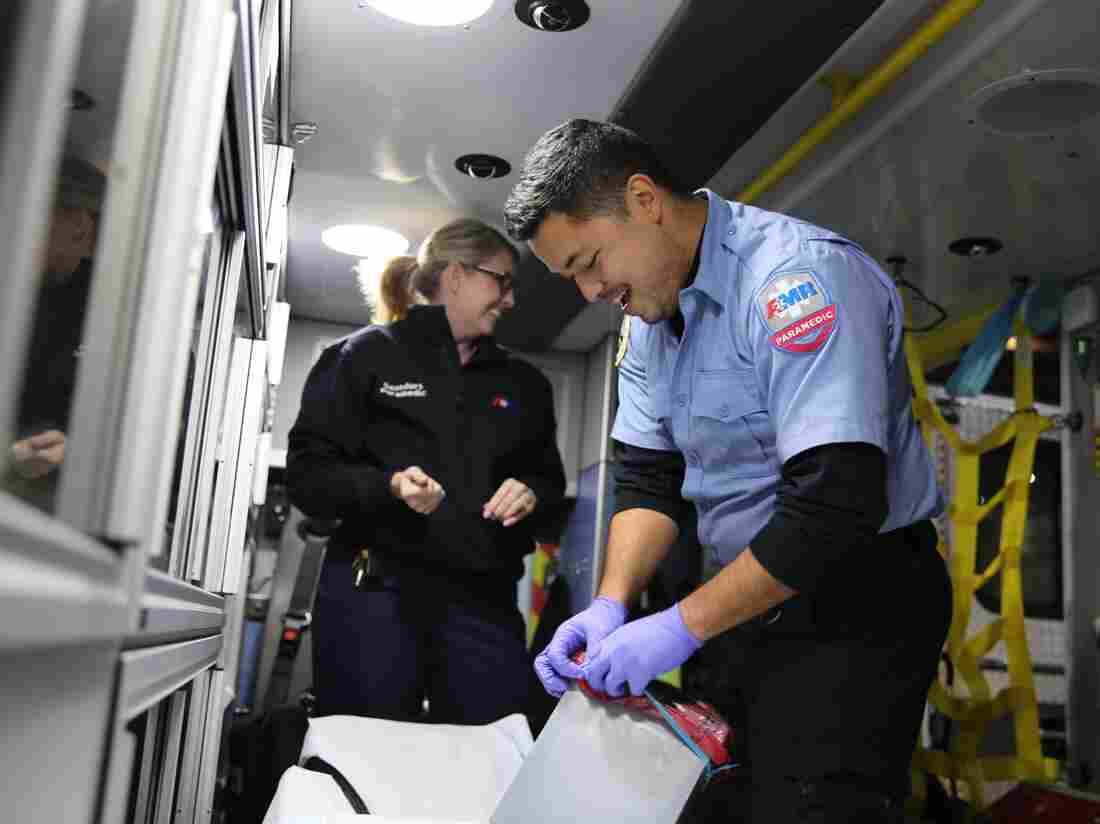
Talitha Saunders and AJ Ikamoto tidy their ambulance at the end of a recent shift. The two work as emergency medical responders in Oregon with American Medical Response in Portland. Leaders there are working to prevent any race-based disparities in treatment.

Kristian Foden-Vencil/Oregon Public Broadcasting


hide caption

toggle caption

Kristian Foden-Vencil/Oregon Public Broadcasting

A recent study out of Oregon suggests emergency medical responders — EMTs and paramedics — may be treating minority patients differently from the way they treat white patients.

Specifically, the scientists found that black patients in their study were 40 percent less likely to get pain medication than their white peers.

Jamie Kennel, head of emergency medical services programs at Oregon Health and Science University and the Oregon Institute of Technology, led the research, which was presented in December at the Institute of Healthcare Improvement Scientific Symposium in Orlando.

The researchers received a grant to produce the internal report for the Oregon Emergency Medical Services department and the Oregon Office of Rural Health.

Outright discrimination by paramedics is rare, the researchers say, and illegal; in this case unconscious bias may be at work.

A few years ago Leslie Gregory, was one of a very few black, female emergency medical technicians working in Lenawee County, Mich. She says the study’s findings ring true to what she’s seen.

She remembers one particular call — the patient was down and in pain. As the EMTs arrived at the scene, Gregory could see the patient was black. And that’s when one of her colleagues groaned.

“I think it was something like: ‘Oh, my God. Here we go again,’ ” Gregory says. She worried — then, as now — that because the patient was black, her colleague assumed he was acting out to get pain medication.

Leslie Gregory, a Portland physician assistant, asks, “How can a person of color not disrespect a system that is constantly studying and talking about these disparities, but does nothing to fix it?” She wants the CDC to declare the effects of racism a national health crisis.

Kristian Foden-Vencil/Oregon Public Broadcasting


hide caption

toggle caption

Kristian Foden-Vencil/Oregon Public Broadcasting

“I am absolutely sure this was unconscious,” adds Gregory, who now lives and works in Portland, Ore. “At the time, I remember, it increased my stress as we rode up on this person. Because I thought, ‘Now am I going to have to fight my colleague for more pain medication, should that arise?’ “

Unconscious bias can be subtle — but, as this new report shows, it may be one of factors behind race-linked health disparities seen across the U.S.

The study looked at 104,000 medical charts of ambulance patients between 2015 and 2017. It found minority patients were less likely to receive morphine and other pain medication compared to white patients — regardless of socioeconomic factors, such as health insurance status.

Gregory is now a physician assistant, and one of her current patients, a black veteran, has cyclic vomiting syndrome. That means he periodically experiences bouts of vomiting he can’t stop without hydromorphone, a potent opioid.

If the man doesn’t get the medicine when he needs it, he could rupture his esophagus and die, Gregory says.

So, he doesn’t call the ambulance anymore. Instead, he goes straight to a hospital emergency department for help. But, Gregory says, the same thing keeps happening — the health professionals in the ER won’t prescribe him the medicine he needs.

“I took his entire medical record and faxed it over to the emergency department director of a local hospital system, in anticipation of this very problem,” Gregory says. “And still, when he presented, it was the same exact thing.”

During a shift-change at American Medical Response headquarters in Portland, I discuss the problem with EMTs and paramedics who are getting their rigs ready for the next shift.

Paramedic Jason Dahlke says he can see how unconscious bias could slip into an emergency responder’s decisions and taint health care. He’s worked hard to be aware of it, in hopes of preventing those disparities in care.

Kristian Foden-Vencil/Oregon Public Broadcasting


hide caption

toggle caption

Kristian Foden-Vencil/Oregon Public Broadcasting

Jennifer Sanders, who has been a paramedic for 30 years, tells me she’s heard about the new study. She’s adamant that her work is not affected by race.

“I’ve never treated anybody different — regardless,” says Sanders.

Most of the emergency responders I speak with, including Jason Dahlke , say race doesn’t affect the treatment they give. But Dahlke also says he and some of his co-workers are thinking deeply about unconscious bias.

“Historically it’s the way this country has been,” Dahlke says. “In the beginning we had slavery and Jim Crow and redlining — and all of that stuff you can get lost in on a large, macro scale. Yeah. It’s there.”

Ask Dahlke where he thinks unconscious bias could slip in, and he talks about a patient he just treated.

The man was black and around 60 years old. Dahlke is white and in his 30s. The patient has diabetes and called 911 from home, complaining of extreme pain in his hands and feet.

When Dahlke arrived at the patient’s house, he followed standard procedure and gave the patient a blood glucose test. The results showed that the man’s blood sugar level was low.

“So it’s my decision to treat this blood sugar first. Make sure that number comes up,” Dahlke says.

He gave the patient glucose — but no pain medicine.

Dahlke says he did not address the man’s pain in this case because by the time he’d stabilized the patient they had arrived at the hospital — where it was the responsibility of the emergency department staff to take over.

“When people are acutely sick or injured, pain medication is important,” Dahlke says. “But it’s not the first thing we’re going to worry about. We’re going to worry about life threats. You’re not necessarily going to die from pain, and we’re going to do what satisfies the need in the moment to get you into the ambulance and to the hospital and to a higher level of care.”

Dahlke say he is not sure whether, if the patient had been white, he’d have administered pain medicine, though he doesn’t think so.

“Is it something that I think about when I come across a patient that does not look like me? I don’t know that it changes my treatment,” he says.

Asked whether treatment disparities might sometimes be a result of white people being more likely to ask for more medications, Dahlke smiles.

“I wonder that — if, in this study, if we’re talking about people of color being denied or not given narcotic medicines as much as white people, then maybe we’re overtreating white people with narcotic medicines.”

Research has also found African Americans more likely to be deeply distrustful of the medical community, and that might play a role in diminished care, too. Such distrust is understandable and goes back generations, says Leslie Gregory.

“How can a person of color not disrespect a system that is constantly studying and talking about these disparities, but does nothing to fix it?” she says.

Gregory wrote an open letter to the Centers for Disease Control and Prevention in 2015, asking it to declare racism a national health crisis.

Past declarations of crisis — such as those focusing attention on problems such as smoking or HIV — have had significant results, Gregory notes.

But the CDC told Gregory, in its emailed response, that while it supports government policies to combat racial discrimination and acknowledges the role of racism in health disparities, “racism and racial discrimination in health is a societal issue as well as a public health one, and one that requires a broad-based societal strategy to effectively dismantle racism and its negative impacts in the U.S.”

Kennel says false stereotypes about race-based differences in physiology that date back to slavery also play a role in health care disparities.

For example, despite a lack of any supporting science, some medical professionals still think the blood of African Americans coagulates faster, Kennel says, citing a recent study of medical students at the University of Virginia.

Another question in the survey asked the students whether they thought African-Americans have fewer pain receptors than whites.

“An uncomfortably large percentage of medical students said ‘yes, that’s true,’ ” says Kennel.

On top of that, he says, EMTs and paramedics often work in time-pressured situations, where they are limited to ambiguous clinical information and scarce resources. “In these situations, providers are much more likely to default to making decisions [based] on stereotypes,” he says.

Disparities in health care are well-documented. Whites tend to get better care and experience better outcomes, whether they’re in a doctor’s office or the ER. But before Kennel’s study, nobody knew whether the same was true in the back of an ambulance.

And they nearly didn’t get to know, because the research required ambulance companies to release highly sensitive data.

“We were prepared to maybe not look that great,” explains Robert McDonald, the operations manager at American Medical Response in Portland. AMR is one of the nation’s largest ambulance organizations and it shared its data from more than 100,000 charts with Kennel.

Some people chalk up the disparities he found to differences in demography and health insurance status, but Kennel says he controlled for those variables.

So, now that AMR knows about disparities in its care, what can the company do?

“My feeling is we’re probably going to put some education and training out to our folks in the field,” McDonald says.

In addition, he says, AMR is going to hire more people of color.

“We want to see more ethnicities represented in EMS — which has historically been a white, male-dominated workforce,” McDonald says.

AMR’s policies must change, too, he adds. The company has purchased software that will enable patients to read medical permission forms in any of 17 different languages. And the firm is planning an outreach effort to communities of color to explain the role of EMS workers.

This story is part of NPR’s reporting partnership with Oregon Public Broadcasting and Kaiser Health News, a nonprofit news service of the Kaiser Family Foundation. KHN is not affiliated with Kaiser Permanente.

Let’s block ads! (Why?)

With $73 Million Deal, Christian Pulisic Is Most Expensive U.S. Soccer Player Ever

Chelsea FC will pay nearly $73 million to Borussia Dortmund for American soccer player Christian Pulisic. He is seen here in a Champions League match between Dortmund and Atlético Madrid in November.

Quality Sport Images/Getty Images


hide caption

toggle caption

Quality Sport Images/Getty Images

Updated at 3:38 p.m. ET

Chelsea Football Club will pay 64 million euros — nearly $73 million — to sign U.S. soccer star Christian Pulisic, bringing the 20-year-old winger to England’s Premier League.

The deal, which pays a transfer fee to his current club, Borussia Dortmund, makes Pulisic the most expensive American soccer player of all time.

Pulisic will play out the rest of the current season with Dortmund, the German club Pulisic joined as a youth player when he was just 16. His contract had been set to expire at the end of the 2019-2020 season. A native of Hershey, Pa., Pulisic plays for the U.S. Men’s National Team and, in 2016, became the youngest USMNT player to score in a World Cup qualifier.

In an effusive letter posted on Twitter, Pulisic thanked the fans, his teammates and coaches. “It feels like only yesterday that I arrived in Dortmund as a raw, excited very nervous but exceptionally proud 16-year old,” he wrote. “I would not be where I am today without the Club and their belief in giving young players a chance.”

Liebe Borussen ?? (????) pic.twitter.com/nAKgF1sHdI

— Christian Pulisic (@cpulisic_10) January 2, 2019

Pulisic’s parents are both former footballers: They met playing soccer at George Mason University. His grandfather was born in Croatia, and Pulisic was able to get a Croatian passport, enabling him to play in Europe at 16, rather than 18.

In a statement on the Dortmund website, the club’s sporting director called Chelsea’s five-and-a-half-year, $72.52 million offer “an extremely lucrative bid.”

“It was always Christian’s big dream to play in the Premier League. That certainly has to do with Christian’s American background, and as a result we were unable to extend his contract,” Dortmund sporting director Michael Zorc said in a statement. “Christian Pulisic is a perfect player in terms of his character.”

Irrespective of what you think about Pulisic’s destination and transfer fee, take a moment to celebrate an American kid growing up in Hershey, PA with big dreams of joining Premier League powerhouse, today made those childhood dreams come true. May there be many more to come ??? pic.twitter.com/egS8y9oAdW

— roger bennett (@rogbennett) January 2, 2019

“We are delighted to have signed one of Europe’s most sought-after young players,” Chelsea director Marina Granovskaia said in a statement. “Christian has shown his quality during a fantastic spell in Germany and at just 20, we believe he has the potential to become an important Chelsea player for many years to come.”

Dortmund is currently leading the top division of the German league, known as the Bundesliga. In April 2016, Pulisic became the youngest non-German to score a goal in the league.

Some observers think there is more to the Chelsea deal than Pulisic’s talents.

As one American soccer fan put it: “Whether he excels or not, this is a masterstroke of business. There are 320 million Americans and most don’t have a favorite BPL Club. Sign the most famous player in the USA and you’ll pick up quite a few.”

On soccer Reddit, fans speculated that NBC, which broadcasts the Premier League in the U.S., was likely thrilled at the news. “They’ll probably have a dedicated camera fixed on Pulisic at all times,” wrote one.

Fox Sports’ David Mosse suggested that Pulisic has another thing working in his favor: “Chelsea are bad about developing their academy players and young players that they spent very little money on. But a flashy foreign signing who they spent 64 million euros on will be given every chance to succeed.”

The previous record for highest transfer fee for an American was set in 2017, when the German club Wolfsburg paid 20 million euros for John Brooks. Pulisic will join a handful of other Americans currently in the Premier League, including DeAndre Yedlin, Tim Ream and Danny Williams.

While 64 million euros is a lot, the Pulisic move doesn’t rank among the richest in international soccer. That distinction belongs to a deal made in 2017, when Paris Saint-Germain paid 222 million euros for Brazilian forward Neymar.

Let’s block ads! (Why?)

Activists Brace For 2019 Abortion-Rights Battles In The States

Abortion-rights advocates rally outside the Iowa capitol building in May. A law there banning abortion after a fetal heartbeat is detected is one of several state laws on its way through the courts.

Barbara Rodriguez/AP


hide caption

toggle caption

Barbara Rodriguez/AP

With a newly configured U.S. Supreme Court, the stakes are high for abortion-rights battles at the state level. Abortion-rights advocates and opponents are preparing for a busy year — from a tug-of-war over Roe v. Wade to smaller efforts that could expand or restrict access to abortion.

Supreme Court Justice Brett Kavanaugh is known for his conservative record on issues including reproductive rights. And with his confirmation, many abortion-rights opponents see new opportunities to restrict the procedure at the state level.

“The pro-life movement has been talking about more pro-life-friendly courts for years, and we see Kavanaugh really tilting that balance,” says Jamieson Gordon with Ohio Right to Life.

Activists in Ohio just pushed through a law banning a common second-trimester abortion procedure called dilation and extraction. Gordon says her group is feeling optimistic and is working to pass more restrictions in the new year.

“It really has been encouraging for us knowing that if our bill … got picked up to go to the court, that we would have a more favorable court,” she says. “So I do think that we’ve seen the tide turn.”

A “watershed moment”

Abortion-rights advocates also are preparing for a wave of bills to be introduced in statehouses across the country, says Elisabeth Smith, chief counsel for state policy and advocacy at the Center for Reproductive Rights.

“We think this will be a watershed moment in terms of the number [of bills] that are filed, and then potentially the number that will actually be enacted in various states,” Smith says.

She says advocates are working to protect abortion rights, repeal existing restrictions and fight new efforts to limit access to the procedure.

“I think the specter of the Supreme Court will be behind both the proactive bills — in terms of shoring up the right and access [to abortion] at the state level — and on the other side, I think states that are hostile to reproductive rights are going to be jockeying to be the state that sends a law to the Supreme Court,” Smith says.

Tug-of-war over Roe v. Wade

Many abortion-rights opponents say they’re hoping to overturn Roe v. Wade, the 1973 decision that legalized abortion nationwide.

“States want their bill to be the one to go to the Supreme Court. They want to be the one,” says Sue Liebel, state director for the anti-abortion-rights group Susan B. Anthony List.

Possible test cases for Roe already are working their way through the courts — including an Iowa law banning abortion after a fetal heartbeat is detected, and one in Mississippi prohibiting the procedure after 15 weeks.

Liebel says anti-abortion-rights activists want to pass similar bills in as many states as possible.

“So I think they’re hopeful; they’re energized and rarin’ to go,” Liebel says.

If Roe were weakened or overturned, more power for regulating abortion would fall to the states. Several anti-abortion-rights groups are pushing to increase the number of states banning abortion after 20 weeks or earlier.

Meanwhile, lawmakers supportive of abortion rights in several states are sponsoring bills to guarantee the right to abortion in state law, in places including Massachusetts, Virginia and even Texas, according to Smith, with the Center for Reproductive Rights.

“It’s unlikely that [Texas] bill will pass,” Smith says. “But I think more and more state advocates are bringing up this bill — either as a messaging vehicle, or to actually get it enacted.”

Big steps, and small ones

NARAL Pro-Choice America is promoting those bills. But Deputy Policy Director Leslie McGorman says it is also working on incremental efforts to improve abortion access, including legislation allowing a broader range of medical providers — such as nurse practitioners and physician assistants — to provide abortions in more states.

“We know that as long as abortion is sort of a one-off procedure, or care that’s delivered in a standalone clinic and people sort of don’t know what it is, that it’s gonna be this part of health care that’s sort of viewed that way, that’s viewed as sort of marginal,” McGorman says.

Abortion-rights opponents also are continuing to pursue their own incremental strategy.

Americans United for Life has close to 60 model bills aimed at restricting abortion. Among them is the Abortion Reporting Act, which requires medical providers to submit detailed reports to health officials about abortion-related complications.

“This is really designed to make sure that women are informed about those abortion providers that are especially dangerous,” says the group’s president, Catherine Glenn Foster.

Abortion-rights advocates say the requirements are intrusive and vaguely defined. Planned Parenthood sued last summer to block a similar law in Idaho.

“There’s also a big push to defund abortion facilities, to stop them from getting Title X funding,” says Ingrid Duran, of the National Right to Life Committee.

It’s already illegal for federal funds to pay for abortions in most cases, but anti-abortion activists want to ban organizations such as Planned Parenthood, which offer abortions, from receiving any public money for reproductive health services. The Trump administration has proposed blocking such groups from getting funds through Title X, the federal family planning program for low-income people; Duran says similar efforts are underway in many states.

Let’s block ads! (Why?)

Commentary: When Politicians Use Football Analogies To Make Their Point

Commentator Mike Pesca, host of the podcast The Gist and author of Upon Further Review: The Greatest What-Ifs in Sports History, breaks down analogies politicians use to explain the war against ISIS.


NOEL KING, HOST:

Sports metaphors have a way of working themselves into casual conversation. But interestingly, conversations about the war against ISIS are no exception. President Trump’s declaration that ISIS had been defeated and that he’ll withdraw U.S. troops from Syria led to serious debate. Some of his critics have started using football metaphors. Here’s commentator Mike Pesca.

MIKE PESCA, BYLINE: Last week on CBS’s “Face The Nation,” Democratic Senator Chris Coons spoke in opposition to the presidential decision to withdraw troops from Syria, saying, we’re so close…

(SOUNDBITE OF TV SHOW, “FACE THE NATION”)

CHRIS COONS: We shouldn’t fumble the ball on the five-yard line.

PESCA: Then this week on CNN, Republican Senator Lindsey Graham grabbed the analogy and ran with it – backwards by about five yards.

(SOUNDBITE OF ARCHIVED RECORDING)

LINDSEY GRAHAM: They’re inside the 10-yard line in defeating ISIS, but we’re not there yet.

PESCA: So close, but not as close. Then there was an NBC News story which quoted an unnamed U.S. Special Forces commander saying, we’re on the two-yard line. We could literally fall into the end zone. We’re that close to total victory to wiping out the ISIS caliphate in Syria.

Those words were said nine months ago at the time Rex Tillerson was still the secretary of state and H.R. McMaster was national security adviser. So you could interpret U.S. success as tantalizingly close but actually moving backwards bit by bit, or you could just conclude that it’s less likely that victory is in sight than the analogy is inapt. Analogies work by taking an abstract or even unknowable concept – in this case, the war against an amorphous enemy – and putting it in terms that an audience can understand.

Most Americans could not tell you the results of the Abu Komal offensive, or the command and control structure of ISIS or even if ISIS is Sunni or Shia. But they know when a football team has the ball on the two or five or 10-yard line, they should score a touchdown. Actually, based on statistics from over 30,000 scenarios, the sports analytics firm numberFire determined that the odds of throwing for a touchdown from the 10-yard line are 19 percent and from the five are 31 percent, a running touchdown from the five happens less often than 20 percent of the time, but push it out to Lindsey Graham’s 10-yard line, and you get a rushing touchdown 8 percent of the time.

So even these imagined yard lines, selected to convey the relative ease of the mission, indicate the opposite. And what would a field goal against ISIS be worth? Furthermore, what’s a turnover? That ISIS defeats the U.S. military? And is the U.S. ahead in this game? If so wouldn’t withdrawing, which is to say, running out the clock and ending the game, be the best strategy? I don’t think the senators and military men who purvey these analogies would argue that. They’d likely say comparisons to yard lines aren’t meant to be precise, but evocative. The only problem is they evoke not just a proximity to the goal, literally, but they imply a clock and a rules-based structure that the situation doesn’t warrant.

There is one notable thing about these analogies. They’re all football. If you remember five years ago, then-President Obama referred dismissively to the Jihadi groups which had inherited al-Qaida’s mantle by saying, quote, “the analogy we use around here sometimes, and I think is accurate, is if a jayvee team puts on Lakers uniforms, that doesn’t make them Kobe Bryant.” I don’t know if it’s deliberate or unconscious, but talk of goal lines and fumbles, as opposed to an NBA hall of famer, makes clear the current situation in Syria is a whole other ball game.

KING: Commentator Mike Pesca hosts the Slate podcast “The Gist,” and he wrote “Upon Further Review: The Greatest What-Ifs In Sports History.”

Copyright © 2019 NPR. All rights reserved. Visit our website terms of use and permissions pages at www.npr.org for further information.

NPR transcripts are created on a rush deadline by Verb8tm, Inc., an NPR contractor, and produced using a proprietary transcription process developed with NPR. This text may not be in its final form and may be updated or revised in the future. Accuracy and availability may vary. The authoritative record of NPR’s programming is the audio record.

Let’s block ads! (Why?)

VIDEO: Texas Longhorns Steer Charges Georgia's Bulldog

Texas Longhorns mascot Bevo XV, entering the stadium before the game against the TCU Horned Frogs on Sept. 22, 2018 in Austin, Texas.

Tim Warner/Tim Warner


hide caption

toggle caption

Tim Warner/Tim Warner

It is a philosophical question often pondered by sports writers and curious Redditors: If every college mascot were to fight each other, which would stand victorious when the dust cleared?

Uga, the University of Georgia mascot, sits near the sideline during the second half of the NCAA Sugar Bowl game against Texas in New Orleans on Jan. 1.

Rusty Costanza/AP


hide caption

toggle caption

Rusty Costanza/AP

Up until now, the question has been purely academic. But during the Sugar Bowl pre-game festivities Tuesday night in New Orleans, viewers almost got an answer to one no-longer-hypothetical match-up.

The University of Texas at Austin Longhorns mascot is Bevo, a longhorn steer weighing in at 1,600 pounds and armed with two spear-like horns that span 58 inches. The University of Georgia Bulldogs mascot is Uga, an English bulldog tipping the scales at 62 pounds. Uga has no horns, but he does wear a festive spiked collar.

With just under an hour before kickoff, handlers were trying to arrange Bevo and Uga for a photo-op on the sidelines of the Superdome. Suddenly and without warning, Bevo broke through the metal barrier separating the two mascots and charged toward the pup. Video of the melee shows Uga running for his life, as Bevo comes perilously close to hooking his tiny opponent (not to mention almost trampling several humans along the way).

BEVO SEE UGA. BEVO EAT UGA. pic.twitter.com/3SFk603rAQ

— Barstool Sports (@barstoolsports) January 2, 2019

One of Bevo’s handlers, Texas senior Patrick Dowell, told ESPN that the steer was “just going to say hi” to the little dog. John Baker, owner of the ranch where Bevo was bred, said that Bevo is actually “as docile as a lamb.”

Many on Twitter chastised Uga’s wardrobe artists for clothing him in the school’s colors: red and black. But the color red doesn’t actually make bulls charge. Bulls (and all cattle) are color-blind; they charge the matador’s muleta not because it’s red, but because it’s moving.

The mascots’ handlers were able to restore order, robbing interspecies speculators of the chance to know definitively who would win in a fight between a steer and a bulldog. As for the human match-up that took place afterward, the answer is clear: The No. 15 Longhorns handily defeated the No. 5 Bulldogs, winning the Sugar Bowl 28-21.

Let’s block ads! (Why?)