Texas Judge Allows Former Baylor Frat President To Sidestep Rape Charge

A judge in Texas on Monday accepted a plea bargain that allows Jacob Anderson, a former Baylor University fraternity president accused of raping a woman at a fraternity party, to avoid serving jail time, marking at least the third time the judge has approved probation for men accused of sexually assaulting Baylor students.
McLennan County Sheriff’s Office via AP
hide caption
toggle caption
McLennan County Sheriff’s Office via AP
A judge has accepted a plea agreement under which the former president of a Baylor University fraternity, accused of raping a female student, will serve no jail time and won’t have to register as a sex offender.
The deal allowed Jacob Walter Anderson, 23, of Garland, Texas, to plead no contest on Monday to the lesser charge of unlawful restraint. In pleading no contest, a defendant does not admit guilt and does not offer a defense.
The woman who brought the charges expressed outrage at the decision.
“He stole my body, virginity and power over my body,” she said in court, according to a family spokesman, the Associated Press reports.
“I not only have to live with his rape and the repercussions of the rape, I have to live with the knowledge that the McLennan County justice system is severely broken,” the family statement quoted the woman as saying. “I have to live with the fact that after all these years and everything I have suffered, no justice was achieved.”
The McLennan County’s district attorney’s office, which dismissed four counts of sexual assault against Anderson, told the alleged victim’s family it was not confident enough to take the case to trial, according to NPR’s Wade Goodwyn.
Goodwyn reports the alleged victim told Judge Ralph Strother she was furious the prosecutors who struck the plea agreement did not attend the hearing. “If I had the courage to come back to Waco and face my rapist and testify, you could at least have had enough respect for me to show up today,” she said.
Strother, on at least two other occasions in the past couple of years, dealt leniently with men accused of raping or sexually assaulting Baylor students, AP reports.
The offer of a plea deal was made public in August, according to the Waco Tribune-Herald. Baylor is a private Christian university in Waco.
“The way the victim’s family found out about the plea deal is they read it in the local newspaper,” Goodwyn reports.
Upon learning the news, the woman and her family urged Strother to reject the plea agreement and send the case to trial, according to the Tribune-Herald.
At the time of the alleged rape, the woman was a 19-year-old Baylor sophomore.
NPR does not name individuals who are the alleged victims of sexual assaults, with some exceptions, such as when the individual goes public with her or his identity.
In the affidavit for Anderson’s arrest, the alleged rape victim told police Anderson raped her in February 2016 when she attended an off-campus party hosted by his fraternity, Phi Delta Theta.
After sipping some punch, “she became disoriented and felt very confused,” according to the affidavit. Anderson led her to a secluded area on the grounds so she could get some air, and then repeatedly raped her, leaving her unconscious, alone and “lying face down in her own vomit.”
Anderson was kicked out of Baylor and the fraternity was suspended.
Baylor University has been roiled in recent years by charges of sexual assault by its students, including the 2016 scandal involving members of Baylor’s football team. As Goodwyn reported, the scandal led to the firing of Baylor’s president, Kenneth Starr, and its head football coach, Art Briles.
Research Gaps Leave Doctors Guessing About Treatments For Pregnant Women

Maria Fabrizio for NPR
Jenna Neikirk was nearing the end of her first pregnancy when her blood pressure shot up to dangerous levels.
“I started feeling splotchy and hot, just kind of uncomfortable, so I took my blood pressure at work and it was 160 over 120,” she says. Neikirk’s a physical therapist in Atlanta and knew that level was alarmingly high.
She left work and walked over to her obstetrician’s office, which was in the same medical complex.
“They took my blood pressure again and they decided to admit me to the hospital,” Neikirk, 29, says. “So I was actually in the hospital for a night monitoring my blood pressure, monitoring the protein in my urine.”
The doctors were making sure her blood pressure didn’t get so high as to cause a stroke and that she didn’t have symptoms of pre-eclampsia, a condition that can be fatal in pregnant women.
When she was sent home the following day, the doctor put Neikirk on bed rest and told her to stop working. She wasn’t offered any of the dozens of medications on the market that treat high blood pressure.

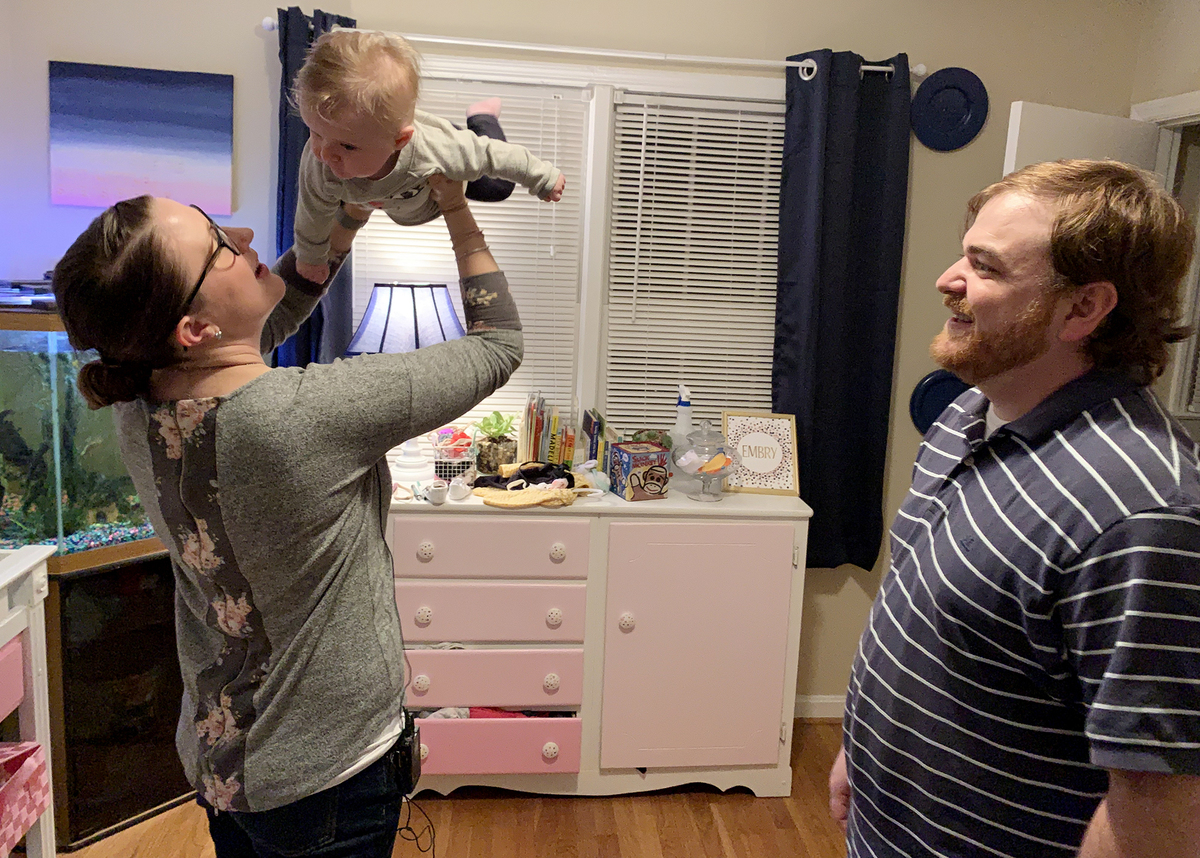
Jenna Neikirk and her husband, Zach, play with their 5-month-old, Embry, in their apartment in Atlanta.
Jim Burress/WABE
hide caption
toggle caption
Jim Burress/WABE
That’s likely because none of those drugs is explicitly approved by the Food and Drug Administration for treatment of pregnant women.
“Gestational hypertension itself is a separate condition, and we actually don’t have any medications that are developed specifically for that,” says Dr. Catherine Spong, chief of maternal-fetal medicine at the University of Texas Southwestern Medical Center in Dallas.
The American College of Obstetricians and Gynecologists recommends women with pre-existing hypertension continue to use some blood pressure medications. And the group says women who develop high blood pressure can receive “emergency treatment” with some drugs.
Still, bed rest isn’t recommended. ACOG cautions against bed rest because there’s no evidence that it helps pregnant women and it may even cause harm.
Neikirk’s doctor’s office didn’t respond to requests for comment.
Neikirk found herself in a situation that many pregnant women do today. They have a medical problem — either that existed before they were pregnant or was caused by being pregnant — and their doctors have to figure out how to deal with it without a strong foundation of medical research to help their decisions.
Historically, pregnant women have been excluded from medical research, because scientists and ethicists were concerned that experimenting on them could hurt them or their fetus.
“Pregnant women are considered a vulnerable population, so, in general, researchers aren’t permitted to experiment on pregnant women,” says Jacqueline Wolf, a professor of the history of medicine in the Department of Social Medicine at Ohio University.
Researchers have to take special precautions to do studies on vulnerable populations, including children, the mentally disabled, incarcerated people and pregnant women. So researchers typically exclude these groups to get their studies approved.
But one result is that doctors caring for pregnant women have fewer tools to care for them when they’re ill, Wolf says.
“That’s where the irony comes in,” she says. “Because researchers are hardly ever permitted to conduct trials on pregnant women, we end up experimenting on pregnant women all the time, because we can’t accumulate a solid fund of evidence. So we just stick with the old standards, or we introduce new things without doing trials on them.”
When a woman gets pregnant, her pre-existing medical conditions don’t disappear, says UT Southwestern’s Spong. She lists a litany of conditions — autoimmune disorders, diabetes, hypertension, infections, asthma, preterm labor, gestational hypertension or hyperemesis — for which there are few therapies that are specifically developed for or tested on pregnant women.
“If someone comes into pregnancy on anti-hypertensive medicines, commonly they will continue on some type of anti-hypertensive medicine during pregnancy,” Spong says. “However, we don’t have information about how that medicine should be dosed in pregnancy.”
She says when women are pregnant, their blood volume doubles and their liver and kidney function change. No one knows how that affects the medication.
So doctors across the country find themselves prescribing medications, or taking patients off them, without strong evidence either way.
By keeping pregnant women out of studies, Spong says, “You are putting them and their fetuses more at risk.”
Spong was chair of a federal task force, mandated in 2016 by the 21st Century Cures Act, that studied the gaps in health care knowledge about pregnant and lactating women. The group issued a 388-page report in September that recommends that pregnant women be routinely included in research studies, that the government devote time and money to studying existing drugs in pregnant women and that the government help develop new drugs to treat problems related to pregnancy and breastfeeding.
Health and Human Services Secretary Alex Azar is supposed to respond to the task force recommendations by the end of December. He didn’t respond to a request made through his spokeswomen for an interview.
Over the years, scientists have accumulated observational research on the safety and efficacy of some existing drugs, including blood pressure medications, says Dr. Alison Cahill, chief of maternal fetal medicine at Washington University in St. Louis.
And for those drugs that have shown themselves to be safe, she says, doctors usually recommend women continue to use them after they become pregnant.
But few studies compare a drug with a placebo in pregnant women, which is considered the gold standard, and few studies show how medications react differently after a woman becomes pregnant. Without that arsenal of well-researched medications, Cahill says she and her patients have to weigh the pros and cons of using a drug, or leaving an ailment untreated.
“I actually think that it’s one of the most important responsibilities of a physician,” she says. “There’s always things that we don’t know. And I think part of respecting patients’ autonomy, and their participation in medical decision-making, is to explain what we know but also to explain what we don’t know even if that’s hard.”
'We're Fighting For Our Lives' — Patients Protest Sky-High Insulin Prices

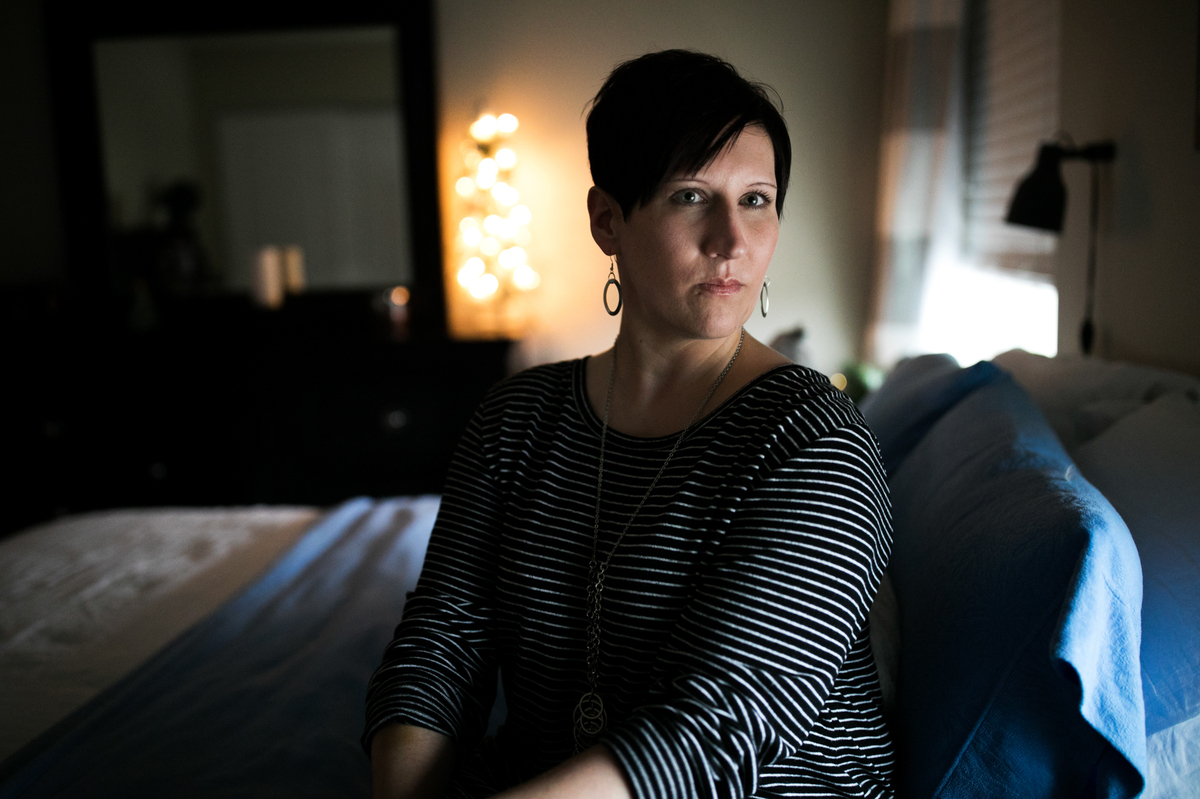
Angela Lautner who lives in Elsmere, Ky. has Type 1 diabetes and is an advocate for affordable insulin.
Maddie McGarvey for NPR
hide caption
toggle caption
Maddie McGarvey for NPR
Angela Lautner knew her thirst was unusual, even for someone directing airplanes, outside in the Memphis summer heat.
“We had coolers of Gatorade and water for people to always have access to,” Lautner remembers of her job as a ground services agent. “But the amount of thirst that I felt was just incredible.”
She had no appetite and she lost an unusual amount of weight. Then after a trip to the emergency room, Lautner, who was 22, was diagnosed with Type 1 diabetes. The diagnosis was life changing.
To start,it meant for the rest of her life she would require insulin injections every day to keep her alive. Unlike Type 2 diabetes, which can sometimes be controlled by diet, people with Type 1 diabetes need daily insulin injections to regulate their blood sugar.
Lautner’s diagnosis also meant she was no longer allowed to become a commercial airline pilot in the U.S. — a lifelong dream that she was training for in flight school at the time.
“I cried harder over losing my dream to fly than I did at the diagnosis of Type 1 diabetes,” Lautner says.
But after 18 years living with diabetes, Lautner now says the hardest thing about the diagnosis is accessing insulin — the expensive drug she needs to keep her alive. She’s had to borrow money from her parents to pay for insurance; she’s spent hours on the phone with drug companies; she’s switched brands of insulin to save costs; and she even moved to a new state, Kentucky, with a more generous Medicaid plan.
Last year, Lautner noticed other people with Type 1 diabetes tweeting similar stories under the hashtag #Insulin4All. She read the stories of Shane Patrick Boyle and Alec Raeshawn Smith, two men who died because they could not afford their insulin. It was an epiphany.
“I thought, ‘My goodness, there’s more people than me. I’m not the only one out here,’ ” she says.
Since then Lautner has joined a group of consumer activists, people who need insulin to live and are angry about the sky-high prices. They are putting pressure on the three main companies that make insulin: Sanofi of France, Novo Nordisk of Denmark, and Eli Lilly and Company in the U.S.
Taking on the drugmakers
The cost of insulin nearly tripled between 2002 and 2013 and has doubled again since then. The list price is over $300 for a single vial of medicine, and most people with Type 1 diabetes need multiple vials every month to live. That cost is typically lower with insurance or with discount programs. Still, for some people the price is unmanageable.
There’s been some action by lawmakers on the issue. In October Minnesota’s attorney general sued insulin manufacturers alleging price gouging, and a bipartisan caucus in the U.S. Congress issued a report in November urging action to bring insulin prices down.

Elizabeth Fiester, founder of T1International, addresses a crowd outside the Indianapolis headquarters of pharmaceutical giant Eli Lilly and Company in September.
Bram Sable-Smith/NPR
hide caption
toggle caption
Bram Sable-Smith/NPR
But prices are still going up, so consumer activists like Lautner are taking things into their own hands.
Nonprofit group T1International, which advocates for Type 1 diabetes around the world, with a particular focus on insulin prices has started holding rallies outside the Indianapolis headquarters of pharmaceutical giant Eli Lilly and Company. (Eli Lilly and Novo Nordisk have provided financial support to NPR.)
Lautner joined more than 70 people who came together to demonstrate there in September. They were asking for three things: transparency about how much it costs to make a vial of insulin and how much profit comes from each vial, and a commitment from the company to lower the list price of insulin.
There were protesters from at least 12 states, mainly Ohio, Illinois, Indiana and Kentucky, but also from as far away as New York. Lautner, who now lives outside Cincinnati, rented a school bus with a dozen others to make the 112-mile trip.
“Insulin is kind of the face of the drug pricing crisis in America,” says Elizabeth Fiester, founder of T1International who has Type 1 diabetes herself. “We literally die without it,” she says. “We’re fighting for our lives.”
This was the third time the group had protested at Eli Lilly headquarters. Last fall, when the group held its first protest there, Fiester says, as it was “the first time where people living with Type 1 were able to physically stand and show that people are angry enough to come out.”
If you can’t afford your insulin
The companies that make insulin offer resources for people having difficulty affording insulin. You can find more information here:
- Sanofi Patient Connection: (888) 847-4877
- Lilly Diabetes Solution Center: (833) 808-1234
- NovoCare Patient Assistance Program
While there are cheaper versions of insulin available over-the-counter, they work differently than most insulin prescribed by doctors, and it can be difficult to guess at the right dosage and timing. If you are considering using an over-the-counter insulin you should consult with your health care provider.
Eli Lilly declined NPR’s request for an interview, but in statement a spokesperson said, “we understand why people are making their voices heard.”
Protesting is one arm of their advocacy efforts; the group is also lobbying at the state and national level, and conducting online awareness-raising campaigns under the hashtag #Insulin4All.
Advocacy at the state level
Last spring, the fight got even more personal for Angela Lautner. She got a letter from her insurance company stating they were no longer going to pay for the insulin she was taking, they wanted to switch her to a different brand.

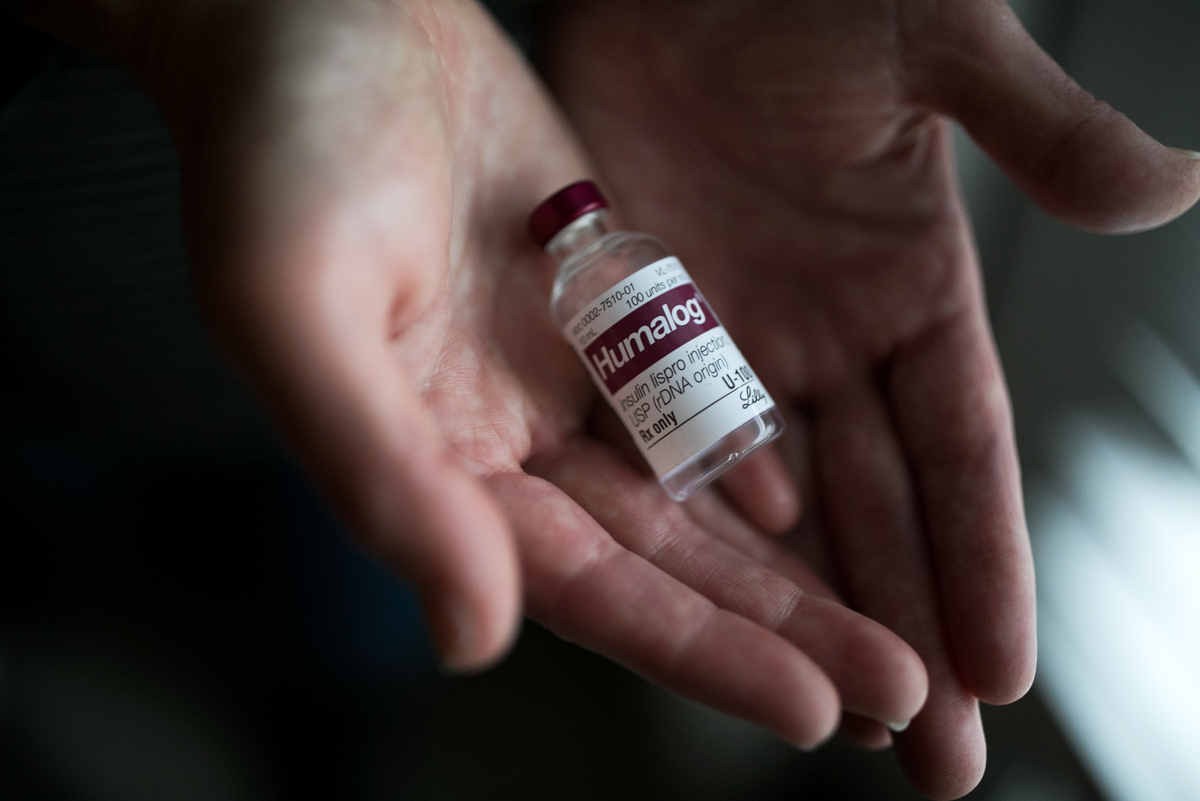
Lautner holds a vial of insulin she uses called Humalog, which is made by Eli Lilly, one of the companies Lautner has been protesting.
Maddie McGarvey for NPR
hide caption
toggle caption
Maddie McGarvey for NPR
Most people with Type 1 diabetes use two types of insulin: short-acting insulin to counteract the carbohydrates consumed with meals, and long-acting insulin to keep blood sugar stable throughout the day.
Lautner has found that the long-lasting insulin brand Lantus works best with her body; it keeps her her blood sugars low, but not so low that she becomes dangerously hypoglycemic, risking death. But her insurer was dropping its coverage of Lantus in favor of a different long-lasting insulin, Basaglar.
“The problem that I immediately saw was that [Basaglar] had not worked for my body,” Lautner says. “So I go into my doctor’s office with this letter and I’m like, ‘What am I going to do?’ “
Lautner’s doctor connected her to Sanofi’s drug discount program where she was able to get a month’s supply of Lantus for a couple hundred dollars. So she decided to pay for the insulin herself.
“I’m fortunate enough to have an emergency fund,” Lautner says.
But she knows others aren’t so lucky.
This year, Lautner organized her own group of diabetes activists in Kentucky, Ohio and Indiana, called KOI Insulin4All. They’ve met with legislators in all three states about establishing emergency insulin prescription refills and about making the cost of insulin more transparent.
There are similar groups starting up in Oklahoma, Pennsylvania, Minnesota and Illinois. In November, activists protested outside the Cambridge, Mass., office of Sanofi. All of them are pushing for the same thing — to make the voices of people with diabetes heard.
Bram Sable-Smith (@besables) is a health reporter based in Madison, Wis.
For One Rural Community, Fighting Addiction Started With Recruiting The Right Doctor

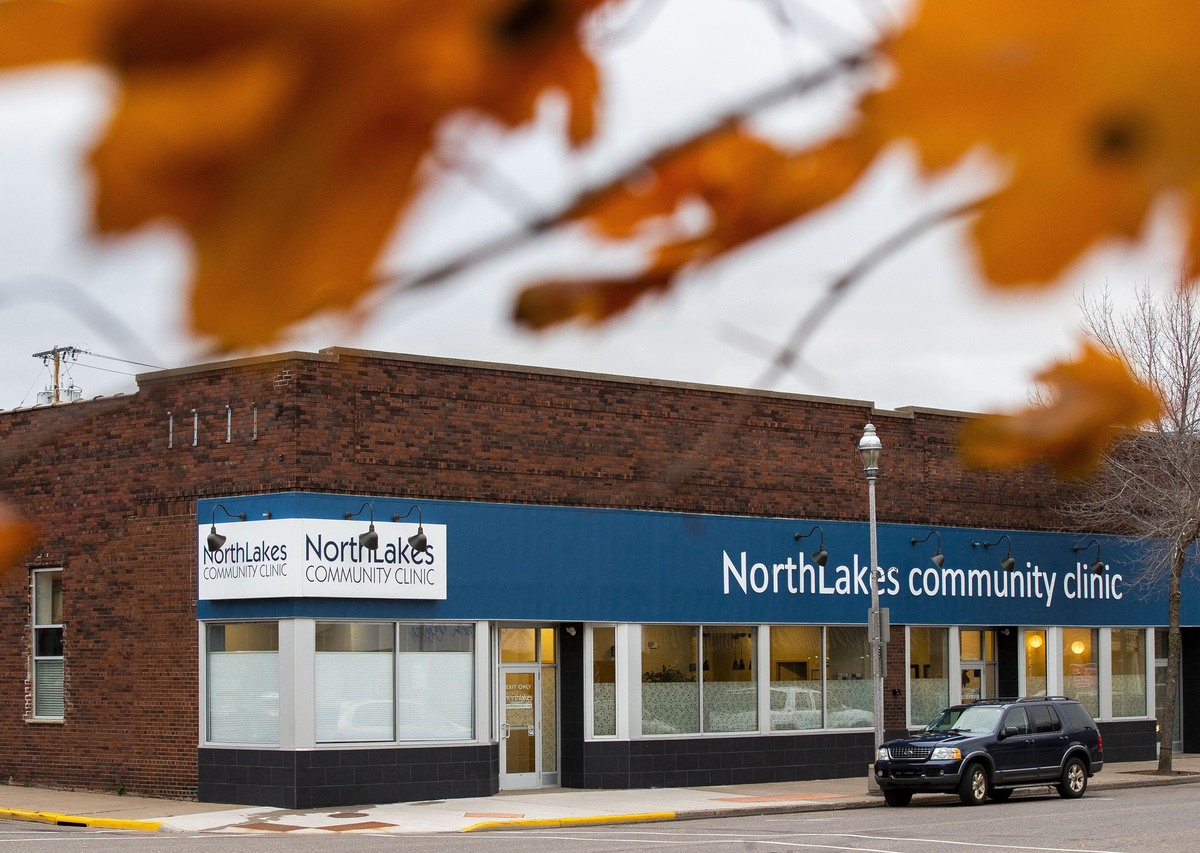
Located in Northern Wisconsin along the shores of Lake Superior, Ashland, Wis. has had enough of substance abuse issue. NorthLakes Community Clinic brought in Dr. Mark Lim to start a team providing substance abuse and mental health services.
Derek Montgomery for NPR
hide caption
toggle caption
Derek Montgomery for NPR
Lindsay Bunker woke up from a nightmare.
The 32-year-old lives with her sixth-month-old daughter on the Lac Courte Oreilles Indian Reservation in northern Wisconsin. She’s struggled with addiction for over 10 years, mostly to heroin. Then came the nightmare: She dreamt two men were attacking her baby while she could think only about drugs.
“In my mind I was thinking, ‘If I can just get one hit, if I can get one line, I can save her,'” she recalls, pausing before continuing, “I woke up and I was panicking. How can a mother think like that?”
It was a wake-up call. Bunker says she realized in that moment that heroin was “evil” and she resolved to get into treatment. In a lot of rural America, that’s where the story could have ended.
Many rural communities lack basic resources for substance abuse. There are fewer services available than in urban areas—as many as 82 percent of rural Americans may live in counties that lack detoxification services, for example.
Life And Health In Rural America
You can find the other stories in our series about life in rural America here.
But Bunker was lucky. She found a community health center only about an hour from her home that recently expanded its addiction treatment services.
The clinic, NorthLakes Community Clinic,serves Medicaid and Medicare patients, and offers sliding scale payments for those with low-income. It expanded its addiction recovery program with the help of state and federal grants targeting opioid use. Though rural communities across the country struggle with addiction, community health centers like this one are modeling an approach to managing — and funding — treatment programs.
“We were seeing substance use disorders killing our community and we felt it was our job to step up,” says Reba Rice, the clinic’s CEO. “We feel that all of our patients and community members deserve a life worth living.”
Not just opioids
Rice says addiction has torn apart rural communities in Northern Wisconsin in the last five years or so, with an increase in crime, problems in schools, trauma in families.
“It was amazing how many things we were seeing changed,” she says. “The way people looked at each other, the level people were willing to trust each other, and it was all about the changes that this disease makes on its victims”

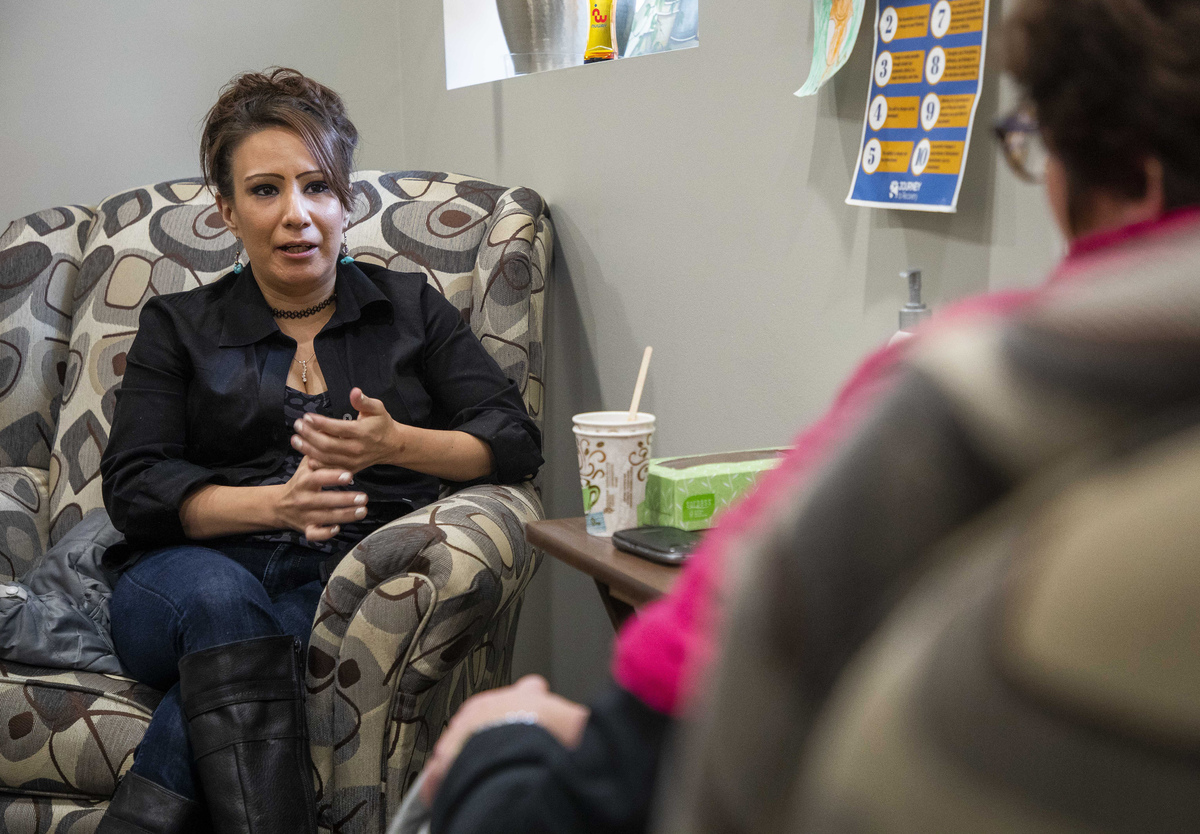
Lindsay Bunker (left) talks to her counselor Regina Fox (right) at the NorthLakes Community Clinic in Ashland, Wisconsin. Bunker is in treatment for heroin addiction. She says the clinic’s approach is helping: “I love being here. I feel safe. I feel strong. I feel supported.”
Derek Montgomery for NPR
hide caption
toggle caption
Derek Montgomery for NPR
A recent poll by NPR, the Robert Wood Johnson Foundation and the Harvard T.H. Chan School of Public Health shows that opioid and other drug abuse is the top health concern for rural Americans.
NorthLakes has long provided primary care, dental and behavioral health services for low-income residents in Ashland, Wisconsin, and in several nearby towns. But as the opioid addiction problem worsened, Rice says she felt a responsibility as a health care provider to do something about it.
“We contributed to the problem so we needed to contribute to the solution,” she says.Rice says opioids were just part of the puzzle: meth and alcohol were huge problems too. In fact, meth use in Wisconsin it has grown by 250 percent in recent years, according to the FBI. But new funds were becoming available for opioid treatment so the clinic applied for those — and is using them to build a comprehensive addiction treatment program that addresses all the substances people there struggle with.
To fund its expanded addiction treatment services, NorthLakes applied for and won a grant from the state of Wisconsin three years ago. It also got other federal grants intended for mental health and addiction. Central to their plan was hiring a physician who could lead the new program, and could prescribe the addiction treatment buprenorphine, known by the trade-name Suboxone.
Suboxone treatment is one of the most effective ways to treat opioid addiction. But it is hard to find in rural areas, because only providers who’ve received special training are allowed to prescribe it. One 2015 study found that more than 80 percent of rural counties in the U.S. do not have a single physician able to prescribe it.
NorthLakes found a physician who could prescribe it and more than that, who had a vision for a comprehensive addiction program.
Building treatment capacity
Dr. Mark Lim says he is surprised he’s here in this 8,000 person port-town on Lake Superior. He’d dreamed of living in a big city since he moved to the U.S. from the Philippines. When he got the call about the job, he was hesitant at first. “I didn’t know where that was on a map,” he recalls.
But he saw this part of Wisconsin, where the death rate from drug and alcohol abuse is nearly twice as high as the state average, as a place where he could make a difference.
Lim’s been board certified in addiction medicine since it was officially recognized as a subspecialty in 2016, but he’s been working in the field since about 10 years ago when he started working in an addiction practice in Maine.



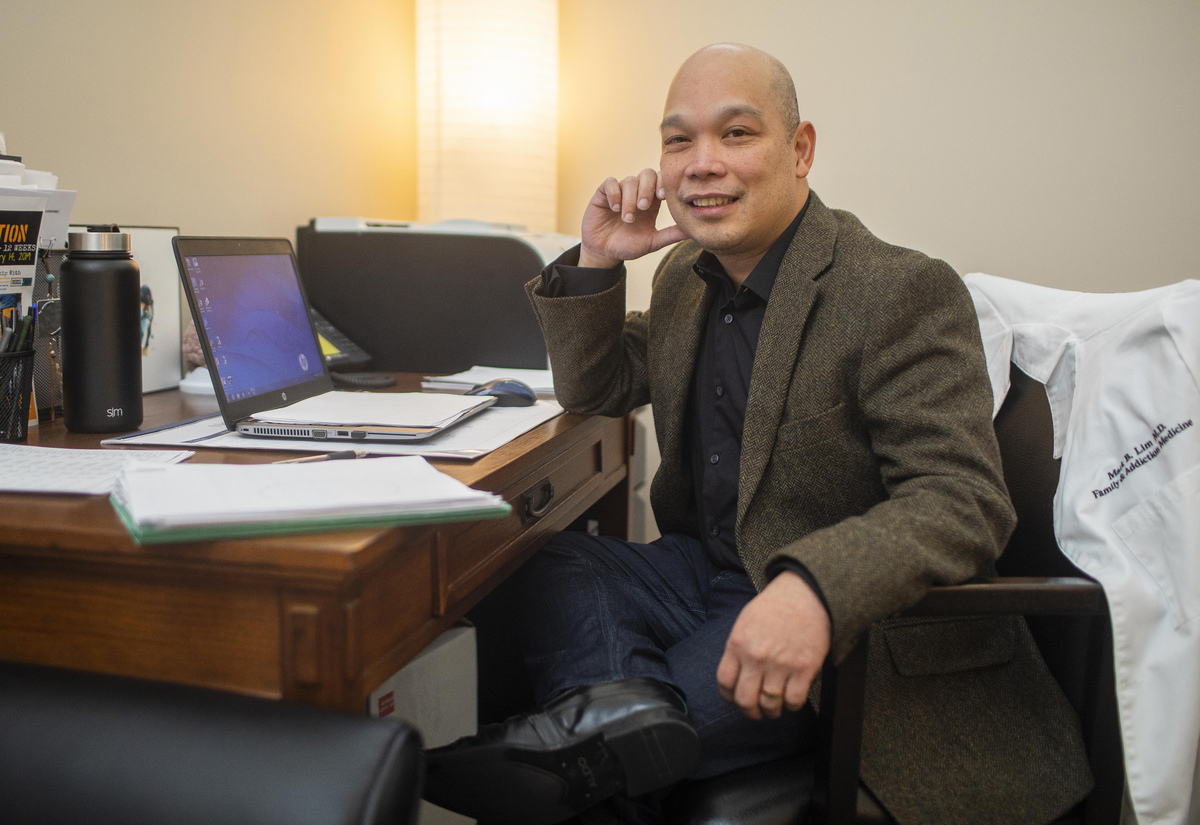
Dr. Mark Lim moved from Maine to become the recovery program medical director at NorthLakes Community Clinic in Ashland, Wisconsin. He wanted to set up a comprehensive practice to treat a range of addictions.
Derek Montgomery for NPR
hide caption
toggle caption
Derek Montgomery for NPR
He took the Wisconsin job, with one stipulation: He would start a program to address addiction as a whole. His expertise would be just one part of the treatment approach.
“If I’m just going to be the Suboxone doctor I’m not doing the full practice of addiction,” Lim says.
Because while the medication can be effective for treating opioid use disorder, Lim says addiction is not just about opioids.
“Opioids are big right now,” Lim says. “But you have to work with alcohol too. You have to work with marijuana too. You have to work with methamphetamine, cocaine.”
Rice says she and Lim developed the program together with community partners including educators, law enforcement and tribal leadership. “We were successful because we had a vision for creating a program and so did he,” Rice says.
While it’s rare to have a doctor who can prescribe Suboxone in a rural area like this one, Lim says only about 40 of his more than 200 patients take it. For the rest, his program relies on a combination of counseling, group therapy for addiction and underlying mental health issues, and case management. Staff help to remove barriers to being successful in recovery, helping patients with things like, transportation to the clinic, daycare for parents during therapy, and even job placements.
This kind of recovery program that combines clinical and counseling services is exactly what rural communities need, says John Gale of the Maine Rural Health Research Center.
“That’s exactly the way it should be done. Because most people with a substance use disorder have co-occurring mental health and substance use problems,” Gale says. “If we take care of [a patient’s] heroin problems and we don’t treat the underlying mental health and substance abuse problems, they’re going to go to go to alcohol, they’re going to do something else.”
And while most of the attention and dollars are focused on opioid abuse right now, he says rural communities struggling to address addiction can use those resources to build a larger treatment capacity.
“They can use [those resources] to say, ‘Wait a minute, let’s build a treatment capacity for other people,’ ” Gale says. “And they begin to create a community where you can treat all sorts of substance use disorders.”
Lindsay Bunker gets a ride to and from the NorthLakes clinic from a medical transportation company — it’s about an hour’s drive each way from the reservation. The clinic has a baby sitter who looks after her daughter when Bunker is in appointments. She makes the trip nearly every day.
“I love being here. I feel safe. I feel strong. I feel supported,” Bunker says.
But she only sees Dr. Lim about once a week. Instead, like all of the patients here, she spends most of her time in one-on-one and group counseling sessions. There’s the early relapse prevention group (from which Bunker recently graduated), then there’s the relapse recovery group, the family group, the engaged-in-recovery group. There’ll be a trauma group soon as well.
Bunker says those group sessions are really important in helping her stay in recovery.
“I get cravings and the cravings are being taken away with that medicine [suboxone]. But being here with my peers, I love it. I really do,” Bunker says.
And she says, recovery agrees with her.
“I look good, I feel good, I’m taking care of my kid,” she says. “I’m doing very well.”
Bram Sable-Smith (@besables) is a health reporter based in Madison, Wis.
Cargo Ship Saves 29-Year-Old Sailor In South Pacific After Her Boat Flips


Susie Goodall on her boat DHL Starlight on July 1 at the start of the solo around-the-world Golden Globe Race.
JEAN-FRANCOIS MONIER/AFP/Getty Images
hide caption
toggle caption
JEAN-FRANCOIS MONIER/AFP/Getty Images
The challenge: Sail 30,000 miles around the globe, non-stop, alone.
What could go wrong?
This week, Susie Goodall found out. The 29-year-old British woman was the youngest participant in the annual Golden Globe Race which sends sailors from the coast of France around the earth and back to the same port. Or at least that’s the plan.
On Wednesday morning, Goodall was 2,000 miles west of South America when her boat flipped in heavy wind, broke its mast and knocked her temporarily unconscious. She activated her emergency beacon and a series of troubling updates were posted to her Twitter account:
73-DISMASTED.HULL https://t.co/jj0fKZ29HZ FORM OF JURY RIG,TOTAL LOSS
— SusieGoodallRacing (@susieBgoodall) December 5, 2018
73-INTERIOR TOTAL WRECK,LIFERAFTOK
— SusieGoodallRacing (@susieBgoodall) December 5, 2018
73-NASTY HEAD BANG AS BOAT PITCHPOLED.UNBELIEVABLY ROLY NOW
— SusieGoodallRacing (@susieBgoodall) December 5, 2018
Chile’s Maritime Coordination Center received her distress signal and ordered the Tian Fu, a cargo ship on its way from China to Argentina, to divert from its course and rescue Goodall.
Meanwhile, all Goodall could do was wait — trying to keep her boat steady in the choppy South Pacific and pumping out water that was leaking into the damaged cabin.
When the 600-foot rescue vessel finally reached Goodall, deploying a small boat to retrieve her was deemed impossible because of 10-13 foot waves rocking both ships. Instead, crew members on board the Tian Fu executed a kind of high-stakes version of Candy Crane, lowered a cable from one of the ship’s massive cargo hoists, and plucked Goodall from her deck, hauling her to safety.
After 3 intensive days of co-ordinations from MRCC Chile, today at 15:35 UTC the motor vessel “TIAN FU” was able to recue the British yachtswoman Susie Goodall.
BZ. pic.twitter.com/20bOEendr2— MRCC Chile (@MRCCChile) December 7, 2018
The good news was posted to her Facebook page: “From Susie, at 15:14 UTC: ON THE SHIP!!!” Goodall is expected to arrive at the Chilean port of Punta Arenas on Wednesday.
She is not the first sailor to run into trouble in this year’s race. As NPR reported, an accident in the Indian Ocean in September forced the evacuation of a naval commander; skippers from France and Ireland have also had to be rescued.
In a post from Nov. 30 titled “Half way round the world,” Goodall wrote about how challenging the experience had been at that point as she faced fierce seas.
“To say I’d had enough by this point is an understatement. They were the hardest and loneliest days I’ve ever had. All I wanted was a break from it. But being under Australia, half the world from home I might as well sail home again instead of taking a break.”
Her family thanked rescuers and race organizers Friday, and said farewell to her ship, the DHL Starlight.
“It was with a heavy heart Susie left DHL Starlight to fend for herself, before she fills with water and rests on the Pacific Ocean floor. DHL Starlight has been her home for the past few years; a faithful friend who stood up valiantly to all the elements, a guardian until their last moments together.”
Saturday Sports: NCAA Women's Basketball And The Denver Nuggets

An NCAA Women’s basketball rivalry gets rough on Twitter and Washington, D.C.’s football team has signed a new backup quarterback.
SCOTT SIMON, HOST:
And no matter what else happens in the world, time for sports.
(SOUNDBITE OF MUSIC)
SIMON: NCAA women’s basketball gets rough on Twitter. The Denver Nuggets are at the top of the NBA’s Western Conference. Wait, wait, is that a misprint? And Washington, D.C.’s football team with the name I will not utter has signed a journeymen to play backup quarterback. (Laughter) What – they didn’t want a quarterback who played in the Super Bowl? We’re going to turn now to Tom Goldman. Tom, thanks so much for being with us.
TOM GOLDMAN, BYLINE: My pleasure, Scott.
SIMON: UConn and Notre Dame already have a great rivalry on court, but this is getting, like, really personal on Twitter, isn’t it?
GOLDMAN: Ooh, yeah, it really is. Notre Dame head coach Muffet McGraw reportedly blocked on Twitter current WNBA star and former UConn star Breanna Stewart, who led the Huskies to four straight NCAA championships. And that action by McGraw prompted some Twitter zingers like, haha, Breanna, you blocked her from getting four titles, so it’s only right that she blocks you back. But wait, Scott.
SIMON: Ooh, ooh, yeah.
GOLDMAN: There’s more. There’s more. You want to hear?
SIMON: Yeah, please.
GOLDMAN: OK. All right. So…
SIMON: Wait, children are listening. Go ahead. Yeah.
GOLDMAN: OK, cover their ears. So two teams – these two teams, top two in the nation, they played last weekend – the first time they’d met since Notre Dame stunned UConn at last season’s final four. UConn got its revenge, pounded Notre Dame by 18, and the UConn official Twitter account posted, thank you, next. And there were technical fouls. There was trash talk. And I think…
SIMON: Ooh, I’m shaking like a leaf – yeah.
GOLDMAN: (Laughter) I think this makes a great rivalry even greater. You know, we see this melodrama all the time in men’s sports. And, yes, Scott, I’m promoting the further degradation of society. But, hey, WNBA star Chiney Ogwumike agrees with me. She tweeted, our game does not need to be proper or perfect all the time. We need the drama, the disses, the controversies. We need to be real.
SIMON: Tom, you and I often degrade society, but let me ask you about Denver Nuggets. They lost last night to Charlotte, but they’ve got the best record in the West. Are they just on a hot streak?
GOLDMAN: Well, they’re more than that, I think. They’re – and it’s pretty cool what’s happening in a city not known as a hoops mecca. In a star-driven league, the Nuggets are largely unknown to, you know, casual NBA fans, players like Jamal Murray, Juan Hernangomez, Monte Morris. They’re really good, and they’re playing well together. They’re playing great defense. And the one emerging superstar, 7-foot center Nikola Jokic from Serbia, he’s got a complete game, and he’s a beautiful passer. I went on YouTube and watched a Jokic passing highlight video. I didn’t have anything better to do, Scott. And I was oohing and aahing. I’d recommend it if you’ve got some free time.
SIMON: So Washington’s football team – Alex Smith, Colt McCoy, out. They (laughter) had signed Mark Sanchez, quarterback probably best known for a fumble when he bumped into the backside of one of his own players.
GOLDMAN: The butt fumble.
SIMON: The butt fumble. Now as a substitute quarterback, Josh Johnson – why would they sign a guy who was playing for the Sacramento Mountain Lions in the USFL instead of Colin Kaepernick, who has been in the Super Bowl?
GOLDMAN: Well, they said they passed up Kaepernick because his skill set isn’t similar to Mark Sanchez’s, so it would have required…
SIMON: Oh, he hasn’t bumped the ball into some player’s butt.
GOLDMAN: (Laughter) It would have required Washington to install a new offense. It’s the latest excuse for keeping Kaepernick on the blacklist, and it doesn’t look good. But hey, Scott, at least Washington’s still alive for a playoff spot – barely.
SIMON: Oh, my gosh, I didn’t know that. Well, they hardly deserve it, I don’t mind saying. NPR sports correspondent Tom Goldman, thanks so much for being with us.
GOLDMAN: You’re welcome.
Copyright © 2018 NPR. All rights reserved. Visit our website terms of use and permissions pages at www.npr.org for further information.
NPR transcripts are created on a rush deadline by Verb8tm, Inc., an NPR contractor, and produced using a proprietary transcription process developed with NPR. This text may not be in its final form and may be updated or revised in the future. Accuracy and availability may vary. The authoritative record of NPR’s programming is the audio record.
Facing Critical Labor Shortage, Japan Opens Door Wider To Foreign Workers


In front of Japan’s parliament on Friday, people stage a rally against the bill to allow more foreign workers into the country.
Kazuhiro Nogi/AFP/Getty Images
hide caption
toggle caption
Kazuhiro Nogi/AFP/Getty Images
Japanese lawmakers have passed controversial legislation expanding the number of semi-skilled foreign workers who can live and work in the notably insular nation for up to five years.
Japan has been pressed to make the change because of a critical labor shortage that results from its rapidly aging society and low birth rate.
Japan’s upper house of parliament passed the law 161 to 76 just after 4 a.m. Saturday local time, after a day when the opposition parties tried to unsuccessfully to block the measure.
The law will go into effect in April 2019.
The legislation has been viewed as a last-resort measure by Prime Minister Shinzo Abe’s ultra-conservative government to address a severe shortage of workers in 14 industries, including restaurants, nursing, construction and agriculture.
According to the Associated Press, two categories of workers will be accepted, with conditions that will discourage them from trying to immigrate permanently.
The law will apply to as many as 345,000 less-skilled workers who will be allowed to stay for up to five years, but not bring in family members. It will also permit higher-skilled workers to enter with their families for 10 years and will provide them a path to Japanese citizenship. Both categories will have requirements for Japanese language competency.
Japan’s population is expected to decline from about 127 million to about 88 million by 2065, according to the National Institute of Population and Social Security. In September, Japan’s Internal Affairs and Communications Ministry released data showing that for the first time, one in five people in the nation is older than 70.
Japan has felt the pressure of an aging population and declining birthrates for decades. The government has tried to meet labor shortages by encouraging more employment of women and older workers, and using more robots and other automation.
And it does have foreign workers. Their number has more than doubled since 2000 to nearly 1.3 million last year, out of a working-age population of 67 million, according to the AP.
“Workers from developing Asian countries used to stay mostly behind the scenes, but not anymore. Almost all convenience stores are partly staffed by Asian workers and so are many restaurant chains.”
Many foreigners are working in Japan on training visas “that don’t allow them to switch jobs even if they are abused or underpaid,” says The Wall Street Journal editorial board. Thousands of student visa holders also work in Japan, often for longer than the 28 hours a week legally allowed.
But until now the government has resisted opening the door to a legal influx of semi-skilled foreign laborers, as many Japanese, particularly Abe’s right-wing supporters, fear a loss of cultural distinctiveness and homogeneity. It’s one reason the government has been careful not to characterize the new visa program as immigration.
But, as The Washington Post reports, Abe’s government is “closely entwined with the business community, and the message it hears from every quarter — shipbuilding and construction, agriculture and fishing, elder-care establishments and convenience-store owners — is ever more insistent: We need more workers.”
A report by Tokyo Shoko Research showed the number of bankruptcies in Japan caused by staff shortages doubled between 2016 and 2017, according to The Wall Street Journal.
Pauline Frechette – The Sacred Mountains of Ojai Review
December 4th, 2017. It’s a seemingly meaningless date. It’s a regular work day, a Monday and it’s not a holiday. It was the 338th day of the calendar year, it was […]
Linda Tourje – Whatever Happened to Forever Review
I have written dozens, if not hundreds, of song reviews, performance reviews and have done interviews with various musicians, songwriters, DJs, singers and composers. I would consider that I have […]
How Atlanta Became A Soccer Town
Atlanta and Portland face on in Major League Soccer’s championship on Saturday. Atlanta’s team is only two years old and its success is due, in part, to massive fan support and a hometown strategy.