Poll: Young People More Likely To Defer Health Care Because Of Cost

When to get care and when to pass often comes down to finances.
Johner Images/Getty Images
hide caption
toggle caption
Johner Images/Getty Images
If you’re not feeling well or have a routine health issue, do you go ahead and get it checked out or put if off because of the cost?
And, let’s say you do make an appointment and go. Afterward, do you fill the prescription you received or do financial concerns stop you?
We wondered how often people deferred or skipped care because of cost, so we asked in the latest NPR-IBM Watson Health Health Poll. The survey queried more than 3,000 households nationwide in July.
For starters we asked if people had postponed, delayed or canceled some kind of health care service, such as a doctor’s appointment or medical procedure, because of cost in the preceding three months. About 1 in 5 people had done so.
“I am pretty impressed that it was only 20 percent that had postponed or delayed or canceled health care services,” says Dr. Anil Jain, vice president and chief health information officer for IBM Watson Health. “I thought it would be higher.”
The proportion of people who said cost had deterred them from getting care varied by age, with a third of people under 35 saying it had been a problem compared with only 8 percent of people 65 and older.

Note: Question asked about health care in preceding three months.
NPR-IBM Watson Health Poll
hide caption
toggle caption
NPR-IBM Watson Health Poll
Jain says one area that may not be getting enough attention is preventive care. “I think it’s important that young people never feel the need to forgo or delay preventive services,” he says.
We also asked people if they – or members of their household — had difficulty paying for some kind health care service in the preceding three months. A quarter said yes. And again the strain varied by age, with 41 percent of people under 35 saying they had experienced difficulty while only 11 percent of people 65 and older had.
Almost all the respondents to the survey, about 97 percent, had some form of health coverage. The sample size of respondents reporting no insurance wasn’t large enough to support further analysis within the uninsured population.
We also asked specifically about people’s experience receiving and filling prescriptions. In the three months before the survey, two-thirds of people said they’d received a prescription. A vast majority of older Americans – 84 percent – said they’d received a prescription, while 39 percent of people under 35 had.
Almost everyone who said they’d gotten a prescription went ahead and filled it – 97 percent overall.
The cost of prescriptions appeared to be a bigger concern for younger people, with 38 percent of those under 35 saying they had difficulty paying for their medicine. Only 9 percent of people 65 and older said they had the same problem.
With an eye on costs, we asked people if they were familiar with discount coupons provided by drugmakers, one way to defray out-of-pocket expenses related to prescriptions. About two-thirds of people said they were aware of these coupons.
In a follow-up question, we asked if people had used this kind of coupon. About a third of people said they had. Among older people, 65 and up, the proportion was quite a bit lower – only 19 percent said they’d used this kind of coupon.
Drug costs weigh on people as deductibles and copayments add up.
“Despite insurance, we feel that more people are experiencing a higher out-of-pocket burden due to medications,” says Thomas Goetz, head of research for GoodRx, a clearinghouse for drug pricing information, discounts and coupons. “Insurance is increasingly not covering that expense as much as it used to.”
Manufacturers’ coupons are geared toward brand-name medicines, only one part of the financial challenge. “The burden for most Americans is largely with these generic drugs that are considered very routine to prescribe and are getting more expensive,” Goetz says. “A $20 drug becomes $100.”
Think of all the sacrifices people are making to avoid skipping prescriptions, he says. “We take these medications because they’re supposed to makes us feel better, and the price doesn’t always have that effect.”
The nationwide poll has an overall margin of error of plus or minus 1.8 percentage points. You can find the questions and full results here.
Chapter 11 Bankruptcy Paperwork Filed For USA Gymnastics

USA Gymnastics has filed for bankruptcy. It’s the latest move for the beleaguered organization following a wide-ranging sexual abuse scandal involving athletes and a former team doctor.
USA Gymnastics Voluntarily Files For Bankruptcy
USA Gymnastics filed for bankruptcy Wednesday. The organization has been under withering criticism for how its handling of scores of sexual abuse reports by former team doctor Larry Nassar.
AILSA CHANG, HOST:
USA Gymnastics filed for federal bankruptcy protection today. It’s a major development for the embattled organization that oversees gymnastics in the U.S. The governing body has struggled to recover from a wide-ranging sexual abuse scandal after former team doctor Larry Nassar abused hundreds of athletes. Since then, USA Gymnastics has cycled through three CEOs and faced increased scrutiny by the U.S. Olympic Committee. We’re joined now by reporter Alexandra Starr with the latest. Welcome.
ALEXANDRA STARR, BYLINE: Hi. Thanks for having me.
CHANG: So USA Gymnastics was on its way to losing its status as the governing body over the sport. I remember talking to you on this show about that. Was this bankruptcy filing a surprise?
STARR: No, it wasn’t. People have talked about it, and it’s been expected. Also let’s specify the fact that they filed doesn’t necessarily mean that they cease to exist as an organization.
CHANG: Right.
STARR: I also think it’s very important to differentiate between USA Gymnastics and the athletes. The organization is in a freefall. The elite athletes are literally the reigning world champions. They’re extraordinary. And arguably the best athlete of all time, Simone Biles, she’s expected to compete in the next Olympics in 2020. And she just won more medals than any American gymnast has in history at the world championships earlier this year. So there’s a real disconnect between the organization and the talent that it’s field – that fields.
CHANG: Absolutely. That said, does this bankruptcy in any way affect the athletes who are competing now?
STARR: Well, the U.S. will absolutely field a team in 2020 at the Olympics. Whether it’s USA Gymnastics fielding the team is in doubt. But, you know, they’re certainly going to be there. I think the real impact could be felt in the pipeline. And what I mean by that is the development of the youngest athletes. USA Gymnastics runs the national team camps. That’s where coaches scope out talent. It’s where judges grade performances and give feedback. That provides the opportunity, too, for promising young athletes to be fielded in international competitions. The question is now, are those opportunities going to remain?
CHANG: Right. Well, let’s also talk about, you know, there’s been dozens of lawsuits that have been filed against USA Gymnastics after the Larry Nassar scandal. What does this bankruptcy mean for the victims and the families who filed suit against the organization?
STARR: That’s a great question. And it’s going to make it tougher for them.
CHANG: How so?
STARR: Well, this is what the filing means. While this bankruptcy case moves through the courts, it basically puts a halt on those lawsuits. And as you know, the courts don’t move quickly. That process could take years. So it’s worth noting that these lawsuits were beginning to unearth information. The lawsuit that Aly Raisman, the star gymnast, had filed was supposed to go to court – go to trial early next year. So that’s ending. And so she and all these other athletes are going to be left without a resolution.
CHANG: That’s Alexandra Starr, who covers USA Gymnastics for NPR. Thank you.
STARR: Thank you.
(SOUNDBITE OF RUN RIVER NORTH’S “INTRO (FUNERAL) PARADE”)
Copyright © 2018 NPR. All rights reserved. Visit our website terms of use and permissions pages at www.npr.org for further information.
NPR transcripts are created on a rush deadline by Verb8tm, Inc., an NPR contractor, and produced using a proprietary transcription process developed with NPR. This text may not be in its final form and may be updated or revised in the future. Accuracy and availability may vary. The authoritative record of NPR’s programming is the audio record.
NHL Announces Expansion To Seattle, Following Success In Las Vegas
The National Hockey League has announced its latest expansion team in Seattle. The new team is the league’s second expansion in three years, on the heels of the NHL’s success in Las Vegas.
USA Gymnastics Files For Chapter 11 Bankruptcy

USA Gymnastics says filing for bankruptcy gives it “the opportunity to reorganize.”
PhotoAlto/Odilon Dimier/Getty Images
hide caption
toggle caption
PhotoAlto/Odilon Dimier/Getty Images
USA Gymnastics, the sport’s national governing body, said today that it had voluntarily filed for Chapter 11 bankruptcy.
Board of Directors Chair Kathryn Carson, who joined the newly restructured board in June, said in a statement that bankruptcy will allow USA Gymnastics to “expedite resolution of claims” against it from survivors of sexual abuse by former team doctor Larry Nassar. She said the organization will continue to operate normally and that it is not having trouble paying its bills.
But while USA Gymnastics says bankruptcy gives it “the opportunity to reorganize,” it’s not clear how the filing is helpful to the victims and other athletes.
In an online post about the bankruptcy filing, USA Gymnastics said that survivors’ claims against the organization are covered by insurance that was previously purchased and that the amount of that insurance is unaffected by the filing. “We believe that the Bankruptcy Court is the best forum in which to implement appropriate procedures to equitably resolve claims and allocate the insurance proceeds among claimants, allowing resolution more quickly than litigation filed in courts around the country,” it said.
But as The Wall Street Journal explained, the filing “will put an automatic stop—perhaps permanently—to depositions and discovery related to USA Gymnastics in lawsuits filed by Mr. Nassar’s victims.”
The U.S. women’s team, led by superstar Simone Biles, was dominant at the recent World Championships. (The men’s team took fourth.) But the 2020 Summer Olympics in Tokyo are fast approaching, and the organization’s leadership has been in persistent disarray since Nassar was arrested in 2016.
USA Gymnastics has cycled through three CEOs in less than two years; one of them, Steve Penny, was arrested in October over allegations that he tampered with evidence related to a Nassar investigation.
Last month, the U.S. Olympic Committee took preliminary steps to revoke USA Gymnastics’ status as the sport’s governing body. The bankruptcy filing may complicate that decertification process.
Federal Legislation Seeks Ban On Shackling Of Pregnant Inmates
As Congress prepares to adjourn for the holidays, one piece of legislation that’s still on the table is a bipartisan criminal justice bill known as the First Step Act.
It aims to improve federal prison conditions and reduce some prison sentences, a sticking point for some lawmakers. But the bill also contains a less controversial provision: a ban on shackling pregnant women.
Incarcerated people outside prison walls are considered potential flight risks. That label applies even to pregnant women when they leave prisons for medical care or to give birth.
These women are often restrained with handcuffs, ankle chains or shackles. Roughly two dozen states ban the practice of restraining incarcerated pregnant women during childbirth, but the First Step Act would apply to federal facilities.
The American Civil Liberties Union says shackling incarcerated pregnant women is “dangerous” and “inhumane.” The American College of Obstetricians and Gynecologists says it puts the health of the mother and baby at risk.
Carolyn Sufrin, a medical anthropologist and OB-GYN at Johns Hopkins School of Medicine, works with incarcerated pregnant women. She says that the U.S. correctional system was designed with men in mind.
“When you have something as gender-specific as pregnancy, it reminds you of how flawed the system is and how ill-prepared it is to take care of pregnant people and the reproductive health needs of women in general,” Sufrin says. “They’re, if at all, an afterthought.”
NPR’s Ailsa Chang spoke with Sufrin about the practice of shackling incarcerated women. The interview has been edited for length and clarity.
Interview Highlights
On why incarcerated pregnant women are shackled
The rationale behind shackling is not something that I understand. When taken off-site all incarcerated persons are presumed to be dangerous and a potential flight risk. A pregnant person needs to be taken off-site for medical attention and for childbirth.
So when she’s in a public space, the presumption is that she must be a flight risk and a public safety risk. Because of this default assumption, she needs to be restrained.
On delivering the baby of a shackled woman
When I was a first-year OB-GYN resident in training in Pennsylvania, I delivered the baby of a woman who was shackled to the bed. It made me more nervous and afraid and overwhelmed and also sort of confused me about my own role and my own complicity in this violence of shackling a pregnant woman in labor.
I had no idea that this was even possible and I didn’t know if I was authorized to ask the guard to unshackle her. I just kept worrying about what I would do if there was an emergency. Luckily, the birth itself went fine.
This was a deeply troubling moment for me, of course much more so for the woman herself, but it’s a pretty harrowing experience to have to practice medicine with someone who is in chains.
On the medical risks of shackling pregnant women
In labor, emergencies arise unexpectedly. We might need to do an emergency C-section if there are signs of distress or the baby’s shoulder could get stuck in the birth canal. When one of these emergencies arises, as a health care professional, we need to focus on our patient, not on asking a guard to unshackle her.
And there are dangers throughout pregnancy, not just in labor and childbirth. If a pregnant woman falls, she could have a dangerous condition where the placenta separates and she could hemorrhage. Shackles can increase her risk of falling and also prevent her from being able to break a fall.
But on top of these medical risks, it’s just common sense. The chances that a woman in the middle of labor, or even not in labor, can outrun someone and be a flight risk are just ludicrous.
I just gave birth six months ago and I can tell you that the thought of running off and escaping and outrunning anybody else is just ludicrous to me.
On the variability of medical care for incarcerated pregnant women
There are no mandatory standards that every prison and jail across the country has to follow when it comes to health services delivery. That means that every prison and jail has its own rules that it follows for pregnant people and the care they receive, including the use or nonuse of restraints.
But the issue really extends even much further than the use of restraints. It has to do with the entire health care for a pregnant person. There’s tremendous variability and you can have some places that provide excellent, comprehensive prenatal care and other places where it’s abysmal and even dangerous.
On why there’s still work to do to ensure proper care for incarcerated pregnant women
This bill would only pertain to women incarcerated in federal facilities and under the jurisdiction of the U.S. Marshals Service, so it would not pertain to people incarcerated in state prisons, which is where the majority of women are incarcerated. It would also not pertain to women housed in local jails. And on top of that, it only addresses the issue of shackling pregnant women. That is an important step to take, but it is only the tip of the iceberg when it comes to the care of pregnant and postpartum women in custody.
Rachel D. Cohen is an intern on NPR’s Science Desk.
Andrea Hsu and Jessica Smith produced and edited this conversation for broadcast.
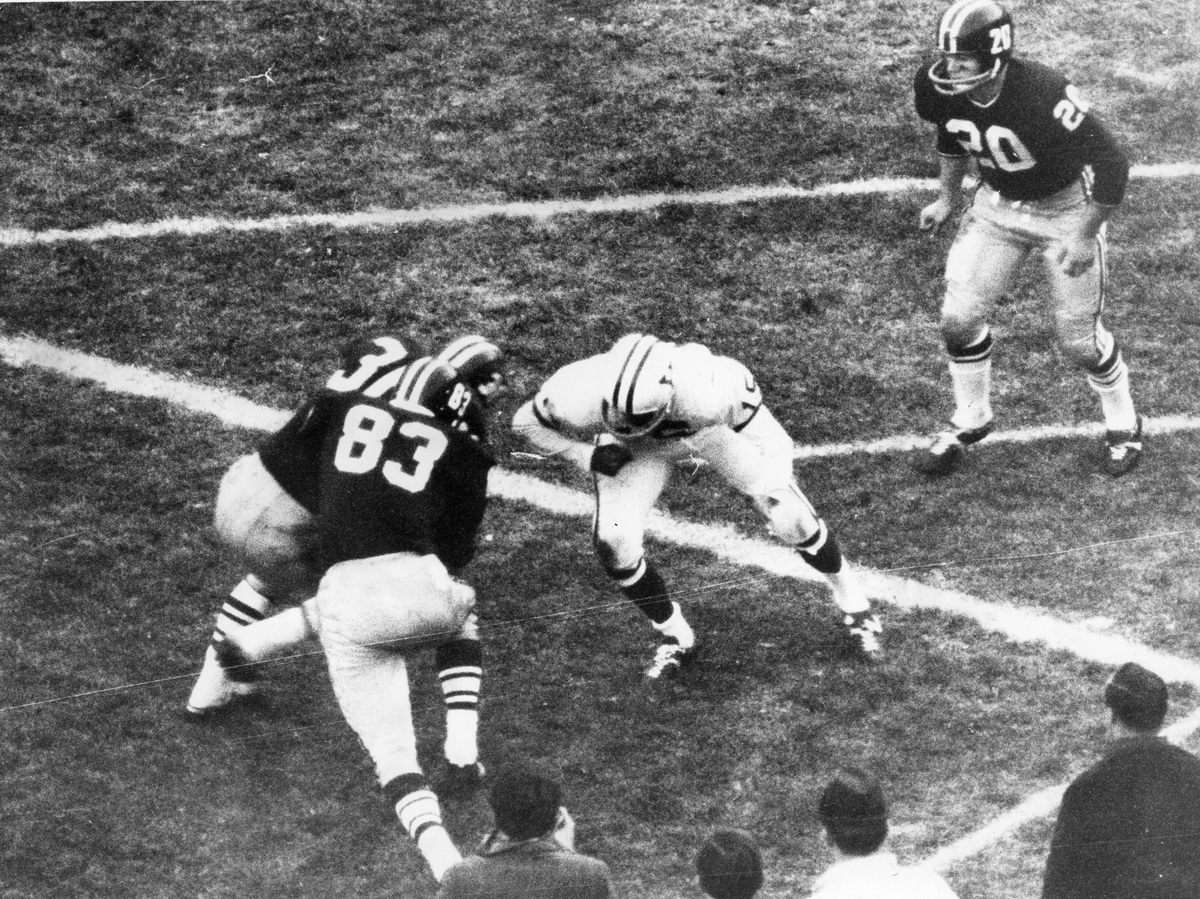
Key 1968 Harvard-Yale Battle Sets Scene For 'The Game' — And Football's Future


Ohio State University Head Football Couch Set To Retire Next Month
Urban Meyer retires as Ohio State University’s football coach after the team’s final game at the Rose Bowl next month. Despite a record of success, he’s endured rocky seasons on and off the field.
U. Of Maryland Hires Michael Locksley To Lead Football Team In Time Of Tumult


Michael Locksley, seen here in 2015 during a previous stint with the Maryland Terrapins, has been hired as head coach of the university’s football team. He replaces DJ Durkin, whose tenure ended in controversy over a player’s death earlier this year.
Alex Goodlett/Getty Images
hide caption
toggle caption
Alex Goodlett/Getty Images
Just over a month since the University of Maryland fired DJ Durkin, dismissing the football coach amid a months-long controversy over a player’s death, the school has named the man set to replace him: Alabama Offensive Coordinator Michael Locksley.
“As we narrowed the search for the individual best suited to lead our program, Michael not only stood out for his talent as a coach,” Maryland’s director of athletics, Damon Evans, said in Tuesday’s announcement, “but most importantly for the role he has played as a mentor to student-athletes throughout his career and his deep commitment to helping them grow into leaders on and off the field.”
It will not be Locksley’s first stop on campus in College Park, Md. Locksley, whose work with Alabama just earned him the 2018 Broyles Award as college football’s top assistant coach, has already served two stints as an assistant at Maryland. After then-coach Randy Edsall was fired, Locksley also acted as the Terrapins’ interim head coach for part of the 2015 season — before leaving to join the Crimson Tide the next year.
We’re proud to announce 2018’s WINNER of the 23rd annual @BroylesAward.
?Michael Locksley, @AlabamaFTBL. pic.twitter.com/BvwEGkNkFd
— BROYLES AWARD (@BroylesAward) December 4, 2018
This time around, however, Locksley can expect to find a significantly more difficult situation awaiting his return.
The University of Maryland’s football program has been wracked by tumult since Jordan McNair’s death in June. The 19-year-old offensive lineman collapsed from heat stroke after an offseason workout and died two weeks later.
The blame for the deadly incident spread widely in the months that followed. First laid with medical personnel, which “misdiagnosed” McNair’s ailments — according to university President Wallace Loh — the blame soon also fell on Durkin for allegedly fostering a toxic culture of intimidation and verbal abuse.
But the buck did not stop with Durkin.
The controversy reached as high as the University System of Maryland’s Board of Regents, which briefly decided to keep the head coach after concluding its investigation — only to promptly do an about-face and fire him one day later, after a groundswell of outrage at the decision. Just another day after that, the board’s chairman, James Brady announced he was stepping down.
President Loh, too, has announced plans to retire next year.
On Tuesday evening, Locksley acknowledged the turmoil that awaits him at Maryland — but expressed his excitement at returning to the Terrapins, nevertheless.
“I have been tremendously impressed at how the team came together through a difficult season and honored their fallen teammate, Jordan,” he said in a statement issued by the school. “We are all in this together, and I look forward to rejoining the Maryland family.”
That said, he arrives in Maryland without a spotless record. Before returning for his second stint at Maryland, Locksley was fired from his head coaching job at the University of New Mexico, where he amassed a putrid total record of 2-26 and found himself dogged by controversy — including allegations of creating a toxic environment of his own.
As The Washington Post notes, his tenure there was marred by an age and sex discrimination complaint against him, which was later withdrawn, and a lawsuit alleging that he choked and punched an assistant coach, which was later settled.
In its announcement Tuesday, the University of Maryland largely kept to the warmer, more recent memories of Locksley’s time with the Terrapins and Crimson Tide.
“On the field, Michael orchestrated one of the country’s most prolific offenses at the University of Alabama and has long been regarded for his recruiting prowess,” Evans said. “Today he was recognized as the nation’s top assistant coach in the country, and I’m excited for him to be leading our program.”