Poor People Are Still Sicker Than The Rich In Germany, Despite Universal Health Care

In Hamburg, Germany, estimated life expectancy in the city’s poorer neighborhoods still trails wealthier neighborhoods by 13 years.
Juergen Sack/Getty Images
hide caption
toggle caption
Juergen Sack/Getty Images
Researchers around the world hail Germany for its robust health care system: universal coverage, plentiful primary care, low drug prices and minimal out-of-pocket costs for residents.
Unlike in the U.S., the prospect of a large medical bill doesn’t stand in the way of anyone’s treatment.
“Money is a problem in [their lives], but not with us,” says Merangis Qadiri, a health counselor at a clinic in one of the poorest neighborhoods in Hamburg, in northern Germany.
But it turns out that tending to the health needs of low-income patients still presents universal challenges.
As an American health care reporter traveling through Germany, I wanted to learn not only what works, but also where the system falls short. So when I arrived here — in one of the country’s wealthiest cities, with one of its largest concentrations of doctors — economists and researchers directed me to two of the poorest neighborhoods: Veddel and Billstedt, both home to high populations of recent immigrants.
Entering these areas felt like stepping into another city, where even though people have universal insurance, high rates of chronic illnesses such as diabetes, depression and heart disease persist. Treatment and preventive care are difficult to access.
The challenges faced at both outposts ? Poliklinik Veddel and Gesundheit für Billstedt/Horn (literally, “Health for Billstedt and Horn”) ? underscore a point: Universal health care, in and of itself, may be a first step toward increasing a community’s health, but it isn’t a magical solution.
Life expectancy in these areas is estimated to trail that of Hamburg’s wealthier neighborhoods by 13 years ? roughly equivalent to the gap between Piedmont, a particularly wealthy suburb of Oakland, Calif., and its more urban neighbor, West Oakland. In Hamburg, the difference persists even though residents never skip medication or doctors’ visits because of cost.
Medical care is only part of the equation. An array of other factors ? known collectively as the “social determinants of health” ? factor strongly into these populations’ well-being. They include big-picture items like affordable, nutritious food and safe areas to exercise — as well as small ones, like having the time and money to get to the doctor.
In Germany, as in the U.S., these are exceptionally difficult problems to treat.
In its three years of operation, Gesundheit für Billstedt/Horn has been visited by about 3,500 patients — 3% of the population in the two neighborhoods it serves. And maybe half of the people who come for a first visit return for a follow-up, says Qadiri, who works at Billstedt/Horn.
For one thing, many don’t know the health outpost exists. For another, people might not feel they can spare the time from chaotic lives.
To address that problem, the Billstedt site, with its patient rooms up front and a large meeting space in the back, is situated in a bustling mall among shops that include an Afghan bakery, Turkish restaurant and McDonald’s. The outpost doesn’t have doctors onsite, but it employs health counselors, who offer advice on healthy living and guidance on how patients can manage chronic conditions, and communicate with patients’ physicians as needed.
The Poliklinik, located in a separate neighborhood known as Veddel, uses social and community events to get patients in the door. The clinic organizes coffees, shows up at local church events and holds local movie nights. The strategy appears to work, at least somewhat: By 11 a.m. on a Tuesday morning, the brightly decorated waiting rooms are filled with patients waiting to see a doctor or other health professional.

The Hamburg neighborhood of Veddel, a 20-minute bike ride from the city’s downtown, is home to many recent immigrants.
Shefali Luthra/Kaiser Health News
hide caption
toggle caption
Shefali Luthra/Kaiser Health News
Still, Poliklinik sees only about 850 unique patients every three months, far short of the area’s 5,000 residents, says Dr. Phillip Dickel, a general practitioner at the clinic.
Another limit on the clinic’s ability to meet need: a shortage of doctors willing to work in this part of town. That includes general practitioners, to say nothing of gynecologists, mental health specialists and pediatricians ? few of whom practice in the area, he adds. In theory, one could take public transit to another part of the city to find a doctor, but that involves time and money for the commute.
Meanwhile, the environmental problems that plague these areas are in some ways more intractable, Dickel says.
Poliklinik’s neighborhood, for instance, is just off the autobahn and filled with old industrial warehouses and factories.
That creates lower air quality and higher risks of asthma and lung diseases, Dickel says. Patients in all these neighborhoods confront housing shortages, so families become overcrowded in small flats. Aside from the psychological toll, illnesses and infections ? influenza, a cold or something more serious ? spread quickly.
While the clinics advocate for improved housing, sometimes the best the staffers at the clinics can do is give advice on how to minimize housing-related health risks.
Qadiri, the Gesundheit health counselor, tries to help patients with diabetes and heart disease find and incorporate fruits and vegetables in their diets and teaches them strategies to replace sugary beverages. She also encourages them to attend onsite exercise classes.
But nutritious food is harder to find in the areas these clinics serve than in one of Hamburg’s wealthier neighborhoods. And fresh produce costs more than fast food.
“People can get care in Germany if they need it,” Dickel says. “Much more important [than access], I would say, are the social conditions. That’s the cause of the life-expectancy gap.”
The Arthur F. Burns Fellowship is an exchange program for German, American and Canadian journalists operated by the International Center for Journalists and the Internationale Journalisten-Programme.
Kaiser Health News a nonprofit, editorially independent program of the Kaiser Family Foundation. KHN is not affiliated with Kaiser Permanente.
Controversial Referee Call Helped Green Bay Win Monday Night Football

The NFL admits a disputed call during Monday night’s game between Detroit and Green Bay was a mistake by the officials. The league has been criticized all season for referee blunders.
RACHEL MARTIN, HOST:
The NFL admits that officials made a mistake. It happened during Monday night’s game between Detroit and Green Bay. Referees made a call that helped Green Bay win. It’s the latest officiating kerfuffle this season that has frustrated players and fans. But what can be done? Here’s NPR’s Tom Goldman.
TOM GOLDMAN, BYLINE: Monday night, Detroit Lions defensive lineman Trey Flowers was penalized twice for illegal hands to the face. Replays showed his hands were locked on his opponent’s shoulder pads, not the face. ESPN “Monday Night Football” analyst Booger McFarland reacted strongly, especially after the second penalty was called late in the game.
(SOUNDBITE OF ARCHIVED RECORDING)
ANTHONY MCFARLAND: And he shouldn’t have been called tonight. Let’s make sure we let America know that That’s twice. The first time it cost them a sack; this time it cost them the game.
GOLDMAN: America got the message, tweeting lots of angry stuff about the NFL and officials. That’s been a thing, really, since last season’s NFC championship game, when the New Orleans Saints were the aggrieved party after an obviously blown no-call by the refs. What to do? There have been discussions about placing a so-called sky judge in each stadium, an official high above the field watching on TV like the rest of us.
JUDY BATTISTA: Coaches like the idea of sky judges. You have somebody in the stadium who has final authority.
GOLDMAN: But NFL.com’s Judy Battista says there’s also concern that sky judges would weaken officiating on the field and not be consistent from stadium to stadium. Calling NFL games is hard. The action is high-speed, and officials don’t have the luxury of watching on high-def TVs with endless replays and multiple camera angles. But Battista says recent retirements by experienced officials have had an impact.
BATTISTA: There’s no question that inexperience plays a role in some of this.
GOLDMAN: The NFL is aware of the officiating issues. But there’s also a strong belief, repeated often, that mistakes will happen in a game officiated by human beings – true, but little solace to sad and angry Detroit Lions fans.
Tom Goldman, NPR News.
(SOUNDBITE OF EDO.G’S “SITUATIONS”)
Copyright © 2019 NPR. All rights reserved. Visit our website terms of use and permissions pages at www.npr.org for further information.
NPR transcripts are created on a rush deadline by Verb8tm, Inc., an NPR contractor, and produced using a proprietary transcription process developed with NPR. This text may not be in its final form and may be updated or revised in the future. Accuracy and availability may vary. The authoritative record of NPR’s programming is the audio record.
Back From China, LeBron James Speaks Out On NBA Controversy

Los Angeles Lakers forward LeBron James, shown here during a game on Monday, has weighed in on comments made by Houston Rockets General Manager Daryl Morey.
Mark J. Terrill/AP
hide caption
toggle caption
Mark J. Terrill/AP
Los Angeles Lakers star LeBron James has criticized a tweet sent by Houston Rockets General Manager Daryl Morey in support of Hong Kong protesters, saying of Morey, “I believe he wasn’t educated on the situation at hand.”
James has just returned from the NBA’s tense trip to China, where teams played exhibition games but many player appearances were canceled owing to the controversy over Morey’s statement, which was deleted shortly after it was posted.
“Yes, we all do have freedom of speech, but at times there are ramifications for the negative that can happen when you’re not thinking about others and you’re only thinking about yourself,” James told reporters in Los Angeles.
“I don’t want to get into a word or sentence feud with Daryl, with Daryl Morey, but I believe he wasn’t educated on the situation at hand and he spoke,” James said. He added, “And so many people could have been harmed, not only financially but physically, emotionally, spiritually.”
James’ comments quickly met with criticism in the U.S. and beyond. For example, Michael David Smith from Pro Football Talk tweeted, “Morey literally was thinking about others. He was thinking about the people of Hong Kong, who want the same freedoms Americans take for granted.”
James has previously spoken out about social issues in the U.S., including police shootings of black men and the far-right rally in Charlottesville, Va. But his latest comments have drawn criticism in the U.S. and outrage from protesters in Hong Kong. On Tuesday, a protester brandished a sign at a demonstration that showed James embracing a Chinese banknote.

A demonstrator holds a sign showing Lebron James embracing a Chinese 100-yuan banknote during a rally in Hong Kong on Tuesday.
Mark Schiefelbein/AP
hide caption
toggle caption
Mark Schiefelbein/AP
In his remarks, James did not engage with the specific message of Morey’s tweet, which said, “Fight for Freedom. Stand with Hong Kong.” He appeared to be speaking primarily about the Chinese backlash that targeted the broader NBA — including James’ team. The Lakers played a preseason game in Shenzhen on Saturday, but Chinese networks refused to broadcast it, and the NBA canceled news conferences related to the game.
Morey’s remarks supporting pro-democracy protesters in Hong Kong caused major backlash from China ahead of an exhibition series there between the Lakers and the Brooklyn Nets. The NBA has been seeking to expand its fan base in the country. But as NPR reported, the NBA’s media partner in China, Tencent, said it wouldn’t air any Rockets games, in addition to dropping the two preseason games played in China.
My team and this league just went through a difficult week. I think people need to understand what a tweet or statement can do to others. And I believe nobody stopped and considered what would happen. Could have waited a week to send it.
— LeBron James (@KingJames) October 15, 2019
James said players on the overseas trip had feared games would be canceled.
“You know, so many different events have been canceled throughout our time there, and all we kept saying is … we flew all these miles to come over to China — we would love to play the game of basketball in front of the fans,” James said.
When the NBA canceled news conferences for the teams last week, the league said the players “have been placed into a complicated and unprecedented situation while abroad and we believe it would be unfair to ask them to address these matters in real time.”
After Morey’s initial comments caused a stir in China, Morey tweeted that he “did not intend my tweet to cause any offense to Rockets fans and friends of mine in China. I was merely voicing one thought, based on one interpretation, of one complicated event.”
The NBA has been hit with a backlash of its own, particularly after it released different statements about Morey’s remarks in English and Mandarin. As NPR’s Brakkton Booker reported, the mixed messages “exposed the NBA to criticism that it was attempting to appease China at the cost of traditional U.S. values — such as free speech.” The league later clarified in a news conference that it supports freedom of expression from the NBA’s community members.
The protests in Hong Kong, which have continued for months now, are calling for greater freedoms in the territory. In recent weeks, they have grown more violent, with clashes between demonstrators and police. Earlier this month, a protester was shot by police.
Trump Is Trying Hard To Thwart Obamacare. How’s That Going?

President Trump talked to seniors about health care in central Florida in early October. “We eliminated Obamacare’s horrible, horrible, very expensive and very unfair, unpopular individual mandate,” Trump told the crowd.
BRENDAN SMIALOWSKI/AFP via Getty Images
hide caption
toggle caption
BRENDAN SMIALOWSKI/AFP via Getty Images
The very day President Trump was sworn in — Jan. 20, 2017 — he signed an executive order instructing administration officials “to waive, defer, grant exemptions from, or delay” implementing parts of the Affordable Care Act, while Congress got ready to repeal and replace Barack Obama’s signature health law.
Months later, repeal and replace didn’t work, after the late Arizona Sen. John McCain’s dramatic thumbs down on a crucial vote (Trump still frequently mentions this moment in his speeches and rallies, including in his recent speech on Medicare).
After that, the president and his administration shifted to a piecemeal approach, as they tried to take apart the ACA. “ObamaCare is a broken mess,” the president tweeted in the fall of 2017, after repeal in Congress had failed. “Piece by piece, we will now begin the process of giving America the great HealthCare it deserves!”
Two years later, what has his administration done to change the ACA, and who’s been affected? Below are five of the biggest changes to the federal health law under President Trump.
1. Individual mandate eliminated
What is it? The individual mandate is the requirement that all U.S. residents either have health insurance or pay a penalty. The mandate was intended to help keep the premiums for ACA policies low by ensuring that more healthy people entered the health insurance market.
What changed? The 2017 Republican-backed tax overhaul legislation reduced the penalty for not having insurance to zero.
What does the administration say? “We eliminated Obamacare’s horrible, horrible, very expensive and very unfair, unpopular individual mandate. A total disaster. That was a big penalty. That was a big thing. Where you paid a lot of money for the privilege […] of having no healthcare.” — President Trump, The Villages, Florida, Oct. 3, 2019
What’s the impact? First of all, getting rid of the penalty for skipping insurance opened a new avenue of attack against the entire ACA in the courts, via the Texas v. Azar lawsuit. Back in 2012, the ACA had been upheld as constitutional by the U.S. Supreme Court, because the penalty was essentially a tax, and Congress is allowed to create a new tax. Last December, though, a federal judge in Texas ruled that now that the penalty is zero dollars, it’s a command, not a tax, and is therefore unconstitutional. He also reasoned that it cannot be cut off from the rest of the law, so he judged the whole law to be unconstitutional. A decision from the appeals court is expected any day now.
Eliminating the penalty also caused insurance premiums to rise, says Sabrina Corlette, director of the Center on Health Insurance Reforms at Georgetown University. “Insurance companies were getting very strong signals from the Trump administration that even if the ACA wasn’t repealed, the Trump administration probably was not going to enforce the individual mandate,” she says. Insurance companies figured that without a financial penalty, healthy people would opt not to buy insurance, and the pool of those that remained would be smaller and sicker.
So, even though the zero-dollar-penalty didn’t actually go into effect until 2019, Corlette says, “insurance companies — in anticipation of the individual mandate going away and in anticipation that consumers would believe that the individual mandate was no longer going to be enforced — priced for that for 2018.” According to the Kaiser Family Foundation, premiums went up about 32%, on average, for ACA “silver plans” that went into effect in early 2018, although most people received subsidies to off-set those premium hikes.
2. States allowed to add “work requirements” to Medicaid
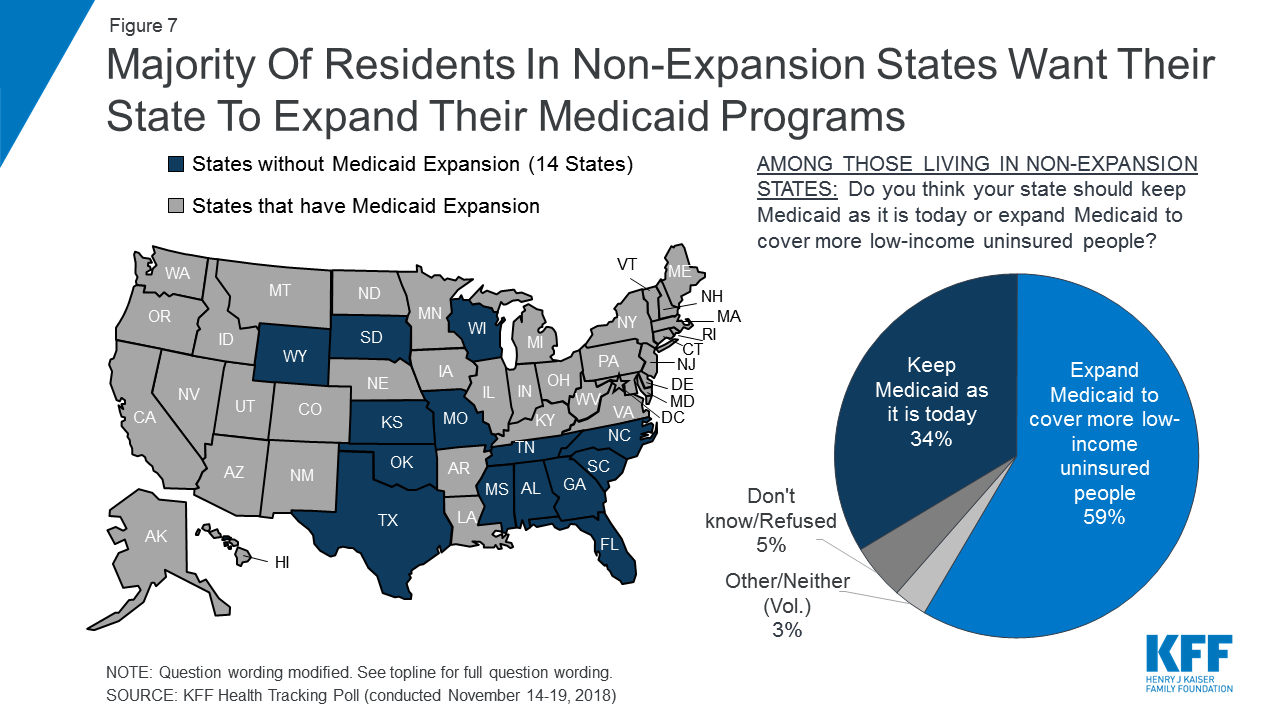
What is it? Medicaid expansion was a key part of the ACA. The federal government helped pay for states (that chose to) to expand Medicaid eligibility beyond families to include all low-income adults; and to raise the income threshold, so that more people would be eligible. So far, 37 states and D.C. have opted to expand Medicaid.
What changed? Under Trump, if they get approval from the federal government, states can now require Medicaid beneficiaries to prove with documentation that they either work or go to school.
What does the administration say? “When you consider that, less than five years ago, Medicaid was expanded to nearly 15 million new working-age adults, it’s fair that states want to add community engagement requirements for those with the ability to meet them. It’s easier to give someone a card; it’s much harder to build a ladder to help people climb their way out of poverty. But even though it is harder, it’s the right thing to do.” — Seema Verma, administrator of the Centers for Medicare and Medicaid Services, Washington, D.C., Sept. 27, 2018
What’s the impact? Even though HealthCare.gov and the state insurance exchanges get a lot of attention, the majority of people who gained health care coverage after the passage of the ACA — 12.7 million people — actually got their coverage by being newly able to enroll in Medicaid.
Medicaid expansion has proven to be quite popular. And in the 2018 election, three more red states — Idaho, Nebaska, and Utah — voted to join in. Right now, 18 states have applied to the federal government to implement work requirements; but most such programs haven’t yet gone into effect.
“The one work requirement program that’s actually gone into effect is in Arkansas,” says Nicholas Bagley, professor of law at the University of Michigan and a close follower of the ACA. “We now have good data indicating that tens of thousands of people were kicked off of Medicaid, not because they were ineligible under the work requirement program, but because they had trouble actually following through on the reporting requirements — dealing with websites, trying to figure out how to report hours effectively, and all the rest.”
If more states are able to implement work requirements, Bagley says, that could lead “to the loss of coverage for tens of thousands — or even hundreds of thousands — of people.”
CMS administrator Verma has pushed back on the idea that these requirements are “some subversive attempt to just kick people off of Medicaid.” Instead, she says, “their aim is to put beneficiaries in control with the right incentives to live healthier, independent lives.”
Work requirements in Arkansas and Kentucky were put on hold by a federal judge in March, and those cases are on appeal. The issue is likely headed to the Supreme Court.
3. Cost-sharing reduction subsidies to insurers have ended.
What is it? Payments from the federal government to insurers to motivate them to stay in the ACA insurance exchanges and help keep premiums down.
What changed? The Trump administration suddenly stopped paying these subsides in 2017.
What does the administration say? “I knocked out the hundreds of millions of dollars a month being paid back to the insurance companies by politicians. […] This is money that goes to the insurance companies to line their pockets, to raise up their stock prices. And they’ve had a record run. They’ve had an incredible run, and it’s not appropriate.” — President Trump, the White House, Oct 17, 2017
What’s the impact? This change had a strange and unexpected impact on the new insurance markets set up by the ACA. Insurers were in a bind: They had to offer subsidies to low-income people applying for insurance, but the federal government was no longer reimbursing them.
“The first thinking [was], ‘Oh gosh, that’s going to cause premiums to go up, and it’s going to hurt the marketplace,’ ” says Christine Eibner, who tracks the ACA at the nonpartisan RAND corporation. “What ended up happening is, insurers, by and large, addressed this by increasing the price of the silver plan on the health insurance exchanges.”
This pricing strategy was nicknamed “silver loading.” Because the silver plan is the one used to calculate tax credits, the Trump administration still ended up paying to subsidize people’s premiums, but in a different way. In fact, “it has probably led to an increase in federal spending” to help people afford marketplace premiums, Eibner says.
“Where the real damage has been done is for folks who aren’t eligible for subsidies — who are making just a little bit too much for those subsidies,” adds Corlette. “They really are priced out of comprehensive ACA-compliant insurance.”
4. Access to short-term “skinny” plans has been expanded
What is it? The ACA initially established rules that health plans sold on HealthCare.gov and state exchanges had to cover people with pre-existing conditions and had to provide certain “essential benefits.” President Obama limited any short-term insurance policies that did not provide those benefits to a maximum duration of three months. (The original idea of these policies is that they can serve as a helpful bridge for people between school and a job, for example.)
What changed? The Trump administration issued a rule last year that allowed these short-term plans to last 364 days and to be renewable for three years.
What does the administration say? “We took swift action to open short-term health plans and association health plans to millions and millions of Americans. Many of these options are already reducing the cost of health insurance premiums by up to 60% and, really, more than that.” President Trump, The White House, June 14, 2019
What’s the impact? The new rule went into effect last October, though availability of these short-term or “skinny” plans varies depending on where you live — some states have passed their own laws that either limit or expand access to them. Some federal actuaries projected lots of people would leave ACA marketplaces to get these cheaper plans; they said that would likely increase the size of premiums paid by people who buy more comprehensive coverage on the ACA exchanges. But a recent analysis from the Kaiser Family Foundation finds that the ACA marketplaces have actually stayed pretty stable.
Still, there’s another consequence of expanding access to these less comprehensive plans: “People who get these “skinny” plans aren’t really fully protected in the event that they have a serious health condition and need to use their insurance,” Eibner says. “They may find that it doesn’t cover everything that they would have been covered for, under an ACA-compliant plan.”
For instance, you might pay only $70 a month in premiums, but have a deductible that’s $12,500 — so if you get really sick or get into an accident, you could be in serious financial straits.
5. Funds to facilitate HealthCare.gov sign-ups slashed.
What is it? The ACA created Navigator programs and an advertising budget to help people figure out specifics of the new federally run insurance exchanges and sign up for coverage.
What changed? In August 2017, the administration significantly cut federal funding for these programs.
What does the administration say? “It’s time for the Navigator program to evolve […] This decision reflects CMS’ commitment to put federal dollars for the federally facilitated Exchanges to their most cost effective use in order to better support consumers through the enrollment process.” — CMS Administrator Seema Verma, written statement, July 10, 2018
What’s the impact? It’s hard to document what the impact of this particular cut was on enrollment. The cuts were uneven, and some states and cities got creative to keep providing services. “We have seen erosion in overall health insurance coverage,” says Corlette. “But it’s hard to know whether that’s the effect of the individual mandate going away, the short term plans or the reductions in marketing and outreach — it’s really hard to tease out the impact of those three changes.”
Overall, Nicholas Bagley says, the ACA has been “pretty resilient to everything, so far, that the Trump administration has thrown at it.” Some of Trump’s efforts to hobble the law have been caught up in the courts; others have not gone into effect. And, despite efforts to lure people away from the individual insurance marketplaces or to make ACA policies unaffordable, “the marketplaces have proved themselves to be remarkably resilient,” Corlette says.
Abbe Gluck, director of the Solomon Center for Health Law and Policy at Yale, cautions that though the law has proven to be stronger than expected, all these actions by the Trump administration have, indeed, had an effect.
“These actions have been designed to depress enrollment — they have depressed enrollment,” she says. “They have increased insurance prices.” Also, the uninsurance rate for U.S. residents also went up in 2018 for the first time since before the ACA was passed.
Despite that, one of the things that have kept the marketplaces as strong as they are, Gluck notes, is that they’re not all run by the federal government.
“Since the Affordable Care Act is implemented half by state governments — mostly blue states — those state governments have been able to resist these sabotaging efforts,” Gluck says.
“They have been able to extend enrollment, and they have been able to do outreach, because they run their own insurance markets. And in those states there is already evidence that sabotage attacks have not been felt as strongly.”
The piecemeal attacks on the ACA have made many people nervous about the future of their health coverage, Gluck says. “The most important theme of [Trump’s] administration of the ACA has been to sow uncertainty into the market and destabilize the insurance pool,” she says.
With open enrollment for 2020 health plans set to kick off in just a few weeks, Bagley wants people to know the ACA is still strong.
The federal health law “has been battered,” Bagley says. “It has been bruised. But it is still very much alive.”
Saints Of Football Welcome Pope’s Inadvertent Blessing
On Twitter this weekend, Pope Francis celebrated five newly recognized #saints — but that hastag is usually about the New Orleans Saints. The team went on to defeat the Jacksonville Jaguars, 13-6.
Simone Biles Becomes Most Decorated Gymnast In History
The 22-year-old Simone Biles won her 24th and 25th medals at the world gymnastics championships in Germany over the weekend, surpassing the previous 23 medals won by male gymnast Vitaly Scherbo.
An Emotional First For Some Iranian Women Allowed To Enter Soccer Stadium
For the first time in decades, Iranian women were allowed to attend a soccer match in Tehran’s Azadi Stadium.
Kenyan Brigid Kosgei Smashes Women’s World Record At Chicago Marathon

Kenya’s Brigid Kosgei won the 2019 Chicago Marathon on Sunday with at time of 2 hours 14 minutes and 4 seconds. Kosgei’s time also marks a new world record marathon time.
Quinn Harris/Getty Images
hide caption
toggle caption
Quinn Harris/Getty Images
Kenya’s Brigid Kosgei won the Chicago Marathon on Sunday with a time of 2 hours 14 minutes 4 seconds, breaking the previous world record by 81 seconds.
At 25, the Kenyan defended her title after winning last year’s event, and put almost 7 minutes between herself and her competition. Both from Ethopia, Ababel Yeshaneh finished second with a time of 2:20:51 and Gelete Burka came in third at 2:20:55.
The previous world record time of 2:15:25 was set by Britain’s Paula Radcliffe in 2003 at the London Marathon.
WORLD RECORD: Brigid Kosgei sets the new world record in the marathon at the 2019 @BankofAmerica #ChicagoMarathon! pic.twitter.com/lakum2XoET
— Chicago Marathon (@ChiMarathon) October 13, 2019
After Kosgei broke Radcliffe’s record, the two of them posed for a photo together.
Radcliffe says it marked a bittersweet moment for her, according to The Guardian.
“If you had told me when I set it in 2003, that it would last that long I wouldn’t have believed it,” Radcliffe said. “But I always knew this time would come — and when I saw how fast Brigid was running today I knew the record would go if she could maintain her pace.”
Former world record holder @paulajradcliffe poses with Brigid Kosgei at the finish after Kosgei broke the record this morning at the 2019 @BankofAmerica #ChicagoMarathon ? pic.twitter.com/niyGYZJ5Tp
— Chicago Marathon (@ChiMarathon) October 13, 2019
Kosgei’s world record race came just a day after fellow Kenyan Eliud Kipchoge broke the 2-hour marathon barrier with a time of 1 hour 59 minutes 40 seconds in Vienna, Austria, during an assisted event.
Because of the nature of the event, Kipchoge’s time does not count as an official world record, but was celebrated nonetheless. Both Kosgei and Kipchoge were sporting Nike’s new model of the Next% training shoes.
Kipchoge’s victory was on Kosgei’s mind, she said, as she set out on the Chicago course.
“I kept saying, ‘Tomorrow is my day,'” Kosgei told The New York Times. “I wanted to be the second Kipchoge — the Kipchoge for women. I focused on that.”
Simone Biles Becomes The Most Decorated Gymnast In World Championship History

U.S. gymnast Simone Biles poses with her five gold meals at the 2019 World Championships in Stuttgart, Germany. With her wins, she becomes the most decorated gymnast ever at the world championships, with 25 total medals.
Laurence Griffiths/Getty Images
hide caption
toggle caption
Laurence Griffiths/Getty Images
Simone Biles is the greatest gymnast of our time – or any time in history. She proved that Sunday at the World Championships, where she raked in her 24th and 25th world medals, both gold.
Biles, 22, took home five of the six golds to be won in Stuttgart, Germany, winning the top of the podium in team competition, all-around, and vault in addition to floor and beam. (On the uneven bars, she took fifth.)
Combining skills of unprecedented difficulty with flawless execution, Biles surpassed Belarusian Vitaly Scherbo’s record 23 world medals he won in the 1990s.
A gold on the balance beam evaded Biles at the 2016 Olympics in Rio, and so she has her eyes on that prize next summer in Tokyo. The goal that appeared well within reach with her rock-solid performance on Sunday. She won the beam competition by more than half a point – even though she opted not to perform the difficult dismount that’s named for her, a double twisting double back.
NBC Sports
YouTube
The dismount, called the Biles, became the subject of controversy in the days before the world championships.
FIG, the international governing body for gymnastics, decided earlier this month to award the dismount a difficulty rating just one tenth higher than the same move with one fewer twist. Many (including Biles herself) were critical of that decision, spurring FIG to release a statement in which it claimed the committee had made its decision in part out of concern for gymnasts’ safety.
That rating led Biles to scrap the dismount on Sunday. “It’s not worth the one-tenth (extra difficulty point). I’m sorry, it’s just not,” she said, according to The Associated Press.
But on the floor, Biles soared with another element named for her: a triple-twisting double back. As NBC’s announcer intoned, Biles’ floor routine was so packed with difficulty that she could have removed a twist from each tumbling pass and still won. Biles captured the event with a score of 15.133, a full point higher than her second-place U.S. teammate Sunisa Lee.
NBC Sports
YouTube
Biles beamed as the five golds adorned her neck.
And those 25 medals she’s collected from the worlds? “It’s older than my age, so I’m pretty thrilled with it,” she said.
Eliud Kipchoge Dashes Past 2-Hour Marathon Barrier In Assisted Event

Kenya’s Eliud Kipchoge celebrates after busting the elusive two-hour barrier for the marathon Saturday in Vienna.
Alex Halada/AFP via Getty Images
hide caption
toggle caption
Alex Halada/AFP via Getty Images
Three-time Olympic medalist Eliud Kipchoge became the first person to run a marathon in under two hours, clocking in at 1:59:40 as he passed the finish line Saturday morning in Vienna, Austria.
“It has taken 65 years for a human being to make history in sport, after Roger Bannister made history in 1954,” Kipchoge, who’s Kenyan, said in an interview with NTV Kenya shortly after the race.
Bannister broke the 4-minute mile record at an athletic meet in Oxford in May 1954.
“No human is limited,” Kipchoge said.
Kipchoge, the reigning Olympic marathon champion, was already a leading figure in the race to break the 2-hour mark, which the race’s organizer, chemicals company Ineos, called “the last great barrier of modern athletics.”
The ability of a human to run that fast wasn’t even considered possible until the 1990s In 1991, Dr. Michael Joyner published a paper that estimated the fastest time for a human to run a marathon at 1:57:58.
“It’s validating to me, but Mr. Kipchoge did all the running,” Joyner said in a phone interview with NPR.
A short distance before the end of the 26.2 miles, a mere 20 seconds before the fabled two hours were up, Kipchoge pointed at the roaring crowds on either side of him, beating his chest as he crossed. He embraced his wife, Grace Sugutt, before his team piled in on a tidal wave of admiration.
Today we went to the Moon and came back to earth! I am at a loss for words for all the support I have received from all over the world.
Thank you to all who gave me the opportunity. Asante. pic.twitter.com/0HTVBjB6YY
— Eliud Kipchoge (@EliudKipchoge) October 12, 2019
“Today we went to the Moon and came back to earth! I am at a loss for words for all the support I have received from all over the world,” Kipchoge tweeted.
A video posted on Twitter by the National Olympic Committee for Kenya showed the crowd in Eldoret, Kenya – Kipchoge’s hometown – cheering and jumping as his record time was announced. According to Citizen Digital, a Kenyan news organization, Kipchoge will have a street named after him in Eldoret when he returns.
On the Hauptallee, a stretch of tree-bordered road that runs through Prater park, where the course was set, teammates lifted Kipchoge up on their shoulders, draping a Kenyan flag around his shoulders.
In several interviews, Kipchoge has compared his attempt to beat two hours to the effort that goes into putting a man on the moon.









Kenya’s Eliud Kipchoge’s sub-two-hour time, although unofficial, is another achievement in the world of marathon running for the Olympic gold medalist.
ALEX HALADA/AFP via Getty Images
hide caption
toggle caption
ALEX HALADA/AFP via Getty Images
Kipchoge, 34, had come to dominate the world of marathon running, winning the Chicago Marathon in 2014, the Berlin and London marathons in 2015, and the London Marathon in 2016.
He competed in the 2016 Summer Olympics in Rio de Janeiro, snagging the gold medal in the marathon.
The following year, 2017, saw Kipchoge win another Berlin Marathon and participate in Nike’s Breaking2 event, a marathon held on a Formula One racetrack in Monza, Italy. It was the first marathon Kipchoge ran where he sought to break the two-hour mark, assisted by a team of pacesetters who acted as a windshield running in a V-formation around him. The assistance would mean that, if he beat two hours, the record would stand as unofficial.
On May 6, 2017, he crossed the finish line in Monza 25 seconds past the two-hour mark.
Undeterred, in 2018 Kipchoge won the London Marathon, then turned around and competed in the Berlin Marathon later that year.
At the time, the men’s marathon world record was 2:02:57, held by fellow Kenyan marathoner Dennis Kimetto. Kipchoge beat that time by a minute and 18 seconds, coming in at 2:01:39. He now held the men’s world record for the first time in his life.
If he had stopped then, he would have gone down as one of history’s best marathoners. But the glory of the record in Berlin meant that legendary sub-2-hour record, which had eluded him a year before, was back in his sights.
Saturday’s feat that tested the upper limits of physical prowess, however, will not be officially recognized as a world record by the International Association of Athletics Federations, much like the Breaking2 event. The race, held in Prater park in the heart of Vienna, was not an open event, the course in the park was evened ahead of time and Kipchoge had a team of 41 pacesetters with him, running in rotating teams of seven.
“Remember, the 41 pacemakers are among the best athletes ever, in the whole world,” Kipchoge said. Among them was Matthew Centrowitz, who earned a gold medal for the U.S. in the men’s 1500 meters at the 2016 Summer Olympics.
Kipchoge was also guided by an electric car that projected a green laser, moving at the pace needed to beat two hours, according to the IAAF.
Kipchoge’s shoes were also the subject of much interest. He tied on Nike’s new model of the NEXT% shoe, equipped with a carbon-fiber plate.
Dr. Joyner said it is all about maximizing the runner’s energy economy.
“There’s less energy loss with each foot strike. They’ve tuned it so that the recoil properties of the shoe optimize the ability of the runner to apply force to the ground.”
Between the shoes, the pacers, the closed race and the electric car, Joyner said that the phrase “assisted” in conjunction with Saturday’s marathon needs to be put in context, especially in comparison to Roger Bannister’s mile 65 years ago.
“Bannister had two pacers, the track at Oxford had been recently refurbished, Bannister was a medical student working on maximum human performance, and his shoes had special ultralight spikes,” Joyner said. “I see many parallels between him and Mr. Kipchoge.”
What an epic achievement! So inspirational ? @EliudKipchoge ?? #NoHumanIsLimited @INEOS159 #ineos159 #ineos159challenge pic.twitter.com/zLpzXQhvWs
— Chris Froome (@chrisfroome) October 12, 2019
“Hearty congratulations @EliudKipchoge. You’ve done it, you’ve made history and made Kenya proud while at it. Your win today, will inspire tens of future generations to dream big and to aspire for greatness. We celebrate you and wish you God’s blessings.” – President Kenyatta
— State House Kenya (@StateHouseKenya) October 12, 2019
The lack of sanction has, however, not deterred Kipchoge’s supporters. He’s now trending on Twitter, and many professional runners and other athletes have voiced their support, like four-time Tour de France winner Chris Froome. According to The Associated Press, Kenyan President Uhuru Kenyatta called Kipchoge shortly after the race.
“You’ve made history and made Kenya proud while at it,” Kenyatta tweeted.
Alexander Tuerk is an intern at Here and Now.