Opinion: NBA Sidelines Free Speech In Favor Of China

Houston Rockets’ James Harden smiles during the first half of an NBA preseason basketball game against the Toronto Raptors.
Jae C. Hong/AP
hide caption
toggle caption
Jae C. Hong/AP
James Harden, one of the greatest players in basketball, has the greatest beard in sports: long, wiry and full. And he wouldn’t be allowed to keep his beard in the Xinjiang region of China, where more than a million Chinese Uighur Muslims have been imprisoned in reeducation camps and “abnormal” beards are outlawed as a sign of dissidence.
It’s not surprising that when Daryl Morey, the general manager of Harden’s team, the Houston Rockets, tweeted an image with the words, “Fight for freedom, stand with Hong Kong,” Chinese state television stopped broadcasting and streaming the Rockets’ games, and Chinese companies dropped their sponsorships. And it’s not surprising NBA officials rushed to say they disagreed with the tweet. It is estimated that the NBA stands to make more than a half-billion dollars in China this year.
And James Harden, who has joined NBA stars in speaking out against police brutality and other urgent issues in America, apologized for Daryl Morey’s tweet by saying, “You know, we love China. We love playing there. … They show us the most important love.”
He may mean dollars and cents — or Tencent, the Chinese company that beams the NBA’s games to some 500 million people. That vast following has made James Harden and other NBA greats not only famous in China, but also even richer with endorsement contracts.
Most Americans buy products from China without much care about how Chinese companies can pay low wages for long hours and sometimes treacherous conditions. We know China is an authoritarian country that censors its citizens, jails dissidents and suppresses free speech.
But the league’s apologies for Daryl Morey’s free speech in support of Hong Kong’s protesters may have shown Americans just how much of our own free speech U.S. corporations are willing to surrender to keep doing business with China.
NBA players have made public stands to support the Black Lives Matter movement and decry police brutality. Seventy-four percent of the players in the NBA are African American. About 20% are from other countries. The league has stood up for players and coaches who criticize U.S. political figures, and NBA Commissioner Adam Silver has spoken proudly of what he has called their “sense of an obligation, social responsibility, a desire to speak up.”
But protesters in Hong Kong and jailed dissidents all over China might tell the NBA how speaking up has cost them a lot more than money.
Saturday Sports: China And The NBA, Washington Mystics, Simone Biles

The China-NBA spat heats up, the Washington Mystics are WNBA champs and American gymnast Simone Biles wins her fifth all-around world title.
SCOTT SIMON, HOST:
Now it’s time for sports.
(SOUNDBITE OF MUSIC)
SIMON: The two-hour marathon barrier has been broken. A new first-time champ in the WNBA. Will Simone Biles break every record around? Joining us now, NPR’s Tom Goldman. Good morning, Tom.
TOM GOLDMAN, BYLINE: Hello, Scott.
SIMON: And we get up to the news today that Eliud Kipchoge, the great Kenyan runner, has broken the two-hour marathon barrier in Vienna today – 26.2 miles in one hour, 59 minutes and 40 seconds. This is big as Dr. Roger Bannister breaking the four-minute mile, isn’t it?
GOLDMAN: It’s OK.
SIMON: (Laughter).
GOLDMAN: (Laughter) It’s amazing. You know, Scott, but what Bannister – when he broke the mile record in 1954, it might have been a bigger deal because sport was not as much as a science as it is now. And Bannister did his thing in a counting race. Kipchoge’s time…
SIMON: Oh, yeah. He was a medical student. He went to class in the morning there in Oxford.
GOLDMAN: (Laughter) That’s right and then go smashes…
SIMON: Yeah.
GOLDMAN: …The four-minute mile, right. Kipchoge’s time won’t count as a world record because it was a special event totally geared toward this outcome. He ran alone other than an army of professional running pace-setters. The organizers picked what they hoped would be an optimal site with optimal weather conditions. And Kipchoge ran behind an electric car driving at the pace he needed to be at and flashing a laser beam showing the optimal spot for where Kipchoge should run. Still…
SIMON: Oh, yeah, I’m sure you could have done it, too, Tom…
GOLDMAN: (Laughter).
SIMON: …With that kind of assistance.
GOLDMAN: You know, I actually did. But it was on a stationary bike.
SIMON: (Laughter).
GOLDMAN: But he’s great. He’s the world’s best marathon runner. This is amazingly fast. I would be interested to see when this can happen in a real, unscripted event.
SIMON: Washington Mystics won their first WNBA title this week, defeating the Connecticut Sun. How’d they do it?
GOLDMAN: With an incredibly tight team that talked more about togetherness and family than individual stats, led by league MVP Elena Delle Donne, who scored 21 points, grabbed nine rebounds in the final game – oh, despite three herniated discs in her back. They had a super substitute in Emma Meesseman, who came off the bench and turned into a terror in the playoffs. She won the finals MVP award. This is an exciting moment, a great ending to a great season.
SIMON: Yes or no – Simone Biles, fifth all-around world title for her, is she in a class of her own?
GOLDMAN: Yeah.
SIMON: OK.
GOLDMAN: She’s peerless, Scott. And even she’s amazed. She was quoted at the world championship saying, I really don’t know how I do it sometimes. And we don’t either. But she does it.
SIMON: Astros and Yanks tonight in Houston. But last night, in the baseball playoffs, National League, the Washington Nationals took the first game from the St. Louis Cardinals after Anabil Sanchez threw eight no-hit innings.
GOLDMAN: Yeah.
SIMON: And, of course, that exciting – I must say – exciting victory that the Nats had just a couple of days ago. Are they on a roll?
GOLDMAN: Oh, in a big way. And, you know, this is so exciting, as you well know, being there in Washington, D.C., for the Nats fans who have suffered through four division series losses since 2012.
SIMON: Suffered? Try 108 years.
GOLDMAN: (Laughter).
SIMON: But go ahead.
GOLDMAN: (Laughter).
SIMON: Oh, four division – oh, those poor Nats fans.
GOLDMAN: (Laughter) Oh, poor babies.
SIMON: Yeah.
GOLDMAN: Right, right.
SIMON: Right. But go ahead. I’m sorry.
GOLDMAN: OK, OK. Point taken. But this year, it’s been different. It’s been amazing – the comeback against the Brewers in the winner-take-all wild-card game, then finally winning a division series, beating the mighty L.A. Dodgers, who were favored…
SIMON: That was incredibly thrilling, that finish, yes. But go ahead, Tom.
GOLDMAN: Oh, yeah. And then they beat the Dodgers. And then they took home-field advantage away from the Cardinals last night in game 1. As our NPR colleague Javon Parris told me, this postseason could wipe out all the misery and the playoff flameouts.
SIMON: NPR sports correspondent Tom Goldman, thanks so much. Talk to you soon.
GOLDMAN: OK, Scott.
(SOUNDBITE OF GOLDROOM SONG, “YELLOW FLOWERS”)
Copyright © 2019 NPR. All rights reserved. Visit our website terms of use and permissions pages at www.npr.org for further information.
NPR transcripts are created on a rush deadline by Verb8tm, Inc., an NPR contractor, and produced using a proprietary transcription process developed with NPR. This text may not be in its final form and may be updated or revised in the future. Accuracy and availability may vary. The authoritative record of NPR’s programming is the audio record.
Heads Up: A Ruling On The Latest Challenge To The Affordable Care Act Is Coming

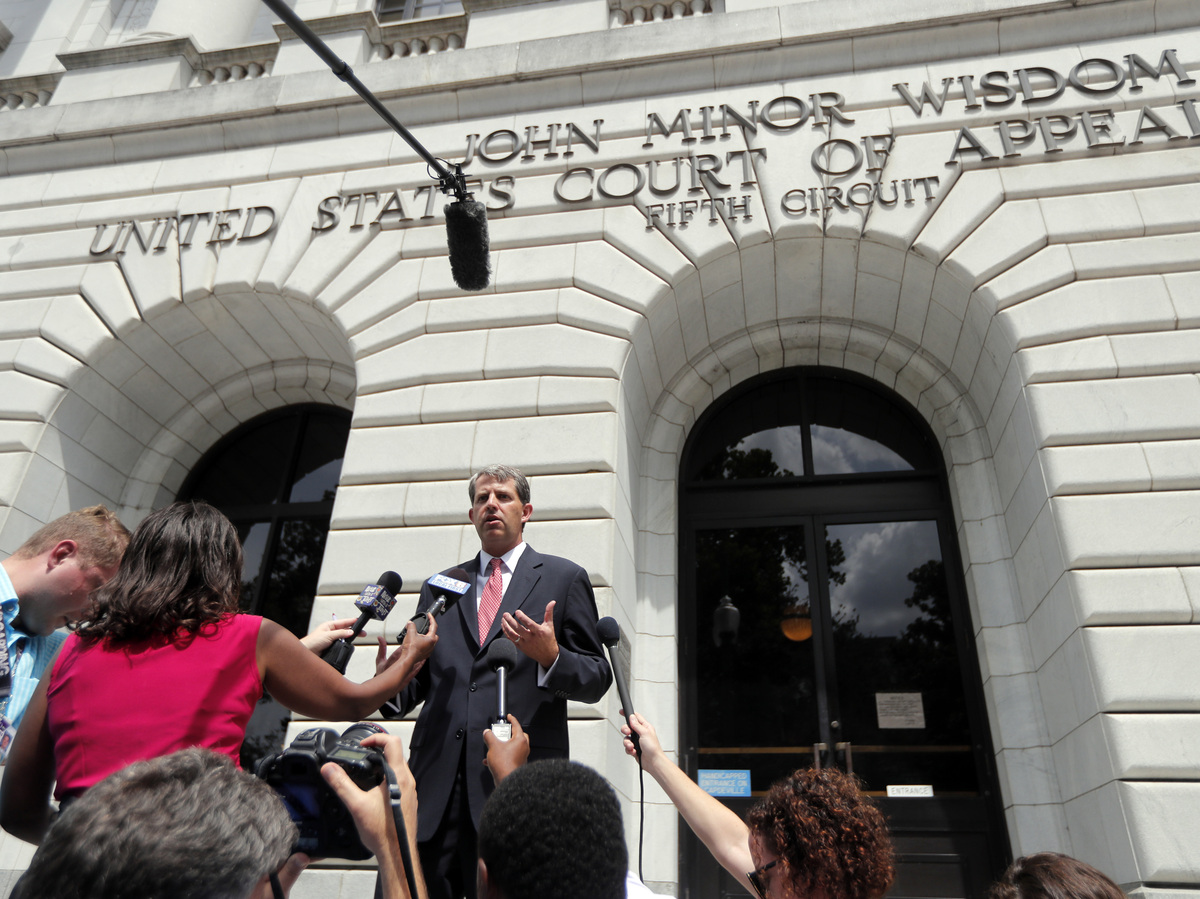
The latest challenge to the Affordable Care Act, Texas v. Azar, was argued in July in the 5th Circuit Court of Appeals. Attorney Robert Henneke, representing the plaintiffs, spoke outside the courthouse on July 9.
Gerald Herbert/AP
hide caption
toggle caption
Gerald Herbert/AP
A decision in the latest court case to threaten the future of the Affordable Care Act could come as soon as this month. The ruling will come from the panel of judges in the 5th Circuit Court of Appeals, which heard oral arguments in the Texas v. Azar lawsuit.
An estimated 24 million people get their health coverage through programs created under the law, which has faced countless court challenges since it passed.
In court in July, only two of the three judges — both appointed by Republican presidents — asked questions. “Oral argument in front of the circuit went about as badly for the defenders of the Affordable Care Act as it could have gone,” says Nicholas Bagley, a professor of law at the University of Michigan. “To the extent that oral argument offers an insight into how judges are thinking about the case, I think we should be prepared for the worst — the invalidation of all or a significant part of the Affordable Care Act.”
Important caveat: Regardless of this ruling, the Affordable Care Act is still the law of the land. Whatever the 5th Circuit rules, it will be a long time before anything actually changes. Still, the timing of the ruling matters, says Sabrina Corlette, director of the Center on Health Insurance Reforms at Georgetown University.
“If that decision comes out before or during open enrollment, it could lead to a lot of consumer confusion about the security of their coverage and may actually discourage people from enrolling, which I think would be a bad thing,” she says.
Don’t be confused. Open enrollment begins Nov. 1 and runs at least through Dec. 15, and the insurance marketplaces set up by the law aren’t going anywhere anytime soon.
That’s not to underplay the stakes here. Down the line, sometime next year, if the Supreme Court ends up taking the case and ruling the ACA unconstitutional, “the chaos that would ensue is almost possible impossible to wrap your brain around,” Corlette says. “The marketplaces would just simply disappear and millions of people would become uninsured overnight, probably leaving hospitals and doctors with millions and millions of dollars in unpaid medical bills. Medicaid expansion would disappear overnight.
“I don’t see any sector of our health care economy being untouched or unaffected,” she adds.
So what is this case that — yet again — threatens the Affordable Care Act’s very existence?
A quick refresher: When the Republican-led Congress passed the Tax Cuts and Jobs Act in 2017, it zeroed out the Affordable Care Act’s penalty for people who did not have health insurance. That penalty was a key part of the Supreme Court’s decision to uphold the law in 2012, so after the change to the penalty, the ACA’s opponents decided to challenge it anew.
Significantly, the Trump administration decided in June not to defend the ACA in this case. “It’s extremely rare for an administration not to defend the constitutionality of an existing law,” says Abbe Gluck, a law professor and the director of the Solomon Center for Health Law and Policy at Yale University. “The administration is not defending any of it — that’s a really big deal.”
The basic argument made by the state of Texas and the other plaintiffs? The zero dollar fine now outlined in the ACA is a “naked, penalty-free command to buy insurance,” says Bagley.
Here’s how the argument goes, as Bagley explains it: “We know from the Supreme Court’s first decision on the individual mandate case that Congress doesn’t have the power to adopt a freestanding mandate, it just has the power to impose a tax.” So therefore, the argument is that “the naked mandate that remains in the Affordable Care Act must be unconstitutional.”
The case made by the plaintiffs goes further, asserting that because the individual mandate was described by the Congress that enacted it as essential to the functioning of the law, this unconstitutional command cannot be cut off from the rest of the law. If the zero dollar penalty is unconstitutional, the whole law must fall.
Last December, a federal judge in Texas agreed with that entire argument. His judgement was appealed to the panel of judges in the 5th Circuit. Even if those judges agree that the whole law is unconstitutional, that would not be the end of the story — the case will almost certainly end up before the Supreme Court. It would be the third case to challenge the Affordable Care Act in the nation’s highest court.
So if the ruling will be appealed anyway, does it matter? “It matters for at least two reasons,” Bagley says. “First of all, if the 5th Circuit rejects the lower court holding and decides that the whole law is, in fact, perfectly constitutional, I think there’s a good chance the Supreme Court would sit this one out.”
On the other hand, if the 5th Circuit invalidates the law, it almost certainly will go the Supreme Court, “which will take a fresh look at the legal question,” he says. Even if the Supreme Court ultimately decides whether the ACA stands, “you never want to discount the role that lower court decisions can play over the lifespan of a case,” Bagley says.
The law has been dogged by legal challenges and repeal attempts from the very beginning, and experts have warned many times about the dire consequences of the law suddenly going away. Nine years in, “the Affordable Care Act is now part of the plumbing of our nation’s health care system,” Bagley says. “Ripping it out would cause untold damage and would create a whole lot of uncertainty.”
PHOTOS: After The Storm, Haitians In The Bahamas Depend On The Kindness Of Strangers

A month after Hurricane Dorian devastated the Bahamas, Sherrine Petit Homme LaFrance gets a hug from husband Ferrier Petit Homme. The storm destroyed their home on Grand Abaco Island. They are now living with China Laguerre in Nassau.
Cheryl Diaz Meyer for NPR
hide caption
toggle caption
Cheryl Diaz Meyer for NPR
Editor’s note: This story includes images that some readers may find disturbing.
Sherrine Petit Homme LaFrance was crying on the side of a road when China Laguerre spotted her.
Hurricane Dorian destroyed LaFrance’s newly constructed house in Great Abaco Island on the northern edge of the Bahamas the same night she moved in. That was on Sept. 1.
She then moved into a hotel offering free shelter in Nassau with her husband and 14-year-old son. But she says they were kicked out when staff found her son talking to guests.
She had nowhere to go. So Laguerre invited her to come stay at the home she shares with her parents and her brother.

Bodies lay in the debris left by Hurricane Dorian, which decimated Marsh Harbour on Great Abaco Island in the Bahamas on Sept. 6. The Mudd, an immigrant shantytown in Marsh Harbour, was home to about 8,000 Haitians, some of whom have lived in the area for several generations.
Cheryl Diaz Meyer for NPR
hide caption
toggle caption
Cheryl Diaz Meyer for NPR
“If these people didn’t help, I didn’t know what we were going to do,” says LaFrance. “I just thank God for these people.”
LaFrance is one of thousands of Haitians who lived in Abaco but were displaced to Nassau after the storm. The government’s policy is to keep evacuees off Abaco until power, water and housing is restored.
But life in Nassau is not easy for evacuees: Haitians in the Bahamas — some recent immigrants, others who have lived in the Bahamas for generations — say that they face discrimination by their Bahamanian neighbors and that government officials that has made it harder to access emergency aid, shelter and health care and to find jobs to get back on their feet after the storm. On Oct. 2, Prime Minister Hubert Minnis announced that Haitians in the Bahamas without documentation would be deported.
So some are relying on the kindness of strangers — and Laguerre’s home has emerged as the headquarters of an ad hoc Haitian community support network.
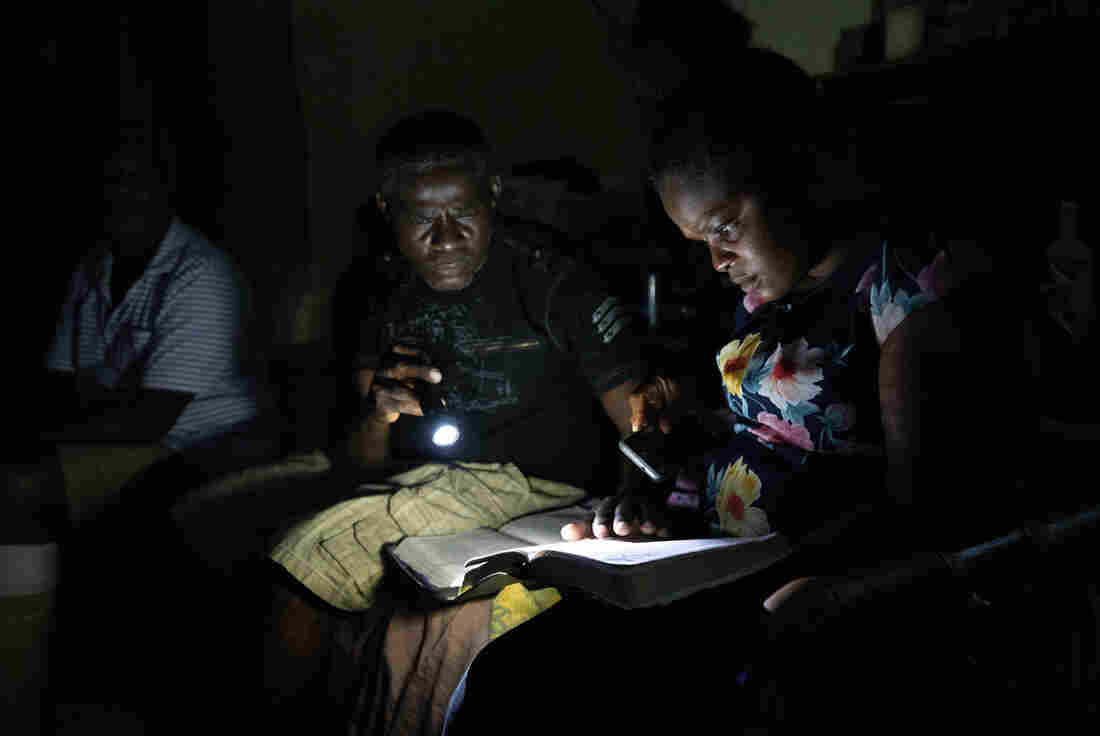
Ferrier Petit Homme (left) and Sherrine Petit Homme LaFrance pray every evening with other Dorian evacuees as well as members of the Laguerre family, who welcomed them into their home. This night was particularly painful: Sherrine’s 14-year-old son ran away in the morning. He returned two days later.
Cheryl Diaz Meyer for NPR
hide caption
toggle caption
Cheryl Diaz Meyer for NPR
While volunteering at a local hospital after the storm, Laguerre, 31, met Haitian evacuees who inspired her to open her doors to strangers.
“I feel sorry because it could’ve been me,” she says.

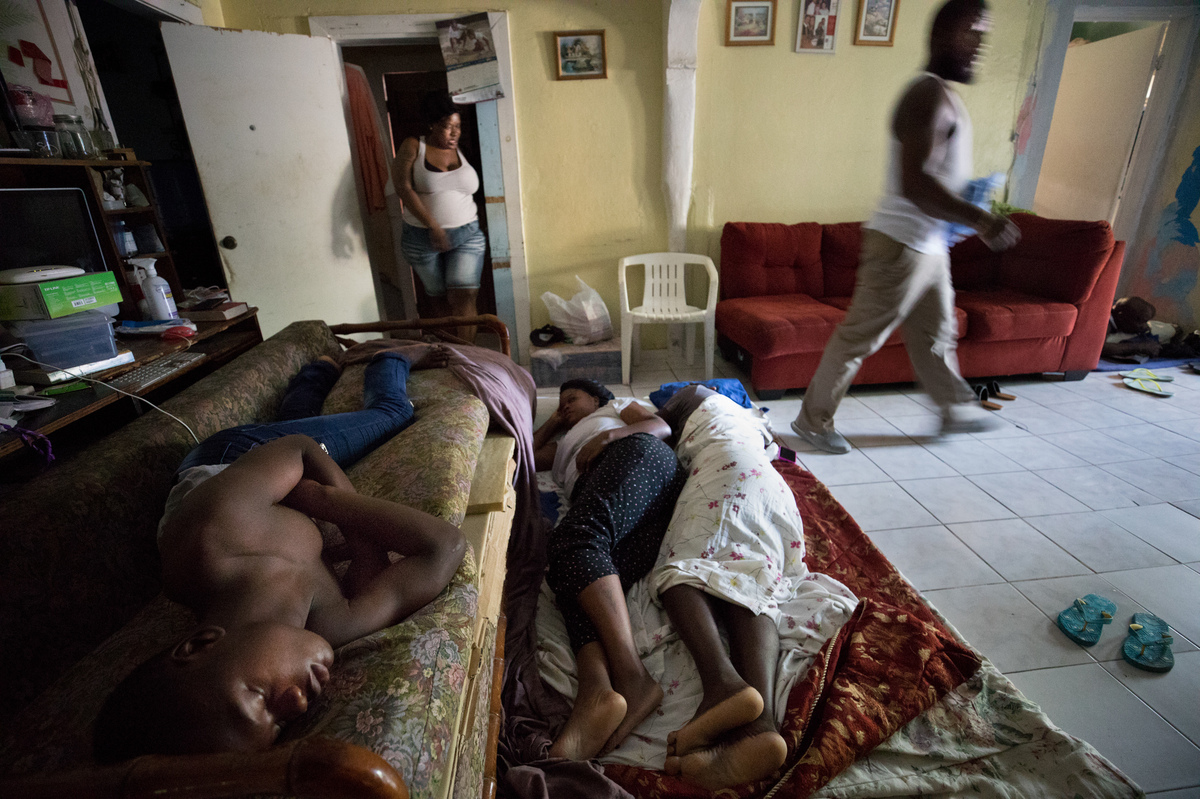
From left: Justin Bain, Sherrine Petit Homme LaFrance and Ferrier Petit Homme have little space to sleep in the family home of China and brother Odne Laguerre, who have taken in 10 Haitian evacuees from Abaco.
Cheryl Diaz Meyer for NPR
hide caption
toggle caption
Cheryl Diaz Meyer for NPR
Laguerre was born and raised in the Bahamas, but her parents are of Haitian descent. Despite not having enough money to pay their water bill, they have taken in 10 Haitian evacuees from four different families. They pool together what resources they can to grocery shop and cook for everybody in their compound.
“I wouldn’t say the floor is comfortable because it’s just cement,” she says. “We just let them put a sheet on the floor, and they sleep on the ground like that.”

Abaco evacuee Sherrine Petit Homme LaFrance shows a photo of herself during better times. LaFrance is one of thousands of Haitians who were displaced to Nassau after Hurricane Dorian.
Cheryl Diaz Meyer for NPR
hide caption
toggle caption
Cheryl Diaz Meyer for NPR
The families are still working through the physical and psychological effects of the storm. Lacieuse Timothee of Treasure Cay spent two days buried beneath debris before her sons found her. At the Laguerre home, she spends most of her time in bed. She says she is partially paralyzed, and the injuries around her feet have begun to turn black.

Evacuee Sherrine Petit Homme LaFrance (right) tries to find an apartment to rent in Nassau. She’s being helped by family friends Benette Lutus (left) and Kenisher Lutus (center), who are with their 2-year-old daughter.
Cheryl Diaz Meyer for NPR
hide caption
toggle caption
Cheryl Diaz Meyer for NPR
Laguerre and her parents do not have enough room in their home to keep welcoming guests. But they help those in need however they can. Recently, Laguerre referred a young mother to a friend’s house so she wouldn’t be left on the street with her child.
“I am not employed, but by the goodness of my heart — and I believe in God — this is God’s work here I am doing,” she says.

“Bahamians only” is printed on an advertisement for an apartment in Nassau. Some recent immigrants and others who have lived in the Bahamas for generations say that they face discrimination by their Bahamanian neighbors.
Cheryl Diaz Meyer for NPR
hide caption
toggle caption
Cheryl Diaz Meyer for NPR
For now, LaFrance’s family is living off the small amount of money that their relatives send from Haiti. They’re unsure when things will start to look up.

Sherrine Petit Homme LaFrance (in print dress) meets about an apartment to rent in Nassau.
Cheryl Diaz Meyer for NPR
hide caption
toggle caption
Cheryl Diaz Meyer for NPR
“You can’t even sleep. You have nightmares. You feel like you’re still in the storm,” says LaFrance, more than a month after Hurricane Dorian made landfall. “If you see a little rain, you think the storm is coming again.”

Sherrine Petit Homme LaFrance weeps as she recounts how her relatives who live in Nassau turned their backs on her after her home was decimated by Hurricane Dorian.
Cheryl Diaz Meyer for NPR
hide caption
toggle caption
Cheryl Diaz Meyer for NPR

A month after Hurricane Dorian devastated the Bahamas, 14,000 people are still displaced and living in shelters like the Kendal Isaacs Gymnasium in Nassau. On Oct. 5, evacuees complained that the building temperature was so low that many spent time outdoors.
Cheryl Diaz Meyer for NPR
hide caption
toggle caption
Cheryl Diaz Meyer for NPR
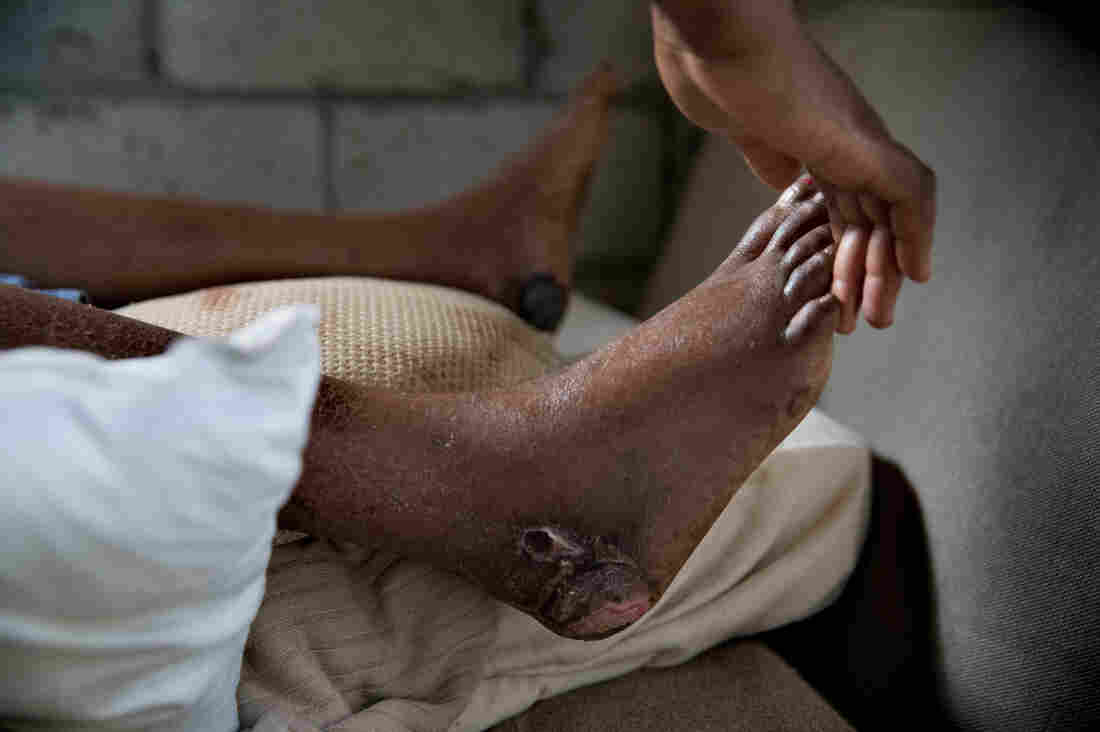
Lacieuse Timothee has sores that are turning black. A doctor diagnosed her with gangrene. She was injured after her home collapsed on her during the hurricane.
Cheryl Diaz Meyer for NPR
hide caption
toggle caption
Cheryl Diaz Meyer for NPR

Bobson Timothee, 23, right, looks in on his mother, Lacieuse. who spends most of her time in bed.
Cheryl Diaz Meyer for NPR
hide caption
toggle caption
Cheryl Diaz Meyer for NPR
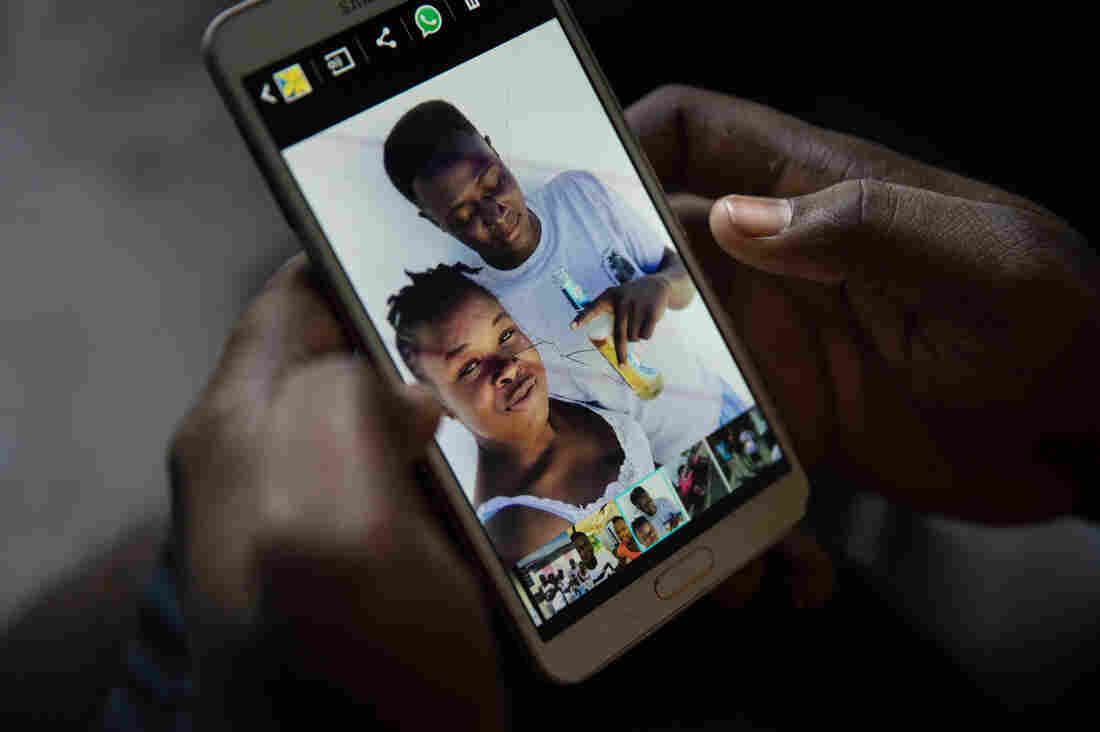
Bobson Timothee keeps a photo on his phone of himself with his best friend, Stephanie Forestal, who died during the storm.
Cheryl Diaz Meyer for NPR
hide caption
toggle caption
Cheryl Diaz Meyer for NPR

Rolin Timothee sits at the doorway of the room in the home of China Laguerre where he and his wife, Lacieuse, stay as guests.
Cheryl Diaz Meyer for NPR
hide caption
toggle caption
Cheryl Diaz Meyer for NPR
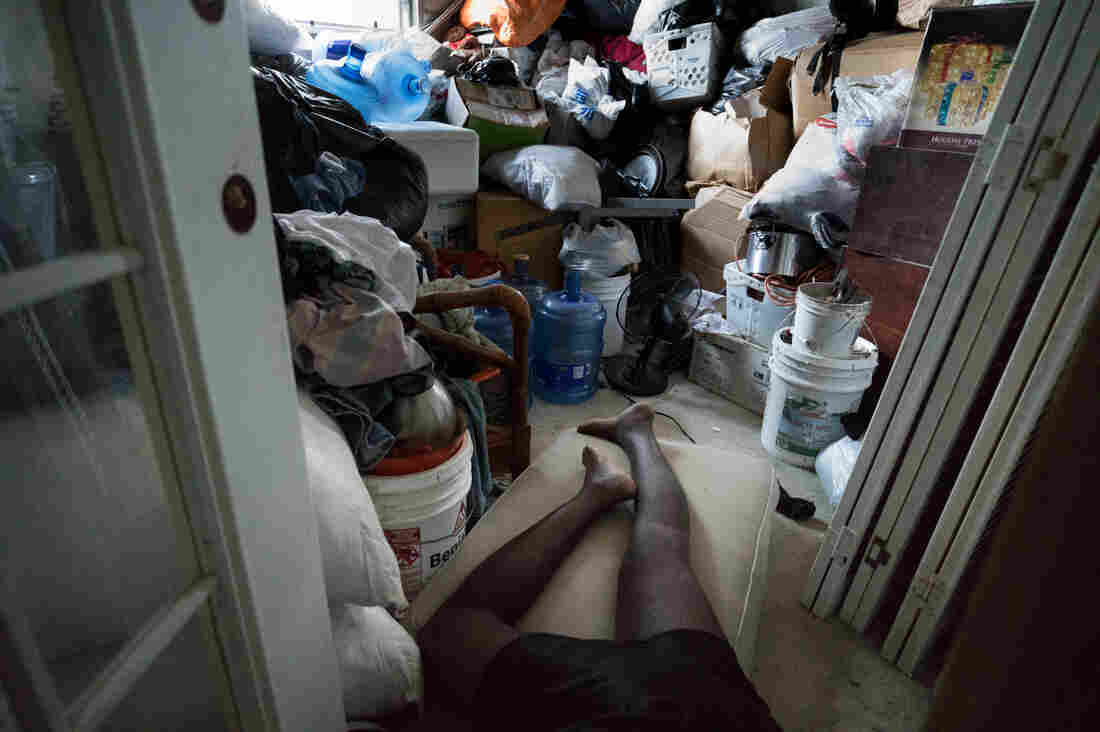
Ten evacuees from four different families are crowded into the six rooms of China Laguerre’s home.
Cheryl Diaz Meyer for NPR
hide caption
toggle caption
Cheryl Diaz Meyer for NPR

Odne Laguerre (left) and evacuee Bobson Timothee pass the time while other evacuees play cards at the Laguerre home.
Cheryl Diaz Meyer for NPR
hide caption
toggle caption
Cheryl Diaz Meyer for NPR

The home of China Laguerre and her family has emerged as the headquarters of an ad hoc Haitian community support network.
Cheryl Diaz Meyer for NPR
hide caption
toggle caption
Cheryl Diaz Meyer for NPR
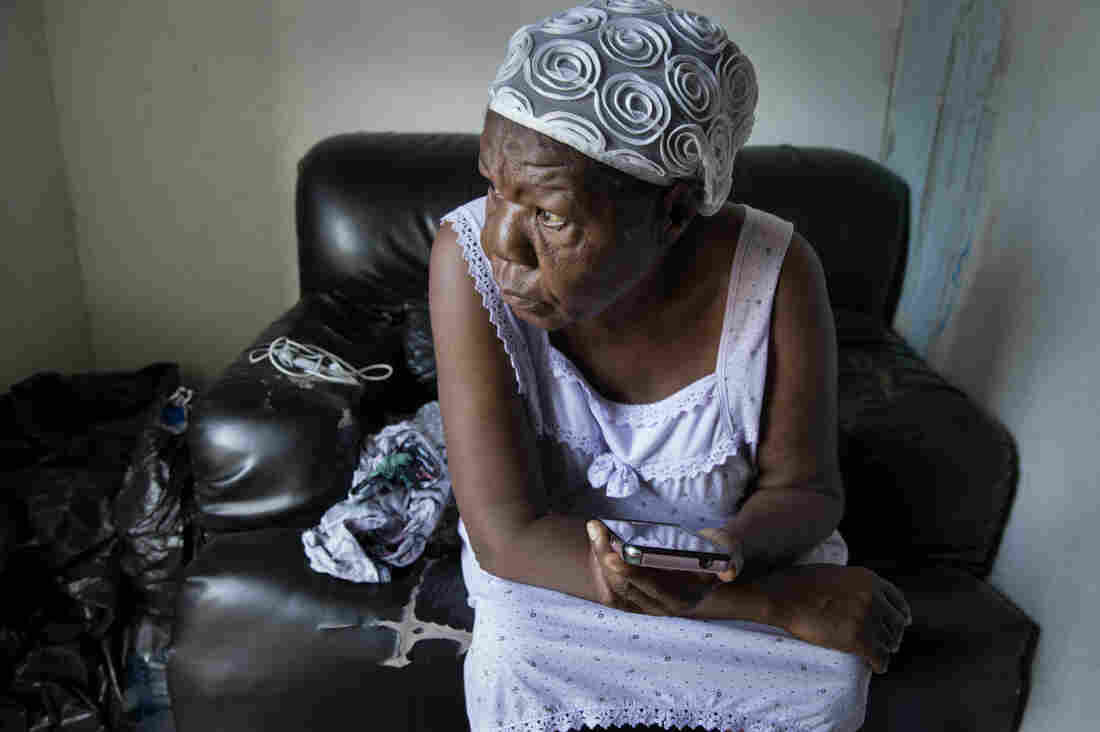
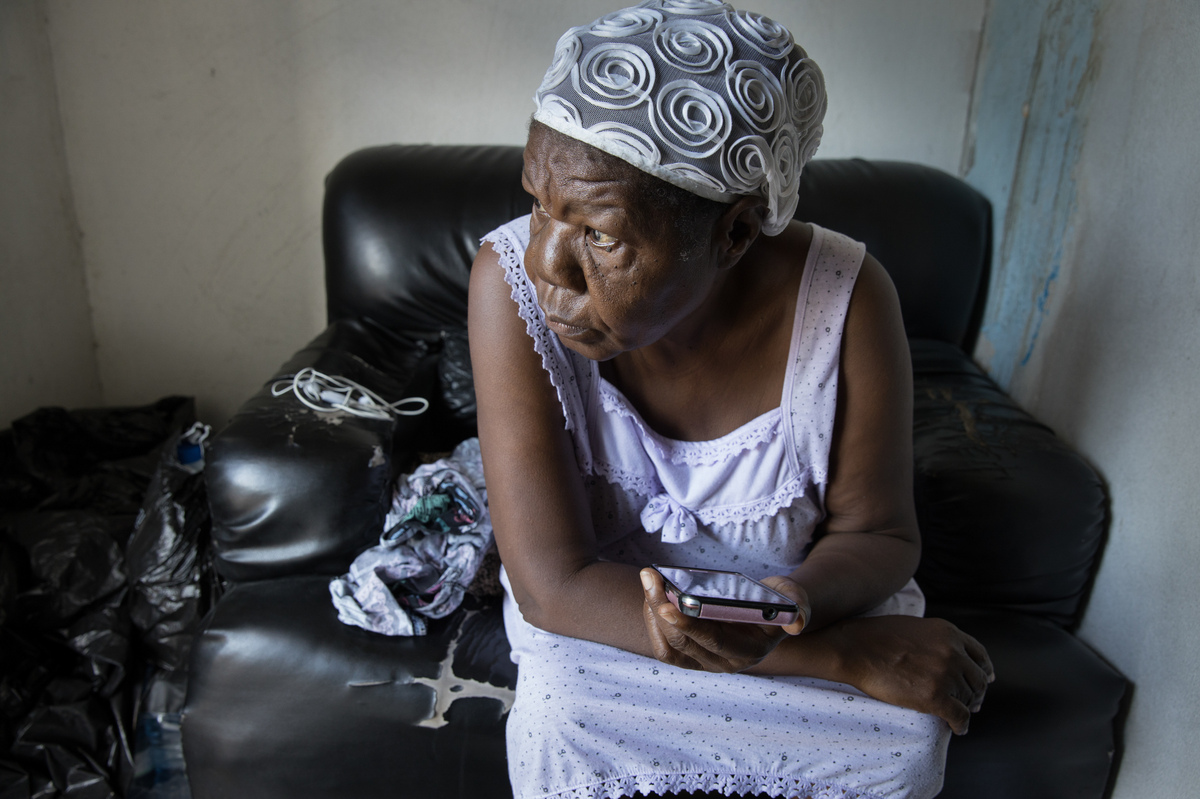
Abaco evacuee and Haitian immigrant to the Bahamas Micilia Etienne, 59, listens to news from Haiti while she and her family take shelter in China Laguerre’s home.
Cheryl Diaz Meyer for NPR
hide caption
toggle caption
Cheryl Diaz Meyer for NPR

The border patrol rounds up undocumented Haitian immigrants in Nassau on Sept. 30. Two days later, Prime Minister Hubert Minnis announced that Haitians in the Bahamas without documentation would be deported.
Cheryl Diaz Meyer for NPR
hide caption
toggle caption
Cheryl Diaz Meyer for NPR
Blizzard Entertainment Faces Public Backlash Following Esports Player Ban

The logo of Activision Blizzard, the parent company of Blizzard Entertainment.
SOPA Images/LightRocket via Getty Images
hide caption
toggle caption
SOPA Images/LightRocket via Getty Images
After Blizzard Entertainment banned professional esports player Blitzchung from competitions for 12 months over his support for Hong Kong’s pro-democracy protests, there is a growing movement in the gaming community to boycott the company’s decision.
Last Sunday, Blitzchung, whose real name is Ng Wai Chung, appeared on a Twitch broadcast after playing in a Hearthstone tournament. Blitzchung ended his remarks by reciting the popular Hong Kong protest slogan, “Liberate Hong Kong, revolution of our times.” At the time, he was wearing a gas mask and dark goggles, evoking the gear activists have worn during months of street protests.
For his actions, Blitzchung, who lives in Hong Kong, was handed a one-year ban from Blizzard’s tournaments. The company also rescinded his 2019 winnings, said to be $10,000.
Nathan “Admirable” Zamora, a commentator for the Hearthstone Grandmasters tournament, announced Thursday that he was stepping down from his role as a “caster” on the Hearthstone broadcast team.
“In Hearthstone, good strategic play involves making the right choice, even if that choice will sometimes cost you. You think about the range of possibilities from the other side,” Zamora said in a tweet. “With the hand you’re dealt, you make the best choice you can, even if the foreseeable outcomes hurt. That doesn’t mean you should make worse choices — it means do the right thing, even if you pay the price.”
Zamora is the second esports caster to step down from his position. Brian Kibler also announced his departure, saying he “will not be a smiling face on camera that tacitly endorses this decision.” Two of their colleagues released statements denouncing Blizzard’s action, but it seems they will continue to cast the Grandmasters tournament.
In another act of solidarity with Blitzchung, a user claiming to be a Blizzard employee posted a photo to Reddit showing people holding umbrellas — a reference to 2014’s Hong Kong Umbrella Movement — as they congregated around an orc statue on the campus at Blizzard’s headquarters in California.
Not everyone at Blizzard agrees with what happened.
Both the “Think Globally” and “Every Voice Matters” values have been covered up by incensed employees this morning. pic.twitter.com/I7nAYUes6Q
— Kevin Hovdestad (@lackofrealism) October 8, 2019
Players are also finding ways to protest Blizzard. During a Hearthstone Collegiate Champs match, which was organized by esports company Tespa in partnership with Blizzard, players from American University held up a sign that read “Free Hong Kong, boycott Blizz.”
Casey Chambers, one of the players on the team, said that they, at minimum, expected a ban in retaliation for their actions — but they were not given one by Tespa officials. The team was scheduled to compete in another game next week, but Chambers told NPR they intend to forfeit the tournament in solidarity with Blitzchung.
“This shows Blizzard’s hypocrisy in how it treats different regions,” the team said in a statement. “They are hesitant to suppress free speech when it happens in America, on an English language stream, but will throw casters’ and players’ livelihoods under the bus if they are from Hong Kong or Taiwan.”
Over the past week, gaming fans have found creative ways to show their support for Blitzchung and Hong Kong. Some have created pro-Hong Kong fan art of Mei, a Chinese character in the Blizzard game Overwatch, in an attempt to have Blizzard ban the game in China. And a look at the official Hearthstone Twitch stream shows users have been spamming a ping pong paddle in the chat box accompanied by the sentence, “Spam this pong to free Hong Kong.”
Gamers aren’t the only ones incensed by Blitzchung’s ban. U.S. Sens. Marco Rubio, R-Fla., and Ron Wyden, D-Ore., tweeted statements denouncing Blizzard’s action, saying it had given in to capital influence from China. As we reported earlier this week, Tencent Holdings Limited, a Chinese conglomerate, owns a 5% stake in Blizzard’s parent company.
Blizzard shows it is willing to humiliate itself to please the Chinese Communist Party. No American company should censor calls for freedom to make a quick buck. https://t.co/rJBeXUiwYS
— Ron Wyden (@RonWyden) October 8, 2019
Blizzard Entertainment and Blitzchung have not responded to requests for further comments.
Paolo Zialcita is an intern on NPR’s News Desk.
Canada’s Decision To Make Public More Clinical Trial Data Puts Pressure On FDA

Already, Health Canada has posted safety and efficacy data online for four newly approved drugs; it plans to release reports for another 13 drugs and three medical devices approved or rejected since March.
Teerapat Seedafong/EyeEm/Getty Images
hide caption
toggle caption
Teerapat Seedafong/EyeEm/Getty Images
Last March, Canada’s department of health changed the way it handles the huge amount of data that companies submit when seeking approval for a new drug, biological treatment, or medical device — or a new use for an existing one. For the first time, Health Canada is making large chunks of this information publicly available after it approves or rejects applications.
Within 120 days of a decision, Health Canada will post clinical study reports on a new government online portal, starting with drugs that contain novel active ingredients and adding devices and other drugs over a four-year phase-in period. These company-generated documents, often running more than 1,000 pages, summarize the methods, goals, and results of clinical trials, which test the safety and efficacy of promising medical interventions. The reports play an important role in helping regulators make their decisions, along with other information, such as raw data about individual patients in clinical trials.
So far, Health Canada has posted reports for four newly approved drugs — one to treat plaque psoriasis in adults, two to treat two different types of skin cancer, and the fourth for advanced hormone-related breast cancer — and is preparing to release reports for another 13 drugs and three medical devices approved or rejected since March.
Canada’s move follows a similar policy enacted four years ago by the European Medicines Agency of the European Union. The U.S. Food and Drug Administration, on the other hand, continues to treat this information as confidential to companies and rarely makes it public.
The argument for more transparency
Transparency advocates say clinical study reports need to be made public in order to understand how regulators make decisions and to independently assess the safety and efficacy of a drug or device. They also say the reports provide medical societies with more thorough data to establish guidelines for a treatment’s use, and to determine whether articles about clinical trials published in medical journals — a key source of information for clinicians and medical societies — are accurate.
“Sometimes regulators miss things that have been hidden in those clinical study reports,” says Matthew Herder, director of the Health Law Institute at Dalhousie University in Nova Scotia. “Regulators often face resource constraints, they have deadlines, other priorities.”
Last year, for example, Canadian researchers used a clinical study report and other previously non-public information from a clinical trial to call into question the efficacy of Diclectin (known as Diclegis in the United States), a commonly prescribed drug to treat nausea and vomiting in pregnancy. The team had requested the information from Health Canada under an older policy, which required researchers to sign a confidentiality agreement and keep the underlying data secret when they published their results. (It “had a chilling effect,” Herder says of the now-discontinued policy, and not many researchers made requests.)
Duchesnay, the Quebec-based manufacturer of Diclectin, defended the drug, and the Canadian and American professional societies of obstetricians and gynecologists continue to recommend it. Yet the new analysis gave pause to the College of Family Physicians of Canada, which had previously published two articles recommending Diclectin’s use in its medical journal, Canadian Family Physician. The organization took the unusual step in January of publishing a correction, which criticized the independence and accuracy of the two earlier articles. And, citing the new research, it advised physicians to use caution when interpreting recommendations for the drug’s use.
Herder and other lawyers and independent researchers who want to see greater transparency in medical research are urging the FDA to follow the example of Canada and the E.U., but without success thus far. To date, the European program, which has been in effect since 2016, has posted clinical study reports for 132 medicinal products whose applications were submitted after January 2015.
Canadian and European regulators lead the way
It is important to have multiple regulators making the data public, says Peter Doshi, an associate editor at the BMJ, an international medical journal, and an associate professor of pharmaceutical health services research at the University of Maryland School of Pharmacy. As it stands now, “If FDA approves first, which often it does, we won’t know anything until Health Canada or the EMA makes a decision,” says Doshi. “And not every drug, device, biologic out there is going to be approved by these other regulators or even submitted to these other markets.”
In addition, redundancy lessens the impact if one regulator changes policy. The EMA, for example, earlier this year moved its operations from London to Amsterdam because of Britain’s anticipated exit from the European Union. Clinical data publication “was one of the activities suspended until we are more settled in Amsterdam,” says Anne-Sophie Henry-Eude, head of documents access and clinical data publication. No date has yet been announced for its resumption.
Sandy Walsh, a spokesperson for the FDA, says the agency does not have the same freedom as Canadian and European regulators to release clinical study reports. “U.S. laws on disclosure of trade secret, confidential commercial information, and personal privacy information differ from those governing EMA and Health Canada’s disclosure of clinical study reports,” she wrote in an email.
Some legal experts argue the FDA has more flexibility than it acknowledges. Federal agencies are “entitled to substantial deference” in determining “what constitutes confidential commercial information,” Amy Kapczynski, a Yale law professor and a co-director of the university’s Collaboration for Research Integrity and Transparency, in The Journal of Law, Medicine & Ethics.
Why drugmakers balk
In response to an interview request sent to the Pharmaceutical Research and Manufacturers of America, Megan Van Etten, the trade group’s senior director for public affairs, emailed a statement expressing concern from the industry that Health Canada’s new regulations “could discourage investment in biomedical research by revealing confidential commercial information.”
Joseph Ross, an associate professor of medicine and public health at Yale University and a co-director, along with Kapczynski and others, of CRIT, maintains that clinical study reports contain little information that companies need to keep secret, and that any such information could be redacted before release. A 2015 report by the Institute of Medicine, now known as the National Academy of Medicine, also called for the FDA to release redacted clinical study reports.
That is the strategy of Health Canada, which discusses possible redactions with the manufacturer. “Health Canada retains the final decision on what information is redacted and published,” Geoffroy Legault-Thivierge, a spokesperson, wrote in an email.
So does the EMA, which goes through a similar negotiating process with manufacturers. “We often are in disagreement but at least there is a dialogue,” says Henry-Eude. The EMA might agree to redact manufacturing details, for example.
Journal reports often underplay harms, emphasize benefits
Researchers who independently re-evaluate drugs say the reports are critical because the data they need is not readily available in medical journal articles. One analysis showed that only about half of clinical trials examined were written up in journals in a timely fashion and a third went unpublished. And when articles are published, they contain much less data than the reports, says Tom Jefferson, an epidemiologist based in Rome who works with Cochrane, an international collaboration of researchers who conduct and publish reviews of the scientific evidence for medical treatments.
In addition, “journal articles emphasize benefits and underplay or, in some cases, even ignore harms” that can be found in the clinical study report data, says Jefferson. An analysis by experts at the Institute for Quality and Efficiency in Health Care in Cologne, Germany, found “considerable” bias in how patient outcomes were reported in journal articles and other publicly available sources. Public access to clinical study reports can shine a light on such discrepancies.
The FDA has flirted in the past with releasing clinical study reports to the public. In January 2018, it launched a pilot program to post portions of reports for up to nine recently approved drugs if the drug companies would agree.
“We’re committed to enhancing transparency about the work we do at the FDA,” commissioner Scott Gottlieb, who resigned in March, said at the time.
But only Janssen Biotech, a subsidiary of Johnson & Johnson, volunteered, and its prostate cancer drug Erleada is the lone entry. In June, the FDA announced it is considering shifting its focus from the pilot program to another designed to better communicate the analyses of FDA experts who review drug applications, which the agency has been making public for approved medicinal products since 2012.
But these analyses by FDA reviewers are no substitute for the actual clinical study reports, says Doshi. The reviews reflect “an FDA scientist’s take on the sponsor’s application,” he said. “Without the clinical study report, somebody like me is largely deprived of looking at the underlying data and developing my own take.”
Independent researchers like those who took a hard look at Diclectin also want access to clinical study reports connected to regulatory decisions made before the European and Canadian portals were opened.
Since 2010, the EMA has been providing researchers and others with access to clinical study reports for such legacy drugs upon request, while Health Canada is even more transparent, posting requested clinical study reports for drugs and devices approved or rejected before March to its new online portal for anyone to see. So far, 12 information packages are available for older drugs and devices and 11 more requests are being processed.
The FDA has, on occasion, provided reports in response to a Freedom of Information Act request, but researchers seeking this information typically invest “a tremendous amount of time and effort,” says Ross. For example, a Yale Law School clinic sued the FDA on behalf of two public health advocacy groups after the agency said it could take years to respond to their FOIA request for clinical trial data for two hepatitis C drugs. In 2017, it won the case and the groups received the data, which they are currently evaluating.
The FDA does not keep track of how many clinical study reports it has released through FOIA, says Walsh. But Doshi and others say such releases are rare, and usually a result of lawsuits or the threat of legal action. In 2011, Doshi requested clinical study reports for Tamiflu, an antiviral medication used to treat the flu. “Eight years later, I think those requests are still alive,” he says now. “I don’t remember getting a denial. They just sit.”
Outside researchers can appeal to companies directly for access to clinical study reports. At least 24 of PhRMA’s 35-member companies have signed on to its six-year-old principles for “responsible clinical trial data sharing,” committing to the release of synopses of clinical study reports for approved medicines and to considering requests for data and the full reports from “qualified” medical and scientific researchers who submit research proposals.
But researchers are concerned they won’t be granted access if companies are not comfortable or sympathetic to their proposals, says Herder. And the companies control the amount of redaction.
The British-based pharmaceutical company GlaxoSmithKline (GSK) has gone further than most in providing public access to its data. In 2013, the company began posting clinical study reports through its own online portal, Clinical Study Register, which is open to the public. “We have published over 2,500 clinical study reports and nearly 6,000 summaries of results — both positive and negative — from our trials on Clinical Study Register,” Andrew Freeman, director and head of medical policy, said in an emailed statement. “GSK is leading the industry in transparency.”
Even so, GSK controls the level of redaction, says Jefferson of Cochrane, who tried to use clinical study reports posted on the company’s portal for a systematic review of HPV vaccines. “Important aspects, for instance the narratives of serious adverse events — those are all blocked out. Big black boxes,” he says. “So they are of moderate use.”
Meanwhile, many researchers do not realize that Health Canada and the EMA are making clinical study reports available. An online survey of 160 researchers around the world who conduct systematic reviews found that 133 “had never considered accessing regulatory data” and 117 of those 133 “were not aware (or were unsure) of where to access such material.” They continue to rely on the limited data in journal articles and other published literature, says Herder of Dalhousie University.
“Transparency is wonderful in theory but unless people actually do the work of getting data and independently analyzing it, transparency is window dressing,” he says.
Barbara Mantel is a New York-based reporter who writes about health care and other social issues.
This story was produced by Undark, a nonprofit, editorially independent digital magazine exploring the intersection of science and society.
NBA Calls Off News Conferences For Players In China As Controversy Lingers

Chinese fans react during a preseason NBA game between the Brooklyn Nets and Los Angeles Lakers in Shanghai on Thursday. While no formal conferences will take place, a league source said the teams can hold their media gatherings independent of the NBA.
AP
hide caption
toggle caption
AP
After several days of controversy, the NBA will complete its exhibition series in China with Saturday’s game between the Los Angeles Lakers and the Brooklyn Nets. But the league says basketball players, including two of the game’s biggest stars in LeBron James and Kyrie Irving, will not address the media in news conferences after.
While no formal conferences will take place, a league source tells NPR that if the Lakers and Nets decide to hold their media gatherings independent of the NBA, they are welcome to do so — and that there would be no repercussions from the league. The source also says the league hasn’t had any discussions about what the teams might decide.
Saturday’s game will end a rocky week between the NBA and China, sparked by an NBA team executive’s since-deleted tweet voicing support for pro-democracy protests in Hong Kong.
The NBA said it canceled news conferences for the rest of its games in China after conferring with players and teams.
“We have decided not to hold media availability for our teams for the remainder of our trip in China,” the NBA says in a statement.
“They have been placed into a complicated and unprecedented situation while abroad and we believe it would be unfair to ask them to address these matters in real time,” the league says of the players.
As NPR’s Emily Feng reports from Hong Kong:







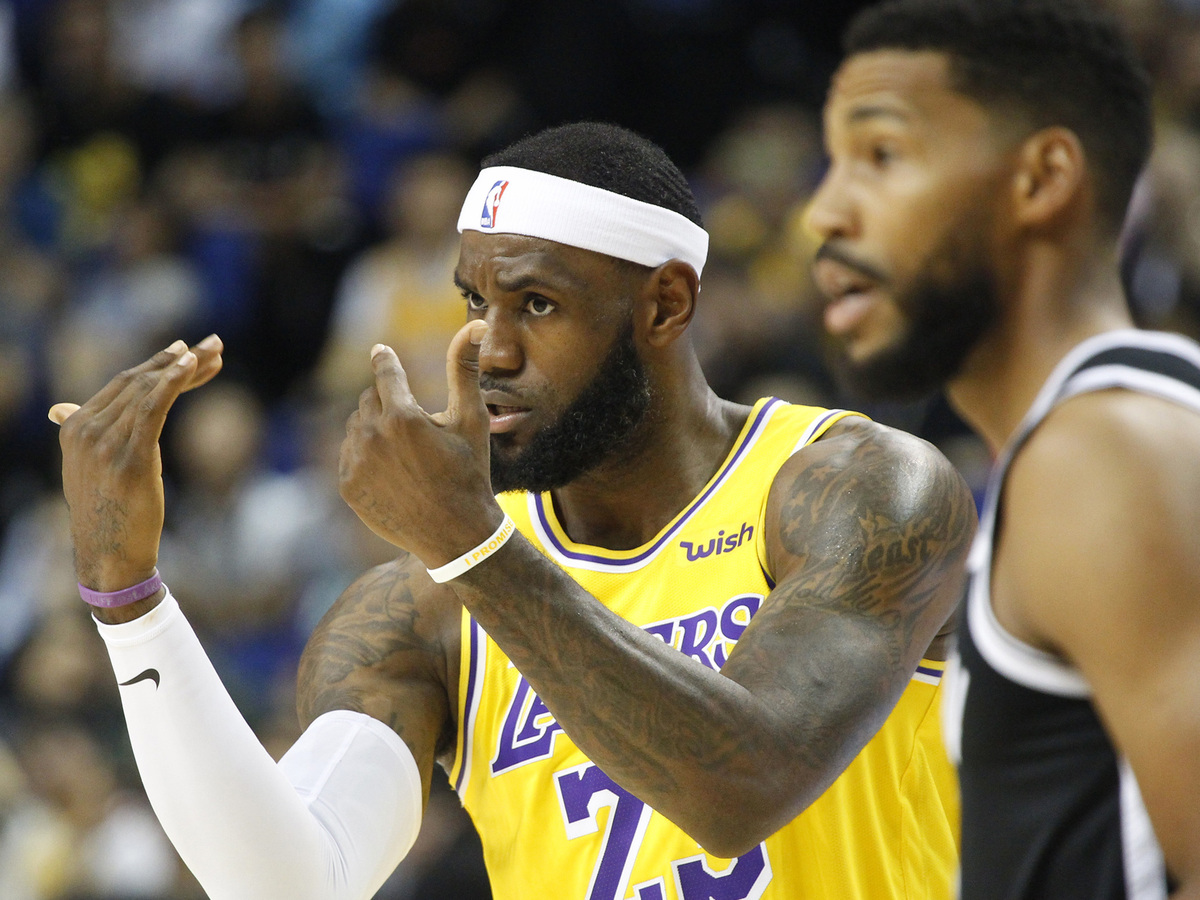
The NBA says basketball players, including LeBron James, will not address the media in news conferences after the preseason games.
AP
hide caption
toggle caption
AP
“[The NBA is] referring to the fallout after Daryl Morey, the Houston Rockets general manager, tweeted in support of Hong Kong protests. That unleashed a storm of criticism in China and China’s state broadcaster and tech giant Tencent dropped streaming this week of two NBA pre-season games being played in China.”
ESPN reports the NBA nixed a scheduled press conference Thursday that was set to take place before a game in Shanghai.
That game between the Nets and Lakers was played “with a stipulation by the Chinese government, mandating that no media availability of any kind be held at the game and that NBA commissioner Adam Silver cancel his pregame news conference,” ESPN says.
The NBA spent much of the week trying to get past the controversy that began after Morey tweeted: “Fight for Freedom. Stand with Hong Kong.”
That tweet was quickly deleted, but not before thrusting the league into a vexing position in China. Several Chinese officials and businesses, including the Chinese Basketball Association, headed by former NBA star and Hall of Famer Yao Ming, said they would drop their dealings with the Rockets.
The NBA, like many other U.S. businesses, wants to grow its business in China, where basketball is wildly popular.
The league’s initial statements, issued in both English and Mandarin, exposed the NBA to criticism that it was attempting to appease China at the cost of traditional U.S. values — such as free speech. The fallout forced the NBA to issue another statement and hold a news conference to reaffirm the league’s stance that it will not censor players or teams.
“The long-held values of the NBA are to support the freedom of expression and certainly freedom of expression by members of the NBA community,” Silver said, speaking at a news conference near Tokyo earlier this week.
The News Roundup – International

With an impeachment inquiry looming, President Donald Trump embarked on another highly controversial foreign policy move: withdrawing from northern Syria.
That territory is held by the Kurdish-led Syrian Democratic Forces, a group that was, until earlier this week, protected by the presence of U.S. forces. On Wednesday, Turkish forces came over the border and attacked the Kurds.
What are the effects of the president’s actions? And what will happen to the Kurds in the region?
The president of Ecuador, Lenín Moreno, moved the country’s government out of Quito this week. Indigenous groups are leading protests against the Moreno government’s proposed austerity package.
The Washington Post reports that five people have been killed in the demonstrations, and more than 680 people have been arrested.
We’re also following how several leading brands, including Apple and the NBA, have become involved in the protests in Hong Kong.
We cover all those stories and get to others as we wrap up the week in global news.
Before The Houston Rockets, Daryl Morey Was A Numbers Whiz In Boston
Before Houston Rockets general manager Daryl Morey was thrust into international spotlight this week for supporting Hong Kong protesters, he first built his reputation as a numbers whiz in Boston.
Simone Biles Wins Fifth All-Around World Championship Medal


Simone Biles performs on the vault in the women’s all-around final at the Gymnastics World Championships in Stuttgart, Germany.
Matthias Schrader/AP
hide caption
toggle caption
Matthias Schrader/AP
Editor’s Note: Earlier, we mistakenly reported that Simone Biles had set a new record for most world championship medals. She is one medal away from tying the record.
As of Thursday, Simone Biles is a step closer to being the greatest gymnast ever to have competed in the world championships.
Biles won her fifth world all-around title by dominating the field at the 2019 World Gymnastics Championships in Stuttgart, Germany. With the win, she now holds 22 world medals.
The 22-year-old is hoping to surpass Belarusian Vitaly Scherbo, who accumulated 23 medals at the world championship stage when he competed during the 1990s. After starting the day needing two medals to tie Scherbo, Biles now needs only one to match him. She’ll try to accomplish that in the upcoming individual events, which run through Sunday.
Biles competed Thursday in four disciplines against the top 23 gymnasts from the qualifying round. Her combined score was 58.999, earning her the all-around gold by a wide margin of more than 2 points.
Xijing Tang of China placed second with 56.899. Russian gymnast Angelina Melnikova collected the bronze, with an overall score of 56.399.
In last year’s competition, Biles won the individual all-around gold medal and scored the most points in the vault and floor events.
At this year’s championship, Biles placed first in the vault portion of the all-around event with a score of 15.233. She was also first on the balance beam, where she scored 14.633 points.
The native of Texas ended the 2019 all-around competition with a bang by placing first on the floor segment, with a score of 14.400 that secured her victory.
Stratospheric ?@Simone_Biles‘ vault = light-years ahead. #Stuttgart2019 pic.twitter.com/qLI7FDRALq
— Team USA (@TeamUSA) October 10, 2019
On Tuesday, Biles led Team USA to their fifth consecutive world title.
Athletes and celebrities flocked to Twitter to praise Biles’ 2019 performances.
Simone you are flat out INCREDIBLE!!! ?? @Simone_Biles https://t.co/iIXzLL5F3C
— LeBron James (@KingJames) October 7, 2019
Biles has four signature gymnastic moves named after her.Gymnasts must submit it for consideration and successfully land it at a major competition to have a move named after them. Two of those moves, the “Biles II” and the “Biles”, were added during Biles’s 2019 performances.
Despite her record-setting performance at the championships, both Biles and USA Gymnastics expressed disappointment at the points classification the “Biles” was assigned. The FIG Women’s Technical Committee said the move was given a lower score in order to dissuade gymnasts from attempting a potentially dangerous maneuver.
Paolo Zialcita is an intern on NPR’s News Desk.