Thousands Of Women Will At Last Be Allowed To Attend A Soccer Match In Iran

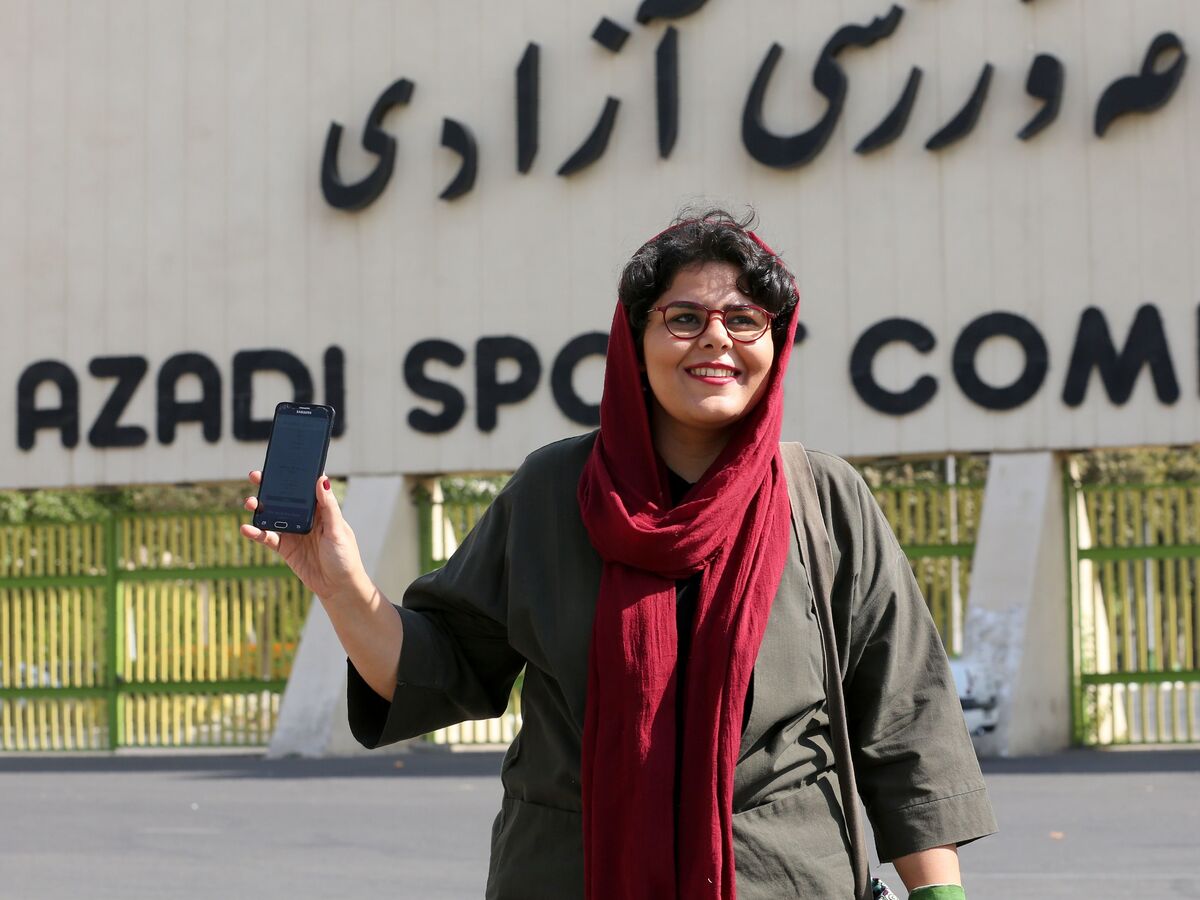
Iranian sports journalist Raha Purbakhsh shows off her ticket to attend a World Cup qualifier in front of Azadi Stadium in Tehran on Tuesday. Iran has essentially banned women from entering the stadium for decades.
Atta Kenare/AFP via Getty Images
hide caption
toggle caption
Atta Kenare/AFP via Getty Images
For some 40 years, women have been largely banned from attending soccer matches at Iran’s stadiums. But under pressure from FIFA, soccer’s governing body, Iranian authorities are allowing a few thousand women to watch a game Thursday at Tehran’s Azadi Stadium – in a section separate from men.
Women were permitted to buy about 3,500 tickets to watch a World Cup qualifier between the men’s teams of Iran and Cambodia.
The change comes after an Iranian woman set herself on fire and died last month, as she faced charges arising from her trying to enter the stadium to watch a match. The woman, 29-year-old soccer fan Sahar Khodayari, had dressed up as a man to try to get into the game. When security guards discerned that she was a woman, she was expelled and charged with “appearing in public without a hijab.”
The ban has been in place since 1979’s Islamic revolution, with only small groups of women allowed to attend a handful of matches in recent years.
Iranian sports journalist Raha Purbakhsh is among those who got a ticket to Thursday’s match. She told news service AFP that she last stepped into Azadi stadium about 25 years ago with her father.
“I still can’t believe it’s happening because after all these years watching every match on TV, I’m going to be able to experience everything in person,” she said. “I’ll be able to feel the stands, and closely watch the game itself.”
But some say it’s not enough. Amnesty International criticized Iran’s authorities for allotting so few tickets to women in a stadium that can seat 78,000. It’s not clear how many tickets have been made available to men.
“Iran’s decision to allow a token number of women into the stadium for tomorrow’s football match is a cynical publicity stunt by the authorities intended to whitewash their image following the global outcry over Sahar Khodayari’s tragic death,” Philip Luther, Amnesty’s Middle East and North Africa Research and Advocacy Director, said in a statement.
“Instead of taking half-hearted steps to address their discriminatory treatment of women who want to watch football, the Iranian authorities should lift all restrictions on women attending football matches, including domestic league games, across the country,” he said. “The international community, including world football’s governing body, FIFA, must also ensure that woman are permitted to attend all matches.”
FIFA statutes prohibit discrimination on the basis of gender. The governing body says the arrangement for Thursday’s match is a pragmatic solution as it works toward lasting change in Iran.
“It’s not just about one match,” FIFA’s head of social responsibility and education Joyce Cook told the BBC. “We’re not going to turn our eyes away from this. We’re totally focused on making sure women can attend this match on 10 October and working just as pragmatically to ensure women also can attend local matches in league football – but it’s about what follows as well. FIFA has a very firm stand – fans are equally entitled to attend matches.”
Iranian Vice President for Parliamentary Affairs Hossein-Ali Amiri said last month that some of the country’s stadiums were being prepared for the entry of women, by adding separate gates and seating.
The group Open Stadiums has long campaigned for women’s right to watch games in Iran’s arenas. The organization’s leader, who goes by the pseudonym Sara, told Reuters that many of the women who bought tickets to Thursday’s match aren’t actually soccer fans.
“[T]hey just want to break this discrimination,” she said. “For years [equal stadium access] has been a demand from the women’s rights movement in Iran and as a part of exclusion from the public spaces. It’s not just about football.”
“People are doing this just to show that if you give capacity to us, we will use it.”
A WAG Drama Unfolds In Britain

NPR’s Mary Louise Kelly talks with Elizabeth Paton of The New York Times about a revelation from Coleen Rooney, wife of footballer Wayne Rooney, about a friend leaking personal stories to tabloids.
FIFA Disciplines Hong Kong Football Association After Chinese National Anthem Protest

Hong Kong soccer fans protest the Chinese national anthem during a 2022 World Cup qualification game in Hong Kong, Sept. 10, 2019.
Kin Cheung/AP
hide caption
toggle caption
Kin Cheung/AP
FIFA fined the Hong Kong Football Association Wednesday after fans protested the Chinese national anthem at a World Cup qualifying game against Iran. The Hong Kong and China national teams are separate, but FIFA plays the Chinese anthem because Hong Kong is considered an administrative region of China.
Disciplinary records said that Hong Kong supporters breached article 16 of the FIFA Disciplinary Code by disturbing a national anthem and using objects to “transmit a message that is not appropriate for a sports events.”
The Hong Kong Football Association has been ordered to pay 15,000 Swiss francs ($15,000 U.S.) and was given a warning. Hong Kong football officials can appeal the decision.
A video taken during the September game shows supporters facing backward and booing as China’s national anthem plays.
During ytd’s 2022 #FIFA World Cup Asian Qualifying match against Iran at #HongKong Stadium, fans of HK Football Team sang the anthem “May Glory Be to HK”, composed by @lihkg_forum members, to show pride and solidarity with the team.#HongKongProtests #5DemandsNo1Less #FreedomHK pic.twitter.com/zT0g5QT2YF
— Freedom HK (@FreedomHKG) September 10, 2019
During halftime, Hong Kong fans surrounded the stadium, locked arms and sang “Glory to Hong Kong,” a song widely adopted as the protest anthem.
Though Hong Kong lost to Iran 2-0, protesters were happy to use the game to increase awareness to their cause.
“The emotion here is good, though we lost,” Hong Kong supporter Leo Fan told the AP. “We will fight till the end.”
The Hong Kong Football Association have yet to comment on their sanction.
During the 2018 World Cup qualifiers, Hong Kong was disciplined three times. All three incidents involved the booing of the Chinese national anthem. Hong Kong was fined twice, totalling about $15,000.
FIFA isn’t the only sporting federation to involve itself in the Hong Kong liberation movement. Earlier this week, the Houston Rockets‘ general manager Daryl Morey tweeted support for Hong Kong protesters. The Chinese Basketball Association then announced it will suspend cooperation with the Rockets.
The league’s commissioner clarified Tuesday that the NBA supports free speech, after the Rockets’ owner and an NBA spokesman denounced Morey’s statement.
Paolo Zialcita is an intern on NPR’s News Desk.
India Banned E-Cigarettes — But Beedis And Chewing Tobacco Remain Widespread

A woman rolls tobacco inside a tendu leaf to make a beedi cigarette at her home in Kannauj, Uttar Pradesh, India, on Wednesday, June 3, 2015. India’s smokers favor cheaper options such as chewing and leaf-wrapped tobacco over cigarettes.
Udit Kulshrestha/Bloomberg/Getty Images
hide caption
toggle caption
Udit Kulshrestha/Bloomberg/Getty Images
At a tiny kiosk on a Mumbai lane choked with rickshaws, Chandrabhaan Chaurasia is selling paan – betel leaves sprinkled with spices. They’re a cheap street snack across South Asia.
Chaurasia, 51, spreads a leaf with spicy herbal paste and then sprinkles it with dried tobacco. He folds the leaf into an edible little parcel, and sells it for 8 rupees — about $0.11. He also sells single-serving packs of chewing tobacco. Another kiosk nearby sells hand-rolled leaf cigarettes, called beedis.
India banned electronic cigarettes last month. With about 100 million smokers, India has the second-largest smoking population in the world, after China. Amid global reports of deaths and illnesses linked to vaping, India decided to ban e-cigarettes preventatively. They had yet to become popular.
But other forms of tobacco already are. In fact, twice as many Indians (about 200 million) use smokeless tobacco — like paan or chewing tobacco — than cigarettes. That’s the most in the world. Those products are harder to regulate because they’re mostly sold at street kiosks, for a fraction of the price of cigarettes.
Chaurasia’s tobacco kiosk is right outside Tata Memorial Hospital, one of the best cancer research facilities in India. Inside the hospital, Dr. Gauravi Mishra, a preventative oncologist, sees the harmful effects of those tobacco products on a daily basis.
“India has the highest number of oral cavity cancers. In fact, one-third of the global burden comes from only one country — and that’s India,” Mishra notes.
When NPR visited her office, Mishra had just biopsied a boil inside the mouth of a patient who’s been chewing tobacco for 10 years.
“I had some idea that it was bad, but I didn’t know it could be so serious,” says Madhukar Patil, 42, his mouth filled with sterile gauze.
Patil is waiting for results to determine whether he has oral cancer. A father of two, he vows to quit tobacco now, for good.
“I realize now that if you want to be there for your family and enjoy precious moments with them, then you must leave this bad habit,” Patil says.
More than one in five Indians over the age of 15 uses some form of smokeless tobacco. (The figure is nearly one-third for men.) Poor laborers often chew tobacco as a stimulant, like chewing gum, to kill their appetite. Some even use tobacco ash as toothpaste. Patil used to chew gutka, a mixture of granular tobacco, betel nuts and spices.
Part of the problem is awareness.
“If someone is smoking, they might be looked down upon. But smokeless tobacco is culturally accepted. If you visit any rural area, people will greet you with paan,” Mishra says.
Another part of the problem is packaging.
Indian law requires cigarette companies to print health warnings on cigarette packs. Often, they carry graphic photos of tobacco-related tumors. So people know that smoking cigarettes is bad.
But other tobacco products are sold loose. Hand-rolled leaf cigarettes, or beedis, are green. They look organic. And they’re seven to eight times more common in India than conventional cigarettes, according to the World Health Organization.
Beedis also provide a livelihood to millions of mostly female, first-time workers.



Balamani Sherla, 60, rolls beedis (leaf cigarettes) in her one-room home in Mumbai’s red light district. It’s the only job she’s ever had, and she’s been doing it for 50 years. She breathes tobacco dust all day, and earns about 14 cents an hour.
Sushmita Pathak/NPR
hide caption
toggle caption
Sushmita Pathak/NPR
In Mumbai’s oldest red light district, Balamani Sherla rolls beedis on the floor of her one-room home. At 60, Sherla has been doing this for half a century. It’s the only job she’s ever held.
She buys the ingredients wholesale: tendu leaves, dried loose tobacco, and string to tie off the rolled beedis. Sherla soaks the leaves in water to soften them, then cuts them round with giant shears, lines them with tobacco, and rolls them into short green cigarettes. She sells them to a middle man who then distributes them to street kiosks.
“It’s tedious work,” she says. “My arms ache, trying to roll the beedis very thin.”
Sherla doesn’t smoke. But studies show that beedi rollers often suffer from respiratory problems, burning eyes and asthma – just from breathing tobacco dust.
Nevertheless, it’s considered such a lucrative skill that women who can roll beedis are coveted as brides. Sherla makes about $0.14 an hour, which is a big help for her family, she says.
But wages used to be higher. The Indian government has repeatedly hiked tax on all tobacco products, including beedis — and that has cut into Sherla’s profits.
Most of the revenue India collects from taxing tobacco comes from packaged cigarettes, even though they’re less popular than beedis and smokeless tobacco. Tax rates on all tobacco products in India fall below the WHO’s recommendation of 75-percent of retail price.
Levying taxes on tobacco has long been considered an effective strategy to discourage its use and improve public health. But in India, where beedi workers often come from very low socio-economic backgrounds, that tax itself could be deadly, says Umesh Vishwad, general secretary of the Akhil Bharatiya Beedi Mazdoor Mahasangh (All India Beedi Workers Union).
If taxes on beedis keep rising, workers could “become homeless and starve to death,” Vishwad says.
They live that close to the bone, he says. His group wants the Indian government to retrain beedi workers for other jobs, before it chips away at their livelihood.
While Sherla and some of her neighbors roll beedis at home in urban Mumbai, the industry employs more people in rural areas, especially in the southern Indian states of Telangana and Andhra Pradesh. In central India, some of the beedi workers come from tribal areas where communist guerrillas are active. Vishwad worries that if their livelihoods are threatened, they could be vulnerable to insurgent recruiters.
“If these people lose their jobs as beedi rollers or beedi leaf collectors, they could be forced to join the militancy and pick up arms to survive,” he warns.
For Sherla, rolling beedis is a calculated decision. She knows that handling tobacco may not be good for her health. But she’s trading a long-term health risk for the ability to feed her family tomorrow.
“What other job can I do? I’m an old lady,” Sherla says. “This is the only option for me.”
As she works, Sherla’s 10-year-old granddaughter Siri bounces around the dank little room. The girl goes to school, and has learned English well. She interrupts often to tease her grandmother and translate for her. She’s the same age Sherla was when she started doing this work.
Will Siri follow in her grandmother’s footsteps?
“No way!” Sherla exclaims. “This little girl wants to be a doctor.”
Stuffed With Sockeye Salmon, ‘Holly’ Wins ‘Fat Bear Week’ Heavyweight Title


Bear 435, “Holly” before and after her pre-hibernation weigh-in. Holly went on to win the final round in Fat Bear Week 2019.
Katmai National Park & Preserve
hide caption
toggle caption
Katmai National Park & Preserve
Fat Bear Week 2019 officially ended Tuesday night. And the winner is….
Number 435, or if you prefer a name, Holly.
Fat Bear Week has been an annual event for the past five years in Katmai National Park and Preserve in southwestern Alaska. The idea is to publicize and celebrate the process of bears eating as much as they can to build up crucial fat reserves in advance of winter hibernation.
Park rangers made a game out of the process – a March Madness-style bracket matching bear against bear, each with photos proving girth and inviting the public to vote on the fattest bear in each pair.
The winners move on to the next round; the losers are out.
This year’s championship round pitted Holly against number 775, Lefty.
And in the end, it was no contest.
After 12 hours of online voting, Holly had about 17,500 votes while Lefty had about 3,600.
Katmai Conservancy Media Ranger Naomi Boak says Holly earned her title.
“It was very hard to get a good picture [of Holly] out of the water,” she says, “because she was a submarine for the entire month. She did not stop fishing, except to dig a belly hole big enough for her to sleep in.”
Holly and all of this year’s 12 contestants are coastal brown bears, who forage along the Brooks river. The Alaskan waterway has one of the largest concentrations of sockeye salmon in the world, and the bears there take full advantage.
This year’s week-long competition was a huge success – there was a record total of 187,000 votes cast, more than three times last year’s total.
Along with the novelty and fun of the event, Boak and her fellow Katmai Conservancy media ranger Brooklyn White hope it builds awareness of a natural process and the need to conserve the unique wilderness area of the Brooks River.
“Not all bears have this same kind of access to these salmon resources,” White says, “and to an ecosystem that has such clean water.”
White says many ecosystems, even within Katmai, are breaking down, caused by human encroachment to warming temperatures that are putting salmon under “heat duress.”
That was especially true this year, as Alaska endured an unusually dry summer.
“Because of the drought, the salmon were really delayed” in reaching the Brooks River,” Boak says. “[T]hey stayed in small creeks and streams that were very dry.”
She says the bears stayed around those streams because of the easy fishing and didn’t arrive at the Brooks until mid-September. Normally they’re there, gorging on salmon around the first of the month.
Because of the delay, Boak says the fat bears in this year’s competition are still eating and will continue doing so right up until late this month, or early November, when hibernation usually begins.
And when it does, it’s not — as many think — as simple as the animals merely going to sleep.
“[Hibernation] is a reduction in their metabolic rate,” says White, who’s worked on the Brooks River the past four years. “[The bear’s] heart rate lowers, the activity obviously is very minimal and it truly is just their body utilizing that fat to keep this baseline going.”
If the bears don’t have adequate fat stored, some may even die during hibernation, Boak says.
That’s why the fattest bears have the best chance at survival. That means when spring rolls around, they’ll be able to emerge from their dens to continue their life cycle.
And for Holly, it’ll mean emerging as a champion.
Blizzard Entertainment Bans Esports Player After Pro-Hong Kong Comments


The Activision Blizzard Booth during the Electronic Entertainment Expo in Los Angeles.
Jae C. Hong/AP
hide caption
toggle caption
Jae C. Hong/AP
Blizzard Entertainment, the game developer behind hugely popular titles such as World of Warcraft and Overwatch, has banned a professional esports player from competing and taken away his prize money after he expressed support for Hong Kong’s protest movement.
Ng Wai Chung, who lives in Hong Kong and plays under the name Blitzchung, is one of the top players in the Asia-Pacific region for the online card deck game Hearthstone.
Blitzchung made the comment on an official Hearthstone broadcast on Twitch, the video streaming platform, after his last game in the 2019 Hearthstone Asia-Pacific Grandmasters Tournament.
Blitzchung wore a gas mask and dark goggles during that interview last Sunday, evoking the gear activists have worn during months of street protests. Toward the end of the segment, he shouted the popular protest chant, “Liberate Hong Kong, revolution of our times!”
In an announcement released Tuesday, Blizzard Entertainment said the player’s statement violated a tournament rule that prohibits any acts that “brings you into public disrepute, offends a portion or group of the public, or otherwise damages Blizzard image [sic].”
Blitzchung, a Hong Kong native who started playing Hearthstone in 2015, was banned from participating in Blizzard esports for a year. He told several media outlets that his tournament winnings, said to be $10,000, have been rescinded. Blizzard also announced they will no longer work with the two Taiwanese streamers who interviewed the esports player on Twitch.
After his punishment was announced, Blitzchung spoke to his fans on his personal Twitch account.
“Today I lost Hearthstone, it’s only a matter of four years,” he said, referring to his years playing the game. “But if Hong Kong lost, it’s a matter of a lifetime.”
The gaming community has largely denounced Blizzard’s actions, accusing the California company of caving in to China. Some of them also note that Tencent Holdings Limited, a Chinese conglomerate, owns a 5% stake in Blizzard’s parent company.
I played hearthstone for a few years but I have just uninstalled it. Bye Blizzard. #StandWithHongKong pic.twitter.com/M3bNGu3Wfq
— HKcitizen0826 (@HKcitizen0826) October 8, 2019
Hearthstone is not the only piece of pop culture embroiled in Chinese political controversy. Yesterday, South Park was scrubbed clean from Chinese internet after the episode “Band In China” criticized the communist government’s censors.
Trey Parker and Matt Stone, the creators of the animated show, responded to the ban with a faux apology.
“Like the NBA, we welcome Chinese censors into our homes and into our hearts. We too love money more than freedom and democracy,” Parker and Stone wrote. “Xi doesn’t look just like Winnie the Pooh at all. Tune into our 300th episode this Wednesday. Long live the Great Communist Party of China! May this autumn’s sorghum harvest be bountiful.”
Parker and Stone’s comment referred to yet another Hong Kong-related controversy, which surrounds Daryl Morey, the Houston Rockets’ general manager. Morey posted and quickly deleted a tweet supporting Hong Kong protesters, prompting the Chinese Basketball Association to announce it will suspend cooperation with the Rockets.
After the team’s owner and an NBA spokesman denounced Morey’s statement — prompting a separate backlash in the U.S. — the league’s commissioner clarified Tuesday that the NBA supports free speech.
As part of the fallout of that controversy, Tencent — which is a media partner of the NBA in China with a deal worth $1.5 billion — said they won’t be airing Rockets games.
NPR’s Jingnan Huo contributed to this report. Paolo Zialcita is an intern on NPR’s News Desk.
NBA Defends ‘Freedom Of Speech’ For Employees As China Moves To Block Games


NBA Commissioner Adam Silver speaks at a news conference before an NBA preseason basketball game between the Houston Rockets and the Toronto Raptors Tuesday, in Saitama, near Tokyo.
Jae C. Hong/AP
hide caption
toggle caption
Jae C. Hong/AP
NBA Commissioner Adam Silver is affirming the league will not censor players or front-office personnel, saying “freedom of expression” is paramount for the league, which has been criticized for its response to an employee’s tweet about pro-democracy protests in Hong Kong.
Silver says the NBA is not apologizing for a now-deleted tweet from Houston Rockets General Manager Daryl Morey that thrust the NBA into tumult over its business dealings in China in recent days.
“The long-held values of the NBA are to support the freedom of expression and certainly freedom of expression by members of the NBA community,” Silver says, speaking at a news conference near Tokyo on Tuesday.
“And in this case, Daryl Morey as the general manager of the Houston Rockets enjoys that right as one of our employees,” Silver adds.
Morey said on Sunday that he didn’t mean to offend anyone with his tweet expressing support for mass protests in Hong Kong. The tweet was quickly deleted after it was sent out on Friday but not before it attracted widespread attention in both China and the U.S.
But on the same day Morey spoke out, the Chinese Basketball Association, run by former Houston Rockets center and NBA Hall of Famer Yao Ming, suspended business dealings with the Rockets franchise.
And as NPR’s Scott Neuman reported, “Tencent, a media partner of the NBA in China with a five-year streaming deal worth $1.5 billion, and China’s state television also said they wouldn’t be airing Rockets games.”
Initially the NBA and other Rockets officials attempted to distance themselves from Morey’s tweet. This includes a statement by NBA spokesperson Mike Bass saying the league was aware Morey’s comments “have deeply offended many of our friends and fans in China, which is regrettable.”
But critics are also taking issue with the NBA over its message, saying the league put out a separate statement in Mandarin that some bilingual speakers argue went further than the one in English and seemed to apologize on Morey’s behalf.
The NBA’s original statement:
Recognize that [Morey’s views] have deeply offended many in China, which is regrettable.
Translation it posted on Chinese social media:
Extremely disappointed in Morey’s inappropriate statement. No doubt he’s severely hurt the feelings of CN fans. pic.twitter.com/pi5PdQq3q9
— Yiqin Fu (@yiqinfu) October 7, 2019
Ahead of Silver’s speech in Japan on Tuesday, the league’s response was seen as inadequate by many in both Western and Eastern hemispheres.
Critics in the U.S. are accusing the NBA of prioritizing profits over principles. And critics in China also cried foul, saying the league is being insensitive in handling a politically divisive issue.
All of this forced the NBA commissioner to put out another statement Tuesday ahead of his press conference, hoping to placate people who were “left angered, confused or unclear” by the league’s earlier response.
Silver clarified that the NBA will not begin “regulating what players and team owners say.”
What is less clear is what impact the controversy may have on the future of the league’s expansion into one of its most important international markets.
“We will have to live with those consequences,” Silver said of any potential repercussions. “It’s my hope that for our Chinese fans and our partners in China, they will see those remarks in the context of now a three-decade, if not longer, relationship. “
In addition to the Chinese actions against the Rockets, China’s state broadcaster CCTV has announced it won’t air games between the Los Angeles Lakers and Brooklyn Nets scheduled to tipoff in two games this week beginning Thursday, The Associated Press reports.
The AP adds:
“Basketball is wildly popular in China and those two teams — largely because of LeBron James starring for the Lakers and Chinese e-commerce giant Alibaba’s co-founder Joe Tsai now owning the Nets — would have almost certainly been a huge television draw.”
On Tuesday, China’s CCTV also called for Rockets and Morey to “offer a sincere apology to the Chinese public.”
Houston Rockets, NBA Face Backlash After Tweet Supporting Hong Kong Protesters
The Houston Rockets’ general manager deleted his tweet, but the team immediately faced backlash from China, where the NBA has a big following. Ben Cohen, a Wall Street Journal reporter, explains.
DAVID GREENE, HOST:
Now we’re turning to a story of how the NBA has gotten wrapped up in global politics. The Houston Rockets general manager, Daryl Morey, tweeted in support of Hong Kong pro-democracy protesters. He quickly deleted this tweet, but the Rockets immediately faced backlash from China. The Rockets in the NBA have a huge following in that country, but public opinion in China is mostly against the protesters in Hong Kong. Ben Cohen, who covers sports for The Wall Street Journal, has been following this story and is on the line with us. Hi there, Ben.
BEN COHEN: Good morning, David.
GREENE: So I guess you’d sort of call this, like, an unforced turnover in basketball, when you don’t mean to get your team or yourself into trouble, but you give the ball away. I mean, the league is really caught in a tough spot here.
COHEN: That’s right. And I’m not really sure who is dunking on who here, to continue…
GREENE: (Laughter) To keep the metaphor going.
COHEN: …The metaphor. That’s right. It’s – the league is in a really tricky spot because it depends on China for its business, like basically every global brand in the United States these days. And yet it is learning that when you play in China, you have to play by the rules or risk the consequences.
GREENE: Wow. So to what extent does the league depend on China? I mean, how important is financial support from fans and elsewhere in the country and how important is it to the NBA’s brand?
COHEN: So the financial support is significant. They have a streaming deal with Tencent sport that’s worth more than a billion dollars over the course of five years, which is not nothing for the league’s bottom line. But the most interesting part about China is that it is central to the NBA’s plans for international growth. And there is no American sports league with a future internationally as bright as the NBA’s, which is part of the reason why valuations for teams have soared so much.
And there has been – you know, people are so bullish about the NBA’s future because it is seen as one of the few American sports, if not the only American sport, with a real future abroad, and there is no country that has been more important to that international growth for the NBA than China.
GREENE: And has there already been financial backlash?
COHEN: Well, yes. CCTV has canceled some of their games. Tencent sports has suspended its broadcasts with the Rockets. And most interestingly, Rockets merchandise has basically disappeared on the top Japanese – the top Chinese e-commerce site overnight. It’s almost as if the Rockets just never existed in the first place.
GREENE: Wow. And the Rockets in particular had a real fan base in China because of one of their players, Yao Ming, right?
COHEN: That’s right. I mean, they are – they – for the last decade or so, they have been one of the most popular teams, if not the single biggest team, in the NBA. I mean, and we’re talking about a really huge market here. There are 300 million basketball players in China, and the estimates are that roughly 500 million people watched a game in China last year. So, you know, this is not a small country. It is – as everyone who knows anything about China knows, it is central to the global economy, and it’s really crucial for the NBA.
GREENE: And it sounds like this is not just a sports story; I mean, this is a story about an American corporation in any industry and how they respond to pressures from a regime that may be authoritarian, obviously.
COHEN: That’s right. We’ve seen this with other American companies that are trying to operate in China, but for whatever reason – and it is probably because of the NBA’s outsized stature and its profile – this seems to be the story that is really blowing up.
GREENE: Ben Cohen covers sports for The Wall Street Journal, joining us this morning. Ben, thanks a lot.
COHEN: Thanks very much.
(SOUNDBITE OF MUSIC)
Copyright © 2019 NPR. All rights reserved. Visit our website terms of use and permissions pages at www.npr.org for further information.
NPR transcripts are created on a rush deadline by Verb8tm, Inc., an NPR contractor, and produced using a proprietary transcription process developed with NPR. This text may not be in its final form and may be updated or revised in the future. Accuracy and availability may vary. The authoritative record of NPR’s programming is the audio record.
Some Parts Of Trump’s Executive Order On Medicare Could Lead To Higher Costs


President Trump signed an executive order requiring changes to Medicare on October 3. The order included some ideas that could raise costs for seniors, depending how they’re implemented.
SOPA Images/SOPA Images/LightRocket via Gett
hide caption
toggle caption
SOPA Images/SOPA Images/LightRocket via Gett
Vowing to protect Medicare with “every ounce of strength,” President Donald Trump last week spoke to a cheering crowd in Florida. But his executive order released shortly afterward includes provisions that could significantly alter key pillars of the program by making it easier for beneficiaries and doctors to opt out.
The bottom line: The proposed changes might make it a bit simpler to find a doctor who takes new Medicare patients, but it could lead to higher costs for seniors and potentially expose some to surprise medical bills, a problem from which Medicare has traditionally protected consumers.
“Unless these policies are thought through very carefully, the potential for really bad unintended consequences is front and center,” says economist Stephen Zuckerman, vice president for health policy at the Urban Institute.
While the executive order spells out few details, it calls for the removal of “unnecessary barriers” to private contracting, which allows patients and doctors to negotiate their own deals outside of Medicare. It’s an approach long supported by some conservatives, but critics fear it would lead to higher costs for patients. The order also seeks to ease rules that affect beneficiaries who want to opt out of the hospital portion of Medicare, known as Part A.
Both ideas have a long history, with proponents and opponents duking it out since at least 1997, even spawning a tongue-in-cheek legislative proposal that year titled, in part, the “Buck Naked Act.” More on that later.
“For a long time, people who don’t want or don’t like the idea of social insurance have been trying to find ways to opt out of Medicare and doctors have been trying to find a way to opt out of Medicare payment,” says Timothy Jost, emeritus professor at Washington and Lee University School of Law in Virginia.
The specifics will not emerge until the Department of Health and Human Services writes the rules to implement the executive order, which could take six months or longer. In the meantime, here are a few things you should know about the possible Medicare changes.
What are the current rules about what doctors can charge in Medicare?
Right now, the vast majority of physicians agree to accept what Medicare pays them and not charge patients for the rest of the bill, a practice known as balance billing. Physicians (and hospitals) have complained that Medicare doesn’t pay enough, but most participate anyway. Still, there is wiggle room.
Medicare limits balance billing. Physicians can charge patients the difference between their bill and what Medicare allows, but those charges are limited to 9.25% above Medicare’s regular rates. But partly because of the paperwork hassles for all involved, only a small percentage of doctors choose this option.
Alternatively, physicians can “opt out” of Medicare and charge whatever they want. But they can’t change their mind and try to get Medicare payments again for at least two years. Fewer than 1% of the nation’s physicians have currently opted out.
What would the executive order change?
That’s hard to know.
“It could mean a lot of things,” says Joseph Antos at the American Enterprise Institute, including possibly letting seniors make a contract with an individual doctor or buy into something that isn’t traditional Medicare or the current private Medicare Advantage program. “Exactly what that looks like is not so obvious.”
Others say eventual rules might result in lifting the 9.25% cap on the amount doctors can balance-bill some patients. Or the rules around fully “opting out” of Medicare might ease so physicians would not have to divorce themselves from the program or could stay in for some patients, but not others. That could leave some patients liable for the entire bill, which might lead to confusion among Medicare beneficiaries, critics of such a plan suggest.
The result may be that “it opens the door to surprise medical billing if people sign a contract with a doctor without realizing what they’re doing,” says Jost.
Would patients get a bigger choice in physicians?
Proponents say allowing for more private contracts between patients and doctors would encourage doctors to accept more Medicare patients, partly because they could get higher payments. That was one argument made by supporters of several House and Senate bills in 2015 that included direct-contracting provisions. All failed, as did an earlier effort in the late 1990s backed by then-Sen. Jon Kyl, R-Ariz., who argued such contracting would give seniors more freedom to select doctors.
Then-Rep. Pete Stark, D-Calif., opposed such direct contracting, arguing that patients had less power in negotiations than doctors. To make that point, he introduced the “No Private Contracts To Be Negotiated When the Patient Is Buck Naked Act of 1997.”
The bill was designed to illustrate how uneven the playing field is by prohibiting the discussion of or signing of private contracts at any time when “the patient is buck naked and the doctor is fully clothed (and conversely, to protect the rights of doctors, when the patient is fully clothed and the doctor is naked).” It, too, failed to pass.
Still, the current executive order might help counter a trend that “more physicians today are not taking new Medicare patients,” says Robert Moffit, a senior fellow at the Heritage Foundation, a conservative think tank based in Washington, D.C.
It also might encourage boutique practices that operate outside of Medicare and are accessible primarily to the wealthy, says David Lipschutz, associate director of the Center for Medicare Advocacy.
“It is both a gift to the industry and to those beneficiaries who are well off,” he says. “It has questionable utility to the rest of us.”
KHN is a nonprofit, editorially independent program of the Kaiser Family Foundation that is not affiliated with Kaiser Permanente.
Houston Rockets Face Backlash After Manager Tweets Support For Hong Kong Protests
The NBA’s Houston Rockets are facing backlash in China after the team’s general manager tweeted out support for protests in Hong Kong.