Serena Williams Beats Maria Sharapova In U.S. Open’s 1st Round

NPR’s David Greene talks to Courtney Nguyen, a tennis reporter and co-host of the No Challenges Remaining podcast, about the start of the U.S. Open tennis tournament.
NPR’s David Greene talks to Courtney Nguyen, a tennis reporter and co-host of the No Challenges Remaining podcast, about the start of the U.S. Open tennis tournament.
Around 150 elite ultrarunners from across the world are in Milwaukee this week to clock as many laps during a six-day period as possible, with runners expected to reach upwards of 600 miles.

A statue of Althea Gibson sits in front of Arthur Ashe Stadium at the Billie Jean King National Tennis Center during the first round of the US Open tennis tournament in New York.
Frank Franklin II/AP
hide caption
toggle caption
Frank Franklin II/AP
In a long overdue tribute to the first African American to break international tennis’ color barrier, a new statue of Althea Gibson was unveiled at the opening day of the U.S. Open.
The statue is comprised of five granite blocks and created by American sculptor Eric Goulder. It sits outside Arthur Ashe Stadium at the Billy Jean King National Tennis Center in Queens, New York.
In 1947, Gibson broke into the elite ranks of the tennis world winning the first 10 consecutive American Tennis Association women’s titles. (The ATA was the tennis equivalent of baseball’s Negro Leagues.) At the age of 23, Gibson became the first African American player to compete in the U.S. Nationals, the precursor to the U.S. Open, in 1950.
Between 1956 to 1958, Gibson made her mark. She won 11 majors, and was the first black player to win the French Open, Wimbledon and the U.S. Nationals. When she retired in 1958, she was the top-ranked woman in tennis having won more than 50 singles and doubles championships.
Perhaps because she was a star during a period when tennis champs made no real money and because she was a woman, more than a few people believe Gibson did not get all of the respect she earned as a trailblazer.
“Recognizing for me as an African American woman and recognizing what Althea stood for and understanding that she truly broke the color barrier for tennis – a lot of people think it’s Arthur [Ashe], but it was Althea 11 years before him,” said Katrina Adams, former president and CEO of the U.S. Tennis Association.
Adams, along with Billy Jean King, helped lead the campaign for the Gibson statue.
“I said, ‘She’s our Jackie Robinson of tennis and she needs to be appreciated for it, and she’s not,’ ” King told the Undefeated in 2018. “I wanted something there that was permanent. I didn’t want just a one-day highlight.”
“It’s about bloody time,” said Angela Buxton of Britain, who won the 1956 French and Wimbledon doubles championships with Gibson, referring to the statue as quoted by the Associated Press.
Buxton, who is Jewish, shared more than doubles titles with Gibson. She knew first hand what Gibson endured as a black competitor in a sport dominated then by white players.
“Althea, with her two ticker-tape parades, still wasn’t allowed into a hotel where the whites sleep or a water fountain to drink where whites drink, but she helped to break that down,” Buxton said.
After leaving the tennis world, Gibson had a brief career as a golfer, becoming the first African American woman to join the Ladies Professional Golf Association.
Etched on one of the granite blocks of the Gibson statue is a quote from her: “I hope that I have accomplished just one thing: that I have been a credit to tennis and my country.”
Gibson died in 2003 at the age of 76.
NPR’s Ailsa Chang speaks with Deadspin columnist Drew Magary about Andrew Luck, star quarterback of the Indianapolis Colts, announcing he is ending his NFL career at age 29.

State’s attorney Brad Beckworth lays out one of his closing arguments in Oklahoma’s case against drugmaker Johnson & Johnson at the Cleveland County Courthouse in Norman, Okla. in July. The judge in the case ruled Monday that J&J must pay $572 million to the state.
Chris Landsberger/AP
hide caption
toggle caption
Chris Landsberger/AP
Today, the judge hearing the opioid case brought by Oklahoma against the pharmaceutical giant Johnson & Johnson awarded the state roughly $572 million.
The fact that the state won any money is significant — it’s the first ruling to hold a pharmaceutical company responsible for the opioid crisis.
But the state had asked for much more: around $17 billion. The judge found the drugmaker liable for only about 1/30 of that.
“The state did not present sufficient evidence of the amount of time and costs necessary, beyond year one, to abate the opioid crisis,” Judge Thad Balkman wrote in his ruling.
That’s the big reason for the discrepancy. The judge based his decision on one year of abatement. The state’s plan — and the basis of that $17 billion ask — was looking at abatement for the next three decades.
That 30-year plan was authored by Christopher Ruhm, a professor of public policy and economics at the University of Virginia. He says you can easily get into the billions when you consider the costs of dealing with this epidemic in the long term.
“Take one example,” Ruhm says. “Addiction treatment services, which includes a variety of things — that includes inpatient services, outpatient services, residential care. You’re talking a cost there on the order of $230 million per year. And so if you take that over a 30-year period — and then you discount it to net present value and all the things economists do — you come up with a cost for treatment services of just under $6 billion.”
Just that cost gets you more than a third of the way to $17 billion. The rest comes from all sorts of things, he says: public and physician education programs; treatment for babies who are born to mothers who used opioids; data systems for pharmacists to better track prescriptions grief support groups and more. Ruhm added up all those costs over 30 years, and got more than $17 billion.
“Let’s be clear,” he says. “It is a lot of money. It’s also a major public health crisis.” Nationally, 130 people, on average, die every day from opioid-related overdoses, according to the Department of Health and Human Services.
Ruhm suggests one year of funding for abatement won’t be nearly enough. “Many currently addicted individuals are likely to need medication-assisted treatment for many years, or even for decades. The same is true for many other aspects of the crisis,” he says.
Today’s verdict does not mean Oklahoma is now going to spend the $572 million dollars it was awarded on any particular abatement plan, assuming, even that it sees any of that cash — Johnson & Johnson’s attorneys say they will appeal Monday’s court decision.
Ultimately, it will be up to state officials and lawmakers to decide how to actually use any money the state gets. And that will probably be nowhere near Ruhm’s projection of what’s needed in the long term.
Health economist Kosali Simon at Indiana University says the $17 billion figure didn’t seem outsize to her.
“In general these numbers tend to be large because we’re thinking over a long time period; we’re thinking about a 30-year horizon,” she says. “There isn’t a vaccine or a one-time dose of medication that would completely heal everybody.”
Simon compares Ruhm’s report to what economists did after the Exxon Valdez oil spill in 1989 — estimating what it would cost to return the environment as closely as possible to its pre-spill condition.
Except in this case, there isn’t a single oil spill. There is an opioid epidemic in every state.
“This report is going to be a very important and useful baseline against which other states can consider their own situation,” says Simon.
Nationally, she says, it would cost much more than taking Oklahoma’s numbers and scaling them up to solve the problem. The country needs to invest in research on what treatment options work best, develop better addiction treatment drugs, et cetera.
Then there’s the question — once you’ve fully accounted for all these costs — of who should pay?
“The economist’s job is to think, ‘How much money does it take now to abate the setting?’ ” Simon says. “Whose pocket that should come from is an entirely different and — I think — much more difficult question for society to answer.”
Today the judge said a drugmaker should pay at least some of the costs of abating the crisis — at least for one year.
There are hundreds of other opioid cases around the country, and those judges might come to different conclusions.
Althea Gibson broke the color barrier in U.S. professional tennis when she competed at the U.S. National Championships in 1950. A new statue honors this as well as her many other accomplishments.
NPR’s David Greene talks to Stephen Holder of The Athletic about Colts quarterback Andrew Luck, who stunned the NFL when he announced he’s retiring just weeks before the regular season starts.

Credit: NPR/Shuran Huang
“Is it ok if I do a little dance on your desk?” asked 47SOUL singer and percussionist Walaa Sbeit on first seeing the Tiny Desk. I thought a minute, went under the desk, tightened the bolts, stuck some splints of wood under a few of the uneven legs and (feeling reassured) gave him the nod. It would be our first traditional Middle Eastern Dabke dancing atop the Tiny Desk and the first sounds of Shamstep (a kind of electronic dance music) behind it.
Shamstep is the creation of 47SOUL. At its heart is Arab roots music laced with dub, reggae and electronic dance music, including dubstep. It’s positive-force music with freedom, celebration and hope for the people of the Sham region (Palestine, Jordan, Lebanon, and Syria).
47SOUL’s message of equality, heard here at the Tiny Desk (and on the group’s current album, Balfron Promise) is meant for all the world. This is music without borders, mixing old and new, acoustic and electronic from a band formed in Amman Jordan, singing in Arabic and English. It’s one big, positive and poignant party.
Walaa Sbeit: vocals, bass drum; Tareq Abu Kwaik: vocals, darbuka; Ramzy Suleiman: vocals, synthesiser, keyboard; Hamza Arnaout: guitar
Producers: Bob Boilen, Morgan Noelle Smith; Creative Director: Bob Boilen; Audio Engineer: Josh Rogosin; Videographers: Morgan Noelle Smith, Bronson Arcuri, CJ Riculan, Jeremiah Rhodes; Associate Producer: Bobby Carter; Production Assistant: Paul Georgoulis; Photo: Shuran Huang/NPR
NPR’s Michel Martin speaks with The Nation’s Dave Zirin about Andrew Luck’s surprise retirement from the NFL.
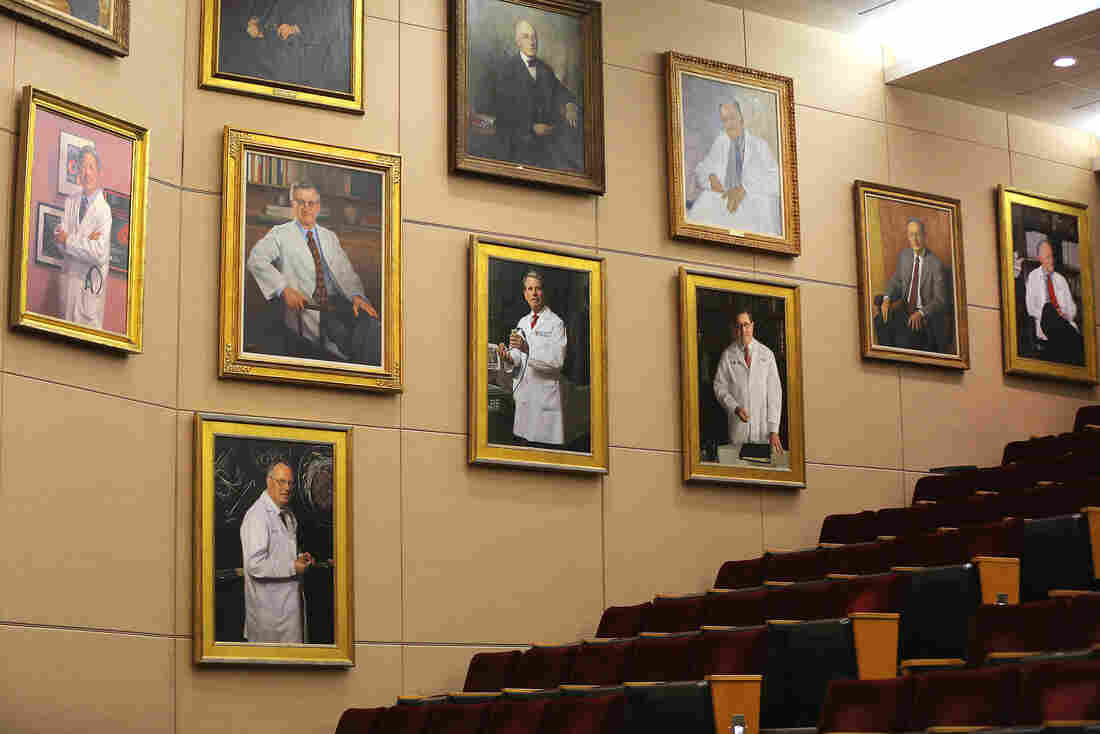
All the portraits hanging on the wall inside the Louis Bornstein Family Amphitheater at Brigham and Women’s Hospital in Boston on June 12, 2018 were of men, nearly all white. The portraits have since been removed.
Pat Greenhouse/Boston Globe via Getty Images
hide caption
toggle caption
Pat Greenhouse/Boston Globe via Getty Images
A few years ago, TV celebrity Rachel Maddow was at Rockefeller University to hand out a prize that’s given each year to a prominent female scientist. As Maddow entered the auditorium, someone overheard her say, “What is up with the dude wall?”
She was referring to a wall covered with portraits of scientists from the university who have won either a Nobel Prize or the Lasker Award, a major medical prize.
“One hundred percent of them are men. It’s probably 30 headshots of 30 men. So it’s imposing,” says Leslie Vosshall, a neurobiologist with the university and the Howard Hughes Medical Institute.
Vosshall says Maddow’s remark, and the word “dude wall,” crystallized something that had been bothering her for years. As she travels around the country to give lectures and attend conferences at scientific institutions, she constantly encounters lobbies, conference rooms, passageways, and lecture halls that are decorated with portraits of white men.
“It just sends the message, every day when you walk by it, that science consists of old white men,” says Vosshall. “I think every institution needs to go out into the hallway and ask, ‘What kind of message are we sending with these oil portraits and dusty old photographs?'”
She’s now on a committee that’s redesigning that wall of portraits at Rockefeller University, to add more diversity. And this is hardly the only science or medical institution that’s reckoning with its dude wall.
At Yale School of Medicine, for example, one main building’s hallways feature 55 portraits: three women and 52 men. They’re all white.
“I don’t necessarily always have a reaction. But then there are times when you’re having a really bad day — someone says something racist to you, or you’re struggling with feeling like you belong in the space — and then you see all those photos and it kind of reinforces whatever you might have been feeling at the time,” says Max Jordan Nguemeni Tiako, a medical student at Yale.
He grew up reading Harry Potter books, and in that fictional world, portraits can talk to the characters. “If this was Harry Potter,” he muses, “if they could speak, what would they even say to me? Everywhere you study, there’s a big portrait somewhere of someone kind of staring you down.”
Yale medical student Nientara Anderson recently teamed up with fellow student Elizabeth Fitzsousa and associate professor Dr. Anna Reisman to study the effect of this artwork; the results were published in July in the Journal of General Internal Medicine.
“Students felt like these portraits were not just ancient, historic things that had nothing to do with their contemporary experience,” says Anderson. “They actually felt that the portraits reinforced contemporary issues of exclusion, of racial discrimination — of othering.”
Yale has recently been commissioning new portraits, including one of Carolyn Slayman, a geneticist and member of the Yale faculty for nearly 50 years, as well as one of Dr. Beatrix Hamburg, a pioneering developmental psychiatrist and the first black female Yale medical school graduate. And there’s an ongoing discussion at Yale about what to do with all those old portraits lining the hallways.
One option is to move them someplace else. That was the approach taken at the department of Molecular & Integrative Physiology at the University of Michigan. Ally Cara, a Ph.D. student there, says its seminar room “featured portraits of our past department chairs, which happened to be all male.”
The 10 or so photographs were lined up in a row. “When our interim chair, Dr. Santiago Schnell began his service a couple years ago, he wanted to bring a more modern update to our seminar room,” Cara says, “including bringing down the dude wall and relocating it.”
The photos are now in a less noticeable spot: the department chair’s office suite. And the seminar room will soon be decorated with artwork depicting key discoveries made by the department’s faculty, students, and trainees.
“We really want to emphasize that we’re not trying to erase our history,” says Cara. “We’re proud of the people who have brought us to where we are today as a department. But we also want to show that we have a diverse and inclusive department.”
Changes like this can be a sensitive subject. At Brigham and Women’s Hospital in Boston, one of Harvard’s teaching hospitals, there’s an auditorium that for decades was covered with large portraits of 31 men.
“It made an impression,” says Dr. Jeffrey Flier of Harvard Medical School, who first saw the wall of portraits back in the 1970’s. But recently, he walked in the auditorium and “was taken aback because, instead of this room filled with portraits of historically important figures from the Brigham, the walls were empty.”
When I last lectured in ?@BrighamWomens? Bornstein auditorium, walls were adorned with portraits of prior luminaries of medicine & surgery. Connecting to a glorious past. Now all gone. Hope everyone is happy. I’m not. (Neither were those I asked- afraid to say openly). Sad. pic.twitter.com/Bsz89r2SBB
— Jeffrey Flier (@jflier) April 12, 2019
The portraits were relocated to different places around the hospital. And while Flier says he understands why there needed to be a change, he prefers the approach taken in another Harvard meeting place called the Waterhouse Room.
It had long been decorated with paintings of former deans, says Flier, and “all of those individuals were white males. I am among them now, hanging up there as the most recent former dean of Harvard Medical School.”
But right up there with Flier’s portrait are photographs of well-known female and African-American physician-scientists, he says, because his predecessor added them to the walls of that room.
“You don’t want to take away the history of which you are justifiably proud,” says Flier. “You don’t want to make it look like you are embarrassed by that history. Use the space to reflect some of the past history and some of the changing realities that you want to emphasize.”
But some argue that the old portraits themselves have erased history, by glorifying white men who hold power while ignoring the contributions to science and medicine made by women and people of color.
One rare exception, and a poignant example of the power and meaning of portraits in science and medicine, can be found at the Johns Hopkins Hospital. There, a black technician named Vivien Thomas worked for a white surgeon named Alfred Blalock. Even though Thomas had only a high school degree, he joined Blalock’s lab in 1930; the pair spent decades developing pioneering techniques for cardiac surgery together.
The last time the two ever spoke, Blalock was in poor health, and in a wheelchair. Together they went to see the portrait of Blalock that had recently been hung in the lobby of the clinical sciences building, which had been named after him.
Soon after that, Blalock died. And a few years later, Thomas received word that a group of surgeons was commissioning a portrait of him. “My first reaction was that surely I must be dreaming,” Thomas wrote in his autobiography, which he originally entitled Presentation of a Portrait: The Story of a Life.
When the portrait was presented to the hospital in 1971, Thomas told the assembled surgeons that he felt proud and humbled. “People in my category are not accustomed to being in the limelight as most of you are,” Thomas said. “If our names get into the print, it’s usually in the very fine print down at the bottom somewhere.”
In his memoir Thomas wrote, “it had been the most emotional and gratifying experience of my life.” He wondered where the portrait would be hung, and thought someplace like the 12th floor, near the laboratory area, would be appropriate. He was “astounded” when Dr. Russell Nelson, then the hospital president, stated “We’re going to hang your fine portrait with professor Blalock. We think you hung together and you had better continue to hang together.”


