Trump Team Hits Brakes On Law That Would Curb Unneeded Medicare CT Scans, MRIs

If a doctor is found to be ordering too many MRI or CT scans or other imaging tests for Medicare patients, a federal law is supposed to require the physician to get federal approval for all diagnostic imaging. But the Trump administration has stalled the law’s implementation.
laflor/Getty Images
hide caption
toggle caption
laflor/Getty Images
Five years after Congress passed a law to reduce unnecessary MRIs, CT scans and other expensive diagnostic imaging tests that could harm patients and waste money, federal officials have yet to implement it.
The law requires that doctors consult clinical guidelines set by the medical industry before Medicare will pay for many common medical scans for enrollees. Health care providers who go way beyond clinical guidelines in ordering these scans (the 5 percent who order the most tests that are inappropriate) will, under the law, be required after that to get prior approval from Medicare for their diagnostic imaging.
But after physicians argued the provision would interfere with their practices, the Trump administration delayed putting the 2014 law in place until January 2020 — two years later than originally planned.
And even then, the Centers for Medicare & Medicaid Services has slated next year as a “testing” period, which means even if a physician doesn’t check the guidelines, Medicare will still pay for the scan. CMS also said it won’t decide until 2022 or 2023 when exactly physician penalties will begin.
Critics worry the delays come at a steep cost: Medicare is continuing to pay for millions of unnecessary exams and patients are being subjected to radiation for no medical benefit.
A Harvard study published in 2011 in the Journal of Urology found “widespread overuse” of imaging tests for men on Medicare who were at low risk of getting prostate cancer. And a University of Washington study in the Journal of the American College of Radiology that reviewed 459 CT and MRI exams at a large academic medical center found 26% of the tests were inappropriate.
“These delays mean that many more inappropriate imaging procedures will be performed, wasting financial resources and subjecting patients to services they do not need,” says Gary Young, director of the Northeastern University Center for Health Policy and Healthcare Research in Boston. “If this program were implemented stringently, you would certainly reduce inappropriate imaging to some degree.”
Doctors order unnecessary tests for a variety of reasons: to seize a potential financial advantage for them or their health system, to ease fears of malpractice suits or to appease patients who insist on the tests.
The law applies to doctors treating patients who are enrolled in the traditional fee-for-service Medicare system. Health insurers, including those that operate the private Medicare Advantage plans, have for many years refused to pay for the exams unless doctors get authorization from them beforehand. That process can take days or weeks, which irks physicians and patients.
CMS Administrator Seema Verma has sought to reduce administrative burdens on doctors with her “patients over paperwork” initiative.
CMS would not make Verma or other officials available for an interview for this story, and answered questions only by email.
A spokeswoman says CMS has no idea how many unnecessary imaging tests are ordered for Medicare beneficiaries.
“CMS expects to learn more about the prevalence of imaging orders identified as ‘not appropriate’ under this program when we begin to identify outlier ordering professionals,” she says.
“It takes four clicks on a computer”
An influential congressional advisory board in 2011 cited the rapid growth of MRIs, CT scans and other imaging, and recommended requiring doctors who order more tests than their peers to be forced to get authorization from Medicare before sending patients for such exams. In the 2014 law, Congress tried to soften that recommendation’s effect by asking doctors billing Medicare to follow protocols to confirm that imaging would be appropriate for the patient.
Studies show a growing number of health systems have used clinical guidelines to better manage imaging services. The University of Virginia Health System found that unnecessary testing fell by between 5% and 11% after implementing such recommendations.
Virginia Mason Health System in Seattle in 2011 set up a system requiring its physicians — most of whom are on salary — to consult imaging guidelines. It would deny claims for any tests that did not meet appropriate criteria, except in rare circumstances. A study found the intervention led to a 23% drop in MRIs for lower back issues and headaches.
Dr. Craig Blackmore, a radiologist at Virginia Mason, says he worries that, unlike the efforts at his hospital, many doctors could be confused by the Medicare program because they have not received the proper training about the guidelines.
“My fear is that it will be a huge disruption in workflow and show no benefit,” he says.
In 2014, AtlantiCare, a large New Jersey hospital system, began grading physicians on whether they consult its guidelines.
“Some doctors see this tool as additional work, but it takes four clicks on a computer — or less than a minute,” says Ernesto Cerdena, director of radiology services at AtlantiCare.
Not all Medicare imaging tests will be subject to the requirements. Emergency patients are exempt, as well as patients admitted to hospitals. CMS has identified some of the most common conditions for which doctors will have to consult guidelines. Those include heart disease, headache and pain in the lower back, neck or shoulders.
Robert Tennant, director of health information technology for the Medical Group Management Association, which represents large physician groups, says the law will unfairly affect all doctors merely to identify the few who order inappropriately.
“For the most part, doctors are well trained and know exactly what tests to perform,” Tennant says.
The association is one of several medical groups pushing Congress to repeal the provision.
American College of Radiology’s role
The law required the federal government to designate health societies or health systems to develop guidelines and companies that would sell software to embed that guidance into doctors’ electronic health record systems.
Among the leaders in that effort is the American College of Radiology, which lobbied for the 2014 law and has been issuing imaging guidelines since the 1990s. It is one of about 20 medical organizations and health systems certified by CMS to publish separate guidelines for doctors.
The college wanted “to get ahead of the train and come up with a policy that was preferable to prior authorization,” says Cynthia Moran, an executive vice president of the radiology group. About 2,000 hospitals use the college’s licensed guidelines — more than any others, she says. And the college profits from that use.
Moran the licensing money helps the college mitigate the costs of developing the guidelines, which must be updated regularly, based on new research. She the college gives away the guidelines to individual doctors upon request and sells them only to large institutions, although she notes they are not as easy to access that way, compared with being embedded in a doctor’s medical records.
Kaiser Health News a nonprofit, editorially independent program of the Kaiser Family Foundation. KHN is not affiliated with Kaiser Permanente.
MLB’s Yankees And White Sox To Play At ‘Field Of Dreams’ Farm

In Iowa, a temporary ballpark will be built to host a game between the New York Yankees and Chicago White Sox next summer.
Major League Baseball
hide caption
toggle caption
Major League Baseball
If they appear, “Shoeless” Joe Jackson and Archibald “Moonlight” Graham will only be there in spirit. But for one night, big leaguers will play baseball at the Iowa farm that was made famous in the beloved film Field of Dreams.
The New York Yankees and Chicago White Sox will face off at the Dyersville, Iowa, farm next August, Major League Baseball announced Thursday. The game will count as part of the regular season — starting a three-game series between the Yankees and White Sox. The two teams will then have one day off as they travel to Chicago to finish out the series.
The game is slated for the night of Aug. 13, 2020 — three decades after Field of Dreams debuted in 1989. But Aaron Judge and his fellow MLB stars won’t be playing on the same diamond that was created for the Kevin Costner movie. Instead, they’ll play at a temporary 8,000-seat ballpark.
“As a sport that is proud of its history linking generations, Major League Baseball is excited to bring a regular season game to the site of Field of Dreams,” MLB Commissioner Robert D. Manfred Jr. said. “We look forward to celebrating the movie’s enduring message of how baseball brings people together at this special cornfield in Iowa.”
According to MLB, the facility will be built adjacent to rows of corn like those that lined the outfield in the movie — and from which the mythical players appeared, fulfilling the whispered prophecy, “If you build it, he will come.” A pathway will connect the site with the movie location.
Celebrating the plan for what will be the first MLB game ever played in her state, Iowa Gov. Kim Reynolds echoed a famous exchange from the film:
“Hey! Is this heaven?”
“No, it’s Iowa.”
In a tweet from MLB, that exchange has now been reedited to show the Yankees’ Judge asking that question of Costner’s character.
Is this heaven?@Yankees–@WhiteSox, see you in Iowa on 8.13.20. pic.twitter.com/5GGbH7TWuq
— MLB (@MLB) August 8, 2019
In addition to the prediction that legendary ballplayers would come to play ball in an Iowa cornfield, Field of Dreams also predicted people would flock to the site. And for years, they’ve done just that, making pilgrimages to soak in the field’s timeless character and to feel the buoyancy that sports can bring.
Now, MLB is hoping fans will want to watch baseball at the Iowa farm. The idea, as James Earl Jones said when he portrayed the character Terence Mann, is that people will come to see their heroes:
“And they’ll watch the game, and it’ll be as if they’ve dipped themselves in magic waters,” Jones said in the film. “The memories will be so thick they’ll have to brush them away from their faces.”
How The CDC’s Reluctance To Use The ‘F-Word’ — Firearms — Hinders Suicide Prevention

In the U.S., firearms kill more people through suicide than homicide.
Joe Raedle/Getty Images
hide caption
toggle caption
Joe Raedle/Getty Images
The nation’s foremost public health agency shies away from discussing the important link in this country between suicide and access to guns.
That’s according to documents obtained by NPR that suggest the Centers for Disease Control and Prevention instead relies on vague language and messages about suicide that effectively downplay and obscure the risk posed by firearms.
Guns in the United States kill more people through suicide than homicide.
Almost 40,000 people died from guns in 2017 alone — 60% of those deaths were suicides. Guns are the most common method used for suicide.
If you or someone you know may be considering suicide, contact the National Suicide Prevention Lifeline at 1-800-273-8255 (En Español: 1-888-628-9454; Deaf and Hard of Hearing: 1-800-799-4889) or the Crisis Text Line by texting HOME to 741741.
Suicide rates are going up in nearly every state, even though research shows that suicide is preventable. Access to guns is such an important risk factor that any effective public education campaign to prevent suicide would surely need to address it.
The trouble is, the CDC is operating under something known as the Dickey Amendment, legislation passed by Congress in 1996 that prohibits the CDC from spending any of its funds to “advocate or promote gun control.”
A lot of attention has been paid to how this has stopped the CDC from funding certain kinds of gun violence research. The law also had another effect: It led the CDC to tiptoe around guns as it tries to tackle the increase in suicides.
“CDC staff do their best to provide the very latest science and evidence-based data to the public so they can protect their health,” a CDC spokesperson told NPR, declining to make any agency official available for an interview.
NPR reviewed early drafts and editing notes of a major 2018 CDC suicide report and a guide on suicide prevention, obtained through a Freedom of Information Act request, along with the agency’s public anti-suicide messages.
The internal documents reveal detailed staff deliberations over wording that resulted in the agency weakening language that might suggest restricting access to guns as a way to prevent suicides.
“Lethal means”
Guns get used in slightly more than half of all suicides. And people who try to kill themselves with a gun almost always die.
But the word “gun” is frequently absent when the CDC presents information on suicide prevention.
A CDC fact sheet published in 2018 on “Preventing Suicide” does not include the word “gun” or “firearm.” Instead, it advises people to “reduce access to lethal means among persons at risk of suicide.”
Where the CDC’s website lists the risk factors for suicide, it also does not include the word “gun.” It says instead “easy access to lethal methods.”
Internal texts exchanged between CDC suicide researchers show why a generic term like “lethal means” is preferred: It “is probably less likely to create issues compared to using the f-word,” which is firearms. A phrase like “access to firearms” would “raise a few red flags.”
Here is one text exchange:
LiKamWa, Wendy (CDC/CCEHIP/NCIPC) 2:56 PM:
haha one of the police articles I saw listed “access to firearms” and I was like, that would raise a few red flags!
Stone, Deborah (CDC/ONDIEH/NCIPC) 2:56 PM:
it’s ok. that’s fair territory!
that’s a big reason why their rates are so high.
we aren’t saying take away their guns!
at least not explicitly!
LiKamWa, Wendy (CDC/CCEHIP/NCIPC) 2:57 PM:
actually, the tiesman et al article (i.e. NIOSH) talks about firearms and access to firearms a lot
Stone, Deborah (CDC/ONDIEH/NCIPC) 2:59 PM:
yeah, it’s more of an issue if we are advocating for gun control. it’s a fact that access is a risk factor.
LiKamWa, Wendy (CDC/CCEHIP/NCIPC) 3:00 PM:
still, “lethal means” is probably less likely to create issues compared to using the F-word
Stone, Deborah (CDC/ONDIEH/NCIPC) 3:00 PM:
very true.
In the past, members of Congress have asked the CDC if agency staffers were told to avoid using the word “gun.” Here’s how the CDC replied:
“To ensure scientific integrity, technical accuracy, consistency with appropriations language, and usefulness to the intended audience, CDC has a standard agency review process for any manuscript or report produced by CDC scientists. … In the course of reviewing manuscripts or reports on firearm violence, CDC has asked employees to use correct terminology — for example, to say ‘died as a result of a firearm-related injury’ vs. ‘died from a firearm’ in the same way as one would write ‘died as a result of a motor-vehicle crash’ vs. ‘died from a car.’ “
But one former CDC official told NPR that of course employees know to censor themselves when it comes to guns.
“There were staff who would say you couldn’t even say the word ‘gun,’ ” recalls Linda Degutis, who used to serve as director of the CDC’s National Center for Injury Prevention and Control. “They would tell other people, or even new people sometimes, you can’t say the word ‘gun’ here.”
She says higher-ups would review documents, “because there would be a thought that if guns were mentioned too often, that would be violating this intent not to do any kind of research or work around guns.”
She says the problem with language like “lethal means” is that it doesn’t convey what people should actually be worried about and what actions they should take when it comes to suicide prevention, such as offering to remove guns from the home of a friend or relative who is going through a personal crisis.
“I think when you say ‘lethal means’ to the general public, they don’t know what you’re saying,” adds Degutis. “They don’t know that you might mean guns.”
“Safe storage” vs. “restricting access”
Another noticeable feature of the CDC’s suicide prevention messaging is the emphasis on “safe storage.”
By that, the agency means keeping guns and ammunition securely locked in a safe. Unlike other measures that could make it more difficult to obtain a gun, “safe storage” isn’t likely to be politically controversial.
Consider the edits made to one internal document prepared to help guide CDC staff in responding to questions about suicide.
The original answer included the words “restricting access to lethal means among those at risk for suicide has been proven effective for preventing suicide.”
One passage got edited to remove any reference to “restricting access.” Instead, the revised answer focused on “safe storage,” saying, “safe storage practices can help reduce the risk for suicide by separating vulnerable populations from easy access to lethal means.”
In a teleconference that the CDC held with reporters in June 2018, when the CDC released a report on rising suicide rates, CDC Principal Deputy Director Anne Schuchat said that “one of our recommendations is assuring safe storage of medications and firearms as one of the approaches to prevention. Very important to — you know, have safe storage.”
Research does show that locking up guns and ammunition can prevent suicidal adolescents from being able to access their parents’ guns.
But the “safe storage” approach doesn’t address the suicide risk that a gun poses to its owner, who presumably has the key or combination to a locked safe or cabinet.
And most gun suicides happen when the owner of the gun turns it on himself or herself.
“I’m a little bit dubious that safe storage will be relevant to the vast majority of suicides with firearms. Because the owners of those firearms are the ones storing the guns and locking the guns,” says Daniel Webster, director of the Johns Hopkins Center for Gun Research and Policy. “I certainly don’t know of any research that shows that safe storage of firearms reduces risks for adult suicide.”
David Gunnell, an epidemiologist at the University of Bristol, was perplexed by the CDC’s focus on safe storage.
“It was all about, if you like, putting the blame on the owners, making them store their firearms safely,” says Gunnell, “rather than seeing this large pool of firearms available in the community in the United States contributing to the heightened use of firearms for suicide.”
In his research on a common means of suicide in Sri Lanka, pesticide ingestion, Gunnell has found that providing locked storage boxes hasn’t been an effective form of prevention. Eventually, he says, families just stop bothering to use the secure box.
What has produced dramatic reductions in suicide rates, he says, has been regulatory bans that took the most dangerous pesticides off the market in certain places.
“So there’s a body of evidence that if you regulate, to make the environment safer by taking out of the broader environment the most toxic products, that results in a fall in deaths,” says Gunnell, because suicide research shows that people do not tend to substitute one suicide method for another.
In fact, Gunnell says, most international reviews of the research literature on suicide have found that the strongest evidence about how to bring down death rates “is around those interventions that restrict access to commonly used, high lethality suicide methods.”
In other countries, that approach has lowered suicide rates by as much as 30% to 50%.
These dramatic decreases are not mentioned in the CDC’s main guide to preventing suicide, described as “a resource to guide and inform prevention decision-making in communities and states.”
It does talk about the need to create “protective environments” and includes the example of “safe storage” of guns. But as the document got edited inside the CDC, its message about the importance of restricting access to “lethal means” got weakened. One early draft stated:
“The evidence for the effectiveness of means restriction and other ways to establish protective environments is some of the strongest in the field.”
The sentence got changed to:
“The evidence for the effectiveness of preventing suicide by reducing access to lethal means and otherwise establishing protective environments for individuals at risk of suicide is strong, particularly compared to existing evidence for other prevention strategies.”
Additional changes produced the final, published version, in which the evidence merely “suggests”:
“The evidence suggests that creating protective environments can reduce suicide and suicide attempts and increase protective behaviors.”
What’s missing?
It’s possible to read the CDC’s materials on suicide and come away not understanding what science shows about how to significantly reduce suicide rates, and the important connection between guns and suicide.
“Half of all suicide deaths in the states are from firearms,” says Gunnell, “and so, as a policymaker, my first step would be to say, ‘Well, what can we do to restrict access to firearms?’ ”
The CDC’s own research shows that simply having a gun in the home is associated with increased risk for suicide, but that isn’t highlighted in its public messages about suicide.
In addition, states that have higher gun ownership rates see higher rates for suicide, “even after you’ve controlled for a range of other factors known to be correlated with suicide risk,” says Webster. “Access to firearms does increase suicide risk. I recognize that is a conclusion that will make people uncomfortable. But that is simply what the facts are.”
When people are going through difficult times or grappling with substance use or mental health issues, says Webster, “it could be, at least temporarily, you can mitigate that risk by having someone else hold the firearms for them.”
Other possible measures might include waiting periods before purchasing guns, licensing processes for gun buyers, or laws that keep firearms from those who are deemed a risk to themselves or others (“red flag” laws).
None of those legislative options get mentioned in the CDC’s guide to strategies for suicide prevention for states and communities.
A spokesperson for the CDC told NPR that “some laws or policies to potentially reduce firearm suicides (e.g., red flag laws) have not been rigorously evaluated. CDC selected examples with ample evaluation using the criteria for inclusion in the front of the technical package. We are always reassessing the evidence and will update the evidence as it becomes available.”
She pointed to one CDC study of firearms and suicides in major metropolitan areas that does briefly mention “safely storing firearms or temporarily removing them from the home.” It also mentions policies to keep firearms away from people under a restraining order for domestic violence, as well as efforts to strengthen the background check system for gun purchases.
Draft documents of the CDC’s guide to suicide prevention show that some researchers at the agency feel that suicide prevention has been hindered by “hesitation to take up strategies known to be effective but perhaps unpopular”:
“Unfortunately, suicide prevention is impeded by barriers including: stigma related to help-seeking, mental illness, being a survivor, or someone with lived experience; fear related to asking about suicidal thought, hesitation to take up strategies known to be effective but perhaps unpopular; misinformation about suicide preventability, harmful messaging about suicide, and disproportionate funding given its public health burden.”
In the final version of that section that was published, some of those barriers to reducing suicide rates go unmentioned:
“There are a number of barriers that have impeded progress, including, for example, stigma related to help-seeking, mental illness, being a survivor and fear related to asking someone about suicidal thoughts.”
What’s actually allowed?
Webster believes that CDC officials have made the choice that it is safest for the agency to tread lightly when it comes to anything related to guns, since Congress controls the CDC’s funding.
“I think that’s a very unfortunate environment that they’ve had to operate in,” says Webster. “But I want people to understand that there is no law in place now that says that CDC can’t talk about the research and what’s been learned about the connection between firearms and suicide risk.”
The exact meaning of what the CDC is or is not allowed to do under the Dickey Amendment has been ambiguous ever since Congress passed the legislation decades ago.
Officials seem inclined to err on the side of caution. The minutes of one meeting to review a report on rising suicide rates showed that one CDC employee told researchers not to mention the often impulsive nature of suicides.
Apparently the official worried that mentioning this fact might turn “it into a removal of lethal means issue,” given that about half the people in the study who killed themselves were not previously known to have a mental health issue. She noted, “I don’t want it to be overly politicized.”
After World Cup Win, Other U.S. Women’s Sports Leagues Ask, ‘What About Us?’

Seattle Mayor Jenny Durkan, center, wears a T-shirt honoring Megan Rapinoe, right, of the U.S. women’s World Cup championship soccer team, and Seattle Storm’s Sue Bird, left, as Rapinoe was introduced during the first half of a WNBA basketball game between the Storm and the Dallas Wings on July 12, 2019 in Seattle.
Elaine Thompson/AP
hide caption
toggle caption
Elaine Thompson/AP
Fans of the World Cup champion U.S. Women’s National Soccer Team are getting what they want.
More.
The team began a victory tour last weekend. It runs until October.
It’s a heady time for women’s soccer. But other women’s sports want to take advantage of the moment as well. And they’re hoping to overcome cultural obstacles that traditionally have made their sports less relevant.
Powerful potential
Five days after the U.S. won the Women’s World Cup, fans of the WNBA’s Seattle Storm welcomed a surprise visitor to the team’s home arena. Even from the cheap seats, the pink/purple hair gave it away.
“Well look who has graced us with her presence,” Storm play-by-play announcer Dick Fain told a television audience. “Is there a more recognizable face in the world of sports over the last month, than that young lady on the right, Megan Rapinoe?!”
Welcome home, CHAMP! ???@mPinoe #WeRepSeattle pic.twitter.com/P88CvUPiar
— Seattle Storm (@seattlestorm) July 13, 2019
Actually this moment wasn’t a shock. Rapinoe and Storm star Sue Bird are one of Seattle’s “it” couples. Still, Rapinoe’s appearance and standing ovation from an arena full of basketball fans, was a reminder of the powerful crossover potential of the women’s World Cuppers.
“For me it was just simply hopeful,” said Storm CEO and General Manager Alisha Valavanis. “That that awareness would continue to expose the country and the globe to the other sports.”
Like ice hockey, lacrosse, softball, pro soccer … and basketball, the most prominent of this country’s women’s professional sports.
A complex game
It would be wonderful, Valavanis said, if this awareness of the Women’s National Soccer Team and exposure to the others, were like a magic wand. That could wave away the chasm separating women’s and men’s pro sports, on issues of money, visibility and relevance.
But there’s no magic wand.
“This is a complex game,” Valavanis said, adding, “there is no quick fix to….the gap.”
Talking is a start.
Rapinoe and her soccer teammates have done plenty of that, about the gap in pay and inferior working conditions. WNBA players are confronting similar issues. Seattle forward Alysha Clark said they’ve been newly-inspired by the soccer team.
“They’re helping grow the confidence of women athletes,” Clark said, “to speak up for what we feel is right.”
An uncomfortable truth
But if a conversation about women’s sport truly has been sparked by the success and audacity of the U.S. Women’s National Team, ultimately it has to also confront an uncomfortable truth.
“Whatever sport is out there that women are trying to make their way professionally,” said Storm co-owner Ginny Gilder, “the biggest problem is the extent, the depth of what I would call invisible and cultural bias against women professional athletes.”
Gilder has owned the Seattle Storm with two other women since 2008. As an undergraduate rower at Yale in the 1970’s, she took part in a Title IX protest – Title IX is the federal law that, among other things, bans gender discrimination in girl’s and women’s sports. Gilder says the protest radicalized her and made her keenly aware of the bias.
“I think we make an assumption, it’s a very deeply held assumption,” she said, “that men are more important. And you actually start seeing that in sports at a very young age.”
“[Even at] 10 years old, boys are starting to have more fans. By the time you get to high school, this interest in supporting boys’ sports has been well established.”
The choice of what to watch
The traditional argument is that male sports are better. Because the athletes mostly are bigger, stronger, faster. Gilder says it’s what often tips the balance when fans have a choice – between paying money to watch a men’s pro sporting event, or a women’s.
“But who decides that?” Gilder asked. “Who decides that women’s basketball isn’t interesting?”

Ginny Gilder at her home in Seattle. Gilder, who won a silver medal in rowing at the 1984 Olympics, owns the Seattle Storm with two other women.
Tom Goldman/NPR
hide caption
toggle caption
Tom Goldman/NPR
Storm CEO Valavanis places some of the blame on mainstream sports media.
“What if we started to play more highlights of the women?” Valavanis said. “Would we then have those individuals, watching and saying ‘gosh I need to see the dunk. I’m only interested if they’re as fast and strong as the men.’ Or is that something we perpetuate because it’s exactly what you’re watching every day?”
Certainly the choice isn’t always to watch men.
At a recent WNBA game in Washington, D.C., Washington Mystics fan Teresa Tidwell said she’s had the choice of basketball games. And she prefers the women.
“I think in women’s basketball, particularly in women’s professional basketball, the team play is better,” Tidwell said. “In men’s professional basketball it’s a lot of run and gun. It’s not really very entertaining from my point of view.”
The WNBA hasn’t had enough Teresa Tidwell’s.
In each of its 23 seasons, the league reportedly has never made a profit. Building up attendance is an ongoing problem. Heading into the recent WNBA All-Star break, Seattle ranked fourth out of 12 teams in total attendance. Still the Storm does what it can to bring fans to games. Including a promotion offering free tickets…for donated blood.
Twenty-nine-year-old Jordan Lake and two friends took advantage of the deal at a recent home game. Their first WNBA experience.
“It’s entertaining,” Lake said, watching the Storm play the Las Vegas Aces. “I’ve grown up with sports. I love sports. You’ve got to find something else to watch in the off-season of football, I suppose.”
Not exactly a ringing endorsement. Despite the athleticism on display in a tight, competitive game, Lake said he probably wouldn’t come back if he had to pay for a ticket.
Not betting, but hopeful
In the face of resistance, still, is there the chance to nudge a cultural change more toward women’s sports?
“I absolutely believe that it’s possible, said Storm co-owner Gilder. “At the same time, I’m a business person and I’ve been in this business for 12 years and I’m not betting on it.”
But she’s hardly giving up, either.
“I am a believer in progress,” Gilder said. “And without showing up and agitating in some way, then you’re wishing. That’s your choice. Agitate or wait.”
“Is this a pivotal moment?” she asked. “Has the Women’s World Cup team been able to bring more awareness in a way that individual Americans start looking at themselves, not in a critical way but like….’oh my gosh [women’s professional sports] could be fun to be part of,’ or ‘I want to do this,’ or maybe a little bit of ‘I should do this.'”
“I hope so.”
A new WNBA plan could help fuel Gilder’s hope.
This fall and winter, some of the league’s best players will tour the country as part of the lead-up to next summer’s Olympics in Tokyo. The training and games will also help increase visibility and connect players more with fans.
Seattle guard Sue Bird helped come up with the idea.
Her inspiration, in large part, was the electric experience of the U.S. Women’s National Soccer team.
Why Competition Hasn’t Brought Down The High Price Of Snakebite Treatment

Tais Policanti/Getty Images
Dr. Steven Curry, a medical toxicologist and professor at the University of Arizona, has treated snakebites since the 1980s — long enough to remember when the treatment represented its own form of misery.
The first medication Curry used sometimes caused an immune reaction called serum sickness — patients broke out in a severe, itchy rash. Then, about 20 years ago, the snake antivenin CroFab entered the market and dramatically reduced the adverse reactions associated with treatment, he says.
But the drug came with a sky-high price tag. In one case reported by NPR and Kaiser Health News, an Indiana hospital last summer charged nearly $68,000 for four vials of CroFab.
Now, CroFab faces competition from a snake antivenin called Anavip. Curry says the health system he works for in Phoenix — Banner Health — is using the new drug as its first line of treatment. It is switching, he says, because Anavip could reduce readmissions by better controlling bleeding associated with a snakebite and lead to “substantial savings” for the hospital.
But few experts who study drug laws and drug prices expect this competition to reduce the cost for patients. Legal wrangling, the advantageous use of the patent system and the regulatory hurdles in creating cheaper alternative drugs stymie any serious price competition.
Indeed, the antivenin can be considered a case study of why drug prices are so high: Head-to-head competition between brand-name medicines may not meaningfully reduce prices.
“When we allow a system of perverse incentives to flourish, this is the result we get,” says Robin Feldman, a professor at University of California, Hastings College of the Law in San Francisco, who specializes in pharmacy law.
After being approved by the Food and Drug Administration in 2000, CroFab was the only commercially available snake antivenin in the United States.
That gave the drug’s British manufacturer, BTG, “a lot of latitude to determine what price it’s going sell its product at,” says Aaron Kesselheim, a faculty member at Brigham and Women’s Hospital in Boston, who studies pharmaceutical policy.
The Centers for Disease Control and Prevention reports that roughly 8,000 people in the U.S. each year are bitten by venomous snakes, which means there’s not a huge market for antivenin. But victims desperately need the remedy. Snake venom can cause tissue damage, hemorrhaging and respiratory arrest — in other words, a painful death.
Having had the market all to itself for years, CroFab has quadrupled in price since its launch, according to data from the health technology company Connecture. Today, the list price for wholesalers for the medicine is $3,198 a vial and the recommended starting dose for a patient is between four and six vials.
CroFab generated more than $132 million in revenue for its parent company, according to BTG’s 2019 annual report. The antivenin represented 14% of the firm’s total revenue.
Anavip, the competitor drug that was launched in October, is priced at $1,220 per vial for wholesalers, and the recommended initial dose is 10 vials.
That’s a “sustainable price that keeps us in business,” says Jude McNally, president of Rare Disease Therapeutics, a Tennessee-based company that markets Anavip in the U.S. (The drug is made by a Mexican company.) McNally says he has no plans to lower the price.
In practice, the prices for these drugs are closer than they appear.
Doctors need to use a higher starting dose of Anavip than of CroFab. Taking that into account, the difference in wholesale price from Anavip shrinks to about $500.
McNally says RDT “has done what we can to reduce initial and subsequent health care costs” with Anavip. He also noted that the package insert for CroFab recommends that patients receive additional doses on a timed schedule if needed to control the damage from the snakebite, making treatment more expensive.
In general, Kesselheim says, direct competition between two drugs can reduce prices for consumers by 15% to 20%. But “if you’re starting at a very high price,” he says, “it may not be helpful for patients.”
Cheaper, alternative versions of brand-name drugs can drive prices down. But an analysis by Kesselheim and his colleagues, described in the New England Journal of Medicine in 2017, found this tends to happen only after three or more generic drug manufacturers enter the market. At that point, the increased competition can offer generic drugs that are priced at 60% (or less) of the brand name’s initial price per dose.
That didn’t happen with antivenin. Manufacturers face bureaucratic challenges to making a cheaper, copycat drug to compete with CroFab and Anavip. These snake antivenins are biologic drugs — complex medicines made from live cells. Congress created a unique pathway for the FDA to greenlight cheaper equivalents to biologics, called biosimilars, in 2009.
As of July 23, the agency has approved 23 biosimilars. In contrast, European countries enjoy a larger, thriving market of biosimilars that are sold at a fraction of the U.S. cost.
In the U.S., even when the FDA approves another drug, the maker can manipulate the patent process to keep competitors out. A patent allows a drug manufacturer to claim ownership of certain product information and bar others from making, using or selling a drug based on the protected content for 20 years. This gives manufacturers a powerful edge – they can sue potential competitors for patent infringement.
“The most creative activity in the drug company should be in the lab, not in the legal department” says Hastings law professor Feldman, paraphrasing a former FDA commissioner.
Indeed, it was lawyers who helped BTG make even more money. When the makers of Anavip first wanted to enter the snake antivenin market in 2013, BTG sued them; the companies settled the case in 2014. In the agreement, Anavip promised to pay BTG royalties on its sales of antivenin until 2028.
BTG intends to maintain its market dominance, says spokesman Chris Sampson, by using strategies that include improving the CroFab formula. He also says the company doesn’t plan to lower the drug’s price.
“If your question is ‘Are we ready for the competition?’ ” Louise Makin, CEO of BTG, told investors in a May 2018 earnings call, “we are ready — we are absolutely ready.”
Kaiser Health News is a nonprofit, editorially independent program of the Kaiser Family Foundation. KHN is not affiliated with Kaiser Permanente.
Coordinating Care Of Mind And Body Might Help Medicaid Save Money And Lives

John Poynter of Clarksville, Tenn., uses a wall calendar to keep track of all his appointments for both behavioral health and physical ailments. His mental health case manager, Valerie Klein, appears regularly on the calendar — and helps make sure he gets to his diabetes appointments.
Blake Farmer/WPLN
hide caption
toggle caption
Blake Farmer/WPLN
In modern medicine, the mind and body often stay on two separate tracks in terms of treatment and health insurance reimbursement. But it’s hard to maintain physical health while suffering from a psychological disorder.
So some Medicaid programs, which provide health coverage for people who have low incomes, have tried to blend the coordination of care for the physical and mental health of patients, with the hope that it might save the state and federal governments money while also improving the health of patients like John Poynter of Clarksville, Tenn.
Poynter has more health problems than he can even recall. “Memory is one of them,” he says, with a laugh that punctuates the end of nearly every sentence.
He is currently recovering from his second hip replacement, related to his dwarfism. Poynter is able to get around with the help of a walker — it’s covered in keychains from everywhere he’s been. He also has diabetes and is in a constant struggle to moderate his blood sugar.
But most of his challenges, he says, revolve around one destructive behavior — alcoholism.
“I stayed so drunk, I didn’t know what health was,” Poynter says, with his trademark chuckle.
Nevertheless, he used Tennessee’s health system a lot back when he was drinking heavily. Whether it was because of a car wreck or a glucose spike, he was a frequent flyer in hospital emergency rooms, where every bit of health care is more expensive.
The case for coordination of mind-body care
Tennessee’s Medicaid program, known as TennCare, has more than 100,000 patients who are in similar circumstances to Poynter. They’ve had a psychiatric inpatient or stabilization episode, along with an official mental health diagnosis — depression or bipolar disorder, maybe, or, as in Poynter’s case, alcohol addiction. And their mental or behavioral health condition might be manageable with medication and/or counseling, but without that treatment, their psychological condition is holding back their physical health — or vice versa.
“They’re high-use patients. They’re not necessarily high-need patients,” says Roger Kathol, a psychiatrist and internist with Cartesian Solutions in Minneapolis, who consults with hospitals and health plans that are trying to integrate mental and physical care.
As studies have shown, these dual-track patients end up consuming way more care than they would otherwise need.
“So, essentially, they don’t get better either behaviorally or medically,” Kathol says, “because their untreated behavioral health illness continues to prevent them from following through on the medical recommendations.”
For example, a patient’s high blood pressure will never be controlled if an active addiction keeps them from taking the necessary medication.
But coordinating mental and physical health care presents business challenges — because, usually, two different entities pay the bills, even within Medicaid programs. That’s why TennCare started offering incentives to reward teamwork.
Health Link
TennCare’s interdisciplinary program, known as Tennessee Health Link, was launched in December 2016. The first year, the agency paid out nearly $7 million in bonuses to mental health providers who guided patients in care related to their physical health.
TennCare has a five-star metric to gauge a care coordinator’s performance, measuring each patient’s inpatient hospital and psychiatric admissions as well as visits to emergency rooms. Providers are eligible for up to 25% of what’s calculated as the savings to the Medicaid program.
Studies show this sort of coordination and teamwork could end up saving TennCare hundreds of dollars per year, per patient. And a 2018 study from consulting firm Milliman finds most of the savings are on the medical side — not from trimming mental health treatment.
Savings from care coordination have been elusive at times for many efforts with varying patient populations around the U.S. A TennCare spokesperson says it’s too early to say whether its program is either improving health or saving money. But already, TennCare is seeing these patients visit the ER less often, which is a start.
While there’s a strong financial case for coordination, it could also save lives. Studies show patients who have both a chronic physical condition and a mental illness tend to die young.
“They’re not dying from behavioral health problems,” points out Mandi Ryan, director of health care innovation at Centerstone, a multistate mental health provider. “They’re dying from a lack of preventive care on the medical side.”
“So that’s where we really started to focus on how can we look at this whole person,” Ryan says.
But refocusing, she says, has required changing the way physicians practice medicine, and changing what’s expected of case managers, turning them into wellness coaches.
“We don’t really get taught about hypertension and hyperlipidemia,” says Valerie Klein, a care coordinator who studied psychology in school and is now an integrated care manager at Centerstone’s office in Clarksville, Tenn.
“But when we look at the big picture,” Klein says, “we realize that if we’re helping them improve their physical health, even if it’s just making sure they got to their appointments, then we’re helping them improve their emotional health as well.”
Klein now helps keep Poynter on track with his treatment. Her name appears regularly on a wall calendar where he writes down his appointments.
Poynter calls Klein his “backbone.” She helped schedule his recent hip surgery and knows the list of medications he takes better than he does.
Klein acknowledges it’s a concept that now seems like an obvious improvement over the way behavioral health patients have been handled in the past. “I don’t know why we didn’t ever realize that looking at the whole person made a difference,” she says.
This story is part of NPR’s reporting partnership with Nashville Public Radio and Kaiser Health News.
The Thistle & Shamrock: From The Archives, Part 1

Cathie Ryan is one of the artists featured on this week’s episode of The Thistle & Shamrock.
Joe Sinnott/Courtesy of the artist
hide caption
toggle caption
Joe Sinnott/Courtesy of the artist
It’s a bit like browsing through a photo album where the memories are captured in sounds, not images. Join Fiona Ritchie as she delves into her archives to re-visit highlights from the past decade of radio shows featuring artists John Doyle, Peggy Seeger and Cathie Ryan.
Opinion: Speeding Up Baseball To Save It

Sports commentator Mike Pesca wonders whether Major League Baseball will modernize to attract a young audience, and how it will keep them for life.
Women’s World Cup Bump — Short-Lived Or Longer?

Before the Dash and Sky Blue FC match, a ceremony honors Dash members who played during the World Cup.
Ilana Panich-Linsman for NPR
hide caption
toggle caption
Ilana Panich-Linsman for NPR
It’s been a month since the U.S. Women’s National Soccer Team won a second straight World Cup, and gained rock star popularity in the process.
Since the win, the goal has been to capitalize on that success.
U.S. Soccer Federation president Carlos Cordeiro has been at odds with the women’s team on issues of pay and working conditions. Still, Cordeiro understands the importance of maintaining USWNT momentum.
“If you love these players of the World Cup,” he said at a victory celebration in New York City, “then come out and cheer on your local teams, NWSL teams, this year.”
The NWSL is the women’s pro soccer league in the U.S. Now in its seventh year, it helped develop the World Cup heroes – all 23 who went to France, play in the league. But it’s still somewhat unknown.

Carli Lloyd, a veteran of the U.S. National Team and current member of Sky Blue FC, is interviewed by the press after the team’s loss to the Dash.
Ilana Panich-Linsman for NPR
hide caption
toggle caption
Ilana Panich-Linsman for NPR
“There are a lot of people out there that don’t even know there’s a league that exists,” said Carli Lloyd, “That’s a problem.” The U.S. National Team veteran and current member of the NWSL’s Sky Blue FC echoes Cordeiro’s call to action.
“It’s about awareness,” Lloyd said.
World Cup Bump
In the National Women’s Soccer League, World Cup bump is a relative term.
In soccer hotbed Portland, Ore., the NWSL’s Thorns drew a whopping post-World Cup crowd of more than 22-thousand. Orlando had its biggest attendance in two years. Even in Houston, where major pro teams like the Rockets, Astros and Texans dominate the sports landscape, the NWSL’s Dash had a season-high turnout at its first home game after the World Cup.
“We drew just under [5,500],” said Zac Emmons, the Dash’s senior director of Communications. “For Dash games we sell the lower bowl of [BBVA Stadium]. We had the entire lower bowl sold out. [We] actually had to open some upper level sections to accommodate the crowd.”

Fans watch the match from the lower-level of a nearly empty stadium in Houston.
Ilana Panich-Linsman for NPR
hide caption
toggle caption
Ilana Panich-Linsman for NPR
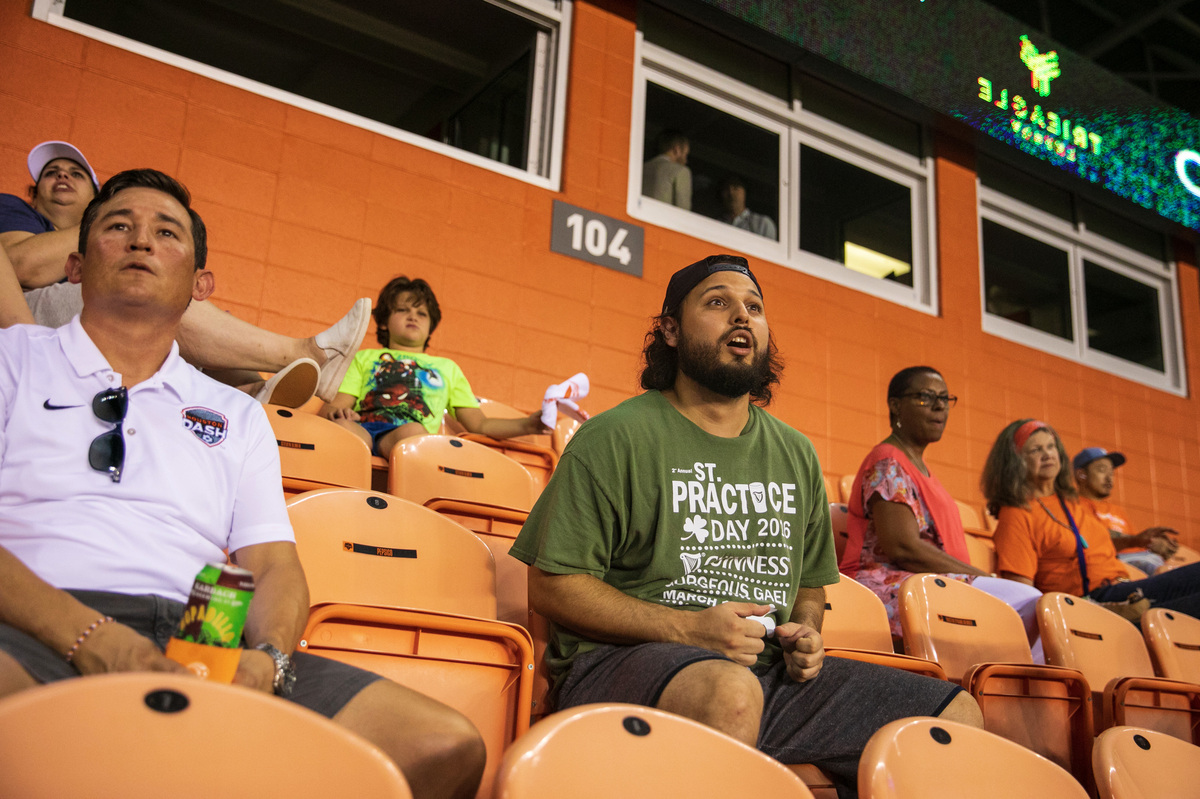
At the second post-World Cup game, the energy was there, but the paying customers – not so much.
This time, 3,500 people showed up on a hot, sticky Sunday night. Including some who still wanted to make a statement.
“I read a call to action, and that’s what I’m doing,” said Houston resident Marco Gomez, “I’m doing it. I’m acting.”

Marco Gomez, 30, watches the match. He says a call to support women’s soccer on Instagram is what got him coming to this game.
Ilana Panich-Linsman for NPR
hide caption
toggle caption
Ilana Panich-Linsman for NPR
Gomez, a 30-year-old hospital technician in Sugarland, Texas, explained what brought him to his first-ever Dash game.
“I was on Instagram,” he said, “and I read that the U.S. World Cup team was fighting for equal pay. One of the comments was a question addressed to Alex Morgan – it was like ‘hey Alex, what can we do to help out? What’s the most effective way?'”
“And the reply was, go support women’s soccer at all levels. That makes sense. So that’s what I’m doing.”
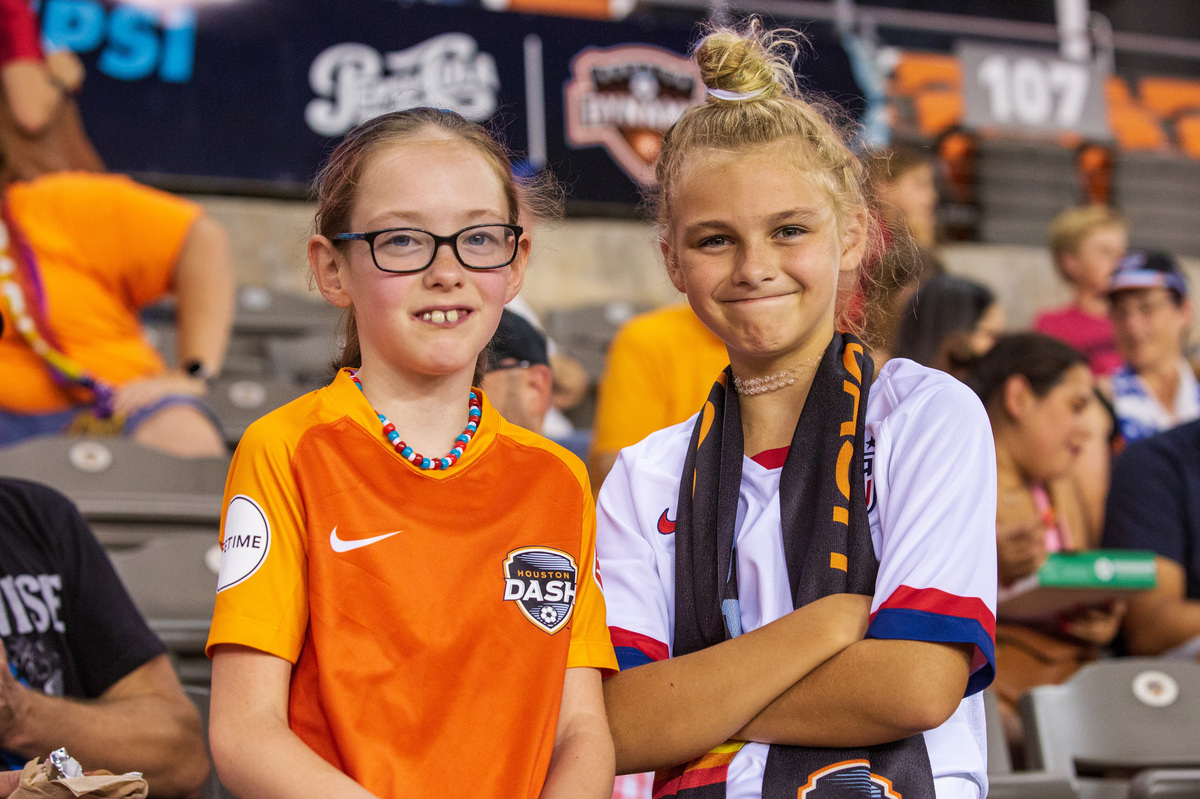
Gomez, wearing a backwards baseball cap and sipping a beer, sat and watched by himself. A few sections over, 9-year-old Remy Haguewood sat surrounded by family members. She’s been to lots of Dash games, but was as excited as ever, decked out in a white U.S. Soccer jersey and Houston Dash scarf.

Ava Martin (left), 9, and her friend Remy Haguewood (right), 9, pose for a portrait during the match.
Ilana Panich-Linsman for NPR
hide caption
toggle caption
Ilana Panich-Linsman for NPR
“I love soccer and I love the drums,” she bubbled, “they play the drums also [the Dash supporter group Bayou City Republic]. So it’s just awesome to be here.”
And, said her mom Lacy Haguewood, it’s also necessary.
“It’s very important to stay dedicated,” Lacy said, “to stay strong for these women. They go to work every day. Carli Lloyd just played for the World Cup and now she’s here [Lloyd’s Sky Blue team was playing the Dash]. Everyone knows who she is. You just have to stay the course and do what we do and that’s show up every day.”
Goal so good we have to take a look from every angle ?#DashOn pic.twitter.com/a4IfsCY7PD
— Houston Dash (@HoustonDash) July 30, 2019
Not Enough
On this night, the dedication of fans like the Haguewoods’ was rewarded midway through the first half.
That’s when Dash forward Rachel Daly blasted a shot from close range into the upper left corner of the Sky Blue goal. It was the only score in a one-nil Houston win over Sky Blue. Despite her starring role, though, Daly was not to be trifled with.
In the autograph line afterwards, where NWSL players work tirelessly to connect with fans, Daly reminded autograph-hungry little girls that manners matter.

Left: Girls hold small soccer balls to get them signed by players after the game; Right: Layla Reese, 8, has a Houston Dash logo painted on her cheek.
Ilana Panich-Linsman for NPR
hide caption
toggle caption
Ilana Panich-Linsman for NPR
“If you say please,” Daly said to a group of kids, who hadn’t said the magic word. “I know your mom told you to say that.”
One pre-teen fan responded quickly.
“Will you please sign my card?” the girl asked. “‘Cause you said please, I will,” Daly replied.
After she made her way through the line, I asked Daly if she thought the NWSL was getting the World Cup bounce people said it should.
Again, no nonsense.
“No, I actually don’t,” she said. “I think some places are, others aren’t. Y’know I don’t think there were enough people out there for us tonight.”
Promoting Others
Daly was on England’s Women’s World Cup team, which lost to the U.S. in the tournament’s semi-finals. She wondered if Houston lagged in the stands because no U.S. National Team members play for the Dash.
Team spokesman Zac Emmons says Houston has had USWNT members, but because of trades, doesn’t now. He’s not certain that has an impact on attendance. Emmons does say it’s natural you’ll see a bigger bump that first game back [after the World Cup].
“It’s a challenge for us to keep those people coming back,” he said, “to continue engaging with them on a week in, week out basis.”

Fans react to a play on the field.
Ilana Panich-Linsman for NPR
hide caption
toggle caption
Ilana Panich-Linsman for NPR
This kind of regression toward the mean is natural as the World Cup glow fades. All the more reason, said women’s soccer writer RJ Allen, for the NWSL to promote others.
“Building up players that are sort of stalwarts for the league itself,” said Allen, “highlighting those players and showing off more than just the Alex Morgan’s or Tobin Heath’s or Alyssa Naeher’s is a key. [The league] has to build up a recognizable base of players that have nothing to do with U.S. Women’s National Team.”
That should be easier thanks to a new ESPN TV deal, essentially broadcasting a national game-of-the-week. The league also secured a major sponsorship with Budweiser.
Allen, the editor-in-chief of Backlinesoccer.com, said those deals help; but more has to happen.
“I think a TV deal,” she said, “a true legitimate every-game-is-somewhere-on-television [deal], I think that is a giant thing the league is lacking.”
And while the U.S. National Team members battle for equal pay with U.S. Soccer (which pays their salaries), the NWSL, Allen said, would do well to pay its non-USWNT players more.
“You’re having players come out of college at 21, 22,” she said, “with degrees from Stanford and University of North Carolina and Duke and a lot of really good colleges, and you’re paying them $17,000 minimum salary, and they have job offers on the table for two or three or four times that.”
“So keeping that talent in the league, growing that talent, having players earn 30,000 minimum, something like that would definitely help the league because it would keep that talent.”
A New Rallying Cry











Houston Dash team member and member of England’s World Cup team Rachel Daly takes a selfie with fans after the game.
Ilana Panich-Linsman for NPR
hide caption
toggle caption
Ilana Panich-Linsman for NPR
Despite the changes for which Allen and others advocate, there’s general consensus the NWSL is the most competitive women’s pro soccer league in the world. It’s where the best soccer players go to hone their games.
And Allen said the public needs to know that.
“The reason the U.S. won the second [straight] World Cup is directly because of the NWSL,” she said. “Because of players like Sam Mewis and Lindsey Horan playing in the NWSL and getting better because of this league. And without it, it becomes a lot less certain the U.S. is going to keep [its] dominance in the world.”
Meaning, the rallying cry, “If you love the World Cup winners, please support the NWSL,” should perhaps be a bit more hard-edged.
“If you love the World Cup winners, you better support the NWSL.”
This Time, Franky Zapata Makes It Across The English Channel On A Hoverboard


French inventor Franky Zapata has successfully flown over the English Channel on a personal flying machine.
Steve Parsons/AP
hide caption
toggle caption
Steve Parsons/AP
French inventor Franky Zapata made history as the first person to cross the English Channel by hoverboard, taking off Sunday from Sangatte on France’s northern coast and touching down near Dover, England.
The elite jet skier’s daring display over the 22-mile channel between France and the U.K. took just over 20 minutes. It seems nobody else has ever tried to cross the body of water by hoverboard, which in Zapata’s case was powered by a backpack full of fuel.
“I’m feeling happy. … It’s just an amazing moment in my life,” Zapata told reporters after landing, according to The Associated Press.
The board moved quickly — almost immediately after takeoff, Zapata rose high in the sky and blasted forward, standing up on his invention as he faded off into the distance above the water. The crowd clapped as they saw him off from the beach.
YouTube
The wind above the channel posed challenges, he said, because gusts required him to constantly adjust his body’s position.
“Your body resists the wind, and because the board is attached to my feet, all my body has to resist to the wind,” Zapata told reporters in England. “I tried to enjoy it and not think about the pain.”
The accomplishment probably felt especially sweet because a previous attempt last month ended dramatically. Zapata attempted to land on a platform on a boat to refuel in the middle of that journey but ended up plunging into the water.
This time, Reuters reported, he used a larger boat and a larger platform.
This type of hoverboard isn’t Zapata’s first invention. One of them, called a Flyboard, enables users to fly out of the water and up into the air, shooting out jets of water and even doing flips.

Zapata celebrates on Sunday after crossing the English Channel on a jet-powered hoverboard.
Steve Parsons/AP
hide caption
toggle caption
Steve Parsons/AP