Are Doctors Overpaid?

05 February 2019, Lower Saxony, Hannover: Medical students practice in the "Skills Lab" of the Hannover Medical School.

picture alliance/Julian Stratenschulte/picture alliance via Getty Images

NOTE: This is an excerpt of Planet Money’s newsletter. You can sign up here.

Every year, medical students apply for residencies at hospitals around the country through the National Resident Matching Program. It’s like a dating app for med students and hospitals, and it culminates this Friday, which is Match Day, when more than 30,000 students find out who they’ve got a really long date with.

Constanza Gallardo/Creative Commons/NPR

Some people view Match Week as a beautifully engineered dance between supply and demand that ensures the best and brightest learn how to be good doctors at top hospitals. Others, like Dean Baker, Senior Economist at the Center for Economic and Policy Research, say this residency system makes health care dramatically more expensive for Americans. A 2011 study in Health Affairs found American doctors, who make an average salary of almost $300,000, are paid around twice as much as doctors in other rich countries.

Baker says “doctors are seriously overpaid” and a big reason is rules that restrict the number of people who can get residencies. He calls these rules the work of “a cartel,” and in economics, those are fighting words. A cartel limits the supply of something in order to increase the amount of money they can charge. The Organization of the Petroleum Exporting Countries, or OPEC, is a classic example.

The residency bottleneck

Baker argues that the U.S. residency system turns away thousands of perfectly qualified students every year. These include many foreign doctors, who are barred from practicing here unless they complete a residency within the country. While the number of residencies has increased about 26% over the last decade, Baker (and the Association of American Medical Colleges) argues it’s a bottleneck preventing an adequate supply of doctors.

Most of the funding for residencies comes from the Medicare program, and Congress capped the number of residencies the program funds in 1997. “It was originally frozen as a response to lobbying from doctors who were complaining that there were too many doctors,” Baker says. Trade groups for doctors have also been lobbying against allowing nurse practitioners, physician assistants and other medical professionals to play a larger role in treating patients. The result of policies like these, Baker argues, is a market with less competition, driving up prices for everyone.

Baker estimates that the salaries of the roughly one million doctors in the U.S. account for about eight percent of total healthcare spending. He estimates that allowing an increased supply of doctors to lower their salaries to competitive levels would save Americans $100 billion a year — or roughly $300 per person.

A second opinion

There are strong arguments that doctors aren’t overpaid. They are highly skilled professionals who save lives and have the brains and work ethic to make lots of money in other sectors, like law or finance. On top of that, many work long hours and are saddled with lots of student debt after years of education.

The American Medical Association, one of the main organizations representing U.S. doctors, says the total number of doctors has more than quadrupled since 1965, greatly outpacing population growth. The association says it’s “actively working to alleviate a maldistribution of physicians that is responsible for [a doctor] shortage in many states.” This includes increasing the size and number of med schools and funding for residencies. It currently supports the Resident Physician Shortage Reduction Act of 2019, which would increase the number of Medicare-funded residency slots by 15,000 over five years.

But, Baker argues, just because the AMA now supports expanding the number of residencies doesn’t mean they and other doctor organizations don’t have their fingers on the scale. “OPEC sometimes votes to increase the supply of oil,” Baker says. “That doesn’t mean that OPEC isn’t restricting the supply of oil and pushing up the price.”

But what about economists…

Awkwardly, it did occur to us that there might be another cartel of professionals limiting their supply in order to increase their incomes. It’s a group we talk a lot about at Planet Money: economists. Are they also colluding to make it hard to enter their ranks?

“It is somewhat of a cartel,” Baker says about his profession. “So, yeah, there’s a natural tendency for any profession to try to limit its supply and push up wages for its members, but really none have been as successful as doctors.”

Did you enjoy this newsletter? Well, it looks even better in your inbox! You can sign up here.

Let’s block ads! (Why?)

Former Royal Marine Becomes 1st Amputee To Row Solo Across Atlantic

Lee Spencer, a 49-year-old single-leg amputee, celebrates after rowing solo across the Atlantic.

Anthony Upton via Getty Images


hide caption

toggle caption

Anthony Upton via Getty Images

Ninety-six days, 12 hours, 45 minutes. That was the record for an able-bodied person to do an unsupported row solo across the Atlantic Ocean from east to west.

Former Royal Marine Lee Spencer did it in 60 days. And Spencer, an amputee, did it with one leg — becoming the first disabled person to row unsupported from mainland Europe to South America, according to the BBC.

“No one should be defined by disability,” the 49-year-old told reporters after he smashed the able-bodied record.

HE’S ONLY JUST GONE AND BLOODY DONE IT! Lee has smashed the able-bodied record for rowing the Atlantic, solo, from mainland Europe to mainland South America, by a whopping 36 days #NotDefinedByDisability

— Lee Spencer (@_leejspencer) March 11, 2019

Spencer, a veteran of Afghanistan and Iraq, lost his leg in a 2014 Good Samaritan incident gone wrong. According to the Telegraph, he was helping extricate people from a car crash when another vehicle crashed, severing his leg below the right knee.

While in the hospital, Spencer met another veteran who inspired him to join an all-amputee rowing team, which in 2016 became the first amputee team to cross the Atlantic. Spencer then decided to make the journey solo, raising money for the Royal Marines Charity and the Endeavour Fund.

He set off Jan. 9, battling 40-foot waves, two bouts of gastroenteritis and the temptation of a bottle of whiskey he had brought with him. He often considered having a spot of whiskey at night, he told reporters, but he stopped himself. You can’t drink anything on this journey, he said, “because you are just waiting constantly for something to go wrong, and you’ve got to react instantly.”

Spencer completed the 3,800-mile journey early Monday, Guyana time.

“If I can beat a record, an able-bodied record, as a disabled man … that is the reason why I wanted to do that,” Spencer told the BBC. “To prove that no one should be defined by disability.”

[embedded content]

YouTube

Let’s block ads! (Why?)

Fresh Challenges To State Exclusions On Transgender Health Coverage

Anna Lange, who works for the sheriff’s office in Houston County, Ga., discovered that her health insurance plan excludes transgender services. She is seeking to challenge that policy.

Audra Melton for NPR


hide caption

toggle caption

Audra Melton for NPR

When Sgt. Anna Lange moved with her young family from Columbus, Ga., to the state’s more rural Houston County, her main priority was being able to stay near her son.

After five years of marriage — and many more years of internal turmoil — Lange had realized that despite being assigned male at birth, she’d felt female her entire life.

She had decided to undergo gender transition and knew it would eventually end her marriage. She also knew her soon-to-be ex-wife would want to move back home to Houston County, an hour and a half’s drive from Columbus.

“I wasn’t going to be that far from my son,” Lange said. “It wasn’t like I was thinking of, you know, the super-open community,” she said with more than a hint of sarcasm.

Although she’d loved working at the police department in Columbus, she took a job with a national insurance company in Houston County, hoping for a more accepting, less conservative environment than law enforcement.

She found the corporate structure so stifling, she didn’t even make it out of training. Within three months, she was once more wearing a badge and gun as a patrol officer at the Houston County Sheriff’s Office. She’s been there since 2006 and has been promoted twice.

That’s why it stung so much when she learned late last fall that the county’s employee health insurance plan wouldn’t cover any of her transition-related surgery. Although federal law prohibits health insurance plans from discriminating against transgender individuals, the plan adopted by Houston County specifically excludes trans-related health care from coverage.

The exclusion came as a shock. After Lange was told by Anthem Blue Cross and Blue Shield that her insurance would cover gender-confirmation surgery — and had her New York City-based surgeon confirm it — she traveled to Manhattan last November for a consultation. Shortly after she returned, she received a letter informing her that her employer’s plan would not, in fact, cover her procedure.

She then contacted Transcend Legal, a New York City-based nonprofit organization, and is now represented by Noah Lewis, the organization’s executive director. After the Houston County Board of Commissioners didn’t respond to a Jan. 16 letter from Lewis requesting that the board remove the exclusion, Lange and Lewis made their request in person during a meeting of the board on Feb. 19. Their request was denied; Lange now plans to sue Houston County in district court.

“The board is not considering any changes to the law at this time,” said Houston County Attorney Tom Hall in response to Lewis’ request, adding that he’d directed the commissioners themselves not to comment given the possibility of future litigation.

Lange’s is one of two Georgia cases challenging transgender exclusions in employee health plans. Skyler Jay, a trans man who appeared on an episode of the popular Netflix series Queer Eye, is currently suing his employer, the University of Georgia, in a lawsuit challenging its health plan’s similar exclusion. Jay is also represented by Lewis.

Within the past six months, transgender government employees in Wisconsin and Iowa have won similar cases and were awarded a total of $900,000 by juries. “It’s definitely going to be more expensive for them to defend it in court,” said Lewis of the Georgia state employee policy exclusion adopted by Houston County. “They can avoid that result by just voluntarily removing the exclusion.”

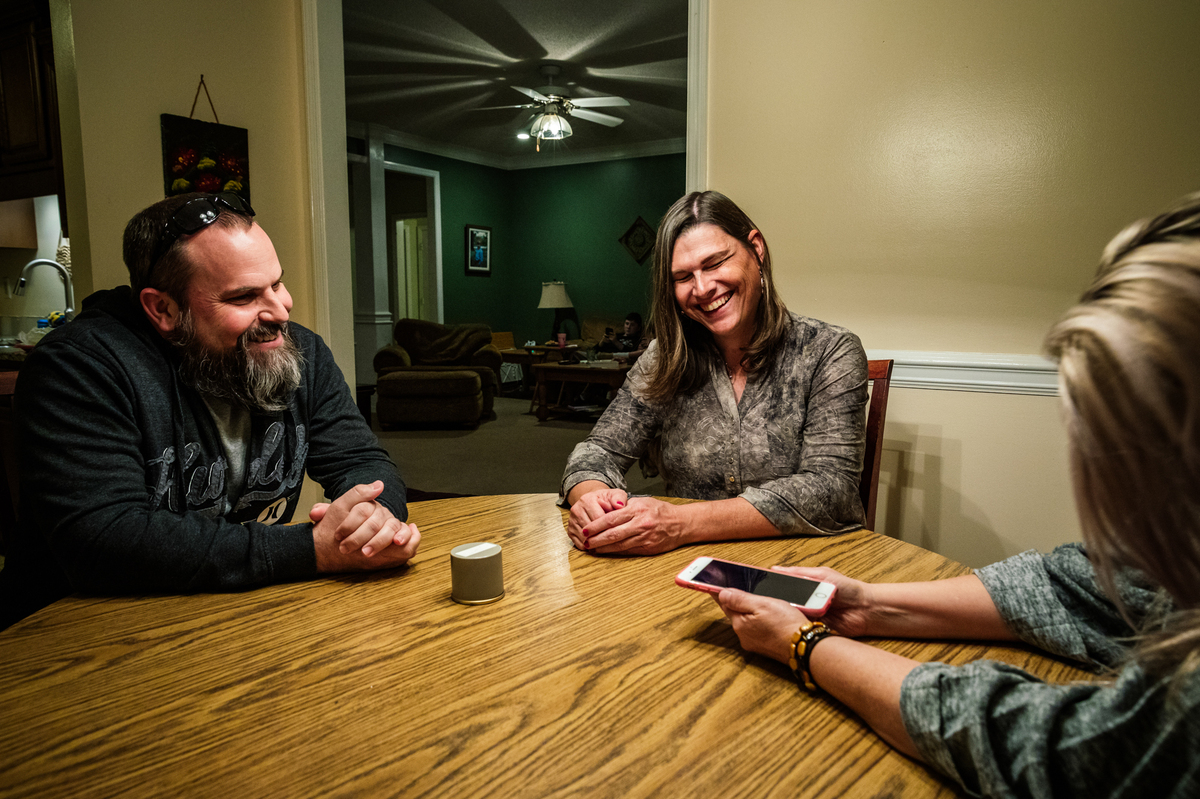
Lange grills burgers for friends Mike Balducci and Heather Buchanon-Romano at home.

Audra Melton for NPR


hide caption

toggle caption

Audra Melton for NPR

Gender dysphoria is the American Psychiatric Association’s name for the distress caused by discordance between one’s assigned gender at birth and the gender they identify as. Multiple major medical societies, including the American Medical Association, have endorsed the medical necessity of treating gender dysphoria with “gender-affirming care,” which may include hormones, surgeries or neither.

As the medical community has shifted from viewing gender-affirming care as cosmetic to understanding it as medically necessary, many insurers, including Medicare and many Medicaid programs, have likewise shifted to covering both surgical and nonsurgical trans-related health care.

Alongside them, the law has evolved to forbid discrimination against trans Americans. Section 1557 of the Affordable Care Act prohibits entities that receive federal funding for health coverage from denying coverage based on sex, gender identity and sex stereotyping. And the Americans with Disabilities Act and Title VII of the Civil Rights Act have also been broadly interpreted by courts to protect transgender individuals from discrimination.

Despite both medical and legal consensus, 30 states allow health insurance plans to exclude transgender-related health care from coverage. Most of these states are in the South, Midwest and Great Plains, and most have a relatively high proportion of rural residents.

Shortages in rural health care workforces, low rates of insurance coverage, and long distances from health care facilities have made it challenging for many Americans outside urban areas to find high-quality, affordable health care. Transgender people in rural areas often face particularly acute challenges when it comes to finding competent providers and obtaining health insurance.

Douglas Knutson, a psychologist who studies health and resiliency among LGBTQ populations at the University of Illinois in Carbondale, said rural trans populations often have high rates of anxiety, depression and suicidality.

That doesn’t mean they’re all eager to flee. Connections to home, land, language and heritage are powerful, said Knutson: “People have specific reasons for living in rural areas.”

Lange certainly does. Although she would love to be in a more welcoming environment, she remains in Houston County because of her son. “I’m a good parent,” she said. “I love him too much and I’m not going anywhere.”

She also has no intention of leaving law enforcement. If she did, she’d be leaving behind a retirement plan. Plus, she was recently promoted to sergeant in criminal investigations, and she finds it deeply satisfying to help people and solve crimes.

Lange enjoys her job working in criminal investigations and was recently promoted to sergeant.

Audra Melton for NPR


hide caption

toggle caption

Audra Melton for NPR

When trans people challenge employers’ policies in stereotypically conservative settings, they often encounter resistance, said Knutson. “There’s the feeling, ‘Why does the battleground have to be here?‘ ” he said.

Although it might seem easier to switch employers than fight an unwelcoming institution for equal treatment, he said, job searches are often expensive and require a financial cushion that many people – especially public servants — don’t have. Additionally, he said, for many, “there’s a commitment to vocation”; like Lange, many people simply like their jobs.

Studies assessing the financial implications of covering transgender-related health care have demonstrated that the cost of care to insurers, including hormones and surgical therapies, is relatively small. Hormone therapy, which around 75 percent of transgender people seek, starts at $20 to $80 a month and is usually taken for the duration of a person’s life after transition. Surgeries range widely in type and cost anywhere from $5,000 to $50,000 each, although many trans people don’t desire surgical treatment.

Perhaps of even greater significance is the finding that providing this coverage is cost-effective. Untreated gender dysphoria leads to high rates of adverse — and expensive – outcomes, including HIV infection, depression, suicidality and drug abuse. The cost of accepting these outcomes outweighs the cost of treating their cause.

Still, state and local governments have pursued costly court battles to maintain these exclusions. “Officials look at this as a political issue instead of as the medical and equal employment issue that it should be,” said Harper Jean Tobin, policy director of the National Center for Transgender Equality.

Lange hangs out at home with friends Balducci and Buchanon-Romano, who came over for a cookout.

Audra Melton for NPR


hide caption

toggle caption

Audra Melton for NPR

Although there is no consensus on transgender acceptance, according to the Pew Research Center, 39 percent of Americans surveyed in 2017 said society hasn’t gone far enough in accepting transgender people. Thirty-two percent said society has gone too far and 27 percent said society’s response has been about right.

Respondents were divided along partisan lines, with 60 percent of Democrats saying society hasn’t done enough compared with 12 percent of Republicans saying that.

Nevertheless, said Tobin, persistent transgender stigma in certain circles causes some lawmakers to assume that inclusive policies will be unpopular in their communities.

“Increasingly,” she said, “I think they’d be surprised.”

Keren Landman, a practicing physician and writer based in Atlanta, covers topics in medicine and public health.

Let’s block ads! (Why?)

Olympic Cycling Medalist Kelly Catlin Dead At 23

Kelly Catlin (left) with her U.S. teammates after they won team pursuit gold medals at the world championships in the Netherlands last year.

Peter Dejong/AP


hide caption

toggle caption

Peter Dejong/AP

Updated at 6:07 p.m. ET

Olympic cycling medalist Kelly Catlin died in her dorm at Stanford University last Thursday, an abrupt end to the 23-year-old’s accolade-filled life.

Her family tells NPR that she took her own life.

“Waves of despair come over us,” her father, Mark Catlin, says. “She promised us she wasn’t going to kill herself.”

Catlin was most known as being a member of the U.S. women’s pursuit team that earned a silver medal during the 2016 Olympics Games in Rio de Janeiro. She and the team earned three consecutive world championship titles between 2016 and 2018.

She was also pursuing a graduate degree in computational and mathematical engineering. In February, Catlin described the struggle to balance school and cycling.

“It’s most difficult when you have to retake a three-hour final exam the moment you step out of the final round of a team pursuit. … And things still slip through the cracks,” she wrote in an article for VeloNews, a cycling magazine.

Catlin was born in Minnesota, a triplet from “the bottom of the stack,” her dad says. Doctors were worried about her lung development.

But Kelly Catlin was a natural athlete, her brother Colin tells NPR. He got her into cycling “kicking and screaming,” until she realized she could win races. “She loved the speed of it, she liked the scientific nature of it – cycling has all these metrics, all these marginal gains.” She also enjoyed the independent side of cycling, “going out and trying to ride as hard as she could,” Colin says.

As a child, Kelly loved horses and tried to petition her parents and the city council for permission to keep a miniature horse in the garage, says her sister, Christine. “We had this secret club called the Federation to Buy Horses,” she adds.

The Catlin triplets on bikes.

Courtesy of the Catlin family


hide caption

toggle caption

Courtesy of the Catlin family

That love of horses apparently made Kelly a better athlete. “She watched a lot of horse races and would reserve something ’til she came down the end stretch,” her mother, Carolyn Emory, says. “This wisp of a girl would pour on the power and outstrip everyone.”

But Catlin suffered some crashes later in her career. She broke her arm in October and sustained a concussion on a slick road in December.

Initially, Catlin didn’t remember that she hit her head and mainly noticed her road rash abrasions. But the concussion changed her, her family members say.

“We didn’t know about the racing thoughts and the obsessing over different things and the nightmares,” Christine says. “We only knew about the headaches.”

At the end of January, the family says Kelly attempted suicide.

“She had carefully planned it out and had an email she wrote before that she had scheduled for hours after she was already dead,” Christine says. “We got it and thought it was a joke for a minute, then called the police.”

Catlin cycling on a track.

Courtesy of the Catlin family


hide caption

toggle caption

Courtesy of the Catlin family

The suicide attempt left Kelly with lung and heart issues, Colin says. Her family and her coaches convinced her to rest and she withdrew from the 2019 Track Cycling World Championships.

But the incident was far from behind them and she appeared frustrated. “She told me she hated failing the suicide attempt,” Colin says.

U.S. Cycling President and CEO Rob DeMartini described her death as a devastating loss. “The entire cycling community is mourning this immense loss,” he said in a statement. “We are offering continuous support to Kelly’s teammates, coaches and staff.”

Catlin’s personal coach of four years, Stephan McGregor, tells NPR that she was not just a top athlete. “People don’t necessarily realize that she spoke Chinese fluently, was a mathematician, was a musician. She was exceptional in every aspect of her life.”

Colin says she was full of contrasts — able to listen to industrial German heavy metal, then play Niccolò Paganini on her violin; she pretended she was fierce like velociraptor, making hissing noises, and dreamed of being a data scientist.

And she wanted to inspire women in the world, Colin says.

“The greatest strength you will ever develop is the ability to recognize your own weaknesses,” Kelly Catlin wrote in February, “and to learn to ask for help when you need it.”

If you or someone you know may be considering suicide, contact the National Suicide Prevention Lifeline at 1-800-273-8255 (En Español: 1-888-628-9454; Deaf and Hard of Hearing: 1-800-799-4889) or the Crisis Text Line by texting 741741.

Let’s block ads! (Why?)

U.S. Hospitals And Insurers Might Be Forced To Reveal The True Prices They Negotiate

The Trump administration aims to boost competition among hospitals and cut costs by letting consumers see how widely prices can vary for the same medical or surgical procedure. But health economists say patients typically have little choice in choosing their hospital.

teekid/Getty Images


hide caption

toggle caption

teekid/Getty Images

The Trump Administration is weighing whether to require hospitals to publicly reveal the prices they charge insurance companies for medical procedures and services — prices that are currently negotiated in private and kept confidential.

The Department of Health and Human services says its aim is to boost competition and cut costs by letting consumers see how prices vary from place to place. But health economists say such “transparency” might not actually bring down costs for patients.

HHS tucked two questions about publicizing the negotiated prices into a separate, 187-page provisional rule released earlier this month that governs health care information technology. The Wall Street Journal reported on the idea last Friday.

“The availability of price information could help increase competition that is based on the quality and value of the services patients receive,” HHS argues in its proposed rule. “The Department is considering subsequent rule-making to expand access to price information for the public, prospective patients, plan sponsors and health care providers.”

Zack Cooper, a health economist at Yale University says he’s skeptical that this particular attempt at price transparency would reduce overall spending on health care.

“Most consumers don’t look at the price of health care services before they access care,” Cooper says. “So I think we need to understand that most folks are not going to, all of sudden, go Googling hospital prices and then make big changes as to where they [go for] care.”

Still, Cooper’s research suggests HHS is looking in the right direction. In a paper he published last month in Health Affairs, in which he analyzed the prices negotiated between hospitals and insurance companies, Cooper found that most health care inflation comes from rising prices for hospital care.

“By and large, physician prices haven’t gone up in the last 10 years,” he says. “In contrast, we’ve seen pretty remarkable growth — on the order of 5 percent per year — in hospital prices.”

Those high prices end up in insurance premiums, which have also been rising, Cooper says.

The American Hospital Association is opposed to making their negotiated prices public.

“This isn’t really what consumers need or want,” says Tom Nickels, the AHA’s executive vice president for government affairs. “What consumers need and want is ‘What are their out-of-pocket costs?’ “

Almost 60 percent of people with employer-sponsored health insurance carry plans with deductibles of more than $1,000. That means more people are exposed to high health care charges for hospital visits. In addition, patients complain frequently of surprise bills they receive after a hospital stay. Those surprise bills often arise when a patient is treated by out-of-network doctors who happen to be working in hospitals that do participate in the patient’s insurance network.

Congress is already considering bills to address such surprise billing practices.

Nickels, the representative of the hospital association, says consumers have no need to see the prices insurance companies pay hospitals, just as they don’t need to see what a grocery store pays for cases of Coca-Cola.

But a glance at the public comments posted on regulations.gov suggests members of public don’t agree with him.

The agency argues in this proposal that the complexity — and opaque pricing in health care system — make the system less efficient and hurts patients’ health.

“Enough with the secrecy and back room deals,” writes one commenter.

Another writes: “When we purchase groceries, cars, homes, airfare, hotel rooms, etc., we know the price before we buy. Shopping around of lower prices is easy. The glaring exception is health care.”

In contrast, Nickels argues that revealing the secretly negotiated deals would actually cut competition. And he questions whether it would be legal.

“We have a system that basically allows people to have private contracts between each other in an economy,” he says.

The hospital price proposal is the latest in a series of efforts by the Trump administration to boost price transparency in health care.

In the last few months, HHS Secretary Alex Azar has proposed several rules to make drug prices more transparent and to change the system for negotiating those prices.

The first would require drug companies to include the list prices of their medications in any television or magazine ads promoting their drugs. Another proposal would tie the price that Medicare pays for many cancer and arthritis drugs to the prices other countries pay for those medications.

And, finally, the agency wants to upend the entire system for pricing prescription drugs that people buy at their local pharmacy. Right now the prices of those medications are determined by negotiations between drug companies and middlemen known as pharmacy benefit managers who negotiate discounted prices on behalf of insurance companies.

But those discounts come in the form of secret rebates — and the PBMs keep a share of those rebates for themselves. Now HHS wants to make those rebates illegal and force the players to negotiate discounts upfront.

Sara Fisher Ellison, a health care economist at MIT, is pessimistic that these proposals will reduce costs in the prescription drug market.

“They’re trying to, around the edges, improve the function of the market,” she says. “But to be honest they probably missed the mark. That’s because the market for pharmaceuticals is not like a standard market.”

She says the problem is consumers don’t have the power to easily switch to a competitor product if the drug they’re taking has a high price.

“In pharmaceuticals, the end consumer — the patient — is not the only decision maker, and in fact is often not even the most important decision maker,” Ellison says.

In reality, she says, it’s the insurance companies and the doctors who decide what drugs a patient gets, and often what hospital a patient goes to. And those are the people who are already negotiating the price.

Let’s block ads! (Why?)

2 Men Killed In San Diego Paragliding Crash

Witnesses looked on in horror as two paragliders collided in midair and fell about 75 feet to their death over the weekend.

The men have been identified as 61-year-old Raul Gonzalez Valerio of Laguna Hills, Calif., and 43-year-old Glenn Johnny Peter Bengtsson of Carlsbad, Calif. They were paragliding off Torrey Pines, a popular cliff-side launching spot near the northern coast of San Diego, when the accident happened on Saturday afternoon.

One paraglider was flying south when he allegedly made a hard right turn, placing himself in the path of the other man, San Diego Lifeguard Lt. Rich Stropky told the San Diego Union-Tribune. Stropky said the lines from the harnesses to their canopies became tangled.

It is unclear which man crossed the other’s path. One of the men was an experienced paraglider who was certified to fly on his own; the other was training for an advanced certification.

The two were about 35 feet in the air when they crashed into each other. They twirled as they fell, witness Ryan Bloum told the Union-Tribune. “Almost like a leaf falling,” he said.

“They started spinning out and they went into the mountain,” witness Rami Abuhamra told NBC 7 San Diego.

Authorities said they didn’t know if the fatal injury happened in the initial crash, or when they hit the steep cliff face about 45 feet below the edge.

San Diego firefighters had to use a helicopter to lower medics to the cliff face. Both men were pronounced dead at the scene.

“We share our sorrow at the loss of two members of our close-knit soaring community,” the Torrey Pines Gliderport said in a statement.

Let’s block ads! (Why?)

How Much Difference Will Eli Lilly's Half-Price Insulin Make?

Eli Lilly and Company, based in Indianapolis, is rolling out a half-price version of its insulin Humalog that will be sold as a generic.

Darron Cummings/AP


hide caption

toggle caption

Darron Cummings/AP

When Erin Gilmer filled her insulin prescription at a Denver-area Walgreens in January, she paid $8.50. U.S. taxpayers paid another $280.51.

She thinks the price of insulin is too high. “It eats at me to know that taxpayer money is being wasted,” says Gilmer, who was diagnosed with Type 1 diabetes while a sophomore at the University of Colorado in 2002.

The diagnosis meant that for the rest of her life she’d require daily insulin shots to stay alive. But the price of that insulin is skyrocketing.

Between 2009 and 2017 the wholesale price of a single vial of Humalog, the Eli Lilly and Company-manufactured insulin Gilmer uses, nearly tripled — rising from $92.70 to $274.70, according to data from IBM Watson Health.

Six years ago, Gilmer qualified for Social Security Disability Insurance — and thus, Medicare — because of a range of health issues. At the time, the insulin she needed cost $167.70 per vial, according to IBM Watson Health.

“When it’s taxpayer money paying for medication for someone like me, it makes it a national issue, not just a diabetic issue,” Gilmer says.

Stories about people with Type 1 diabetes dying when they couldn’t afford insulin have made headlines. Patient advocates like Gilmer have protested high prices outside Lilly’s headquarters in Indianapolis.

Loading…

Don’t see the graphic above? Click here.

Last October in Minnesota, then state Attorney General Lori Swanson sued insulin manufacturers alleging price gouging. Pharmaceutical executives were grilled about high drug prices by the Senate Finance Committee on Feb. 26.

This is the backdrop for Lilly saying Monday that it is rolling out a half-priced, generic version of Humalog called “insulin lispro.” The list price: $137.35 per vial.

“Patients, doctors and policymakers are demanding lower list prices for medicines and lower patient costs at the pharmacy counter,” Eli Lilly CEO David Ricks wrote in a blog post about the move. “You might be surprised to hear that we agree – it’s time for change in our system and for consumer prices to come down.”

No panacea

When Lilly’s Humalog, the first short-acting insulin, came to market in 1996, the list price was about $21 per vial. The price didn’t reach $275 overnight, but yearly price increases added up.

In February 2009, for example, the wholesale price was $92.70, according to IBM Watson Health. It rose to $99.65 in December 2009, then to $107.60 in Sept. 2010, $115.70 in May 2011, and so on.

“There’s no justification for why prices should keep increasing at an average rate of 10 percent every year,” says Inmaculada Hernandez of the University of Pittsburgh School of Pharmacy who was lead author of a January report in Health Affairs attributing the skyrocketing cost of prescription drugs to accumulated yearly price hikes.

“The public perception that we have in general is that drugs are so expensive because we need to pay for research and development, and that’s true,” Hernandez says. “However, usually research and development is paid for in the first years of life of a drug”

At $137.35 per vial, Lilly’s generic insulin is priced at about the same level as Humalog was in 2012, 16 years after it came to market.

“We want to recognize that this is not a panacea,” says company spokesman Greg Kueterman. “This is an option that we hope can help people in the current system that we work with.”

It’s worth noting that Humalog is a rapid-acting insulin, but that’s only one of the two types of insulin most people with Type 1 diabetes use every day. The second kind is long-lasting. Lilly makes one called Basaglar. The most popular long-lasting insulin is Lantus, produced by Sanofi. Neither has a lower-cost alternative.

Still, Lilly’s move on Humalog could put pressure on the other two big makers of insulin to act.

Novo Nordisk called Lilly’s lower-priced generic insulin “an important development,” in an emailed statement.

“Bringing affordable insulin to the market requires ideas from all stakeholders,” Novo Nordisk’s Ken Inchausti said in an email, which also listed steps the company has taken, such as a patient assistance program. The statement didn’t say whether Novo Nordisk is considering offering a lower-priced version of its popular insulin Novolog, a rival of Humalog.

A statement from Sanofi, the third major insulin maker, also didn’t say whether the company would offer lower-priced version of its insulins.

“Sanofi supports any actions that increase access to insulins for patients living with diabetes at an affordable price,” spokesperson Ashleigh Koss said in the email, which also touted the company’s patient assistance program.

A different kind of generic

One twist in this story is that Lilly’s new insulin is just a repackaged version of Humalog, minus the brand name. It’s called an “authorized generic.”

“Whoever came up with the term, ‘authorized generic’ ?” Dr. Vincent Rajkumar says laughing. Rajkumar is a hematologist at the Mayo Clinic in Rochester, Minn.

“It’s the same exact drug” as the brand name, he continues.

Typically, Rajkumar says, authorized generics are introduced by brand-name drugmakers to compete with generic versions of their drugs made by rival companies.

But in the case of Humalog and other insulins, there are no generics made by competitors, as there are for, say, the cholesterol medicine Lipitor or even other diabetes drugs, such as metformin.

So when Lilly’s authorized generic comes to market, the company will have both Humalog insulin and the authorized generic version of that medicine on the market.

Rajkumar says it’s a public relations move.

“There’s outrage over the price of insulin that is being discussed in Congress and elsewhere. And so the company basically says, ‘Hey, we will make the identical product available at half price.’ On the surface that sounds great,” Rajkumar says.

“But you look at the problems and you think, ‘OK, how crazy is this that someone is actually going to be buying the brand-name drug?’ “

In fact, it’s possible that Lilly could make the same or even more profit off its authorized generic than it does from the name-brand Humalog, according to University of Pittsburgh’s Hernandez.

The profit margin would depend on the rebates paid by the company to insurers and pharmacy benefit managers. Rebates are getting a lot of attention these days as one factor in rising drug prices. They’re usually not disclosed and increase as a drug’s price increases providing an incentive to some

“Doing an authorized generic is nothing else than giving insurers two options,” Hernandez says: Pay the full list price for a brand-name drug and receive a higher rebate, or pay the lower price for the authorized generic and receive a presumably smaller rebate.

“What we really need to get insulin prices down is to get generics into the market, and we need more than one,” Hernandez says, adding that previous research has shown that prices begin to go down when two or three generics are competing in the marketplace.

Even so, Lillly’s Kueterman says the authorized generic insulin “is going to help hopefully move the system towards a more sustainable model.”

“I can guarantee you the reason that we’re doing this is to help people,” Kueterman says, noting the company’s Diabetes Solution Center has also helped “10,000 people each month pay significantly less for their insulin” since it opened in August 2018.

For Erin Gilmer, the news about an authorized generic insulin from Lilly has left her mildly encouraged.

“It sounds really good and it will help some people, which is great,” Gilmer says. “It’s Eli Lilly and pharma starting to understand that grassroots activism has to be taken seriously, and we are at a tipping point.”

This story is part of NPR’s reporting partnership with Kaiser Health News. Freelance journalist Bram Sable-Smith can be found on Twitter: @besables.

Let’s block ads! (Why?)

Instead Of Wrestling A Girl, High Schooler Chooses To Forfeit State Wrestling Match

Jaslynn Gallegos settles into her wrestling stance.

Courtesy of Delfino Rodriguez


hide caption

toggle caption

Courtesy of Delfino Rodriguez

When high school senior and wrestler Brendan Johnston realized he had to face Jaslynn Gallegos, a high school senior, and Angel Rios, a high school junior, in last month’s Colorado state wrestling championship, he knew his shot at a state title was over.

Johnston refused to compete against Rios and Gallegos because they are both girls.

Gallegos went on to place fifth in that tournament, and Rios was fourth — marking the first time girls have placed at a Colorado state wrestling tournament.

Despite her success, Gallegos finds it frustrating when she is treated differently as an athlete because of her gender. Her would-be opponent, Johnston, told reporters that he was uncomfortable wrestling females, in part because of his Christian beliefs.

“I’m not really comfortable with a couple of things with wrestling a girl,” Johnston told The Denver Post. “The physical contact, there’s a lot of it in wrestling. And I guess the physical aggression too. I don’t want to treat a young lady like that on the mat. Or off the mat. And not to disrespect the heart or the effort that she’s put in. That’s not what I want to do either.”

[embedded content]


Colorado High School Activities Association
YouTube

But while Gallegos said she respected his decision, she doesn’t understand it.

“I just want to be a wrestler, not necessarily defined as a girl wrestler, so it kind of hurt me a little bit,” she told NPR’s Scott Simon. “I just want to be this wrestler, and my gender is holding me back.”

A senior at Skyview High School in Thornton, Colo., Gallegos plans to continue the sport in college, where she will be competing against other women.

But wrestling someone of either gender doesn’t faze Gallegos. She has been wrestling girls, and boys, since she was 5 years old.

“When I wrestle, it’s literally all muscle memory, because I practice my shots, and my stand-ups, and my sit-outs, and my pinning combinations so often, I don’t even have to think when I wrestle,” she said.

Jaslynn Gallegos (left) stands after winning a match at Colorado’s state wrestling championship.

Courtesy of Delfino Rodriguez


hide caption

toggle caption

Courtesy of Delfino Rodriguez

She joins an increasing number of girls who are participating in the sport. Since 1994, the number of female high school wrestlers has grown from 804 to 16,562, according to the National Wrestling Coaches Association. But only 12 states have approved girls wrestling programs with sanctioned state championships, according to the association.

Colorado may soon join those ranks. In February 2018, the Colorado High School Activities Association approved girls wrestling for pilot seasons, which is the first step toward officially sanctioning the sport within the state.

Since girls wrestling is not a sanctioned sport in Colorado, girls have the right to participate alongside boys at the state tournament. This year was the first time for the state’s pilot program, which allowed for a female state wrestling bracket. But Gallegos decided she wanted to compete with the boys.

When Gallegos steps up to the mat, her eyes are trained on her opponent. The minute the referee blows the whistle, she keeps her elbows in and moves quickly to ensnare her opponent, then wrangle her competitor down onto the mat.

The wrestling matches are a tangle of limbs — Gallegos’ and her opponent’s — arms and legs slipping out of holds or locking the other’s in place. In the twisting and pushing, eventually one wrestler comes out on top; the victor grinds the opponent’s face down against the mat, keeping tight control of a writhing, wriggling opponent until they hear the referee’s whistle.

[embedded content]


USA Wrestling
YouTube

For such a physical sport, some males may express concerns over applying force on a female or pressing against a female opponent in the era of the #MeToo movement.

But, Gallegos said, the concerns are a nonissue because she knows exactly what she’s signing up for every time she steps up to the mat.

“It’s kind of unheard of in the wrestling community for a girl to say something happened during a match,” she said. “It’s wrestling, and I think we all understand that it’s a very physical sport. You’re literally fighting someone to put them to their back.”

In her hundreds of matches against guys, Gallegos said, she has never experienced those sorts of issues. She encourages men to approach wrestling female athletes the same way they would with male athletes.

“You know you might get pinned. You might win by one or two points. You might even pin me,” Gallegos said. “But, I’m definitely worth giving a match to.”

Her message for male wrestlers who might be reluctant to face off with her?

“Just wrestle me.”

Let’s block ads! (Why?)