Saturday Sports: Women's Soccer Lawsuit, LeBron James, Celtics

NPR’s Scott Simon talks about this week’s sports headlines with ESPN’s Howard Bryant.


SCOTT SIMON, HOST:

And I come to work every week just say it’s time for sports.

(SOUNDBITE OF MUSIC)

SIMON: The Boston Celtics play LeBron’s LA Lakers tonight. But who cares? Neither team’s had a stellar year, and the U.S. women’s soccer team has filed a lawsuit against U.S. Soccer just ahead of the FIFA Women’s World Cup. ESPN’s Howard Bryant joins us. Howard, thanks so much for being with us.

HOWARD BRYANT, BYLINE: Good morning, Scott. How are you?

SIMON: I am fine thanks.

BRYANT: And, by the way, of course you care. It’s still Celtics-Lakers. It doesn’t make a difference what year it is.

SIMON: I agree.

BRYANT: It’s Celtics-Lakers.

SIMON: And you know I care about LeBron. I’d care about LeBron if he was playing for a high school team, particularly if he was playing…

BRYANT: He actually is playing for a high school team this year.

SIMON: Oh, oh wow, wow, wow, wow.

BRYANT: That’s Boston shade for you.

SIMON: Well, tell us – 538 gives the Lakers a less than 1 percent chance of making the playoffs. If LeBron had stayed with Cleveland, he might have been – they might have made it to the playoffs. And I’m beginning to wonder, Howard, is anybody going to want to see “Space Jam 2?”

BRYANT: Well, it’s been an interesting year for the Lakers and especially when LeBron James comes and joins the – one of the iconic, one of the two iconic franchises in the NBA that this was supposed to be a magical year, and it’s been a massive disappointment. The Lakers are 30 and 35. They’re out of the playoff race right now. Let’s not forget what LeBron James has done. He’s not only made the playoffs every year for the last eight years, he’s made the finals every year for the last eight years. There’s only one other guy superstar level who has done that, and it’s Bill Russell back in the 1960s when they won eight straight championships. And so looking at what the Lakers have done – it’s really fascinating, too, because LeBron has actually been part of the problem. His defense has been terrible. He’s actually been really unprofessional in a couple of different examples…

SIMON: Kicking the ball.

BRYANT: …Rolling the ball down court and having it knocked out of – he’s just not focused. And it’s been really strange to see. It’s not impossible that they could go on a little streak and make the playoffs maybe as an eighth seed. But, you know, they’d play the Warriors in the first round and pretty much get hammered, so this has been a lost season for the Lakers.

SIMON: And what about the Celtics? They just haven’t gelled.

BRYANT: Well – and the Celtics were supposed to be the team that was going to – they were going to play the – they were going to play the Warriors in the finals. And they’re 10 games behind Milwaukee. They’ve been inconsistent all season long. And I really do think that one of the big problems that they’ve had, and the Lakers have had the exact same problem, is they had this public love fest trying to acquire Anthony Davis.

And I think in the Celtics’ case, they’ve gone out of their way to sort of alienate their own team. I mean, what – how do you really get a team to get up and play for you when you’ve pretty much signaled to the world that you’re willing to trade everybody on the roster for a guy you don’t even have? And so it’s been a really difficult gelling process for them. Kyrie Irving can leave at the end of the season. People are saying whether he’s going to join the Knicks or go sign with another team. So they have all kinds of distractions. And it really has not come together.

I think another thing that happened with them is that when you are told that you are a great team before you play your first game of the season, it’s kind of hard to adjust to the fact that maybe you’re not that good and you really have to grind every single day. And we’ll see what they do. However, they did beat the Warriors in Oakland last week by 33 points, so it does show you what they’re capable of.

SIMON: Twenty-eight members of the U.S. women’s soccer team are suing the federation for gender discrimination, demanding equal pay. They feel that almost nothing was done of their previous complaint back in 2017. They’re picking an especially propitious time to make the case, too, aren’t they?

BRYANT: Well, as they should. This is what we call leverage. You’ve got the World Cup coming. They’re a three-time World Cup champion. This is ongoing, and this is one of the issues that we’ve seen over the last several years in terms of equal pay. They want equal pay compared to the men. They want – they’re the better team of the two.

SIMON: Yeah, and they’re the crowd pleasers, too.

BRYANT: They’re the crowd pleasers and yet they get fewer – they get demonstrably fewer bonuses. They get demonstrably worse playing conditions. They feel like second-class citizens. And let’s not forget we were in the same situation two years ago when the women’s hockey team had to boycott or threaten to boycott not playing in the world championships to strike a deal with USA Hockey. So when this is happening right now – you know, Scott, I watched “Captain Marvel” last night. And it was just so wonderful to see that – and it’s a great movie. Marvel makes better movies than DC. But the real issue is all of this is a pander if you’re going to talk about women being upfront and being out front if you’re not going to pay them. It’s got to be equal pay.

SIMON: Howard Bryant, thanks so much.

BRYANT: Thank you.

Copyright © 2019 NPR. All rights reserved. Visit our website terms of use and permissions pages at www.npr.org for further information.

NPR transcripts are created on a rush deadline by Verb8tm, Inc., an NPR contractor, and produced using a proprietary transcription process developed with NPR. This text may not be in its final form and may be updated or revised in the future. Accuracy and availability may vary. The authoritative record of NPR’s programming is the audio record.


Let’s block ads! (Why?)

Cancer Leads Athlete To Tough Choice

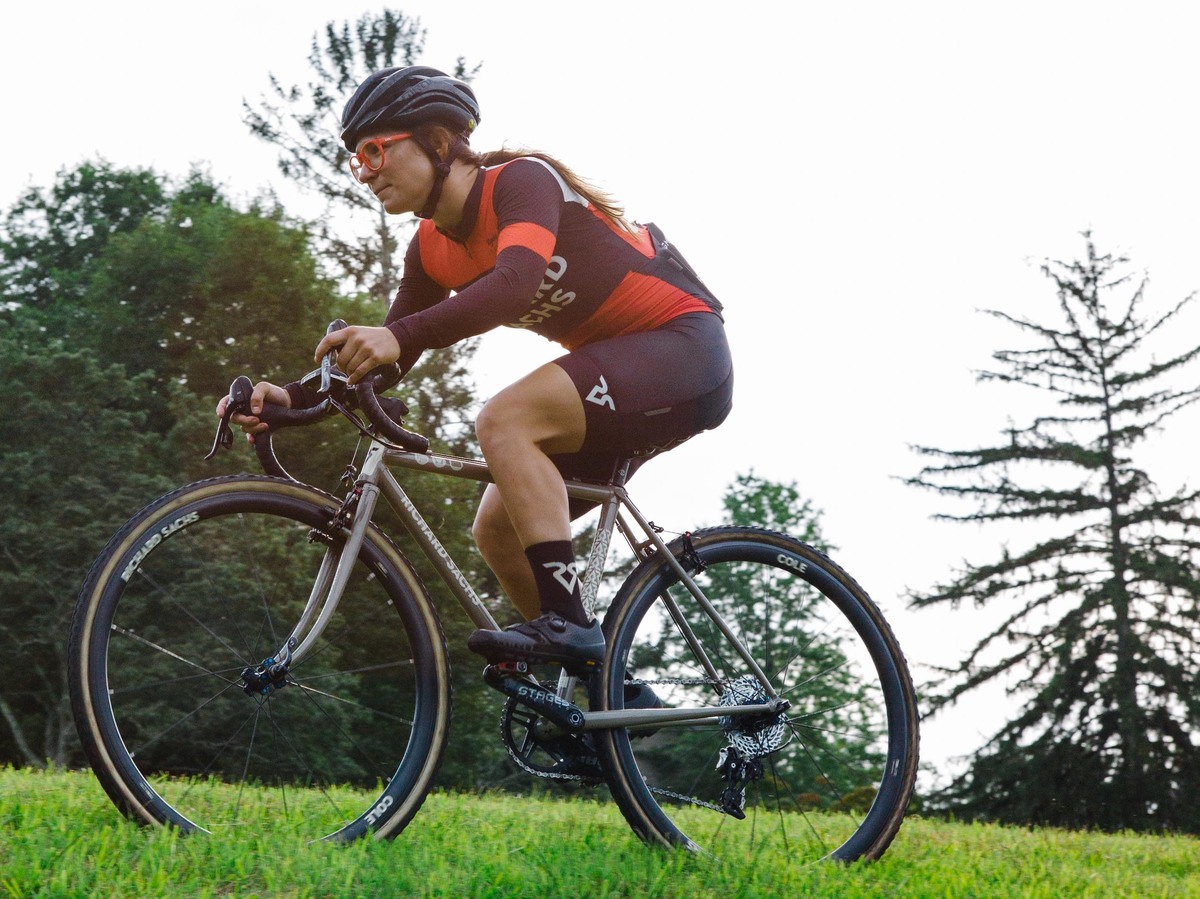
BrittLee Bowman competes during a recent cyclecross race. She was diagnosed with breast cancer and faced a decision on how to treat it.

Courtesy of Dan Chabanov


hide caption

toggle caption

Courtesy of Dan Chabanov

BrittLee Bowman had a huge decision to make as she lined up at an elite cyclocross race. Cyclocross is a sport that throws obstacles at you, from sand pits to staircases to knee high barriers. And this one, alongside the Hudson River in Queens, N.Y. was no different.

Bowman pedaled. People cheered. And if you saw her that day… you probably had no idea what she was wrestling with. That decision she had to make: Do I have both my breasts removed?

It all started with a tiny lump. “Sometime in October I just you know was touching my boob and felt a lump,” she says. “It was about the size of a pea.”

She immediately called her mom, Sara Bowman. Her mom says she was probably more concerned than her daughter, but she didn’t let on.

Bowman made an appointment with her doctor. And the doctor thought it was best to do an ultrasound. And the ultrasound showed another lump. Two total. And that led to a biopsy. And the biopsy led to waiting.

“I’m telling you,” she says. “In my mind, I did not have cancer.”

So Bowman went on with her life. She was out shopping when she got the call.

“You have breast cancer,” she says the doctor told her. “And I was like, ‘Wait. What!?'”

The doctor clarified her statement, telling Bowman the result came back positive. She had stage one multifocal invasive ductal carcinoma, ductal carcinoma in situ, and lobular carcinoma in situ all in her left breast. Her right was unaffected. She called her mom.

“I don’t even remember what I said,” Sara Bowman says. “I was just trembling.”

For BrittLee, the cancer diagnosis just didn’t make sense.

Rachel Rubino and Bowman at a recent cyclecross event. “A lot of people in my family have had cancer,” Rubino says. “My mom passed away of breast cancer when I was 22. So for me it hits this really deep place. You know? It’s like being a woman and being an athlete. This can happen to any of us.”

Courtesy of Dan Chabanov


hide caption

toggle caption

Courtesy of Dan Chabanov

“You can exercise everyday of the week for an hour-and-a-half — except on Sundays, you need a rest day. Be pescatarian for six years. Eat lots of fruits and vegetables all the time. Drink green juice all the time. You know, you can be pretty healthy and live an active lifestyle and still get cancer,” she says. “It sucks.”

Bowman started researching her particular cancer: medical journals and anything she could get her hands on. Meanwhile, there were more tests. Her doctor gave her options: lumpectomy, single mastectomy, or double mastectomy.

“So basically, if I chose double mastectomy and then take care of everything right now then I hopefully will not have a recurrence of this cancer,” she says.

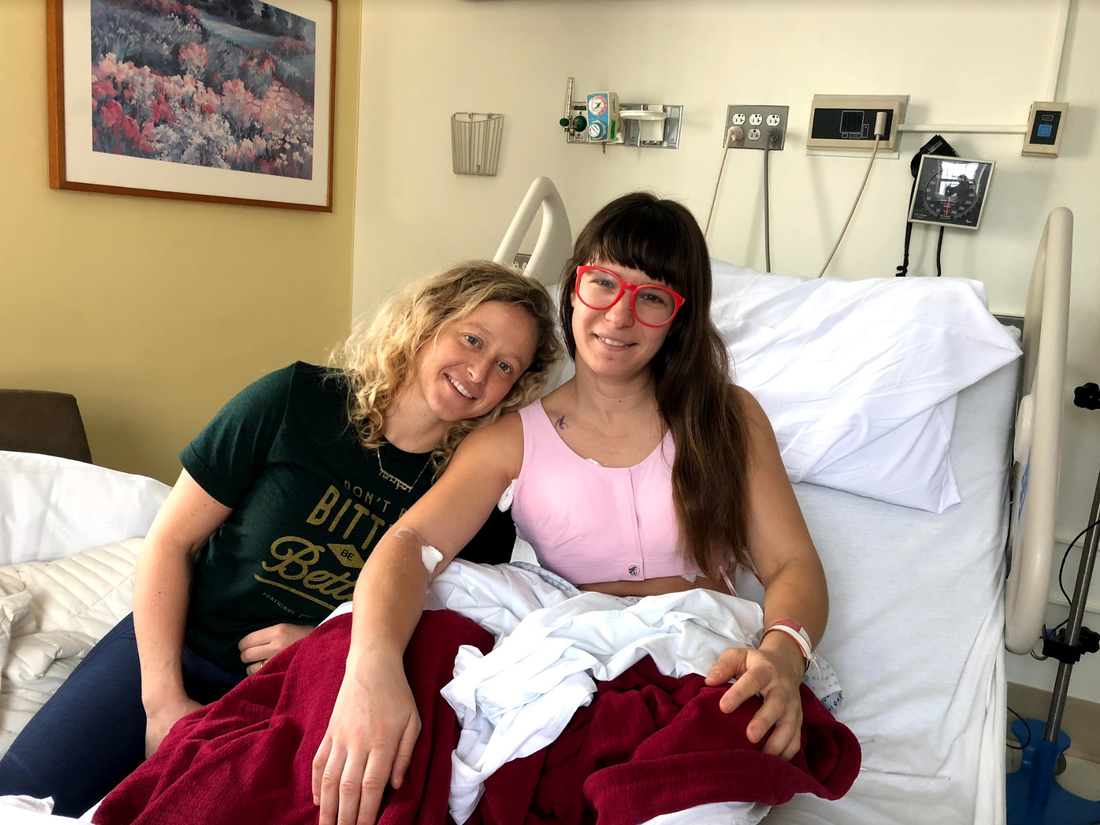
Becca Schepps visits Bowman in the hospital.

Courtesy of BrittLee Bowman


hide caption

toggle caption

Courtesy of BrittLee Bowman

Thirty-four and single, she wanted the option to have kids. Some treatments impact fertility. Then there were a host of other concerns, including how it could impact her athletic career, and also, how she looked at her body.

“I’ve always been a very comfortable person with my body… And I know that a lot of women struggle with their bodies and don’t love them,” she says. “And so I had this fear that the surgery would change that about me. It wasn’t totally the fear of it changing my body, it’s like more about like the fear of it changing how I felt about my body.”

She continued to research and read. But sometimes journals feel impersonal.

So she looked up #doublemastectomy on Instagram. “And they’re posting everything. They’re showing: This is what it looks like right after surgery. This is what it looks like when you have a bad reconstruction that you’re sad about and that makes you want to get surgery again. This is what it looks like when you’re happy that your surgery went well. This is what it looks like when you have radiation. And so just finding that on Instagram was actually really helpful for me to see other women my general age going through this experience.”

She soon had her surgery date. But still hadn’t decided which surgery to get.

“It was the thing I thought about every moment.”

All that was going through her head when she entered that cyclocross race in Queens.

***

That day, Bowman powered through the course, battling for second place with rider Rachel Rubino. The two are competitors and also friends.

“Hey, I’ve been thinking about you so much all week, Rubino told her as they raced. “I love you so much.”

Rachel Rubino finished in second place and Bowman took third in the Rainey Park race.


Eric Lee Bowman


hide caption

toggle caption


Eric Lee Bowman

By the last lap, Rubino was in second and Bowman had third place wrapped up. They’d get to stand on the podium together. It meant a lot for Bowman. But it meant a lot for Rubino, too.

“A lot of people in my family have had cancer,” Rubino says. “My mom passed away of breast cancer when I was 22. So for me it hits this really deep place. You know? It’s like being a woman and being an athlete. This can happen to any of us.”

***

Days after the race, Bowman made her decision. She’d have surgery to remove both her breasts. On the day of the appointment she went to the hospital with family and a friend.

“It was just a long wait a long wait in there …” says Sarah Bowman.

Finally, it was time.

“So they they placed the I.V. in my arm while I was in the holding area with my family,” says Bowman. “And they walked me down a hallway. And there was an elevator. And I was with the nurse. And I had to say bye to my family. So I go into this elevator. The doors close. And I was like in the elevator with the nurse and I was just crying. … It’s just scary. You know you don’t want to have to do that, but you’re trying to fix the problem.”

She walked into the operating room in her gown, past a table of surgical tools. She climbed onto the table. And she stared into silver lamp lights.

***

Three weeks after her surgery, she was still healing and feeling hopeful about racing again.

“I got on my bike on a 28-degree day here in New York City. And I rode laps in Central Park,” she says.

Athletes are like that: Tough. But Bowman is quick point out that she only had stage one. She’s young. There’s a lot of women dealing with far worse. That said, there’s still radiation ahead, healing from reconstructive surgery, and five to 10 years of tamoxifen to ward off a recurrence.

“I’m like did I survive yet? I don’t know. Do I still have cancer? I’m a little unclear on that right now. Maybe I do still have cancer? Or maybe maybe it was all cut out of me? I’m not quite sure,” she says.

You can see the wear on Bowman’s face, but also the resolve. She’ll wake up. Roll out of bed. Do her treatment. Get on with her life.

Let’s block ads! (Why?)

Jaslynn Gallegos On Being A Woman In Wrestling

NPR’s Scott Simon talks with high school wrestler Jaslynn Gallegos of Brighton, Colo. A male wrestler refused to face off against her at a state championship.


SCOTT SIMON, HOST:

A high school wrestler named Brendan Johnston refused to compete against two opponents and forfeited those matches at the Colorado State Wrestling Championship last month. Those two opponents, Angel Rios and Jaslynn Gallegos, are women. Brendan Johnston told reporters he wasn’t comfortable wrestling with women. Jaslynn Gallegos went on to win in fifth place in that tournament. She is a senior at Skyview High School and joins us now from Brighton, Colo. Ms. Gallegos, thanks so much for being with us.

JASLYNN GALLEGOS: Yeah. No problem.

SIMON: First, congratulations.

JASLYNN: Thank you.

SIMON: How did you feel when Brendan Johnston declined to compete against you?

JASLYNN: Well, one of my things is I just want to be a wrestler, not necessarily defined as a girl wrestler. So it kind of hurt me a little bit because, you know, I just want to be this wrestler. And my gender is holding me back.

SIMON: Brendan Johnston told reporters, quote, “I don’t want to treat a young lady like that on the mat or off the mat and not to disrespect the heart or the effort that she’s put in. That’s not what I want to do.” Do you accept that?

JASLYNN: Yeah, I mean, everybody has their own beliefs. But at the same time, it’s not just black and white. Like, you can’t really change what somebody believes. Like, for me, I believe that I’m just a wrestler. And he believes that you’re not just a wrestler. You know, you’re a female wrestler.

SIMON: Now, let me ask. You know what’s going on in this country and around the world. Can you see in this day and age why a young man just may not want to put himself in the position of applying force on a woman or pressing against her even if it’s in a public athletic competition?

JASLYNN: You know, I feel like that whole situation is something that the wrestling community has gone past, especially, like, since I’ve wrestled hundreds of guys. Like, that’s not an issue here, you know? It’s kind of unheard of in the wrestling community for a girl to say something happened during a match.

It’s wrestling, and I think we all understand that it’s a very physical sport. You’re literally fighting someone to put them to their back. It’s – you’re not thinking about anything else at the time because you’re trying to win a match. For me, when I wrestle, it’s literally all muscle memory because I practice my shots and my stand-ups and my sit-outs and my pinning combination so often I don’t even have to think when I wrestle.

SIMON: Anything you’d like to say to boys who might be reluctant to wrestle you?

JASLYNN: You know, just wrestle me. You know, you might get pinned. You might win by one or two points. You might even pin me. But I’m definitely worth giving a match to, you know?

SIMON: And I gather your brothers are wrestlers, too, right?

JASLYNN: Yes. My older brother, he wrestled his whole life, as well – qualified for state. And then my two little brothers, they are currently wrestling.

SIMON: Bet you can beat them.

JASLYNN: Oh, yeah, definitely – both of…

SIMON: (Laughter).

JASLYNN: …Them at the same time.

SIMON: (Laughter) I gather you started wrestling when you were 5.

JASLYNN: Yes. I did.

SIMON: Well, so you’ve been at it a while. Anything you would like to tell young women who want to wrestle?

JASLYNN: You know, just like anything, there’s going to be points where it gets really hard, and you don’t know if you can do it. But, you know, if you push yourself and just keep going, especially if you love it, it’s worth it in the end to just keep on doing it.

SIMON: Jaslynn Gallegos, a wrestler at Skyview High School in Thornton, Colo., thanks so much for being with us.

JASLYNN: Yeah. No problem.

(SOUNDBITE OF VETIVER SONG, “BACKWARDS SLOWLY”)

Copyright © 2019 NPR. All rights reserved. Visit our website terms of use and permissions pages at www.npr.org for further information.

NPR transcripts are created on a rush deadline by Verb8tm, Inc., an NPR contractor, and produced using a proprietary transcription process developed with NPR. This text may not be in its final form and may be updated or revised in the future. Accuracy and availability may vary. The authoritative record of NPR’s programming is the audio record.
Let’s block ads! (Why?)

Unvaccinated Boy, 6, Spent 57 Days In The Hospital With Tetanus

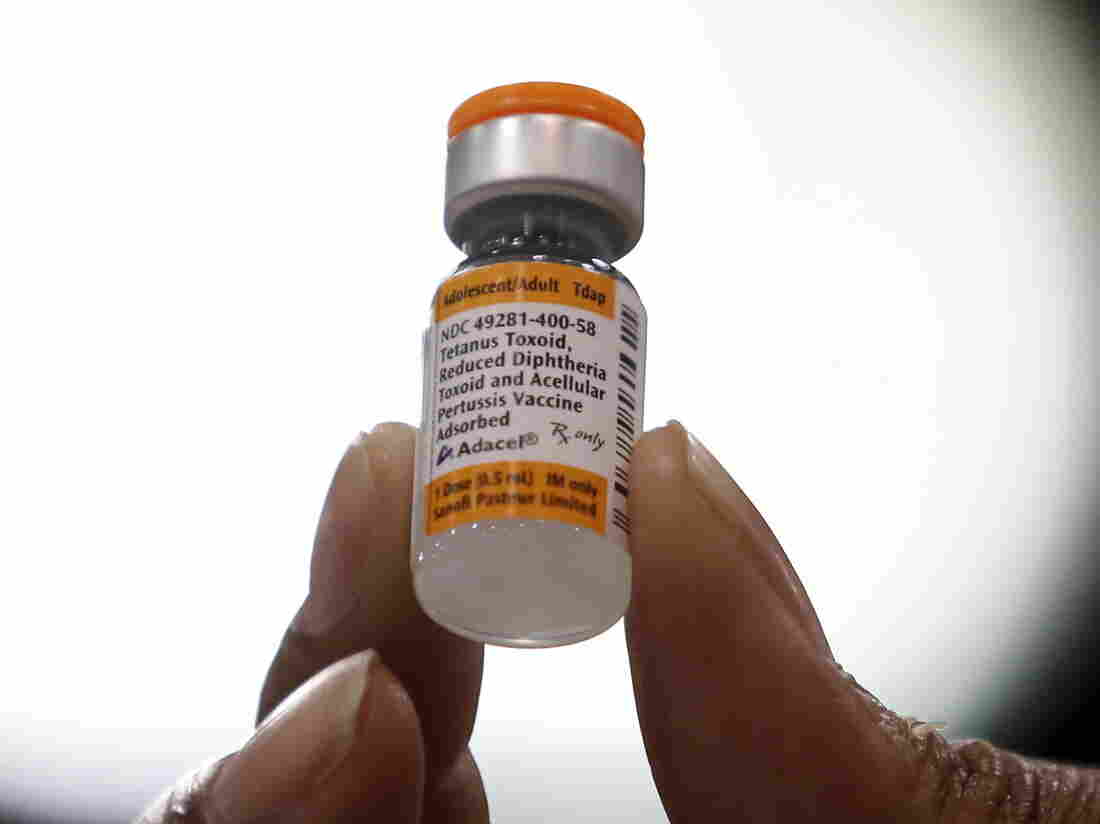
A nurse holds a tetanus, diphtheria and whooping cough vaccine in 2016. Physician Judith Guzman-Cottrill tells NPR that she has met many families who hesitate to give their children vaccines.

Lucy Nicholson/Reuters


hide caption

toggle caption

Lucy Nicholson/Reuters

A new report published by the Centers for Disease Control and Prevention details the harrowing story of a child in Oregon who contracted tetanus because he wasn’t vaccinated.

The boy was playing outside on a farm in 2017 when he cut his forehead. Six days later, he started having symptoms: a clenched jaw, muscle spasms and involuntary arching of his neck and back. When he started struggling to breathe, his parents realized he needed help and called for emergency medical services.

Doctors diagnosed the 6-year-old boy with tetanus and administered a dose of the vaccine, but it took 57 days in a hospital, including 47 days in intensive care, to restore his health.

“It was difficult to take care of him, to watch him suffer,” says Judith Guzman-Cottrill, a pediatric infectious-disease physician who co-authored the article in the CDC’s online journal Morbidity and Mortality Weekly Report.

At first, he asked for water but couldn’t open his mouth. The boy had to spend weeks in a dark room on a respirator. He was able to walk 20 feet, with help, after 50 days.

At a time when preventable outbreaks are making headlines in the United States, Guzman-Cottrill tells NPR that she has met many families who hesitate to give their children vaccines.

“These days, there are so many different places parents can go to for vaccine-related education and advice that many families struggle with knowing who to believe.”

The Internet and social media have made it harder for people to distinguish fact from fiction, she says.

The boy’s infection marked the first pediatric case of tetanus in the state of Oregon in more than 30 years, according to the researchers.

After allowing the first dose of vaccine, the parents refused a second dose for their son, despite doctors giving them information about the advantages of being immunized against tetanus. “I did provide education about the benefits of all pediatric vaccinations and that was also refused,” Guzman-Cottrill says.

The report of his illness comes after outbreaks of measles occurred this winter in the Pacific Northwest. Measles is also preventable with a vaccination.

The rise in measles cases, spurred by the anti-vaccination movement, is pushing authorities to address the issue.

On Tuesday, 18-year-old Ethan Lindenberger told lawmakers that his mother prevented him from getting immunizations because her Facebook feed turned her into an anti-vaxxer.

Facebook itself announced Thursday that it is using vaccine hoaxes identified by the World Health Organization, the CDC and other global organizations to address inaccurate information plaguing the site.

“As a parent myself, I understand that parents are trying to make the best decision for their child,” Guzman-Cottrill says.

“This illness could have been prevented with five doses of the tetanus vaccine, for $150,” she adds. Instead, the ordeal cost $811,929.

Let’s block ads! (Why?)

U.S. Women's Soccer Team Sues U.S. Soccer For Gender Discrimination

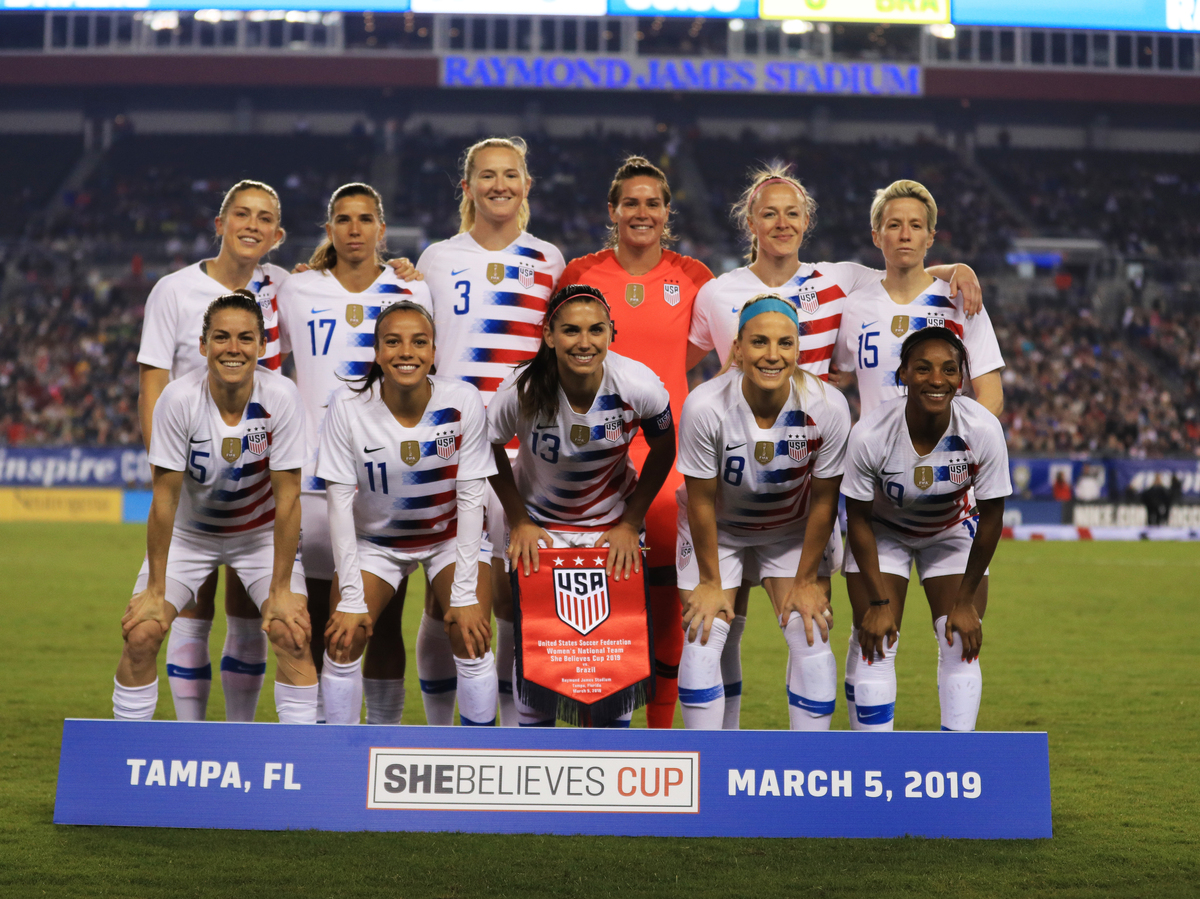
The members of the U.S. women’s national soccer team filed a lawsuit Friday against U.S. Soccer, accusing it of gender discrimination. The starting 11 are seen here before playing Brazil earlier this week in Tampa, Fla.

Mike Ehrmann/Getty Images


hide caption

toggle caption

Mike Ehrmann/Getty Images

Updated at 2:22 p.m. ET

The U.S. women’s soccer team has filed a lawsuit against U.S. Soccer, accusing it of gender discrimination.

The complaint, filed Friday in California district court, argues that U.S. Soccer “has a policy and practice of discriminating” against members of the women’s national team on the basis of gender, by paying them less than similarly situated members of the men’s team.

Twenty-eight members of the women’s team are named as plaintiffs, including many of the sport’s biggest stars: Alex Morgan, Carli Lloyd and Megan Rapinoe. The lawsuit seeks to be a class action, representing other women who’ve played for the U.S. national team and who may have been denied equal pay for substantially equal work.

The issue of unequal pay has been a highly contentious matter in recent years, and the U.S. women’s team has kept the pressure on U.S. Soccer. The women’s team reached a new collective bargaining agreement with the federation in 2017.

Four of the plaintiffs — Morgan, Lloyd, Rapinoe and Becky Sauerbrunn — filed a charge of discrimination with the Equal Employment Opportunity Commission in 2016, on behalf of themselves and similarly situated players. But no progress was made, and last month, the EEOC issued letters giving the four the right to sue.

“Each of us is extremely proud to wear the United States jersey, and we also take seriously the responsibility that comes with that,” Morgan said in a statement reported by The Associated Press. “We believe that fighting for gender equality in sports is a part of that responsibility. As players, we deserved to be paid equally for our work, regardless of our gender.”

U.S. Soccer declined to comment on the pending litigation.

The filing comes on International Women’s Day – and less than three months before the Women’s World Cup kicks off in France. The U.S. women’s team, currently ranked No. 1 in the world, hopes to defend the World Cup it won four years ago.

The U.S. Women’s National Team, or USWNT, has consistently been more successful than the men’s team. The U.S. women have won the World Cup three times and are four-time Olympic champions. The men’s team has never won either tournament and failed to qualify for the 2018 World Cup.

Despite their success and popularity, the women are paid less by U.S. Soccer than the men. The lawsuit details how the pay gap plays out in myriad ways: Women’s players paid less for each “friendly” match, they’re paid less for making the team’s World Cup roster, and they’re paid much less for their performance at the World Cup.

“A comparison of the WNT and MNT pay shows that if each team played 20 friendlies in a year and each team won all twenty friendlies,” the complaint says, “female WNT players would earn a maximum of $99,000 or $4,950 per game, while similarly situated male MNT players would earn an average of $263,320 or $13,166 per game against the various levels of competition they would face.” In other words, a top-tier women’s player would earn just 38 percent of the compensation of a similarly situated player on the men’s team.

But direct comparisons of compensation between the men and women can be tricky, as The New York Times notes: “Each team has its own collective bargaining agreement with U.S. Soccer, and among the major differences are pay structure: the men receive higher bonuses when they play for the United States, but are paid only when they make the team, while the women receive guaranteed salaries supplemented by smaller match bonuses.”

The lawsuit points out that for their success in winning the 2015 Women’s World Cup, the U.S. women were paid less than a third of what the U.S. men were paid for losing in the Round of 16. The pools of bonus money are meted out to countries by FIFA, soccer’s international governing body, but it’s up to U.S. Soccer to decide how the money is divvied up.

FIFA plans to double the prize money it awards nations at this summer’s Women’s World Cup, but the purse will still be a fraction of what the men collect.

The union representing the members of the U.S. Men’s National Team, whose own collective bargaining agreement expired last year, issued a statement supportive of the USWNT’s efforts to be paid equally. “Specifically, we are committed to the concept of a revenue-sharing model to address the US Soccer Federation’s ‘market realities’ and find a way towards fair compensation. An equal division of revenue attributable to the MNT and WNT programs is our primary pursuit as we engage with the US Soccer Federation in collective bargaining.”

Let’s block ads! (Why?)

Commentary: Can Oklahoma Eliminate Overdose Deaths?

Graphic facilitator Emily Jane Steinberg rendered a visual summary in real time of the conversation at an opioid summit held in Stroud, Okla., in late February.

Courtesy of Chuck Tryon


hide caption

toggle caption

Courtesy of Chuck Tryon

Oklahoma has been making progress in fighting the opioid epidemic. But there’s still a lot of work to be done.

While the death rate from prescription opioids is on the decline here, the number of opioid prescriptions written in the state continues to vastly outpace the national average. Also, deaths from heroin overdoses have been climbing — up by more than 50 percent between 2015 and 2016 — and that could be a byproduct of stricter state regulations that aim to curb opioid prescribing.

So in late February, I was one of about 60 people from across Oklahoma invited to brainstorm ideas during a one-day exercise to find solutions to the state’s opioid crisis. The Oklahoma Primary Healthcare Improvement Cooperative convened the meeting at the Tatanka Ranch in Stroud.

The cooperative was created in 2014 to help doctors and nurses across the state do their jobs better by implementing best practices as determined by medical research. It works like an agricultural extension service, with academic doctors and nurses acting like farm bureau experts and visiting local offices throughout the state to share their wisdom.

The conveners of the opioid meeting divided us into small groups and focused on two really tough questions:

  • What if Oklahoma had zero overdose deaths?
  • What would be expected of each of us to make that happen?

Academic physicians (like me) from the state’s two major research universities, were sprinkled among the groups, which also included community and rural physicians, some of whom specialize in medication-assisted treatment for substance use.

But what made the one-day summit unique in my eyes was the inclusion of professionals well beyond doctors, nurses and physician assistants. Pharmacists were there, as were officials from Oklahoma’s Medicaid agency and the state’s Bureau of Narcotics and Dangerous Drugs, which administers Oklahoma’s Prescription Monitoring Program.

Thirty-seven states now give health care providers access to online tools that let them see the prescriptions for controlled substances, such as opioids, that a patient has received. This information can help prevent “doctor shopping” by people seeking drugs and it can help clinicians be aware of potential overuse.

Given how disruptive opioid addiction can be for families, there were also child welfare and mental health professionals who reported on programs to help addicted mothers overcome opioids and find pathways to win back custody of their children.

The summit also included representatives from law enforcement and community-based support programs, such as a prison diversion initiative aimed at providing treatment and help instead of incarceration for nonviolent male offenders.

The strength of the meeting was that it brought together people who work on different aspects of the same broad problem, who may never have had the chance to meet one another in their day-to-day work and consider ideas from others’ perspectives.

“We’re all blindfolded people working on our own aspect of an elephant,” one person noted. “And this has allowed us to remove our blindfolds and see the whole elephant in the room.”

One set of conversations early in the day asked us to put ourselves on a complicated flow diagram of where, when and how opioid prescribing occurs.

Some people were involved in fielding patients’ complaints. Others worked in doctors’ offices or hospital emergency rooms, right on through to the dispensing of medicines in pharmacies. Still others were on the law enforcement, social service, and payer sides of such transactions.

By visualizing where each of us work along the opioid continuum, we could more easily imagine ways to improve things and implement new educational approaches to better inform the public about the risks and benefits of opioid use.

Suggestions for lessening the impact of opioid abuse included both “upstream” and “downstream” components.

Upstream refers to preventing opioid abuse and addiction before it starts. Ideas for that included more interdisciplinary and interagency cooperation, and pushing our state legislature to consider the health effects of all bills that are enacted into law.

Downstream suggestions included widening availability and accessibility of mental health and substance abuse treatment services, something Oklahoma sorely lacks. Other ideas included better data monitoring and sharing tools.

I left the meeting mulling over what we had really accomplished.

I don’t think we’ll ever realistically get to zero opioid deaths. But it’s certainly a worthy aspiration. In order for us to move in that direction, we have to treat addiction as a medical problem — not a character flaw — and place equal value on every human life.

Further, we have to accept the idea that we have excellent medical treatment for opioid addiction and be willing to provide it in all kinds of health care settings, including jails and prisons, without preconditions.

If we could achieve this mindset, people would have the chance to live longer, more productive lives. Family and childhood trauma could be greatly diminished, too.

The meeting prompted me to learn more about intranasal naloxone, an opioid antidote, and to carry it with me. If I can use it, certainly anyone can. I also plan to lobby to make medication-assisted treatment more widely available.

The attendees concluded it would be important for those of us in different sectors to keep in touch and sustain the dialogue. We also pledged to better educate each other, our lawmakers and the public.

But as inspiring as it was to be part of the meeting, it was abundantly clear that complex issues such as opioid use and abuse don’t lend themselves to one-day solutions.

John Henning Schumann is a writer and doctor in Tulsa, Okla. He serves as president of the University of Oklahoma, Tulsa. He also hosts Public Radio Tulsa’s Medical Mondays and is on Twitter: @GlassHospital.

Let’s block ads! (Why?)

Fans Of Phillies, Padres: What Do You Think Of Harper, Machado?

Bryce Harper of the Philadelphia Phillies.

Mike Ehrmann/Getty Images

Major League Baseball’s biggest free agents have found a home. Manny Machado signed a 10-year, $300 million contract with the San Diego Padres in February. Bryce Harper signed a 13-year, $330 million contract with the Philadelphia Phillies last week. Harper’s contract — which does not include any opt-outs and has a no-trade clause — is the largest in MLB history.

Are you a fan of the Phillies or Padres? If so, NPR’s Morning Edition want to hear your thoughts on your team signing either Harper or Machado. Tell us what you think in the form below — or here. An NPR producer may reach out to you for an upcoming story.

<!–
If possible, insert the following lines into your .
–>

<!– Insert everything below in the . –>This form requires JavaScript to complete.
Powered by Screendoor.

Let’s block ads! (Why?)