Loyola Upsets Nevada

The Loyola Ramblers’ upset against Nevada surprised many basketball watchers, including fans of Loyola’s breakout star, the team chaplain Sister Jean.
The Loyola Ramblers’ upset against Nevada surprised many basketball watchers, including fans of Loyola’s breakout star, the team chaplain Sister Jean.

Houston Astros starting pitcher Justin Verlander was traded from the Detroit Tigers in a move that that experts estimate netted the Astros about $10 million, though no money changed hands between the two teams.
Jeff Roberson/AP
hide caption
toggle caption
Jeff Roberson/AP
A single four-letter word — added to a provision of the tax code — has professional sports leagues scrambling, as teams face what could be millions of dollars in new taxes.
“Real.”
The revision changed a section of the tax code that applies to “like-kind exchanges.” Under the old law, farmers, manufacturers and other businesses could swap certain “property” assets — such as trucks and machinery — without immediately paying taxes on the difference in value.
The 2017 tax overhaul inserted the word “real” before “property.” With that, the provision now applies only to real estate swaps.
That means teams could be looking at tax bills in the millions for trading player contracts. Major League Baseball is already lobbying Washington to carve out an exception.
Jim Tankersley, who reported on the issue this week for The New York Times, explains what the change could mean for teams, and how leagues are responding.
This interview has been lightly edited for clarity.
What the provision is, and how it changed
The provision mostly applies to farmers and fleet owners, people who own machinery. What it allows you to do is, if you trade property … you don’t pay taxes on the value you gain in that trade, until you sell the truck. …
This provision has been narrowed now, so that it only applies to real estate. And that excludes trucks and farm animals … and baseball players.
This is a $31 billion savings over 10 years, according to the Joint Committee on Taxation.
On why lawmakers narrowed the tax break
There were a lot of provisions like this in the tax bill. Lawmakers call these changes “base-broadening,” but what that really means is: they’re raising some taxes to capture new federal revenue, in order to pay for the tax rates they cut. Lawmakers needed more money to pay for those rates, and the way they found that money was to close loopholes like the one that was in this provision.
On how this affects sports trading
Right now, based on a ruling from the ’60s, when teams trade players, [the players] are treated like a “like-kind exchange.” … A player contract is like a truck.
But now, because they’re not real estate, these players have to be traded in a way that there might be taxable values.
What that means is, teams have to figure out how much a player is worth to them in dollar figures, and how much the player they might be giving away is worth. And if they’re getting more back than they gave, they’ve got to pay taxes on that — capital gains taxes.
So the question is: How do you value [each player]? Is he ‘how many extra wins he brings to your team’? Is he ‘how many extra wins he brings for how much money he costs’? Or is he some special formula of ‘how much he would bring to you value-wise’ that is different from one team to the other, because your team might have three second basemen and my team has none?
On the size of the tax hit
The Houston Astros won the World Series last year. And on the way to winning the World Series, they traded for a pitcher named Justin Verlander from the Detroit Tigers. Some experts I talked to estimate that the value the Astros got back in that trade was probably about $10 million above what they had given up. So in that case, $10 million value, 15 percent capital gains tax — that’s $1.5 million that the Astros would have give to the government. And the Astros have made several other trades like that over the last few years. That adds up.
On sports leagues lobbying Congress
Major League Baseball says they’re already at work on it. I would not be surprised if the other leagues are close behind. …
One reason Congress might not [go along with what major sports leagues want] is because of Washington partisan politics. Democrats don’t seem likely to give Republicans any fixes on this law that [the GOP] passed without Democratic votes, so you could see a stalemate going forward on this. A reason to think that sports lobbyists might actually get Congress to cave is that Congress always caves to sports leagues. Baseball has an antitrust exemption. ….
It’s a real possibility that [Congress could just pass] the ‘Make Sports Trades Great Again’ Act of 2018 on a voice vote, because nobody wants to be the one who stopped their local team from making the trade it needed to win a championship.
NPR’s Emily Sullivan produced this story for digital.
NPR’s Noel King talks to Sister Jean Dolores-Schmidt, the 98-year-old chaplain of the Loyola University Chicago men’s basketball team.

Pasieka/Getty Images/Science Photo Library RF
There’s a hole at the heart of quantum physics.
It’s a deep hole. Yet it’s not a hole that prevents the theory from working. Quantum physics is, by any measure, astonishingly successful. It’s the theory that underpins nearly all of modern technology, from the silicon chips buried in your phone to the LEDs in its screen, from the nuclear hearts of the most distant space probes to the lasers in the supermarket checkout scanner. It explains why the sun shines and how your eyes can see. Quantum physics works.
Yet the hole remains: Despite the wild success of the theory, we don’t really understand what it says about the world around us. The mathematics of the theory makes incredibly accurate predictions about the outcomes of experiments and natural phenomena. In order to do that so well, the theory must have captured some essential and profound truth about the nature of the world around us. Yet there’s a great deal of disagreement over what the theory says about reality — or even whether it says anything at all about it.
Even the simplest possible things become difficult to decipher in quantum physics. Say you want to describe the position of a single tiny object — the location of just one electron, the simplest subatomic particle we know of. There are three dimensions, so you might expect that you need three numbers to describe the electron’s location. This is certainly true in everyday life: If you want to know where I am, you need to know my latitude, my longitude, and how high above the ground I am. But in quantum physics, it turns out three numbers isn’t enough. Instead, you need an infinity of numbers, scattered across all of space, just to describe the position of a single electron.
This infinite collection of numbers is called a “wave function,” because these numbers scattered across space usually change smoothly, undulating like a wave. There’s a beautiful equation that describes how wave functions wave about through space, called the Schrödinger equation (after Erwin Schrödinger, the Austrian physicist who first discovered it in 1925). Wave functions mostly obey the Schrödinger equation the same way a falling rock obeys Newton’s laws of motion: It’s something like a law of nature. And as laws of nature go, it’s a pretty simple one, though it can look mathematically forbidding at first.
Yet despite the simplicity and beauty of the Schrödinger equation, wave functions are pretty weird. Why would you need so much information — an infinity of numbers scattered across all of space — just to describe the position of a single object? Maybe this means that the electron is smeared out somehow. But as it turns out, that’s not true. When you actually look for the electron, it shows up in only one spot. And when you do find the electron, something even stranger happens: The electron’s wave function temporarily stops obeying the Schrödinger equation. Instead, it “collapses,” with all of its infinity of numbers turning to zero except in the place where you found the electron.
So what are wave functions? And why do they only obey the Schrödinger equation sometimes? Specifically, why do they only obey the Schrödinger equation when nobody is looking? These unanswered questions circumscribe the hole at the heart of quantum physics. The last question, in particular, is notorious enough that it has been given a special name: the “measurement problem.”
The measurement problem seems like it should stop quantum physics in its tracks. What does “looking” or “measurement” mean? There’s no generally agreed-upon answer to this. And that means, in turn, that we don’t really know when the Schrödinger equation applies and when it doesn’t. And if we don’t know that — if we don’t know when to use this law and when instead to put it aside — how can we use the theory at all?
The pragmatic answer is that when we physicists do quantum physics, we tend to think of it only as the physics of the ultra-tiny. We usually assume that the Schrödinger equation doesn’t really apply to sufficiently large objects — objects like tables and chairs and humans, the things in our everyday lives. Instead, as a practical matter, we assume that those objects obey the classical physics of Isaac Newton, and that the Schrödinger equation stops applying when one of these objects interacts with something from the quantum world of the small. This works well enough to get the right answer in most cases. But almost no physicists truly believe this is how the world actually works. Experiments over the past few decades have shown that quantum physics applies to larger and larger objects, and at this point few doubt that it applies to objects of all sizes. Indeed, quantum physics is routinely and successfully used to describe the largest thing there is — the universe itself — in the well-established field of physical cosmology.
But if quantum physics really applies at all scales, what’s the true answer to the measurement problem? What’s actually going on in the quantum world? Historically, the standard answer was to say that there is no measurement problem, because it’s meaningless to ask what’s going on when nobody’s looking. The things that happen when nobody’s looking are unobservable, and it’s meaningless to talk about unobservable things. This position is known as the “Copenhagen interpretation” of quantum physics, after the home of the great Danish physicist Niels Bohr. Bohr was the godfather of quantum physics and the primary force behind the Copenhagen interpretation.
Despite its historical status as the default answer to these quantum questions, the Copenhagen interpretation is inadequate. It says nothing about what’s going on in the world of quantum physics. In its stubborn silence on the nature of reality, it offers no explanation of why quantum physics works at all, since it can point to no feature of the world that is anything like the mathematical structures at the heart of the theory. There’s no compelling logical or philosophical grounds for declaring unobservable things meaningless. And the word “unobservable” isn’t much better defined than the word “measurement” anyhow. So declaring unobservable things meaningless is not only a silly position, it’s a vague one. That vagueness has plagued the Copenhagen interpretation from the start; today, the “Copenhagen interpretation” has become a collective label for several mutually contradictory ideas about quantum physics.
Despite this host of problems, the Copenhagen interpretation was overwhelmingly dominant within the physics community for much of the 20th century, because it allowed physicists to perform accurate calculations without worrying about the thorny questions at the heart of the theory. But over the past 30 years, support for the Copenhagen interpretation has eroded. Many physicists still voice support for it — surveys suggest that a plurality or majority of physicists subscribe to it — but there are live alternatives that now have significant support.
The best known of these alternatives is the “many-worlds” interpretation of quantum physics, which states that the Schrödinger equation always applies and wave functions never collapse. Instead, the universe continually splits, with every possible outcome of every event occurring somewhere in the “multiverse.” Another alternative, pilot-wave theory, states that quantum particles are guided in their motions by waves, and that the particles in turn can exert faster-than-light influences on far-distant waves (though this cannot be used to send energy or signals faster than light).
These two ideas give two very different depictions of reality, but they both line up perfectly with the mathematics of quantum mechanics as we know it. There are also alternative theories that modify the mathematics of quantum physics, such as spontaneous-collapse theories, which suggest that the collapse of the wave function has nothing to do with measurement, and is instead a natural process that happens entirely at random.
There are many, many other alternatives. Quantum foundations, the field that deals in resolving the measurement problem and the other basic questions of quantum theory, is a lively subject brimming with creative ideas. The hole at the heart of quantum physics is still there — there’s still an open problem that needs solving — but there are many fascinating theories that have been proposed to solve these problems. These ideas might also point the way forward on other problems in physics, such as a theory of quantum gravity, the “theory of everything” that has been the ultimate goal of physicists since Albert Einstein.
Whether that will come to pass remains to be seen. But the problems papered over by the Copenhagen interpretation for so long are finally receiving the attention they deserve. And plumbing the depths of the quantum hole may yield an entirely new perspective, not just on the world of the quantum, but on the nature of reality itself.
Adam Becker is the author ofWhat Is Real?: The Unfinished Quest For The Meaning Of Quantum Physics, published March 20. He is a visiting scholar in the University of California, Berkeley, Office for History of Science and Technology. Becker holds a PhD in astrophysics from the University of Michigan and a BA in philosophy and physics from Cornell.

Tiger Woods and caddie Joe LaCava approach the green on the 4th hole during Sunday’s final round of the Arnold Palmer Invitational in Orlando, Fla. Woods had a camera crew following his every step during the round.
Tom Goldman/NPR
hide caption
toggle caption
Tom Goldman/NPR
Irish golfer Rory McIlroy ended his drought in convincing fashion Sunday.
The four-time major tournament winner went on a final round birdie binge to win the Arnold Palmer Invitational in Orlando, Fla. It was his first victory since 2016. McIlroy pulled away at the end with five birdies on the last six holes for an 8-under par 64.
As dominant as his win was, McIlroy shared the spotlight with Tiger Woods, who finished eight shots back.
For the second week in a row, Woods almost won a tournament. That’s saying a lot when you consider Woods essentially has been wandering in a golf desert for the better part of five years — his legendary career derailed by debilitating back problems.
But since the beginning of this year, he’s been mounting a dramatic comeback. And Sunday’s final round gave Woods and his fans more reason for optimism.
Time travel and a charge
There was a moment Sunday that felt like time travel.
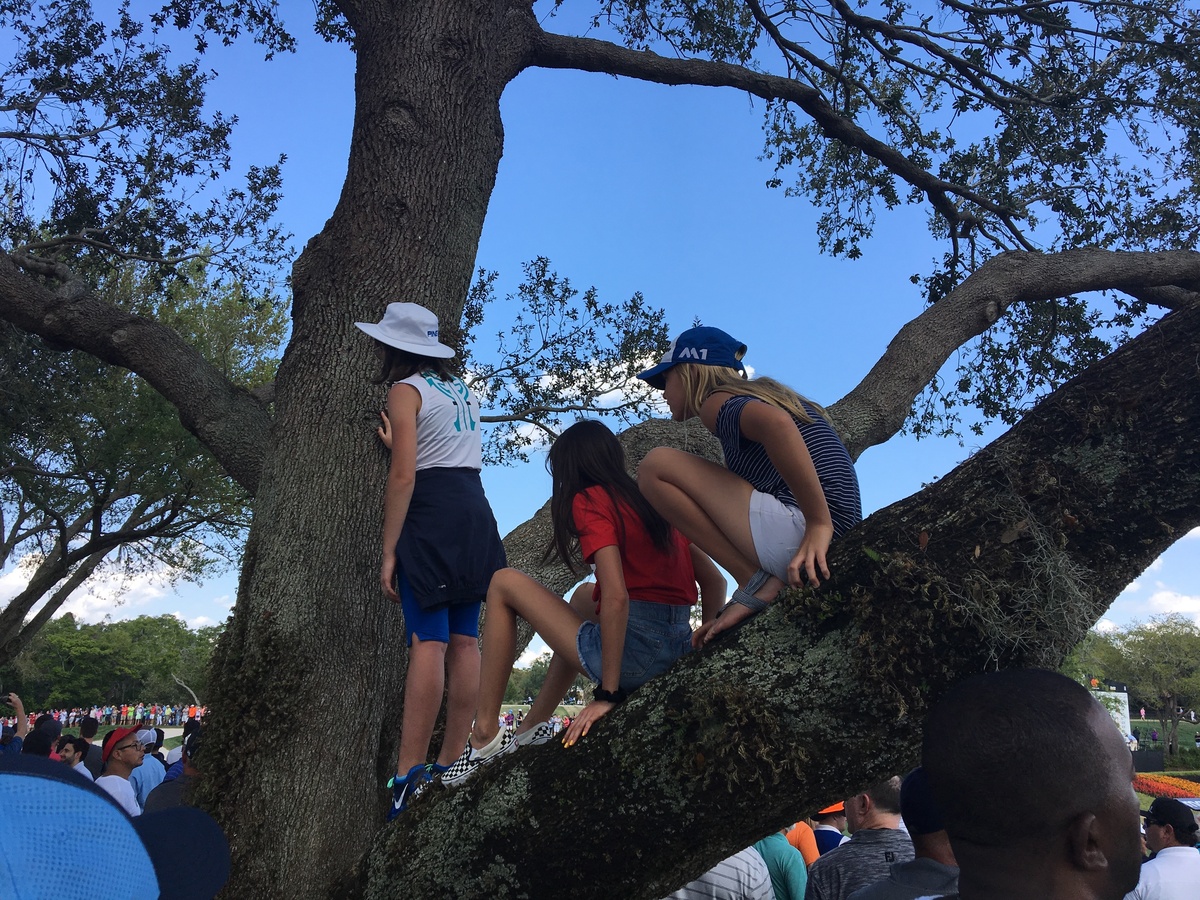
Donatella Masson, Chloe Trinh and Lowa Johansson get a tree’s-eye view of Tiger Woods as he passes by on the 8th hole Sunday at the Arnold Palmer Invitational in Orlando, Fla.
Tom Goldman/NPR
hide caption
toggle caption
Tom Goldman/NPR
It was at the 13th green on the Bay Hill course, and it started when Woods, wearing his traditional Sunday red golf shirt and black hat and pants, drained a 15 foot putt. The crowd exploded in one of those “Tiger roars” heard all over the golf course. The birdie putt was his second in a row, his third in four holes and it moved him one shot off the lead.
Tiger Woods was making a charge.
It felt like it could’ve been anywhere from 1997, the year he burst onto to the scene with a dominating win at the Masters to 2013, the last year he won a PGA Tour event.
As Woods made his way to the 14th tee, it was pandemonium, with many in the gallery chanting “Tiger! Tiger! Tiger!”
His competitors out on the course, like Bryson DeChambeau, felt it too.
“Oh it was amazing,” DeChambeau said. “I told my caddie, Tim, in the 11th fairway, I’m like ‘man, Tiger’s doing it!’ I was incredibly happy for him. At the same point in time I’m still trying to win a golf tournament, right?”
DeChambeau finished second. Woods’ magic moment ended on the 16th hole, when he drove the ball out of bounds.
It was as if the golf gods sent a message to Woods from on high — not yet. Actually, the real reason for his mistake was much less celestial in nature.
Standing on the 16th tee, Woods pondered three possible shots he could hit.
“If I hit a driver I had to fit it with a cut,” he told reporters after his round. “[But also] In the back of my mind [I] said ‘Why don’t you just bomb it over the top?’ Or just hit a three-wood straight away. And so I’m running through these different scenarios and it’s on me. I didn’t commit to either one of those three shots and I hit a poor one.”
It cost him a stroke and was the start of a shaky finish to an otherwise positive round.
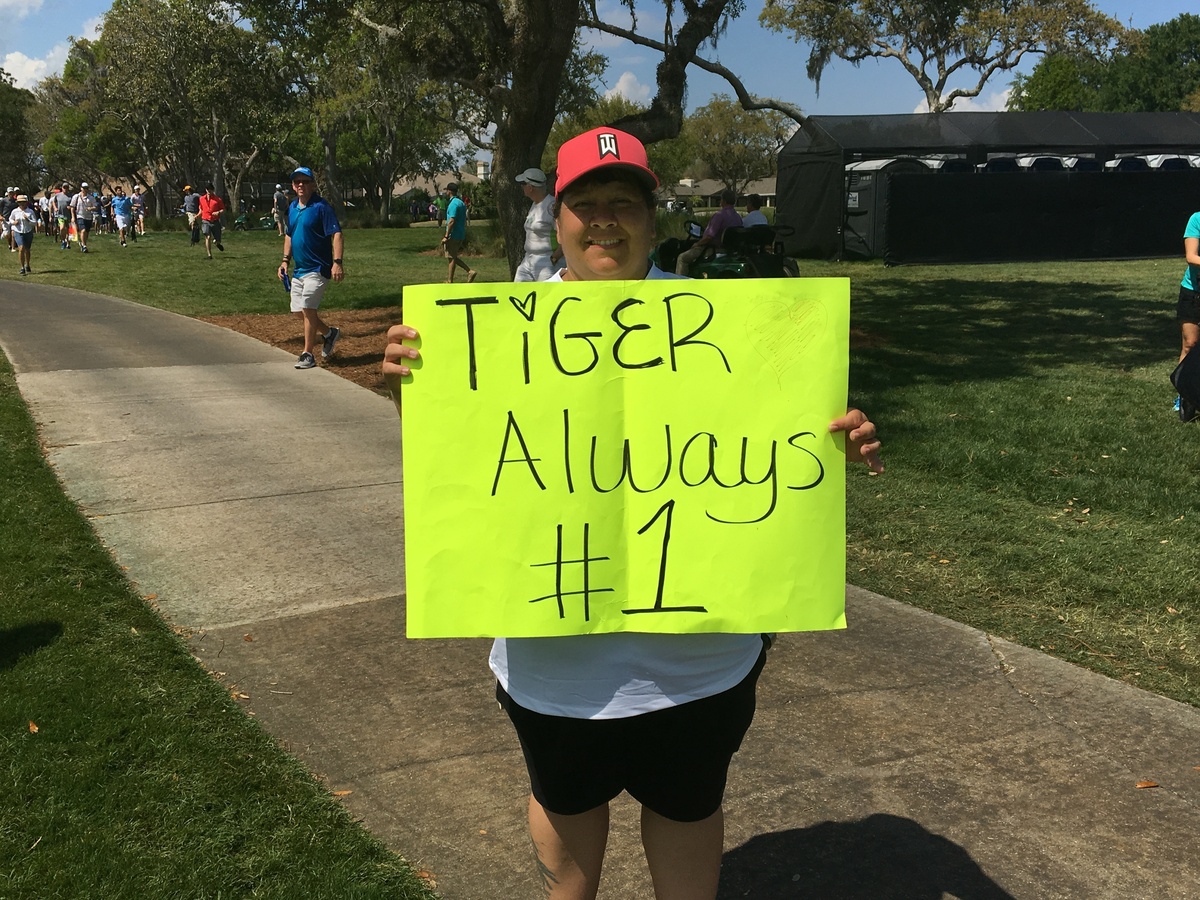
Stephanie Valdez of Orlando, Fla., says she’s been a Tiger Woods fan since 1996. She followed Woods his entire final round Sunday at Bay Hill golf course in Orlando. Valdez is “glad he turned his life around. He’s back in the game.”
Tom Goldman/NPR
hide caption
toggle caption
Tom Goldman/NPR
Woods tied for fifth. A week after tying for second. In his mind, the comeback that even he doubted was possible, is moving forward nicely. Thanks to a fourth back surgery that seems to have worked.
“If I can play with no pain and I can feel I can make golf swings, I’ll figure it out,” he said Sunday after his round. “I’m starting to piece it together, tournament by tournament. Each tournament’s gotten a little bit crisper and a little bit better.”
His results bear that out. He’s gone from 23rd, to a missed cut, to a 12th-place finish, to 2nd and now 5th. With his final round of three under par 69 on Sunday, Woods now has shot 10 straights rounds of par or better stretching back over his last three tournaments.
Augusta bound
Next up for Woods is the Masters in early April.
He hasn’t played his favorite major tournament since 2015 and he says he needs to travel to Augusta, Ga., to reacquaint himself with the course’s special characteristics.
“Playing on overseeded rye [grass]; the different spins that we’re going to encounter there,” Woods said, adding “I’ll figure out what wedge system I want to use for that week, what bounce system. [I’ll] Get used to those bunkers. The sand’s very heavy, thick and so I’ve got to do a little bit of work.”
While Woods sweats the details, his fans will be content anticipating more time travel.
To 2005 — the last time he won there.
The idea that Woods can win another major tournament is startling. The debate over whether he could catch and pass Jack Nicklaus’ all-time record of 18 major wins, Woods has 14, died away as Woods’ career foundered.
It’s foundering no more. And suddenly, the 42-year-old Woods is redefining what’s possible.
The University of Maryland Baltimore County men’s basketball team beat the No. 1 seed in the NCAA tournament — by a lot. NPR’s Michel Martin talks with UMBC President Freeman Hrabowski about the win.
Scott Simon talks with ESPN’s Howard Bryant about the latest in college basketball.
SCOTT SIMON, HOST:
Now time for sports.
(SOUNDBITE OF MUSIC)
SIMON: And overnight, the University of Maryland, Baltimore County Retrievers are a household name. They pulled off the biggest upset ever in the NCAA Men’s Basketball Tournament. But how upset should fans be about the ways of the NCAA? Howard Bryant of ESPN joins us. Good morning, Howard.
HOWARD BRYANT: Good morning, Scott. Are you really going to make me ruin the Golden Retriever moment by talking about the business of sports? Yes. You are, aren’t you?
SIMON: Well, that’s what we had planned – yes.
(LAUGHTER)
SIMON: That’s what we do here in the news business.
BRYANT: What a great victory, though.
SIMON: Really was – I confess. I didn’t even know the University of Maryland, Baltimore County had a basketball team. And they beat the No. 1 ranked team in the country, the Virginia Cavaliers, by 20 points – 74-54.
BRYANT: Smoked them – yeah.
SIMON: So would you call this shocking, staggering or stupefying?
BRYANT: Well, I think it’s a great victory because as the field has gone to 64, you’d never had a 16 beat a No. 1. Eventually, one day, it was going to happen – that it was going to happen to Virginia and that they were going to – not just lose the game – it wasn’t going to be some half-court buzzer beater. They got demolished. They got beat by 20 points. And they were down double digits most of the game. And so that was pretty significant.
I am not, however, going to say this was the greatest upset in the history of college basketball because I still think that you have some great, great teams that later in the tournament had no business losing. I’d say 1984. If you look at Houston and NC State – obviously that one. I think you look the next year – Georgetown, Villanova – also an incredible, incredible upset. This, however, was pretty significant and a lot of fun.
SIMON: Of course, the games are entertaining. But the real game is money. And did last night – well, let me put it this way. How much, Howard Bryant, will the non-profit NCAA make from this tournament?
BRYANT: Over a billion dollars. And for the first time, they are crossing the billion-dollar mark for a two-week tournament. And once again, as we know, the players don’t make any money from this. And if you buy a kid a tuna sandwich, it’s an NCAA violation for the most part. And so I think we need to recognize the enormous sums of money that’s being made in this tournament. But I think more than that, I think we also have to pay attention to the promise that these kids are on campus to get an education. That has completely disappeared. All of those fallacies have to be sort of confronted.
And we need to look at this as the hardcore business that it is. In a lot of ways, Scott, it’s not that much different from football in that we have this decision we want – we have to make as fans. Are you going to simply watch this for your entertainment and for your alma mater? Or are you going to watch it for recognizing it as the cold billion-dollar business that it is where the actual talent isn’t compensated?
SIMON: Now, the NCAA says the money does go to student athletes in that it supports athletic programs at colleges and universities including, for that matter, sports like fencing or curling that don’t sell television rights typically and scholarships and general enhancement of the university. Are you moved by that argument?
BRYANT: Not really, no, because you can’t tell me that there’s no room to compensate the player when Mike Krzyzewski at Duke makes over $10 million a year or John Calipari makes $8 million a year in salary.
And I think that it’s much more an attitude of the public as well in that we need to concentrate on this attitude that the players are receiving a free education. It’s not free. Their scholarships aren’t even guaranteed. So they’re not even receiving the value of a four-year scholarship. They’re there for one year – renewable. So if they get hurt or something, sometimes the scholarship’s not even guaranteed. And we need to look at them as something that – it’s not being given to them. They earned this. They earned this. And they work very, very hard. And I think that it’s difficult to look at sports unless we look at this as well.
SIMON: Howard Bryant of ESPN, thanks so much for being with us, my friend. Talk to you soon.
BRYANT: Thank you.
(SOUNDBITE OF THE TRUE LOVES’ “FAMOUS LAST WORDS”)
Copyright © 2018 NPR. All rights reserved. Visit our website terms of use and permissions pages at www.npr.org for further information.
NPR transcripts are created on a rush deadline by Verb8tm, Inc., an NPR contractor, and produced using a proprietary transcription process developed with NPR. This text may not be in its final form and may be updated or revised in the future. Accuracy and availability may vary. The authoritative record of NPR’s programming is the audio record.

Jairus Lyles, left, and teammate Jourdan Grant of the UMBC Retrievers react Friday night to their 74-54 victory over the Virginia Cavaliers in Charlotte, N.C.
Streeter Lecka/Getty Images
hide caption
toggle caption
Streeter Lecka/Getty Images
The NCAA men’s basketball tournament has included 64 teams every year since 1985, split into four quadrants and seeded 1-16. In all those years — in 135 tries — no 16 seed had ever beaten a top-seeded team.
Until the University of Maryland-Baltimore County beat the stuffing out of Virginia, the best team in the country, 74-54 on Friday night.
All of which is to say, if anyone claims they picked against Virginia in their tournament pool, you should feel comfortable not believing them.
The Retrievers — who made half their three-point shots against easily the best defensive team in the country — were led by 28 points from senior guard Jairus Lyles, and also presumably every four-leaf clover along the shoulders of I-95.
UMBC outscored Virginia 53-33 in the second half, and also outrebounded the Cavaliers despite giving up a lot of height.
Virginia entered today allowing 53.4 PPG.
It allowed 53 points in the 2nd half to UMBC. pic.twitter.com/8RW2cxuzei
— ESPN Stats & Info (@ESPNStatsInfo) March 17, 2018
University of Maryland-Baltimore County advances to play ninth-seeded Kansas State on Sunday.
The Virginia Cavaliers advance to wincing at trivia questions for the rest of their lives.
“I told our guys we had a historic season,” coach Tony Bennett said after the game. “And then we go and make history as the first top seed to lose.”
The last time Tiger Woods won a golf tournament was 2013. Once the world’s top player, he’s struggled with a myriad of health issues and off-the-course distractions. But he’s back and close to winning again.
In March Madness, Loyola Chicago beat Miami with a last-second three-pointer. Team chaplain Sister Jean is a 98-year-old nun who said she prayed for good calls from the referees.