Get A Vasectomy To Get Off Work To Watch Basketball

It’s March Madness, but college basketball games are inconveniently scheduled during work. Many urologists say they see a spike in vasectomy procedures in March.
It’s March Madness, but college basketball games are inconveniently scheduled during work. Many urologists say they see a spike in vasectomy procedures in March.
High School athletes often raise money for their teams. In Newton, Mass., instead of a donation, a football player got a lecture when he rang the doorbell of a leading brain injury researcher.

Dr. Lee Goldstein, Associate Professor of Psychiatry, Neurology, Ophthalmology, Pathology and Laboratory Medicine, & Biomedical Engineering at Boston University and Newton North High School Football player Alex Riviero speak on the front porch of Dr. Goldstein’s home in Newton, Mass.
Meredith Nierman/WGBH
hide caption
toggle caption
Meredith Nierman/WGBH
As Alex Rivero biked around town raising money for the Newton North High School football team last fall, the 17-year-old started getting pretty good at guessing which houses were worth the door knock. He’d look for lights on and listen for kids’ voices.
When he found a house that looked promising, he would stop.
At one place, Dr. Lee Goldstein opened the door. Goldstein cares a great deal about high school football. It’s what he was thinking about when the doorbell rang.
“I was writing about these postmortem pathology specimens — brains — from teenagers who had played football,” says Goldstein.
Clearly visible in the boys’ brains were tell-tale brown areas, the early signs of the same disease found in the brains of more than 100 former pro football players: CTE, or Chronic Traumatic Encephalopathy.
“This is the beginning of a dementing process that will destroy a brain,” says Goldstein, who leads the molecular research team at Boston University’s CTE Center. “To see this, a neurodegenerative disease, in a teenage brain, that’s tough. That’s really tough.”
Thinking back on that chance encounter, Rivero says, “It could have been any random dad who just came down the stairs and said, ‘Oh football, I used to play football.’ “
“No, it was the one dude who probably knows the most about CTE probably out of 99.9 percent of the world.”
The research Goldstein was working on would, a few months later, be published in the journal Brain and generate widespread media coverage. It involved evidence not only from teenage football players’ brains but also animal models that offered ground-breaking information: CTE can develop even without a concussion.
“We sat down on the porch,” Rivero recalls, “and he starts telling me it’s not just concussions that are the problem.”
“It’s about getting hit in the head,” says Goldstein. “And the more hits he gets, the greater the risk for this disease, even if he never has a concussion. Ever.”
“I didn’t realize how little you needed, how little damage you needed to suffer from CTE,” says Rivero.
Goldstein hoped the conversation would do more than inform Rivero. He wanted to convince him to stop playing football.
“That was my hope,” says Goldstein. “He seems like such a lovely kid and I’m thinking ‘Why? Why do this?’ “
Rivero says he plays football for many of the same reasons that, during the offseason, he engages in his other favorite sport: boxing. It’s the only sport with a higher risk of CTE than football.
“There’s something about it, when you’re boxing, when you’re playing football,” explained Rivero. “It just brings something out of you that you really only know if you play those sports.”
That chance meeting made Rivero think long and hard about the risks those sports carry. And when his English teacher assigned a research project, Rivero decided to write his own paper on CTE. His research included a visit to Goldstein’s lab at Boston University.
“He told me it was the most important thing he was doing that day and he said, ‘I know I might not stop you, but I feel like education’s the most important thing here.’ “
Rivero is still a regular at the boxing gym but says he rarely goes into the ring. He doesn’t want to get hit in the head. So, what about football?
“It’s kind of hard to think about but I’m still going to play,” says Rivero. “This is something I love. I dedicate myself to [this]. This makes me healthier physically, mentally. I’m doing what I love, making friends, there’s a lot of great experiences that I’m having from this.”
It’s hard to compare that tangible experience with the abstract idea of, decades from now, possibly being addled by brain disease. Although, Rivero says he gets it — playing football puts him at risk for developing CTE.
“It’s a thought, it’s definitely a thought. I know it’s entirely possible,” says Rivero, “but right now I’m just trying to enjoy life.”
“He loves the game and I get that. I really do,” says Goldstein, “And then I ask the question, not about his wishes, but about the greater society. Why are we not protecting our kids?”
Dr. Goldstein says the research on CTE is a lot like the early days of lung cancer research. The link to cigarette smoking was not immediately understood — or accepted. And it’s taken generations to change behaviors and policies around smoking. He thinks it might be the same thing with football.

Alex Meyer, then a member of the minor-league Rochester Red Wings, watches for a signal from his catcher as a 20-second pitch clock counts down in 2015. On Wednesday, Minor League Baseball announced it will shave five seconds off that clock when there are no runners on base, among other rule changes.
Bill Wippert/AP
hide caption
toggle caption
Bill Wippert/AP
Strap in, purists. This game is about to get a good deal faster.
At least, that’s what Minor League Baseball officials are hoping. The league announced Wednesday that it plans to institute some pretty big rule changes for the 2018 season — including beginning extra innings with a runner automatically on second base and, in certain situations, shaving five seconds off the pitch timer the league had already instituted in triple- and double-A ball.
Now, when there are no runners on base, pitchers at those levels will get just 15 seconds to begin their pitching motion. When runners are on, pitchers will still enjoy the full 20-second clock first instituted in the minors in 2015.
If the pitcher fails to meet his deadline, a ball will be awarded to the batter’s count, while a strike will be counted against the batter if he’s not ready for the pitch. For a 15-day grace period at the start of the 2018 season, though, violators will just receive warnings as they get used to the new system.
As for the big rule change in extra innings: Beginning in the 10th, when the leadoff hitter takes his place in the batter’s box, the teammate directly ahead of him in the batting order will set up across from him on second base — already halfway to home plate before a pitch has even been thrown.
“We believe these changes to extra innings will enhance the fans’ enjoyment of the game and will become something that the fans will look forward to on nights where the game is tied late in the contest,” Minor League Baseball President Pat O’Conner said in a statement.
He added that officials also have the players’ interests in mind, saying that lengthy extra innings and longer games can pose health risks, both in the near- and long-term. He noted that their partners in Major League Baseball also have a vested interest in keeping their farm team prospects injury-free.
Visits to the pitcher’s mound from coaches and other players will also be capped.
“We feel that limiting mound visits and decreasing the amount of time between pitches with no runners on base will further improve the pace of play,” said O’Conner, “and make it a more enjoyable experience for our fans.”
Major League Baseball, for its part, will only be instituting a cap on mound visits, deferring a decision on pitch clocks this year “in order to provide players with an opportunity to speed up the game without the use of those timers,” MLB Commissioner Rob Manfred said last month.
The rule changes were greeted Wednesday by many long-time fans with, let’s say, a fair bit of skepticism. Die-hard baseball fans rarely respond kindly to the notion of fiddling with their pastime, and a cursory Twitter search — “really horrendous idea,” the “dumbest idea since the glowing puck,” “GROSS!” — reveals a little immediate resistance.
That reference to pucks is telling, though: If the MLB decides to follow the lead of the minor leagues, it won’t be the only major sports league in the U.S. to brave the third rail in recent years with rule changes to speed up play or prevent injuries.
The NHL, for instance, got rid of the two-line pass rule in 2005, opening up the game to rink-spreading plays, and has toyed more than once recently with its own overtime regulations to coax more excitement out of the extra period. And the NFL has been chipping away at high-impact kickoff plays, also with an eye toward reducing player injuries.
Former Washington NFL replacement player Tony Robinson will receive a Super Bowl ring more than 30 years after helping the team win the 1987 Super Bowl as a scab player.

Investor Warren Buffett in 2017 gestures on stage at a national conference sponsored by the Purpose Built Communities group that Buffett supports in Omaha, Neb. Buffet says any Berkshire Hathaway employee who correctly predicts all Sweet 16 teams in the men’s NCAA basketball tournament will received $1 million per year for life.
Nati Harnik/AP
hide caption
toggle caption
Nati Harnik/AP
Billionaire CEO Warren Buffett has an NCAA men’s basketball bracket challenge that just may blow other office pools out of the water.
Buffett told CNBC last month that any Berkshire Hathaway employee who accurately predicts all Sweet 16 teams will receive $1 million per year for the rest of his or her life.
The Oracle of Omaha went on to say that “if either Creighton or Nebraska ends up winning the tournament, we’re going to double the prize.”
Buffett, a Nebraska native, is also offering a $100,000 prize to the employee whose bracket stays intact the longest.
Last year, a steel worker from West Virginia correctly predicted 31 of the first 32 games and picked up his six-figure reward.
Berkshire Hathaway owns more than 90 companies, including Geico and Dairy Queen.
Here is a dose of reality that will calm your but-I-don’t-work-for-Berkshire- Hathaway-itis:
USA Today reports the odds of accurately predicting the Sweet 16 are less than one in a million.
Previously, Buffett offered $1 billion for anyone who predicted a perfect bracket.
That feat has never been achieved in the 21-years that ESPN has been doing a bracket challenge.
The odds of predicting a perfect bracket, according to USA Today, are anywhere from one in nine quintillion to about one in two billion.

At the American Athletic Conference tournament semifinals earlier this month in Uncasville, Conn., Cincinnati’s Andeija Puckett, left, looks to pass to Sam Rodgers, right, under pressure from Connecticut’s Kia Nurse. Connecticut is the first overall seed in the NCAA women’s basketball tournament that begins on Saturday.
Jessica Hill/AP
hide caption
toggle caption
Jessica Hill/AP
The slots in the NCAA women’s basketball tournament bracket have been filled and Connecticut is the first overall seed.
At 32-0, they are the only team to enter the NCAA tournament unbeaten.
The Huskies are aiming for their 12th national championship. Last season, UConn was the overwhelming favorite but lost to Mississippi State in the Final Four.
This year’s other No. 1 seeds are Notre Dame, Louisville and Mississippi State.
Here’s a printable bracket for the women’s tournament.
There were five teams trying to get into the bracket’s top spots and in the end Baylor lost out.
The Associated Press reports the Bears, who lost just one game all season (31-1), instead get a No. 2 seed in Lexington, a region that includes top-seeded Louisville, Tennessee and Stanford.
“‘We felt there was a razor-thin margin between Baylor and Notre Dame,’ said NCAA women’s basketball committee chair Rhonda Bennett. ‘Notre Dame did have the top strength of schedule in the country and they did have the best strength of schedule in the country and they had nine more top-50 wins than Baylor and those were the reason that the committee put Notre Dame on that one line and Baylor on that two line.’
Baylor coach Kim Mulkey said she doesn’t see it as that big a deal.
‘We’ve won a national championship as a two seed, we’ve won it as a one seed,’ she said. ‘And really what does it matter? Because the one has to play the two. Mississippi State was a two last year and they played for the national championship. We were a two seed in 2005 and we played and won the national championship.'”
The first round of the women’s tournament begins on Saturday. UConn faces St. Francis University of Loretto, Pa.
The men’s NCAA basketball bracket was announced on Sunday.

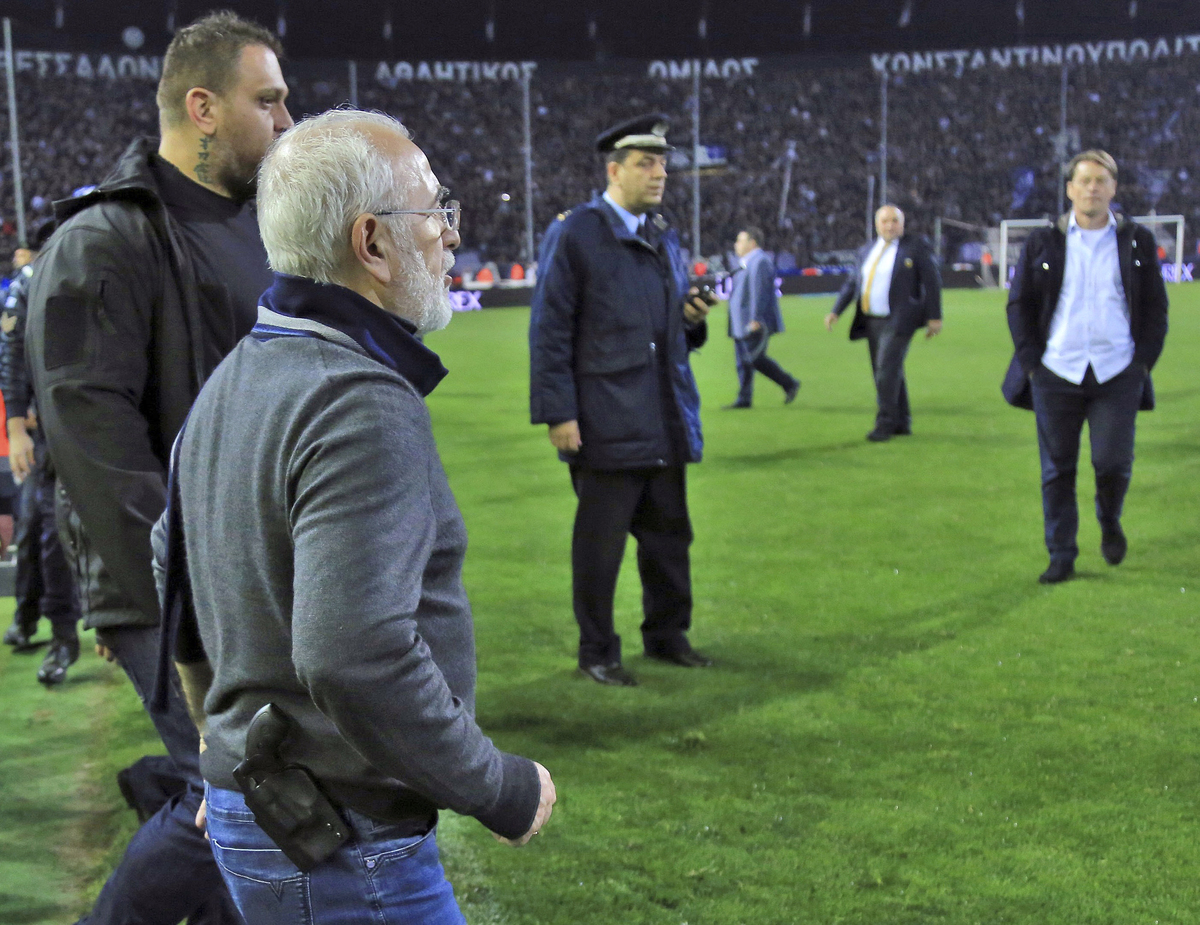
PAOK owner Ivan Savvidis invades the pitch during the Greek League soccer match between PAOK and AEK Athens in the northern Greek city of Thessaloniki on Sunday.
AP
hide caption
toggle caption
AP
Greece has suspended indefinitely its Super League after the team owner of PAOK walked onto the pitch apparently carrying a gun in a holster to protest a referee’s call in a match against AEK.
It happened in the final few seconds of Sunday’s game in the Greek city of Thessaloniki, after PAOK player Fernando Varela scored a goal that was subsequently tossed out by a referee. The teams had been tied up till that point.
As The Associated Press reported, “FIFA urged Greek authorities to take swift action against PAOK owner Ivan Savvidis or face as possible suspension.”
The country’s deputy minister for sport, Giorgos Vasileiadis, told the wire service that games would not start up again “if there is not a new, clear framework agreed to by all so we can move forward with conditions and regulations.”
Savvidis looks very angry and has to be held back by bodyguards, but he does not appear to remove the apparent weapon from his holster during the chaotic scenes. He was initially wearing a jacket but later removed it, providing a clear view of what looks like a gun. Here’s a video of the melee from The Guardian:
According to the Telegraph, AEK coach Manolo Jimenez told a Spanish radio station that Savvidis threatened the referee.
“I’m stunned; I don’t understand it. It’s the type of thing you expect to see in a Clint Eastwood movie,” the opposing coach added.
PAOK issued a statement after the incident, saying that Savvidis “is preparing to take all necessary steps to protect the club and all his executives and associates from the threats and attacks they are suffering.” It did not elaborate on what threats or attacks they are suffering and what steps he would deem necessary.
The BBC reports that Savvidis, a businessman, is one of the richest men in Greece. He “was born in Georgia of Greek heritage and is a former member of the Russian parliament.”
A spokeswoman for Greece’s police, Ioanna Rotziokou, told The New York Times that an arrest warrant has been issued for Savvidis and some of his bodyguards. She added that Savvidis “is a legal gun-carrier,” but the warrant was issued for invading the field.
Vasileiadis, the deputy sports minister, told the AP that this comes as Greece is trying to clean up its football sector.
“We have won a lot, but much more remains to be done,” Vasileiadis said. “In any case, we will not allow all this effort to be endangered, we will not allow phenomena of the past to be resurrected.”

Villanova celebrates after an NCAA basketball game win over Providence in the Big East men’s tournament final Saturday in New York. Villanova won in overtime 76-66. Villanova along with Virginia, Kansas and Xavier are the No. 1 seeds in the men’s NCAA basketball tournament.
Frank Franklin II/AP
hide caption
toggle caption
Frank Franklin II/AP
With much fanfare, brackets for the men’s NCAA basketball tournament were released on what has come to be known as Selection Sunday. Virginia, Villanova, Kansas and Xavier are the No. 1 seeds.
The tournament begins Tuesday with opening-round games in Dayton, Ohio, and then gets into full swing Thursday and Friday at eight sites across the country. Final Four action is set for March 31 and April 2 in San Antonio, Texas.
Hard core March Madness participants already know when their office pool brackets are due — most likely by Thursday’s games. That will give newbies and dilettantes plenty of time to study up.
Here is the official, printable NCAA bracket for the NCAA Division I men’s basketball tournament.
Sports Illustrated reports:
“Murray State was the first team to secure its bid to the Big Dance by winning the Ohio Valley Tournament, and Michigan was the first team from a major conference to lock up a spot by defeating Purdue in the Big Ten Tournament Championship.
The last team to steal a bid into the tournament was Davidson. The Wildcats knocked off Rhode Island in the A-10 Tournament Championship Sunday to secure a spot in the Big Dance, and make the bubble a bit more difficult to navigate. The Selection Committee said Notre Dame was the team that was bumped out because of Davidson.
The ACC has the most teams in the tournament with nine (Virginia, Duke, North Carolina, Clemson, North Carolina State, Virginia Tech Florida State, Miami and Syracuse).
“The biggest snubs of this year’s tournament include Oklahoma State, USC, Saint Mary’s, Louisville and Notre Dame. Syracuse claimed the final spot in the bracket for at-large teams.”
This year’s tournament is being played under a cloud. Shortly after the new championship team is crowned, a commission investigating alleged bribes and payoffs is expected to release its recommendations.
That commission’s investigation, led by former Secretary of Stage Condoleezza Rice, started after the FBI charged assistant coaches, agents, employees of apparel companies and others in a federal bribery and fraud probe.
The Associated Press reports:
“No fewer than a dozen teams in the tournament have been named either in the FBI investigation or in media reports that allege coaches and others have directed payments and improper benefits to recruits and players – thus, breaking rules that go to the core of the amateur-sports code that defines both the NCAA and the ‘student-athletes’ who make this billion-dollar business run.
They range from teams that made it into the tournament off the so-called bubble — Alabama — to one of the best teams in the country. Arizona, a No. 4 seed in the South, has been roiled by a report that wiretaps caught coach Sean Miller discussing a $100,000 payment to freshman Deandre Ayton. Miller has strongly denied the accusation, though the story line figures to follow the Wildcats through what could be a long run in the tournament.”
In media interviews, chairman of the NCAA selection committee Bruce Rasmussen said the investigations did not play a role in the bracket-filling process.
There is a new sport growing in popularity: ax throwing. Just grab yourself an oversized dart board and hatchet.
DON GONYEA, HOST:
OK. If you’ve become just a bit bored with the darts at your local pub or ale house, you may want to up your game a bit with ax throwing. And you don’t even need the super strength of Thor. All that’s required is an oversized dartboard and a sturdy hatchet. According to the BBC, competitive ax throwing had its origins in Canada a decade ago. And you thought they were all about the curling. It snuck across the border and is now growing in popularity in the States. There’s even a National Axe Throwing Association. Participants say ax throwing can be relaxing, and it’s not that dangerous, they say.
Copyright © 2018 NPR. All rights reserved. Visit our website terms of use and permissions pages at www.npr.org for further information.
NPR transcripts are created on a rush deadline by Verb8tm, Inc., an NPR contractor, and produced using a proprietary transcription process developed with NPR. This text may not be in its final form and may be updated or revised in the future. Accuracy and availability may vary. The authoritative record of NPR’s programming is the audio record.