Winter Olympics Kick Off With Biting Winds And History-Making Wins
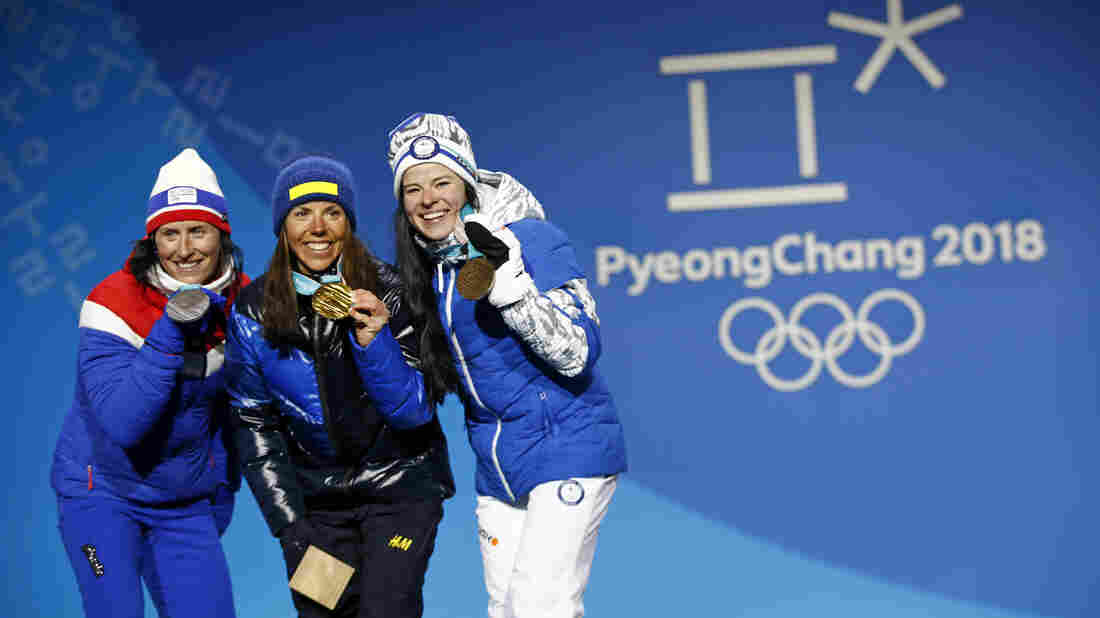
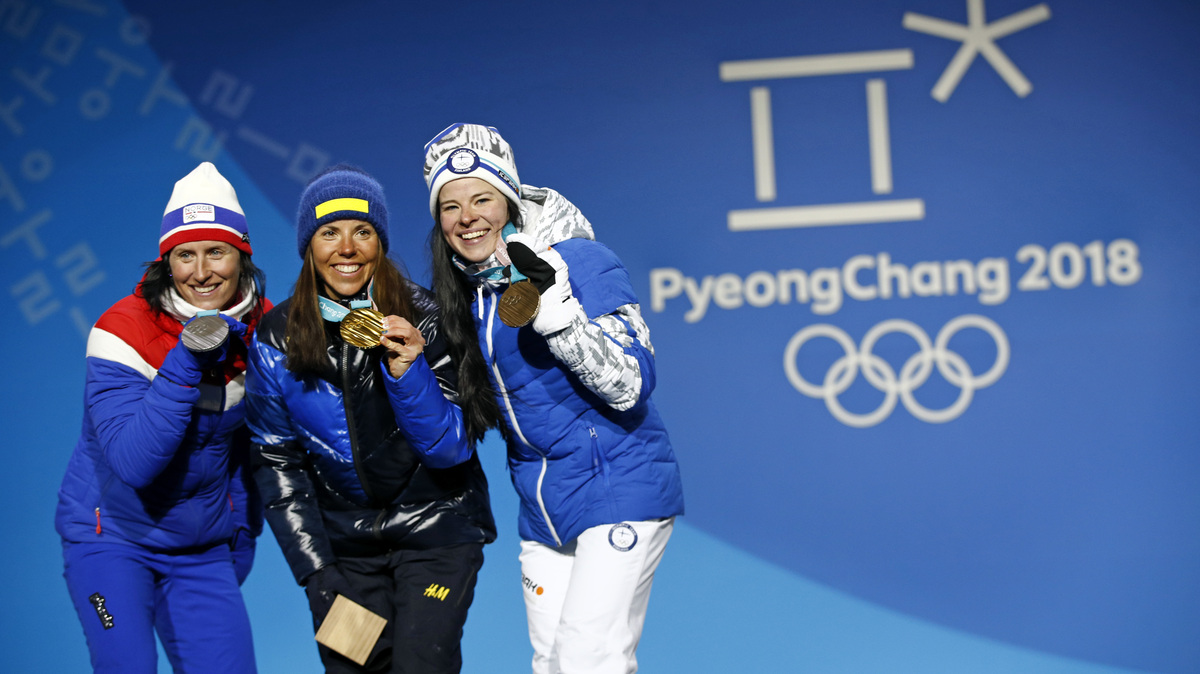
The first medals of the Games were awarded to the women’s cross-country 15-kilometer skiathlon athletes. From left, Norway’s Marit Bjoergen, silver; Sweden’s Charlotte Kalla, gold; and Finland’s Krista Parmakoski, bronze, pose during their medals ceremony in at the 2018 Winter Olympics in Pyeongchang
Patrick Semansky/AP
hide caption
toggle caption
Patrick Semansky/AP
Sweden won the first gold medal of the Winter Games on Saturday, but the United States and Norway also made history on a blustery and bitter cold day in Pyeongchang, South Korea.
Swedish cross-country skiier Charlotte Kalla won top honors in the women’s 15-kilometer skiathlon with a finishing time of 40:44.9.
Wohoo, ski queen Charlotte Kalla wins Sweden’s first Olympic gold medal! Congrats! ???? pic.twitter.com/IUNhSdTjC5
— Sweden.se (@swedense) February 10, 2018
Norway’s Marit Bjoergen came in fewer than eight seconds behind to take silver, adding to her trove of 10 prior Olympic medals, making her the most decorated female Winter Olympian of all time.
In 2014’s Sochi Winter Games, at the age of 33 and 324 days, Bjoergen became the oldest individual female gold medalist in the sport.
On Saturday, the 37-year-old acknowledged that her age may be catching up with her. “I have been very good for many years but I’m also getting older and the younger girls are getting better,” she said, reports The Associated Press.
Finland’s Krista Parmakoski rounded out the top three with Sweden’s Ebba Andersson finishing fourth.
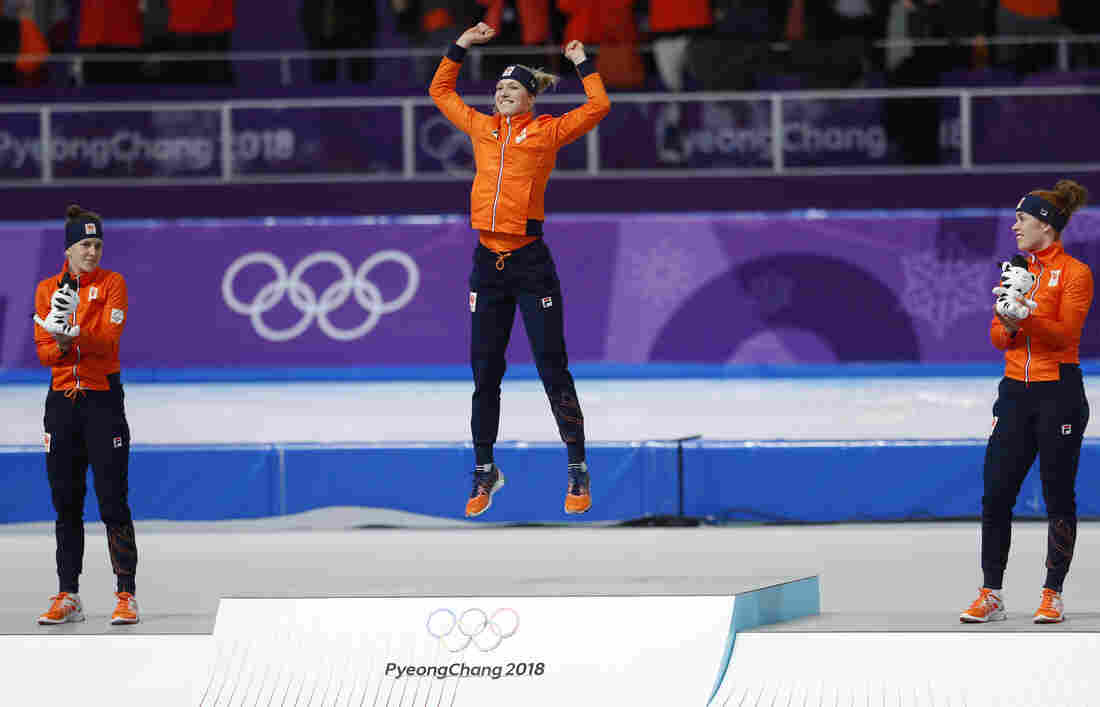
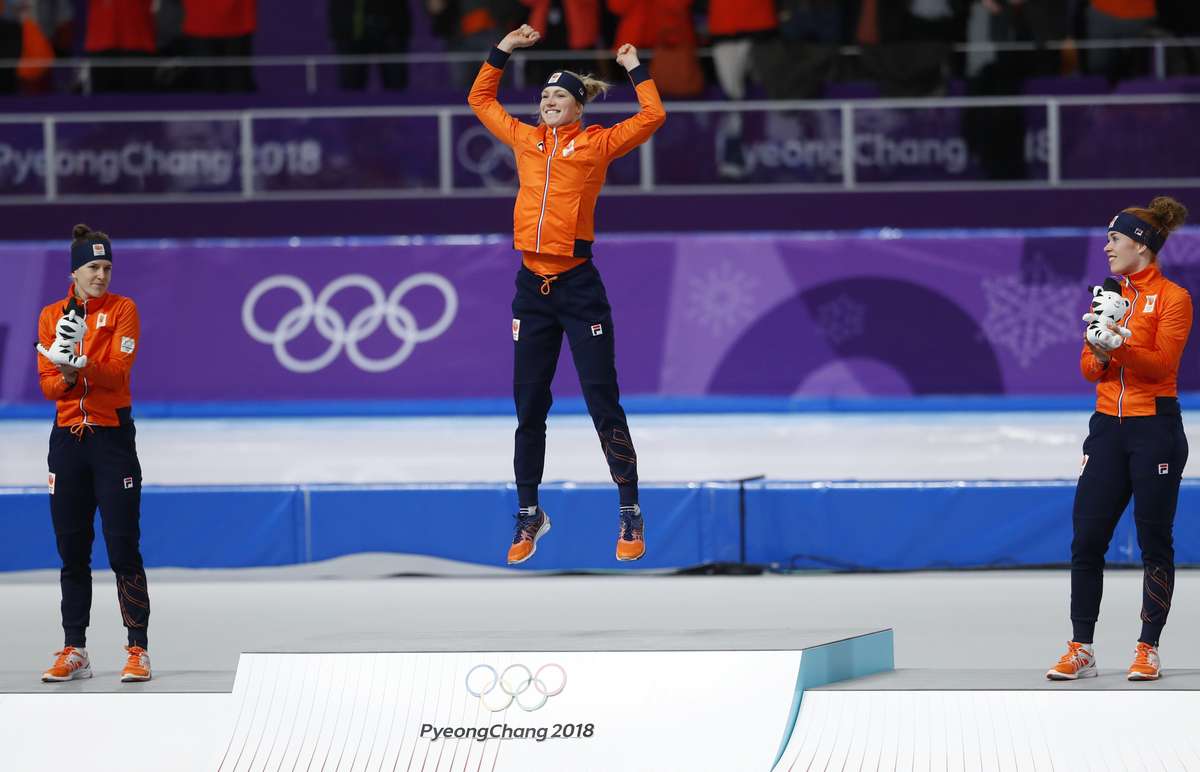
With a clean sweep for The Netherlands, gold medallist Carlijn Achtereekte, (center), jumps for joy as silver medallist Ireen Wust, (left), and bronze medallist Antoinette de Jong, (right), watch during the flower ceremony of the women’s 3,000 meters race at the 2018 Winter Olympics.
Petr David Josek/AP
hide caption
toggle caption
Petr David Josek/AP
And it was American Jessica Diggins, 26, who broke the Scandinavian dominance with a time of 40:59.6.
While her time fell short of a medal, Diggins’ fifth place finish represented another history-making moment — it was the best ever for an American woman in the sport.
ESPN reports Diggins is scheduled to race again Tuesday in the women’s individual sprint.
“It was really cool being seconds away from a medal, and seeing it right there,” Diggins said. “I know it’s possible. I know I have what it takes.”
#ICYMI: @jessdiggs made #TeamUSA history last night with her 5??th place finish! ??
?? https://t.co/znBmAyBvFApic.twitter.com/mE5HMPlGL8— U.S. Olympic Team (@TeamUSA) February 10, 2018
Also Saturday, host country South Korea got the chance to celebrate one of its own, when Lim Hyojun won gold in the men’s short track speed skating. ESPN reports that it was actually Hwang Dae-heon who had been heavily favored to win, but his crash in the final allowed his compatriot to overtake him.
The Netherlands’ Sjinkie Knegt took silver. And Semen Elistratov won bronze, giving Russia its first medal, although Elistratov is competing under the Olympic flag, in accordance with the rules the IOC instated following Russia’s doping scandal.
In the women’s 3,000 meter speed skating, the Netherlands made a clean sweep taking all three of the top spots.
Germany’s Laura Dahlmeier won the first biathlon gold of the Games in the women’s 7.5-kilometer sprint. And German Andreas Wellinger won the men’s normal hill title. He said the harsh conditions may actually have helped him nail his jump of 113.5 meters.
“The wind was quite good,” Wellinger told ESPN.
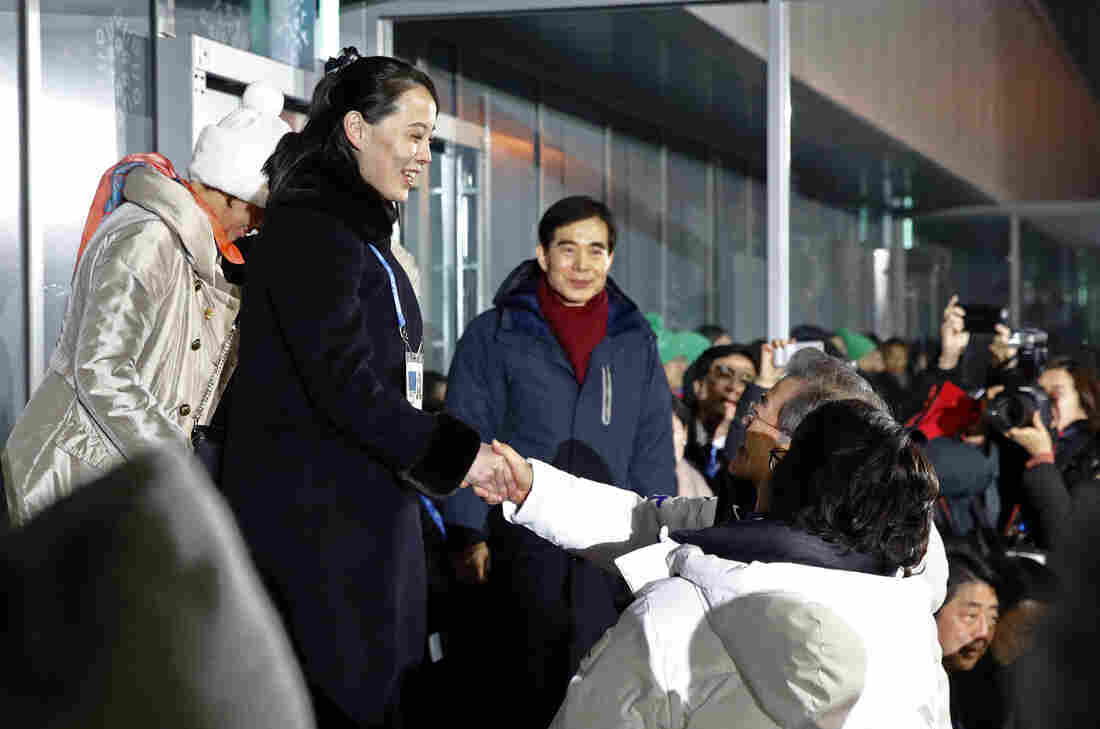
And while the Korean women’s ice hockey team may embody lofty hopes around reunification, they were trounced by Switzerland Saturday. The gaze of South Korea’s president and the sister of the North Korean leader, alongside the choreographed moves of the famed North Korean cheerleaders couldn’t help elicit a single goal; the Swiss won eight to zero.
Downhill Skiers Gear Up To Face Their Fears — And 'Snow Snakes' — In Winter Games
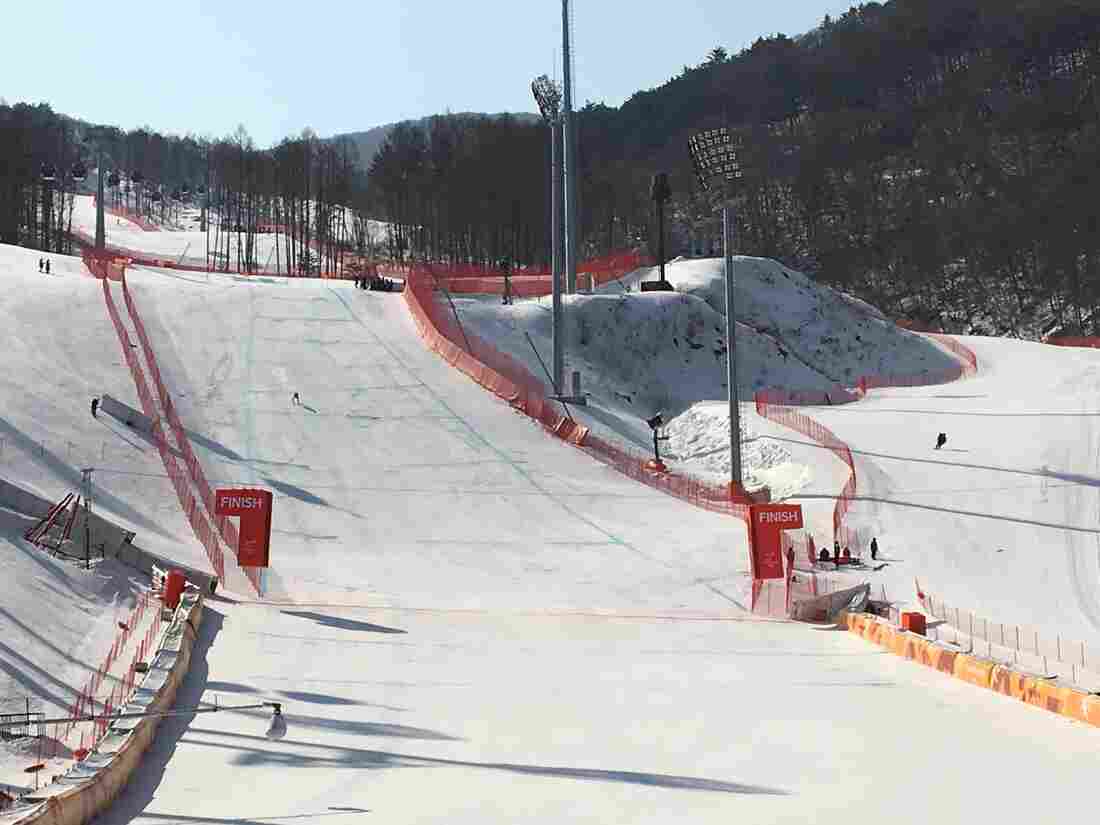
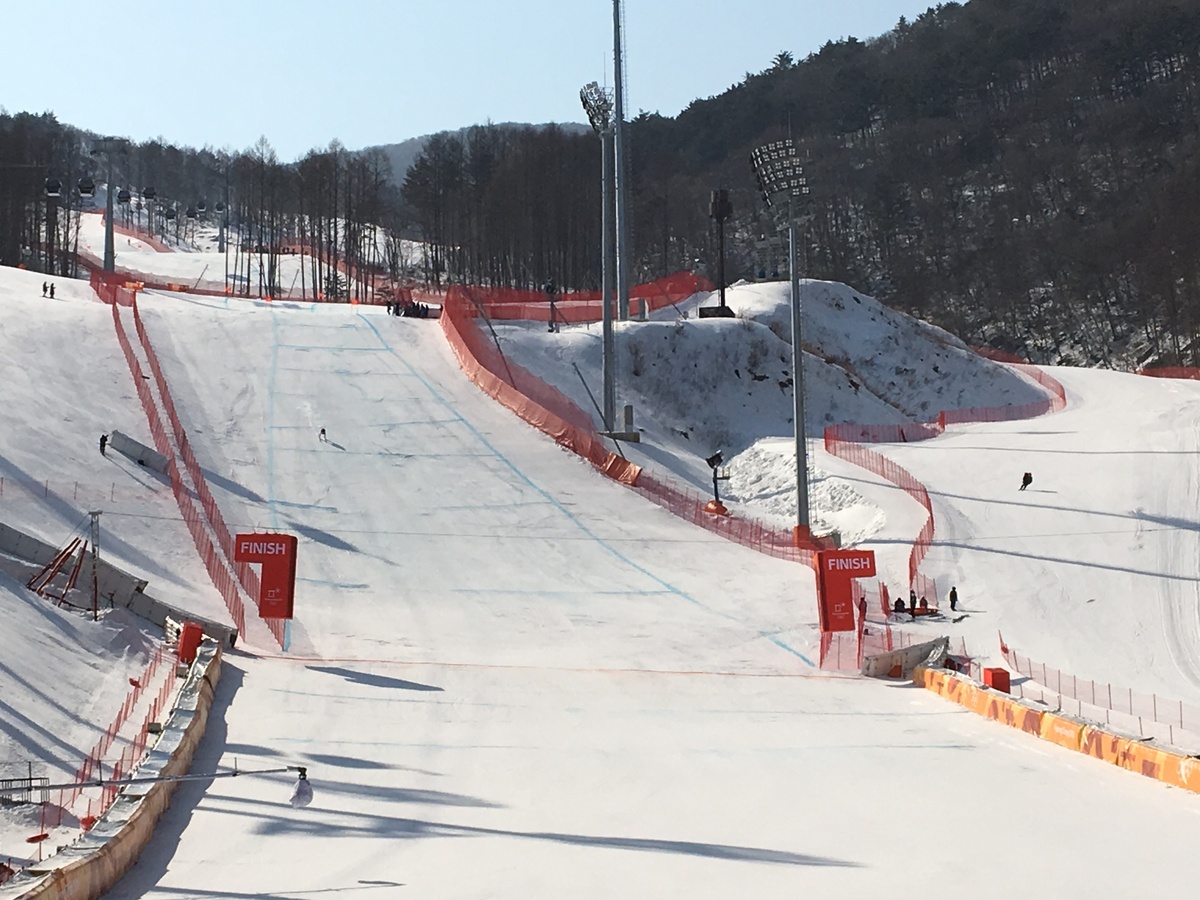
The finish line for the Olympic downhill at the Jeongseon Alpine Center in South Korea.
Tom Goldman/NPR
hide caption
toggle caption
Tom Goldman/NPR
The Winter Olympics start with a bang this weekend.
Or maybe we should say a whoosh.
Sunday morning (9 p.m. ET Saturday) in South Korea, at the Jeongseon Alpine Center, the men’s downhill will feature the best male speed skiers in the world. The downhill is one of the most anticipated events of any Winter games. The race is raw power and speed as competitors plummet down a mountain course, sometimes going over 90 miles per hour.
Like any great athlete, downhillers make something very tough look fairly easy. When we watch the likes of Beat Feuz of Switzerland or Norway’s Aksel Lund Svindal rocket through a nearly two minute run, we don’t see the tremendous G forces they’re fighting or the tremendous leg strength needed to drive their ski edges into rock hard snow, even ice to maintain control.
And we certainly don’t see the fear.
But for many it’s there.
Snow snakes
Downhillers have this term. Snow snake. It’s an unseen serpent that rises from the ground and gets you.
Last weekend in Germany, the snow snake bit American racer Stacey Cook. Hard. Cook figures the crash happened when she was going more than 80 mph. Her skis splayed, she lost control, smashed into protective netting on the side of the course, and then catapulted back onto the course like a rag doll.
“It was really really fast but in a part of the course that stuff like that normally wouldn’t happen,” Cook said, “so it’s kind of unexplainable.”
Cook was speaking at a press event this week in Pyeongchang, where she’ll compete in her fourth Olympics. The women’s downhill is Feb. 21.

U.S. speed skier Stacey Cook is in Pyeongchang for her fourth Olympic games. She appeared at a press conference just a few days after a major crash during a competition in Germany.
Tom Goldman/NPR
hide caption
toggle caption
Tom Goldman/NPR
Yes, despite the horrific looking crash, she will compete.
“I definitely have some extra work for myself trying to get healthy again and back in my ski boots which will be the most painful thing,” Cook said, adding, “I think once I get in my boots and feel comfortable the racing will come naturally.”
Cook was sore and bruised, but she looked fine. By design. She’d worked hard to cover up a black eye from her wipeout.
“Can you not see it?” she asked a reporter. “This morning a friend sent a glam team to our hotel so I had a professional makeup artist.”
But to twist an old adage, while Stacey Cook can hide her black eye, she can’t run from the reality of the sport she loves, and fears.
Managing the fear
“I’m definitely scared all the time,” she says. “I think it’s [downhill racing] a really unique women’s sport with the level of danger that comes along with it.”
Cook has skied since she was 4, raced since she was 6.
“[I’ve developed] an ability to handle the fear and also to realize that overcoming fear and overcoming obstacles makes for the best moments possible in life. And you learn that really easily within the sport and you’re able to carry it outside the sport as well.”
A big step in the evolution of her “fear management” came in 2010. At the Vancouver Winter Olympics she had another major crash. She was helicoptered off the course with a concussion. It happened in her first training run; when she returned for the next training session, she was so scared she cried in the start gate. Cook got down the mountain, but that night she had an epiphany.
“I decided the fear was too much and I didn’t want to have that anymore,” she says. “I changed my mindset to believe in the opportunity and not the circumstance of the past. And that switch in my mindset was really key in how I went into that race [the downhill final where she finished 11th ].And I look back on that moment often.”
Working with fear and peer pressure
There are probably as many ways to find the nerve, as there are downhillers.
Unlike Cook, fellow American speed skier Laurenne Ross can’t hide the scars of her chosen sport. Battered from a lifetime of downhill injuries, 29-year-old Ross also has had to figure out her relationship to fear.

U.S. speed skier Laurenne Ross. She suffered a major knee injury in a race crash in March, 2017.
Tom Goldman/NPR
hide caption
toggle caption
Tom Goldman/NPR
“The way I work through fear is actually to work with it,” Ross says. “I try not to get out of fear or overcome fear or dominate fear. I try to embrace it and get to know it and understand why it’s there. Because it’s a basic human instinct that obviously has allowed our [species] to survive.”
“It can be hard sometimes to live in that fear and try to embrace the fear, but I find that it’s a lot more helpful than trying to repress it and have it resurface later.”
For American men’s downhiller Tommy Biesemeyer, peer pressure helps.
Particularly when he’s standing at the start of the legendary, and fearsome, Hahnenkamm downhill in Kitzbuhel, Austria. It’s a nasty, icy plunge with jumps that fling a skier 150 feet through the air.
“It’s funny,” Biesemeyer says, “like I don’t know if I’d actually go out of the start gate if all the guys that I was competing against didn’t go. Like if I was up there by myself, and had the opportunity to ski it, I think I would pass.”
But he hasn’t passed. And Biesemeyer calls his first Hahnenkamm a defining moment in his life.
“I think with something you’re honestly scared of, it’s really important to have a plan,” he says. “In the start gate you’re committed. You’re doing it. And you get to the bottom and you start thinking about how you’re going to go faster [next time].”
Last month Biesemeyer finished a career-best 16th in Kitzbuhel, a result that’s helped fuel a run to Pyeongchang and his first ever Olympics.
A death in the family
Biesemeyer joined the world’s top speed skiers this week for training runs at the Jeongseon Alpine Center. As has been the case since November of last year, one member of this elite group was missing. Frenchman David Poisson, who finished 7th in the men’s downhill at the 2010 Olympics, died in a training accident in Canada.
In the finish area at Jeongseon, French skiers wore fish decals on their helmets – fish in French is “poisson.”
“We think about him every time,” says French downhill racer Adrien Theaux. “He’s one of us.”
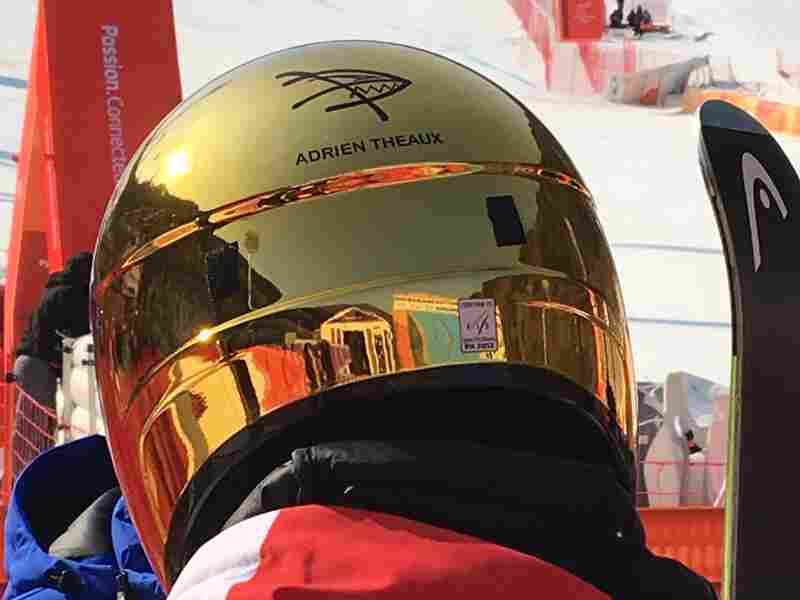
French downhill skier Adrien Theaux wears a fish-shaped decal in honor of his late teammate David Poisson. Poisson (which is “fish” in French) died in November 2017 when he crashed during a downhill training session in Canada.
Tom Goldman/NPR
hide caption
toggle caption
Tom Goldman/NPR
Poisson’s death, although a rare occurrence, is a reminder of the risk every downhiller takes every time they step into the start gate. And it explains the fear that’s always there, not only with the racers.
“Her initial response was like, you’re not skiing downhill,” says American Ted Ligety. He’s talking about his wife Mia when she learned about Poisson’s death.
Ligety is one of America’s most decorated alpine skiers. He’s won two Olympic gold medals, and has raced in and won many downhills. He’ll compete in the alpine combined event at these Olympics, which consists of slalom and downhill. But he won’t race in this weekend’s main downhill event, and says at age 33, he’s not “chasing a lot of downhill starts” like he was a few years ago.
That’s partly because he’s had more success as a technical skier than a speed skier. He’s currently ranked 8th in the world in the Giant Slalom, a race that’s slower than a downhill and has more gates. But Ligety also acknowledges he’s “pretty good at being risk averse,” which, he says, probably has kept him from becoming one of the world’s top downhillers.
“There are definitely decisions you can make on a course,” says Ligety, “that y’know, not taking a risk on this one turn might cost you a tenth or two [of a second], but it might then lead you into a fence or might cost you even more time at the end if you mess it up.”
“I haven’t been as willing to be, like, ‘OK, I’m going to go for those two tenth’s [of a second] in this turn,’ but also [that’s] a reason why I haven’t had as many injuries as a lot of guys.”
Loving it through the fear
Those guys who go for the extra speed will be on display this weekend in the men’s event. Risking everything. And, for most of them, loving it.
“I think the moment I step in the gate, the fear turns a little more into excitement,” says Ross of the U.S. women’s team. “I really look forward to that moment [when] the fear sort of turns into something else a lot of the time — excitement and anticipation.”
“The feeling you get sometimes skiing speed, you can’t beat it.”
There Is A Competition To Avoid Learning Who Won The Super Bowl, For Some Reason

About a dozen people are among the last standing in a competition against modern technology. They don’t know who won the Super Bowl and they’re trying to go as long as possible without finding out.
SCOTT SIMON, HOST:
Spoiler alert for our next story – (laughter) we’re going to tell you who won the Super Bowl. Yes, the game happened last week, but there’s an important warning for the eight people still in the running in a contest called Last Man. Competition’s pretty straightforward but a near impossible goal – go as long as you can without finding out who won the Super Bowl. NPR’s Scott Detrow explains.
SCOTT DETROW, BYLINE: The hardest part of the Last Man competition is probably the first couple hours. That’s when news notifications and text messages ping cell phones. The news is blanketed by the results, and the Super Bowl is all everyone on social media is talking about. Jeb Adams of Agoura Hill, Calif., washed out early in 2016 and 2017. This year, he prepared.
JEB ADAMS: I turned off all my news notifications on my phones and iPads. I warned everyone on Facebook and Twitter that I was going to disappear for a while.
DETROW: Social media is dangerous, but so are co-workers. Jamie Baskin from Kansas City says she was lingering outside a break room, waiting for a colleague to turn off ESPN when her boss asked what she was doing.
JAMIE BASKIN: No. I’m just – I can’t go in the break room. And she just, like, gave me the weirdest look and was like, why? And I’m like, because I’m going to find out who won the Super Bowl. And she just kind of was like, OK, and walked into her office. And so I’m pretty sure she thinks I’m, like, very weird.
DETROW: About 1 to 200 people play every year. And, no, there’s no prize – really. They just seem to like the challenge. People post their status on Twitter and, once they’re eliminated, what ultimately killed their chances. Last Man deaths are a gauntlet of the modern information age. Death by Twitter, by seemingly unrelated news articles. One player was knocked out by a message that popped up on an ATM screen. Michael Griener organizes the event and keeps a detailed spreadsheet of how people were knocked out.
MICHAEL GRIENER: We’ve had people who found out by drunk college kids running past their dorm room window.
DETROW: I hate to say that NPR is a regular killer, too. For both Baskin and Adams, the end came Thursday afternoon, when, a little too confidently, they ventured back on to social media. Adams was betrayed by Twitter’s trending topics – Baskin, Instagram.
BASKIN: And the first picture I saw when I opened the app was a friend of mine who lives in Philadelphia at the parade. And I was like, welp.
DETROW: So how’d she feel about the Eagles’ win?
BASKIN: I’m pretty sad that of all the years I picked to not pay attention to it, it ends up being what my dad said the best game that he’s ever seen other than the year that the Chiefs won.
DETROW: As of Friday afternoon, there were eight confirmed people who still don’t know. Scott Detrow, NPR News.
(SOUNDBITE OF MUSIC)
Copyright © 2018 NPR. All rights reserved. Visit our website terms of use and permissions pages at www.npr.org for further information.
NPR transcripts are created on a rush deadline by Verb8tm, Inc., an NPR contractor, and produced using a proprietary transcription process developed with NPR. This text may not be in its final form and may be updated or revised in the future. Accuracy and availability may vary. The authoritative record of NPR’s programming is the audio record.
Korean Women's Hockey Team Presents A Unified Front As It Takes To The Ice
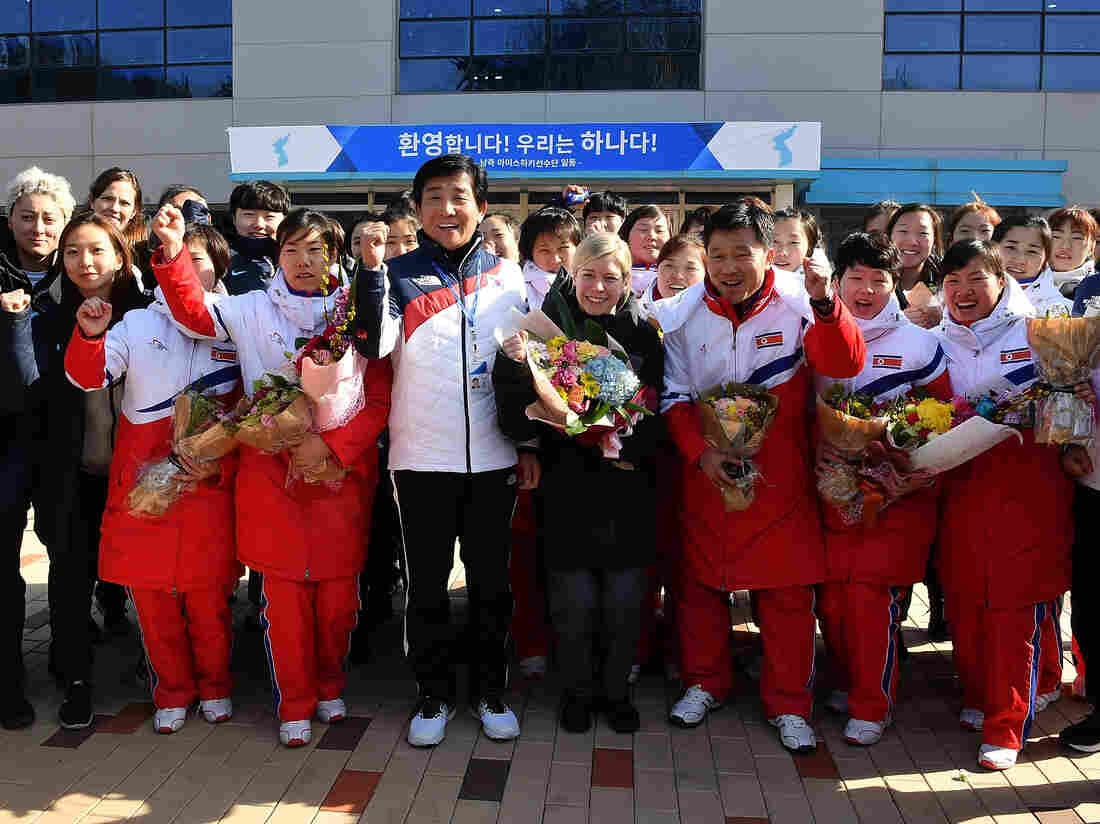
Sarah Murray, center, head coach of the unified Korean women’s ice hockey team, says the team has come together since being formed through a political dialogue. Here, Murray and the South Korean players (in black) welcomed North Korea’s coach Pak Chol-Ho and members of the northern team last month. The united team now wears all-white coats.
Pool/Getty Images
hide caption
toggle caption
Pool/Getty Images
In many ways, the Korean women’s hockey squad at the Pyeongchang Winter Olympics is the most interesting team in the world. And Saturday night, it will get even more interesting.
They were jammed together in January because of a political accord – and a desire by South Korea’s leaders to include their northern neighbors in the Winter Games. Now the joint women’s hockey team is playing their first game, offering a look at how sports diplomacy could work on the Korean Peninsula.
Korea plays Switzerland on Saturday night, facing off against the No. 6 team in the world while South Korea’s president, Moon Jae-in, looks on. He’ll reportedly be sitting with Kim Yong Nam, the ceremonial head of North Korea’s government at the Kwandong Hockey Centre.
The game will show the first results of an experiment, in which 12 North Korean players joined South Korea’s team.
It’s heady stuff for a group of hockey players who were already slated to play their first one-the-record game on the world’s largest sporting stage. Eight of the players on the Korean team are teenagers; the squad’s average age is just 22.
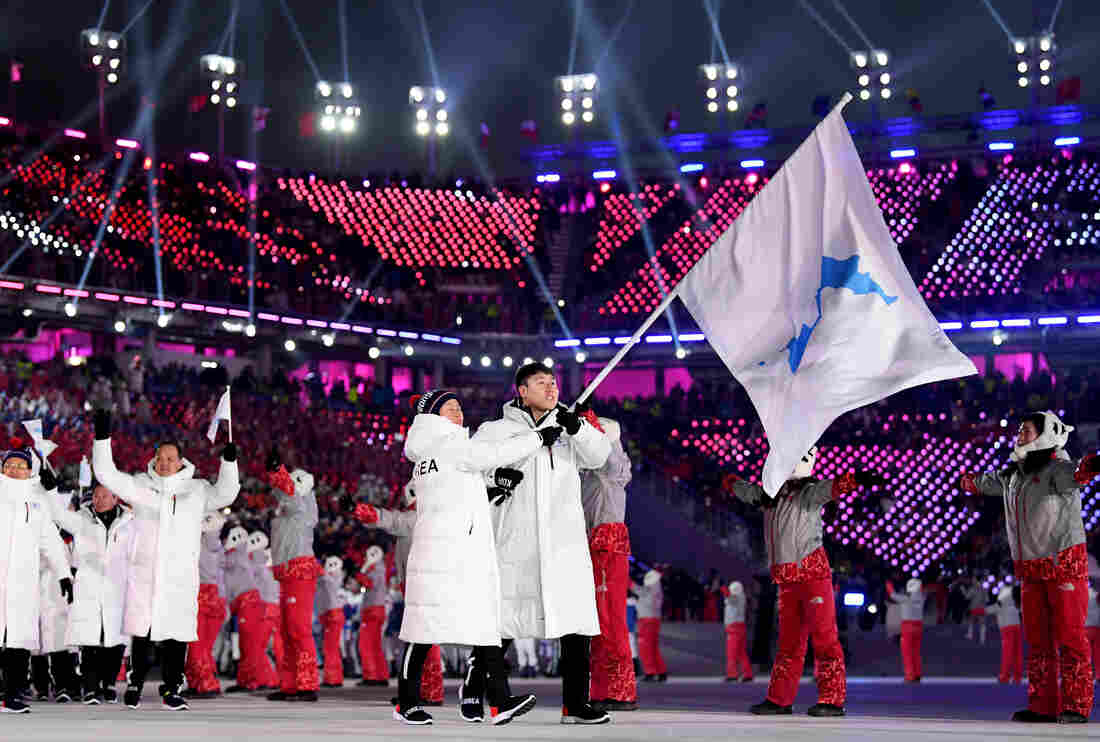
With a simple name on their chests — “Korea” — these 35 hockey players will be urged on by fans waving special rally flags that feature the shape of the united peninsula, presented in light blue on a white background. There are sure to be protests, as well: Not all South Koreans agreed with the move to shake up South Korea’s women’s hockey team just weeks before the Olympics began, to put the home flag away in favor of a neutral banner.
All this has come as the women on the Korean team work to become a cohesive unit, to learn each others’ strengths and preferences on the ice. They’ve practiced as many as three times a day this week, with a large media presence looking on at a training facility in Gangneung.
At a practice earlier this week, the players wore practice jerseys in either solid blue or white, scrambling around on the ice as coaches called out drills and taught technique.

During a practice ahead of their first match in the Pyeongchang Winter Olympics, the unified Korean team wore blue and white jerseys — leaving onlookers to wonder which players were from the north.
Bill Chappell/NPR
hide caption
toggle caption
Bill Chappell/NPR
Inside the small barracks-like practice arena, one question was being asked by more than a dozen journalists: Where are the North Koreans? And to the team’s credit, the same answer always came: They’re out there, we just can’t tell who’s who. I was told that the team is working out in mixed groups; when asked if anyone else was holding three-a-day practices, a facility staffer couldn’t name one.
The practice that day was both spirited and focused. Coaches’ orders were obeyed immediately; players fired pucks around and sometimes sprawled on the ice during intense one-one-one drills. Through it all, accurate shots on goal were cheered by the whole squad.
When it was over, they worked together to corral errant pucks and put all their gear away.
Confirming the positive attitude this team projects, its coach, Sarah Murray, said this week, “We feel strangely calm given everything that is going on. The thing we were most worried about was team chemistry and right now the chemistry is good. The communication is good.”
Speaking after a practice on Wednesday, Murray said she had worried that her team might splinter into groups — “But it is fantastic,” she said. And she gave credit to her North Korean counterpart for helping that process.
“The head coach that they brought, he has been amazing and without him we could not be doing what we are doing,” Murray said. “He is very open to suggestions.”
“All the meetings are together. All the meals are together,” Murray said, in comments relayed by the Olympic Information Service. “Our players are together. In the locker room, they mix and talk. This is our family and this is great.”
Acknowledging that the team’s composition was the result of a political statement, Murray said that now the Olympics have begun, it’s time to compete as a team.
The Korean team’s goal is simple: advance out of their four-team group (which includes the Swiss along with Sweden and Japan), and keep playing together.
The hockey players’ task of blending cultures extends beyond the Korean Peninsula. The squad includes two Americans with Korean heritage: Randi Griffin of North Carolina, whose jersey will bear her Korean name, Heesoo; and Marissa Brandt of Minnesota, who plays under the name Park Yoonjung – and whose sister, Hannah, is on the U.S. hockey team.
Here’s how Griffin recently described her first exposure to South Korea’s hockey scene, back in the summer of 2015:
“[We] played in this little summer league, which was just three teams. The age range was, like, 13 to 40. And this was literally all of the Korean hockey players in existence. And I think for all of us, it was this combination of a great hockey experience but also a really cool cultural experience.”
The Korean roster also includes Canadian college player Danelle Im, as well as Caroline Park, who grew up in Canada and played hockey for Princeton University. Also on the squad is goalkeeper Genny Kim Knowles – a 17-year-old who is a native of Vancouver but who plays hockey for her high school in Lawrenceville, New Jersey.
The coaching staff shows the same diversity: the head coach, Murray, is Canadian; her three assistant coaches are South Korea’s Kim Doyun; North Korea’s Pak Chol Ho; and American Rebecca Baker.
If it sounds like the South Korean team went looking for female hockey players to suit up for their squad, that’s because they did.
Despite their No. 22 world ranking in 2017, the South Korean team enjoys an automatic Olympic berth as the hosts. And in recent years, its staff looked far and wide to fill out the roster. It turns out that another source of players was just 40 miles or so from Pyeongchang – and across the DMZ in North Korea.
On Friday night, the North and South Koreans walked together in Pyeongchang Olympic Stadium. On Saturday, they’ll hit the ice as a unified team.
Canadian Ice Dancers Step Down The Heat To Step Up At The Podium

Two Canadian retirees have taken time out of their schedule to make it to the Olympics. They’re celebrating 20 years together and are eager for their favorite event: Ice dancing free dance (a part of the figure skating category). At 28 and 30 years old, athletes Tessa Virtue and Scott Moir came out of retirement for one last skate on the Olympic stage. After the disappointment of a silver medal in Sochi, they’ll leave it all on the ice. Within good taste, that is.
Canadians Tessa Virtue and Scott Moir perform their Moulin Rouge program at the ISU Grand Prix of Figure Skating Final in Japan in December.
Koji Sasahara/AP
hide caption
toggle caption
Koji Sasahara/AP
The pair has honed a free program to a medley from the 2001 movie Moulin Rouge!, starring Nicole Kidman and Ewan McGregor. It’s the love story of a poor writer and a beautiful courtesan in Belle Epoque Paris. There’s intrigue, jealousy, deception — and lots of raw passion. And the athletes originally included a lift that really leaned in to that passion.
Virtue and Moir performed the routine at last month’s Canadian championships. The national news agency The Canadian Press found it risqué enough to hesitate before circulating images, according to The Toronto Star. (NPR could not find such photos from the outlet.)
The lift begins when Virtue dips her leg underneath her upright body, then extends it at full speed to launch herself, twisting and flipping up Moir’s torso. She lands with her legs on Moir’s shoulders, one leg on each side. They spin as she straddles his head for a moment before she gracefully floats back down, touching her skates to the ice.
It takes just a few seconds, but it was too long for comfort for some (despite much of the crowd erupting in standing applause).
Moir and Virtue perform at the Canadian skating national competition with a routine that includes the original lift.
YouTube
(Caution: 2001 movie spoiler ahead.)
“I think edgy would probably summarize most of the program quite well and that’s what we were going for,” Virtue told The Toronto Star. “We knew that taking the ice at an Olympic Games again meant that we needed to have a different style. We wanted to make a bit of a different statement. If that was bringing an edge or sexuality or darkness, or a contemporary feel to it, then mission accomplished I guess.”
Though they won first place in the championships, Moir and Virtue chose to make a change for the decidedly more conservative international Olympic crowds. Not only have they toned down the lift, The Toronto Star reports, but they’ve also tweaked the ending to make it even more dramatic.

The pair skate their free dance to win the gold at the world figure skating championships in Helsinki, Finland in April 2017.
Ivan Sekretarev/AP
hide caption
toggle caption
Ivan Sekretarev/AP
“Of course, my character dies and that was the original ending we’d gone with, sort of faltering to this dramatic death,” Virtue told the outlet. “This is a little bit, perhaps, more triumphant in a way … because our love story gets to linger a little bit longer, with more depth to it. But there’s still some sort of heartbreak in the end and there’s still some desperation. We’re clinging on to something.”
The pair is coming back from what many perceived to be a heartbreaking loss to Americans Meryl Davis and Charlie White in Sochi 2014. When asked about it in an interview with Canadian magazine Maclean’s, they said they were proud of their performance, but decided it was time to leave the field. The two stoke a comfortable and extremely close vibe. They even wrote a book together about their long working relationship.
Virtue and Moir were the designated flag bearers for the 225 athletes competing as part of Team Canada. The ice dancing free dance medal competition is scheduled for 12:20 p.m. Monday in South Korea — which is 10:20 p.m. Sunday on the East Coast.
The Oldest Rookie In The Winter Olympics Will Turn 50 This Year
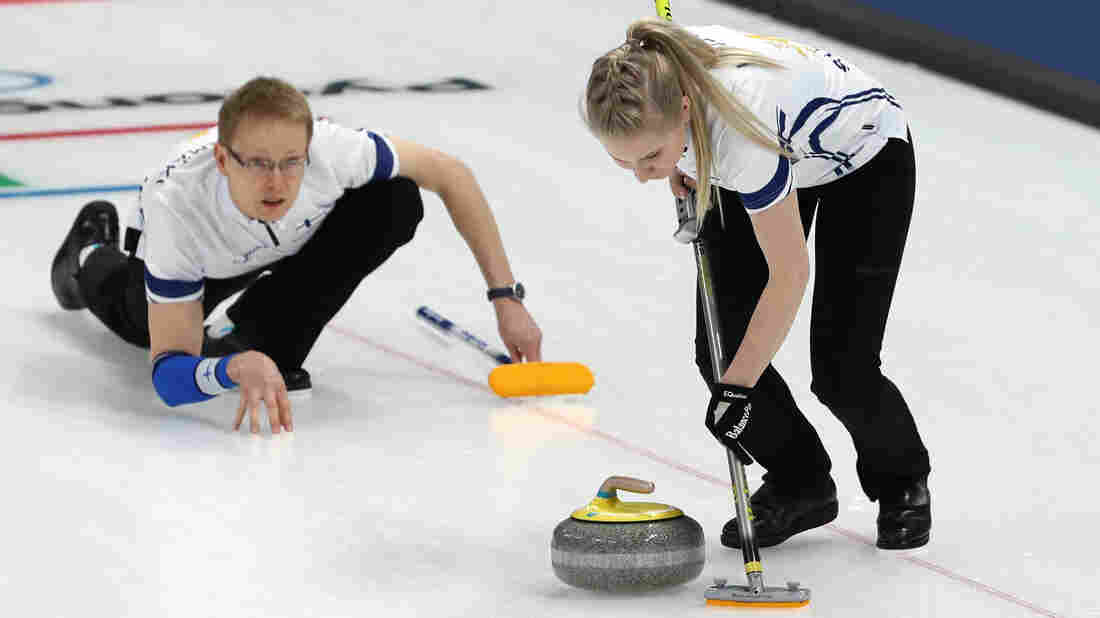
South Korea Celebrates The Official Start Of The Pyeongchang Winter Olympics
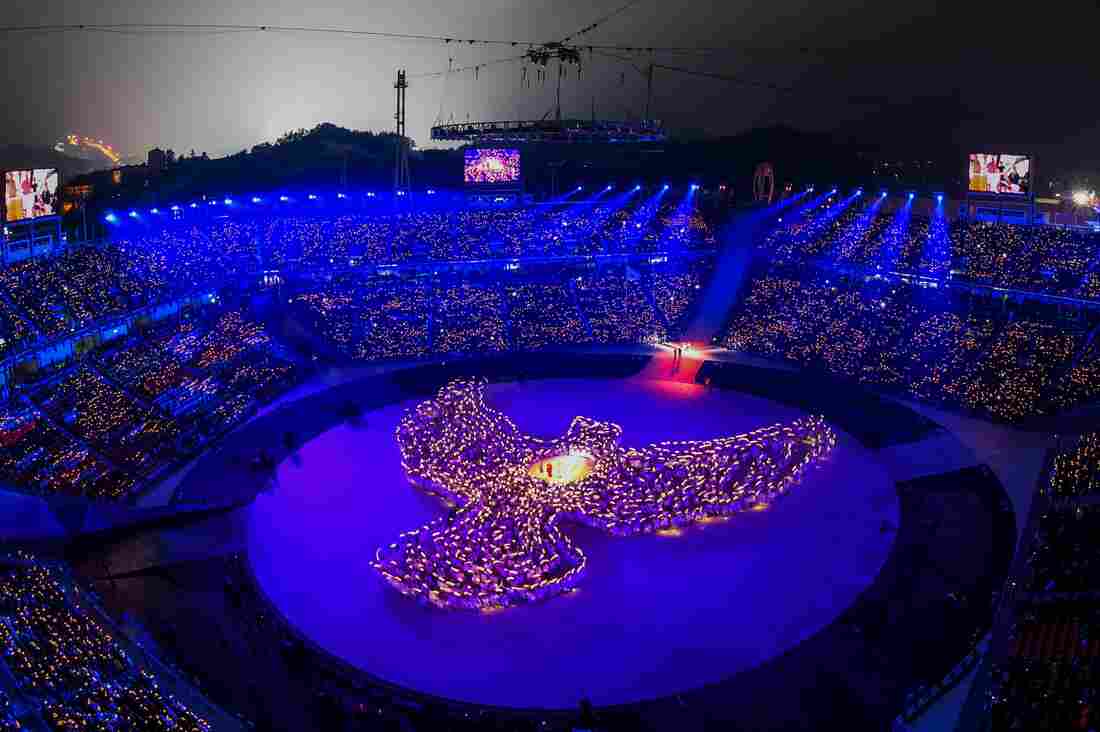
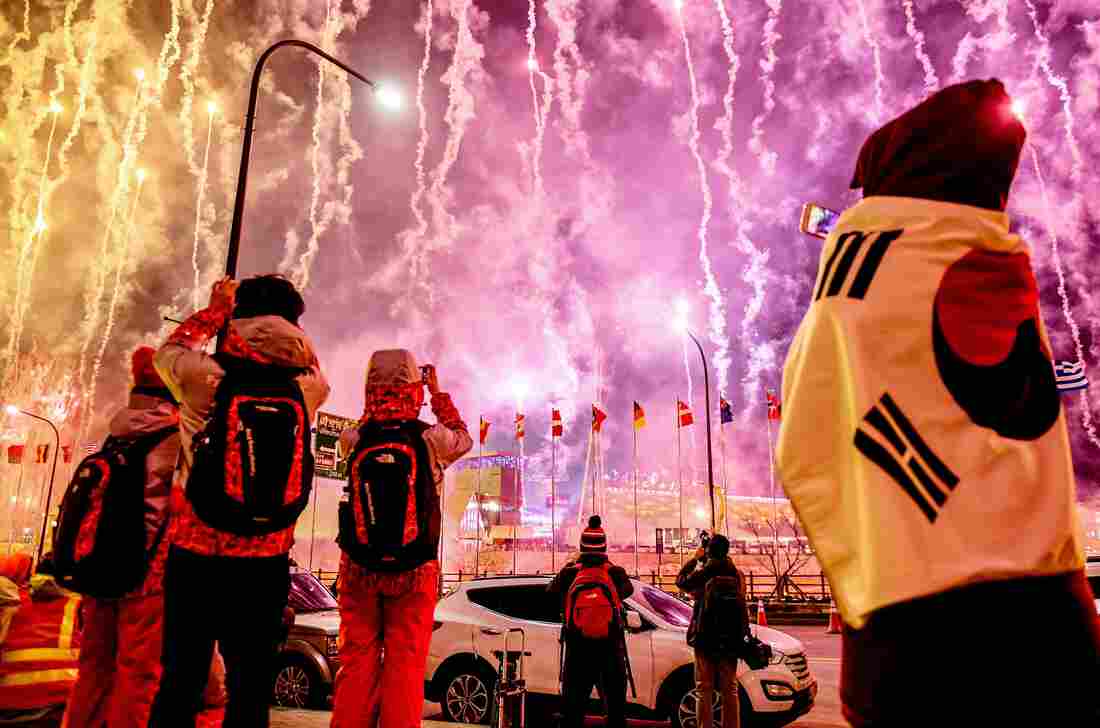
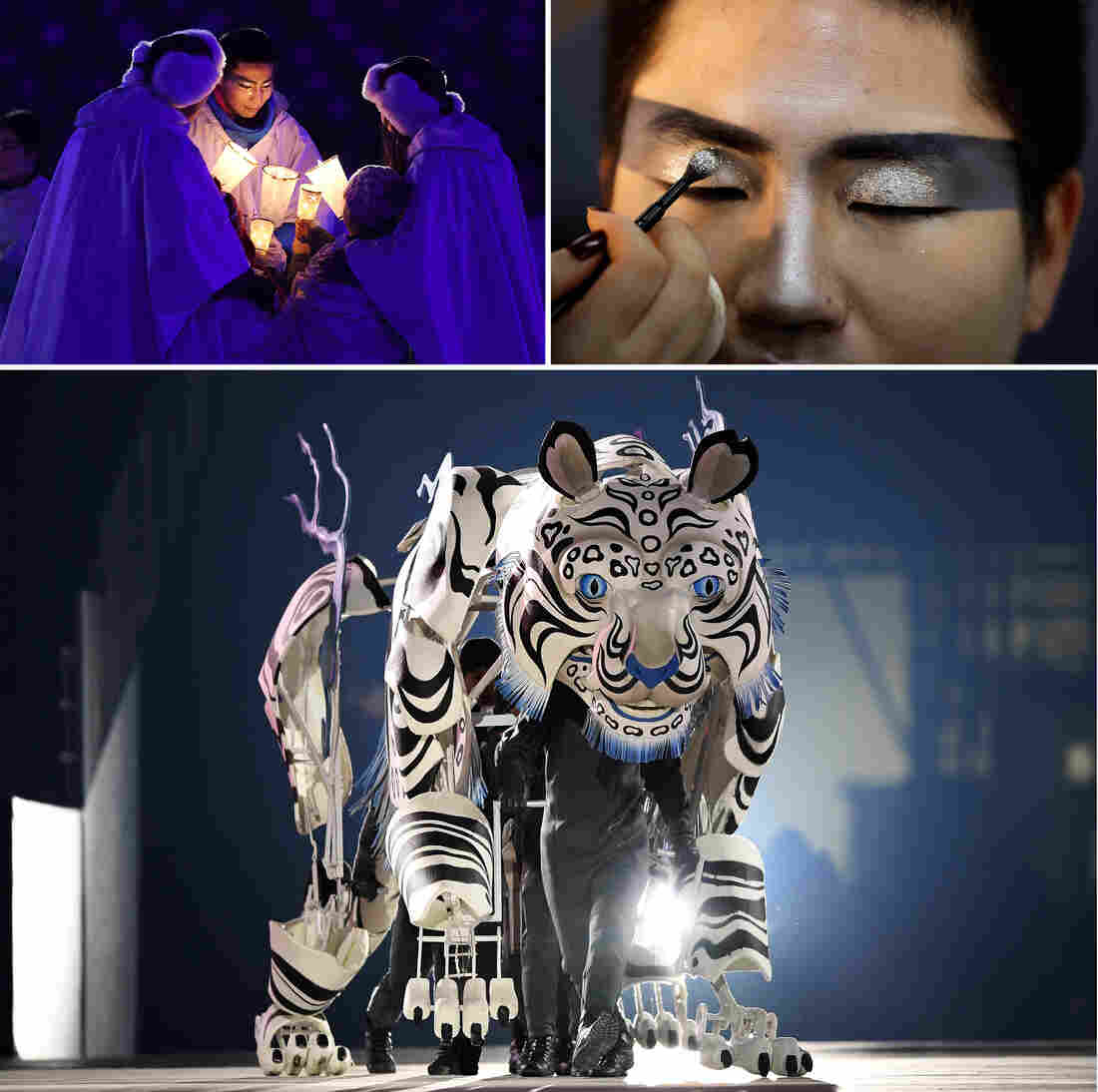
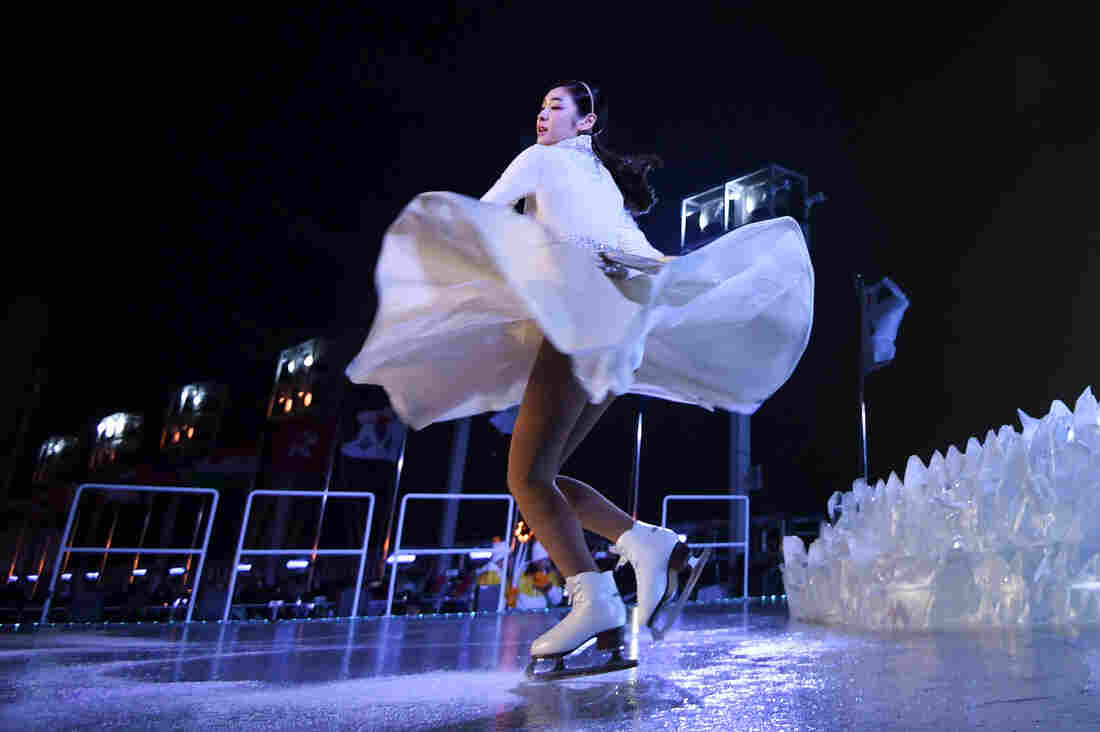
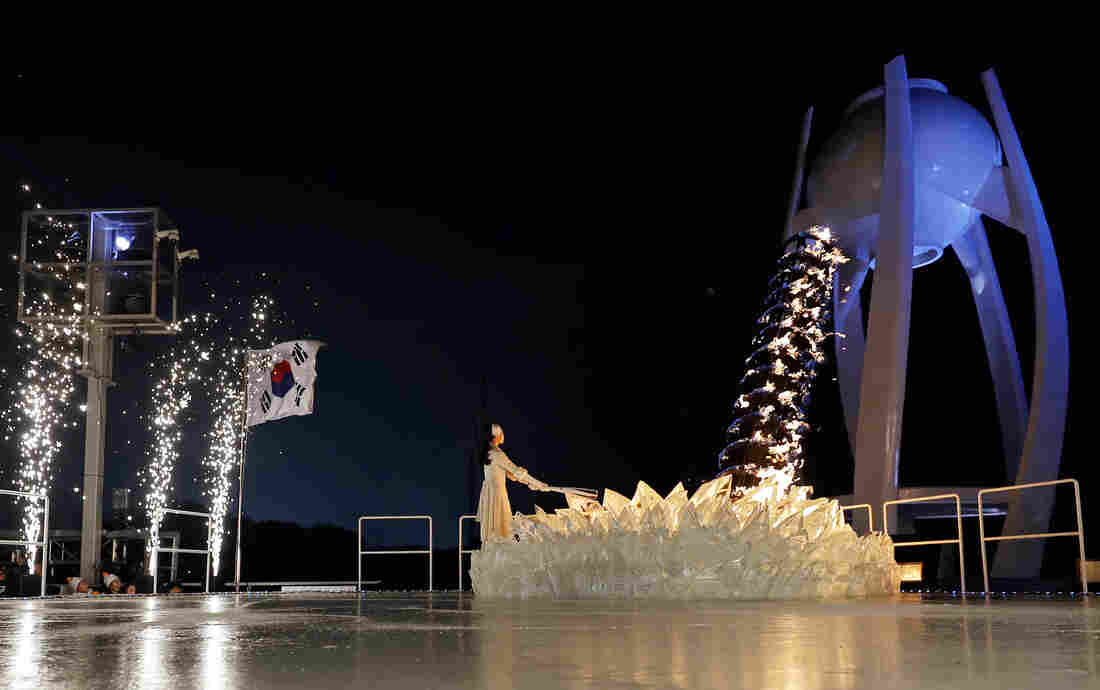
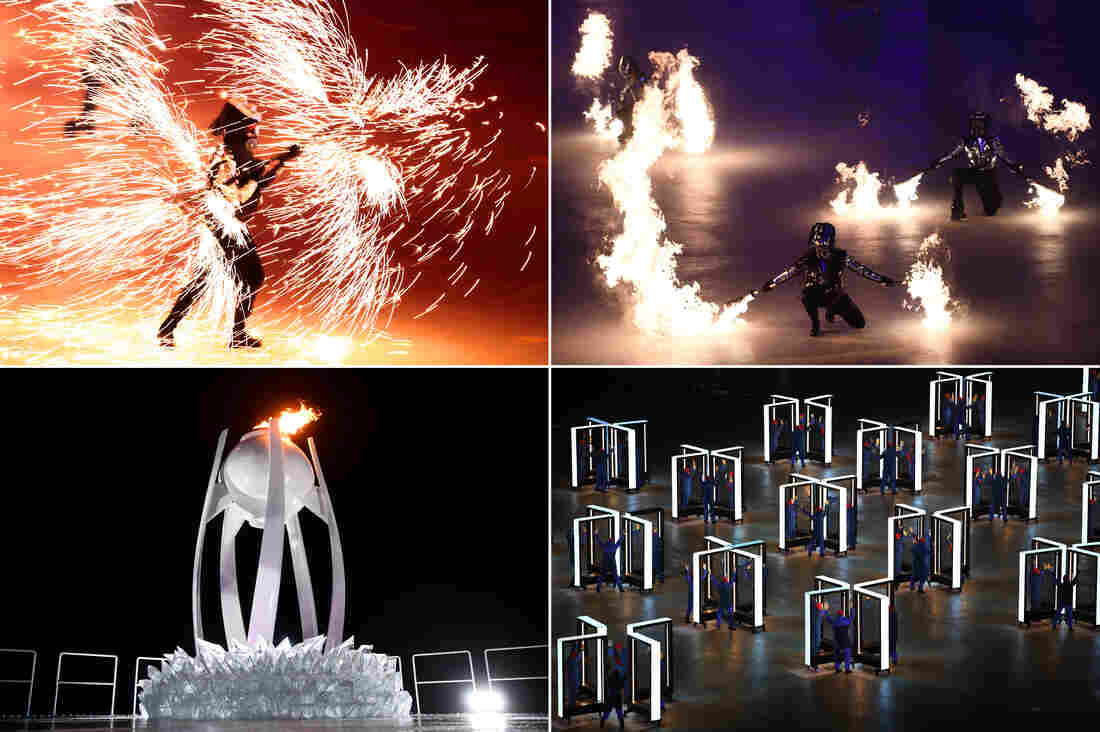
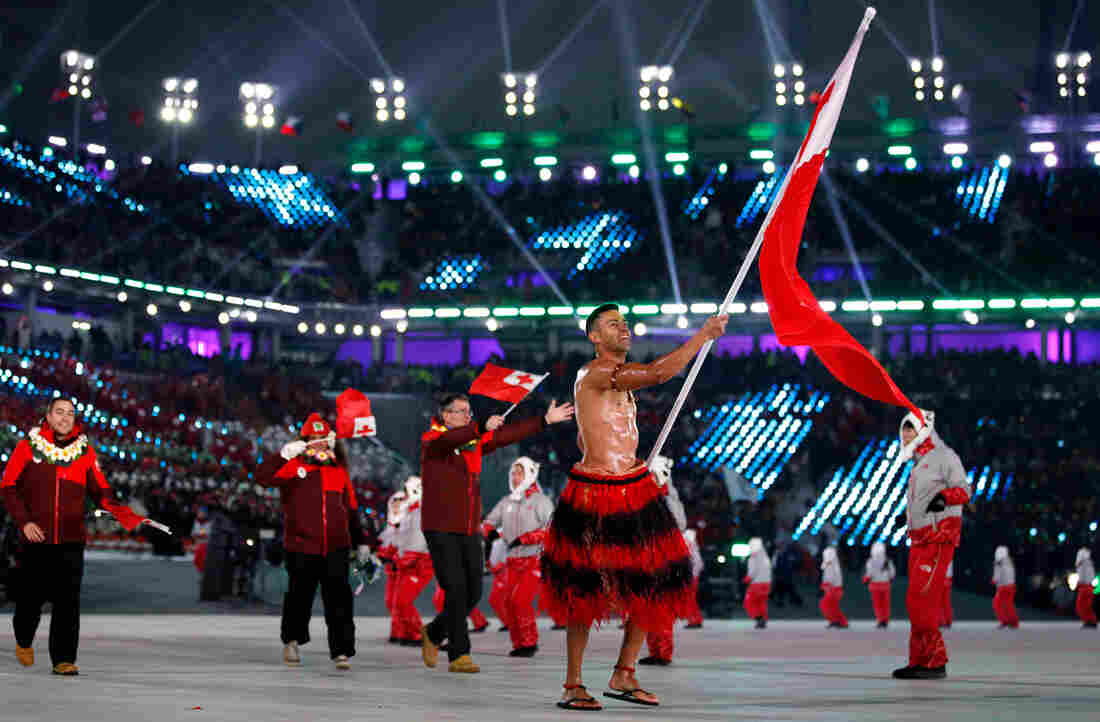
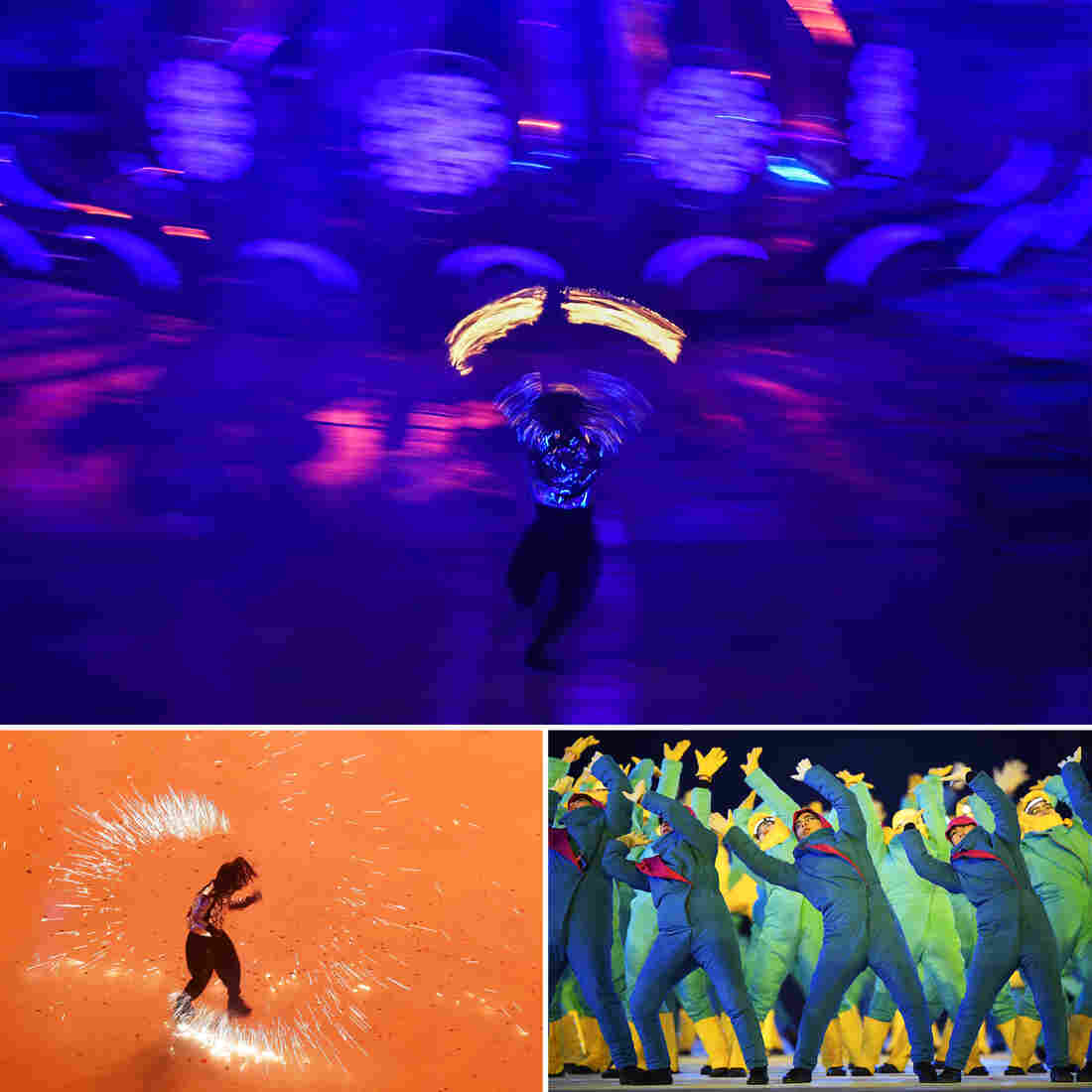
The Winter Olympics officially began Friday with opening ceremony in Pyeongchang, South Korea. Athletes from 92 countries marched into an open-air stadium to mark the start of the Olympiad.
How Olympians Cope With The Terror Of Downhill Alpine Skiing
Winter Olympic sports combine grace, beauty and danger, where athletes defy and even embrace risk. In downhill skiing, a racer has to find confidence amid the terror of a headlong plunge down a mountain.