How Instant Replay Sucks The Fun From Football

Commentator Mike Pesca says watching football is no longer just glorious enjoyment of fantastic plays. With the NFL’s frequent use of instant replay, it’s become an exercise in scrutiny and doubt.
Commentator Mike Pesca says watching football is no longer just glorious enjoyment of fantastic plays. With the NFL’s frequent use of instant replay, it’s become an exercise in scrutiny and doubt.
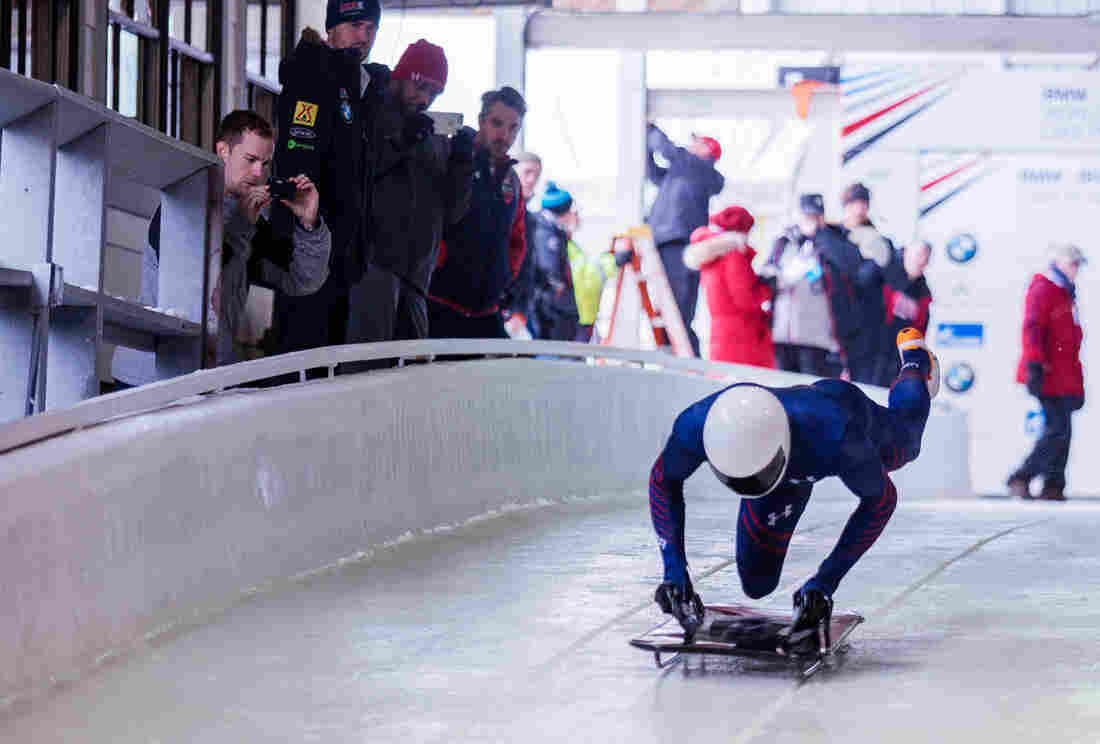
Matt Antoine, who won the bronze medal at the 2014 Winter Olympics in Sochi, Russia, dives onto his sled from a full sprint. “You always have to be on your toes in the sport,” he says. “When you’re moving 80, 90 miles an hour, you can’t get lazy.”
John Tully for NPR
hide caption
toggle caption
John Tully for NPR
At the winter Olympics, which get underway next month in Pyeongchang, South Korea, some of the most blistering speeds will come in the three high-adrenaline sliding sports, where top athletes zip on the ice at about 90 miles an hour.
There’s bobsled, kind of like a downhill race car on steel runners.
Olympic veterans and hopefuls in skeleton from countries around the world took practice runs in November in Lake Placid, N.Y., leading up to the bobsled and skeleton World Cup races.
John Tully for NPR
hide caption
toggle caption
John Tully for NPR
In the luge, athletes lie back on a sled, going down the track feet first and face up.
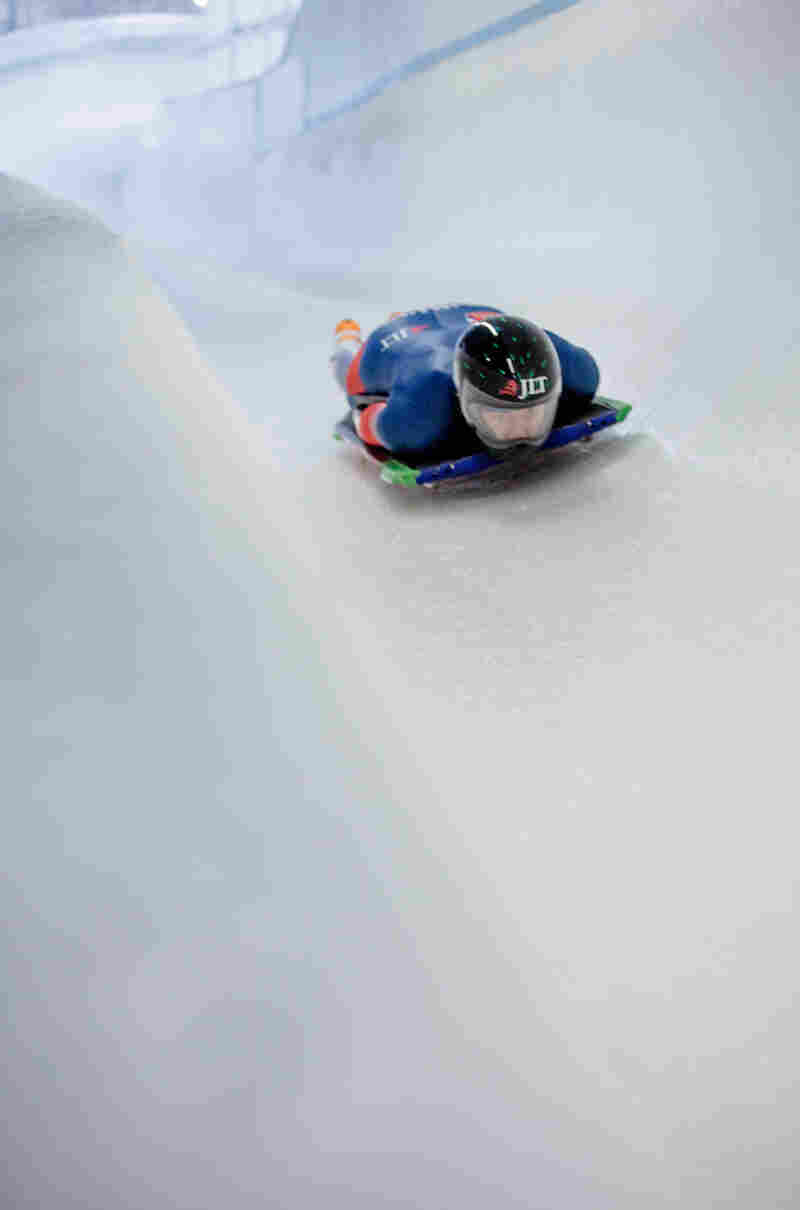
And then there’s skeleton, where racers go head-first, face-down, in a blink-and-you-miss-it blur of speed.
What lures athletes to this sport?
Katie Uhlaender, one of the top U.S. skeleton athletes — both a World Cup champion and world champion, aiming for her fourth Olympics at age 33 — explains the appeal this way:
“It is the perfect combination of meathead and freestyle zen athlete,” Uhlaender says. “And,” she adds with a grin, “due to my short attention span, it suits me well!”
It takes less than a minute for an elite skeleton athlete to race down the mile-long track: 50-some seconds of speed thrills.
For Uhlaender, the key to success is submitting to her fear.
“I embrace it,” she says. “I start going with gravity, and then find myself wanting more. So I start chasing the speed and just dancing with the curves. It’s like those dreams where you’re flying, except if you mess up here, you’re going to hit a wall!”
Which happens, often.
Savannah Graybill, 29, remembers the first time her parents came to watch her race several years back. They were standing just inches away, alongside the track in Lake Placid, New York, watching as their daughter’s sled slammed into a wall and hit a patch of exposed concrete.
“And sparks fly everywhere,” Graybill recalls.
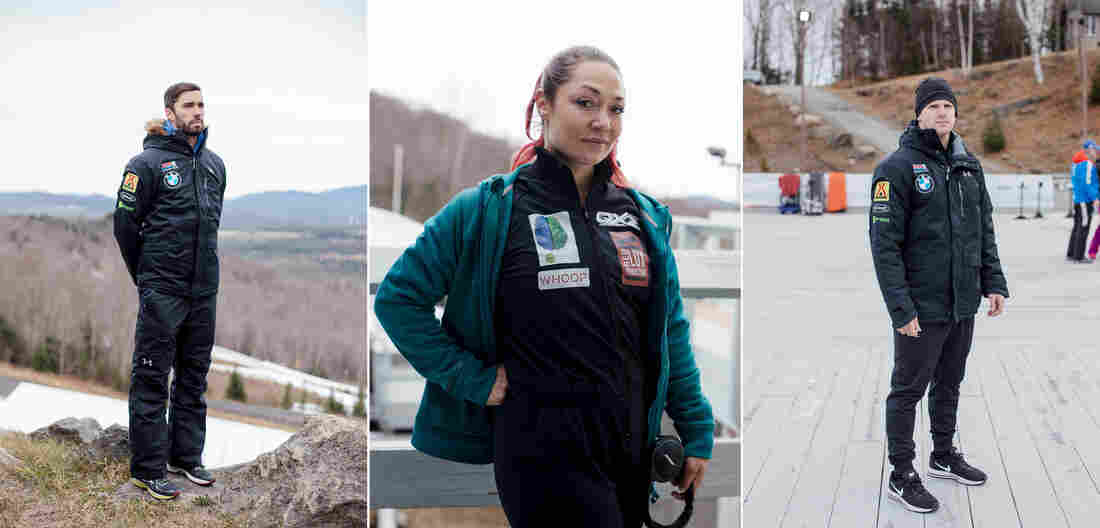
Matt Antoine (left) of Prairie du Chien, Wisc., won bronze in skeleton during the 2014 Winter Olympics in Sochi, Russia. Katie Uhlaender (center) of Breckenridge, Colo., is aiming for her fourth Olympics. John Daly from Smithtown, N.Y., has competed in skeleton in two Winter Olympics.
John Tully for NPR
hide caption
toggle caption
John Tully for NPR
Her parents ran to the finish line, terrified.
“They’re expecting to see me come up through the finish line, you know, missing an arm,” she says, “and they’re freaking out: ‘We just saw sparks! We saw you come through here; we thought you were dead!’ I’m like, ‘Oh no, it was fine.’ And they’re just looking at me like, ‘What are you? Are you crazy? You’re literally crazy.’ “
According to Olympic bronze medalist Matt Antoine, 32, watching skeleton might be scarier than actually doing it.
“Sometimes when I’m watching other sleds go down the track, I don’t even realize how fast we’re going,” he says. But, he adds, maintaining a bit of fear is wise: “You always have to be on your toes in the sport. When you’re moving 80, 90 miles an hour, you can’t get lazy.”
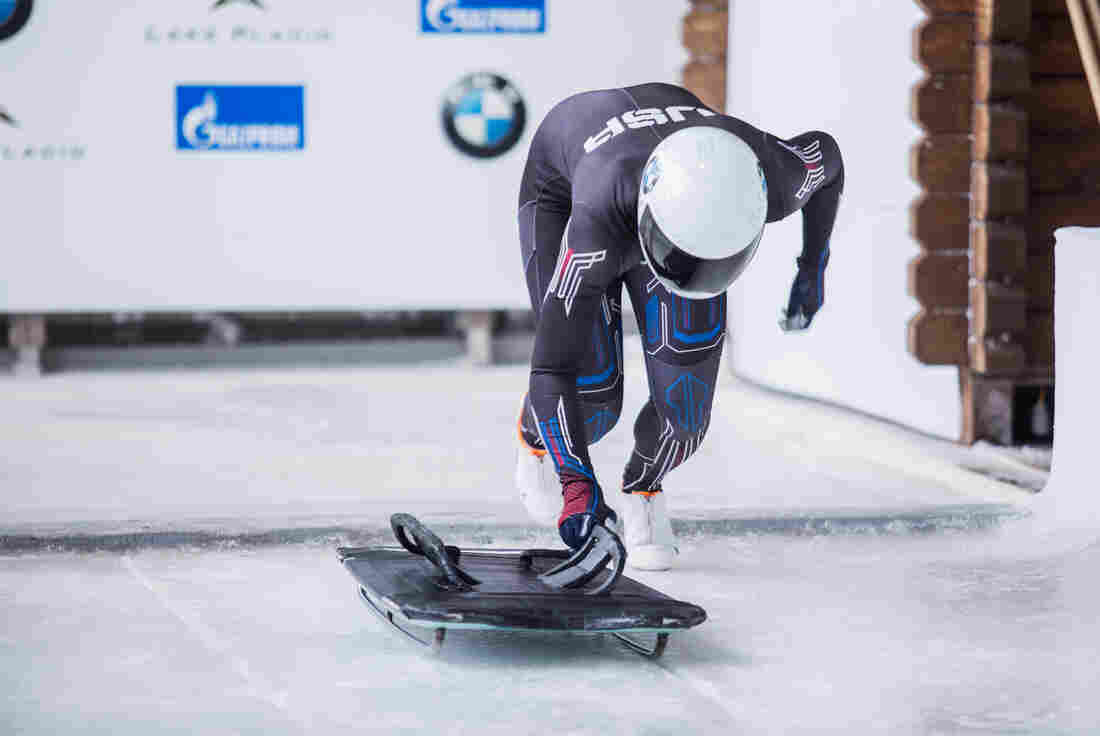
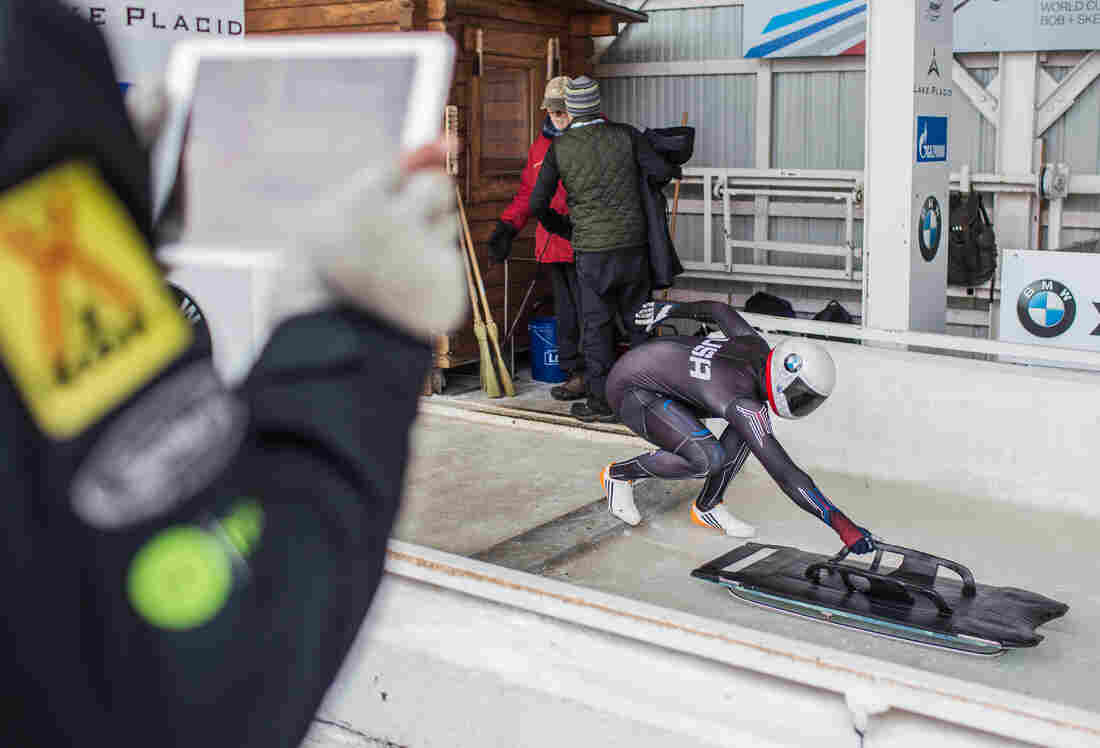
A skeleton run starts with a burst of explosive speed and power. The athletes dash for about 30 yards on the ice, pushing their sleds with one hand. Picture trying to sprint while you’re folded in half, with one hand on the ground.
Kendall Wesenberg of Modesto, Calif., launches into her training run on the skeleton track in Lake Placid, N.Y.
John Tully for NPR
hide caption
toggle caption
John Tully for NPR
“It’s a very awkward, bent-over position,” Antoine says, one “you would never do in track.”
After the push, skeleton racers dive onto the sleds head first (they are wearing helmets), trying to mold their bodies into the sleds and relax, staying as still as possible while going 90 miles an hour. They endure forces up to 5Gs going around the curves.
Steering comes through small movements of shoulders and knees, pressing into the sled so it flexes. The racer’s feet hang off the back; head and neck, off the front. The chin rests just an inch or two off the ice.
“Obviously, you don’t want your face scraping across the ice, ’cause it does slow you down,” Antoine says. “But it also doesn’t feel good.”
Skeleton racers have to keep their heads aerodynamically low to reduce drag, so they can only see a few feet ahead of them. But they’ve memorized the course ahead of time, visualized the curves and planned their lines.
“For me, I feel the ice move under my chest, so that’s how I can feel the pressures and know how to direct my sled,” Uhlaender says. “And I almost visualize myself from a bird’s-eye point of view of where I want to end up, and I somehow end up there. It’s like The Force!”
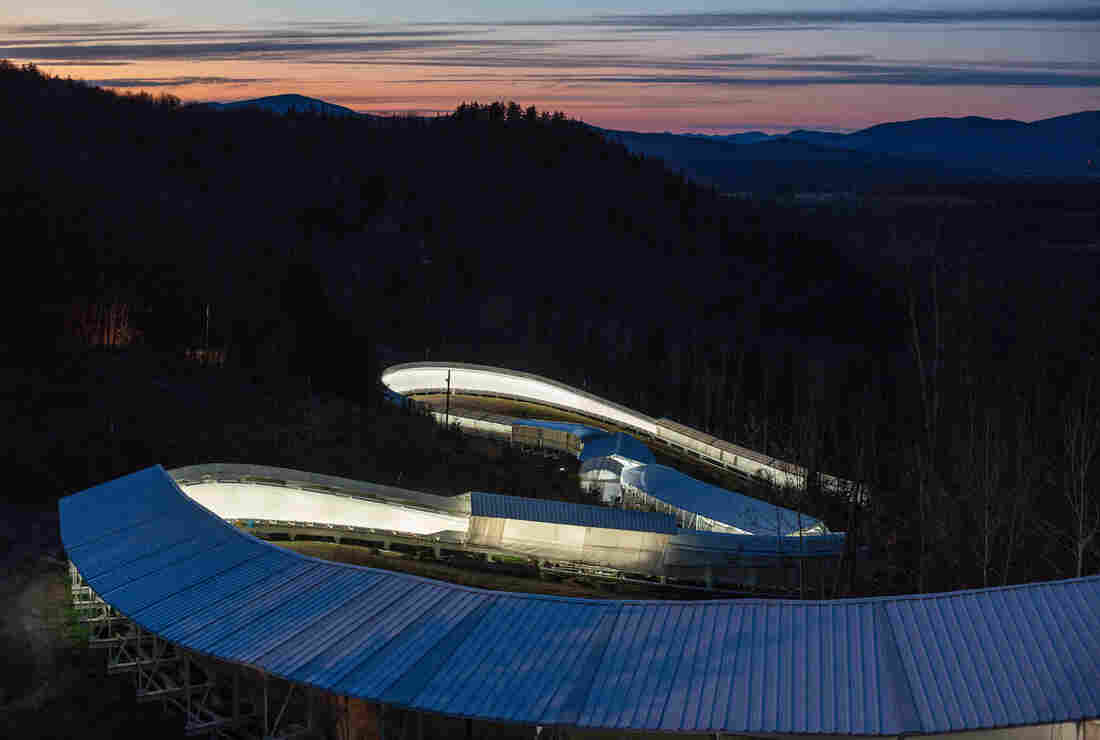
It takes elite skeleton athletes less than a minute to race down the mile-long, 20-curve track in Lake Placid, reaching speeds up to 90 miles an hour.
John Tully for NPR
hide caption
toggle caption
John Tully for NPR
Skeleton, which returned to the Olympics in 2002 after decades of absence — and whose name derivation is a matter of debate — is a niche sport, so it recruits natural athletes who have excelled in other disciplines.
Graybill’s sport was field hockey. She was recruited for bobsled after college, but found she wasn’t big and strong enough to be a contender, so she made the switch to skeleton.
“It was a natural fit,” she says. “Ever since I was a kid, I’ve always loved thrills and adrenaline. I loved sledding. I loved roller coasters. I loved anything that could give you that rush.”
Going into her first skeleton run, Graybill was terrified.
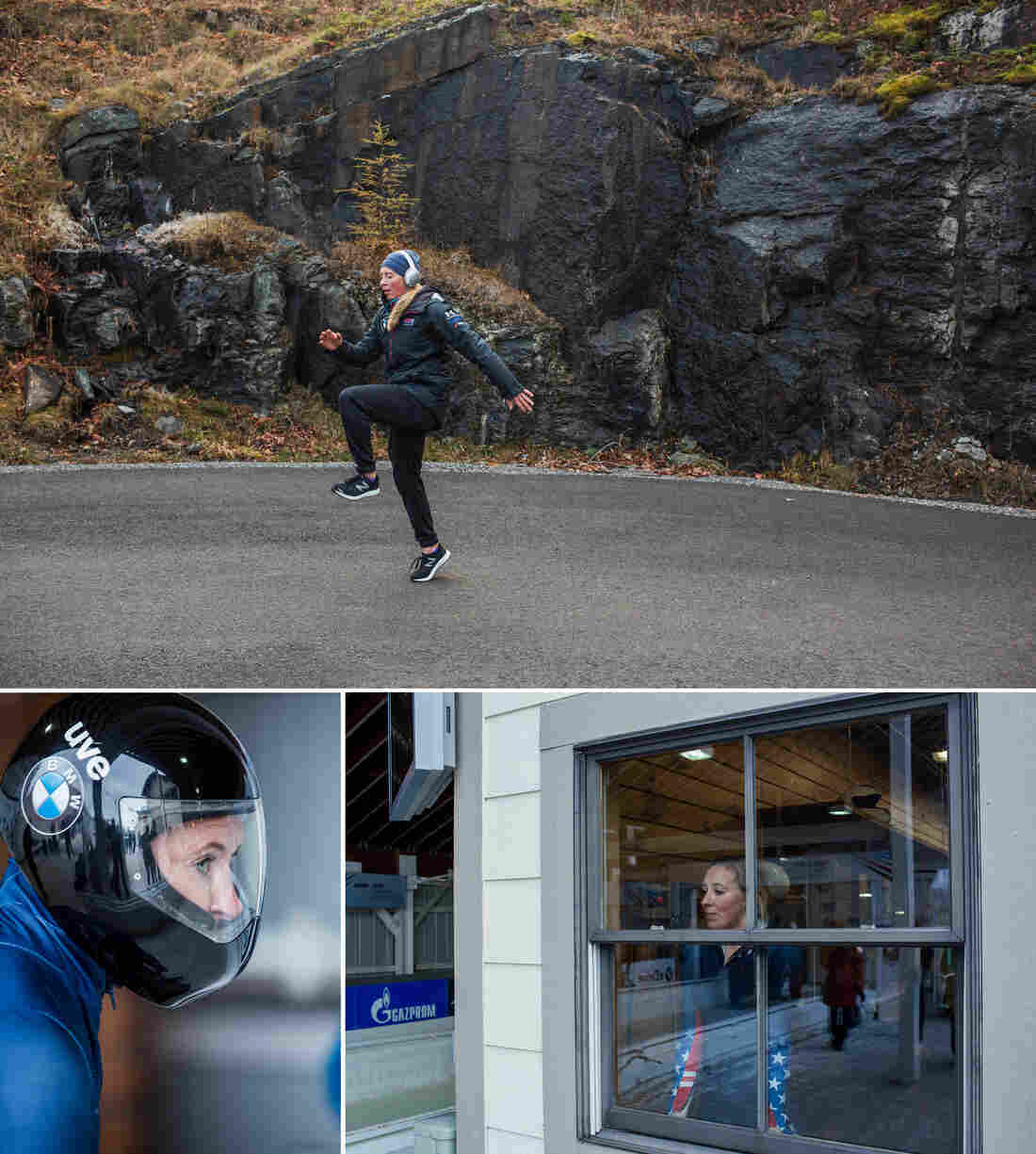
Savannah Graybill of Denver, Pa., a skeleton racer with the U.S. national team since 2011, warms up near the starting line at Lake Placid before a training run. “Ever since I was a kid, I’ve always loved thrills and adrenaline,” she says.
John Tully for NPR
hide caption
toggle caption
John Tully for NPR
“I remember feeling like I was going at warp speed, and getting down to the bottom and checking that everything was still there, and thinking, ‘OK, I need to go back up and do this again,'” she says. “That was way too cool.”
Antoine grew up snowboarding and running track in Wisconsin. He saw skeleton for the first time on television during the 2002 Olympics in Salt Lake City, and was hooked.
He arrived in Lake Placid for his first sliding school a few months later, when he was 17.
“When you first come into skeleton, you really have no idea what to expect,” he says. “You just kind of hold on and hope for the best.”
Twelve years later, Antoine was standing on the podium in Sochi, Russia, with an Olympic bronze medal around his neck (and because of the Russian doping scandal, he’s slated to be upgraded to silver).
As for Uhlaender, she competed in a wide range of sports in high school: skiing, power lifting, track and baseball — a passion she inherited from her father, Ted Uhlaender, a major-league outfielder for eight seasons.
Poised on the starting block in Lake Placid, N.Y., Kendall Wesenberg is vying for one of three women’s skeleton spots on Team USA for the 2018 Winter Olympics.
John Tully for NPR
hide caption
toggle caption
John Tully for NPR
“I played baseball all the way until I couldn’t,” Katie says, “until I realized I was five foot three and female, and the major leagues were a far reach.”
When a fellow athlete proposed she try skeleton, she proved a natural, zooming up improbably fast through the ranks. Just a few months after she took her first skeleton run, she won the women’s national championship, and the coaches started grooming her for the Olympics.
Now, assuming she makes the 2018 U.S. Olympic team, she’ll be competing in her fourth Olympic games.
The sensation of skeleton, Uhlaender says, is like nothing else you can imagine.
“You have a free-falling feeling,” she says, “basically like a water slide, but epically fast.”

Yasuhiro Suzuki of Japan reacts after competing in the Canoe Sprint Men’s Kayak Single 1000m during the Guangzhou Asian Games on Nov. 25, 2010, in Guangzhou, China. Suzuki is now banned for eight years for spiking a fellow Japanese racer’s drink with an anabolic steroid.
The Asahi Shimbun via Getty Images
hide caption
toggle caption
The Asahi Shimbun via Getty Images
Japanese kayaker Yasuhiro Suzuki says his desperation to compete in the 2020 Tokyo Olympics led him to lace a fellow countryman’s drink with an anabolic steroid — and now he’s been banned for eight years. Before Suzuki admitted the plot, his rival Seiji Komatsu had been banned.
Komatsu’s ban was overturned on Tuesday, after the Japan Anti-Doping Agency found that Suzuki had laced Komatsu’s water bottle with a banned substance at the 2017 Canoe Sprint Japan Championships last fall. Komatsu failed a doping test at the event, part of the Olympics qualifying process.
The Japan Canoe Federation, which oversees kayaking, called the case unprecedented as it announced the results of JADA’s inquiry on Tuesday.
The canoeing federation says that in addition to spiking Komatsu’s drink, Suzuki, 32, was found to have repeatedly resorted to trickery at competitions, such as stealing other kayak racers’ tools or gear.
Suzuki confessed to officials after he felt guilty about Komatsu’s ban, Japanese media report.
“We apologize for causing trouble, not only to canoe athletes but also to those of all other sports,” JCF Director Osahiro Haruzono said, according to The Asahi Shimbun.
Suzuki’s doping set-up came after he and Komatsu had competed together as part of Japan’s delegation to the 2017 World Championships in the Czech Republic. Both athletes had been seen as strong contenders for Japan’s Olympic team.
To prevent a similar scheme from playing out, the canoeing federation said it will designate a spot to store athletes’ drinks at competitions.
The canoeing body also said it will invite lecturers to create a speaking program based around the ideas of justice in sports and the spirit of fair play in competitions.

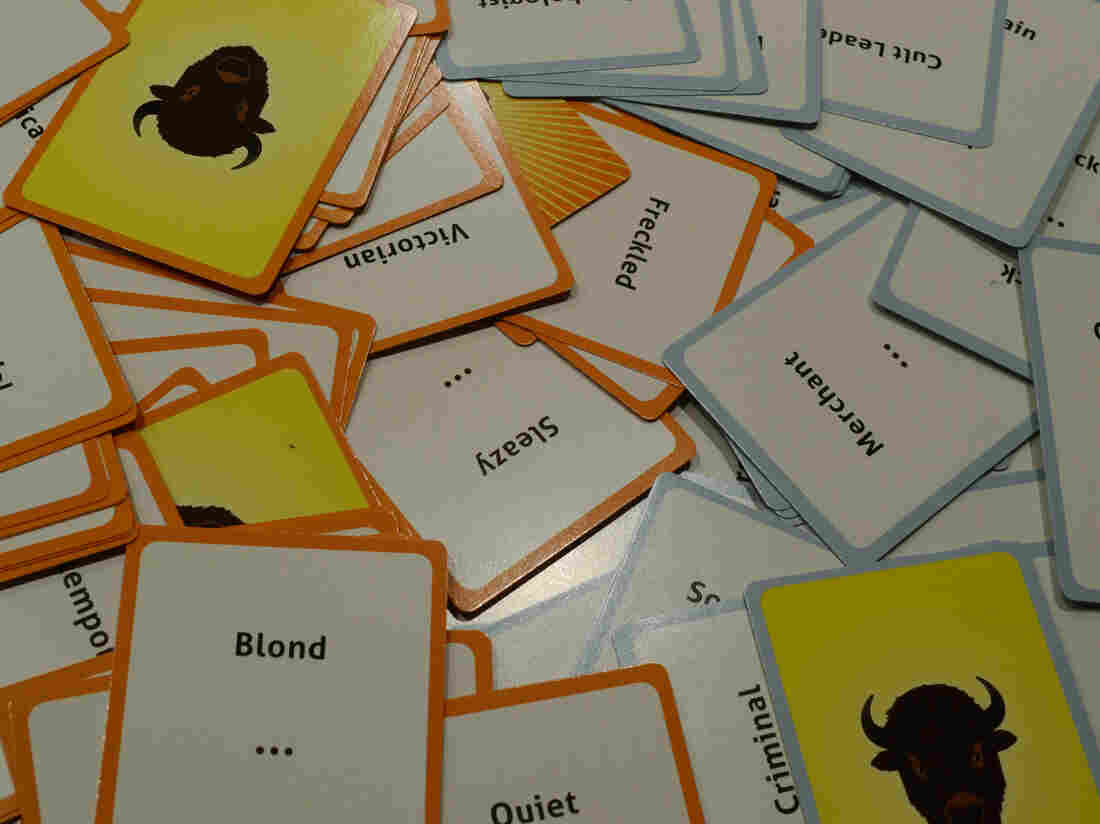
The game Buffalo prompts players to think of people that buck stereotypes, and subliminally challenges those stereotypes in the process.
Maanvi Singh for NPR
hide caption
toggle caption
Maanvi Singh for NPR
Quick, think of a physicist.
If you’re anything like me, you probably didn’t have to think very hard before the names Albert Einstein and Isaac Newton popped up.
But what if I asked you to think of a female physicist? What about a black, female physicist?
You may have to think a bit harder about that. For years, mainstream accounts of history have largely ignored or forgotten the scientific contributions of women and people of color.
This is where Buffalo — a card game designed by Dartmouth College’s Tiltfactor Lab — comes in. The rules are simple. You start with two decks of cards. One deck contains adjectives like Chinese, tall or enigmatic; the other contains nouns like wizard or dancer.
Draw one card from each deck, and place them face up. And then all the players race to shout out a real person or fictional character who fits the description.
So say you draw “dashing” and “TV show character.”
You may yell out “David Hasselhoff in Knight Rider!”
“Female” and “olympian?”
Gabby Douglas!
Female physicist?
Hmm. If everyone is stumped, or “buffaloed,” you draw another noun and adjective pair and try again. When the decks run out, the player who has made the most matches wins.
It’s the sort of game you’d pull out at dinner parties when the conversation lulls. But the game’s creators says it’s good for something else — reducing prejudice. By forcing players to think of people that buck stereotypes, Buffalo subliminally challenges those stereotypes.
“So it starts to work on a conscious level of reminding us that we don’t really know a lot of things we might want to know about the world around us,” explains Mary Flanagan, who leads Dartmouth College’s Tiltfactor Lab, which makes games designed for social change and studies their effects.
Buffalo might nudge us to get better acquainted with the work of female physicists, “but it also unconsciously starts to open up stereotypical patterns in the way we think,” Flanagan says.
In one of many tests she conducted, Flanagan rounded up about 200 college students and assigned half to play Buffalo. After one game, the Buffalo players were slightly more likely than their peers to strongly agree with statements like, “There is potential for good and evil in all of us,” and, “I can see myself fitting into many groups.”
Students who played Buffalo also scored better on a standard psychological test for tolerance. “After 20 minutes of gameplay, you’ve got some kind of measurable transformation with a player — I think that’s pretty incredible,” Flanagan says.
Buffalo isn’t Flanagan’s only bias-busting game. Tiltfactor makes two others called “Awkward Moment” and “Awkward Moment At Work.” They’re designed to reduce gender discrimination at school and in the workplace, respectively.
“I’m really weary of saying things like, ‘Games are going to save the world,'” Flanagan says. But she adds, “it’s a serious question to look at how a little game could try to address a massive, lived social problem that affects so many individuals.”
Maanvi Singh for NPR
Scientists have tried all sorts of quick-fix tactics to train away racism, sexism and homophobia. In one small study, researchers at Oxford University even looked into whether Propranolol, a drug that’s normally used to reduce blood pressure, could ease away racist attitudes. Unsurprisingly, it turns out that there is no panacea capable of curing bigotry.
There are, however, good reasons to get behind the idea that games or any other sort of entertainment can change the way we think.
“People aren’t excited about showing up to diversity trainings or listening to people lecture them. People don’t generally want to be told what to think,” explains Betsy Levy Paluck, a professor of psychology at Princeton University who studies how media can change attitudes and behaviors. “But people like entertainment. So, just on a pragmatic basis, that’s one reason to use it to teach.”
There’s a long history of using literature, music and TV shows to encourage social change. In a 2009 study, Paluck found that radio soap opera helped bridge the divides in post-genocide Rwanda. “We know that various forms of pop-culture and entertainment help reduce prejudice,” Paluck says. “In terms of other types of entertainment — there’s less research. We’re still finding out whether and how something like a game can help.”
Anthony Greenwald, a psychologist at the University of Washington who has dedicated his career to studying people’s deep-seated prejudices, is skeptical. Like Flanagan, he says, several well-intentioned researchers have proved a handful of interventions — including thought exercises, writing assignments and games — can indeed reduce prejudice for a short period of time. But, “these desired effects generally disappear rapidly. Very few studies have looked at the effects even as much as one day later.”
After all, how can 20 minutes of anything dislodge attitudes that society has pounded into our skulls over a lifetime?
Flanagan says her lab is still looking into that question, and hopes to conduct more studies in the future that track long-term effects. “We do know that people play games often. If it really is a good game, people will return to it. They’ll play it over and over again,” Flanagan says. Her philosophy: maybe a game a day can help us keep at least some of our prejudices away.
Alabama beat Georgia 26-23 to win its fifth national championship since 2009 under coach Nick Saban. Freshman quarterback Tua Tagovailoa threw a 42-yard touchdown pass to put Alabama on top.
STEVE INSKEEP, HOST:
The University of Alabama won the national football title again. It’s the fifth time in a decade, and the game was dramatic. It began with some political protests and ended in overtime before the Crimson Tide beat the Georgia Bulldogs 26-23. Here’s Ross Terrell of our member station WABE.
ROSS TERRELL, BYLINE: Before the game started, President Trump took the spotlight. He was greeted by protesters outside the stadium, including Isabel Hidalgo.
ISABEL HIDALGO: Basically, we don’t want him to think he can just come here without anybody saying, we don’t like you. We want you impeached. You’re nuts. Get out of our town.
TERRELL: Inside, he stood on the field for the national anthem where he was met with applause and boos.
(CHEERING, BOOING)
TERRELL: But then it was time for the main event – the national championship game. It was a raucous crowd as the game began.
(CHEERING)
TERRELL: And Georgia jumped out to a 13 to zero lead at halftime. Defensive player of the game Da’Ron Payne says something changed in the Alabama locker room at half.
(SOUNDBITE OF ARCHIVED RECORDING)
DA’RON PAYNE: I think we went in and Coach Saban told us that we needed to tighten things up. And I guess the team heard Coach and we came out and tried to play our best ball.
TERRELL: In the third quarter, Alabama head Coach Nick Saban rolled the dice and came up big. He benched their starting quarterback for a true freshman, Tua Tagovailoa.
(SOUNDBITE OF ARCHIVED RECORDING)
NICK SABAN: I thought Tua would give us a better chance and a spark, which he certainly did.
TERRELL: Tagovailoa led the Crimson Tide to their first touchdown of the game about six minutes into the third quarter. UGA responded with a touchdown of their own, but Alabama scored the next 13 points of the game to tie it at 20 apiece. They missed a field goal that would’ve won it in regulation but instead finished the job in overtime.
(CHEERING)
TERRELL: Tua threw a game-winning 41-yard touchdown pass to fellow freshman, DeVonta Smith.
(SOUNDBITE OF ARCHIVED RECORDING)
DEVONTA SMITH: I looked back out and he was wide open, so I hit him and now here we are now. Thank God.
TERRELL: It was the freshmen that helped win it all. That turned out to be the play and the story of the game. Alabama coach Nick Saban says he can’t remember a time when they had to rely on so many young players to win a matchup.
(SOUNDBITE OF ARCHIVED RECORDING)
SABAN: A lot of those guys are really mature for their age, and they were ready to make contribution. And they certainly did a fantastic job for us this year. There’s no doubt about that.
TERRELL: With the win, Saban remains undefeated against former assistant coaches. He’s now 12 and zero. This time, he knocked off Georgia head coach Kirby Smart, who worked with Saban for nine years at Alabama. The Crimson Tide claimed their 17th national title. For NPR News, I’m Ross Terrell in Atlanta.
(SOUNDBITE OF MENAHAN STREET BAND’S “GOING THE DISTANCE”)
Copyright © 2018 NPR. All rights reserved. Visit our website terms of use and permissions pages at www.npr.org for further information.
NPR transcripts are created on a rush deadline by Verb8tm, Inc., an NPR contractor, and produced using a proprietary transcription process developed with NPR. This text may not be in its final form and may be updated or revised in the future. Accuracy and availability may vary. The authoritative record of NPR’s programming is the audio record.

Alabama’s Tua Tagovailoa holds up the championship trophy after overtime of the NCAA college football playoff championship game against Georgia, on Monday in Atlanta.
David J. Phillip/AP
hide caption
toggle caption
David J. Phillip/AP
Updated at 12:15 a.m. ET Tuesday
The Georgia Bulldogs got into the college football title game with an unexpected comeback for an overtime win against the Oklahoma Sooners. On Monday night, they had their championship hopes yanked away the same way.
In the fourth quarter, the Alabama Crimson Tide made up lost ground, bringing the score with Georgia’s Bulldogs to 20-20 with less than four minutes left in the College Football Playoff National Championship game in Atlanta.
Down to what might have been their last down, freshman quarterback Tua Tagovailoa flung the ball to the endzone on fourth down and found wide receiver Calvin Ridley. Georgia had been leading Alabama 20-7 in the the third quarter.
Alabama got the ball back, but kicker Andy Pappanastos pulled a 36-yard field goal wide, and the game went to overtime.
Georgia went first and managed a field goal of their own, and looked to be in good shape after a 16-yard sack of Tagovailoa on Alabama’s first play. But Tagovailoa found wide receiver DeVonta Smith streaking down the left sideline for a touchdown, and Alabama’s fifth national championship in nine seasons.
The Bulldogs had scored their second touchdown of the game on a 80-yard reception by receiver Mecole Hardman. Rodrigo Blankenship kicked the point-after.
After being held scoreless in the first half, Alabama got on the board with a 6-yard touchdown pass by freshman quarterback Tua Tagovailoa to Henry Riggs III.
Tagovailoa started the second half for Alabama after a lackluster performance by starting quarterback Jalen Hurts.
Late in the second quarter, Georgia scored a touchdown on a one-yard run by Mecole Hardman. That capped off a 69-yard drive.
Blankenship earlier had kicked two field goals of 41 and 27 yards.
Georgia’s freshman quarterback Jake Fromm has paced his team with a mix of medium-length passes which have set up the Bulldogs a potent running attack.
Georgia’s offense dominated the game early with twice as many offensive plays as Alabama which hadn’t managed to sustain a drive throughout the contest.
The game pitted Georgia’s potent running game against Alabama’s stout rushing defense.
Alabama is led by arguably the best college football coach in the game, Nick Saban, while Georgia is led by Kirby Smart, who spent nine years as a Saban assistant coach and was looking to best the master by bringing the Peach State its first title since 1980. No former assistant coach has ever beaten Saban.
President Trump, who once, as a football mogul, tried to break the National Football League’s hold on pro football and failed, was there for the first half.
The Atlanta chapter of the NAACP encouraged people to stage a “snowflake” protest by waving small white towels at any mention of Trump. But apparently that didn’t happen.
Chapter president Richard Rose told USA Today that his group would also protest on social media, but their planned action would be limited.
“Rose said the Atlanta chapter of the NAACP will not officially participate in any physical gathering before or during the game due to weather and security concerns,” reported the national daily.
It was likely that Trump would be on safe ground at a game between competitors of two deep-red states.
But as the New Yorker pointed out:
“While it’s true that Alabama and Georgia went for Trump in the 2016 presidential election, he’s not exactly beloved in either state. Clarke County, Georgia, home to the UGA, went for Hillary Clinton in 2016 by a nearly 40 percent margin. And Alabama recently dealt Trump a double whammy in the special election to fill the seat left vacant by his Attorney General Jeff Sessions. Republicans in the state first rejected Trump-endorsed Luther Strange in the GOP primary and then dealt a loss to Roy Moore in last month’s special election.”
And in case you’re wondering how popular Nick Saban is in Alabama, consider this: more than 400 voters cast their ballot during that recent special election for the 66-year-old coach as a write-in candidate. Not that Saban ever did anything to encourage that support. As Al.com reports, Saban said bluntly, “I don’t get involved in politics.”
College football will crown its national champion Monday night. And fans of the two teams won’t have too far to travel: Alabama and Georgia are playing in Atlanta where things have been a bit crazy.
NPR’s Kelly McEvers talks with Tina Park, executive director of the Canadian Centre for the Responsibility to Protect, about whether sending North Korean athletes to the winter Olympics in South Korea, signals any significant change in relations.
The PyeongChang 2018 Olympics will be the first Winter Olympics to feature figure skaters performing to music with lyrics. Maggie Hendricks of USA Today tells NPR’s Kelly McEvers that figure skating organizers hope music filled with lyrics will help create a new generation of figure skating fans.

Adam Rippon, the first openly gay man to qualify for the U.S. Winter Olympics team, competes during the 2018 Prudential U.S. Figure Skating Championships in San Jose, Calif.
Matthew Stockman/Getty Images
hide caption
toggle caption
Matthew Stockman/Getty Images
As of Sunday morning, 28-year-old figure skater Adam Rippon will be the first openly gay man to compete for the United States in the Winter Olympics.
Despite a disappointing fourth-place performance at the U.S. figure skating championships Saturday night, Rippon was selected to join Nathan Chen and Vincent Zhou in Pyeongchang next month.
“I’m really grateful that the selection committee looked at my body of work over the last two seasons,” Rippon told reporters on Sunday.
The committee’s decision wasn’t without controversy. Rippon’s selection edged out Ross Miner, who placed second in the national championship. U.S. Figure Skating President Sam Auxier said the athletes’ track records in international competitions were a deciding factor.
But for Rippon, who was the U.S. national champion in 2016, the road to PyeongChang has been a long one. This year will be the 28-year-old’s Olympic debut — more than 80 years since an American man his age competed as a rookie, according to The Washington Post.
“I don’t really care what other people think of me. I’m able to go out there and I’m really able to be unabashedly myself,” he said. “I want somebody who’s young, who’s struggling, who’s not sure if it’s OK if they are themselves to know that it’s OK.”
And depending on how the roster for the U.S. ski team shapes up, Rippon may end up sharing his historic moment.
U.S. freestyle skier Gus Kenworthy came out publicly in 2015, a year after he took silver in the 2014 Sochi Olympics. Kenworthy will find out later this month whether he heads to Pyeongchang.
A third gay athlete, luger John Fennell, had also been vying for a spot on Team USA, but a sled malfunction slashed his chance at qualifying in December.
Figure skater Johnny Weir faced speculation about his sexuality while competing in 2006 and 2010, but he avoided questions on the matter. In 2011, he publicly confirmed that he was gay in his memoir, Welcome to My World.
Despite the gain in LGBTQ representation this winter, the Olympics contend with a dearth of openly queer athletes. The U.S. hasn’t sent an openly gay man to the Summer Olympics in 14 years — since equestrians Robert Dover and Guenter Seidel competed in 2004.
But come February, a global audience will get the chance to know Rippon, who’s built a reputation as an unapologetic, highly entertaining skater.
“A few weeks ago, I was asked in an interview … what was it like being a gay athlete in sports. And I said it’s exactly like being a straight athlete. Only with better eyebrows,” Rippon said.