Olympic Figure Skating Judges Make Controversial Selections

The U.S. Olympic Skating Team was chosen this weekend, but the choice was not without controversy. NPR’s Michel Martin talks with Christine Brennan from USA Today about the selection process.

MICHEL MARTIN, HOST:

The Winter Olympics are upon us. They start next month. And if you plan to watch, chances are figure skating will be one of the reasons. It’s a driver of television ratings, a fan favorite, and every so often, a source of drama. This year is no exception. The U.S. national championships just wrapped up in San Jose. The Olympic teams were picked shortly after, and we’ll let Christine Brennan of USA Today take it from here. She joins us via Skype. Christine, good to talk with you again.

CHRISTINE BRENNAN: Michel, my pleasure. Thanks so much.

MARTIN: So let’s start with the women’s event. Ashley Wagner is a superstar. She’s certainly a name that a lot of people know, but she didn’t make the team. She was not happy about that. What happened?

BRENNAN: Yeah, it was interesting because a lot of us thought going in she would make the team. She’s got the international reputation. She’s got the world silver medal from just 21 months ago. And while people might say, well, wait a minute, what about now versus reputation? Well, she’s actually still one of the two or three best American skaters in the world. But the judges hammered her, and we never see that. For some reason, the judges basically said here that, Ashley, you know, we’re going to hold you to a higher standard. It was as if they said, hey, goodbye, you know, get out of here.

Extraordinary. I’ve never seen anything quite like it. But the – what has happened is U.S. judges, Michel, have said they wanted to go with younger skaters. They picked Brady Tennell as the national champion. This is kind of the Russianization (ph) of U.S. figure skating. The little jumping beans that are winning the titles in the world are from Russia, and I think the U.S. basically said, if we can’t beat them, let’s join them. Let’s get rid of the older skaters. Let’s get the new kids going. And that’s exactly what happened here.

MARTIN: So let’s talk about the men’s side. What happened there?

BRENNAN: Well, Nathan Chen is going to be an Olympic medal contender, maybe even for the gold – 18 years old. He made it. He ran away with the competition – no problem, and he’s made the Olympic team. Second place Saturday night was Ross Miner. But as skating is, Michel, you move from the competition to the committee room. And following a bizarre kind of arcane set of criteria, a committee dropped Ross Miner and did not put him on the team, brought in a man named Adam Rippon to join Vincent Zhou and Nathan Chen as the three men who will go to the Olympics.

MARTIN: Well, what happens now? Do you think it will affect how people watch the Olympics next month? What are your thoughts about that?

BRENNAN: It will have absolutely no impact on the medals. But in terms of leaving a sour taste in the mouths of skaters – the young kids who skate everyday who watched last night, and then saw the way that the committee voted, the coaches – I talked to Mark Mitchell who was left off the ’92 Olympic team in a very similar twist. He was talking about, why even have the nationals? We even come? Why did we pay for a hotel? Why did Ross Miner spend the money to travel here if his performance didn’t matter? So I think it’s a black eye for the sport, even though in terms of pivoting to the Olympics, U.S. figure skating is saying, OK, done with that, moving on. And the bottom line is skating always has controversy. And here we are once again. It never, ever, ever disappoints.

MARTIN: That’s Christine Brennan reporting from San Jose and the U.S. National Figure Skating Championships. She reports for USA Today. Christine, thank you.

BRENNAN: Michel, my pleasure. Thanks so much.

Copyright © 2018 NPR. All rights reserved. Visit our website terms of use and permissions pages at www.npr.org for further information.

NPR transcripts are created on a rush deadline by Verb8tm, Inc., an NPR contractor, and produced using a proprietary transcription process developed with NPR. This text may not be in its final form and may be updated or revised in the future. Accuracy and availability may vary. The authoritative record of NPR’s programming is the audio record.

Let’s block ads! (Why?)

North Korea's Olympic Skaters

North Korea may send a pair of skaters to the Olympics. NPR’s Lulu Garcia Navarro talks with New York Times sports reporter Jere Longman about what this means for skating and international relations.

LULU GARCIA-NAVARRO, HOST:

North Korea’s Olympic committee representative said yesterday that it’s likely that two of their figure skaters will go to the Olympics in South Korea beginning February 9, which is a big deal. Joining us to talk about it is Jere Longman, sports reporter for The New York Times. He’s at the U.S. Figure Skating Championship in San Jose, Calif., which is the noise I think we can hear behind you. Welcome to the program.

JERE LONGMAN: Thanks for having me, Lulu – appreciate it.

GARCIA-NAVARRO: All right. So tell us a little bit about these North Korean skaters. What kind of skaters are there? What are their names?

LONGMAN: So it’s a pairs team that finished 15th at the 2017 World Championships. So they’re, you know, elite, quality skaters. The woman in the pair is Ryom Tae Ok, who’s – will turn 19 shortly before the Olympics. And her partner is Kim Ju Sik, who is 25. And they’re both listed as students. They have a kind of dynamism that’s reflective of Chinese skaters and a kind of precision that’s often seen in the Russian skaters. And they skate to the Beatles in their short program – instrumental version of “Day In The Life” as performed by Jeff Beck.

GARCIA-NAVARRO: (Laughter) Good choice, good choice – I like it. So let me ask you this. Why is it significant that they might be competing in the Olympics in South Korea?

LONGMAN: So North Korea is not a Winter Olympic power. It has only won two medals in the Winter Olympics – both in speedskating – and none since 1992. But given that the Olympics are taking place in…

GARCIA-NAVARRO: Their great rival.

LONGMAN: …In the divided North Korean peninsula at a time of great geopolitical tension, the International Olympic Committee and the president of South Korea are really desperately hoping they – and have been saying for months that they want North Korea to participate in hopes that, you know, it could bring some sort of immediate reduction of tensions on the peninsula and perhaps lead to some longer-term thaw in the relations between the two countries.

GARCIA-NAVARRO: So sports bringing these two countries together is the Olympic hope and, I suppose, just the Olympic dream writ large for all sports.

LONGMAN: Yes – so they’re being labeled and have been for months as the Peace Games. The Olympics have been corrupted in many ways by, you know, scandal and money and other things. But at its ideal is the notion that athletes from countries who don’t get along with each other can, for a short period of time, come together through friendship and competition – show the, you know, sort of the better angels of mankind.

GARCIA-NAVARRO: If the North Korean pair actually compete in South Korea, how closely scrutinized will their performance be, do you think, and what will their reception be in South Korea?

LONGMAN: I think in the larger Olympic world and the larger political world, their presence would mean far more than how they actually skate. And, you know, it’s much more important, at least in the eyes of the Olympics, that they be there and less important by exactly what place they finish.

GARCIA-NAVARRO: Jere Longman, sports reporter for The New York Times – thank you very much.

LONGMAN: Thank you.

Copyright © 2018 NPR. All rights reserved. Visit our website terms of use and permissions pages at www.npr.org for further information.

NPR transcripts are created on a rush deadline by Verb8tm, Inc., an NPR contractor, and produced using a proprietary transcription process developed with NPR. This text may not be in its final form and may be updated or revised in the future. Accuracy and availability may vary. The authoritative record of NPR’s programming is the audio record.

Let’s block ads! (Why?)

Browns Parade A 'Perfect Season'

Cleveland Browns fans are “celebrating” their team’s winless 0-16 season today with a “Perfect Season Parade.”

SCOTT SIMON, HOST:

A parade in Cleveland today for the Cleveland Browns to celebrate what they call their perfect season, 0-16 – 16 losses and 0 wins. The Browns had an almost perfect season last year but managed to win one game toward the end. It did not begin a tradition. A fan named Chris McNeil has organized the parade to march around the team’s oval-shaped stadium, which observers note is the shape of a zero. He told The Guardian, we are not having a celebration of losing. We are having a protest of losing. We want to let the Browns ownership and front office know we’re holding them accountable for having such a bad team. And maybe we’ll have some fun while doing it.

Marching outdoors in 10-degree weather doesn’t sound like much fun. Fans will drive hearses and ambulances in the parade and display tombstones etched with the names of the 28 quarterbacks who’ve started for the Browns since 1999. Since then, the team has won just 88 games and lost 216. Money will be raised for a local food bank, so there is a win for all.

Copyright © 2018 NPR. All rights reserved. Visit our website terms of use and permissions pages at www.npr.org for further information.

NPR transcripts are created on a rush deadline by Verb8tm, Inc., an NPR contractor, and produced using a proprietary transcription process developed with NPR. This text may not be in its final form and may be updated or revised in the future. Accuracy and availability may vary. The authoritative record of NPR’s programming is the audio record.

Let’s block ads! (Why?)

Figure Skaters Compete For Olympic Spots

The best figure skaters in the United States are competing this week in California. A trip to next month’s Winter Olympics is on the line.

SCOTT SIMON, HOST:

Let’s move now to the world of figure skating. The United States has just named its team of women skaters who will go to the Winter Games in South Korea next month and try to win an individual medal for the first time since 2006. NPR’s Tom Goldman is in San Jose, Calif. – where I think it’s so early, it’s probably still December – covering the U.S. Figure Skating Championships. Tom, thanks very much for being with us.

TOM GOLDMAN, BYLINE: It’s always a pleasure, especially today, Scott.

SIMON: Who’s on the team?

GOLDMAN: Well, the women who finished one, two, three in the U.S. championships last night in San Jose. Bradie Tennell, 19 years old – she finished first in both the short and long programs in San Jose. And in last night’s long program, if you saw it, she was nearly flawless. She landed all 11 jumps cleanly. She looked very polished.

Then there’s Mirai Nagasu, 24, the old-timer of the group. She finished second last night. She’s also going to the Olympics. She’s a fan favorite, a powerful jumper and a beautiful, artistic skater, as well. She’s one of only two American women ever to complete the difficult triple axel jump in international competition. And I know you know the other one, Scott – right?

SIMON: Yes. Although the last time she did it – Tonya Harding, we’re talking about, you know…

GOLDMAN: Right.

SIMON: …Whose biopic is out now. The last time she did it, she did the triple axel and then hit Nancy Kerrigan on the knee with a wrench or something, right? Isn’t that what happened?

GOLDMAN: With another axel, exactly.

SIMON: Right.

GOLDMAN: So yeah. So there you go. And then – well, it wasn’t Tonya. It was a friend of hers.

SIMON: It was a friend of hers. Yeah.

GOLDMAN: But anyway, 18-year-old Karen Chen is the third. She won last year’s U.S. National. She was sick as a dog the day before last night’s long program. She says she consulted her sports psychologist, her acupuncturist, other doctors. And she just toughed it out and skated a really nice program, good enough for a third place finish last night. And now she’s on the Olympic team, too.

SIMON: You mentioned Mirai Nagasu. She was passed over four years ago. Do we see this as redemption?

GOLDMAN: I think it is a redemption. You know, it’s this kind of quirky, if you will, selection process. We think that it should be the top three from the U.S. championships going – filling the three Olympic spots. But in fact, a selection committee decides on the skaters. And it looks at their body of work. It looks at how they’ve done over the past year in other major competitions.

And because of this process, the top three at the Nationals don’t always make it. And as you mentioned, Mirai Nagasu in 2014 was passed over. She finished third at the U.S. Nationals but was passed over for Ashley Wagner, who finished fourth. The selection committee thought Wagner had the better resume.

Now, Nagasu – it is a bit of redemption. Her coach says even non-skating fans knew of Mirai as the poor skater who didn’t make the Olympic team in 2014. But in last night’s press conference after the competition, Nagasu, you know, admitted she was the one responsible for her failure in 2014. Here she is.

(SOUNDBITE OF PRESS CONFERENCE)

MIRAI NAGASU: I was a little bit careless over the season and didn’t put out the body of work that I needed. And so I didn’t want to feel that same way this year, and so I took on the full responsibility of becoming a stronger competitor and person.

GOLDMAN: And, Scott, it’ll be really interesting to see how she does in South Korea. Right now she’s the highest-ranked American woman in the world at No. 6. Even though she missed those 2014 Games, she has Olympic experience. She finished fourth at the Vancouver Olympics in 2010, and she’ll be a contender in South Korea, especially if she can get that triple axel cranked up.

SIMON: NPR’s Tom Goldman, thanks so much for being with us.

GOLDMAN: You’re welcome.

(SOUNDBITE OF MACK DAVID, AL HOFFMAN, JERRY LIVINGSTON’S “A DREAM IS A WISH YOUR HEART MAKES (INSTRUMENTAL VERSION)”)

Copyright © 2018 NPR. All rights reserved. Visit our website terms of use and permissions pages at www.npr.org for further information.

NPR transcripts are created on a rush deadline by Verb8tm, Inc., an NPR contractor, and produced using a proprietary transcription process developed with NPR. This text may not be in its final form and may be updated or revised in the future. Accuracy and availability may vary. The authoritative record of NPR’s programming is the audio record.

Let’s block ads! (Why?)

Saturday Sports: NFL Playoffs

NPR’s Scott Simon talks with Howard Bryant of ESPN about the NFL playoffs — which games to watch and which teams to watch out for.

SCOTT SIMON, HOST:

Talk about fire and fury. It’s time for sports.

(SOUNDBITE OF MUSIC)

SIMON: Much of the country is huddled inside against the cold, but the NFL playoffs are just heating up. Howard Bryant of ESPN joins us. Howard, thanks so much for being with us.

HOWARD BRYANT: Good morning, Scott. How are you doing?

SIMON: I’m fine. Thank you, my friend. Most of the NFL talk we’ve had this this year has been about demonstrations of conscience on the field, been about the dropping ratings of the games. There are four big games this weekend. You’ve got the Tennessee Titans playing the Kansas City Chiefs and the Panthers against the New Orleans Saints. Where’d you like to start?

BRYANT: Well, actually, I’d like to start with Buffalo – and Buffalo and Jacksonville. You’ve got two teams that haven’t made the playoffs in forever. Jacksonville hadn’t made the playoffs since 2007. And they were a laughingstock for years. And the Buffalo Bills, the once proud Buffalo Bills, hadn’t made the playoffs since 1999. They play each other this weekend.

And you’re right, Scott. This has been a very difficult year, whether you’re talking about CTE and concussions, and we’re talking about the ratings and protests for and against Colin Kaepernick and against police brutality. And so this is the period now where the league needs this, where I think football fans are going to try to settle in and salvage this season. It’s go time for the players in terms of trying to win a championship.

And then, also, of course, you’re looking at the Atlanta Falcons. You’ve got a team there that had a 28-3 lead in the Super Bowl against the Patriots a year ago. And now they’re in the playoffs again one more time. And a team that lost the Super Bowl hasn’t gone back to the Super Bowl since 1993, when Buffalo did it. So maybe…

SIMON: And this was a team that was two minutes away from – or four minutes away from winning the Super Bowl.

BRYANT: From winning the Super Bowl. It goes back to what John Madden always said – I love that – that the greatest gap in sports is between the winner and loser of the Super Bowl. And it really is true.

SIMON: Yeah. Teams that had a rough regular season – can they put that all behind them when it gets to the playoffs? Do you wipe the slate clean?

BRYANT: Well, I think you have to. And I think that one of the teams that you’re really concerned about in that regard is the Kansas City Chiefs. There’s a team that – they went out on opening day, and they demolished the defending champion Patriots in Foxborough. You looked at them, and you said, here’s a team that’s really going to put it together.

And they’ve got Andy Reid back there, who’d been to the Super Bowl with the Philadelphia Eagles. And then, of course, they had their troubles during the season. And then they turned it around, and so now they’re in the playoffs. And so, this is one of the – they’re going to be one of those teams that is definitely saying, look. We’re in the tournament now, so everything that happened in the past isn’t going to matter. Let’s see if we can turn this around.

And, of course, the team that everyone’s looking out – there are two teams that everyone’s looking out for. One in the NFC is the Philadelphia Eagles – great team, 13 win team. But they lost their quarterback, Carson Wentz. So now you’re looking at the Eagles to see, can they win the Super Bowl with Nick Foles, with a backup? And then, of course, the defending champion Patriots, who are always there. And can 40-year-old Tom Brady do what no one’s ever done before, which is to win the Super Bowl at that age?

SIMON: Yeah. You didn’t ask. But I’ll say, yeah. I think he can.

BRYANT: (Laughter) I think he can too.

SIMON: And let me ask about the Australian Open because it is such a testament to the eminence of Serena Williams that she can dominate a news cycle about the Australian Open by making a personal decision – let me put it that way.

BRYANT: No question. Well, Serena Williams hasn’t played a professional match since she beat her sister in the Australian Open last year. She was eight weeks pregnant at the time and then announced that she was pregnant. And then she had her baby. And yet, for much of that time, she had told people that she was going to come back and make the Open, announced that she didn’t reach her goal and that she’s not going to play in the Open.

Serena Williams is the greatest athlete we’ve got going in the country right now. She does not, however, have an S on her chest. It was a great ask. But because it was Serena, everybody assumed that, hey, you’re not going to bet against her. But she said she’s not quite there yet. Kind of a shame but not really a surprise. You’re asking a lot even of the great Serena Williams to not play a match in a year and then come back and compete for a championship.

SIMON: Yeah. Well…

BRYANT: But she’ll be back.

SIMON: …Let me just say, no male champion’s ever come back after giving birth, has he?

BRYANT: (Laughter) Asking a lot, even of Serena.

SIMON: Howard Bryant, thanks so much for being with us.

BRYANT: Thank you.

Copyright © 2018 NPR. All rights reserved. Visit our website terms of use and permissions pages at www.npr.org for further information.

NPR transcripts are created on a rush deadline by Verb8tm, Inc., an NPR contractor, and produced using a proprietary transcription process developed with NPR. This text may not be in its final form and may be updated or revised in the future. Accuracy and availability may vary. The authoritative record of NPR’s programming is the audio record.

Let’s block ads! (Why?)

Training For The Olympics Is Hard Enough. Try Doing That While Earning A Degree

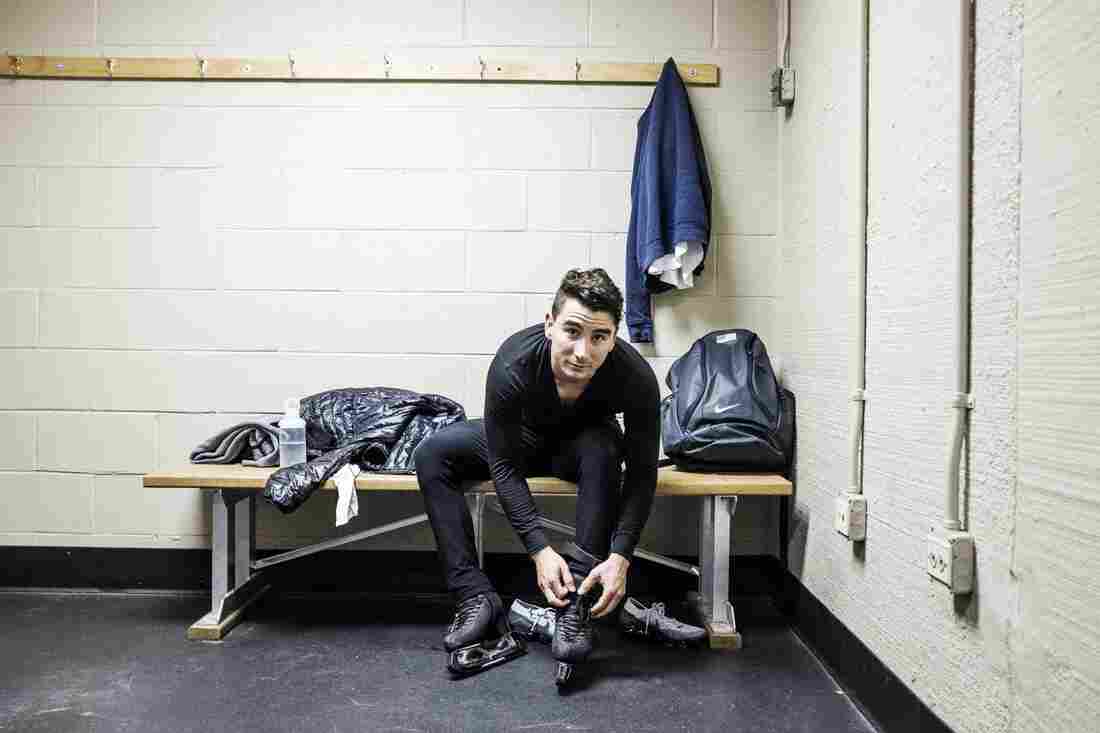
2013 Figure skating national champion and Olympic hopeful Max Aaron trains at the World Arena Ice Hall in Colorado Springs. Aaron recently graduated with a degree in finance.

Matt Nager for NPR

hide caption

toggle caption

Matt Nager for NPR

Max Aaron may have been the 2011 men’s junior figure-skating champion, 2013 U.S. national champion and 2015 Skate America champion. And sure, he’s a top contender for a spot on the U.S. team in next month’s Winter Olympic Games in PyeongChang, South Korea.

But all his grandfather wants to know is when he’s going to machan a leibedik—Yiddish for “make a living.”

Before he can do that, though, Aaron and many other elite athletes face a big hurdle: Finding time, between all that training — hours in the gym or pool or on the ice — to earn a college degree.

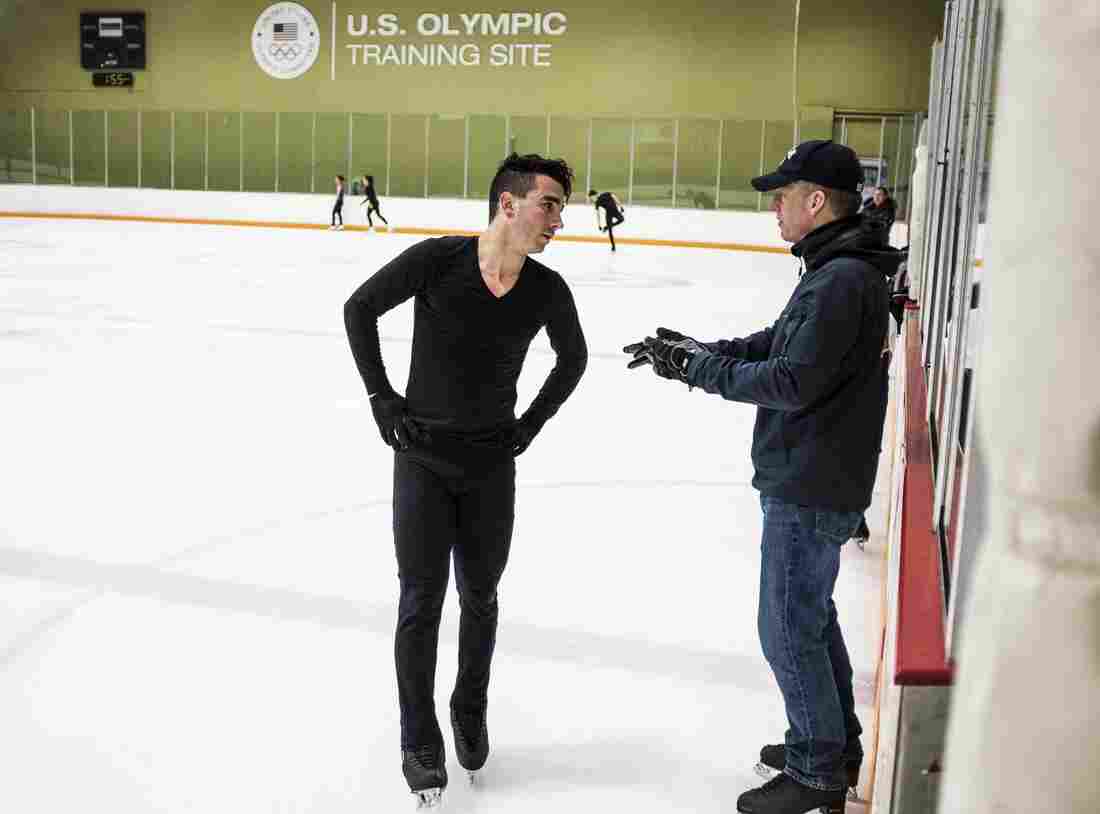
Aaron, who is 25, has been working on it — for years — balancing his grueling training schedule with classes in finance at the University of Colorado Colorado Springs.

A onetime hockey player who switched to figure skating after breaking his back in high school, Aaron took his competitive nature with him to the university, where he was determined to outdo his classmates.

This story was reported for radio by Elissa Nadworny and for the web by Jon Marcus of the Hechinger Report.

“I look at, they got a 99 — I’m going to get 100,” he says during a break from the rink in the World Arena Ice Hall, where aspiring and elite Olympic skaters train.

That doesn’t mean it was easy. Because of his skating career, he hadn’t ever taken the SAT or ACT, so he had to start at community college. He worked as a a waiter on the weekends to help pay the tuition. To accommodate his three hours a day at the rink, plus warmup time, strength conditioning, physical therapy and dance, he typically took his finance classes from 8 to 10:40 a.m. and 7:30 to 10:05 p.m.

Max Aaron talks with his coach, Tom Zakrajsek, during practice at the World Arena Ice Hall in Colorado Springs.

Matt Nager for NPR

hide caption

toggle caption

Matt Nager for NPR

“I laid out my entire schedule,” he says. ” ‘And these are my breaks and this is when the courses meet and where I can fit them in.’ ” Universities “don’t work around you,” he says, “you work around them.”

Meeting the needs of older students

Olympic athletes and hopefuls comprise only a tiny handful of the older students trying to get higher educations. But their struggles with finding the money and time to do it, among other problems, illustrate the problems legions of adults are facing.

American higher education long ago stopped being primarily for the 18-year-old undergraduate, tossing a Frisbee on a manicured quadrangle.

Sixty percent of undergraduates today are over 25, working full time, financially independent of their parents, or connected with the military, according to the American Council on Education. That’s nearly 16 million people.

As the number of 18-year-olds declines, colleges and, eventually, employers, are becoming more dependent on this older group to fill classrooms and jobs. And the supply of them is vast. One in five American adults has earned some college credit, but never finished a degree, the American Academy of Arts & Sciences reports.

Yet exactly at the time when more nontraditional-aged adults are needed to go to college, institutional and government policies make that harder than trying to skate uphill.

Compared with most of these older students, Olympic athletes and hopefuls have some help. In August, Colorado made them eligible for lower in-state tuition at community colleges and public universities; 56 athletes are already taking advantage of that. There are 500 athletes in residence at the U.S. Olympic Training Center, chosen by the governing bodies of their sports.

In 2014, the U.S. Olympic Committee began offering college scholarships, using money it receives from donors. And athletes can take online courses for free from the for-profit DeVry University, a USOC sponsor.

Thirty-seven student-athletes have graduated, and there are another 118 enrolled. (About 1,600 paying students at DeVry have filed claims for loan forgiveness, saying the school defrauded or misled them, according to the Century Foundation, a nonpartisan think tank, and its parent company has reached a tentative deal to sell it.)

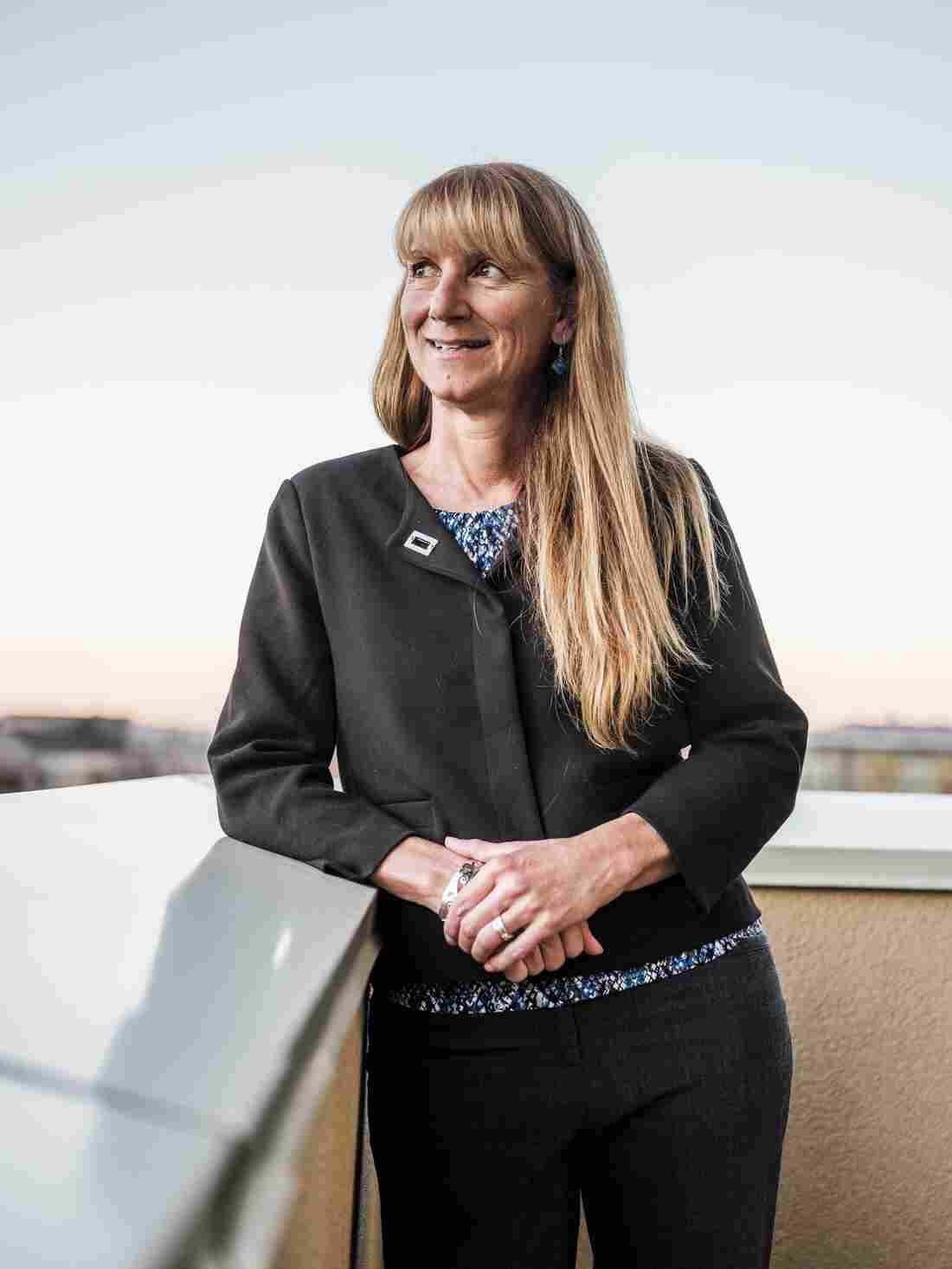
“The athletes are a little bit at the forefront of this,” says Leslie Klein, the USOC’s director of athlete career and education. She’s a former two-time Olympian who competed in kayaking and canoeing. Veteran athletes with multiple trips to the Olympics, she says, “are just trying to chisel away at their educations [and] we’re trying to make it a little easier for them.”

In many ways, it’s still tough. The USOC last year awarded $236,000 in tuition scholarships, for instance, but the amount requested was four times that much. Only 80 athletes got them out of 120 who applied.

Leslie Klein, director of the athlete career and education program the U.S. Olympic Committee.

Matt Nager for NPR

hide caption

toggle caption

Matt Nager for NPR

Then there are the time constraints. Olympic hopefuls train so incessantly that their training is often the equivalent of a full-time job. On top of that, they travel often to compete. And many older athletes juggle families and jobs on top of all that.

Elana Meyers Taylor is a bobsledder with two Olympic medals: bronze in Vancouver and silver in Sochi. It took her four years to get her master’s in sports administration, and then she started studying online for an MBA.

Bobsled competitions are often held in tiny ski towns around the world, which made studying hard in places without reliable wireless service.

“You can imagine getting an online degree is pretty difficult,” she says.

She’d work on her academics during travel time and at night. “I’d get a couple of hours in and study here and there,” Meyers Taylor says. She got her MBA in finance in 2015.

“It’s not easy,” she says of combining work, study and international competition. “I’m not going to say … I wanted to sit down and read about the stock market” after every race. “It’s about setting a goal and keeping that long-term perspective.”

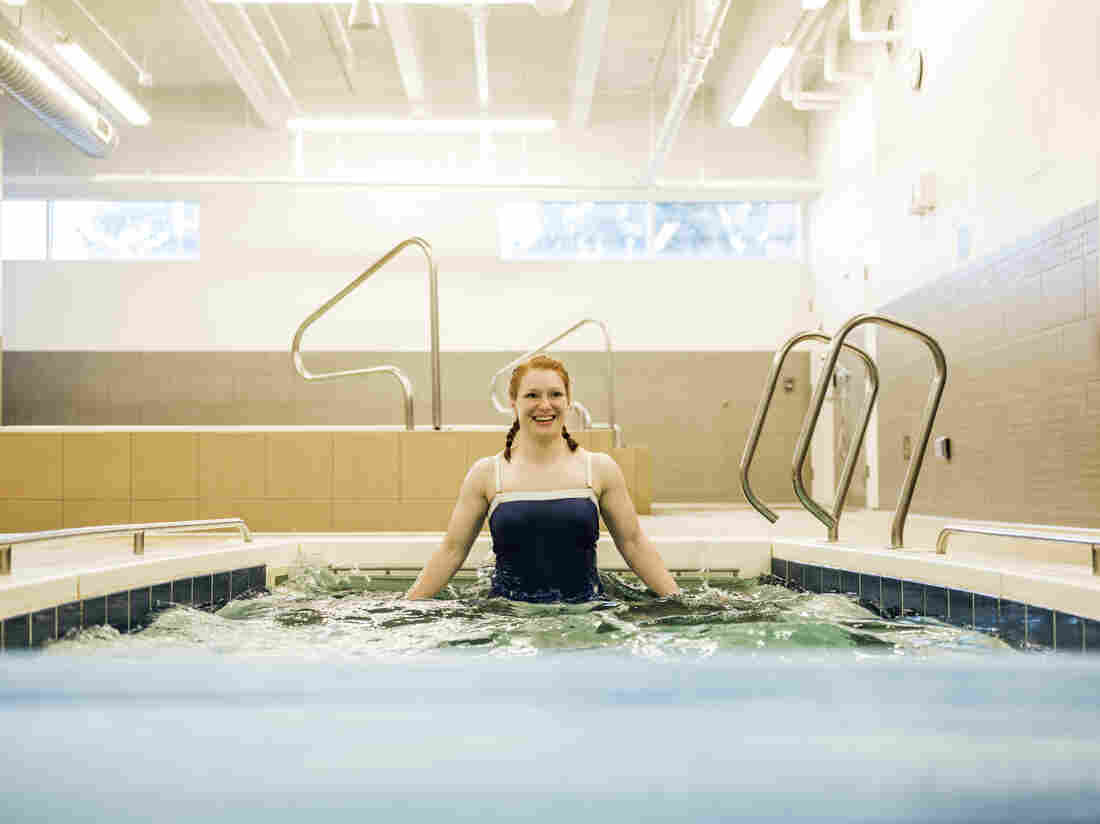
Jennifer Page, a 2020 Olympic hopeful in women’s wrestling, just finished an undergraduate degree in health sciences and strength and conditioning at the University of Colorado Colorado Springs, or UCCS.

“I would wake up, I’d have class at 8 a.m., I had practice at 10. I’d eat, shower, go back to school from 1 to around 3:30 and then have practice again from 4 to 6 p.m. and I’d go home and eat, shower, do homework and go to bed. And that was my day.”

Page earned some credits at Oklahoma City University, where she spent a year on a wrestling scholarship but quit to train for London with the Olympic team. It took her six years to earn her bachelor’s degree.

Page was amused to hear her younger classmates complain about how hard college was.

Team USA wrestler Jennifer Page trains in a pool at the Colorado Springs Olympic Training Center. She is recovering from an ACL surgery.

Matt Nager for NPR

hide caption

toggle caption

Matt Nager for NPR

“I think how easy it would be if all I had to do was go to school,” she says. “Life seems so simple when all you have to do is show up for school and do your homework.”

Figure skater Mirai Nagasu also hopes to return to the Olympics — she came in fourth in Vancouver in 2010, when she was just 16.

“Whenever I have a break, I’m back on my computer and studying,” says Nagasu, now 24. She’s in the equivalent of her junior year, on her way to a bachelor’s degree in international business at UCCS. “It is so beyond difficult to balance it all. During finals week I don’t get a lot of sleep and I tell myself, ‘I can’t do this anymore.'”

But she and other Olympic athletes do, because they know their competitive years will someday end.

“An athlete ends up at the pinnacle of a career sometimes as early as their late 20s and they’ve never known a life outside of sport,” says Leslie Klein, who interrupted her own education to compete before later earning undergraduate and graduate degrees. “If they haven’t gone to school, they have nothing to lean on in terms of a career outside of sport.”

That’s what keeps Max Aaron focused on fulfilling his grandfather’s wishes.

“I have met a lot of athletes who were on the top of their sport, and then sat around and did nothing. They just didn’t know what to do,” he says. “It eventually ends, and that’s what I think a lot of athletes forget. It’s 10 years after the Olympics and you won the Olympics and that’s great, but no one cares.”

Figure skater Mirai Nagasu at the World Arena Ice Hall in Colorado Springs.

Matt Nager for NPR

hide caption

toggle caption

Matt Nager for NPR

His graduation ceremony last month was held in the arena next to the rink where he trained. His grandfather couldn’t make it, but his parents did.

After he received his degree, he went back to the locker room, changed clothes, and got back on the ice to train some more.

This story was produced with The Hechinger Report, a nonprofit, independent news organization focused on inequality and innovation in education.

Let’s block ads! (Why?)