ESPN's Jemele Hill On Race, Football And That Tweet About Trump

Members of the Houston Texans kneel during the national anthem before the game at CenturyLink Field on Oct. 29, 2017 in Seattle.
Jonathan Ferrey/Getty Images
hide caption
toggle caption
Jonathan Ferrey/Getty Images
One of the biggest stories in a year of big stories was the intersection of sports, race and politics, and it’s looking like that story won’t go away in 2018.
And at several key moments one of the people who seemed right in the middle of this story was ESPN’s Jemele Hill.
Back in February, ESPN relaunched the evening edition of its flagship sports news show, SportsCenter, with Jemele Hill and Michael Smith as its new anchors.

ESPN columnist Jemele Hill attends ESPN The Party on Feb. 5, 2016 in San Francisco.
Robin Marchant/Getty Images
hide caption
toggle caption
Robin Marchant/Getty Images
The subtext was hard to miss: The dominant force in the sports media world was promoting two young, popular black personalities, known for their chemistry and candor, in hopes they might bolster sinking ratings by attracting a younger, hipper and, yes, browner audience.
And then all hell broke loose, as the sports world became one of the most contentious battlegrounds around race and politics. Professional athletes whose teams had won championships said they would skip the traditional White House meet-and-greet out of distaste for President Trump’s rhetoric around race. And then came the massive controversy around the NFL, the national anthem, Colin Kaepernick and black players taking a knee to protest racial inequality and police violence.
ESPN’s coverage came in for particular scrutiny: Was the network promoting a liberal agenda by covering the ongoing protests? Couldn’t its anchors and commentators just stick to sports?
It was against that backdrop, and following the violent white nationalist rally in Charlottesville, Va., that Hill fired off a barrage of tweets that landed her in serious trouble. In one, she called the President of the United States a “white supremacist.”
Donald Trump is a white supremacist who has largely surrounded himself w/ other white supremacists.
— Jemele Hill (@jemelehill) September 11, 2017
A White House spokeswoman called for Hill to be fired and, later, President Trump lambasted her on Twitter. (There was plenty of rancor among Hill’s ESPN colleagues regarding the network’s decision not to punish her.)
About a month later, after the owner of the Dallas Cowboys threatened to bench players who protested during the national anthem, Hill took to Twitter again. She suggested that people who disagreed with the owner could stop patronizing businesses that advertised with the Cowboys.
ESPN suspended Hill for two weeks for violating its social media policy — a move that turned out to be as controversial and polarizing as anything else in 2017.
I talked with Jemele Hill last month about becoming a flashpoint in the culture wars, about the flimsy partition between racial politics and sports in this country and about where all this is headed in 2018. Our conversation has been edited for clarity and length.
We want talk to about the biggest stories in sports and race in 2017, but I guess we kinda got to start with you. Because you’ve had a very interesting year.
To say the least.
Sarah Huckabee Sanders, the White House press secretary, went on TV and said that you should be fired for your comments [on Twitter]. Where were you when you heard that? What were you thinking?
I was actually at work. We were putting the show together. And I have a couple of friends that cover politics, and one of them was in the White House briefing room. And she texted me. It was like, “You will not believe what just happened.” And she told me. And I was, like, “What!?!”
And so I go to Twitter and it’s everywhere. But my first reaction is still is my reaction — I thought it was kind of cool! I mean, I know that’s going to sound bizarre to people. Look, when I came up in journalism I had the pleasure to be a lot around a lot of great journalists and people that I respect [who] take down public officials. And I’ve seen some of my friends who have had public officials call for them to be fired because they were upset about their reporting. For journalists, it’s kind of a badge of honor, you know what I’m saying?
That tweet — calling Donald Trump a “white supremacist” — do you feel that statement is justified?
I think time and place are everything. And I don’t think that that’s necessarily an opinion to be shared on Twitter. I mean the odd thing about the reaction is — naive as this may sound — it kind of surprised me just because I wasn’t the first person to say it. It wasn’t like, “Oh my God, nobody is saying this!” I think it was because of who I am and that I represent ESPN and the SportsCenter brand.
That being said, people have to realize the timing of that. I was coming off of Charlottesville. Obviously, a lot of people in this country, not just me, were very emotional about witnessing a bunch of Nazi sympathizers and self-branded white supremacists taking over an American city. That’s just something I don’t think I ever would have imagined that I would have seen in my lifetime. That’s something my mother grew up with, you know, as a child of the ’60s living in Detroit and witnessing racial strife. That’s not to say that I didn’t know racism existed before Charlottesville, but I think it was just jarring to see it play out so physically and so obviously, I was emotional from that.
But there’s a reason why they tell you, you know, when you’re on Twitter and your emotions are running high — that’s probably not the time to be on Twitter. So between that and just some other troubling incidents that I don’t necessarily need to regurgitate because if you hit Google, you know they’re there … and you know, I just called it what it is.
I’m curious about where the line is for you now. Because at Code Switch we obviously tweet about race in America all the time, and we have to be careful in how we talk about race and electoral politics, for example, because they are so incredibly racialized, and at NPR we’re not supposed be partisan. …
That’s why I’ve never tried to make it about parties — and for me it never has been. Because for me it’s just right and wrong. That’s it. I don’t care what party you’re with or what your political affiliation is. Even in legislation and policy-making, it’s about, does this make sense or not? And so, for me, it wasn’t an issue of attacking Republicans. It was issue of feeling that something was wrong, feeling that wrong is happening and reacting as a citizen of this country. And I think that’s what makes this time so unique and so different and so sensitive for a lot of us who are in charge of delivering the news — and especially for me because I’m not a political reporter. Clearly. I’m in sports, all right? And it’s being brought right to the doorstep of sports all the time. And so, I think what can be a struggle for us is: Where does the job end and where do we begin?
One of the things that’s been really fascinating to watch over the last year is the repeated suggestion that there be a hard partition between sports and politics and that sports is a respite, and separate from the world of politics. But if you think about a sports story like the Oakland Raiders moving to Las Vegas, for example, that story is about … municipal politics. I’m curious as to how you think SportsCenter and ESPN should go about navigating these spaces that have always been political but are now very explicitly so.
The only thing different about it now is things are more divided in our country in general. That’s the thing that makes it hard. Because even if you can even just do flat reporting about, say, Colin Kaepernick taking a knee, you’re going to get wildly emotional reactions, and we’re just reporting the news. We’re not even weighing in, we’re just telling you it happened!
Or telling you why he’s doing it, which is our journalistic responsibility, to explain it in context. And so, people still get mad, and it’s like, “All right, but it is just the news.” It’s the biggest story in sports of the year — you can even argue the last two years. And we would be journalistically irresponsible if we did not discuss it. And what I often do, I just remind them that politics has been everywhere in sports for so long that you’ve just come to accept it and didn’t even realize it. Again, using the Raiders as an example: Any time a team gets a stadium built, those are built largely with taxpayer dollars. It has to be voted on, which makes it political, all right? And even the association with the NFL and the military. Flyovers are political. The anthem is political. The NFL was paid by the military to showcase certain military things. I’m not making a commentary on it, but that’s part of the the story, too. It’s funny how people pick and choose when they’re OK with politics being in sports depending on how they feel about said politics.
I’ve been thinking a lot lately about the really unique position the NFL is in. Baseball has a television fanbase that is overwhelmingly white and its players are overwhelmingly white, although there is a sizable Latino contingent. The NBA is mostly black players and its viewership is mostly brown and skews younger. But the NFL, which is the biggest league by leaps and bounds, has a TV audience that is at once very white — I was actually surprised when I looked at the numbers — and has a median viewer age that is a little bit higher, in the low 50s. So you have this older, white audience while the player base is around 70-percent black. There’s this unspoken, underlying demographic tension and it seems like watching the protests this fall and the reaction to them, that a lot of this conflict was probably overdue. I’m curious how you think the controversy around these protests will resolve themselves.
I don’t think they will. I don’t know if that toothpaste is going back in the tube. You pointed out that automatic tension just given who the base of the fans are versus who the players are versus the structure of the NFL, from who is the ownership and even the way that players are paid.
Because the NFL doesn’t guarantee contracts.
Right. The fact that the contracts are not guaranteed. So you have a lot of elements there. I would liken it to college football, too, because I think it’s the same dynamic. The difference is, because the schools and the coaches and the teams have the leverage of having their scholarship and being in control, then the conformity is there because it has to be. [The players] want to get to the NFL. They want to showcase themselves, and so, by and large they go along with whatever the program is.
And in the NFL it’s the same. Even though players are getting paid, they’re are also in a sport that has the dynamic of them being disposable. You’re hired to be fired. You’re there to be replaced.
Throughout the history of sports, when it comes to sports and race, we’ve seen this routinely. It’s that whenever black athletes [move] outside the box of going beyond just being the entertainment of society, it is met with tremendous blowback. Tremendous. It’s all good when you’re catching touchdown passes or when you score 30 points a game. But the moment you start talking about some issues of substance or start demanding that your audience do something, then it becomes a different situation.
Now the owners and the fans know that whatever values they imagined [they shared with these players] are not so. They’re critically thinking about things: “We don’t want that. We just want them to play. We just want them to score. And we just want them to entertain us.”
And you know, that’s why I think Colin it doesn’t have a job. I don’t say this to be casual about the issue because it’s very serious, but had Colin Kaepernick put his hands on a woman, he’d be back in the league. Because that’s a tale of redemption that can be sold. Like Josh Gordon: “No, no, no! He doesn’t use drugs anymore, because he said it!”
You can’t do that with Kaepernick, because we’re talking about how he is as a person and as a man. He’s not to all of a sudden tomorrow going to say, “You know what? Come to think of it, Philando Castile got what he deserved.” That’s not going happen. So he’s exposed that he’s not a conformist. And while he is a team player — with the 49ers, he got the highest leadership award that you can give a player, and that was from his teammates — he has certain beliefs that are intrinsic to the person he is and he’s not given those up. So they can’t “redeem” Colin Kaepernick. They can’t sell that story.
Terrell's World Marathon Challenge Raises Money For Mental Health

David Greene talks to Jonathan Terrell, founder of the consulting firm KCIC, about running seven marathons on seven continents in seven days to raise money for pediatric mental health.
WATCH: Hockey Player Tells Dad He Made The Olympic Team

Bobby Butler during hockey training camp when he played for the Florida Panthers in 2014.
Lynne Sladky/AP
hide caption
toggle caption
Lynne Sladky/AP
The U.S. unveiled its roster for the men’s Olympic Hockey team on Monday.
And the joyful, emotional moment when forward Bobby Butler told his dad that he made the team was caught on video.
It shows Butler skating up to the side of the rink as his father walks in. The two men shake hands, then Butler breaks the news. His dad immediately throws his arms around him as his teammates cheer.
Watch, it will probably brighten your day:
TFW you tell your dad that you’ve made the US Olympic Team ??#TeamUSA ?? pic.twitter.com/ASoOYYXS4Z
— Milwaukee Admirals (@mkeadmirals) January 1, 2018
The 30-year-old Butler, who hails from Marlborough, Mass., skates for the American Hockey League’s Milwaukee Admirals.
Like 14 of his Olympic teammates, Butler has played on NHL teams. But this is the first Olympics in two decades that no U.S. team members are currently playing for the NHL.
That’s because the NHL announced last April that it wouldn’t pause its regular season to accommodate players who want to compete at the games in Pyeongchang, South Korea. The NHL stated that the “overwhelming majority of our clubs are adamantly opposed to disrupting the 2017-2018 NHL season.”
The decision was also about money, as NPR’s Camila Domonoske reported: “The International Olympic Committee has previously paid for players to travel to the Olympics, and covered their insurance costs. But the IOC wasn’t planning to foot the bill for 2018.”
The players on the men’s final roster came from colleges, from Americans playing in Europe and from the American Hockey League. And, as SB Nation wrote, NHL stars are out and “in their place are a bunch of guys you’ve probably never heard of.”
In previous years, “USA Hockey got all its Olympic players from one league: the NHL,” according to SB Nation. “Without that option, management turned to a wide variety of sources, plucking players from leagues around the world to piece together a roster for Pyeongchang.”
The NHL’s decision created a unique opportunity for players who would not have been able to make the team otherwise. Just one member of the team, captain Brian Gionta, has played in the Olympics before.
“We really like our roster,” team general manager Jim Johannson said in a statement. “It’s a group that brings versatility and experience and includes players with a lot of passion about representing our country.”
The roster is perplexing to some hockey observers, such as Deadspin’s Barry Petchesky, who calls it “weird as hell” with little name recognition.
But it may be that the lack of prior fame makes moment like Butler’s all the more poignant.
“I know we’re a little down on the Olympics without the NHL, but these are the kinds of moments that make me so happy for the players selected,” writes ESPN hockey analyst Chris Peters. “You know they’ll battle every day for the crest on that jersey.”
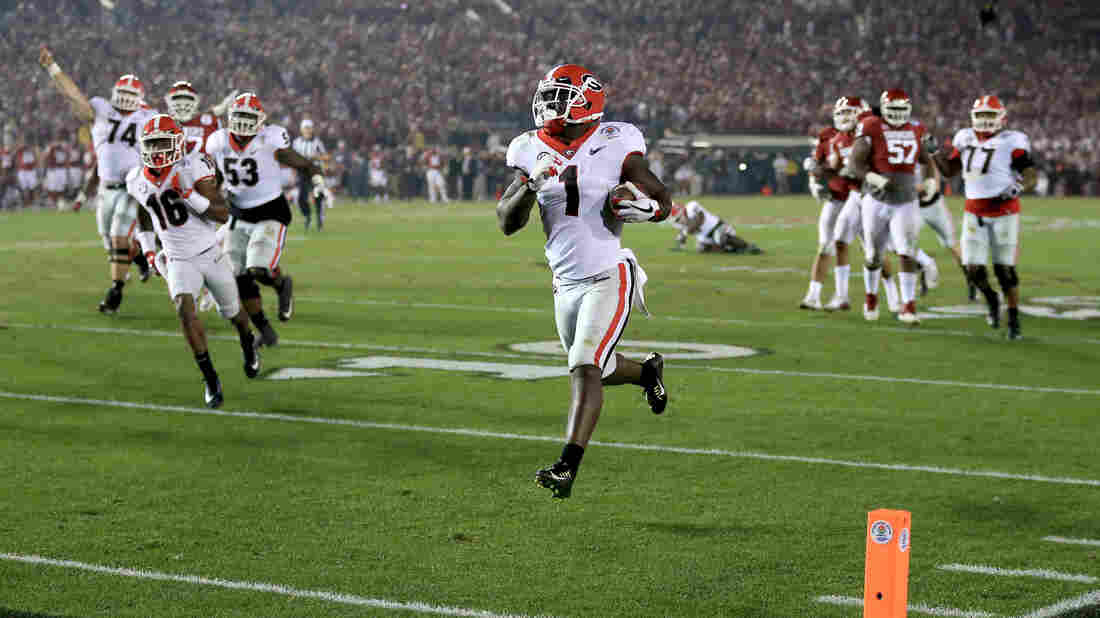
Georgia And Alabama To Play For College Football Championship Title
On Monday, the Georgia Bulldogs beat the Oklahoma Sooners in an exciting double-overtime Rose Bowl, while Alabama’s Crimson Tide beat the Clemson tigers in the Sugar Bowl.
Alabama Bulldozes Into 3rd Straight Title Game; Georgia Runs By Oklahoma



The Buffalo Bills Make The NFL Playoffs
It’s been 18 years since the Buffalo Bills were in the NFL playoffs. That streak ended yesterday.
Teapot Is A Reminder Of The Remarkable 1922 Rose Bowl Game
In that game, a small Pennsylvania college, backed by a black quarterback, battled the University of California, Berkeley to the only tie in the history of the game.
AILSA CHANG, HOST:
A teapot sits on the mantelpiece in a house in Urbana, Ill. And while it’s charming to behold, the real power of this piece of fine china is the story it holds. It’s a tale about long odds, strength in the face of adversity and the 1922 Rose Bowl. NPR’s Richard Harris has this audio postcard.
RICHARD HARRIS, BYLINE: In October, I paid a visit to the home of Tina Gunsalus, a professor at the University of Illinois. While her husband Michael was preparing dinner, she walked into her living room and came back with a white teapot festooned with a blue floral pattern.
TINA GUNSALUS: It’s a teapot that was given as part of an entire tea set to my grandmother when she was married. And she said it had been given to her and to her husband as a wedding present from the football coach who took Washington & Jefferson College to the Rose Bowl.
HARRIS: Gunsalus’s grandfather was a history professor at tiny Washington & Jefferson, which had just 450 students at the time. He also helped out the football team. And she says she didn’t think much about the story until she told it to her daughters.
GUNSALUS: And we all sort of looked at each other and thought, that’s really odd. Washington & Jefferson is this little college in Washington, Penn. And the Rose Bowl, as a person from the University of Illinois, I happen to know is between the Big Ten and the Pac-12. So it seemed odd. And I thought, well, you know, maybe my grandmother was old, or maybe I got it wrong. And, no, I had a note from her that said that’s what it was.
HARRIS: A bit of research revealed that the story was even odder than that.
GUNSALUS: Not only did they go to the Rose Bowl. It turned out that they were the first team to take an African-American quarterback with them. And the more we looked, the better this story got and the more interesting it got.
HARRIS: Other teams had actually refused to play Washington & Jefferson because of its black quarterback, a man named Pruner West. But the coach, Greasy Neale, refused to bench West, even though it once meant forfeiting a game. The team was so cash-strapped that it could only afford to buy train tickets to Pasadena for 11 players. And during the trip, near disaster struck.
GUNSALUS: In Kansas City, one of the players takes ill, gets off the train. And they think they’re going to have to play the game with only 10 players. Except it turns out one of the other players had stowed away in the baggage car. So he got off the train, got on the seat that had been occupied by the player who’s now in the hospital, and they went. And I think that the same 11 players played the entire game, both offense and defense.
HARRIS: Their Rose Bowl opponent was no less a team than the University of California, Berkeley Golden Bears, who were heavily favored. But amazingly, the Washington & Jefferson Presidents finished the game in a tie at zero. In fact, it was the only scoreless Rose Bowl game ever. As she recounts this story, Tina Gunsalus glances down lovingly at the teapot and its hand-painted glaze.
GUNSALUS: It’s just as pretty as it can be. And we look at it, and we think about the Rose Bowl and W&J and honorable people in the 1920s and Pruner West.
HARRIS: Do you ever use the teapot?
GUNSALUS: Well, we did. We all had tea with it. And other than that, we mostly just keep it on the mantel and look at it because the more that we found out the story was true, the more worried I got about breaking it.
HARRIS: So there it rests on an ornate, oak mantelpiece, an unlikely memento of a moment in American history. Pruner West would go on to become a physician and spend his life treating patients in Alexandria, Va. And he has just been elected into the Rose Bowl Hall of Fame. Richard Harris, NPR News.
(SOUNDBITE OF SAM SPENCE’S “WINTER ICICLES”)
Copyright © 2018 NPR. All rights reserved. Visit our website terms of use and permissions pages at www.npr.org for further information.
NPR transcripts are created on a rush deadline by Verb8tm, Inc., an NPR contractor, and produced using a proprietary transcription process developed with NPR. This text may not be in its final form and may be updated or revised in the future. Accuracy and availability may vary. The authoritative record of NPR’s programming is the audio record.
Saturday Sports: Expect More Politics In The New Year
Politics is expected to dominate sports in the new year much as it did in 2017, from the NFL playoffs and Super Bowl to the Olympics and World Cup.
LINDA WERTHEIMER, HOST:
And now it’s time for sports.
(SOUNDBITE OF MUSIC)
WERTHEIMER: It seems like our sports coverage this past year was as much about politics as it was about touchdowns or home runs. And heading into 2018, we’re likely in for more of the same. We have NPR’s Tom Goldman to give us a preview.
Good morning, Tom.
TOM GOLDMAN, BYLINE: Happy new year – almost.
WERTHEIMER: Yeah. The NFL taking the knee protests were front page, headline news for weeks and months. Politicians and ordinary Americans had strong opinions about this and voiced them loudly. What are you expecting to see in the playoffs and in the Super Bowl?
GOLDMAN: Probably more. The protests have continued up through last weekend, and there’s a good chance they’ll keep going through the postseason, Linda – although some players stopped after they reached a tentative agreement with the NFL about a month ago, where the league will contribute about $90 million to social causes important to the players, an owners vote on that expected in March. Some of the more outspoken players this season are on the Philadelphia Eagles. And the Eagles will be a No. 1 seed as the playoffs start.
And if they make it to the Super Bowl, we may very well hear about the issues these players have been talking about, especially considering the big game’s in Minnesota. That, of course, is where a policeman shot and killed Philando Castile last year, one of the prominent police shootings that prompted the NFL protests in the first place.
WERTHEIMER: Then, less than a week after the Super Bowl, the Winter Olympics open in South Korea. We know of at least one prominent Olympian who is not shying away from politics, alpine ski champion Lindsey Vonn.
GOLDMAN: Yeah, she has said she’ll be competing at the Olympics for the American people and not for the president. She’s also said she won’t visit the White House if she’s invited. It’s not clear what she’ll say or do in South Korea. The Olympic rules strictly forbid political protests. But, you know, she’s one of the most famous Olympians, and she’ll certainly be asked a lot about it.
WERTHEIMER: The Olympics are always political, Tom. But this year…
GOLDMAN: Oh, really?
(LAUGHTER)
WERTHEIMER: …With the IOC picking the Russian team out of the Winter Games in South Korea, that’s created an extra layer of controversy.
GOLDMAN: Yeah, it sure has. I mean, the International Olympic Committee kicked out the Russian team because of Russia’s widespread doping scandal, which Russian officials continued to deny. But supposedly, clean Russian athletes who passed the screening process going on right now will be in Pyeongchang. Technically, they’ll be neutral competitors with no official Russian uniforms or anthem or flags. But in a compromise by the IOC because Russia is such a power player in the Olympics, Russian athletes will wear uniforms that say Olympic athlete from Russia. So we’ll know who’s who.
It will be an uncomfortable Russian presence at the games. And, you know, it’s bound to create some tension. Will fans wave Russian flags? Will winning Russian athletes sing their national anthem while the Olympic anthem plays over the loudspeakers? So all of this is layered on top of the tension already on the Korean peninsula. It’s going to be a very political games.
WERTHEIMER: And Russia’s state-sponsored doping scandal will hang over the World Cup as well. The soccer tournament kicks off in June, hosted by Russia.
GOLDMAN: Yeah. And this week, a prominent Russian sports official, Vitaly Mutko, resigned as head of the World Cup organizing committee. He’d become a PR liability after he was banned from the Olympics because of the doping scandal. Russia is hoping, with him gone, it’ll smooth this approach to the World Cup in the summer. But already, there’ve been allegations about doping by members of the Russian men’s national soccer team, allegations about bribery in the awarding of the World Cup to Russia. And by June, who knows where the story will be about Russian interference in the 2016 U.S. election?
WERTHEIMER: Now, the U.S. soccer team will not be at the World Cup. The USA is not a soccer superpower. But there were some unexpected results from the qualifying matches.
GOLDMAN: Yeah – no USA, no Netherlands, no Italy – that’s a big absence. Soccer fans in the U.S. still will be interested. There will be a lot of great action. But casual fans who’d normally be drawn to the tournament because the U.S. is playing – they won’t be as interested. TV ratings in this country will take a hit. That’s important because the promise of those ratings bring in big advertisers and sponsors. And hopefully, U.S. soccer will figure out what it takes to bolster the men’s program in order to get the Yanks back in the next World Cup.
WERTHEIMER: That’s NPR’s Tom Goldman. Tom, thank you.
GOLDMAN: You’re welcome, Linda.
(SOUNDBITE OF TOE’S “VANISHING POINT AND WHISTLE”)
Copyright © 2017 NPR. All rights reserved. Visit our website terms of use and permissions pages at www.npr.org for further information.
NPR transcripts are created on a rush deadline by Verb8tm, Inc., an NPR contractor, and produced using a proprietary transcription process developed with NPR. This text may not be in its final form and may be updated or revised in the future. Accuracy and availability may vary. The authoritative record of NPR’s programming is the audio record.
Go Jump In A Lake
Last season, the Cleveland Browns were 1-15. Coach Hue Jackson vowed they’d be better this year or he’d swim in Lake Erie. Now that the Browns have lost 15 games already he said he’s “got to” jump in.
DAVID GREENE, HOST:
Good morning. I’m David Greene. Last season, the Cleveland Browns were 1-15. Their coach, Hue Jackson, vowed they’d be better this year or, he promised, he’d swim in the lake over there. He was talking about frigid Lake Erie. Well, the Browns have lost 15 games already, so Jackson was asked…
(SOUNDBITE OF ARCHIVED RECORDING)
UNIDENTIFIED JOURNALIST: Are you really going to jump in the lake?
HUE JACKSON: Heck yeah, I got to. Well, how? You just jump in.
GREENE: He is turning it into a positive, using it to raise money to fight human trafficking. It’s MORNING EDITION.
Copyright © 2017 NPR. All rights reserved. Visit our website terms of use and permissions pages at www.npr.org for further information.
NPR transcripts are created on a rush deadline by Verb8tm, Inc., an NPR contractor, and produced using a proprietary transcription process developed with NPR. This text may not be in its final form and may be updated or revised in the future. Accuracy and availability may vary. The authoritative record of NPR’s programming is the audio record.
Liberia Elects Soccer Star George Weah Its Next President


Liberian election officials said Thursday that soccer great George Weah, seen addressing an October campaign rally in Monrovia, had won the presidential runoff.
Issouf Sanogo/AFP/Getty Images
hide caption
toggle caption
Issouf Sanogo/AFP/Getty Images
Former international soccer star George Weah has won Liberia’s presidential runoff, the country’s election commission announced Thursday.
Weah won 61.5 percent of the vote, with more than 98 percent of ballots counted. He defeated the current vice president, Joseph Boakai.
This marks the first time in 70 years that Liberia will transfer power from one elected president to another. President Ellen Johnson Sirleaf, a Nobel Peace Prize winner and the first female head of state elected in Africa, is stepping down after two terms in office. She did not publicly endorse either candidate.
Weah had run unsuccessfully for president twice before. NPR’s Ofeibea Quist-Arcton reports that many Liberians identify with the 51-year-old footballer, who grew up poor and was not part of the social or political elite. Critics say Weah has limited experience and education.
The job won’t be easy, as Ofeibea explained on NPR’s Morning Edition:
“Liberians will tell you that Ellen Johnson Sirleaf, the outgoing president, has managed to cement peace, which is hugely important after back-to-back civil wars and then that Ebola outbreak three years ago in Liberia but that she has not done enough to make Liberians prosper, to pull them out of poverty and to give them jobs and deal with the economy. And also, there have been allegations of corruption. So whoever wins has huge challenges ahead of him.”
Soccer’s international governing body, FIFA, has described Weah as “a towering figure on the ’90s football scene.” He burst onto the world stage at Monaco under manager Arsene Wenger and went on to play at some of the sport’s pre-eminent clubs: Paris Saint-Germain, AC Milan, Chelsea and Manchester City. He is the only African player to have won FIFA’s World Player of the Year. He announced his retirement in August 2003.
Weah’s vice president will be Jewel Howard Taylor, ex-wife of former president Charles Taylor, who is serving a 50-year sentence for war crimes. Some are asking whether the former president will try to influence the country’s politics from prison.
“She’s my colleague in the Senate,” Weah told Deutsche Welle, explaining his choice of running mate. “She is a Liberian, capable, qualified, and Liberian people love her. I also believe in gender and equality, so I think having a woman as my vice president is a good thing.”