Louisiana Lawmaker Threatens Saints' Tax Breaks After Anthem Protests

The New Orleans Saints kneel before the playing of the national anthem before the game against the Green Bay Packers at Lambeau Field on Oct. 22.

Dylan Buell/Getty Images

hide caption

toggle caption

Dylan Buell/Getty Images

A Louisiana state legislator wants to cut off tax breaks and other funding for the state’s only NFL franchise, the New Orleans Saints.

State Rep. Kenny Havard, a Republican, objects to player protests during the pregame national anthem. He plans to propose an amendment to strip any state funding that benefits the Saints, including free rental of the Mercedes-Benz Superdome, their home venue.

“We’re paying the Saints a lot of money to entertain us — not to get off in the weeds of, you know, political discourse,” Havard says. “They can do that, but do it on their own time.”

The controversy started last season, when San Francisco 49ers quarterback Colin Kaepernick chose to kneel instead of stand during the national anthem in response to racial injustice and police brutality. Over the course of the 2016 season, other players joined Kaepernick’s protest by kneeling, sitting or raising a fist during the song.

Kaepernick was not offered an NFL contract in 2017, but the #TakeAKnee movement he sparked has continued without him. In September, President Trump entered the debate, saying in a speech and repeating on Twitter that the NFL should fire all players who refuse to stand for the national anthem.

The president’s comments only spurred more protests throughout the league, including by members of the Saints franchise. At the game after the president’s tweets, 10 Saints players remained on the bench for the national anthem. Since then, the team has knelt as a group before the anthem and then stood for the actual song.

Havard says removing the team’s tax breaks has had bipartisan support in the past, when the conversation focused on the league’s handling of domestic violence, concussion risk for players or team owner enrichment. But since the anthem protests began, he says, the tax debate is being perceived as a racial issue.

“Look: Slavery was however long ago, and it was a horrible thing and no one should have to go through that,” says Havard. “But it’s time that we move on as a nation.”

Havard says he believes institutional barriers to equal opportunity are gone, and he rejects the notion of an unjust society. For him, the debate over standing for the national anthem is not about how police treat African-Americans, but a question of doing what is right.

“When I see a lady coming, I open the door,” he says. “When I sit at the table, I take my hat off. When the national anthem plays, I stand.”

State Rep. Ted James, a Democrat, rejects Havard’s argument.

“This is not a conversation about Saints players being political,” James says. “This is a conversation about race.”

James represents a district in the state capital, Baton Rouge. That city became a flashpoint for the discussion about racial injustice in policing after the death of Alton Sterling, a black man who was shot by officers outside a convenience store there in 2016. No federal charges were filed in the case, and the state attorney general has not filed charges either.

Then, less then two weeks after Sterling’s death, three local police officers were killed and three others wounded in an ambush.

James says that Baton Rouge did some tough racial reconciliation work after those events and that the debate over the anthem protests is reopening painful wounds. He is preparing for a legislative fight over the Saints funding issue.

“As a black man and as a black player, you are telling these athletes ‘go throw that ball, catch that ball, run that ball, tackle that quarterback, but you dare not say a word,’ ” says James. “That’s a plantation mentality.”

The anthem protests have prompted NFL boycotts on both sides of the issue. Baton Rouge publisher and activist Gary Chambers joined the local protests after Sterling’s killing. He says he has stopped watching the NFL in solidarity with Kaepernick’s movement.

“This man took a knee and flipped America upside down,” says Chambers.

Sitting in a Baton Rouge cafe, Chambers and a friend, businessman Geno McLaughlin, say the football players are giving voice to what African-Americans have been fighting for in communities all across the country, including their own.

McLaughlin says how you view the flag and what patriotism means to you depend on your experiences as an American.

“When I see the red stripes, I also see bloodstains,” he says. “For me and for many black people … we don’t feel the same way about the flag that [a white person] might.”

He says that doesn’t mean he hates the country.

“My people, we built this country,” he says. “So do I love the country? Absolutely.”

Chambers says Trump’s inflammatory public statements and tweets about firing the players send a clear message.

“Trump is basically telling all the other slave owners ‘keep your Negroes in check’ is what I hear,” says Chambers.

Tony Melera, manager of Sarita’s Mexican Grill & Cantina, stands in front of a American flag — a gift from state Attorney General Jeff Landry — draped over the New Orleans Saints 2017 game schedule.

Debbie Elliott/NPR

hide caption

toggle caption

Debbie Elliott/NPR

About 25 minutes outside Baton Rouge, the player protests have sparked a boycott from the opposite perspective.

At Sarita’s Mexican Grill & Cantina in Denham Springs, nearly 50 big-screen TVs line the walls. Manager Tony Melera says diners can watch golf, pro wrestling and the Weather Channel, but never professional football. The restaurant has banned NFL games.

“There’s a time to protest,” Melera says. “They have the right to do so. But don’t take it out on national television against the flag.”

Melera, an immigrant from El Salvador, says the protests on the field send the wrong message.

“We respect the flag. We stand. And we pledge allegiance,” he says. “They make a lot more money than we do. Why do it? They’re going at it the wrong way.”

Melera says the restaurant lost some business at first; people in Louisiana take their football seriously. But Melera says they’ve also picked up new customers who support the boycott. Louisiana Attorney General Jeff Landry even gave the restaurant an American flag that now hangs over the New Orleans Saints schedule that had been posted in the bar.

The state Legislature will take up the tax break question when it reconvenes in March, in the meantime, the issue is also now in the courts. Just last week, a Saints season ticket holder sued the team for a refund, claiming he has been damaged by players using football games as a platform for protest.

Let’s block ads! (Why?)

2017 Sports: Patriots Comeback, Warriors-Cavs, Best Sister Act

The year in sports had as much drama off the field as on it. Howard Bryant of ESPN relives the highs and lows of 2017 with NPR’s Scott Simon.

SCOTT SIMON, HOST:

And it’s time for sports.

(SOUNDBITE OF MUSIC)

SIMON: And what a year – the Patriots’ last-second comeback, the Warriors and the Cavs again. The Astros win for their first time. And brilliant play from just about the best sister act ever. And, of course, huge, dominating stories off the field. Joined now by Howard Bryant of espn.com and ESPN The Magazine. Howard, thanks so much for being with us.

HOWARD BRYANT: Good morning, Scott.

SIMON: And let’s start appreciating the year with tennis and the utterly amazing Williams sisters.

BRYANT: Exactly. And we’ll start the year with the utterly amazing Williams sisters. If you go back a year or two, the Australian Open – and you have a final between Venus and Serena, something that nobody thought any – that we’d ever see again, considering that they’re both now on the other side of 35 years old and – which is a lifetime in tennis. And, of course, there was another story that was going on that Serena was playing while pregnant, and she just had her baby. And so now the new storyline – first Serena and Venus – is you’ve got Aunt Venus. And now Serena is going to be…

(LAUGHTER)

BRYANT: Serena is going to try to do something that’s very difficult to do – to win a Grand Slam as a mother. And who would bet against Serena on that? It was really remarkable when you look at what those two sisters had done – and especially even Venus more so because even two years ago, Scott, her camp had been beginning to think about what her retirement song was going to look like. Now you look at her. She’s a top 10 player. She went to two Grand Slam finals. And she’s as good as anybody in the world, except for maybe her sister. And so, it goes with the two greatest siblings professional sports has ever produced.

SIMON: We recognize some highlights are going to have to be left out in this quick review. But how did the Houston Astros, within a month of a storm that devastated much of their city, manage to win their first World Series title?

BRYANT: Just by being tough and by being fun and by having really, really good players. And it was a great World Series, especially. The Los Angeles Dodgers hadn’t been to the World Series since 1988. The Houston Astros had been once, and they lost in 2005 to the Chicago White Sox. And this series looked like it was going to be over after Game 2. And then, suddenly, the Astros came back, and then they came back again. And then you had that wild game, the 13-12 game, out in Houston.

And so it was a wonderful – you know Scott, the thing that happens with sports quite often is for all the things that take place, for all the money and the contract disputes and the protests and the counter-protests and everything taking place, at some point, we watch the game because there’s something remarkable taking place with these athletes. They do things to bring us in, and they keep us there.

SIMON: Cavs, Warriors, Cavs, Warriors – enough said. In football, Tom Brady led the New England Patriots to a record-breaking come-from-behind in the Super Bowl. But I’d say the season’s still been defined by activism and protests inspired by Colin Kaepernick.

BRYANT: No question. And off the field has defined football and, really, sports. I think that we’ve reached that point where we thought we could get away from it, where sports was the place where we went away from our problems. And I think that sports has actually magnified the divisions that we have in this country. And I don’t think there’s any way around it. You can blame Colin Kaepernick if you want. You can blame the protesters.

But you also have to look at the multibillion dollar sports industry that has taken police and military and now embedded them into the game. You can’t watch a game now without the flags and the flyovers and all of the militarism. And so that collision has taken place on the field now, and it’s a very divisive place. I think sports has done a very poor job with it, actually, because there is an opportunity to discuss where we are right now, but we seem to fall along the same sort of divisive lines.

SIMON: Yeah. And, of course, we have talked about and will in later segments certainly get to the horrifying scandal on the USA gymnastics program. Howard Bryant of ESPN, thanks so much for being with us.

BRYANT: And on that note, Happy New Year. We’ll see you next year, Scott.

SIMON: OK. Take care, my friend.

Copyright © 2017 NPR. All rights reserved. Visit our website terms of use and permissions pages at www.npr.org for further information.

NPR transcripts are created on a rush deadline by Verb8tm, Inc., an NPR contractor, and produced using a proprietary transcription process developed with NPR. This text may not be in its final form and may be updated or revised in the future. Accuracy and availability may vary. The authoritative record of NPR’s programming is the audio record.

Let’s block ads! (Why?)

IOC Bans 11 More Russian Athletes For Life

Luger Albert Demchenko is one of 11 Russian athletes whom the International Olympic Committee banned for life on Friday. He will be stripped of the two silver medals he won at the 2014 Sochi Games.

Alex Livesey/Getty Images

hide caption

toggle caption

Alex Livesey/Getty Images

The International Olympic Committee says it is banning 11 of Russian athletes for life as part of its investigation into doping at the 2014 Winter Olympics in Sochi.

Ruling on the last 11 of the 46 cases it has been investigating, the IOC said all were now disqualified from the Sochi Games. The IOC has now banned 43 Russian athletes and stripped 13 medals from the country, according to NBC Sports. Three of the 46 were cleared.

The 11 athletes sanctioned Friday compete in five sports:

  • Lugers Tatiana Ivanova and Albert Demchenko
  • Speed skaters Ivan Skobrev and Artem Kuznetcov
  • Cross-country skiers Nikita Kryukov, Alexander Bessmertnykh and Natalia Matveeva
  • Bobsledders Liudmila Udobkina and Maxim Belugin
  • Ice hockey players Tatiana Burina and Anna Shchukina

The sanctions mean that Russia has lost two more medals from its Sochi count. Ivanova and Demchenko had captured a silver in the mixed relay event, and Demchenko had won an individual silver medal.

Two of the cross-country skiers, Kryukov and Bessmertnykh, had already lost medals when their teammates were disqualified, The Associated Press reports.

Russia is banned from having an official presence at the upcoming 2018 Pyeongchang Games, as punishment for its widespread doping at the Sochi Games.

Some 200 athletes from Russia may still compete at the Olympics under a neutral flag. They are barred from wearing uniforms in the colors of the Russian flag, and they’ll sport generic red-and-white logos that say “Olympic Athlete from Russia.”

Let’s block ads! (Why?)

Sportscaster Dick Enberg, Whose Career Spanned 60 Years, Dies At 82

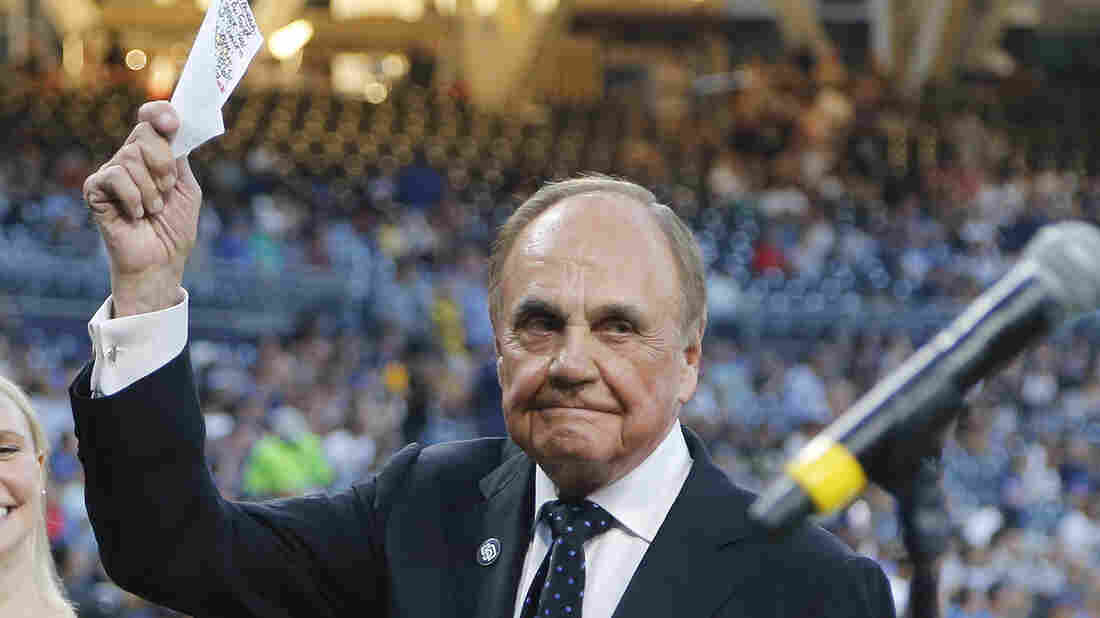
San Diego Padres broadcaster Dick Enberg waves to the crowd at a retirement ceremony prior to the Padres final home baseball game of the season on Sept. 29, 2016, in San Diego.

Lenny Ignelzi/AP

hide caption

toggle caption

Lenny Ignelzi/AP

Legendary announcer Dick Enberg, whose amazing sportscasting career spanned six decades, died Thursday at the age of 82. He did play-by-play for college basketball, college and professional football and Major League Baseball. He also called other sporting events such as boxing, tennis, golf, horse racing and the Olympics.

Enberg retired from his TV job with the San Diego Padres in October 2016.

The team released a statement on Enberg’s death:

“We are immensely saddened by the sudden and unexpected passing of legendary broadcaster Dick Enberg. Dick was an institution in the industry for 60 years and we were lucky enough to have his iconic voice behind the microphone for Padres games for nearly a decade. On behalf of our entire organization, we send our deepest condolences to his wife, Barbara, and the entire Enberg family.”

Endberg was known for exclaiming “Oh my!” So much so, that his 2004 autobiography is titled: Dick Enberg, Oh My!

He also had a baseball catchphrase: “touch ’em all” for home run hitters.

Enberg’s big break came when he was chosen to call UCLA basketball games. During that nine-year stint, the Bruins won eight NCAA titles.

When asked what was the most historically important event he covered, Enberg replied, “The Game of the Century.” In that 1968 game, the University of Houston Cougars beat UCLA to snap the Bruin’s 47-game winning streak.

During his time behind the microphone Enberg had many broadcast partners, including Al McGuire, Merlin Olsen and Don Drysdale.

Enberg’s wife Barbara told the San Diego Union-Tribune that her husband died Thursday morning at his home in La Jolla, Calif.

“Barbara Enberg said the family found out later in the day when Dick Enberg failed to get off a flight in Boston, where they were scheduled to meet. She said her husband had appeared to be waiting for a car that was set to shuttle him to the San Diego airport for a 6:30 a.m. flight.

” ‘He was dressed with his bags packed at the door,’ she said. ‘We think it was a heart attack.’ “

An official cause of death has not been determined yet.

Let’s block ads! (Why?)