So You’ve Become A Rabid Fan Of Women’s Soccer. Now What?

Megan Rapinoe and the U.S. squad won a lot of fans on their way to winning the Women’s World Cup on Sunday in Lyon, France. For the sport to keep growing, that support needs to continue long after the ticker tape lands.
Alex Grimm/Getty Images
hide caption
toggle caption
Alex Grimm/Getty Images
You cheered when Megan Rapinoe scored that ice-cold penalty shot. You spilled your coffee as you celebrated Rose Lavelle’s incredible left-footed strike. You got misty watching that stirring new Nike ad. And when you saw the U.S. team members hoist the World Cup trophy over their heads on Sunday, you felt their joy as your own.
Congratulations! You are now a U.S. Women’s National Team fan, if you weren’t one already.
When the U.S. won the Cup on Sunday, the crowd broke into chants of “Equal pay!” And fans like you have a role in making that happen.
So what can you do? Here’s your guide to helping the sport and its players to prosper.
Catch the champions on their victory tour
The World Cup champions will play a series of games in at least four U.S. cities as part of a barnstorming victory tour. Sites and dates haven’t yet been announced. But first, they’ll be feted with a ticker tape parade on Wednesday morning through the streets of Manhattan, where New York Mayor de Bill Blasio will present them with the keys to the city.
Go to NWSL games (this one really matters)
Every member of the U.S. Women’s National Team plays in the National Women’s Soccer League. Good news: The league’s season is less than halfway through — meaning that in short order, the players you watched tear up the field in France are players you can watch in real life.
The league has nine teams: Chicago Red Stars; North Carolina Courage (Raleigh); Portland Thorns (Oregon); Sky Blue FC (Central New Jersey); Washington Spirit (D.C.); Houston Dash; Orlando Pride (Florida); Reign FC (Tacoma, Wash.); Utah Royals FC (Salt Lake City).
Some of the NWSL’s teams are thriving — the Portland Thorns, in particular, enjoy a fervent following. The team attracted an average of nearly 17,000 fans a game last year. Researchers have studied what they say is the Thorns’ world-leading popularity and found that the fan culture was the No. 1 reason people loved going to matches. Excited fans beget more excited fans.
One benefit of having a small league is that most teams have a number of national team players. You can catch standouts from overseas, too: Australian superstar Sam Kerr plays for the Chicago Red Stars and is the league’s all-time leading scorer. Canadian legend Christine Sinclair plays for the Thorns, alongside Tobin Heath and Lindsey Horan.
Many of the teams play in small suburban stadiums that aren’t super accessible by transit. The Washington Spirit, featuring Rose Lavelle and Mallory Pugh, play at the Maryland SoccerPlex, about an hour northwest of D.C., with a seating capacity of just 4,000. But the Spirit will play two upcoming matches at D.C. United’s gleaming new Audi Field, which seats 20,000 on the District’s waterfront.
One reason the USWNT has been fighting so hard for higher salaries is that women’s pro soccer in the U.S. doesn’t pay well. For the 2019 season, the league’s maximum player salary is $46,200, while the minimum is just $16,538. The more tickets, merchandise and sponsorships that NWSL teams sell, the more its player salaries can rise.
Fan support is crucial to sustaining the league. Both the Boston Breakers and FC Kansas City ceased operations in the past two years. And the NWSL is built on the ashes of two previous women’s soccer leagues that folded, including one that was founded amid the excitement of the U.S. win at the 1999 World Cup.
Watch them play on TV
Another way to generate more money for women’s soccer is to watch it on television or via streaming online. The USWNT and NWSL make money from ads shown during their games, and the bigger the audience for each broadcast, the more often such games will be televised. And if viewership grows, networks will opt to show more games on flagship channels rather than obscure cable offerings.
Big news on this front was announced last week: ESPN will broadcast 14 upcoming NWSL matches on its ESPN2 and ESPNEWS channels, and they’ll be streamed on its app, too.
Keep the pressure on FIFA and the U.S. Soccer Federation
Chants of “Equal pay!” resounded in the stadium after the U.S. clinched Sunday’s final in Lyon, France. And everywhere from Twitter to Congress, “Pay the women” has become a curt directive to the U.S. Soccer Federation as the players’ lawsuit against their employer moves into mediation.
FIFA President Gianni Infantino says he intends to double the investment in women’s soccer over the next four years and double the prize money for the winners of the next Women’s World Cup — but that still won’t shrink the gap because the men’s purse will also grow.
Teams at the 2019 Women’s Cup will share $30 million, compared with the $400 million the men’s teams split last year. In 2023, the women will play for $60 million, while the men’s prizes increase to $440 million.
“If you really care about each game in the same way, are you letting the gap grow? No,” Rapinoe said Saturday. “Are you scheduling three finals on the same day? No. Are you letting some federations play two games in the four years between each tournament? No, you’re not.”
While no one would call FIFA or U.S. Soccer especially transparent organizations, they absolutely rely on fan and sponsor support. Tell them you care about the women’s game. Tell them to pay the women.
Live abroad? Support women’s soccer where it needs it most
The success of the USWNT is a direct result of the investment that has been made in women’s sports in America.
One enormous factor is Title IX, which requires athletic departments at schools and colleges to fund women’s sports as a condition for receiving federal financial assistance. Another factor is that pay gap notwithstanding, U.S. Soccer does an admirable job of supporting and funding the women’s team.
Many players elsewhere are not so lucky. The teams in Jamaica and Thailand, for example, are reliant on the largesse of a single donor to support their squads in the absence of adequate funding from the national federations.
The opportunities to help these teams are enormous — whether it’s making a donation, going to watch a pro or college match, or coaching a girls’ team.
If the millions and millions of people who tuned in to this World Cup each do one or two items from this list, the 2023 tournament will be even more spectacular than this one.
U.S. Dominates The Netherlands To Win Women’s World Cup Title

The U.S. Women’s National Soccer Team has done it again — winning the World Cup for a fourth time. The 2-0 victory over the Netherlands capped a thrilling tournament.
U.S. Takes A Record 4 Women’s World Cup Titles
The United States won the Women’s World Cup after a thrilling 2-0 victory against the Netherlands. With the win, the U.S. has won the World Cup a record four times.
Four-Peat: U.S. Women’s Soccer Team Wins World Cup Title

The United States’ Megan Rapinoe celebrates after scoring the opening goal from the penalty spot during the Women’s World Cup final soccer match between the U.S. and the Netherlands at the Stade de Lyon in Décines, outside Lyon, France, on Sunday. The U.S. won 2-0.
Francisco Seco/AP
hide caption
toggle caption
Francisco Seco/AP
The U.S. women’s soccer team is still the world’s best after dominating the Netherlands in the Women’s World Cup final and winning 2-0. Throughout the tournament, the U.S. brushed aside criticism, complaints of arrogance and calls for the team to tone down their goal celebrations. All the team did was win. All seven World Cup games, in fact.
In the first half, the U.S. created more chances than the Netherlands. The Americans attacked and attacked, but the Dutch defense and, particularly, the goalkeeping of Sari van Veenendaal, who blocked four shots, kept the U.S. from scoring in an opening half for the first time this tournament.
The streak is broken: #USWNT had scored in the first 12 minutes in all 6 of its previous #FIFAWWC2019 games. But it’s halftime in the final match: still no score. #USA 0 – #NED 0. #USANED pic.twitter.com/w79Dw33xDY
— melissa block (@NPRmelissablock) July 7, 2019
Sunday’s sell-out crowd at Stade de Lyon, near Lyon, France, decked out in red, white and blue — and orange — and cheered and cheered and sweated it out with nervous fans watching around the world. Before the final, neither team had trailed or lost a game in this tournament. Both squads had each permitted only a total of three goals. The Dutch got better as the tournament progressed — keeping their opponents from scoring in each of the knockout games before the final.
The U.S. made one change at halftime, replacing Kelley O’Hara with Ali Krieger. O’Hara knocked heads with Lieke Martens late in the first half. The collisions continued in the second half. Becky Sauerbrunn was knocked to the turf, blood trickling down her face. She returned with black tape wrapped across her forehead.
The breakthrough for the U.S. came in the 61st minute. As forward Alex Morgan streaked in front of the Dutch goal, defender Stefanie van der Gragt tagged Morgan’s shoulder with her right boot. A penalty kick was awarded after video review. Megan Rapinoe coolly slapped the ball into the back of the net. It was her third converted penalty and sixth goal of the tournament. Rapinoe won the Golden Ball (MVP) and Golden Boot (top goal scorer).
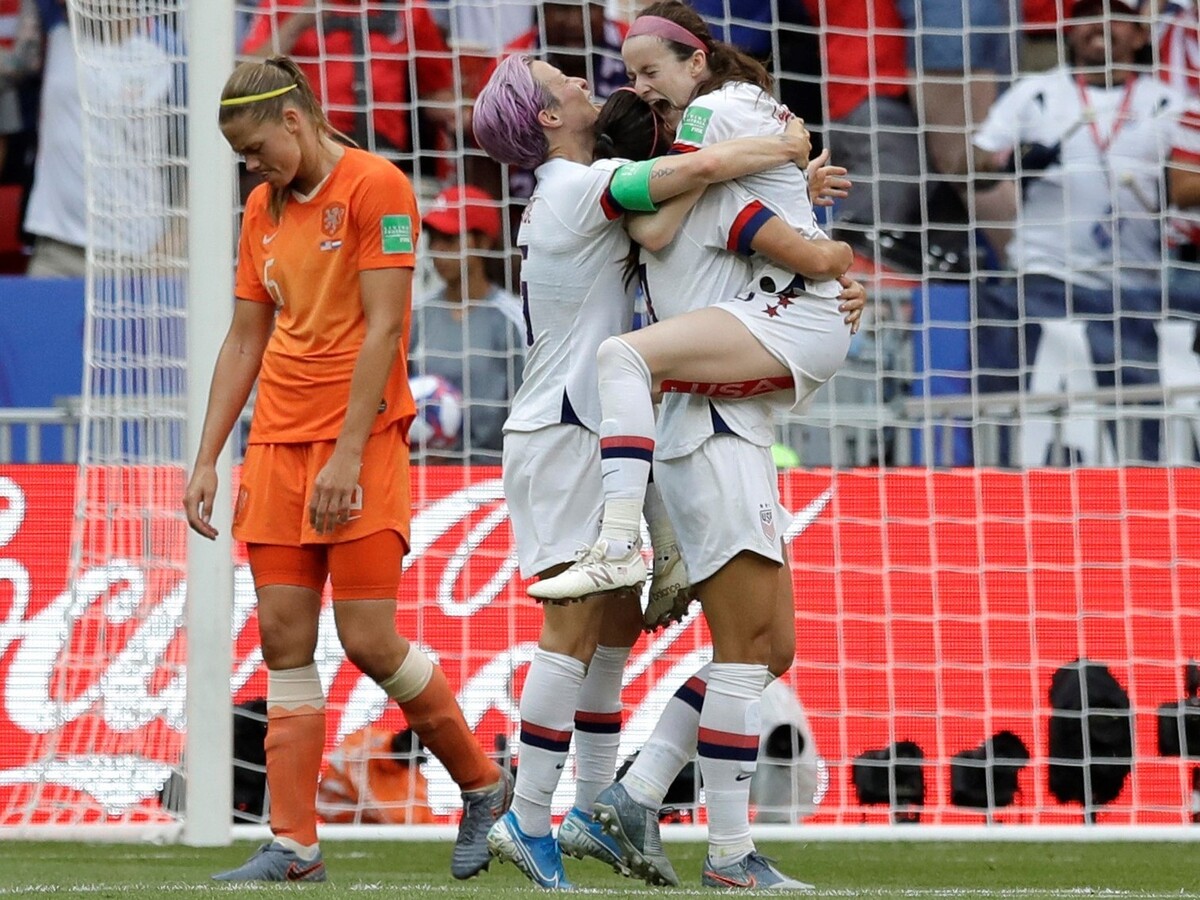
The U.S. scoring continued in the 69th minute thanks to midfielder Rose Lavelle. She dribbled down the field and, with a beautiful left-footed strike at the top of the penalty area, zipped the ball low and to the right. 2-0. It was all the scoring the U.S. would need.
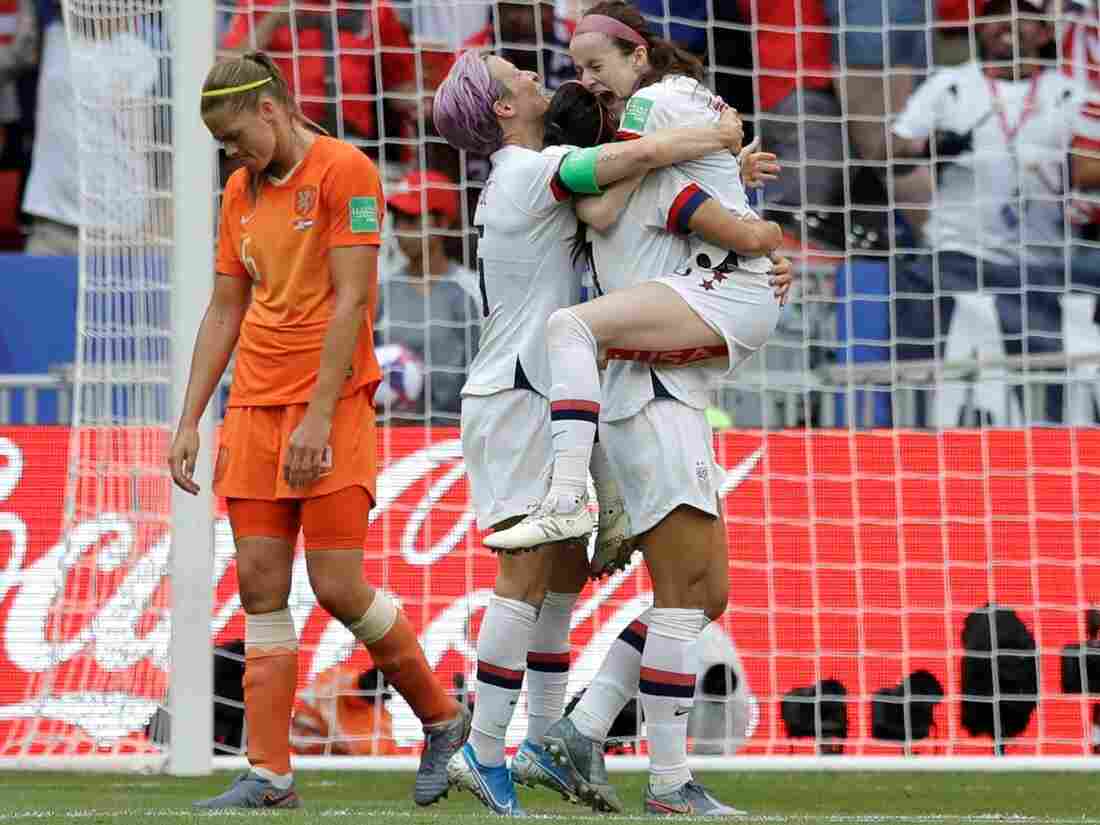
The Netherlands’ Anouk Dekker (left) walks past as the United States’ Rose Lavelle (right) celebrates with teammates after scoring her side’s second goal during the Women’s World Cup final soccer match between the U.S. and the Netherlands.
Alessandra Tarantino/AP
hide caption
toggle caption
Alessandra Tarantino/AP
The United States rolled through the opening round with statement wins over Thailand (13-0), Chile (3-0) and Sweden (2-0). Brushing aside criticism about perceived arrogance and excessive goal celebrations, the U.S. then powered through the heart of European soccer with victories over Spain (2-1), France (2-1) and England (2-1) to make it to the final against the reigning European champions.
It was the fifth time the United States Women’s National Team played a World Cup final (there have been only eight tournaments). The U.S. is the first team to reach three consecutive finals and joins Germany as a repeat champion (2003 and 2007). With Sunday’s win, the U.S. has a record four Women’s World Cup trophies.
On a day that should have been all about the World Cup, the United States had to share the soccer spotlight. “It’s ridiculous,” said Rapinoe, that there are not one but two men’s soccer championships scheduled on the same day: the Copa América and CONCACAF Gold Cup. “That’s a terrible idea to put everything on the same day in every way. This is the World Cup final. This is ‘cancel everything day,’ ” Rapinoe said. Soccer’s international governing organization, FIFA, said having all three tournament finals on the same day will draw attention to the sport.
The U.S. team will return home to adoring crowds and fans and a new fight. In March, the U.S. Women’s National Team sued U.S. Soccer for gender discrimination. In the lawsuit, the team claims that the soccer federation pays members of the women’s team far less than similarly situated members of the men’s team — a men’s team that has had nowhere near the success of the women on the international stage. Both sides agreed to mediation after the tournament. After the final whistle, the crowd in Lyon chanted, “Equal Pay!”
Record audiences have tuned in for this tournament both in the United States and around the world. Will this exciting tournament translate into continued growth of the women’s game? “Your hope is [that] back in the U.S., more kids want to go out and play this great sport,” said U.S. head coach Jill Ellis. “I mean, that’s ultimately the building block you build on. My hope is that more people get on board financially. You know, sponsors, they see the value in it. They see the marketing marketability of it, and then more little kids want to go and kick a ball around.”
Now the U.S. returns home as champions again.
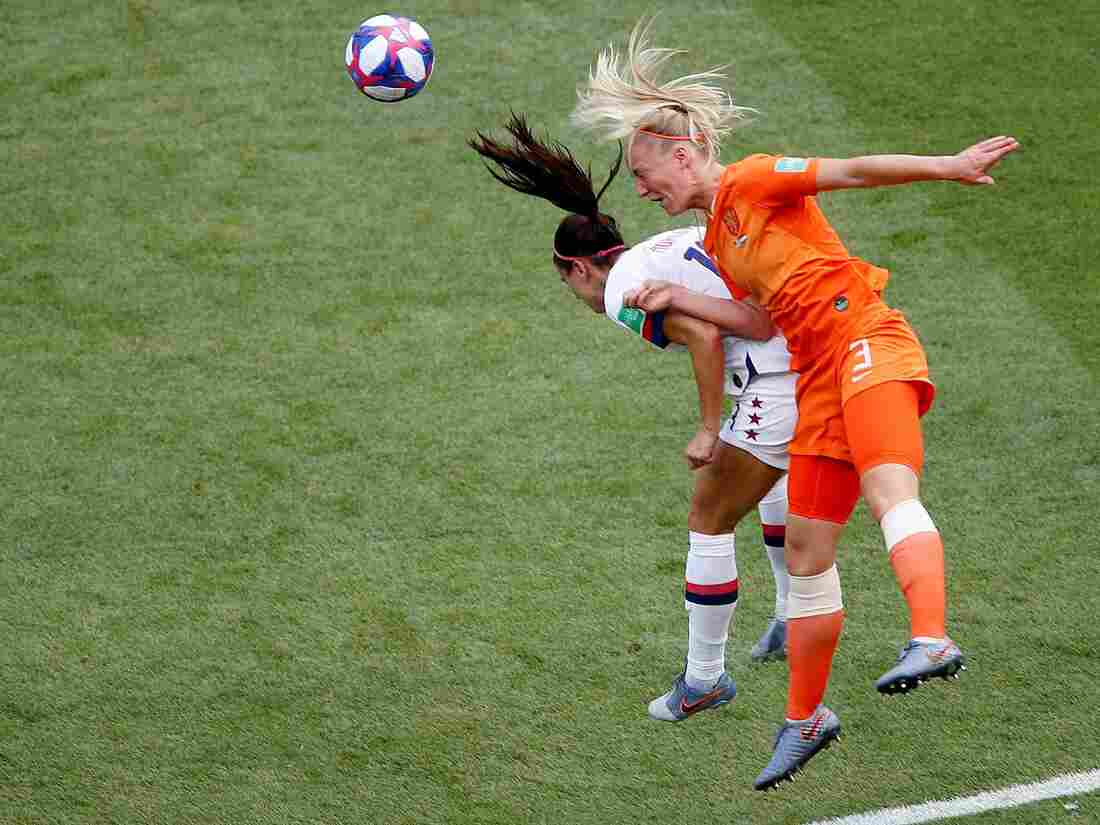


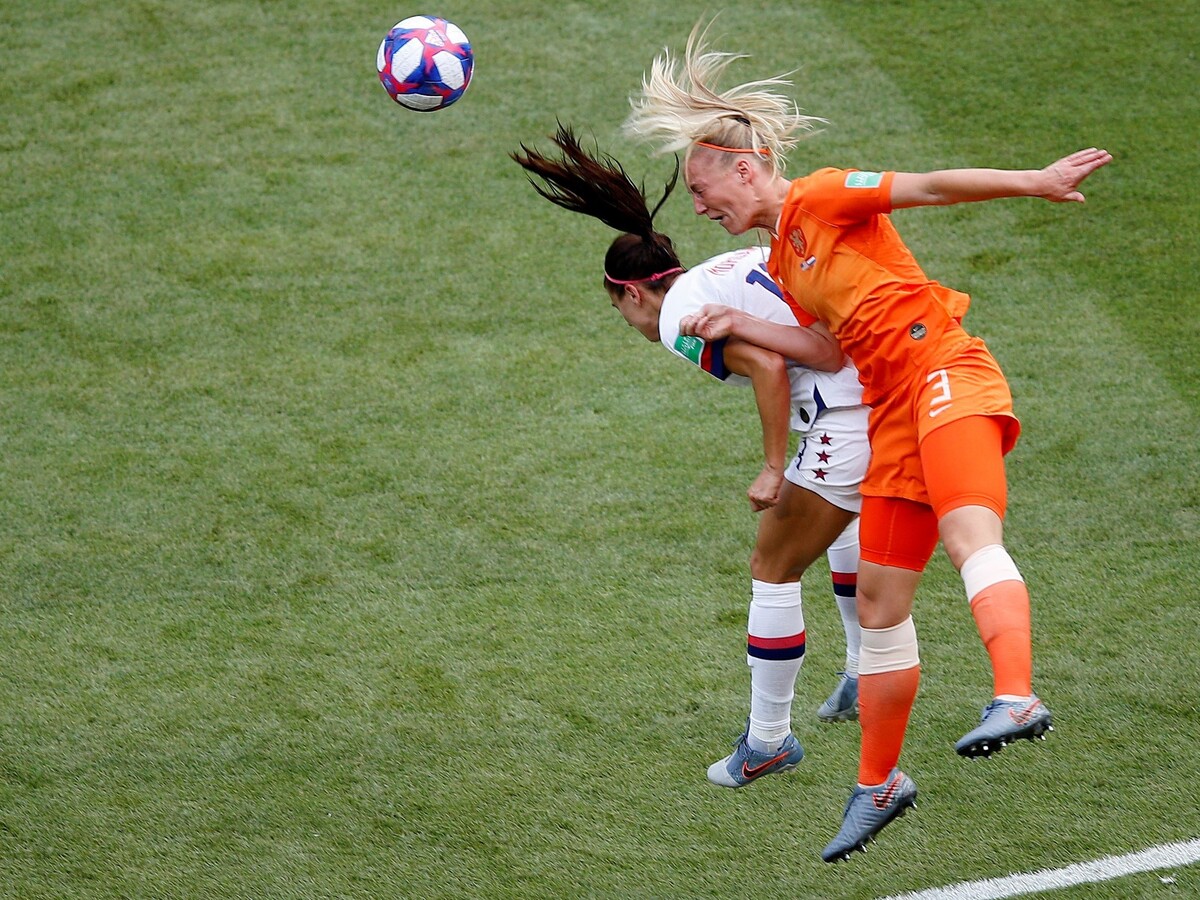
The United States’ Alex Morgan (left) and the Netherlands’ Stefanie van der Gragt challenge for the ball during the Women’s World Cup final soccer match between the U.S. and the Netherlands.
Francois Mori/AP
hide caption
toggle caption
Francois Mori/AP
U.S. Faces The Netherlands In World Cup Final
The Women’s World Cup final is later Sunday. The U.S. is the defending champion and is going for its fourth trophy. The Dutch are playing in their first final.
LULU GARCIA-NAVARRO, HOST:
Today is the women’s World Cup final. The United States, a superpower in women’s soccer, will take on the upstart squad from the Netherlands. NPR’s Laurel Wamsley has been covering the tournament, and she joins us now.
Good morning.
LAUREL WAMSLEY, BYLINE: Good morning.
GARCIA-NAVARRO: The U.S. has been unstoppable so far. Should the American women be worried about the Dutch?
WAMSLEY: Well, yes, the U.S. has been amazing so far. They’ve only allowed three goals the entire tournament, and they’ve now won 11 World Cup games in a row, which is a record. But this could be a tricky match against the Netherlands. This Holland team has made it to the final by upsetting teams that were supposed to beat them. And this is, actually, only their second time playing in a World Cup. They made it to the round of 16 four years ago in Canada. But then they won the 2017 European Championships, and they’ve only gotten stronger since then.
GARCIA-NAVARRO: All right, we’ll get to Megan Rapinoe in a second. But I want to ask about the Dutch side first. Who are you watching there?
WAMSLEY: The Dutch are led by two strong attackers, Lieke Martens and Vivianne Miedema. So Lieke Martens – she’s a gifted winger who was named FIFA’s Player of the Year in 2017. But she actually has a toe injury that took her off the field for the team’s win over Sweden in the semifinals. And Vivianne Miedema is a standout at Arsenal. And she’s only 22, but she’s already the Netherlands all-time leading scorer. And I would suggest you should watch out for the Dutch fans too. They’ve been travelling en masse in France, decked out in orange, singing and dancing wherever they go.
GARCIA-NAVARRO: (Laughter) All right, can we talk about Megan Rapinoe now?
WAMSLEY: I would love to.
GARCIA-NAVARRO: Yeah. After scoring all four U.S. goals in the games against Spain and France, she sat out the game against England. Is she hurt? What’s up with her?
WAMSLEY: Right. So she sat out that game against England with a strained hamstring. And she says that just kind of comes with the territory. She turned 34 on Friday. And she says as you get older, you just need more rest days. But she told reporters that she’ll be healthy enough to play in today’s game. And certainly, the fans are hoping that she will be. She is a lot of fun to watch and really brings a lot of gravitas to the field.
GARCIA-NAVARRO: The U.S. team has been demanding attention, both on and off the field. Remind us why.
WAMSLEY: I think it has to do with their confidence. They have been here before. They are often under high pressure. And I think they planned ahead. They thought about what would happen if they were under the spotlight. What would they do with that moment? And so they’ve prepared for it. And they are just so willing to be outspoken.
Some athletes, when these big moments happen, they don’t want to talk about politics. They just say, oh, we’re just focused on one game at a time. But this team, they are just willing and able to engage with the personal and the political all at the same time. And when people say they celebrate too much or they should just be talking only about sports, they say, no. That’s not us. And they do it so articulately. And they stand their ground. And then they go out on the field, and they win. And it’s just – it’s remarkable to watch.
GARCIA-NAVARRO: That’s NPR’s Laurel Wamsley, who will be watching the game.
Thank you so much.
WAMSLEY: Thank you.
(SOUNDBITE OF SUFFER LIKE G DID’S “BRING ME THE FIRST AID KIT”)
Copyright © 2019 NPR. All rights reserved. Visit our website terms of use and permissions pages at www.npr.org for further information.
NPR transcripts are created on a rush deadline by Verb8tm, Inc., an NPR contractor, and produced using a proprietary transcription process developed with NPR. This text may not be in its final form and may be updated or revised in the future. Accuracy and availability may vary. The authoritative record of NPR’s programming is the audio record.
California Pay-To-Play Bill Pushes College Athlete Compensation
NPR’s Michel Martin speaks with College Athletics Players Association founder Ramogi Huma about a California bill that will allow compensation for college athletes.
Cori ‘Coco’ Gauff Continues Sensational Wimbledon Run
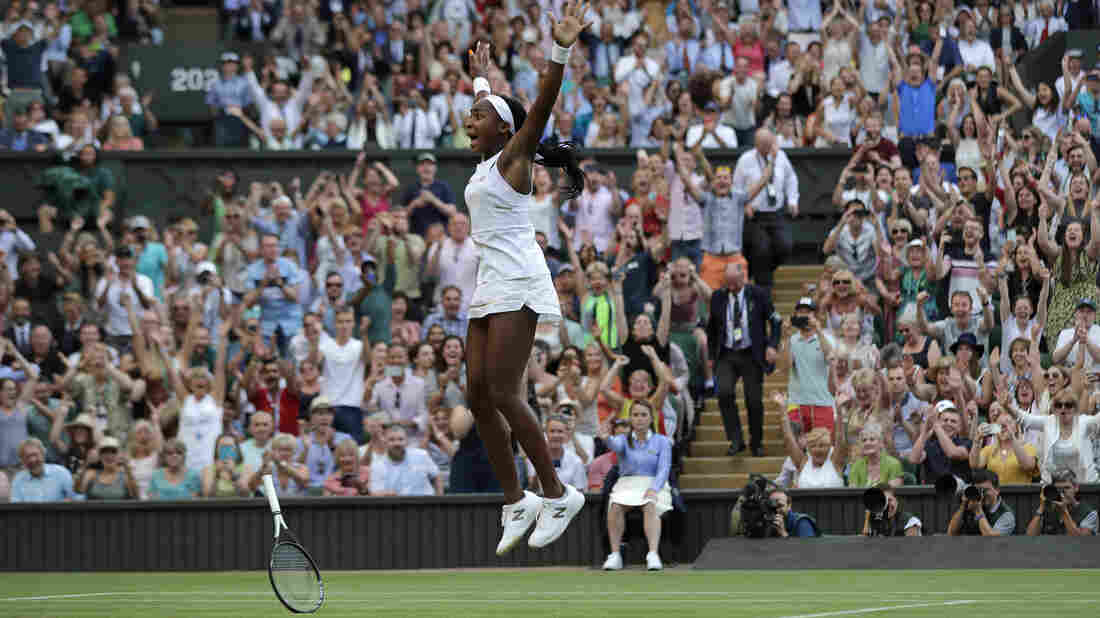

Cori “Coco” Gauff celebrates after beating Slovenia’s Polona Hercog on Friday.
Ben Curtis/AP
hide caption
toggle caption
Ben Curtis/AP
Cori “Coco” Gauff, the 15-year-old tennis player who defeated Venus Williams in her first-round match, has now advanced to the round of 16 at Wimbledon. She is the youngest player to advance this far in the tournament since 1991, when Jennifer Capriati made the semifinals as a 15-year-old.
Gauff was down a set and two separate match points in her third-round match against Polona Hercog of Slovenia on Friday, but she came back to win 3-6, 7-6 (9-7), 7-5.
In a press conference after the match, Gauff said she knew she could win, even when she was down 2-5 in the second set.
“I was like, ‘I can fight back — I just need to hold serve and then break,’ ” Gauff said.
Gauff, the youngest woman to qualify for Wimbledon in the modern era, is playing the most high-profile matches of her career. She committed 43 unforced errors in Friday’s match against Hercog, but she had just 18 unforced errors in her first two matches combined.
The comeback kid – and then some! ?
15-year-old @CocoGauff‘s irresistible run at #Wimbledon continues, rallying from a set down to defeat Polona Hercog 3-6, 7-6(7), 7-5 pic.twitter.com/bS79tUkMwG
— Wimbledon (@Wimbledon) July 5, 2019
“I wasn’t really tired,” Gauff said after the match against Hercog, which lasted two hours and 47 minutes. “I’m young. I have a lot of energy, and I’m used to playing two matches a day [in the junior tennis circuit].”
Gauff’s age means that the Women’s Tennis Association (WTA) restricts the number of events she can play. According to the New York Times, the WTA put the rules into effect in 1994, in response to burnout struggles faced by young tennis stars — including Capriati. A 15-year-old girl is typically allowed to play 10 professional tournaments in a year, but Gauff’s successes have earned her a merit-based increase of two additional events.
On Monday, Gauff will face the tournament’s No. 7 seed, Simona Halep. Halep won last year’s French Open title and has reached four Grand Slam finals. Gauff said she has never played against Halep or practiced with her, but she’s “familiar with how she plays just from watching her a lot.”
Gauff, currently ranked 313th in the world, has been a dominant presence in the junior tennis circuit. In 2018, she won the Junior French Open and in 2017, at 13 years old, she became the youngest player to make the finals of the Girls’ singles at the U.S. Open.
Venus Williams had won two Wimbledon titles by the time Gauff was born. Gauff said beating Williams, who she considers an idol, a real turning point for her in terms of fame.
“It was pretty surreal how life changes in a matter of seconds,” Gauff said.
But Gauff has long been clear about her tennis ambitions.
“I want to be the best ever,” Gauff said as a 14-year-old on the show No Days Off. “I want to be better than Serena, and I want to have that Grand Slam record one day.”
Serena Williams, who has won 23 Grand Slam titles and holds an Open Era record, will face Carla Suarez Navarro in a round-of-16 match on Monday.
Like mother, like daughter…#Wimbledon | @CocoGauff pic.twitter.com/5oKKMewXJj
— Wimbledon (@Wimbledon) July 5, 2019
Friday’s victory means Gauff has now earned almost $200,000 in Wimbledon winnings. When a reporter asked her how she planned to spend the money, she said she wasn’t sure.
“I mean, I can’t buy a car, because I can’t drive,” Gauff said. “I hate spending money to be honest, so I don’t really know.” She said she would maybe buy some hoodies from Jaden Smith’s line of apparel.
The most unexpected attention Gauff said she had received came from Miss Tina Knowles-Lawson, mother of Beyoncé and Solange Knowles.
“[She] posted me on Instagram and I was screaming,” Gauff said. “I hope Beyoncé saw that. I hope she told her daughter about me, because I would love to go to a concert.”
Saturday Sports: Wimbledon, Women’s World Cup
NPR’s Renee Montagne talks with Howard Bryant of ESPN about a rising tennis star at Wimbledon and the upcoming Women’s World Cup final.
RENEE MONTAGNE, HOST:
And it’s time now for sports.
(SOUNDBITE OF MUSIC)
MONTAGNE: A 15-year-old from Florida takes Wimbledon by storm and on the eve of the Women’s World Cup final, America’s brash, outspoken and very, very good team. We’re joined now by Howard Bryant of ESPN. Good morning.
HOWARD BRYANT, BYLINE: Good morning. How are you?
MONTAGNE: Pretty good. Let’s start with Wimbledon because – and I say this is an incredible understatement – a star is being born there.
BRYANT: A star is being born there. Fifteen-Year-Old Coco Gauff – just an amazing, amazing story, one, because we’re just not used to seeing someone that young be this good anymore. We’ve seen it in the old days, remember, with Tracy Austin at 14 and Jennifer Capriati, who was the last player as young as Coco Gauff to be doing what she’s doing now. But over the last several years, the game has gotten so physical and so strong, the players are so much bigger, that teenagers haven’t really had the chance to do what Coco Gauff is doing now. And she did something even more remarkable than just show up and play well at Wimbledon. She came in in the first round and beat her idol, Venus Williams, who’s only won Wimbledon five times and is a seven-time Grand Slam champion.
And, of course, yesterday’s match against Polona Hercog was just amazing considering she was down 6-3, 5-2, match point twice and found her way to win the entire match 7-5 in the third set. It just showed you how much – how much fun it is, and then it shows you how much talent she’s got as well. I was thinking to myself watching her parents in the crowd yesterday that I couldn’t stomach that. I can barely watch my son at a piano recital at the nursing home. And watching them watch their teenager do what she’s doing, it’s incredible.
MONTAGNE: Well, something else incredible, of course, is the Women’s World Cup final soccer team from America, the U.S. team. Before we talk about them – and I’m going to ask you about them – they have transformed this tournament into a much talked about event – I mean, much more than a game – haven’t they?
BRYANT: Well – and they have, and they always do. They are brash. They are good. They are fantastic. And they’re tough. I think when you look at the personalities involved, you’ve got Megan Rapinoe, who was the only player – white woman player to take a knee after Colin Kaepernick did in 2016 out of support for him. You have Alex Morgan and Carli Lloyd, who are two of the other stars on the team. You’ve got this team – they start to the tournament and they destroy Thailand, and people are mad at them because they won so big. And then they had a tough match against Spain.
And then, of course, you go up against England as well, and England didn’t like the fact that when they came out and beat them that they had a real – you know, Morgan’s celebration was of her sipping tea. I thought it was kind of fun. People thought this team was brash, but you know what? They’re good. They demand equal pay for women. They fight with the federation to make sure that they get what they deserve in terms of their respect. And they are something to watch. And tomorrow, they’ll be playing for the championship against the Netherlands.
MONTAGNE: OK. No predictions, but what’s the 30-second version of what you’ll be looking at when the U.S. kicks off with the Netherlands?
BRYANT: Oh, I think you’re looking to see how healthy Megan Rapinoe is. She didn’t play the other match. She didn’t start the other match because of her hamstring. So we’ll see if she’s healthy and playing. And I think you just want to see if they can play on their terms, they win. If they get into a tough defensive battle, then it’s anybody’s game.
MONTAGNE: Howard Bryant of ESPN, pleasure talking to you.
BRYANT: My pleasure. Thank you.
Copyright © 2019 NPR. All rights reserved. Visit our website terms of use and permissions pages at www.npr.org for further information.
NPR transcripts are created on a rush deadline by Verb8tm, Inc., an NPR contractor, and produced using a proprietary transcription process developed with NPR. This text may not be in its final form and may be updated or revised in the future. Accuracy and availability may vary. The authoritative record of NPR’s programming is the audio record.
U.S. Prepares To Face The Netherlands In Women’s World Cup Final
The U.S. will face the Netherlands in the Women’s World Cup Final on Sunday. The U.S. women are the defending champs and looking to secure their fourth World Cup title.
World Cup Final: It’s The Juggernaut Vs. The New Kid As U.S. Takes On The Netherlands


The Netherlands are the last team standing between the United States and its fourth Women’s World Cup. Here, U.S. forward Megan Rapinoe watches her teammates warm up before Tuesday’s 2-1 semifinal win over England.
Alex Grimm/Getty Images
hide caption
toggle caption
Alex Grimm/Getty Images
Before the World Cup began, nearly everyone predicted a final between the United States and, well, some team from Europe. Perhaps Germany, England or France. When the quarterfinals arrived, that soothsaying was on target: The Yanks and seven European squads remained.
Now all the blanks on the World Cup bracket have been filled in, save one. On Sunday, the mighty United States will battle the bright orange Netherlands as two soccer-crazed nations tune in.
Will the U.S. continue its march of greatness undaunted, or will the Dutch pull off an upset for the ages?
The U.S. squad has been nearly perfect, allowing no goals in the group phase and only one goal each against Spain, France and England.
But there have been some close calls. In Tuesday’s semifinal, there were moments when the U.S. team’s fate hinged on the smallest of margins. A goal in the 68th minute by England’s Ellen White would have been an equalizer, but it was ruled offside after video review. And a late-game penalty kick by England (during which most of America could be seen biting its nails) was saved by U.S. goalkeeper Alyssa Naeher. But the U.S. won, as it does so often.
So the final in Lyon, France, comes down to the juggernaut and the new kid.
This is just the second time the Dutch have played in the World Cup. The OranjeLeeuwinnen made it to the round of 16 four years ago and have been ascendant ever since. They were the surprise victors of the 2017 European Championships, and they are now beloved by a nation of orange-frocked football fans.
The Dutch are led by two strong attackers: Lieke Martens and Vivianne Miedema. Martens is a gifted winger who was named FIFA’s player of the year in 2017, but she is grappling with a toe injury that took her off the field for the team’s 1-0 semifinal win over Sweden. Miedema is a standout at Arsenal and, at 22, is already the Netherlands’ all-time leading scorer.
But it will take a lot to overcome the strength and skill of the U.S. Women’s National Team. As the U.S. has worked and won its way to play for a fourth World Cup title, it has done so with remarkable style and confidence.
Exhibit A: U.S. midfielder Rose Lavelle nutmegging the ball through the legs of England’s Millie Bright.
First big chance of the game goes to the @USWNT!
All set up by @roselavelle with the killer nutmeg on Bright ? #FIFAWWC pic.twitter.com/XvhOtcs1Lc
— FOX Soccer (@FOXSoccer) July 2, 2019
Exhibit B: Forward Alex Morgan scoring a soaring header to give the U.S. the lead on her 30th birthday. Then celebrating by delicately sipping an imaginary cup of tea. Then pointing out that male goal scorers celebrate in all kinds of ways, including in crude fashion, and that it elicits barely a comment.
Alex Morgan scores her first goal since the opening game and retakes the lead in the Golden Boot race (6 goals, 3 assists)
She’s the first player in #FIFAWWC history to score on her birthday ? pic.twitter.com/EGWBNIyaxI
— FOX Soccer (@FOXSoccer) July 2, 2019
Exhibit C: Megan Rapinoe.
For many U.S. fans, Rapinoe is the heart and soul of the team — artful winger, unflappable professional, moral center. Last week, President Trump tweeted critically about Rapinoe’s statement that she wouldn’t go to the White House if the team was invited. She stood by those words, then went onto the pitch and scored both of the U.S.’s goals against France.
Some have called her unpatriotic over her decision to not mouth the words to the national anthem before matches. But Rapinoe told reporters on Wednesday that she considers herself “particularly and uniquely and very deeply American.”
“I feel very fortunate to be in this country — I’d never be able to do this in a lot of other places but also, that doesn’t mean that we can’t get better. That doesn’t mean that we shouldn’t always strive to be better,” she said. “I think that this country was founded on a lot of great ideals, but it was also founded on slavery, and I think we just need to be really honest about that and be really open in talking about that so we can reconcile that and hopefully move forward and make this country better for everyone.”
Rapinoe didn’t play in the semifinal match against England because of a sore hamstring. Christen Press joined the team’s front line instead and scored almost immediately, demonstrating the depth and power the U.S. brings. Rapinoe says she will be healthy enough to play in Sunday’s final.
Netherlands midfielder Danielle van de Donk said Friday that she thinks the U.S. team has been arrogant.
“They’re basically already congratulating us on finishing in second place. I love it, let them say what they want to say,” she said. “The final is a game like any other: it will start at 0-0 and there are still at least 90 minutes to play. We’ll show them on the pitch how much we want to win that World Cup. Let’s talk afterwards!”
If the Dutch win, they will be honored Tuesday with a ceremony and a celebratory cruise through Amsterdam’s canals. The squad’s supporters have traveled en masse while in France and filled the streets with coordinated dancing, willing their team to greatness.
So this is happening in @valenciennes: Oranje parade in Valenciennes. @FIFAWWC @FecafootOfficie v @oranjevrouwen #StadeDuHainaut pic.twitter.com/mP1p5lRDZD
— Fatma Samoura (@fatma_samoura) June 15, 2019
If the U.S. wins, expect some tweets in all caps from the White House.
As it happens, the World Cup final isn’t the only FIFA event happening on Sunday. The governing body managed to schedule two other finals — in the men’s Copa América and CONCACAF tournaments — that day.
“It’s ridiculous, and disappointing, to be honest,” Rapinoe told reporters.
“I don’t really understand why there’s such a resistance against going all-in on women,” Rapinoe said. “I think it’s pretty clear women in sport have not been treated with the same care and financing and all of that that men’s sports has.”
Sunday’s match kicks off at 11 a.m. ET and will be broadcast on Fox and Telemundo.