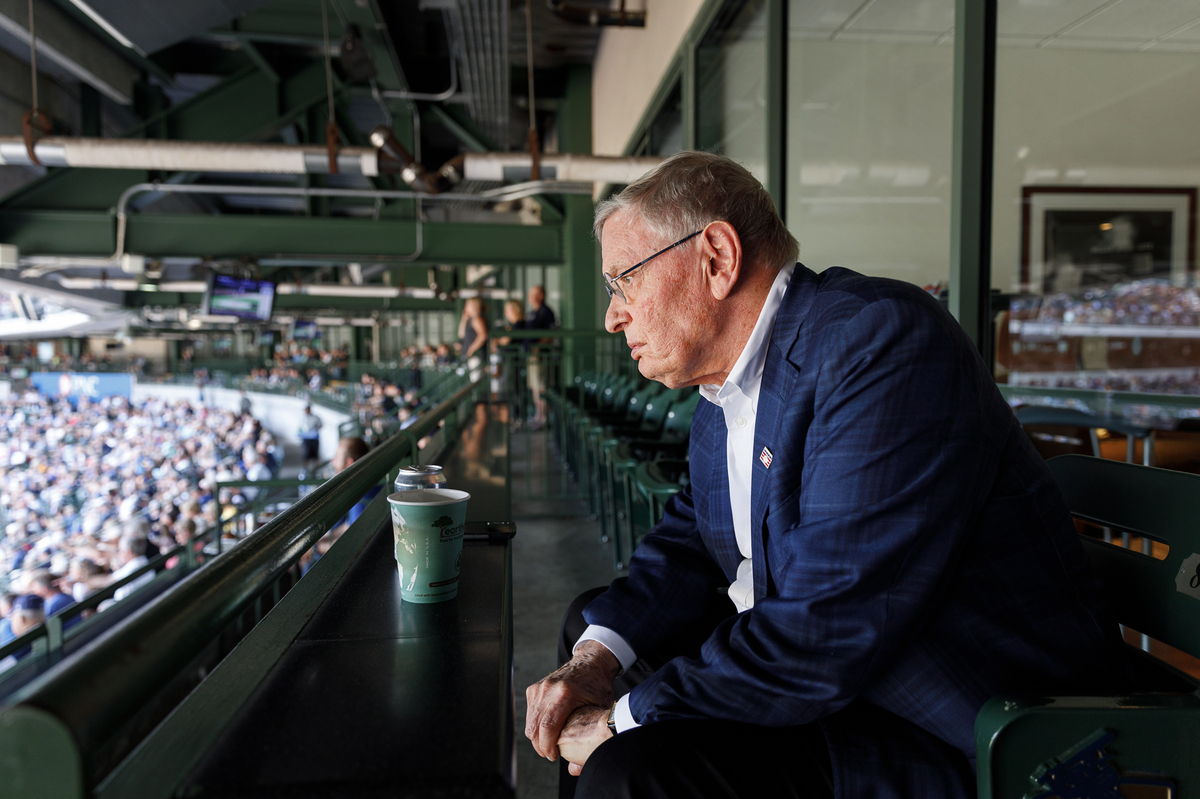
Former Major League Baseball Commissioner Bud Selig sits outside his luxury suite to watch the Milwaukee Brewers game at Miller Park. His new book reveals how he navigated tumultuous events in his career like the devastating player strike and the spread of performance-enhancing drugs.
Sara Stathas for NPR
hide caption
toggle caption
Sara Stathas for NPR
Some of Bud Selig’s new book may surprise you.
In For the Good of the Game, the former Major League Baseball commissioner is candid, sometimes foul-mouthed and angry. That’s a stark contrast to his public persona when he led the sport for more than two decades, and navigated tumultuous events like the devastating player strike and the spread of performance-enhancing drugs.
Selig retired in 2015 but he’s still closely connected to the game he fell in love with as a boy — and that he helped change in profound ways.
Sharp edges
Bud Selig didn’t like Barry Bonds.
In 2007, Selig was miserable having to follow the steroids-tainted slugger for the San Francisco Giants, as Bonds crisscrossed the country closing in on the milestone he finally reached — breaking Henry Aaron’s career home run record.
The reception area of Selig’s office in downtown Milwaukee. He likes to take visitors on a tour of his office to explain its Hall-of-Fame worthy artifacts.
Sara Stathas for NPR
hide caption
toggle caption
Sara Stathas for NPR
In 1995, the Clinton administration got involved in trying to resolve the baseball player strike. During a particularly heated incident, Selig launched a tirade, replete with F-bombs, against former Vice President Al Gore.
These pointed moments, recounted in the book, don’t exactly jibe with Selig’s sometimes unflattering public image. Critics derided the commissioner as bumbling and absent minded.
Those who know him and worked with him, know differently. For them, the sharp-edged Bud Selig is real.
But so too is the one who gets lost in baseball reverence.
Almost Cooperstown
Selig likes to take visitors to his Milwaukee office on impromptu tours around the space, with its Hall-of-Fame worthy artifacts.
“Well there’s nothing like Cooperstown,” Selig says, “but this is pretty close.”
He stops at one wall, and points to a letter, written in 1942, a month after Pearl Harbor. It’s an original, from President Franklin D. Roosevelt to then baseball commissioner Kenesaw Landis, asking Landis to keep the game going during World War II.
“[Roosevelt] thought so much of the game,” Selig says, “and thought the game could really provide so much of a catharsis during the [war]. Y’know I often refer to baseball as a social institution and this letter’s another manifestation of that.”
The tour continues, past photos of “my guys” Henry Aaron, a lifelong friend and Robin Yount, who spent his entire, star-studded 20-year career with the Milwaukee Brewers. Selig brought the major league team to Milwaukee in 1970, owned it for many years and still cherishes all things Brewers.
There’s a row of seats donated by the L.A. Dodgers, signed by such luminaries as long-time manager Tommy Lasorda, Hall-of-Fame pitcher Sandy Koufax, broadcaster Vin Scully.
Mounted on another wall, an actual x-ray of legendary Boston Red Sox outfielder Ted Williams. It was given to Selig by the team.
“He broke his elbow in 1950, and played the whole game,” Selig marvels about Williams’ gritty performance in, of all things, an All-Star game. Modern players often dismiss the game as a meaningless exhibition, but Selig likes to remind them it meant something back in the day. In fact, Selig tried to infuse the all-star game with more significance in the early 2000s when he announced the league that won the game would have home field advantage in the World Series. But that experiment ended in 2016.
Selig stands next to a wall display in his office of New York Yankees legend Joe DiMaggio. “Well there’s nothing like Cooperstown,” he says, “but this is pretty close.”
Sara Stathas for NPR
hide caption
toggle caption
Sara Stathas for NPR
Talking to owners … a lot
The book recounts how Williams liked to tell Selig he had the worst job in America.
“That’s how he started every conversation,” Selig laughs. “How do you deal with those blankety-blanks … meaning the baseball owners.”
How did Selig answer?
“I said there are some weeks you’re right,” Selig says, adding, “but [I said] I’m doing what I love. And the owners were great. I can never criticize them.”
A row of autographed chairs from Dodger Stadium sits in Selig’s office. The signatures include long-time manager Tommy Lasorda, Hall-of-Fame pitcher Sandy Koufax, broadcaster Vin Scully.
Sara Stathas for NPR
hide caption
toggle caption
Sara Stathas for NPR
Of course many could, and did. Allegations ranged from owners trying to break the union during the 1994/95 baseball strike, to colluding in the early 1980s to hold down player salaries.
Selig, who was a long-time owner of the Brewers and, like all commissioners, worked for baseball’s owners, denies the allegations. And he still has a strong connection to at least one owner.
Mark Attanasio bought the Brewers from Selig and his family in 2005. He and Selig talk regularly – in fact, Selig’s phone rings as he’s driving to watch a Brewers game.
“Hi Mark.”
Selig, acting Baseball Commissioner of Major League Baseball and president of the Milwaukee Brewers, attends a news conference in Milwaukee, on Jan. 23, 1995, regarding the team’s season ticket sales.
Roberto Borea/AP
hide caption
toggle caption
Roberto Borea/AP
Selig has turned down the Neil Diamond music he loves and now focuses on his conversation with Attanasio. Which not surprisingly, is about baseball. Milwaukee has lost two straight games. But Selig notes, so have the Brewers division rivals.
“I know the [Chicago] Cubs are losing and the Redbirds [St. Louis Cardinals] are losing but the fact is …” Selig pauses as Attanasio speaks. “Oh you bet,” Selig answers.
During his working years, Selig talked and talked to everyone, especially owners.
“Yes I did spend endless hours [on the phone],” Selig says, “no question about it.”
When he became acting commissioner in 1992, Selig says he inherited a mess.
“Owners hating each other; owners hating the union. Everybody hating the commissioner,” he says.
Communication, in Selig’s mind, was key to setting things right. It was necessary to listen, cajole and convince people that controversial proposals like adding Wild Card teams to the playoffs, introducing revenue sharing between teams, instituting drug testing … all of that was good for baseball.
And the primacy of the game, Selig says, over individual teams, is a message he learned early and preached often.
“If you really are a great sports owner,” he says, “the well being of your sport is the most important thing. Everything else is secondary.”
Building new buildings
Fans begin to leave the Milwaukee Brewers game at Miller Park. Selig led the effort to build Milwaukee’s new stadium, which opened in 2001.
Sara Stathas for NPR
hide caption
toggle caption
Sara Stathas for NPR
Selig says new stadium construction, in the 1990s and 2000s, was a key to ensuring baseball’s well being.
New stadiums became new revenue generators. But there were often fierce battles because teams relied on a lot of public funding and, opponents said, manipulated cities by threatening to leave unless they got a new facility.
Selig led the effort to build Milwaukee’s new stadium, which opened in 2001. It was sometimes a bare knuckles effort that cost a Wisconsin state senator his job for casting a key vote in favor of public financing.
“We had a lot of controversy,” Selig says as he slides his black sedan into a spot in the Miller Park parking lot. “Public funds, private funds. [But] look at it today. They’re going to draw 3 million people here this year. In a market of a million five.”
Fans watch the game against the Seattle Mariners. New stadiums became new revenue generators. But there were often fierce battles over public funding for the projects, including Miller Park.
Sara Stathas for NPR
hide caption
toggle caption
Sara Stathas for NPR
This is a recurring theme in Selig’s book. Ends justified means.
There was pain and anger surrounding the 1994-95 strike and cancellation of the World Series. But since then, there have been 24 years of labor peace.
Big market owners like the New York Yankees’ George Steinbrenner railed against helping small and medium market teams. But, ultimately, Selig says revenue sharing helped save some from going bust, and increased parity so more teams could be competitive.
Steroids commissioner
There was perhaps no more enduring controversy than the issue of steroid use.
It mushroomed on Selig’s watch, prompting critics to label him the “Steroids Commissioner.”
Selig watches a presentation of the “Selig Experience” at Miller Park. It’s a multimedia presentation that tells the story of Selig’s role in bringing Major League Baseball back to Milwaukee in 1970, and leading the effort 25 years later to build the new park.
Sara Stathas for NPR
hide caption
toggle caption
Sara Stathas for NPR
Sitting now outside his stadium suite, munching on a salad, Selig wants to set the record straight on what he calls historical myths about the drug issue.
“We were slow to react? No we weren’t,” Selig says. “This [policing steroid use with drug testing] is a subject of collective bargaining.”
And Selig says the union wouldn’t bargain.
San Francisco Giants’ Barry Bonds (left) holds the National League Hank Aaron award with Commissioner Selig during a ceremony before Game 4 of the World Series on Oct. 27, 2004 in St. Louis. Selig was inducted into Baseball’s Hall-of-Fame in 2017 but Bonds and other other players linked to the so-called Steroids era have not.
James Finley/AP
hide caption
toggle caption
James Finley/AP
He still blames the Player’s Association for resisting at every turn the drug testing he says he wanted and got the owners to support. Although a comprehensive steroids study he commissioned, the Mitchell Report, spread the blame to include baseball management, including commissioners.
“Yes [the Mitchell Report] did,” Selig acknowledges, “that’s right. But look, I’ve often thought, what else could I have done?”
Selig always has said he consulted those inside the game – managers, players, medical staff, athletic trainers – and was told steroids were not a widespread problem. But that didn’t convince skeptical baseball writers, or lawmakers. In 2007, Florida representative Cliff Stearns called for Selig’s resignation.
“Certainly, a lack of leadership and oversight in Major League Baseball enabled these abuses to continue,” Stearns said at the time. “After 15 years of slow action, a new commissioner is needed to guide the league out of this era of drug abuse.”
If Selig and baseball were slow to react, they weren’t alone among sports organizations in the mid 1990’s. That’s according to Travis Tygart, head of the U.S. Anti-Doping Agency.
“Look with the U.S. Olympic Committee [another organization hit hard by performance enhancing drug use], the light switch hadn’t gone on either,” says Tygart. “It wasn’t until Congress [held] hearings and bad [doping] cases in late 1999, going into Sydney [2000 Olympics], where they said we have to get this right.”
Tygart says the light switch eventually went on for baseball, in a big way.
A food vendor walks through the crowd during a Milwaukee Brewers afternoon baseball game. On a national level, what were once raging baseball controversies during Selig’s tenure, now are accepted parts of the game.
Sara Stathas for NPR
hide caption
toggle caption
Sara Stathas for NPR
“To the extent you can get [baseball] owners to agree to anything,” he says, “Selig did a hell of a job getting his owners to eventually recognize the issues and put in a strong [drug] program. And that in turn, I think, turned the tide of the players.”
Baseball’s drug program today, Tygart says, with its robust testing and sanctions and investigating arm, is the gold standard among major U.S. professional sports.
Mollifying the critics
Critics still linger, however.
Selig was inducted into Baseball’s Hall-of-Fame in 2017. Some said, as a result, Barry Bonds and other players linked to the so-called Steroids era, who’ve been left out of the hall, should get in too.
A bronze statue of Selig stands near the main entrance of Miller Park. Selig says he wants to set the record straight on what he calls historical myths about the drug issue.
Sara Stathas for NPR
hide caption
toggle caption
Sara Stathas for NPR
Will Selig’s book, with its detailed description of the steroid battles and lengthy explanations of his actions, mollify the critics?
“I mean that’s a fair question,” Selig says. “I don’t think so. But maybe it will.”
“It was a painful period. It was a period that was clearly not good for baseball. But I have to say, finally, through a lot of pain, we got it right.”
A hometown legacy
Whatever the final verdict, Selig knows, at least, his legacy is secure in the place he’s always cared about most.
Walking the concourse at Miller Park, next to Selig, is revealing. You’d think all the strangers coming up or calling out were planted by the team.
But it’s genuine.
Selig’s legacy is secure in the places he’s always cared about most: Milwaukee and, since 2001, Miller Park.
Sara Stathas for NPR
hide caption
toggle caption
Sara Stathas for NPR
“Hi Mr. Selig, how are you?”
“Thank you for transforming the game, Mr. Selig.”
Wisconsin native Ben Gentile, 37, shook Selig’s hand.
“I just told him thank you for keeping baseball in Milwaukee,” Gentile says, referring to the time, before Miller Park, when there was talk that the Brewers might leave.
Milwaukee resident Katie Allen, another Selig hand-shaker, looked star struck.
“It’s amazing he’s here,” she says, “it’s amazing. He means a lot to the city. A hell of a lot.”
On a national level, what were once raging baseball controversies during Selig’s tenure, now are accepted parts of the game.
Wild card teams. Interleague play. Revenue sharing. Drug testing.
Selig walks down a hallway to his office. He has retired but he still works. It’s someone else’s job to meet the game’s current challenges, such as attracting younger, more diverse fans and maintaining labor peace.
Sara Stathas for NPR
hide caption
toggle caption
Sara Stathas for NPR
It’s someone else’s job to meet the game’s current challenges, such as attracting younger, more diverse fans, maintaining labor peace and improving action on the field.
But the commissioner emeritus is always a phone call away. He talks regularly with current Commissioner Rob Manfred, although Selig won’t reveal what’s said in their conversations.
Selig’s retired but he still works. On this day, he left the ballpark after a 4th inning home run put the Brewers ahead for good. Back at the office, with a Milwaukee victory secured and surrounded by his history, chances are good Bud Selig … was satisfied.
Let’s block ads! (Why?)