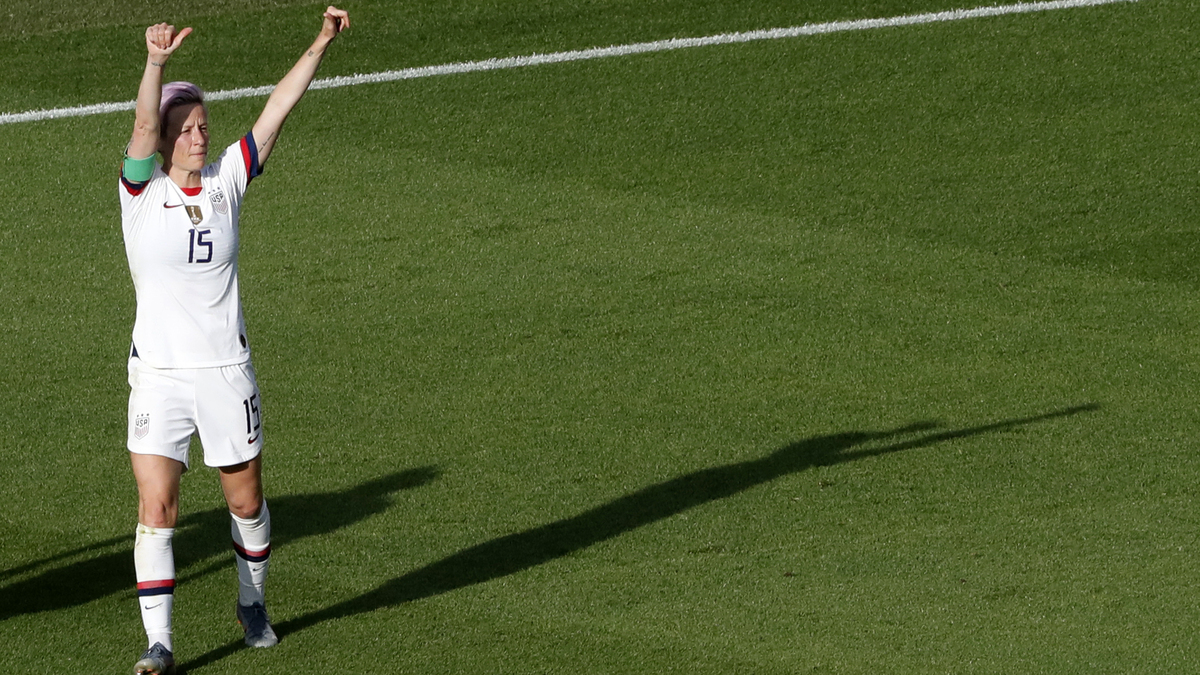
The Women’s World Cup in France has been attracting worldwide attention. The tournament has also been spurring controversy over how the referees are using video to review crucial plays.
A mass of fervent, dedicated U.S. soccer fans has taken France by storm, inspiring the more lackluster “Les Bleues” supporters, and forcing small, World Cup towns to up their game.
“We weren’t surprised that there was resistance to an all-female crew in the race …” says Tracy Edwards, who assembled the first all-female crew to enter the Whitbread Round the World Race. “But I was shocked at the level of anger there was that we wanted to do this, because why is this making you angry?”
Courtesy of Tracy Edwards and Sony Pictures Classics
hide caption
toggle caption
Courtesy of Tracy Edwards and Sony Pictures Classics
In the 1980s, Tracy Edwards dreamed of racing a sailboat around the world. But at the time, open ocean sailboat racing was a male-dominated sport. She was only able to sign on as a cook for an all-male team in the 1985-86 Whitbread Round the World Race, a grueling 33,000 mile endeavor.
Afterward, when she still wasn’t able to crew, she decided to take matters into her own hands: “My mom always told me, ‘If you don’t like the way the world looks, change it,'” she says. “So I thought, OK, I will.”
In 1989, Edwards, then 26-years-old, assembled an all-female crew to enter the Whitbread Round the World Race. The idea was unthinkable to many of the men in the world of yacht-racing, and backlash was intense.
“We had so much obstruction and criticism and anger,” she says. “Guys used to say to us, with absolute certainty, ‘You’re going to die.'”
But Edwards didn’t back down: “We all became very aware, as a crew, as a team, that we were fighting for all women, and actually anyone who’s been told they can’t do anything,” she says.
Edwards and her 12-woman crew restored an old racing yacht, which they christened Maiden, and finished the nine-month race second in their class. Now, a new documentary, Maiden, retraces their voyage.
Interview Highlights
On restoring an old racing yacht while the male crews had new boats
We found an old, secondhand racing yacht with a pedigree. … She was in a terrible state, and we put her on a ship and we brought her back to the U.K. and then I gave the girls sledgehammers and I said, “Right, take her apart,” and we did. We stripped the inside of the boat. We stripped the deck. We took the mast out. We took everything apart. …
This was also a bit of a first, because people didn’t usually see women in shipyards. So that was an interesting situation. … All these other guys had a shore team. They had brand new boats. So they didn’t really need to do any work on them. And so they’d sit in a cafe and watch us as we were putting this boat together. …
Although, as I say, there was a very nice part of that sort of, being part of this big Whitbread family, is that if you did go and ask for help, 99.9 percent of the time you would get it. You know, you might get a bit of a snide, “Ugh, you know if you need help …,” kind of thing, but you know, beggars can’t be choosers.
But the great thing about doing what we did the way we did it was we learned everything we needed to know about the boat. We put every single item into that boat, onto that boat. We painted her. We put the rig in. We did the rigging. We did the electronics, the plumbing, the [navigation] station. … So when we put Maiden in the water, I would say that we, as a crew, knew our boat better than any other team in the race.
“We were always chatting, always talking,” Edwards (left, with crewmate Mikaela Von Koskull) says of the Maiden’s voyage. “I don’t think there’s one subject that we didn’t cover in depth inside, outside and backwards.”
Courtesy of Tracy Edwards and Sony Pictures Classics
hide caption
toggle caption
Courtesy of Tracy Edwards and Sony Pictures Classics
On the media’s reaction to an all-female crew
We weren’t surprised that there was resistance to an all-female crew in the race. Sailing is one of the last bastions of patriarchy. … It is so entrenched. We’re a maritime nation. It’s entrenched in our history, in our warfare, in our culture, and it is extremely male-dominated. … So I wasn’t surprised there was resistance, but I was shocked at the level of anger there was that we wanted to do this, because why is this making you angry? We’re only going out there and doing what we want to do.
On how at the time she didn’t think of herself as a feminist — and said so in an interview — and why she changed her mind
In the ’80s, “feminist” was an accusation. It wasn’t a nice title. It had all sorts of horrible connotations, and really, it had been made into a word that women should be ashamed of — I think with deliberate reason. … I was very young. I was 23, 24 … [and] I didn’t want people not to like me. You care very much, at that age, that people like you. …
But I do remember [after that interview] my mum said to me, “I am so surprised that you don’t think you’re a feminist, and I’m not going to tell you what you should say, but I think you need to have a bit of a think about that one.”
And then when we got to New Zealand and we won that leg [of the race] and we were getting the same stupid, crass, banal questions that we had on every other leg, I just thought, you know what? I think this is bigger than us, and bigger than Maiden, and bigger than anything we’ve been tackling. This is about equality. And I think I am a huge, fat feminist. I think I absolutely am! And I stood up for the first time in my life and I said something that might hurt me and might make me not likable, and I took pride in it, and it was an extraordinary experience.
On how her experience with a male crew was different than the female crew
[Male-run boats are] very smelly. It’s very messy. There’s a lot of swearing and then there are days when guys don’t talk to each other. What is that? So that was very weird. A lot of tension, testosterone, egos. I mean, it was an interesting experience, that nine months, [the] first time and last time I’d ever been with 17 men and sort of watching them in their environments, if you like, their natural habitat. …
Then, doing an all-female crew, then I noticed, wow, there’s a huge difference between a group of women and a group of men. … I prefer sailing around the world with an all-female crew. I prefer sailing with women anyway — much cleaner. We do tend to wash, even if it was in cold, salt water. More use of deodorant as well, I have noticed. But we were always chatting, always talking. … We did talk the whole way ’round the world. I don’t think there’s one subject that we didn’t cover in depth inside, outside and backwards.
Women are kinder to each other, and in a much more obvious way. We’re actually more nurturing and caring, I think. And if you saw someone scared or worried or anxious or a bit down, there’d always be someone that would put their arm around your shoulder and say, “Cuppa tea?”
On the conditions on the Southern Oceannear the South Pole
Your body starts to deteriorate as soon as you cross the start line. Pain and cold are the quickest ways to lose weight. You can get frostbite in your fingers and toes. It’s minus 20, minus 30 degrees below freezing. You are constantly damp because salt water doesn’t dry. So the girls up on deck would be miserable — cold, wet, miserable. Freezing fingers and toes. Tons of clothing on so you can barely move. The food’s revolting. So you just shovel it down your throat as quickly as possible and and try and get as much sleep as possible with this four [hour]-on/four-off watch system. It’s also a sensory deprivation. There’s no sun. There’s no blue sky, it’s gray, and the boat’s gray, and everything’s gray.
On Maiden’s second-place finish in the Whitbread Round the World Race
Thousands of boaters cheered Maiden’s crew as they finished the round the world race.
Courtesy of Andrew Sassoli-Walker and Sony Pictures Classics
hide caption
toggle caption
Courtesy of Andrew Sassoli-Walker and Sony Pictures Classics
We came second in our class overall, which is the best result for British boat since 1977, and actually hasn’t been beaten yet, but that didn’t mean much to us at the time. When you finish a race like, that you go through a mixture of emotions. Obviously if you’re winning it’s all happiness and wonderful and fantastic. We hadn’t won; we’ve come second, and it took me a long time to come to terms with that, because second is nowhere in racing. But as Claire [Warren, the ship doctor] says in the film — and she’s very right — there was a bigger picture, and the bigger picture was what we had achieved.
On the reception when Maiden arrived in England
It was sunrise. There wasn’t really that much wind, and we were so close to … [the] final stretch, and as we were going up Southampton Water, hundreds of boats came out to meet us and they would come towards us, turn round, and start sailing with us. So the final two hours of the boat was two hours I will never forget as long as I live, surrounded by thousands of people on hundreds of boats throwing flowers and cheering. It was absolutely amazing. And crossing the finishing line we knew, OK, we hadn’t won, but we had sailed into the history books, and we are first, and you can’t beat being first to do something.
Lauren Krenzel and Thea Chaloner produced and edited this interview for broadcast. Bridget Bentz, Molly Seavy-Nesper and Beth Novey adapted it for the Web.
Keenan Reynolds (center), Baltimore Ravens’ sixth round NFL draft pick, carries his diploma during the Naval Academy’s graduation in May 2016. Trump’s order on Wednesday would allow more military graduates to defer service in order to pursue professional sports careers.
Patrick Semansky/AP
hide caption
toggle caption
Patrick Semansky/AP
President Trump is ordering the Pentagon to rewrite a rule allowing athletes to delay mandatory active service in order to play professional sports directly upon graduation.
“These student-athletes should be able to defer their military service obligations until they have completed their professional sports careers,” Trump wrote in a presidential memorandum issued on Wednesday.
Under existing Department of Defense policy, those enrolled in military academies cannot play sports before serving at least two years in the armed forces.
That requirement, Trump wrote in his memo, deprives some student athletes of “a short window” they have to take advantage of their athletic talents.
During the Obama administration, military academy athletes were able to go right into sports after graduating if they were granted reserve status. But last year, Trump’s own Defense Department revoked that policy.
“Our military academies exist to develop future officers who enhance the readiness and the lethality of our military services,” Pentagon officials wrote in May 2017 announcing rescinding the Obama-era policy. “Graduates enjoy the extraordinary benefit of a military academy education at taxpayer expense.”
Pentagon officials pointed to successful professional athletes who completed the minimum of 25 months of service before playing sports, such as Roger Staubach, Dallas Cowboys quarterback, 1963 Heisman Trophy winner and Naval Academy graduate. Staubach became a professional player after serving a tour in Vietnam.
Proponents of Trump’s order highlight cases like former Navy quarterback Keenan Reynolds, who was drafted into the NFL in 2016 after deferring his military service.
It is the first official action Trump has taken to return to the old rule following public comments indicating that the president preferred allowing graduate to defer military service in order to pursue careers in professional sports.
“I mentioned this to the coach, and it’s a big deal,” Trump said in May when the West Point football team visited the White House. “Can you imagine, this incredible coach with that little asset because I would imagine that would make recruiting a little bit easier.”
In his order, Trump said that the new policy should not be seen as a way out of active duty service.
“These student-athletes should honor the commitment they made to serve in the armed forces,” Trump said.
Trump’s memo gives the defense department 120 days to devise a new rule.
The U.S. women’s soccer team has advanced to the quarterfinals of the World Cup after a thrilling game against Spain. The U.S. on Friday will play France, which is hosting the tournament.
Members of the delegation from Milan and Cortina d’Ampezzo react after the Italian cities were named to host the 2026 Olympic Winter Games.
Philippe Lopez/AFP/Getty Images
hide caption
toggle caption
Philippe Lopez/AFP/Getty Images
The 2026 Winter Olympics and Paralympics will be held in Italy.
The International Olympic Committee voted Monday to accept the joint bid by Milan and Cortina d’Ampezzo over the runner-up, Stockholm, Sweden.
The last time Italy hosted the Winter Olympics when Turin was home to the 2006 Games. Cortina hosted the Winter Olympics in 1956.
Milan-Cortina won 47 of the committee votes cast. Stockholm won 34 votes and there was one abstention.
Stockholm’s bid included sharing some game events with the Latvian city of Sigulda. The Swedes were hoping to win the Winter Games for the first time.
“We can look forward to outstanding and sustainable Olympic Winter Games in a traditional winter sports country,” said IOC President Thomas Bach in his congratulatory message. “The passion and knowledge of Italian fans, together with experienced venue operators, will create the perfect atmosphere for the best athletes in the world.”
In the 76th minute of the game, United States’ Megan Rapinoe powered the ball low and to the left giving the U.S. a 2-1 lead.
Thibault Camus/AP
hide caption
toggle caption
Thibault Camus/AP
It wasn’t easy, pretty or elegant. But the U.S. Women’s National Team battled to beat Spain in the round of 16 at the Women’s World Cup. The U.S. had an easy road in this tournament. Until Monday. Spain, playing in its first ever World Cup, looked like it had been there many times before. But in the end, it was not enough. The U.S. defeated Spain 2-1.
Spain started aggressively and came out on the attack in the opening minute — challenging the U.S. defense. But the U.S. struck first. Tobin Heath was tripped in front of the Spanish goal for a U.S. penalty kick. Megan Rapinoe hammered the ball low and to the left in the seventh minute. But the lead did not last long.
Spain came right back after U.S. goalkeeper Alyssa Naeher made a short and ill-advised pass to Becky Sauerbrunn that Spain intercepted and led to a beautiful strike by Jennifer Hermoso to tie it 1-1 (that was the first goal the U.S. had allowed in 647 minutes of play)
Alyssa Naeher plays Becky Sauerbrunn the ball despite #ESP‘s high pressure, and the #USA pays the price. Quite a finish by Hermoso, too
Both sides battled back and forth during a tense and physical first half. U.S. forward Alex Morgan was knocked to the turf a half-dozen times (and the knockdowns of the star U.S. striker continued in the second half). It was the fourth sell-out of a U.S. game at this tournament and the decidedly pro-U.S. crowd was anxious as Spain made run after run in the U.S. backfield (and watching Spain trip up U.S. players all game long).
It’s 1-1 at the half. Spain, in its World Cup debut, is giving the 3-time-champion US team a real challenge in this round of 16. And US fans seem stunned. #USAvESP#WWC2019pic.twitter.com/wgE8VyGCEb
Spain is the toughest opponent the top-ranked U.S. had faced in the Women’s World Cup. Questions had swirled this tournament about a relatively untested U.S. defense. Spain had several chances and challenged the back line all game long but the Americans did not break.
It was in the 76th minute when the U.S. broke the tie. Rose Lavelle was brought down in the box after a light challenge by a Spanish defender that may or may not have have hit Lavelle’s leg. Megan Rapinoe took her second penalty kick of the game. And, like in the first half, she powered the ball low and to the left giving the U.S. a 2-1 lead.
In a post-match interview on FS1, U.S. Head Coach Jill Ellis looked relieved, “You can talk tactics. You can talk everything. But just the heart and the grit and the resolve. That’s a big part of World Cup soccer. No game is ever easy in this tournament. We know that. We learn that and so part of that is the mental piece and I thought we were great tonight.”
The U.S. had never lost a World Cup game when it scored first. And it had always made it to at least the semifinals in every WWC. The three-time and defending 2015 champions next play on Friday. It’s a game that’s been anticipated all tournament long: U.S. taking on host country France in the quarterfinals.
In her new documentary “Homecoming,” singer Beyoncé talked about the punishing measures she took to prepare for her two-hour show at Coachella, only a few months after she gave birth to twins:
In pre-Coachella behind-the-scenes footage, a voice off-camera — presumably Beyoncé’s choreographer, JaQuel Knight — said that she was likely burning 1,500 to 2,000 calories per day from hours of rehearsing.
“It’s true,” Beyoncé responded. “And eventually, I want to be able to do Soul Cycle, the stairs, and rehearsal in a day.”
The “Formation” singer also revealed that she followed a strict diet to get back in shape: “In order for me to meet my goal, I’m limiting myself to no bread, no carbs, no sugar, no dairy, no meat, no fish, no alcohol — and I’m hungry.”
She pushed her endurance, just as many elite athletes do every day. And the determination to work that hard may simply be a quality with which you’re born.
Numerous factors—genetic, psychological, cultural, and financial—go into making a super performer, but the right genes may be the most critical. Elite athletes, as these super performers are called, are in a sense fortunate freaks of nature.
How do you mentally prepare someone to endure the pain that comes with pushing the human body to its limits? What can people who do significantly less exercise learn from those who reach these elite achievements?
U.S. forward Megan Rapinoe throws the ball from the touch line during last week’s World Cup match against Sweden.
Damien Meyer/AFP/Getty Images
hide caption
toggle caption
Damien Meyer/AFP/Getty Images
The U.S. has shown few weaknesses in its march through the Women’s World Cup in France. But now the competition gets harder and the stakes are higher in the knockout round of the monthlong tournament. The first U.S. test comes Monday against Spain in the round of 16 (kickoff is noon ET and broadcast on FS1 and Telemundo).
The Spaniards have never been to a Women’s World Cup before. In the group stage, they opened with a victory against South Africa, a defeat by Germany and a scoreless draw with China. None of that matters in the knockout round. The winner plays on and the loser goes home.
“I feel good where we are in terms of the collective understanding of our team,” said U.S. head coach Jill Ellis at Sunday’s prematch news conference. “Obviously Spain’s a great opponent.”
Spain is not the United States, though. In the three games the U.S. has played so far, it set records for most goals scored (18) and the biggest goal differential while shutting out each of its opponents (Thailand, Chile and Sweden).
Perhaps the three biggest questions are these:
How is star forward Alex Morgan? She was tackled in the last game against Sweden and didn’t return for the second half. “Alex is fine,” Ellis said.
What about midfielder Julie Ertz who anchors the defense? She didn’t play against Sweden because of what U.S. Soccer called a “minor hip contusion.” Ellis said she’s fine, too.
Has the U.S team had enough rest? The Americans last played on Thursday (three full days of rest). While Spain last played a week ago (six days of rest).
“At this point, it is what it is,” Ellis told reporters. But she’s not concerned about it. “I think we’re very used to a three-day rhythm. It’s what we’ve done in certain tournaments. Specifically for this purpose of having a consistent rhythm in what we do. And we can’t control obviously what our opponent has.”
There has been little that has slowed the U.S. in its romp through the World Cup competition thus far. Ellis has played different lineups in each game and her players don’t seem bothered by it. “The strength of this team is that we have a lot of strengths,” said midfielder Rose Lavelle. “We’re really deep, and we don’t rely on one person to get the job done. And I think that gives us a lot of confidence moving forward.”
The U.S. is ranked No. 1 in the world and the defending 2015 WWC champions. But it has little history with Spain. The two teams have played only once before, and that was in January (a game the U.S. won 1-0). The U.S. coaching staff and the players say they’re taking nothing for granted and focusing on just one game at a time. But they’d be forgiven if they looked ahead just a little bit. The winner of this contest takes on host country France in the quarterfinals on Friday.
First, the U.S. has to get by Spain to make the matchup that has been talked about all tournament long.
The Women’s World Cup has entered the elimination quick-fire Round of 16. NPR’s Michel Martin speaks with Roger Bennett of the Men in Blazers about Team USA’s performance so far.