Cuban Baseball Players Deal With Dashed Hopes

After the U.S. canceled the deal between Cuba and Major League Baseball, many players in Cuba are left with few options for their future.


LULU GARCIA-NAVARRO, HOST:

Major League Baseball hasn’t given up on making a deal with Cuba. It’s still searching for ways to sign the island’s star players. This, after the Trump administration canceled a deal brokered by President Obama that would’ve let Cuban athletes come play in the U.S. without defecting.

MLB has hired new lobbyists, and its commissioner recently met with President Trump. But as NPR’s Carrie Kahn reports, the Cuban players are now dealing with dashed hopes and disappointment.

UNIDENTIFIED PERSON: (Speaking Spanish).

CARRIE KAHN, BYLINE: Players warm up on the field at the Latinoamericano Stadium in Havana for a hot Sunday afternoon game.

(SOUNDBITE OF BAT HITTING BALL)

KAHN: While batters take practice swings, pitcher Pavel Hernandez Bruce, with a 93-mile-an-hour fastball, says he was taken by surprise to see his name on the Cuban Baseball Federation’s list of 34 players unveiled in April.

PAVEL HERNANDEZ BRUCE: (Speaking Spanish).

KAHN: “I was just watching TV and found my name on the list,” he says. That meant U.S. Major League Baseball scouts could legally sign him up for play through the deal brokered during President Obama’s warming of relations with Cuba.

HERNANDEZ BRUCE: (Speaking Spanish).

KAHN: “It’s something I’ve always wanted,” he says, “going to play in the U.S. major leagues.”

But less than a week after the list was released, President Trump canceled the MLB deal, claiming the U.S. doesn’t do business with Cuba’s Communist leaders and that Cuba’s Baseball Federation is controlled by the regime.

(CROSSTALK)

KAHN: That topic and all things baseball are routinely discussed in the heated tones in Havana’s famous Parque Central – Central Park.

JUAN DE DIOS: (Speaking Spanish).

KAHN: “All Cubans feel destroyed now,” says Juan de Dios. “Canceling the deal was a cruel blow to the players,” he said.

But Tony Salazar, sporting a Houston Astros cap, says everyone knows the government controls Cuba’s Baseball Federation.

TONY SALAZAR: (Speaking Spanish).

KAHN: “If you play with the league, you aren’t a free agent,” he says. Salazar hopes something is worked out so the Cuban players don’t have to risk so much to make it to the U.S.

For decades, Cuban players have had to defect to make it to the U.S. majors. They travel a dangerous path through Mexico, Haiti or the Dominican Republic in the hands of a network of smugglers. MLB said the new deal would put an end to that perilous practice. And, in fact, during the first four months of this year, not one player was smuggled off the island, says Cuban sports writer Francys Romero.

FRANCYS ROMERO: (Speaking Spanish).

KAHN: “The brakes were on. The whole exodus had stopped,” says Romero, reached by phone in Miami. He says those numbers will inevitably rise again.

MLB is trying to persuade the Trump administration to reconsider the deal, but Trump officials say they won’t work with Cuba until the island’s regime stops its support of Venezuela. And that has put Major League Baseball in a tough spot, says Adrian Burgos, Jr., a history professor at the University of Illinois. He says MLB’s reputation has been stained by the smugglers who operate in the sport, but the polarizing political times don’t look favorable for a quick resolution.

ADRIAN BURGOS JR: And in the interim, it’s really those Cuban baseball defectors who will have to carry the weight of the implications of this agreement not going into effect.

(SOUNDBITE OF MUSIC)

KAHN: Back at the Havana stadium, Hernandez’s team is winning. He says he won’t defect and will stay in Cuba and keep playing. Maybe Donald Trump won’t get reelected next year, he says.

HERNANDEZ BRUCE: (Speaking Spanish).

KAHN: And with a chuckle, he says, “that’s something the whole world is hoping for.”

Carrie Kahn, NPR News, Havana.

(SOUNDBITE OF BUENA VISTA SOCIAL CLUB’S “BLACK CHICKEN 37”)

Copyright © 2019 NPR. All rights reserved. Visit our website terms of use and permissions pages at www.npr.org for further information.

NPR transcripts are created on a rush deadline by Verb8tm, Inc., an NPR contractor, and produced using a proprietary transcription process developed with NPR. This text may not be in its final form and may be updated or revised in the future. Accuracy and availability may vary. The authoritative record of NPR’s programming is the audio record.


Let’s block ads! (Why?)

3×3 Basketball World Cup

NPR’s Scott Simon talks with Kareem Maddox, who is competing in the 3×3 World Cup in Amsterdam. The relatively recent competitive sport is also now set to debut at the 2020 Olympics.


SCOTT SIMON, HOST:

You know, the last time we spoke with our friend Kareem Maddox, the former public radio announcer was playing pro basketball for a team in Poland. He’s also now a producer for Gimlet Media. And he is still shooting hoops this week at the 3×3 World Cup in Amsterdam. He joins us on the line. Kareem, good to talk to you again.

KAREEM MADDOX: Hey, you, too, Scott. Thanks for having me.

SIMON: Three on three (ph) – you like to call it 3×3 – we’ll explain is a half-court kind of basketball game. And it will debut as an Olympic sport in 2020. How is the game different?

MADDOX: Exactly. I mean, just how it sounds. You know, there’s three guys on the court for each team, instead of five. I guess a close parallel might be what they did for the Olympics, bringing in beach volleyball to accompany, you know, regular volleyball. So it’s a little bit like that.

SIMON: And you play outdoors, right?

MADDOX: Outdoors, yep, in some beautiful venues, too, yeah. Here in Amsterdam, we’re outside the Rijksmuseum, you know, one of the biggest museums in Amsterdam.

SIMON: Oh, my gosh. That’s a beautiful museum.

MADDOX: It is. It is. And…

SIMON: Don’t miss a shot and knock down a Rembrandt, OK?

MADDOX: Yeah. That’s true. We’re steering clear of the Van Gogh Museum, which is also right here.

SIMON: Yeah. Van Goff (ph) I think they say there. Listen; Kareem, you guys, the U.S. team, has been doing well, right?

MADDOX: We have been. We’re 4-0 in full play, so undefeated so far in this World Cup.

SIMON: So South Korea you were able to defeat, and then the host, right?

MADDOX: Yeah, South Korea, the Netherlands. We played, you know, the reigning champs, Serbia, and we also played Turkey. So yeah. Yeah, we had a good four games of full play.

SIMON: I understand the French team looks strong.

MADDOX: They are strong. They’re very good. There’s a lot of good teams here. I mean, this is the highest level of 3×3 in the – 3 on 3 (ph) basketball there is around the world.

SIMON: Do you feel you’re kind of in on the ground floor of a sport that’s going to become more popular around the world?

MADDOX: I hope so. I mean, it’s a lot of fun to watch. It’s fun to play. It’s very accessible. You know, you have less requirements. You don’t need a full court. You can play with a half court. You need less players. You’re not even allowed to have a coach on the floor with you.

So I think it’s, you know, it’s a great learning tool, and it’s a great sport to play and be a part of. So you know, I hope we are on the ground floor and it just continues to gain popularity after the Olympic Games next year.

SIMON: When’s your next game in this tournament, this World Cup?

MADDOX: In a few hours, actually. We play Slovenia at 7:30 your local time.

SIMON: Shouldn’t you be napping or something, or carbo-loading?

MADDOX: I was just doing both of those things. But, you know, I had to wake up from a nap to chat with you, which I’m very happy to do.

SIMON: Oh, mercy. Well, I’m sorry. Well, OK, you have a big game coming up. I thank you very much for spending time with us. How are you going to go back to podcasting after you’ve been playing hoops in front of the Rijksmuseum?

MADDOX: You know, I don’t know. I think it calls for a podcast about that very experience. But, you know, it’s great. I love juggling both. As you know, I’m a radio guy, so I want to do both always.

SIMON: All right, well, it’s wonderful to talk to you again. Good luck to you and your teammates and to everyone there.

MADDOX: Thank you. Appreciate that.

SIMON: Kareem Maddox speaking to us from Amsterdam, where he’s been competing in the 3×3 World Cup.

(SOUNDBITE OF CORY WONG’S “THE OPTIMIST (LIVE IN MPLS)”)

Copyright © 2019 NPR. All rights reserved. Visit our website terms of use and permissions pages at www.npr.org for further information.

NPR transcripts are created on a rush deadline by Verb8tm, Inc., an NPR contractor, and produced using a proprietary transcription process developed with NPR. This text may not be in its final form and may be updated or revised in the future. Accuracy and availability may vary. The authoritative record of NPR’s programming is the audio record.

Let’s block ads! (Why?)

Move Over, Goat Yoga. Alaskans Now Have Reindeer Yoga

A reindeer calf scratches its head with its hoof. Their ability to move their bodies into extreme positions was one of the reasons owner Jane Atkinson thought that reindeer would be a good fit for a yoga class.

Ravenna Koenig/KTOO


hide caption

toggle caption

Ravenna Koenig/KTOO

If you want to incorporate quality time with animals into your yoga practice, you have a lot of options these days. There’s puppy yoga, cat yoga, and perhaps the most famous — goat yoga.

Now, in Fairbanks, Alaska, there’s a new offering: a yoga class with fauna particular to the cold northern climes of the subarctic. Reindeer.

In a grassy pen at the Running Reindeer Ranch, adult and baby reindeer are milling around — grazing, nosing curiously at water bottles, and pawing yoga mats as people shake them out for class.

The air is buzzing with mosquitoes, and the sky is threatening rain, but a good two dozen or so people have shown up for this petting zoo and exercise experience.

“I’ve wanted to do goat yoga, but this is like one step up,” says Tarah Hoxsie, one of the attendees. “This is like the ultimate, OK. So while everybody’s doing goat yoga in the lower 48, we’re doing reindeer yoga, which is way cooler.”

The reindeer yoga class is a brand new offering for the ranch — it’s only the third class. They usually give natural history walking tours with the animals.

A reindeer stands in front of participants at the start of the yoga class.

Ravenna Koenig/KTOO


hide caption

toggle caption

Ravenna Koenig/KTOO

Jane Atkinson, one of the owners, does yoga herself. She thinks that reindeer are particularly well-suited to it. They’re twisty creatures — especially in the springtime when their antlers are growing and itchy, and they scratch them with their back hooves.

“So you’ll see the reindeer getting into these amazing poses,” she says, “and it’s like wow … look at this little yoga move that they do!”

One of Atkinson’s employees at the ranch, Elsa Janney, happens to also be a yoga instructor.

She starts the class with a safety talk — things like, don’t touch the reindeer’s sensitive antlers because it could hurt them.

From there, much of the class follows a typical yoga class script. But there is some extra stuff mixed in, like what Janney says after she asks the class to pay attention to the sounds around them.

“Reindeer make a click when they walk,” she says. “That is a ligament connected to two different ankle bones. That is unique to both caribou and reindeer.”

At the start of class, most of the reindeer are standing up or slowly wandering around the mats.

But as the class goes on, one by one they all lie down. Rocket, an elegant male reindeer, spreads out between the first and second rows and spends most of the class making a soft, breathy, grunting sound — like snoring.

Rocket the reindeer takes a rest during a yoga class at Running Reindeer Ranch in Fairbanks, Alaska.

Ravenna Koenig/KTOO


hide caption

toggle caption

Ravenna Koenig/KTOO

The whole thing is pretty surreal. There’s a lot of giggling. Especially when one of the reindeer relieves itself on the grass.

After class, Beth Ann Chase says she didn’t really mind sharing her mat with Rocket the lounging reindeer.

“It was awesome. It was super cool,” she says. “I could hear him snoring the whole time that I was doing it. … It definitely brought me to like, a peaceful place.”

And Diana Saverin says that trying to maintain focus was part of the workout.

“As the rain came down, the mosquitoes buzzed, and the reindeer snored, it was like, can you stay with your breath?” she says, laughing. “It’s good hard work.”

Plus, all the participants now have some kind of animal yoga bragging rights.

Let’s block ads! (Why?)

Saturday Sports: NBA Draft, Wimbledon

Even though the NBA is in its off-season, the draft this week drew a lot of attention. Plus, Wimbledon is coming up! Scott Simon talks to Howard Bryant of ESPN.


SCOTT SIMON, HOST:

Time for sports.

(SOUNDBITE OF MUSIC)

SIMON: The NBA draft, a major shake-up in the offseason, moving around the furniture. And will we ever really see the Montreal-Tampa Bay Des Rayons (ph)? Joining us now, Howard Bryant of ESPN. Thanks very much for being with us, Howard.

HOWARD BRYANT, BYLINE: Good morning, Scott.

SIMON: The NBA is in its offseason but still manages to capture a lot of attention with the draft and a lot of major stars moving around. Who do you think has suddenly gotten better?

BRYANT: Yeah. Well, it’s the greatest soap opera of the year. And it’s one of the things that the NBA has sort of mastered, which is offseason drama. Obviously, the team that got better, or that got better the fastest, was the Los Angeles Lakers. They ended up getting Anthony Davis, who’s an MVP-caliber player. He’s going to be playing with LeBron James. And suddenly, people think the Lakers are now championship material. That’s one end of the spectrum.

And then, suddenly, you have the Boston Celtics, who were supposed to be championship material. They’re losing not just Kyrie Irving, who’s not going to resign, it looks like, and Al Horford is also leaving, who’s been the anchor of that defense and the steadiest player they’ve had for years.

On the other hand, of course, everyone’s waiting to find out what Kawhi Leonard is going to do in Toronto. Will he stay? Will he go? Chances are he’s going to leave. And then, of course, with the draft a couple of nights ago, you’ve got Zion Williamson going No. 1 to the New Orleans Pelicans. All kinds of things happening.

SIMON: And Kevin Durant and Klay Thompson.

BRYANT: Yeah. They’re going to be out, though, almost the whole season, but they’re also free agents, so will the Warriors give them max contracts – both of them, 200 million apiece – even though they’re not going to play? There had been some talk that the Warriors may even max out Kevin Durant and still trade him, so who knows what the Warriors are going to look like?

Klay Thompson has made it very, very clear that despite the injury, he wants to stay there and that the Warriors have pretty much said that they’re going to reward him as well for playing his guts out. He belongs with that team. The Warriors aren’t going to be what they were, but, eventually, when those injuries are clear, they’re still going to be a really good team.

SIMON: Wimbledon begins next week. What are you watching for?

BRYANT: I’m watching for two things, and I’m really looking for Ashleigh Barty. I’m actually watching her in a couple of ways. One, she has the chance to become the first Indigenous player, obviously from Australia, to become world No. 1. She can do that tomorrow if she wins in the final at Birmingham. She can also – when Wimbledon begins, she can become the first Indigenous woman since Evonne Goolagong, also who was No. 1 in 1976.

SIMON: My favorite player as a youth, yeah.

BRYANT: Yeah, she was amazing. And she could follow up Evonne Goolagong by winning the French Open and Wimbledon back-to-back, which is what Evonne Goolagong did in 1971. Ashleigh Barty, who took a few years off from the sport to sort of rearrange her priorities and find herself and find the love of the game once again, and it’s been an amazing story. So you’re watching her. You’re also watching whether or not Serena Williams can get that elusive 24th Major.

SIMON: Is there any chance the Tampa Bay Rays are going to split time by playing in Montreal half the season?

BRYANT: Well, we’ve seen this playbook before, Scott. We’ve seen what happens when teams are trying to leverage for a new stadium. We saw this in Montreal, of all places, 10, 15 years ago when it looked like the Expos were going to leave. And so what happened? The fan base was alienated enough, and the team was trying to engineer its way out of town, and they did. And they moved to Washington, D.C. And now suddenly, 14 years later, we see what going around is coming around in the other direction. Now Tampa Bay is trying to engineer its way out of the Tampa-St. Pete area and muscle its way into Montreal.

It’s kind of cynical. It’s not great for the fan bases. Obviously, you see what happens when these teams want new stadiums and they try to find another city to leverage themselves to either get one or leave town.

SIMON: Howard Bryant, thanks so much.

BRYANT: Thank you.

(SOUNDBITE OF MUSIC)

Copyright © 2019 NPR. All rights reserved. Visit our website terms of use and permissions pages at www.npr.org for further information.

NPR transcripts are created on a rush deadline by Verb8tm, Inc., an NPR contractor, and produced using a proprietary transcription process developed with NPR. This text may not be in its final form and may be updated or revised in the future. Accuracy and availability may vary. The authoritative record of NPR’s programming is the audio record.

Let’s block ads! (Why?)

Sweet Win Over Sweden; U.S. Women’s Soccer Team Rolls Through World Cup

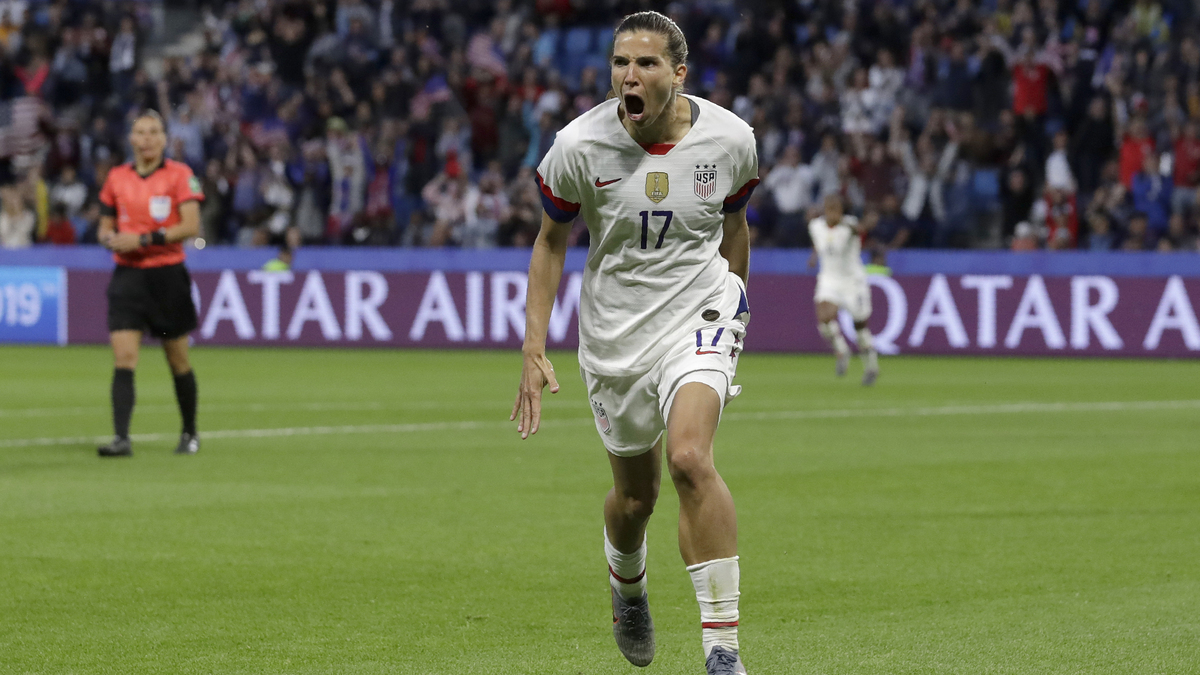
United States’ Tobin Heath celebrates after scoring her team’s second goal during the Women’s World Cup in Le Havre, France, Thursday.

Alessandra Tarantino/AP


hide caption

toggle caption

Alessandra Tarantino/AP

The U.S. got a little redemption at the Women’s World Cup with a 2-0 victory over Sweden. The U.S. powered to the win with a strong defense and relentless attack. It was the hardest game yet for the Americans and shows the team is in top form as it enters the knockout round to defend its World Cup title.

A capacity crowd of 25,000 at Stade Océane in Le Havre, France got to see a gem of a match. The U.S. was sharp and precise from the beginning. It didn’t take long for the Americans to score. In the third minute, Megan Rapinoe punched a corner kick into the penalty area. It skipped low through the box and Lindsey Horan poked it into the back of the net for the fastest goal scored in this tournament.

That didn’t take long. Lindsey Horan with a goal just two minutes in! #USASWE pic.twitter.com/TkOYTWYrLR

— Laurel Wamsley (@laurelwamsley) June 20, 2019

The second goal came in the second half at the 50th minute. Tobin Heath did some very Tobin Heath things with her footwork. Faced with a crazy angle, she blistered the ball off a Swedish defender into the goal.

.@TobinHeath: the reason ‘don’t believe me just watch’ exists https://t.co/KKQbpFxeRY

— U.S. Soccer WNT (@USWNT) June 20, 2019

This was the toughest opponent the U.S. has faced so far. At the last two games there was an assumption that the U.S. would win, this time around the only known was that some very good soccer would be played. And indeed, it was. Sweden pressured the U.S. but it was never enough.

The U.S. team was well-rested. Seven of its starters did not play in the last match against Chile. The biggest surprise was the absence of midfielder Julie Ertz. She is the anchor of the U.S. backfield and held out of competition today for precautionary reasons. U.S. Soccer said Ertz had a “minor hip contusion.” Star forward Alex Morgan played the first half but went down late and was replaced by Carli Lloyd at halftime.

Both the U.S. and Sweden had already advanced to the knockout round regardless of what happened on the field today. But this match was about bragging rights. There’s a long history between the U.S. and Sweden.

The teams have played each other 38 times going back to 1987, and they’ve faced off at five previous World Cups. The U.S.’s record in those matches is three wins, one loss and one tie.

In fact, it was at the 2015 Women’s World Cup when these two teams also squared off in the final game of group play like today. The Swedish coach then was Pia Sundhage who had led the U.S. until 2012 including Olympic gold medals in 2008 and 2012. It was also her Sweden team that knocked the U.S. out of the 2016 Olympics in the quarterfinals.

That loss still stings the U.S. Soccer program. It was the earliest the Americans got bounced from a major tournament and forced the team to change to a more attacking style of play that was both more technical and more tactical. U.S. forward Christen Press says the loss sticks with her to this day. “You don’t forget the taste in your mouth when you fail and when you lose in a world championship,” she said. “There’s a little bit of that that will definitely act as motivation. And you always play to win and to never have that feeling again.”

With the win, the U.S. will take on Spain in the Round of 16. Spain has struggled offensively and squeaked into the knockout round of the Women’s World Cup for the first-time ever. The Spaniards defeated South Africa 3-1 in the opener, then lost to Germany 1-0 and played to a scoreless draw against China. The U.S.-Spain match is Monday at noon (ET) at Stade Auguste-Delaune in Reims.

Laurel Wamsley contributed to this report.

Let’s block ads! (Why?)

David Ortiz Shooting Was A Case Of Mistaken Identity, Dominican Officials Say

Ney Aldrin Bautista Almonte, director of the Dominican Republic’s national police, projects a photograph of David Ortiz (second from right) taken on the night he was shot in Santo Domingo. Officials say a gunman shot Ortiz after mistaking him for Sixto David Fernández, not pictured.

Roberto Guzman/AP


hide caption

toggle caption

Roberto Guzman/AP

A mix-up and a bad photo contributed to a gunman shooting retired Red Sox player David Ortiz by mistake, instead of his intended target in Santo Domingo, Dominican officials announced Wednesday.

Surveillance video from the evening of June 9 shows a man who approaches Ortiz, a legend in his native Dominican Republic, and shoots him in the back at close range as Ortiz sits at a bar’s outdoor table in the country’s capital.

Next to Ortiz was his friend Sixto David Fernández, who was the actual target, said Attorney General Jean Alain Rodríguez and Maj. Gen. Ney Aldrin Bautista Almonte, director of the national police. The officials delivered an update on the shooting at a news conference in Santo Domingo.

About a dozen people have been arrested, including Rolfi Ferreras Cruz, the man police say is the gunman.

Dominican officials say Víctor Hugo Gómez, whom they describe as an associate of a Mexican drug cartel, is believed to have orchestrated the hit in an attempt to murder his cousin, Fernández. They say Gómez suspected his relative of betraying him to Dominican drug investigators years earlier.

Fernández was well-known at the upscale Dial Bar and Lounge, regularly reserving a table on Sundays, police said. Ortiz, on the other hand, rarely visited, so his appearance there came as a pleasant surprise to the other guests.

But that unexpected visit would place Ortiz at the wrong place and wrong time in what officials called “a regrettable mistake.” They point to evidence that includes mobile communications between the suspects describing Fernández’s table, along with a blurry photo taken minutes before the attack.

An accomplice, identified as Alberto Miguel Rodríguez Mota, snapped a picture of Fernández at the bar in an effort to help the gunman identify him, the authorities said. But the lighting was bad and in the image Fernández’s lower body was obscured by a white object, making it seem that he was wearing white pants. Fernández was actually wearing black pants. And Ortiz, clad in white pants, was hit with the bullet meant for Fernández, officials said.

Speaking through the bars of his Dominican jail cell last week, Ferreras Cruz told reporters that he mistakenly shot Ortiz based on information about the color of his clothing. Officials have now corroborated the claim for the first time.

Still, as The Associated Press reports, some Dominicans remain skeptical that a baseball superstar who looms large at over 6 feet tall and dresses in distinctively flashy clothing and jewelry could be confused with Fernández, who appears to be much smaller and have a lighter complexion.

Ortiz, 43, remains hospitalized in the intensive care unit at Boston’s Massachusetts General Hospital after undergoing surgery. His wife, Tiffany Ortiz, said this week that doctors have upgraded his condition to good.

Known by the affectionate nickname Big Papi, Ortiz retired from the Red Sox in 2016, after helping the team win three World Series championships. Over his near-two-decade career in the majors, Ortiz hit 541 home runs and was a 10-time All Star.

Television personality Jhoel López was also injured in the shooting at the bar; he is expected to recover.

Gómez, the alleged mastermind, remains at large and is believed to be in the United States. Attorney General Rodríguez says they have asked the FBI for help in capturing him.

Let’s block ads! (Why?)

Women’s World Cup: USA Takes On Sweden In A Game That Means Little — And Everything

The U.S. will face its first major test in the Women’s World Cup Thursday, as it plays Sweden in the final match of the group stage. U.S. forward Megan Rapinoe is seen here during the U.S. game against Thailand.

Thomas Samson/AFP/Getty Images


hide caption

toggle caption

Thomas Samson/AFP/Getty Images

The United States doesn’t have to beat Sweden in the last game of the group stage of the Women’s World Cup on Thursday. The Americans are already through to the next round, as are the Swedes.

But in another sense, the U.S. women’s national team does have to beat Sweden today in Le Havre, France — if they want to show they are the best in the world. The game starts at 3 p.m. ET and will be televised on Fox and Telemundo.

The USA and Sweden have a lot of history on the pitch. The teams have played each other 38 times going back to 1987, and they’ve faced off at five previous World Cups. The U.S.’s record in those matches is three wins, one loss and one tie.

And Sweden dealt the U.S. one especially painful defeat: knocking the Americans out of the 2016 Summer Olympics in the quarterfinals, the earliest the U.S. squad has ever left a major tournament. At the time, Sweden’s team was led by the former U.S. coach Pia Sundhage, which only added to the insult.

U.S. forward Christen Press said Wednesday that she has rewatched parts of that match in Brazil.

“You don’t forget the taste in your mouth when you fail and when you lose in a world championship,” she said. “There’s a little bit of that that will definitely act as motivation. And you always play to win and to never have that feeling again.”

In that game, Sweden hunkered down defensively and prevented the U.S. offense from getting chances. This was the match after which then-U.S. goalkeeper Hope Solo called the Swedish team “a bunch of cowards” — and thereby sealed the end of her time on the U.S. squad.

Press said that loss drove the U.S. to develop new strategies and be more mentally tough to take on an opponent like Sweden.

“As the game’s evolved, the team’s evolved,” she said. “And both technically and tactically, we’re able to do things that we weren’t able to do three years ago.”

U.S. fans celebrate during their team’s victory over Chile at Parc des Princes on Sunday in Paris.

Richard Heathcote/Getty Images


hide caption

toggle caption

Richard Heathcote/Getty Images

For both teams in today’s game, there is a question: How hard do you play in a game that you don’t need to win? How much should you risk injury, fatigue and yellow cards when you have difficult must-win games ahead?

Adding to the strategic muddle: The team that loses this game could actually have an easier path to winning the tournament. The match’s winner will likely go on to face France in the quarterfinals — a team that may be second in strength only to the U.S. squad.

The U.S. has made it clear that “going easy” isn’t one of its modes. Coach Jill Ellis and her squad have repeatedly demurred any notion that the U.S. would try anything but its best, even if that means an early encounter against Les Bleues.

“I struggle to tell my team not to tackle each other in training the day before” a match, Ellis said.

U.S. defender Abby Dahlkemper agreed: “It’s in our team’s DNA to want to win and do really well.”

The U.S.’s first two games in this tournament — a 13-0 thumping of Thailand, and a 3-0 win over Chile that would have been 6-0 if not for spectacular saves by La Roja goalie Christiane Endler — have been a showcase for the Yanks’ offensive prowess.

But the U.S. defense has so far been untested in the tournament. The team’s defenders have spent many minutes in front of the halfway line, ready to assist or score. And goalkeeper Alyssa Naeher has barely touched the ball: Thailand mustered only two shots at the goal, and Chile just one.

The U.S. team has shown itself to be skillful, experienced and packing enough talent to fill two full squads that could be the best in the world.

And it brings along one more advantage to Stade Océane in Le Havre: a huge crowd. Fans wearing USA jerseys disembarked trains from Paris on Wednesday and Thursday, ready to watch their team take on a tough opponent. U.S. players have said playing in front of so many fans cheering for them makes it feel like they’re playing a home game — even though they’re thousands of miles from home.

We do it for you @USWNT.

?: https://t.co/qMQ3HQaxPs pic.twitter.com/e5MlwSH1bZ

— The American Outlaws (@AmericanOutlaws) June 17, 2019

So, will the U.S. put on a show for all those fans? Mia Hamm, who was part of the 1999 U.S. team that won the World Cup in a dramatic penalty shootout at the Rose Bowl, said the U.S. always plays toward victory.

“You want to be world champs? You win every game,” Hamm told ESPN. “That’s the easiest way to do it. Then it’s all in your hands. This team — they’re monsters. They’re not ducking anyone. They want to play the best, they want to beat the best, to be world champions. And that’s what they’ll do.”

Let’s block ads! (Why?)

Finding Equal Footing On And Off The Soccer Field

When the U.S. team took the field against Thailand in the opening match of the FIFA Women’s World Cup earlier this month, they were battling on two fronts: on the pitch and in the courtroom.

The outcome of that first contest — a historically lopsided 13-0 drubbing by the Americans — hinted at the resolve of the 28 women who are suing the sport’s U.S. governing body over unequal pay and working conditions.

[embedded content]

Journalist Gemma Clarke says this is just the latest chapter in a long history of women fighting for equal footing in the soccer world.

In her new book, SoccerWomen: The Icons, Rebels, Stars, and Trailblazers Who Transformed the Beautiful Game, Clarke chronicles the trials and tribulations of the women who have fought for more than a century to earn the right to play the game. And she argues that the current struggle for equal treatment is about much more than soccer.

American soccer is a perfect microcosm of the pay gap: here you have a women’s team who outperform the men, who are more popular and more famous, who attract more viewers, and who still don’t get paid as much. It’s not even as though they’re asking for more, just to be paid equally. This is how women’s soccer has become integral to the fight for gender equality.

Women’s soccer transcends sport; from the beginning, it has been essential to the struggle for female selfhood.

While the U.S. men’s team failed even to qualify for the last Men’s World Cup, the women’s team has dominated the modern era. Winners of three of the seven World Cups since the women’s championship began in 1991, they entered this year’s tournament a favorite to repeat. The team is so stacked with talent that two-time world player of the year Carli Lloyd isn’t even a starter.

After their dominating win over Thailand, the U.S. women faced criticism from some commentators for not taking it easy on their outmatched opponents. In their next game, a somewhat harder-fought 3-0 win over Chile, Lloyd celebrated one of her two goals with a tongue-in-cheek golf clap.

Carli Lloyd, still a scorer of top-class #FIFAWWC goals

(via @FoxSoccer) pic.twitter.com/F8Oszxgxzv

— Planet Fútbol (@si_soccer) June 16, 2019

The lawsuit, filed in March, seeks to force the U.S Soccer Federation to address the “institutionalized gender discrimination” that results in better pay, travel, medical care and other treatment for the men’s team — despite the women bringing in more revenue in recent years.

Those problems extend beyond the United States. Norway’s Ada Hegerberg, reigning winner of the Ballon d’Or as the world’s best player, left her national team over complaints about the treatment of female athletes. Although the Norwegian women’s and men’s teams are now paid the same, she’s sitting out this year’s World Cup.

As if to make her point even clearer, after Hegerberg accepted the award, the male presenter jokingly asked if she could twerk. She replied with a blunt “no” before delivering a speech calling on girls to “believe in yourself.”

With the World Cup in full swing, we talk with Clarke about the book she calls “a love letter to soccer in its purest form” and where the sport — and the fight for equality — will go from here.

Text by Orion Donovan-Smith. Produced by Gabrielle Healy.

Let’s block ads! (Why?)