Tiger Woods Wins 2019 Masters

In a surprise comeback, Tiger Woods wins his first major title in more than a decade.
In a surprise comeback, Tiger Woods wins his first major title in more than a decade.

Tiger Woods won his fifth Masters title at Augusta National Golf Club on Sunday, nearly 11 years after his last major win.
Kevin C. Cox/Getty Images
hide caption
toggle caption
Kevin C. Cox/Getty Images
Tiger Woods won his fifth Masters title on Sunday, marking an incredible comeback from injury and personal hardship that ended a nearly 11-year-long championship drought.
Woods finished the final round of his 22nd Masters appearance 13 under par, winning the tournament by a single stroke over Xander Schauffele, Dustin Johnson and Brooks Koepka, who were tied for second place.
Sunday’s win at Augusta National — where Woods won his first major in 1997 — was his 15th time winning a major. Prior to Sunday, Woods hadn’t won a major championship since his victory at the U.S. open in 2008.
With five Masters titles, he is now just one victory away from tying the record for most Masters wins held by American Jack Nicklaus, who has six. The victory also brought Woods closer to tying Nicklaus’ record of 18 major championships.
“THE RETURN TO GLORY!”
Tiger Woods wins the Masters for the 5th time. pic.twitter.com/u3cNdQm6MG
— CBS Sports (@CBSSports) April 14, 2019
The win capped a stunning professional comeback for Woods, who has faced crippling back and leg injuries that led to multiple surgeries and nearly ended his professional golf career. In 2017, he underwent a spinal fusion, his fourth back surgery, with hopes of alleviating the pain.
It was also his first victory at a major since a series of personal troubles that began in 2009 pushed Woods to take a break from the sport.
As the final round of the tournament got off to an early start Sunday morning due to bad weather, it wasn’t clear that Woods would come back from two strokes behind, but he did.
“I was just trying to plod my way along the golf course all day, then all of a sudden I had a lead,” Woods said after his victory. “Coming up to 18, it was just trying to make a five. When I tapped the putt in — I don’t know what I did. I know I screamed.”
As the ball went in, the crowd erupted into applause and chants of “TIGER! TIGER!”
Chris Davis of the Baltimore Orioles on Saturday succeeded breaking out of his 0-for-54 hitless streak.
SACHA PFEIFFER, HOST:
Yesterday afternoon, Baltimore Orioles first baseman Chris Davis ended a Major League Baseball record-breaking streak – a streak no baseball player ever wants to be part of. When he stepped to the plate in the first inning at Fenway Park in Boston, Davis had gone 0 for 54. He hadn’t gotten a hit since last September. Then with a count of one ball and no strikes, Red Sox pitcher Rick Porcello offered him up something – a thigh-high fastball on the inside corner of the plate.
(SOUNDBITE OF ARCHIVED RECORDING)
UNIDENTIFIED ANNOUNCER: Porcello out of the full windup – Davis is going to get one. Base hit into right field. Mancini will score. Smith will score. RBIs – one and two. And for Chris Davis, it’s over, baby.
PFEIFFER: Even though Davis was playing in a hostile territory of Fenway, the crowd joined the announcers in the excitement of seeing his burden finally lifted. And then, kind of as a joke or maybe not, Davis did what most major leaguers do when they’ve reached a milestone. He asked for the ball.
(SOUNDBITE OF MUSIC)
Copyright © 2019 NPR. All rights reserved. Visit our website terms of use and permissions pages at www.npr.org for further information.
NPR transcripts are created on a rush deadline by Verb8tm, Inc., an NPR contractor, and produced using a proprietary transcription process developed with NPR. This text may not be in its final form and may be updated or revised in the future. Accuracy and availability may vary. The authoritative record of NPR’s programming is the audio record.
ESPN’s Howard Bryant talks with Scott Simon about the start of the NBA playoffs and some of the story lines from the early days of baseball season.
SCOTT SIMON, HOST:
Politics, policies, yada, yada. Time for sports.
(SOUNDBITE OF MUSIC)
SIMON: Two weeks into the baseball season, the standings look upside-down. And the NBA says so long to a couple of legends. Playoffs begin today with – what? – without LeBron. Howard Bryant of ESPN joins us. Hi, Howard.
HOWARD BRYANT, BYLINE: Good morning, Scott. How are you?
SIMON: I’m fine, thanks. But for the first time since 2005, LeBron James is not leading a team into the playoffs. Notice how I managed to make him the lead anyway?
BRYANT: He’s still the news. But the real news in the NBA, of course, is the same question we’ve been asking for about – what? – four years now.
SIMON: Yeah.
BRYANT: Can anybody beat the Golden State Warriors four times? I’m still unconvinced. I know that the Cleveland Cavaliers did it once, but I think the answer is no. I think they’re going to win their third straight championship. However, that does not mean that there’s not a lot of intrigue in here. I like the Milwaukee Bucks, as well. They had the best record in the NBA…
SIMON: Howard…
BRYANT: …Won 60 games.
SIMON: Howard…
BRYANT: Fear the deer.
SIMON: Fear the deer.
BRYANT: (Laughter) I knew that was coming.
SIMON: I love that. Yes, exactly.
BRYANT: We also want to know if the Boston Celtics can turn their disastrous season on – I mean, I know winning 49 games is not really disastrous, but still. They were supposed to be in Milwaukee, in the Warriors’ class, but they weren’t. I think it’s going to be interesting, also, to see what the Philadelphia 76ers do and also those Toronto Raptors, who were flustered by LeBron all those years. But now they’ve got Kawhi Leonard, and LeBron’s not here. So I think that the postseason’s going to be really interesting.
SIMON: Two great players and classy guys – Dwyane Wade of the Miami Heat, Dirk Nowitzki of the Dallas Mavericks – have played their last game. How should we remember their careers?
BRYANT: Great, great players, and I think that this is – I’m an ’80s guy, of course. And I think when you look at the number of Hall of Famers that came out of that decade, I think that the numbers still show it was a pretty amazing decade. But this is a golden age, as well. I think that looking at Dirk and Dwyane Wade – met for a championship twice – in 2006, with the Heat winning that one, although I think Dallas should’ve won that one; and then, of course, in 2011 when – LeBron’s first year in Miami – Dallas winning that one when, of course, people thought Miami should’ve won that one.
So two phenomenal players – lovely that Dirk played 21 years with one team, which you don’t really see anymore. And I think that both of these guys are going to be remembered as the icons for their cities that they were – and also, Dirk, especially, in terms of growing the international game – coming in from Germany; changing the perception, in a lot of ways, of what European players could be; and also, really immersing himself in the culture in Dallas. He’s the greatest player they’ve had.
SIMON: Come into the studio this morning – Stu Rushfield, our technical director, has a scrap of west – wastepaper on our…
BRYANT: (Laughter).
SIMON: …On my reading stand showing the New York – and can’t – Mets – thought they played basketball – in first place. The Cubs – well, not doing well, although they beat the Angels last night. What’s going on? The standings seem upside-down.
BRYANT: Yeah, what’s up with your ball club, Scott Simon? The Cubs are a really interesting team because I think when they won it in 2016, I think people were expecting a long run of success. And now Joe Maddon didn’t get his extension, so you’re starting to wonder what is – what his future’s going to be.
I think when you’re looking at the Mets, obviously, they’re 9-4. They’re in first place and ahead of the Phillies by a game. I think the Red Sox, the defending world champions in the crazy American League East – there’s only one team in that division that has a winning record, and it is the Tampa Bay Rays. The Yankees don’t have any players right now.
I think it’s fascinating. It’s – and it’s good. This is one of the things that makes baseball different. It’s a sprint up – it’s not a sprint. It’s a marathon. It’s going to take a long time. You’re starting to wonder, do these teams have what it takes to just be there? Even at the All-Star break, what are they built for? But when you start the season, it is kind of interesting that the San Diego Padres are in first place. It’s not what we’re used to.
SIMON: Howard Bryant, thanks so much.
BRYANT: Thank you.
Copyright © 2019 NPR. All rights reserved. Visit our website terms of use and permissions pages at www.npr.org for further information.
NPR transcripts are created on a rush deadline by Verb8tm, Inc., an NPR contractor, and produced using a proprietary transcription process developed with NPR. This text may not be in its final form and may be updated or revised in the future. Accuracy and availability may vary. The authoritative record of NPR’s programming is the audio record.

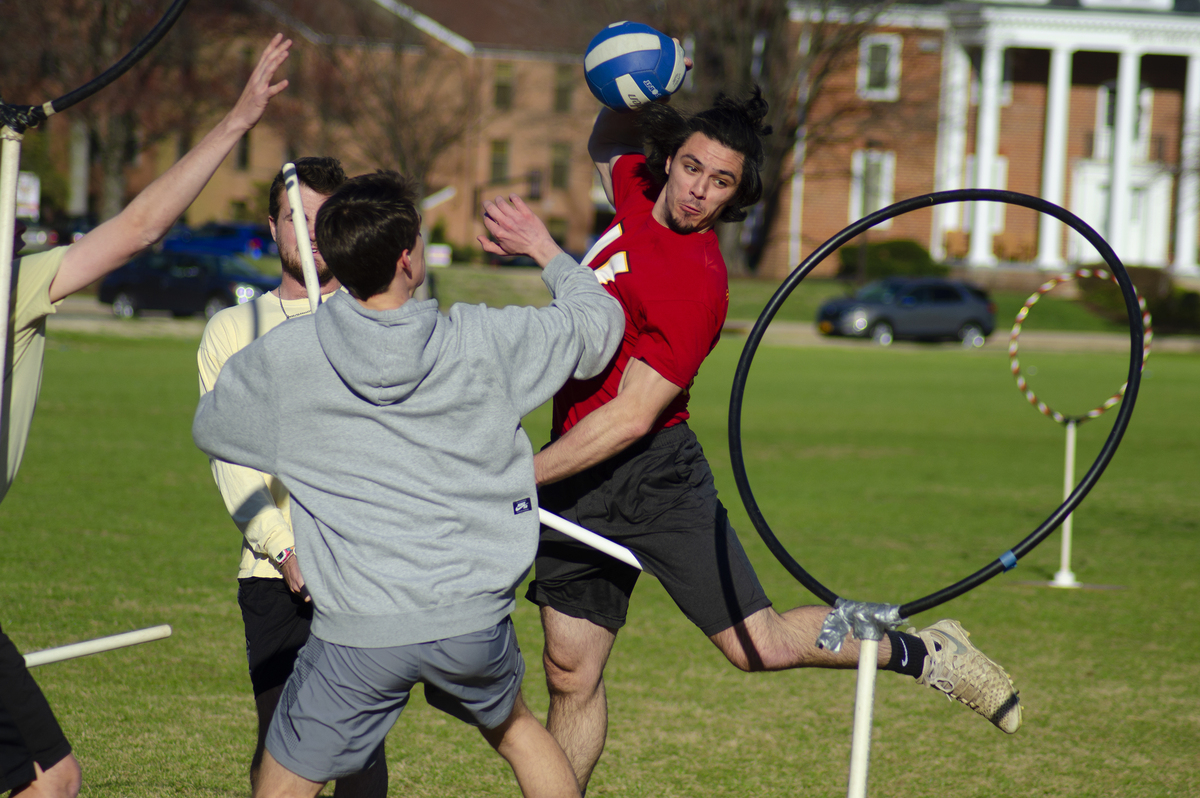
Quidditch is a fast-paced, co-ed, full-contact combination of dodgeball, rugby and basketball. Above, John Sheridan tries to score points by throwing a quaffle ball through the other team’s hoop.
Noah Fortson/NPR
hide caption
toggle caption
Noah Fortson/NPR
It happened in a split second, and Vanessa Barker doesn’t remember any of it. She doesn’t remember dropping to the field, nor does she remember how she got hit.
When she came to, she was sitting on the sidelines with an EMT, being evaluated for what turned out to be her first concussion. Over the next two years, she’d suffer another two more while out on the field — hardly what she expected when she decided to start playing quidditch.
Before 2005, quidditch existed only as a creation from the fictional world of Harry Potter — a pastime for witches and wizards on flying broomsticks. But charmed by the game’s allure, students at Middlebury College in Vermont held the first real-life quidditch match, a fast-paced, co-ed, full-contact combination of dodgeball, rugby and basketball.
Vanessa Barker of the University of Maryland has suffered three concussions while playing quidditch.
Noah Fortson/NPR
hide caption
toggle caption
Noah Fortson/NPR
Nearly a decade-and-a-half later, participation has grown dramatically, with teams sprouting up in communities and college campuses across the country. The sport has its own governing body, U.S. Quidditch, with 134 teams already registered this season and another five to 10 more added each year.
But as teams gather in Texas this weekend for U.S. Quidditch Cup championship, players, coaches and officials are increasingly grappling with how to minimize risk in a game where the potential for injury has become more and more apparent. Many have come to realize it’s not just scrapes and bruises — it’s also broken bones, and for players like Vanessa Barker, repeat concussions.
“If I ever have any others, I’ll have to stop playing,” she said.
The real life game of quidditch is similar to the fictional sport, sans the flying broomsticks. To make up for that, players run with a piece of PVC pipe between their legs, sprinting up and down the field with as many as five balls in play at a time.
There are seven players to a team. Three “chasers” try to score a volleyball through hoops on both sides of the field, each set defended by the opposing team’s “keeper.”
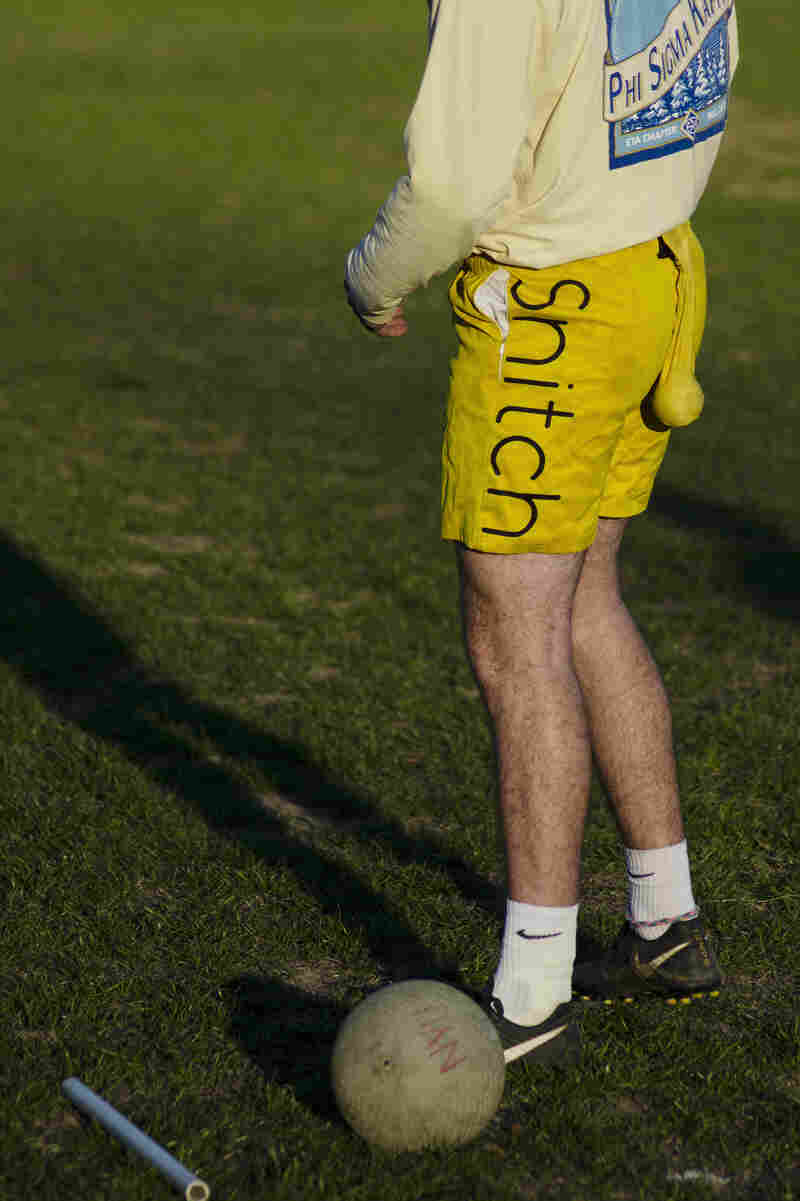
Just as with the rules of quidditch from the Harry Potter series, in real-life quidditch, once a seeker catches the snitch, the match is over.
Noah Fortson/NPR
hide caption
toggle caption
Noah Fortson/NPR
While the chasers focus on scoring, two “beaters” try to stop them by either tackling them or throwing dodgeballs at them. Meanwhile, a seventh player, the “seeker,” goes after the ultimate prize: the snitch. Once a seeker catches the snitch, the match is over.
Matches can be intense. Players run at full-speed without any required protective equipment other than a mouthguard. And because the game is co-ed, players of all gender are tackling each other.
Barker is a beater on the University of Maryland quidditch team. This means she often competes against other beaters to get the dodgeballs, or “bludgers,” that they use to heave at chasers. At 5 feet, 2 inches tall, she’s the shortest person on her team. Male players sometimes tower a foot over her.
“I’ve gotten egregiously tackled many times, where they tackle me too hard for no reason,” she said.
Barker said her second concussion happened when she was tackled by a 200-pound male during tryouts. She got another when a male beater hit her in the head with the bludger, but without letting the ball go, essentially punching her in the head.
On the field, Barker has seen a range of other injuries. During her freshman year, she said the president of her team broke his collarbone twice.
“I’ve seen broken thumbs, broken noses, broken collarbones,” Barker said.
Amelia Gurley, a former quidditch player, has seen these types of injuries too — particularly as the sport has grown more competitive. A medical student at Brown University, Gurley is now trying to answer a fundamental question: how dangerous is quidditch really? In February, she began work on what she hopes to be the first international quidditch injury survey.
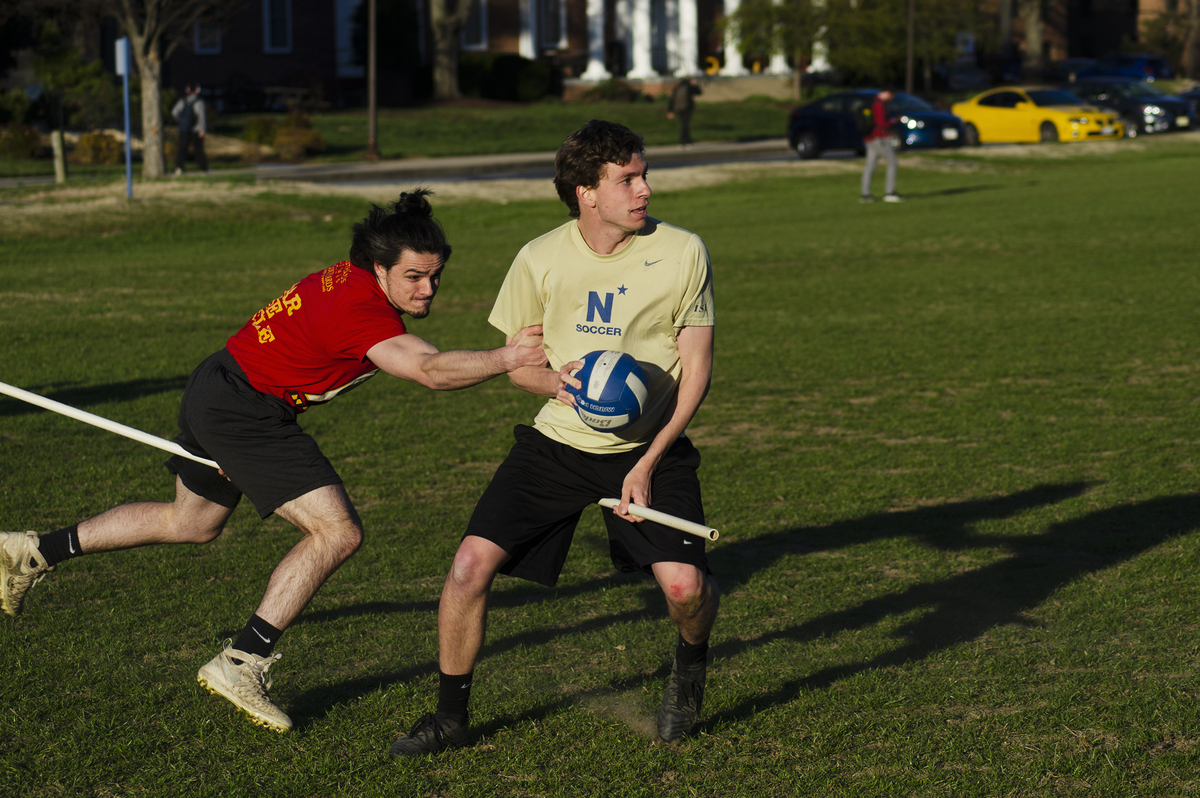
John Sheridan (left) lunges to steal the ball from Dan Reise.
Noah Fortson/NPR
hide caption
toggle caption
Noah Fortson/NPR
“I worry,” she said. “We’re a new sport. No one’s really even looking into this.”
To date, the most comprehensive data comes from a 2017 study by researchers at the University of Edinburgh who surveyed roughly 50 percent of all quidditch players in the United Kingdom.
The study revealed a mixed picture. While overall injury rates were no higher than in other recreational sports, concussions accounted for more than 20 percent of all injuries. That made concussions the second most common injury overall, according to Ashley Cooper, one of the study’s authors. Sprains were the most common injury, at roughly 26 percent. Lacerations, at about 18 percent, were the third most common injury type.
The authors called the study’s concussion numbers “relatively high when compared to other full contact sports.” For comparison, the study noted that the concussion rate in professional rugby was between 3 percent and 10 percent of all injuries.
Caleb McConnon rubs his neck during practice. According to a study by researchers at the University of Edinburgh, concussions account for more than 20 percent of all injuries in quidditch. Above, players stretch during a quidditch practice at the University of Maryland.
Noah Fortson/NPR
hide caption
toggle caption
Noah Fortson/NPR
Men and women are injured at roughly the same rate, according to the study, but women experienced concussions at nearly double the rate as men.
There are still no studies of injuries in U.S. Quidditch, making it difficult to tell how safety compares in the U.S., where thousands play the game, and the U.K., where the number of players is estimated in the hundreds.
USQ declined to provide specific injury data, but Sarah Woolsey, its executive director, said the league was aware of the concussion risk and noted that medical personnel are required to be present at every official USQ game.
“Every single certified coach in our league is required to complete a concussion training webinar,” Woolsey said. “If any player is suspected of having a concussion … they’re immediately removed from play and cannot return to play unless they are cleared by a medical professional.”
For newcomers to quidditch, the physical nature of the game can be eye-opening.
“I thought it’d be a load of super fans with scars on their heads running around the field,” said Cooper, referring to Harry Potter’s trademark scar.
A quidditch player himself, Cooper said he got “absolutely battered” playing the game. “I thought if it was contact it’d be these asthmatic nerds running around and it wasn’t.”
Now, many players are starting to think more seriously about whether the rules of quidditch need to be reevaluated
One of the biggest debates in the sport is about tackling technique. USQ rules only allow one-armed tackles, but some players have begun to wonder whether two-arms would be safer.
“When you have the broom in one hand and you’re trying to make a tackle, it makes it awkward, you have to twist or fall backwards and throw them over you,” said Mack Morgan, a co-captain of the University of Maryland quidditch team. “With a two hand tackle there’s never really going to be that twisting motion.”
Morgan said that many of the injuries he sees on the field — like torn knee ligaments, broken collarbones and concussions — come from that twisting motion.
Woolsey declined to say whether USQ was considering two-armed tackles, but pointed out that USQ players are required to sign a waiver that states that quidditch is a full contact sport.
Another topic of debate is the co-ed nature of the game and whether it’s safe for differently gendered people to be tackling one another — not only because players don’t wear protective padding, but also because of the size differences between players.
“One of the parts of the rules deals with reckless or excessive force,” Woolsey said. “Our athletes understand it might take a different amount of force to tackle somebody who is smaller versus somebody who is bigger.”
Many players say they’d be reluctant to eliminate co-ed play. Many say they were drawn to the sport because of how inclusive it is for people of all genders, including those who identify as nonbinary.
“It’s nice being able to play sports with people of all genders and all backgrounds,” Gurley said.
University of Maryland quidditch co-captain and chaser/keeper Mack Morgan catches his breath after a competitive team scrimmage.
Noah Fortson/NPR
hide caption
toggle caption
Noah Fortson/NPR
Rules are typically updated every year, Woolsey said, based on feedback from players and internal data about injuries gathered at every official USQ game.
She said she thinks quidditch is approaching a point where the rules are more permanent, but will still probably change a bit.
“Even sports that have been around for over a hundred years make changes,” she said.
Members of the University of Maryland quidditch team gather at the end of a recent practice. Though research is limited, some who play the game are starting to think more seriously about whether the rules of the sport need to be reevaluated.
Noah Fortson/NPR
hide caption
toggle caption
Noah Fortson/NPR
But as Gurley from Brown University pointed out, there are still many quidditch teams across the country that are not affiliated with USQ. So even if USQ were to make changes, those would not necessarily have any impact for players on non-USQ teams.
Gurley’s former team, the Providence Ashwinders, is not an official USQ team, so it doesn’t need to abide by USQ regulations. Once, she remembers a game that her team played where an EMT was not present until halfway through the tournament.
“Different people in different places are playing quidditch differently, which can be great,” Gurley said. “But it can also be dangerous when it comes to things like safety … We’re not wizards. We can’t fix that kind of stuff with a wave of our wands.”
Finn, a black lab, is a bat dog for the Minor League Las Vegas Aviators. Finn was dashing to the plate, but an umpire beat him there and tossed the bat aside. Fans were not happy and booed the ump.
NPR’s Ailsa Chang speaks with sports radio host Donovan Lewis about Dirk Nowitzki’s 21-year NBA career with the Dallas Mavericks after his final home game.

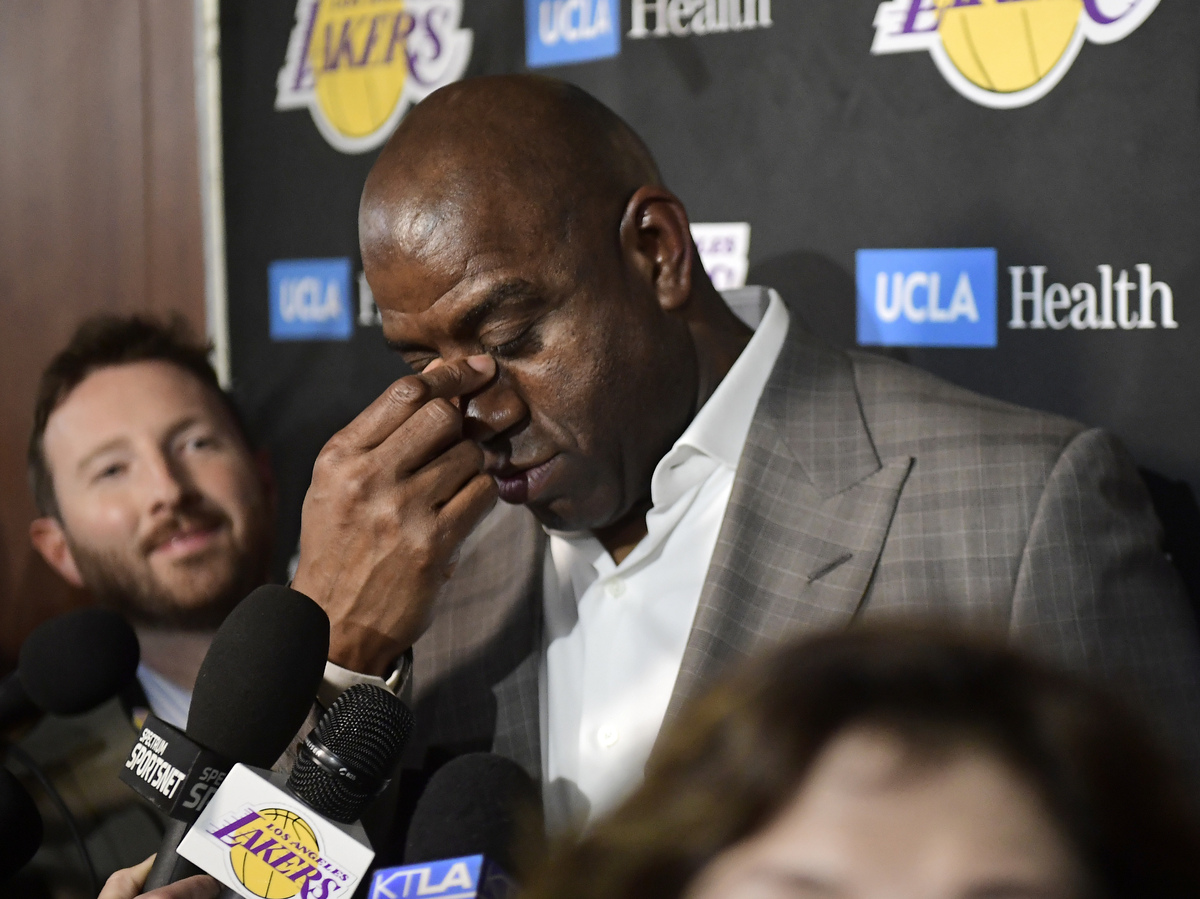
Magic Johnson fought back tears while he broke the news of his resignation from the LA Lakers on Tuesday. He said he hadn’t told his boss yet because he knew he would cry “like a baby.”
Mark J. Terrill/AP
hide caption
toggle caption
Mark J. Terrill/AP
Magic Johnson isn’t having fun anymore.
“Today, I’m going to step down as president,” the former NBA superstar told a gaggle of reporters on Tuesday night, about an hour and a half before the Los Angeles Lakers played their last game of the season. “I was happier when I wasn’t the president.”
Johnson has served as the team’s president of basketball operations for more than two years — the latest move in a long and successful career as a businessman and philanthropist after he first retired in 1991 when he tested positive for HIV. He came back to be part of the U.S. Olympic “Dream Team” in 1992 and then again to play for the Lakers in the 1995-96 season.
His resignation came out of the blue; on Monday, Johnson had a three-hour meeting about the team’s future after its sixth consecutive losing season, the Associated Press reported.
Reporters and basketball fans weren’t the only ones to find out about his resignation late in the game.
“Somebody’s gonna have to tell my boss,” Johnson told reporters.
His boss is Lakers controlling owner Jeanie Buss, who hired Johnson just over two years ago after she dismissed her brother Jim, who was vice president of basketball operations, and General Manager Mitch Kupchak in an effort to change things up after multiple losing seasons.
Magic Johnson is conducting an impromptu press conference and just stepped down as Lakers president. He said he loves Jeanie Buss like a sister.
— Dave McMenamin (@mcten) April 10, 2019
Johnson said he just couldn’t face Buss, who he called “my sister.”
“Have you really not told Jeanie yet?” a reporter asked.
“No, I haven’t. I couldn’t,” he answered. “She doesn’t know I’m standing here because I knew I would be crying like a baby in front of her.”
The Hall of Famer barely kept it together in front of the press: “I’m about to cry now,” he said.
When his boss inevitably heard the news, the Lakers issued a statement thanking Johnson for his time with the team. “There is no greater Los Angeles Laker than Earvin Johnson,” the statement said. “He will always be not only a Lakers icon, but our family.”
Buss also tweeted her thanks:
Earvin, I loved working side by side with you. You’ve brought us a long way. We will continue the journey. We love you ?? https://t.co/ofmQl6BtBz
— Jeanie Buss (@JeanieBuss) April 10, 2019
But not everyone thought Johnson was good for the Lakers.
“It’s a mess,” sports anchor Rob Parker said recently, calling him “tragic Johnson.”
“Nobody … thought that the Lakers wouldn’t make the playoffs when LeBron James came here, even with the injury,” Parker said.
James, who joined the LA team in July of last year, didn’t comment on Johnson’s resignation on Tuesday.
LeBron James didn’t address the media and had his security try to stop reporters who came near him. LeBron on the phone: “Crazy, crazy, crazy.” Yep. pic.twitter.com/PObznj26Rd
— Arash Markazi (@ArashMarkazi) April 10, 2019
Johnson didn’t give any specific reasons for his decision to quit.
He said he’s happy with where the team has gone during his two years. “We’re halfway there with LeBron coming back,” Johnson said. “I think this team is going to be in the position to really contend for a championship with the growth of the young players.”
The Lakers ended their season with a loss to the Portland Trail Blazers on Tuesday night, after being eliminated from the playoff race last month.
They used to be a top team, with 16 NBA titles. But they haven’t made the playoffs in six years.
Johnson said he is not stepping down because of differences he’s had with the team’s coach of three years, Luke Walton.
“I like Luke a lot,” Johnson said. “We have different opinions about different things — that’s OK.”
It’s been widely reported that the Lakers were expected to dismiss Walton at the end of the regular season.
Walton told reporters he didn’t know Johnson was planning to quit. “I found out the same time as you guys,” the coach said at a press conference after the team’s Tuesday night game.
However, Johnson did suggest vaguely that his departure had to do with an upcoming confrontation.
“Tomorrow, I would have to affect somebody’s life — ruin their life,” he said. “That’s not fun for me, that’s not who I am.”
Delivering bad news — that’s one of the job requirements Johnson said he doesn’t like. He talked about the challenge of having to trade players that he likes.
Magic Johnson just gave the longest, strangest, greatest “I’m stepping down” press conference I have ever witnessed. Just beautifully bizarre and completely contradictory. None of it made sense – except he is now so happy & so relieved to be going back to his old life.
— Skip Bayless (@RealSkipBayless) April 10, 2019
Johnson would rather be on the other side of things, helping mentor players such as tennis champion Serena Williams and the Philadelphia 76ers’ Ben Simmons.
But NBA rules prevent teams — including players, coaches and management — from doing anything that might entice a player away from another team they’re under contract with. Mentoring another player can be construed as tampering.
Johnson has been investigated by the NBA for tampering four times, including for his response to a mentoring request from Simmons in February. Also this year, Johnson incurred a $500,000 fine for “impermissible contact” with Oklahoma City Thunder player Paul George’s agent, and another $50,000 for praising Milwaukee Bucks player Giannis Antetokounmpo.
Johnson said he’s had enough of the tampering charges. “I can’t help young men who want me to help them,” he said. “I don’t like that; I like to be free.”
He also said he was tired of “the backstabbing and the whispering” associated with his leadership position.
“What am I doing? I’ve got a beautiful life,” said Johnson, laughing. “So I’m gonna go back to that beautiful life.”
David Greene talks to USA Today sports columnist Christine Brennan about the historic women’s golf tournament in Augusta, Ga. It’s the first time women have been allowed to compete at the club.
The famed Santa Anita racetrack in southern California is under scrutiny after a spike in thoroughbred deaths. Santa Anita hosted its biggest race day of the year this past weekend.