Saturday Sports: College Basketball, Baseball Begins, NFL Pass Interference Rule

We look at the season openings of Major League Baseball, the NCAA tournaments and all the latest sports news.


SCOTT SIMON, HOST:

Going to take a deep breath because it’s time for sports.

(SOUNDBITE OF MUSIC)

SIMON: Spring has sprung. The flowers bloom but not in Chapel Hill this morning. Not only did UNC lose, but Duke won. NPR’s Tom Goldman joins us. Good morning, Tom.

TOM GOLDMAN, BYLINE: Hey there, Scott.

SIMON: Auburn, seeded five, defeated the No. 1 seeded Tar Heels, and they didn’t have to sweat too much either, did they?

GOLDMAN: They really didn’t. And No. 1 fan and former star and March Madness broadcaster Charles Barkley – that’s a lot of titles – gets happier and happier. Auburn need…

SIMON: He’s also bald, too. OK. But go ahead.

GOLDMAN: (Laughter) Four titles.

SIMON: Yeah.

GOLDMAN: Auburn was the lower seed (laughter), but they were the better team, surged pass the Tar Heels in the second half for a 97-80 win. But there is a lot of concerns, Scott, about the team’s best player. Forward Chuma Okeke – his knee buckled on a drive to the hoop in the second half. He had to be helped off. And it looks like a serious injury.

SIMON: And Duke won, but they barely held on against Virginia Tech.

GOLDMAN: Man, for a second straight game, Virginia Tech had a chance to tie at the end of regulation, missed a point-blank shot, I mean, from a foot. And Duke escaped – reminiscent of that second round game, a classic versus Central Florida. Remember that when Central Florida had two chances to win at the end, but the ball just would not go in?

Last night, Duke also had to deal with an injury issue. One of its star freshmen, Cam Reddish, didn’t play because of a sore knee. So Duke’s other super freshmen, including the superest (ph) of them all, Zion Williamson, did just enough to move this team to the Elite Eight versus Michigan State. Scott, I should say this Duke team may be a bunch of one-and-done players, you know, in college for a year before moving on to the pros, but they’re getting a college career’s worth of NCAA tournament experience.

SIMON: Over on the women’s side, UConn got a scare against UCLA, didn’t they?

GOLDMAN: Yeah, the Huskies did. UCLA’s a good team, and UConn held on for an 8-point win. You know, there was some surprise going into the tournament that UConn was only a 2 seed. UConn had been a 1 seed every year since 2006, but the Huskies haven’t looked as strong as this tournament’s No. 1s. Louisville, Mississippi State, Baylor, Notre Dame, those teams have – they’ve been cruising, winning easily by double digits each game – each of their games. You know, there’s no real March Madness in the women’s tournament – meaning major upsets in the women’s tournaments so far.

SIMON: Yes. March method it seems to be.

GOLDMAN: Right. Right. Exactly. But, you know, that just means the excitement comes in the later rounds when all of the best, the 1s and the 2s, get together and start to play each other.

SIMON: Major League Baseball started again this week on North American soil.

GOLDMAN: Yeah.

SIMON: Chicago Cubs are undefeated after two games. I’m willing to call it a season right now.

GOLDMAN: Sure, Scott. At 1-0, the Cubs already have a death lock on the NL Central division. Even though they’re tied with Cincinnati, no way the Reds keep up as Chicago builds to its inevitable 162-0 record this season, right?

SIMON: San Diego Padres might be for real this year – right? – not just moving to Montreal or Mexico, but they might be a real factor.

GOLDMAN: The Padres are off to their best start since 2011, and here’s what’s to like about them. A small market team that’s made it clear it wants to win now, which is not always the case with major league teams these days. In fact, it’s a real sore point between management and the union. The players say a number of teams aren’t spending enough on rosters. But they’re doing that in San Diego. They paid Manny Machado $300 million over 10 years. They want to win now, and the Padres should be fun to watch.

SIMON: NPR’s Tom Goldman, thanks so much.

GOLDMAN: You’re welcome.

Copyright © 2019 NPR. All rights reserved. Visit our website terms of use and permissions pages at www.npr.org for further information.

NPR transcripts are created on a rush deadline by Verb8tm, Inc., an NPR contractor, and produced using a proprietary transcription process developed with NPR. This text may not be in its final form and may be updated or revised in the future. Accuracy and availability may vary. The authoritative record of NPR’s programming is the audio record.

Let’s block ads! (Why?)

Friday News Roundup – International

So. Brexit. Will it happen?

Yesterday, members of Parliament voted down eight different options for Brexit — including a no-deal Brexit.

Prime Minister Theresa May also said she would resign once Parliament accepted a deal.

Will the members of Parliament and the European Union be able to agree on a deal? And if they don’t, and a hard Brexit happens, what could be the economic effects?

Facebook banned white nationalist and white separatist rhetoric this week, following a livestreamed massacre at two Christchurch, New Zealand, mosques.

More details from Vice’s Motherboard:

Specifically, Facebook will now ban content that includes explicit praise, support, or representation of white nationalism or separatism. Phrases such as “I am a proud white nationalist” and “Immigration is tearing this country apart; white separatism is the only answer” will now be banned, according to the company. Implicit and coded white nationalism and white separatism will not be banned immediately, in part because the company said it’s harder to detect and remove.

Motherboard also learned that the social platform would “begin directing users who try to post content associated with those ideologies to a nonprofit that helps people leave hate groups.”

How will Facebook enforce this ban?

Ahead of the Israeli presidential election, Prime Minister Benjamin Netanyahu spoke at AIPAC. He’s experienced a boost from President Donald Trump recently, after Trump changed decades-old American foreign policy by recognizing the Israeli claim over the Golan Heights.

Netanyahu is embattled at home due to a sweeping federal investigation. The New York Times’ Jerusalem bureau chief analyzed his position in the upcoming election this way:

Running as Israel’s indispensable man, Mr. Netanyahu argues that he is the only one who can keep Israel safe when Iran is making aggressive moves from nearly every direction. Because of him, he says, Israel’s tech sector has become the envy of much of the world, formerly hostile capitals have opened to Israeli diplomats, and a thorough debunking has been administered to the idea that Israel, with its brutal treatment of the Palestinians, had to choose between its security and international acceptance.

But on Thursday, the attorney general announced plans to indict Mr. Netanyahu on charges of bribery, fraud and breach of trust. He is accused of trading lucrative official favors for positive news coverage and gifts worth hundreds of thousands of dollars, including cigars, jewelry and pink Champagne.

With the corruption case hanging over his head and a stiff challenge from Benny Gantz, a retired army chief of staff whose security credentials rival Mr. Netanyahu’s, Israelis are starting to ask whether Israel can not only survive, but thrive, without the man who has come to dominate their national self-image.

What are Bibi’s chances to win the election?

And the fallout from a devastating cyclone in southern Africa continues. At least 460 people in Mozambique are confirmed dead, with the death toll expected to rise. In addition, the mayor of Beira, a city in Mozambique, said the government failed to warn the people in the hardest hit areas.

We’re wrapping up the busy week in international news.

Let’s block ads! (Why?)

America's Favorite Pastime Is Back — And Some Wish It Would Just Hurry Up!

A pitch clock behind home plate at Scottsdale Stadium in Arizona, spring training home of the San Francisco Giants. As part of Major League Baseball’s efforts to increase the game’s pace of play, pitch clocks were used on an experimental basis at some spring training games. But the experiment ended in mid-March.

Tom Goldman/NPR


hide caption

toggle caption

Tom Goldman/NPR

Baseball is back. Thursday is opening day for the major leagues. All 30 teams are in action. And while the cry of “play ball!” sounds throughout the majors, baseball officials hope the game embraces a companion cry of “hurry up!”

Since 2014, the average time of a nine-inning game has hovered at or above three hours, which may be driving away the younger demographic baseball is trying to appeal to.

When Commissioner of Baseball Rob Manfred made a recent spring training swing through Arizona, he acknowledged pace of play is one of the trends of the game that the league watches carefully.

“We’re thinking we can make small changes in what is still the greatest game in the world,” Manfred told reporters, “in order to make our entertainment product more competitive.”

Baseball unveiled one of those changes during spring training.

It didn’t last long.

Watching the clock on a beautiful day

Earlier this month, it was a classic spring training day in Scottsdale, Ariz. Fans at the San Francisco Giants home park, Scottsdale Stadium, lounged under a hot sun at a game between the Giants and the Los Angeles Dodgers.

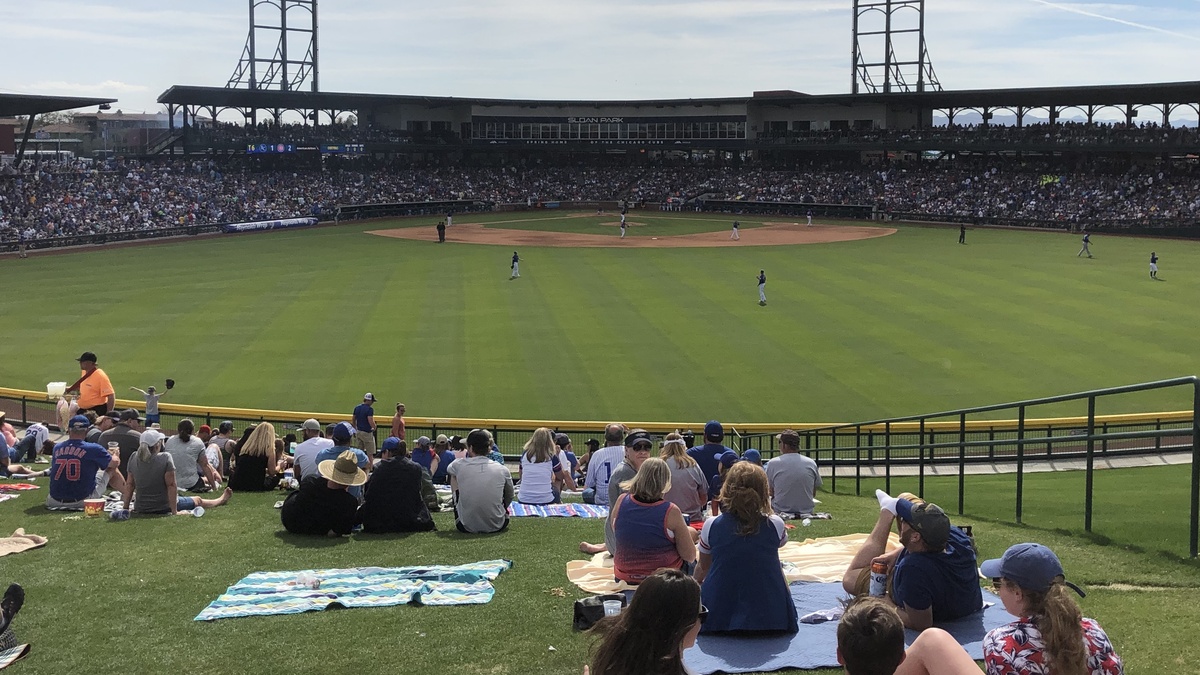
Baseball fans lounge on blankets beyond the center field wall at Sloan Park, the spring training home of the Chicago Cubs, in Mesa, Ariz.

Tom Goldman/NPR


hide caption

toggle caption

Tom Goldman/NPR

There’s a lot of lounging during spring training. Families sat on blankets on a grassy slope out past the center field wall. Standing nearby, longtime Giants fan Ryan Koven sipped a Pacifico beer and gazed toward home plate.

“You’re supposed to forget time at a baseball game,” Koven said, taking in the scene. “You’re supposed to relax and forget time.”

Which is why Koven, 34, was agitated. That doesn’t happen often at spring training. He watched as a large clock, near home plate, ticked down from 20 seconds every time the pitcher got the ball from the catcher.

“It’s very distracting; I’m looking at it right now,” Koven said, adding, “I’m looking at the pitcher and I see it ticking down, 10 … 9 … 8 … this is a very unbaseball experience right now!”

On this day, it was early in the pitch clock experiment. The clock has been used in the minor leagues for a few years to make pitchers and batters work faster. But not in the majors. And there was grumbling in Arizona, from the stands to major league clubhouses.

“I think this is a big game changer,” said Chicago Cubs pitcher Kyle Ryan, standing in front of his locker. “[Baseball] is America’s sport. [It] kind of stinks seeing it change. But, it is what it is.”

Actually, it isn’t anymore.

The baseball players union shared Ryan’s distaste for the pitch clock. MLB ended the spring training experiment in mid-March, agreeing not to implement it through the 2021 season.

Baseball still wants to hurry up

But baseball officials still are committed to the idea behind the clock — speeding up the game, and specifically, eliminating dead time. They want crisp play for all fans, but especially device-toting young ones who, the reasoning goes, want action and want it now!

Back at Scottsdale Stadium, Giants fan Koven questioned that stereotype.

“I think young people can appreciate tradition,” he said, “and they can get into things that have a history. I think you can sell an old game with a history better than you can speed up an old game, or change an old game to fit new people’s tastes.”

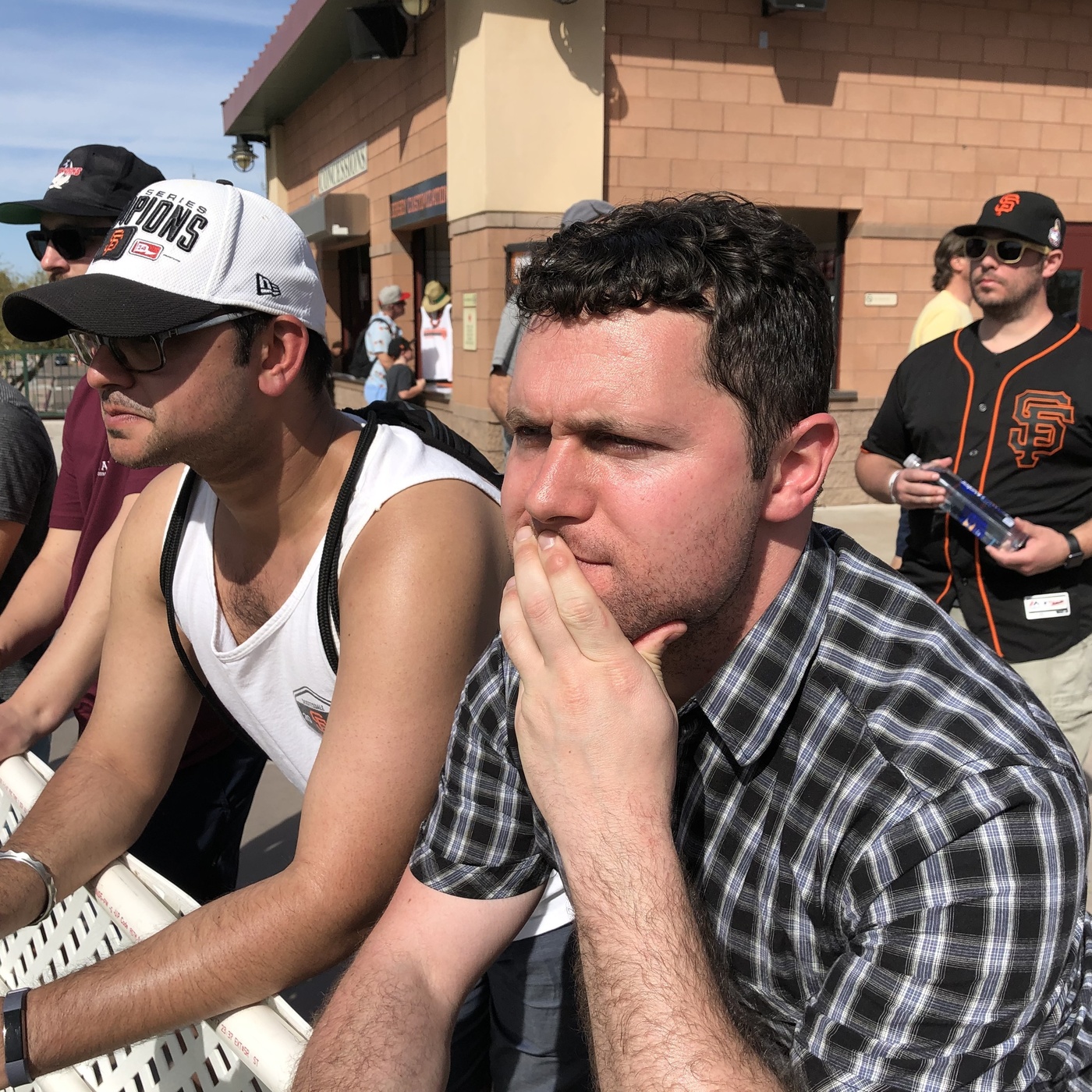
San Francisco Giants fans Aman Grewal (left) and Ryan Koven (right) watch a spring training game at Scottsdale Stadium. Both were against the pitch clock, which was introduced at the beginning of spring training to speed up the game and then discontinued in mid-March.

Tom Goldman/NPR


hide caption

toggle caption

Tom Goldman/NPR

“I don’t think that’s a hard sell for young people. I think they may be going at it the wrong way.”

Koven’s friend, 32-year-old Aman Grewal, agreed.

“I still think I’m young,” Grewal said, “and I enjoyed the game the way it was without a pitch clock, for instance.”

Grewal said if baseball wants to appeal more to younger fans, do like the NBA: Make videos and clips of action more available. And, he said, baseball is too buttoned up and needs to let the players have fun.

“When a player does a bat flip and people freak out,” Grewal said, “traditionalists freak out. You know, it’s 2019. They’re pro athletes. Let them entertain.”

Entertain faster

In nearly Mesa, Ariz., lifelong Chicago Cubs fan Bob Weinberg watched a game at the Cubs’ Sloan Park. He has a different, and perhaps surprising take on speedy baseball. Weinberg is 61, a time of life when you really shouldn’t care how long a baseball game takes.

But Weinberg does.

“I love coming out here. I love being outdoors,” said Weinberg. “I’m retired now and living the dream, as they say. But I also understand why people who are younger, without the attention span, don’t want to sit and watch all the downtime in an MLB game.”

Weinberg said constant pitching changes are a major culprit in slowing down baseball.

“I was at a game last year in Milwaukee,” he said. “Brewers and somebody. It was an 8-2 game in the eighth inning and they brought in three pitchers to face three batters. And when you see that, it’s not about the competition or the entertainment. … I’m not sure what it’s about.

“I’ve never, ever walked into a ballpark, and I’ve been to thousands of games, never heard a little kid say to his dad, ‘Gee, Daddy, I hope we see eight pitching changes today!” Weinberg added, sarcastically: “That’s always so exciting to see, that manager walk out of the dugout and wave his arm to the bullpen — that’s my favorite part of the game!”

Weinberg is glad officials are tweaking the rules, even though the pitch clock has gone away. This season, the number of pitcher’s mound visits he jokes about will be reduced. Also, breaks between innings will be shortened.

A little too fast?

Weinberg, who wants the game sped up, and Grewal and Hoven in Scottsdale, who don’t, defy generational stereotypes. But some fit.

Sixty-four-year-old Ned Yost is a baseball lifer. Since 2010 he has been the Kansas City Royals’ manager. At a spring training media event, he answered a few questions about pace of play. Finally, he got fed up.

“I don’t know, man. You want to speed it up?” he asked. “Make it a seven-inning game. That’ll speed it up.”

That may be a little too much, too fast. But such is the debate, as baseball strolls, a little more briskly, into 2019.

Let’s block ads! (Why?)

Soccer-Playing Engineer Calls Foul On Pricey Knee Brace

After a sports injury, Esteban Serrano owed $829.41 for a knee brace purchased with insurance through his doctor’s office. He says he found the same kind of brace selling for less than $250 online.

Paula Andalo/Kaiser Health News


hide caption

toggle caption

Paula Andalo/Kaiser Health News

Last October, Esteban Serrano wrenched his knee badly during his weekly soccer game with friends.

Serrano, a software engineer, grew up playing soccer in Quito, Ecuador, and he has kept up the sport since moving to the United States two decades ago.

He hobbled off the field and iced his knee. But the pain was so severe that he made an appointment with Rothman Orthopaedic Institute, a network of orthopedists practicing in Greater Philadelphia, New Jersey and New York.

The doctor diagnosed a strain of the medial collateral ligament and prescribed over-the-counter pain medication as well as a hinged knee brace, which Serrano used for several weeks until he’d healed.

He expected his insurance to cover his treatment. A plan from a previous job had covered him when he needed surgery to fix a broken nose sustained in another soccer game in 2017.

Then the bill came.

Patient: Esteban Serrano, 41, a software engineer and father of two from Phoenixville, Pa., outside Philadelphia.

Total bill: $1,197. $210 for the office outpatient visit, $105 for an X-ray and $882 for a hinged knee brace, all billed by the orthopedic practice. His insurer, Aetna, covered the visit and the X-ray but only $52.59 of the cost of the brace. That left Serrano with a balance of $829.41.

Service provider: Rothman Orthopaedic Institute in Bryn Mawr, Pa.

Medical service: A doctor examined Serrano’s knee and sent him for an X-ray. The doctor said he should use a knee brace for four weeks and recommended a hinged one sold through the practice.

What gives: A medial collateral ligament injury is a common knee injury occurring frequently among participants in contact sports. According to the American Academy of Physical Medicine and Rehabilitation, the medial collateral ligament is involved in at least 42 percent of knee ligament injuries. Although most cases are sports related, such injuries can also result from everyday activities like tripping on stairs.

“The doctor told me that he thought I didn’t have damage, that it was more of an inflammation, but he ordered an MRI just to make sure,” said Serrano. (The MRI confirmed that suspicion.)

Serrano said the brace did ease the discomfort and stabilized his knee as it healed. However, the bill was almost more painful — he owed the orthopedic practice $829.41.

“You can find the same brace for less than $250 online,” he said.

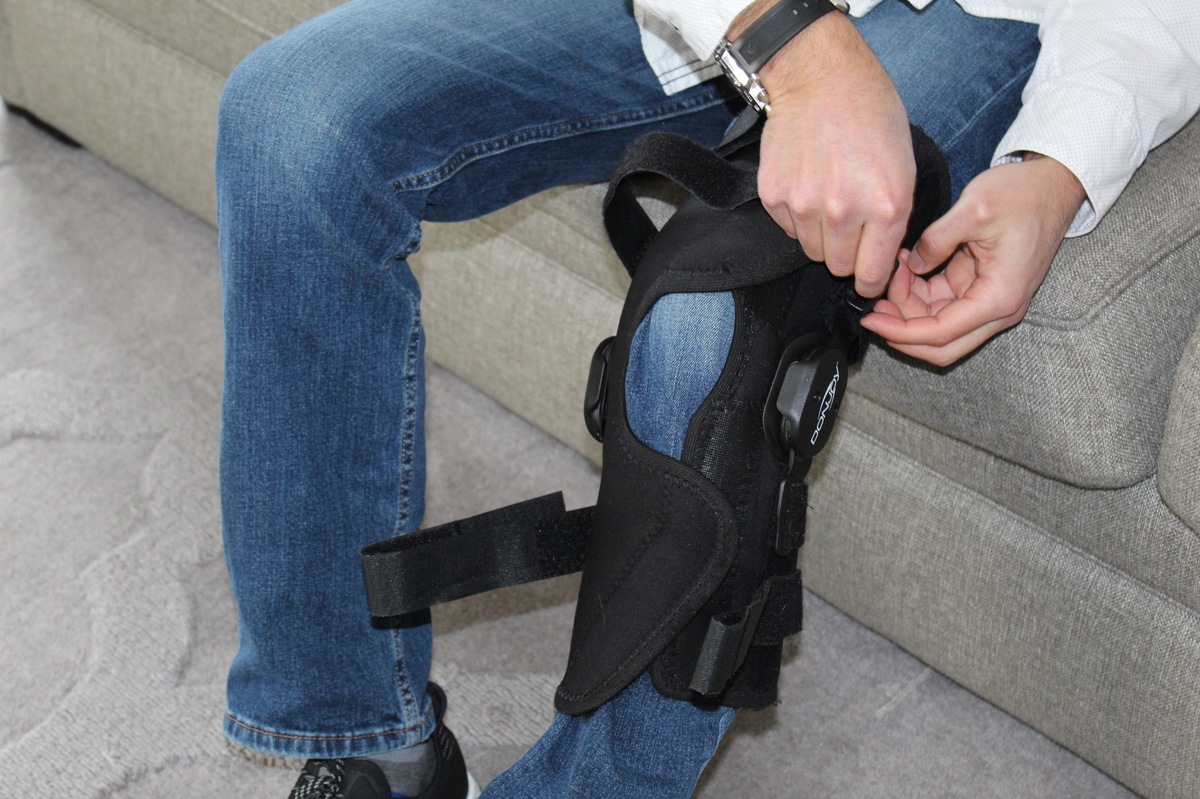
Serrano, a software engineer, grew up playing soccer in Quito, Ecuador. After straining a medial collateral ligament, he got a brace to help it heal.

Paula Andalo/Kaiser Health News


hide caption

toggle caption

Paula Andalo/Kaiser Health News

The bill came close to Christmas, when Serrano’s 12-year-old daughter wanted her first iPhone. “I told her, ‘Sorry, honey, but I already paid a price of an iPhone for the hinged knee brace,’ ” Serrano joked.

Serrano emphasized that he felt lucky to have the money to handle a bill that for many people could equal a month’s rent or three months of groceries.

Knee braces fall into a category of products called “durable medical equipment,” whose prices can vary widely. Items range from slings and braces to wheelchairs and commodes. They also include glucose meters and breast pumps for new mothers.

Doctors and hospitals that dispense such equipment for patients to take home almost always bill for them and add hefty markups that can catch patients unaware.

Braces and other products “are often marked up two or three times what the cost is, and unfortunately, that is the standard practice,” said Dr. Matthew Matava, an orthopedic surgeon and chief of sports medicine for Washington University Physicians in St. Louis.

Rothman Orthopaedic didn’t respond to requests for comments.

The type of hinged knee brace Serrano bought was a DonJoy Playmaker. DonJoy is one of the nation’s largest producers of braces. A customer service representative for the company said it charges a retail price of $242.51 for the model that Serrano got. Serrano paid more than three times that price.

In an emailed statement about the case, an Aetna spokesman wrote that “while the cost of a knee brace, or any other health care service, is determined by the negotiated rate between the health care provider and the health plan, the starting point is the charge from the health care provider.”

It is not even clear that such an elaborate knee brace was needed for Serrano’s injury.

Dr. Elizabeth Matzkin, chief of women’s sports medicine at Brigham and Women’s Hospital in Boston and an assistant professor at Harvard Medical School, said that while it is helpful to give patients some kind of knee brace for support after medial collateral ligament injuries, the use of a hinged knee brace does not influence recovery, according to studies. She called hinged braces “luxury products.” Simpler, cheaper braces also offer support.

Resolution: Serrano recalled that when he received the brace, an employee showed him a form with its estimated cost in writing. He remembered his share was more than $700, but he didn’t pay too much attention because he assumed his insurance would cover it.

After receiving the bill, he made several phone calls to the doctor’s practice to get a copy of the form he’d signed. It stated that the product could be returned within seven days. A month had already passed. Because he had not met his deductible, his $829.41 balance was even more than the estimate.

The takeaway: These days, many types of equipment dispensed by doctors’ offices or hospitals involve a charge. Don’t assume generosity. Ask the doctor to identify precisely what you need and explain why you need it.

When a doctor or hospital offers you a piece of equipment to help your healing, decide if you really need it or will use it. Say no if you won’t. Ask if you will be billed for it and how much.

Many items can be purchased at a fraction of the cost online or from a pharmacy just down the block.

Know your insurance plan’s copay or coinsurance for medical equipment (often 20 percent). The cost of purchasing the equipment yourself online may well be less than if you purchase through a medical office.

NPR produced and edited the interview with Kaiser Health News’ Elisabeth Rosenthal for broadcast.

Kaiser Health News is a nonprofit news service covering health issues. It is an editorially independent program of the Kaiser Family Foundation that isn’t affiliated with Kaiser Permanente.

Let’s block ads! (Why?)

The Last American Baseball Glove Factory

Baseball’s opening day is right around the corner and one company will be paying close attention. Nokona is the last remaining glove maker that still produces the gloves in the U.S. for MLB players.


LULU GARCIA-NAVARRO, HOST:

Baseball is back again. The first games of the regular season were played last week in Tokyo. America’s oldest professional sport has grown worldwide and the industry that supports it. But a tiny town in Texas is holding onto one tradition. KERA’s Bill Zeeble in Dallas takes us to the factory that’s still making gloves in the U.S. for major league baseball players.

BILL ZEEBLE, BYLINE: About a hundred miles northwest of Dallas-Fort Worth past pastures of crops and cattle sits Nocona, Texas, population 3,000, home to the Nokona baseball glove factory.

(SOUNDBITE OF MACHINERY WHIRRING)

ZEEBLE: Inside, stacks of tanned and dyed kangaroo, buffalo and calf skins are piled at one end of the 20,000-square-foot shop.

ROB STOREY: We literally bring leather in through one door. And magically, ball gloves come out the door at the very end – that and about 45 labor operations, then you’ve got a ball glove.

ZEEBLE: Rob Storey should know. He’s Nokona’s executive vice president. And this is the family business. To survive the depression, his grandfather Bob Storey added ball gloves to the family’s line of leather goods in 1934. Since then, just about every U.S. competitor has moved production overseas. Grandfather Bob, who died in 1980, said he’d rather quit and go fishing than import Nokonas.

STOREY: In some ways, we see it as a competitive advantage because we have people that understand the game of baseball. Our competitors are making them in factories. A lot of those factories – people have never even seen a baseball game or know what it is. Sure, it would be easy to go over there and do something. But that’s not who we are. We’re not about easy.

ZEEBLE: Nokona and it’s 75 employees are about making, marketing and selling their mostly handmade gloves in the town with the same name. The brand honors Comanche chief Peta Nocona. The company couldn’t legally use the city’s spelling, so Storey’s grandfather changed the C to a K. And its been spelled that way ever since. Martin Gomez has been Nocona’s master glove turner for 19 years. That’s a big deal because every glove is first sewn inside-out.

MARTIN GOMEZ: It’s not that hard. No, but it takes some time to learn, to get used to. Like, the first time you start to work, it give you a blister all over your hands. But you get used to it.

ZEEBLE: Storey says Gomez is modest. If he’s not careful, he can tear the leather and hand-stitching. Gomez slides a rod in each inside-out finger, pushes it hard against a wooden dowel and turns each leather finger back the right way. First, he sprays leather softener on the inside-out glove. Then, says Storey, he heats it on a 250-degree metal form.

STOREY: It’s very critical to do that so that you don’t rip out any of the seams while we’re going through this process because this process, in some ways, is more difficult on the glove than, actually, the game of baseball.

ZEEBLE: The game of baseball, after all, is what Nokona’s all about, even if it’s not nearly as well-known as giants like Rawlings or Wilson. In the youth market, though, it’s big.

ROBBY SCOTT: I grew up using a Nokona glove. My first glove that I ever really remember was a first baseman’s mitt that was a Nokona.

ZEEBLE: That’s Arizona relief pitcher Robby Scott. When we first talked long distance, he was with the Red Sox between World Series games. Nokona found him while searching for player endorsements. Scott says there’s just something special about it.

SCOTT: I will never wear a different glove. It’s a special bond that I have with them. They could have 200 players wearing their gloves. But to me, it seems special because they make it seem like I’m the only one.

ZEEBLE: And, says Storey, Nokona’s the only maker he knows of that’ll refurbish its old, tattered mitts. He says try that with a glove made overseas.

For NPR News, I’m Bill Zeeble in Nocona, Texas.

(SOUNDBITE OF MUSIC)

Copyright © 2019 NPR. All rights reserved. Visit our website terms of use and permissions pages at www.npr.org for further information.

NPR transcripts are created on a rush deadline by Verb8tm, Inc., an NPR contractor, and produced using a proprietary transcription process developed with NPR. This text may not be in its final form and may be updated or revised in the future. Accuracy and availability may vary. The authoritative record of NPR’s programming is the audio record.

Let’s block ads! (Why?)

Opinion: How America's Pastime Became So Slow

Chicago Cubs’ Kris Bryant, right, is hit by a pitch as Seattle Mariners catcher Austin Nola looks on at a spring training baseball game on Tuesday.

Elaine Thompson/AP


hide caption

toggle caption

Elaine Thompson/AP

And amidst all this urgent news, the 2019 Major League Baseball season also began this week. Organized baseball worries that the game once considered America’s pastime has become slooowww, old, and tedious.

In 1948 — when Joe DiMaggio, Ted Williams and Jackie Robinson were on the field — an average 9-inning game lasted 2 hours and 15 minutes. Today, it takes more than 3 hours.

It’s not just more commercials and on-field promotions. It’s increased analytics. The data that tell managers a certain player might stand a .001 percentage better chance of getting a hit off a certain pitcher, or the reverse, causes managers to stop the game, go to the mound, pull pitchers, pinch-hit for batters, and move players around like Legos.

A 12-year-old who starts to watch a game at 7:10 on a school night might grow a beard before the game is over. Games seem to last longer than the Mueller investigation. The average age of a Major League Baseball television fan has become as old as George Clooney.

And analytics may have made the game more tame. Fewer players try to steal bases these days. It’s a high-risk play, with a low success rate, in an era when players are paid more just to stand and clobber the ball.

This season, Major League Baseball will reduce the time between innings from two minutes and five seconds to … two minutes. This will trim 40 seconds off a 3-hour game, which is like boasting that a new production of Wagner’s Ring Cycle is just 14 hours and 58 minutes, instead of 15 hours long.

I’d like to offer a few more proposals to speed and enliven the game many of us love, often because of its unhurried pace and multifarious strategies:

Don’t bother with actual pitches and hits. They take time and are hard to predict. Have the pitcher point to his stats on a screen, the batter point to his, then each touch a button on a home screen and have algorithms flash the results. Single! Walk! It’s outta here!

Bury gold bricks under each base. Incentivize the play! A potential payoff might encourage more base stealing.

Make managers remove one item of clothing each time the opposing team scores a run. That’ll keep managers in the dugout.

And to really speed up the game, put in antelopes as pinch runners. Antelopes can run 60 miles an hour. If baseball is to become America’s national pastime again, why not let the deer and the antelope really play!

Let’s block ads! (Why?)

Saturday Sports: March Madness, Ichiro Suzuki

NPR’s Scott Simon speaks with ESPN’s Howard Bryant about the week in sports.


SCOTT SIMON, HOST:

Now it’s time for sports.

(SOUNDBITE OF MUSIC)

SIMON: And I put on my sports doofus voice to tell you the first round of March Madness is over for the men – almost for the women. Top seeds have made it through. Meanwhile, the real Mr. Baseball has retired as Major League season opens in Japan. But don’t worry, BJ Leiderman, who writes our theme music, is still with us. Howard Bryant of ESPN and ESPN The Magazine joins us. Howard, thanks so much for being with us.

HOWARD BRYANT, BYLINE: Hey, Scott. How are you doing?

SIMON: Fine, thank you. NCAA biggest upset so far in the men’s tournament – No. 13 seed, UC Irvine, upended No. 4, Kansas State, 70-64. What have you seen in the first couple days (unintelligible)?

BRYANT: Well, I like that win by Irvine. It was their first-ever tournament win, so those are always fun. I think that when you get to the tournament now, you sort of recognize that because of the dilution in the game, because so many of the great players come in one and done, you’re not going to have those four-year champions anymore, those really good powerful three-year teams that – it really is an upset-driven tournament. Seven, tens are no longer – and those are toss-ups – eight, nines are toss-ups.

And now all of a sudden, when you start getting the four seeds losing, there aren’t that many teams that are safe in those first round matchups. And so the good news, obviously, if you’re – if you believe in your bracket – is that the one seeds all came through pretty well.

But as you start getting into the second round, there aren’t any real dominant teams outside of Duke. Duke is the best team when they have a full complement, when they’ve been healthy, when Zion Williamson has been there. Together, they’ve lost one game. They lost to Gonzaga. Other than that, they – they’re pretty dynamite. But…

SIMON: To forestall email, it’s Gonzaga.

BRYANT: Is it Gonzaga? Oh, the Zags. That’s (unintelligible).

SIMON: Gonzaga.

BRYANT: Oh, my goodness.

SIMON: We hear it all the time.

BRYANT: Do I have to say it like that, though?

SIMON: Well, you can just say Gonzaga.

BRYANT: Just Gonzaga.

SIMON: Yeah.

BRYANT: But not – I can’t do the Scott Simon voice. So – and North Carolina is a good team. Michigan is a good team. I kind of like Houston. I haven’t heard about them for a really long time. They’re three seed. So it’s going to be Duke for now. But, you know, once again, you get to the tournament, anything’s possible.

SIMON: Women’s tournament – UConn, Texas A&M, Louisville have all gone into the second round. What are you going to be watching?

BRYANT: I’m going to be watching Mississippi State. They’ve gone to the final the last two years. They’ve lost – once heartbreakingly last year to Notre Dame. They lost the year before, as well. I think that those – when you have those teams that are knocking on the door, you know, they won last night by I think 57 points. And so I’m watching them. Obviously, UConn being the great UConn – 11-time champion that they’ve been. And they’re a two seed. They…

SIMON: Yes.

BRYANT: …Get upended by…

SIMON: I’m not used to that.

BRYANT: No one’s used to that. It hasn’t happened since 2006. And at the end of the day, when they get to the final, they don’t lose. They’ve never lost when they’ve gotten to the championship game. But I like the fact that you’ve got four, five, six teams that are that are really good. People talk about college basketball – women’s college basketball – being all UConn all the time. But Mississippi State’s a great team. Notre Dame’s a defending champion. And, you know, Baylor is a great team. This is as good and as much parity as we’ve had in some time. It’s good stuff.

SIMON: Finally, Major League Baseball season opened over – under the Tokyo Dome. One of the great ballplayers of all times – 45 years old – retired.

BRYANT: Forty-five.

SIMON: And he’s one of the great ballplayers in both the United States and Japan.

BRYANT: Yeah. Ichiro Suzuki – and just Ichiro, that’s all we need to know him by…

SIMON: Yeah.

BRYANT: …He’s one of those one-namers (ph) – really phenomenal player and just a dynamic player. I remember Ichiro came in – when he came in with Seattle in 2001. I was covering the Oakland A’s. So we got to see Ichiro numerous times. And he won the MVP and the rookie of the year that year. And they won 116 games. And so it’s a really sort of interesting thing when you’re watching his style. We always talk about being kids and copying batting stances and everything else. He’s that dynamic a guy. People are…

SIMON: Yeah.

BRYANT: …Going to remember him for a long time – 3,000 hits, 4,300 hits across both countries. He’s as good as it gets – maybe the best hitter of all time.

SIMON: Yeah. I agree. And the real Mr. Baseball, a great spirit in the game. Howard Bryant of ESPN, thanks so much.

BRYANT: Thank you.

(SOUNDBITE OF TOUBAB’S “BAMANA NIYA”)

Copyright © 2019 NPR. All rights reserved. Visit our website terms of use and permissions pages at www.npr.org for further information.

NPR transcripts are created on a rush deadline by Verb8tm, Inc., an NPR contractor, and produced using a proprietary transcription process developed with NPR. This text may not be in its final form and may be updated or revised in the future. Accuracy and availability may vary. The authoritative record of NPR’s programming is the audio record.

Let’s block ads! (Why?)