Headless Goat Polo Is A Top Sport At World Nomad Games

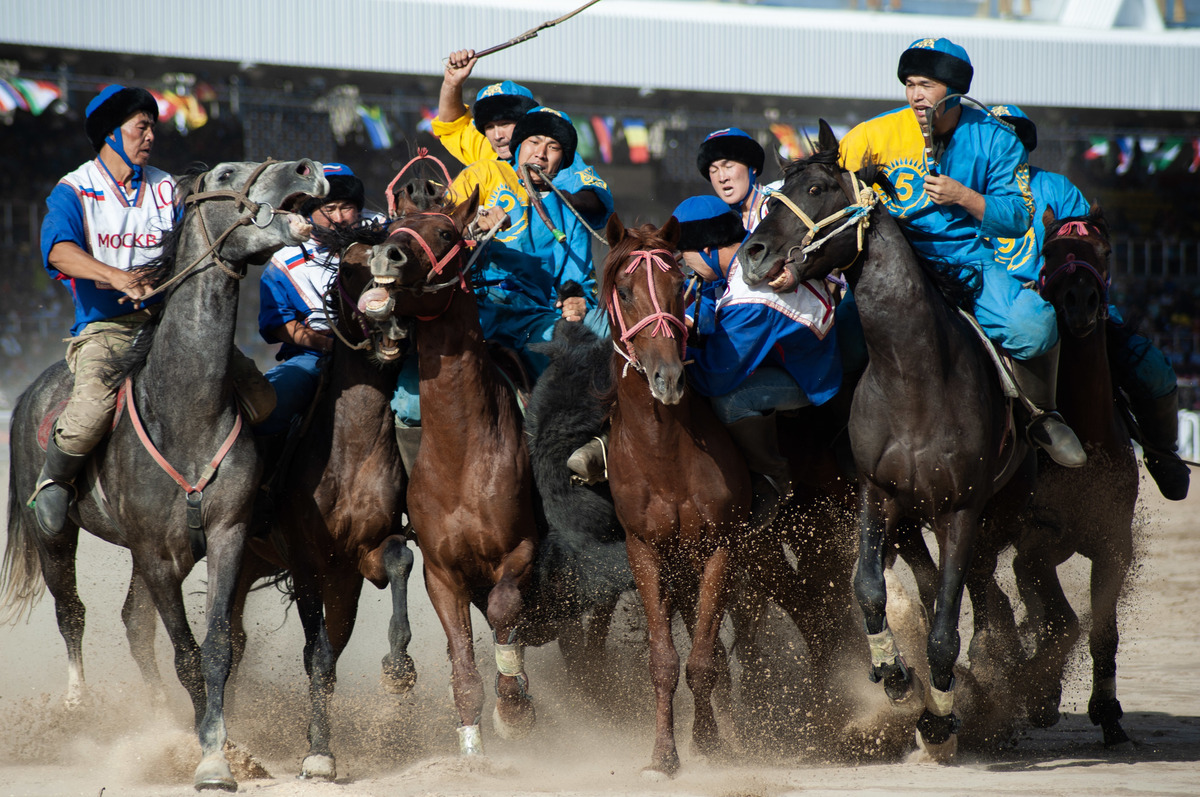
The Uzbek and Russian teams clash in the World Nomad Games as Uzbekistan tries to score in a game of kok-boru — a form of polo played with a headless goat carcass.
Nicolas Tanner for NPR
hide caption
toggle caption
Nicolas Tanner for NPR
Two bare-chested men on horseback wrestle. The goal is to pull your opponent off the horse so a part of his body touches the ground.
Three dogs chase a dummy clad in a fox or hare skin to see who’s fastest. Biting an opponent is grounds for disqualification.

Two competitors engage in er-enish — wrestling on horseback.
Nicolas Tanner for NPR
hide caption
toggle caption
Nicolas Tanner for NPR
And then there is this sport: “Each team seeks to throw as many goat carcasses as possible into the tai kazan (goal) of the opposing team.”
They’re definitely not Olympic sports but they are a part of another global competition: The World Nomad Games, held in Kyrgyzstan last September. That’s the landlocked central Asian nation of 6.2 million that, centuries ago, was a stop on the Silk Road traveled by traders from China to the Mediterranean. In modern times, it was part of the Soviet Union until it declared independence in 1991.

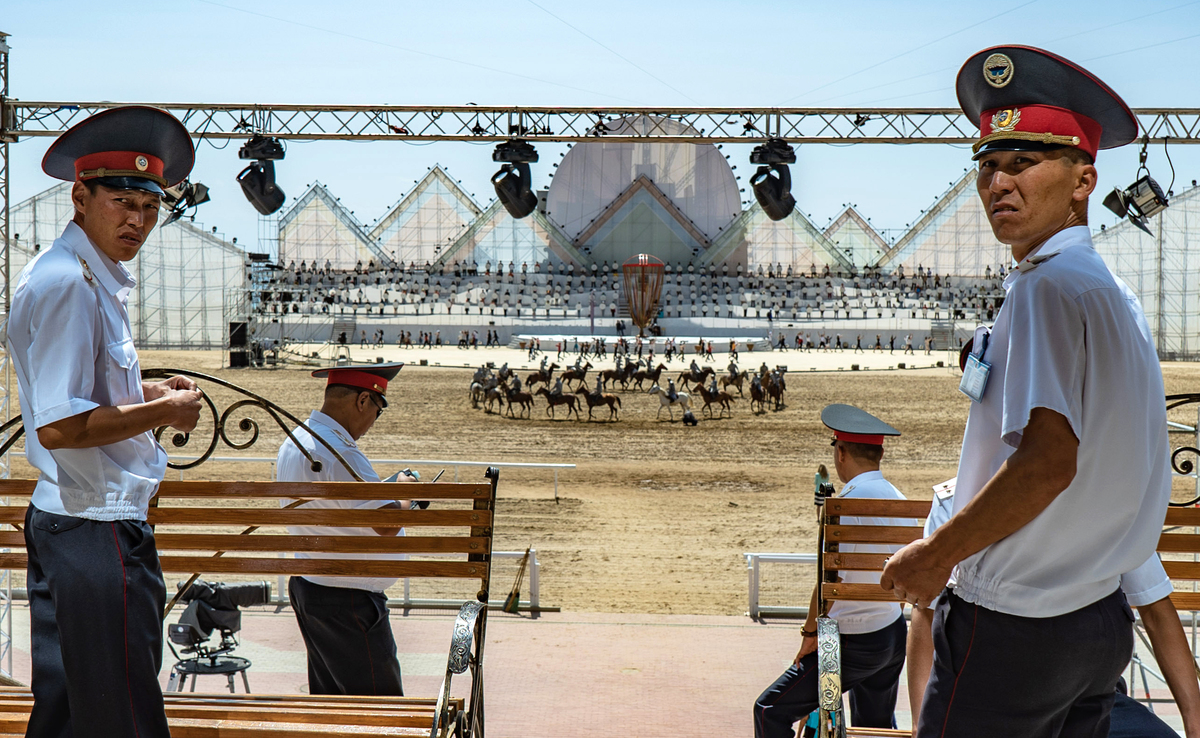
Police officers stand guard during preparations for the opening ceremonies of the third World Nomad Games in Cholpon-Ata, Kyrgyzstan, held in September.
Nicolas Tanner for NPR
hide caption
toggle caption
Nicolas Tanner for NPR
This was the third iteration of the games, which were spearheaded by former Kyrgyzstani president Almazbek Atambayev and highlight both unusual regional sports as well as more traditional ones like archery. According to the local press, 2,000 athletes from 80 countries competed before an audience of 150,000, about a third of whom were foreign tourists. The overall cost was about $6.7 million, with $2.3 million covered by private sponsors and the rest picked up by the government.

A Turkish tightrope walker shows his skills at the games.
Nicolas Tanner for NPR
hide caption
toggle caption
Nicolas Tanner for NPR
The government involvement has prompted some local criticism, according to a New York Times report. “Keep in mind that Kyrgyzstan, compared to its neighbors, is a relatively open country with regard to freedom of speech. So people there tend to be more vocal in criticizing the actions of the government,” wrote Kanybek Nurtegin, a professor of economics at Florida Atlantic University who grew up in Kyrgyzstan. “While the country could indeed have used the funds on other pressing issues, I think the idea of bringing people together to enjoy peaceful events, reviving cultural traditions and hosting guests from dozen of countries is a great idea.”
In a country that’s not rich in natural resources, he adds, “tourism is a promising industry.”
Nurtegin thinks the games “have put Kyrgyzstan on the world map.”

A Kyrgyz woman from the southern part of the country (center) and other onlookers watch the Nomad Game events.
Nicolas Tanner for NPR
hide caption
toggle caption
Nicolas Tanner for NPR
Nicolas Tanner, a photojournalist and student at the Institute for Doctoral Studies in the Visual Arts in Portland, Maine, chronicled the third World Nomad Games. “There were so many bloggers there,” Tanner says, “to do Instagram stories, showing this thing to the world.”
Tanner, who was a Peace Corps volunteer in the Kyrgyz village of At-Bashy from 2008 to 2010, spoke with us about the Games.

Kyrgyz teenagers pose with hunting dogs and eagles that are part of the Nomad Games.
Nicolas Tanner for NPR
hide caption
toggle caption
Nicolas Tanner for NPR
How do the Kyrgyz maintain their ancient traditions in the face of modern influence?
By choosing to stay by super hardcore tradition – their sense of tradition is sacred to them. If you ask a Kyrgyz person who their father’s father’s father’s father’s father was, they can tell you. They can tell you who was in their family like seven generations back. That’s how you bring the past forward.

A Kyrgyz performer at the games poses with his daughter.
Nicolas Tanner for NPR
hide caption
toggle caption
Nicolas Tanner for NPR
Are there still nomads among the Kyrgyz people?
Kyrgyz are partially nomadic: In the winters [some of them] live in a house, then in the summers they’ll go out. Traditionally, they would just go out in what’s called the jailoo, which is a mountain pasture. Now they have these cellphones, and they can communicate back down to their families or with each other. So it makes their ease of movement actually easier or more efficient.
Cellphones in general are sort of a wild, little nomadic tool — it sort of makes all of us nomadic. We can now kind of be anywhere and still be communicating to anywhere else.

A member of the Mongolian horse wrestling team passes a flag to another member who is preparing for a victory lap around the stadium after a match victory.
Nicolas Tanner for NPR
hide caption
toggle caption
Nicolas Tanner for NPR
Since we’re Goats and Soda, I have to ask: what is headless goat polo like?
It’s called kok-boru [which means gray wolf, said to be the animal first used in this sport.]
They cut the hooves and the head off the goat. They’re basically [two teams of] men on horses trying to get the goat into the other team’s goal. It’s a physical game, guys get bloody and horses fall down.

This target was used during the horseback archery event.
Nicolas Tanner for NPR
hide caption
toggle caption
Nicolas Tanner for NPR
The next set of games, in 2020, will take place in Turkey – which is one of the sponsoring countries. How do the locals in Kyrgyzstan feel about that?
I did talk to some that said essentially, That’s fine, whatever. But these games are mostly Kyrgyz and we created the games, so why not keep it here? Well, because it’s worth money now, so Turkey wants in.
Freelance writer Joel Goldberg covers sports, science and culture and has contributed to NPR, National Geographic Magazine and On Tap Magazine.
NCAA Upset: Murray State Knocks Off Marquette In First Round

Murray State beat Marquette 83-64 Thursday in the NCAA men’s basketball tournament. Ja Morant’s triple-double is the talk of the tournament. He had 17 points, 16 assists and 11 rebounds.
Blair Braverman And Her Dogs Finish First Attempt At Iditarod
Blair Braverman just finished her rookie attempt at the nearly 1,000-mile Iditarod race in Alaska. She sent a radio diary of the most-notable moments from her first go at the race.
Maroon 5's Halftime Show Was Forgettable, Excluding All The FCC Complaints Filed
The past Super Bowl was largely forgettable, as was the halftime show starring Maroon 5. But, that didn’t stop viewers from complaining to the FCC about Adam Levine taking off his shirt.
Deadline Draws Near To Complete NCAA Basketball Brackets
The top men’s college basketball teams on Thursday start their journey to the annual championship. The women begin Friday. Get ready for exciting stories to play out over the next few weeks.
There's Word Of Another Record-Shattering Baseball Deal In The Works
The Los Angeles Angels reportedly are very close to signing Mike Trout to a record breaking 12-year, $430 million deal.
Surrounded By Military Barracks, Skiers Shred The Himalayan Slopes Of Indian Kashmir

A helicopter brings skiers and snowboarders into the mountains around Gulmarg, in Indian-administered Kashmir
Lauren Frayer/NPR
hide caption
toggle caption
Lauren Frayer/NPR
In a Himalayan valley surrounded by military barracks, blasts of artillery fire often reverberate across the icy mountain peaks. This is one of the world’s longest-running conflict zones. It’s near where India and Pakistan recently traded airstrikes. So it’s not unusual to see helicopters buzzing overhead.
But on a morning in early February, one particular chopper was not part of the conflict.
“I run Kashmir Heliski. We have clients from different parts of the world. We take people to 4,500 meters. They enjoy it!” says Billa Majeed Bakshi, a local skier turned businessman.
Since 2011, Bakshi has ferried more than 1,000 skiers and snowboarders nearly 15,000 feet up into the Himalayas, via helicopter, in Indian-administered Kashmir.
Kashmir is split between Indian and Pakistani control. The mountain valley is the site of a decades-long insurgency, as separatists on the Indian side fight for independence. Hundreds of thousands of soldiers are stationed on either side of the Line of Control, Kashmir’s de facto border. India blames Pakistani-based militant groups for attacks on Indian security forces, including a Feb. 14 suicide car bombing on the valley’s main highway.

Billa Majeed Bakshi, the founder of Kashmir Heliski, has ferried skiers and snowboarders nearly 15,000 feet up into the Himalayas via helicopter in Indian-administered Kashmir since 2011.
Furkan Latif Khan/NPR
hide caption
toggle caption
Furkan Latif Khan/NPR
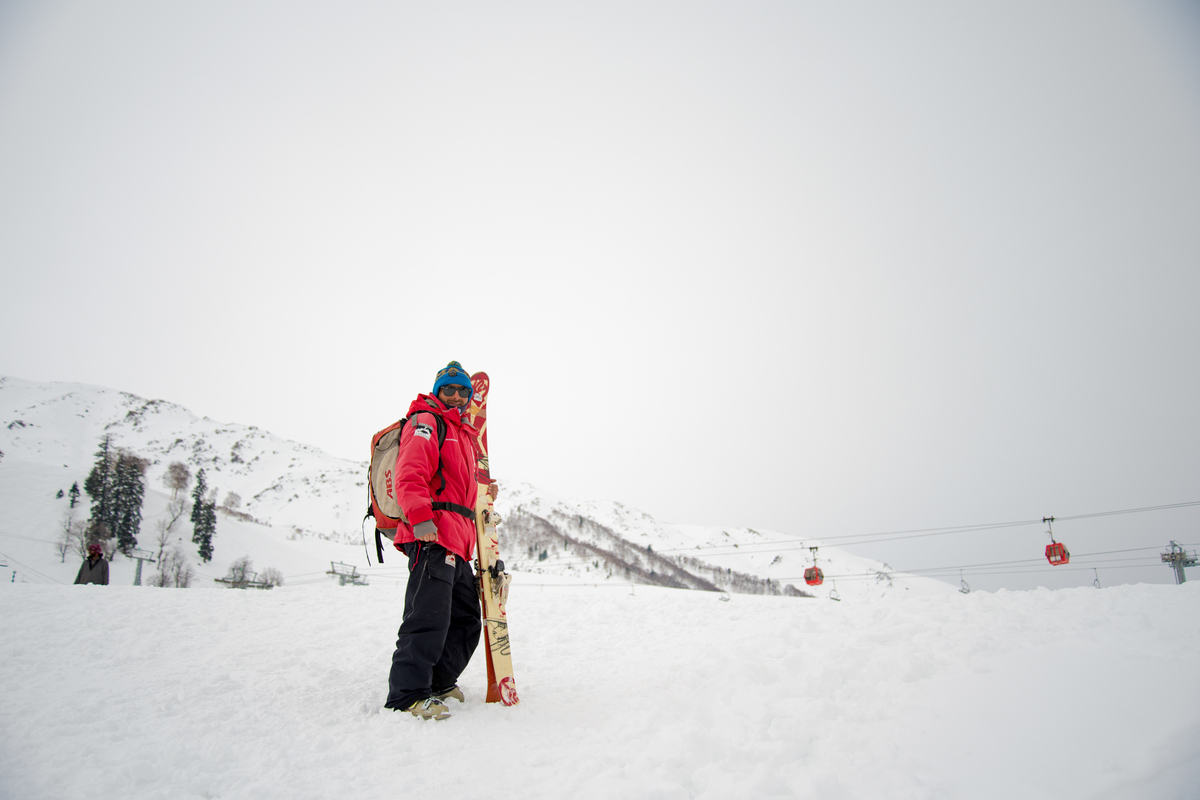
But in the cold months, when the valley fills with snow, it also becomes a winter sports haven for a small but devoted gang of extreme sports enthusiasts. They often ski — “shred lines,” as boarders and ski bums put it — just a few hundred yards from the Line of Control, within view of Pakistani troops on the other side.
“I think it’s fantastic! I just wish we could get over their mountain ranges and shred with them too,” says Jimmy Hands, 41, who’s visiting from Toronto. “Look, nothing brings peace like a little bit of snow, and everybody’s been magical here! Like, it is magic.”
The powder this high up may be magical — but it also leads to avalanches. In early February, at least nine people died in avalanches triggered by a single snowstorm.
“Someone who’s had an accident, whether it’s a fall on ice or they’re involved in an avalanche, to move that person to a hospital — that is a big challenge here, without the infrastructure of other countries,” says Brian Newman, a Coloradan who serves as the snow safety officer for the Gulmarg Ski Resort, a Kashmiri state government-run resort with two giant gondola lifts. During the recent Indian and Pakistani airstrikes and shelling over the Line of Control, the ski station at Gulmarg remained open for business.
The main Jammu-Srinagar highway, the only route connecting Kashmir to the rest of India, is often impassable for several days at a time because of snow. At the area’s main airport, flights regularly get canceled due to foul weather. Snowplows are in short supply.

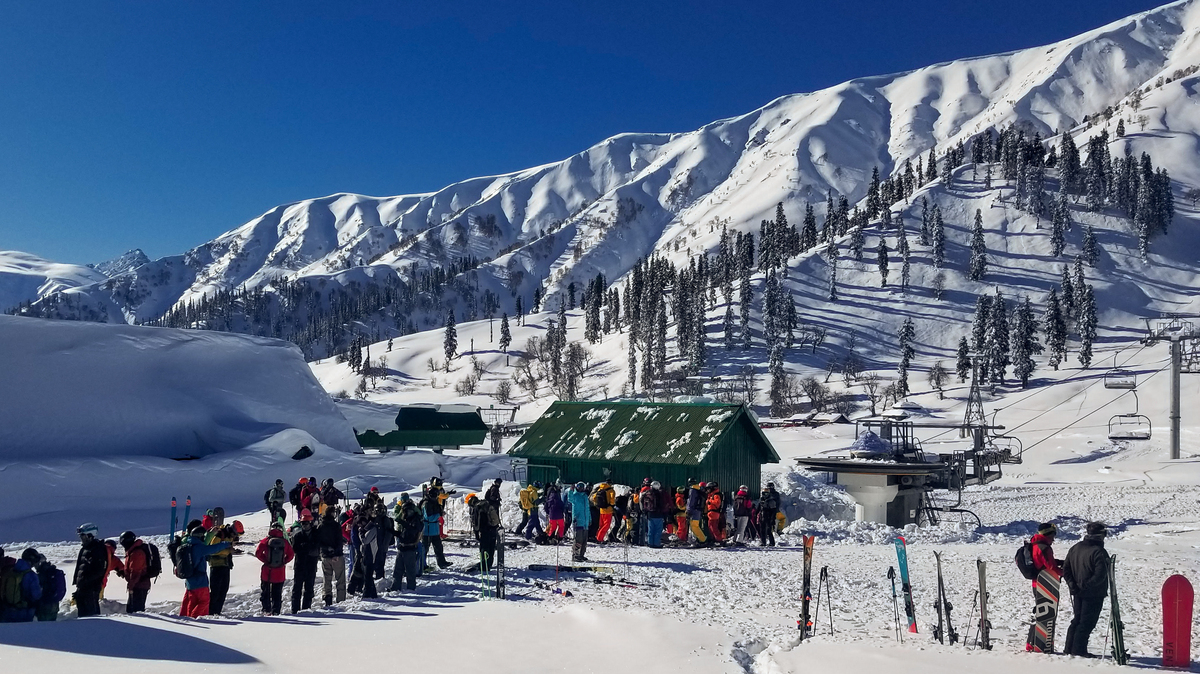
Skiers line up at the only chairlift in Gulmarg, a resort in Indian-administered Kashmir.
Lauren Frayer/NPR
hide caption
toggle caption
Lauren Frayer/NPR
Until the 1990s, Gulmarg, with fewer than 2,000 residents, was a sleepy hill station. The area, the Pir Panjal Range of the western Himalayas, was a summertime playground for India’s British colonial rulers, who came to escape the sweltering heat farther south. There’s still a British-built golf course.
Synonymous with romance and revolution, Kashmir has always captured the Indian imagination. Bollywood song sequences have long been filmed there. But after the state government built two gondolas in 1998 and 2005, Gulmarg began attracting more tourists from abroad, and increasingly from India too.
In 2007, the government hired Newman. He obtained explosives from the Indian military to blast off excess snow that might otherwise avalanche and imposed rules requiring skiers to carry avalanche beacons, shovels and probes. He even learned the Kashmiri language.
As India’s middle class grows, domestic tourists have been coming to Gulmarg in greater numbers. The state government says 800,000 Indian tourists visited Kashmir in 2018, along with 50,000 foreigners. There are traffic jams every Sunday afternoon, as day trippers, having paid about $5.25 for a scenic ride up the first gondola, exit the resort and drive back to Srinagar, the biggest city in the Indian state of Jammu and Kashmir, about 30 miles away.
“It’s almost like a different world! You’re cocooned in this space between the sky and the snow,” says Nikita Kapoor, 29, visiting for a long weekend from Kolkata — where it never snows. “I’m learning how to snowboard for the first time, so it’s really exciting!”

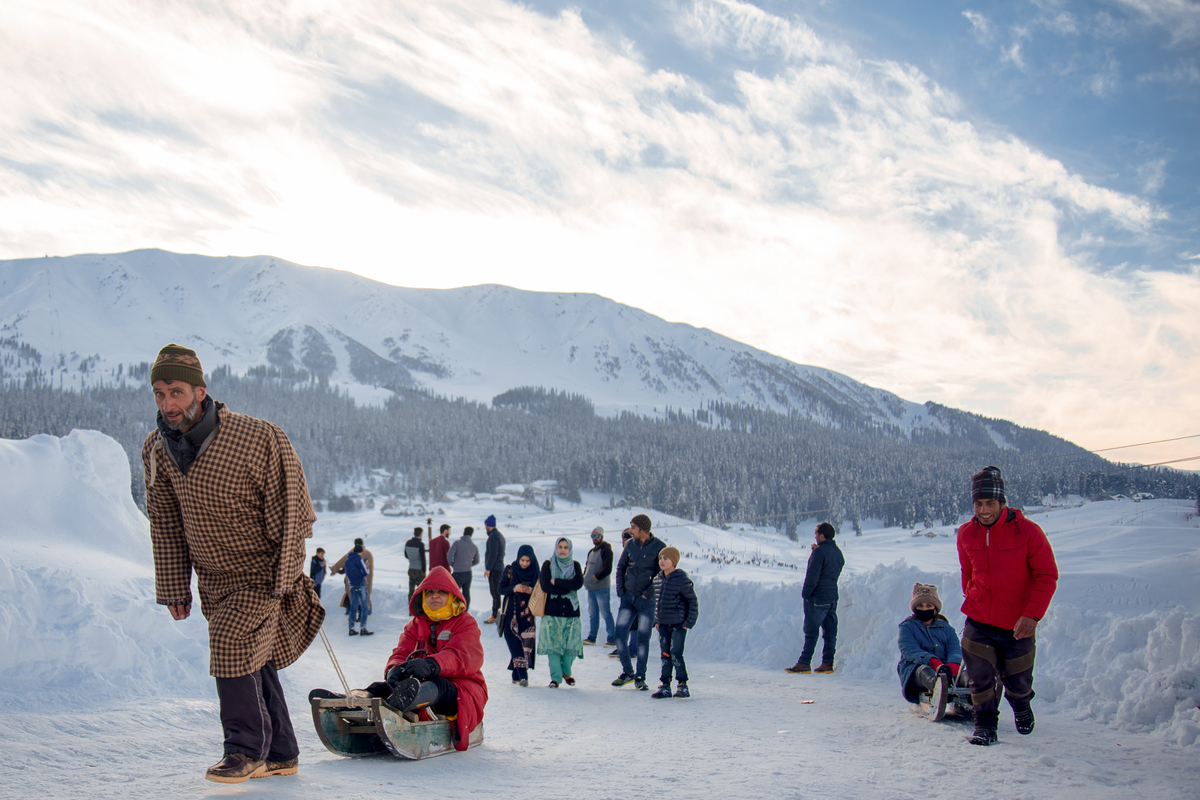
As India’s middle class grows, more domestic tourists are coming to Gulmarg, a resort in Indian-administered Kashmir that used to be a playground for British colonial rulers in the 19th and early 20th centuries.
Furkan Latif Khan/NPR
hide caption
toggle caption
Furkan Latif Khan/NPR
Tourists like Kapoor don’t seem fazed that their holiday destination is home to a decades-long separatist insurgency that, by some measures, is growing. Clashes between protesters and security forces have resulted in an estimated 40,000 to 70,000 deaths and thousands of injuries in the past three decades. Indian troops are accused of firing live ammunition on civilians, including deliberately targeting people’s eyes.
Still, tourism brings much needed revenue — as much as 8 percent of the state’s gross domestic product — which dips dramatically whenever there’s violence. The local unemployment rate, 21 percent, is about triple that of the rest of India.
What kind of jobs are there in Kashmir, beyond this ski resort?
“Nothing!” says ski guide Altaf Khanday, shaking his head. “You know the guys who are [throwing] stones in the valley? They are well-educated guys. Even they are busy in the militancy. It’s so sad.”
For Khanday, becoming an expert skier was an economic decision. Now, at age 30 and working as a back-country ski guide for the two-month ski season, he’s able to support seven members of his extended family all year.

Altaf Khanday, 30, works as a back-country ski guide in Gulmarg for two months a year. His earnings allow him to support seven members of his family all year.
Furkan Latif Khan/NPR
hide caption
toggle caption
Furkan Latif Khan/NPR
He learned to ski with secondhand gear. Lots of ski shops in Gulmarg rent gear donated by foreign visitors when they leave. It’s common to see Kashmiri youth learning to ski on straight, long, old-fashioned skis from the 1980s and 1990s.
“Oh my gosh, my first ski boots, they didn’t even have buckles!” Khanday says, laughing. “You know what skis I had? Broken ones!”
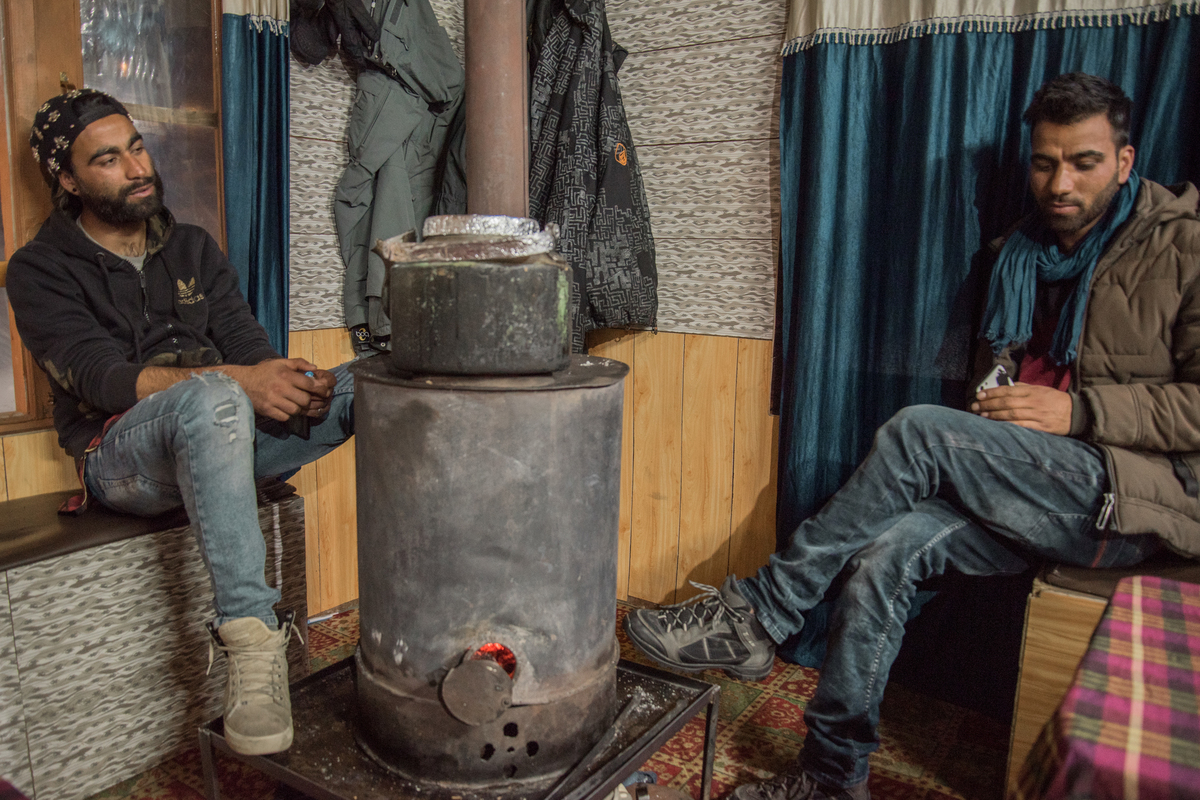
Not far from the ski lifts, young men huddle around a wood stove in a mountain hut in a forest. Tourists can rent dormitory rooms in the hut for about $14 a night, including breakfast.
One of the men, Raja Wasim Khan, 24, says his father moved the family to Gulmarg in 2010, when he was a teenager.
“Actually, he was a terrorist. He fought for Kashmir. For five or six years, he was in jail,” says Khan. “Then he started a new life, and he taught us snowboarding.”

Raja Wasim Khan (left), 24, and his brother Ashraf Khan, 21, huddle around a wood stove inside the ski hut they manage in Gulmarg. The Khan brothers’ father was a Kashmiri militant who served time in an Indian prison and then moved his sons to the mountains and taught them snowboarding. He wanted to keep them away from the violence he grew up in.
Furkan Latif Khan/NPR
hide caption
toggle caption
Furkan Latif Khan/NPR
Khan says his father, Parvez Ahmed Khan, 52, a notorious Kashmiri militant also known as “the Tiger,” wanted him and his brother to pour their energy into snowboarding rather than violence. Militant groups in Kashmir often recruit from the ranks of poor, unemployed and disaffected teenage boys.




A gondola ferries skiers in Gulmarg.
Lauren Frayer/NPR
hide caption
toggle caption
Lauren Frayer/NPR
“Sometimes, if I’m so angry, I have to take my snowboard and go for a ride — to make myself relax,” Khan says. “When you put your straps on and go for powder run, it makes you [feel] like you are flying! You didn’t think about anything. You are just flying in the air.”
It’s a welcome distraction from Kashmir’s conflict, he says — if only for two months a year.
NPR producer Furkan Latif Khan contributed to this report.
Mike Trout To Finalize $430 Million Contract With Los Angeles Angels
Mike Trout and the Los Angeles Angels are finalizing a $430 million contract, the largest in professional sports history. NPR’s Mary Louise Kelly speaks with Jonah Keri of The Athletic.
Head Of Japan's Olympic Committee Steps Down Amid Tokyo 2020 Corruption Probe


Japan’s Olympic Committee President Tsunekazu Takeda said Tuesday that he will step down in June, as French authorities probe his involvement in payments made before Tokyo was awarded the 2020 Summer Games.
Charly Triballeau/AFP/Getty Images
hide caption
toggle caption
Charly Triballeau/AFP/Getty Images
The president of the Japanese Olympic Committee said he will step down amid allegations of corruption into the successful bid for Tokyo to host the 2020 Olympics.
Tsunekazu Takeda, 71, is a former Olympic equestrian jumper who competed at the 1972 and 1976 Olympics. He is also the chair of the International Olympic Committee’s Marketing Commission.
He maintains his innocence and intends to serve out the rest of his 10th term as president, resigning in June. He’ll also step down from the IOC.
“I don’t believe I’ve done anything illegal,” Takeda said at a news conference Tuesday, according to Reuters. Asked why he didn’t step aside now, he said, “It pains me to have created such a fuss, but I believe it is my responsibility to serve out the rest of my term.”
Takeda was president of the Tokyo bid committee that clinched the 2020 Games in an IOC vote in 2013, beating out Istanbul and Madrid — a bid that is now under investigation.
As The New York Times reports, French prosecutors suspect the Tokyo bid committee of paying bribes to African Olympic committee members to win votes:
“Payments in connection with the process to Papa Massata Diack, a former marketing official from the International Association of Athletics Federations, first raised suspicions among French prosecutors about the decision.
“The French authorities had previously sought to extradite Mr. Diack from his home in Senegal on charges that he helped manipulate the awarding of the 2016 Summer Olympics to Rio de Janeiro. Mr. Diack has said that racism and jealousy are behind the allegations.
“In 2016, French prosecutors said that the Tokyo bidding committee had made more than $2 million in payments to Black Tidings, a Singaporean company run by a close friend of Mr. Diack’s. The Japanese authorities have since questioned Mr. Takeda about his role in the payments and concluded that they were for consulting work. The Japanese Olympic Committee maintains the payments were legitimate.”
The Games begin in less than than 500 days, and Japan is spending some $25 billion to stage them. “I want to step aside to make room for the younger generation to step up and lead the way,” Takeda said. “In June, I will step down as the JOC president so that the tournament can be held in peace.”
Japan has framed the 2020 Games as an emblem of the country’s resurgence, as NPR’s Bill Chappell reported at the time of the winning bid: “Tokyo officials also promoted their city’s bid as symbolizing a new chapter for Japan, which is still recuperating from the tsunami and earthquake that devastated swaths of the country in 2011. Organizers have said they plan to have Olympic torchbearers run through areas hit by the tsunami.”
In December, IOC President Thomas Bach praised Tokyo, saying he could not remember a host city that was so well-prepared to host the Games. But that preparation comes at a price: The Tokyo Games will likely cost three times what organizers predicted in 2013.
Takeda is a distant member of the Japanese royal family, the AP notes, “the great grandson of the Meiji emperor who ruled late in the 19th century and into the 20th.”
Minnesota High School Basketball Game Has A Fantastic Finish
After a last-second basket, Albany fans stormed the court. The referees conferred and it was determined the basket didn’t count, and Albany had lost. That’s when Melrose fans stormed the court.