Peter Kaiser Takes First In Iditarod — Marking A Win For Alaskan Natives

Peter Kaiser and his team of dogs take off at the start of the Iditarod race.
Courtesy of John Wallace
hide caption
toggle caption
Courtesy of John Wallace
Snow whipped past Peter Kaiser and his eight-dog team as they passed under the famous Burled Arch at the end of the grueling, 1,000-mile Iditarod sled dog race, cinching a first place win.
After racing for miles in inky darkness across the Alaska wildnerness, Kaiser was greeted in Nome, Alaska by bright lights, cameras, and cheering fans chanting “Way to go Pete!”
It was the 31-year-old’s tenth time competing in the Iditarod, but his first time winning the championship — making him the first musher of Yup’ik descent to ever win the race.
Just after his finish at 3:39 a.m. on Wednesday morning, Kaiser raised both arms in a double-fist pump celebration.

Peter Kaiser celebrates his first-place victory at the finish line of the Iditarod race.
Courtesy of John Wallace
hide caption
toggle caption
Courtesy of John Wallace
“Honestly, I’ve heard this from many different people that have won, but it hasn’t sunk in,” he told NPR’s Melissa Block. “Like, you actually have to think about it pretty hard and you’re like, ‘oh man, I actually won this.'”
Kaiser managed to edge out the defending champion, Joar Leifseth Ulsom, by 12 minutes. His winning time was nine days, 12 hours, 39 minutes and six seconds.
“We just got some trail that the team really likes and we didn’t see much of that this race,” Kaiser told Alaska Public Media. “My team really likes hard, fast trails where they can go fast, and that was probably the best type of trail for that kind of race, so when they got on that they really wanted to roar.”
His win is a point of pride for his hometown of Bethel, Alaska which is situated in the Yukon Delta. The delta is where the Yukon and Kuskokwim rivers empty into the Bering Sea on the western end of the state — and is the traditional land of Yup’ik people.
“It’s about time somebody wins from Kuskokwim,” Bethel resident Nelson Alexie told KYUK’s Anna Rose MacArthur.
Over the course of the race, Kaiser’s supporters — many of whom were from the same area as him — cheered him on and followed his race through his website and Facebook page. One native, Evon Waska, spoke in the Yup’ik language about the significance of the win for Alaskan natives.
“We Yup’ik people, are very proud,” he told KYUK.
Unlike other competitors, who hail from prominent mushing families, Kaiser doesn’t come from a dynasty of champion mushers.
“We kind of have our own little mushing story but it’s not quite as mainstream as some of the others,” Kaiser said.
Though Kaiser is Alaskan on his mother’s side, it was his father, Ron Kaiser, originally from Kansas, who introduced him to mushing. His father had a dog team and started mushing in the late 70s — but never competed at a high level.
At first, Kaiser mushed for fun, but after graduating high school and trying out college, he decided he wanted to make a career out of racing. In the winters, he trains and races, and in the summer he works seasonal jobs. He owns a total of 40 dogs at his kennel, which require attention, care and training all year round.
tundratech
YouTube
Of Kaiser’s eight-dog team — Morrow, Lucy, Frieda, Sky, Zuma, Pronto, Charlie and Arbor — Morrow and Lucy were his two lead dogs that pushed the team across the finish. Kaiser said he thinks the dogs know they accomplished something special.
“They have an idea of when teams are in front of them on the trail or not,” he said. “They’re real spunky right now and probably ready to go for another run, but they’re going to get some good time off.”
In the past, his best finishes had been a fifth place spot in the 2018, 2016 and 2012 races. His prize for winning this year’s race includes $50,000 and a new truck. He is also planning to take some time to enjoy himself.

Some dogs on Peter Kaiser’s sled team howl before the start of the Iditarod race.
Courtesy of John Wallace
hide caption
toggle caption
Courtesy of John Wallace
His secret for success this year? He’s not quite sure — he said there are a variety of factors that may have helped him triumph.
“I can’t put my finger on one thing in particular, but I guess we have a whole year to kind of figure out what we did right.”
Kaiser regularly pays attention to the small details that contribute to a win. He jots down extremely precise details about his dogs and various races in many notebooks that he regularly studies to enhance his performance.
One big factor is the snow itself. The record for the fastest winning time in the Iditarod is a time of eight days, three hours, 40 minutes and 13 seconds by Mitch Seavey in 2o17. By comparison, this year’s race was a little slow — partially due to how the warmer weather over the past two years has impacted the snow.
“Anytime you get fresh snow and drifting snow and warmer temperatures, you’re going to have a slower race,” Kaiser explained. “So the pace of the race is really more dictated by trail conditions and weather than dog teams.”

Peter Kaiser and his team of dogs crossed the finish line just past 3 a.m. on Wednesday morning.
Courtesy of John Wallace
hide caption
toggle caption
Courtesy of John Wallace
It’s too soon to tell whether Kaiser is kicking off an Iditarod dynasty for his six-year old son and 1-year-old daughter.
But, his son Ari took to the dogs from an early age — making puppy-like howling sounds — and likes to mush with the family’s retired racing dogs. Since his son only weighs about 45 pounds, his sled team is a lot smaller than Kaiser’s — it’s comprised of one dog, instead of eight.
About a week before Kaiser left to race the Iditarod, his son went on a dog sledding exursion of his own — bringing his baby sister, Aylee, along for the ride.
Pete Kaiser On His First Iditarod Win

NPR’s Melissa Block gets the reaction of this year’s Iditarod winner, Pete Kaiser. Kaiser is the first musher of Yup’ik descent to win.
Brown's Trade For Odell Beckham Jr. Excites Cleveland Fan
After the Browns signed receiver Odell Beckham Jr., one fan ran around his neighborhood screaming “We got Odell” so loudly and uncontrollably, a neighbor called 911 and kept her kids in the car.
DAVID GREENE, HOST:
Good morning. I’m David Greene. NFL fans know when your team signs a star player, it’s exciting – right? – especially if it’s the Cleveland Browns, who have not won anything in forever. After the Browns signed receiver Odell Beckham Jr., one fan ran around his neighborhood screaming, we got Odell – so loudly and uncontrollably a neighbor called 911 and kept her kids in the car. Police didn’t arrest the guy. They simply explained to the woman who called that the Browns got Odell.
Copyright © 2019 NPR. All rights reserved. Visit our website terms of use and permissions pages at www.npr.org for further information.
NPR transcripts are created on a rush deadline by Verb8tm, Inc., an NPR contractor, and produced using a proprietary transcription process developed with NPR. This text may not be in its final form and may be updated or revised in the future. Accuracy and availability may vary. The authoritative record of NPR’s programming is the audio record.
A Marriage Proposal For Memphis Fans
At an NBA game, a woman was delighted when her boyfriend asked into a microphone, “Will you Grit N Grind with me forever and ever babe?” It’s the slogan for the Memphis Grizzlies.
Westbrook-Fan Incident May Spur NBA To Do More To Shield Players
David Greene talks to William C. Rhoden, who writes for ESPN’s website The Undefeated, about how some basketball fans abuse players, and whether greater protections need to be put in place.
Refugee Soccer Player Hakeem al-Araibi Granted Australian Citizenship

Australian Prime Minister Scott Morrison fastens an Australian flag pin on Hakeem al-Araibi, a Bahraini refugee soccer player who was granted citizenship in the country on Tuesday in Melbourne.
Stefan Postles/Getty Images
hide caption
toggle caption
Stefan Postles/Getty Images
On Tuesday, a Bahraini refugee soccer player who was jailed and facing deportation arguably got his biggest goal — citizenship in a foreign country.
Hakeem al-Araibi, 25, was one of about 200 people who became Australia citizens at a ceremony in Melbourne.
Prime Minister Scott Morrison fastened his own Australia flag pin to Araibi’s jacket. “I’ll take the new one,” he said. “But this is for you, which you can wear very proudly, as our newest Australian but as someone whose Australian values have always been deep in his heart.”
The developments in Araibi’s life triggered outcry among human rights activists, sports enthusiasts and lawmakers across the globe.
Araibi used to play on the national soccer team in the small Persian Gulf state of Bahrain. In 2012, authorities arrested him. In 2014, a court convicted him in absentia of torching a police station, handing him a prison sentence of 10 years. The professional soccer player fled Bahrain that year.
He had been living in Australia as a refugee until last November, when he landed in Thailand during his honeymoon. Thai officials arrested him on an Interpol red notice. He spent two months in jail, facing extradition to Bahrain.
“I could still remember the tone in Hakeem’s voice,” Sayed Ahmed Alwadaei, the director of advocacy for the London-based Bahrain Institute for Rights and Democracy, tells NPR. “He was telling me about his sleepless nights, like it was a film running back in his head. Remembering everything in detail about how he was abused in Bahrain detention.”
Araibi was beaten, especially on his legs and feet just to remind him that he would not play soccer again, Alwadaei says.
He says video footage showed that Araibi was playing in a televised soccer match when the alleged vandalism occurred.
Inside Bangkok Remand Prison, Araibi told The Guardian that “Bahrain wants me back to punish me” for speaking publicly about human rights abuses and discrimination against Shia Muslims by Sunni leaders.
Under international pressure, Thai prosecutors dropped the case in February and Araibi was released from a Bangkok prison cell. Bahrain withdrew its extradition request but on the same day, the minister of foreign affairs gave the ambassador of Australia to Bahrain a memorandum with the international arrest warrant issued against Araibi.
On Tuesday, the soccer player announced that he finally felt safe. “No one can follow me now,” he tweeted.
In attendance at the ceremony was Craig Foster, an Australian sports analyst and retired soccer player who worked tirelessly to raise awareness of Araibi’s case. “May we learn from the experience as a nation, treat every asylum seeker as supportively, with corresponding compassion as Hakeem. All deserve equal dignity, opportunity,” he said.
Australian Minister for Foreign Affairs Marise Payne told a crowd from the podium about the widespread concern for Araibi’s welfare. Public support “played an enormous part in ensuring he was returned to Australia,” she said.
His soccer club, Pascoe Vale, described Tuesday’s event as “a moment we all have been waiting for.” It added that his example showed how soccer can break down barriers and unite people.
Araibi is currently training and trying to regain the strength he lost while away from soccer, according to The Guardian.
Alwadaei says Tuesday’s joy only goes so far.
“Although someone managed to escape the torture doesn’t mean that their family members will be immune from consequences from the government,” he says. Araibi’s brother, who was imprisoned on the same charges, remains behind bars, Alwadaei says.
He adds that many more political prisoners are languishing in Bahrain.
“Although Hakeem got unprecedented support from the international community simply for his affiliation with [soccer],” he says, “there are thousands of other individuals who simply have no one to advocate on their behalf simply because they don’t happen to be a famous athlete or to have the community behind them.”
Former Royal Marine Becomes 1st Amputee To Row Solo Across Atlantic

Lee Spencer, a 49-year-old single-leg amputee, celebrates after rowing solo across the Atlantic.
Anthony Upton via Getty Images
hide caption
toggle caption
Anthony Upton via Getty Images
Ninety-six days, 12 hours, 45 minutes. That was the record for an able-bodied person to do an unsupported row solo across the Atlantic Ocean from east to west.
Former Royal Marine Lee Spencer did it in 60 days. And Spencer, an amputee, did it with one leg — becoming the first disabled person to row unsupported from mainland Europe to South America, according to the BBC.
“No one should be defined by disability,” the 49-year-old told reporters after he smashed the able-bodied record.
HE’S ONLY JUST GONE AND BLOODY DONE IT! Lee has smashed the able-bodied record for rowing the Atlantic, solo, from mainland Europe to mainland South America, by a whopping 36 days #NotDefinedByDisability
— Lee Spencer (@_leejspencer) March 11, 2019
Spencer, a veteran of Afghanistan and Iraq, lost his leg in a 2014 Good Samaritan incident gone wrong. According to the Telegraph, he was helping extricate people from a car crash when another vehicle crashed, severing his leg below the right knee.
While in the hospital, Spencer met another veteran who inspired him to join an all-amputee rowing team, which in 2016 became the first amputee team to cross the Atlantic. Spencer then decided to make the journey solo, raising money for the Royal Marines Charity and the Endeavour Fund.
He set off Jan. 9, battling 40-foot waves, two bouts of gastroenteritis and the temptation of a bottle of whiskey he had brought with him. He often considered having a spot of whiskey at night, he told reporters, but he stopped himself. You can’t drink anything on this journey, he said, “because you are just waiting constantly for something to go wrong, and you’ve got to react instantly.”
Spencer completed the 3,800-mile journey early Monday, Guyana time.
“If I can beat a record, an able-bodied record, as a disabled man … that is the reason why I wanted to do that,” Spencer told the BBC. “To prove that no one should be defined by disability.”
YouTube
LeBron And The Lakers: What Went Wrong During His First Season In Los Angeles
NPR’s Mary Louise Kelly talks with Los Angeles Times sports columnist Arash Markazi about LeBron James’ disastrous first season with the Los Angeles Lakers.
Olympic Cycling Medalist Kelly Catlin Dead At 23

Kelly Catlin (left) with her U.S. teammates after they won team pursuit gold medals at the world championships in the Netherlands last year.
Peter Dejong/AP
hide caption
toggle caption
Peter Dejong/AP
Updated at 6:07 p.m. ET
Olympic cycling medalist Kelly Catlin died in her dorm at Stanford University last Thursday, an abrupt end to the 23-year-old’s accolade-filled life.
Her family tells NPR that she took her own life.
“Waves of despair come over us,” her father, Mark Catlin, says. “She promised us she wasn’t going to kill herself.”
Catlin was most known as being a member of the U.S. women’s pursuit team that earned a silver medal during the 2016 Olympics Games in Rio de Janeiro. She and the team earned three consecutive world championship titles between 2016 and 2018.
She was also pursuing a graduate degree in computational and mathematical engineering. In February, Catlin described the struggle to balance school and cycling.
“It’s most difficult when you have to retake a three-hour final exam the moment you step out of the final round of a team pursuit. … And things still slip through the cracks,” she wrote in an article for VeloNews, a cycling magazine.
Catlin was born in Minnesota, a triplet from “the bottom of the stack,” her dad says. Doctors were worried about her lung development.
But Kelly Catlin was a natural athlete, her brother Colin tells NPR. He got her into cycling “kicking and screaming,” until she realized she could win races. “She loved the speed of it, she liked the scientific nature of it – cycling has all these metrics, all these marginal gains.” She also enjoyed the independent side of cycling, “going out and trying to ride as hard as she could,” Colin says.
As a child, Kelly loved horses and tried to petition her parents and the city council for permission to keep a miniature horse in the garage, says her sister, Christine. “We had this secret club called the Federation to Buy Horses,” she adds.

The Catlin triplets on bikes.
Courtesy of the Catlin family
hide caption
toggle caption
Courtesy of the Catlin family
That love of horses apparently made Kelly a better athlete. “She watched a lot of horse races and would reserve something ’til she came down the end stretch,” her mother, Carolyn Emory, says. “This wisp of a girl would pour on the power and outstrip everyone.”
But Catlin suffered some crashes later in her career. She broke her arm in October and sustained a concussion on a slick road in December.
Initially, Catlin didn’t remember that she hit her head and mainly noticed her road rash abrasions. But the concussion changed her, her family members say.
“We didn’t know about the racing thoughts and the obsessing over different things and the nightmares,” Christine says. “We only knew about the headaches.”
At the end of January, the family says Kelly attempted suicide.
“She had carefully planned it out and had an email she wrote before that she had scheduled for hours after she was already dead,” Christine says. “We got it and thought it was a joke for a minute, then called the police.”
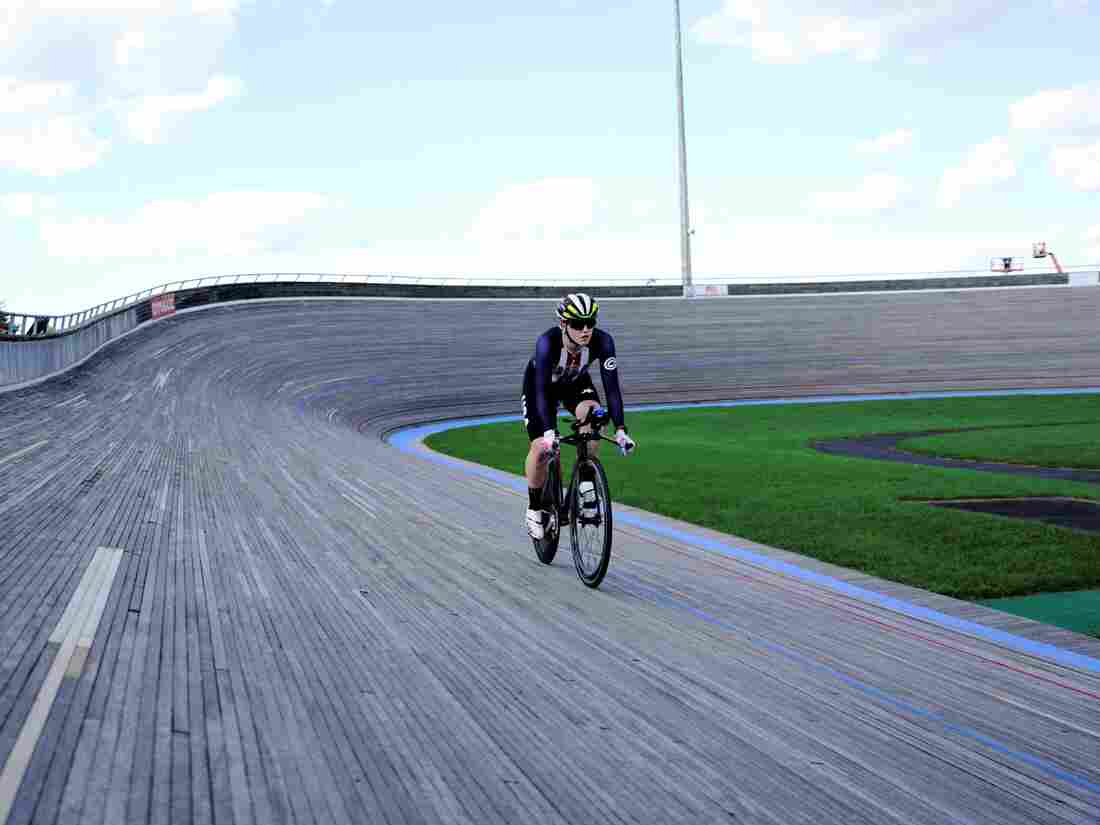


Catlin cycling on a track.
Courtesy of the Catlin family
hide caption
toggle caption
Courtesy of the Catlin family
The suicide attempt left Kelly with lung and heart issues, Colin says. Her family and her coaches convinced her to rest and she withdrew from the 2019 Track Cycling World Championships.
But the incident was far from behind them and she appeared frustrated. “She told me she hated failing the suicide attempt,” Colin says.
U.S. Cycling President and CEO Rob DeMartini described her death as a devastating loss. “The entire cycling community is mourning this immense loss,” he said in a statement. “We are offering continuous support to Kelly’s teammates, coaches and staff.”
Catlin’s personal coach of four years, Stephan McGregor, tells NPR that she was not just a top athlete. “People don’t necessarily realize that she spoke Chinese fluently, was a mathematician, was a musician. She was exceptional in every aspect of her life.”
Colin says she was full of contrasts — able to listen to industrial German heavy metal, then play Niccolò Paganini on her violin; she pretended she was fierce like velociraptor, making hissing noises, and dreamed of being a data scientist.
And she wanted to inspire women in the world, Colin says.
“The greatest strength you will ever develop is the ability to recognize your own weaknesses,” Kelly Catlin wrote in February, “and to learn to ask for help when you need it.”
If you or someone you know may be considering suicide, contact the National Suicide Prevention Lifeline at 1-800-273-8255 (En Español: 1-888-628-9454; Deaf and Hard of Hearing: 1-800-799-4889) or the Crisis Text Line by texting 741741.