Controversial Serena Williams Cartoon Ruled 'Non-Racist' By Australia's Press Council

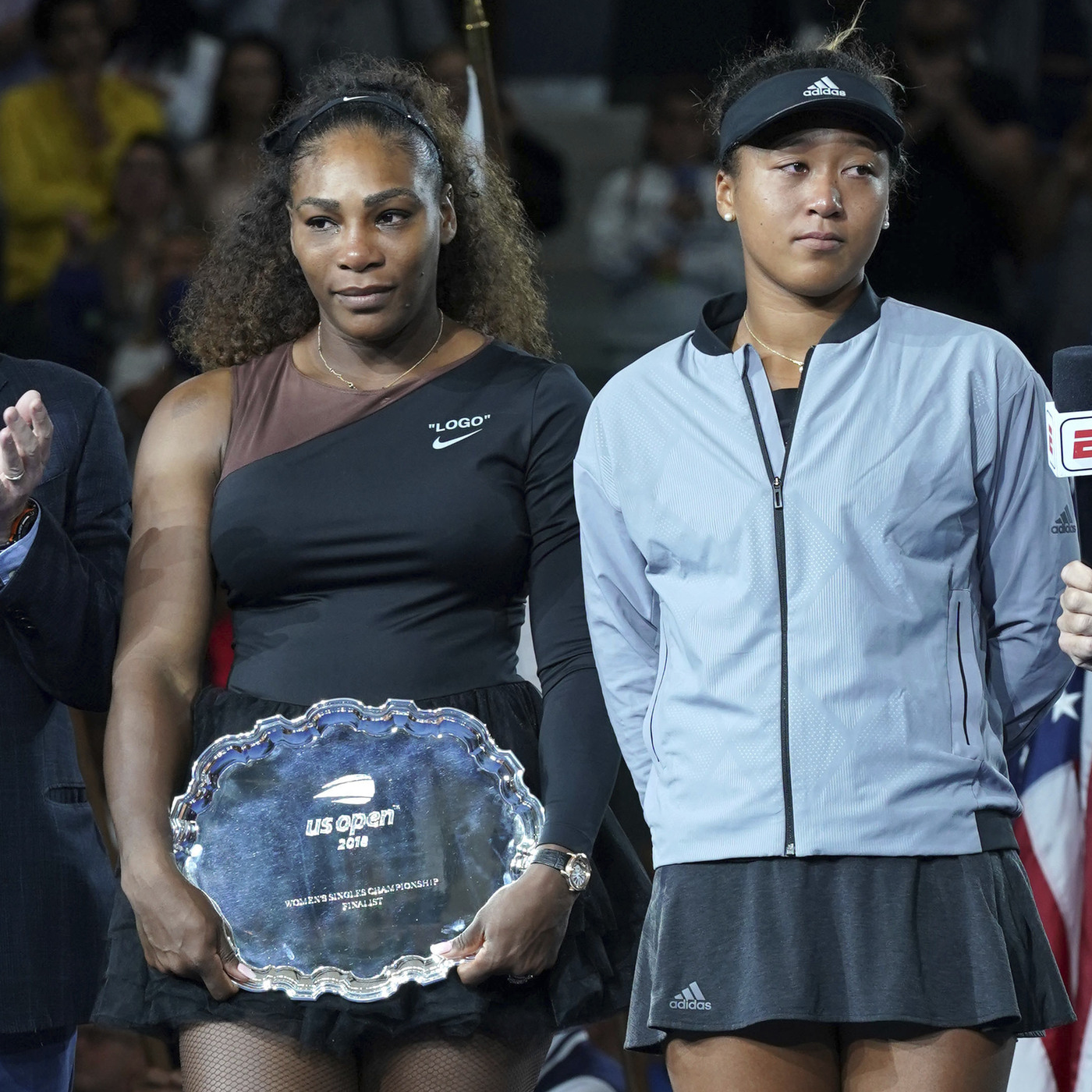
Serena Williams (left) and Naomi Osaka during the trophy ceremony after Osaka defeated Williams in the U.S. Open final on Sept. 8, 2018, that inspired a controversial cartoon mocking Williams.
Greg Allen/Invision/AP
hide caption
toggle caption
Greg Allen/Invision/AP
Nearly six months after a cartoon mocking Serena Williams unleashed immediate international rebuke, with critics calling it a racist Jim-Crow-era-like rendering of the sports star, the Australian Press Council weighed in on Monday, defending the image.
The cartoon, published last September in Australia’s The Herald Sun following Serena Williams’ stinging U.S. Open loss to Naomi Osaka of Japan, shows Williams in mid-tantrum and stamping on her tennis racket. The umpire is shown asking Osaka, “Can you just let her win?”
The Council said the cartoon “uses exaggeration and absurdity to make its point but accepts the publisher’s claim that it does not depict Ms Williams as an ape, rather showing her as ‘spitting the dummy’, a non-racist caricature familiar to most Australian readers.” (A “dummy” is an Australian term for a pacifier, which was drawn lying alongside Williams’ racket on the ground.)
@Knightcartoons cartoon is not racist or sexist …. it rightly mocks poor behavior by a tennis legend … Mark has the full support of everyone @theheraldsun pic.twitter.com/KWMT3QahJh
— damon johnston (@damonheraldsun) September 11, 2018
The Council, a watchdog group responsible for promoting good media practice standards in Australia, said it “accepts that the cartoon was illustrated in response to the events that occurred at the US Open final.”
On Sept. 8, 2018, Williams was playing the Grand Slam final against an opponent 16 years her junior, when in the second set, the chair umpire determined Williams’ coach was directing her from the sidelines and called a code violation.
Williams protested. “I don’t cheat to win,” she told the ump, Carlos Ramos. “I’d rather lose.”
As the game continued and Williams grew more frustrated, she slammed her racket onto the court, bending it. It was her second violation, and Osaka automatically got a point.
Visibly upset, Williams went on to confront Ramos and demand an apology, calling him a “liar” and a “thief.”
“You will never, ever, ever be on another court of mine as long as you live,” she told him. Williams was given a third code violation.
Osaka ultimately won — becoming the first Japanese player to win a Grand Slam title — but there was little joy evinced at a game that saw both players in tears at points and the crowd jeering the trophy ceremony. Williams was fined $17,000.
Williams, a winner of nearly two dozen Grand Slam titles, and her defenders have pointed to what they say is a double standard, whereby male players can get away with on-court outbursts for which female players are likelier to be called out. Williams’ coach later said he was trying to guide her from the sidelines, but said it is a common practice that is rarely penalized.
London-based writer Tobi Oredein told NPR’s Rachel Martin that what happened was not only about sexism but also racism.
“At the heart of ‘misogynoir’ — because it only affects black women — is a caricature of the angry, black woman,” she said. “And it dehumanizes us, and it stops us showing emotion.”
Well done on reducing one of the greatest sportswomen alive to racist and sexist tropes and turning a second great sportswoman into a faceless prop. https://t.co/YOxVMuTXEC
— J.K. Rowling (@jk_rowling) September 10, 2018
Mark Knight, who penned the cartoon, told the Herald Sun, he was inspired to draw the cartoon when he saw “the world’s best tennis player have a tantrum and thought that was interesting.”
The Herald Sun has stood by Knight, even as critics have said there is no getting around the stereotypical depictions in the drawing.
The National Association of Black Journalists called the cartoon “repugnant on many levels. The Sept. 10 cartoon not only exudes racist, sexist caricatures of both women, but Williams’ depiction is unnecessarily sambo-like,” a reference to the racist Jim Crow caricatures popularized in the 19th century.
.@heraldsun cartoonist Mark Knight reflects on how he should have drawn Serena Williams #USOpenFinal pic.twitter.com/zG8zqqkGVH
— Herald Sun (@theheraldsun) September 16, 2018
Knight defended his rendering of Williams. “I drew her as an African American woman,” he said in a video published on the Herald Sun’s web site. “She’s powerfully built. She wears these outrageous costumes when she plays tennis. She is interesting to draw.”
“This whole business that I’m some sort of racist calling on racial cartoons from the past — it’s just made up,” Knight said. “The cartoon was about her behavior on the day.”
Knight said he had to suspend his Twitter account because of the onslaught he faced after the cartoon was published.
He was also criticized for his rendering of Osaka. Oredein said he “whitewashed” the player, who is of Japanese and Haitian descent. Osaka “was seen as heroic and good and within her place,” Oredein said. “And she had blonde hair, and it was straight.”
In its ruling, the Australian Press Council said it had considered complaints about how the women were depicted and “that the cartoon should be considered in the context of the history of caricatures based on race and historical racist depictions of African Americans. “
Nevertheless, the Council said it found the publication did not fail “to take reasonable steps to avoid causing substantial offence, distress or prejudice, without sufficient justification in the public interest,” and so it did not breach the Council’s standards of practice.
Oredein said the cartoon embodies a wider problem in the industry, “that black women and their talents, especially in sports, are treated with suspicion.”
Robert Kraft Is Formally Charged With Solicitation Over Visits To Florida Day Spa

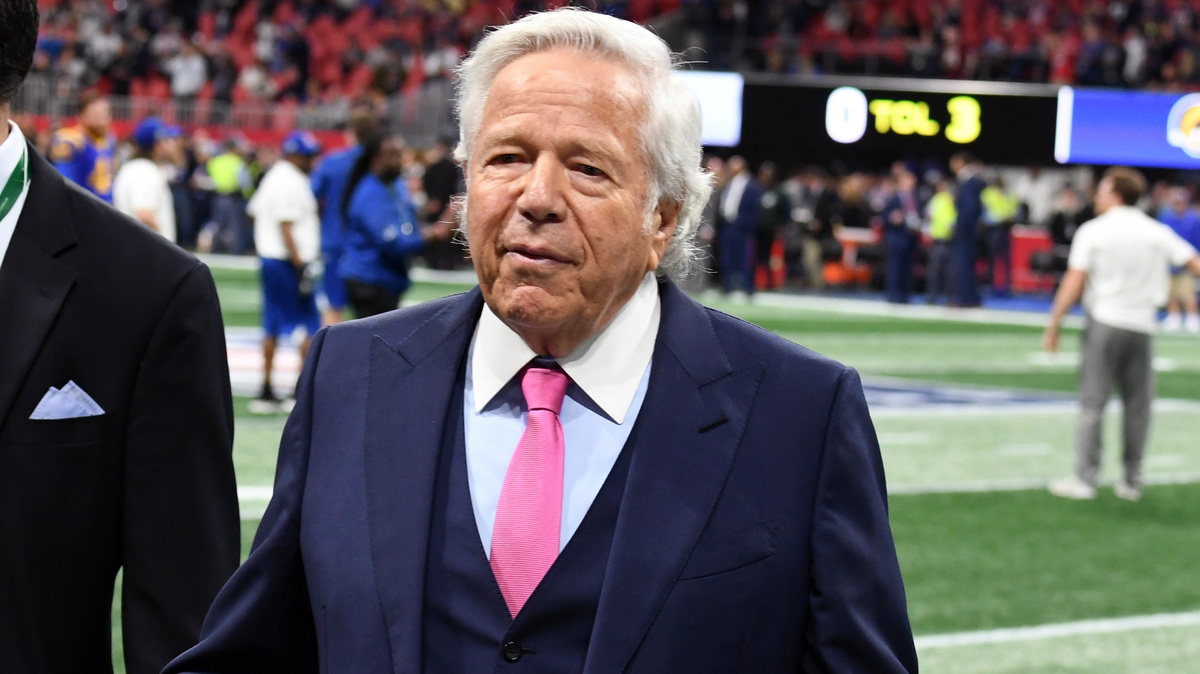
New England Patriots owner Robert Kraft faces misdemeanor charges over two visits to a Jupiter, Fla., day spa, where police allege that he paid for sex acts.
Kevin Winter/Getty Images
hide caption
toggle caption
Kevin Winter/Getty Images
Updated at 5:46 p.m. ET
The Florida state attorney’s office in Palm Beach says New England Patriots owner Robert Kraft has been charged with two counts of soliciting prostitution, days after police alleged surveillance video had caught Kraft during two visits to the Orchids of Asia Day Spa in Jupiter, Fla.
State Attorney Dave Aronberg said at a news conference Monday that Kraft, a resident of Massachusetts who also has a home in Palm Beach, is among 25 people facing first-degree misdemeanor charges of soliciting another to commit prostitution.
As for potential penalties, Aronberg said the charge potentially carries a prison sentence of up to one year, along with “mandatory 100 hours of community service, a mandatory $5,000 fine, and a mandatory class on the dangers of prostitution and human trafficking.”
The police investigation into the spa was aimed at stopping human trafficking, which Aronberg equated to “modern day slavery” and called an “evil in our midst.”
Officials will send Kraft a summons about the charge, the state attorney said. He also said all of the cases will be handled in the same way.
“No one gets any special justice in Palm Beach County,” Aronberg said. He later added that none of the alleged “johns” were targeted, saying they come from “all walks of life — there’s rich [and] poor, there’s young and old.”
The women who worked at the spa were victims of a criminal enterprise who deserve the government’s help, Aronberg said. While he didn’t provide new details about how the women who worked at the Jupiter spa arrived in the U.S., the state attorney described how human traffickers often lure women to come to the U.S. for the promise of a better life, but instead force them into becoming sex workers.
Kraft and the other men, including former Citigroup President and COO John Havens, and Wall Street financier John Childs, were snared in a sting operation that targeted the strip-mall massage parlor and spa — part of a broader investigation into what officials allege is a system of human trafficking and money-laundering.
Martin County Sheriff William Snyder, whose office opened the investigation that led to more than 300 arrest warrants across Florida counties, told NPR’s All Things Considered the sting was launched after receiving a tip about one of the illicit businesses.
A health care worker visiting one of the day spas noticed suitcases in one of the massage parlors and other indicators that some of the women might be living in the storefront business, Snyder said. Eventually, officials discovered that six to eight women were living in the small commercial space at any given time.
“They were staying inside the massage parlor for 24 hours a day, seven days a week,” Snyder explained, adding that the women, most of whom do not speak English, “were working seven days a week.”
He said the women cooked food on hot plates and slept on the same massage tables where they were forced to provide sexual services for eight to 15 men per day.
A Chinese woman currently in protective custody has provided grim details about how some of the women ended up working there.
She told investigators she was offered a job “making a lot of money” in an American nail salon, Snyder said. “And before she knew it she came here and found herself in the sex trafficking industry in massage parlors.”
She did not speak out because she feared her family in China would be put at risk if she cooperated with law enforcement.
In other cases, he said, women are trafficked into the country with their children and forced into making a horrible bargain with their captors: Engage in sex work in exchange for the well-being of their children.
“There are coercion points that keep them in bondage and the person with the key is not the trafficker. It’s the men who go into these parlors and avail themselves of this human misery,” Snyder told NPR. “I think they are monsters.”
The Martin County probe quickly led to a multi-jurisdictional investigation in Indian River County — where billionaire Childs and three law enforcement officers were snagged — and Palm Beach County, where Kraft and Havens were charged.
Jupiter Police Chief Daniel Kerr said in a press conference on Friday that there is video evidence of the criminal acts “for all of the individuals being charged,” including Kraft.
“We categorically deny that Mr. Kraft engaged in any illegal activity,” a spokesman for The Kraft Group told NPR Friday in a statement about the case. “Because it is a judicial matter, we will not be commenting further.”
Jupiter police raided the Orchids of Asia spa early last week, Kerr said at a news conference Friday. In addition to Jupiter, the coordinated police operation targeted businesses in Martin County and Indian River County. The Jupiter raid came after police collected video evidence from cameras hidden inside the facility.
“We’re as equally stunned as everybody else,” Kerr said of the high-profile suspects who now faced solicitation charges.
Kraft’s is not the only boldface name among the spa’s alleged clients. Also on the list is Citigroup’s former president and chief operation officer John Havens.
The spa charges $59 for a half-hour treatment and $79 for a full hour, Detective Andrew Sharp said on Friday. When Sharp was asked if there is video evidence of Kraft in the massage parlor room receiving alleged sex acts, he replied, “The answer to that is yes.”
In addition to seeking charges against men who visited the spa, Jupiter police also arrested its owner, Hua Zhang, and its manager, Lei Wang.
Kraft, 77, has a net worth that’s estimated at some $6.6 billion. He was recently ranked No. 79 on Forbes magazine’s list of the wealthiest people in the U.S. Most famously, Kraft has turned the Patriots into a dynasty, winning multiple Super Bowl titles since its first championship in 2002. He acquired the franchise in 1994.
Childs, founder of private equity firm J.W. Childs Associates, was among 165 people charged by the Vero Beach Police Department and whose photo was released on the police website.
“I have received no contact by the police department about this charge,” he told Bloomberg on Friday. “The accusation of solicitation of prostitution is totally false. I have retained a lawyer.”
A man who answered the listed phone number for Havens told the news outlet: “I have no idea what you are talking about,” when asked about the charges.
In addition to the criminal charge in Florida, Kraft also faces the possibility that the NFL could take action against him.
League spokesman Brian McCarthy said on Friday that the NFL is “aware” of the allegations and is monitoring the case. The NFL’s personal conduct policy explicitly prohibits sex offenses — and the rules apply to everyone in the league, McCarthy said.
The policy also seeks to impose a higher order of responsibility for one’s actions than simply avoiding being found guilty by the justice system.
On Monday, the NFL issued an updated statement saying that it is “seeking a full understanding of the facts,” and pledging to “take appropriate action as warranted based on the facts.”
Against The Odds, A Pro Soccer Team In Kashmir Is Close To Winning India's Top Title

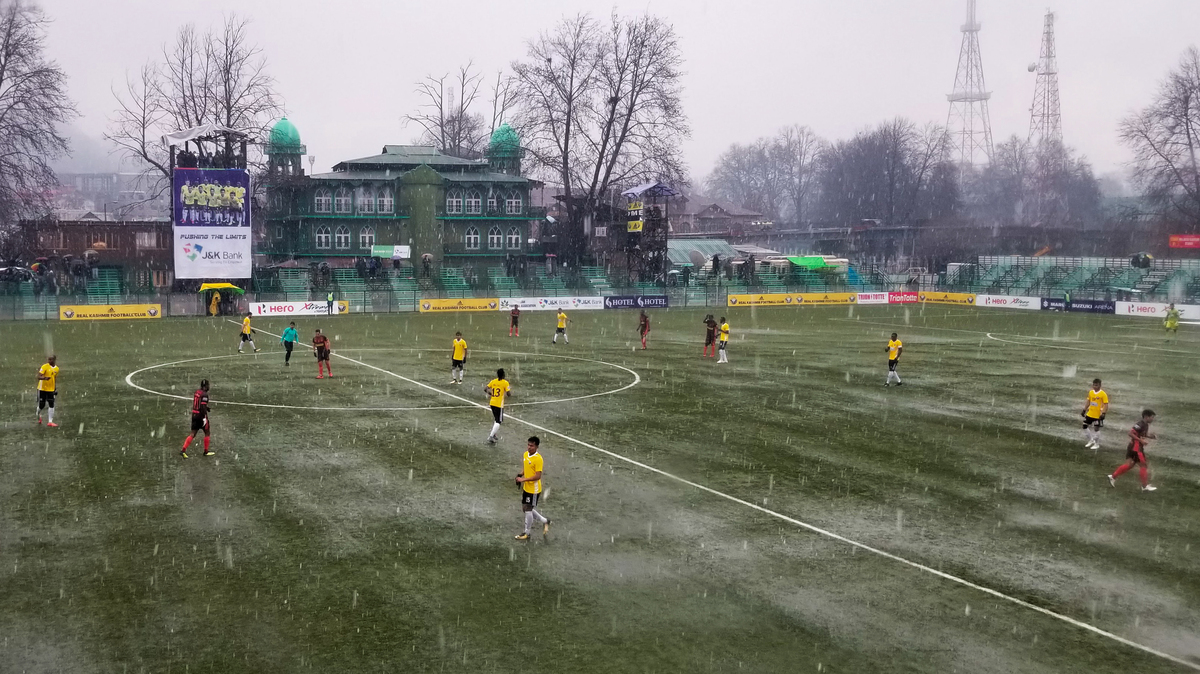
Snowflakes began accumulating on the turf by halftime during a Feb. 6 game at Real Kashmir’s home stadium in Srinagar. The coach of the visiting team said later that some members of his team, from southern India, had never seen snow.
Lauren Frayer/NPR
hide caption
toggle caption
Lauren Frayer/NPR
They play soccer in a disputed Himalayan valley prone to car bombs, strikes and heavy snow. Soldiers with machine guns patrol their home stadium. Players sometimes have to arrive at practice three hours early to avoid police curfews. Their team is less than three years old, with a budget that’s one-tenth that of some of their competitors.
Now, against all odds, Real Kashmir Football Club, from Indian-controlled Kashmir, is tantalizingly close to winning India’s top professional soccer title. They’ve been flitting back and forth between first, second and third place, and the season ends in early March.
“We’re the only club in India that has sold-out stadiums at almost every game,” says the team’s co-founder Shamim Mehraj. “What we have done is give people some hope in a place that has actually been taken down by conflict and violence for the past 60 years. It’s helping this place heal.”
Kashmir’s recent history has been chaotic. It has seen three wars between India and Pakistan and is the site of a decades-long separatist insurgency that Indian forces have often dealt with violently. The valley is part of Hindu-majority India’s only Muslim-majority state, Jammu and Kashmir.
A natural disaster helped give birth to this soccer team. In 2014, the Kashmir Valley suffered devastating floods. Hundreds of people were killed. Schools were closed, and young people spilled out onto the streets of Mehraj’s hometown Srinagar, the summer capital of Jammu and Kashmir and one of the largest cities in the valley.
One evening, Mehraj and a friend had an idea.
“We used to go for evening walks. We would see a lot of kids hanging around doing nothing, and I had been a footballer myself. That’s when I thought, ‘Why don’t I get some balls and at least give these kids something to do?'” recalls Mehraj, 38. He had played for his college team in New Delhi, and for his state in amateur soccer tournaments.
Mehraj, who is Muslim, and his Hindu friend Sandeep Chattoo, 52, got friends and neighbors to pitch in and buy 1,000 soccer balls, which they handed out to flood victims. But why stop there? In March 2016, they started a team.

Mahak Farooq (center), 24, watches her brother Danish Farooq, who plays midfield for Real Kashmir, alongside 12-year-old Urooj Ayyub Bhat (left), a local boy who’s one of the team’s most loyal fans and a fixture at home games.
Furkan Latif Khan/NPR
hide caption
toggle caption
Furkan Latif Khan/NPR
They applied for the team to compete in India’s I-League 2nd Division — the pro soccer equivalent of baseball’s minor leagues. Mehraj and Chattoo invested their own money to pay players’ salaries. They also hired a Scottish former player, David Robertson, who had been coaching a professional soccer team in Phoenix, Arizona, to coach Real Kashmir, a.k.a. the “Snow Leopards.”
Robertson had never been to India, and admits he probably couldn’t have placed Kashmir on a map.
“All I ever saw was TV shows that showed it’s 90 degrees — it’s hot in India! But I arrived here and the next day, it was snowing,” says Robertson, 50, now in his third season as Real Kashmir’s coach. “There was no Internet, the electricity was out, and I just thought, ‘I want to go home.'”
Mehraj invited Robertson over to his family’s house, gave him a hot water bottle and some home-cooked Kashmiri food — and convinced him to stay. Since then, Robertson has recruited his own son, Mason Robertson, 24, to play for Real Kashmir. By the end of the 2017-2018 season, several Robertson relatives were in the stands at the team’s home stadium in Srinagar, to watch Real Kashmir win the 2nd Division title.
This season, the team was promoted to the I-League’s top division, the first soccer team from Kashmir ever to qualify. (There is one other Kashmiri pro soccer team, Lone Star Kashmir FC, which plays in the I-League’s 2nd Division). In October, Real Kashmir signed a lucrative sponsorship deal with the sports giant Adidas. The brand features prominently on team uniforms and advertisements, and helps pay the salaries Mehraj and Chattoo had initially paid from their own pockets.
Now the team is neck-and-neck with Chennai City FC and East Bengal FC for the top title in Indian professional soccer. (Besides the I-League, India also has another pro soccer league called the Indian Super League, or ISL, but the I-League’s top division is considered the most competitive.)

Fans braved sleet and snow to watch Real Kashmir play a home game on Feb. 6 in Srinagar.
Furkan Latif Khan/NPR
hide caption
toggle caption
Furkan Latif Khan/NPR
“I never did think we would go this far,” Mehraj tells NPR, as he looks out over the turf at Real Kashmir’s home stadium.
There are constant reminders of the violence. On Feb. 14, a suicide car bomber killed dozens of Indian security forces on a main highway on the outskirts of Srinagar, where Real Kashmir plays home games. Curfews were imposed in the aftermath. The I-League Division 1 reigning champions Minerva Punjab FC, who were supposed to travel to Srinagar for a match four days later, refused to show up, citing safety concerns.
In Srinagar’s old quarter, the Muslim call to prayer reverberates through a warren of lanes sprayed with militant graffiti saying “India Go Home” and “Free Kashmir,” with the names of Kashmiri militants who have been killed in fighting. Kashmir’s 21 percent unemployment rate is triple that of the rest of India and militant groups recruit from the ranks of young, idle Kashmiri men.
Soccer “keeps him away from that,” says Ishfaq Hussain, 52, a former professional cricket player whose son Muhammad Hammad plays center-back for Real Kashmir. “He thinks always about when to play, when to practice. He’s got no time to join politics or go shouting or pelleting stones.”
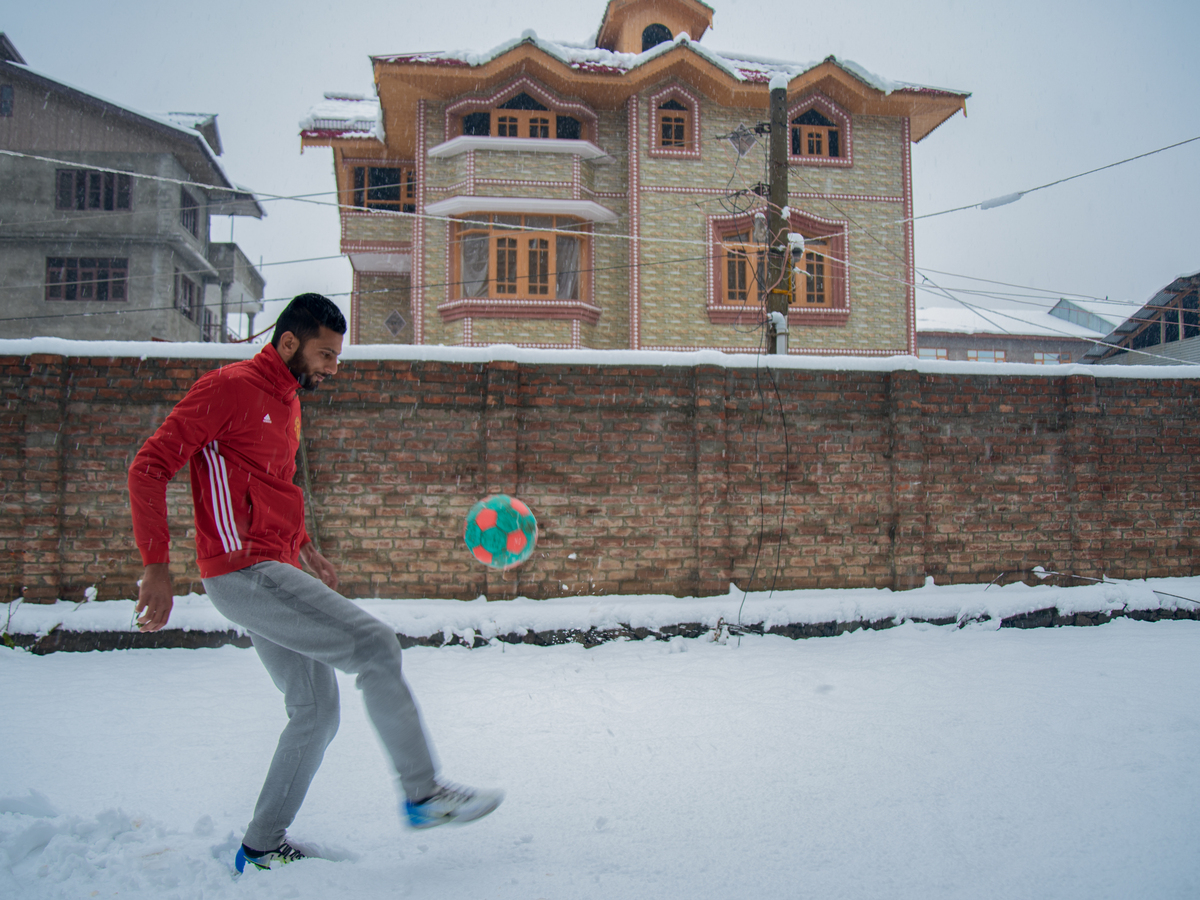
Hammad, 21, often has to circumvent police curfews to make it to morning soccer practice.

Muhammad Hammad, 21, kicks a soccer ball outside his family home in Srinagar. Hammad plays center-back for Real Kashmir as it vies for the top title in Indian professional soccer.
Furkan Latif Khan/NPR
hide caption
toggle caption
Furkan Latif Khan/NPR
“If the practice is at 11 o’clock, I have to leave home at 8 or 7 a.m. because there will be curfew around the city and you are not able to move around,” says Hammad. “The conditions here, you get much more motivation to achieve something. I have struggled a lot. These things also motivate you.”
When NPR visited Hammad at his parents’ home, his mother Mahjabeen, 46, got choked up describing how proud she is to watch her son play professional soccer. She has a giant flat-screen TV mounted on the wall of her living room to watch all of her son’s games. She describes how neighborhood children constantly ring their doorbell, hoping for a chance to kick around a soccer ball with Hammad.
His teammates include fellow Kashmiris and recruits from Africa, Europe and across India — including Muslims, Hindus, Christians and atheists.
Mehraj says he can’t manufacture T-shirts, stickers and banners fast enough to keep up with fans’ demand.

Muhammad Hammad (right), 21, who plays center-back for Real Kashmir, sits at home with his mother Mahjabeen.
Furkan Latif Khan/NPR
hide caption
toggle caption
Furkan Latif Khan/NPR
At a Feb. 6 home game, fat snowflakes began accumulating on the turf at a scoreless halftime. Drenched fans huddled in the bleachers under long plastic tarps, screaming. Schoolgirls in headscarves swooned.
Real Kashmir scored the winning goal against Gokulam Kerala FC, from southern India, in the 51st minute. As the referee’s whistle sounded and the home team moved one match closer to India’s top soccer title, the crowd of shivering, ecstatic Kashmiris erupted in cheers.
“You’re always rooting for the underdog, and I think Kashmir are that,” observes Sumedh Bilgi, an Indian sports journalist who’s watched the team’s improbable rise. “Ultimately, money rules the world. But you always want your fairy tale, don’t you?”



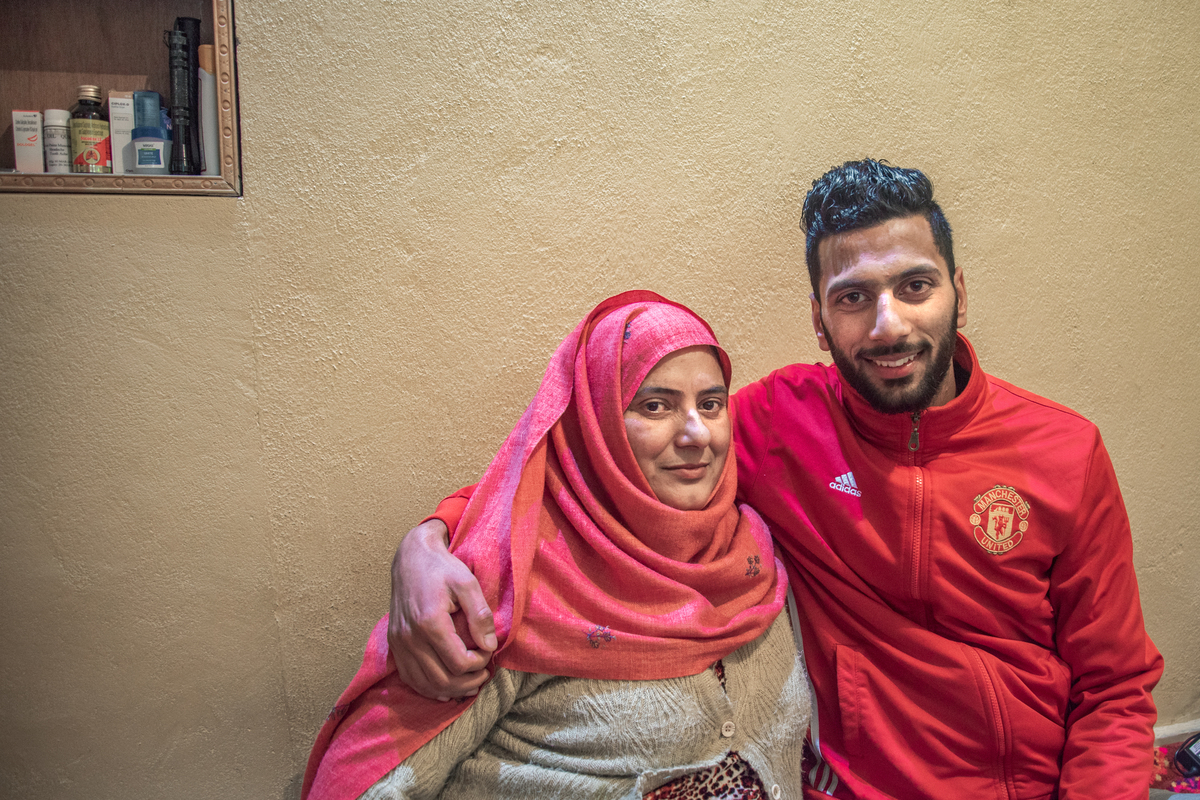

Team photo after Real Kashmir won India’s I-League 2nd Division title in May 2018.
Courtesy of Umar Amin
hide caption
toggle caption
Courtesy of Umar Amin
NPR Producer Furkan Latif Khan contributed to this report.
Jack Davidson On Breaking An NCAA Free Throw Record

NPR’s Scott Simon talks to Jack Davidson, a student at Wabash College. He broke the NCAA record for all-time consecutive free throws. He made 95 consecutive free throws, breaking a 22-year-old record.
SCOTT SIMON, HOST:
Jack Davidson is in the record books. The sophomore at Wabash College in Indiana hit his 95th free throw in a row last Saturday in a 13-point win over Oberlin, and he established a new all-time, all-divisions NCAA record for consecutive free throws. And then he missed his next free throw. Jack Davidson joins us now from the team bus. Thanks very much for being with us, Mr. Davidson.
JACK DAVIDSON: For sure. Thanks for having me on.
SIMON: Well, congratulations. What did it feel like to make that shot?
DAVIDSON: Yeah, it was a great feeling. Just to have the crowd’s support behind you and my teammates and coaches supporting me, it was a great feeling.
SIMON: So you must have known it was coming up, right?
DAVIDSON: Yeah. We knew before the game I was at 92, and we knew it was just three more to get the record. My parents were definitely really nervous about that. And my mom actually said she had some trouble sleeping the night before because how nervous she was.
SIMON: Yeah.
DAVIDSON: But I tried to stay calm and just try to win the game and let the record take care of itself.
SIMON: So I have to ask, what happened on the next shot?
DAVIDSON: Yeah, that’s what everyone keeps asking. But honestly, I just missed it. I left it short. It is what it is. And I’m glad I could make the 95th and just miss the next one.
SIMON: I gather your record – 22-year-old record that was set by Paul Cluxton of Northern Kentucky.
DAVIDSON: Yeah.
SIMON: Have you heard from Mr. Cluxton?
DAVIDSON: Yeah. He did – he actually reached out to me the other day and texted me and congratulated me, which was pretty awesome. And also, Darnell Archey, who had the Division 1 record at Butler, gave me a call, and then we had a nice conversation. So it’s been really nice – the outreach of everyone congratulating me. And that’s been really cool.
SIMON: I did a little research. Paul Cluxton is now running a car dealership.
DAVIDSON: Is that right?
SIMON: Yeah. So what do you see in your future?
DAVIDSON: It’s hard to tell right now. I’m just trying to get a good education and see where that takes me.
SIMON: Want to play basketball in the pros?
DAVIDSON: Yeah, that’s definitely a dream of mine. To play overseas somewhere would be pretty awesome. And so I’m always going to work towards that. But for right now, I’m just not really sure what I’m going to do after college. But just trying to live each day and then try to get better in every aspect.
SIMON: There are people all over America – well, all over the world – who practice free throw shots in gyms and backyards. Any tips, since you’re kind of the ranking expert?
DAVIDSON: Yeah. I’d just say try to keep your routine simple. Don’t do anything too crazy to distract you from just making the shot.
SIMON: What do you think about those people that do it underhand?
DAVIDSON: If that works for them – you know, Rick Barry obviously had a lot of success with that.
SIMON: Yeah.
DAVIDSON: But it’s definitely, I think, probably more difficult. But if you can master that, then do what you please. But it’s definitely been easy for me shooting overhand.
SIMON: Yeah. You do have two more years to break your own record, you know?
DAVIDSON: Yeah. It would be tough to make that many in a row again, but it sure is something I could strive for to do the next two years. And that’d be pretty crazy if I got that done.
SIMON: Yeah. How many consecutive do you have now?
DAVIDSON: I think it’s just seven or eight. I missed one last game…
SIMON: Oh.
DAVIDSON: …In the middle of the game, and then I finished by making seven or eight in a row.
SIMON: OK. Well, we’ll keep an eye on it, all right?
DAVIDSON: Sounds good.
SIMON: Jack Davidson, Wabash College basketball player, thanks so much for being with us.
DAVIDSON: Yeah, thanks for having me on.
(SOUNDBITE OF MUSIC)
Copyright © 2019 NPR. All rights reserved. Visit our website terms of use and permissions pages at www.npr.org for further information.
NPR transcripts are created on a rush deadline by Verb8tm, Inc., an NPR contractor, and produced using a proprietary transcription process developed with NPR. This text may not be in its final form and may be updated or revised in the future. Accuracy and availability may vary. The authoritative record of NPR’s programming is the audio record.
Saturday Sports: Robert Kraft, Zion Williamson
NPR’s Scott Simon talks to ESPN’s Howard Bryant about the week in sports, including criminal charges facing Patriots owner Robert Kraft and Zion Williamson’s injury on the basketball court.
SCOTT SIMON, HOST:
And it’s time for sports. There are more charges of misbehavior in the NFL – this time by an owner. A major college star sprains his knee when his Nike comes apart – so did their stock prices. We’re going to turn now to Howard Bryant of ESPN The Magazine and espn.com. Howard, thanks so much for being with us.
HOWARD BRYANT, BYLINE: Good morning, Scott. How are you?
SIMON: Fine, thanks. Robert Kraft, owner of the Super Bowl-winning New England Patriots, faces misdemeanor charges of solicitation at a day spa in Palm Beach County, Fla. He denies the charges. They are serious because police say that the solicitation at this spa is tied to human trafficking. Now how likely is it the NFL will discipline maybe its most powerful owner?
BRYANT: Well, I think it’s pretty likely that he’ll be disciplined at some level. The severity of the discipline I would tend to doubt is going to be particularly harsh. I could be wrong about this, but I think when you look at the history of owners dealing with their own – it’s not like they’re dealing with a player because you have an owner-management-labor relationship where they are – they took a long time to go after their greatest superstar, Tom Brady, over a couple of years’ worth. But I don’t think they’ll ever do that to another owner. You remember Robert Irsay the – I’m sorry, Jim Irsay, the owner of the Colts, had his drug issue, and he didn’t really – I mean, he got a little bit punished but not really punished I think.
Let’s also not forget the Washington Redskins had the – in 2013, they had forced their own cheerleaders to go on a business trip to Costa Rica and be escorts for some of the ownership group, for some of their executives. So I think, obviously, owners are not going to be as harsh on other owners. Let’s not forget that the commissioner may discipline ownership, but the owner works for the commissioner. So we’ll see what happens, but I have a hard time believing the billionaire class is going to be that hard on itself.
SIMON: I want to tie two stories of the week together, if I can. Thirty seconds into the Duke-Carolina game, President Obama in the stands, Zion Williamson, Duke’s transcendent player, sprained his knee. His Nike came apart like a cheap suit in a rain storm. And then USA Today reports the NBA has proposed lowering the league’s draft age to 18. Zion Williamson is 18. Isn’t it only fair to him and other great 18-year-old athletes to be allowed to play pro ball? So if they’re going to risk a career injury, they do it while being paid gobs of money.
BRYANT: Yeah. Well, in my opinion 15, 16, 17 and 18-year-old players – and you watch tennis – Tracy Austin was 14 years old when she played up against Chris Evert. And so to me, it’s always been collusion. You always look at what’s taken place between the leagues and the colleges. If you have the ability to play a certain sport, you should be able to play it. I think that we remember not too long ago – it was only about 15 years ago – where they had the rookie age limit when they raised it because they didn’t think that the players were mature enough for their millions because they didn’t like the look of the new hip-hop generation walking around with gold chains instead of three-piece suits. And so there was a lot of consternation about that.
And then they are the ones that created this one-and-done situation that you have now where you have these great players who are eligible – Zion Williamson could play in the NBA right now, and the only reason that his shoe blew up and he’s playing for no money and risked an entire future in the NBA is because the NBA doesn’t let him play in the league right now. So the fact that they’re finally going back to lowering the age limit to 18 is a good thing. And I think it’s a smart thing that they should have never raised it in the first place.
And once again, I think, when you’re looking at this – obviously, you can look at this from an amateur standpoint that the – this is another example that amateurism in the college game has to go. It’s not – especially because the irony of this, Scott, is that Mike Krzyzewski, he’s the one who controls the shoe contract for the players. So the players have to wear his shoe, he makes the money off of it, and they risk the injury and have no recourse.
SIMON: Oh, mercy. And I wonder – I – does Coach Krzyzewski even wear Nikes on the sidelines? He usually wears a suit, right?
BRYANT: Yeah, but those checks cash, that’s for certain. And so Zion Williamson has an $8 million insurance policy now. The bottom line is that this has to change, and the NBA should do its part. If you’re good enough to play in the league, go play in the league.
SIMON: Howard Bryant of ESPN The Magazine and espn.com. Yeah, I mean, ballet dancers, right? They – you know, nobody says to them one and done. Howard Bryant, thanks very much for being with us.
BRYANT: Thank you, Scott.
(SOUNDBITE OF ERIC VLOEIMANS AND GATECRASH’S “PICCOLO DAVID”)
Copyright © 2019 NPR. All rights reserved. Visit our website terms of use and permissions pages at www.npr.org for further information.
NPR transcripts are created on a rush deadline by Verb8tm, Inc., an NPR contractor, and produced using a proprietary transcription process developed with NPR. This text may not be in its final form and may be updated or revised in the future. Accuracy and availability may vary. The authoritative record of NPR’s programming is the audio record.
Breakdancing In The Olympics? Paris 2024 Organizers Say, 'Oui, Garçon!'

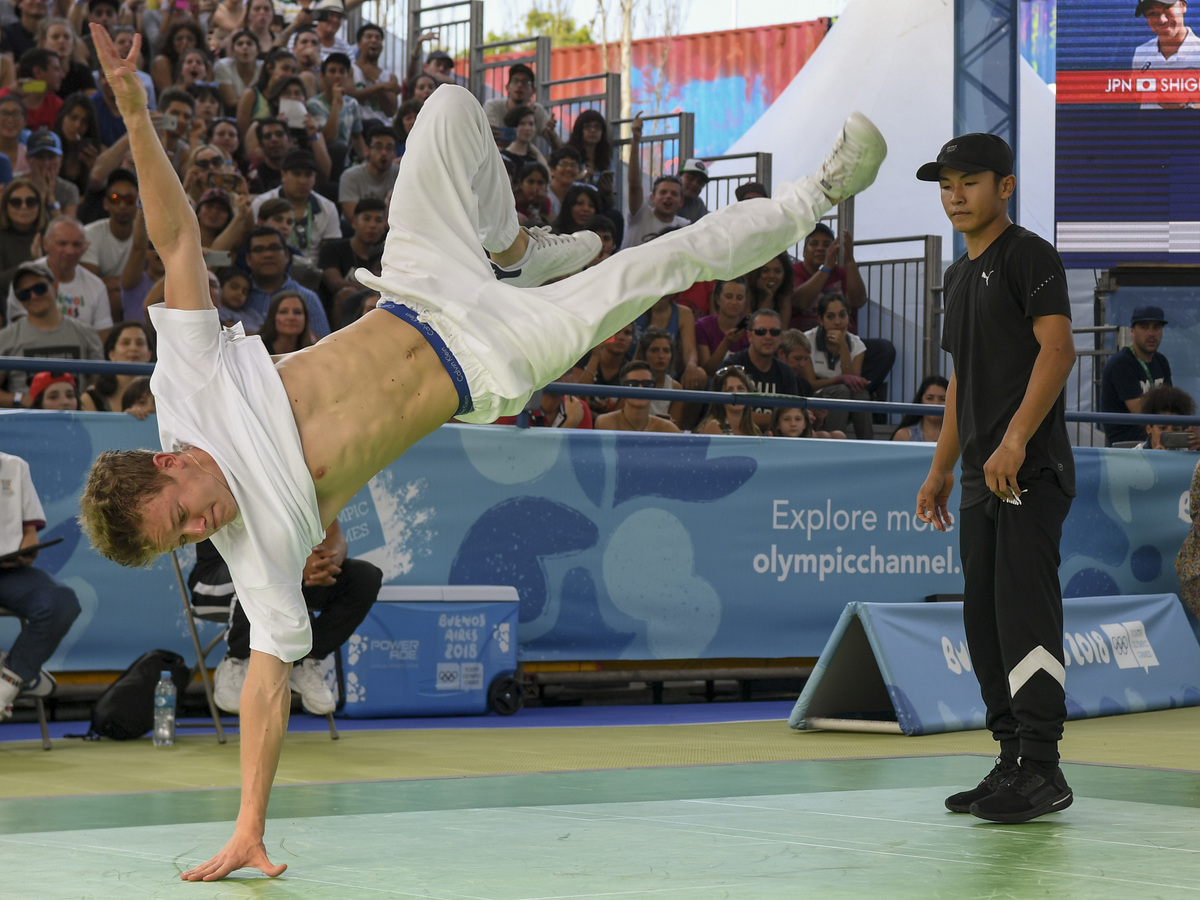
Paris Olympics organizers want breakdancing to be part of the 2024 Olympics. The sport was part of the Youth Olympic Games in Buenos Aires last fall, when Russian b-boy Bumblebee (left) defeated Japan’s b-boy Shigekix in the gold-medal battle.
Eitan Abramovich /AFP/Getty Images
hide caption
toggle caption
Eitan Abramovich /AFP/Getty Images
The world’s best breakdancers could compete for Olympic gold medals at the 2024 Summer Games in Paris, if the event’s organizers succeed in getting the hip-hop dance style recognized as an Olympic sport.
As Paris organizers proposed adding breakdancing to the roster, the International Olympic Committee said the idea fits with its goal of making the Olympics “gender-balanced, more youth-focused and more urban.”
Breakdancing was part of the Youth Olympic Games in Buenos Aires 2018, with participants competing as b-girls, b-boys and on mixed teams. At the Olympics, the discipline would be known simply as “breaking.”
In Buenos Aires, the b-girls competition was won by Ram (Japan’s Ramu Kawai), and the b-boy’s medal was won by Bumblebee (Russia’s Sergei Chernyshev).
YouTube
“The Paris organizing committee also wants to include climbing, surfing and skateboarding, which are already on the roster for the 2020 Tokyo Games,” Jake Cigainero reports for NPR’s Newsdesk. “Karate will also make its Olympic debut in Tokyo, but Paris snubbed the sport for its lineup.”
In breaking battle competitions, judges vote to decide the winner of multiple rounds of dancing, in which two dancers take turns on the floor — with rivals often doing their best not to look impressed with their opponent.
Discussing “le breakdance” at a news conference on Thursday, Paris organizers said that it speaks to young people worldwide and that it has more than 1 million practitioners in France — second only to the U.S.
Praising the dancers’ acrobatic ability and innovation and the dramatic suspense of battles, organizers said it would offer a completely new type of competition at the Olympics.
If breaking does become an Olympic sport, the dance style that has its roots in New York City’s streets will achieve a status that ballroom dancing aficionados have been pursuing for years. That effort has been led by the World DanceSport Federation — which now finds itself celebrating the inclusion of a different discipline.
“It is an incredible honor and privilege that, for the first time, a dance discipline is being considered for inclusion in the Olympic Games,” said WDSF President Shawn Tay, adding that breaking would be “an outstanding success” in Paris.
The Paris committee’s decision to back the four new arrivals means that baseball and softball will be left out of the Paris Olympics, after a brief return for the Tokyo Games. Squash is also shut out; so are chess and snooker, which were seen as facing long odds to become Olympic sports in 2024.
While a gritty sport that started in the U.S. has a shot at being in the Olympics, a gritty and acrobatic French sport — parkour — was left out of the Paris proposals. As NPR’s Laurel Wamsley has reported, the International Gymnastics Federation has increasingly sought to bring parkour under its purview and reportedly lobbied to make it part of the 2024 Games.
Paris organizers predict the new sports will boost the Olympics’ appeal to a younger generation that might not be transfixed by more traditional sports. While they sketched out how the competitions would be held in 2024, final details about the proposed sports aren’t likely to emerge until after the Tokyo Summer Olympics in 2020.
The International Olympic Committee will review the Paris group’s proposals, with an initial decision possible in March, when the Olympic Program Commission is slated to make its recommendation to the IOC Executive Board. Final approval could come in June, when the IOC will meet in Lausanne, Switzerland.
Florida Police: Robert Kraft, Owner Of Patriots, To Face Solicitation Charges
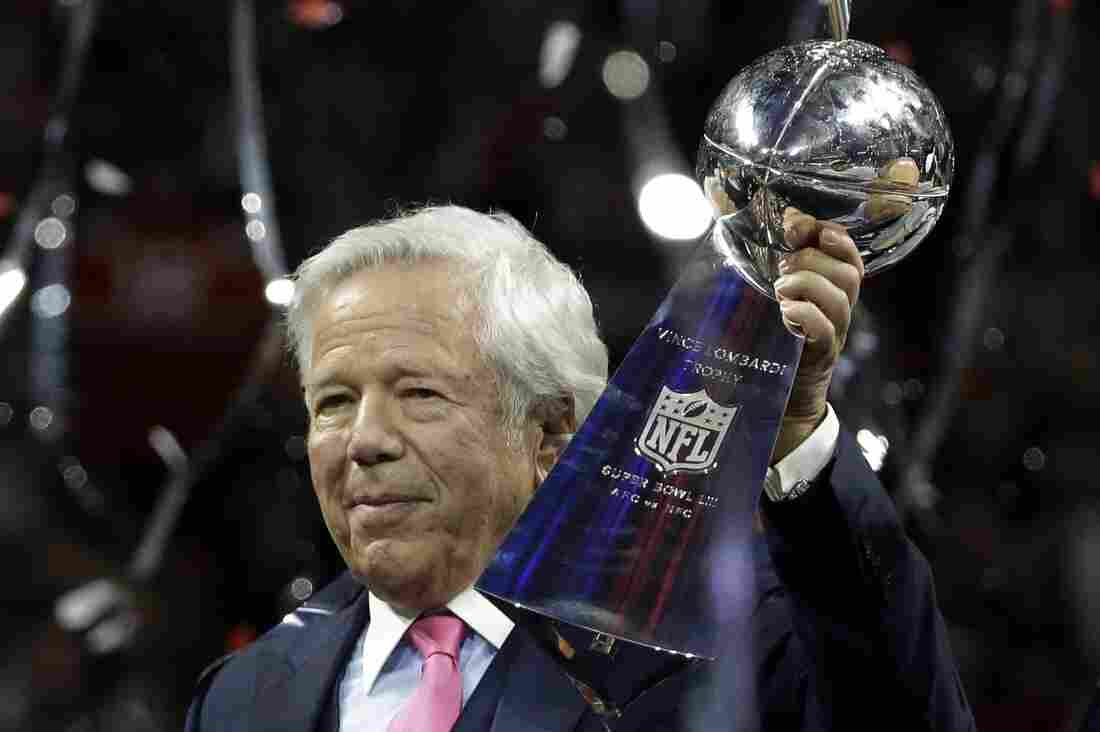

New England Patriots owner Robert Kraft is being charged with soliciting prostitution.
Mark Humphrey/AP
hide caption
toggle caption
Mark Humphrey/AP
Updated at 4:45 p.m. ET
A Florida police chief has announced that Robert Kraft, the owner of the New England Patriots, will face charges of soliciting prostitution after he was caught on surveillance video allegedly in the midst of a sexual act.
Jupiter Police Chief Daniel Kerr announced the charges on Friday as part of a sting on a local spa suspected of human trafficking and potential money laundering.
Kraft is one of dozens to face similar charges. Kerr says he is being charged with two counts of soliciting prostitution, a misdemeanor, tied to two different visits to the Orchids of Asia Day Spa.
Detective Andrew Sharp was asked at the Friday news conference if there is video evidence of Kraft in the massage parlor room receiving the alleged acts. “The answer to that is yes,” he said.
Sharp later elaborated, saying the footage — collected over several months — had been recorded by secret cameras mounted inside massage parlor rooms throughout the spa.
He added that Kraft, who he said was a regular, visited twice “approximately a month ago” and was taken to the spa, located in a strip mall, by a driver.
“I can’t speak to the exact dollar number that [Kraft] paid; however, there is a specific number for a time frame when you are there that you pay,” Sharp told reporters.
According to the detective, customers at the day spa typically paid $59 for a half-hour and $79 for a full hour. Sharp did not confirm how much time Kraft allegedly spent at the spa.
Kerr said that an arrest warrant will be issued for Kraft.
The 77-year-old Kraft has been the owner of the Patriots since 1994.
“We categorically deny that Mr. Kraft engaged in any illegal activity,” a spokesman for The Kraft Group told NPR in statement. “Because it is a judicial matter, we will not be commenting further.”
In an emailed statement, NFL spokesman Brian McCarthy wrote, “The NFL is aware of the ongoing law enforcement matter and will continue to monitor developments.”
McCarthy added that “all personnel” are subject to the league’s personal conduct policy which explicitly prohibits sex offenses.
“It is not enough simply to avoid being found guilty of a crime,” the policy states. “We are all held to a higher standard and must conduct ourselves in a way that is responsible, promotes the values of the NFL, and is lawful.”
A Blown-Out Sneaker, An Injured Superstar And A Night To Forget For Nike


Duke’s Zion Williamson reacts after falling as his shoe breaks in the game against the North Carolina Tar Heels Wednesday in Durham, N.C.
Streeter Lecka/Getty Images
hide caption
toggle caption
Streeter Lecka/Getty Images
It was the most highly anticipated college basketball game of the season: Duke was facing archrival North Carolina, with the spectacular talents of Duke’s freshman sensation Zion Williamson on display.
Former President Barack Obama was there. Tickets for the game were reselling for more than $3,000 — Super Bowl prices. Duke’s exuberant student section, known as the Cameron Crazies, was extra hyped.
And then a mere 33 seconds into the game, on a routine play, Williamson dribbled near the foul line when his left leg buckled, his left blue-and-white Nike sneaker ripped apart at the seams and he tumbled to the floor, grabbing his right knee in pain.
Williamson limped off the court. Hearts sank everywhere. Obama visibly mouthed “his shoe broke.” And in mere seconds, Nike was facing a marketing nightmare. The offending shoes were stashed away by a trainer. But the images of the young star being felled by his footwear couldn’t be erased.
“His shoe broke.”
President Barack Obama knew what was happening as soon as Zion Willamson went down
? @ChaseHughesNBCS pic.twitter.com/7sneMhzlOD
— SB Nation (@SBNation) February 21, 2019
On social media, messages of concern and sympathy for Williamson were mixed with dishy remarks about the shoes. A Nike rival tweeted, “Wouldn’t have happened in the pumas.” The tweet was later deleted.
In a statement, Nike said it was “obviously concerned” and wished Williamson a speedy recovery. “The quality and performance of our products are of utmost importance. While this is an isolated occurrence, we are working to identify the issue.”
Thankfully Williamson’s injury does not appear to be serious. Though the freshman didn’t return to the game, Duke’s coach Mike Krzyzewski described it as a mild right knee sprain.
But Williamson’s shoe implosion is an embarrassment for Nike, which also had a problem in 2017 with NBA jerseys that were tearing. But whether it will have any long-term impact on the world’s largest sports apparel brand is another matter. Nike’s shares were down about 1.7 percent in late morning trading — not good news, but not a major selloff.
Zion’s shoe: destroyed ? pic.twitter.com/LqQ2te0Jay
— SportsCenter (@SportsCenter) February 21, 2019
Nike’s markets are so global and its products are so diversified that it’s unlikely the sad fate of one shoe will have a meaningful impact on sales.
But then there’s the young man who was wearing those shoes — Zion Williamson. Possessing a unique combination of leaping ability, power, speed and basketball IQ, he is widely expected to be the No. 1 pick in June’s NBA draft.
At a mere 18 years old, his skills, athletic ability and court demeanor are already being compared to LeBron James’. Companies will be vying fiercely to sign him to a multimillion-dollar shoe deal. And when he plays his first NBA game, likely later this year, millions of people will be watching; many will be looking at the brand of sneakers he’s wearing.
Nike had better hope the memories of what happened 33 seconds into the North Carolina game don’t stay top of mind for Williamson.
Colin Kaepernick's Long Legal Battle With The NFL Is Over
David Greene talks to Jemele Hill of The Atlantic about the NFL’s settlement with Colin Kaepernick, who claimed team owners conspired to blacklist him for taking a knee during the national anthem.
DAVID GREENE, HOST:
Colin Kaepernick’s long legal battle with the NFL is over. He and his former San Francisco 49ers teammate Eric Reid have signed confidential agreements settling claims that team owners conspired to blacklist them for taking a knee during the national anthem to protest racial injustice.
Reid now plays for the Carolina Panthers, but no one has signed Kaepernick since his final 2016 season. Jemele Hill writes for The Atlantic, and we reached her via Skype. She is doubtful that Kaepernick will ever play for the NFL again. But she says, in one respect, he did win.
JEMELE HILL: The NFL, their playbook is really trying to pummel their opponents in court. And they’ve done that very successfully. They did it to Tom Brady, who eventually had to drop his fighting, as the NFL and Deflategate happened, and serve his four-game suspension. And Tom Brady is arguably the face of the NFL. And they had no problem going after him.
It’s very rare that a player has the league in the position that Colin Kaepernick kind of had them in, where in the fact that, you know, they didn’t want, I think, certain information to come out and be on the public record. You know, there have been plenty of reports and, certainly, it leads me to believe it was true, that there were emails, and text messages and other communication that probably would have been embarrassing to the NFL about this entire issue.
GREENE: So what do you think the NFL was trying to hide that had them under so much pressure to keep things under wraps?
HILL: They probably were worried about being tagged as racist. And already, in just the little bit of reporting that’s been done about what’s happened in some closed-door meetings and depositions – if you recall the late Bob McNair, the owner of the Houston Texans, when that comment that he said, calling the players inmates.
Once that became public, he had to apologize. And I would just imagine that there were probably more conversations that people would look at as being racist in nature, in terms of how they were discussing this protest and maybe other of the black athletes who were protesting in the same vein that Colin Kaepernick was.
GREENE: So no matter what side of this debate someone is on, couldn’t you argue that Kaepernick lost a lot? I mean, this is a young, talented, aspiring quarterback who already played in a Super Bowl, almost won a Super Bowl. And now there’s a chance that he may never play football again. Isn’t that losing a lot, personally, for him?
HILL: It is definitely losing a lot. I mean, a lot of people will look at the last contract that he had in the NFL, which was a very handsome contract. They’ll theorize about what his settlement is financially with the NFL in this lawsuit. And they’ll say from a financial standpoint, or even if you include his Nike deal, they’ll say from a financial standpoint that he won, and that should make everything better.
But I’ve always said, you know – and this is sort of the disheartening thing about this whole thing, is that Colin Kaepernick has spent pretty much his whole life trying to become a professional NFL player. He obviously loves football. And to have his career taken away from him is something that’s never going to be right. The NFL can never amend that, no matter how much money they give him, especially for the reason that they did, which is important.
I mean, this is a league that has welcomed, you know, players who have hit women, players who’ve been accused of sexually assaulting people. Players who’ve been accused of a number of different crimes, they have been welcomed back into the NFL. And the one person that is blackballed, that is kept out of that NFL dream, is somebody who merely wanted to bring attention to the racial injustice that we see every day. And forever in history, the NFL will have to answer to that.
GREENE: Jemele Hill is a staff writer for The Atlantic. Jemele, thanks a lot.
HILL: Thank you.
Copyright © 2019 NPR. All rights reserved. Visit our website terms of use and permissions pages at www.npr.org for further information.
NPR transcripts are created on a rush deadline by Verb8tm, Inc., an NPR contractor, and produced using a proprietary transcription process developed with NPR. This text may not be in its final form and may be updated or revised in the future. Accuracy and availability may vary. The authoritative record of NPR’s programming is the audio record.
Remembering Former Dodger Great Don Newcombe
Don Newcombe, who joined the Brooklyn Dodgers as a pitcher in the 1940s died on Tuesday. He was 92. Newcombe was one of the first black pitchers in Major League Baseball.
DAVID GREENE, HOST:
The baseball pitcher Don Newcombe has died. He was 92 years old, a man who broke barriers in the early days of baseball desegregation.
STEVE INSKEEP, HOST:
The world knows the name of Jackie Robinson, who broke a racial barrier when he played for the Brooklyn Dodgers in 1947. By 1949, the Dodgers had three black players – Robinson, Roy Campanella and Don Newcombe. Bill Plaschke as a columnist at the LA Times.
BILL PLASCHKE: He was as much a part of the civil rights movement as much as anybody. At age 92, he outlived many of those who harassed him and tormented him.
GREENE: The first black major league players faced segregated quarters when they traveled. They endured racial slurs and death threats. But Newcombe says opposing teams knew better than to insult him. He spoke with All Things Considered in 1975.
(SOUNDBITE OF ARCHIVED BROADCAST
DON NEWCOMBE: I was big, I was young, and I could throw that baseball awful hard. And players weren’t about to call me any names outside of hello, Mr. Newcombe or Don or whatever. They had to get up to that plate with that baseball bat in their hand, and they – you know, that ball hurts when it hit you.
INSKEEP: Newcombe became the first African-American pitcher to start a World Series game. He was named national league rookie of the year. And, in later years, he received a Cy Young Award, then awarded to baseball’s best pitcher. He did all that despite missing two years of play while serving in the Korean War.
GREENE: Newcombe believed he could have accomplished even more had he not suffered from alcoholism. He later helped other players facing addiction.
(SOUNDBITE OF ARCHIVED BROADCAST)
NEWCOMBE: I’m asked many times, Don, what do you do now? And I tell them that I am an ex-alcoholic, had the life that I lived, got weak in the sense and got involved with alcohol. I didn’t take care of myself, like a lot of athletes do today and have done in the past. But I consider myself sort of an evangelist.
INSKEEP: Columnist Bill Plaschke says that attitude is what he’ll remember about Newcombe.
PLASCHKE: You learn from him that every day is a good day, that every day you can make a positive influence on somebody, that every day, you know, no matter what’s going on around you, you can judge your day by how you affect others.
GREENE: Don Newcombe died here in California yesterday just under 70 years after his first Major League Baseball game.
(SOUNDBITE OF LYMBYC SYSTYM’S “PITTSBURGH LEFT (ELIOT LIPP REMIX)”)
Copyright © 2019 NPR. All rights reserved. Visit our website terms of use and permissions pages at www.npr.org for further information.
NPR transcripts are created on a rush deadline by Verb8tm, Inc., an NPR contractor, and produced using a proprietary transcription process developed with NPR. This text may not be in its final form and may be updated or revised in the future. Accuracy and availability may vary. The authoritative record of NPR’s programming is the audio record.