How Former NFL Quarterback Tony Romo Got His Broadcast Break

Tony Romo never got to the Super Bowl as quarterback for the Dallas Cowboys. But he’s finally going as an analyst for CBS Sports. Romo made a seamless transition to the broadcast booth.
Tony Romo never got to the Super Bowl as quarterback for the Dallas Cowboys. But he’s finally going as an analyst for CBS Sports. Romo made a seamless transition to the broadcast booth.
Sportswriter Ray Ratto believes you’re hating the New England Patriots for all the wrong reasons. NPR’s Ari Shapiro chats with Ratto ahead of Sunday’s Super Bowl.
In 2002, the Patriots played against the Rams in Super Bowl 36. That was the beginning of a Patriots’ dynasty. They are now playing in their eighth Super Bowl since that game.

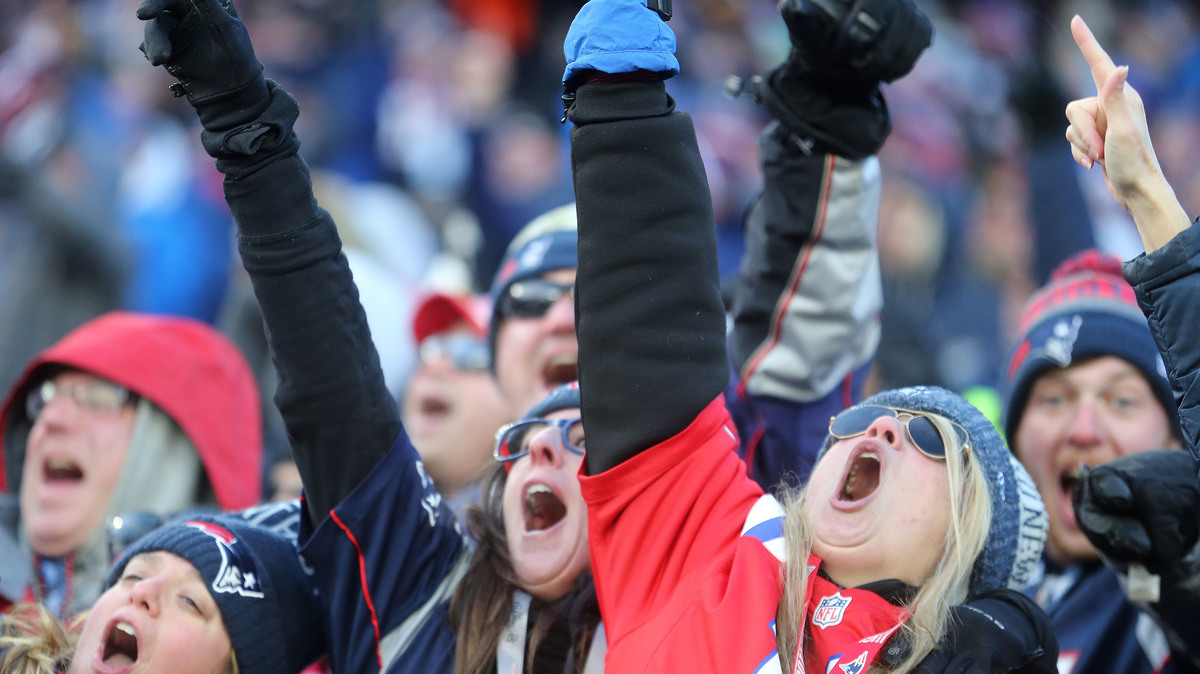
Fans cheer at Gillette Stadium in Foxborough, Mass., on Jan. 13. What stuff do you do to help your team?
Stan Grossfeld/Boston Globe via Getty Images
hide caption
toggle caption
Stan Grossfeld/Boston Globe via Getty Images
What’s your superstitious sports ritual?
Is it a prayer, wearing a special T-shirt, not washing your socks or eating a special sandwich? With the Super Bowl this Sunday, we’re looking at you Patriots and Rams fans in particular. What are you doing to help ensure your team wins?
NPR’s Weekend Edition wants to hear from you. Fill out the form below, and a producer may get in touch.
<!– Insert everything below in the . –>This form requires JavaScript to complete.
Powered by Screendoor.
The Super Bowl is set to be held in Atlanta this year, but chilly weather, and an icy history have some leaders on edge about the city’s ability to host the big game.

University of Maryland President Wallace Loh leaves the House Appropriations Committee hearing room in Annapolis in November 2018. The hearing was called to examine how the university responded to the death of football player Jordan McNair. Loh announced that he will stay on as president until June 2020.
Mark Gail for The Washington Post/Getty Images
hide caption
toggle caption
Mark Gail for The Washington Post/Getty Images
University of Maryland President Wallace Loh was supposed to retire in June, following the death of college football player Jordan McNair. But the university announced Wednesday that Loh would stay on an extra year because it’s taking longer than expected to find a new president.
McNair, a 19-year-old offensive lineman, collapsed last spring due to heatstroke during an off-season workout, and died two weeks later. Subsequent investigations found that McNair might have survived had Maryland trainers recognized the severity of his illness. While some called for Loh’s ouster, others — including McNair’s father — praised Loh for accepting responsibility on behalf of the university for the death.
In the aftermath of the tragedy, Loh said he would step down at the end of the 2018-19 academic year. Now, Loh plans to stay on until June 2020.
“The most important responsibility of the board is the successful hiring of a president and the most important responsibility of a sitting president is to ensure that the transition of leadership occurs very smoothly,” Loh told the Baltimore Sun on Wednesday. “It is my job to make sure that happens.” The Sun reported that the search for Loh’s successor “will launch now.” The paper added that, until now, the school’s search had not yet begun.
The Board discussed with me having a smooth transition of leadership, and we mutually agreed upon a retirement date of June 2020. With all of Maryland’s supporters, I look forward to what we will accomplish together. (2/2)
— Wallace D. Loh (@presidentloh) January 30, 2019
“We must take the time necessary to identify and select a bold and talented leader,” Board of Regents Chair Linda Gooden said in a statement. It will likely take “up to a year” to select a new president, the school said. The report declared Loh’s leadership as critical with various ongoing projects, including continuing to implement the football reforms recommended by two independent investigations.
An investigation by sports medicine consulting company Walters Inc. concluded that the training staff failed to quickly diagnose and treat McNair’s heatstroke. As NPR reported, if trainers had recognized the severity of McNair’s illness, “there might have been the opportunity to reverse the patient’s core temperature.”
Another investigation found the Maryland football team had “a culture where problems festered because too many players feared speaking out,” according to the report. Even some coaches “feared sharing criticisms” with ex-Maryland football assistant Rick Court, the report said. Court was the first athletic official to leave the program because of questions surrounding McNair’s death. Head coach DJ Durkin was fired at the end of October, his departure being “in the best interest of the University,” Loh wrote at the time.
The school said it had begun implementing many of the recommendations it had received, including adopting new technology to monitor and respond to rising temperatures, implementing mandatory hydration testing, and emphasizing longer and more frequent recovery breaks.
Loh accepted responsibility on behalf of the university for McNair’s death, admitting in August that the athletic training staff had “misdiagnosed” him when he collapsed, which led to his death. “The university accepts legal and moral responsibility for the mistakes that our training staff made on that fateful workout day,” Loh told reporters.
“It would be a complete shame if, after such a display of decency and humanity, Dr. Loh were to be let go,” McNair’s father, Martin McNair, said in a statement last summer. “Decency and transparency are the only path forward for our family, the University, and its sports programs to heal and emerge as safe places for families to entrust their children. Dr. Loh’s leadership is critical to this happening.”
Endurance runners, skiers and cyclists in Minnesota haven’t let extreme cold get in the way of competing in the Arrowhead 135 ultramarathon. The race kicked off Monday in International Falls, Minn.
Over the weekend, Coach Steve Kerr of the Golden State Warriors became the fastest coach to win 300 games, not just in NBA history, but in the history of professional sports.

Shim Suk-hee (front left) races during the women’s 1,500-meter finals at a World Cup short track speedskating event at the Utah Olympic Oval on Nov. 13, 2016, in Kearns, Utah.
Rick Bowmer/AP
hide caption
toggle caption
Rick Bowmer/AP
South Korea’s human rights commission is launching a sprawling investigation into sexual abuse and violence in sports, following multiple allegations that coaches mistreated and attacked athletes.
The National Human Rights Commission of Korea plans to interview thousands more athletes, including children and adults, about possible mistreatment.
“Physical and sexual harassment in the sports community take place repeatedly within a structured system, rather than accidentally,” the commission’s chief Choi Young-ae told a news conference in Seoul last week. “Violence is exonerated in the performance-centered culture.”
The commission, an independent body set up by the government, says it is assembling a team to carry out the interviews for one year, after which it might recommend further investigation and possible prosecution.
Earlier this month, three government ministries in charge of gender equality, education and sports pledged to coordinate action to make sure offenders, and those who ignore or cover up abuse, are prosecuted.
“From now on, we will make sure that victims of sexual abuse can call on the authorities without having to fear backlash,” Lee Sook-jin, vice minister of gender equality and family, told reporters on Thursday.
South Korea’s Olympic medal counts have ranked in the top 10 in recent years. But the new abuse accusations reveal entrenched problems in the competitive training culture of one of Asia’s rising sports powers, sports and human rights experts say.
The first case that appeared to lead a series of survivors to come forward was short track speedskater Shim Suk-hee, who went missing from the national team’s training camp in early 2018 — weeks before she competed in last year’s Pyeongchang Winter Olympics.
A Sports Ministry investigation found that Shim, a two-time Olympic gold medalist, was beaten by her coach Cho Jae-beom the day she went missing. Cho was fired and convicted of abusing four athletes, including Shim. He was sentenced to 10 months in jail last September.
Shim testified at Cho’s appeal hearing last month. Speaking to reporters outside the courthouse, she said, “I mustered my courage to come here today because I hope there will be no more victims like myself in the sports world and because I want to do what I can, not just for myself, but for the future.”
This month Shim went further, accusing Cho of repeatedly raping her since she was 17. She’s now 21.
Cho, who is 37, has denied the sexual abuse charges through his lawyer but admitted to physically abusing Shim and three other athletes.
As the scandal grabbed headlines, a petition on the presidential office’s website calling for harsher sentencing of Cho got more than a quarter of a million signatures.
Government officials and lawmakers promised to get tough on sexual abuse in sports.
“Recent allegations of physical and sexual violence in sports reveal a shameful side hidden beneath the shiny facade of South Korea as a sports powerhouse,” President Moon Jae-in told his aides in a speech this month.
Also in January, a former judo athlete as well as a taekwondo trainee stepped forward to accuse their coaches of physical and sexual violence.
But some observers say the recent series of accusations are just a drop in the bucket.
“Still, the numbers are low, and we all know why,” says Chung Yong-chul, a professor of sports psychology at Seoul’s Sogang University and an activist against abuse in sports. “Because of all the threats, [abused athletes] are afraid to talk about it.”
Sports and Olympics authorities say the government has taken disciplinary action in 124 cases of physical, sexual and verbal abuse against athletes in the past five years, including 16 incidents of sexual abuse.
Chung says the government has been promising to crack down further on abuse for the past decade, but because of a culture of impunity, little has changed.
Some of this culture, he notes, has roots in South Korea’s Confucian traditions, in which a teacher’s authority is just like a father’s: It must be obeyed and not challenged.
“That’s part of the reason why it’s so hard for athletes to speak out,” he says, “because you’re actually accusing a father-like figure, accusing him as an aggressor.”
That’s also why sports authorities who have the power to punish abusers often shield them, Chung says. He adds that athletes are suspicious of the help centers and hotlines set up for them, and that they fear the services may be working against them and protecting coaches and trainers.
Athletes also face limited educational and career prospects after they retire from sports, Chung notes, so they are often afraid of risking their futures by speaking out.
He acknowledges that the current scandal in South Korea bears some superficial resemblance to the case of Larry Nassar, the former USA Gymnastics national team doctor.
But Chung points out that Nassar was sentenced to a total of more than 300 years in prison for multiple sex offenses. In addition, USA Gymnastics’ entire board of directors resigned, as did the interim president of Michigan State University, where Nassar worked as a physician.
“That didn’t happen in Korea,” Chung says. Although the head of the Korean Sport and Olympic Committee apologized to victims and the public, officials have not resigned or lost their posts as a result of the allegations.
Chung adds that if the snowballing scandal and public outrage don’t force an overhaul of a system that has allowed such abuses, then perhaps nothing will.
“So I think this could be the last chance for Korean sports to actually eradicate all the problems,” he warns.
He hopes South Korea will accept a reduced gold medal haul at next year’s Tokyo Olympics, in exchange for an increase in athletes’ human rights.
NPR News Assistant Se Eun Gong contributed reporting.
Over the weekend, Kai Struthers became the second youngest person in the country to bowl a perfect 300-point game.
RACHEL MARTIN, HOST:
Good morning. I’m Rachel Martin. When was the last time you went bowling? Maybe you got a few strikes and were pretty happy with yourself because bowling a strike every time is hard – right? – which is why Kai Struthers’ family is so excited. Kai, who is just 10 years old, became the second youngest person in the country to bowl a perfect 300-point game. His coach said when he doesn’t have a bowling ball in his hand, Kai is just a regular 10 year old, but when he does, he is bowling perfection. It’s MORNING EDITION.
Copyright © 2019 NPR. All rights reserved. Visit our website terms of use and permissions pages at www.npr.org for further information.
NPR transcripts are created on a rush deadline by Verb8tm, Inc., an NPR contractor, and produced using a proprietary transcription process developed with NPR. This text may not be in its final form and may be updated or revised in the future. Accuracy and availability may vary. The authoritative record of NPR’s programming is the audio record.