With $73 Million Deal, Christian Pulisic Is Most Expensive U.S. Soccer Player Ever

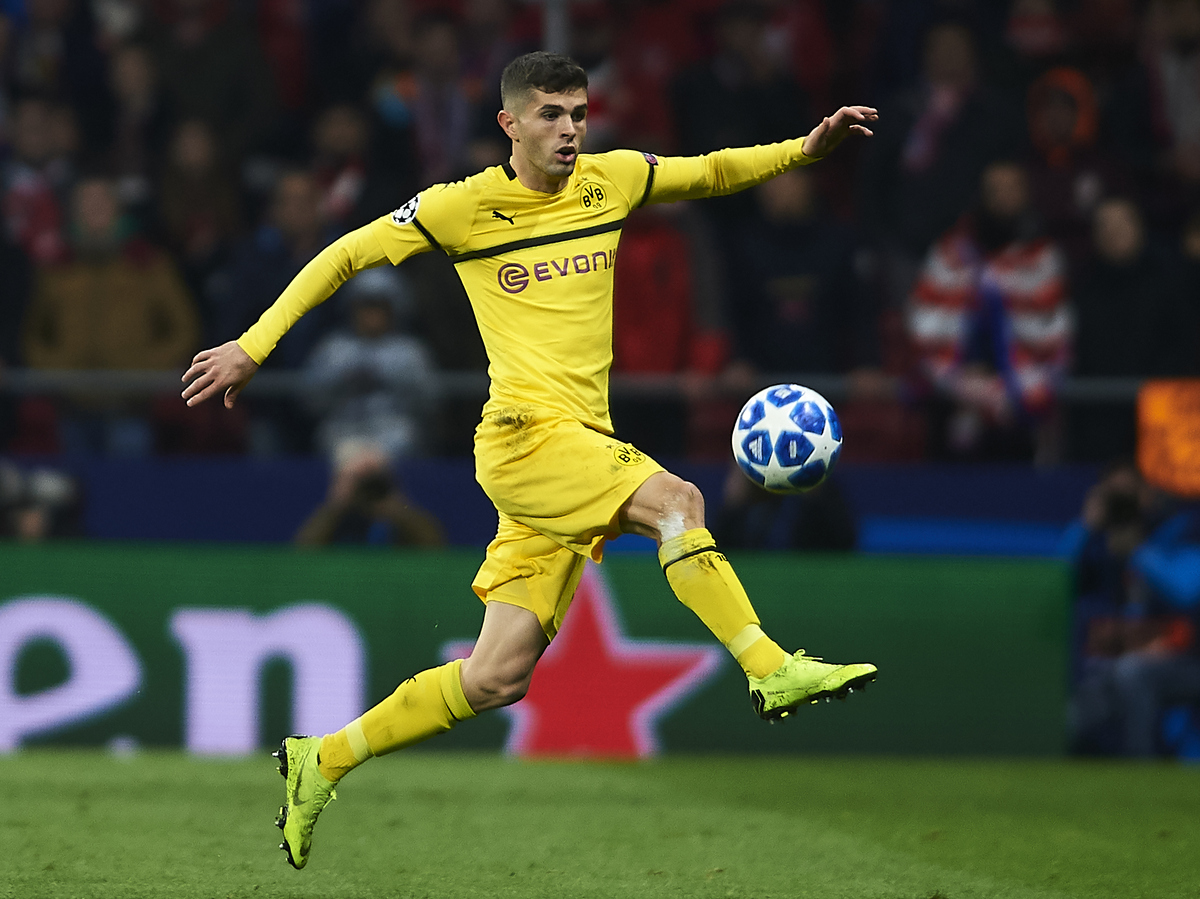
Chelsea FC will pay nearly $73 million to Borussia Dortmund for American soccer player Christian Pulisic. He is seen here in a Champions League match between Dortmund and Atlético Madrid in November.
Quality Sport Images/Getty Images
hide caption
toggle caption
Quality Sport Images/Getty Images
Updated at 3:38 p.m. ET
Chelsea Football Club will pay 64 million euros — nearly $73 million — to sign U.S. soccer star Christian Pulisic, bringing the 20-year-old winger to England’s Premier League.
The deal, which pays a transfer fee to his current club, Borussia Dortmund, makes Pulisic the most expensive American soccer player of all time.
Pulisic will play out the rest of the current season with Dortmund, the German club Pulisic joined as a youth player when he was just 16. His contract had been set to expire at the end of the 2019-2020 season. A native of Hershey, Pa., Pulisic plays for the U.S. Men’s National Team and, in 2016, became the youngest USMNT player to score in a World Cup qualifier.
In an effusive letter posted on Twitter, Pulisic thanked the fans, his teammates and coaches. “It feels like only yesterday that I arrived in Dortmund as a raw, excited very nervous but exceptionally proud 16-year old,” he wrote. “I would not be where I am today without the Club and their belief in giving young players a chance.”
Liebe Borussen ?? (????) pic.twitter.com/nAKgF1sHdI
— Christian Pulisic (@cpulisic_10) January 2, 2019
Pulisic’s parents are both former footballers: They met playing soccer at George Mason University. His grandfather was born in Croatia, and Pulisic was able to get a Croatian passport, enabling him to play in Europe at 16, rather than 18.
In a statement on the Dortmund website, the club’s sporting director called Chelsea’s five-and-a-half-year, $72.52 million offer “an extremely lucrative bid.”
“It was always Christian’s big dream to play in the Premier League. That certainly has to do with Christian’s American background, and as a result we were unable to extend his contract,” Dortmund sporting director Michael Zorc said in a statement. “Christian Pulisic is a perfect player in terms of his character.”
Irrespective of what you think about Pulisic’s destination and transfer fee, take a moment to celebrate an American kid growing up in Hershey, PA with big dreams of joining Premier League powerhouse, today made those childhood dreams come true. May there be many more to come ??? pic.twitter.com/egS8y9oAdW
— roger bennett (@rogbennett) January 2, 2019
“We are delighted to have signed one of Europe’s most sought-after young players,” Chelsea director Marina Granovskaia said in a statement. “Christian has shown his quality during a fantastic spell in Germany and at just 20, we believe he has the potential to become an important Chelsea player for many years to come.”
Dortmund is currently leading the top division of the German league, known as the Bundesliga. In April 2016, Pulisic became the youngest non-German to score a goal in the league.
Some observers think there is more to the Chelsea deal than Pulisic’s talents.
As one American soccer fan put it: “Whether he excels or not, this is a masterstroke of business. There are 320 million Americans and most don’t have a favorite BPL Club. Sign the most famous player in the USA and you’ll pick up quite a few.”
On soccer Reddit, fans speculated that NBC, which broadcasts the Premier League in the U.S., was likely thrilled at the news. “They’ll probably have a dedicated camera fixed on Pulisic at all times,” wrote one.
Fox Sports’ David Mosse suggested that Pulisic has another thing working in his favor: “Chelsea are bad about developing their academy players and young players that they spent very little money on. But a flashy foreign signing who they spent 64 million euros on will be given every chance to succeed.”
The previous record for highest transfer fee for an American was set in 2017, when the German club Wolfsburg paid 20 million euros for John Brooks. Pulisic will join a handful of other Americans currently in the Premier League, including DeAndre Yedlin, Tim Ream and Danny Williams.
While 64 million euros is a lot, the Pulisic move doesn’t rank among the richest in international soccer. That distinction belongs to a deal made in 2017, when Paris Saint-Germain paid 222 million euros for Brazilian forward Neymar.
Commentary: When Politicians Use Football Analogies To Make Their Point

Commentator Mike Pesca, host of the podcast The Gist and author of Upon Further Review: The Greatest What-Ifs in Sports History, breaks down analogies politicians use to explain the war against ISIS.
NOEL KING, HOST:
Sports metaphors have a way of working themselves into casual conversation. But interestingly, conversations about the war against ISIS are no exception. President Trump’s declaration that ISIS had been defeated and that he’ll withdraw U.S. troops from Syria led to serious debate. Some of his critics have started using football metaphors. Here’s commentator Mike Pesca.
MIKE PESCA, BYLINE: Last week on CBS’s “Face The Nation,” Democratic Senator Chris Coons spoke in opposition to the presidential decision to withdraw troops from Syria, saying, we’re so close…
(SOUNDBITE OF TV SHOW, “FACE THE NATION”)
CHRIS COONS: We shouldn’t fumble the ball on the five-yard line.
PESCA: Then this week on CNN, Republican Senator Lindsey Graham grabbed the analogy and ran with it – backwards by about five yards.
(SOUNDBITE OF ARCHIVED RECORDING)
LINDSEY GRAHAM: They’re inside the 10-yard line in defeating ISIS, but we’re not there yet.
PESCA: So close, but not as close. Then there was an NBC News story which quoted an unnamed U.S. Special Forces commander saying, we’re on the two-yard line. We could literally fall into the end zone. We’re that close to total victory to wiping out the ISIS caliphate in Syria.
Those words were said nine months ago at the time Rex Tillerson was still the secretary of state and H.R. McMaster was national security adviser. So you could interpret U.S. success as tantalizingly close but actually moving backwards bit by bit, or you could just conclude that it’s less likely that victory is in sight than the analogy is inapt. Analogies work by taking an abstract or even unknowable concept – in this case, the war against an amorphous enemy – and putting it in terms that an audience can understand.
Most Americans could not tell you the results of the Abu Komal offensive, or the command and control structure of ISIS or even if ISIS is Sunni or Shia. But they know when a football team has the ball on the two or five or 10-yard line, they should score a touchdown. Actually, based on statistics from over 30,000 scenarios, the sports analytics firm numberFire determined that the odds of throwing for a touchdown from the 10-yard line are 19 percent and from the five are 31 percent, a running touchdown from the five happens less often than 20 percent of the time, but push it out to Lindsey Graham’s 10-yard line, and you get a rushing touchdown 8 percent of the time.
So even these imagined yard lines, selected to convey the relative ease of the mission, indicate the opposite. And what would a field goal against ISIS be worth? Furthermore, what’s a turnover? That ISIS defeats the U.S. military? And is the U.S. ahead in this game? If so wouldn’t withdrawing, which is to say, running out the clock and ending the game, be the best strategy? I don’t think the senators and military men who purvey these analogies would argue that. They’d likely say comparisons to yard lines aren’t meant to be precise, but evocative. The only problem is they evoke not just a proximity to the goal, literally, but they imply a clock and a rules-based structure that the situation doesn’t warrant.
There is one notable thing about these analogies. They’re all football. If you remember five years ago, then-President Obama referred dismissively to the Jihadi groups which had inherited al-Qaida’s mantle by saying, quote, “the analogy we use around here sometimes, and I think is accurate, is if a jayvee team puts on Lakers uniforms, that doesn’t make them Kobe Bryant.” I don’t know if it’s deliberate or unconscious, but talk of goal lines and fumbles, as opposed to an NBA hall of famer, makes clear the current situation in Syria is a whole other ball game.
KING: Commentator Mike Pesca hosts the Slate podcast “The Gist,” and he wrote “Upon Further Review: The Greatest What-Ifs In Sports History.”
Copyright © 2019 NPR. All rights reserved. Visit our website terms of use and permissions pages at www.npr.org for further information.
NPR transcripts are created on a rush deadline by Verb8tm, Inc., an NPR contractor, and produced using a proprietary transcription process developed with NPR. This text may not be in its final form and may be updated or revised in the future. Accuracy and availability may vary. The authoritative record of NPR’s programming is the audio record.
VIDEO: Texas Longhorns Steer Charges Georgia's Bulldog

Texas Longhorns mascot Bevo XV, entering the stadium before the game against the TCU Horned Frogs on Sept. 22, 2018 in Austin, Texas.
Tim Warner/Tim Warner
hide caption
toggle caption
Tim Warner/Tim Warner
It is a philosophical question often pondered by sports writers and curious Redditors: If every college mascot were to fight each other, which would stand victorious when the dust cleared?



Uga, the University of Georgia mascot, sits near the sideline during the second half of the NCAA Sugar Bowl game against Texas in New Orleans on Jan. 1.
Rusty Costanza/AP
hide caption
toggle caption
Rusty Costanza/AP
Up until now, the question has been purely academic. But during the Sugar Bowl pre-game festivities Tuesday night in New Orleans, viewers almost got an answer to one no-longer-hypothetical match-up.
The University of Texas at Austin Longhorns mascot is Bevo, a longhorn steer weighing in at 1,600 pounds and armed with two spear-like horns that span 58 inches. The University of Georgia Bulldogs mascot is Uga, an English bulldog tipping the scales at 62 pounds. Uga has no horns, but he does wear a festive spiked collar.
With just under an hour before kickoff, handlers were trying to arrange Bevo and Uga for a photo-op on the sidelines of the Superdome. Suddenly and without warning, Bevo broke through the metal barrier separating the two mascots and charged toward the pup. Video of the melee shows Uga running for his life, as Bevo comes perilously close to hooking his tiny opponent (not to mention almost trampling several humans along the way).
BEVO SEE UGA. BEVO EAT UGA. pic.twitter.com/3SFk603rAQ
— Barstool Sports (@barstoolsports) January 2, 2019
One of Bevo’s handlers, Texas senior Patrick Dowell, told ESPN that the steer was “just going to say hi” to the little dog. John Baker, owner of the ranch where Bevo was bred, said that Bevo is actually “as docile as a lamb.”
Many on Twitter chastised Uga’s wardrobe artists for clothing him in the school’s colors: red and black. But the color red doesn’t actually make bulls charge. Bulls (and all cattle) are color-blind; they charge the matador’s muleta not because it’s red, but because it’s moving.
The mascots’ handlers were able to restore order, robbing interspecies speculators of the chance to know definitively who would win in a fight between a steer and a bulldog. As for the human match-up that took place afterward, the answer is clear: The No. 15 Longhorns handily defeated the No. 5 Bulldogs, winning the Sugar Bowl 28-21.
Serena Williams And Roger Federer To Face Off For The First Time

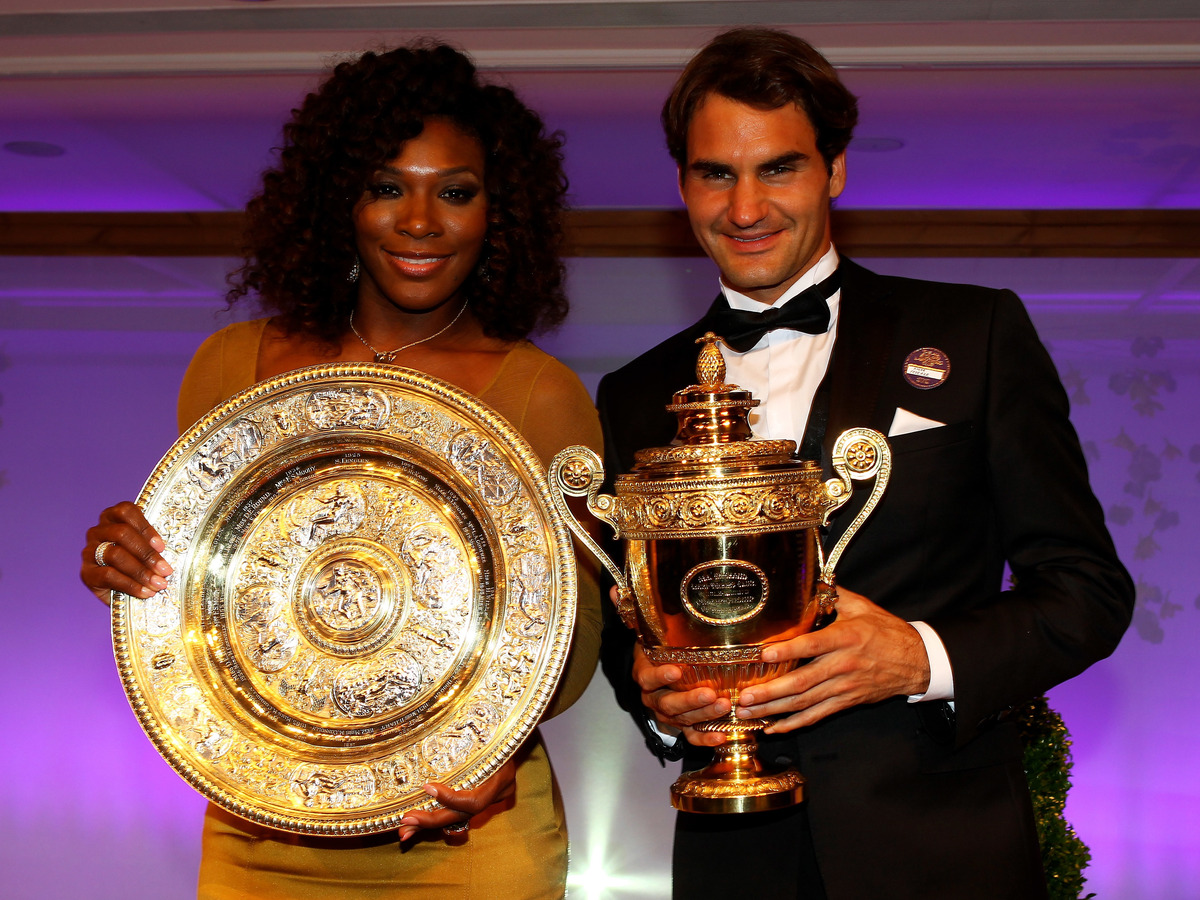
Serena Williams and Roger Federer, shown here at the Wimbledon Championships 2012 Winners Ball, are set to play each other at a mixed doubles match on New Year’s Day at the Hopman Cup in Perth, Australia.
Clive Brunskill/Getty Images
hide caption
toggle caption
Clive Brunskill/Getty Images
On New Year’s Day, two of the greatest tennis champions ever will stride out onto a court in Perth, Australia, and play each other for the first time.
Serena Williams and Roger Federer have been on the international tennis circuit for decades — both are 37 years old — and they have won 43 Grand Slam titles between them.
“I’ve always thought, ‘How is it to return that serve, or to go head to head with her?’ ” Federer said, according to Tennis.com.
They’ll meet in a mixed doubles match at the Hopman Cup. Williams, representing the U.S., will play with Frances Tiafoe, while Federer will compete alongside Swiss player Belinda Bencic.
The match has been compared to the 1973 exhibition match known as Battle of the Sexes, where Billie Jean King roundly beat Bobby Riggs.
Both Federer and Williams say they’re excited about the historic matchup. Williams has called it a “dream come true,” the BBC reports. “I have been looking forward to it. This is so cool.”
As Tennis.com notes, Williams said: “You know, I’ve been training in the off-season to be ready for Roger. I’m not sure how I’m going to do, but we’ll see.”
Federer stressed that both players are looking for victory. “I admire everything she’s done on and off the court, we are both fierce competitors and we always want to win,” he said, according to Agence France-Presse.
“It is going to be one time, probably never again. She is one of the biggest champions in our sport ever, men and women combined, so it is great to be playing against her,” Federer added.
“I don’t know her very well,” he said. “In the corridors and cafes, walking by each other, sometimes in the past she has asked me how are the kiddies and how is everyone doing, but if I said I know her it would be a bit of an exaggeration.”
At the Hopman Cup, eight teams representing their nations compete in a round-robin format. Competitors play a men’s and women’s singles match along with the mixed doubles match.
Williams defeated Greece’s Maria Sakkari on Monday in her first tournament appearance since she lost to Japan’s Naomi Osaka in September’s controversial U.S. Open Final.
During the final against Osaka, Williams received multiple penalties from umpire Carlos Ramos. In an escalating argument, she called him a “thief” and accused him of stealing a point from her. Some commentators have suggested that Williams was penalized unfairly due to sexism and racism.
Federer also won his first match of the Cup on Sunday, easily defeating Great Britain’s Cameron Norrie, 6-1 6-1.
He and teammate Bencic are the defending champions at Hopman. Federer also won 17 years prior to that victory when he teamed up with tennis star Martina Hingis.
Former Phanatic, Who Helped Create Gritty, Opens Mascot Hall Of Fame
The first Mascot Hall of Fame opened recently in Whiting, Indiana. NPR’s Leila Fadel speaks with Dave Raymond, the founder and a former mascot himself.
LEILA FADEL, HOST:
Googly-eyed, furry, orange and terrifying – when the Philadelphia Flyers hockey team introduced its new mascot Gritty this year, it became an Internet sensation. Now there’s a new museum in Whiting, Ind. It opened last week, dedicated to honoring the hard-working mascots of college and professional sports teams – a Mascot Hall of Fame.
The man who connects these two things is Dave Raymond. He helped create Gritty and co-founded the museum after a long career as the original Philadelphia Phillies mascot, the Phanatic. And he joins me now.
Thank you for joining us.
FADEL: My pleasure.
DAVE RAYMOND: This has been a project of yours for a long time. You started this as a website in 2005. Now it’s a physical museum. What does this mean to you?
RAYMOND: Well, about five years ago, I got a call from the city of Whiting, Ind., that said, hey. How about we help you build a bricks-and-mortar hall of fame? And I actually thought – (laughter) I thought I was getting pranked by part of my organization, somebody…
FADEL: (Laughter).
RAYMOND: …Calling me from another phone. And so I asked a few questions. And lo and behold, a trip out to Whiting and meeting the mayor started the whole thing. So, you know, to say it’s a dream come true is almost underselling it, you know, for me, personally, and, I think, for the people who really love mascots and have, you know, built their career doing it.
FADEL: You were a mascot for a long time being Phanatic. What are some of the more bizarre moments or your most bizarre memory playing that character?
RAYMOND: There were many. I mean, I performed at a funeral for an 89-year-old Irishman who wanted his wake to be fun. And he was a…
FADEL: Wow.
RAYMOND: …Big Phillies fan. And I – coming into that environment in the beginning in costume, I wasn’t too sure how it would work out. But everybody cheered and slapped the Phanatic on his back in the Supreme Court justices’ private chambers, when Justice Alito was brought on the bench because he was from Trenton. This was at the Supreme Court. Oh, yeah, in their private chambers…
FADEL: Wow.
RAYMOND: …At dinner, so there was a lot of security (laughter).
FADEL: You know, you were one of the creators behind Gritty. Were you expecting the reaction that came…
RAYMOND: (Laughter).
FADEL: ..With Gritty (laughter)?
RAYMOND: Well, I’ll tell you what we were expecting, which is part of my preamble when I sat down with the Flyers for the very first time. And that was, hey, you guys recognize we’re going to get killed – right? – from the standpoint of social media and negative feedback. And sure enough, in the first 24 hours, they received it. But they actually celebrated it (laughter) by sharing, probably, the meanest tweets…
FADEL: Right (laughter).
RAYMOND: …Or the funniest tweets.
FADEL: Do you have a favorite meme or Gritty punchline?
RAYMOND: (Laughter) Well, my favorite was that fake ad for making sure that you’re following safe sex because it said, after all, if you look at Gritty, you see that he is the love child of the abominable snowman and Yukon Cornelius from “Rudolph The Red-Nosed Reindeer” animations. So (laughter) that was pretty creative and very funny.
FADEL: So we’ve talked about mascots being loved and adored, but they can sometimes be controversial and seen as polarizing or possibly prejudiced, depending on what they’re depicting. Can you react to that a little bit?
RAYMOND: So what I would say is it’s all about, you know, trying to do your best to be away from any of those lines, so neutral gender, fantasy character that doesn’t have a representation of an animal. And I’ve been asked this question a number of times throughout my career. And it’s just, like – it’s just – to say it’s counterproductive is not even reaching the level of what a mistake it would be to either honor or create a character that does those things.
FADEL: Dave Raymond, the original Philadelphia Phanatic and creator of the Mascot Hall of Fame. Thank you so much.
RAYMOND: Thanks.
Copyright © 2018 NPR. All rights reserved. Visit our website terms of use and permissions pages at www.npr.org for further information.
NPR transcripts are created on a rush deadline by Verb8tm, Inc., an NPR contractor, and produced using a proprietary transcription process developed with NPR. This text may not be in its final form and may be updated or revised in the future. Accuracy and availability may vary. The authoritative record of NPR’s programming is the audio record.
Barbershop: The Year In Sports
In the Barbershop, NPR’s Don Gonyea speaks with Washington Post‘s Kevin Blackistone, The Nation‘s Dave Zirin, and USA Today‘s Christine Brennan about the biggest stories in sports in 2018.
Cuba's Mobile Internet Access Is A Big Step, But It's Not Without Flaws
The Cuban government recently extended Internet to mobile devices, a big step for Cubans living on the island under the repressive communist regime.
ESPN's Howard Bryant Previews Saturday's College Football Semifinals
NPR’s Debbie Elliott speaks with ESPN’s Howard Bryant about the college football playoffs that begin Saturday.
Cleveland Browns Are On The Verge Of A Winning Record
For fans of the NFL team, there’ve been some rough years. But finally, this weekend, the Browns go for their first winning record in 11 years.
DAVID GREENE, HOST:
Good morning. I’m David Greene. This song came out in 1998 to celebrate football returning to Cleveland. The Browns were back.
(SOUNDBITE OF SONG, “HERE WE GO AGAIN”)
THE BROWNS ALL-STAR BAND: (Singing) The Browns are going to show you how the game is played. Here we go again.
GREENE: There have been some rough years. But finally this weekend, the Browns will go for their first winning record in 11 years. Now, I need the Browns to win. If they beat Baltimore, my Steelers can make the playoffs. But this isn’t about Pittsburgh. I just want Cleveland to be happy. You’re listening to MORNING EDITION.
Copyright © 2018 NPR. All rights reserved. Visit our website terms of use and permissions pages at www.npr.org for further information.
NPR transcripts are created on a rush deadline by Verb8tm, Inc., an NPR contractor, and produced using a proprietary transcription process developed with NPR. This text may not be in its final form and may be updated or revised in the future. Accuracy and availability may vary. The authoritative record of NPR’s programming is the audio record.
Nassar Survivor On How USA Gymnastics Handled Abuse Crisis
It’s been a turbulent year for USA Gymnastics. Noel King talks to former gymnast Trinea Gonczar, about how the organization has dealt with the Larry Nassar abuse scandal, CEO issues and bankruptcy.
NOEL KING, HOST:
It’s been a turbulent year for USA Gymnastics. Back in January, dozens of women testified in a Michigan courtroom. They talked about years of sexual abuse they suffered at the hands of a prominent doctor, Larry Nassar. Trinea Gonczar was one of those women.
(SOUNDBITE OF ARCHIVED RECORDING)
TRINEA GONCZAR: This latest year has traumatized me in ways you cannot even begin to imagine, as I’ve had to realize I was abused for many years of my life. And this, my old friend, is because of you.
KING: Nassar was sentenced to decades in prison and a succession of USA Gymnastics CEOs have since stepped down. Then, this month, the organization filed for bankruptcy. I talked to Trinea Gonczar and I asked her how she thinks USA Gymnastics is handling all of this.
GONCZAR: I mean, I think that they’ve completely crumbled to their feet. I don’t think that they’ve done anything but make one bad decision after another and completely ruin the name of the sport and the organization. It looks worse and worse every time that they make these kind of decisions.
KING: If someone from the organization was to call you and say, Trinea, what should we do? – what would you tell them to do?
GONCZAR: Meet me. Talk to me. Meet with us. Talk to us. Learn about us. You know, I think that there is something to be said about character when you actually just say, we were wrong. How do we make this better?
KING: You’re saying, essentially, an apology would go a long way toward starting to heal this thing.
GONCZAR: Truly, that is all we have ever wanted from anyone, ever.
KING: Despite all of this, the U.S. women’s team did really well at the world championships in Qatar a couple months ago in October. Simone Biles, the top gymnast in the world, keeps on dominating the sport. When you see the U.S. team compete and do well, how do you feel about that?
GONCZAR: So proud. So, so proud. I mean, they’ve gone through the trenches at this stage. And to continue to fight? You know, I think there’s one thing about being a gymnast. Like, we’re trained to face fear. So he picked on, essentially, the worst group of athletes to do something like this, too, because we’re so focused, and we’re so taught how to overcome fear.
And I think USAG and United States Gymnastics being the powerhouse that we are, I think, just, I mean, speaks so loudly of the survivors of this case and the sport. I mean, we’re little, but we’re mighty. But it’s when they go out of competition and that door closes, unfortunately, is when you actually see the heartbreak. And that’s truly the reality for all survivors.
KING: Let’s talk about you as an individual for a moment because I know that you’ve taken on sort of a role in the past year as an advocate, as an activist. But you suffered very greatly as a young woman and as a girl. Your testimony at Larry Nassar’s trial was powerful. It was also agonizing. You talked for about 17 minutes. You said that, for many years, you had defended him. And you said that he was your friend. We’re going to play a little bit of that tape, Trinea.
(SOUNDBITE OF ARCHIVED RECORDING)
GONCZAR: I never doubted you. I never felt scared of you. We loved you like family. We believed you looked out for us and protected us from harm. We literally loved you like family.
KING: What did it mean for you to have the chance to talk directly to him in open court?
GONCZAR: Well, that moment, for me, was 1000 percent between he and I. It was a moment that the world saw that was extremely heartbreaking for me and, to be honest, heartbreaking for him. I never understood that this person could be the same person as the person that did this to all these girls and did so much harm. But now, as I go forward, I can understand, for these other amazing ladies and athletes and women, how this ruined a part of their life because they didn’t know him the same fashion that I knew him.
KING: Your last words to Larry Nassar in court were, goodbye, Larry. May God bless your dark, broken soul. When he went to prison, did you find closure?
GONCZAR: For me, no. For a lot of the other girls, it was a closure. For me, it was an opener. I had really not been able to start the healing process because I was still – I was very pregnant and really trying to understand what was happening. So for me, those words were the beginning of my journey, and it’s been a long one.
KING: Trinea Gonczar, thank you so much for joining us.
GONCZAR: Thank you so much for having me. I appreciate it so much.
KING: Trinea Gonczar works for Wayne County SAFE. They work with sexual assault survivors in and around Detroit.
Copyright © 2018 NPR. All rights reserved. Visit our website terms of use and permissions pages at www.npr.org for further information.
NPR transcripts are created on a rush deadline by Verb8tm, Inc., an NPR contractor, and produced using a proprietary transcription process developed with NPR. This text may not be in its final form and may be updated or revised in the future. Accuracy and availability may vary. The authoritative record of NPR’s programming is the audio record.