Adults Come Under Scrutiny After HS Wrestler Told To Cut His Dreadlocks Or Forfeit


A video still shows Buena Regional High School wrestler Andrew Johnson getting his hair cut on Dec. 19, in Buena, N.J., after referee Alan Maloney told Johnson he would forfeit the match if he did not have his dreadlocks cut.
Michael Frankel/SNJToday.com via AP
hide caption
toggle caption
Michael Frankel/SNJToday.com via AP
A week after a white referee told a black high school wrestler that he needed to cut off his dreadlocks or forfeit a match, the referee has been suspended. But people in town — and on social media — are asking why other adults didn’t do more to prevent what happened: A school official cut the student’s hair as the crowd watched and the clock ticked down.
In a video that has been viewed millions of times, Buena Regional High School junior Andrew Johnson is seen having his hair cut by the team trainer. Johnson won the match in overtime. But as the referee, Alan Maloney, raised Johnson’s hand as the winner, the young man looks utterly miserable.
Epitome of a team player ??
A referee wouldn’t allow Andrew Johnson of Buena @brhschiefs to wrestle with a cover over his dreadlocks. It was either an impromptu haircut, or a forfeit. Johnson chose the haircut, then won by sudden victory in OT to help spark Buena to a win. pic.twitter.com/f6JidKNKoI
— Mike Frankel (@MikeFrankelSNJ) December 20, 2018
A local sports reporter tweeted video of the incident, and outrage followed.
“This is not about hair. This is about race,” tweeted the ACLU of New Jersey. “How many different ways will people try to exclude Black people from public life without having to declare their bigotry? We’re so sorry this happened to you, Andrew. This was discrimination, and it’s not okay.”
The New Jersey State Interscholastic Athletic Association said in a statement that it had suspended Maloney while the incident is investigated by the New Jersey Division on Civil Rights.
Athletic association Executive Director Larry White said the incident had hit close to home: “[A]s an African-American and parent — as well as a former educator, coach, official and athlete — I clearly understand the issues at play, and probably better than most. The NJSIAA takes this matter very seriously, and I ask that everyone respect the investigatory process related to all parties involved.”
It turns out that it’s not the first time that Maloney has been investigated on charges of racist conduct. At a party in 2016, he allegedly called a black referee the N-word. Maloney told the South Jersey Courier-Post that he didn’t remember using the slur, but he believed the accounts of witnesses who said he did. The New Jersey Wrestling Officials Association initially decreed that Maloney would be suspended for a year, but he filed an appeal. The association’s ethics committee overturned the suspension, ruling that it didn’t have jurisdiction.
Johnson’s family released a statement through its attorney, Dominic Speziali, that offered a more detailed accounting of what it says happened at the Dec. 19 match. Referee Maloney was reportedly late to the meet and missed weigh-ins when “scholastic wrestling rules clearly state that referees are to inspect wrestlers’ appearance and determine any rules violations prior to the start of the meet, typically during weigh-ins. … When he did evaluate Andrew, he failed to raise any issues with the length of his hair or the need to wear a head covering.”
Maloney rejected the covering that Johnson wore over his hair, and then started the clock, giving the wrestler 90 seconds to cut his hair or forfeit the match. The family says, “Under duress but without any influence from the coaching staff or the athletic trainer, Andrew decided to have his hair cut rather than forfeit the match.”
The family added that it is supportive of Buena’s coaches and trainer: “The blame here rests primarily with the referee and those that permitted him to continue in that role despite clear evidence of what should be a disqualifying race-related transgression.”
Buena’s school superintendent released a statement outlining the incident and pledged continued support for its student-athletes. The Buena Regional Board of Education convened an emergency meeting on Wednesday evening, and as WHYY’s Darryl Murphy reports, it served as an occasion for community members to voice their displeasure:
“Rajhon White, a Buena alum, said the fact that the adults in the gym let that haircut happen reflects a larger problem with the culture of the community.
” ‘It was a direct correlation of what happens. It was Andrew being put in a situation where no one is standing up and fighting for him. You seen the video,’ he said. ‘Everyone is sitting there like, “Hmm, this is happening,” and that is exactly what is happening in these hallways.’
” ‘It’s not surprising,’ said Alison Arne of Buena Vista. ‘It was shocking to see Andrew Johnson’s hair being cut, but it definitely was not shocking that it was allowed to happen.’ “
The state’s department of education tweeted that it had met with the NJSIAA on Thursday morning “about protecting the rights of all student-athletes across New Jersey.”
The episode brought Johnson tweets of support from Olympic gold-medal-winning wrestler Jordan Burroughs and film director Ava DuVernay, among others.
“I don’t just wear locs. They are a part of me. A gift to me. They mean something to me,” DuVernay wrote. “So to watch this young man’s ordeal, wrecked me.”
Burroughs called the incident “sickening.”
“I’ve been wrestling for 25 years, at every level, and I have never once seen a person required to cut their hair during a match,” he wrote. “My opinion is that this was a combination of an abuse of power, racism, and just plain negligence. As heroic as it was for Andrew to step up in the midst of what was happening, it shouldn’t have got that far. The parents and coaches of the Buena wrestling team should have intervened. This young man should have been protected in this moment. I’m sure his hair was a strong part of his identity, and no single victory is worth succumbing to the pressure of unjust oppression and the unwarranted stripping of that identity.”
Johnson’s parents said the family had been moved by the outpouring of support, and that wrestling has taught their son resilience against adversity.
“As we move forward, we are comforted by both the strength of Andrew’s character and the support he’s received from the community,” they wrote. “We will do all that we can to make sure that no student-athlete is forced to endure what Andrew experienced.”
Pitcher Brady Singer Gives His Parents A Memorable Christmas Gift

Brady Singer recently joined the Kansas City Royals and received a $4.25 million signing bonus. He wrote his parents a holiday letter and told them he would be paying off all their debts.
DAVID GREENE, HOST:
Good morning. I’m David Greene. After pitcher Brady Singer signed with the Kansas City Royals, he wrote his parents a letter this holiday. He posted video of them reading it.
(SOUNDBITE OF VIDEO)
JACQUELYN SINGER: I love you, Mom and Dad.
GREENE: The Kansas City Star reports Singer used his $4 million signing bonus to thank mom and dad for their support and all the travel to games.
(SOUNDBITE OF VIDEO)
SINGER: I am paying off the loan from the bank. Also, I paid off all your debt, as well. What?
GREENE: You’re listening to MORNING EDITION.
Copyright © 2018 NPR. All rights reserved. Visit our website terms of use and permissions pages at www.npr.org for further information.
NPR transcripts are created on a rush deadline by Verb8tm, Inc., an NPR contractor, and produced using a proprietary transcription process developed with NPR. This text may not be in its final form and may be updated or revised in the future. Accuracy and availability may vary. The authoritative record of NPR’s programming is the audio record.
NFL Mental Health Therapist On Depression In Football
David Greene talks to Tish Guerin, mental health therapist for the Carolina Panthers. She’s the NFL’s first in-house therapist — meaning she’s in the building just like any other Panther employee.
New York Jets QB Sam Darnold Poses As A Mall Santa Claus
Last week in New Jersey, quarterback Sam Darnold went undercover as a mall Santa. Kids asked for toys and pets. One young fan asked for a Saquon Barkley jersey. Barkley plays for the New York Giants.
NOEL KING, HOST:
Good morning. I’m Noel King. New York Jets rookie quarterback Sam Darnold went undercover dressed in a red-and-white suit and a beard at a New Jersey mall last week. Kids asked him to bring them puppies and skateboards.
And then, eek, two young football fans asked him for Saquon Barkley jerseys. Barkley plays for the Giants. Darnold slumped a little and asked one kid kind of sadly, Saquon?
But when he revealed his true identity, a bunch of young Jets fans went nuts, and he seemed to cheer up.
Copyright © 2018 NPR. All rights reserved. Visit our website terms of use and permissions pages at www.npr.org for further information.
NPR transcripts are created on a rush deadline by Verb8tm, Inc., an NPR contractor, and produced using a proprietary transcription process developed with NPR. This text may not be in its final form and may be updated or revised in the future. Accuracy and availability may vary. The authoritative record of NPR’s programming is the audio record.
N.J. High School Wrestler Told To Cut His Dreadlocks Or Forfeit Match
Noel King talks to Washington Post sports columnist Kevin Blackistone, who shares his take about what happened when a referee gave a high school wrestler in New Jersey an ultimatum.
The Week In Sports: MLB, Cuba Reach Historic Deal
It’s time to reflect on the highlights of the week in sports, including an agreement that would allow Cuban athletes to play Major League Baseball without defecting from their home country.
SCOTT SIMON, HOST:
And now a couple of chestnuts roasting on an open fire (laughter) or, as we say around here, time for sports.
(SOUNDBITE OF MUSIC)
SIMON: There is a deal on the table between the U.S. and Cuba to allow the best baseball players in Cuba to play in the United States and Canada without having to defect. But it’s not as simple as just letting them sign. Here’s my fellow chestnut, Tom Goldman. How are you, Tom? Happy holidays.
TOM GOLDMAN, BYLINE: Smile when you say that when you call me a chestnut. Good morning.
SIMON: I said a couple of chesnuts. Some of the best baseball players in the world, obviously, are Cuban, but their government has not let them just sign a contract and play wherever in the world they want to – U.S., Japan, any place. What is in this new agreement?
GOLDMAN: Well, Scott, it would allow for easier signing of Cuban ballplayers and safer passage for players from Cuba to the major leagues. As you know, historically, it’s often a harrowing journey. The Cuban government hasn’t allowed players to leave, so they’ve had to defect, leave family behind, take big risks to get to the majors, you know, unscrupulous agents.
SIMON: And not be able to come back and see their family typically in the offseason.
GOLDMAN: Yeah, exactly, and there are unscrupulous agents and criminal elements, you know, waiting to extort players and kidnap them. This agreement, which grew out of more relaxed relations between Cuba and the U.S. during the Obama administration, would let players sign with MLB while they’re in Cuba, come to North America on a work visa and then return to Cuba in the offseason.
SIMON: Do they get to keep their salaries?
GOLDMAN: They do. They do. And this is an interesting point. You know, this is all going to depend on the Trump administration’s approval. And the White House sounds hostile to the idea so far. A statement from a senior administration official criticized the proposal because – and I’m quoting here – “a Cuban body would garnish the wages of hard-working athletes who simply seek to live and compete in a free society.” Now, a source in baseball I spoke to said wages will not be garnished. At most, the source says there will be, like, a 2 percent national tax. But other than that, the agreement guarantees no one’s going to touch the money players get from MLB. Scott, one other thing about money, which is always involved in baseball. Major League clubs that sign Cuban players will have to pay what’s called a release fee to a Cuban – to the Cuban Baseball Federation. There’s concern by our government that the money might end up in the wrong hands – the Cuban government. Now, there are no guarantees some of the money won’t go that way, but baseball officials in this country say while the proposed agreement isn’t perfect, it’ll be a lot better for Cuban players and a lot better for baseball to have this better pipeline to some of the world’s best players.
SIMON: I want to ask you about two American Olympians, both 23 years old, both women, at different points in their career. Mikaela Shiffrin won a slalom today in France, the great skier.
GOLDMAN: Right. Right. Yes, absolutely – breaking news. She won that slalom. It was her 35th slalom victory in her career, ties the women’s all-time record. Also at 23, she’s now the youngest skier ever, women or men, to have 50 World Cup races to have won them in all disciplines. We’ll have to wait till 2022 to watch her do her thing at the next Winter Olympics. But until then, watch her if you can. She’s really special.
SIMON: But there’s a 23-year-old swimmer who’s going to be saying goodbye to professional competition.
GOLDMAN: Yes, Scott, unlike Defense Secretary Mattis, Missy Franklin really is retiring…
SIMON: (Laughter) Yes.
GOLDMAN: …At the ripe old age of 23. Now, you have to go back a couple of Summer Olympics to remember her true greatness in the pool. In London 2012, she won four gold medals, five total, as a 17-year-old. At the World Championships the next year, she won six golds. And at that point, there was talk she was going to be a medal machine like Michael Phelps. She had a bubbly personality to boot. But then it all kind of crashed. Her body betrayed her with injuries. She battled depression. She had surgery on both shoulders last year. And she never could beat the pain. And it turns out, her late teenage years were her heyday, but she is ever-positive. She says she’s choosing to look at retirement as a new beginning, which one can realistically say at 23.
SIMON: Yeah. Well, NPR’s Tom Goldman, thanks. You know, we have run out of time before I could sing (singing) they’re the pride and joy of Illinois, Chicago Bears – bear down.
GOLDMAN: February, Scott, you’ll be celebrating.
SIMON: Oh, really? Tom Goldman, thanks so much.
GOLDMAN: You’re welcome.
Copyright © 2018 NPR. All rights reserved. Visit our website terms of use and permissions pages at www.npr.org for further information.
NPR transcripts are created on a rush deadline by Verb8tm, Inc., an NPR contractor, and produced using a proprietary transcription process developed with NPR. This text may not be in its final form and may be updated or revised in the future. Accuracy and availability may vary. The authoritative record of NPR’s programming is the audio record.
Parkour Resists 'Hostile Takeover' By International Gymnastics

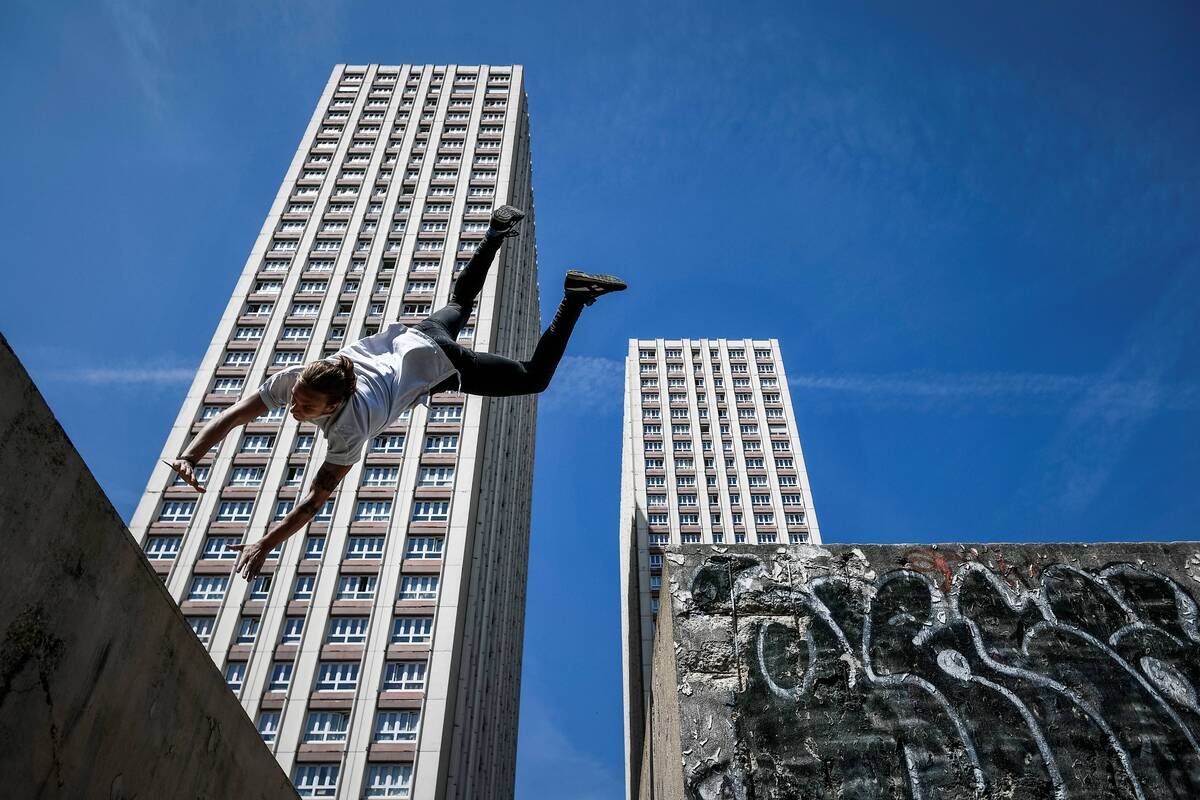
Many in the parkour community are resisting attempts by the International Gymnastics Federation to bring the sport under its umbrella. Here, Johan Tonnoir practices parkour in Paris in May.
Philippe Lopez/AFP/Getty Images
hide caption
toggle caption
Philippe Lopez/AFP/Getty Images
Since its beginnings in the 1980s in France, parkour has been sporty – but not exactly Olympic sporty.
Parkour and its cousin freerunning involve scaling urban obstacles and using the city as a playground. Its adherents, called traceurs and traceuses, bound railings, climb walls, and leap across terrifying expanses.
But now parkour, emblematic of freedom and practiced risk-taking, is fighting for its autonomy — from the gymnastics establishment.
Earlier this month, the International Gymnastics Federation (the FIG, for its French appellation) voted to make parkour one of its official disciplines. The FIG has been moving quickly to make parkour its own. It staged two Parkour World Cup events this year in Japan and France, and announced plans for a Parkour World Championships in 2020. The group intends to lobby the International Olympic Committee to include parkour in the 2024 Olympics, as a discipline of gymnastics, The Associated Press reports.
All of this has sparked resistance among some of parkour’s founders and practitioners.
David Belle, considered to be the inventor of parkour, was recruited to be on the FIG’s Parkour Commission. But he soon quit, followed by four others who wrote an open letter complaining that the FIG is “trying to trying to go fast with very little or no transparency, no involvement of the international parkour community or national communities.”
The en-masse resignation of @gymnastics “Parkour Commission”
“The implementation is trying to go fast with very little or no transparency, no involvement of the international parkour community or national communities”
“We see problems that worries us for the future of parkour” pic.twitter.com/8iSjlPcakH
— Eugene Minogue (@EugeneMinogue) October 26, 2018
Members of the parkour community have been voicing its displeasure on Twitter using the hashtag #WeAreNOTGymnastics.
“Now THIS, Internet, is what cultural appropriation looks like,” wrote one. “Running and climbing and jumping is life, not ‘regulated’, corporate owned sport.”
“No other community has the right to make decisions for us,” tweeted New Zealand Parkour.
Last year, six national parkour associations came together to form Parkour Earth – a governing body founded with the specific goal of protecting “the sovereignty and autonomy of Parkour/Freerunning/Art Du Déplacement internationally.”
The group’s CEO, Eugene Minogue, called the FIG’s maneuvering “the equivalent of a hostile takeover.”
“They are completely whitewashing our sport, its integrity, its history, its lineage, its authenticity,” he told the AP — which notes that Olympic sports have absorbed their more youthful upstarts before, as skiing did with snowboarding.
Gymnastics’ governing bodies have been on the defensive after the drubbing they they took their handling of the Larry Nassar sexual abuse scandal. But the FIG’s aggressive attempt to bring parkour into its fold may not turn out to be as easy a win as they’d hoped.
'Realization Of An Impossible Dream': MLB And Cuba Make Historic Deal


Los Angeles Dodgers’ Yasiel Puig in October. On Wednesday, U.S. Major League Baseball and Cuba’s baseball federation reached an agreement, allowing Cuban players to sign with U.S. teams without defecting.
Jae C. Hong/AP
hide caption
toggle caption
Jae C. Hong/AP
A new inning has begun for Cuban baseball players, after a historic agreement will allow the athletes to sign with U.S. teams without needing to defect.
Major League Baseball and the Major League Baseball Players Association announced Wednesday that they reached an agreement with the Cuban Baseball Federation after years of negotiating.
Under the deal, Cuba must release baseball players who are at least 25 or with more than six years of experience, and any major league club with whom they sign will pay Cuba’s baseball federation a “release fee.” The athlete will be able sign with a club while in Cuba, apply to the U.S. for a work visa and return to their homeland during the off-season.
The agreement is meant to stem the trafficking of Cuban athletes, its architects say. Since the U.S. embargo against Cuba started in 1962, baseball players on the island have had no choice but to defect and establish residence in a third country before signing a contract with a major league club in the United States.
That has led to a slew of perilous and harrowing encounters, including trafficking and extortion. Los Angeles Dodgers’ right fielder Yasiel Puig was smuggled out of Cuba to Mexico, then held by gangsters for ransom before receiving a $42 million contract.
“Establishing a safe, legal process for entry to our system is the most important step we can take to ending the exploitation and endangerment of Cuban players who pursue careers in Major League Baseball,” MLB Players Association Executive Director Tony Clark said in a statement. “The safety and wellbeing of these young men remains our primary concern.”
Deputy Commissioner Dan Halem told Reuters that the payments to Cuba are acceptable despite the sanctions because the Cuban Baseball Federation isn’t part of the island’s government.
A State Department official told NPR in an emailed statement that the agency is aware of the agreement and that baseball players will still have to go to another country to apply for a work visa, in accordance with U.S. policy.
If athletes choose to defect, they will face a mandatory waiting period before being eligible to sign.
It is unclear when the agreement will take effect. MLB did not immediately respond to NPR’s request for comment.
Similar agreements exist with Korea, Taiwan and Japan.
As part of their effort to form a deal, Major League Baseball spent more than $1.3 million lobbying on Cuban issues last year and nearly $1 million through the third quarter of 2018, Yahoo reported.
Baseball agent and consultant Joe Kehoskie told The Washington Post that despite an end to their legal obstacles, players will “likely end up worse off financially.” A reported 15 to 25 percent release fee to Cuba’s baseball federation is “roughly the same percentage Cuban players are currently paying to smugglers, and they’d likely be signing less-valuable contracts, since they’d be negotiating within a more restrictive [release] system, or draft, rather than as free agents.”
Emily Mendrala, executive director of the Center for Democracy in the Americas, called it “great news for Cuba, for the U.S., for the safety of Cuban baseball players and their families, and for baseball fans everywhere.”
In a statement, she described the long, shared history of baseball between the U.S. and Cuba, from Jackie Robinson training in 1940s Havana to a 2016 game between Cuba’s national team and Florida’s Tampa Bay Rays, with then-Presidents Barack Obama and Raul Castro in attendance.
Despite economic isolation, Cuba has continued to produce renowned baseball players over the years, including Puig, the Boston Red Sox’s Rusney Castillo, Chicago White Sox’s Jose Abreu, and former pitcher Orlando Hernandez.
“Knowing that the next generation of Cuban baseball players will not endure the unimaginable fate of past Cuban players is the realization of an impossible dream for all of us,” Abreu said in a statement. “Dealing with the exploitation of smugglers and unscrupulous agencies will finally come to an end for the Cuban baseball player.”
5-Time Gold Medalist Missy Franklin Retires From Swimming


Swimming champion Missy Franklin announced her retirement from the sport in an emotional letter to ESPN.com on Wednesday. She is 23.
Simon Hofmann/Getty Images for Laureus
hide caption
toggle caption
Simon Hofmann/Getty Images for Laureus
Five-time Olympic gold medalist and world record-holder Missy Franklin announced her retirement from swimming in an impassioned letter to ESPN.com on Wednesday, citing chronic shoulder pain that has ravaged her body and psyche over the last years of her career.
“It took me a long time to say the words, ‘I am retiring.’ A long, long time. But now I’m ready,” she said.
“I’m ready to not be in pain every day. I’m ready to become a wife and, one day, a mother. I’m ready to continue growing each and every day to be the best person and role model I can be. I’m ready for the rest of my life,” Franklin wrote.
The 23-year-old became an Olympic sensation during the 2012 London games where she was hailed by authorities in the sport as the new, best hope of American swimming. And she did not disappoint.
At 17, with her braces recently removed, she beamed from the podium time and time again, earning a total of five medals and becoming the first woman to win four gold medals in a single Olympics in any sport.
Franklin broke the world record for the 200-meter backstroke with a record time of 2:04:06, which netted the teen athlete a third gold medal at the games. At the time the young phenom was still training with her childhood swimming coach.
Over her amateur and professional career the swimming champion has won more than two dozen medals and accolades, including FINA World Swimmer of the Year in 2011 and 2012. But things began to unravel leading into Franklin’s second Olympic games.
“I’ve been very open about what I went through as I prepared for the Olympics in 2016 and talked openly about the struggles I endured, which included shoulder pain whenever I tried to train or compete, depression, anxiety and insomnia. It was also the year when I began to fully accept the fact that something was wrong with my body and it wasn’t working the way it was supposed to work,” Franklin said in the letter.
While she qualified for the games in Brazil she did not make it to the finals in either of her strongest events — the 200-meter freestyle and the 200-meter backstroke. Her only medal was a gold in the 4×200-meter freestyle relay.
Franklin described years of “the worst” shoulder pain, surgeries, physical therapy and mental anguish. She explained she has been diagnosed with “severe chronic tendonitis of both the rotator cuff and the bicep tendon.”
She said she has gone through three rounds of cortisone shots, including one just before the U.S. nationals in July in which she finished third in the C final of the 200-meter freestyle.
And just as she prepared to begin her “comeback, to prove everyone wrong, to show what a fighter” she is, Franklin was told she would need to have another surgery. She decided she couldn’t go through with it.
“I’ve been in too much pain, for too long, to go through another surgery with a longer recovery time and no guarantee it would even help,” she said.
Looking toward the future, Franklin said her “greatest dream in life, more so than Olympic gold, has always been becoming a mom.”
“This is by no means the end,” she added. “Rather, I choose to look at this as a new beginning. Swimming has been, and always will be, a big part of my life and I absolutely plan to stay involved in what I feel is the best sport in the world, just in a different way.”
Saturday Sports: Hard Chargers And Ravenous Raptors
NPR’s Scott Simon discusses the week in sports with ESPN’s Howard Bryant, including impressive wins by the NBA’s Toronto Raptors and the NFL’s Los Angeles Chargers.
SCOTT SIMON, HOST:
This is WEEKEND EDITION from NPR News – I’m Scott Simon – where BJ Leiderman writes our theme music. Here it comes. Time for sports.
(SOUNDBITE OF MUSIC)
SIMON: Basketball, football and litigation – America’s favorite sports. Howard Bryant from espn.com and ESPN The Magazine joins us. Howard, thanks so much for being with us.
HOWARD BRYANT, BYLINE: Hey, Scott. How are you?
SIMON: I’m fine, thanks. Let’s begin – but not as good as the Toronto Raptors. Let’s begin with the NBA. They’re not just lucky, are they? They completed their season sweep of the Warriors, the Golden State Warriors, this week – beat them by 20 points. What’s going on in Toronto?
BRYANT: Yeah, and they won that game on the road, as well. And that is – it’s a great one.
I know people talk about the 82-game season, and none of the games matter until the playoffs or whatever. But if you are the Toronto Raptors, and you were struggling for respect, you’ve never been to the NBA Finals, you were the best team in the league in your conference last year – or so you thought you were – and you won more games than you’d ever won before, and then LeBron James came in and blew your doors off…
SIMON: Yeah.
BRYANT: …And then you fired your coach, you need these victories. And it’s important to measure yourself against the greatest team of this era, the Golden State Warriors. And so to beat them twice in a season, I agree with what Steph Curry said. We’re after the game. He said, hey, if we meet them in the playoffs, it’s 0-0. Nothing matters from here.
That’s OK when you’ve won three championships – quite a different story when you’re the Raptors, and you’ve got Kawhi Leonard, and it’s a very, very different team. I always say – we’ve talked about this so many times on this show – that the NBA is a best-player-wins league, and Kawhi Leonard is the best player, I think, in the Eastern Conference. He didn’t even play…
SIMON: Yeah.
BRYANT: …In that game, and they still won. So it shows you how much confidence this team has now.
SIMON: And now to the NFL and the AFC, where the Los Angeles Chargers – still a little uncomfortable to say that.
BRYANT: San Diego…
SIMON: Yeah. I…
BRYANT: Yeah.
SIMON: Well, Stephen Smith said San Diego again this week – didn’t he? – several times.
The Los Angeles Chargers are also for real. They beat the Kansas City Chiefs with a 2-point conversion in the last few seconds Thursday night, even though there were some questions raised about it. How are they doing it?
BRYANT: Well, I think they’re a very good team. And I think that one of the interesting things about the Chargers, especially – we talked about the Raptors earlier. The Chargers are in a very similar boat. If you go back and think about this history of this team, they haven’t been to the Super Bowl – they’ve never won the Super Bowl. They haven’t been to the Super Bowl since ’95, when they lost to the 49ers.
And you think about this team having all these players – when they had LaDainian Tomlinson and Shawne Merriman and Antonio Gates. And now they’ve got Philip Rivers, who’s the old man of the conference now. And this might be their best team.
And I think that what’s funny about it is that, on the one hand, the NFL is – it’s a mediocre league. You know, they – the game is set up for every team to pretty much have a chance at winning because of the rules. But they’re 11-3, and they’re right up there. They’re tied with the Chiefs. They’re a game and a half ahead of the Patriots.
And so maybe this is how it works the same way it worked with the Philadelphia Eagles last year – that the best team that you’ve had in your history isn’t the team that wins, but maybe this is the one that gets there.
SIMON: I want to close this week, Howard, by talking about – asking about Russell Beckman, a Green Bay Packers fan. He lost a court case this week. He – you know, he’s one of these Packer fans that puts the cheese stuff on. He wants to stand along the sidelines at the game tomorrow and wear his Packers gear at a pregame event. The Bears won’t let him do it. Firstly, I am appalled that this winds up in court.
BRYANT: Yeah. I think, on the one hand, it looks like one of these quirky stories where you say, well, wow, this is sort of kind of funny news of the weird. But on the other hand, you look at it, and you say, why is this in court in the first place? On the one hand, I understand it. It sounds…
SIMON: And the Bears are being small-minded – no doubt about it. Yeah.
BRYANT: But it also sounds like classic trolling. You have these events, and you do them for your fans. And why would you have a Packers fan on the Bears sideline? Now, the guy paid his money, obviously. He’s a season ticket holder.
On the other hand, you also recognize that this is – once again, there’s no reason to do this. There’s no reason, if you are a real, true Packer fan, why are you on the sideline of the Chicago Bears other than simply being a nuisance? I understand that.
And I think, on the other hand, you also look at it, and you say – you also say, well, this isn’t something that belongs in a courtroom. This is something that should be fun. But if it does end up in a courtroom, then I suppose that maybe the republic is not collapsing after all. There’s room for this.
SIMON: Howard Bryant, thanks so much.
BRYANT: Thanks, Scott.
Copyright © 2018 NPR. All rights reserved. Visit our website terms of use and permissions pages at www.npr.org for further information.
NPR transcripts are created on a rush deadline by Verb8tm, Inc., an NPR contractor, and produced using a proprietary transcription process developed with NPR. This text may not be in its final form and may be updated or revised in the future. Accuracy and availability may vary. The authoritative record of NPR’s programming is the audio record.