Philly Frustration, 1968: 'The Day That They Were All Against Everything'

Philadelphia Eagles fans are known for passionately — sometimes rudely — backing their team. That reputation was cemented on a cold Sunday in 1968, when disgruntled fans pelted Santa with snowballs.


SCOTT SIMON, HOST:

Sports fans in the City of Brotherly Love have a tough reputation and history in part because of the images of Eagles fans booing and pelting Santa Claus with snowballs 50 years ago today. NPR’s Philadelphia correspondent Jeff Brady talked with locals about that anniversary.

JEFF BRADY, BYLINE: When it comes to Philadelphia Eagles fans, Gail Wehmeyer is among the dedicated.

GAIL WEHMEYER: I’ve been a season ticket holder since 1961.

BRADY: I caught up with her at her day job at a bowling alley in Northeast Philadelphia.

(SOUNDBITE OF BOWLING PINS FALLING)

BRADY: Somebody is hitting a lot of noisy strikes. So we head into a quiet room to remember December 15, 1968. The Eagles played the Minnesota Vikings on a very snowy day. The game wasn’t memorable, but halftime was.

WEHMEYER: Poor, little, old Santa Claus got bombarded while my dad and I sat in the stands with our hands over our heads.

BRADY: Wehmeyer says fans behind her didn’t have great aim. So she got pelted, too. Here’s the basic story that’s been repeated over the decades. The Eagles were having a bad season. And this game wasn’t going well, either. The fans held on to their anger for the halftime show.

WEHMEYER: The Eagles fans are either all for you, or they’re all against you. And this was the day that they were all against everything. And poor Santa Claus was the target.

BRADY: The man in the suit was 20-year-old Frank Olivo. He’s since died. But here he is seven years ago in an ESPN video.

(SOUNDBITE OF ARCHIVED RECORDING)

FRANK OLIVO: I remember watching a fellow make a snowball and throw it at me. And I just walked up to him, you know, at the bottom of the wall there. And I said, you’re not getting anything for Christmas.

BRADY: That’s an attitude Philadelphians can respect. And over the past five decades, Olivo became a minor hero. Local news outlets ran feature-length obituaries when he died in 2015. On Philadelphia streets now, a few people say they’re a little ashamed that fans gave Santa a hard time 50 years ago. But outside a popular cheese steak restaurant, before last Sunday’s loss to Dallas, fans like Zane Major remained unapologetic.

ZANE MAJOR: It’s part of our reputation of no nonsense. And we don’t even respect Santa Claus. We respect the win – the Eagles to win. That’s what – all we want for Christmas (laughter). If he’s not bringing that, then go away Santa Claus – snowballs coming.

BRADY: And this attitude extends beyond the Eagles fan base.

REBEKAH ADENS: Hi, I’m Rebekah. I’m from Philadelphia.

BRADY: OK. And you’re wearing green. Is that because you’re an Eagles fan or?

ADENS: Nope. It was on sale.

BRADY: Rebekah Adens had never heard of Frank Olivo or that fans pelted Santa with snowballs. But she’s not surprised.

ADENS: That’s Philly. We’re pretty rude. That’s messed up.

MAJOR: Sorry about that.

BRADY: But you say that with a smile.

ADENS: Because we’re proud of it. That’s why. It’s terrible. We want to be better. But we won’t (laughter).

BRADY: After last year’s Super Bowl win, the Eagles are not doing as well this year – six wins and seven losses so far – not as bad as 1968. Still, Sanchanina Ball wonders if Eagles fans might be in the mood to celebrate the 50th anniversary of that day when fans threw snowballs at Santa.

SANCHANINA BALL: So they going to do it again…

MAJOR: (Laughter).

BALL: …At the stadium? (Laughter).

BRADY: I don’t think that’s the plan. Jeff Brady, NPR News, Philadelphia.

But you’re fun.

BALL: Thank you, you too (laughter).

Copyright © 2018 NPR. All rights reserved. Visit our website terms of use and permissions pages at www.npr.org for further information.

NPR transcripts are created on a rush deadline by Verb8tm, Inc., an NPR contractor, and produced using a proprietary transcription process developed with NPR. This text may not be in its final form and may be updated or revised in the future. Accuracy and availability may vary. The authoritative record of NPR’s programming is the audio record.

Let’s block ads! (Why?)

A Trans Man Steps Into The Ring – And Wins His Debut As A Professional Boxer

Patricio Manuel, the first openly transgender man to box professionally in the U.S., faced off against Hugo Aguilar on Saturday evening at a casino in Indio, Calif. The judges declared Manuel the winner.

Texas Isaiah


hide caption

toggle caption

Texas Isaiah

If you just happened to be in the crowd at a super featherweight bout in Indio, Calif., on Saturday evening, you might not understand the importance of that particular boxing match.

But for Patricio Manuel, it represented 12 minutes of triumph. With that fight, Manuel, 33, became the first openly trans man to compete in a professional boxing match in the U.S.

It was moment of joy following a long journey after Manuel first stepped into the ring as a high schooler in Gardena, a small city south of Los Angeles.

“The first week I fell in love with the sport and never looked back,” Manuel tells NPR. He was drawn by boxing’s rigor — “the specific, very grueling training from boxing, as well as the opportunity to compete consistently is what really attracted me to the sport.”

Boxing entered his life at the same time as another fateful event for Manuel: puberty.

“I had always seen myself as a boy, even though society basically kept telling me no,” he says. “And when I started going through puberty, it was like nature being like, no — you actually are a girl, no matter how much you don’t want to be.”

Manuel trained hard, developing a high-pressure style, throwing lots of shots at his opponents. He worked up the ranks of women’s boxing, winning five amateur championships – and qualified for the 2012 Olympic trials, the first time women’s boxing would be in the games. But after sustaining an injury in the first round at the trials, Manuel had to withdraw.

It was a career setback, but it forced a personal reckoning.

“Boxing was this thing I love, but it was also a distraction from me really looking at myself, and being like ‘Who are you, really? What will make you happy?’ ” he says. “I was just always like, ‘Boxing makes me happy.’ But there’s more to me than just a sport. And when the sport was taken away from me, I really had to look at myself, and be like, ‘There’s more to this than just losing the fight.'”

Manuel realized he had been lying to himself about being known as a female athlete and competing in women’s boxing: “I really was a man that wanted to be in boxing, but I was afraid that I would lose my ability to compete.”

It was time. Manuel decided to go by the name Pat, to use he/him/his pronouns and live publicly as a man. He also began taking hormones and medically transitioning, having a mastectomy and then surgery to give him a male-shaped chest.

Manuel flexes at the match on Saturday in Indio, Calif.

Texas Isaiah


hide caption

toggle caption

Texas Isaiah

But other complications arose now. His longtime gym told him that he could train there, but only if he didn’t tell anyone — an impossibility for Manuel. “I’ve never lived my life in a closet, and I refuse to compromise that way. So I walked out of that gym and I never came back.”

He found a new gym that welcomed him, and he fought two amateur bouts in 2016 – winning one, losing the other. But it was hard to find opponents, and he had to get used to taking on boxers who fought in a style more like his own.

“A lot of the male fighters — especially in Los Angeles, which is a primarily Mexican-populated boxing area — a lot of it’s hunting someone down and ripping them to the body, which used to be my style in the amateurs,” Manuel says. “But I faced a lot of female fighters who were really excellent boxers who worked on getting their distance, getting their points, moving out of the way. So it was an adjustment to turn from being the person who was always chasing down and breaking down the body of other fighters, to having someone do that to me.”

But he kept up his training regimen, and with some new support from Golden Boy, Oscar de la Hoya’s boxing promotion company, Manuel was able to get his pro license to box as a man. Golden Boy also found him an opponent.

So on Saturday evening, in an eight-fight card at a casino in Indio, Manuel battled a man named Hugo Aguilar. After four rounds, the judges declared Manuel the winner.

[embedded content]


A LO MACHO
YouTube

As Manuel was interviewed in the ring about what it all meant, boos and whistles could be heard from the crowd. But Manuel wasn’t shaken, and he says he wasn’t angry, either.

“I’m a black trans man. I’ve had people saying cruel, hateful things to me my entire life. People booing me – it’s more about them than me. They don’t know me. They don’t know what I’ve been through. They don’t know how much I love this sport, how happy I was in that moment. I refuse to give them power over me by feeling even angry toward it.”

And, he says, he’ll be back.

“This wasn’t a one-show, this wasn’t a publicity stunt. This is something I love, something I’ve invested my entire life to, this is something I’ve sacrificed for. This is just the start.”

Let’s block ads! (Why?)

Former Bahraini Soccer Pro Awaits His Fate In A Thai Prison

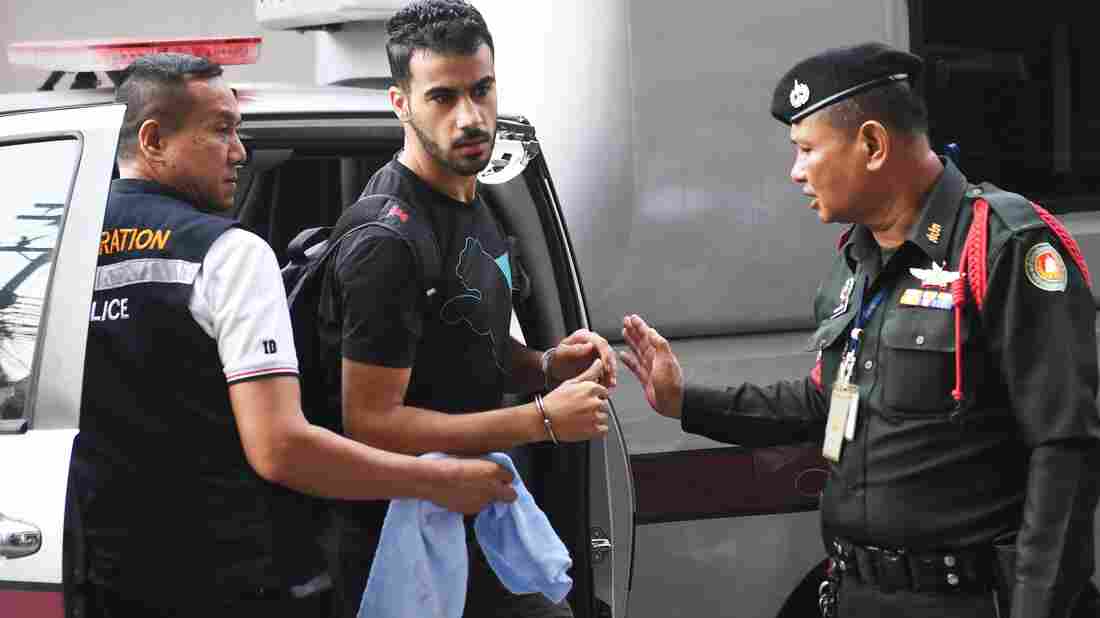
Hakeem al-Araibi, a soccer player with refugee status in Australia, was detained in Bangkok as he began a vacation. Bahrain wants him extradited after a vandalism conviction, but Araibi fears he will be tortured.

Lillian Suwanrumpha /AFP/Getty Images


hide caption

toggle caption

Lillian Suwanrumpha /AFP/Getty Images

A professional soccer player is being held in a Bangkok prison while he awaits extradition to Bahrain, where he was convicted in absentia of vandalism and sentenced to 10 years imprisonment.

Hakeem al-Araibi, 25, formerly on the Bahraini national soccer team, denies he vandalized a police station and says he fears political persecution and torture if he is returned to Bahrain, according to the Associated Press.

On Tuesday a Thai court ruled that Araibi could be detained for 60 days pending the completion of Bahrain’s extradition request. The court also denied a request for bail.

The London-based Bahrain Institute for Rights and Democracy said it was in contact with Araibi, who communicated this message on Dec. 4:

“This might be my last message. I still don’t know whether I will be deported to Bahrain tomorrow. I appeal to the United Nations, individual states, FIFA, footballers, and all people, as my fate is now in danger and my future will soon be over. If I am deported to Bahrain, don’t forget me, and if once I’m there you hear me saying things, don’t believe me. I know what will happen to me and I know I will be tortured to confess things that I have never done. Please continue your fight to save me.”

Araibi fled his homeland four years ago. Since the failed Arab Spring uprising in 2011, the Bahraini government has become known for harshly repressing its critics. Araibi, who has criticized Bahrain’s ruling family in media interviews, made his way to Australia, where he was granted refugee status and, in 2017, permanent residency.

Araibi was arrested at a Bangkok airport on Nov. 27 upon entering Thailand with his wife for a vacation. Since then, there have been widespread calls for his release, including from the Australian government and international human rights organizations.

Thailand’s Immigration Bureau commissioner, Surachate Hakparn, told the Bangkok Post the detention of Araibi abides by international law on human rights.

When Araibi was detained in Bangkok, there was an Interpol red notice attached to him. Such a notice is meant to alert nations about individuals with active arrest warrants. They are not legally binding, but according to The New York Times, red notices have been “abused by authoritarian governments that want to bring home critics who have fled abroad.”

Thai authorities detained him “in response to the red notice alert received from the Interpol National Central Bureau of Australia and the formal request from the Bahraini government for his arrest and extradition,” the Thai Ministry of Foreign Affairs said in a statement.

Interpol rescinded the red notice for Araibi about a week after he was detained, the Times says.

Araibi’s Australian soccer club has urged the Thai government to free the Bahraini athlete. But FIFA, soccer’s governing body, which told The Guardian it supports his release, has been criticized by Human Rights Watch and other groups for not doing more to gain his freedom.

Bahrain, a small Persian Gulf nation ruled by a Sunni monarch, has been the focus of concern by human rights groups for some time. Last year Amnesty International warned that Bahrain was “heading towards total suppression of human rights.”

Sayed Ahmed Alwadaei, director of advocacy at the Bahrain Institute for Rights and Democracy, told The Guardian that “The Thai government must know it’s crossing a red line if it deports Hakeem.”

The Bahrain rights group notes on its website that Araibi “has been very critical of the current president of the Asian Football Confederation,” Sheikh Salman bin Ebrahim Khalifa, a member of Bahrain’s royal family, especially during his 2016 candidacy for the position of president of FIFA. Khalifa did not win but is a vice president of the organization.

Let’s block ads! (Why?)

Former NFL Player Tim Green Has A New Opponent — ALS

Tim Green, former NFL player and a former NPR commentator, has ALS, also known as Lou Gehrig’s disease. Green believes football gave him the disease.

Heather Ainsworth for NPR


hide caption

toggle caption

Heather Ainsworth for NPR

Tim Green first noticed the symptoms about five years ago.

The former NFL player, whose strength was a job requirement, suddenly found his hands weren’t strong enough to use a nail clipper. His words didn’t come out as fast as he was thinking them.

“I’m a strange guy,” Tim says. “I get something in my head and I can just run with it. I was really afraid I had ALS. But there was enough doubt that I said ‘alright, I don’t. Let’s not talk about it. Let’s not do anything.'”

Denying pain and injury had been a survival strategy in football.

“I was well trained in that verse,” he says.

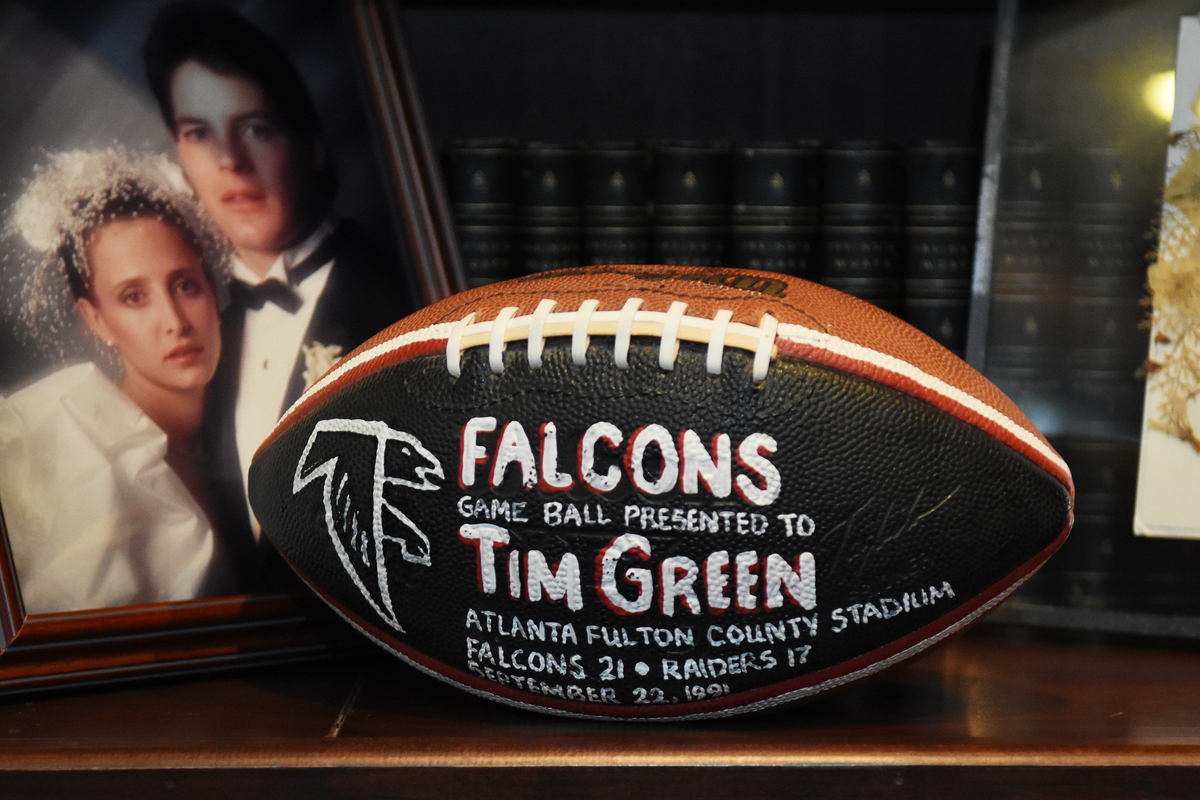
A Falcons game ball that was presented to Green in 1991.

Heather Ainsworth for NPR


hide caption

toggle caption

Heather Ainsworth for NPR

But a diagnosis in 2016 made denial impossible. Doctors confirmed that Tim, also a former NPR commentator, had ALS, known as Lou Gehrig’s disease. The degenerative illness attacks the body’s motor nerve cells, weakening muscles in the arms and legs, and the muscles that control speech, swallowing and breathing.

Tim tried to keep it private — he didn’t want people feeling sorry for him.

But he says, “I got to a point where I couldn’t hide it anymore.”

So Tim went on 60 Minutes and revealed his illness.

“What we said is, you either write your own history or someone’s going to write it for you,” says 24-year-old Troy Green.

When one isn’t enough

I was one of Tim Green’s producers for his Morning Edition commentaries back in the 1990s. We went to dinner once when he was in Washington, D.C. for a game — his Atlanta Falcons were playing Washington. Tim had a huge plate of pasta and when we finished, the waiter came over and asked “anything else?” Tim pointed to his clean plate and said, “yeah. Let’s do it again.”

That was him. One entrée wasn’t enough. One high-profile career wasn’t enough – he’s also a prolific author, has a law degree and works for two firms.

And ultimately, it wasn’t enough for Tim to deal with ALS in silence. Last month, in conjunction with his 60 Minutes appearance, Tim helped launch a fund-raising website, Tackle ALS.

Writing his own story

I recently visited Tim at his lakeside home in upstate New York, in the village of Skaneateles.

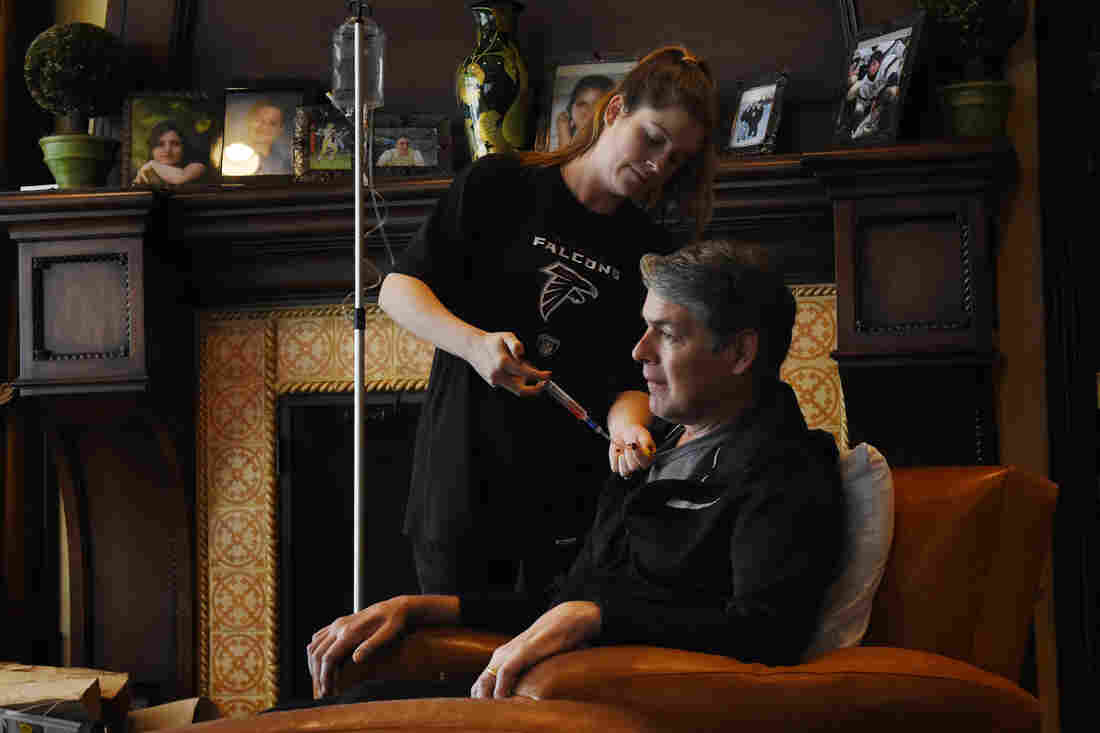
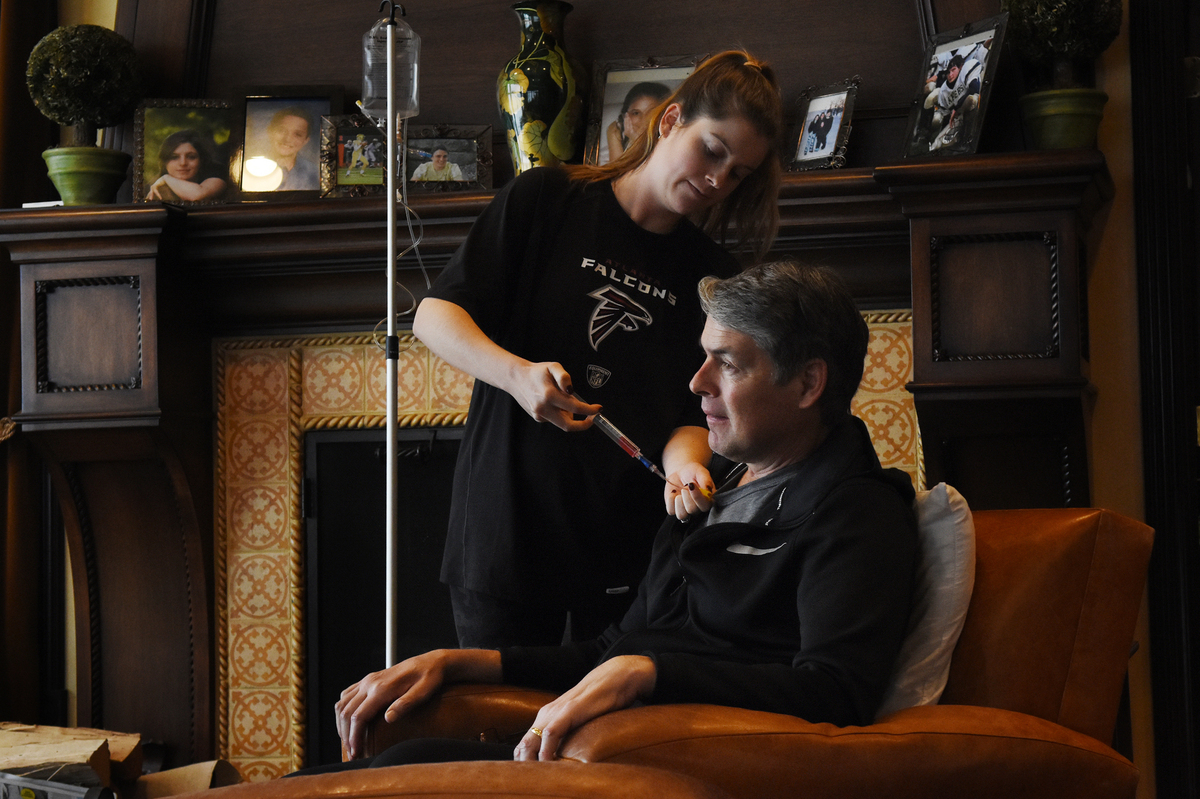
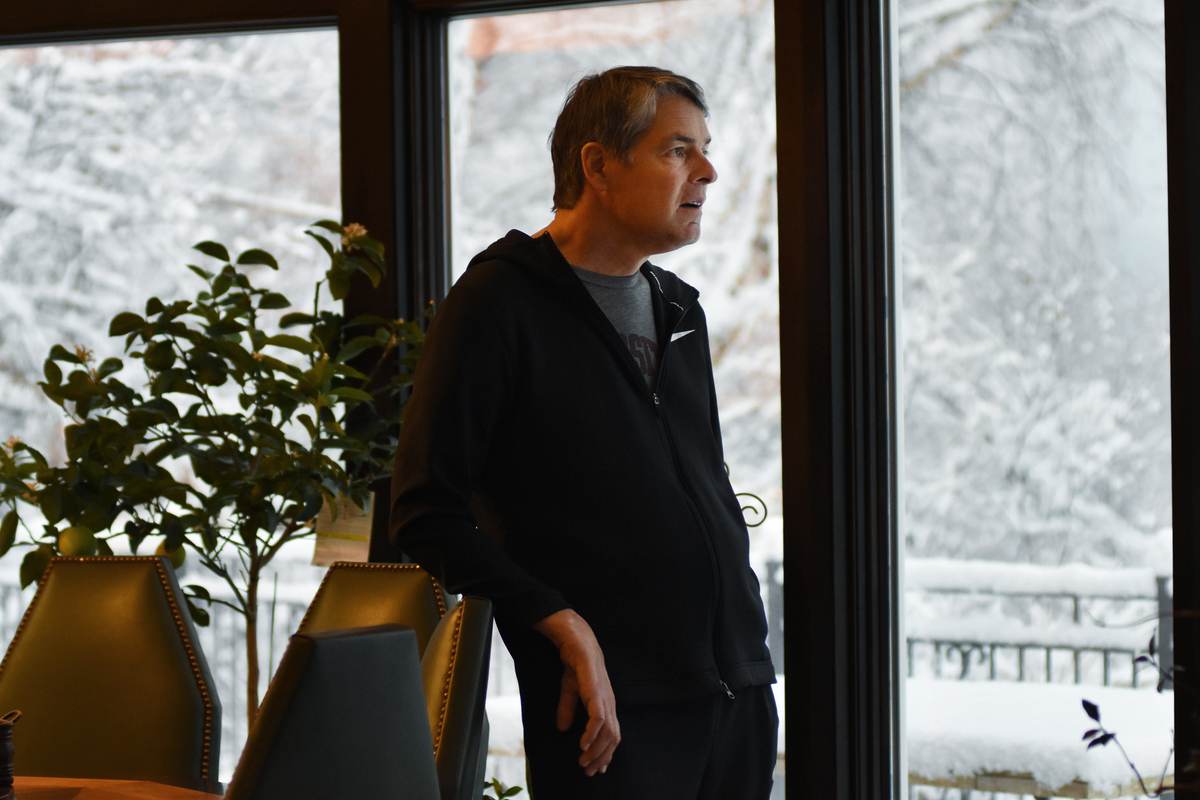
We sat down in a room with a huge picture window that normally offers a gorgeous view of Skaneateles Lake. On the day I visited, all you could see was driving snow. Troy Green sat next to his dad — Tim’s speech is slow and raspy and sometimes Troy helps repeat or reinforce Tim’s words. During our talk, a tube connected to a port in Tim’s chest provided an infusion of Radicava. Last year, the FDA approved the new drug, which has been shown to slow the progress of what’s currently a fatal disease.

Green’s daughter-in-law, Jessica Green, gives him an infusion of Radicava. Last year, the FDA approved the new drug, which has been shown to slow the progress of what’s currently a fatal disease.

Heather Ainsworth for NPR


hide caption

toggle caption

Heather Ainsworth for NPR

The history Troy encouraged Tim to write is positive and hopeful. They stress that ALS can be cured, it’s just underfunded.

The history certainly includes family. Tim and his wife Illyssa have been married for 29 years. They have five kids — all with first names starting with “T” — that’s Illyssa’s doing, Tim says. And the family is incredibly close. Literally.

“My brother lives on the same lane as us. I’m their neighbor,” Troy says, adding, “my little sister’s at school, my little brother lives here and then my older sister lives the furthest away. She’s about a three minute drive.”

“We’re going to reel her in,” Tim laughs.

Football, a complicated love

Of course, any Tim Green history has to include football.

For better and worse.

Tim believes football gave him the disease. His eight years in the NFL in the 1980s and 90s, as a defensive lineman and linebacker, were before protective rule changes and concussion protocols.

There were “countless” head collisions, Tim says. I mention that he had decades of those collisions, from an early age through the NFL.

“But in the NFL,” he says, “the violence and the impacts are extraordinary. Every day.”

Troy adds, “when [Tim] played, practices were worse than the games. Because in the game, you typically would see 45 to 65 plays. In practice, you could run 100, 200 by the time you’re done with drills.”

Researchers say repetitive head blows may play a part in causing ALS. The recent NFL Concussion Settlement acknowledged a link by including payouts to former players with the disease, including Tim.

His Morning Edition commentaries regularly took listeners inside the violent game. In 1992, Tim wrote one about about a teammate, former Atlanta defensive end Rick Bryan, who’d had enough of the physical toll and was retiring.

The piece ended with this:

“Back at the locker room, I checked my protective neck padding and pumped some extra air into the padding of my helmet. Like a gypsy gazing into a crystal ball, I looked at my own distorted reflection in the glossy black surface of my helmet. The smile let me know I was glad to be there, but there was nothing I could see that told me how long it would last.”

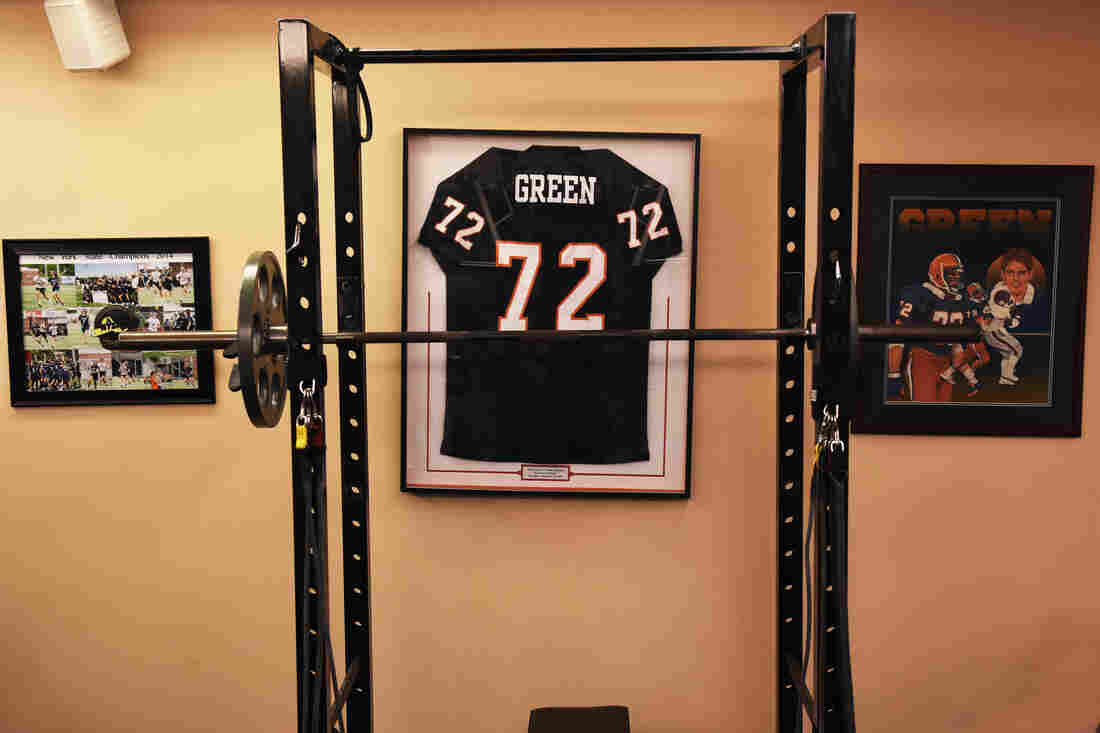
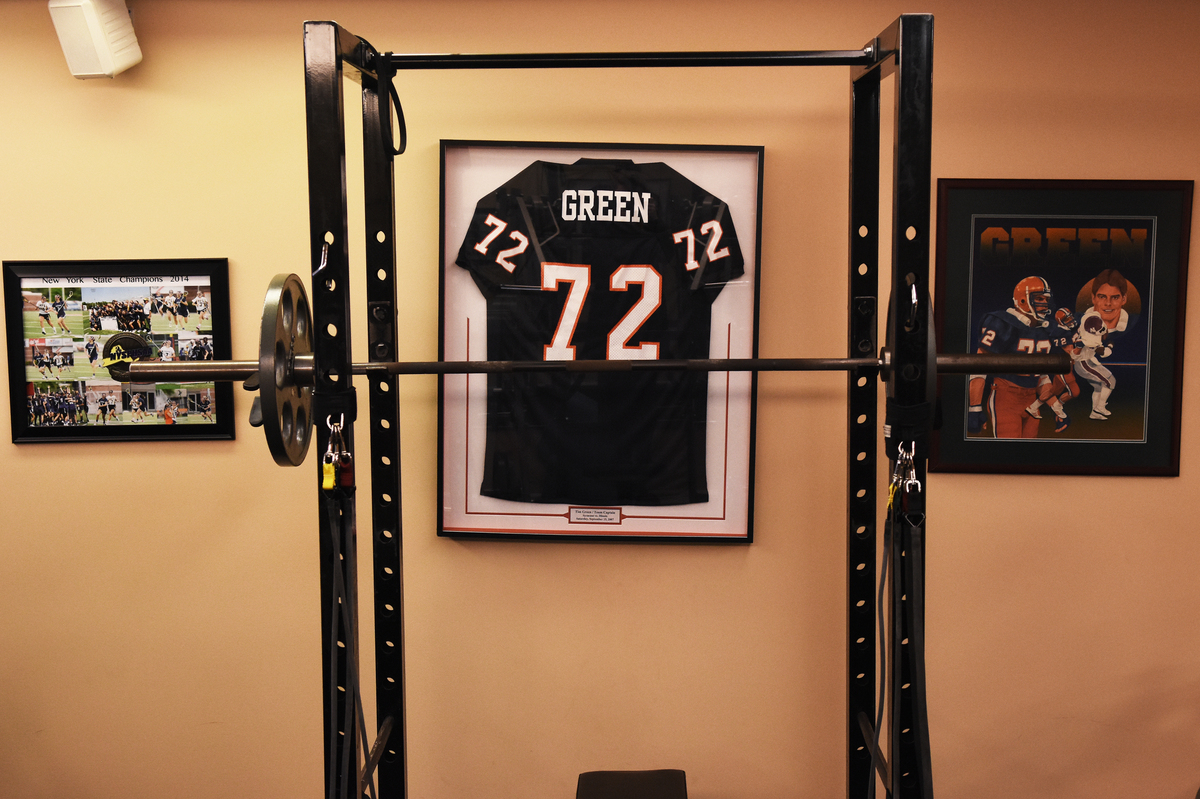
Old uniforms and posters adorn the walls at Green’s home gym.

Heather Ainsworth for NPR


hide caption

toggle caption

Heather Ainsworth for NPR

Tim could articulate what many players couldn’t. Why, I asked him, with his insights, would he play a sport that had the potential to do permanent damage?

Tim says as a kid, he had two passions. Writing and football. From the earliest age, he says, he worked incredibly hard to succeed at both, and he did.

“I was just impassioned,” he says. “That’s what I wanted, and that’s what I got.”

“If [this disease] is part of the bargain, I don’t know,” he continues. But back then, he says, he had “no idea” of the potential long-term damage of football. “So the temporary pain and discomfort, I knew that was worth it. Some pain in the future with my back, neck, knees, I knew that was worth it.”

“Can I say getting ALS was worth it? I don’t know. I don’t know.”

His ambivalence illustrates Tim’s profound and complicated love for the game. Still. He says it gave him the disease. But it also taught him so many life lessons growing up. It allowed him to vent anger and violence in an acceptable way.

“I’m not indicting football or the NFL,” he says.

He passed on his love – his two oldest sons played football. His 12-year-old, Ty, plays now. And it has split the close-knit Greens. Illyssa doesn’t like it. Tim says he wants Ty to play if he wants to.

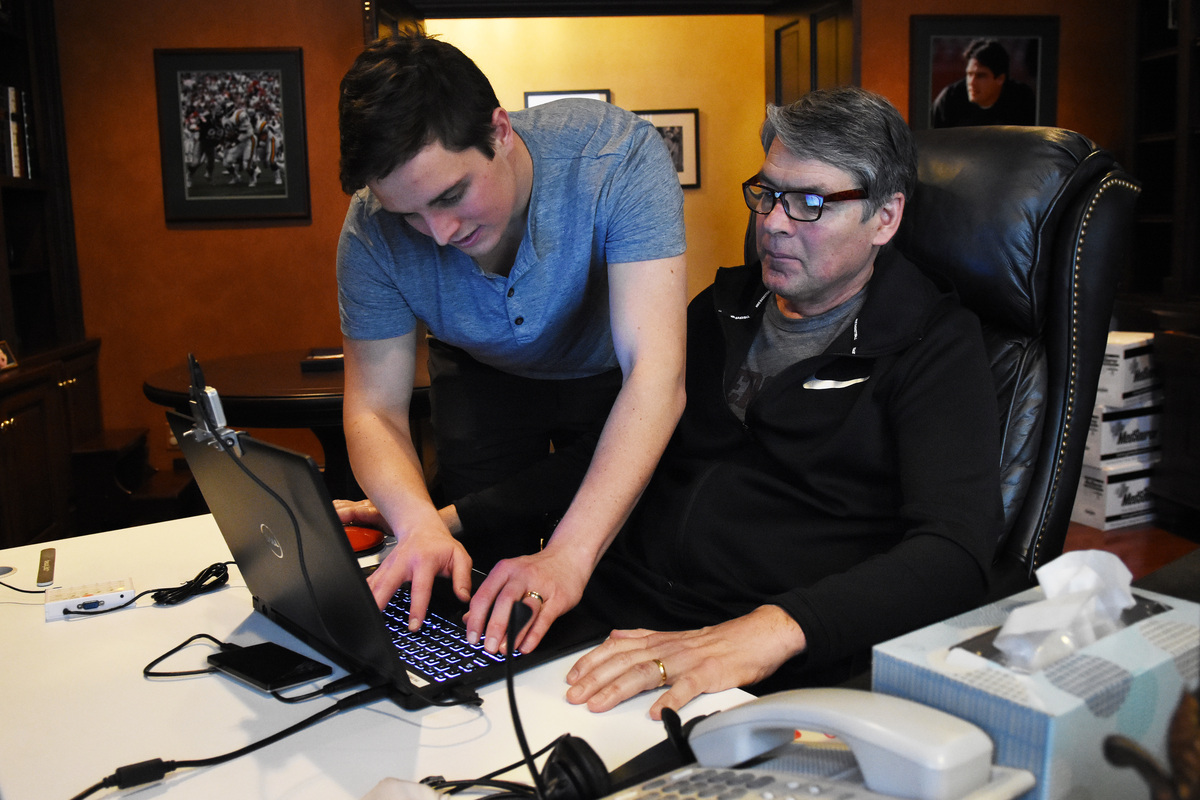
Troy Green helps his father on the computer. Tim can’t type, so he has a sensor on his glasses that highlights letters. Then he clicks a mouse with his right hand, and the letters show up on his laptop screen.

Heather Ainsworth for NPR


hide caption

toggle caption

Heather Ainsworth for NPR

Tim and Troy say the game now is different than it was. It’s much safer with less contact in practice. Both of them coached Ty’s junior team.

“We trained [so in] every tackling drill your head’s out of the play,” says Troy. “In practice we would penalize our players if they had their head in the drill. We really just encouraged the modern day football, not the 1980’s edition.”

Still, football is inherently dangerous, and so far Ty wants to play.

“I don’t want to wrap him up in a bubble,” says Tim, “because where do you stop?”

But there’s a deeper, more complex reason behind Tim’s support. Troy says his dad doesn’t want the illness to be a burden on anyone. So Tim doesn’t want Ty not to play, just because the game hurt him.

Translating science into treatment

“I do want to point out that most people who play football don’t develop ALS.”

So says Dr. Merit Cudkowicz, who treats Tim’s disease. Cudkowicz has researched ALS for nearly 25 years. She thinks football probably is a factor that led to his illness, but not the only one. The studies so far haven’t established a direct cause and effect.

“And that’s why we think there’s something else,” Cudkowicz says. “It’s a combination perhaps in someone’s immune system or something in their genetics that makes it more likely that if you also hit your head repetitively that you might come down with the disease.”

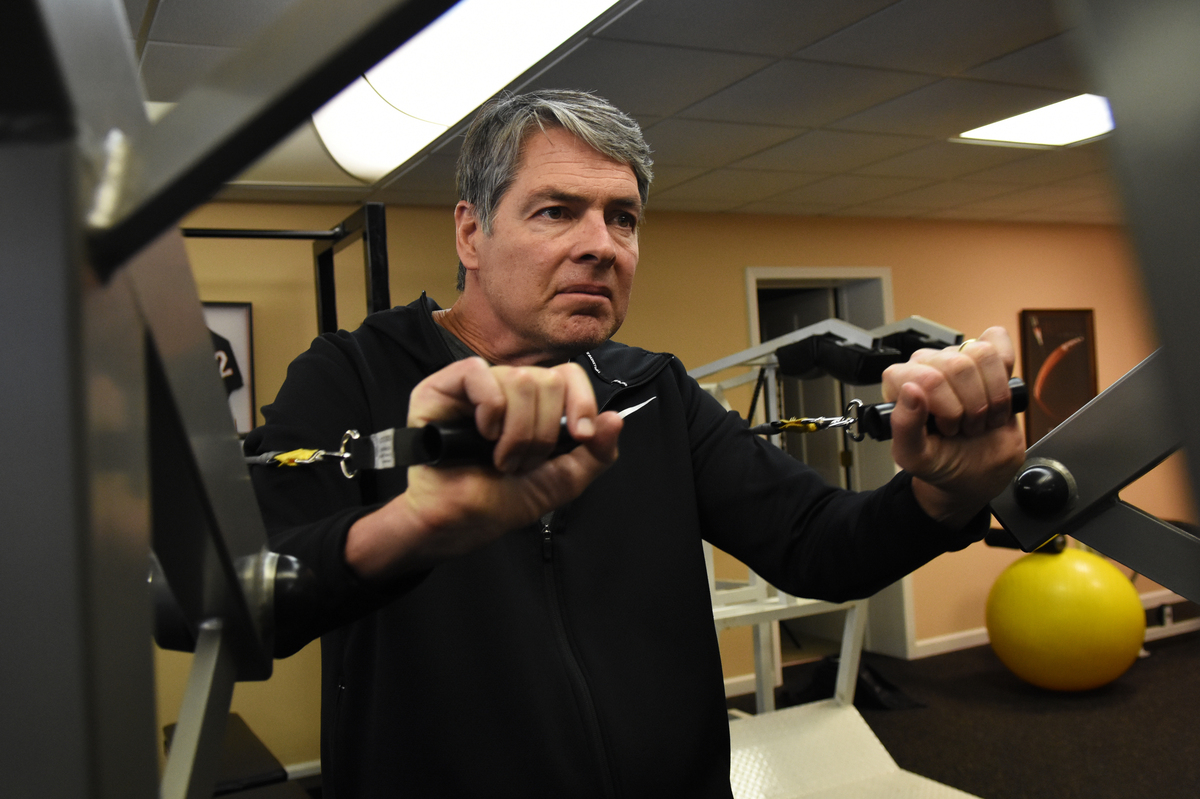
Green works out at his home gym. Studies of ALS patients suggest people who do stretching and toning function much better. There’s a concern if a patient does too much and tries to bulk up, he or she could tear the muscles. Green’s doctor advises more low weight, repetition, toning types of exercise.

Heather Ainsworth for NPR


hide caption

toggle caption

Heather Ainsworth for NPR

Cudkowicz directs the Healey Center for ALS at Massachusetts General Hospital in Boston. She says Tim’s and other prominent people’s involvement and publicity present a great opportunity, as a follow up to the viral ice bucket challenges that raised money for ALS a few years ago.

“Absolutely I think this is a huge next step,” Cudkowicz says. “The ice bucket challenge came at the right time. The science was exploding but there were no resources for it. And suddenly there’s this $220 million resource for ALS and it fed this great science and drew in all these new people and new companies for the field.”

“But there’s still a [funding] gap in getting that great science to patients. And that’s where Tim’s Tackle ALS initiative and the Healey Center are going to partner and hopefully with many other groups, translate that great science into treatment for people.”

“If you have a good life, it’s never long enough”

Later, on the day I visited, Tim sat down at a desk in a large wood-paneled den, indulging his other passion in life — writing.

He can’t type, so he has a sensor on his glasses that highlights letters. Then he clicks a mouse and the letters show up on his laptop screen. He’s working on a kid’s baseball book. It’s a third collaboration with former New York Yankees star Derek Jeter and Tim says they both provide specific areas of expertise. Jeter brings baseball realism to the book; Tim draws on his many years of being surrounded by young people. Disgusting young people, he laughs.

Green writes by clicking this mouse after a sensor on his eyeglasses has located letters. He clicks one letter at a time.

Heather Ainsworth for NPR


hide caption

toggle caption

Heather Ainsworth for NPR

“These are kids 10 to 14 years old. Tweens,” he says. “They think vomit is funny. [So] somebody has to throw up [in the book], and it’s best when they throw up on someone.”

“Writing [these scenes] is easy. It’s convincing Derek to keep them is where I earn my money.”

On cue, Troy looks up from his phone and makes an announcement.

“Just got an email that Jeter, and [his] Turn 2 Foundation donated $10,000 [to Tackle ALS]. His ears are ringing,” Troy says, laughing. “He heard about the vomit scenes!”

Tim says the fundraising is a chance to help others. He says he’s one of the lucky people with the disease. It’s relatively slow moving.

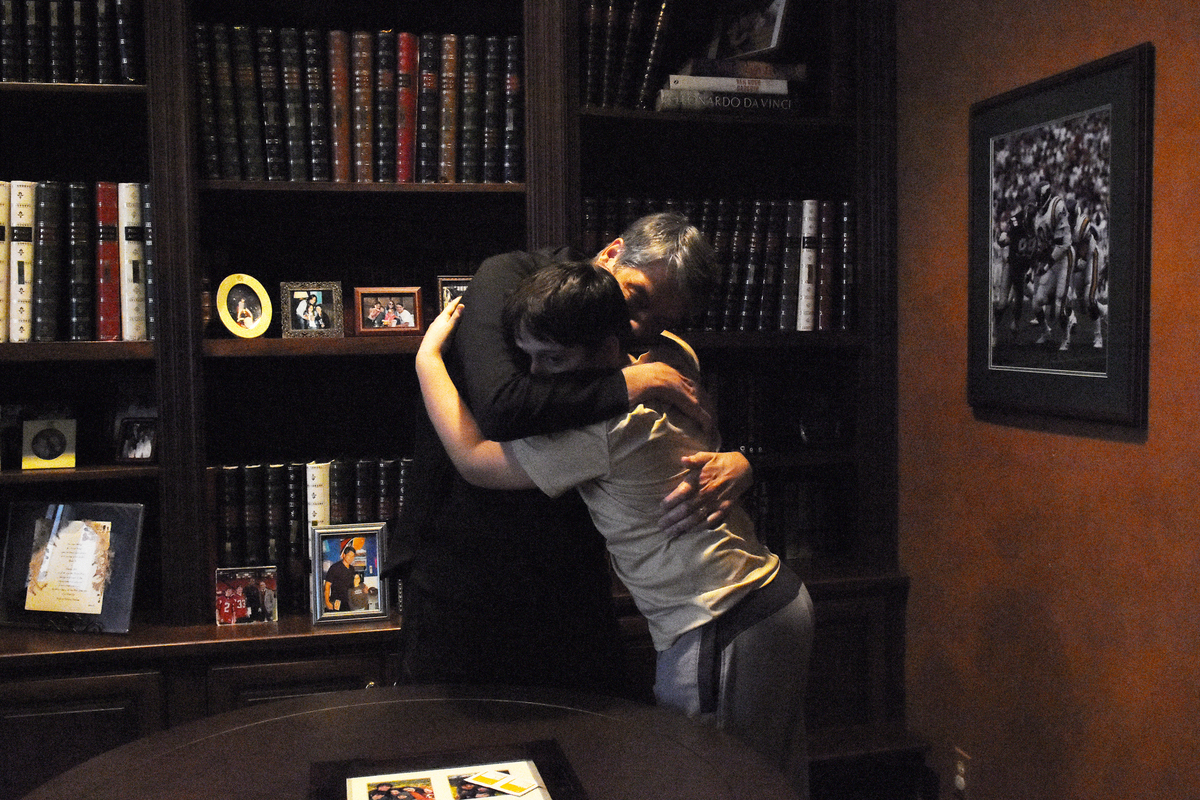
Green hugs his 12-year-old son, Ty. Green coaches Ty in football and insists his son is playing a much safer game than his father did in the 1980s and 90s. Still, Green and his wife disagree about Ty’s participation. Illyssa Green doesn’t want her son playing; Tim supports it as long as Ty wants to play.

Heather Ainsworth for NPR


hide caption

toggle caption

Heather Ainsworth for NPR

I ask Tim what keeps him positive through this time. He answers by recounting a period 12 years ago, when Illyssa was diagnosed with cancer.

“She was out of her mind,” Tim says, “and I remember saying to her, you’ve got great doctors, we’re gonna beat this and do everything we can. But in the meantime, I don’t want you to wallow in fear and anxiety and misery. I said, because we have a very good life and if you have a good life … and a lot of people do, maybe they don’t realize it, but they do… but if you have a good life, it’s never long enough. We all know it’s finite.”

“So whenever the end point is, I ask to be strong enough to maintain that positive attitude no matter what the challenges are.”

Today, Illyssa is cancer free. And it’s Tim trying to live by his own advice.

As I leave, I stop to look at two large sculptures outside their house. One is of five kids, playing. The other is a lone figure. A helmeted football player, running and catching a pass over the shoulder. Tim says it’s an homage to the game, that let him “buy this amazing property and build a comfortable home.”

A home, and family, that now mean even more than they have all along.

A statue of a helmeted football player, running and catching a pass over the shoulder. Tim says it’s an homage to the game, that let him “buy this amazing property and build a comfortable home.”

Heather Ainsworth for NPR


hide caption

toggle caption

Heather Ainsworth for NPR

Let’s block ads! (Why?)

Texas Judge Allows Former Baylor Frat President To Sidestep Rape Charge

A judge in Texas on Monday accepted a plea bargain that allows Jacob Anderson, a former Baylor University fraternity president accused of raping a woman at a fraternity party, to avoid serving jail time, marking at least the third time the judge has approved probation for men accused of sexually assaulting Baylor students.

McLennan County Sheriff’s Office via AP


hide caption

toggle caption

McLennan County Sheriff’s Office via AP

A judge has accepted a plea agreement under which the former president of a Baylor University fraternity, accused of raping a female student, will serve no jail time and won’t have to register as a sex offender.

The deal allowed Jacob Walter Anderson, 23, of Garland, Texas, to plead no contest on Monday to the lesser charge of unlawful restraint. In pleading no contest, a defendant does not admit guilt and does not offer a defense.

The woman who brought the charges expressed outrage at the decision.

“He stole my body, virginity and power over my body,” she said in court, according to a family spokesman, the Associated Press reports.

“I not only have to live with his rape and the repercussions of the rape, I have to live with the knowledge that the McLennan County justice system is severely broken,” the family statement quoted the woman as saying. “I have to live with the fact that after all these years and everything I have suffered, no justice was achieved.”

The McLennan County’s district attorney’s office, which dismissed four counts of sexual assault against Anderson, told the alleged victim’s family it was not confident enough to take the case to trial, according to NPR’s Wade Goodwyn.

Goodwyn reports the alleged victim told Judge Ralph Strother she was furious the prosecutors who struck the plea agreement did not attend the hearing. “If I had the courage to come back to Waco and face my rapist and testify, you could at least have had enough respect for me to show up today,” she said.

Strother, on at least two other occasions in the past couple of years, dealt leniently with men accused of raping or sexually assaulting Baylor students, AP reports.

The offer of a plea deal was made public in August, according to the Waco Tribune-Herald. Baylor is a private Christian university in Waco.

“The way the victim’s family found out about the plea deal is they read it in the local newspaper,” Goodwyn reports.

Upon learning the news, the woman and her family urged Strother to reject the plea agreement and send the case to trial, according to the Tribune-Herald.

At the time of the alleged rape, the woman was a 19-year-old Baylor sophomore.

NPR does not name individuals who are the alleged victims of sexual assaults, with some exceptions, such as when the individual goes public with her or his identity.

In the affidavit for Anderson’s arrest, the alleged rape victim told police Anderson raped her in February 2016 when she attended an off-campus party hosted by his fraternity, Phi Delta Theta.

After sipping some punch, “she became disoriented and felt very confused,” according to the affidavit. Anderson led her to a secluded area on the grounds so she could get some air, and then repeatedly raped her, leaving her unconscious, alone and “lying face down in her own vomit.”

Anderson was kicked out of Baylor and the fraternity was suspended.

Baylor University has been roiled in recent years by charges of sexual assault by its students, including the 2016 scandal involving members of Baylor’s football team. As Goodwyn reported, the scandal led to the firing of Baylor’s president, Kenneth Starr, and its head football coach, Art Briles.

Let’s block ads! (Why?)

Cargo Ship Saves 29-Year-Old Sailor In South Pacific After Her Boat Flips

Susie Goodall on her boat DHL Starlight on July 1 at the start of the solo around-the-world Golden Globe Race.

JEAN-FRANCOIS MONIER/AFP/Getty Images


hide caption

toggle caption

JEAN-FRANCOIS MONIER/AFP/Getty Images

The challenge: Sail 30,000 miles around the globe, non-stop, alone.

What could go wrong?

This week, Susie Goodall found out. The 29-year-old British woman was the youngest participant in the annual Golden Globe Race which sends sailors from the coast of France around the earth and back to the same port. Or at least that’s the plan.

On Wednesday morning, Goodall was 2,000 miles west of South America when her boat flipped in heavy wind, broke its mast and knocked her temporarily unconscious. She activated her emergency beacon and a series of troubling updates were posted to her Twitter account:

73-DISMASTED.HULL https://t.co/jj0fKZ29HZ FORM OF JURY RIG,TOTAL LOSS

— SusieGoodallRacing (@susieBgoodall) December 5, 2018

73-INTERIOR TOTAL WRECK,LIFERAFTOK

— SusieGoodallRacing (@susieBgoodall) December 5, 2018

73-NASTY HEAD BANG AS BOAT PITCHPOLED.UNBELIEVABLY ROLY NOW

— SusieGoodallRacing (@susieBgoodall) December 5, 2018

Chile’s Maritime Coordination Center received her distress signal and ordered the Tian Fu, a cargo ship on its way from China to Argentina, to divert from its course and rescue Goodall.

Meanwhile, all Goodall could do was wait — trying to keep her boat steady in the choppy South Pacific and pumping out water that was leaking into the damaged cabin.

When the 600-foot rescue vessel finally reached Goodall, deploying a small boat to retrieve her was deemed impossible because of 10-13 foot waves rocking both ships. Instead, crew members on board the Tian Fu executed a kind of high-stakes version of Candy Crane, lowered a cable from one of the ship’s massive cargo hoists, and plucked Goodall from her deck, hauling her to safety.

After 3 intensive days of co-ordinations from MRCC Chile, today at 15:35 UTC the motor vessel “TIAN FU” was able to recue the British yachtswoman Susie Goodall.
BZ. pic.twitter.com/20bOEendr2

— MRCC Chile (@MRCCChile) December 7, 2018

The good news was posted to her Facebook page: “From Susie, at 15:14 UTC: ON THE SHIP!!!” Goodall is expected to arrive at the Chilean port of Punta Arenas on Wednesday.

She is not the first sailor to run into trouble in this year’s race. As NPR reported, an accident in the Indian Ocean in September forced the evacuation of a naval commander; skippers from France and Ireland have also had to be rescued.

In a post from Nov. 30 titled “Half way round the world,” Goodall wrote about how challenging the experience had been at that point as she faced fierce seas.

“To say I’d had enough by this point is an understatement. They were the hardest and loneliest days I’ve ever had. All I wanted was a break from it. But being under Australia, half the world from home I might as well sail home again instead of taking a break.”

Her family thanked rescuers and race organizers Friday, and said farewell to her ship, the DHL Starlight.

“It was with a heavy heart Susie left DHL Starlight to fend for herself, before she fills with water and rests on the Pacific Ocean floor. DHL Starlight has been her home for the past few years; a faithful friend who stood up valiantly to all the elements, a guardian until their last moments together.”

Let’s block ads! (Why?)

Saturday Sports: NCAA Women's Basketball And The Denver Nuggets

An NCAA Women’s basketball rivalry gets rough on Twitter and Washington, D.C.’s football team has signed a new backup quarterback.


SCOTT SIMON, HOST:

And no matter what else happens in the world, time for sports.

(SOUNDBITE OF MUSIC)

SIMON: NCAA women’s basketball gets rough on Twitter. The Denver Nuggets are at the top of the NBA’s Western Conference. Wait, wait, is that a misprint? And Washington, D.C.’s football team with the name I will not utter has signed a journeymen to play backup quarterback. (Laughter) What – they didn’t want a quarterback who played in the Super Bowl? We’re going to turn now to Tom Goldman. Tom, thanks so much for being with us.

TOM GOLDMAN, BYLINE: My pleasure, Scott.

SIMON: UConn and Notre Dame already have a great rivalry on court, but this is getting, like, really personal on Twitter, isn’t it?

GOLDMAN: Ooh, yeah, it really is. Notre Dame head coach Muffet McGraw reportedly blocked on Twitter current WNBA star and former UConn star Breanna Stewart, who led the Huskies to four straight NCAA championships. And that action by McGraw prompted some Twitter zingers like, haha, Breanna, you blocked her from getting four titles, so it’s only right that she blocks you back. But wait, Scott.

SIMON: Ooh, ooh, yeah.

GOLDMAN: There’s more. There’s more. You want to hear?

SIMON: Yeah, please.

GOLDMAN: OK. All right. So…

SIMON: Wait, children are listening. Go ahead. Yeah.

GOLDMAN: OK, cover their ears. So two teams – these two teams, top two in the nation, they played last weekend – the first time they’d met since Notre Dame stunned UConn at last season’s final four. UConn got its revenge, pounded Notre Dame by 18, and the UConn official Twitter account posted, thank you, next. And there were technical fouls. There was trash talk. And I think…

SIMON: Ooh, I’m shaking like a leaf – yeah.

GOLDMAN: (Laughter) I think this makes a great rivalry even greater. You know, we see this melodrama all the time in men’s sports. And, yes, Scott, I’m promoting the further degradation of society. But, hey, WNBA star Chiney Ogwumike agrees with me. She tweeted, our game does not need to be proper or perfect all the time. We need the drama, the disses, the controversies. We need to be real.

SIMON: Tom, you and I often degrade society, but let me ask you about Denver Nuggets. They lost last night to Charlotte, but they’ve got the best record in the West. Are they just on a hot streak?

GOLDMAN: Well, they’re more than that, I think. They’re – and it’s pretty cool what’s happening in a city not known as a hoops mecca. In a star-driven league, the Nuggets are largely unknown to, you know, casual NBA fans, players like Jamal Murray, Juan Hernangomez, Monte Morris. They’re really good, and they’re playing well together. They’re playing great defense. And the one emerging superstar, 7-foot center Nikola Jokic from Serbia, he’s got a complete game, and he’s a beautiful passer. I went on YouTube and watched a Jokic passing highlight video. I didn’t have anything better to do, Scott. And I was oohing and aahing. I’d recommend it if you’ve got some free time.

SIMON: So Washington’s football team – Alex Smith, Colt McCoy, out. They (laughter) had signed Mark Sanchez, quarterback probably best known for a fumble when he bumped into the backside of one of his own players.

GOLDMAN: The butt fumble.

SIMON: The butt fumble. Now as a substitute quarterback, Josh Johnson – why would they sign a guy who was playing for the Sacramento Mountain Lions in the USFL instead of Colin Kaepernick, who has been in the Super Bowl?

GOLDMAN: Well, they said they passed up Kaepernick because his skill set isn’t similar to Mark Sanchez’s, so it would have required…

SIMON: Oh, he hasn’t bumped the ball into some player’s butt.

GOLDMAN: (Laughter) It would have required Washington to install a new offense. It’s the latest excuse for keeping Kaepernick on the blacklist, and it doesn’t look good. But hey, Scott, at least Washington’s still alive for a playoff spot – barely.

SIMON: Oh, my gosh, I didn’t know that. Well, they hardly deserve it, I don’t mind saying. NPR sports correspondent Tom Goldman, thanks so much for being with us.

GOLDMAN: You’re welcome.

Copyright © 2018 NPR. All rights reserved. Visit our website terms of use and permissions pages at www.npr.org for further information.

NPR transcripts are created on a rush deadline by Verb8tm, Inc., an NPR contractor, and produced using a proprietary transcription process developed with NPR. This text may not be in its final form and may be updated or revised in the future. Accuracy and availability may vary. The authoritative record of NPR’s programming is the audio record.

Let’s block ads! (Why?)
USA Gymnastics Voluntarily Files For Bankruptcy

USA Gymnastics filed for bankruptcy Wednesday. The organization has been under withering criticism for how its handling of scores of sexual abuse reports by former team doctor Larry Nassar.


AILSA CHANG, HOST:

USA Gymnastics filed for federal bankruptcy protection today. It’s a major development for the embattled organization that oversees gymnastics in the U.S. The governing body has struggled to recover from a wide-ranging sexual abuse scandal after former team doctor Larry Nassar abused hundreds of athletes. Since then, USA Gymnastics has cycled through three CEOs and faced increased scrutiny by the U.S. Olympic Committee. We’re joined now by reporter Alexandra Starr with the latest. Welcome.

ALEXANDRA STARR, BYLINE: Hi. Thanks for having me.

CHANG: So USA Gymnastics was on its way to losing its status as the governing body over the sport. I remember talking to you on this show about that. Was this bankruptcy filing a surprise?

STARR: No, it wasn’t. People have talked about it, and it’s been expected. Also let’s specify the fact that they filed doesn’t necessarily mean that they cease to exist as an organization.

CHANG: Right.

STARR: I also think it’s very important to differentiate between USA Gymnastics and the athletes. The organization is in a freefall. The elite athletes are literally the reigning world champions. They’re extraordinary. And arguably the best athlete of all time, Simone Biles, she’s expected to compete in the next Olympics in 2020. And she just won more medals than any American gymnast has in history at the world championships earlier this year. So there’s a real disconnect between the organization and the talent that it’s field – that fields.

CHANG: Absolutely. That said, does this bankruptcy in any way affect the athletes who are competing now?

STARR: Well, the U.S. will absolutely field a team in 2020 at the Olympics. Whether it’s USA Gymnastics fielding the team is in doubt. But, you know, they’re certainly going to be there. I think the real impact could be felt in the pipeline. And what I mean by that is the development of the youngest athletes. USA Gymnastics runs the national team camps. That’s where coaches scope out talent. It’s where judges grade performances and give feedback. That provides the opportunity, too, for promising young athletes to be fielded in international competitions. The question is now, are those opportunities going to remain?

CHANG: Right. Well, let’s also talk about, you know, there’s been dozens of lawsuits that have been filed against USA Gymnastics after the Larry Nassar scandal. What does this bankruptcy mean for the victims and the families who filed suit against the organization?

STARR: That’s a great question. And it’s going to make it tougher for them.

CHANG: How so?

STARR: Well, this is what the filing means. While this bankruptcy case moves through the courts, it basically puts a halt on those lawsuits. And as you know, the courts don’t move quickly. That process could take years. So it’s worth noting that these lawsuits were beginning to unearth information. The lawsuit that Aly Raisman, the star gymnast, had filed was supposed to go to court – go to trial early next year. So that’s ending. And so she and all these other athletes are going to be left without a resolution.

CHANG: That’s Alexandra Starr, who covers USA Gymnastics for NPR. Thank you.

STARR: Thank you.

(SOUNDBITE OF RUN RIVER NORTH’S “INTRO (FUNERAL) PARADE”)

Copyright © 2018 NPR. All rights reserved. Visit our website terms of use and permissions pages at www.npr.org for further information.

NPR transcripts are created on a rush deadline by Verb8tm, Inc., an NPR contractor, and produced using a proprietary transcription process developed with NPR. This text may not be in its final form and may be updated or revised in the future. Accuracy and availability may vary. The authoritative record of NPR’s programming is the audio record.

Let’s block ads! (Why?)