USA Gymnastics Files For Chapter 11 Bankruptcy

USA Gymnastics says filing for bankruptcy gives it “the opportunity to reorganize.”

PhotoAlto/Odilon Dimier/Getty Images


hide caption

toggle caption

PhotoAlto/Odilon Dimier/Getty Images

USA Gymnastics, the sport’s national governing body, said today that it had voluntarily filed for Chapter 11 bankruptcy.

Board of Directors Chair Kathryn Carson, who joined the newly restructured board in June, said in a statement that bankruptcy will allow USA Gymnastics to “expedite resolution of claims” against it from survivors of sexual abuse by former team doctor Larry Nassar. She said the organization will continue to operate normally and that it is not having trouble paying its bills.

But while USA Gymnastics says bankruptcy gives it “the opportunity to reorganize,” it’s not clear how the filing is helpful to the victims and other athletes.

In an online post about the bankruptcy filing, USA Gymnastics said that survivors’ claims against the organization are covered by insurance that was previously purchased and that the amount of that insurance is unaffected by the filing. “We believe that the Bankruptcy Court is the best forum in which to implement appropriate procedures to equitably resolve claims and allocate the insurance proceeds among claimants, allowing resolution more quickly than litigation filed in courts around the country,” it said.

But as The Wall Street Journal explained, the filing “will put an automatic stop—perhaps permanently—to depositions and discovery related to USA Gymnastics in lawsuits filed by Mr. Nassar’s victims.”

The U.S. women’s team, led by superstar Simone Biles, was dominant at the recent World Championships. (The men’s team took fourth.) But the 2020 Summer Olympics in Tokyo are fast approaching, and the organization’s leadership has been in persistent disarray since Nassar was arrested in 2016.

USA Gymnastics has cycled through three CEOs in less than two years; one of them, Steve Penny, was arrested in October over allegations that he tampered with evidence related to a Nassar investigation.

Last month, the U.S. Olympic Committee took preliminary steps to revoke USA Gymnastics’ status as the sport’s governing body. The bankruptcy filing may complicate that decertification process.

Let’s block ads! (Why?)

Key 1968 Harvard-Yale Battle Sets Scene For 'The Game' — And Football's Future

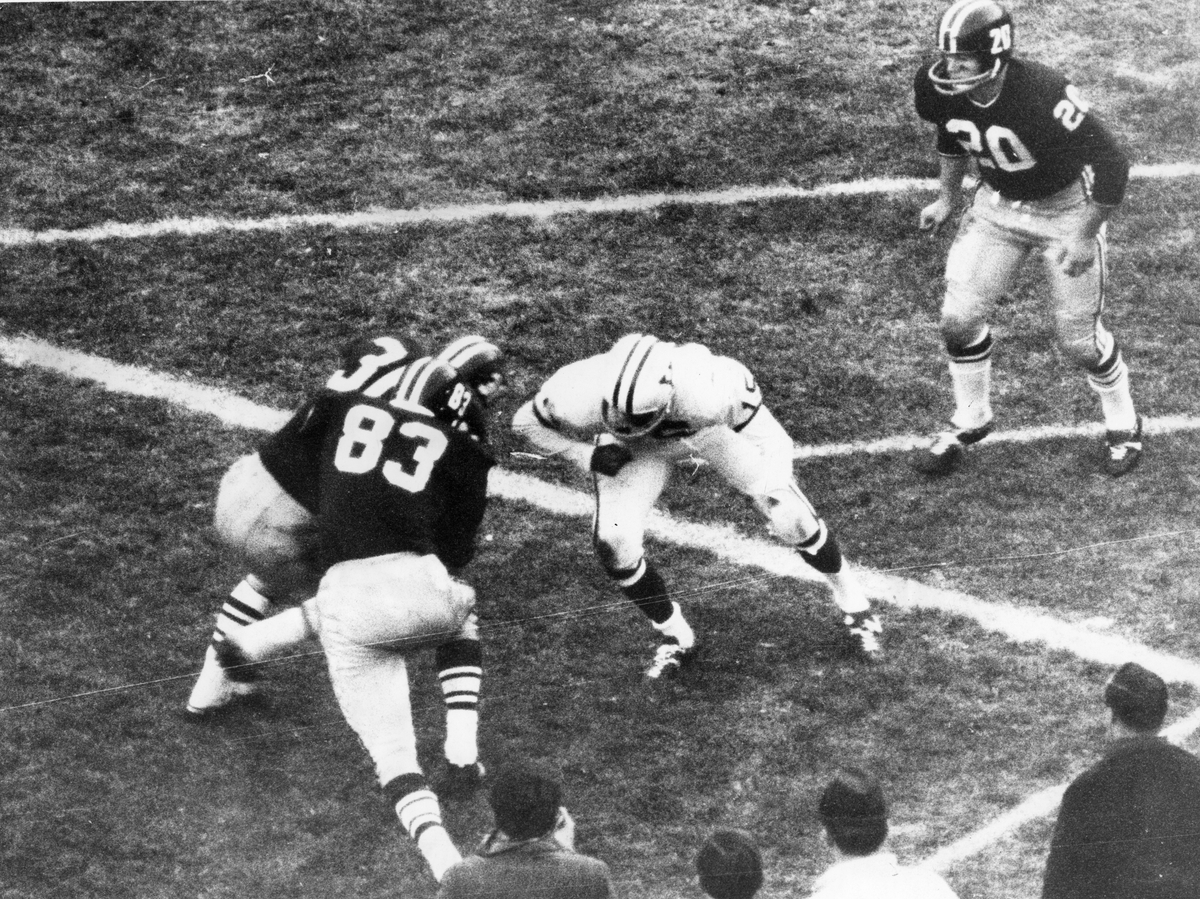
Harvard University’s Bruce Freeman tries to run around a teammate and a Yale player and into the end zone after catching a pass during the final 42 seconds of The Game against Yale University at Harvard Stadium in Boston on Nov. 23, 1968.

Boston Globe via Getty Images


hide caption

toggle caption

Boston Globe via Getty Images

When college football championship time rolls around each year, you’re not likely to encounter the names Harvard or Yale.

The legendary schools play in the Football Championship Subdivision, which in recent years has been dominated by teams like North Dakota State and James Madison. When an Ivy League school does manage to crack the Top 25, it’s usually Princeton or Dartmouth.

But college football as we know it likely wouldn’t exist without the two bitter rivals, who, as George Howe Colt writes in his fascinating new book, The Game,” came up with most of the rules and innovations that would transform the game from a semi-organized brawl into a sophisticated sport.” Colt’s book is a transfixing look at a season in the Ivy League that would culminate in one of the most unforgettable matches in college football history. (If you’re 50 years behind on sports news, fair warning: The outcome of the game will be revealed later in this review.)

Colt is quick to disclose his special interest in the Harvard-Yale rivalry: The Massachusetts writer bleeds crimson, and has long considered the yearly game to be “a clash of civilizations that seemed no less than that of Athens and Sparta.” But he dedicates just as much ink to both schools in his book, taking deep dives into the coaches and players who made the 1968 season so unforgettable.

Those characters include Yale quarterback Brian Dowling, whom the student newspaper simply called “God” — and who was the inspiration for the perpetually helmeted character B.D. in Garry Trudeau’s Doonesbury comic strip. They also include a terse Harvard offensive lineman from Texas — at the time an aspiring actor — named Tommy Lee Jones. Colt even briefly mentions some of the team’s fans then: an enthusiastic Eli named George W. Bush, and a Harvard man (and roommate of Jones) named Al Gore. (Some rivalries, it seems, never die.)

Colt’s book is based heavily on interviews with the players involved in the legendary game, and he paints rich portraits of many of them. He has a clear sympathy for the underdogs — players like Harvard safety Pat Conway, a 24-year-old Vietnam vet who struggled with dyslexia, and Yale player Calvin Hill, a shy young man who aspired to be his university’s first African American quarterback. (At the time, many coaches were loath to start black quarterbacks; Hill, despite his talent, was assigned fullback.)

Football doesn’t happen in a vacuum, of course, and 1968 was one of the most fraught years in modern American history. Colt carefully looks at the social upheaval in America through the lens of the players, providing fascinating context to that year’s football season. Harvard, for example, had two players in the school’s ROTC chapter, and two who were regulars at meetings of the left-wing Students for a Democratic Society (SDS). The students at Yale, by contrast, hadn’t been quite as caught up in countercultural fervor, although its team did feature liberal players like Bob Levin, who would post anti-war posters on campus with his then girlfriend, a Vassar drama major named Meryl Streep.

Colt’s decision to delve into the lives of the players and coaches, as well as the turbulent year itself, makes his writing about the actual Harvard-Yale game pay off beautifully. That year’s match was “the most ballyhooed ever,” with both teams entering the last game of the season undefeated. Colt dedicates 52 pages to the game itself — and he writes so evocatively and so intensely, it’s hard to put the book down for even a second. It’s an absolutely remarkable piece of sportswriting.

The game ended with one of the most iconic comebacks in college football history. Harvard, the underdogs, were down by 16 points with just a few minutes left in the fourth quarter; thanks to some favorable calls by the referees and a miraculous onside kick, the Crimson managed to tie the game with no time left on the clock. The outcome (remember, this was in the days before overtime) led the elated Harvard student newspaper to publish its now famous headline: “HARVARD BEATS YALE, 29-29.”

There’s no doubt that football fans will find The Game fascinating — Colt understands the nuances of the sport, and he writes about it with an enthusiasm that never descends into rah-rah fandom. But you don’t have to be a sports fan to enjoy the book; like Buzz Bissinger’s Friday Night Lights, its human focus makes it accessible to everyone, even if you don’t know the difference between a touchback and a touchdown. Vibrant, energetic and beautifully structured, The Game is a big-time winner.

Let’s block ads! (Why?)

U. Of Maryland Hires Michael Locksley To Lead Football Team In Time Of Tumult

Michael Locksley, seen here in 2015 during a previous stint with the Maryland Terrapins, has been hired as head coach of the university’s football team. He replaces DJ Durkin, whose tenure ended in controversy over a player’s death earlier this year.

Alex Goodlett/Getty Images


hide caption

toggle caption

Alex Goodlett/Getty Images

Just over a month since the University of Maryland fired DJ Durkin, dismissing the football coach amid a months-long controversy over a player’s death, the school has named the man set to replace him: Alabama Offensive Coordinator Michael Locksley.

“As we narrowed the search for the individual best suited to lead our program, Michael not only stood out for his talent as a coach,” Maryland’s director of athletics, Damon Evans, said in Tuesday’s announcement, “but most importantly for the role he has played as a mentor to student-athletes throughout his career and his deep commitment to helping them grow into leaders on and off the field.”

It will not be Locksley’s first stop on campus in College Park, Md. Locksley, whose work with Alabama just earned him the 2018 Broyles Award as college football’s top assistant coach, has already served two stints as an assistant at Maryland. After then-coach Randy Edsall was fired, Locksley also acted as the Terrapins’ interim head coach for part of the 2015 season — before leaving to join the Crimson Tide the next year.

We’re proud to announce 2018’s WINNER of the 23rd annual @BroylesAward.

?Michael Locksley, @AlabamaFTBL. pic.twitter.com/BvwEGkNkFd

— BROYLES AWARD (@BroylesAward) December 4, 2018

This time around, however, Locksley can expect to find a significantly more difficult situation awaiting his return.

The University of Maryland’s football program has been wracked by tumult since Jordan McNair’s death in June. The 19-year-old offensive lineman collapsed from heat stroke after an offseason workout and died two weeks later.

The blame for the deadly incident spread widely in the months that followed. First laid with medical personnel, which “misdiagnosed” McNair’s ailments — according to university President Wallace Loh — the blame soon also fell on Durkin for allegedly fostering a toxic culture of intimidation and verbal abuse.

But the buck did not stop with Durkin.

The controversy reached as high as the University System of Maryland’s Board of Regents, which briefly decided to keep the head coach after concluding its investigation — only to promptly do an about-face and fire him one day later, after a groundswell of outrage at the decision. Just another day after that, the board’s chairman, James Brady announced he was stepping down.

President Loh, too, has announced plans to retire next year.

On Tuesday evening, Locksley acknowledged the turmoil that awaits him at Maryland — but expressed his excitement at returning to the Terrapins, nevertheless.

“I have been tremendously impressed at how the team came together through a difficult season and honored their fallen teammate, Jordan,” he said in a statement issued by the school. “We are all in this together, and I look forward to rejoining the Maryland family.”

That said, he arrives in Maryland without a spotless record. Before returning for his second stint at Maryland, Locksley was fired from his head coaching job at the University of New Mexico, where he amassed a putrid total record of 2-26 and found himself dogged by controversy — including allegations of creating a toxic environment of his own.

As The Washington Post notes, his tenure there was marred by an age and sex discrimination complaint against him, which was later withdrawn, and a lawsuit alleging that he choked and punched an assistant coach, which was later settled.

In its announcement Tuesday, the University of Maryland largely kept to the warmer, more recent memories of Locksley’s time with the Terrapins and Crimson Tide.

“On the field, Michael orchestrated one of the country’s most prolific offenses at the University of Alabama and has long been regarded for his recruiting prowess,” Evans said. “Today he was recognized as the nation’s top assistant coach in the country, and I’m excited for him to be leading our program.”

Let’s block ads! (Why?)

Urban Meyer Will Retire As Ohio State's Football Coach, After Scandal-Marred Season

Ohio State Buckeyes coach Urban Meyer is retiring, the school said on Tuesday. He’s shown with his wife, Shelley Meyer, after defeating the Northwestern Wildcats in the Big Ten conference championship game at Lucas Oil Stadium in Indianapolis.

Brian Spurlock/USA Today Sports / Reuters


hide caption

toggle caption

Brian Spurlock/USA Today Sports / Reuters

Ohio State football coach Urban Meyer is retiring, the school said on Tuesday. Meyer will depart OSU after a season in which he was suspended for three games over his handling of domestic abuse allegations against an assistant coach. His last game will be in the Rose Bowl on New Year’s Day.

Meyer will be replaced by offensive coordinator Ryan Day — who led the team when the head coach served his suspension for the first three games of the 2018 season.

In addition to the domestic abuse scandal, Meyer “has been slowed by headaches caused by a cyst,” member station WOSU reports, adding, “The chatter increased after he looked more distressed and beleaguered than usual on the sideline during the 49-20 loss to unranked Purdue on Oct. 20.”

Meyer, 54, has won three national titles — two at Florida and one at Ohio State. With one game left to play this season, he has an overall win-loss record of 186-32.

This season, Ohio State is 12-1 and won the Big Ten conference title, but it did not make it into the final four of the College Football Playoff, which will decide the national champion. Currently ranked No. 6, the Buckeyes will face Washington in the Rose Bowl.

Ohio State’s athletic department says it will hold a news conference to announce the coaching transition from Meyer to Day at 2 p.m. ET.

Meyer has been Ohio State’s head coach since 2012, amassing an 82-9 record — and never losing to the school’s arch-rival, Michigan. But both the coach and his university were criticized earlier this year for their response to domestic abuse allegations against longtime assistant Zach Smith by his ex-wife, Courtney Smith.

As NPR’s James Doubek reported, “Meyer fired Zach Smith, an assistant coach, on July 23 after learning of reports that … Courtney Smith had been given a domestic violence civil protection order against him a few days before.”

At that time, Meyer said he and his staff had not previously known about the allegation. But that immediately drew skepticism, along with questions about how long Meyer had known about the accusations — and whether he had reported them, as required by Title IX.

Ohio State’s inquiry revealed that Meyer had known about domestic abuse allegations against Smith since at least 2015, when police investigated the case — and when, according to Courtney Smith, she told Meyer’s wife about it. After a months-long investigation from 2015-16, no charges were filed. The Smiths divorced in 2016.

OSU said the lack of charges led Meyer and the school’s athletic director, Gene Smith, to believe they were not required to report the situation or take disciplinary action. It suspended both men over their lack of action.

Amid the scrutiny on Meyer’s program, it also emerged that Zach Smith’s treatment of his wife had drawn police scrutiny nearly 10 years ago — shortly after Meyer first took him on as a graduate assistant at the University of Florida.

As The Tampa Bay Times reported earlier this year, “Smith was arrested in 2009 for allegedly jamming his pregnant wife into a wall.”

When he left Florida, Meyer cited health concerns as the main reason. He had been hospitalized after a high-profile loss to Alabama. But as ESPN reported in 2015, the coach also left “myriad off-field issues,” including more than 30 arrests of players during Meyer’s six-year tenure.

Born in Toledo, Ohio, Meyer started his coaching career with a two-year stint at Bowling Green State. He followed that with another two years at Utah, where he cemented his reputation for developing high-powered offenses.

Let’s block ads! (Why?)

Blind Swimming Coach Demonstrates He's More Than Capable

Being a collegiate coach is tough — coaching while blind is even more difficult. The only person to do it in NCAA swimming is Tharon Drake, an assistant coach at Catawba College in North Carolina.


STEVE INSKEEP, HOST:

Coaching at the collegiate level is tough. Imagine how hard it must be to coach at that elite level when you’re blind. That is the challenge facing the nation’s only blind swimming coach at Catawba College in North Carolina. From member station WFAE in Charlotte, Cole Del Charco brings us this profile.

UNIDENTIFIED PERSON: Take your mark.

(SOUNDBITE OF SWIMMERS DIVING INTO POOL)

COLE DEL CHARCO, BYLINE: Swim practice at Catawba College is noisy, nonstop and muggy. Assistant coach Tharon Drake walks the edge of the pool barking instructions. He doesn’t need to see his swimmers to know when they’re doing something wrong. He can hear it.

THARON DRAKE: I’m going to show Joao in a second. I’m going to put my left hand in the position I want him. And we’ve talked about this so he’ll know it. Left hand. Watch his hand. Yup. There he goes.

DEL CHARCO: Drake’s been hounding freshman Joao Miranda all season about the way his hand hits the water.

DRAKE: What finger goes first?

JOAO MIRANDA: The middle finger.

DRAKE: Middle finger entry. Middle finger entry.

MIRANDA: Yeah. And sometimes I use my thumb first and I splash a lot of water.

(SOUNDBITE OF WATER SPLASHING)

DEL CHARCO: For Drake, it’s not hard at all to figure out when a swimmer uses bad form.

DRAKE: Everything has a different pitch, just like it would on a piano. Don’t ask me what pitch it makes. It just makes a different noise.

DEL CHARCO: His swimmers at Catawba College didn’t know what to think of having a blind coach at first. But not any longer. Drake has hand motions, yells and paces the pool deck, all without a white cane.

DRAKE: Pick it up. Pick it up.

DEL CHARCO: And when swimmers like junior Federico Borrego are swimming…

FEDERICO BORREGO: What you see outside the pool is going to be the same when you’re racing and you come out and see – you actually see him doing, like, the hand signs, or to tell you to go faster or screaming at you. That is really, really neat ’cause any coach does that.

DEL CHARCO: Drake says his perspective gives him an edge over other coaches. They can only see problems.

DRAKE: Being able to tell the water different, being able to hear the breathing gives me so much more feedback than your typical coach is going to get. So I have more – I have more details. And if this was a math problem, I know more variables.

DEL CHARCO: Drake’s an accomplished swimmer. In blind swimming divisions, he’s reigning world champion and medaled in the Paralympics. But he wasn’t always sure he could coach. Then one day, at the Paralympics in Rio de Janeiro in 2016, he wanted to try something. Sitting by a fellow swimmer, he tested his theory that he could hear the difference between good and bad form. He could. But identifying specific issues took a lot of trial and error. Now he says it’s easy to identify each of the 28 swimmers on this team by their sound.

DRAKE: I think of it like anything else. You know what someone looks like, their facial characteristics. I just have to memorize what their sound characteristics are. Everyone’s arms hit the water a little bit different. Everyone’s got a little bit different of a pattern, and you just learn where they normally will be and then what their little pattern is.

DEL CHARCO: When starting out, Drake took inspiration from some blind people who use a kind of echolocation to know their surroundings and do things like ride bikes.

DRAKE: And if we’re being honest, they don’t probably tell their story about how many times they ran their head into a wall trying to learn that skill. It’s not like one day they woke up and, bam, they had it perfect. They had to work for it.

DEL CHARCO: So has Drake. He wants to show people that just because someone says you can’t do something doesn’t mean you have to listen.

(SOUNDBITE OF WATER SPLASHING)

DEL CHARCO: For NPR News, I’m Cole del Charco in Salisbury, N.C.

Copyright © 2018 NPR. All rights reserved. Visit our website terms of use and permissions pages at www.npr.org for further information.

NPR transcripts are created on a rush deadline by Verb8tm, Inc., an NPR contractor, and produced using a proprietary transcription process developed with NPR. This text may not be in its final form and may be updated or revised in the future. Accuracy and availability may vary. The authoritative record of NPR’s programming is the audio record.

Let’s block ads! (Why?)

Paul Sherwen, Renowned Cycling Commentator, Dies At 62

Cycling commentator Paul Sherwen, pictured at the 2013 Tour Down Under, died on Sunday at the age of 62.

Morne de Klerk/Getty Images


hide caption

toggle caption

Morne de Klerk/Getty Images

Paul Sherwen, one of the best-known pro-cycling commentators who is widely credited with introducing the English speaking world to the sport, died on Sunday at his home in Uganda. He was 62.

Sherwen’s voice became almost inextricable from the Tour de France and other major cycling events after a stellar career as a competitor. He rode in the Tour seven times during the 1970s and 1980s, twice becoming the British national champion. But the British cyclist is best known for his 33 years commentating on the world’s most famous and grueling cycling competition — many with co-commentator, Phil Liggett.

Over more than three decades, Sherwen spread his passion for cycling across British, Australian and American television and radio to new generations of fans. He covered the sport during five Olympic Games as an analyst for NBC Sports.

“We are saddened to offer our condolences to the friends and family of Paul Sherwen, who passed away this morning at his home in Uganda,” the news outlet said in a statement on Sunday.

“Paul was synonymous with the Tour de France in the U.S. and will be greatly missed by his legions of fans and the NBC Sports family, which was honored to be part of Paul’s 40th Tour last July,” NBC wrote. “Our thoughts are with Paul’s wife, Katherine, their children, and all of those in the cycling community who became Paul Sherwen fans over his many years calling the sport he loved.”

Members of the cycling community, including his longtime broadcasting partner, were blindsided by the news of Sherwen’s sudden death.

“I went to bed in Africa with a heavy heart last night feeling sadness like never before,” Liggett wrote on Twitter. “My team mate for 33 years was no longer with me. Your hundreds of messages showed how well @PaulSherwen was loved.”

I went to bed in Africa with a heavy heart last night feeling sadness like never before. My team mate for 33 years was no longer with me. Your hundreds of messages showed how well @PaulSherwen was loved. Let’s think of Katherine and his children with love just now.

— Phil Liggett (@PhilLiggett) December 3, 2018

British Cycling also noted the loss of the former national champion in a tweet, calling him “a great voice of our sport.”

We were truly saddened by the news of the passing of @PaulSherwen. A former national champion and a great voice of our sport, our thoughts are with his family and friends at this time.

— British Cycling (@BritishCycling) December 2, 2018

Lance Armstrong, who won the Tour seven times before being stripped of his championships amid a major doping scandal, wrote about meeting Sherwen in 1992, when he worked as a press officer for Team Motorola. “He was always a class act and a great friend,” Armstrong said.

Completely shocked and saddened to hear of Paul Sherwen’s passing. Met Paul in 1992 when he worked as our press officer for Team Motorola. He was always a class act and a great friend. My deepest condolences go out to his family. RIP Climber.

— Lance Armstrong (@lancearmstrong) December 2, 2018

“The soundtrack to our July and our sport has been silenced,” Australia’s Cycling Central wrote on Twitter. “We are too gutted for words right now.”

The soundtrack to our July and our sport has been silenced. Paul Sherwen died overnight at his home in Uganda. We are too gutted for words right now, but we tried somehttps://t.co/5x0jQZRBqY pic.twitter.com/fSjX0xdarm

— CyclingCentral (@CyclingCentral) December 2, 2018

Cycling commentator and former professional Paul Sherwen has died at age 62. I don’t know specifics, other than he was in Uganda, where he lived and had stake in mining businesses. An extremely warm guy and a true gentleman from the first time I met him to the last time I saw him pic.twitter.com/P05yiang3H

— Neal Rogers (@nealrogers) December 2, 2018

Sherwen was born in Lancashire in the U.K. and raised in Uganda since age 7, NBC Sports reported. “He helped create Paul’s Peloton, which brought bicycles to Africa, and advocated for African wildlife as a chairman of the Ugandan Conservation Foundation and supporter of the Helping Rhinos initiative.”

The cause of Sherwen’s death is not yet known.

Let’s block ads! (Why?)