NFL's Chiefs Cut Player Seen Attacking Woman — After Video Becomes Public

Kareem Hunt walks off the field before his last game with the Kansas City Chiefs. The Chiefs released him after the release of a video showing Hunt shoving and kicking a woman.
Kelvin Kuo/AP
hide caption
toggle caption
Kelvin Kuo/AP
Editor’s note: This article contains images of assault that some may find disturbing.
The Kansas City Chiefs cut Kareem Hunt, one of the NFL’s top running backs, on Friday, hours after the release of a video showing him attacking a woman.
Now, fans are asking a familiar set of questions: What did the NFL know about the domestic violence incident, and did it try to conceal what happened?
KC Chiefs Running Back Kareem Hunt Brutalizes and Kicks Woman in Hotel Video https://t.co/o3UZsnKM02
— TMZ Sports (@TMZ_Sports) November 30, 2018
The security camera video obtained and published by TMZ shows Hunt and a few other people in the hallway of a Cleveland apartment building. Hunt appears to argue with a woman. He shoves her several times — at one point knocking her to the ground and then kicking her — as other people try to break up the fight.
The victim told police after the February incident that they should watch the video and that she wanted Hunt arrested, USA Today reported. Police said they did not see the video until it was made public. The NFL investigated but didn’t interview Hunt or the victim and also didn’t see the video, ESPN said.
No charges were filed against Hunt at the time, and the NFL didn’t discipline him. Hunt, 23, played in each of Kansas City’s first 11 games and entered Sunday’s contests with the fifth-most rushing yards in the league.
The league and the Chiefs moved quickly after the video surfaced. Almost immediately, TMZ reported, the Chiefs sent Hunt home early from a practice. The NFL placed him on the Reserve/Commissioner Exempt List, which would prevent him from playing. Then, hours after the video came out, the Chiefs announced they were releasing Hunt.
Statement from the Kansas City Chiefs on Kareem Hunt
?? https://t.co/MrjIX1Y7Ke pic.twitter.com/efSMqUDio1
— Kansas City Chiefs (@Chiefs) December 1, 2018
The incident drew comparisons to the case of Ray Rice, who in 2014 was initially suspended for two games after he was charged with felony assault. Rice was set to return to the field when TMZ published a previously unseen video of the incident. It showed Rice hitting his then-fiancée who then fell to the ground.
In that case, as with Hunt, the NFL said it had asked for the security video but hadn’t been given access to it. But according to several reports, the NFL had seen the video but didn’t act until it became public — and until it faced intense public blowback over what many fans perceived as a light punishment for Rice. An independent investigation — which was led by Robert Mueller, now the special counsel investigating Russian interference in the 2016 presidential election — determined that there was no evidence the NFL had seen the Ray Rice video but that the league should have investigated more thoroughly.
The specter of domestic violence and questions about the league’s willingness to address it have lingered since 2014. Other players have been arrested and accused of committing domestic violence. Teams continue to draft players who have a history of domestic violence — sometimes even players who have been seen on camera committing violence similar to Hunt and Rice.
In the wake of the Rice video and widespread criticism of the league, the NFL Players Association set up a commission to investigate domestic violence and how the league could address it. But this summer, two of its 11 members resigned. Deborah Epstein, a co-director of the Domestic Violence Clinic at the Georgetown Law Center, wrote in The Washington Post that the commission was “a fig leaf” and that the NFLPA “is no longer interested in even making a public show of concern about violence against women.”
Days before the video of Kareem Hunt became public, another NFL player lost his job. On Nov. 24, Reuben Foster of the San Francisco 49ers was arrested and charged with first-degree misdemeanor domestic violence — his second arrest this year on domestic violence charges. The 49ers released Foster the next day.
But Foster appears to have found a new home: Washington’s NFL team claimed him, with one its executives calling the allegations against him “small potatoes.”
First Student With Autism To Join Kent State Basketball Division 1 Team

Kent State university believes basketball player Kalin Bennett is the first student athlete with autism to sign a letter of intent for a Division 1 team. Bennett speaks with NPR’s Scott Simon.
SCOTT SIMON, HOST:
Eighteen-year-old Kalin Bennett, 6-foot-10 basketball player from Little Rock, Ark., has committed to play at Kent State University next year. Getting signed is a big moment for any student athlete. According to Kent State, Kalin Bennett may be the first student athlete with autism to sign a national letter of intent to play Division I men’s basketball.
Kalin Bennett joins us now from Branson, Mo., where he plays basketball at Link Year Prep. Thanks so much for being with us.
KALIN BENNETT: Yes, sir. I’m excited – glad to talk to you.
SIMON: Well, we’re excited to talk to you. How did it feel to sign that letter?
BENNETT: I mean, it’s all good. I already knew I can play with all these players, so it was good to sign.
SIMON: And why did you choose Kent State?
BENNETT: Out of all the offers I had, Kent State – I knew their tradition of winning, the coaching staff. And I just wanted to be part of that tradition. And also the autism program and this – the people in general. The campus was amazing. Everybody there treated me greatly. It just felt like home as soon as I touched down off the plane, so…
SIMON: Mr. Bennett, help us understand what it was like for you to grow up with autism.
BENNETT: I mean, it was hard. It was difficult because sometimes I wouldn’t know if people were being nice to me or not. And there are times where it just – there are some times it clicked, and some times it didn’t. Sometimes, I don’t process things as fast as everybody else, so I have to, like, slow down, like, think to myself, like, get in the details of it.
SIMON: Yeah.
BENNETT: And it’s just – it was just hard at times. But then as I started growing up, it just started unlocking for me. And by the grace of God, I’m able to do what I’m doing.
SIMON: Yeah. I understand – here you are playing Division I basketball. I understand you were a little late to walk.
BENNETT: Yes, sir. I wasn’t able to do as much when I was younger.
SIMON: Yeah. How old were you when you began to walk?
BENNETT: Around 4.
SIMON: Yeah. Well, you do pretty well now, don’t you (laughter)?
BENNETT: Yes, sir.
SIMON: And basketball’s not your only interest in life, is it? You’ve got a lot of talents.
BENNETT: Yes, sir.
SIMON: Like what?
BENNETT: I like playing instruments. I play drums, guitar. I’m still learning the keyboard. And I love math.
SIMON: What do you love about math?
BENNETT: I just like being around numbers. I know, like, a lot of people, like, think that’s weird, but I just like doing numbers.
SIMON: Yeah. What do you hope to do at Kent State?
BENNETT: Keep improving as a basketball player and then go and achieve my dreams of going to the NBA or whatever dreams God has ahead of me.
SIMON: Going to the NBA? Oh, that would be nice…
BENNETT: Yes, sir.
SIMON: …Wouldn’t it?
BENNETT: Yeah, and I can do it.
SIMON: Your mother’s really – well, your mother has her own story in this success, doesn’t she?
BENNETT: Yes, sir.
SIMON: She never gave up on you.
BENNETT: She never did, not one time. We just don’t like being told what we can’t do. So we just go ahead and work to get better and keep proving people wrong.
SIMON: You have anything you’d like to say to youngsters who might be living with autism, who might, you know…
BENNETT: Don’t let anybody tell you – don’t let anybody tell you what you can’t do ’cause you’re the only person who determines your future. And you can do it. And you are smart and intelligent and a beautiful creature. You can go out there and do anything you want. We’re all human. We all have a heart. Just go out there and keep competing, and go out there and keep doing what we’re doing.
SIMON: Mr. Bennett, you have made my week.
BENNETT: Thank you.
SIMON: (Laughter) Kalin Bennett, Kent State Golden Flash, thank you so much.
BENNETT: Yes, sir.
Copyright © 2018 NPR. All rights reserved. Visit our website terms of use and permissions pages at www.npr.org for further information.
NPR transcripts are created on a rush deadline by Verb8tm, Inc., an NPR contractor, and produced using a proprietary transcription process developed with NPR. This text may not be in its final form and may be updated or revised in the future. Accuracy and availability may vary. The authoritative record of NPR’s programming is the audio record.
Saturday Sports: NFL Suspends Kareem Hunt
Howard Bryant of ESPN.com and ESPN the Magazine joins NPR’s Scott Simon to talk about sports.
SCOTT SIMON, HOST:
We’re going to go into sports now. Howard Bryant is standing by. The Kansas City Chiefs have released their running back, Kareem Hunt. And the Toronto Raptors are on a hot streak. How long has it been if we heard that, if ever? Howard Bryant of espn.com and ESPN The Magazine joins us. Howard, thanks so much for being with us.
HOWARD BRYANT, BYLINE: Good morning, Scott.
SIMON: Kansas City released Kareem Hunt after a video that shows him knocking down a woman and kicking her was made public. NFL…
BRYANT: In February.
SIMON: Yeah. Nothing was done over this time. But the NFL suspended him now that the video is made public. What do you know about this?
BRYANT: Well, I think that the first thing is you look at this – and I don’t know anyone who’s watched the video who’s not appalled by it. It’s incredibly disturbing. And there’s no sound to it. But you can watch it. And then, of course, TMZ also obtained the interview with the young woman talking with police and then also with Kareem Hunt and some of his friends who were part of the altercation. And you watch this, and it’s just very disturbing in so many different ways. I think one of the things that bothers me most about it is, having covered sports for all these years, you have to – it’s very unspoken in the business. And I think you have to reconcile this relationship between these young men with all of this fame and all of this wealth and entitlement and the women who are in these different places and the relationships between those two, the expectations. And when those expectations aren’t met, whatever they are, things become – they can become violent. And you’re looking at this. And when I watched that video, I was, like, you can just count – anyone who’s been in the business knows that, at some point, this celebrity culture has to change. And this – the relationship between these young men and the women and what happens out there is just – you could just see it happening so many times.
You know, obviously, when you’re watching the video, you can’t go back and think – and not think about the Ray Rice video a few years ago.
SIMON: Yeah.
BRYANT: And it brings you to the NFL and makes you think about the – there’s the player responsibility side of it. But then there’s also the league side of it. The NFL didn’t want to know what was taking place here. They had this information. They trusted the player. And the player told them something that they believed not to be true. They have a security team. They have enormous resources. Yet they weren’t able to obtain this video but TMZ was? I don’t think that the NFL really does take any of this seriously. They are as untouchable – or they act as untouchable as the players believe they are. And then things like this happen.
SIMON: And, at the same time, the Washington football team, whose name I will not utter, has claimed the rights to Rueben Foster just days after he was released by the San Francisco 49ers following an arrest for domestic violence.
BRYANT: Three of them actually, Scott, and I think that’s the other point. So you have these two bookends, and it speaks to a pattern of behavior for the league. The – Washington – not only did they claim Rueben Foster but, on top of that, the people who made the decision – Bruce Allen hasn’t even really been public on it. They stuck Doug Williams out there, the VP of personnel, to pretty much take the fall for this ridiculous signing. And once again, you think about what message this sends. And when it sends this message, it goes back to the very same thing. They don’t care. They’re a $12 billion, $13 billion industry. They have no interest in any of this because there’s no sanction. When the business is affected, then maybe they’ll care. But you cannot look at the NFL to be a moral compass on this.
SIMON: I do want to note Toronto Raptors defeated Golden State Warriors this week by 51 – despite 51 points by Kevin Durant. We’ve got a few seconds left. Are the Raptors going to last?
BRYANT: Yeah. They’re going to last because the NBA is a best-player-wins league, and Kawhi Leonard is the best player in the Eastern Conference. And when you look at that team, everyone’s talking about the Boston Celtics and the others, but Kawhi Leonard is a legit player. And what you saw the other night may very well be an NBA finals preview.
SIMON: Howard Bryant of espn.com and ESPN The Magazine, thanks so much for being with us.
BRYANT: Thanks, Scott.
Copyright © 2018 NPR. All rights reserved. Visit our website terms of use and permissions pages at www.npr.org for further information.
NPR transcripts are created on a rush deadline by Verb8tm, Inc., an NPR contractor, and produced using a proprietary transcription process developed with NPR. This text may not be in its final form and may be updated or revised in the future. Accuracy and availability may vary. The authoritative record of NPR’s programming is the audio record.
Changes In Brain Scans Seen After A Single Season Of Football For Young Players
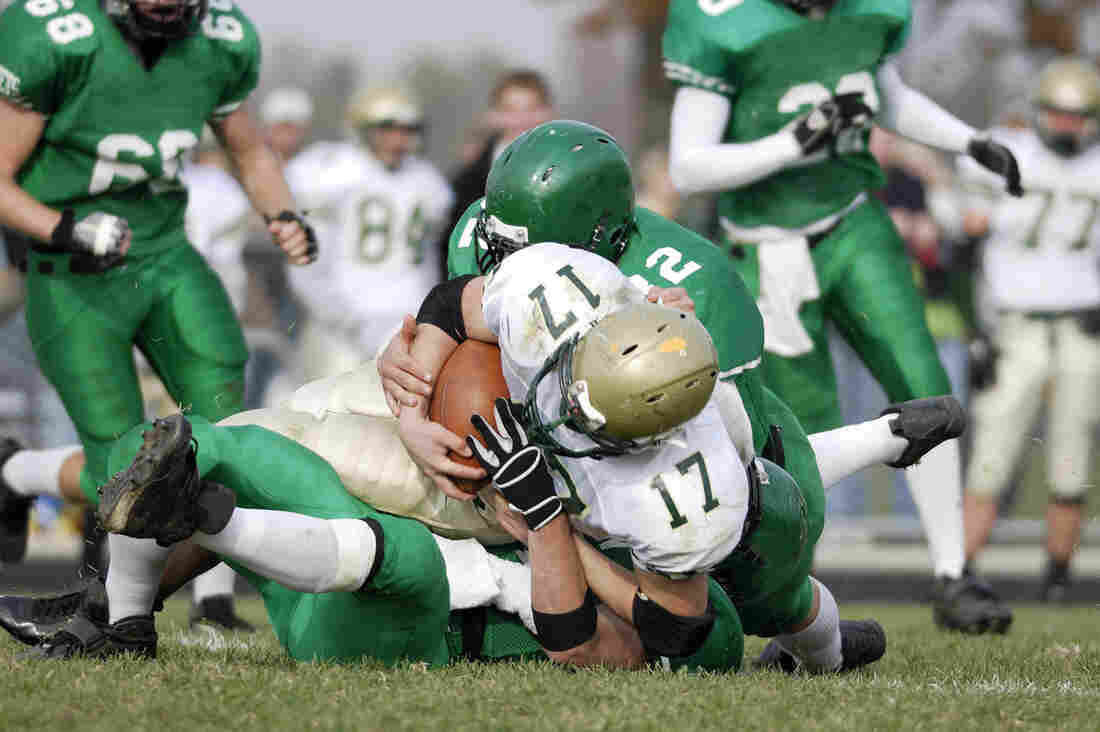
MRI scans before and after a season of football showed brain changes in a study of high school players.
groveb/Getty Images
hide caption
toggle caption
groveb/Getty Images
A single season playing football might be all it takes to change a young athlete’s brain.
Those are the preliminary findings of research presented this week in Chicago at the annual meeting of the Radiological Society of North America.
Researchers used special MRI methods to look at nerve bundles in the brain in a study of the brains of 26 young male football players, average age 12, before and after one season. Twenty-six more young males who didn’t play football also got MRI scans at the same time to be used as a control group.
In the youths who played football, the researchers found that nerve fibers in their corpus callosum — the band that connects the two halves of brain — changed over the season, says lead study author Jeongchul Kim, a research associate in the Radiology Informatics and Imaging Laboratory at Wake Forest School of Medicine in Winston-Salem, N.C.
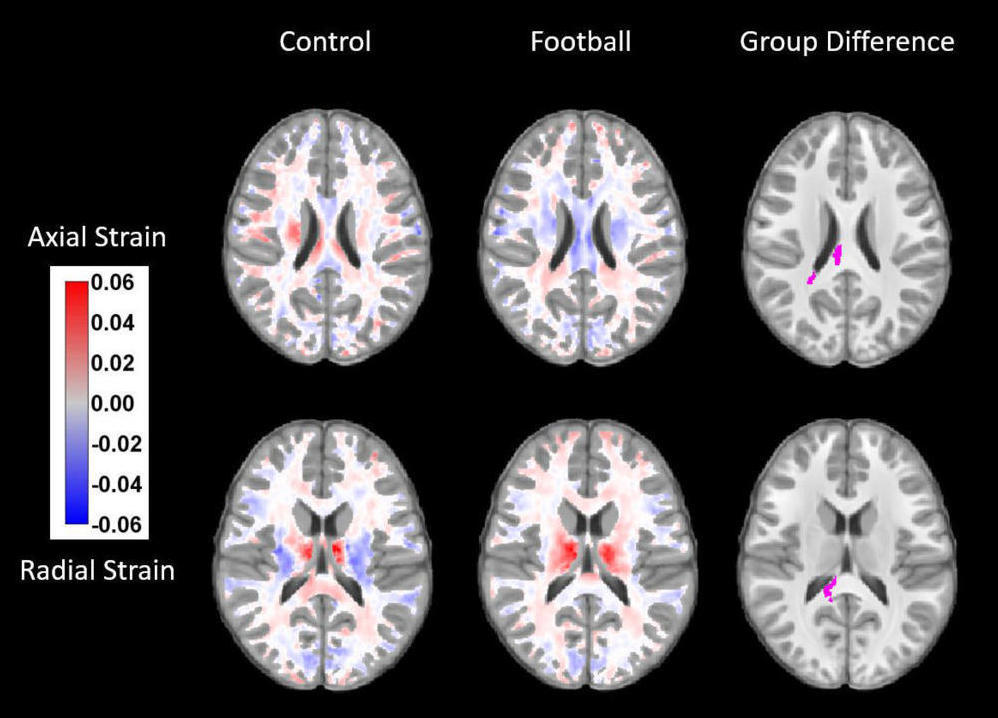
“We applied here two different imaging approaches,” he says. One analyzed the shape of the nerve fibers and the other focused on the integrity of the nerves.
Kim says the researchers found some nerve bundles grew longer and other bundles became shorter, or contracted, after the players’ initial MRI scans at the beginning of the season. He says they saw no changes in the integrity of the bundles.
The team says these results suggest that repeated blows to the head could lead to changes in the shape of the corpus callosum, which is critical to integrating cognitive, motor and sensory functions between the two hemispheres of the brain, during a critical time for brain development in young people.
The researchers say their ultimate goal is to help inform guidelines for safer football play for youths.

A series of MRI images shows the signs of strain in nerve fibers following a season of football.
Courtesy of Wake Forest School of Medicine
hide caption
toggle caption
Courtesy of Wake Forest School of Medicine
Since the discovery of the degenerative brain disease chronic traumatic encephalopathy in the early 2000s, most of the research into the consequences of repeated head injuries during sports has been on adult athletes. This focus has occurred despite growing concerns that young athletes who experience the same kinds of collisions may also be vulnerable to their effects.
Radiologist Christopher Whitlow, a co-author of the new findings, says while the stories about NFL and collegiate players are very important, they have to be put into context.
“You have to understand that the NFL players were also most likely once collegiate players, they were also high school players and they were also probably youth players,” he says. “To us, it’s more than a question about concussions, it’s a question about long-term cumulative exposure.”
That being said, both Whitlow and Kim caution against making their findings out to be more than what they are: preliminary results from a single study with a relatively small number of participants.
“We don’t know what it means,” says Whitlow. “The natural next question is, do these changes persist over time? Do they accumulate with multiple seasons? And then No. 3, probably the most important: Do they have any relevance to long-term health?”
The results, presented at a medical meeting, haven’t been published in a peer-reviewed journal. Whitlow says that the team is working on a paper to be submitted to a journal.
These latest findings are actually part of a years-long research collaboration among University of Texas Southwestern Medical Center, Wake Forest University and Children’s National Health System in Washington, D.C.
Dr. Gerard Gioia is a pediatric neuropsychologist at Children’s National Health whose role in the larger study is to look at the functional outcomes of kids playing football. He says these latest findings are only a part of the piece of the puzzle they’re trying to solve.
“Everybody wants to know, ‘Should my kid play football? Should my kid play soccer? Should my kid play ice hockey?’ And we say, ‘Can we please study this and understand it?’ ” says Gioia, who has been pushing for funding for more long-term studies into youth and sports.
For now, he says, they still have a lot of unanswered questions.
Loyola's Sister Jean Presented With Final Four Ring After March Madness Run
Loyola University Chicago surprised Sister Jean Dolores-Schmidt this week with an NCAA Final Four appearance ring. The 99-year-old chaplain became a national star after an improbable March Madness run.
'Seduced By The Game' – Hall Of Fame Coach Returns To The Court



Magnus Carlsen Retains His Title As World Chess Champion
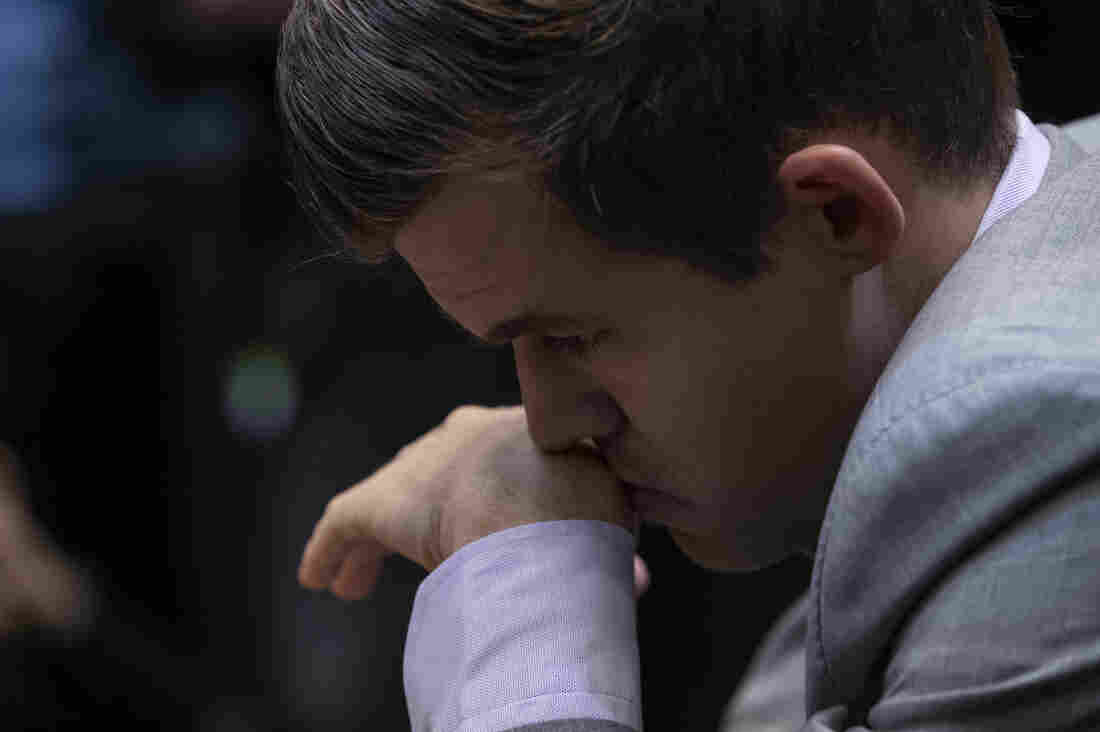

Defending world champion Magnus Carlsen, who is Norwegian, decisively beat his opponent, American Fabiano Caruana, at the World Chess Championship on Wednesday in London.
Dan Kitwood/Getty Images
hide caption
toggle caption
Dan Kitwood/Getty Images
It came down to a series of rapid tie-break games, but defending world chess champion Magnus Carlsen has emerged victorious once again.
Carlsen, a 27-year-old Norwegian, has held the title since 2013. He defeated Fabiano Caruana, who would have been the first U.S. citizen to win the world title since Bobby Fischer in 1972.
The two appeared evenly matched in the 12 games they played over three weeks before Wednesday’s climax. Each of those 12 games resulted in a draw, making it the first time in the tournament’s history that no player won a game during regular play.
But Carlsen dominated the board at Wednesday’s matches in London, decisively winning three games in a row to clinch the title.
“After a generally close-fought 12 games of classical, today just felt like slaughter,” commented grandmaster Peter Svidler in a chess24 livestream of the match.
“This was a hard fought match to the end, and I want to congratulate Magnus on defending his title,” said Caruana. “I was up against one of the most talented players in the history of chess, and I gave it everything I had.”
The previous 12 games had been much slower-paced – they could take more than five hours to complete. In the tie-break rounds, the pace sped up a lot.
Carlsen won the best of four tie-break series in three straight games. These started with 25 minutes on each player’s clock, and 10 additional seconds after each move.
If the pair had been tied after those four games, it would have proceeded to additional rounds of even faster games.
Here’s an animation of the final game from FiveThirtyEight’s Oliver Roeder (Carlsen played white):
here’s the final nail. #CarlsenCaruana pic.twitter.com/M10dhgMSQT
— Oliver Roeder (@ollie) November 28, 2018
Carlsen was seen to have an advantage in the tie-break games because he is higher ranked than Caruana at faster play.
But on Monday, he made a decision that caused some chess experts to question whether he was losing his fighting spirit. Even though he was in a more favorable position in game 12, he suddenly offered Caruana a draw, which he accepted.
“In light of this shocking draw offer from Magnus in a superior position with more time, I reconsider my evaluation of him being the favorite in rapids,” legendary chess grandmaster Garry Kasparov wrote on Twitter. “Tiebreaks require tremendous nerves and he seems to be losing his.”
It appears that Carlsen kept a grip on his nerves for Wednesday’s games.
The Guardian quotes grandmaster Judit Polgár from the commentary booth: “What a match. What a player. What a drama.”
'That's How I Found Out I Was Dead': Soccer Club Fakes Player's Demise (Poorly)


Fernando LaFuente did not learn of his death until this week, days after his former team falsely reported it to the Leinster Senior Football League
Nicolò Campo/LightRocket via Getty Images
hide caption
toggle caption
Nicolò Campo/LightRocket via Getty Images
The tragic phone call came in Friday morning.
That’s when Ballybrack FC, an amateur Dublin soccer team, told league officials that one of its players had been killed in a traffic accident on his way home from practice. Fernando LaFuente, sadly, had played his last game.
The reaction was swift. Ballybrack’s opponents that Saturday agreed to call off their scheduled game out of respect for LaFuente, and teams across the Leinster Senior Football League observed somber moments of silence before they resumed play.
Condolences to everyone involved at Ballybrack FC on the tragic passing of their player making his way home from training on Thursday night. All at Rush Athletic express our deepest sympathies.
— Rush Athletic Senior (@RushAthleticFc) November 24, 2018
There was just one minor issue: Fernando LaFuente is very much alive.
“After my work finished I was playing some video games, and suddenly I got a call from work,” LaFuente told RTÉ Radio One on Wednesday. His coworkers called Tuesday night to check in on him. They’d seen reports about his “accident.”
“They started sending me all these news articles and all these mass media,” he explained. “And that’s how I found out I was dead.”
As it turns out, Ballybrack officials had faked his death.
A Spanish national, LaFuente said he had played on the team since January. But he dropped out about two months ago, when he left Ireland’s capital for work in Galway, on the other side of the country. It appears at least one team manager used his move as a convenient opportunity to wriggle out of playing Saturday’s match.
Later asked why he thought the team did it, LaFuente said they were most likely just struggling with a thin bench as the game approached. “I think maybe they had a rough time getting players,” he told the Irish broadcaster. “They don’t play professionally. Most of them have regular jobs and some of them work in the UK or at university, people moving to other countries.”
League Chairman David Moran said the story began to come apart Monday, when he inquired about funeral arrangements. The team’s response — that LaFuente’s body had already been flown back to Spain — immediately “rang alarm bells for us,” Moran told RTÉ on Tuesday.
“We checked the hospitals, we checked everywhere,” Moran added. “Nobody could find anything about this young fella.”
The jig was up.
“This grave and unacceptable mistake was completely out of character and was made by a person who has been experiencing severe personal difficulties unbeknownst to any other members of the club,” Ballybrack FC said in a statement issued Tuesday, noting that “the person in question has been relieved of all footballing duties.”
Moran has promised a detailed investigation into what exactly happened.
Meanwhile, observers have wasted little time cracking wise about the incident — including some of club’s opponents: “Any of the alive players from Ballybrack are more than welcome to come up training,” Valeview Shankill FC quipped on Twitter. Another Irish club, which plays in another amateur league, was even moved to perform a tribute.
A tribute to Ballybrack and Fernando #LSL #Ballybrack #like #retweet #abba pic.twitter.com/bfADWXekPn
— Oldbury FC (@Oldbury_FC_) November 27, 2018
LaFuente himself said that as early as last weekend he was aware that something was up. His former teammates had warned him that he might see something online about his being in an accident but, he told RTE, “I thought it was going to be a broken leg-type accident.”
When he found out the true scale of the lie, he reached out right away to his mother in Spain to let her know that all the reports of his death — including an obituary in the Dublin Herald, LaFuente noted — were greatly exaggerated.
But all in all, this dead man walking is taking it in stride.
“It’s serious on their part, but I’m finding it a little bit funny,” he said. “Because basically, I’m not dead.”
Freedom Of Movement Rule May Be The Cause Of High-Scoring NBA Games
David Greene talks to Tim Reynolds, who writes about basketball for The Associated Press, about why NBA scores are repeatedly climbing into the triple digits.
Stalemate To Checkmate: After 12 Draws, World Chess Championship Will Speed Up


Reigning chess world champion Magnus Carlsen (right), from Norway, plays Italian-American challenger Fabiano Caruana in the first few minutes of round 12 of their World Chess Championship match on Monday in London.
Matt Dunham/AP
hide caption
toggle caption
Matt Dunham/AP
The World Chess Championship is heading toward a dramatic conclusion on Wednesday, which could give the U.S. its first champion since Bobby Fischer took the crown in 1972.
The players will embark on a series of fast-moving tiebreaks at the event in London, which will get faster and faster if they continue to draw.
Fabiano Caruana, the 26-year-old Italian-American prodigy who grew up in Brooklyn, is definitely the underdog. For 12 games so far, he has taken on the current world chess champion, Magnus Carlsen. And each game has ended in a draw.
“I’ve had mediocre years, I’ve had good years,” Caruana said in a recent interview with The New York Times. “This year has been the best by far.”
According to the organizer World Chess, it’s the first championship match where nobody has won a game through the first 12 games of regular play.
Carlsen, who is 27 and from Norway, has been on top of the game for much of his adult life. He’s held the world champion title since 2013.
But some observers think he may be losing his edge. “He’s a shadow of himself, of his best times,” chess grandmaster Judit Polgár tells NPR’s Here & Now.
Carlsen raised eyebrows at a crucial moment in Game 12, when he appeared to be in a stronger position, yet suddenly offered to leave the game as a draw.
“For whatever reason, he chose not to invest the energy and, instead, proposed a draw after 31 moves, which Caruana accepted,” according to a write-up from World Chess.
That decision was baffling to legendary chess grandmaster Garry Kasparov.
In light of this shocking draw offer from Magnus in a superior position with more time, I reconsider my evaluation of him being the favorite in rapids. Tiebreaks require tremendous nerves and he seems to be losing his.
— Garry Kasparov (@Kasparov63) November 26, 2018
“In light of this shocking draw offer from Magnus in a superior position with more time, I reconsider my evaluation of him being the favorite in rapids,” Kasparov wrote on Twitter. “Tiebreaks require tremendous nerves and he seems to be losing his.”
At the same time, World Chess pointed out that even though computer calculations say Carlsen was more likely to win when he offered the draw, “the position was complicated and it was clear that it would take a lot of maneuvering, and many hours, if Carlsen hoped to break through.”
“I wasn’t in a mood to find the punch,” Carlsen said after the game, according to FiveThirtyEight.
Polgár said Carlsen has previously been known for avoiding draws. She says the two players are very evenly matched. “I think he lost the appetite of winning, or it is not so much important for him to win again, somehow he cannot motivate himself so much as he could before,” she said.
These past 12 games have been played according to time regulations that mean each game can take hours. The players have 100 minutes each for the first 40 moves, with even more time added after that.
But on Wednesday, the pace of the game is going to speed up – a lot. The challenge of the tie-breaks is that play happens in smaller and smaller amounts of time.
The faster play is expected to work in Carlsen’s favor. He’s higher-ranked in styles of chess with tighter time regulations.
The first four tie-breaker games start with 25 minutes each on the clock, and 10 additional seconds after each move.
After those four games, if the scores are still tied, it moves to even faster rounds called “blitz games.”
First, the players play two games with five minutes each plus three seconds after each move. If they’re still tied, they’ll play another two games, and this could continue up to 10 games total.
And if it’s still even after the end of the blitz games, they’ll go to a round referred to as “Armageddon.”
The player who has white pieces gets five minutes on his clock, one more minute than the player who has black. But, should the game end in a draw, the player with black pieces is automatically the winner.
And unless the referee decides otherwise, according to the rules, the players will have just 10 minutes between each of these tie-break games.
Besides the coveted title of world champion, there’s a lot of money on the line. The players are duking it out for a prize fund of 1 million euros ($1.1 million). If it had been decided in regular games the winner would get 60 percent and the loser 40 percent — now, because it has gone to tie-break games, the winner will get 55 percent and the loser 45 percent.
It’s worth noting that it’s highly unlikely that the matches will actually get to the epic conclusion of a sudden death round.
In fact, according to calculations by FiveThirtyEight, there’s a 0.02 percent chance this World Chess Championship will end in Armageddon.
We’ll just have to watch to find out. Games kick off Wednesday at 10 a.m. ET.