Graham-Cassidy Health Bill Would Shift Funds From States That Expanded Medicaid

Senate Republicans’ latest plan to overhaul the U.S. health care system ends with a massive shift of federal money from states that expanded Medicaid — and are largely dominated by Democrats — to those that refused to expand.

Several analyses of the bill show the pattern. A report by the health care consulting firm Avalere Health shows California and New York losing a combined $123 billion in federal health care funding by 2026, while Texas would see its flow of money from Washington rise by $35 billion.

Two other reports, by consulting firm Manatt and by the left-leaning Center on Budget and Policy Priorities, show the same pattern. And a fourth analysis from the Kaiser Family Foundation release Thursday also largely concurs.

Loading…

The bill’s sponsors say it’s a matter of basic fairness.

“Four states get 40 percent of the money under Obamacare: New York, California, Massachusetts and Maryland,” Sen. Lindsey Graham, R-S.C., said on the Senate floor on Sept. 14. “Our goal is by 2026 to make sure every patient in every state gets the same contribution, roughly, from the federal government.”

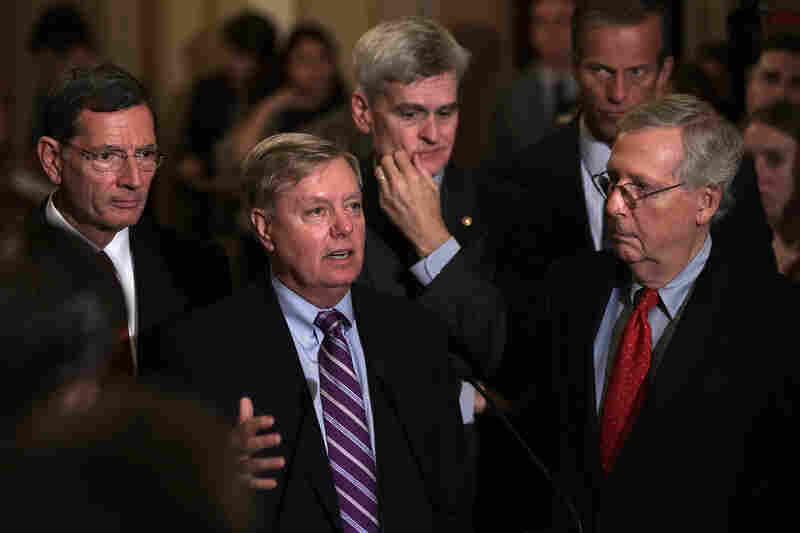
Sen. Lindsey Graham, second from left, speaks as Sen. John Barrasso, from left, Sen. Bill Cassidy, Sen. John Thune and Senate Majority Leader Sen. Mitch McConnell listen during a news briefing after the weekly Senate Republican policy luncheon on Tuesday. Graham and Cassidy have sponsored a bill to overhaul the Affordable Care Act.

Alex Wong/Getty Images

hide caption

toggle caption

Alex Wong/Getty Images

Graham, and his co-sponsor Bill Cassidy, R-La., both highlighted the inequity in the current system on the day after they introduced their bill. Neither mentioned that the states getting less money voluntarily shunned the Medicaid expansion that made millions more people eligible for coverage.

The Graham-Cassidy bill would dismantle the major components of the Affordable Care Act, or Obamacare. It eliminates the federal health insurance exchange; gets rid of the individual mandate that requires people to buy insurance, along with the subsidies that help people pay for a policy; and ends the expansion of Medicaid.

Then it takes all the money from those programs, puts it together and redistributes it to the states to set up their own health care systems.

The formula laid out in the bill distributes the federal dollars based on the number of low-income people in a state and their overall health status.

Massachusetts Gov. Charlie Baker, a Republican, says the formula ignores the fact that health care in more expensive in high-cost states, and sometimes in rural areas, than elsewhere.

Baker points out that wages make up a big chunk of the cost of health care. “How you can say that there’s one cost of health care per service delivered for the entire country and make that work?” Baker said on NPR’s Morning Edition. “A high-wage state, of which Massachusetts is one, gets absolutely slammed under a proposal like that.”

The Avalere analysis shows Massachusetts losing about $8 billion in federal health care funding under the proposal.

However, it’s worth nothing several other states that would lose money are Republican – including Arizona, Nevada, Kentucky, Arkansas and Louisiana. Although Louisiana’s Cassidy is co-sponsoring the bill, the state’s governor has come out against it. And Arizona Republican Sen. John McCain’s vote could end up being crucial.

Let’s block ads! (Why?)

Mass. Gov. Baker Opposes Graham-Cassidy Health Care Bill

David Greene talks to GOP Gov. Charlie Baker of Massachusetts, who signed a letter urging Senate Majority Leader Mitch McConnell to table the Graham-Cassidy bill, which attempts to repeal Obamacare.

DAVID GREENE, HOST:

And let’s talk about an issue that is before Congress right now. The Senate looks like they will vote next week on the latest Republican effort to repeal the Affordable Care Act. It’s a bill known as Graham-Cassidy, named for its sponsors. Its chances of passing – just not clear. Some moderate GOP senators need convincing, and a number of moderate Republican governors have signed a letter urging Majority Leader Mitch McConnell to get rid of this new bill. Massachusetts Republican Governor Charlie Baker is one of them and joins us on the line.

Good morning, Governor. Governor, you there?

Looks like we don’t have a Republican Governor Charlie Baker. We will try as best we can to get him on the line. We’re going to be talking with him about bill Graham-Cassidy and – Governor, you there? All right, well, let’s just explain the bill a little bit. One of the big issues that has come up as this bill has been debated is the issue of pre-existing conditions, which is something that President Trump tweeted about last night. He said he would not sign this bill if it does not include pre-existing conditions.

And I believe we have Governor Baker on the line now. Governor, you there?

CHARLIE BAKER: I am.

GREENE: Fantastic. Well, welcome to the program. We appreciate it.

BAKER: Thank you.

GREENE: I guess it’s – I suppose it’s worth pointing out a few things on your resume. You were Health and Human Services secretary from Massachusetts in the ’90s. You were the CEO of a health care provider for 10 years, so you’ve been dealing with this issue for some time. What’s your big concern with this piece of legislation?

BAKER: Well, I guess I’d say three things. The first is, it – one of the things it does is it establishes this notion that health care costs be the same across all 50 states, and it goes to kind of a national average for determining how this block grant proposal works. Now, even the Medicare program, which is a national reimbursement program for people who are elderly and disabled, makes adjustments in what it pays providers for services that they render based on the wage rates in their county.

And I don’t see how you can say that health care, which – 75 percent of the cost of health care is typically wages – how you can say there’s one cost of health care for service delivered for the entire country and make that work. And any high-wage state, of which Massachusetts is one, gets absolutely slammed under a proposal like that, unfairly.

GREENE: Well, let me just help our listeners understand exactly what you’re talking about. You’re talking about the block grant because one of the key parts of this bill would be flexibility to the states, taking a lot of the money on Obamacare programs and giving them to states, which in theory, sounds like flexibility that you have asked for. But you’re making the argument that the funding model would really hurt a state like Massachusetts because it assumes – the bill, you’re saying, gives – doles out money to the states equally.

Governor, you still with us? OK, it looks like we’ve lost governor of Massachusetts, Mary Louise. We had him very briefly.

MARY LOUISE KELLY, HOST:

We had him very briefly. And he was just gearing up, and I was actually really (laughter) waiting to see what you were going to ask him next. It was an interesting conversation.

GREENE: He’s back, I hear. Governor, you there?

BAKER: Yeah, I don’t know what’s going on on this. But yes, I’m back.

GREENE: That’s OK. Well, let me just ask you one broad question. I mean, it’s – it sounds like you are open to this bill in theory – the idea of taking money out of Obamacare, giving it to states to have the flexibility to build their own models. You’re just not happy that a state like yours under this model would not get as much money as it has in the past.

BAKER: No, there’s more to it than that. I mean, there are block grants that states get from the federal government for all kinds of things, you know? And they come with rules, with standards and guidelines, as they should because they’re federal money that states are using to pay for services that they’re rendering in their states. We get block grants for substance use services. We get block grants for mental health services, child welfare service. A lot of the transportation money looks like block grants.

The whole notion of a block grant is not something that’s foreign to federal-state relation. But when you get into something the size and magnitude of this, that’s just a completely different game. And that’s something that people should keep in mind because there are very important elements of just sort of how the health care system works generally that need to be dealt with on a state, local basis. And I’m one of these people who thinks the Medicaid program, which is a shared state, local – excuse me, state, federal program – has worked pretty well for 50 years.

GREENE: All right, forgive me. We’re out of time, and I’m sorry the line was so bad.

BAKER: Me too.

GREENE: We’ll have to try and correct that later on. It’s Republican Governor Charlie Baker of Massachusetts, one of the moderate Republican governors who has asked Senate Majority Leader Mitch McConnell to scrap this new Republican health care proposal.

Copyright © 2017 NPR. All rights reserved. Visit our website terms of use and permissions pages at www.npr.org for further information.

NPR transcripts are created on a rush deadline by Verb8tm, Inc., an NPR contractor, and produced using a proprietary transcription process developed with NPR. This text may not be in its final form and may be updated or revised in the future. Accuracy and availability may vary. The authoritative record of NPR’s programming is the audio record.

Let’s block ads! (Why?)

Women With Opioid Addiction Live With Daily Fear Of Assault, Rape

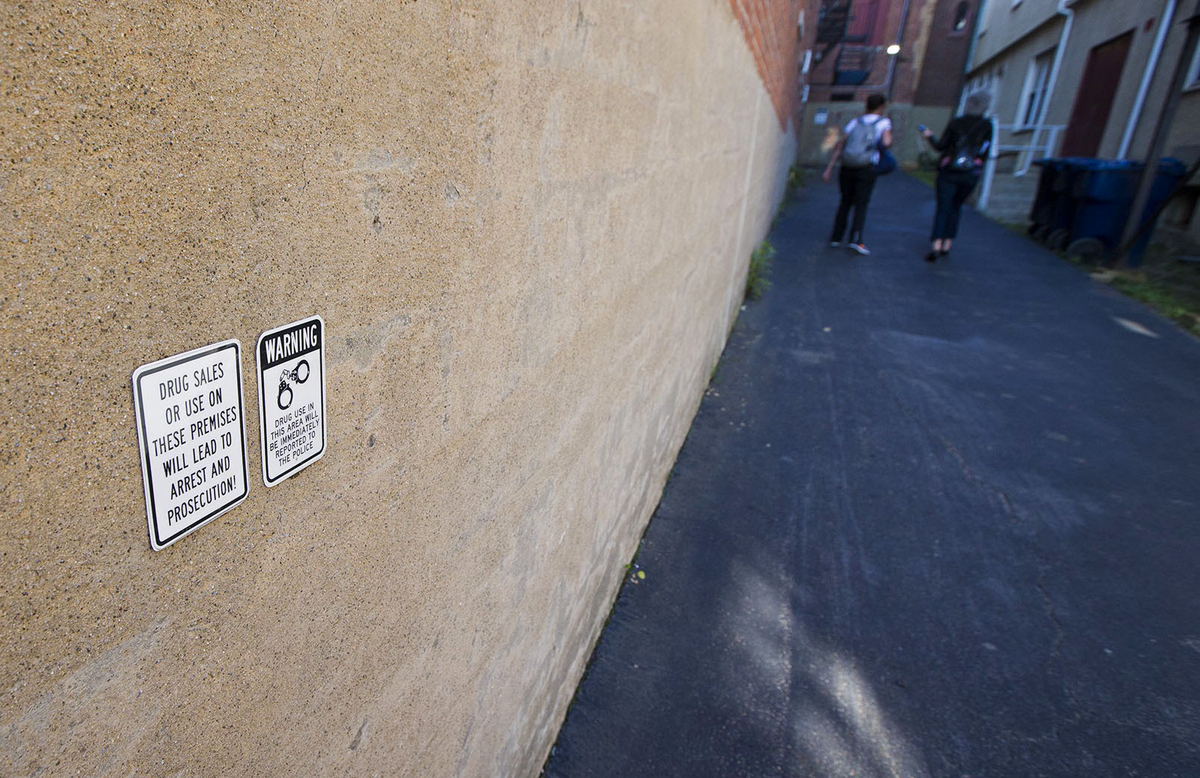
WBUR reporter Martha Bebinger (right) walks with Kristin, a drug user who says she has been repeatedly sexually assaulted while high on drugs.

Jesse Costa/WBUR

hide caption

toggle caption

Jesse Costa/WBUR

In Cambridge, Mass., a woman named Kristin sits down on a stone bench to talk about a common but rarely discussed injury that’s starting to grow along with the opioid epidemic: rape.

We’ve agreed to use just Kristin’s first name because she’s a victim of this crime. Kristin says she, like many women who live on the streets, cope with the daily fear of an attack that they are too sedated to fend off, or of waking up to find their pants pulled down, bruises, and other signs of an assault.

It’s an assault active drug users often don’t report out of shame, distrust of police, or fear they’ll be labeled a “cop caller” and have trouble buying heroin. It’s an injury women say they can’t figure out how to prevent. And it’s one few doctors think to ask about, and thus rarely treat.

The road to trouble starts many mornings, says Kristin, when she wakes up, sick and desperate for heroin but afraid to shoplift, sell the goods, and seek a dealer on her own. So she finds a male buddy, someone she calls a running partner.

“It’s just safer. People are less likely to beat you, rob you, sell you fake drugs if you’ve got a strong, well-known man with a reputation — a good reputation —you know,” says Kristin, 32, who still has the lanky body of a high school backstroke champion. She’s been addicted to opioids since she was 13 when they were prescribed to relieve pain after a shoulder surgery.

But sometimes that strong man with a good reputation turns out to be another danger. Kristin cringes at the memory of falling into a drug-induced sleep near a running partner she’d come to trust.

“I woke up to him on top of me, with my pants off, pretty much demanding that we have sex,” Kristin says, the emotion draining from her voice. “I’m weak because of the drugs I’ve taken, so I’m trying to push him off. I can’t do it. I grab my phone and just kind of barrel roll off the bed, pull my pants up, and run outside.”

That time Kristin got away. In two other attacks, she did not. She has story after story of unwanted kissing and groping. She says that for many women, there is steady pressure from those they partner with to perform sexual favors. After the attempted rape, Kristin pressed charges. Shortly before trial, the man died of a drug-related heart infection.

Other women interviewed for this story say they rarely seek help from police because they are worried investigators will turn on them and seek drug charges. Sometimes women are alert and recognize or can recall their assailant. Other times they only realize they’ve been raped because their clothes are torn, they have cuts or bruises and a sore vagina.

To prevent attacks, some women travel in pairs, but some say that doesn’t protect them from gang rape. They may arrange to ride out a high in view of a security camera, hoping someone would see and stop an assault.

After each assault, Kristin would try going solo on the streets. But then she’d get robbed or sold fake drugs and decide to find a new running partner. Kristin says she still attaches herself to men she knows are not safe. The drug addiction, she says, overpowers fear and common sense warnings.

“In hindsight, it’s like crazy, you look back and you’re like, ‘red flag, red flag, red flag,’ ” Kristin says. “I’m even noticing it in real time and pushing it aside because there’s a high waiting for me at the end.”

Two women who were sitting with Kristin and nodding while she spoke have drifted away. She glances over her shoulder when I ask if her experience is unusual.

“Between the other two women that were sitting here with me and the few that are across the street, combined, we probably have about 20 to 25 assaults or rapes,” Kristin says, her voice rising in anger. “It’s almost become normalized, and that’s messed up.”

While there’s lots of data on the connections between substance abuse and sexual violence in general, there’s little information about sexual assault stemming from the opioid epidemic.

Gina Scaramella, director of the Boston Area Rape Crisis Center, says she isn’t surprised by Kristin’s account. “I would almost be surprised if that wasn’t the case, to be 100 percent honest,” Scaramella says.

That’s because some assailants actually seek women and men whom they expect will be unconscious or semiconscious. Drug users may already be hiding from public view, and many have lost connections that might offer protection, “[l]ike a job, stable housing — people that know where they are and care where they are,” Scaramella says. “The isolation piece is a huge vulnerability for sexual violence because the offender will see that as an opportunity.”

One of Scaramella’s staff members is taking a course in substance use intervention as the center tries to address rape during the opioid epidemic.

Researchers are just beginning to document the problem. One study, published two years ago, asked 164 young adults in New York with an addiction to opioids about their experience with sexual violence. Forty-one percent of women and 11 percent of men said they had been forced to have sex while using drugs.

Authors urge more focus on prevention, but not just for potential victims.

“A lot of the focus is on telling people how to be safer when they are using or not impairing their judgment, but what we found was that there were people who were actively seeking out drug users, and more focus needs to be on them,” says study author Lauren Jessell.

One Boston physician says virtually all of her patients, mostly homeless women, have stories about sexual assaults.

“I wasn’t aware of this until more recently but I’m just struck by how common it is. In fact, it seems ubiquitous,” says Dr. Jessie Gaeta, medical director at the Boston Health Care for the Homeless Program.

Gaeta oversees the only clinic in the state where drug users can ride out a high in comfortable chairs with medical staff monitoring their conditions and safety.

Gaeta says women often pull her aside as they return to full consciousness, to ask if she’ll look at infections, cuts or swelling around their genitals.

“The stories are just so heart wrenching about the worst possible kind of sexual trauma,” Gaeta says.

Few emergency room doctors routinely ask overdose patients if they’ve been raped. Gaeta says this is understandable in the chaos of trying to save a life, stabilize the person, and persuade them to consider treatment.

But she says screening must become routine, because there are many reasons to worry about a patient who’s been raped.

“There’s unintended pregnancy, sexually transmitted illness, even physical injuries, lacerations we’ve seen around the rectum or around the vagina,” Gaeta says.

Doctors could be prescribing drugs to help patients avoid HIV and antibiotics to stop infections and treat wounds, but this rarely happens.

And there are the mental injuries that fester with rape. Kristin still blames herself for the attempted assault.

“I can’t believe that I put myself in that situation, I know better,” she wails as friends rub her back.

After the assault, Kristin checked in to detox and then rehab for the first time. She didn’t finish the program.

“I was like, ‘Oh my God, my life’s gotten out of control,’ ” she says, hands gripping her head. “I am getting raped, I’m overdosing on the regular, something’s got to change.”

Kristin pauses and looks up, her face calms.

“I have these moments of clarity … like, this has got to stop. I know better, I’m smarter than this, I’m going to die. But then there’s this very apathetic, I don’t care attitude to what happens to me. And I think the reason I’m able to get up and go on is … ” Kristin doesn’t finish the sentence.

She struggles for words and then begins again.

“I didn’t let the rape define me. For me it’s easier to completely detach myself from it, put it in a box, throw it away, don’t think about it,” Kristin says in a firm tone.

Except, she acknowledges, the sexual assaults, and fear of more, become one more pain she numbs with heroin, one more reason she clings to the drug for escape.

This story is part of a reporting partnership with NPR, WBUR and Kaiser Health News.

Let’s block ads! (Why?)