Nurses, Hospitals Prepared For Hurricane Irma To Ensure Patient Care Continues

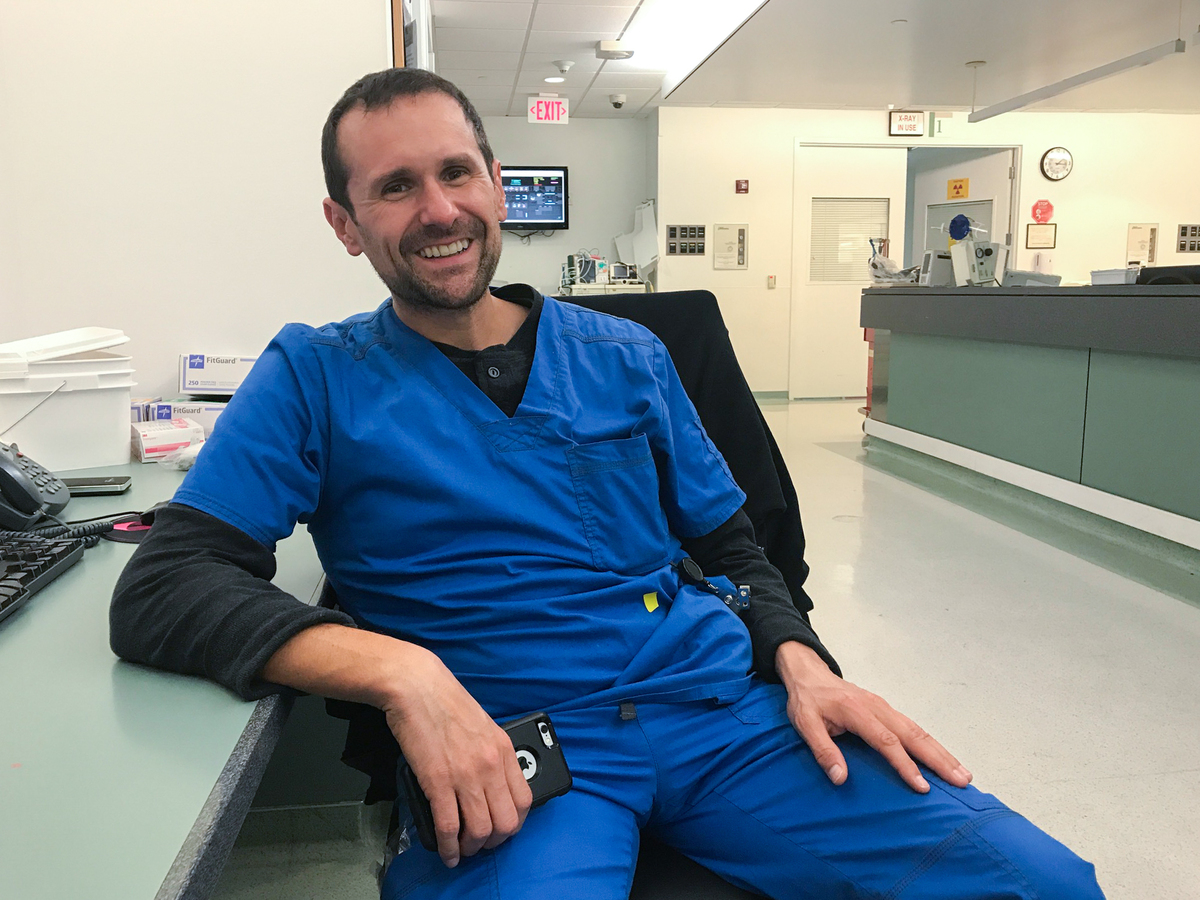
Taylor Roberts is a pediatric nurse who is waiting for Hurricane Irma to pass so she can go back to work at Golisano Children’s Hospital in Fort Myers, Fla.
Taylor Roberts is a pediatric nurse who is waiting for Hurricane Irma to pass so she can go back to work at Golisano Children’s Hospital in Fort Myers, Fla.
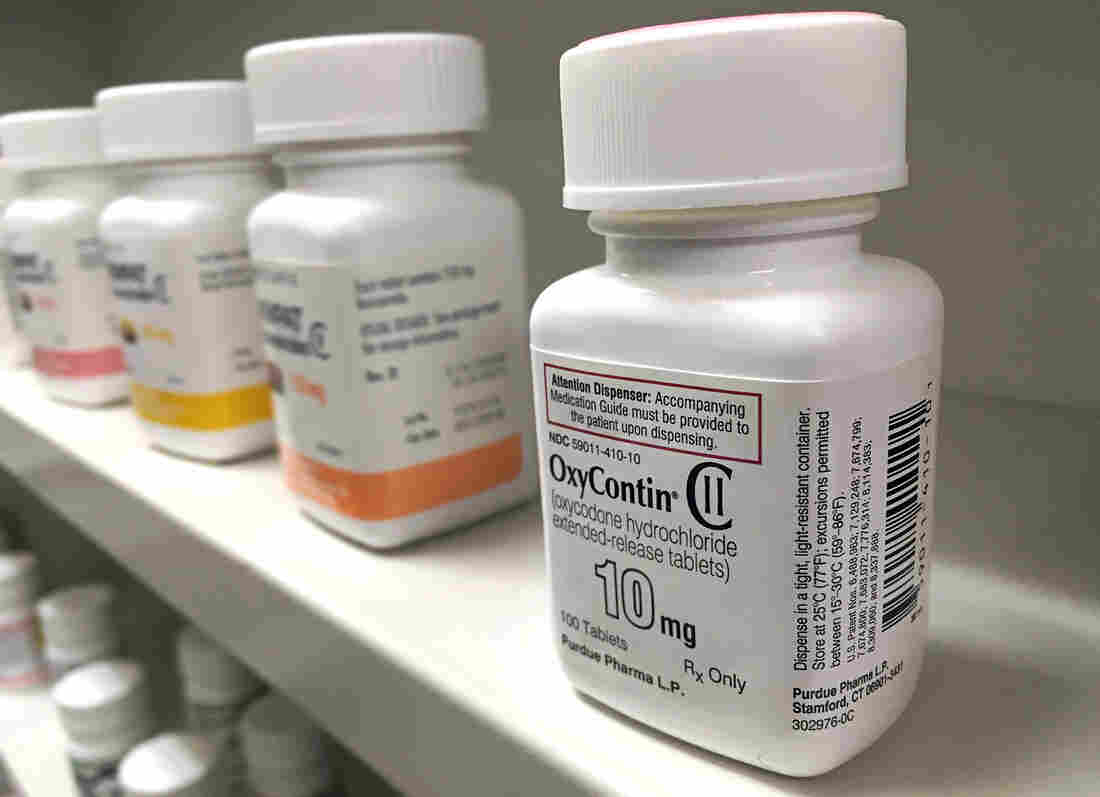
Dentists are among the larger prescribers of opioid painkillers. They’re trying to change that.
PureRadiancePhoto/Getty Images
hide caption
toggle caption
PureRadiancePhoto/Getty Images
The opioid epidemic has been fueled by soaring numbers of prescriptions written for pain medication. And often, those prescriptions are written by dentists.
“We’re in the pain business,” says Paul Moore, a dentist and pharmacologist at University of Pittsburgh School of Dental Medicine. “People come to see us when they’re in pain. Or after we’ve treated them, they leave in pain.”
Indeed, 12 percent of prescriptions for immediate-release opioids are written by dentists. In 2012, dentists ranked fourth among medical specialties for their opioid prescribing rates, according to data from QuintilesIMS. It has made dentists targets for people “doctor shopping” in order to get opioids.
Loading…
“I have dentures,” said Shawn Bishop, who is recovering from an opioid addiction at Hope House, a treatment center in Boston. “I had went to get some legitimate work done. And I got some Percocet. I realized that by going to another dentist, I could get some more Percocets.”
Bishop, now 59, recounts the times he teamed up with others to play dentists for their opioid pills.
“He would look at our teeth or Mark’s teeth in particular,” Bishop said. “He would look at his teeth and say, ‘Yeah, we need to take this one, this one, and this one.’ And Mark will always say well, ‘I can’t do it today. Can we make an appointment for next week?’ And then the doctor will say, ‘Yeah, I need to write a prescription of Percocets.’ He kept bad teeth and toothaches just so he can do that, you know?”
For Bishop and his friends, the enterprise of getting opioid pain pills from dentists grew so routine that, he says, he became a professional at it.
“It was almost like they knew their part to play and we knew ours,” he said. “It was like actors in a little sketch there.”
Massachusetts has taken the lead in trying to reduce opioid prescription abuse. Last year, Gov. Charlie Baker’s office passed a law to prevent drug misuse. Dental schools in the state are also required to teach a set of core competencies that their students are required to meet before graduating. Students will have to demonstrate that they know how to consider nonopioid treatment options.
“At least at the medical school, the dental school, nursing school and pharmacy school level, you don’t graduate from those places without having studied this stuff and understanding both the positives and the negatives associated with using it,” Baker says. “In addition to that, making sure as a condition of relicensure, you’re getting everyone who is writing prescriptions as part of that process.”
Now, after decades of criticizing health care providers for undertreating pain and not prescribing enough pain medication, the pendulum is swinging back. Some dentists are getting back up to speed about alternatives to opioids.
“For most dental pains, the nonsteroidal anti-inflammatory drugs (NSAIDS) —that’s Advil, Aleve, Naproxen — those agents are every bit as effective as one Vicodin or one Percocet,” Moore says. “That’s been shown over and over and over again.”
Third-year students at the Harvard School of Dental Medicine learn how to trim crowns and prep a tooth for a crown. They’re also learning to deal with the aftereffects, studying alternatives to opioids for pain relief.
Jessica Cheung/NPR
hide caption
toggle caption
Jessica Cheung/NPR
This next generation of dentists is not only learning about how to prescribe opioids appropriately, but also about how to think about pain differently. At the Harvard School of Dental Medicine, students are learning how to approach pain, a world away from opioids.
“You can approach it from opioid therapy, you can approach it from different neuropathy drugs, you can approach from stretching exercises to meditation,” says Kellie Moore, a fourth-year dental student at Harvard. “And just kind of like, exhausting all the options.”
Leaning on different methods of pain treatment can yield mixed success, she says: what works with one patient might not work for another.
Dental students are also rethinking what the goal of treating pain is.
“On a scale of 0 to 10, with 10 being the worst, if we can get you to a 4 or 5, could you live with that and still function daily?” says Sam Lee, a fourth-year dental student. “If the answer is yes, then I think it’s important to the patient understand that that’s what we’re going to try to maintain as the new normal for them.”
David Keith, an oral surgeon at Massachusetts General Hospital, agrees.
“I think it does us a disservice, making us and the patients assume that we should a total smiley face and a zero level of pain,” he said. “That’s not the real world. So we take a tooth out. We do a dental implant. You’re going to be sore for a few days, but that doesn’t mean you can’t go to work.”
The changing definition of pain is part of a larger change in the profession of dentistry. And Jeff Shaefer, an orofacial pain specialist who teaches at the Harvard School of Dental Medicine, says the role of the dentist is changing as a direct result of the opioid crisis.
“Dentistry is part of the problem and I think that hurts — that we’ve been overprescribing medication,” he says. “Having a standard regimen to give every patient is not appropriate.”
Nationally, the profession of dentistry is starting to change as well. This summer, the Commission on Dental Accreditation, which sets accreditation standards for all dental schools, ordered all graduates to be competent in accessing for substance use disorder.
But currently practicing dentists may not be so eager for a change to their profession. Keith, who regularly gives lectures to dentists in the state, has heard their complaints.
“There is a reluctance to add that, as there is reluctance to check blood pressure or check a list of medication their patients are on because it adds time to the day,” he said.
Education Images/UIG/Getty Images
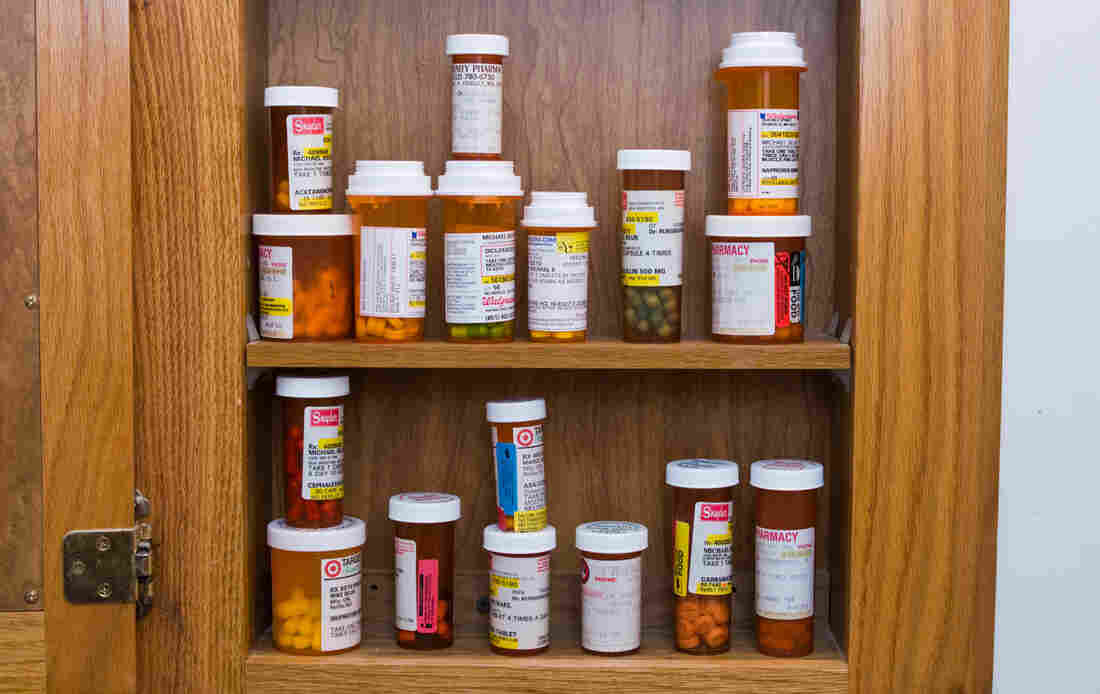
Almost one-third of people have stopped taking a prescription drug at some time without telling their health care provider, according to the latest NPR-Truven Health Analytics Health Poll.
And while cost certainly influences whether and how people take their drugs, only 10 percent of people in this poll cited it as the reason for their behavior. A separate question asked people who filled a prescription recently whether they missed at least one dose. A full quarter said they had.
The related problems of quitting a drug without consultation with a doctor, missing doses and even not filling the prescription in the first place fall under the umbrella of medication non-adherence. About half of medications for chronic disease aren’t taken as directed, according to a review published in 2012 in Annals of Internal Medicine. The problem has been estimated to result in increased hospitalizations, more premature deaths and a tab of between $100 billion and $289 billion a year.
“The implications are big, not just for the well-being of that patient but for the health care system overall,” says Bruce Bender, codirector of the Center for Health Promotion at National Jewish Health in Denver.
As the results of the poll indicate, there’s no single reason why people don’t take their prescription drugs as directed, which means there’s no single solution.
“What motivates human behavior? The economic angle is only one part,” says Anil Jain, vice president and chief health informatics officer for IBM Watson Health, which owns Truven Health. The poll suggests that people earning at least $100,000 a year were more likely to report that they stopped taking a medication or missed a dose than those earning less.
When people were asked why they stopped taking a drug without consulting with a doctor, they cited side effects (29 percent); a belief they didn’t need the drug (17 percent); that they were feeling better (16 percent); and that they felt the drug wasn’t working (15 percent).
Loading…
Bender thinks that people subconsciously do a cost-benefit analysis when faced with a decision whether to take a drug. “Into their head goes all the factors, including the benefits or what they perceive as the benefits, and the costs, including side effects and financial cost,” he says.
And the benefits can be hard to gauge. People on medications for chronic diseases may not feel like their blood pressure medication or statin is working because they don’t feel different. “Many people like to have a sense of immediate relief,” he says.
When asked why they missed a dose of a prescribed drug, 52 percent of poll respondents said they forgot. There are a host of ways, from low-tech pillboxes to high-tech apps, to alert people that their dose is due. But that won’t address the other issues. People under 35, for example, were more likely than older people to report having missed a dose, and those who did were more likely to also cite reasons like a perception that the drug wasn’t working or that they felt better.
Loading…
Getting people to take their medications as prescribed hasn’t been easy. In August, a study of people with heart disease found a combination of electronic reminders, financial incentives and social support made no difference in adherence or clinical outcomes.
Loading…
Bender says two areas have shown some promise. One is training health care providers to engage with and talk with patients about their medications. “It’s moving away from the paternalistic approach of ‘You go take this,’ to ‘Let’s work together and decide whether you’ll start a new drug,'” he says. This model has been shown to help in asthma, for example. Using texts and other feedback beyond reminders to help encourage patients to take their medications also seems to help.
The respondents in this poll, at least, reported actually filling prescriptions for medications that they were given in the previous 90 days, with 97 percent saying they did so. (Studies relying on prescription data instead of self-reports have found a higher proportion of prescriptions go unfilled.) Of the small minority that didn’t fill the prescription or pick it up, cost was cited as the main reason.
Younger respondents were more likely to shop around and try to save money. Almost a third of people said they looked for the cost of the medication before filling the prescription, including 64 percent of people under age 35. Among that same age group, more than 20 percent responded they had purchased a drug from outside the U.S. to save money, and 34 percent said they’d used drug company coupons or rebates to help cover copays. Younger workers are more likely to use high-deductible health plans that leave them responsible for costs, according to Benefitfocus, a benefits management software company.
Bender says it’s really important for people to talk with their health-care provider before stopping a drug that’s been prescribed. If side effects or cost are a problem, there may be alternatives, he says.
The Truven Health Analytics-NPR Health Poll is powered by the Truven Health Analytics PULSE® Healthcare Survey, an independently funded multimodal (landline, cellphone, Internet) survey that collects information from approximately 80,000 U.S. households annually. The results depicted here represent responses from 3,003 survey participants interviewed from June 1-15, 2017. The margin of error is plus or minus 1.8 percentage points.
Katherine Hobson is a freelance health and science writer based in Brooklyn, N.Y. She’s on Twitter: @katherinehobson.

Governors from left; Bill Haslam of Tennessee, Steve Bullock of Montana, Charlie Baker of Massachusetts, John Hickenlooper of Colorado and Gary Herbert of Utah all testified Thursday about ways t improve the ACA.
Jose Luis Magana/AP
hide caption
toggle caption
Jose Luis Magana/AP
The Senate is again trying to tackle the politics of health care. Rather than going for sweeping changes, lawmakers are acting more like handymen this time, looking for tweaks and fixes that will make the system that’s already in place work better.
Sen. Lamar Alexander, R-Tenn., is leading the effort to stabilize the Affordable Care Act’s insurance markets for next year. He’s trying to get a bipartisan bill together in the next 10 days, he said Thursday. He’s working against the clock; insurance companies have only until Sept. 27 to commit to selling policies on the ACA exchanges, and to set their final prices for health plans.
It’s a big ask. And Alexander, who is chairman of the Senate’s Health, Education, Labor and Pensions Committee, was frank about what needed to happen.
“To get a Republican president and a Republican House and a Republican Senate just to vote for more money won’t happen in the next two or three weeks, unless there’s some restructuring,” he told a group of five governors who testified before his committee Thursday.
It was the second of four hearings the committee is holding while developing a new health bill.
All of the governors and most of the senators in the room agreed that the top priority was for Congress to appropriate money for what are called cost-sharing reductions. These reimburse insurance companies for discounts they’re required by law to give low-income customers.
President Trump has threatened to cut off the payments, and insurance companies have responded to that uncertainty by proposing higher premiums for next year.
Funding CSR’s is the easy part, Alexander said.
He was looking for tweaks that will appease conservative Republicans who for years have told their constituents that Obamacare is a failure. They would be hard-pressed to appropriate money to fund it without some substantive changes.
Alexander presented the dilemma to the governors as an opportunity to ask for specific changes they’d like to see happen fast.
“This train may move through the station, and this is the chance to change those things,” he said near the end of the hearing. “And so if you want to tell us exactly what those are, and we got it by the middle of next week, we could use it and it would help us get a result.”
The governors had plenty of ideas.
Massachusetts Governor Charlie Baker, a Republican, said establishing reinsurance plans — pools of money to help insurers when they face huge costs from severely ill patients — can cut premiums for everyone.
Alaska last year created a reinsurance program that almost immediately slowed down the inflation in health insurance premiums in that state, Lori Wing-Heier, the director of the Alaska’s Division of Insurance, told the committee in testimony Wednesday.
Democratic Sen. Maggie Hassan of New Hampshire thinks Washington should put up some of the money for such programs.
“I’d be making the argument that at least some of the seed money should be coming from the feds because the feds are going to save money,” she told the governors at Thursday’s hearing.
And the governors unanimously supported Alexander’s proposal to give states waivers that would allow them out of some of Obamacare’s regulations, and enable states to design their own health care systems.
“What we’re really focused on is, how do you make the bureaucracy easier so that you can get these various waivers that pretty much all of us agree offer not only cost savings but in many cases will improve the actual outcomes of health care delivered,” Gov. Steve Bullock, of Montana, told the committee.
Sen. Chris Murphy, D-Conn., said he was concerned that giving too much flexibility would diminish the quality of the insurance policies.
Gov. Bill Haslam, of Tennessee, took issue with that.
“There’s an assumption from the federal government, that’s a little offensive to be honest, that ‘you won’t care for the least of these unless we tell you exactly how to do it,’ ” he said.
The governors were divided on a suggestion by Alexander that catastrophic health plans — which have high deductibles and don’t cover routine health care — should be more widely available. Under the Affordable Care Act such policies are only available to people under age 30.
Alexander said expanding the role of such policies could help gain the support of conservative Republicans in the House and Senate who want consumers to have more and cheaper choices in their insurance plans.
Baker, of Massachusetts, said he opposed expanding such policies, but Gov. Gary Herbert of Utah said he liked the idea.
In the end, Alexander suggested the bill he’ll pursue will likely include funding for cost-sharing payments and a more flexible waiver program. But he says he’s open to ideas.
“The reason for the hearings is for me to learn and listen,” Alexander said.
Several governors were in Washington, D.C., to testify before the Senate health committee about their bipartisan plan to shore up the health insurance marketplace. NPR’s Robert Siegel talks to Republican Gov. Gary Herbert of Utah and Democratic Gov. John Hickenlooper of Colorado.

The Children’s Health Insurance Program relies on money from state and federal governments to help subsidize the cost of medical care for some kids not poor enough to qualify for Medicaid.
Rebecca Nelson/Getty Images
hide caption
toggle caption
Rebecca Nelson/Getty Images
A popular federal-state program that provides health coverage to millions of children in lower- and middle-class families is up for renewal Sept. 30.
But with a deeply divided Congress, some health advocates fear that the Children’s Health Insurance Program could be in jeopardy or that conservative lawmakers will seek changes to limit the program’s reach. Other financial priorities this month include extending the nation’s debt ceiling, finding money for the Hurricane Harvey cleanup and keeping the government open.
“With all that is on Congress’ plate, I am very worried that a strong, wildly successful program with strong public support will get lost in the shuffle and force states to begin the process of winding down CHIP,” said Bruce Lesley, president of the advocacy group First Focus.
The program covers more than 9 million kids — typically from families not poor enough to qualify for Medicaid, the state-federal program that covers health care for people with low incomes.
Income eligibility levels for CHIP vary widely among states, though most set thresholds at or below 200 percent of the poverty level — about $49,000 for a family of four. Unlike Medicaid, CHIP is usually not free to participants. Enrolled families pay an average premium of about $127 a year.
Since CHIP’s enactment, the share of uninsured children in the U.S. fell from 13.9 percent in 1997 to 4.5 percent in 2015, according to the Medicaid and CHIP Payment and Access Commission.
The 20-year-old program has bipartisan support. One of its original sponsors is Sen. Orrin Hatch, R-Utah, chairman of the Finance Committee, which has scheduled a hearing on reauthorization Thursday.
It’s possible in the jam-packed legislative calendar this month that other health-related provisions could be attached to a CHIP reauthorization bill — such as Republican-sponsored changes to the Affordable Care Act. Those changes could keep the resulting bill from getting enough support from Democrats and some Republicans in the Senate for passage.
“It’s the only vehicle in health care policy other than the federal budget that’s going to be moving, so it’s likely extraneous items are likely to be added to it,” says Christopher Pope, a health policy researcher and senior fellow at the conservative Manhattan Institute.
Supporters of CHIP also worry about changes in eligibility for the program that could dampen enrollment.
The Affordable Care Act bumped up federal funding of CHIP by 23 percentage points and forbids states to restrict eligibility rules that were in place in 2010. Both of those requirements continue through September 2019.
The added funding means a dozen states have their entire CHIP programs paid for by the federal government. In the fiscal year that ended last September, states contributed less than $2 billion, compared with the federal government’s $13.6 billion contribution, according to the conservative Heritage Foundation. States should pay a higher share of the program’s costs, the foundation argues.
President Trump’s budget request this spring called for immediately eliminating the ACA bump in funding and ending the restriction on a state’s ability to curtail eligibility — often referred to as the “maintenance of effort” provision.
But that provision has kept CHIP stable at a time when the individual insurance market faces uncertainty, says Joan Alker, director of Georgetown University’s Center for Children and Families in Washington, D.C.
Advocates note that if children have to leave CHIP and move to marketplace coverage, their families may be forced to pay higher out-of-pocket costs for their kids’ health care.
Without the maintenance-of-effort requirement, advocates fear that states would be more likely to do what Arizona did during the last economic downturn: It froze enrollment from December 2009 until last June. The move was allowed because it took effect before the ACA’s restriction began in March 2010.
Meanwhile, Republicans are not united in their views of the maintenance-of-effort requirement. Some favor it because, they say, it shifts more authority of the program to states. Others say it would very likely lead some states to move many CHIP enrollees into either Medicaid or private insurance policies sold on the Obamacare exchanges — both areas where the federal government may pay an even higher share of the costs, Pope says.
“It’s not a simple win for anything, but you can see why some governors would like it,” he says.
At a House subcommittee hearing in June, some Republican lawmakers expressed concerns about extending the enhanced federal funding for CHIP.
“This increase in funding has challenged the program by both shifting the nature of shared responsibility of the state Children’s Health Insurance Program to the federal government and making states more dependent on federal dollars,” said Rep. Michael Burgess, R-Texas, who heads the Energy and Commerce subcommittee on health.
A committee staff memo prepared for the hearing suggested that taking away the extra funding (as some Republicans would like to do), but leaving the maintenance-of-effort requirement in place, would not result in fewer children having coverage.
Without renewal of the program, Arizona, Minnesota, North Carolina and the District of Columbia would run out of their federal CHIP funding by the end of this year. By March 2018, an additional 27 states would exhaust their funds.
Minnesota and D.C. officials say all children in those two regions who are covered by CHIP will transition to Medicaid if the federal funding is cut.
Alker says the enhanced funding included in CHIP’s 2009 reauthorization has helped several states, including Nevada and Utah. The states were able to expand coverage to legal immigrant children immediately; before that extra money came in, these kids faced a five-year wait for insurance.
Given the complexity of making major changes and the tight congressional timeline, some experts say Congress may opt to pass a clean CHIP bill — without major changes to the program.
“Congress is in [session] this month so few days that I can easily see CHIP simply being reauthorized without strings attached,” says Joe Antos, a health economist with the conservative American Enterprise Institute. Lawmakers’ attention is more likely to focus on the debt-limit deadline, the budget resolution and tax reform, Antos says.
Kaiser Health News is a national health policy news service that is part of the nonpartisan Henry J. Kaiser Family Foundation. Phil Galewitz is a senior correspondent for KHN.

Sen. Lamar Alexander, R-Tenn., is working with Patty Murray, D-Wash. on a bill to stabilize the health insurance market.
Zach Gibson/Getty Images
hide caption
toggle caption
Zach Gibson/Getty Images
After Republicans in the Senate spectacularly failed to deliver on their promise to repeal and replace the Affordable Care Act, also known as Obamacare, a smaller group of lawmakers is trying a new approach: bring in the Democrats and aim low.
It starts Wednesday when the Senate Health, Education, Labor and Pensions Committee holds the first of four hearings over two weeks with the goal of passing a modest bill to help stabilize the Obamacare health insurance markets for 2018.
Committee Chairman Lamar Alexander, R-Tenn., says he’s looking to do something “small, bipartisan and balanced.”
What’s remarkable is that he made that statement in a joint press release last month with the committee’s ranking Democrat, Sen. Patty Murray, D-Wash.
Up until recently, all major Republican efforts to alter Obamacare were launched with no Democratic support, and no attempts to get any.
Alexander and Murray say they want to work first to stabilize the markets for next year and then perhaps move on to broad reforms that will attract more insurance companies to compete in the individual markets, potentially making prices lower for consumers.
They’ve got a short window. Insurance companies have until Sept. 27 to sign contracts committing them to offering health plans on the Affordable Care Act exchanges next year, and setting their prices.
Alexander says his priorities include getting Congress to commit to funding so-called cost-sharing subsidies – payments that reimburse insurance companies for giving their lowest-income customers discounts on deductibles and co-payments.
President Trump has threatened to end the payments, and has refused to even say whether the government will make them for the final four months of this year.
“State insurance commissioners have warned that abrupt cancellation of cost-sharing subsidies would cause premiums, copays and deductibles to increase and more insurance companies to leave the markets in 2018,” Alexander said in a statement last month. “Congress now should pass balanced, bipartisan, limited legislation in September that will fund cost-sharing payments for 2018.”
He also wants the federal government to make it easier for states to get waivers so they can implement health policies that differ from Obamacare.
Wednesday’s hearing will feature insurance commissioners from four states, including Julie Mix McPeak from Alexander’s home state of Tennessee. She’s called for assurances that the payments will continue.
“When there’s any uncertainty surrounding the continuation of those payments, the insurers are doing two things. They are raising premium rates for 2018 and they’re making decisions about whether or not to participate in the individual exchange markets across the nation,” McPeak told NPR’s Ari Shapiro in August.
On Thursday, governors from four states will testify. They include John Hickenlooper of Colorado, who together with Gov. John Kasich of Ohio recently proposed their own bipartisan plan to overhaul the insurance markets.
Their plan includes creating a two-year reinsurance fund to protect insurers from people who have severe illnesses and make big claims. It would also exempt insurance companies from certain taxes if they enter a market in which there’s little to no competition.
The governors’ plan also advocates maintaining the so-called individual mandate, which requires everyone to own health coverage or pay a fine. That mandate is one of the most hated elements of Obamacare among republicans and President Trump has suggested that his administration will make little effort to enforce it.
Hickenlooper and Kasich laid out their plan last week in a letter to congressional leaders that was signed by the Republican and Democratic governors of eight states, including Gov. Brian Sandoval of Nevada. By signing on to this proposal, Sandoval, a popular Republican, seems to be indicating he will not support the new health plan proposed by his fellow Nevadan, Sen. Dean Heller.
Throughout the late spring and summer, insurance companies filed plans with the federal government that included proposed premiums for the health insurance plans they intend to offer in 2018. Many said they were raising rates because they weren’t certain the Trump administration would enforce the individual mandate or pay the cost-sharing subsidies.
An analysis by the consulting firm Oliver Wyman suggest that by taking action to stabilize the market, lawmakers could boost enrollment by two million people while cutting prices.
HELP isn’t the only Senate committee pursuing the bipartisan approach. Finance Committee leaders Orrin Hatch, R-Utah, and Ron Wyden, D-Ore., are planning two hearings in the next two weeks on insurance markets and the Children’s Health Insurance Program.

Dr. Ruth Berggren stands outside Charity Hospital in New Orleans in 2005, where she had earlier cared for patients during Hurricane Katrina.
Cheryl Gerber/AP
hide caption
toggle caption
Cheryl Gerber/AP
As Dr. Ruth Berggren digests the calamity affecting her new home state of Texas, she admits to some PTSD.
In 2005, she was an infectious-disease doctor at Charity Hospital in New Orleans when Hurricane Katrina hit, and she became one of a small number of physicians left to care for 250 patients for six days, trapped by flooding and without running water or electricity.
“I remember what it was like to be standing on the balcony of the ninth floor of Charity Hospital looking out over the floodwaters,” Berggren says.
She spent weeks and months dealing with the aftermath before moving to Texas, where she heads the University of Texas-San Antonio’s Center for Medical Humanities and Ethics, part of its Health Science Center.
In response to Hurricane Harvey, she has spent time volunteering at a makeshift clinic in a San Antonio middle school, once again treating victims of the storm — elderly patients who lost their walkers and people who in the rush to evacuate had forgotten medicines.
Storms such as this place a heavy burden on the local health system. Hospitals worked to keep caring for patients as flooded streets promised complications for people trying to deliver refuge and health care.
Harvey is the first major storm since the federal government revised emergency preparedness standards for hospitals, in response to Katrina and 2012’s Superstorm Sandy. Now, health care institutions that receive Medicare or Medicaid dollars must have disaster preparedness plans, including relocation strategies for at-risk patients and mechanisms to maintain basic power.
Berggren says she has seen improvements in preparing for disaster since Katrina, and shared her distinctive perspective. The interview has been edited for length and clarity.
What kind of burden does a storm like Harvey place on local hospitals, and on the health care system?
The first responders are always the people there locally. They’re being affected by the disaster at the same time as the population is. You have sort of a dual role.
Where I saw this burden take its biggest toll at Charity was two or three days after the storm. The people who had the hardest time were the folks who didn’t know the safety or whereabouts of or well-being of their loved ones. [Berggren’s husband and 12-year-old son were at Tulane’s hospital, and her daughter was with friends in Houston.]
Hurricane Katrina shone a spotlight on challenges that can arise at a hospital navigating a natural disaster. Are there lessons learned that we’re maybe seeing applied here in Harvey?
It does look like they were far better prepared, with regard to having protection for their power supply and for water in these hospitals.
Berggren and her patients and colleagues waited for days to be evacuated from Charity Hospital, which was surrounded by floodwaters from Hurricane Katrina.
Courtesy of Ruth Berggren
hide caption
toggle caption
Courtesy of Ruth Berggren
You can never really be fully prepared. What I recall before Katrina is there was kind of a set of misplaced priorities. We had to all undergo about four hours of training about sexual harassment in the workplace because Tulane was worried about that that year in particular — and had had exactly zero hurricane preparedness. We didn’t even know what Code Gray was. [It alerts staff to severe weather, a combative person or other safety risks.]
I think that whole region along the Gulf Coast is much more attuned to the fact that we have to prioritize educating health professionals about disaster preparedness. I see better preparedness in the medical community and I like to think that’s part of the Hurricane Katrina legacy.
What challenges should we expect in the storm’s wake?
There are always going to be vulnerable people, disenfranchised groups of people. If they’re not gotten out and they become further deprived of food and shelter and having their basic needs met, you’re going to see, unfortunately, I fear, the potential for violence. We had the experience at Charity Hospital of getting shot at by snipers, and we never knew who they were. We assumed they were disenfranchised people who had become desperate and been deprived of food or perhaps medication.
It’s going to be very hard to get regular services back up and running. I would say mental health is going to be a big problem. We saw a number of suicides in New Orleans after Katrina. People have a bit of a sense of despair when they become aware of the scope and scale of the disaster.
Post-Katrina it took many, many, many months to see the mental health counselors and psychiatrists return. I would hope that in the intermediate-range and long-range planning for disaster recovery that mental health is given a really high priority.
Next, I would worry about some infectious-disease issues. There’s a lot that’s been written about Houston’s risk for a Zika outbreak. Of course, the way you combat Zika is you get rid of standing water — and what does Houston have right now?
Lots of standing water?
Lots of standing water! They have had a superb proactive public health response up until now. I only hope the state continues to support that.
We have a lot of people living with chronic illness in general. When it’s tuberculosis, when it’s HIV, those people need their medications on a regular schedule, without interruption.
There were a lot of logistical hurdles in New Orleans, post-Katrina, in keeping patients on their full HIV regimens and full tuberculosis regimens. My patients with AIDS and tuberculosis who were evacuated without their medications — it took a long time before they could get to a place where they really felt they could confidently tell their health care providers what their needs were.
I had AIDS patients contacting me and saying, “Is it OK if I take my pills every other day to make them last longer?” And that’s exactly what you don’t want to do.
With people saying recovery will take months and even years — what sort of long-term impact might we see on the health system in Houston?
Physical infrastructure will take time to repair, but you can still provide funding to help people access care.
Houston doesn’t have to have all the floodwater evacuated and the buildings pristine to provide health care to vulnerable people.
Having moved from Louisiana to Texas, what is it like for you watching another major hurricane play out in your new home?
I’m comparing and contrasting constantly. I’m always checking the news. I’m checking in with my resident who’s assigned at Ben Taub. I’m seeing things that are being done a lot better and I’m seeing things that I wish could be done differently.
Disasters bring out the best and the worst in people. We always want to look to criticize and identify the mistakes, but these are also opportunities to see how good we really can be.
The capacity of our people to take care of one another and to rise to the occasion and to go beyond themselves is just so inspiring.

These days, a radiologist at UCSF will go through anywhere from 20 to 100 scans a day, and each scan can have thousands of images to review.
xijian/iStockphoto
hide caption
toggle caption
xijian/iStockphoto
In health care, you could say radiologists have typically had a pretty sweet deal. They make, on average, around $400,000 a year — nearly double what a family doctor makes — and often have less grueling hours. But if you talk with radiologists in training at the University of California, San Francisco, it quickly becomes clear that the once-certaingolden path is no longer so secure.
“The biggest concern is that we could be replaced by machines,” says Phelps Kelley, a fourth-year radiology fellow. He’s sitting inside a dimly lit reading room, looking at digital images from the CT scan of a patient’s chest, trying to figure out why he’s short of breath.
Because MRI and CT scans are now routine procedures and all the data can be stored digitally, the number of images radiologists have to assess has risen dramatically. These days, a radiologist at UCSF will go through anywhere from 20 to 100 scans a day, and each scan can have thousands of images to review.
“Radiology has become commoditized over the years,” Kelley says. “People don’t want interaction with a radiologist, they just want a piece of paper that says what the CT shows.”
Dr. Marc Kohli says that radiologists should embrace artificial intelligence.
Courtesy of Christopher Jovais
hide caption
toggle caption
Courtesy of Christopher Jovais
‘Computers are awfully good at seeing patterns’
That basic analysis is something he predicts computers will be able to do.
Dr. Bob Wachter, an internist at UCSF and author of The Digital Doctor, says radiology is particularly amenable to takeover by artificial intelligence like machine learning.
“Radiology, at its core, is now a human being, based on learning and his or her own experience, looking at a collection of digital dots and a digital pattern and saying ‘That pattern looks like cancer or looks like tuberculosis or looks like pneumonia,’ ” he says. “Computers are awfully good at seeing patterns.”
Just think about how Facebook software can identify your face in a group photo, or Google’s can recognize a stop sign. Big tech companies are betting the same machine learning process — training a computer by feeding it thousands of images — could make it possible for an algorithm to diagnose heart disease or strokes faster and cheaper than a human can.
UCSF radiologist Dr. Marc Kohli says there is plenty of angst among radiologists today.
“You can’t walk through any of our meetings without hearing people talk about machine learning,” Kohli says.
Both Kohli and his colleague Dr. John Mongan are researching ways to use artificial intelligence in radiology. As part of a UCSF collaboration with GE, Mongan is helping teach machines to distinguish between normal and abnormal chest X-rays so doctors can prioritize patients with life-threatening conditions. He says the people most fearful about AI understand the least about it. From his office just north of Silicon Valley, he compares the climate to that of the dot-com bubble.
“People were sure about the way things were going to go,” Mongan says. “Webvan had billions of dollars and was going to put all the groceries out of business. There’s still a Safeway half a mile from my house. But at the same time, it wasn’t all hype.”
‘You need them working together’
The reality is this: dozens of companies, including IBM, Google and GE, are racing to develop formulas that could one day make diagnoses from medical images. It’s not an easy task: to write the complex problem-solving formulas, developers need access to a tremendous amount of health data.
Health care companies like vRad, which has radiologists analyzing 7 million scans a year, provide data to partners that develop medical algorithms.
The data has been used to “create algorithms to detect the risk of acute strokes and hemorrhages” and help off-site radiologists prioritize their work, says Dr. Benjamin Strong, chief medical officer at vRad.
Zebra Medical Vision, an Israeli company, provides algorithms to hospitals across the U.S. that help radiologists predict disease. Chief Medical Officer Eldad Elnekave says computers can detect diseases from images better than humans because they can multitask — say, look for appendicitis while also checking for low bone density.
Radiologist John Mongan is researching was to use artificial intelligence in radiology.
Courtesy of Mark Kohli
hide caption
toggle caption
Courtesy of Mark Kohli
“The radiologist can’t make 30 diagnoses for every study. But the evidence is there, the information is in the pixels,” Elnekave says.
Still, UCSF’s Mongan isn’t worried about losing his job.
“When we’re talking about the machines doing things radiologists can’t do, we’re not talking about a machine where you can just drop an MRI in it and walk away and the answer gets spit out better than a radiologist,” he says. “A CT does things better than a radiologist. But that CT scanner by itself doesn’t do much good. You need them working together.”
In the short term, Mongan is excited algorithms could help him prioritize patients and make sure he doesn’t miss something. Long term, he says radiologists will spend less time looking at images and more time selecting algorithms and interpreting results.
Kohli says in addition to embracing artificial intelligence, radiologists need to make themselves more visible by coming out of those dimly lit reading rooms.
“We’re largely hidden from the patients,” Kohli says. “We’re nearly completely invisible, with the exception of my name shows up on a bill, which is a problem.”
Wachter believes increasing collaboration between radiologists and doctors is also critical.
“At UCSF, we’re having conversations about [radiologists] coming out of their room and working with us. The more they can become real consultants, I think that will help,” he says.
Kelley, the radiology fellow, says young radiologists who don’t shy away from AI will have a far more certain future. His analogy? Uber and the taxi business.
“If the taxi industry had invested in ride-hailing apps maybe they wouldn’t be going out of business and Uber wouldn’t be taking them over,” Kelley says. “So if we can actually own [AI], then we can maybe benefit from it and not be wiped out by it.”
At least for now, Kelley offers what a computer can’t — a diagnosis with a face-to-face explanation.
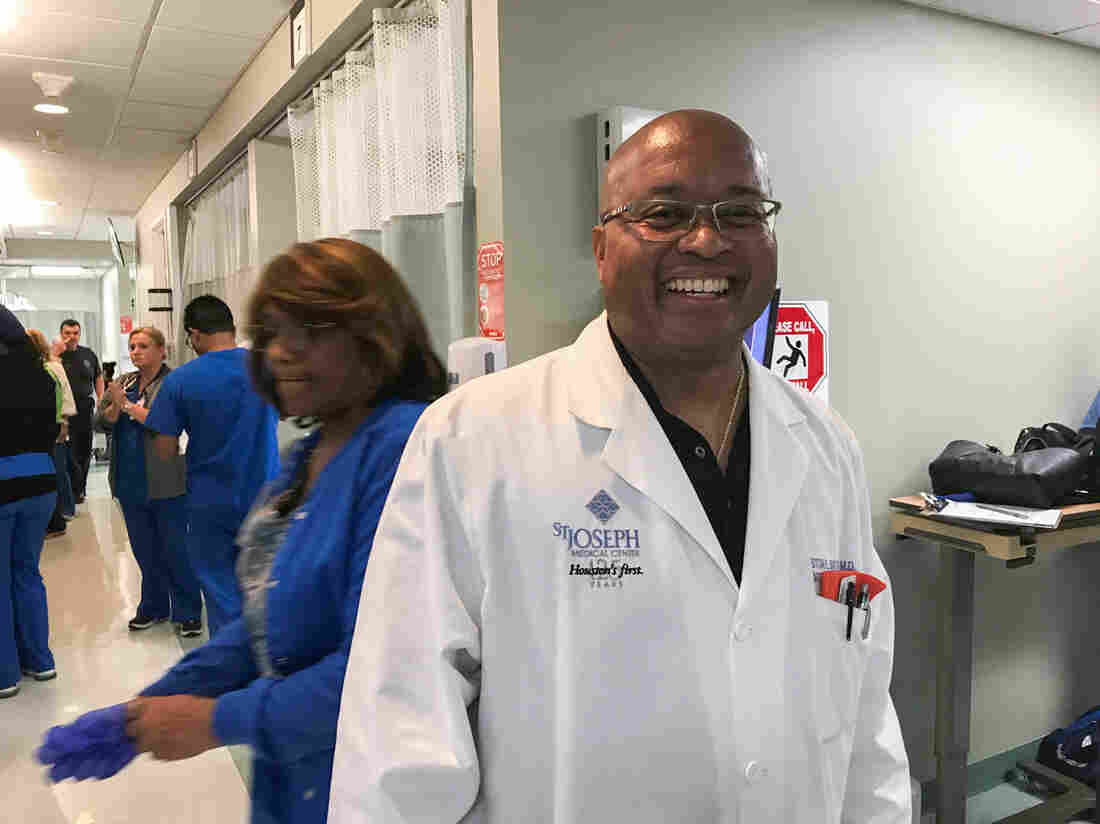
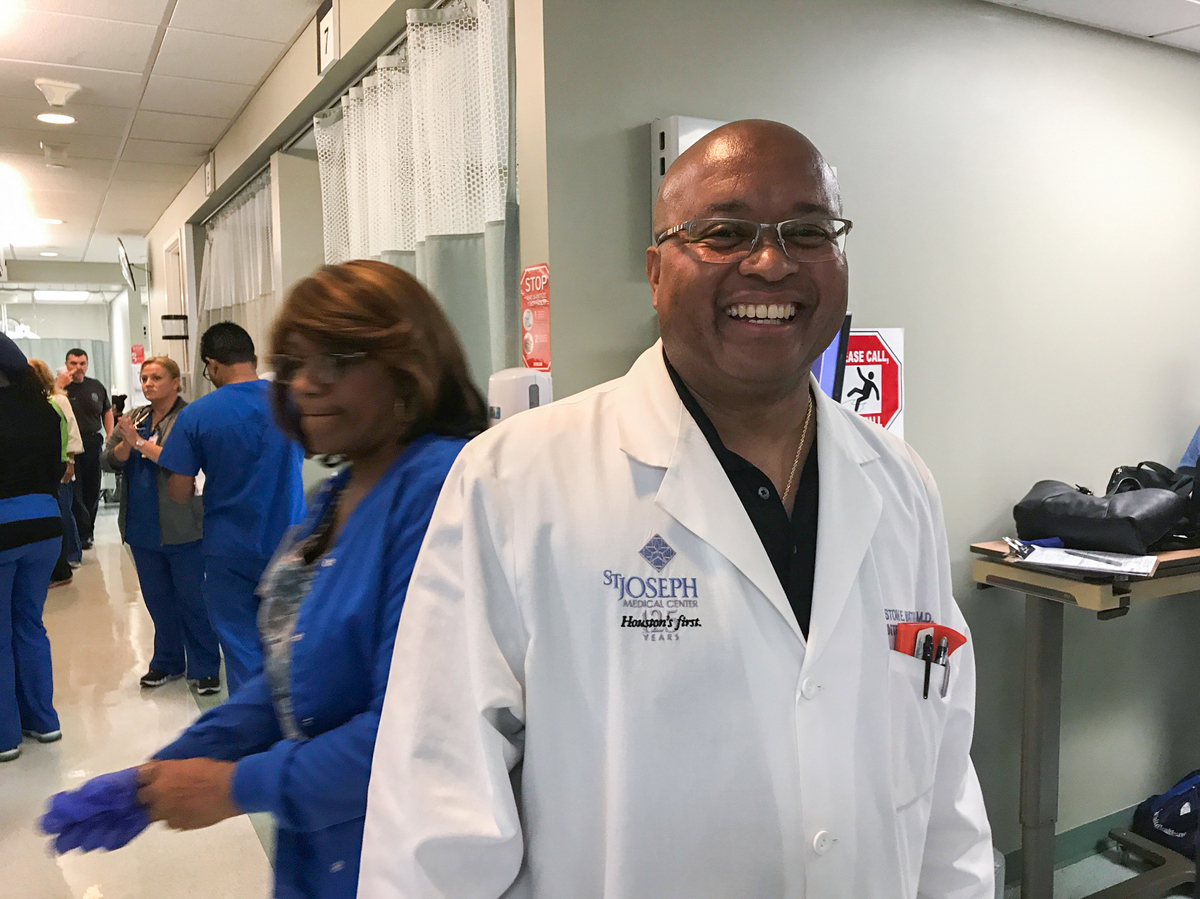
Dr. Winston Watkins, an internist at St. Joseph Medical Center in Houston, volunteered to do a shift in the ER to give his colleagues a break.
Rachel Osier Lindley/KERA
hide caption
toggle caption
Rachel Osier Lindley/KERA
St. Joseph Medical Center is downtown Houston’s only hospital, located just down the street from the convention center where thousands of evacuees have been staying since Harvey hit.
As of Friday, some doctors and nurses have been on the clock for almost a full week.
Trent Tankersley, director of emergency services at St. Joseph Medical Center in downtown Houston, had a very long work week, as did many of his colleagues.
Rachel Osier Lindley/KERA
hide caption
toggle caption
Rachel Osier Lindley/KERA
When you’re working in an ER during a major natural disaster, nothing is routine. Trent Tankersley, director of emergency services at St. Joseph Medical Center, describes one tense situation after another in the hospital this week.
“We had a lady who the only vehicle heavy enough and strong enough to get to her through the floodwaters was a dump truck. She was pregnant. She was in labor. She was brought to the hospital in the dump bed of a dump truck, soaking wet.
“As we were getting her over to the women’s building to get taken care of, we had a trauma come in. Shortly after that, we had a young man [who] came in that was having a stroke.”
Tankersley showed up to work Saturday, and hasn’t had what you’d consider “a break” since.
“Finally got to go home last night for a couple hours and do some laundry and then came right back. So it’s been an interesting five or six days.”
Some staff haven’t been home since before Harvey struck
Kristen Benjamin, an associate chief nursing officer, has been right beside Tankersley.
“I think we’re all working on adrenaline right now. We’re working shift by shift. Some people are doing 15-, 16-hour shifts. We let them go off and sleep. They come back in.”
Kristen Benjamin, associate chief nursing officer at St. Joseph Medical Center, says many employees hadn’t been home to see if their houses were flooded.
Rachel Osier Lindley/KERA
hide caption
toggle caption
Rachel Osier Lindley/KERA
They’ve seen more than 600 patients in the first five days. At times, they saw more patients in a few hours than they usually would in a whole day.
Many staffers have been stuck at the hospital, with no clear path to their homes. As floodwaters recede, their coworkers can finally come back.
“We’re going to start transitioning staff out to get home so that they can check on their homes,” Benjamin says. “Because some of them don’t even know what’s happening at their house right now because they haven’t been home since Friday. So I don’t even really have an idea if their house has been flooded or not.”
His first day working in the ER
Among those staffing the ER are doctors from other departments pitching in, and even medical students, like Diana Johnson. She and her classmates are using a Google spreadsheet to organize shifts to help.
She’s in her third year at Houston’s McGovern Medical school. She’s assisting Dr. Winston Watkins, an internist on his first day in the ER.
“One of the first patients that came in happened to be one of my own patients from my practice, and he came in with his foot hurting,” he says.”So Diana evaluated him and it turns out he has gangrene of his right fourth toe. And so we’re going to admit him to the hospital.”
“Some of them don’t even know what’s happening at their house right now because they haven’t been home since Friday.”
His house is underwater
Nurse Aaron Padron says he’s never seen such a wide range of emotions in the ER.
“A lot of laughter crying yelling, tears,” he says. “People that you work with you think that wouldn’t crack just put their head in their hands and take a second to cry to themselves, or not to themselves, and wipe away the tears and get back to work.”
He’s been working here for most of the last week, except Saturday night.
Aaron Padron, an emergency room nurse, says hospital employees were much more emotional, reflecting the stresses on everyone in the city.
Rachel Osier Lindley/KERA
hide caption
toggle caption
Rachel Osier Lindley/KERA
“I went home on Saturday to sort of rescue my family before the floods got too high for me to get in or out,” he says. “And then I came back Sunday and I’ve been working and sleeping here ever since.”
Neighbors say his house is underwater. He says several others working in the ER saw their homes flooded. In a way, he says, it’s all been a transformational experience.
“I think times of crisis, in times of emergency, in times of stress really have a way to bring people together and create a lot of camaraderie and really can push people to excel at what they do,” he says.
Once reinforcements come in, he’ll be able to rotate off his shift and find out just how much his family lost.