For Grocery Stores In Texas, It's A Race To Restock Their Shelves

People in Richmond, Texas, line up to gain entrance to a grocery store after it opened for the first time in several days due to Tropical Storm Harvey.

Charlie Riedel/AP

hide caption

toggle caption

Charlie Riedel/AP

Earlier this week, as torrents of rain fell on Houston, Craig Boyan, CEO of the H-E-B supermarket chain, went on a video-taped tour of his company’s emergency operations center in San Antonio, Texas. The company later made the video available online.

It was a revealing look inside a logistical nightmare. Boyan walked through two crowded, windowless rooms, stopping to speak with the people responsible for reopening stores, locating employees (or, as the company calls them, “partners”) to staff those stores, organizing deliveries of water and ice, and figuring out how to line up fresh supplies of milk, eggs and bread despite the city’s waterlogged streets.

One example: H-E-B makes most of its own bread, and its two bread-making plants are located in Corpus Christi and Houston. When the storm hit, “we had to take Corpus down, run the whole company out of Houston,” Boyan explained in the video. When the storm moved on toward Houston, “we had to switch back to Corpus, now we’re on generator power” at that plant. But the company’s supply of fresh bread was never interrupted.

There was a lot more than H-E-B’s own business at stake. Every day without deliveries of food and water could mean hunger for many thousands of people. “One of the things we’re really proud of is being the last to close and the first to open,” Boyan said.

Indeed, H-E-B and other big supermarket chains managed to get stores open and trucks rolling from warehouses at an impressive pace this week.

On Tuesday, at the height of the flooding, Walmart had closed 134 Houston-area storms. By Thursday, only 21 stores remained closed. H-E-B also had reopened almost 90 percent of its stores by then. Of the 20 stores owned by Albertson’s, 16 are now open.

According to Ragan Dickens, a Walmart spokesman, “very few” of the company’s stores actually flooded. The company had to throw out some perishable food, but it was able to reopen any stores that were accessible to trucks and had electrical power.

Dickens says that customers at some locations have been forced to line up outside to prevent overcrowding inside. And some stores remain closed because workers and trucks can’t get to them through flooded roads.

The ability of Houston’s big grocery chains to rebuild their supply chains “is amazing, but not surprising,” says Roni Neff, a professor of Environmental Health and Engineering at Johns Hopkins University. Neff recently co-authored a report on ways that the city of Baltimore could ensure continued food supplies in the face of future disasters, including possible flooding.

“We did a whole set of interviews, and we found that the bigger chains and the bigger businesses had very extensive planning in place” for natural disasters, Neff says.

City governments, on the other hand, don’t always think enough about food supply in their emergency planning, she says. In Baltimore, for instance, “there was an emergency operations center, but nobody [overseeing] food was there.”

Baltimore has now changed that. The city now has a “food resilience coordinator” who is part of emergency planning. “This is something that very few places have done in the past,” Neff says. “I really believe it’s something that everybody should be looking at.”

According to Neff, governments do need to be involved, in addition to supermarkets. “In Houston, as everywhere, the impacts are not equally felt,” she says. “People with lower incomes, people who are elderly, with disabilities, with medically necessary diets, may be particularly hit by this kind of situation, and really have quite severe food security threats to them.” And city governments need to be prepared to get food to these, more vulnerable groups.

In Houston, many supermarket chains, including Walmart, H-E-B, and Albertson’s, have also helped in relief measures. They have delivered truckloads of water and food to large shelters and to food banks, which in turn send food to distribution points in other parts of Houston and nearby areas.

Trucks were only able to reach the central Houston Food Bank starting Wednesday evening. “Now, the wheels are spinning, literally and figuratively,” says Paula Murphy, who handles public communication for the organization.

Seventeen truckloads of non-perishable food and water from Walmart were scheduled to arrive on Thursday, along with three airplane loads of food flown in from Dallas. “As soon as it arrives, it goes out again,” she says. “Our fleet of trucks is out there. The area we can reach is expanding.”

The biggest need, she says, is probably in rural areas outside Dallas, far from any supermarkets, where roads still may be impassable.

Let’s block ads! (Why?)

Why Some Muslims In Pakistan Won't Be Able To Buy A Goat This Year

Goats at a market in Karachi, Pakistan, are decorated ahead of Eid al-Adha celebrations.

Amar Guriro for NPR

hide caption

toggle caption

Amar Guriro for NPR

Thursday marks the start of Eid al-Adha, the holiest Muslim day of the year. It celebrates the biblical story of Abraham and his willingness to sacrifice his son for God. The moment before the sacrifice, God intervened and sent a goat to take the boy’s place.

Muslims around the world celebrate the holiday by sacrificing a goat, then eating it together with family and friends. But for many Muslims in Karachi, Pakistan, that tradition will be harder to follow this year.

Providing enough goats for a city of 15 million, like Karachi, is quite an undertaking. The city hosts an annual goat market where herders bring hundreds of thousands of goats, adorned with handmade collars and bangles, to sell in the days leading up to the holiday.

This year has been especially tough for the goat herders at the market. Pakistan’s southern provinces have been experiencing some of the harshest droughts in recent history.

According to ACAPS, a Geneva-based crisis research organization, below-average rainfall in 2016 resulted in substantial loss of crop production, including the type of grass that goats in the region eat in Sindh, the southern province where Karachi is situated. As a result, the price of that crop has increased, forcing herders to pay a lot more for goat feed than usual. And so the cost of the goats has skyrocketed.

Ghulam Siddique, a herder from Khairpur in Sindh, has yet to sell a single goat at the market with this year’s prices. “[Goat herders] need to increase the cost of our goats because the cost for animal feed is increasing with the water shortages,” says Siddique.

Ghulam Siddique, a goat herder from Pakistan’s Sindh province, has been forced to increase the price of his goats to offset the rising cost of the animals’ feed.

Amar Guriro for NPR

hide caption

toggle caption

Amar Guriro for NPR

For Kamran Ahmed, a low-income laborer from North Karachi, the increased livestock prices mean his family might not purchase a goat this year. A single animal usually goes for $200 to $300 at the market — a sizable portion of his monthly income.

“The prices are up by as much as [about $47] this year,” he laments as his son roams the goat market grounds, playing with the ribbons and pompoms hanging on the goats. “I’m not making a higher salary than last year. If this is how much [the herders] are charging, we may decide not to purchase.”

Other window shoppers at the goat market also felt a sacrificial goat will be out of their budget. Naeem Furan and his wife, Sajda, had been looking for a well-priced goat for the holiday, a tradition that the couple, both in their late 30s, have maintained since they married.

“If we can’t find [a goat in our price range] we’ll end up linking with another family in their sacrifice. But it’s the mark of a strong household,” Furan said of the practice. “God willing, we’ll find one we can afford and do the sacrifice ourselves.”

Karachi hosts an annual market where herders bring hundreds of thousands of goats to sell in the days leading up to Eid al-Adha.

Amar Guriro for NPR

hide caption

toggle caption

Amar Guriro for NPR

When people don’t buy, herders like Siddique face an uncertain future. “I rent my home in Khairpur,” he says. “If I don’t make a profit from these goats, I won’t make rent and my landlord will kick out my family.”

“We won’t have a home to come back to,” he says, as he fiddled with some of the goat feed.


Meher Ahmad is a journalist and documentary producer based in Karachi, Pakistan. Follow her on Twitter at @_meher.

Let’s block ads! (Why?)

An 'Army Of People' Helps Houston Cancer Patients Get Treatment

The University of Texas MD Anderson Cancer Center had 528 patients in the hospital as Harvey hit. A team of about 1,000 people tended to them and their families until reinforcements arrived Monday.

Courtesy of MD Anderson Cancer Center

hide caption

toggle caption

Courtesy of MD Anderson Cancer Center

As rains pounded Houston on Sunday, Dr. Karen Lu took to Twitter and conveyed both alarm and reassurance: “Roads around @MDAndersonNews impassable. Our on-site ride out team is caring for patients and we are all safe.”

Roads around @MDAndersonNews impassable. Our on-site ride out team is caring for our patients and we are all safe. https://t.co/AAgavZwQsP

— Karen Lu (@karenluMD) August 27, 2017

Lu is a professor of gynecologic oncology and interim chief medical officer at the University of Texas MD Anderson Cancer Center, a top cancer hospital and research center. Earlier that morning, the hospital had sent a high-water vehicle — a box truck — to Lu’s neighborhood, and she walked eight blocks through flooded streets to meet it.

The storm forced the hospital to close to outpatients. Surgeries, chemotherapy and radiation treatment and other appointments were put on hold for the 13,000 people MD Anderson sees each week.

Inside the hospital, doctors, nurses, technicians and facilities and food service staff were keeping things running for more than 500 inpatients and their families.

Lu spoke to Morning Edition host Mary Louise Kelly as the hospital was shifting into recovery mode Thursday.

This interview has been edited for length and clarity.


When the water was highest, what did that look like?

The main road that leads to the hospital was a river of about 4 feet of water.

#HarveyStorm@MDAndersonNews Medical Center Flooded pic.twitter.com/K7YxMOCzss

— Ashish Kamat (@UroDocAsh) August 27, 2017

Amazingly, our buildings withstood the storm. Over the last decade, the Texas Medical Center has re-engineered the area so that there are floodgates that go up, and that really protected the buildings. There were no patient care areas that were impacted by the storm.

You have a ride-out team, which refers to staff who have agreed to stay put and ride out the storm. How did that work?

We had about a thousand staff here. The unsung heroes in this disaster are our nurses, our lab techs, our pharmacy techs, our food services, our security who kept [everyone] safe.

We had 528 patients who were in the hospital on Sunday morning and probably another couple hundred family members. We were really able to care for these very sick individuals. There was no compromise in our ability to care for them.

What about those outpatients whose appointments were canceled?

[Thursday] morning, we moved to limited outpatient services.

We’ve had our teams, even while they have been at home, going through and looking at who urgently needs treatment. So already yesterday, we were able to address these urgent needs — in surgery, for chemotherapy as well as radiation therapy.

When you talk about surgery, it’s not just the surgeon. It’s the [operating room] nurse. It’s the surgical tech. It’s the individuals who sterilize our instruments. So, while you can have a surgeon on site, it’s all those other team members that it really takes.

So yesterday, we tested to be able to see that we could safely provide care, and we were able to do two OR cases, we were able to treat over 50 individuals for radiation, and we were able to treat about 35 very sick [leukemia patients] who needed blood products.

And today, we’re ramping up and doing more. And there’s an army of people trying to reach out to patients to get them rescheduled.

Your staff at the hospital is obviously just as affected as everyone else.

Absolutely. Prior hurricanes have impacted our buildings. Other hurricanes have impacted our research enterprise, our laboratory animals. I have to say what Harvey’s impacted is our staff. And that’s what’s so heartbreaking. We believe that somewhere between 30 [and] 60 percent of our workforce has been impacted by Harvey — people whose homes have been flooded and who have been asked to evacuate.

Have you made it home since Sunday?

I have. And I’m glad, because I really need a clear head to lead our team to recovery. We’re energized here at MD Anderson. Our patients are our focus, and we know that they need us.


Morning Edition editor Gail Austin and producers Maria Paz Gutierrez and David Fuchs contributed to this story.

Let’s block ads! (Why?)

Live In Hawaii, And Odds Are You'll Need Fewer Prescription Meds

We might all feel a lot better if we saw a view like this, from the North Shore of Oahu, every day.

Vince Cavataio/Perspectives/Getty Images

hide caption

toggle caption

Vince Cavataio/Perspectives/Getty Images

If you think you would be healthier if you lived in Hawaii, you may be right.

People in Hawaii appear to be much less likely to overuse problematic prescription drugs, including opioid pain medications and antibiotics, than people in the mainland United States.

Medicare beneficiaries in Hawaii used fewer opioid pain medications, fewer antibiotics, fewer antipsychotic drugs and fewer drugs labeled as risky for seniors on average than patients in any other state in 2015, according to a ProPublica analysis of data from the Centers for Medicare and Medicaid Services. Medicare’s prescription program covers more than 42 million seniors and disabled people, and pays for more than one in every four prescriptions in the U.S.

These four classes of medications are problematic for a number of reasons. Misuse and abuse of opioid painkillers has been linked to an ever-growing overdose epidemic. Overuse of antibiotics has been linked to the emergence of deadly superbugs that are resistant to drugs. Critics have faulted the use of antipsychotics in the elderly, particularly those with dementia, as a means of chemically restraining them. And the American Geriatrics Society has labeled some medications inappropriate for the elderly because they can increase the risk of falls, confusion and other problems.

On Thursday, ProPublica is updating its Prescriber Checkup tool, which allows people to compare their doctors’ prescribing patterns in Medicare to other providers in the same specialty and state. While it has long been known that patients in the southern and southeastern United States use more medications that are prone to abuse and overuse, there’s been little discussion about why Hawaii fares so well.

“Hawaii is so different,” says Dr. Chien-Wen Tseng, a family physician and health services researcher at the University of Hawaii. “I think there is more of a cultural thing that says we don’t want to overuse medications.”

Other research also has found that people in Hawaii use fewer prescription drugs. Recent figures from the Centers for Disease Control and Prevention show that after the District of Columbia, Hawaii had the lowest rate of opioids dispensed of any state. The state also has among the lowest rates of antibiotic prescribing per capita overall, not just among its Medicare population.

Dr. Lauri Hicks, director of the CDC’s Office of Antibiotic Stewardship, said she can’t definitively explain why some states, including Hawaii, have lower rates of prescribing than others. Some of the variation could be explained by differences in the population and the health of each state’s residents, she said in a written statement.

That said, Hicks wrote, for conditions that don’t warrant antibiotic use, such as uncomplicated bronchitis and common colds, prescribing rates tend to be highest in the South, “suggesting that there is more inappropriate antibiotic prescribing in that region than in other regions of the country.”

Hawaii doesn’t just have lower rates of prescribing for drugs that carry extra risks. Our analysis shows that among Medicare enrollees who filled at least one prescription, patients in Hawaii filled fewer overall than residents of any other state — an average of 25.7 per person in 2015, compared to 37.2 per person for the country as a whole.

Physicians and health policy experts in Hawaii offer a variety of possible reasons.

For one, Hawaii is ranked as the healthiest state in a recent America’s Health Rankings report by the United Health Foundation. It has a low rate of obesity, a low rate of people without health insurance and fewer preventable hospitalizations than other states, according to the report.

Along the same lines, the state’s Medicare population has a smaller percentage of younger enrollees who qualify for coverage based on their disabilities than in any other state, 10 percent compared to 17 percent for the country as a whole. Disabled younger enrollees tend to take more drugs — particularly opioids — than older patients.

Hawaii’s demographics may also play a role.

With a large Asian population, its residents are more likely to embrace alternative medicine therapies including acupuncture and chiropractic manipulation, says Claudio Nigg, professor and director of the health behavior change research workgroup at the University of Hawaii’s office of public health studies. And they rely on their families and extended families for help rather than seek medications. “The tendency is more towards social wellness and family taking care of family,” Nigg says.

Prior work has shown that Asian patients are less likely to be prescribed opioid painkillers than patients in other demographic groups.

Dr. Scott Miscovich, a family physician in Hawaii who heads a narcotic policy working group for the state, says that while his state has not seen the same opioid epidemic that has been striking the mainland, it is taking steps to prevent it, including rewriting laws to parallel those of other states.

“I wish I could say that I thought it was because we had this magic formula for educating our doctors or educating our public,” he says. “It really isn’t the case. …. We still have pockets of doctors that are probably significantly overprescribing all of these classes of medicine, but I think it’s a far more limited number compared to bigger areas across the United States.”

All of this is not to say that Hawaii has no health concerns. The state is struggling with a persistent methamphetamine problem, far worse than it faces with opioids, Miscovich says. And it has the highest homelessness rate of any state. (Washington, D.C., has a higher rate.) “If you roll the statistics back, it’s not all rosy,” Miscovich says.

States that come closest to matching Hawaii’s low rates of prescribing for risky and misused drugs include New Mexico, Vermont, California, Minnesota and Wyoming.

Our analysis of Medicare’s data also reveals other intriguing national trends:

  • The number of opioid prescriptions has finally started to decline. After peaking at 81.7 million in 2014, the figure dropped to 80.2 million in 2015. The drop is even more pronounced when you consider that enrollment in Medicare’s prescription drug program continued to grow during that time.
  • The number of antibiotics dispensed kept going up, to 57.3 million in 2015, from 54.2 million in 2014 and 52.4 million in 2013.
  • The average cost per prescription continues to increase, to $94.84 in 2015 from $85.82 in 2014 and $75.73 in 2013. However, those figures do not include confidential rebates the government receives from drug manufacturers.

Let’s block ads! (Why?)

In Houston, Most Hospitals 'Up And Fully Functional'

Parts of Houston remain flooded, but most hospitals are up and running, according to Darrell Pile, CEO of the Southeast Texas Regional Advisory Council, which manages the catastrophic medical operations center in Houston.

Marcus Yam/LA Times/Getty Images

hide caption

toggle caption

Marcus Yam/LA Times/Getty Images

In southeastern Texas, about two dozen hospitals remained closed as of midafternoon Wednesday, and several Houston hospitals remain under threat of flooding from nearby reservoirs.

But things are looking up. Some hospitals that had been evacuated have reopened, and others are restoring services they had temporarily suspended. Many never closed at all.

A catastrophic medical operations center, housed within Houston’s emergency center, has been coordinating with hospitals throughout the storm and continues to field calls about patients needing evacuation or immediate medical attention.

All Things Considered host Kelly McEvers spoke with Darrell Pile, CEO of the Southeast Texas Regional Advisory Council, which runs the catastrophic medical operations center.

This interview has been edited for length and clarity.


Interview Highlights

While the storm has largely left Houston, the flooding continues. What is the situation with the hospitals you’re working with?

The flooding is devastating, and we have at least two reservoirs where water is having to be released and is, in fact, flooding neighborhoods as we speak and has placed three hospitals in harm’s way.

The three hospitals are monitoring the water coming from the two reservoirs very closely, and they could, depending on the flow of the water, find that they could become inaccessible to EMS agencies. We are tracking that very closely.

The situation with residents in their homes — some are on the second floor of their homes — the evacuation process [for those neighborhoods] continues, and, as a result, it’s unclear what the demands on the health care system may be. However, most hospitals are up and fully functional, and we believe we can handle any new demands that happen today or tomorrow.

Has the catastrophic medical operations center ever handled anything like this?

No. The phone lines at one point became inundated. The amount of resources needed began to exceed what we had available. The calls included patients needing dialysis who might be at home. It included hospitals saying we need to evacuate. One call was asking for 50 wheelchairs to be sent to a shelter. We didn’t have 50 wheelchairs left. Fortunately, our governor declared a disaster and the president declared a disaster and resources have been brought in from all over the state and all over the nation to help us.

How did you get those 50 wheelchairs?

I’m not clear on how they ended up getting the 50 wheelchairs, but I can tell you, it can be accomplished just through one or two tweets to Houstonians. Those with wheelchairs perhaps in their attic or stored [elsewhere] could bring an abundance of wheelchairs, perhaps more than you even need. So there are methods to solve every problem. It’s just having enough people to make the calls or to be innovative and creative to solve the problems. This community has come to the call.

A number of hospitals did evacuate, either prior to the storm or during. How difficult is it to evacuate a hospital?

It’s not as simple as pulling up a bus or a convoy of ambulances and moving patients from one hospital to another hospital. My organization makes sure that the receiving hospital meets the need of every single patient they agree to receive. As a result, the evacuation of a hospital might mean we must identify 10 different hospitals to meet the unique needs of each patient.

Every day, three times per day, we have hospitals electronically advise us of beds that they have available and the type. So a pediatric patient goes to a pediatric bed.

And we’ve also spent time making sure the receiving hospital is not in harm’s way so that the patient would not have to be evacuated twice. We have worked with the [Texas] Department of State Health Services to also identify hospitals with beds available in cities such as Dallas or San Antonio or Austin or even further away so that a patient doesn’t move twice.

We’ve heard news of at least one hospital being short of food. Has that been resolved?

Yes. I was intimately involved in the Ben Taub [Hospital] decision to evacuate, and I was aware of their call for food. It was not a problem that was devastating or affecting patient care to any significant extent, and it did not last throughout the disaster period.

We do have to deal with situations where we have to dig down and find out the truth and make sure our response is responding to facts and not to stories that might have had some facts at one point, but as days went by, it became a little distorted.

[Editor’s note: Ben Taub Hospital confirmed to NPR that they have reopened, that supply lines are steadily improving and that they have received a food delivery and are expecting another one today.]

A number of Houston hospitals added flood protections as a result of other devastating storms, including Allison in 2001. Have those worked?

Absolutely. We had a situation where in prior storms, water came into a tunnel system that connects the Texas Medical Center hospitals. [The tunnels] make it easier to go from one hospital to another hospital. However, waters came in and flooded every hospital through that tunnel system.

The Texas Medical Center invested in submarine-type doorways, and when there is a risk of flooding, they now close those doorways. So each hospital is compartmentalized. As a result, this storm — even though flooding devastated our community, it did not devastate Texas Medical Center. So, congratulations to the Texas Medical Center.

Do the hospitals have the staff they need right now?

I can imagine some of the hospitals have fewer employees available to staff the hospital. Some members of their workforce have lost everything — their homes destroyed, their automobiles destroyed.

Tomorrow, we will be holding a meeting to discuss what do our hospitals need. And from there we will be identifying where we need to place nurses. We have an abundance of nurses from throughout Texas who have offered to help. We also have an abundance of physicians who have offered to help. Now it’s a matter of making sure we place them in the proper facilities.

Let’s block ads! (Why?)

'This Is Surreal': Houston Dialysis Center Struggles To Treat Patients

William Scott (right) and his wife, Teresa, arrived at DaVita Med Center Dialysis in Houston on Tuesday morning, after missing William’s appointment on Monday. “It’s just good he got in here,” she says.

Ryan Kellman/NPR

hide caption

toggle caption

Ryan Kellman/NPR

Among the most pressing medical needs facing Houston at the moment: getting people to dialysis treatment.

At DaVita Med Center Dialysis on Tuesday afternoon, nurses tended to dozens of patients on dialysis machines while another 100 people waited their turn. Some were clearly uncomfortable, and a number said they hadn’t been dialyzed in four days.

Those delays can be life-threatening.

Typically, patients with kidney failure undergo dialysis every other day, or three times a week, for four hours each time. To try to move more people through, nurses were doing two-hour sessions at this center in Houston, enough to keep patients out of danger.

Dialysis replaces the functions of the kidneys. Healthy kidneys remove toxic waste and excess fluid from the body in the form of urine. For dialysis patients, a filter, sometimes called an artificial kidney, does the job. A patient’s blood is pulled through the filter and pumped back into the body.

Dialysis does not cure kidney failure, but it does help people feel better and can extend their life. According to the National Kidney Foundation, average life expectancy for patients on dialysis is five to 10 years, though many patients live as long as 20 years or more.

But it’s crucial that patients get regular treatment.

Dr. Steve Fadem, medical director at DaVita Med Center Dialysis, says many of the facility’s nurses are unable to get to work. As a result, the center is struggling to keep up with the number of patients who are showing up.

Ryan Kellman/NPR

hide caption

toggle caption

Ryan Kellman/NPR

“If they don’t dialyze three times a week, they can easily become fluid-overloaded, or they can have a high potassium level in their blood, and they can become very, very sick,” says Dr. Steve Fadem, medical director at the DaVita center, which is one of about 100 the company operates in the Houston area, about half of which are open. Muscles, including the heart, can stop functioning correctly. “Over so many days, they can’t survive.”

In the wake of Harvey, DaVita has opened its doors to all dialysis patients, not just its own. But the company has been struggling with staffing shortages.

“Many of our nurses are locked in, flooded out of their homes, and they’re either somewhere else, or they can’t get out of our neighborhoods,” Fadem says. “As a consequence, we don’t have enough nurses to dialyze the numbers of patients that are coming here.”

They’ve been helped by a team from Baton Rouge, La., who showed up with boats to ferry both patients and nurses from their flooded homes to the center.

Scott waited almost four hours to start dialysis after arriving on Tuesday. Part of the reason is because the DaVita center is open to all dialysis patients this week, not just regulars such as Scott.

Ryan Kellman/NPR

hide caption

toggle caption

Ryan Kellman/NPR

“This is surreal. I’ve never seen anything like this ever in my career. I’ve been doing this for almost 40 years,” says Fadem.

After missing his regular Monday session, William Scott and his wife, Teresa, arrived at the center just before 10 a.m. He finally started dialysis almost four hours later.

“It was a long wait, but we could understand because it was a lot of people,” Teresa Scott says with a laugh. “It’s just good he got in here.”

Yesuf Said, a nurse who’s worked at this center for four years, says it’s been difficult dealing with so many patients at once and so many who are new to this center. “We have to do it, because nobody can do it,” he says. “It’s life and death for patients.”

He’s worried about the coming days. Normally, if patients don’t show up for dialysis, they get a phone call from the center. Now, Said says, he’s not sure they can reach everyone.

DaVita serves around 6,700 patients in Houston, according to Chakilla Robinson White, who oversees operations for the company’s dialysis centers in Texas and neighboring states. On Tuesday, she sent a companywide email with the subject line “Rally For Help in Texas,” appealing to staff in other places to travel to Houston to help.

Dialysis patients who are unable to find an open center can get help from the nationwide Kidney Community Emergency Response coalition by calling 1-866-901-3773.

Let’s block ads! (Why?)

5 Controversial Ideas For Shoring Up Health Insurance Markets

Republican Sen. Lamar Alexander (right), chairs the Senate’s Health, Education, Labor and Pensions committee; Sen. Patty Murray (left), is the committee’s ranking Democrat.

Andrew Harrer/Bloomberg/Getty

hide caption

toggle caption

Andrew Harrer/Bloomberg/Getty

With Republican efforts to “repeal and replace” the Affordable Care Act stalled, tentative bipartisan initiatives are in the works to stabilize the fragile individual insurance market that serves roughly 17 million Americans.

The Senate Health, Education, Labor and Pensions Committee says it plans to launch hearings next week to stabilize premiums in the individual insurance market — hearings that will feature state governors and insurance commissioners. A bipartisan group in the House is also working to come up with compromise proposals.

Both before and after Obamacare, this portion of the insurance market — which serves people who don’t get coverage through work or the government — has proved problematic. Before the ACA, many people with preexisting health conditions could not get insurance at any price.

Now, consumers in the individual market often face higher out-of-pocket costs and have fewer choices of health care providers and insurers than people buying individual policies have faced in past years.

More than 12 million people buy that insurance through the ACA’s marketplaces, while another 5 million buy it outside of the exchanges.

Policymakers generally agree on what immediate efforts to stabilize the market might include. At the top of most lists is prompt federal payment of the subsidies to insurers known as “cost reduction payments.” These are the payments that reimburse insurers for the discounts on copayments and deductibles they are required by law to give to their low-income customers.

Insurers also want the federal government to continue enforcing the requirement that most Americans either have insurance or pay a tax penalty. The government also needs to work hard to get uninsured people to sign up for coverage during the upcoming open enrollment period, from Nov. 1 to Dec. 15, insurers insist. Those federal efforts are essential, the firms say, to keeping enough healthy customers in the mix to defray the costs of beneficiaries who have high medical needs.

Those are among the most commonly proposed fixes for the insurance market. Here are five proposals that are more controversial — but are starting to generate buzz in policy circles.

1. Allow people into Medicare starting at age 55.

Getting slightly younger people into Medicare, the federal program for the disabled and Americans 65 and older, is a longtime goal of Democrats. It dates at least to President Bill Clinton’s administration and was nearly included in the Affordable Care Act in 2010.

Note that a Medicare buy-in is not exactly the same as a public option, which many Democrats, including former President Barack Obama, have embraced. A true public option would offer government coverage to people of any age.

Still, simply lowering the age for Medicare eligibility (whether by allowing people to purchase coverage early or by letting them join on the same terms as those who are 65) is controversial. Some Democrats support it as a first step toward a single-payer, Medicare-for-all system. Most Republicans oppose it on those same grounds — they see it as a step toward government-run health care.

But proponents argue it would help the current individual market by excluding the oldest people, thereby lowering the average age of the pool of people within that particular health plan. Since older patients, on average, cost more to insure, the change could lower premiums for everyone left in the ACA market.

That’s the stated goal of a Medicare buy-in bill introduced earlier this month by Sen. Debbie Stabenow, D-Mich., and seven other Democratic senators. Their bill would allow customers ages 55-64 in the ACA market to purchase Medicare coverage instead, but would also let them use ACA tax credits if they are eligible for those. The cost of such policies has not been worked out.

“The way we’ve structured it actually both helps Medicare by having younger people in that pool, and it helps private insurance by taking higher-cost individuals out of their pool,” Stabenow toldThe Detroit News.

Conservative health analysts don’t buy that, though. “This is just a way of saying we’re going to take these people out of the exchanges and put them where there are bigger subsidies,” said Joseph Antos at the conservative-leaning American Enterprise Institute.

2. Allow people to ‘buy in’ to Medicaid.

An alternative to letting people buy in to Medicare is letting them buy into Medicaid, the joint federal-state program for those with low incomes.

Medicaid buy-ins already exist — for example, in 2005 Congress passed the Family Opportunity Act, which allows families earning up to three times the poverty level to purchase Medicaid coverage for their disabled children who aren’t otherwise eligible. Medicaid has typically provided richer benefits for those with disabilities than private health insurance.

Earlier this year, Gov. Brian Sandoval, R-Nev., vetoed a bill that would have allowed Nevada residents to buy Medicaid coverage through the state’s insurance exchange.

Now Sen. Brian Schatz, D-Hawaii, is pushing for a federal Medicaid buy-in plan, which he described to Vox.com last week. It would give states the option to allow people who make more than the current Medicaid eligibility thresholds to pay a premium to join the program. Like the Medicare buy-in bill, Schatz’s proposal would allow those who qualify for federal tax credits to use them to pay the premiums.

The proposal would also raise the reimbursements that Medicaid pays to doctors, hospitals and other health care providers to the same level it pays them to treat Medicare patients. Traditionally, low Medicaid payment rates have kept many doctors — particularly specialists — from accepting Medicaid patients.

The idea of a further Medicaid expansion does not sit well with conservative policy analysts. “It’s completely unworkable,” Avik Roy, of the Foundation for Research on Equal Opportunity, told Vox. He predicted such a plan would raise Medicaid spending by $2 trillion over 10 years.

3. Get younger adults off their parents’ insurance and back into the individual market.

Allowing young adults up to age 26 to stay on their parents’ health plans is unquestionably one of the most popular ACA provisions. Democrats have touted it proudly while Republicans have dared not touch it in almost any of their overhaul proposals.

Yet what has been a boon to 3 million young adults (and a relief to their parents) has come at a cost to the individual marketplace itself, where only an estimated 28 percent of those buying coverage in state exchanges were ages 18-34 in 2016. That is well below the 40 percent most analysts said was necessary to keep the market stable.

“Frankly, it was really stupid,” to keep those young people out of the individual market, said Antos of AEI. The result has been a lack of people in the risk pool who are “young, healthy and whose parents will pay their premiums.”

But rolling back that piece of the law might be nearly impossible, said Antos, because “this is a middle-class giveaway.”

4.Require insurers who participate in other government programs to offer marketplace coverage.

One clear shortcoming of the individual marketplace is a lack of insurer competition, particularly in rural areas. While it now appears that every county in the U.S. will have at least one insurer offering health coverage for the coming year, the percentage of counties with only one insurer seems certain to rise from 2017’s 33 percent.

In an effort to more strongly encourage private companies to step up and offer coverage, several analysts have suggested tying access to participation in other government programs to a willingness to offer individual ACA policies as well.

For example, some have suggested insurers be required to provide policies in the marketplaces as a condition of being able to offer coverage to federal workers. Others have suggested that private insurers who offer profitable Medicare Advantage plans could also be required to offer individual exchange coverage, although the same rural areas with a lack of private individual market insurers also tend to lack Medicare Advantage coverage.

5. Let people use HSA contributions to pay health insurance premiums.

A little-noticed provision in one of the versions of the Senate GOP health bill that failed to pass in July would have allowed people to use money from tax-preferred health savings accounts to pay their insurance premiums. A proposal from a group of ideologically diverse health care specialists included a similar idea.

HSAs are linked to high-deductible insurance plans, and consumers use the money in the account to pay their out-of-pocket expenses. The money put into the account and the earnings are not taxable.

With a few exceptions, people with HSAs have not been allowed to use those funds to pay monthly premiums. But the change would be one way to provide relief to people who a)buy their own insurance, b)earn too much to get federal premium subsidies and c)cannot deduct premiums from their taxes because they are not technically self-employed. Such people, although likely relatively small in number, have been disproportionately hurt by rising premiums in the individual market since the ACA took full effect.

Still, the change would involve some trade-offs.

Roy Ramthun, who helped design HSAs as a Senate staffer in the early 2000s and helped implement them while at the Treasury Department during the George W. Bush administration, said that, generally, “Republicans have preferred to subsidize insurance premiums through tax deductions and credits and leave the HSA for out-of-pocket expenses.”

Allowing premiums to be paid from HSA funds, Ramthun said, “could eat up the entire balance of the account and leave nothing for out-of-pocket expenses.” There are limits to how much money can be put into an HSA. For 2017, the maximum is $3,400 for an individual and $6,750 for a family.

Let’s block ads! (Why?)

Health Issues Stack Up In Houston As Harvey Evacuees Seek Shelter

Evacuees fill up cots at a shelter set up inside the George R. Brown Convention Center in Houston, Texas.

Joe Raedle/Getty Images

hide caption

toggle caption

Joe Raedle/Getty Images

As floodwaters continue to rise in parts of Houston, health workers are trying to keep people safe and well, though that challenge is escalating.

“The first and foremost thing that everybody’s concerned about is just getting folks out of harm’s way with the flooded waters,” says Dr. Umair Shah, Executive Director of Harris County Public Health, whose own home came under mandatory evacuation Tuesday morning.

Before the storm hit, Harris County Public Health sent out a number of messages warning residents of to avoid hazards presented by flood waters: downed power lines, sewage contamination, rusted nails and the possibility of critters in the water — everything from snakes to spiders to alligators.

Now that people are showing up in shelters, efforts are turning to helping people with both health issues arising from the flood — including respiratory and gastrointestinal problems — and with getting care for preexisting conditions, some of which can be life-threatening if not treated promptly.

“That doesn’t even obviously take into account the numerous injuries and the mental health issues that all come into play. So it’s a very complicated response system,” Shah tells All Things Considered host Ari Shapiro.

Shah remembers that after Hurricane Katrina in 2005, health workers set up clinics in shelters and asked people with anxiety or schizophrenia to come forward. Many were not willing to do so. “So we actually had to fan into the shelter to identify ourselves mental health issues,” Shah recalls. “That’s a big component and something we’re also mindful of now.”

At the George R. Brown Convention Center in downtown Houston, licensed clinical social worker Brittany Burch showed up to help some of the thousands of people who have taken shelter there. As she tells NPR, she’s already seeing and hearing a lot of distress.

“A lot of people really overwhelmed, stories of having to jump in a boat or get a helicopter out, wade through waist-high water, losing everything,” she says. “So just a lot of people in shock, trying to adjust to what’s happened and what happens from here.”

Burch has heard from people who, before the storm, already suffered from chronic depression, post-traumatic stress disorder, bipolar disorder and other illnesses. “Some people haven’t been on their medications for a few days,” she says. “So there’s a lot of stress just being here, and then the extra mental health needs that arise in the midst of this [are] also very challenging.”

“There is such an unmet medical need,” says Kristin Malaer, another social worker who also showed up to volunteer. “Just going and connecting with people, you find out so many of them are diabetic or so many of them have chronic medical illness, that serving them all is pretty overwhelming.”

Among the more pressing medical issues is getting treatment to the sizeable population of people on dialysis.

DaVita, a leading provider of dialysis services nationwide, says the company normally serves approximately 6,700 patients in Houston. About a third of their 100 or so centers in the city remain open for all patients who need dialysis, according to Chakilla Robinson White, who oversees operations at DaVita’s dialysis centers in Texas and neighboring states.

“We are trying to call proactively and ensure that those patients we know need treatment are seeking treatment, either with us or within a hospital system,” White says. “We’re like, ‘Hey, we would like to see you in a center. What do we need to do to be able to get you here?’ “

For patients they reach who are stuck in their homes, surrounded by flood water, they’re trying to arrange transportation. “We’re alerting the authorities that this is a medical emergency so that they can get prioritized,” she says.

Gail Torres, senior clinical communications director for the National Kidney Foundation, says forgoing dialysis treatment for even a day can be extremely dangerous, particularly to the heart.

“Certain toxins can build up, but most importantly, potassium and fluid can affect the heart,” she says. “If you have a buildup of potassium, depending on what their baseline is, it can send them into cardiac arrest.” She says that delays in treatment can result in cumulative damage, as they saw after Hurricane Katrina in 2005 and Superstorm Sandy in 2012.

In Houston, DaVita is working to bring in enough staff to keep dialysis centers open, calling in workers from other cities and states and also finding ways to get their Houston-based colleagues to work.

“We’re working on bringing in boats to actually get our teammates in some of the neighborhoods where they’re unable to escape through the flood,” White says. “It’s amazing how many teammates have had hardships themselves, losing part of their homes and still showing up to treat our patients.”

Let’s block ads! (Why?)

Epic Floods — Not Just In Texas — Are A Challenge For Aid Groups

A boy on the outskirts of Bogra, Bangladesh, on Aug. 20.

Turjoy Chowdhury/NurPhoto via Getty Images

hide caption

toggle caption

Turjoy Chowdhury/NurPhoto via Getty Images

With a reported 50 inches of rainfall, flash flooding and high, murky waters, Hurricane Harvey in Houston has gripped America’s attention. But halfway around the world, another flood has wreaked havoc on historic levels. Two weeks ago, record monsoon rains hit parts of Bangladesh, India and Nepal, bringing the worst floods the region has seen in years. Over 1,200 people have been killed and 24 million affected.

Relief agencies like the Red Cross, Islamic Relief and Save the Children are on the ground in both areas, juggling resources to address the crises. On its face, the humanitarian needs are the same, explains Jono Anzalone, vice president of international services at the American Red Cross, who just returned from Bangladesh, where he witnessed flood relief efforts. But for workers and volunteers in South Asia and the U.S., the conditions to deliver aid couldn’t be any more different.

NPR interviewed Anzalone, Minhaj Hassan of Islamic Reliefand Laura Cardinal, senior director of humanitarian response at Save the Children about the situation in both disaster areas. The interviews have been edited for length and clarity.

Editor’s note: In investigative stories by NPR, the Red Cross was criticized for “poorly managed projects, questionable spending and dubious claims of success” after the earthquake in Haiti and Superstorm Sandy. The Red Cross has defended its record. Addressing concerns about the Red Cross role in the wake of Hurricane Harvey, a spokesperson told NPR: “We respect donor intent and assure Americans that all donations raised for Hurricane Harvey relief efforts will enable the Red Cross to prepare for, respond to and help people recover from this specific disaster.”


A flooded street during heavy rain in Mumbai, India, on Tuesday.

Imtiyaz Shaikh/Anadolu Agency via Getty Images

hide caption

toggle caption

Imtiyaz Shaikh/Anadolu Agency via Getty Images

Interview Highlights

Is having two flood disasters putting a strain on relief efforts?

Anzalone: What is challenging is that this is just another disaster on top of four famines in Africa and the Middle East, a cholera crisis in Yemen, protracted emergencies in Syria, Afghanistan. Donor fatigue is a significant concern. When you have this many simultaneous disasters, it’s hard to draw attention to any particular one.

What do the floods in Houston and South Asia have in common?

Cardinal: Whether it’s here at home or across the ocean, children and families have been stranded in their homes. Many have lost everything. Education has been disrupted. Businesses have been closed, destroyed. It will take a long time for people to restart their lives. In Nepal, for example, 80 percent of the fields were destroyed, which has a huge impact on the agricultural sector and food security.

Are the needs similar?

Cardinal: Children and adults need safe places and access to food and water. Children need psychosocial support. We need to get children back in school as quickly as possible. In both places, the situation is still in the first phase: We are delivering life-saving support right in the middle of the emergency. In Nepal, the waters have started to recede, but there’s another forecast of rain.

And what’s different?

Anzalone: Infrastructure. If you compare the shelter conditions in Bangladesh to Texas, as dire as the condition may seem in Texas, typically, we would at least have safe structures on safe ground — not in flood plains.

What about health needs?

Anzalone: In Bangladesh, India and Nepal every single year, things like bed nets [to keep away mosquitoes that can spread malaria and dengue], oral rehydration salts [to prevent diarrheal disease and cholera] can save a person’s life. Those are priority items to distribute when a disaster like this strikes.

In the U.S., it’s uncommon to see the distribution of mosquito nets and rehydration salts. Even though in Texas we do have mosquitoes, we’re very fortunate that the shelters have well-contained vector control [methods to shut out mosquitoes and other disease-carrying animals].

What about recovery efforts? How will those differ?

Anzalone: For better or for worse, when people look at the U.S. response system, we have a very mature federal disaster response system, starting with FEMA [the Federal Emergency Management Agency]. It’s a machine. Immediately before landfall of Hurricane Harvey, the governor of Texas requested aid for long-term recovery projects.

You don’t see that in Nepal, Bangladesh or India. In Nepal and Bangladesh, the government simply doesn’t have the resources. There is no tax base to support that robust response and recovery system. Their process to rebuild is complicated by underlying development issues that are inherent in those countries.

What lessons could both disasters learn from each other?

Cardinal: Preparedness is key. Nepal, Bangladesh and India are no strangers to emergency. They’ve done a lot over the last decade: making sure people evacuate and know where to seek shelter, making sure governments are ready to support the population. We’ve seen that in both [Texas and South Asia].

Anzalone: And no one agency can do it alone. Aid groups work together to see where they can help.

How do aid groups divvy up the work in times of crisis?

Hassan: In the case of Hurricane Harvey, we are working with the American Red Cross. Everyone knows their responsibilities, so stepping on each other’s toes is not a problem. Right now, our volunteers are assisting in emergency shelters in Dallas, providing support and counseling to the evacuees.

In Bangladesh and India, we’re more independent. We’ve had an office in Bangladesh a long time, we have roots there.

What do people need right now in both places?

Hassan: Right now, cash is king. Material goods aren’t as effective as cold, hard cash. We’ve been stressing all along: whoever wants to donate, please give cash.

In Bangladesh, we’re giving cash cards with about $50 a person to help [flood evacuees] get back on their feet and provide themselves with the essential goods. In Bangladesh, that amount can go a pretty long way.

Is one disaster more urgent than the other?

Anzalone: No one life is greater than the other.

Let’s block ads! (Why?)

Syringe Exchange Program Aims To Slow Hepatitis C Infections In Alaska

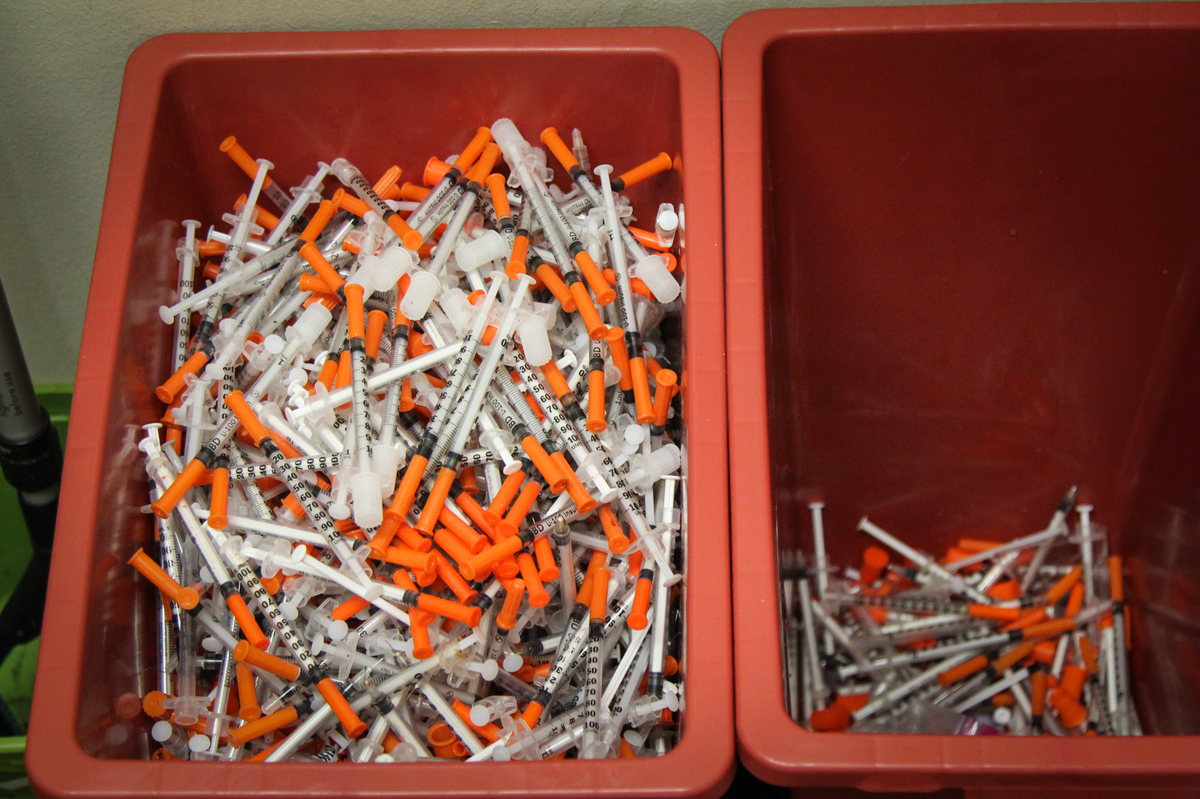
Needles at the Alaska AIDS Assistance Association syringe exchange in Anchorage.

Zachariah Hughes/Alaska Public Media

hide caption

toggle caption

Zachariah Hughes/Alaska Public Media

Like many states, Alaska is struggling under the burden of opioid abuse.

Prescription painkillers and heroin accounted for 74 percent of Alaska’s drug overdose deaths last year.

Transmission of blood-born viruses like hepatitis C, which can cause liver scarring, cancer, and death, is exploding, increasing in some rural areas by 490 percent in just the last few years. One calculation estimated that to treat all the Alaskans who contracted hepatitis C from injecting drugs in 2015 would cost $90 million.

Alaska volunteers collect used syringes stored in puncture-proof plastic drink containers.

Zachariah Hughes/Alaska Public Media

hide caption

toggle caption

Zachariah Hughes/Alaska Public Media

This is driving up healthcare costs at a time when low oil prices have left the state in a years-long financial crisis. And public health officials think this is just the beginning of the epidemic and its fallout. One program is working to prevent the transmission and spread of the disease.

On a recent afternoon in Anchorage, dozens of orange-topped plastic needles clattered into a brimming red trashcan.

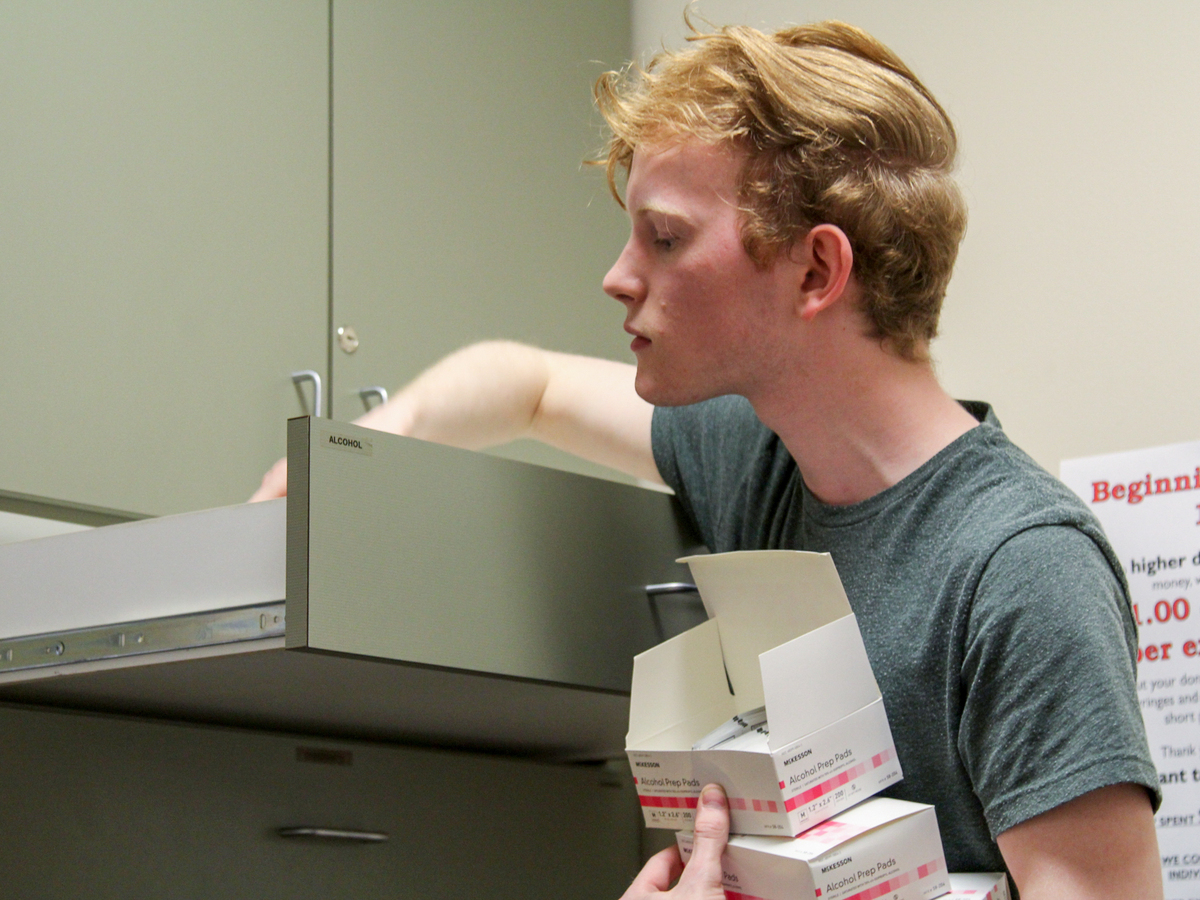
Volunteer Zane Davis restocks alcohol swabs and other supplies at the Alaska AIDS Assistance Association’s Anchorage office.

Zachariah Hughes/Alaska Public Media

hide caption

toggle caption

Zachariah Hughes/Alaska Public Media

Inside a supply closet, 22-year-old volunteer named Zane Davis runs through routine questions with a young woman who, like all the others who come to the clinic, isn’t required to give her name to get fresh supplies.

“How many needles did you have?” Davis asks.

“I had like, 80,” the 26-year-old woman replies. (NPR is not using her name because she uses illegal drugs.)

“Awesome,” he says cheerfully. “Just so you know, we can only give you 50.”

The Alaska AIDS Assistance Association, known as Four A’s, runs one of just four syringe exchanges in the state, and by far the biggest. The 50-needle cap is a new policy the organization implemented to keep up with surging demand.

The busiest time of the week is Friday afternoons, explains Davis. “People are prepping for the weekend.”

In just a few hours, dozens of people come through, throwing out hundreds and hundreds of needles. Just before 5 p.m. when Four A’s closes, a receptionist started taking information and sending people to Davis with post-it notes to get through the line that had formed. A cardboard box in the corner is filling up with Gatorade and soda bottles packed tight with syringes. The plastic drink containers are puncture proof, so they’re a safe way to carry needles around.

Last year, Four A’s gave out nearly 500,000 syringes, which was double the number dispensed just two years earlier. This year they’ll outpace that. This is the only place to trade in needles for hundreds of miles in every direction. Even in small towns where there is a pharmacy, there’s no guarantee the staff will sell syringes over the counter.

“They’ll be like, ‘Where’s your prescription? Ya junkie,'”says Kerby Kraus. He has been clean for four-and-a-half years, and now helps run a recovery program. His path to shooting heroin started like a lot of others, first with strong painkillers that he found around the house.

“It was just being in high school and popping some pills, and then you’re snorting some pills, and then you’re smoking some pills, and then all of the sudden you’re IV-using pills,” Kraus says.

Kraus is from Wasilla, which is about 40 miles north of Anchorage. Back when he was using heroin, Kraus would stop at Four A’s for clean syringes if he happened to be nearby. But if he was broke or sick from withdrawal, that was an insurmountable distance, and he’d shoot with used needles. That’s how he got hepatitis C.

“I know who I got Hep C from,” he says. “But I worried more about not being sick. It was ‘I feel like absolute crap, and I don’t want to feel this way no more.’ “

In Alaska, the virus is exploding among people ages 18 to 29. It’s a trend that is mirrored nationwide. A recent study in Alaska found that the hepatitis C rate among young people doubled between 2011 and 2015. Rural parts of the state are being especially hard hit. In the remote islands of Southeast Alaska, where the capital Juneau is located, the rate nearly quintupled, rising by 490 percent.

“We talk mostly about opioid overdose deaths, but there’s a lot more that happens related to opioid use than just deaths,” explains Jay Butler, chief medical officer for Alaska’s health department.

Butler says worries about hepatitis C keep him awake at night, partly because of the wave of costs he sees approaching for Alaska and the country. Treating hepatitis C is extremely expensive. Until recently, the treatment available was ineffective and fairly toxic. But in 2013, the FDA approved a new class of antiviral drugs which can clear the body of hepatitis C 90 percent of the time. It is effectively a new cure to a dangerous and widespread chronic condition.

But there’s a catch.

“The price is the downside and why I usually don’t say it’s a miracle drug,” Butler says. Because miracles don’t come with a price, they’re gifts.”

A treatment course of Viekira Pak or Harvoni, two common medications, can cost between $85,000 and $94,500. At that price, Butler estimates it would cost more than 10 percent of what we currently pay for all medical care annually in this country to treat the roughly 3.5 million Americans estimated to be infected with hepatitis C.

Though those prices have come down slightly in the last few years, the cost of hepatitis C treatments still put real stress on the health care program for the poor.

“We’ve seen definitely an increase in the number of individuals who access these medications,” says Erin Narus, the lead pharmacist for Alaska’s Medicaid program.

As patients and doctors have grown more familiar with the new anti-viral meds, they’re being prescribed with greater frequency. In 2015, Alaska’s Medicaid program spent $5.9 million dollars on hepatitis C treatments, according to Narus. The next year, that more than doubled to $13.6 million. And that money only bought treatment for around 150 people.

Public health advocates say syringe exchanges are extremely cost effective in the long-term — especially when it comes to preventing people from getting hepatitis C in the first place or spreading it to others. State officials like Butler are pushing for more access to needles, especially in rural areas. For the cost of curing one person with the new antiviral meds, Four A’s could run nearly a full year of its syringe exchange program.

Let’s block ads! (Why?)