Holistic Therapy Programs May Help Pain Sufferers Ditch Opioids

Physical therapy as well as cognitive therapy are part of a promising approach to managing chronic pain without drugs.

Hero Images/Getty Images

hide caption

toggle caption

Hero Images/Getty Images

Each year, more than 300 patients with chronic pain take part in a three-week program at the Pain Rehabilitation Center at Mayo Clinic in Rochester, Minn. Their complaints range widely, from specific problems such as intractable lower-back pain to systemic issues such as fibromyalgia. By the time patients enroll, many have tried just about everything to get their chronic pain under control. Half are taking opioids.

But in this 40-year-old program, they can’t stay on them. Participants must agree to taper off pain medications during their time at Mayo.

Still, more than 80 percent of the patients who enroll remain through the entire program, says Wesley Gilliam, the center’s clinical director. And many previous opioid users who finish the treatment report six months later that they have been able to stay off those drugs. Just as important, he adds, they have learned strategies to deal with their pain.

But such a program is not for everyone. Insurers might say that the intensive, interdisciplinary approach is not medically necessary, and decline to cover these treatments, he says. Mayo’s insurance team sometimes advocates on patients’ behalf if they’re good candidates for treatment, but there are no guarantees.

Mayo’s program is one of a few around the country to address the emotional, social and psychological aspects of pain and reduce patients’ reliance on addictive medicines. But as the nation faces an opioid epidemic, Gillam says there needs to be more of them.

Gilliam, a clinical psychologist with a specialty in behavioral pain management, talked with me about the program.

The interview has been condensed and edited for clarity.

Q: How do pain medications work? By blunting the pain?

They blunt some of the pain. Opioids are very effective for acute problems, but they were never designed to be used chronically. They’re not effective in the long term.

Opioids are central nervous system depressants. They soothe people who are in distress. Many people aren’t demonstrating improved functioning when they take opioids; it’s calming their nerves. It’s chemical coping.

Q: In treating pain, does it matter what’s causing it or how severe it is?

Pain is pain. The fundamental approach to self-managing it doesn’t change based on the cause or severity of the pain.

Q: How does someone wind up at a program like yours?

Virtually all of our patients have tried and exhausted primary and secondary treatment options for pain.

In primary care, a patient comes in with a complaint, and a treatment plan is developed. It generally involves encouraging the patient to be active, to stretch, maybe the doctor initiates a non-opioid medication like a non-steroidal anti-inflammatory (NSAID) or an antidepressant.

If the patient continues to complain of chronic pain, the primary care provider will step up to level two and refer someone to a neurologist or maybe a pain psychologist or pain anesthesiologist.

If patients don’t respond, they start to think about step three, which is a pain program like Mayo.

Q: How does the Mayo program work?

We don’t take a medical approach. It’s a biopsychosocial approach, [which] acknowledges not only the biological aspect of pain, but also recognizes that psychological and social variables contribute to how people experience pain.

That is not to say that pain is imagined, but rather how people experience pain is influenced by mood, anxiety, and how that person’s environment responds to the person’s symptoms.

Q: What does that mean for the patient who is in pain?

People need to accept that they have pain and focus on their quality of life. Some approaches reinforce in patients that the only way you can function is if you reduce your pain, as measured on a pain scale from zero to 10.

We focus on how to get you back into your life by focusing on function instead of eliminating symptoms and pain. When I refer to functioning, I mean getting back into important areas of your life such as work, social activities, and recreation. If you’re waiting for pain to go away, you’re never going to get back into your life. When that happens, people get despondent, they get depressed.

Q: So how do you help people manage it?

When you’re in chronic pain and it’s poorly managed, the nervous system can get out of whack. Your body behaves as if it’s under stress all the time, even when it’s not. Your muscles may be tense and your heart and breathing rates elevated, among other things.

With meditation and relaxation exercises, we’re trying to teach people to learn to relax their bodies and hopefully kick in a relaxation response.

If I have low-back pain, for example, during periods of stress, muscular tension is going to exacerbate the pain in my back. We focus on helping people to disengage from their symptoms.

By learning to relax in response to stress, muscular tension can be diminished and the experience of pain eased. This doesn’t require a medication or a procedure, just insight and implementation of a relaxation skill.

Relaxation/meditation training is one component of a much broader treatment package. All aspects of our treatment — cognitive techniques for managing mood, anxiety and anger, physical therapy, occupational therapy — are all designed to settle the nervous system.

Q: Does insurance typically cover the program?

Insurance companies may want to see patients complete more conservative treatment approaches before approving an interdisciplinary pain rehabilitation program like ours.

There are patients whose policies don’t cover it. If we deem a patient a good candidate, we’ll write letters saying they should be accepted.

There are a very select few who have paid out-of-pocket for our program. This is a significant minority, however. The program can cost up to $40,000 for someone with other complicated medical problems in addition to chronic pain.

There are many studies that show these programs do save money over the long term in health care costs and reduced health care utilization. If we’re going to manage this chronic pain problem, we have to look at it for what it is — multifaceted. You can’t just treat the symptom, you have to treat the whole person.

Let’s block ads! (Why?)

Serious Nursing Home Abuse Often Not Reported To Police, Federal Investigators Find

More than one-quarter of the 134 cases of severe abuse that were uncovered by government investigators were not reported to the police. The vast majority of the cases involved sexual assault.

Scott Olson/Getty Images

hide caption

toggle caption

Scott Olson/Getty Images

More than one-quarter of serious cases of nursing home abuse are not reported to the police, according to an alert released Monday morning by the Office of Inspector General in the Department of Health and Human Services.

The cases went unreported despite the fact that state and federal law require that serious cases of abuse in nursing homes be turned over to the police.

Government investigators are conducting an ongoing review into nursing home abuse and neglect but say they are releasing the alert now because they want immediate fixes.

These are cases of abuse severe enough to send someone to the emergency room. One example cited in the alert is a woman who was left deeply bruised after being sexually assaulted at her nursing home. Federal law says that incident should have been reported to the police within two hours. But the nursing home didn’t do that, says Curtis Roy, an assistant regional inspector general in the Department of Health and Human Services.

[embedded content]
YouTube

“They cleaned off the victim,” he says. “In doing so, they destroyed all of the evidence that law enforcement could have used as part of an investigation into this crime.”

The nursing home told the victim’s family about the assault the next day. It was the family that informed the police. But Roy says that even then, the nursing home tried to cover up the crime.

“They went so far as to contact the local police department to tell them that they did not need to come out to facility to conduct an investigation,” says Roy.

Looking at records from 2015 and 2016, Curtis Roy and his team of investigators found 134 cases of abuse of nursing home residents severe enough to require emergency treatment. The vast majority of the cases involved sexual assault.

“There’s never an excuse to allow somebody to suffer this kind of torment, really, ever,” says Roy.

The incidents of abuse were spread across 33 states. Illinois had the most at 17. Seventy-two percent of all the cases appear to have been reported to local law enforcement within two hours. But twenty-eight percent were not. Investigators from the Office of the Inspector General decided to report all 134 cases to the police. “We’re so concerned,” says Roy, “we’d rather over-report something than not have it reported at all.”

The alert from the Inspector General’s office says that the Centers for Medicare and Medicaid Services (CMS), which regulate nursing homes, need to do more to track these cases of abuse. The alert suggests that the agency should do what Curtis Roy’s investigators did: cross-reference Medicare claims from nursing home residents with their claims from the emergency room. Investigators were able to see if an individual on Medicare filed claims for both nursing home care and emergency room services. Investigators could then see if the emergency room diagnosis indicated the patient was a victim of a crime, such as physical or sexual assault.

The alert notes that federal law on this issue was strengthened in 2011. It requires someone who suspects abuse of a nursing home resident causing serious bodily injury, to report their suspicion to local law enforcement in two hours or less. If their suspicion of abuse does not involve serious bodily injury of the nursing home resident, they have 24 hours to report it. Failure to do so can result in fines of up to $300,000.

But CMS never got explicit authority from the Secretary of Health and Human Services to enforce the penalties. According to the Inspector General’s alert, CMS only began seeking that authority this year. CMS did not make anyone available for an interview.

Clearly, the 134 cases of severe abuse uncovered by the Inspector General’s office represent a tiny fraction of the nation’s 1.4 million nursing home residents. But Curtis Roy says the cases they found are likely just a small fraction of the ones that exist, since they were only able to identify victims of abuse who were taken to an emergency room. “It’s the worst of the worst,” he says. “I don’t believe that anyone thinks this is acceptable.

“We’ve got to do a better job,” says Roy, of “getting [abuse] out of our health care system.”

One thing investigators don’t yet know is whether the nursing homes where abuses took place were ever fined or punished in any way. That will be part of the Inspector General’s full report which is expected in about a year.

Let’s block ads! (Why?)

Houston Community Center Turns Into Makeshift Shelter For Harvey Evacuees

As the flooding in Houston, Texas, worsens many people have escaped to shelters around the greater Houston area. NPR’s Michel Martin speaks with Luis Villanueva, the lieutenant commanding officer at the Salvation Army in Pasadena, in addition to evacuee Kent Davis.

MICHEL MARTIN, HOST:

And now we’re going to hear from a community center that’s been turned into a shelter in Pasadena, Texas. That’s a city just outside of Houston. People started arriving there earlier this morning. On the line with us now is Lieutenant Luis Villanueva. He is the commanding officer at the Salvation Army there in Pasadena, and he’s coordinating things at the shelter. Lieutenant Villanueva, thank you so much for speaking with us.

LUIS VILLANUEVA: Thank you for allowing us to share what is going on here in Pasadena.

MARTIN: Well, tell me a little bit about where you are.

VILLANUEVA: Right now, we’re located in Pasadena, Texas. We are about 20, 30 minutes located from Houston. And here in the city of Pasadena was really severe damage last night about midnight. So we started to have a few calls from the city. And they asked us to see if we can open our gymnasium at the shelter. So we said, yes. Sure, we can do that. And since then, people have been coming, you know, little by little. By right now, we have about 65 people. And we have a capacity of a hundred right now in our gym.

MARTIN: So what did you have there to offer people when they got there? Do you have any cots or blankets or water or food, anything like that?

VILLANUEVA: Yeah. So in this command, we had about a hundred blankets already in storage. And we have about 40 beds that were distributed mainly for children, women and seniors. And also, we also have a food pantry. We took some of the food pantry to feed also to the people that is here with us.

MARTIN: So what were some of the conditions that brought people there?

VILLANUEVA: Most of the people that is here is because their houses are flooded. But most of the people, they were trapped in their houses. So not even the trucks of the city, they weren’t able to get into the houses. They weren’t because the water was so high.

MARTIN: So can I talk to one of the families there? I think Mr. Johnson there – Elliott Johnson (ph) is there with you.

VILLANUEVA: Yes, ma’am. Yes. He’s right here.

ELLIOTT JOHNSON: Yes, hello?

MARTIN: Hey, Mr. Johnson. It’s Michel Martin from NPR. How are you?

JOHNSON: Oh, I’m fine. Thank you.

MARTIN: Do you mind telling me what was going on with you, like, what happened?

JOHNSON: Well, about 1 o’clock in the morning, my daughter came up and woke me up and said there was water in the house. And so when I got up and I stepped out of the bed, it was like water up to my ankles. And I was like, oh, my God, what are we going to do? We’ve got to do something. So when I opened the front door, a bunch of water crashed – more water crashed into the house because it was like, I couldn’t even see the mailboxes. I thought that, well, we’ve got to get out of here. We’ve got to get up high. So me and my family, we moved up into the attic. We brought the little stairs down and sit up there. And we had our cellphones with us. And then we were just calling and calling.

Finally, I found the number for the city of Pasadena. And I was like, well, we have to get out of here. And they said, OK, we’re going to send somebody to you. But then when they tried to get the truck to come to us, the water was so high in the neighborhood that the trucks were dying out. They said, well, we can’t get to you. You’re going to have to try to come to us. And I said, oh, my God, it’s going to be kind of impossible because I have a 1-year-old daughter. I have two puppies. I don’t know. I don’t know how we’re going to do it. So they came in, like, little rafts and threw some of us on there. And we had to walk through the water to get to the lower level to get to the other truck.

MARTIN: It must have been scary.

JOHNSON: Yes, it was scary, it was. I was worried about getting out in the water because I didn’t know if the lights or the power was still on, but the water was coming up to the sockets. And I was like – I was kind of scared to step in the water. I’m afraid that if – they’re going to get electrocuted, you know, ’cause the water was that high.

MARTIN: Wow. Well, thanks so much for speaking with us. Our very best wishes to you and to your family.

JOHNSON: OK. Thank you.

MARTIN: Can I talk to Mr. Villanueva?

VILLANUEVA: Hello?

MARTIN: So, Lieutenant, how long can you shelter people there? I’m told it’s still raining. And they say it might be raining through Wednesday, which means you have to assume more people are probably going to find their way there. Well, how long can you take care of people?

VILLANUEVA: Well, we will be open as long as the city want us to be open. As long as we have the resources, we will be open and helping these people. But I’m pretty sure that they’re going to be really, really anxious to come back and probably going to leave before Wednesday or something like that. Yeah.

MARTIN: Yeah. OK. That’s Lieutenant Luis Villanueva. He is the commanding officer at the Salvation Army in Pasadena, Texas. And the Salvation Army’s community center there has been turned into an emergency shelter. And we’ve been speaking with him from there. Lieutenant Villanueva, thanks so much for speaking with us. And we hope we’ll talk again under better circumstances.

VILLANUEVA: Thank you so much for allowing us to share what’s going on here.

Copyright © 2017 NPR. All rights reserved. Visit our website terms of use and permissions pages at www.npr.org for further information.

NPR transcripts are created on a rush deadline by Verb8tm, Inc., an NPR contractor, and produced using a proprietary transcription process developed with NPR. This text may not be in its final form and may be updated or revised in the future. Accuracy and availability may vary. The authoritative record of NPR’s programming is the audio record.

Let’s block ads! (Why?)

What's Making These Dogs In Mumbai Turn Blue?

One of the stray dogs that turned blue hangs out on a street in the Taloja industrial zone in Mumbai.

AFP/Getty Images

hide caption

toggle caption

AFP/Getty Images

Five dogs turned blue in Mumbai.

That was a story that journalist Deepak Gharat broke this past week. He was following up on a story in the industrial zone of Taloja, home to about 1,000 pharmaceutical and chemical factories. Every week, there’s something going wrong over there, he says. Industrial waste catches fire. Dead fish float up to the surface of the local river en masse.

Last week, he noticed a canine of unusual hue snoozing under a truck. Unable to believe his eyes, he took pictures and mailed them to his newsroom.

[embedded content]
YouTube

Puddles for the pooches

Some people, like local animal rights activist Arati Chauhan, suggested the dogs turned blue because of waste in the local Kasardi River, where the dogs were thought to have gone wading.

That theory appeared in many media outlets but does not appear to be true. The dogs hang out at a pigment and detergent factory about 2 miles away from the river, and they’re too territorial to venture that far, says Gharat.

“The dogs go looking for food in the dye factory compound,” Gharat found.

Locals have seen the dogs crawling on their bellies under the factory’s gate to loll in the ubiquitous puddles of cool, blue water in the grounds.

So they’re definitely not swimming in the river and instead are picking it up from the dye in the stagnant water on the factory grounds, Gharat observed.

Gharat confirmed with a local vet that the dye on their fur had dried to leave behind a powdery, blue residue.

While the dye isn’t permanent, it’s toxic to the dogs, who lick their fur to groom themselves and end up ingesting the chemical.

The dogs are lucky it’s monsoon season, because the dye washes off after several rainy rinses. After activist Chauhan and her organization, the Navi Mumbai Animal Protection Cell, filed a complaint, the local chapter of the Society for the Prevention of Cruelty to Animals checked the dogs, including one with an eye infection. All the animals have been given a clean bill of health, and the dye has been scrubbed off. The factory has put up a temporary net under the gate to prevent dogs from getting back in.

Not fine for fish

So the problem with the dogs was apparently cosmetic. But the media attention pushed the state pollution control board to shut down the chemical factory, identified as Ducol Organics & Colours Pvt Ltd. The factory was releasing untreated chemicals into the river and toxic residual dye powder into the atmosphere, violating India’s Water Act from 1974 and the Air Act from 1981.

That’s not a problem for dogs, because they don’t appear to drink from the river. But it is a problem for fish.

Last year, local fishermen complained that their catch volumes had dropped by 90 percent. They had the water tested at the municipal environment laboratory. Measured against guidelines from the Central Pollution Control Board, a national regulatory body, the pollution in the Kasardi River was 13 times over the safe limit for fish to survive, and 40 times over the limit for human consumption.

At the source of the Kasardi River, 24 miles away, the water is used for agriculture, drinking and washing clothes, says Gharat. “But where the industrial zone starts in Mumbai, the water is totally chemical.”

Factories were set up in this area in the 1960s, he says, and more than 300 of them make chemicals.

‘Successfully polluted’

V.M. Balsaraf, a professor of applied chemistry at the Datta Meghe College of Engineering and a researcher of groundwater pollution in Mumbai, is surprised at the sudden brouhaha over the river pollution. “We have found heavy metals and chemicals in the area water. Most of the industries don’t have treatment for sewage,” he says. “All our water sources are successfully polluted, they’ve become gutters. Even birds and animals have nowhere to drink water.”

Chauhan, the activist, has asked the pollution board to plant more trees, clean up the river and stop the dumping of untreated waste in the area.

Shutting down the factory, though, is shortsighted, she says. It would be better to hold all the factories accountable rather than depriving some workers a livelihood, she suggests.

“People are saying just implement the law, get the pollution under control,” echoes Gharat, who says that fixing the treatment plant, monitoring waste discharge and punishing offenders would be a good place to start.

But he and the activists are afraid that official action will taper off once the memory of the blue dogs fades away.


Chhavi Sachdev is a journalist based in Mumbai. Contact her @chhavi

Let’s block ads! (Why?)

Four Steps That Could Cut Health Insurance Premiums And Boost Enrollment

The Senate health committee meets next month to discuss ways to stabilize the insurance markets. Insurers have until Sept. 27 to commit to selling policies on the ACA marketplaces in 2018.

Andrew Harnik/AP

hide caption

toggle caption

Andrew Harnik/AP

Congress and the Trump administration could boost insurance coverage by a couple of million people and lower premiums by taking a few actions to stabilize the Affordable Care Act insurance markets, according to a new analysis by the consulting firm Oliver Wyman.

The paper, which lays out a simple blueprint for making insurance more affordable for more people while working within the current health law’s structure, comes just days before the Senate Health, Education, Labor and Pensions Committee begins hearings on ways to stabilize markets in the short term.

“Together, these approaches could increase enrollment by roughly two million individuals, reduce average premiums by more than 20 percent and be roughly revenue neutral,” the analysis by Kurt Giesa and Peter Kaczmarek says.

The analysis concludes that under current law, about 17 million people will buy insurance in the individual market next year, many of them outside the ACA marketplaces. If the four actions outlined in the paper are implemented, about 19 million people would buy individual insurance, the study finds.

At the same time, the average monthly premium would fall from $486 to $384.

Some of the actions, including extending the Affordable Care Act’s cost-sharing subsidies, are already on the table for next month’s committee hearings.

These are the four steps that Oliver Wyman recommends to stabilize Obamacare.

1. Fund the cost-sharing reduction payments for the long term

These are payments the government makes to insurance companies as reimbursement for discounts on copayments and deductibles the companies are required by law to give to low-income customers. President Trump has said he wants to end the payments — which a court has ruled are unlawful since Congress never authorized them. But now lawmakers, including Republican Sen. Lamar Alexander of Tennessee, chairman of the health committee, say they want Congress to fund the payments through next year.

“State insurance commissioners have warned that abrupt cancellation of cost-sharing subsidies would cause premiums, copays and deductibles to increase and more insurance companies to leave the markets in 2018,” Alexander said in a statement on Aug. 16. “Congress now should pass balanced, bipartisan, limited legislation in September that will fund cost-sharing payments for 2018.”

2. Create a reinsurance program

The ACA included a temporary reinsurance program that protected insurance companies from huge losses while they transitioned to the new market under the new law.

Senate Republicans included a reinsurance program in the Better Care Reconciliation Act, the health care overhaul that failed earlier this summer.

Govs. John Hickenlooper of Colorado and John Kasich of Ohio are publicly advocating such a program.

“Top of our list would be this notion of having some sort of reinsurance to make sure the high-cost pool is not causing higher rates for all,” Hickenlooper said in an interview with Colorado Public Radio.

3. Strongly enforce the individual mandate

President Trump has suggested he doesn’t want the Internal Revenue Service to enforce Obamacare’s requirement that every person have insurance. Today, individuals who can’t prove they have coverage must pay a fine of $695 or more. Oliver Wyman’s analysis shows that if the mandate isn’t enforced, many young healthy people would drop their coverage.

“As younger and healthier people opt out of the market, the cost of coverage would increase, and market-average premiums would increase in parallel,” the study said.

4. Get rid of the health insurance tax

Obamacare includes a tax on health insurance companies to help offset the costs of federal subsidies that help people buy policies on the ACA markets. It was in place from 2014 through 2016, but then Congress passed a moratorium on the levy for this year. Insurance companies are lobbying hard to ensure it doesn’t return next year. Oliver Wyman’s analysis shows that continuing that moratorium would cut premiums by about 3 percent next year.

Insurance companies have until Sept. 27 to commit to selling policies on the ACA marketplaces in 2018. Alexander says he wants some legislation to pass before then to help stabilize the markets and cut premiums.

Let’s block ads! (Why?)

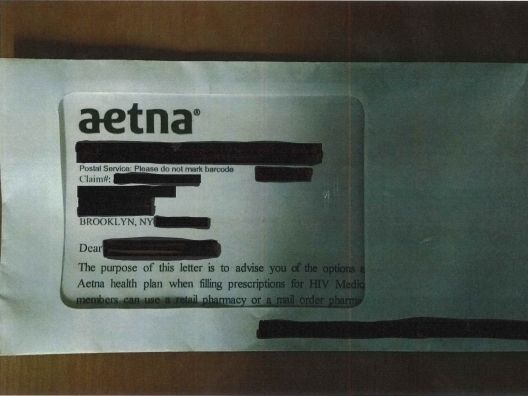
Aetna Mailer Accidentally Reveals HIV Status Of Up To 12,000 Customers

A photo provided by the AIDS Law Project of Pennsylvania shows an Aetna mailer in which a reference to HIV medication is partly visible though the envelope window.


AIDS Law Project of Pennsylvania
hide caption

toggle caption


AIDS Law Project of Pennsylvania

The health insurer Aetna is facing criticism for revealing the HIV status of potentially thousands of customers after it sent out a mailer in which information about ordering prescription HIV drugs was clearly visible through the envelope’s clear window.

For example, in a letter sent to a customer in Brooklyn, N.Y., the window revealed considerably more than the address. It also showed the beginning of a letter advising the customer about options “when filling prescriptions for HIV Medic … “

Aetna says approximately 12,000 customers were sent the mailer on July 28 that potentially revealed private medical information, though the company says it isn’t clear exactly how many were affected, because it depends on how the letter was positioned in the envelope.

“We sincerely apologize to those affected by a mailing issue that inadvertently exposed the personal health information of some Aetna members,” the company said in a statement. “This type of mistake is unacceptable, and we are undertaking a full review of our processes to ensure something like this never happens again.”

The Legal Action Center in New York City and the AIDS Law Project of Pennsylvania sent a cease-and-desist letter to Aetna, stating that the privacy breach caused “incalculable harm to Aetna beneficiaries.” The groups say they received complaints from individuals in Arizona, California, Georgia, Illinois, New Jersey, New York, Ohio, Pennsylvania and Washington, D.C.

“Aetna’s privacy violation devastated people whose neighbors and family learned their intimate health information,” Sally Friedman, legal director of the Legal Action Center, said in a statement. “They also were shocked that their health insurer would utterly disregard their privacy rights.”

The groups also called for “corrective measures to ensure that this gross breach of privacy and confidentiality never reoccurs.”

They say the people who received the letters “are currently taking medications for HIV treatment as well as for Pre-exposure Phophylaxis (PrEP), a regimen that helps prevent a person from acquiring HIV.”

In a letter notifying customers of the privacy breach, a copy of which was obtained by NPR, Aetna says it learned on July 31 that personal information may have been exposed through the envelope window.

The letter states that upon investigating, Aetna “confirmed that the vendor handling the mailing had used a window envelope, and, in some cases, the letter could have shifted within the envelope in a way that allowed personal health information to be viewable through the window.”

It adds: “Regardless of how this error occurred, it affects our members and it is our responsibility to do out best to make things right.”

The Legal Action Center and the AIDS Law Project of Pennsylvania say they are considering further legal action.

Let’s block ads! (Why?)

Intent On Reversing Its Opioid Epidemic, A State Limits Prescriptions

Across the state of Maine, the number of prescriptions for painkillers is dropping. But some patients who have chronic pain say they need high doses of the medication to be able to function.

Fanatic Studio/Getty Images

hide caption

toggle caption

Fanatic Studio/Getty Images

A year ago, Maine was one of the first states to set limits on opioid prescriptions. The goal in capping the dose of prescription painkillers a patient could get was to stem the flow of opioids that are fueling a nationwide epidemic of abuse.

Maine’s law, considered the toughest in the U.S., is largely viewed as a success. But it has also been controversial — particularly among chronic pain patients who are reluctant to lose the medicine they say helps them function.

Ed Hodgdon, who is retired and lives in southern Maine, was just that sort of patient — at least initially.

Name a surgery, and there’s a decent chance Hodgdon has had it.

“Knee replacement. Hip replacement. Elbows. I’ve got screws in my feet,” he says.

Dr. Don Medd, an internist in Westbrook, Maine, has found that working with patients to find alternatives to opioids has helped many taper their dose and reliance on the drugs — and reduce side effects.

Patti Wright/Maine Public Radio

hide caption

toggle caption

Patti Wright/Maine Public Radio

Hodgdon has rheumatoid arthritis. And along with each surgery came an opioid prescription for pain. At first he got some relief from the drugs, but it didn’t last.

“It just numbed it for a while,” he says, “and then I needed more.”

Though Hogdon keptincreasing the dose, the pain never went away.

“And then I found Dr. Medd. That’s my angel right there,” Hodgdon says, nodding toward Dr. Donald Medd, a general internist in Westbrook.

Medd had already started to taper high doses among patients like Hodgdon before Maine put a cap on new prescriptions for opioids last July. The new limit allows a maximum of 100 morphine milligram equivalents (the standard used to measure potency for all prescription opioids) for most patients per day — with certain exemptions for some cancer patients, those in hospice care, and some others. Patients with existing prescriptions were, by and large, given a year to meet the new restriction.

Medd was ahead of the game because he’d noticed that many of his patients on high doses of opioids grew increasingly angry about their pain as time wore on, and tended to demand ever more medication. At the same time, they were struggling to function in daily life because of the drugs’ side effects.

“You know, at some point the medications get in the way of some sort of recovery,” Medd says.

Opioids were affecting Hodgdon’s mood and his memory. Medd worked with him to cut the dose he was taking every day by two-thirds and helped him get in touch with a psychologist for further help. Though Hodgdon still lives with some pain, he says his life is infinitely better.

“I can remember things,” he says. “I get along better with people.”

Despite success stories like Hodgdon’s, Medd says he initially opposed Maine’s law. He didn’t want the legislature to interfere with medicine.

But now he thinks the law gave a necessary nudge to many doctors. Compared to a few years ago, Medd says, he and colleagues in his medical practice have cut the number of their chronic pain patients who are on opioids by almost half — from about 1,500 to 800.

In nearly all counties in the state, the number of prescriptions for painkillers is dropping. It’s a trend that Gordon Smith, executive vice president of the Maine Medical Association, says was underway even before the law took effect.

“We had the fourth largest drop in the country,” he says, citing a 21.5 percent reduction in opioid prescriptions from 2013 through 2016.

The data only include the first few months after Maine’s prescribing cap went into effect, Smith says; he expects the law will accelerate further reductions.

“Now having said that, it’s not been easy,” he says. “It’s been particularly difficult for patients,” he says — specifically for the 16,000 patients on high-dose opioids who were expected to taper to the 100 morphine milligram limit by July of this year.

Brian Rockett runs a wholesale lobster business in Maine, despite his chronic pain from past injuries. He needs high doses of opioids to be able to work, he says, and his doctor agrees.

Keith Shortall/Maine Public Radio

hide caption

toggle caption

Keith Shortall/Maine Public Radio

“I was about four times above that,” says Brian Rockett. He operates a wholesale business buying lobsters on the Maine coast. Rockett started taking opioids years ago to ease the pain of injuries from racing motorcycles and boats. When he tried to taper the dose, he says, he had unbearable pain. So, he filed a notice of intent to sue the state over its restrictions on how much he could be prescribed.

“I just knew that I was facing possibly losing my business,” he says.

Rockett wasn’t alone in his inability to taper his use of the drug, and Maine lawmakers — like Dr. Geoffrey Gratwick, a state senator who is also a rheumatologist — took notice.

“A certain group of people simply cannot come off [opioids],” Gratwick says.

He recently pushed through a change to Maine’s law that allows broader exemptions, so that people with incurable, chronic conditions can continue to take high doses.

It put the decision about that back in the hands of the doctor and patient, Gratwick says, “where it should be.”

Under the revised law, Rockett was able to increase his dose, and dropped his lawsuit.

Even though more patients could, potentially, seek exemptions, Maine’s law is seen by its advocates as an important step. Recent data from the federal Centers for Disease Control suggest that nationwide, despite an overall decrease in recent years, the number of opioids prescribed still triple what it was in 1999.

Let’s block ads! (Why?)

Oregon, Texas Lay Down Markers On Abortion Coverage

Oregon Gov. Kate Brown, D, center, recently signed a bill into law that would require insurers in the state to cover reproductive health services.

Don Ryan/AP

hide caption

toggle caption

Don Ryan/AP

Federal health insurance rules are a moving target, and it’s unclear whether Republicans will take another run at replacing the Affordable Care Act. In the meantime, some states are staking out strong positions on coverage of abortion, regardless of how the federal landscape changes.

Last week, Texas Gov. Greg Abbott, a Republican, signed a bill generally prohibiting health insurers who offer individual and employer-based plans from covering abortion unless a woman’s life is in danger.

That same day, Oregon Gov. Kate Brown, a Democrat, signed a bill requiring most health plans to cover reproductive health services, including contraceptive drugs, devices, and procedures, without charging consumers anything out-of-pocket. Abortion is one of those services.

The federal Affordable Care Act probably deserves some of the credit or blame, depending on your point of view, for the new state laws.

“The ACA raised the profile of abortion coverage in private insurance,” says Adam Sonfield, a senior policy manager at the Guttmacher Institute, a reproductive health research organization that supports abortion rights. The federal law allows states to prohibit plans sold on the insurance marketplaces from covering abortion, and 25 states subsequently moved to restrict or prohibit it.

“Many states passed those laws pretty quickly” after 2010 when the ACA was passed, Sonfield says, “and other states took it further,” banning or restricting abortion coverage in other private individual and group insurance plans. Ten states prohibit all private insurance plans from offering abortion coverage. Like Texas’ new law, in eight of those states, the only exception is to save a woman’s life. No allowances are made for rape, incest, or fetal impairment.

“Taking the life of a pre-born child, that doesn’t change, whether it’s a case of rape or incest,” says John Seago, legislative director of Texas Right to Life, which supports the law. He points out that the law does allow women to buy supplemental insurance for abortion.

In Kansas, a state that has a similar law, Blue Cross Blue Shield of Kansas offers a supplemental abortion policy for group plans — but not individual plans — that costs roughly $80 per member annually, says spokeswoman Mary Beth Chambers.

But abortion rights advocates say that with few exceptions, these riders for abortion coverage simply aren’t available. They liken the situation to the problems women faced getting maternity coverage before the ACA passed. Back then, individual policies generally did not cover maternity expenses, so women who didn’t get coverage through work had to buy a rider to cover those costs. Often, though, they weren’t offered by insurers or were prohibitively expensive.

The ACA requires maternity coverage in all individual and small-group plans. Still, an analysis by the National Women’s Law Center found that only 7 percent of individual plans offered maternity riders in 2012.

And while women may have been able to plan ahead to purchase coverage for a pregnancy, “no one wants to think they’re going to need an abortion this year,” Sonfield says. “It’s not something you want to plan for.”

The ACA was a force behind Oregon’s new law expanding women’s health coverage as well, advocates say.

“In other years, this could have been a can that could be kicked down the road,” says Grayson Dempsey, executive director of Naral Pro-Choice Oregon, whose organization was part of a coalition of advocacy groups that worked on the law. “Instead, now there was a real urgency to get it done.”

The Trump administration is expected to release a revised rule within days that will roll back ACA provisions requiring most employers and insurers to cover contraceptives without passing on costs to consumers. The rule is expected to allow any organization that has religious or moral objections to covering birth control to stop doing so.

An opponent of the Oregon law says it will probably lead to more abortions. “When you make something free, it’s potentially accessed more,” says Liberty Pike, communications director at Oregon Right to Life. Pike says her organization fears that young women would use abortion as birth control.

The organization doesn’t have a position on the other elements of the new law, Pike says.

The Oregon law does has a caveat that allows insurers to offer plans that don’t cover contraceptives or provide abortions to religious employers, such as churches.

Two other states, New York and California, require nearly all health plans to cover abortion services, says Gretchen Borchelt, vice president for reproductive rights and health at the National Women’s Law Center.

Despite all the focus on restricting abortion coverage, these states show that there’s also movement in the other direction: states stepping forward to protect abortion rights, Borchelt says.

It should be noted that these state laws don’t apply to the large companies that self-fund their health plans and pay their employees’ claims directly rather than buy coverage from an insurer. Those plans, which cover about 61 percent of workers who get insurance through their jobs, are regulated by the federal government.

Kaiser Health News is an editorially independent news service that is part of the nonpartisan Henry J. Kaiser Family Foundation. Michelle Andrews is on Twitter: @mandrews110

Let’s block ads! (Why?)

Governors Preparing Bipartisan Health Care Plan For Congress To Consider

Colorado Gov. John Hickenlooper (left) and Ohio Gov. John Kasich will present a plan that fleshes out a set of principles they wrote about in an op-ed in The Washington Post.

Carolyn Kaster/AP

hide caption

toggle caption

Carolyn Kaster/AP

In the wake of congressional Republicans’ failure to pass a health care bill, two governors from different parties are going to bring their own ideas to Washington.

Staff for Colorado Gov. John Hickenlooper, a Democrat, and Ohio Gov. John Kasich, a Republican, are working on a joint plan to stabilize the country’s health insurance markets. Kasich told Colorado Public Radio’s Colorado Matters that they expect to release it ahead of September hearings in the U.S. Senate. They also intend to get other governors from both parties to sign onto the plan, to show support at the state level.

“We’re getting very close. I just talked to my guys today, men and women who are working on this with [Hickenlooper’s] people, and we think we’ll have some specifics here, I actually think we could have it within a week,” Kasich said in a joint interview with Hickenlooper that aired Tuesday.

The plan will flesh out a set of principles the two men wrote about in an op-ed in The Washington Post, in which they said another one-party health care plan is “doomed to fail,” just like the Republican plans considered this year. In the op-ed, they asserted that the best place to start reform efforts is “to restore stability to our nation’s health insurance system.”

Bipartisan health care hearings, including the one the governors will appear at, are set to begin just after Labor Day when Congress returns from its August recess. Lawmakers will be consumed with a number of deadlines involving government funding, though — sending health care to the back burner.

“I’m not going to get into specifics with you until we have it all ironed out, but it’s not going to be some pie-in-the-sky, way-up-there kind of stuff. There will be things that we will address that will have specific solutions. And one of the things we’re finding out is the states do have some power to do some things unique to them, as long as these insurance markets are going to be stabilized,” Kasich said.

One specific they agree on and would discuss: changing the Affordable Care Act mandate that employers with 50 or more employees provide insurance coverage. The governors say that number is too low, which deters hiring at small companies.

They also agree that the possibility of national single-payer coverage is not on the table in their discussions.

In recent months, Hickenlooper and Kasich have appeared on national television shows to advocate for bipartisan health care reform that includes keeping the Medicaid expansion intact, with both took advantage of in their states. The two governors have even entertained running for the White House on a split ticket.


Interview Highlights With Govs. Hickenlooper And Kasich

On whether they think health care should be a “right”

John Hickenlooper: I come from the school that I think it is a right. I’m not sure how much health care is included in that right, but some basic coverage.

John Kasich: I don’t think that’s that important in this. I mean we want everybody to have health insurance. I mean that’s how I feel. Is it a right or is it a privilege or whatever? I don’t know why that declaration is important … The question is how do you do it, and that’s what we’re working on … Primary care is important. Catastrophic coverage is important. We don’t want anybody to get bankrupted because they get sick.

On what to change about the Affordable Care Act first

Hickenlooper: There are several important things, but the probably top one on our list would be this notion of having some sort of reinsurance [using public money to help insure the sickest people] to make sure the high-cost pool is not causing higher rates for all the people seeking insurance on the private markets … You use reinsurance in almost every type of insurance program to cut off those “hilltops” as we say.

On why this joint effort may gain traction

Hickenlooper: “[The Senate’s health committee] is now holding hearings [starting Sept. 5], and hopefully in those hearings we’ll get a chance to present, hopefully, what by that point a number of both Republican and Democratic governors think look like good ideas.”

The Colorado Matters website has the full transcript.

This story is part of a reporting partnership with NPR, Colorado Public Radio and Kaiser Health News.

Let’s block ads! (Why?)

Hospitals Could Do More For Survivors Of Opioid Overdoses, Study Suggests

Hospital emergency departments are tasked with saving the lives of people who overdose on opioids. Clinicians and researchers hope that more can be done during the hospital encounter to connect people with treatment.

FangXiaNuo/Getty Images

hide caption

toggle caption

FangXiaNuo/Getty Images

To get a sense of how severe the opioid crisis is in the U.S., you can look at the number of fatal overdoses — more than 33,000 in 2015, according to the Centers for Disease Control and Prevention. That means, on average, 91 people are dying after overdosing on opioids each day. And for every fatal overdose, there are believed to be roughly 30 nonfatal overdoses.

Clinicians and researchers trying to get a handle on the epidemic look at those nonfatal experiences as opportunities to jump in and figure out whether there is overprescribing going on or whether the patient needs help getting treatment for an addiction. But a paper published Tuesday in the Journal of the American Medical Association, suggests such interventions don’t happen often enough.

“This is a time when people are vulnerable, potentially frightened by this event that’s just occurred and amenable to advice, referral and treatment recommendations,” says Julie Donohue, associate professor of health policy and management at the University of Pittsburgh and senior author of the paper. “It’s safe to characterize it as a missed opportunity for the health system to respond.”

Using claims data from Medicaid patients in Pennsylvania from 2008 to 2013, Donohue and her colleagues looked at prescription opioid use and medication-assisted treatment rates before and after overdoses. Medication-assisted treatment numbers were based on documentation showing that a patient had been dispensed one of three drugs approved by the Food and Drug Administration to treat opioid addiction: buprenorphine, naltrexone or methadone.

While one might expect to see a big decrease in the filling of opioid prescriptions or a big increase in treatment rates among people who had experienced overdoses, this was not the case. The researchers found, for example, that among people who had overdosed on heroin, the filling of opioid prescriptions fell by 3.5 percent, while medication-assisted treatment increased by only 3.6 percent.

Even though medication-assisted treatment is considered the gold standard of treatment for opioid addiction, researchers found treatment rates to be low overall. Only 33 percent of heroin overdose survivors and 15 percent of prescription opioid overdose survivors had been dispensed buprenorphine, naltrexone or methadone within six months of an overdose.

Donohue says many hospital emergency departments are not adequately set up to serve or even screen patients with addiction. “They may not have strong connections to treatment providers. So they, at best, may leave patients with a list, but then there is no active follow-up,” Donohue says. “People who are quite vulnerable and are at great risk for future overdoses are falling through the cracks.”

Dr. Corey Waller, who trained in emergency medicine and is now senior medical director for the National Center for Complex Health and Social Needs, says medical teams often lack basic knowledge.

“The professionals that are supposed to be able to refer and treat don’t have the training to know how and what to do,” Waller says, pointing out that as a resident, he received less than one hour of instruction in addiction treatment.

Another problem, he says, is that emergency departments treat an opioid overdose as a toxicological problem, not unlike dealing with a patient who took too much Tylenol.

“But what that completely ignores are the psychological aspects of [addiction],” Waller says. “When you ignore that, you are fully ignoring the disease. And you’re looking at the patient like a toxicological problem and not a human.”

He says it’s important to remember that opioid addiction changes people’s brains in ways that keep them from making logical decisions, such as seeking out treatment after an overdose. “They’re not putting a pros and cons list on the refrigerator,” he says. “They’re just reacting to a situation that feels very much like survival.”

Dr. Yngvild Olsen, medical director for the Institutes for Behavior Resources/REACH Health Services in Baltimore, says the study confirms what many in the addiction medicine field have known for a long time: There’s a need for interventions beyond what she calls the “usual standard of care, which has been to hand people a phone number or pamphlet and say ‘Here. Good luck.’ “

Olsen says such interventions are in the works. She points to a 2015 study by researchers at the Yale School of Medicine who tested three interventions for opioid-dependent patients who came to the emergency department for medical care.

The first group was given a handout with contact information for addiction services. The second group got a 10- to 15-minute interview session with a research associate who provided information about treatment options and helped the patient connect with a treatment provider, even arranging transportation. The third group got the same interview, plus a first dose of buprenorphine, additional doses to take home and a scheduled appointment with a primary care provider who could continue the buprenorphine treatment within 72 hours.

The study found that 78 percent of patients in the third group — the group that got a dose of buprenorphine in the hospital — were still in treatment 30 days later, compared with 45 percent in the group that only got the interview and 37 percent who only got the handout.

Based on the study, hospitals across the country are now discussing incorporating buprenorphine into emergency department care for patients who have overdosed, Olsen says. Several Baltimore hospitals have begun doing so. She is hopeful that such a system could provide new paths to treatment for people who need it, while not overburdening emergency department staff who are already stretched thin.

“Conceptually, it makes so much sense,” Olsen says. “It is, in my mind, one of those landmark studies that really addresses how to take advantage of those missed opportunities that the JAMA research letter describes.”

Let’s block ads! (Why?)