Widowed Early, A Cancer Doctor Writes About The Harm Of Medical Debt

Andrew Ladd and Fumiko Chino at their wedding in 2006, after his cancer diagnosis. Ladd died the following year, leaving behind hundreds of thousands of dollars in medical debt.

Courtesy of Dr. Fumiko Chino

hide caption

toggle caption

Courtesy of Dr. Fumiko Chino

Ten years ago, Fumiko Chino was the art director at a television production company in Houston, engaged to be married to a young Ph.D. candidate.

Today, she’s a radiation oncologist at Duke University, studying the effects of financial strain on cancer patients. And she’s a widow.

How she got from there to here is a story about how health care and money are intertwined in ways that doctors and patients don’t like to talk about.

But Chino is determined to do so.

“I think of him every day,” Chino says of her late husband, Andrew Ladd. “It drives me to do the type of research that I do — that’s looking at the financial toxicity of cancer care.”

Chino is co-author of a research letter, published Thursday in JAMA Oncology, that shows that some cancer patients, even with insurance, spend about a third of their household income on out-of-pocket health care costs outside of insurance premiums.

It’s an issue Chino knows well.

In 2005, before they were married, Chino and Ladd were living together in Houston. She was working in entertainment, and he was on the verge of earning his doctorate in robotics at Rice University. Each had medical insurance – she through her job, he through the school.

Then he started to vomit and lose weight.

He was diagnosed with neuroendocrine carcinoma, an aggressive cancer of endocrine cells that can strike in a variety of places in the body and can be hard to treat.

It was a huge blow for the young couple, still in their 20s, with promising careers ahead of them. Still, they looked to the future and decided to go ahead with their wedding.

But as Ladd’s treatment moved forward, a harsh reality hit. His student insurance didn’t cover much.

“So paltry,” Chino says. “Basically, I like to think of it as sham insurance.”

In less than a month, they reached his $5,000 prescription drug limit and began paying $300 out of pocket for his anti-nausea medications and blood thinners.

Ladd was getting sicker but trying to keep up with his work. Chino emptied her retirement savings and quit her job to care for him.

“Ultimately, I had to take care of him. He was getting weaker and weaker,” she says. “It was an overwhelming strain on us as a young couple. This is not what we thought our lives would be.”

Soon, his medical costs surpassed his insurance policy’s $500,000 lifetime limit. But the bills kept coming.

“The stress and overwhelming crushing defeat of these bills that would come in every week — it had an effect on our quality of life,” Chino says.

They moved in with her parents, borrowed money and even considered moving to Canada to get care.

“At a certain point, we realized it was unsustainable,” she says. “We knew it was coming. The cancer facility where he was getting his primary treatment was going to turn off the spigot.”

Despite his illness, Ladd landed a job as a professor at the University of Michigan. It came with health insurance, and he continued treatment there.

But he never moved into his office. Three months into his time at Michigan, he died.

Chino was left with an ocean of debt. She estimates it’s in the hundreds of thousands of dollars.

That’s when she found a new mission in life. She enrolled in Duke’s medical school and teamed up with Dr. Yousuf Zafar, who has made a specialty out of studying and writing about “financial toxicity,” which he describes as the toxic effects of financial strain from health care costs. He’s lead author on the JAMA Oncology study that Chino worked on.

Chino and Ladd’s story unfolded before the Affordable Care Act was passed, when health insurance markets were far less regulated. Today, policies can’t carry annual and lifetime benefit limits.

But that doesn’t mean people don’t face financial hardship because of medical costs. Even as insurance coverage has expanded, deductibles and copays on many policies have risen, leaving patients to shoulder more of the financial burden for their health care.

The JAMA Oncology study shows that on average, cancer patients spend about 11 percent of their income on out-of-pocket health care costs, not including insurance premiums. But as their costs rise, patients become less likely to want to pay their bills.

“Patients are frustrated,” Zafar says. “They believe they’ve got insurance. They believe they paid for insurance and that insurance should fully cover their cancer care.”

He says doctors need to talk with patients about the costs of their treatment as well as the side effects and prognosis.

“We need to do a better job explaining to our patients how much benefit they can get from treatment,” he says. “But also how much harm they can face, whether that harm is physical toxicity or financial toxicity.”

Some patients don’t talk with their doctors about costs, the study shows, because they fear they will get substandard care.

Chino says she wishes she and her husband had had those conversations.

“It was not part of my husband’s care, and it could have changed things,” she says.

Ten years after Ladd’s death, Chino is still dealing with the aftereffects.

“I still owe the debt,” she says. “I stopped answering phone calls from debt collectors.”

Let’s block ads! (Why?)

Beach Town Tries To Reverse Runaway Growth Of 'Sober Homes'

The surf and sand views of Delray Beach, Fla., draw residential drug recovery programs, as wells as tourists.

Greg Allen/NPR

hide caption

toggle caption

Greg Allen/NPR

Delray Beach’s charming downtown, palm trees and waves attract locals, vacationers and, increasingly, drug users who come here to try to get off opioids. In some parts of the small Florida community, there’s a residential program for people recovering from addiction — a sober living house or “sober home” — on nearly every block. Sometimes two or three.

On a block where resident Michelle Siegel was walking a dog recently, there are at least six sober homes. She says “you can usually tell” by the white vans and “no trespassing” signs out front.

“I have walked down the street sometimes and seen kids just passed out, face down on the ground,” she says. “And you ask them if they’re OK and they’re like, ‘Yeah, yeah, I was just tired. I was sleeping.’ And you don’t know whether you should get them help; whether you should leave them alone.”

In South Florida, there’s been runaway growth of these residential programs. As group homes for people recovering from addictions, sober homes are protected by the Americans with Disabilities Act and also the Fair Housing Act. Those federal laws have made it difficult for local communities to limit or otherwise regulate the facilities.

And the nation’s epidemic of opioid abuse has created new opportunities for insurance fraud. Under federal law, health care insurance pays for the costs of recovery. That’s led to a boom in residential programs to treat addiction, and also growth in deceptive marketing by some programs, fraudulent claims and what’s known as patient brokering.

The state attorney for Palm Beach County, Dave Aronberg, convened a special task force to study opioid abuse and the drug recovery industry, with a report released early this year.

Aronberg says while there are many legitimate sober homes, there are also many others operated by unscrupulous providers. They tap into insurance money by offering free rent and getting kickbacks from outpatient drug treatment centers. Aronberg calls the practice of “patient brokering” a scheme.

Fire Rescue crews say they get overdose calls even from restaurants and shops in Delray Beach’s downtown.

Greg Allen /NPR

hide caption

toggle caption

Greg Allen /NPR

“The outpatient treatment center van picks your residents up three times a week to go drug test them,” he says, “which is then billed to insurance at very high rates.”

Treatment centers bill insurance companies not just for drug tests but also for other services, like group counseling, massage and acupuncture. They share the money with the people supplying the patients, Aronberg says.

“In return,” he says, “you as a sober home owner, you get a nice check for patient brokering — which is what you’ve done.”

Although they’re in Delray Beach for recovery, residents of sober homes can find easy access to heroin and other drugs. The city’s fire rescue crews responded to more than 1,300 overdose calls last year — many at sober homes.

“We respond there sometimes repeatedly in the same shift,” says Matt Pierce, an EMS captain. On one recent night, he says, “they responded to the same sober home two times within 10 minutes, both for overdoses.”

With a cost of $2,500 for each EMS call, these overdoses have put a strain on the city’s budget. Much worse is the human toll. Countywide, nearly 600 people died of overdoses last year.

A recent study in Delray Beach identified at least six sober homes on this street alone.

Greg Allen /NPR

hide caption

toggle caption

Greg Allen /NPR

It’s a problem for Delray Beach and for people with addictions who are often lured by marketers to South Florida on false pretenses.

“They make the individual on the other line think that they’re a doctor and they’re diagnosing them,” Aronberg says, “when, in reality, they’re only reading from a script given to them by the treatment center which is paying them.”

Rather than operating on a recovery model, Aronberg says, unscrupulous sober homes and treatment centers operate on a “relapse cycle,” which bring clients back time and again for treatment that is covered by health insurance.

Neill Timmons has seen how reputable facilities can work — from both sides. “I’m in recovery myself,” he says, “six years next month.” Timmons runs four houses for sober living in another Palm Beach county community, Boynton Beach.

Like other reputable operators, he doesn’t receive payments through arrangements with drug treatment centers. He says for someone going through recovery, landing in a good sober home can make all the difference. Of his residents, he says, “They’re not certain … if they want to stay sober the rest of their lives or return back to use. And they’re struggling with what they need to do … if they do want to stay sober.”

A good facility, he says, “should really guide and give them some guidance toward recovery.”

Timmons and others who run good facilities want more regulation. They’re pleased by a law, recently signed by Florida’s governor, that increases the penalties for patient brokering and deceptive marketing.

A study commissioned by Delray Beach, and released in May, found at least 250 sober homes in a town of just 60,000 — about a quarter of them operating under the city’s radar.

The town’s mayor, Cary Glickstein is no fan of the drug recovery industry and sober homes — or of the problems he says they’ve brought to his city. He runs down the list — “patient brokering, drug trafficking, human trafficking, prostitution. It’s a Pandora’s Box of problems that the unscrupulous operators bring to a community.”

Glickstein is confident a new ordinance just adopted by Delray Beach will enable the city to crack down on sober homes. It requires them to be certified by an independent trade association and limits their presence to no more than one per block.

After adopting a similar ordinance, officials in Prescott, Arizona say the number of sober homes in their community is now a third of what it once was.

Let’s block ads! (Why?)

47 Hospitals Slashed Their Use Of Two Key Heart Drugs After Huge Price Hikes

Valeant Pharmaceuticals, based in Bridgewater Township, N.J., bought two specialty heart drugs used in emergency treatment from Marathon Pharmaceuticals in 2015, and then dramatically increased each drug’s price.

Ron Antonelli/Bloomberg via Getty Images

hide caption

toggle caption

Ron Antonelli/Bloomberg via Getty Images

Even before media reports and a congressional hearing vilified Valeant Pharmaceuticals International for raising prices on a pair of lifesaving heart drugs, Dr. Umesh Khot knew something was very wrong.

Khot is a cardiologist at the Cleveland Clinic, which prides itself on its outstanding heart care. The health system’s internal monitoring system had alerted doctors about the skyrocketing cost of the drugs, nitroprusside and isoproterenol. But these two older drugs, frequently used in emergency and intensive care situations, have no direct alternatives.

“If we are having concerns, what is happening nationally?” Khot wondered.

As it turned out, a lot was happening.

Following major price increases, use of the two cardiac medicines has dramatically decreased at 47 hospitals, according to a research letter Khot and two others published Wednesday in the New England Journal of Medicine.

The number of patients in these hospitals getting nitroprusside, which is given intravenously when a patient’s blood pressure is dangerously high, decreased 53 percent from 2012 to 2015, the researchers found. At the same time, the drug’s price per 50 milligrams jumped more than 30-fold — from $27.46 in 2012 to $880.88 in 2015.

The use of isoproterenol, key to monitoring and treating heart-rhythm problems during surgery, decreased 35 percent as the price per milligram rose from $26.20 to $1,790.11.

The two drugs, which are off patent, have long been go-to medicines for doctors.

“This isn’t like a cholesterol medicine; these are really, very specialized drugs,” says Khot, who is lead author on the peer-reviewed research letter. When patients get the drugs, he says, “they are either sick beyond sick in intensive care or they’re under anesthesia [during] a procedure.”

Valeant bought the drugs in early 2015 from Marathon Pharmaceuticals.Last year, Valeant announced a rebate program to lower the price hospitals paid for the drugs.

And Valeant’s Lainie Keller, a vice president of communications, says the company is committed to limiting price increases.

“The current management team is committed to ensuring that past decisions with respect to product pricing are not repeated,” Keller says.

Pharmacist Erin Fox, the director of drug information at University of Utah Health Care, said the findings by Khot and his colleagues reveal “exactly what a lot of pharmacists have been talking about. When prices are unsustainable, you have to stop using the drug whenever you can. You just can’t afford it.”

Fox says her Utah health system has removed isoproterenol from its bright-red crash carts, which are stocked for emergencies like heart attacks. But Nitroprusside is more difficult to replace.

“If you need it, you need it,” Fox says. “That’s exactly why the usage has not gone down to zero, even with the huge price increases.”

Cleveland Clinic leaders spent months investigating each drug’s use and potential alternatives, Khot says.

“We’re not going to ration or restrict this drug in any way that would negatively impact these patients,” Khot says, adding that he hopes to do more research on how the decreased use of both drugs has affected patients.

Dr. Richard Fogel is a cardiologist and electrophysiologist at St. Vincent, an Indiana hospital that’s part of Ascension, a large nonprofit chain with facilities in 22 states and the District of Columbia. He told a Senate committee last year that the cost of the two drugs alone drove a nearly $12 million increase in Ascension’s spending over one year.

“While we understand a steady, rational increase in prices, it is the sudden, unfounded price explosions in select older drugs that hinder us in caring for patients,” Fogel told the committee.

The NEJM letter also analyzed the use of two drugs that remained stable in price over that time period, as a control group — nitroglycerin and dobutamine. The number of patients treated with nitroglycerin, a drug used for chest pain and heart failure, increased by 89 percent. Khot warns that the drugs can’t always be used as substitutes.

Kaiser Health News, a nonprofit health newsroom, is an editorially independent part of the Kaiser Family Foundation. Sarah Jane Tribble is a senior correspondent at KHN.

Let’s block ads! (Why?)

A Physician Explores 'A Better Path' To The End Of Life

Dr. Jessica Nutik Zitter, author of Extreme Measures, discusses the ethics of using medical assistance to hasten death. Zitter is the subject of the Netflix documentary Extremis.

TERRY GROSS, HOST:

This is FRESH AIR. I’m Terry Gross. My guest is a critical care and palliative care physician who is among the health care professionals trying to find a more humane approach to helping people as they reach the ends of their lives. Dr. Jessica Nutik Zitter wants to help patients avoid what she describes as the end-of-life conveyor belt, where they are intubated, catheterized and die attached to machines, frequently without even knowing they’re dying.

As a critical care doctor, it’s her job to save lives. As a palliative care doctor, it’s her job to decrease physical and emotional suffering. Some people see those two jobs as being at odds with each other. She doesn’t. She works at a public hospital in Oakland, Calif. She’s the author of the book “Extreme Measures: Finding A Better Path To The End Of Life.” And she’s the subject of the Netflix documentary “Extremis.”

Jessica Nutik Zitter, welcome to FRESH AIR. You practice critical care and palliative medicine. Why is that considered unusual?

JESSICA NUTIK ZITTER: Well, hopefully it’s becoming less unusual. And I’m meeting more and more people who are doing it. And I’m thrilled for that. I’m seeing definite changes in that. But you know, critical care – I mean I went into critical care because I really wanted to save lives. I wanted to rescue people from the jaws of death. And it wasn’t until I got into it that I started to understand – and again, it was – for many years, it was very subconscious. It wasn’t even a conscious thing. But I started to have this feeling that this activity was causing a lot of suffering.

And then eventually I was lucky enough to be exposed to the – a very early form of palliative care. It was before palliative care – it wasn’t even called a palliative care team. It was called the family support team at a hospital that I worked at in Newark, N.J. And the nurse who headed that team was a palliative care practitioner, Pat Murphy. And she called it out like she saw it. She was very – you know, she didn’t mince words. And she basically accused me one day of torture – torturing a patient who was dying.

GROSS: No, no, you got to tell this story because you tell this story in your book.

ZITTER: (Laughter).

GROSS: You were supposed to insert a dialysis catheter into the neck of a patient with metastatic breast cancer. And I take it that’s a very painful procedure.

ZITTER: Painful, risky, you know, causes suffering during and after – you know, she has to lie under these drapes. Very – you know, her husband couldn’t be with her. He had to go back to the waiting room. And this woman was so close to death. And we had been told, well, let’s try cleaning her blood with – you know, because her kidneys were starting to fail. And I thought, OK, you know, I’ll put in the catheter. We’ll do dialysis through this catheter.

The procedure honestly, you know, has risks – small risks, but it could have killed her. It certainly causes discomfort. It’s terrifying. Imagine lying – you’re already so sick and feeling so ill, and you’re lying underneath these drapes. And there’s a whole bunch of doctors talking to each other – well, and you know, insert it through here, and push it this way. No, give it a little extra push, and twist it this way. And all of a sudden, I looked up, and I see this woman standing in the doorway. And it’s Pat – you know, Pat Murphy, who’s the head of this team.

And they had been in our ICU now for a few months because they had – this group had won this grant from the Robert Wood Johnson Foundation to study communication in the ICU. And I was like, who are these people? You know, I know how to communicate. I went to – I did my pulmonary fellowship. I did residency at a really great place. I mean I know how to take care of these patients. And I was kind of annoyed that they were always kind of looking over my shoulder, and I didn’t really know why. And at this point, she’s standing there, and she’s tapping her foot. And she puts her hand up to her face like she’s holding a pretend telephone. And she says, 911, call the police. They are torturing a patient in the ICU.

And all those years that I was telling you about before where I had sort of subconsciously been feeling, you know, just uncomfortable and a little bit of a moral crisis – like, oof (ph), I’m kind of hurting these people. I’m not really helping, you know, people who are dying. And all of a sudden, it just snapped into, like, complete focus for me. And I thought, oh, my goodness, she’s right. You know what? What I’m doing is not helping this woman. And I just – it was a major shift for me from then on.

GROSS: But in that instance, you continued the procedure and inserted the catheter.

ZITTER: I did. And I certainly – as I say in the book, you know, that catheter did not change that patient’s life, but it changed mine. I will never forget it.

GROSS: Did the patient soon die in spite of the dialysis?

ZITTER: Oh, she died the next day. Yeah, she died the next day. I mean – and you know, wasn’t surprising to anybody.

GROSS: So you tell a story in your book about a patient. And the decision had to be made about whether to send her for palliative care or to do a major intervention. And she was, you know, an older woman. She was an Auschwitz survivor and not only that. Like, she was the only person in her family to survive. She and her twin sister had been the subject of experiments done by the famous sadistic Nazi doctor, Dr. Mengele. Her sister did not survive those experiments, but your patient did. So what were you presented with in the final days of her life?

ZITTER: It was such a constellation of strange events. I was called in by the team to see this patient. And they said, look; you know, she’s – she has no family. She’s really deteriorating. She has pneumonia, and she’s really decided that she does not want to be intubated. And we really would like to provide her with some palliative care and have you bring her to the palliative care suite and make her calm and comfortable. And I thought, oh, OK, wow, you know, this is great. This is such a different approach than what I usually do.

And so I went into the room, and I see this woman. And she’s a beautiful woman. She looked to me like Anne Bancroft. And she was really struggling to breathe. And I could see she – her lips were blue, and she was really – her – the oxygen saturation read I think 78 next to her bed. It’s supposed to be a hundred. So she was really, really – had a very serious pneumonia. And I thought, oh, wow, let’s get her comfortable, and you know, let’s get her upstairs. And we’ll give her some morphine, which is a medication which really, really calms the center of the brain that feels the sense of suffocation or shortness of breath.

So I started to look through her chart, and I started to get this history of – this woman had had, you know, this abdominal experimentation. And she had multiple bowel obstructions and had been hospitalized at that hospital many times for bowel obstructions. And as I read through and – on this particular admission, she had had a bowel obstruction and had aspirated because she had been vomiting from the bowel obstruction. And so she had developed a pneumonia on the basis of this. And this wonderful hospital team had been trying to treat her very, very aggressively with antibiotics. And she just wasn’t getting better fast enough, and she was starting to tire out.

And so the moment when I was learning that she had actually been an Auschwitz survivor and I see her number on her arm, something kicked in in me that was very emotional. I have many family members who were also in the Holocaust. And it was a very personal experience, and I’m sure that there was a personal drive and my ICU training to – oh, my gosh, let’s save this woman. And I went to the team. And I said, wait a minute. If we intubate her, maybe we can, you know, really give her a little rest and treat her with antibiotics. And the attending said, wait a minute. I’ve just spent all this time with her, and she really, you know – I said to her, do you want us to put the tube in, or do you want us to keep you comfortable? And she said, keep me comfortable.

And at that moment, the respiratory therapist piped in. And he said, well, wait a minute. I’m not sure she totally understood because by that point, she was so low on oxygen. So there was this just going back and forth, and it was really a struggle for all of us. And I could imagine that this woman wouldn’t want to be intubated after all she had gone through. But I didn’t know, and I felt very emotionally driven to save her. And so the story goes that I basically proceeded to make a bigger mess out of this case. And I tried to do other types of things without putting the tube down her to kind of help her with her breathing. And it ended up making things worse.

And you know, I don’t know what the moral of that story is. I think it’s really that you can sometimes – you know, you have to be careful not to get personally involved. And you have to also not let your own history of training drive you to do things that may not be what the patient would want. And there are things that we do from our training that are sort of muscle memory. And we have to really be careful to try and keep the patient, you know, in our vision all the time.

GROSS: Once a patient is on a ventilator, is it hard to take them off of it? Like, say you know that they would die if they’re taken off of it. How hard is it for the family or for the patient themselves to give the directive, like, stop. It will end life, but make it stop.

ZITTER: It’s so varied and depends on the situation. There’s so many variables involved here. First of all, you know, is this patient conscious? Is this patient not conscious? Let me tell you. You know, taking a person who only has a lung issue as the only sort of life-limiting illness and the rest of the body is healthy – the mind is healthy – I mean I had a patient like this, for example. It was a man with terrible, terrible COPD but otherwise really just a vibrant guy who’s probably 60. And, you know, the question was whether or not – we were never going to get him off the breathing machine. And he wasn’t, for a variety of reasons, a candidate for a lung transplant.

And, you know, we went – it was a few days that we talked – his son and I and the patient because he was alert – about whether or not he would want to be trached (ph), you know, have a permanent attachment through his neck to the breathing machine and really – discussing it really in depth and what kind of a person was he and how did he like to live and would it be acceptable for him to live the way he would probably have to live for the rest of his life on this machine? And he decided no. You know, I can’t live that way. And we ended up extubating (ph) him.

But those kinds of cases are very, very difficult – you know, very sad, very, very difficult. We can, obviously, keep people very, very calm and comfortable as they die once we take the tube out, but it’s a grueling choice. It’s a grueling decision. You know, if you kept the person on the machine, they’d still be with us and alive but living a life that for this particular patient was not acceptable.

GROSS: My guest is Jessica Nutik Zitter, a critical care and palliative care doctor who works at a public hospital in Oakland. She’s the author of the book “Extreme Measures.” We’ll talk more after a break. This is FRESH AIR.

(SOUNDBITE OF MOACIR SANTOS’ “EXCERPT NO. 1”)

GROSS: This is FRESH AIR. Let’s get back to my interview with Jessica Nutik Zitter, a critical care and palliative care physician. She’s the author of the book “Extreme Measures.” What kinds of advance directives are most helpful to you as a critical care and palliative physician?

ZITTER: An advance directive is a really static form. It’s a piece of paper. It’s something that has a check, literally. If you look at it, in most states, they have a checkbox that’s really, really high level very, very simplistic that says, if I’m not going to be restored to a quality of life that will be acceptable to me, I either – check box A – do want you to keep me alive on machines. Do everything you can to keep my body alive or, B, allow me to have a natural death. And it’s a very important first order question. But the problem with it is it’s not enough for a variety of reasons.

Number one, as people get ill, as people get old, their feelings tend to change. I mean, there’s a lot of data on that. People start to change their own personal feelings and preferences and values about these things. So it’s a dynamic evolving question for a particular person – how they’re going to feel about that sort of high level, you know, approach. And second of all, you know, as the ICU doctor standing there when someone comes in to the hospital, if the check box says, if I’m not in a quality that would be acceptable to me, you know, let me die a natural death, that isn’t helpful enough to me because I need so much more detail than that. What might be acceptable to one person, might be completely unacceptable to another. And so I need much more definition about what that means.

I once had a woman say to me, you know, my dad, he’s a crusty old Italian. He told me, if I can’t wipe my own behind, you better let me go. Well, I’ll tell you. For me, I would be OK with someone else taking care of my personal hygiene if I couldn’t do it. If I were cognitively and emotionally able to be part of this world, I think I could live with those physical limitations. But not everybody can. And so this is very personal. And it requires long years of recurrent conversation and communication with, not only your loved ones who will be the ones at that bedside making those calls, but also with your doctors.

GROSS: Do you have an advance directive?

ZITTER: I finally do. But it took me a long time to get it – to get it written. And I carried this yellow advanced directive – you know, state of California advanced directive form with me back and forth on so many trips, on so many airplane flights. Like, oh, my God, I’m going to do my advanced directive today. And it took me years because that section – you know, there are several things that are really quick and easy to fill out. Who’s your surrogate? OK, I’ll have my husband be my surrogate, you know? Do you want to be an organ donor? Yeah, I do.

But when it came down to that question about my instruction directive – the health care part of it – the – like, what exactly – what are my wishes? – I realized, like, I got to explain to you what these two check boxes mean. If I can’t live in a quality with which – you know, to which I – and I started elaborating. And I was writing pages and pages and pages about what this meant. And then I finally realized, you know, just turn this thing in. And really, what this is going to be is conversation after conversation with my family, which we are now having more and more frequently. In fact, my kid just said to me – I don’t know – few months ago, mom, can we ever have dinner without talking about death?

(LAUGHTER)

GROSS: So you just check the questions without writing essays attached to them?

ZITTER: Well, no. I actually did turn in my essay. But the truth – you mean, with the advanced directive? I turned – I turned in the many pages of extra stuff. But I’ll be honest with you. What really is important is the conversations I’m leaving with my family members and the, you know, the – for example, OK, well, how do I feel about the Terri Schiavo case? And how would I feel in – you know, Aunt Mary, you know, and how she died. I mean, it’s just really bringing this – these experiences into life and, you know, just continuing this ongoing conversation about who I am and what’s important to me.

And, you know, I play this game with my son. We did this thing last weekend where we did this intergenerational dialogue about death and dying for one of the local hospices just to show us strategies for how you can actually sit and talk to your teenage kid. And I learned a bunch of stuff about my son I just did not know. I mean, he was so clear. He said, mom, if I cannot tell you if I want to be taken off of a breathing machine and I’m unlikely ever to be able to tell you, then I want to be taken off of a breathing machine. And that was really helpful for me.

GROSS: That strikes me as a really difficult conversation to have with a teenage son.

ZITTER: (Laughter) You know, once you start it, it’s not as difficult as you think. What it was that was keeping me…

GROSS: How do you feel about asking your son to imagine his own death?

ZITTER: I feel good about asking him to imagine it because I used to feel – and I think on some subconscious level, I feel like so many of us do that, oh, jeez, you know, if we talk about it, maybe it’ll be more likely to happen. Or, you know, if I talk about this with him, maybe it’s going to make him feel like I don’t love him. And the truth is it doesn’t. It’s about having somebody stand up and say, hey, this is what’s important to me. This is what I care about. And it’s about you saying back to them, hey, I love you. And I care about knowing that. That’s really important information to me. Thank you.

You know, it feels like this taboo thing, like ew (ph). You know, I don’t want to talk about that to my mother. That’s going to make her think I’m looking for her money or what – who knows? – whatever a person’s particular concern is. And in the end, I – you know, I’ve talked about this with more people than – you know, it’s part of what I write about. So it’s something that I really feel obligated to do. It’s not like I like these conversations either. But every single time I’ve had them, they’ve turned out to be very helpful.

GROSS: So it’s becoming more common now for critical care doctors to also be palliative care doctors. But when you started combining the two disciplines, that was considered pretty unusual. Would you explain what each position is and why some people see them as being in conflict?

ZITTER: Coming in as a palliative care doctor, there was this perception that what we were focusing on was stuff that was just, you know, fluffier and less important and, you know, emotions and communication and how people were feeling and even symptoms, none of which were really thought to be the essential meat of medicine. And that’s why, especially in the early days when I would do palliative care consuls, I felt that we sort of had to be treading a little bit on eggshells at times. You know, I got fired from a couple of cases.

You know, one of the cases I write about is this case of a surgeon taking care of a guy who’d had multiple gunshot wounds to his stomach. And this patient was in the ICU. And he had been there for now going on – what? – six, seven months. And he was not only not getting better, but he was never going to get better because he had no gut left. He was, at this point, getting all of his calories through I.V. nutrition, which is really not a sustainable situation. And he was wasting away. He was a young man, and he was – really, there was just no future for him.

And I had been called in as a palliative care doctor to help with his – some of his pain. But I said, well, you know, does this guy who’s got three young children understand that this is sort of a very limited prognosis, that we really don’t have long-term ways to keep him fed and that he’s – the real reason he’s wasting away is because, you know, he’s starving to death. And the surgeon said, look; I don’t need you here taking hope away from my patient. And she essentially fired me from the case.

And so, you know, when you’re a palliative care consultant and you’ve got people who are really focused on – I would almost call it hero medicine. I say it because that’s how I sort of see it in the ICU. Yeah, I want to be doing this heroic stuff which I really care about. And I’ve seen it do such great things so many times in so many cases. And so you want to focus on that piece of it. And then, you have somebody coming around and saying, hey, wait a minute; maybe we should talk to your patient about the fact that we’re not going to be able to do, you know, an 11th-hour save here. And people can bristle at that.

So it – there was, in the earlier days especially, conflict. I am lucky enough now to work in a hospital that really values palliative care. And as I said, most hospitals are starting to value palliative care as time goes on because the data really are irrefutable, you know, in showing its benefits to patients and to everyone else around the patient.

GROSS: Jessica Nutik Zitter, thank you so much for talking with us.

ZITTER: Oh, it was such a pleasure.

GROSS: Jessica Nutik Zitter is a critical care and palliative care doctor and author of the book “Extreme Measures.” After we take a short break, we’ll listen back to a 2008 interview with Glen Campbell, who died yesterday. And book critic Maureen Corrigan will review “What She Ate: Six Remarkable Women And The Food That Tells Their Stories.” I’m Terry Gross, and this is FRESH AIR.

(SOUNDBITE OF IKE QUEBEC’S “IF I COULD BE WITH YOU – ONE HOUR TONIGHT”)

Copyright © 2017 NPR. All rights reserved. Visit our website terms of use and permissions pages at www.npr.org for further information.

NPR transcripts are created on a rush deadline by Verb8tm, Inc., an NPR contractor, and produced using a proprietary transcription process developed with NPR. This text may not be in its final form and may be updated or revised in the future. Accuracy and availability may vary. The authoritative record of NPR’s programming is the audio record.

Let’s block ads! (Why?)

'Pay For Success' Approach Used To Fund A Program That Supports New Moms

Deona Scott and her son Phoenix at her graduation from Charleston Southern University in South Carolina in 2015. Scott now works full time for Nurse-Family Partnership, a program she credits with helping to prepare her to be a good mother.

Courtesy of Deona Scott

hide caption

toggle caption

Courtesy of Deona Scott

Deona Scott was 24 and in her final semester at Charleston Southern University in South Carolina when she found out she was pregnant. She turned to Medicaid for maternity health coverage, and learned about a free program for first-time mothers that could connect her with a nurse to answer questions about pregnancy and caring for her baby.

The nurse would come to her home throughout her pregnancy and for two years after her child’s birth.

“My mouth dropped,” Scott says. “I was like, ‘Thank you, thank you — I can’t not take this program.’ “

Now Scott works full time for the same branch of Nurse-Family Partnership that helped her, a local affiliate of the national program. She spreads the word about the program to pregnant teenagers and other young women in South Carolina who may be feeling just as scared and unprepared as she felt before her son Phoenix was born. He’s now 3.

Scott’s job is part of a private-public initiative that is expected to ultimately increase the number of young women in the state that Nurse-Family Partnership serves by 3,200. The expansion, which started last year, was designed in accordance with the nonprofit pay-for-success approach: It ties South Carolina’s contribution to the payment for social services to measurable outcomes.

This is the first pay-for-success program to be run statewide in any state. Before the expansion, the program served about 1,000 first-time mothers in South Carolina.

Initially, the expansion is being funded with a total of $30 million from private donors and the federal Medicaid program.

Philanthropists, including the Duke Endowment, the Boeing Co. and the BlueCross BlueShield of South Carolina Foundation, pledged $17 million upfront to allow Nurse-Family Partnership to expand its services.

In addition, the federal Centers for Medicare & Medicaid Services approved a waiver that allows the project to be reimbursed by Medicaid. This will allow approximately $13 million in Medicaid reimbursement (jointly funded by the federal government and the state) to go to service providers over the course of the project.

And after the first few years, the state will contribute as much as another $7.5 million (in total) in “success payments” to help keep the program going over years four and five — but only if the partnership achieves specified results.

The outcomes to be measured include reducing the number of preterm births, reducing hospitalizations of the young children, and reducing emergency department visits related to injuries.

Also, the program will need to show an increase in the spacing between births and an increase in the number of moms served in high-poverty areas. In South Carolina, more than a quarter of children live in poverty, and a majority of babies are born to low-income mothers who qualify for Medicaid.

The expansion will allow the partnership to focus on pregnant teenagers and young women with less formal education, who are at higher risk for complications, says Chris Bishop, executive director of Nurse-Family Partnership in South Carolina.

“It’s a massive investment to help us grow and to serve more families, and to innovate,” Bishop says. For example, the program is trying telehealth visits “to keep moms engaged and stay in touch, and keep them in the program while they go off and become great moms.”

Having someone like Scott doing grass-roots outreach is a new strategy, too, Bishop says, noting that his organization traditionally relied on referrals from other groups.

Nationally, Nurse-Family Partnership has been operating for more than 30 years. During that time, dozens of studies and clinical trials have found it improves pregnancy outcomes, reduces the likelihood of child abuse and neglect and enhances school readiness, among other things.

Scott, for example, says that until she started talking with her nurse, Lindsay Odell, she had no plans to breast-feed her baby. “I thought that was old-school,” Scott says, but Odell’s advice helped change her mind.

She also credits Odell with helping her organize child care and other details so she could complete her bachelor’s degree in kinesiology. She graduated at the end of 2015, and is now married and five months pregnant with her second child.

Nurse-Family Partnership and other similar organizations receive federal funding through the Maternal, Infant and Early Childhood Home Visiting program. Congress bundled its nearly $400 million in funding with the appropriation for the Children’s Health Insurance Program two years ago, but that money will dry up on Sept. 30. Traditionally a bipartisan program, it’s expected to be reauthorized for funding by Congress in the next budget; in fact advocates of the program are requesting an increase to $800 million over five years.

Efforts like South Carolina’s pay-for-success project can play an important role in expanding services, says Karen Howard, vice president of early childhood policy at First Focus, a nonprofit advocacy group.

“Many of the programs in the states are relatively small programs,” she says, “and because of funding can’t always go deep and saturate the community.”

Continued federal funding is key, she adds. “What we really want is secure and dedicated funding. “We need to serve more families.”

Let’s block ads! (Why?)

First Responders Spending More On Overdose Reversal Drug

Battalion Chief Mark St. Laurent, seen here at the Franklin Square firehouse in Washington, D.C., says sometimes multiple doses of naloxone are needed to stop an overdose.

Shelby Knowles/NPR

hide caption

toggle caption

Shelby Knowles/NPR

In Prince George’s County, Md., every first responder carries naloxone, the drug that can reverse an opioid overdose.

“We carry it in our first-in bags,” says Bryan Spies, the county’s battalion chief in charge of emergency services. “So whenever we arrive at a patient’s side, it’s in the bag, along with things like glucose, aspirin and oxygen.”

The first responders in Prince George’s County are pulling the drug out of the bag more than ever. Last year they administered 877 doses to people who had overdosed. This year, they’re on track to administer 1,230 doses, Spies says. That averages out to more than three doses a day in just one county.

In Washington, D.C., it’s the same story.

“Depending on the strength [of the opioid], you may see that we’d use two of these,” says Battalion Chief Mark St. Laurent, holding up a 2-milligram vial of naloxone.

If the patient has taken fentanyl — a particularly potent opioid — he says, “sometimes it takes 10 milligrams just to get them to breathe.”

Opioid addiction has reached crisis levels across the country. Overdose deaths from prescription painkillers and heroin totaled about 33,000 in 2015, according to the American Society of Addiction Medicine.

Naloxone reverses the progress of an overdose and revives the victim so they start breathing again. It’s been around since the 1960s but has become so ubiquitous in the emergency response arena in recent years that even the bomb squad in Prince George’s County carries it — to safeguard their bomb-sniffing dogs.

“Obviously, they’re sniffing a lot of things in a lot of different places,” Spies says. “So if they come across white powder or any type of the drug, the bomb team does have the naloxone readily available to give to the canines.”

Prince George’s County will spend about $45,000 of its $600,000 equipment budget this year on naloxone. Spies says the price of the drug had been rising but has leveled off in recent years.

The Washington, D.C., fire department confirms this. The city paid about $6 for a prefilled syringe of naloxone in 2010, says spokesman Vito Maggiolo. This year, that same syringe runs about $30. Maggiolo says the fire department spent about $170,000 on naloxone in the last 10 months.

That worries Sen. Claire McCaskill, D-Mo., who last week sent letters to four pharmaceutical companies that make naloxone, asking them to provide details about the discount programs they offer to emergency management and public health agencies. It’s part of an ongoing inquiry she launched last year with Sen. Susan Collins, R-Maine, into rising drug prices.

First responders in Washington, D.C., bring naloxone on every emergency call.

Shelby Knowles/NPR

hide caption

toggle caption

Shelby Knowles/NPR

“The rise in costs associated with acquiring naloxone has caused significant accessibility issues for those on the front lines of this epidemic,” she wrote in the letters. The letters were following up on an earlier request about naloxone costs, in which the companies responded by saying they had donated doses and offered discounts on naloxone to first responders.

The prices of some brands of naloxone have risen in recent years, according to an analysis by the investment research firm SSR Health for NPR. The price of a vial of generic naloxone made by the company Amphastar rose from about $4 in 2009 to about $16 this year, according to SSR.

McCaskill was particularly concerned about a naloxone auto-injector called Evzio, made by Kaleo Pharmaceuticals, whose price rose from $288 per dose when it hit the market in 2014 to more than $2,000 this year. McCaskill sent the company a separate letter asking it to justify its price in February.

Kaleo CEO Spencer Williamson said in a statement that no customers actually pay that much because of all the discounts and rebates the company offers.

The company says it has donated more than 250,000 of the devices to nonprofit groups, fire departments and public health agencies. It says 3,600 lives have been saved by those donated devices.

Not all prices are rising. Narcan is probably the best-known brand of naloxone. It’s made by Adapt Pharma and comes in a nasal spray. The list price has been $125 since it went on sale in 2015, according to the company and SSR. Company spokesman Thomas Duddy says Adapt sells Narcan to emergency responders and other public agencies for $75 for a two-pack.

“You get a sense of the premium being charged for the unique delivery mechanism,” says Richard Evans, general manager at SSR. But Evans says the higher prices for those specialty products have also driven up the price of generic naloxone.

Last week, President Trump’s opioid commission, chaired by New Jersey Gov. Chris Christie, issued a report that included a recommendation to declare the opioid epidemic a national emergency. Doing so would give the Department of Health and Human Services the power to negotiate lower prices for naloxone, the report said.

Today, HHS Secretary Tom Price said the administration believes they already have the resources and focus they need to tackle the problem without needing an emergency declaration, but he did add that “all things are on the table for the president.”

The report also asked the president to require every law enforcement officer in the country to carry naloxone.

Let’s block ads! (Why?)

Big Employers Say They Will Continue To Offer Health Plans To Their Workers

Eager to attract good help in a tight labor market, large employers say they are newly committed to maintaining health coverage for workers.

Gregory Baldwin/Ikon Images/Getty Images

The shrinking unemployment rate has been a healthy turn of events for people with job-based insurance.

Eager to attract good help in a tight labor market — and unsure of the future of the Affordable Care Act — large employers are newly committed to maintaining health coverage for workers and often for their families, too, according to new research and interviews with business analysts.

Two recent surveys of large employers — one released last week by the consulting firm Willis Towers Watson and the other out Tuesday from the National Business Group on Health — suggest companies are continuing to try to control costs, while backing away from shrinking or dropping health benefits for their workers. NBGH is a coalition of large employers.

“The extent of uncertainty in Washington has made people reluctant to make changes to their benefit programs without knowing what’s happening,” says Julie Stone, a senior benefits consultant with Willis Towers Watson. “They’re taking a wait-and-see attitude.”

That’s a marked change from three years ago, when many big employers — those with 1,000 employees or more — contemplated ending medical benefits and shifting workers to the Affordable Care Act’s marketplaces.

In 2014, only 25 percent of big companies said they were “very confident” they would have a job-based health plan for their employees in 10 years, according to the Willis Towers Watson survey.

This year, 65 percent say they expect to offer health benefits in a decade. And 92 percent say they are very confident a company-based health plan will exist in five years.

Business analysts say many managers once eyed Obamacare marketplaces as workable alternatives for health coverage, despite the law’s requirement that employers offer health insurance.

But problems with marketplace plans — including fewer offerings, rising premiums and shrinking medical networks — have made employers think twice, the analysts say.

Another big reason to maintain rich coverage is “the strength of the economy,” says Paul Fronstin, director of health research at the Employee Benefit Research Institute, an industry group. “Employers are doing what they have to do to get the right workers.”

Unemployment has fallen from 9.9 percent when Obamacare became law in 2010 to 4.3 percent last month, which equaled a 16-year low reached in May.

With such a steep decline, Fronstin adds, “employers are thinking, ‘We need to offer this benefit for recruitment and retention.’ “

Second thoughts on high-deductible plans

Other research shows that companies are even rethinking the long-standing expedient of shifting a portion of their rising medical costs to employees; they’re rethinking high-deductible plans and their tendency to make workers shoulder an increasing share of the health insurance premium.

“Employers are beginning to recognize that cost sharing has its limits,” says a June report from PwC, a multinational professional services network. Low unemployment and competition for workers mean “employers have less appetite for scaling back benefits and continuing with a plan design that has proven largely unpopular.”

At Fidelity Investments, a Boston-based financial firm with more than 45,000 employees, workers’ required contribution to their health plans have grown to about 30 percent of total health costs.

Jennifer Hanson, the company’s benefits chief who sits on NBGH’s board, doesn’t see that continuing.

As costs grow, “if you continue to shift more of a bigger number to employees, health care becomes unaffordable,” she says. “As employers, we really do need to pay attention less to who’s paying for what and more to how much everything costs.”

More than half of Americans with job-based insurance face deductibles (out-of-pocket costs for medical care they generally pay before insurance kicks in) of more than $1,000 for single-person coverage. Family deductibles can be much higher.

High on the to-do list: controlling drug costs

Big employers’ planned changes for next year focus on controlling drug costs and improving health results through telemedicine, as well as steering patients to efficient, high-quality hospitals, noted the Willis Towers Watson report and the NBGH survey.

Health costs for employers are continuing to rise, but not at the double-digit clip seen for many plans sold to individuals and families through the ACA marketplaces.

Employers expect health costs to increase 5.5 percent next year, up from 4.6 percent in 2017, according to the Willis Towers Watson report.

Companies in the NBGH survey predict health costs will rise 5 percent next year, up from an average 4.1 percent increase for 2016.

That’s still far faster than inflation (which is less than 3 percent) and overall wage growth.

By many accounts, soaring costs for specialty pharmaceuticals used to treat cancer, rheumatoid arthritis, hemophilia and other complex conditions are the biggest factor behind the continued increase in health spending.

“These are very expensive drugs,” says Brian Marcotte, NBGH’s CEO. “They cost thousands or tens of thousands per treatment.”

Often these drugs require infusion into the blood in a hospital setting, which also can drive up their price tag.

For instance, hospital-based infusions have been found to cost as much as seven times more than those performed in, say, a doctor’s office.

Employers are working hard to steer patients to the least expensive, appropriate site, Marcotte said.

The NBGH survey found big employers are also offering more on-site nurses and doctors in the workplace; setting up accountable care organizations that include incentives for doctors and hospitals to control costs; and are striking deals with particular hospitals for high-cost surgeries, such as organ transplants and joint replacements.

Job-based insurance covers some 160 million people younger than 65, according to Census and Labor Department data — far more than the 10 million or so insured by plans sold through ACA marketplaces.

Government employers and companies with at least 500 workers, which historically have been more likely to offer health benefits than smaller employers, cover more than 90 million employees and dependents.

Willis Towers surveyed 555 large employers with about 12 million workers and dependents. NBGH surveyed 148 large companies with more than 15 million employees and dependents.

Kaiser Health News, a nonprofit health newsroom is an editorially independent part of the Kaiser Family Foundation. Follow Jay Hancock, a KHN senior correspondent, on Twitter @jayhancock1.

Let’s block ads! (Why?)

Flattening The 'Mummy Tummy' With 1 Exercise, 10 Minutes A Day

Women work on strengthening their core abdominal muscles in Leah Keller’s exercise class for new moms, inside a San Francisco clothing store called Monkei Miles.

Talia Herman for NPR

hide caption

toggle caption

Talia Herman for NPR

I admit it. I have a “mummy tummy,” also known as “mommy pooch.” You know, that soft, jelly belly you retain after having a baby — it makes you look a few months pregnant.

I’ve tried to convince myself that the pooch is a valiant badge of motherhood, but who am I kidding? The pooch bothers me. And it turns out it’s been causing me back pain.

So when I hear that a fitness coach and doctor have come up with a technique that can flatten the pooch quickly and easily, I think, “Why not?”

A few weeks, later I’m rolling out a yoga mat with a dozen other moms and pregnant women in San Francisco.

“We will see a dramatic change,” says Leah Keller, who leads the class. “You can easily expect to see 2 inches off your waist in three weeks of time,” Keller says. “That’s not an unrealistic expectation.”

Decked out in purple yoga pants and leather cowboy boots, Keller is a personal trainer from New York City. She has developed an exercise that allegedly shrinks the mommy pooch.

There’s science to back up the method, she says.

“A doctor at Weill Cornell and I did a study on the exact same program we’re going to do,” Keller says. “And we found 100 percent of women achieved full resolution.”

Keller measures the separation in a student’s abdominal muscles using her fingers as a guide.

Talia Herman for NPR

hide caption

toggle caption

Talia Herman for NPR

OK! Wait a second. Two inches off my belly in three weeks? That sounds too good to be true. I decide to do a little digging into the science of mummy tummy and Keller’s claim.

Putting the six-pack back together

It turns out the jelly belly actually has a medical term: diastasis recti, which refers to a separation of the abdominal muscles.

And it’s quite common. Last year, a study from Norway reported about a third of moms end up with diastasis recti a year after giving birth.

“This is such a ubiquitous issue,” says Dr. Geeta Sharma, an OB-GYN at Weill Cornell Medical Center-New York Presbyterian Hospital.

And it’s not just a cosmetic problem. Diastasis recti can cause another big issue for new moms: lower back pain.

“People can start feeling some back pain because the core is weakened,” Sharma says.

The Diastasis Recti

During pregnancy, the abdominal muscles responsible for a “six pack” stretch apart (left) to accommodate a growing fetus. After birth, the muscles don’t always bounce back, leaving a gap known as the mommy pooch.

distasis recti

Source: Nick Sousanis/Courtesy of Sustainable Fitness Incorporated

There’s a simple way to see if you have diastasis recti:

  1. Lie flat on your back with your knees bent.
  2. Put your fingers right above your belly button and press down gently.
  3. Then lift up your head about an inch while keeping your shoulders on the ground.
  4. If you have diastasis recti, you will feel a gap between the muscles that’s wider than an inch.

Diastasis recti arises during pregnancy because the growing fetus pushes the abdominal muscles apart — specifically the rectus abdominal muscles.

“These are the muscles that give you a ‘six pack,’ ” says Dr. Linda Brubaker, an OB-GYN at the University of California, San Diego. “People think these muscles go horizontal across the belly. But they actually go vertical from head to toe.”

The rectus abdominal muscles should be right next to each other, on either side of the belly button, Brubaker says. “There shouldn’t be much of gap between them.”

But during pregnancy a gap opens up between the muscles, right around the belly button. Sometimes that gap closes on its own, but other times it stays open.

That leaves a spot in the belly where there’s very little muscle to hold in your stomach and other organs, a spot that can be one to two inches wide. That lets the organs and overlying tissue bulge out — and cause mommy pooch.

To flatten the area, women have to get those abdominal muscles to realign. And that’s where the exercises come into play.

If you search online for ways to fix diastasis recti, you’ll turn up a deluge of exercise routines, all claiming to help coax the abdominal muscles back together.

But the quality of much of that information isn’t good, Brubaker says. “Some of it is actually potentially harmful.”

Even some exercises aimed at strengthening the abdomen can exacerbate diastasis recti, says Keller, including simple crunches.

“You have to be very careful,” she says. “For example, please don’t ever again in your life do crossover crunches or bicycle crunches. They splay your abs apart in so many ways.”

That said, there are a few exercise programs for diastasis recti that many doctors and physical therapists support. These include the Tupler Technique, Keller’s Dia Method and the MuTu System in the U.K.

Most such courses, taught once a week for an hour in New York, San Francisco and at least a few other places, tend to run about four to 12 weeks and cost around $100 to $300. Some places offer online classes and videos.

The American College of Obstetricians and Gynecologists also recommends abdominal exercises for the perinatal period. But the organization’s guidelines don’t provide details — such which exercises work best, or how often women should do them and for how long.

Plus, ACOG focuses more on preventing diastasis than fixing the problem; it recommends strengthening the abdomen before and during pregnancy.

“The best way is prevention,” says Dr. Raul Artal, an OB-GYN at St. Louis University, who helped ACOG write its exercise guidelines for the perinatal period. “The best way to do that is to exercise during pregnancy.”

But, as Sharma, the Cornell OB-GYN, points out, no one has really vigorously studied these various exercises to see if they actually fix diastasis recti.

“There’s a general knowledge that exercise is going to help,” Sharma says. “But no one has really tested them in a standardized way.”

Keller (right) checks a student’s progress after the the final class. The fitness coach worked with an OB-GYN from Weill Cornell Medicine to standardize and evaluate her exercise program, which primarily targets abdominal muscles.

Talia Herman for NPR

hide caption

toggle caption

Talia Herman for NPR

Sharma hopes to change that. A few years ago, she teamed up with Keller to start to gather some evidence on her technique.

“We did a pilot study to see if the method is helpful for women,” Sharma says.

The study was small — just 63 women. But the results were quite promising. After 12 weeks of doing Keller’s exercise — 10 minutes a day — all the women had fixed their diastasis recti, Sharma and Keller reported at ACOG’s annual meeting few years ago.

“We had patients that were even one year out from giving birth, and they still had such great benefit from the exercises,” Sharma says. “We love to see that there is something we can do to help women.”

Tight and tighter

Back at the class in San Francisco, Keller is taking us moms through the key exercise. It’s surprisingly simple to do.

“The exercise is a very small, very intense movement. That’s almost imperceptible,” Keller says. “OK. We’re going to do another set.”

Sitting on the floor cross-legged, with our hands on our bellies, we all take a big breath. “Let the belly fully expand,” Keller says.

Tania Higham (left) and Maeve Clancy, strengthening their abs in Keller’s class in San Francisco.

Talia Herman for NPR

hide caption

toggle caption

Talia Herman for NPR

And then as we exhale, we suck in our belly muscles — as far back as they’ll go, toward the spine. “Now we’re going to stay here near the spine. Hold this position,” she says.

Then we take tiny breaths. With each exhale, we push our stomachs back further and further.

“Tight, tighter,” Keller chants, rhythmically. “Good!”

This is our fourth week of class, and we’ve been doing this same exercise on our own every day for at least 10 minutes. So it’s judgement day. Time to see if we’ve flattened our bellies.

Keller pulls out a measuring tape and starts wrapping it around women’s middles.

One by one, there’s success after success. Several moms completely closed up their abdominal separations. Many lost inches from their bellies.

One woman had amazing results. “Oh my goodness, you lost nearly four inches from your belly circumference,” Keller exclaims. “That’s amazing!”

How did I fare? Well, after three weeks, I didn’t completely close up the abdominal separation. But I did drop more than an inch from my belly circumference.

And I am quite happy with the results. My abs are definitely firmer. And regularly doing this exercise brought a bonus benefit: My lower back pain has almost completely gone away.

Let’s block ads! (Why?)

Your ZIP Code Might Be As Important To Health As Your Genetic Code

Shannon McGrath, pictured with her son Rayder, says it has been a lot easier to make her medical appointments recently, thanks to help from a “patient navigator” — assigned to her by Kaiser Permanente — who arranged McGrath’s transportation.

Kristian Foden-Vencil/OPB

hide caption

toggle caption

Kristian Foden-Vencil/OPB

When a receptionist hands out a form to fill out at a doctor’s office, the questions are usually about medical issues: What’s the visit for? Are you allergic to anything? Up to date on vaccines?

But some health organizations are now asking much more general questions: Do you have trouble paying your bills? Do you feel safe at home? Do you have enough to eat? Research shows these factors can be as important to health as exercise habits or whether you get enough sleep.

Some doctors even think someone’s ZIP code is as important to their health as their genetic code.

That’s why Shannon McGrath was asked to fill in a “life situation form” this spring when she turned up for her first obstetrics appointment at Kaiser Permanente in Portland, Ore. She was 36 weeks pregnant.

“When I got pregnant, I was homeless,” she says. “I didn’t have a lot of structure. And so it was hard to make an appointment. I had struggles with child care for my other kids, transportation, financial struggles.”

The form asked about her rent, her debts, her child care situation and other social factors. On the strength of her answers, Kaiser Permanente assigned her what is called a “patient navigator.”

“She automatically set up my next few appointments and then set up the rides for them, because that was my No. 1 struggle,” McGrath says. “She assured me that child care wouldn’t be an issue and that it would be OK if they came. So I brought the kids and everything was easy, just like she said it would be.”

McGrath’s navigator helped her get in touch with local nonprofits that helped her with rent, a phone and essentials for the baby — such as diapers and bottles — all in the hope that making her life easier might keep her healthier and, in turn, keep Kaiser’s medical costs lower.

McGrath says her patient navigator, Angelette Hamilton, was a bureaucratic ninja, removing paperwork obstacles that kept her from taking care of herself and her family.

Angelette Hamilton works as a patient navigator at Kaiser Permanente Northwest, helping patients get social services. After Kaiser started offering patients this sort of support, one study found a 40 percent reduction in emergency room use.

Kristian Foden-Vencil/OPB

hide caption

toggle caption

Kristian Foden-Vencil/OPB

Patient navigators have been around for a while. What is new is the form that McGrath filled out and how hospitals are using the socioeconomic and other data the forms glean to serve patients. The details now go into a patient’s file, which means providers such as Dr. Sarah Lambert have more information at a glance.

“I find it incredibly helpful because it can be very hard to find out,” says Lambert, who is McGrath’s OB-GYN and works at Kaiser Permanente Northwest. “Having it coded right there — we have this problem list that jumps up — really can give you a much better understanding as to what the patient’s going through.”

Federal officials introduced new medical codes for the social determinants of health a few years ago, says Cara James, director of the Office of Minority Health at the Centers for Medicare and Medicaid Services.

“More providers are beginning to recognize the impact that the social determinants have on their patients,” she says.

Nicole Friedman, a regional manager at Kaiser Permanente Northwest, agrees. But she goes one step further.

She hopes giving doctors more information about the home life of each patient will push health care in a new direction — away from more high-priced treatments and toward providing the basics.

“My personal belief is that putting more money into health care is a moral sin,” she says. “We need to take money out of health care and put it into other social inputs like housing and food and transportation.”

Linking health organizations like Kaiser with nonprofit social services such as the Oregon Food Bank will help governments and medical providers see where their money can make the biggest difference, Friedman says.

For example, spending more on affordable housing for homeless people can also have health benefits, in turn saving the government money down the line.

Friedman says that when Kaiser started addressing people’s social needs, one study found a 40 percent reduction in emergency room use.

McGrath was initially skeptical when doctors offered to help her with things like rent and transportation.

“I didn’t want someone to see my situation and have it raise alarms,” she says.

But ultimately she was glad to have shared that information.

“I’m able to look at life and not feel overwhelmed or burdened,” she says, “or like I’ve got the whole world on my shoulders.


This story is part of NPR’s reporting partnership with Oregon Public Broadcasting and Kaiser Health News, which is an independent journalism organization and not affiliated with Kaiser Permanente.

Let’s block ads! (Why?)

South Texas Fights Tuberculosis One Blood Test At A Time

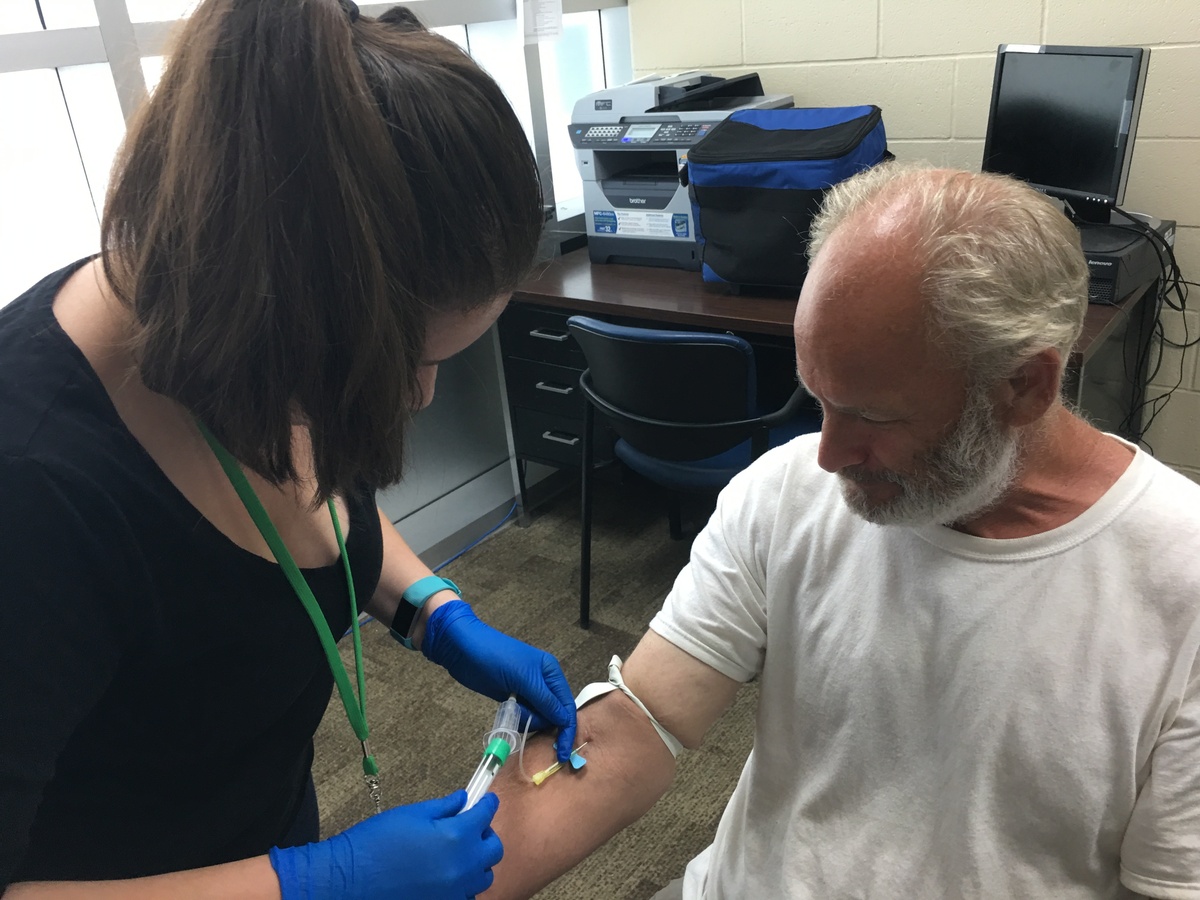
James Harrison gets a free blood test from Michelle Mutchler with the San Antonio Metropolitan Health District. The test checks for a dormant tuberculosis infection that hasn’t produced symptoms, but could flare into an active state and become contagious.

Wendy Rigby/Texas Public Radio

hide caption

toggle caption

Wendy Rigby/Texas Public Radio

At San Antonio’s largest homeless shelter, huge fans cool off the temporary residents. The courtyard can get crowded. One of the hundreds of nightly boarders is James Harrison. “I lost my apartment and had nowhere else to go,” he explains.

Like most people at Haven for Hope, Harrison, who is 55, doesn’t plan on staying long. But while he’s here, he’s taking advantage of some free medical testing — a screening for dormant tuberculosis.

“People don’t even think about TB anymore because you don’t see it anymore,” Harrison says. “There’s nothing that tells you until it’s too late that it’s there.”

Differences between latent and active TB

Tuberculosis is an airborne bacterial infection that attacks the lungs and can be deadly. There’s a common TB skin test, but the San Antonio health department says the skin test takes 48 to 72 hours to produce a result and is susceptible to false positives. A blood test is more accurate and requires only 24 hours to get results. A vial of blood can be tested to see if people are carrying TB without showing symptoms. That’s called latent tuberculosis infection, a condition that puts them at much greater risk of developing active, contagious TB if they are exposed again.

“It goes into your lungs and usually it hides there dormant for years and years. Although it sounds very scary, it is completely treatable,” says Dr. Barbara Taylor, an infectious disease specialist who is part of a program called Breathe Easy South Texas. BEST is an ambitious $2 million effort to test at-risk people in 20 Texas counties — an area larger than some entire states.

The Texas Department of State Health Services is teaming up with the San Antonio Metropolitan Health District, UT Health San Antonio and University Health System. They offer testing at places like shelters, diabetes clinics, and medical offices that treat mostly low-income patients.

The Haven for Hope, a homeless shelter in San Antonio, is one of dozens of locations around 20 South Texas counties where people are now being tested for latent tuberculosis infections.

Wendy Rigby/Texas Public Radio

hide caption

toggle caption

Wendy Rigby/Texas Public Radio

“It’s not a problem that’s on the south side or east side. It’s a problem all across Bexar County,” says Tommy Camden, TB services manager with San Antonio’s health department. He says tuberculosis it rears its ugly head in urban and rural communities.

“It doesn’t care what color you are, how much money you make,” he adds. “As long as you’re breathing, you’re susceptible to catching tuberculosis.”

Still, some populations are at greater risk of carrying the TB bacterium: the homeless, IV drug abusers, people with diabetes and those born in some other countries. For most people who test positive, the diagnosis of latent TB comes as a surprise. But testing is easy.

A third of the world’s population is infected

“We’ve got some huge challenges ahead of us,” Camden says, because there is so much latent TB out there.

Texas, California, Florida and New York have the highest rates of tuberculosis in the U.S. Camden says he hopes those states can mimic the BEST program, which has screened 3,500 people a year. Roughly 9 to 10 percent were found to have latent TB.

“I am passionate about this because this condition can affect you when you least expect it,” says nurse Diana Cavazos with University Health System. She says those who test positive are given X-rays and a 12-week course of antibiotics — even transportation to the appointments if they need it, free of charge.

“Testing, supplies, treatment, X-rays — it’s completely covered,” Cavazos explains.

It’s covered by Medicaid. But future funding is a question mark. The threats in Washington, D.C., of cuts to Medicaid are creating uncertainty at precisely the time the testing program has plans to expand.

This story is part of NPR’s reporting partnership with Texas Public Radio and Kaiser Health News.

Let’s block ads! (Why?)