Candidates Confront GOP Health Care Bill In Montana Special Election

The three candidates, from left, Republican Greg Gianforte, Democrat Rob Quist and Libertarian Mark Wicks, who are vying to fill Montana’s only congressional seat.

Bobby Caina Calvan/AP

hide caption

toggle caption

Bobby Caina Calvan/AP

Many Democrats are hoping the GOP health care bill that narrowly passed the U.S. House of Representatives is going to push political momentum their way, and result in big gains in the 2018 midterm elections. A special election next week in Montana may be an early test for this theory.

President Trump won Montana by 20 points in the November 2016 election, and the May 25 special election is being held to replace the state’s only congressman, Rep. Ryan Zinke, whom Trump nominated to be interior secretary.

Montana resident Jim Lynch plans to vote for the Republican candidate, Greg Gianforte. Lynch is a member of the Glacier Country Pachyderm Club and members get together once a month in Kalispell, Mont., to talk about advancing Republican values.

Lynch says health care is a top issue for him. He hates the Affordable Care Act. He’s 63 and says he maintained good health insurance coverage throughout the Obama administration. But, he says, “There’s a lot of people in my shoes who aren’t that lucky. I do know, personally, that they’ve seen huge increases in health care costs, to the point that they don’t even have it anymore.”

Indeed, people who are 55 to 64 can be charged as much as three times what a younger person can be charged for health insurance. Subsidies are available based on income, but older people may earn more than young people just starting their careers.

Under the GOP bill that’s now before the Senate, however, older people can be charged five times as much as younger people, and the subsidies are decreasing in aggregate.

Lynch says he doesn’t think the House health care bill is perfect, but he’s confident that, as President Trump shepherds it through Congress, it will be modified into something much better than the Affordable Care Act.

About a hundred miles south in Missoula, Mont., restaurant owner Molly Galusha dreads the idea of Obamacare being repealed. She says the current health care law’s subsidies have made it possible for her employees to afford health coverage on the wages she can afford to pay them.

Galusha is 62 and gets her health coverage through her husband’s job. She says she doesn’t know what they’d do if their insurance went away.

“We’re old and broken,” she laughs.

The Affordable Care Act’s protections for people with pre-existing conditions are also likely to affect older people, because the likelihood of having a pre-existing condition increases with age.

“We are uninsurable as a couple, so we’re very grateful,” Galusha says.

Republican candidate Gianforte says he won’t vote for a health care bill that doesn’t work for Montana.

“I need to know that, in fact, it’ll bring premiums down, preserve rural access and protect people with pre-existing conditions,” he says.

He also says he would have voted against the House health care bill, because there wasn’t enough time to read and understand it before the House voted.

Democrats, however, accuse Gianforte of being disingenuous. They point to a recording of a phone call he had with lobbyists on the day the House bill passed, which was leaked to The New York Times. On the tape he can be heard saying, “Sounds like we just passed a health care thing, which I’m thankful for, that we’re starting to repeal and replace.”

Democratic candidate Rob Quist pounced on those words. Quist needs Republican votes to win, so he’s trying to convince Republicans that their candidate will sell out the state’s interests on health care.

“Montanans want a Congressman who’ll shoot straight, not a dishonest politician who says one thing to Montanans and another to the millionaires behind closed doors,” he says. Quist says he wants to build on the ACA and thinks the country should eventually move to a single-payer health insurance system.

This story is part of a reporting partnership with NPR, Montana Public Radio and Kaiser Health News.

Let’s block ads! (Why?)

An Experiment Helps Heroin Users Test Their Street Drugs For Fentanyl

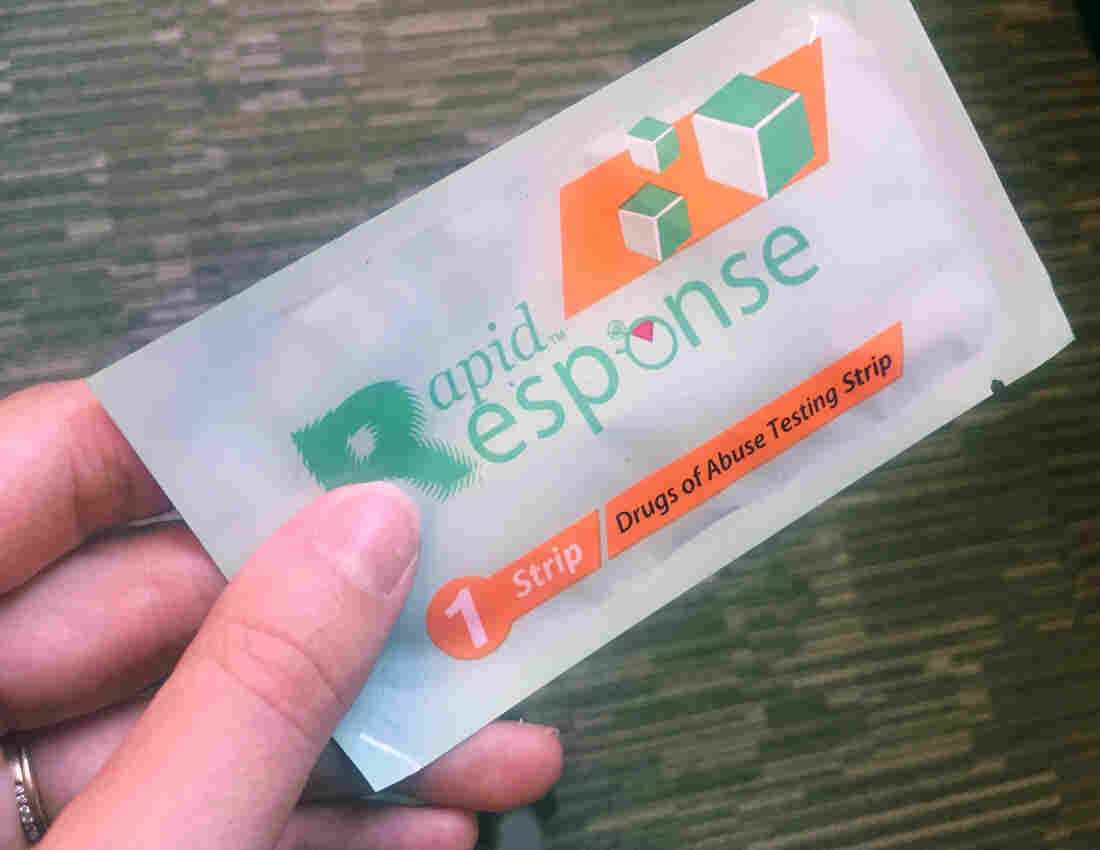
A test strip designed to help doctors check a patient’s urine for fentanyl is being distributed in the Bronx to encourage users of heroin or other opioids to check what’s in their syringe before they inject.

Mary Harris/WNYC

hide caption

toggle caption

Mary Harris/WNYC

In the day room at St. Ann’s Corner of Harm Reduction, which runs a needle exchange program in the Bronx, a group of guys are playing dominoes and listening to salsa music while they wait for lunch. And Van Asher, one of the staffers in charge of “transactions” — that means he gives out needles — is talking up his latest idea for how to keep the users here safe.

He wants to tell them what’s really in their stash.

“If you’re doing dope,” he says to one client, “we’ll give you a test strip so you can test and see if there’s fentanyl.”

Fentanyl is a synthetic opioid that is “similar to morphine but can be 50 to 100 times more potent,” according to the National Institute on Drug Abuse. Increasingly, drug dealers have been using fentanyl to cut their heroin supply — which can be lethal for users. By using the same simple test a doctor would use to check for fentanyl in a patient’s urine, Asher is now giving drug users in the Bronx a way to quickly find out what’s in their syringe before they inject.

“I know what I’m getting is the raw,” one client tells Asher, implying he knows his drugs are pure.

“That’s what you think!” Asher tells him. “But how do you know? Are you buying it from, like, the FDA?” The client laughs.

Asher is the data manager here: He makes sure the Centers for Disease Control and Prevention and local health departments get the information they need about the drugs taken by the people who come here. But he started this project more out of his own feeling of desperation about the community he serves than out of a desire for official data collection.

He says the number of overdose deaths in the last year has been so overwhelming, he’s tried to stop counting them. But the New York City Department of Health and Mental Hygiene says drugs killed more than 1,300 people in 2016 — the highest number on record. And public health officials say that rise has been driven, in large part, by fentanyl.

As Asher says, “You see someone, you go: ‘I’ll see you tomorrow.’ And you never see them again.”

Which is why he and St. Ann’s Corner recently ordered a bunch of fentanyl test strips from Canada and started handing them out. The idea is that giving users information about what they’re using could empower them make a better choice. If they know there’s fentanyl in the mix, maybe they’ll inject the drug more slowly. Maybe they’ll use in a safer place. Maybe they won’t use at all.

Now, Asher is working with needle exchanges around the country who are trying the same sort of thing. Dr. Alexander Walley, the director of the addiction medicine fellowship program at Boston Medical Center, has been tracking the use of these test strips since the idea first got started last year, at a needle exchange in Vancouver, called Insite.

“From what I’ve heard … even when they know they’re going to be positive for fentanyl, the experience of somebody testing their drugs and seeing that it’s fentanyl has an impact,” Walley says. “It really encourages them to use more safely.”

Insite, which is funded by the Canadian government, is also the only “safe injection” site in North America. That means there’s a key difference between what’s happening there, and what’s happening at needle exchanges in the U.S. In Canada, whether or not a user’s drugs test positive for fentanyl, he or she can stay at Insite and inject under a nurse’s supervision, which increases the chances that an otherwise lethal overdose could be reversed.

Walley thinks about these test stripsthe same way he thinks about a fire extinguisher or a seat belt: as a precaution. He’s interviewed heroin users, and says while some users tell him they like fentanyl, and some don’t, “the majority of people are agnostic. Because the people we interview, they have a daily opioid use disorder — and what they really care about is not being in withdrawal.”

“At the end of the day,” he continues, “I think giving people knowledge about what they’re putting in their body is probably a good thing more than a bad thing.”

But will these test strips help users in the Bronx avoid an overdose? Asher says the only way to know is to give them out and study what happens next.

His project is still very much a work in progress. Asher says that he’s been giving out about 10-15 test strips a day, and is starting to run low. Each strip costs about a dollar, and the budget at St. Ann’s, which is funded primarily by the city and state departments of health, is tight. Asher has tried handing out surveys with the strips, to figure out which brands might be more dangerous, or what a tainted batch might look like. But it’s hard to get users to report back.

One thing he’s already learned: Fentanyl has become a big part of the local drug supply in the Bronx. One user, Vincente Estepa, says all but one of the bags of heroin he tested came up positive for fentanyl.

When asked whether that will change the way he uses, though, he says no.

“At the end of the day an addict is an addict, Estepa says. “It’s stronger! If it makes me feel the euphoria, I’m going to go for it.”

Estepa says dependence on the drug means constantly looking to avoid “E.” That stands for “empty,” he explains — when the physical symptoms of opioid withdrawal kick in. And avoiding withdrawal can mean taking risks.

Using heroin has already taken a lot from him. Estepa has lost his job. He’s homeless. But he’s still alive. The people running this project want to keep it that way.

Let’s block ads! (Why?)

Trump Refusal to 'Bail Out' Insurers Might End Up Making Policies Cheaper

President Trump celebrated House passage of legislation to roll back the Affordable Care Act in the Rose Garden of the White House on May 4.

NurPhoto via Getty Images

hide caption

toggle caption

NurPhoto via Getty Images

President Trump has been saying in recent weeks that the Affordable Care act, or Obamacare, is “dead.”

So he’s threatened to cut off crucial payments to health insurance companies that help low-income customers pay day to day health care expenses.

That plan, however, may just end up bringing more people into the Affordable Care Act insurance markets.

An analysis by the consulting firm Oliver Wyman shows that if the government stops paying for the subsidies that the lowest-income customers get on the Affordable Care Act exchanges, the government would instead have to provide larger tax credits to more people.

The result? Many more people could end up finding they can get insurance policies at little to no cost at all. And that “might also encourage some subsidy-eligible people who have not previously purchased plans to enroll,” the report concludes.

“People can take that higher subsidy and buy any plan on the exchange that they want,” said Dianna Welch, the Oliver Wyman actuary who co-wrote the report.

To understand to how this could happen requires getting deep into some of the wonky details of how the Affordable Care Act works.

The exchanges require insurance policies to conform to one of four “metal” levels – bronze, silver, gold or platinum. Those levels coincide with how much an individual is expected to pay, so a bronze plan covers about 60 percent of a customer’s health care costs, with relatively low monthly premiums, while a platinum plan will cost more each month but pay 90 percent of total health costs.

The law provides income-based tax credits to people to buy insurance, and those credits are calculated based on the price of silver plans. Last year about 85 percent of people who bought Obamacare insurance got a credit, according to the Center for Medicare and Medicaid Services.

Complicated enough, but there’s more.

People with the lowest incomes get even more government help in the form of discounts off deductibles and co-payments – known as “cost-sharing subsidies.” Insurance companies are required by law to grant the discounts and the government pays them back.

Democrats are trying to bail out insurance companies from disastrous #ObamaCare, and Puerto Rico with your tax dollars. Sad!

— Donald J. Trump (@realDonaldTrump) April 26, 2017

Those are the payments that Trump – who on Twitter referred to them as a way to “bail out insurance companies from disastrous #ObamaCare” — now says he may not pay.

It’s that threat that could lead eventually to cheaper insurance for many people.

That’s because the government only pays cost-sharing subsidies on silver level plans. So if the Trump administration decides not to make those payments, insurance companies are likely to raise rates about 19 percent on those policies to make up the lost money, according to an analysis the Kaiser Family Foundation.

“Increasing just silver premiums would be the rational thing for insurers to do,” says Larry Levitt, senior vice president at Kaiser. “The cost-sharing reductions are only available in silver plans, so there’s no reason to affect premiums in other plans.”

Ending the cost sharing payments could also cost the government as much as $2.3 billion in 2018, according to Kaiser, because the government would need to offset those premium increases.

And that’s where the good news for some consumers could come in.

Remember that the government bases its subsidies on the cost of a silver plan. So if silver policy premiums rise 19 percent, subsidies also rise.

That gives all those people who qualify for government help a bigger government check to use toward their premiums.

They could buy a more expensive silver plan. But they could also take that money and buy a cheaper bronze policy.

But people who don’t get government help buying insurance would suffer, because their costs would likely rise.

Oliver Wyman’s analysis shows, for example, that in Phoenix, people age 40 with incomes up 250 percent of the federal poverty level could get a bronze plan for free. And in Detroit, consumers could get a gold-level policy, with more generous benefits, for just $3 more than a silver plan because of the bigger subsidies.

Welch says this could lead low-income people who didn’t think they could afford insurance last year to perhaps buy in 2018.

“Now you can get a bronze plan for free. If someone says ‘Would you like to buy it for free?’ They may say yes,” she says.

Let’s block ads! (Why?)

GOP Health Bill Penalizes Patients Who Let Insurance Lapse

There are many reasons someone could end up having a lapse in health insurance. They might need to move closer to a caregiver or treatment center, for example, and consequently have to quit their job — and lose their insurance.

Portra Images/Getty Images

hide caption

toggle caption

Portra Images/Getty Images

Before he was diagnosed with head and neck cancer in 2015, Anthony Kinsey often went without health insurance. He is a contract lawyer working for staffing agencies on short-term projects in the Washington, D.C., area and sometimes the 90-day waiting period for coverage through a staffing agency proved longer than the duration of his project — if health coverage was offered at all.

When Kinsey, now 57, learned he had cancer, he was able to sign up for a plan with a $629 monthly premium because the agency he was working for offered group coverage that became effective almost immediately. The plan covered the $62,000 surgery to cut out the diseased bone and tissue on the left side of his face, as well as chemotherapy and radiation. His share of the treatment cost was $1,800.

If the GOP health plan recently approved by the House becomes law, people like Kinsey who have health problems might not fare so well trying to buy insurance after a lapse.

The Republican bill would still require insurers to offer coverage to everyone, including people who have pre-existing medical conditions, such as diabetes, asthma or even cancer. But it would allow states to opt out of the federal health law’s prohibition against charging sick people more than healthy ones.

In those states, if people have a break in coverage of more than 63 days, insurers could charge them any price for approximately a year when the consumers next apply for coverage — effectively putting health insurance out of reach for many sick people, analysts say. After a year, they would be charged a regular rate again.

Coming up with a figure for how many people have pre-existing conditions that could put them at risk for facing unaffordable health insurance premiums has been the subject of debate, with estimates ranging from 133 million on the high end to 2 million on the low end.

What we know is that before the Affordable Care Act, also known as Obamacare, insurers in the individual market frequently charged people more if they were sick. According to a 2009 survey of individual market insurers by America’s Health Insurance Plans, a trade group, 34 percent of coverage was offered at higher-than-standard rates, and 6 percent of those offers included waivers that excluded coverage for specific conditions.

It’s not only people who have a gap in coverage who could be affected if a state seeks the health law waiver, some health policy analysts suggest. Anyone with a pre-existing condition — even those who have maintained continuous insurance coverage — could pay higher rates. That’s because the bill opens the door for insurers to set rates for people based on their health.

“If you have a pre-existing condition, you’re going to be put into the block of business with the sicker risk pool,” said Sabrina Corlette, a research professor at Georgetown University’s Center on Health Insurance Reforms.

Requiring people to maintain continuous coverage is the Republicans’ preferred alternative to Obamacare’s individual mandate that requires people to have insurance or pay a fine. But there are many reasons people may have a gap in coverage, especially if they’re sick, say consumer advocates.

“If they’re diagnosed with cancer and going through a grueling treatment, they might move closer to their caregiver or the cancer center,” said Kirsten Sloan, vice president for policy at the American Cancer Society Cancer Action Network. “They may quit their job for that reason, or they may lose their job.”

Once people have a gap in coverage they may really be in a bind if the available coverage is unaffordable. To address this, the Republican bill requires states to set up a high-risk pool or reinsurance program or participate in a federal risk-sharing program.

State high-risk pools, which were available in 35 states before the ACA passed, have been widely criticized, however, as inadequate for people with expensive health care needs. Premiums were often extremely high, and there were frequently lifetime or annual limits on coverage. Some plans excluded coverage for as long as a year for the very conditions people needed insurance.

Still, Thomas Miller, a health economist and resident fellow at the American Enterprise Institute, says high-risk pools offer a reasonable solution for the 2 million to 4 million people in the individual market he estimates have pre-existing conditions but would otherwise be medically uninsurable or offered such high-cost coverage that they couldn’t afford it. The $130 billion over nine years that the bill sets aside to use for high-risk pools or other individual market activities, along with an additional $8 billion over five years for states that get waivers from ACA community-rating requirements, “could be adequate” to meet the need, he said.

Besides, he argued, the higher rates would last only for a year.

“Once you’ve paid up, you graduate back to the regular market,” Miller said. “It’s not like being sentenced to the gulag.”

Kinsey said he plans to keep his coverage up to date from now on, but he doesn’t think it’s fair to charge sick people higher rates even if they have a break in coverage.

“It would be problematic,” he said. “I’m not in favor of that.”

Kaiser Health News is an editorially independent news service that is part of the nonpartisan Henry J. Kaiser Family Foundation. Follow Michelle Andrews on Twitter: @mandrews110.

Let’s block ads! (Why?)

The Fox And The Hedgehog: The Triumphs And Perils Of Going Big

Psychologist Phil Tetlock thinks the parable of the fox and the hedgehog represents two different cognitive styles. “The hedgehogs are more the big idea people, more decisive,” while the foxes are more accepting of nuance, more open to using different approaches with different problems.

Renee Klahr

hide caption

toggle caption

Renee Klahr

The Greek poet Archilochus wrote, “the fox knows many things, but the hedgehog knows one big thing.”

There are many different interpretations of this parable, but psychologist Phil Tetlock argues it’s a way of understanding two cognitive styles: Foxes have different strategies for different problems. They are comfortable with nuance, they can live with contradictions. Hedgehogs, on the other hand, focus on the big picture. They reduce every problem to one organizing principle.

“The hedgehogs are more the big idea people, more decisive. In most MBA programs, they’d probably be viewed as better leadership material,” Tetlock says.

This week, we have the story of a hedgehog by the name of Don Laub: a young surgeon who was eager to make his mark. In his words, he wanted to “do a big thing, and help a lot of people.”

One day, Don got his chance when a colleague asked him if he could help with a surgery. The patient was a child from Mexico with a cleft lip and palate, and the surgery was simple. Don says it gave the child, who had been ostracized in his community, a real chance in life.

The experience inspired him to organize trips for surgeons to travel to Mexico and help other children with similar injuries. “Everybody jumped on it,” he said. “I had to hide when I would go into the hospital because people wanted to get in on this.”

His story is one of many triumphs — and a tragedy that he continues to dwell on many decades later. This week on Hidden Brain, we explore his story, and what it can tell us about how we view our roles in the world.

The Hidden Brain Podcast is hosted by Shankar Vedantam and produced by Maggie Penman, Jennifer Schmidt, Renee Klahr, and Rhaina Cohen. Our supervising producer is Tara Boyle. Follow us on Twitter @hiddenbrain, and listen for our stories each week on your local public radio station.

Let’s block ads! (Why?)

Secret Republican Senate Talks Are Shaping Health Care Legislation

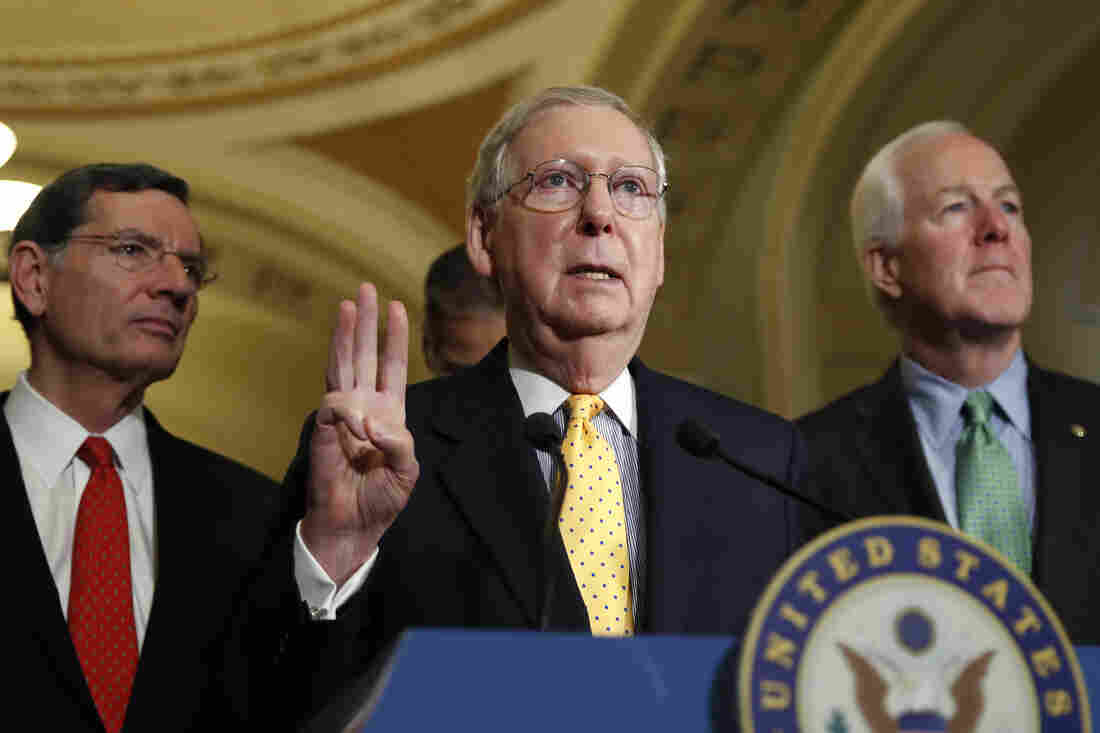
Senate Majority Leader Mitch McConnell is flanked by Sen. John Barrasso, R-Wyo., (left) and Senate Majority Whip John Cornyn of Texas (right). They are three of the 13 senators in the health care working group.

Jacquelyn Martin/AP

hide caption

toggle caption

Jacquelyn Martin/AP

The Senate is negotiating its own legislation to repeal and replace much of the Affordable Care Act in secret talks with senators hand-picked by party leaders and with no plans for committee hearings to publicly vet the bill.

“I am encouraged by what we are seeing in the Senate. We’re seeing senators leading,” said Sen. Ted Cruz, R-Texas, one of the 13 Republicans involved in the private talks. “We’re seeing senators working together in good faith. We’re not seeing senators throwing rocks at each other, either in private or in the press.”

Senate Democrats have a different take. “Your morning reminder that under the cloud cover of the FBI story, 13 GOP Senators are still secretly writing a bill to destroy the ACA,” Sen. Chris Murphy, D-Conn., tweeted Monday morning.

Your morning reminder that under the cloud cover of the FBI story, 13 GOP Senators are still secretly writing a bill to destroy the ACA.

— Chris Murphy (@ChrisMurphyCT) May 15, 2017

Senate Republicans have shrugged away criticism about their decision to avoid action in committees in favor of closely guarded meetings in the U.S. Capitol to craft legislation to repeal and replace key pillars of President Barack Obama’s health care law and reshape Medicaid.

The working group has met four times, and it plans to continue to meet every Tuesday and Thursday. So far, its strategy appears to be selectively suggesting potential provisions of the legislation to the media.

For instance, Sen. John Thune, R-S.D., has floated pegging tax credits to help Americans buy health insurance to their income instead of their age like it does in the House version of the bill.

While the fallout over President Trump’s decision to fire FBI Director James Comey consumes the news cycle, it has not had an impact on Republicans’ health care talks. A GOP aide for a senator involved in the talks said it has even given the Senate some breathing room to negotiate with so much attention focused elsewhere.

Senate Majority Leader Mitch McConnell formed the negotiating team to take the lead on crafting health care legislation that can ultimately win the support of at least 50 of the chamber’s 52 Republicans. No Democrats are expected to support any potential GOP health care bill. The legislation is moving under special budget rules known as reconciliation, which means it is not subject to usual filibuster rules and cannot be blocked by the minority party.

Republicans ditched the House-passed bill in pursuit of their own legislation, although the two chambers share the broad goals of repealing the ACA’s individual mandates and taxes, restricting access to abortion services and overhauling the Medicaid system from an open-ended federal guarantee that covers costs to a system that gives states more flexibility to spend an allotted amount of money.

Conservatives like Cruz are also laying down what they say is a key marker for whether a bill can pass the Senate: “Do premiums go up, or do they go down?” Cruz said.

Sen. Ron Johnson, R-Wis., told reporters last week that Republicans are still in the early planning phase of crafting a bill. “We still need to agree on those goals and find out what’s achievable,” he said. Like Cruz, Johnson said for him lowering premiums is a top goal and he wants to repeal as much of the ACA as possible under the Senate’s more strict budget rules.

Early talks suggest Republicans are optimistic they can ultimately pass a bill by the August recess. “We’ve got a group of 52 Republican senators, all of us want to get to ‘yes,'” Johnson said.

Sens. Susan Collins, R-Maine, and Bill Cassidy, R-La., have introduced their own health care plan, and they have been prominent voices in the debate, but they were excluded from the health care working group.

Republicans were roundly criticized for not including any women in their core group, but the Republican women in the Senate who were asked about the omission said they didn’t mind. “It doesn’t bother me, the leaders have the right to choose whoever they wish,” said Collins. “It doesn’t mean that I’m not going to work on health care.”

Cassidy and Collins have been moderating voices in the health care debate, and their support or opposition could be critical to Republicans’ success.

The Cassidy-Collins proposal would let states keep the ACA, also known as Obamacare, in place if they wanted to, and it leaves in place the ACA’s taxes and fees to have revenue streams to pay for their health care overhaul. However, their plan doesn’t enjoy support among conservatives who don’t believe it goes far enough to repeal and replace Obamacare — the party’s signature campaign pledge.

The duo has been reaching out to Democrats, but Cassidy said his efforts have been rejected. Democrats see no policy or political upside to working with Republicans to dismantle the ACA. “Let me phrase this carefully. I’ve had seven or eight meetings with Democrats either in their office, maybe once my office or on the floor, and that was the consistent message I got,” Cassidy said.

Most Republicans see no political advantage to attempting to craft bipartisan legislation that could aid vulnerable Red State Senate Democrats heading in to the midterm elections. In other words, there is mutual disinterest in bipartisanship when it comes to the fundamentals of Obamacare.

The GOP health care talks are expected to roll through the summer months in the Senate. The long-term strategy — according to senior GOP aides in both the House and Senate — is to pass a Senate bill and send it back to the House for an up-or-down vote.

While House passage of their bill was hailed by the president in an unusual Rose Garden ceremony earlier this month, Republicans are still a long way away from fulfilling their campaign promises on health care.

Let’s block ads! (Why?)

Doctors Who Are Moms Say They Face Discrimination At Work

Medicine and maternity can make for an uneasy mix, female physicians report.

Juanmonino/Getty Images/iStockphoto

hide caption

toggle caption

Juanmonino/Getty Images/iStockphoto

“If you become chief resident are you just going to get pregnant and have a baby?” asked the silver-haired male attending physician as I sat interviewing for the prestigious academic position of chief internal medicine resident. “That’s what all the female chiefs do, and I’m tired of it,” he added, shaking his head in clear disgust.

Gobsmacked by the blatant sexism of his interview technique, I laughed nervously and made some lame joke about working so much that I barely had time to see my husband, let alone make babies with him. Feeling absolutely professionally alone, with no good means of reporting the incident, I quietly pulled my application and plowed on through residency and life, eventually giving birth to a son at the very end of my training.

My experience is hardly unique: 4 out of 5 physician mothers say they experience workplace discrimination, according the results of a study published last week in JAMA Internal Medicine.

The researchers were inspired to study the topic after reading thousands of Facebook posts on the difficulties of balancing medicine and motherhood on a popular social and professional network forum called Physician Moms Group (aka PMG), an active community with more than 65,000 members. I’m one of those members, and I’ve found it invaluable for navigating medicine as a woman and mother. From discussions on how to efficiently breast pump between patients to advocating for fair contract negotiations, it’s exactly the professional support system I needed years ago when interviewing for that chief residency position.

Dr. Hala Sabry, one of the study’s co-authors and founder of PMG, knows that good medicine is based in evidence. So when Dr. Eleni Linos, a researcher at the University of California, San Francisco, approached her about surveying the group for data, she knew it was the right decision. Although PMG had been quietly supporting thousands of doctor moms on an individual level for over two years, this was the group’s chance to effect change on a wide scale. Sabry says: “We wanted to have data that went beyond anecdotal stories.”

The team surveyed nearly 6,000 physician mothers over a wide range of specialties, from pediatrics to surgery, to assess for perceived workplace discrimination and desired workplace changes. Although I did not participate in the study, I was struck by how common maternal discrimination was. Even Sabry and her colleagues say they were surprised by the high percentages.

While previous studies have long demonstrated gender discrimination within medicine, from pay discrepancies to academic advancement, this was one of the first to investigate the role that motherhood plays in physician career satisfaction.

Of all respondents, 77.9 percent reported discrimination. Nearly two thirds reported gender discrimination and one third reported maternal discrimination, defined as discrimination based on pregnancy, maternity leave or breast feeding,

Almost all of the women reporting maternal discrimination attributed it to pregnancy or maternity leave, and nearly half attributed it to breast feeding. The most common manifestation of discrimination overall was disrespectful treatment by nursing or other support staff, followed by reported exclusion from administrative decision-making , and claimed pay and benefits not equivalent to those of male counterparts.

Nearly half of all the doctors who said they experienced maternal discrimination also reported burnout. This is not new a new finding, and not unique to women: A 2014 national survey found that more than 50 percent of physicians report professional burnout, at rates two times greater than non-physician working adults. But women physicians had higher self-reported burnout risk than their male colleagues.

Although this study may not be surprising to any woman trying to balance work and motherhood, the results may have big-time consequences for the health of the country.

Female physicians represent a third of all practicing physicians, and keeping them in the work force is an important part of providing adequate health care to the country. By the year 2025, a shortage of nearly 90,000 physicians is predicted, according to the Association of American Medical Colleges, as the medical establishment seeks to care for a growing and aging population. An aging medical workforce will only worsen the shortage. Over 40 percent of practicing physicians are 55 years are older, and a wave of physician retirement is expected over the next 10 years.

But attracting and retaining female physicians is not only important from a numbers perspective, but from a morale and care perspective. Studies have found that women are not only more optimistic about the state of medicine than their male counterparts, but they also may offer better care. One recent study found that patients of female physicians have significantly lower mortality rates compared to those of their male peers.

Ultimately, Sabry hopes that the research garnered from the Facebook group will lead to “happier and more fulfilled physicians, leading to better healers.” She and her fellow study authors say health care employers could decrease maternal discrimination and burnout by promoting policies such as longer paid maternity leave, backup child care, lactation support and increased schedule flexibility. A healthy piece of advice that should be adopted in and out of medicine.

Alexandra Sowa is an internist and obesity medicine specialist in New York City and clinical instructor in medicine at Weill Cornell Medical College. You can find her on Twitter at @AlexandraSowaMD.

Let’s block ads! (Why?)

Leaving Segregated Neighborhoods Lowers Blacks' Blood Pressure

It’s not clear how living in a segregated neighborhood affects blood pressure, but stress is one potential cause, experts say.

annebaek/Getty Images/iStockphoto

hide caption

toggle caption

annebaek/Getty Images/iStockphoto

African-Americans experience a significant drop in their blood pressure after they move out of highly segregated neighborhoods and into more integrated neighborhoods, researchers report Monday.

A study involving more than 2,000 African-Americans found that those who moved from the most-segregated neighborhoods to less-segregated neighborhoods later experienced lower systolic blood pressure, a factor in heart attacks and strokes.

“The big message here is that this study shines a light on one of the root causes of heart disease and stroke in our country,” says David Goff, director of the division of cardiovascular diseases at the National Heart, Lung, and Blood Institute, which funded the study. It was published in JAMA Internal Medicine.

Doctors have known for a long time that African-Americans are prone to high blood pressure. And previous research had found that people living in segregated places tended to have higher blood pressure.

The new study is the first to follow people over time to see how leaving segregated communities could affect the risk of heart disease. This kind of before-and-after study strengthens the observations made in the earlier studies.

Kiarri Kershaw, an assistant professor of preventive medicine at Northwestern University, and her colleagues followed 2,280 African-Americans participating in the Coronary Artery Risk Development in Young Adults study.

The subjects were living in highly segregated neighborhoods in Chicago, Minneapolis, Birmingham, Ala., and Oakland, Calif., when the study began in 1985. They were between the ages of 18 and 30 when the study started.

The researchers followed the study subjects for 25 years, when they reached the ages of 43 to 55. Those who moved away from highly segregated neighborhoods to less-segregated neighborhoods and stayed there during that period had significantly lower blood pressure.

Their systolic blood pressure, the first of the two numbers used to measure blood pressure, was one to five points lower, the researchers reported.

While the differences in blood pressure may seem small, that difference among a large number of people could translate into thousands fewer heart attacks and strokes over time. Systolic blood pressure is thought to be the more important number when it comes to developing cardiovascular disease.

“I think it’s pretty powerful in the sense that the reasons for their moves were not necessarily for their health, but it has these other added benefits,” Kershaw says.

The study did not examine how moving to less-segregated neighborhoods could affect blood pressure. But Kershaw thinks it’s probably because of a combination of factors, including experiencing less stress from being exposed to less violence.

“There’s a decent-size body of evidence relating stress to blood pressure and that’s one pathway that we hypothesize that segregation influences health — through exposure to violence, things like that — that could increase your stress level and then potentially influence blood pressure,” Kershaw says.

Less-segregated neighborhoods may also provide more economic opportunities for people and their children and access to better schools, which could also reduce stress, she says.

In addition, those neighborhoods may also make it easier to live healthier lifestyles by having more access to parks, sidewalks, gyms, grocery stores with more fresh produce and pharmacies to get medication.

The researchers found the difference in blood pressure persisted after accounting for other factors that could have played a role, such as changes in income and education.

Kershaw acknowledges, however, that moving to less segregated neighborhoods could increase stress in at least one way — by potentially exposing African-Americans to more racism.

“It’s certainly possible that those who move to less segregated neighborhoods experience more exposure to racism, which could be one reason why some African-Americans choose to stay in more segregated neighborhoods,” she wrote in an email. She noted that African-Americans living in more segregated neighborhoods tend to have better mental health.

But Kershaw says her study found there was an overall beneficial effect on blood pressure of leaving a segregated neighborhood.

“The take-home message is that policies that can allow people who are living in segregated neighborhoods to move and live in more integrated neighborhoods have some spillover effects that influences health like blood pressures,” Kershaw says.

Others agree. “This study is really important,” says Ashish Jha, who studies health policy at the Harvard T.H. Chan School of Public Health and was not involved in the study.

“It helps us really feel much more confident that there’s something about segregation itself that’s leading to worse health outcomes,” Jha says. “And this study says that we really do have to tackle segregation if we’re going to really improve the health of minorities in America.”

Let’s block ads! (Why?)

Stressed-Out High Schoolers Advised To Take A Nap Pod

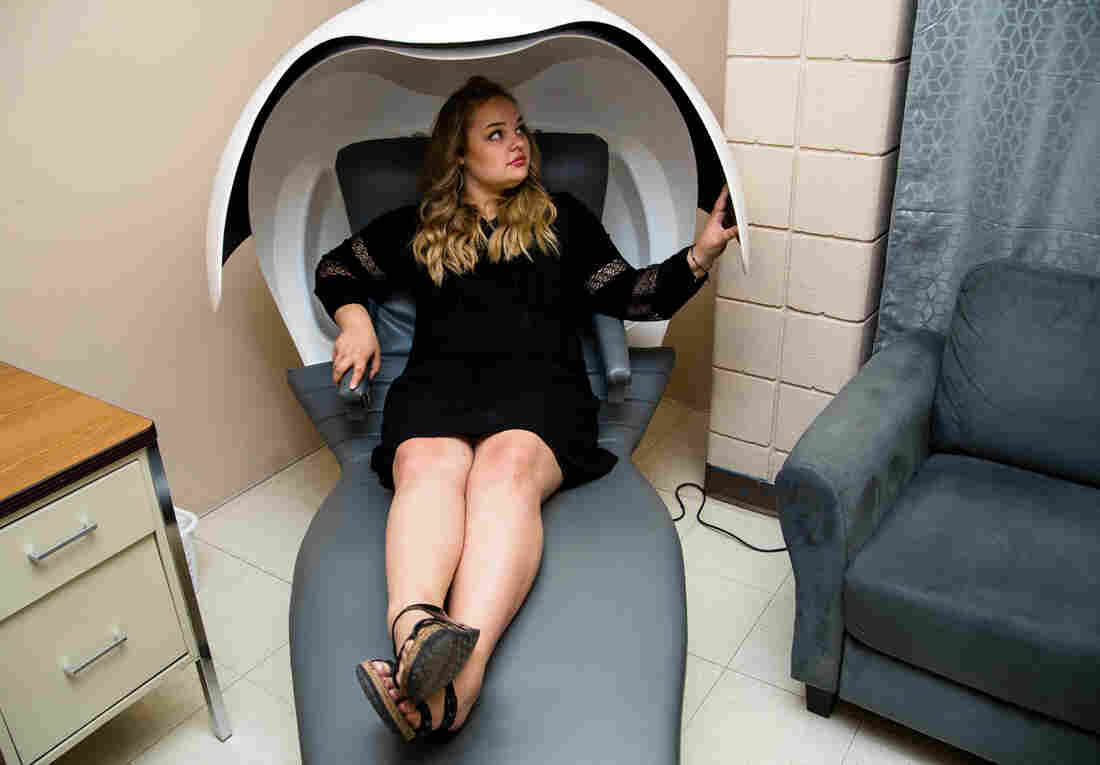
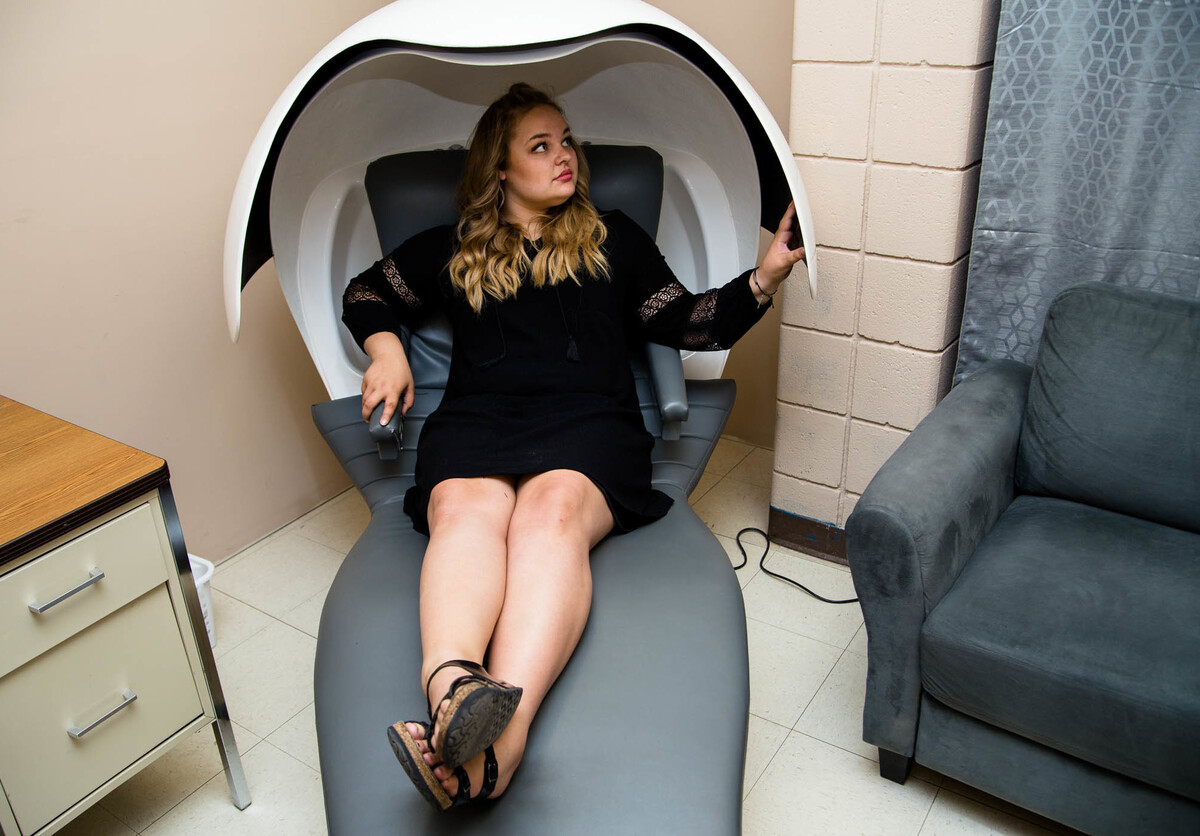
Hannah Vanderkooy demonstrates the napping pod she uses at Las Cruces High School in Las Cruces, N.M.

Joe Suarez for NPR

hide caption

toggle caption

Joe Suarez for NPR

When 18-year-old Hannah Vanderkooy feels extremely tired or anxious, she heads to a space-like capsule for a nap — during school. Like many teens struggling to get good grades and maybe even a college scholarship, Vanderkooy doesn’t get enough sleep.

And she’s not alone. Various studies indicate that chronically sleepy and stressed-out teenagers might be the new normal among U.S. adolescents who are competing for grades, colleges and, eventually, jobs.

Studies have shown teenagers actually need between nine and 10 hours of sleep a night. But the vast majority (69 percent) aren’t getting it.

Enter “napping pods.” They’re essentially an egg-shaped lounge chair that reclines, with a circular lid that can be pulled over the chest to shield against light.

“It just sort of envelops you in a really nice darkness, with soft lighting behind you,” says Vanderkooy, a frequent user of the pods. She says she typically gets only four to five hours of sleep a night.

There’s soft music playing in the pod and “you just feel extremely relaxed,” she says. The 20-minute experience is a wonderful “oasis” amidst all the worry and stress of school, she says.

Las Cruces High School has one napping pod, which students use for 20 minutes when they are tired, stressed or angry.

Joe Suarez for NPR

hide caption

toggle caption

Joe Suarez for NPR

“Being a senior, I have to apply for scholarships, do all my homework,” she says — noting that she’s taking three advanced placement courses. “So my sleep cycle has just sort of become this night-owl life, and it’s just kind of the new normal.”

A nap can’t substitute for a good night’s sleep, but it certainly can help, says Dr. Nitun Verma, a sleep specialist and spokesperson for the American Academy of Sleep Medicine.

A short nap for a teenager “can give a boost to memory and attention during the day, and it can increase school performance,” he says, adding that in a perfect world, schools would roll back their start times.

As it is now, the average school starts at 7:30 in the morning while the start time recommended by researchers at the Centers for Disease Control and Prevention is 8:30 a.m. or later. On top of that, teens’ circadian rhythms work against them — coaxing them to stay up late and then sleep late. So they are already sleep-deprived and “waking up much earlier than normal,” Verma says.

Several public schools in New Mexico are trying to tackle the problem by providing napping pods for their students.

“We know lack of sleep changes mood and makes you more anxious,” says family nurse practitioner Linda Summers, who is an associate professor at New Mexico State University’s school of nursing in Las Cruces.

Summers also works with the nearby Las Cruces High School health center, and has seen firsthand the effects of sleep deprivation on students there. So she decided to apply for a federal health grant to buy the pods, which, at the time, cost $14,000 each. They were installed in four high schools.

Vanderkooy is a senior at Las Cruces High School. With three advanced placement classes she often doesn’t get enough sleep.

Joe Suarez for NPR

hide caption

toggle caption

Joe Suarez for NPR

And while the Las Cruces school napping pods were bought to remedy sleep deprivation, Summers says, “it also turns out to be good for anger and stress.”

Even if kids don’t fall asleep, but simply “zone out,” she says, they emerge saying they feel “refreshed and calm.” This led Summers to embark on a study looking at the emotional impact of pods.

She recruited students who reported feeling “agitated or upset about something,” and had them describe their feelings before and after spending 20 minutes in the pod.

“They all felt more rested, happier and more in control of their emotions,” she says, “after just 20 minutes.” Summers now writes prescriptions for the nap pod for students who are anxious, angry or just plain sleepy.

The findings haven’t been published yet, but they have been accepted for publication by a peer-reviewed journal. Summers says the teachers and school nurses she works with already see the pods as a big success. Each capsule is sort of a “therapeutic study hall,” she says, that helps students focus better when they’re in the classroom.

Vanderkooy recalls falling asleep in one of her classes and being told by her teacher that she “really, really” needed to go take a nap.

“I came back and I was awake and attentive,” she says, able to take out her notes and proceed — “just like a normal class.”

Let’s block ads! (Why?)

Yawning May Promote Social Bonding Even Between Dogs And Humans

Turns out that humans aren’t the only animals that contagiously yawn.

iStockphoto

hide caption

toggle caption

iStockphoto

Bears do it; bats do it. So do guinea pigs, dogs and humans. They all yawn. It’s a common animal behavior, but one that is something of a mystery.

There’s still no consensus on the purpose of a yawn, says Robert Provine, professor of psychology and neuroscience at the University of Maryland, Baltimore County. Provine has studied what he calls “yawn science” since the early 1980s, and he’s published dozens of research articles on it. He says the simple yawn is not so simple.

“Yawning may have the dubious distinction of being the least understood common human behavior,” Provine says.

There are many causes for yawning. Boredom, sleepiness, hunger, anxiety and stress — all cause changes in brain chemistry, which can trigger a spontaneous yawn. But it’s not clear what the yawn accomplishes. One possibility is the yawn perks you up by increasing heart rate, blood pressure and respiratory function.

“[Yawning] stirs up our physiology and it plays an important role in shifting from one state to another,” Provine says.

When violinists get ready to go on stage to play a concerto, they often yawn, says Provine. So do Olympians right before a competition, or paratroopers getting ready to do their first jump. One study found that yawning has a similar impact on the brain as a dose of caffeine.

But not all yawn researchers agree with this theory.

“No specific arousing effect of yawning on the brain could be observed in at least five studies,” says Adrian Guggisberg, a professor in the department of clinical neurosciences at the University of Geneva.

Guggisberg and fellow researchers reviewed several theories of yawning and concluded that the arousal theory lacks evidence. What they did find were several studies that show yawning is highly contagious among humans, suggesting that “yawns might have a social and communicative function,” Guggisberg said in an e-mail.

Looking at yawns, hearing yawns, thinking about yawns or talking about yawns will likely trigger a contagious response. Contagious yawning may have evolved in early humans to boost social bonding, according to Provine. A good group yawn could serve to perk everyone up to be more vigilant about danger, he says.

Another piece of evidence backing up the social bonding theory of yawning is a 2011 study by Ivan Norsicia and Elisabetta Palagi that found people are more likely to copy a yawn if they know the person who is yawning. A stranger’s yawn is less likely to trigger a contagious response. And while babies yawn spontaneously, children don’t engage in contagious yawning until about age 4 — around the same time they’re becoming more socially connected.

Now, what about other animals? We know that all vertebrates, critters with backbones, yawn spontaneously. But very few yawn contagiously.

“Until the last few years, the feeling was that contagious yawning was unique to humans,” Provine says.

But recently, two more species have been added to the list of contagious yawners: dogs and chimpanzees. When two groups of chimpanzees were shown videos of familiar and unfamiliar chimps yawning, the group watching the chimps they knew engaged in more contagious yawning. This study, by Matthew Campbell and Frans de Waal, supports the theory that yawning plays a role in the evolution of social bonding and empathy.

And dogs not only catch each others’ yawns, they are susceptible to human yawning as well. In one study, 29 dogs watched a human yawning and 21 of them yawned as well — suggesting that interspecies yawning could help in dog-human communication.


Let’s block ads! (Why?)