The Future Of The GOP Health Care Plan

The White House claimed a victory this week with the House passage of the bill to replace the Affordable Care Act. NPR’s Ron Elving joins Scott Simon to talk about the bill’s prospects in the Senate.

SCOTT SIMON, HOST:

President Trump is at his home on his golf course in Bedminster, N.J., this weekend. Most members of Congress are back in their districts. Before they left, Republicans voted to repeal and replace the Affordable Care Act. But that vote was close. And many senators have already said they’re opposed. NPR senior editor and correspondent Ron Elving joins us. Ron, thanks so much for being with us.

RON ELVING, BYLINE: Good to be with you, Scott.

SIMON: So many different claims were made this week. We’re going to turn to you as a voice of reason. Do we actually know what’s in the American Health Care Act?

ELVING: Let’s remember, it was voted on on the House floor 24 hours after it was filed with a lot of new amendments in it and with no budget impact score from the Congressional Budget Office. So how much would you expect the average member of Congress to know about any bill this mammoth, this complex, after just 24 hours? I think Lindsey Graham, the Republican senator from South Carolina, said it best. He says, we don’t even know if this baby’s a boy or a girl yet.

SIMON: And it just squeaked by – 217 votes to 213. What does that final tally tell you?

ELVING: It says a lot of Republicans didn’t want to vote for it. Twenty said no. And they’re worried about the hundreds of billions of dollars that are going to be taken out of Medicaid. That’s one of the big things that people are worried about. And, of course, they like the tax cuts that are also hundreds of billions of dollars. But the voters, the people around the rest of the country, are mostly concerned about pre-existing conditions.

That seems to be the big issue. Obamacare said such things had to be covered if you were already sick. And this legislation will put a lot of those people into what are called high-risk pools with very high premiums. And the bill says they will try to help them pay for it.

SIMON: What’s the landscape look like in the Senate? Democrats certainly seem to be unified, as they were in the House. What are the divisions, though, among some Republicans which – the party there in the Senate has even a few more moderates?

ELVING: You know, in the Senate, the landscape always includes a lot of very high peaks. And some of those high peaks of self-regard in the Senate are going to be calculating that they have to oppose anything that is not straight repeal. But you also have a lot of Republicans who would not mind something closer to just patching up the flaws in Obamacare because they come from states that have expanded Medicaid generously.

And what happens to those millions of Americans on Medicaid, most of them low income? So this bill got over the top in the House with the promise to be fixed in the Senate. The question is, what do you promise the senators, who’s going to fix it next?

SIMON: The president and Republican members of the House who voted for the bill posed for photos at the White House. Given what the bill faces in the Senate, was this a little bit like popping open the champagne in the locker room at halftime?

ELVING: Yes or spiking the ball at midfield. You know, you could say this legislation has not even actually reached midfield or halftime because not only does it need the Senate, but then there’s going to be a conference committee between the House and Senate to work out the differences between their bills, which may be quite vast. And then whatever that conference comes up with has to be taken back to the House, taken back to the Senate, voted on again in identical form with no amendments. Those are not just procedural niceties. That’s what the Constitution requires.

SIMON: Let’s look ahead to this week. Sally Yates, who was briefly the former acting attorney general, is going to testify before the Senate on Russian meddling. What are you listening for, especially given today’s news from France?

ELVING: We’re listening for new names, if she should be able to bring up any new names to illustrate any of these other connections or new details on how she learned what she learned about Mike Flynn and his conversations with the Russian ambassador.

But we also understand she’s going to be constrained in some respects because of the classified nature of much of what she learned when she was the acting attorney general. So yet, she might reveal more about what the Justice Department knew, when it knew it and who else the Justice Department might know something about.

SIMON: NPR senior editor and correspondent Ron Elving. Thanks so much.

ELVING: Thank you, Scott.

Copyright © 2017 NPR. All rights reserved. Visit our website terms of use and permissions pages at www.npr.org for further information.

NPR transcripts are created on a rush deadline by Verb8tm, Inc., an NPR contractor, and produced using a proprietary transcription process developed with NPR. This text may not be in its final form and may be updated or revised in the future. Accuracy and availability may vary. The authoritative record of NPR’s programming is the audio record.
Let’s block ads! (Why?)

Health Care Vote Could Threaten Republican House Majority

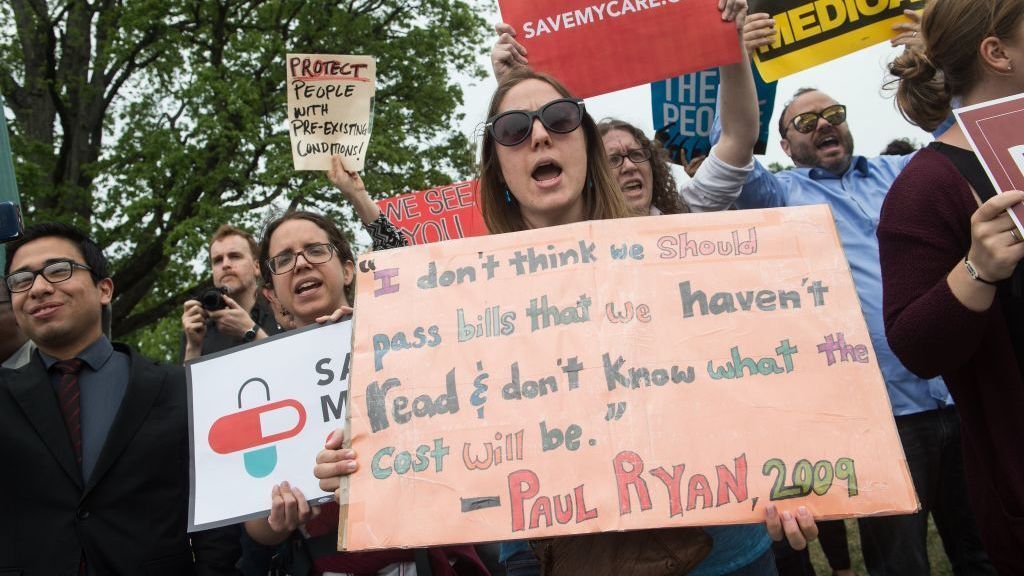
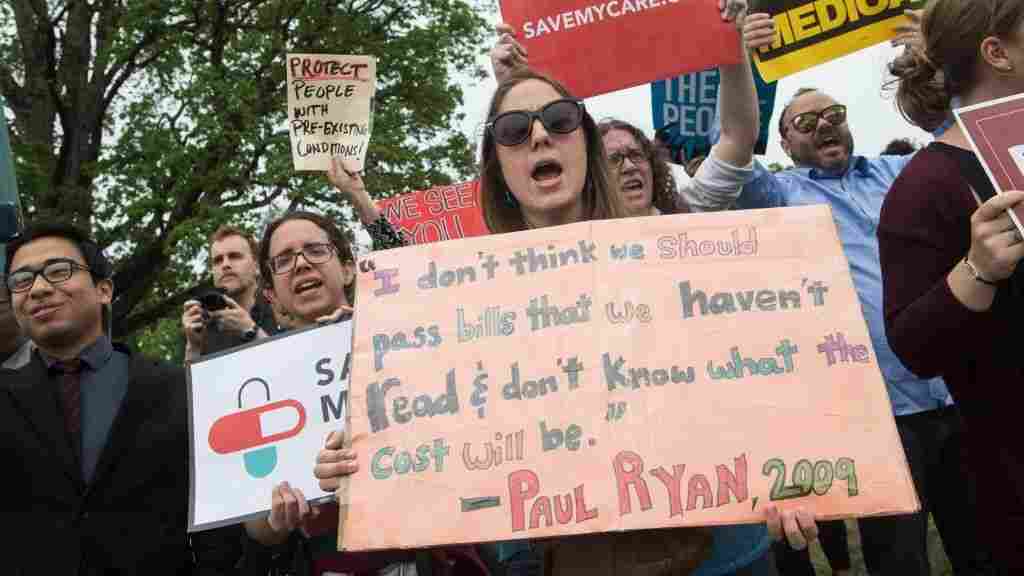
Protesters hold signs and shout at lawmakers walking out of the Capitol on Thursday after the House of Representatives narrowly passed a Republican effort to repeal and replace Obamacare.

Nicholas Kamm/AFP/Getty Images

hide caption

toggle caption

Nicholas Kamm/AFP/Getty Images

As soon as the House approved the GOP health care bill on Thursday, Democrats were working on using it against Republicans in next year’s midterm elections.

“They have this vote tattooed on them. This is a scar they carry,” House Minority Leader Nancy Pelosi declared just after the American Health Care Act passed the House.

Just to rub it in, many Democrats on the House floor began singing “Na Na Hey Hey Kiss Him Goodbye” to their colleagues across the aisle after the vote, a moment of schadenfreude hoping for the same fate many of their own suffered after the Affordable Care Act passed in 2010.

Democrats need to flip 24 seats to win back the House in 2018, and the congressional vote to repeal and replace Obamacare may well have made that a much easier task. Some of the most vulnerable House Republicans voted in favor of the GOP health care plan on Thursday. No Democrats voted for it, while 20 Republicans opposed it, and it only eked by with 217 yay votes — one more than it needed to pass.

Even members who bit the bullet and voted yes, on what they admitted was an imperfect bill, sounded anything but certain about the vote they had just cast.

Florida Rep. Carlos Curbelo — who represents a Miami district Hillary Clinton won in 2016 by 16 points — made a “game-time decision” on the vote, his spokeswoman told the Miami Herald, and now will be looking to the Senate to smooth out some issues with the bill.

“Today’s vote is just a step in the legislative process for this bill — not the end of it,” Curbelo said in a taped statement. “We have worked hard to improve the legislation, but we have a long way to go.”

Today’s vote is just a step in the legislative process for this bill – not the end of it. My statement: https://t.co/pO7RyIr4Xs

— Rep. Carlos Curbelo (@RepCurbelo) May 4, 2017

It has yet to be scored by the nonpartisan Congressional Budget Office to determine how much the bill will cost or how many people could lose coverage. The CBO report in March on an earlier iteration of the bill predicted that 24 million fewer people would be covered.

Atop Democratic target lists for 2018 are the 23 Republicans who sit in districts that were won by Hillary Clinton last November. Of those members, 14 ended up voting for the bill, with just nine opposing it. One of those no votes, Florida Rep. Ileana Ros-Lehtinen, announced earlier this week she wasn’t seeking re-election, so that’s one open race Democrats are feeling hopeful about.

Many of the Republicans who ended up voting against the bill cited concerns that the legislation didn’t do enough to protect people with pre-existing conditions — echoing a major attack line Democrats are already using, and will surely stick with over the next 18 months.

Moderate New Jersey Republican Tom MacArthur worked with members of the conservative Freedom Caucus to come up with an amendment to the GOP’s American Health Care Act that allows states to seek waivers from Obamacare requirements, including on coverage for people with pre-existing conditions.

Further changes put more money towards so-called “high-risk pools” to help defray costs for people with pre-existing conditions. But NPR’s Alison Kodjak reported that “an analysis released Thursday by consulting firm Avalere Health concludes that that amount would be inadequate for providing full health coverage for the number of people who now buy insurance in the individual market and have medical problems.”

“At this time, I cannot support the AHCA with the MacArthur amendment because I’m concerned that a small percentage of those with preexisting conditions may still not be protected,” Colorado Rep. Mike Coffman, who sits in a district Clinton won, said in his statement explaining his decision.

For Democrats, it’s a pronounced turn of events since Obamacare passed in 2010. With Republicans riding high on the public opposition to the law, Democrats’ majority in the House was decimated that year, with 63 seats and control of the House lost.

But sentiment has changed on Obamacare, with Gallup finding this month that 55 percent now approve of the ACA.

The AHCA faces a much tougher road in the Senate, and if it dies there some of those vulnerable GOP members may have taken what ends up being a futile vote.

But there’s another side to consider, too. For Republicans who have made the refrain “repeal and replace Obamacare” their mantra for seven years now, not acting on their signature campaign promise could risk depleting enthusiasm among their core voters, who they also need to turn out in November 2018 to combat a Democratic base energized against Trump.

And after the first attempt at repeal failed in an embarrassing fashion, House Republicans and President Trump badly needed a win. That’s why they took a victory lap in the White House Rose Garden on Thursday afternoon, even though the bill is far off from becoming law.

“The American people expected us to deliver on the promises we’ve made and that’s what House Republicans have just done,” National Republican Congressional Committee communications director Matt Gorman wrote in a memo after the vote.

Republicans have pointed out that more insurance companies are pulling out of state-run exchanges, and the GOP bill will cut about $765 billion in taxes over the next decade, NPR’s Scott Horsley reported, though mostly for wealthy Americans.

Some Democratic operatives were already gloating on social media that the Rose Garden event provided great footage for attack ads against House Republicans next year.

Thank you @RepMimiWalters and @claudiatenney for standing in front! https://t.co/eXKiI6pAr2

— Meredith Kelly (@meredithk27) May 4, 2017

Ultimately, for the most vulnerable House Republicans, this may be a vote they won’t be able to escape over the next year and a half — even if it never becomes law.

Let’s block ads! (Why?)

5 Things To Watch As GOP Health Bill Moves To The Senate

House Speaker Paul Ryan (center) walks to the House chamber ahead of a budget vote on Capitol Hill. Though Ryan was able to deliver 217 votes Thursday to get his GOP health plan through the House, there are still significant hurdles before the bill becomes law.

Eric Thayer/Getty Images

hide caption

toggle caption

Eric Thayer/Getty Images

After weeks of will-they-or-won’t-they tensions, the House managed to pass its GOP replacement for the Affordable Care Act on Thursday by a razor-thin margin. The vote was 217-213.

Democrats who lost the battle are still convinced they may win the political war. As the Republicans reached a majority for the bill, Democrats on the House floor began chanting, “Na, na, na, na … Hey, hey, hey … Goodbye.” They claim Republicans could lose their seats for supporting a bill that could cause so much disruption in voters’ health care.

Now the bill — and the multitude of questions surrounding it — moves across the Capitol to the Senate. And the job doesn’t get any easier. With only a two-vote Republican majority and likely no Democratic support, it would take only three GOP “no” votes to sink the bill.

Democrats have made clear they will unanimously oppose the bill. “Trumpcare” is just a breathtakingly irresponsible piece of legislation that would endanger the health of tens of millions of Americans and break the bank for millions more,” said Senate Minority Leader Chuck Schumer, D-N.Y.

It’s The Senate’s Turn

House passage of the American Health Care Act is just a first step. As this measure moves to the Senate, it will face a new set of political and policy challenges. Among them:

  • MEDICAID: The House-passed measure makes the most sweeping changes to the program since its inception in 1965. Some of these changes, such as capping federal funding, would provoke intraparty divisions in the upper chamber.
  • UNINSURED RATES: The Congressional Budget Office initially estimated that the House bill would mean the loss of coverage for 24 million people. Many analysts say this number is now likely higher.
  • TAX CREDITS: Some GOP senators are already on record opposing the bill’s age-based tax credits, charging that they will make coverage unaffordable for older constituents. Others, however, describe these credits as “Obamacare Lite.”
  • PLANNED PARENTHOOD FUNDING: The House would defund this reproductive health organization for a year — a step that draws opposition from a handful of Senate Republicans.

And Republicans in the Senate have their own internal disagreements, too.

Here are five of the biggest flashpoints that could make trouble for the bill in the upper chamber.

Medicaid

House leaders correctly point out that their bill represents the biggest changes to the federal-state health program for the poor since its inception in 1965 — a point that appeared to be drowned out during the most recent House debate that focused on coverage for people with preexisting health conditions.

For the first time, federal funding for low-income people on Medicaid would be limited, resulting in what House Speaker Paul Ryan, R-Wis., described at an event sponsored by the conservative National Review as “sending it back to the states, capping its growth rates.” It’s a longtime goal for many conservatives. “We’ve been dreaming of this since I’ve been around,” Ryan said.

But it is not a consensus position in the party. Some moderates support the current program, especially for children and people with disabilities. In addition, many GOP governors took the federal government’s offer in the ACA of near-complete federal funding to expand Medicaid to non-disabled, working-age adults, and they are worried about the impact on their residents and their budgets if the expansion goes away and the program’s funding is restricted.

The House bill, wrote the Republican governors of Ohio, Michigan, Arkansas and Nevada in a letter to House and Senate leaders, “provides almost no new flexibility for states, does not ensure the resources necessary to make sure no one is left out, and shifts significant new costs to states.”

That pushback has also created doubts in the minds of some GOP senators. Sens. Rob Portman, R-Ohio, Bill Cassidy, R-La., and Shelley Moore Capito, R-W.Va., are among those who have expressed concerns about the House bill, as has Dean Heller, R-Nev., It’s not clear if any of the House changes have satisfied those senators.

Increase In Number Of Uninsured People

The Congressional Budget Office’s initial estimate that the bill could lead to 24 million more Americans without health insurance within a decade spooked many lawmakers in the upper chamber. “You can’t sugarcoat it,” Cassidy told Fox News when explaining that “it’s an awful score.” The final House bill passed without the score being updated, although most outside analysts said the changes were likely to increase the number who would lose insurance.

And Democrats have been using those initial numbers to score rhetorical points, even if they lack the votes in either the House or Senate to stop the bill or change it.

“The CBO’s estimate makes clear that Trumpcare will cause serious harm to millions of American families,” said Schumer. “Tens of millions will lose their coverage, and millions more, particularly seniors, will have to pay more for health care.”

Tax Credits

On one hand, even with the additional $85 billion added by House leaders to help older people pay for their insurance premiums, many moderates feel the age-based tax credits in the bill replacing those in the Affordable Care Act are too small, particularly for people in their 50s and early 60s. The CBO estimated that under the original version of the House bill, premiums for a 64 year-old with an income of $26,000 a year could rise from $1,700 currently to more than $14,000.

That brought a strong rebuke from the powerful AARP, which was an outspoken ACA supporter. “Although no one believes the current health care system is perfect, this harmful legislation would make health care less secure and less affordable,” said a statement from the group.

Sen. Susan Collins, R-Maine, has said she could not support the House bill in its original form because of concerns about the effects on older constituents.

On the other hand, some conservatives in the Senate are ideologically opposed to offering any tax credits. Sens. Ted Cruz, R-Texas, Mike Lee, R-Utah, and Rand Paul, R-Ky., have all expressed concerns about the bill being too much like the ACA, with Paul referring to it as “Obamacare Lite.” They worry that the tax credits amount to a new entitlement.

“For me, it’s a big stumbling block still that there’s taxpayer money that’s being given to insurance companies,” Paul told reporters in late April. “And I’m just not in favor of taxpayer money going to insurance companies.”

Planned Parenthood

As Republicans have been vowing for years, the House-passed bill would defund Planned Parenthood, although only for a year. That’s likely because a permanent defunding would actually cost the federal government more money, according to the CBO, as some women who lose access to birth control would become pregnant, have babies and qualify for Medicaid. Birth control is vastly cheaper than health care for mothers and babies.

But while cutting funding for Planned Parenthood is overwhelmingly popular in the House, there are a handful of GOP senators, including Collins and Lisa Murkowski, R-Alaska, who have said they are likely to oppose a bill carrying this provision.

Procedural Problems

The budget process Republicans are using to avoid a Democratic filibuster in the Senate, called reconciliation, has very strict rules that require every piece of the bill to be directly related to the federal budget. It will be up to the Senate parliamentarian, a Republican appointee, to make those determinations.

That’s why the bill does not wipe away all the ACA’s private insurance regulations, including the requirement that insurers not discriminate against customers who have preexisting health conditions.

Some analysts have suggested that the House amendment sought by conservatives to allow states to waive some of the health law’s regulations might run afoul of Senate’s “Byrd Rule,” which limits what can be included in a budget reconciliation measure.

“It could be argued that any budgetary effects of the waiver are ‘merely incidental,’ ” said the Committee for a Responsible Federal Budget in a blog post.

Even Rep. Mark Meadows, R-N.C., who negotiated that amendment that won the backing of conservatives, conceded that it could prove problematic in the upper chamber. “There’s still a lot of work that needs to be done before we can celebrate and all go home,” he said in an interview outside the House chamber.

Democrats say it is one of several provisions in the House bill that might not pass parliamentary muster in the Senate.

For example, analysts have suggested that the GOP replacement for the much-disliked “individual mandate” requiring most people to have insurance or pay a fine might not pass Byrd Rule scrutiny either. That’s because the 30 percent premium penalty that people with a lapse in insurance would have to pay under the bill would go to the insurance company, not the federal government, so it would have no budget impact.

A third potentially problematic element of the original House bill would allow insurers to charge older adults five times more in premiums than younger adults — up from a ratio of 3-to-1 under the Affordable Care Act. That provision could be viewed as not directly affecting federal spending, some analysts predict.

Kaiser Health News (KHN) is a national health policy news service. It is an editorially independent program of the Henry J. Kaiser Family Foundation.

Let’s block ads! (Why?)