How A Psychedelic Drug Helps Cancer Patients Overcome Anxiety

Psychedelic drugs could provide relief for anxiety and depression among advanced cancer patients.

Katherine Streeter for NPR

The brilliantly-colored shapes reminded Carol Vincent of fluorescent deep-sea creatures, and they floated past her languidly. She was overwhelmed by their beauty — and then suddenly, as if in a dream, she was out somewhere in deep space instead. “Oh, wow,” she thought, overwhelmed all over again. She had been an amateur skydiver in her youth, but this sensation didn’t come with any sense of speeding or falling or even having a body at all. She was just hovering there, gazing at the universe.

Vincent was having a psychedelic experience, taking part in one of the two studies just published that look at whether cancer patients like her could overcome their death-related anxiety and depression with a single dose of psilocybin.

It turned out they could, according to the studies, conducted at New York University and Johns Hopkins and reported this week in the Journal of Psychopharmacology. NYU and Hopkins scientists gave synthetic psilocybin, the hallucinogenic component of “magic mushrooms,” to a combined total of 80 people with advanced cancer suffering from depression, anxiety, and “existential angst.” At follow-up six months or more later, two-thirds of the subjects said their anxiety and depression had pretty much disappeared after a single dose.

Article continues after sponsorship

And about 80 percent said the psilocybin experience was “among the most personally meaningful of their lives,” Roland Griffiths, a professor of psychiatry and leader of the Hopkins team, said in an interview.

That’s how it was for Vincent, one of the volunteers in Griffiths’ study. By the time she found her way to Hopkins in 2014, Vincent, now 61, had been living for six years with a time bomb of a diagnosis: follicular non-Hodgkin’s lymphoma, which she was told was incurable. It was asymptomatic at the time except for a few enlarged lymph nodes, but was expected to start growing at some undefined future date; when it did, Vincent would have to start chemotherapy just to keep it in check. By 2014, still symptom-free, Vincent had grown moderately anxious, depressed, and wary, on continual high alert for signs that the cancer growth had finally begun.

“The anvil over your head, the constant surveillance of your health — it takes a toll,” says Vincent, who owns an advertising agency in Victoria, British Columbia. She found herself thinking, “What’s the point of this? All I’m doing is waiting for the lymphoma. There was no sense of being able to look forward to something.” When she wasn’t worrying about her cancer, she was worrying about her son, then in his mid-20s and going through a difficult time. What would happen to him if she died?

Participating in the psilocybin study, she says, was the first thing she’d looked forward to in years.

The experiment involved two treatments with psilocybin, roughly one month apart — one at a dose high enough to bring on a markedly altered state of consciousness, the other at a very low dose to serve as a control. It’s difficult to design an experiment like this to compare treatment with an actual placebo, since it’s obvious to everyone when a psychedelic experience is underway.

The NYU study used a design similar to Hopkins’ but with an “active placebo,” the B vitamin niacin, instead of very-low-dose psilocybin as the control. Niacin speeds up heart rate but doesn’t have any psychedelic effect. In both studies it was random whether a volunteer got the dose or the control first, but everyone got both, and the order seemed to make no difference in the outcome.

Vincent had to travel from her home in Victoria to Baltimore for the sessions; her travel costs were covered by the Heffter Research Institute, the New Mexico nonprofit that funded both studies. She spent the day before each treatment with the two Hopkins staffers who would be her “guides” during the psilocybin trip. They helped her anticipate some of the emotional issues — the kind of baggage everyone has — that might come to the fore during the experience.

The guides told Vincent that she might encounter some hallucinations that were frightening, and that she shouldn’t try to run away from them. “If you see scary stuff,” they told her, “just open up and walk right in.”

They repeated that line the following day — “just open up and walk right in” — when Vincent returned to Hopkins at 9 a.m., having eaten a light breakfast. The treatment took place in a hospital room designed to feel as homey as possible. “It felt like your first apartment after college, circa 1970,” she says, with a beige couch, a couple of armchairs and some abstract art on the wall.

Vincent was given the pill in a ceramic chalice, and in about 20 minutes she started to feel woozy. She lay down on the couch, put on some eye shades and headphones to block out exterior sights and sounds, and focused on what was happening inside her head. The headphones delivered a carefully-chosen playlist of Western classical music, from Bach and Beethoven to Barber’s “Adagio for Strings,” interspersed with some sitar music and Buddhist chants. Vincent recalled the music as mostly soothing or uplifting, though occasionally there were some brooding pieces in a minor key that led her images to a darker place.

With the music as background, Vincent started to experience a sequence of vivid hallucinations that took her from the deep sea to vast outer space. Listening to her describe it is like listening to anyone describe a dream — it’s a disjointed series of scenes, for which the intensity and meaning can be hard to convey.

She remembered seeing neon geometric shapes, a gold shield spelling out the name Jesus, a whole series of cartoon characters — a fish, a rabbit, a horse, a pirate ship, a castle, a crab, a superhero in a cape — and at some point she entered a crystal cave encrusted with prisms. “It was crazy how overwhelmed by the beauty I was,” she says, sometimes to the point of weeping. “Everything I was looking at was so spectacular.”

At one point she heard herself laughing in her son’s voice, in her brother’s voice, and in the voices of other family members. The cartoon characters kept appearing in the midst of all that spectacular beauty, especially the “comical crab” that emerged two more times. She saw a frightening black vault, which she thought might contain something terrifying. But remembering her guides’ advice to “just open up and walk right in,” she investigated, and found that the only thing inside it was herself.

When the experience was over, about six hours after it began, the guides sent Vincent back to the hotel with her son, who had accompanied her to Baltimore, and asked her to write down what she’d visualized and what she thought about it.

Griffiths had at first been worried about giving psychedelics to cancer patients like Vincent, fearing they might actually become even more afraid of death by taking “a look into the existential void.”

But even though some research participants did have moments of panic in which they thought they were losing their minds or were about to die, he said the guides were always able to settle them down, and never had to resort to the antipsychotic drugs they had on hand for emergencies. (The NYU guides never had to use theirs, either.)

Many subjects came away feeling uplifted, Griffiths says, talking about “a sense of unity,” feeling part of “an interconnected whole.” He adds that even people who are atheists, as Vincent is, described the feeling as precious, meaningful or even sacred.

The reasons for the power and persistence of psilocybin’s impact are still “a big mystery,” according to Griffiths. “That’s what makes this research, frankly, so exciting,” he says. “There’s so much that’s unknown, and it holds the promise for really understanding the nature of human meaning-making and consciousness.”

He says he looks forward to using psilocybin in other patient populations, not just people with terminal diagnoses, to help answer larger existential questions that are “so critical to our experience as human organisms.”

Two and a half years after the psychedelic experience, Carol Vincent is still symptom-free, but she’s not as terrified of the “anvil” hanging over her, no longer waiting in dread for the cancer to show itself. “I didn’t get answers to questions like, ‘Where are you, God?’ or ‘Why did I get cancer?’ ” she says. What she got instead, she says, was the realization that all the fears and worries that “take up so much of my mental real estate” turn out to be “really insignificant” in the context of the big picture of the universe.

This insight was heightened by one small detail of her psilocybin trip, which has stayed with her all this time: that little cartoon crab that floated into her vision along with the other animated characters.

“I saw that crab three times,” Vincent says. The crab, she later realized, is the astrological sign of cancer — the disease that terrified her, and also the sign that both her son and her mother were born under. These were the three things in her life that she cared about, and worried over, most deeply, she says. “And here they were, appearing as comic relief.”

Science writer Robin Marantz Henig is a contributing writer for The New York Times Magazine and the author of nine books.

Let’s block ads! (Why?)

Winners And Losers If 21st Century Cures Bill Becomes Law

Rep. Tim Murphy, R-Pa., embraces Rep. Fred Upton, R-Mich., during a media briefing about the 21st Century Cures Act on Capitol Hill Wednesday. Susan Walsh/AP hide caption

toggle caption

Susan Walsh/AP

A sprawling health bill expected to pass the Senate, gain President Obama’s signature and become law before the end of the year is a grab bag for industries, academic institutions and patient groups that spent oodles of time and money lobbying to advance their interests.

Who wins and who loses?

Here’s the rundown of what’s at stake in the 21st Century Cures Act:

Winners

Pharmaceutical and Medical Device Companies

The law would likely save drug and device companies billions of dollars when it comes to bringing products to market by giving the Food and Drug Administration more discretion in the kinds of studies required to evaluate new devices and medicines for approval.

The changes represent a massive lobbying effort by 58 pharmaceutical companies, 24 device companies and 26 biotech companies, according to a Kaiser Health News analysis of lobbying data compiled by the Center for Responsive Politics. The groups reported more than $192 million in lobbying expenses on the Cures Act and other legislative priorities, the analysis shows.

Medical schools, hospitals and doctors

The law would provide $4.8 billion over 10 years in additional funding to National Institutes of Health, the federal government’s main biomedical research organization. (The funds aren’t guaranteed, however, and would be subject to annual appropriations.)

The money could help researchers at universities and medical centers get hundreds of millions more dollars in research grants, most of it toward research on cancer, neuroscience and genetic medicine.

The bill attracted lobbying activity from more than 60 schools, 36 hospitals and several dozen groups representing physician organizations. They reported spending more than $120 million in lobbying disclosures that included the Cures Act.

Article continues after sponsorship

Advocates for mental health and substance abuse treatment

The law would provide $1 billion in state grants over two years to address opioid abuse and addiction. While most of that money would go to treatment facilities, some would fund research.

The Cures Act would also boost funding for mental health research and treatment, with hundreds of millions of dollars authorized for dozens of existing and new programs.

Mental health, psychology and psychiatry groups spent $1.8 million on lobbying disclosures that included the Cures Act as an issue.

Patient groups

Groups focused on specific diseases and patient advocacy generally supported the legislation and lobbied vigorously for it. Many of these groups get a portion of their funding from drug and device companies. The bill includes more patient input in the drug development and approval process, and if it becomes law would boost the clout of such groups.

More than two dozen patient groups reported spending $6.4 million in disclosures that named the bill as one of their issues.

Health information technology and software companies

The law would push federal agencies and health providers nationwide to use electronic health records systems and to collect data to enhance research and treatment. Although the Cures Act wouldn’t specifically fund the effort, IT and data management companies could gain millions of dollars in new business.

More than a dozen computer, software and telecom companies reported Cures Act lobbying. The groups’ total lobbying spending was $35 million on it and other legislation.

The Food and Drug Administration would get more money for hiring, but probably not enough to solve its personnel problems. Andrew Harnik/AP hide caption

toggle caption

Andrew Harnik/AP

Losers

Public health

The Cures Act would cut $3.5 billion — about 30 percent — from the Prevention and Public Health Fund established under Obamacare to promote prevention of Alzheimer’s disease, hospital acquired infections, chronic illnesses and other ailments.

Consumer and patient safety groups

Groups like Public Citizen and the National Center for Health Research either fought the bill outright or sought substantial changes. Although they won on some points, these groups still say the Cures Act opens the door for unsafe drug and device approvals and doesn’t address rising drug costs.

Medicaid patients seeking hair growth

The act says Medicaid would no longer help pay for drugs that help patients restore hair. The National Alopecia Areata Foundation spent $40,000 on lobbying disclosures this cycle that included the Cures Act.

Food and Drug Administration

The law would gives FDA an additional $500 million through 2026 and more hiring power, but critics say it isn’t enough to cover the additional workload under the bill. The agency also would get something it has opposed: renewal of a controversial voucher program that rewards companies for getting drugs approved to treat rare pediatric diseases.

Kaiser Health News is an editorially independent news service that is part of the nonpartisan Henry J. Kaiser Family Foundation. KHN’s coverage of prescription drug development, costs and pricing is supported in part by the Laura and John Arnold Foundation.

Let’s block ads! (Why?)

Only 26 Percent Of Americans Support Full Repeal Of Obamacare, Poll Finds

Americans continue to be divided along partisan lines over Obamacare, with an overwhelming percentage of Democrats favoring it and an equal share of Republicans having unfavorable views, according to a newly released Kaiser Family Foundation poll.

But when it comes to an actual gutting of Obamacare, there’s doesn’t appear to be a lot of support.

One-fourth, or 26 percent, of Americans favor a full repeal of the health care law, while 17 percent say scale it back, according to the Kaiser poll. On the other hand, 30 percent favor expanding the law and another 19 percent want lawmakers to move forward with the law as it is.

The poll was conducted one week after the 2016 presidential election. In its aftermath, President-elect Donald Trump and Republican lawmakers have signaled their intention to follow through on their campaign promise to repeal President Obama’s landmark health care legislation. Republican lawmakers have voted to repeal Obamacare dozens of times.

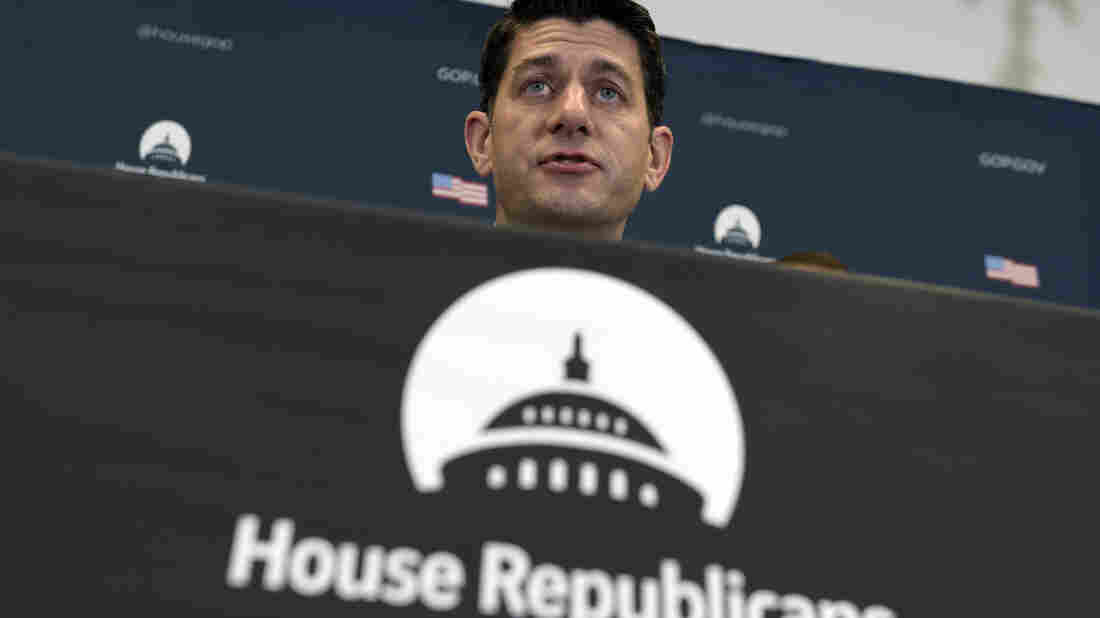
House Speaker Paul Ryan holds a press conference about his 2016 agenda and GOP efforts to repeal Obamacare. Susan Walsh/AP hide caption

toggle caption

Susan Walsh/AP

But the Kaiser survey indicates that there’s been a decline in the percentage of Republicans who want to see the law repealed just since October. In that month, 69 percent of GOPers said they favored repealing the entire law. A month later, once it was clear that the GOP would be in control of the health care debate, just 52 percent of Republicans said the law should be repealed.

Article continues after sponsorship

Similarly, in October, just 11 percent of Republicans said they wanted the law scaled back but not eliminated. In November, that percentage increased to 24 percent.

The poll also indicates that among those who want to see Obamacare repealed, only a third don’t want a replacement. Two-thirds want to see it replaced by a Republican alternative. There are reports that the GOP may seek an immediate repeal of the law and wait years before settling on a replacement.

Overall, the survey finds that some key provisions of Obamacare are very popular among Democrats and Republicans. For example, 85 percent favor keeping young adults on their parents’ insurance plan until age 26. Sixty-nine percent like the prohibitions on insurance companies denying coverage based on pre-existing conditions.

The most unpopular feature of Obamacare? Only 35 percent favor the individual mandate requiring all people to sign up for health insurance or pay a fine.

Let’s block ads! (Why?)

Time For Homeopathic Remedies To Prove That They Work?

Drugstore shelves carry medications approved by the Food and Drug Administration as well as unregulated supplements and homeopathic remedies. Christopher Dilts/Bloomberg via Getty Images hide caption

toggle caption

Christopher Dilts/Bloomberg via Getty Images

Homeopathy has been around since the 1700s, but despite having devoted followers, there is no scientific evidence that it works. Soon, packages for homeopathic products might say just that.

On Nov. 15, the Federal Trade Commission released an enforcement policy statement about labeling for over-the-counter homeopathic products. Homeopathic treatments have increasingly been marketed in drug store and supermarket aisles, alongside Food and Drug Administration-approved over-the-counter medications like Tylenol and Mucinex.

Some homeopathic remedies have disclaimers that say their products aren’t regulated by the FDA. Some don’t have any disclaimers at all. One product even claims that homepathic remedies are regulated just like other medicines, which is not true.

Homeopathy is based on the notion that “like cures like.” Remedies include a tiny amount of a substance that might spark similar symptoms, but the amount in most products is so small as to be undetectable. Because they’re sold next to medications, the FTC believes that they need to be held to the same labeling standards when it comes to making medical claims on their packaging.

Article continues after sponsorship

And the FTC outlined very specific ways to do so.

First of all, the people producing the remedies need to be able to provide evidence that they work. If they can’t, they need to add a disclaimer to packaging that says “there is no scientific evidence that the product works” and “the product’s claims are based only on theories of homeopathy from the 1700s that are not accepted by most modern medical experts.”

According to Richard Cleland, assistant director of the division of advertising practices at the FTC, we might not be seeing that exact languages on boxes, but the products need to both say that their claims are not based on scientific evidence, and also say what they are based on.

A current label on a homeopathic remedy. Erin Ross/NPR hide caption

toggle caption

Erin Ross/NPR

“And they can’t just say that it’s based on homeopathic principles. People don’t know what those are,” says Cleland. So in some way, companies need to convey that that means 300-year-old widely-rejected theories.

The FTC didn’t stop there. On the label, the disclaimer needs to be close to the medical claims the product is making, or even be incorporated into the claims themselves. There will be no hiding this message with a footnote at the bottom of the box or label.

It’s unclear how long it will take for the FTC to take action against homeopathic products with misleading labels or packaging. In past cases, the FTC has waited several months after issuing an enforcement policy statement to allow companies time to comply or change their practices. Then they send warning letters, and eventually go after the most egregious offenders.

Understandably, the homeopathy community isn’t happy with these regulations. But Skipp Neville, the president and CEO of Clear Products, a small company based in San Diego that makes homeopathic products, says he’ll update the language on his packages — if his lawyers agree he should. “We follow the guidelines for what the FDA requires. The FTC, I can’t speak on that — obviously there’s legal issues.”

The legal issue is this: Some people within the natural remedy community don’t believe the FTC has jurisdiction to enforce claims on labeling. Daniel Fabricant, the executive president of the Natural Products Association, says that “this is a clear example of jurisdictional creep.”

Drug stores increasingly sell homeopathic remedies, even though there is no scientific evidence that they have health benefits. Erin Ross/NPR hide caption

toggle caption

Erin Ross/NPR

Labels, he says, are not advertisements. The FTC regulates claims in advertisements. He believes that the labels on homepathic packaging are the FDA’s territory.

But the FTC disagrees, and so does Jonathan Turley, a law professor at George Washington University who teaches courses on labeling. “The FDA effectively struck a deal with the homeopathic industry that says they won’t be regulated as other drugs, as long as they don’t say they’re FDA approved. Obviously, the FTC sees it differently.”

And according to Turley, the FTC does have the ability to require certain label wording.

Still, Fabricant believes these new guidelines unfairly target homeopathic remedy manufacturers by requiring them to back up their medical claims with evidence like double-blind trials.

“There’s no double-blind trial for plenty of over-the-counter drugs — like aspirin, for example,” says Fabricant. Actually, aspirin might have been the wrong example — it’s been the subject of tons of double-blind trials.

“Other products need to support their claims, so why shouldn’t homeopathic products?” counters the FTC’s Cleland. “They’re not different; they’re going to be held to the same standard.”

Cleland doesn’t think the labeling will necessarily dissuade people from purchasing homeopathic remedies, and that’s not the FTC’s goal. “We believe the consumer should have as much accurate information as they can before making purchasing decisions.”

Still, there’s always the possibility that these labeling changes might make homeopathy fans like the products even more.

Some people who use alternative medicine are distrustful of traditional medicines. Learning that the product isn’t supported by modern medicine might be just the endorsement they need.

Let’s block ads! (Why?)

Life Inside The Alzheimer's Ward: A Hidden World Revealed

Maja Daniels' project, Into Oblivion, follows life inside a geriatric unit in France.

Maja Daniels

Inside the walls of a geriatric hospital in France, time stands still. Light falls across two stockinged feet on a bed. The fading floral pattern on a swath of wallpaper is interrupted by an unused corkboard. And between these scenes of stillness, residents approach a pair of locked doors with modest curiosity, expectation and even anger.

Swedish photographer Maja Daniels says those doors, which were locked to prevent the residents from wandering, were crucial early in the project.

“I found myself on the other side of those doors looking at someone looking at me, waving at me to get my attention and not knowing why,” Daniels says. “That vision just stuck with me.”

Daniels is the inaugural winner of the Bob and Diane Fund, a $5,000 grant for visual storytelling about Alzheimer’s disease and dementia. National Geographic’s Gina Martin started the fund this year and named it in honor of her mother, Diane, who died from Alzheimer’s in 2011, and her father, Robert.

“It’s very hard to document Alzheimer’s disease,” Martin said. “I think people will find [Maja’s] work to be very smart, fresh and modern.”

Maja Daniels

After spending time with the hospital residents and their families and getting permission to photograph, Daniels visited the hospital for about a week each month over three years.

Article continues after sponsorship

With the backing of the grant, Daniels plans to create a publication of the work that will be distributed as part of a larger project on aging.

Shots caught up with Daniels to talk about her project. The interview has been edited for clarity and length.


Interview Highlights

  • Daniels spent three years working on her project, Into Oblivion, which documents life inside a geriatric unit in France.

    Daniels spent three years working on her project, Into Oblivion, which documents life inside a geriatric unit in France.
    Maja Daniels
  • Daniels spent three years working on her project, Into Oblivion, which documents life inside a geriatric unit in France.

    Daniels spent three years working on her project, Into Oblivion, which documents life inside a geriatric unit in France.
    Maja Daniels
  • Daniels spent three years working on her project, Into Oblivion, which documents life inside a geriatric unit in France.

    Daniels spent three years working on her project, Into Oblivion, which documents life inside a geriatric unit in France.
    Maja Daniels
  • Daniels spent three years working on her project, Into Oblivion, which documents life inside a geriatric unit in France.

    Daniels spent three years working on her project, Into Oblivion, which documents life inside a geriatric unit in France.
    Maja Daniels
  • Daniels spent three years working on her project, Into Oblivion, which documents life inside a geriatric unit in France.

    Daniels spent three years working on her project, Into Oblivion, which documents life inside a geriatric unit in France.
    Maja Daniels
  • Daniels spent three years working on her project, Into Oblivion, which documents life inside a geriatric unit in France.

    Daniels spent three years working on her project, Into Oblivion, which documents life inside a geriatric unit in France.
    Maja Daniels
  • Daniels spent three years working on her project, Into Oblivion, which documents life inside a geriatric unit in France.

    Daniels spent three years working on her project, Into Oblivion, which documents life inside a geriatric unit in France.
    Maja Daniels

1 of 7

How did you first get into the project?

I was studying at university and was part of a photographic collective. We were approached by this really dynamic director of a geriatric hospital who was keen to have image makers come in and collaborate. It’s very rare to have this opportunity — it’s a very closed world. That’s also why it’s frightening to many people. We don’t always know what’s hiding behind those doors.

Maja Daniels

What was it like to spend time on the other side getting to know the people who were there?

The power of the project lies in its very strict viewpoint and simplistic storytelling. It’s not trying to tell everything that’s going on; it’s taking the standpoint of one of the residents and lingering with that. I wanted to get into the spirit of being a part of this world. How does that affect someone? That door would always remain shut for them. Even though there are activities and people rushing in and out to care for them, a large majority of the time is spent without much happening at all. So that silence is something I wanted to get across, partly because it felt like part of some interior silence as well. When you’re experiencing this disease it’s like the world is slowly fading.

How did the residents first respond to you when you began shooting?

Part of the preparation work was to introduce myself to residents, to their families, to the carers and the hospital in general. I’d do it without cameras, and just spend time meeting people. The residents took to me as a human presence in the ward that was appreciated. Someone there who could tie them to the now or to the everyday. If you’re just left to yourself, you kind of float around in your mind, you can go to other places, but with someone else in your space, you’re tied to that moment in time.

It was interesting to see how the camera got to play its own role because it was something that many residents would relate to. There’s a lot of corporeal memory that’s stuck in your body that doesn’t leave with Alzheimer’s disease. For instance, if you’ve been singing a lot in your life, you’ll still have this urge to sing. There was a mechanic and he was absolutely fascinated with the camera. He took a lot of pictures himself and was positively pleased by its presence there.

How did the families respond to the work?

It’s often very difficult to look at a photograph of a person you know because the photograph becomes something else to you. It was very hard for them to look at [the work], but they were motivated to let the story get out there and to hopefully bring more attention to the topic, to care policies and how institutions work. Some families didn’t want their residents to be photographed at all, which was absolutely fine as well.

Maja Daniels

Has this changed the way you view Alzheimer’s?

Yeah, of course. I didn’t know much at the onset. I didn’t know that there were these moments of lucidity where it becomes clear to the person that they are losing their memories. And these moments can cause trouble. Depression kicks in or other aspects of violence or frustration. This is something I didn’t know about the disease beforehand. It’s all very complex.


Let’s block ads! (Why?)

Abortion-Rights Groups Challenge Restrictions In Three States

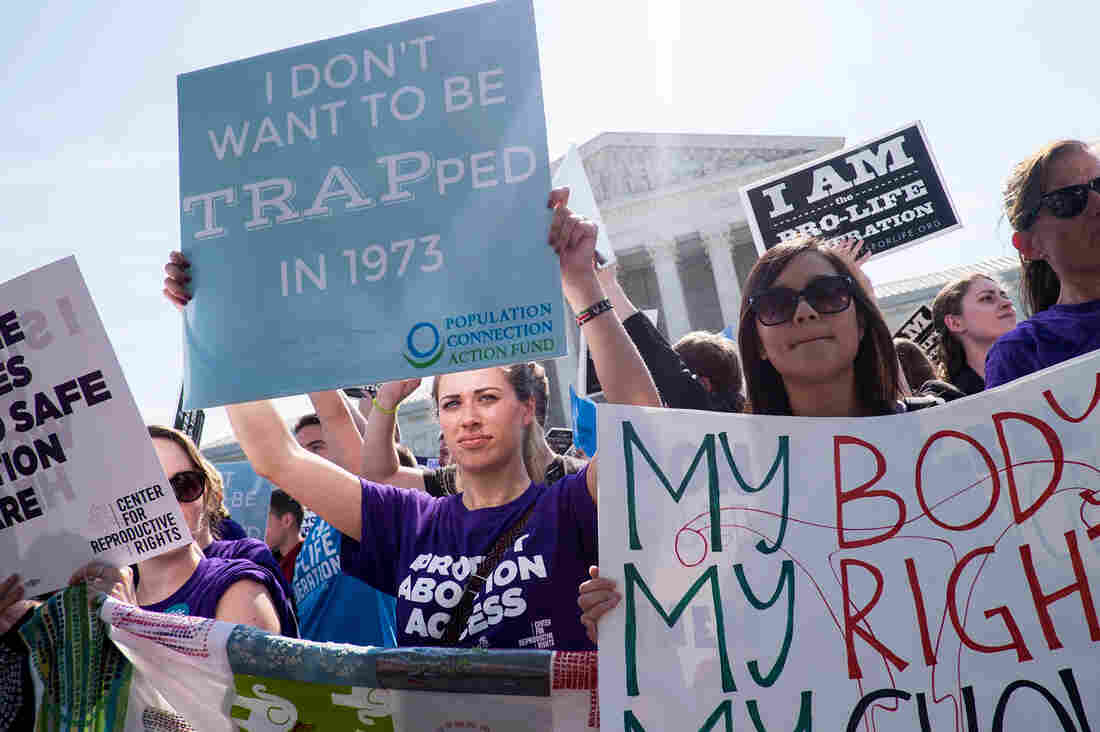
People await a decision outside the Supreme Court on June 27. The court struck down a Texas law restricting abortions. Pete Marovich/Getty Images hide caption

toggle caption

Pete Marovich/Getty Images

There’s no shortage of speculation about how the incoming Trump administration, whose appointees so far are staunch abortion opponents, might crack down on access to the procedure.

But reproductive rights groups say the big picture is getting lost: Women in large parts of the country already have limited access to abortion, due to hundreds of Republican-backed laws passed by state legislatures over the past half-decade.

“People are forced to travel hundreds of miles, cross state lines, miss work, lose wages and jeopardize their health and safety to obtain an abortion,” says Carrie Flaxman, an attorney with Planned Parenthood.

On Wednesday, Planned Parenthood joined the ACLU and the Center for Reproductive Rights in filing legal challenges to abortion restrictions, targeting laws in three states:

North Carolina. The lawsuit challenges a law banning abortion after 20 weeks of pregnancy, except in the case of a medical emergency. That is several weeks earlier than the generally agreed point of fetal viability, before which the 1973 Roe v. Wade decision says women have a constitutional right to abortion.

Article continues after sponsorship

Alaska. A four-decade-old restriction effectively bans second-trimester abortions in outpatient health centers. Abortion-rights advocates say for many women the only option would be to fly out of state, if they can afford it.

Missouri. Restrictions require doctors who perform abortions to have admitting privileges in hospitals, and clinics have to have the same health and safety standards as ambulatory surgical centers. Abortion-rights advocates say this has left the state with just one clinic that provides abortions.

The Missouri laws are similar to those in Texas that were struck down in a landmark Supreme Court ruling last June. Julie Rikelman, interim vice president of the Center for Reproductive Rights, says that precedent could help overturn the other restrictions as well. She says the ruling makes clear that states must consider whether a restriction actually benefits women’s health, and they must “look at real and credible evidence.” She says, “They can’t look at junk science.”

In the case of 20-week bans, abortion opponents often claim that fetuses can feel pain at that point, an assertion disputed by most medical research. That claim is not made in the North Carolina law.

Denise Burke, vice president of legal affairs for Americans United for Life, thinks that North Carolina’s 20-week ban will withstand this new challenge for another reason. An amendment that took effect this year set a stricter standard for exemptions, saying a woman can have the procedure after 20 weeks only if her life is in danger or there is a “serious risk of substantial and irreversible physical impairment of a major bodily function.”

“The plaintiffs are simply saying the exception [in the North Carolina law] is too narrow,” Burke says. But even if it’s overturned, she does not consider this a broad challenge to other such laws. “Texas’ 20-week abortion ban remains in effect, as do 20-week limitations in other states.”

Meanwhile, Burke says abortion opponents will continue to push for new restrictions. Texas this week announced it will soon require some aborted fetuses to be buried or cremated, not disposed of as medical waste. Courts have blocked similar measures in Indiana and Louisiana, but Burke says she expects that more states will propose versions of her organization’s Unborn Infants Dignity Act when lawmakers convene next year.

Burke notes that the Supreme Court ruling also said that health and safety standards can be constitutional if they show evidence of harmful conditions inside clinics that perform abortion. She says, “AUL is preparing a special project to present such evidence.”

As reproduction-rights groups launch more legal challenges, they have a new concern. By the time these cases wend their way up to the Supreme Court, President-elect Donald Trump may have appointed one or more justices to it. He has said he will make it a priority to choose people who would overturn the constitutional right to an abortion in Roe v. Wade.

“We know it is now at greater risk than it was before,” says Rikelman of the Center for Reproductive Rights. But the right to abortion “has stood the test of time and been approved by a variety of justices appointed by a variety of administrations.”

Let’s block ads! (Why?)

Obamacare's Test Kitchen For Payment Experiments Faces An Uncertain Future

Will a change in administration curtail experiments in how the government pays for health care? Hero Images/Getty Images hide caption

toggle caption

Hero Images/Getty Images

Joint replacements. Cardiac care. Chemotherapy.

What do those things have to do with the repeal of the Affordable Care Act?

Well, an often overlooked part of Obamacare is a test kitchen within the Department of Health and Human Services that experiments with new ways for the government to pay for some expensive and frequently used health care services, including those three.

But with the Affordable Care Act up for potential repeal, will Congress preserve the Center for Medicare & Medicaid Innovation, whose goals include lowering costs and improving quality?

Rep. Tom Price, an orthopedic surgeon who is President-elect Trump’s choice to run HHS, has been a vociferous critic of Obamacare and the Center for Medicare & Medicaid Innovation. In September, Price and other GOP lawmakers wrote to CMS officials asking that CMMI “stop experimenting with Americans’ health, and cease all current and future planned mandatory initiatives.”

Republican lawmakers have complained — along with some in the health care industry — that the law under the Obama administration gave too much authority to the head of HHS to create and expand projects. Now, however, that very same authority may look appealing as Republicans head the department and may want to use the center to test their own ideas, including those that would revamp Medicare or Medicaid.

“You can dislike that authority, until you have the opportunity to use the authority,” said Rodney Whitlock, a vice president at ML Strategies, a government consulting firm in Washington, D.C., and former Republican staff member of the Senate Finance Committee.

Article continues after sponsorship

As lawmakers debate and discuss ways to repeal the Affordable Care Act, they will weigh the fate of innovation center, funded through the health law with $10 billion for 2011 to 2019, and another $10 billion for each subsequent decade. The Congressional Budget Office estimates the center would increase federal spending initially, but ultimately result in lower costs and save up to $34 billion over the next 10 years.

Congressional Republicans haven’t yet hinted whether they will keep, modify or kill the program, but they generally support the cost-saving goal of the center and many observers think they will want to keep it.

“If health care providers can do a better job of delivering patient care … at the same or lower costs, that’s the kind of flexibility the system needs more of,” said Dr. Mark McClellan, a professor of health policy at Duke University who headed Medicare for two years in the George W. Bush administration.

One group that generally supports the broad cost-saving goal of the innovation center, nonetheless warned that Congress should place limits on it. Otherwise, “there is nothing preventing [the center] from testing a model … that includes all Medicare and/or Medicaid beneficiaries in the U.S,” the Healthcare Leaders for Accountable Innovation in Medicare said in a white paper. “In effect [the center] could test a model that completely restructures the Medicare or Medicaid program.”

Billions of dollars have already been spent by the center, testing a variety of ideas, from ways to improve care for at-home dialysis to ways to foster more collaboration between doctors and hospitals to efforts to reduce unnecessary hospital visits by chronically ill Medicare patients. Many of the projects look at ways to move from Medicare’s traditional fee-for-service payment system — that economists and policymakers say drive up costs — and instead set up reimbursement that rewards coordinated care. Few of the projects have been in place long enough for the center to determine if they truly save money and improve care.

Even if the center were eliminated, many experts say these types of payment reforms will continue because of private sector interest.

“Pay-for-value is going to be a guiding principle going forward irrespective of who is in power,” said Dan Mendelson, president and CEO of the consulting firm Avalere Health. “It would surprise me to see wholesale U-turn from that policy.”

To date, most of the programs funded by the innovation center are voluntary, but controversy has arisen over several recent initiatives that require participation by doctors or hospitals.

What may happen is that there will be fewer of these mandatory efforts. This year, one such project got underway, testing a method of “bundling” payments for joint replacements at 800 hospitals in 67 metro areas. For their Medicare patients, the project requires a single bundled payment to cover the cost of these procedures, including in-patient and post-operative care, instead of separate payments for each doctor, hospital or nursing home visit. A similar mandatory project for certain kinds of cardiac care has also been proposed.

In the end, the center’s future will be determined by whether the Republican majority believes it is one of the best ways to slow rising medical costs, said Christopher Condeluci, principal at CC Law & Policy in Washington, D.C., and the former tax and benefits counsel to the Senate Finance Committee.

“If the answer is yes, they will keep it and it might go to new heights,” Condeluci said.

But economist Joe Antos, a resident scholar at the American Enterprise Institute, doesn’t think the new administration – or many members of Congress – will push to use the center’s authority to create broad, mandatory nationwide experiments with Medicare.

“I can’t imagine a Trump administration saying we want the bureaucrats to decide on the health care your grandmother is going to get,” said Antos. “Anything that is that much of a marquee issue absolutely has to go through Congress.”

Kaiser Health News is an editorially independent news service that is part of the nonpartisan Henry J. Kaiser Family Foundation. Julie Appleby is on Twitter: @Julie_appleby.

Let’s block ads! (Why?)

It's Never Too Late to Quit Smoking, Even In Your 60s

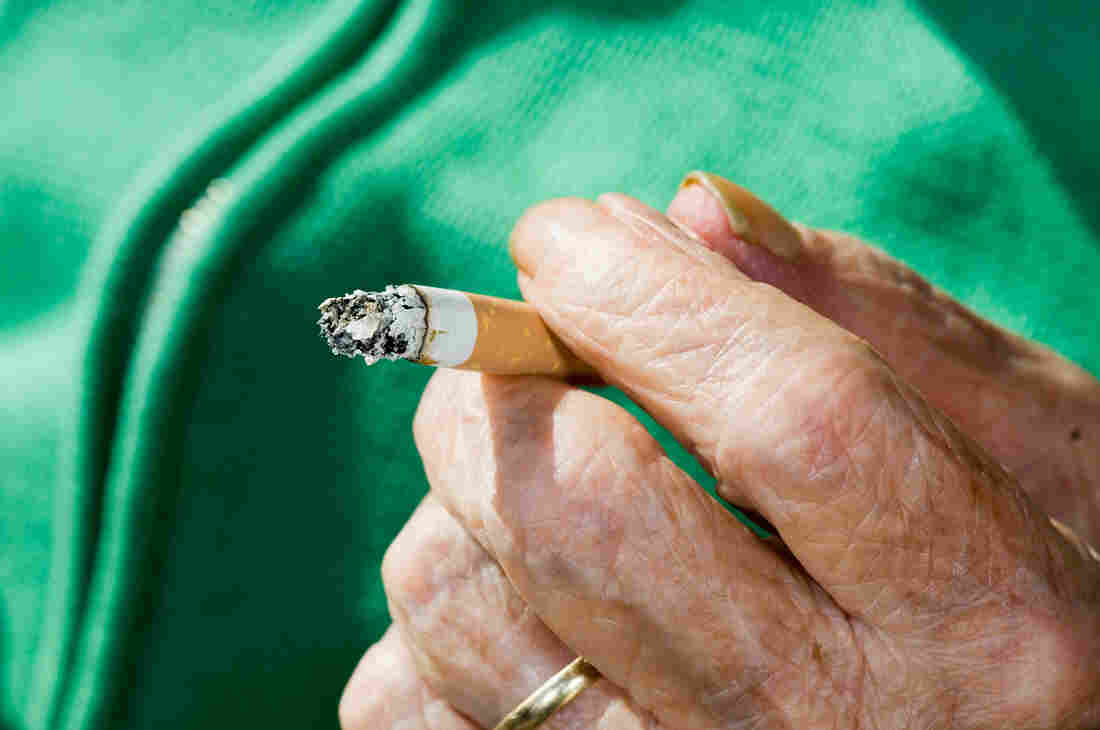
One more coffee, one more cigarette. One more morning, trying to forget. Bob Thomas/Getty Images hide caption

toggle caption

Bob Thomas/Getty Images

Older people who smoke may think there’s no reason to give up the habit. After all, hasn’t the damage to their bodies already been done?

But it turns out there’s a benefit to quitting even later in life. Research published Wednesday in the American Journal of Preventive Medicine finds that older adults who quit smoking in their 60s had a lower chance of dying in the years that followed than contemporaries who kept smoking.

“It’s never too late,” says Sarah Nash, an epidemiologist and one of the study’s authors.

The results are based on data from more than 160,000 participants older than 70 who were part of the NIH-AARP Diet and Health Study. Participants completed questionnaires about their smoking history in 2004 or 2005 and were tracked until the end of 2011 to see who had died.

The study found that it’s definitely best to avoid smoking entirely. During the follow-up period, 12 percent of participants who never smoked died, compared to 33 percent of current smokers. And the earlier people quit the better, but there was still a benefit even for late quitters. Of those who quit in their 30s, 16 percent died. In their 40s: 20 percent. In their 50s: 24 percent. And in their 60s: 28 percent.

Article continues after sponsorship

Still, people who quit in their 60s had a 23 percent lower risk of death during the study than current smokers, says Nash, who conducted the research while she was a fellow at the National Cancer Institute.

One limitation of the study is that the “current smoker” category included anyone who was smoking when they completed the questionnaire, which means it likely included people who went on to quit during the follow-up period. But if that happened to a significant degree, the true mortality gap between people who smoke and those who quit would only be larger.

The researchers also looked at deaths from smoking-related diseases, including lung cancer, heart disease and respiratory infections, and saw similar trends.

The research also reinforces the well-known point that it’s important to try to prevent people from picking up the habit in the first place. Most smokers start during their teenage years, according to the Centers for Disease Control and Prevention. And among current smokers, the earlier the study participants started, the higher their likelihood of dying during the follow-up period. Of those who started when they were younger than 15, 38 percent died, compared to 23 percent of those who started when they were 30 or older.

Until now there have been hints from other research, but no solid proof, that people in their 60s and 70s could benefit from quitting.

“Based on less substantial data, we’ve been telling the public that it’s never to late to quit, because it will benefit health and prolong life,” says Norman Edelman, a physician and senior scientific advisor to the American Lung Association who wasn’t involved with the study. Now, he says, he’ll have more concrete evidence to offer to patients, especially to older smokers who assume that the damage from years of tobacco use can’t be reversed.

Edelman says he gives the same smoking cessation advice to older smokers as to younger ones: Use a program (the ALA has its own, as does the American Cancer Society) in conjunction with pharmaceutical help, such as nicotine replacement products or prescription medications (such as Chantix or Zyban). Your odds of success are greater if you use both, he says.

He says older smokers should be sure to speak with their physicians about potential side effects of tobacco cessation medications.

Katherine Hobson is a freelance health and science writer based in Brooklyn, N.Y. She’s on Twitter: @katherinehobson.

Let’s block ads! (Why?)