Donald Trump speaks during an campaign event with employees at Trump National Doral, Tuesday in Miami. Evan Vucci/APhide caption
toggle caption
Evan Vucci/AP
Republican presidential hopeful Donald Trump seized on rising health insurance premiums Tuesday as evidence that “Obamacare is just blowing up.”
But the general manager of a Trump golf course in Florida corrected his boss for suggesting that Trump’s own employees would be personally affected.
“All of my employees are having a tremendous problem with Obamacare,” Trump told reporters during an appearance at the National Doral Golf Club in Miami. “What they’re going through with their health care is horrible because of Obamacare.”
In fact, the club’s general manager David Feder said “more than 95 percent” of the club’s employees receive health insurance through the company, so they’re not affected by the sharp premium increases on government-run exchanges.
The Obama administration announced this week that premiums for 2017 on those exchanges will increase by an average of 22 percent nationwide.
Trump called that number an understatement.
“That is such a phony number,” Trump said. “You’re talking about 60, 70, 80 percent in increases.”
Customers in some states will see increases in that range, but the premiums vary widely from state to state. The benchmark plan in Arizona will cost 116 percent more next year. Premiums in Indiana and Massachusetts are actually going down by about 3 percent.
The average increase of 22 percent nationwide follows much smaller increases of 7.5 percent this year and 2 percent in 2015. When Obamacare began, many insurance companies priced their policies too low and ended up losing money. Today’s premiums are roughly in line with what government forecasters initially predicted.
The administration notes that most people who buy insurance on the government-run exchanges receive subsidies, which could offset some or all of the price increase.
But Trump, like other critics of the Affordable Care Act, is not impressed.
“Obamacare has to be repealed and replaced,” Trump told reporters. “Otherwise, this country is in even bigger trouble than anybody thought.”
Trump’s health care plan calls for an expansion of Health Savings Accounts, which allow consumers to buy insurance with pre-tax dollars. He would also allow insurance companies to market their policies across state lines.
That would not necessarily help many of the 20 million people who gained health care coverage under the Affordable Care Act, pushing the nation’s uninsured rate to an all-time low.
The new rates for the Affordable Care Act were released, and they show an average 22 percent increase. Analysts say how people react to the price hikes will determine if the law succeeds.
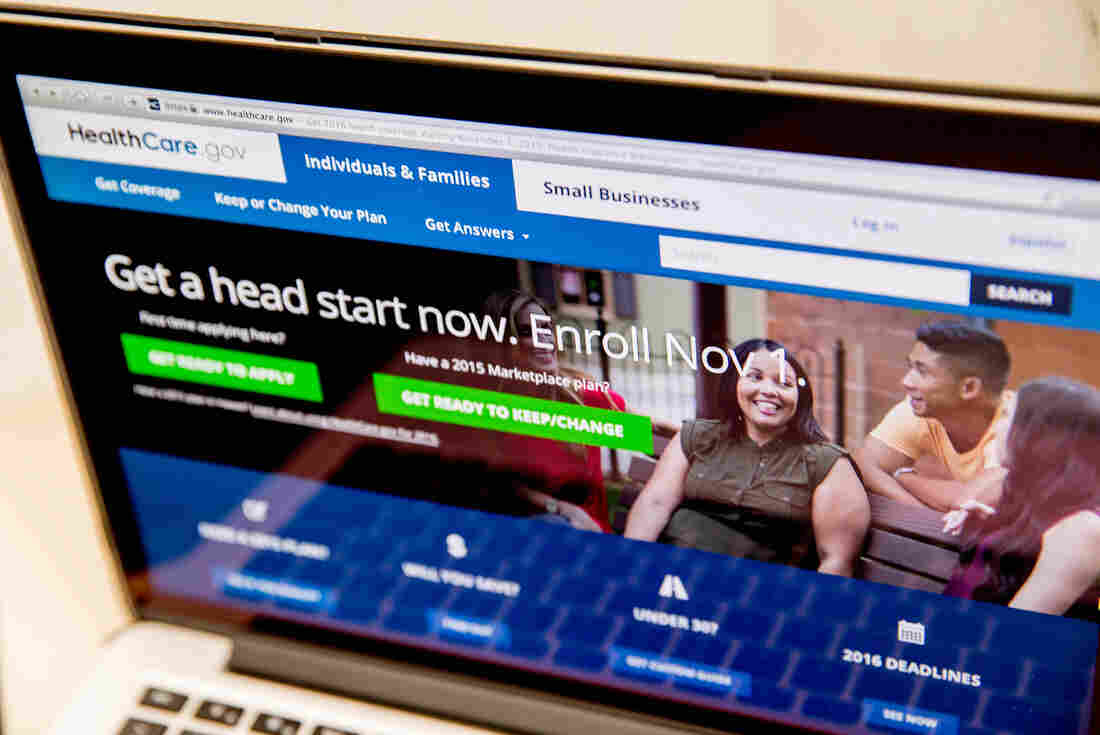
You can check HealthCare.gov for health insurance options and prices. Andrew Harnik/APhide caption
toggle caption
Andrew Harnik/AP
The cost of health insurance under the Affordable Care Act is expected to rise an average of 22 percent in 2017, according to information released by the Obama administration Monday afternoon.
Still, federal subsidies will also rise, meaning that few people are likely to have to pay the full cost after the rate increases to get insurance coverage.
“We think they will ultimately be surprised by the affordability of the premiums, because the tax credits track with the increases in premiums,” said Kevin Griffis, assistant secretary for public affairs at the Department of Health and Human Services.
During a media briefing Monday, Griffis said the 2017 rates are roughly at the level the Congressional Budget Office forecast when the law was proposed. “The initial marketplace rates came in below costs,” he said. “Many companies set prices that turned out to be too low.”
Enrollment opens Nov. 1. For coverage effective Jan. 1, people need to pick a plan by Dec. 15. With a few exceptions, the last day to sign up for Obamacare is January 31, 2017. Plans are available on HealthCare.gov and state-run exchanges.
While the average premiums on the benchmark health plans are increasing, the government says more than 70 percent of people buying insurance on the marketplaces created by the law could get a health plan for less than $75 a month for 2017. To get the best deal, people would have to pick a low-cost plan with limited benefits and take advantage of all the subsidies available.
People who already have coverage through the exchanges can often save money by switching plans, the administration said. More than three-quarters of people could save money by switching to the lowest-cost plan within the level of coverage, such as bronze or silver, that they’ve previously selected.
The Obamacare insurance exchanges are under strain after three major insurers pulled back from offering coverage in markets across the U.S. The administration says about 1 in 5 people buying insurance through the marketplaces will have only one company offering coverage.
It’s in places like that where consumers will feel the most pain. “Where it really matters is where a big insurance company has exited and where that’s going to leave just one company remaining,” said Cynthia Cox, associate director of health reform and private insurance at the Kaiser Family Foundation. “For those people who live in that area, many people may have to switch plans. And they won’t have much choice if they want to receive financial assistance and purchase through the exchanges.”
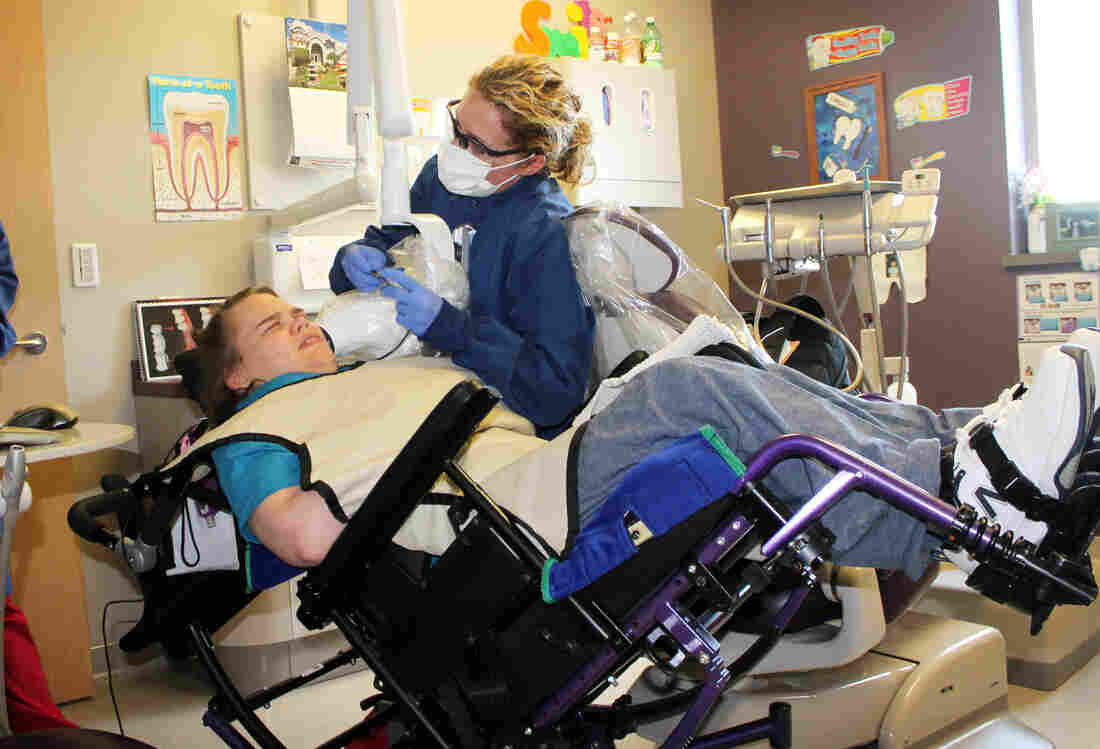
Beth Rown (right), a dental hygenist who cares for patients with special needs, cleans Lindsay Klecker’s teeth. Alison Kodjak/NPRhide caption
toggle caption
Alison Kodjak/NPR
At the Marshfield Clinic dental center in Chippewa Falls, Wis., hygienist Karen Aslinger is getting her room ready. It’s all quite routine — covering the chair’s headrest with plastic, opening instruments, wiping down trays.
But then she starts getting creative.
“My next patient is pretty tiny and frail, so I like to go to oral surgery and get a heated blanket. I wrap her up, and I think it soothes her,” Aslinger says.
The patient is 16-year-old Kathy Falk. She suffers from Rett syndrome, which is a genetic disorder with a constellation of symptoms that look like cerebral palsy, Parkinson’s, anxiety and autism all wrapped up together. She uses a wheelchair, can’t speak and would find it difficult holding her mouth open for long stretches.
Kathy’s parents lift her from her wheelchair into the dental chair. Aslinger swaddles her in the warmed blanket and fits her with tiger-striped sunglasses to block the glaring light. She narrates the entire cleaning, telling Kathy everything she’s about to do, interspersed with words of encouragement.
“She’s challenging to get the toothbrush in here and we can only ask so much, you know; whatever she tolerates,” Aslinger says as she’s bent over Kathy with an electric toothbrush. “You’re doing the best you can.”
For someone with severe disabilities like Kathy, Aslinger and this clinic are quite a find. They welcome patients with all kinds of physical and behavioral disabilities.
People with disabilities are often insured through Medicaid, the federal health care program for the poor and disabled. The program doesn’t always pay for dental care, and when it does, those payments often fall short of the costs.
That means it can be hard to find a dentist willing and able to do the work.
Dentists and hygienists at the Marshfield clinic take people with Medicaid and people without any insurance. They specialize in caring for people with disabilities who need extra help to get through a checkup and cleaning. Some patients with autism may be afraid of lights, sounds or touch. Some with physical disabilities may be unable to hold their head in place.
“I have a patient who comes in, and before she gets in the chair we read some books, and then she gets a little calmer and stops crying and we can do a little more of the cleaning,” Aslinger says. The patient is in her 30s.
A patient with Down syndrome was so frightened that Aslinger started off cleaning his teeth in the lobby. Each appointment moved closer to the treatment room, until finally she convinced him to get into the chair.
The work is also quite physical, says Beth Rowan, another hygienist at the clinic who cares for special needs patients.
She’s down the hall from Aslinger, cleaning the teeth of Lindsay Klecker, a 31-year-old woman with cerebral palsy and a seizure disorder. Lindsay is blind and uses a wheelchair. Her mother says she functions at the level of a toddler.
Rowan leans over Lindsay, working to floss her teeth while her mother stands at her head, singing to her throughout the cleaning.
Sandra Klecker sings to her daughter Lindsay to help her stay calm through the cleaning. Alison Kodjak/NPRhide caption
toggle caption
Alison Kodjak/NPR
“It’s hard on your body; they’re strong,” Rowan says. “They’re pulling and tugging, their head is strong, their lips are strong, their tongue is strong.”
For invasive procedures like fillings or root canals, the dentists at the Marshfield clinic go across the street to St. Joseph’s Hospital, where patients can be treated in an operating room under full anesthesia.
“There’s a certain percentage of the population that absolutely requires having anesthesia for their dental care to be safe,” says John Morgan, a professor in the division of special care at Tufts University School of Dental Medicine. Tufts runs a chain of clinics across Massachusetts that cares for people with disabilities.
Morgan is lead author of 2012 study published in the Journal of the American Dental Association that shows that people with disabilities have worse oral health than the general population.
“Access to dental care is one part of the issue, but there’s also the issue of what happens at home; what can be done to help improve maintenance of oral health in the home environment,” Morgan says.
Kathy’s mother, Arla Falk, says they tried several dentists before finding the clinic in Chippewa Falls. It’s 45 minutes from their home, and they come four times a year.
“To have a dentist who would be willing to take medical assistance is a challenge,” she says. “We’ve been to several with her. One of them didn’t even want to take her on or keep her as a patient.”
Three of the Marshfield clinics specialize in serving people with disabilities, and they serve more than 1,700 patients with disabilities a year.
“We do have patients that come as far as three, four hours away for a cleaning appointment or for their initial appointment,” Rowan, the hygienist, says. “Then they’ll have their one to two hours of care and they’ll have to drive back, because there isn’t anything in their surrounding area.”
Two years ago, the only clinic in Madison, Wisconsin’s capital, that provided dental care under anesthesia shut down because the hospital, Meriter UnityPoint Health, said it was losing more than $600,000 annually on providing dental care. It reopened this month under an agreement with two other hospitals in the city to share costs.
While the clinic was closed, Meriter officials referred the patients to the University of Minnesota, four hours away.
“We do receive patients who come to us from Wisconsin; also from the Dakotas and parts of Iowa as well,” Karp says. “There are not a lot of resources and obviously, you do need to travel larger distances to find those resources.”
Karp has a grant to identify hospitals, clinics and dentists across the country that care for people with disabilities. The goal is to create networks of providers who have a commitment to providing dental care to people with disabilities despite the cost.
Greg Nycz, executive director of the dental clinics in the Marshfield Clinic network, says they get most of their costs reimbursed by Medicaid through a special provision that allows clinics that cater only to the poor to get bigger reimbursements than regular dentists.
But St. Joseph’s Hospital and two others that Marshfield works with don’t benefit from that. “Because we only have poor patients and patients on public assistance, this is a sacrifice for these hospitals,” Nycz says. He says he’s angry that large for-profit hospitals often won’t make the same commitment.
Back at the clinic in Chippewa Falls, Kathy Falk has had enough. She’s becoming agitated and gurgles a bit. Aslinger finishes up.
“We are all done with the cleaning,” Aslinger says. “Ah, we got toothpaste everywhere, didn’t we?”
Down the hall, Rowan compliments Lindsay Klecker’s mother, Sandra.
“You are doing such a great job caring for her teeth,” she says. “She’s lucky to have had them as long as she has.”
When Dr. Rishi Manchanda worked in a clinic in South Central Los Angeles, he saw that patients were getting sick because of toxic living conditions — so he tried a unique treatment approach.
About Rishi Manchanda
Rishi Manchanda is a physician and public health innovator. He aims to reinvigorate primary care by teaching doctors to think about and treat the social and environmental conditions that often underlie sickness.
Ocean advocate Emily Penn has seen first hand how much plastic ends up in the oceans. She explains how the toxins from plastic makes their way into our food chain and how we might be able to stop it.
About Emily Penn
Emily Penn is an ocean advocate and director of Pangaea Exploration, which helps scientists, filmmakers and everyday people visit the most remote parts of our planet. Emily is the youngest and only female recipient of Yachtmaster of the Year, awarded by HRH Princess Royal.
Neuroscientist Jeff Iliff talks about his research, which explores how the brain naturally flushes out toxins during sleep.
About Jeff Iliff
Neuroscientist Jeff Iliff is an Assistant Professor of Anesthesiology and Perioperative Medicine at Oregon Health & Science University. Iliff was a part of a University of Rochester Medical Center team that discovered a brain cleansing system, which they dubbed the “glymphatic system.”
A government watchdog’s report says Flint residents’ exposure to lead in city drinking water could have been stopped months earlier by federal regulators. Carlos Osorio/APhide caption
toggle caption
Carlos Osorio/AP
The Environmental Protection Agency had the authority and information to issue an emergency order protecting residents of Flint, Mich., from lead-tainted water a full seven months before it did so, an EPA internal investigation has concluded.
By June 2015, the EPA regional office “had information that the city of Flint exceeded the lead level at which corrosion control is required, and that Flint was not using a corrosion inhibitor.” It also knew that testing showed high levels of lead in at least four homes. Finally, the regional office “knew that the state and local authorities were not acting quickly to protect human health.”
That is enough to issue an emergency order, the report says. Such action “could have required the city and state to provide alternative water supplies to affected residents, study the extent and severity of lead contamination within the water system, or immediately begin corrective actions to reduce and eliminate lead contamination in the drinking water system.”
And yet, the EPA did not issue an order until January 2016. According to the report, local authorities “believed that the state of Michigan’s actions to address the Flint situation barred formal federal action.” But that was incorrect – the Safe Drinking Water Act states that the EPA can take action if “state actions are deemed insufficient.”
The watchdog’s report concludes that the agency “needs to clarify for its employees how its emergency authority can and should be used to intervene in a public health threat.”
The EPA is among the people and groups under fire for the slow response to Flint’s lead-laced water. An independent task force concluded earlier this year that a state environmental agency called the Michigan Department of Environmental Quality bears primary responsibility, though others are also to blame.
The problem began when Flint switched to a new water source in 2014 for cost reasons. But water from that new source, the Flint River, was not adequately treated with corrosion controls and caused lead from the city’s pipes to leach into the drinking water supply. And as we’ve reported, the city switched back to its original water supply late last year, but it was too late to reverse the damage to the pipes.
The city is in the process of treating its water system and recent test results show that lead levels have improved.
High levels of lead are especially dangerous for children and can cause “learning disabilities, behavioral problems and mental retardation,” the World Health Organization said.
Catching up on the lead crisis in Flint? Our timeline takes you through how the public health disaster unfolded, step by step.
President Obama traveled to Florida Thursday to encourage more people to sign up for Obamacare when the enrollment window opens next month. The president’s signature health care law has helped cut the uninsured rate to record lows. But it’s showing some cracks, and many young people are reluctant to sign up.