Will A Study Save Victims Of Violence, Or Gamble With Their Lives?

An ambulance pulls out of the emergency entrance at Temple University Hospital in North Philadelphia. Brad Larrison for NewsWorks hide caption

toggle caption

Brad Larrison for NewsWorks

Dr. Zoe Maher has never been busier. In addition to being a trauma surgeon and a new mom, she’s spent the last year and half talking to hospital patients and community groups across Philadelphia about a study she’s confident will save more adult gunshot and stab wound victims.

On a recent Saturday morning, Maher stood before a dozen members of a North Philadelphia neighborhood association to walk them through the specifics of the Philadelphia Immediate Transport in Penetrating Trauma Trial. At the heart of the study is a simple but counterintuitive idea. For patients who are potentially bleeding to death, Maher and her colleagues say, just basic care is better until they reach the hospital.

To test this, patients in the study would get different medical attention based on the dispatch number city paramedics receive – what’s called a randomized study.

“It’s like the flip of a coin if patients are getting advanced or basic,” said Maher, who works at Temple University Hospital.

Odd numbers will get what’s called advanced care, which is what the majority of patients transported by paramedics get now. It includes inserting a breathing tube or supplying intravenous fluids.

Even numbers will get what’s known as basic care, which can include hemorrhage control, breathing assistance with a bag-valve mask, dressing wounds and aligning bones. They would then be immediately transported to the hospital.

But the idea of assigning types of care randomly got mixed reviews at the community meeting in North Philadelphia.

Joanne Taylor was wary, but, like nearly everyone in the room, she has first-hand experience with gun violence. She said she is mourning a husband, son, grandson and cousin, so she’s willing to support anything that may save more lives.

“It shakes me up a little bit, but I know something has to be done somewhere,” said a teary-eyed Taylor afterwards.

Dr. Zoe Maher interviews a shooting victim at Temple University Hospital for a citywide study of care of violent trauma victims. Emma Lee/WHYY hide caption

toggle caption

Emma Lee/WHYY

Others had more trepidation.

“In the interim, you’re still sacrificing people, somebody,” said Charles Lanier.

Yanitza Gonzalez, a staffer with City Councilwoman Maria Quinones-Sanchez, nodded from across the room.

“It almost seems like we’ll be gambling with people’s lives,” said Gonzalez.

Community buy-in is key for Maher. She wants to tell as many people about the study before patients are enrolled, potentially this fall, and she told them residents can opt out.

Maher has heard the gambling response before, but she’s convinced that her study is closer to a sure thing. She said previous research has proven as much, and that her trial is just about confirming those results.

The study would look only at use of IV fluids and breathing tubes, explained Maher.

That’s because if someone is shot or stabbed and bleeding to death, the body instinctively tries save itself by constricting blood vessels and forming clots. For those clots to stick, the body needs to maintain a lower-than-normal blood pressure. IV fluids can raise a patient’s blood pressure and potentially cause more internal bleeding.

Maher said a breathing tube could also be problematic and cardiopulmonary resuscitation or CPR is a better option because it keeps more blood moving from the heart to the rest of the body.

On average, about 30 percent of patients who would qualify for this study die. If basic care becomes the norm for paramedics in Philadelphia, Maher says the rate could get down to roughly 20 percent. In a city that routinely records 250-plus murders each year, that could potentially mean a lot of lives being saved.

Dr. Brent Myers, president-elect of the National Association of EMS Physicians, said that would be a big deal for medical professionals, especially paramedics.

“This has been one of the great questions, is how much advanced life support is beneficial for victims of penetrating trauma. You could probably go to any paramedic in any city in the United States and engage in a debate, because we just don’t have the appropriate evidence to guide the decision,” said Myers.

It’s part of why Myers said he wouldn’t expect a lot of grousing from paramedics, even though it will effectively dictate what they do in the field.

Dr. Amy McGuire, a medical ethicist at Baylor University in Texas, said while the study does carry some risk for patients, there’s nothing inherently unethical it.

“The only way to really know whether this is better or not is to do a randomized trial and to compare it to what is currently the standard of care,” McGuire said.

Where she does see some moral gray area is in the community outreach piece of the trial. It’s impossible for everyone in the city to know about the study before it gets underway.

“They’ll be enrolled in the study, and they may not have wanted to have participated,” said McGuire.

Every resident in Philadelphia is a potential enrollee in the study, all 1.5 million people. But residents can choose to not participate. They would get a wristband that they’d have to wear for the duration of the study, which is expected to last five years, maybe more.

Researchers hope to enroll roughly 1,000 patients, half of whom would get advanced care, half would get basic care. Anyone who is under 18, pregnant or a prisoner will be excluded.

Maher said the study would end early if it’s clear that one kind of care is doing more harm than good.

“All of the evidence points to us being right, but if we are wrong, we will not complete the study,” said Maher. “We surely don’t want to hurt anyone.”

Every trauma center in the city is participating. That includes: Temple University Hospital, Hospital of the University of Pennsylvania, Hahnemann University Hospital, Thomas Jefferson University Hospital, Albert Einstein Medical Center, Aria Health Torresdale, and City of Philadelphia Fire Rescue.

This story is part of a reporting partnership with NPR, WHYY’s health show The Pulse and Kaiser Health News.

Let’s block ads! (Why?)

Fall Enrollment Efforts Could Be Pivotal For Federal Health Law

Secretary of Health and Human Services Sylvia Burwell at a Senate hearing in 2014. “We expect this to be a transition period for the marketplace,” she told reporters Wednesday. “Issuers are adjusting their prices, bringing them in line with actual data on costs.” Alex Wong/Getty Images hide caption

toggle caption

Alex Wong/Getty Images

Rate hikes are likely on the way for insurance plans issued under the Affordable Care Act, health policy analysts say. Consumers’ out-of-pocket costs are expected to climb in 2017 and some major insurers have signaled they are pulling out of the health insurance exchanges in a number of states.

In a meeting Wednesday with reporters and representatives of groups working to increase enrollment in the health plans, Department of Health and Human Services Secretary Sylvia Burwell acknowledged that the Affordable Care Act’s fourth enrollment season — scheduled to begin Nov. 1 and run until Jan. 31 — is a pivotal time for the federal health law.

“Building a new market is never easy,” she told the group at HHS headquarters. “We expect this to be a transition period for the marketplace. Issuers are adjusting their prices, bringing them in line with actual data on costs.”

Burwell’s comments foreshadow the higher premiums expected when federal officials release details on the health plans to be offered on HealthCare.gov for 2017. Those details are likely to come just days before a presidential election that could determine whether the ACA is repealed or revamped.

While the health law hasn’t been a central issue in the current election season, it has been at the center of a bitter battle between political parties since it was passed in 2010. The House of Representatives has voted more than 60 times to repeal all or part of the measure. The law has survived some court challenges and faces others.

Burwell noted those fights Wednesday when talking about issues that arose in the law’s implementation. “It also hasn’t helped,” she said, “that at nearly every turn, we’ve had to overcome partisan attempts to repeal and undermine the law through legislation and litigation.”

Enrollment in the state and federal marketplaces is expected to grow by about a million people next year — from about 12.7 million to 13.8 million, according to federal estimates released Wednesday. The number of consumers who actually pay premiums and stay in the market is expected to average about 10.5 million per month in 2016 and about 11.4 million per month in 2017.

Consumers flow in and out of ACA plans because they change jobs, get coverage from other sources and face other factors that affect where and how they enroll in health insurance, including affordability. About 9.2 million of the 13.8 million people who now have ACA coverage are expected to reenroll, according to HHS.

This year, Burwell said, health officials working to increase insurance coverage among the uninsured are intent on making the enrollment process faster and simpler, and will particularly focus on signing up healthier consumers – including people between the ages of 18 and 34, who tend to have fewer ailments. They will also remind consumers of the penalty for not having coverage, which for adults in 2016 is $695 or 2.5 percent of income, whichever is higher. The flat penalty will be adjusted for inflation in 2017.

Federal officials are also focusing enrollment efforts on the 5.1 million Americans who are eligible to purchase health care coverage on the exchanges but buy it elsewhere, according to HHS figures. Of that group, 2.5 million people could be eligible for the law’s financial assistance if they sign up for coverage during open enrollment, which ends Jan. 31.

The outcome of the November elections may well determine the future of the ACA. Republican presidential nominee Donald Trump has promised to repeal and replace the law, while Democratic nominee Hillary Clinton has said she wants to fix the law, making it more affordable for consumers who don’t qualify for subsidies, yet struggle to afford coverage.

Burwell called on Congress to work with her and the Obama administration to make needed changes to the law. “To make more substantial changes — like a public option to encourage competition — we’ll need cooperation from Congress,” she said. “And we are hopeful that soon, we’ll see more bipartisan efforts to make improvement.”

Bipartisan cooperation isn’t likely to happen until the next Congress meets, if then. Much will depend on the outcome of the presidential and congressional elections – on who is in power and whether GOP leaders think the ACA is still a potent political issue, as well as on how willing Democrats are to make changes that appeal to Republicans.

Mary Agnes Carey reports for Kaiser Health News, an editorially independent news service that is part of the nonpartisan Henry J. Kaiser Family Foundation.

Let’s block ads! (Why?)

Emergency Room Use Stays High In Oregon Medicaid Study

Although expanding Medicaid in Oregon didn’t drive down the recipients’ overall use of hospital emergency rooms, the state has seen a decline in avoidable use of ERs by 4 percent in the past two years, according to state statistics. Paul Burns/Getty Images hide caption

toggle caption

Paul Burns/Getty Images

Will Medicaid expansion save the country money as people stop using expensive emergency rooms for primary care?

Not yet, suggest the latest findings from a landmark study published online Wednesday in the New England Journal of Medicine.

The study of Medicaid patients in Oregon who got Medicaid in 2008 found their ER use stayed high two years after they gained the health insurance coverage — even as they also increased their visits to doctors’ offices.

All eyes have been on Oregon to answer this question about ER use because, eight years ago, the state tried an experiment. It wanted to expand Medicaid, but it didn’t have the money to cover every eligible resident.

So it held a lottery to give coverage to as many people as possible, in the fairest way possible. The result was something of a gift to researchers like Bill Wright, director of the Providence Center for Outcomes Research and Education.

Bill Wright, one of the authors of the study, called the results “a surprise to a lot of folks.” Kristian Foden-Vencil/Oregon Public Broadcasting hide caption

toggle caption

Kristian Foden-Vencil/Oregon Public Broadcasting

“You couldn’t do this as a researcher,” Wright says. You couldn’t design a study that randomly gave some people insurance, but not others. It wouldn’t be ethical to leave some people without coverage just to have a control group.

“As a researcher,” Wright says, “you don’t want to put someone in that position, just to study it.”

But, since Oregon was already conducting the insurance lottery, that offered an invaluable chance to study the differences between people who have Medicaid insurance and similar people who don’t.

It was the first randomized study on the impacts of health insurance, and it’s one of the largest, surveying about 25,000 people.

The study’s first findings, published a few years ago, showed that Medicaid was beneficial in many ways. It improved people’s financial security. They went to the doctor when they were sick. And having the insurance correlated with a drop in rates of depression.

“These are all things that are really important benefits of Medicaid expansion,” says Wright.

But the study also found Medicaid enrollees increased their emergency room visits by 40 percent over the first 15 months.

“That was a surprise to a lot of folks,” says Wright.

It was widely believed that having insurance would encourage people to get routine medical care in doctors’ offices or clinics, instead of waiting until they have more serious symptoms and have to head to the ER, where care is most expensive.

After those early findings were published, health care analysts scrambled to explain why the number of ER visits didn’t decline. Some thought it was a reflection of pent-up demand from people who hadn’t seen a doctor in years because they didn’t have insurance.

Others thought some of these newly insured patients simply hadn’t yet had time in that first 15 months to establish a relationship with a primary care doctor. As more time passed, that theory suggested, and more patients had primary care providers, their reliance on emergency rooms would drop.

But Wright, one of the study’s authors, says he and his colleagues have now studied two years of data — and that’s not what they’re finding.

“There was no sign that this [ER] use went down,” he says. “So this idea of pent-up demand sort of fading away — at least in the first couple of years, it didn’t happen.”

Quite the opposite.

“If your hope is that, in the short term — the first couple of years — you’re going to see savings that come out of reduced [ER] use from Medicaid expansion alone, I don’t think I’d be super optimistic about that,” Wright says. “I think that it is going to cost money in the short term.”

However, there may be savings in other areas, he says, like an increased use of preventive services that could stave off problems that would become more expensive later.

And, Leslie Clement, with the Oregon Health Authority, says over the past two years, Oregon has seen avoidable use of emergency rooms drop by 4 percent.

That’s because the state is now coordinating care better, she says, by doing things like helping people get to their doctors’ appointments and take their medication.

“It is not just a ‘open up coverage and let people used health care services as they have done historically,’ ” she says. “It’s reforming that system.”

The researchers won’t be able to tease much more information out of what’s come to be known as the Oregon Health Insurance Experiment — the experiment had to stop once the state expanded Medicaid fully under the Affordable Care Act.

This story is part of NPR’s reporting partnership with Oregon Public Broadcasting and Kaiser Health News.

Let’s block ads! (Why?)

Small Savings For Drugs Made To Mimic Biotech Blockbusters

A patient with Crohn’s disease receives an IV infusion of Remicade, or infliximab. Dr P. Marazzi/Science Source hide caption

toggle caption

Dr P. Marazzi/Science Source

Generic drugs generally cost 80 percent less than brand-name drugs, so hopes were high when a law enacted in 2010 paved the way for competition among the highest-priced drugs of all, known as biologics.

But, as these competing drugs start to appear on the market, consumers aren’t reaping a windfall.

On Monday, Pfizer said it would start selling Inflectra, its version of the blockbuster rheumatoid arthritis drug Remicade, in late November. But Inflectra, the second so-called biosimilar set to hit the market, isn’t exactly a steal.

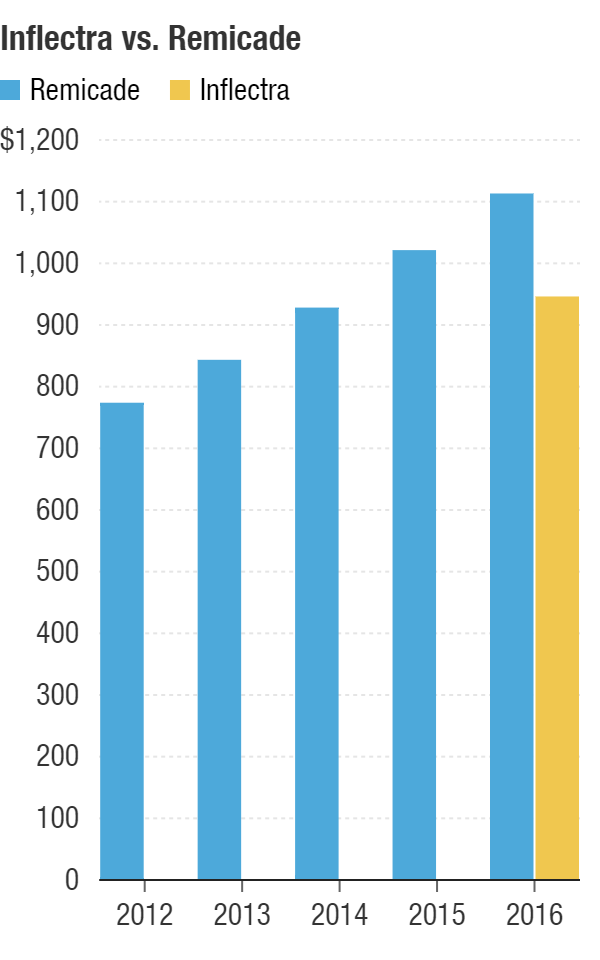
Note: Chart shows the highest annual price, according to wholesale acquisition cost, for a vial containing 100 milligrams of powder for preparing an intravenous solution. Truven Health Analytics hide caption

toggle caption

Truven Health Analytics

The wholesale acquisition cost (a benchmark price in the drug industry) for Inflectra is $946 a vial, only 15 percent off $1,113 for a comparable vial of Johnson & Johnson’s Remicade, according to data from Truven Health Analytics. (The WAC price doesn’t reflect rebates drugmakers typically offer.)

Early indications are that the prices for these substitute medications will only lop 15 or 20 percent off the price, said Dr. Mark McClellan, director of the Duke-Margolis Center for Health Policy, at a Tuesday meeting in Washington, D.C.

That discount is a far cry from the one for standard generic drugs, McClellan said at a forum hosted by Duke and Friends of Cancer Research. “On the other hand, 15 to 20 percent of a very big price – a very large number — is still a big number.”

Steady price increases for Remicade mean that Inflectra, even at a 15 percent discount, will cost about what Remicade did in 2014.

Pricing this new class of drugs is just one challenge. Drugmakers will also have to persuade consumers and physicians that they are every bit as good as the drugs they would replace. Because these biotech drugs are similar but not identical to the brand-name medicines they mimic, pharmacists generally are restricted from substituting one for the other automatically, unlike most traditional generics.

The case for biosimilars as these new medicines are sometimes called isn’t quite as straightforward as it is for standard generics. Typical drugs are simple molecules, so generic versions can be built atom by atom to be identical with the original.

These new “biologic” drugs are complex biological molecules. These drugs are produced in living cells. As a result, even the brand-name drugs vary a bit from batch to batch. The generic versions of these drugs, known as biosimilars, also vary. The Food and Drug Administration considers them essentially the same as the original drug, as long as their variations fall into the same range as the brand-name biologics.

So far, scientists have found no meaningful differences between these drugs and their mimics. Europe, which is a decade ahead of the United States in developing these drugs, has gathered 400 million patient life-years of data (which, for example, would be studies of 40 million people for 10 years), and hasn’t identified any safety issues, said Emily Alexander, senior director for biologics strategic development at drugmaker Abbvie.

The latest reassuring data, announced at a meeting Tuesday in Vienna, Austria, come from a government-funded study in Norway of 481 patients, half of whom switched from brand-name Remicade to another biosimilar called Remsima. After a year of follow-up, there was no meaningful differences between the two groups (though there were nonsignificant findings that provided potential fodder for skeptics).

In Europe, governments have a big hand in deciding which drugs are made available to patients in government-sponsored health systems. The system in the United States is a much more complicated picture, involving patients, doctors, insurance companies, middlemen and government providers such as Medicare. Doctors, in particular, have a big voice and will need to be convinced that the substitutes are just as good as the original drugs.

For example, doctors routinely prescribe Herceptin to treat certain forms of breast cancer. Dr. Richard Schilsky, senior vice president and chief medical officer of the American Society of Clinical Oncology, said a competitive product was shown to be at least as good as the original drug in a study that measured the likelihood that a woman taking the drug would suffer a relapse. But Herceptin has a 25-year-history that looks not only at relapse rates, but at long-term survival and other significant endpoints.

“At what point does the doctor and the patient have the confidence to make that switch” to the substitute brand, Schilsky asked at the meeting in Washington.

A patient may or may not see any savings, given the convoluted system of insurance and medical reimbursement in this country.

And the doctor may have a financial incentive to opt for the more expensive drug, including some cancer drugs. Currently, Medicare bases some payments to doctors on the price of chemotherapy drugs, so doctors make more when they prescribe more expensive drugs, Schilsky noted. (He said his organization is trying to change that payment system).

Time is running short to sort out all these issues. Leah Christl, at the FDA’s Center for Drug Evaluation and Research, says that as of Oct. 5, the agency is processing 66 projects involving biosimilar drugs, which are potentially substitutes for 20 existing medications. Four products have already been licensed, though only one, Sandoz’s Zarxio, is currently on the market, she said. Inflectra will be the second.

These applications all result from the 2010 law called the Biologics Price Competition and Innovation Act. It remains to be seen whether the hoped-for price competition will make a significant dent in American health care costs.

Let’s block ads! (Why?)

Who Will Be The Next Leader Of WHO?

One of these candidates will be the next head of WHO. Top row from left: Tedros Adhanom Ghebreyesus, Flavia Bustreo, David Nabarro. Bottom row from left: Miklós Szócska, Sania Nishtar, Philippe Douste-Blazy. Getty Images, AP and WHO hide caption

toggle caption

Getty Images, AP and WHO

Who will be the World Health Organization’s next director-general? In September, the U.N. agency announced the six nominees, four men and two women, ranging from a cardiologist from Pakistan to a former punk rocker from Hungary. Over the next few months, WHO member-states will whittle down the list to one final candidate, who will succeed the current director, Dr. Margaret Chan, in July 2017.

In a series of interviews this month published by The Lancet, the candidates outlined their health priorities. For the most part, they’re on the same page: They want WHO to mount faster and more effective responses to epidemics and humanitarian emergencies, to address the impact of climate change on health, and to deal with the threat of antimicrobial resistance.

But they definitely bring different skills and experience to the table. Here’s a brief look at each contender:

Flavia Bustreo, Italy

The doctor and epidemiologist is currently the assistant director-general for family, women’s and children’s health at WHO. Before that, she ran the agency’s maternal, newborn and child health program.

“As the only WHO internal candidate, I bring in-depth management experience and extensive knowledge of the organization — the pitfalls and dynamics and the strengths and weaknesses — and have driven reforms and innovation, mainstreaming of gender, equity, and human rights across the entire organization,” she told The Lancet.

Her official WHO bio takes note of her lingual skills: Bustreo speaks five languages: English, French, Spanish, Portuguese and Italian and has studied Arabic and Russian.

Philippe Douste-Blazy, France

Douste-Blazy, the under secretary-general of the U.N., was the former French minister of health and minister of foreign affairs. And he founded UNITAID, the U.N. agency that helps reduce the cost of HIV/AIDS, TB and malaria meds by raising funds in creative ways, like convincing airlines to donate to the cause by adding $1 to tickets.

While he says those jobs have given him skills in diplomacy, politics and innovation, a job from his home region of France has taught him a lot, too.

“As a former mayor of Toulouse, I have managed an annual budget of $1.5 billion and 30 000 employees, comparable to the budget and exceeding the workforce of WHO. I will bring strong administrative and management experience to this role,” he told The Lancet.

This year, he’s a visiting professor at Harvard, teaching global health at the T.H. Chan school of public health.

Tedros Adhanom Ghebreyesus, Ethiopia

Currently the Ethiopian minister of foreign affairs, Ghebreyesus was previously the country’s minister of health. He’s the only candidate who is not a medical doctor (he has a Ph.D. in community health). But he believes that the challenges he’s faced have prepared him for the post at WHO.

“I have learned what it takes to create real and sustainable change. I led the revitalization of weak health systems at Ethiopia’s national and community levels; mobilized unprecedented human and financial resources; and catalyzed large-scale responses to health emergencies,” he told The Lancet.

A father of five, he was named one of Africa’s 100 most influential people in the New African Magazine in 2015 for transforming Ethiopia’s health system by deploying massive numbers of health workers.

David Nabarro, United Kingdom

Nabarro, a 40-year veteran of public health, has held leadership positions at the U.N. and WHO, with a specialty in stopping the spread of disease. Currently, he oversees the U.N.’s approach to the cholera epidemic in Haiti. And in 2014, he did the same for the Ebola epidemic in West Africa.

“I … have experience [in] transforming work on outbreaks and emergencies. I offer a safe pair of hands in crises and am effective at bringing different actors together so they work in synergy,” he told The Lancet.

The medical doctor has worked in places like East Africa, Nepal and Iraq. Last year, he won the Helen Keller Humanitarian Award for his work in fighting malnutrition and Ebola.

Sania Nishtar, Pakistan

A trained cardiologist based in Islamabad, Nishtar is the co-chair of WHO’s commission on ending childhood obesity. She’s also the founder and president of Heartfile, a think tank that focuses on public health in her country. She believes her perspective as a Pakistani and a woman will help bring diversity to WHO.

“I am a bridge between the Muslim world and the west and have the confidence of both developed and developing countries,” she told The Lancet. “As a woman leader and change agent, I am particularly gender-sensitive … I can bring diverse voices to the negotiating table.”

Nishtar is the subject of a 2016 documentary from the U.K. called Choked Pipes, which follows her work on bringing health care to the under-served in Pakistan.

Miklós Szócska, Hungary

Szócska is the founder of the Health Services Management Training Centre, a Hungarian health policy think tank supported by WHO and the World Bank. He’s also the former Hungarian minister of state for health, where he helped enforce a ban on smoking in public spaces, limit trans fats in foods, and introduce a tax food and beverages with added sugar and salt.

In his statement to The Lancet, Szócska said he couldn’t pass any of those big policies without being a team player. “I habitually do my job working in teams, and as public health interventions are collaborative efforts, I am ready to mobilize WHO and the best public health experts … to support our decisions and actions,” he said.

He definitely has a past life different from the other candidates. In the early 80s, Szócska was a member of a punk rock band called ETA, where he wrote politically charged songs with vulgar lyrics — but told the Hungarian press that these songs of youthful rebellion wouldn’t be appropriate today.

Let’s block ads! (Why?)

7 Insurers Alleged To Have Discriminated Against HIV Patients

Once-a-day HIV pills that combine multiple medicines, such as Truvada, are easier to take, but they can be more expensive than pills that contain only one active ingredient. Justin Sullivan/Getty Images hide caption

toggle caption

Justin Sullivan/Getty Images

The Affordable Care Act prohibits insurers from discriminating against people with serious illnesses, but some marketplace plans sidestep that taboo by making the drugs that people with HIV need unavailable or unaffordable, complaints filed recently with the Department of Health and Human Services’ Office for Civil Rights allege.

The effect may be to discourage people with HIV from buying a particular health plan or getting the treatment they need, according to the complaints.

The complaints – brought by Harvard Law School’s Center for Health Law and Policy Innovation – charge that plans offered by seven insurers in eight states are discriminatory because they don’t cover drugs that are essential to the treatment of HIV or require high out-of-pocket spending by patients for covered drugs.

The center filed complaints against Humana plans in six states: Alabama, Georgia, Illinois, Louisiana, Tennessee and Texas. Cigna plans were targeted in three states: Georgia, Tennessee and Texas. The group filed complaints against five other insurers: three in Pennsylvania, including Highmark, Independence Blue Cross and UPMC Health Plan; a complaint against Community Health Choice in Texas and a complaint against Anthem Blue Cross Blue Shield in Wisconsin.

“What’s most important to us is that there’s a robust enforcement mechanism around the promises … in the [Affordable Care Act] and its regulations, especially the anti-discrimination provisions,” said Kevin Costello, director of litigation at the health law center.

Although the center’s focus is on HIV drugs, the complaints may help people with other chronic illnesses who may face similar hurdles on access to drugs, Costello said.

The HHS Office for Civil Rights investigates and enforces violations of civil rights and health information privacy. The Harvard center complaints were filed in September.

Federal rules prohibit marketplace plans from adopting benefit designs — such as coverage rules or reimbursement rates — that discriminate based on age, illness, race, gender or sexual orientation, among other things. But federal regulators have declined to define discriminatory plan design, noting that they will examine the facts on a case-by-case basis.

They’ve hinted, however, at some specifics in the regulations. They say, for example, that refusing to cover a single-tablet drug regimen, which is often associated with better compliance because a number of different drugs are combined in one pill, or placing most or all of the drugs that treat a specific condition in the highest cost tiers are examples of “potentially discriminatory practices.”

Working with local AIDS groups in several states, the Harvard center examined hundreds of silver-level plans sold on the marketplaces to gauge whether their formularies would allow access to six treatment regimens that are the current standard of care for treating people who are newly diagnosed with HIV. In addition, they looked at the plans’ cost-sharing requirements, Costello said.

They found, for example, that this year Anthem silver plans in Wisconsin cover only four of the 16 drugs or combination products that are recommended to meet the current standard of care, and they fail to cover any single-tablet regimens. In Illinois, the center charged that Humana’s silver plans place 16 of the 24 most commonly prescribed HIV drugs in the highest cost-sharing tier, which requires patients to pay 50 percent of the cost. With estimated monthly costs ranging from $377 to $684 for different drug regimens, enrollees in the Illinois Humana plans would have to pony up between 8 and 14 percent of their average monthly income, according to the complaint.

“All Humana health insurance plans offered through the Health Insurance Marketplace fully comply with state and federal laws and regulations,” said Alex Kepnes, Humana’s director of corporate communications. He added, “Humana shares the concerns of HIV/AIDS organizations regarding the high cost of HIV/AIDS drugs and we are committed to working with them to lower prescription drug costs.”

Similarly, Anthem spokesman Scott Larrivee said, “Anthem Blue Cross and Blue Shield is committed to providing all of our members with access to the care and services they need, including appropriate coverage of medications for the treatment of HIV/AIDS. Anthem Blue Cross and Blue Shield in Wisconsin covers more than a dozen medications for the treatment of HIV/AIDS and all required therapeutic drug categories are included on our formulary/drug list which is compliant with (marketplace) requirements.”

Cigna spokesman Mark Slitt said his company doesn’t comment on pending legal matters.

The center’s work builds on an earlier discrimination complaint filed in 2014 with the Office for Civil Rights by two advocacy groups, the AIDS Institute and the National Health Law Program, against four Florida insurers that were selling marketplace plans. That complaint, against some of the same insurers highlighted by the Harvard center, charged that the insurers placed all the HIV drugs in the highest cost-sharing tier. The Florida insurance commissioner reached agreements with the four plans to move the HIV drugs to generic tiers and reduce cost sharing, and the same arrangement will continue in 2017, said Carl Schmid, deputy executive director of the AIDS Institute.

“We’ve been talking about these issues for years now,” Schmid said. “These things need to be addressed, and it could be through enforcement” by the Office for Civil Rights.

Marketplace coverage of drugs to treat HIV and other serious conditions have improved somewhat in recent years, according to research by Avalere Health, a consulting company. An analysis found that in the case of five classes of drugs that treat cancer, HIV and multiple sclerosis, fewer silver plans in 2016 placed all the drugs in the class in the top tier with the highest cost sharing or charged patients more than 40 percent of the cost for each drug in the class.

Speaking about HIV drugs, Caroline Pearson, a senior vice president at Avalere, said that while access and costs in marketplace plans are improving, they vary widely from plan to plan. Employer plans tend to offer better coverage, she said.

The new complaints may put more pressure on the Office for Civil Rights to address this issue, said Katie Keith, a steering committee member for Out2Enroll, a health insurance advocacy group for the lesbian, gay, bisexual and transgender community.

“It’s smart to do this in multiple states,” she said. “People are really pushing for more concrete guidance.”

Kaiser Health News is an editorially independent news service that is part of the nonpartisan Henry J. Kaiser Family Foundation. Michelle Andrews is on Twitter:@mandrews110.

Let’s block ads! (Why?)

Nursing Home Group Sues U.S. Government Over New Lawsuit Rule

The American Health Care Association, an industry group that represents most nursing homes in the U.S., has filed a lawsuit against the federal government over a new rule that protects the right of patients and their families to sue nursing homes in court.

The new rule, which is part of a set of regulatory reforms set to take effect on Nov. 28, bans so-called pre-dispute binding arbitration clauses in nursing home contracts, which require patients and their families to settle any dispute over care outside the court system via arbitration.

As The Two-Way has reported, “The rule applies to facilities that receive money from Medicare or Medicaid — which is nearly all of them.”

The lawsuit filed Monday in Mississippi by the American Health Care Association calls the arbitration clause ban “arbitrary and capricious” and contests the authority of the Centers for Medicare & Medicaid Services, which drafted the rule, to regulate how nursing homes handle disputes. The suit asks a federal court at least to delay the ban from taking effect when the rest of the rules become law in November, while the court considers the industry group’s challenge.

[embedded content]

The lawsuit also echoes comments made to NPR by an American Health Care Association spokesman in arguing that arbitration is “an equally fair — yet far simpler and less costly — means of seeking redress as compared to the complicated and slow-moving court system.”

The American Bar Association noted in 2014 that “arbitration has a number of elements that lend to its reputation for efficiency and expediency, including traditionally faster timelines and therefore lower costs for case resolution.” A 2009 study commissioned by the American Health Care Association found the average awards after arbitration in nursing home cases were 35 percent lower than if the plaintiff had gone to court.

“Long-term care facilities and their residents and residents’ families should not be deprived of the ability to choose arbitration, a valuable form of dispute resolution,” the suit states.

As we reported when the new rule was announced in September, it does not prevent patients and their families from pursuing arbitration if both sides agree to it.

The heads of the Department of Health and Human Services and Centers for Medicare & Medicaid Services, who are both named as plaintiffs, have not commented on the case since the lawsuit was filed.

Let’s block ads! (Why?)

How Gaps In Mental Health Care Play Out In Emergency Rooms

Too often, pediatricians say, the teen depression that went undiagnosed in the community shows up in the ER as a suicide attempt. Studio 642/Blend Images/Getty Images hide caption

toggle caption

Studio 642/Blend Images/Getty Images

Nearly 1 in 5 children each year suffer a psychiatric illness, according to research estimates. But a national shortage of medical specialists and inpatient facilities means that many still go untreated — despite national efforts to improve mental health care.

New research is driving home the consequences. Scientific abstracts presented Monday in Las Vegas, at the annual meeting of the American College of Emergency Physicians, offer insights into how frequently patients with mental health issues land in the emergency room — often because opportunities to intervene earlier are missed. Pediatricians and child psychiatrists say children are among the hardest hit.

The researchers analyzed data compiled by the National Hospital Ambulatory Medical Care Survey, which tracked mental health visits to hospital emergency departments between 2001 and 2011.

Compared with physically ill patients, people with mental health conditions rely more on the emergency department for treatment, and are more often admitted to the hospital from the ER, the scientists found. Also, they tended to be stuck in the ER longer than people who show up in the ER with physical symptoms.

Specifically, the researchers found that about 6 percent of all the emergency department patients — of all ages — had a psychiatric condition. More than 20 percent of these psychiatric patients were admitted to the hospital, compared to just over 13 percent of the medical patients. About 11 percent of these patients with mental health problems required transfer to another facility, compared with 1.4 percent of the patients with physical ailments.

About 23 percent of mental health patients stayed in emergency care for longer than six hours, and about 1.3 percent for more than 24 hours. Only 10 percent of medical patients were under treatment in the ER for more than six hours, and just half a percent were there for more than 24 hours.

The researchers have not yet determined the distribution of ages among the patients in their study who came to the ER because of mental health symptoms. Anecdotally, though, ER patients with psychiatric problems tend to include more children and elderly patients than you’d expect to see based on the age range of the general population, says Suzanne Lippert, a clinical assistant professor in emergency medicine at Stanford University, and lead author on the study.

The findings highlight what can happen when patients can’t find good outpatient treatment for mental health problems, Lippert says. The evidence also underscores, she says, that when psychiatric patients arrive at the ER in a crisis, there is often no good place where they can continue treatment, once the immediate issue has been addressed.

Patients who come to the ER because of physical ailments can usually be sent home, Lippert says, “because we know they’ll be evaluated by [their] doctor in one or two days.” But psychiatric patients don’t always have that option because of gaps in the mental health care system.

And young patients may be affected the most, says Dr. Steven Schlozman, a research psychiatrist at Harvard Medical School and associate director of the Clay Center for Young Healthy Minds at Massachusetts General Hospital. He was not affiliated with the research.

“It’s a numbers game,” Schlozman says. “Unless you live in a large urban area, you’re very unlikely to find a child psychiatrist.”

Lippert’s study found that the most severely ill psychiatric patients typically spent more time in the ER. Patients with bipolar disorder, depression or psychosis, and those diagnosed with multiple conditions were more likely than others to be held in the ER longer than 24 hours.

A national shortage of inpatient beds for psychiatric patients is part of the problem, Lippert says. She’s seen patients have to wait longer than a week to get the inpatient treatment they need.

Such delays in cramped, overused emergency quarters hurt patients, says Dr. Thomas Chun, an associate professor of emergency medicine and pediatrics at Brown University. Doctors often agree a child needs to be transferred, he says, only to find no outside beds available.

“We are the wrong site for these patients,” says Chun, who was not involved in Lippert’s study. “Our crazy, chaotic environment is not a good place for them.”

Meanwhile, the young patients are even less likely to get reliable care after they are discharged from the ER. Whether they need regular follow-up with a psychiatrist, or a transfer to specialized facility, the resources often aren’t in place. The American Academy of Child and Adolescent Psychiatry estimates there are only 8,300 such specialists in the U.S., for more than 15 million young patients.

Dr. Lindsay Irvin, a pediatrician in San Antonio, says the dearth of psychiatrists who specialize in treating young people means many young patients simply don’t get the mental health treatment they need. By the time they wind up in the ER, she says, undiagnosed depression may have progressed to suicidal intent. And after leaving the ER, many are lost to follow-up.

“They’ll land in a pediatric or family practice,” Irvin says, where most primary care doctors haven’t been trained “to navigate the ins and outs of psychotropic meds.”

Lippert and her colleagues also found that the emergency psychiatric patients were more likely to be uninsured than medical patients were. About 22 percent of mental health patients lacked coverage, versus 15 percent of patients treated for physical conditions.

Kaiser Health News is a national health policy news service that is part of the nonpartisan Henry J. Kaiser Family Foundation.

Let’s block ads! (Why?)

A Reboot For Wheelchair That Can Stand Up And Climb Stairs

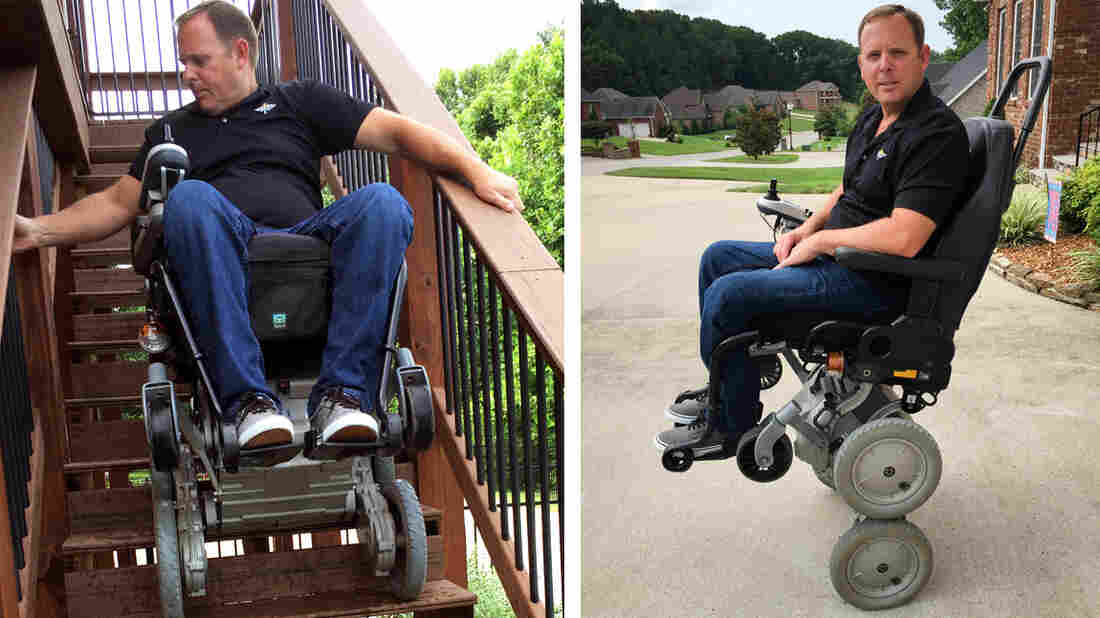
Gary Linfoot was paralyzed by a helicopter crash in Iraq. He’s one of the few veterans still using an iBOT, which allows him to rise up to eye level using Segway-style balancing technology. The wheelchair was discontinued in 2009, but may soon be reissued. Quil Lawrence/NPR hide caption

toggle caption

Quil Lawrence/NPR

Thirteen years ago, just as the United States began what was to become its longest war, a futuristic wheelchair hit the market.

The iBOT allowed paralyzed people, including many veterans of Iraq and Afghanistan, to stand up by rising to eye level. It also did something no wheelchair ever had: climb stairs.

But even though users loved it, the iBOT went out of production in 2009 when Johnson & Johnson discontinued it.

“I was very disappointed,” says disabled veteran Gary Linfoot, a former Army helicopter pilot. “I knew my tent was up, I had one, but I knew there were other people out there who could use this device, this technology and it would not be available to them.”

Now, however, the iBOT could be coming back.

Toyota announced this year that it’s bankrolling a reboot of the iBOT, which the machine’s inventor, Dean Kamen, says will allow him to make some improvements.

“With advances in computers, the advances in solid-state gyros and electronics … we can take a hundred pounds out of it. We can take a lot of cost out of it. We can improve it,” he told NPR.

Kamen is widely known as the inventor of the Segway, which was actually a byproduct from development of the iBOT. The first iteration of the wheelchair had a $25,000 price tag — too high even for the department of Veterans Affairs in most cases. Most veterans who had iBOTs got them from veterans charities, and all but a few are now sitting in the garage, with nowhere to service them.

Today, Toyota is interested in some of the machine’s balancing technology, possibly to be used in the company’s robotic helpers for the aging. And that could mean new parts and new life for existing iBOTs as well as a new version of the chair.

It also helps that the Food and Drug Administration reclassified the iBOT from its strictest regulatory category for medical devices Class 3, alongside replacement heart valves, to Class 2, alongside condoms. That will also lower the expense of the machine, and Kamen says testimony by veterans using the machine was one key to persuading the FDA to make that switch.

For people like Linfoot, it was a game changer.

He lost the use of his legs after a 2008 helicopter crash south of Baghdad. “I wasn’t shot down or anything,” he says. “It was just a mechanical malfunction. Probably a $25 part failed and we lost all power to the rotor system.”

Linfoot and his copilot survived, but the impact left Linfoot paralyzed below the chest. The iBOT allows him to navigate street curbs and the hills around his home north of Nashville, Tenn.

“It goes beyond just reaching in the cabinet to get the cookies that my wife might hide up there, or the good booze,” he says, sitting on top of what looks like an easy chair balanced on a pair of unicycles.

Plus the ability to stand up is huge.

“When you go out to a social setting, back up at 6 feet, talking to somebody eye to eye, you get this sense of dignity,” he says. “The disability just kind of fades into the background.”

Kamen said he hopes stories like Linfoot’s will help persuade his new backers to return the iBOT to production and make it available to a wider group of people.

“The reason some of these veterans need these things is they’ve literally given up pieces of their body for this country,” he says. “The least we can do is give them back the best technology that is currently available.”

Several other companies have designed chairs that can get people with spinal injuries up to eye level and even off-road. But doctors at the department of Veterans Affairs are more excited about inventions that can actually get veterans walking again. The health effects of immobility for paralyzed people are just like the effects of sitting down all the time for able-bodied people, they say.

“Sitting is the new smoking,” says Dr. Will Bauman, director of the Center of Excellence on the Medical Consequences of Spinal Cord Injury at the James J. Peters VA Medical Center in the Bronx. He and Dr. Ann Spungen, associate director of the center, have studied the secondary health effects of paralysis.

“Just you and I, if we sat around all day, we already know that’s the worst thing can do to ourselves,” says Spungen.

Immobilized people are prone to weakened bones, higher blood pressure, urinary tract infections and constipation that can be debilitating. At the Bronx VA veterans have been using an exoskeleton called a ReWalk to get them moving again. It’s like a backpack with robotic leg braces that allows patients to walk using crutches.

So far devices like these aren’t that useful outside a safe, flat surface. Regular therapy with these machines can help reduce pain and promote better sleep, Spungen says.

With as little as 4 to 6 hours of walking a week, about half of patients lost more than a kilogram of body fat, says Spungen. For many problems, she says, “the best cure is to take a walk.”

Let’s block ads! (Why?)

NPR Poll: Are Parents Overrating The Quality Of Child Care?

Parents’ views of child care are a little like life in Lake Wobegon — the vast majority say it’s way above average.

That’s just one of the findings in a poll looking at child care and health from NPR, the Robert Wood Johnson Foundation and the Harvard T.H. Chan School of Public Health, released Monday.

In it, we found that a remarkable 88 percent rated their child care as “very good” or “excellent.”

That stands in stark contrast to the most comprehensive and most recent study on child care and child development, which rated the quality of fewer than 10 percent of child care arrangements in the U.S. as “very high.” The vast majority of child care was rated as only “fair.”

That 15-year-long study by the National Institutes of Health looked at a wide range of quality measures, from basic safety to daily activities and interactions with providers and other children.

That led us to think about how there could be such a big disconnect between parents’ perceptions and apparent reality.

It may be that parents’ measures of quality are very different from those who study childhood development. Or parents may be reluctant to tell a pollster that they’ve got their child in anything other than the best child care.

“Our findings suggest that parents value and seek out quality child care and believe it benefits their child and themselves,” says Gillian SteelFisher, research scientist and deputy director of the Harvard Opinion Research Program and the poll’s academic leader. “However, we also found that parents face challenges related to the limited options they have for child care, the cost, and a lack of information about its quality.”

To get a reading on the state of child care and health in America today, we looked for parents of children up to age 5 who were not yet in kindergarten and whose child receives regularly scheduled care at least once a week from someone other than a parent.

We conducted interviews in English or Spanish and on landlines and cellphones. The margin of error is plus or minus 3.4 percentage points.

When it comes to the individual features of the care their child receives, safety of the indoor and outdoor environment was most frequently rated as excellent, followed closely by other measures.

But just finding child care can be a major challenge, with 1 in 5 parents saying there was only one “realistic” child care option for his or her child.

It will come as no surprise, but cost was the most common challenge in finding child care, with 27 percent of people saying it’s an issue. Four in 10 parents (39 percent) say that the cost of paid child care in their area is not affordable for them.

That could be a major reason why child care is one of the few domestic social issues getting any attention in the current presidential campaign. (We’ve detailed the candidates’ positions below.)

In addition to asking parents about quality and cost in our poll, we wanted to find out how they perceive the impact that child care has on their child and themselves — and whether child care has lasting effects.

The most surprising finding was that parents, particularly mothers, feel child care has benefited their own health and well-being, as well as their relationship with the child.

Half the mothers said it had a “very positive effect” on their relationship with their spouse and an even larger percentage, 64 percent, saw a very positive effect on their relationship with their child.

We also wanted to find out what happens when a child is sick and can’t go to child care. The results: Mothers are more likely to stay home than fathers. And our results suggest that traditional views of gender roles may foster this dynamic. When parents said mothers are most likely to stay home, 16 percent said it was because it was their responsibility to take care of the child, while just 4 percent of parents viewed it as the father’s responsibility.

One of the strongest findings in the poll was that 86 percent feel that care in early childhood has a “major impact” on a child’s long-term well-being.

While it is perhaps not terribly surprising that 84 percent said there was a major impact on kindergarten readiness, it’s worth noting that 52 percent said there was a major impact on job success later in life.

Presidential candidates’ child care platforms

Hillary Clinton has proposed universal access to preschool for 4-year-olds within 10 years, and she would seek to double funding for the Early Head Start and Early Head Start-Child Care Partnership programs as well as increasing funding for child development and support programs for children under age 3 and pregnant women. She is also calling for 12 weeks of paid family and medical leave for both parents. And she has proposed capping the amount a family spends on child care at 10 percent of income, among several other actions aimed at reducing costs.

Donald Trump has proposed allowing all parents to deduct the average cost of child care in their state from their income taxes, limiting it to those who make under $250,000 as a single parent or $500,000 for a couple. He would also allow tax-free contributions of up to $2,000 a year to dependent care savings accounts, with a 50 percent federal government match for low-income parents, up to $1,000. Trump also has proposed a paid maternity leave program.

Libertarian candidate Gary Johnston has not proposed anything specific on child care, while the Green Party’s Jill Stein has called for universal child care.

Detailed fact checks of the Clinton and Trump positions are here and here.

The child care and health series

There’s a lot more in the full poll report, but one final note: Parents perceive significant differences in quality depending on where they get care — from a relative versus a nonrelative versus a center.

NPR will provide in-depth reporting on the results of this poll in a series of radio and online reports over the coming weeks, including a story on Morning Edition Tuesday that explores the giant disconnect between parents and experts when it comes to quality.

We’ll also live stream an expert panel at Harvard discussing these issues, Tuesday at 12:30 p.m. ET on NPR.org.

Let’s block ads! (Why?)