Ruling Backs States Opposed To Obamacare; White House Expects Appeal

A Texas judge on Friday said that the Affordable Care Act is unconstitutional — a ruling likely to be appealed and to make its way up to the Supreme Court.


SCOTT SIMON, HOST:

Another effort to repeal the Affordable Care Act gained steam last night. A federal judge in Texas ruled that the law is unconstitutional. We’re joined now by NPR’s health policy correspondent, Alison Kodjak. Alison, thanks so much for coming in.

ALISON KODJAK, BYLINE: Thanks for having me, Scott.

SIMON: This decision was received last night. What’s it say?

KODJAK: Well, it’s a pretty sweeping decision, actually. This judge ruled that the entire Affordable Care Act, which famously ran more than a thousand pages long, was unconstitutional. The case was brought by 18 Republican attorneys general, and it was led by Texas AG Ken Paxton.

And, you know, in 2015, the Supreme Court ruled the Affordable Care Act is constitutional by calling the penalty for not having insurance a tax. And Congress has the power to tax people. So these attorneys general come in, and they argued that since Congress eliminated that tax penalty, the law can no longer stand. And that’s what the judge agreed to last night. And he took that argument, and he struck down the entire law.

Now, it’s going to be appealed.

SIMON: Yeah.

KODJAK: The attorney general of California’s already said so.

SIMON: Any immediate effect on anyone’s health care?

KODJAK: Well, it’s unclear. But at least the Department of Health and Human Services is saying that the Affordable Care Act will stand as this works its way through courts. And the funny thing is today is the final day for…

SIMON: Yes.

KODJAK: …Open enrollment for next year for people to get insurance. And on the website healthcare.gov, there’s actually a banner that says, this decision doesn’t change open enrollment for now.

SIMON: What about political repercussions?

KODJAK: And that’s a more complicated thing.

SIMON: Yeah.

KODJAK: So we just had midterm elections, as you know, and people really said health care is an important issue to them. And, you know, that’s not a surprise. But lots of Republicans were running ads during this midterm, saying that they were the ones who are going to protect people’s health care and, specifically, protect people with pre-existing conditions, which is one of those more sensitive issues around the Affordable Care Act. People want to make sure that if they’re sick, they can get insurance.

But in this lawsuit, these Republican attorneys general specifically argue that the pre-existing condition protections had to be struck down when that mandate went away. So now you have Republicans sort of trying to play both sides, which is going to be difficult.

And then there’s one other point that, you know, I think a lawyer made to me last night. Congress, in 2017, voted multiple times on whether to repeal the Affordable Care Act, and they didn’t do it. And now this judge has gone in and done it by himself. And one lawyer called this a breathtaking act of judicial activism.

SIMON: In the end, if the Affordable Care Act goes away, if it’s abolished, what can we expect to happen?

KODJAK: It will be – the repercussions will, you know, be far and wide. As I said, the law has more than a thousand pages. It touches every part of the health care system. So it’s not just these marketplaces that we talk about most of the time.

The most immediate impact is Medicaid expansion. More than 10 million people have gotten health care because states have expanded Medicaid to a larger population. The law guarantees that people up to age 26 can get insurance through their parents. That’s popular – that would go away. Again, the pre-existing condition protections – insurance companies have to give people coverage for their existing health problems.

But then, it also controls what Medicare pays doctors. It authorizes the Indian Health Service. It determines whether companies have to make accommodations for breastfeeding mothers. It makes chain restaurants put calorie counts on their menus. I mean, it’s everywhere.

SIMON: Yeah. Well, I mean, a lot of things have changed in American life.

KODJAK: Yeah.

SIMON: And that was the idea of the legislation. There are Americans who have changed their jobs. There are Americans who’ve changed what they do in life…

KODJAK: Yeah. If this just goes away…

SIMON: …To be able to get health care.

KODJAK: …It would wreak havoc across the country in many ways.

SIMON: NPR’s Alison Kodjak, thanks so much for being with us.

KODJAK: Thank you, Scott.

Copyright © 2018 NPR. All rights reserved. Visit our website terms of use and permissions pages at www.npr.org for further information.

NPR transcripts are created on a rush deadline by Verb8tm, Inc., an NPR contractor, and produced using a proprietary transcription process developed with NPR. This text may not be in its final form and may be updated or revised in the future. Accuracy and availability may vary. The authoritative record of NPR’s programming is the audio record.

Let’s block ads! (Why?)

Texas Judge Rules Affordable Care Act Unconstitutional, But Supporters Vow To Appeal

A federal district court judge in Texas has threatened the future of the Affordable Care Act.

Judge Reed C. O’Connor struck down the law, siding with a group of 18 Republican state attorneys general and two GOP governors who brought the case. O’Connor said the tax bill passed by Congress in December 2017 effectively rendered the entire health law unconstitutional.

That tax measure eliminated the penalty for not having insurance. An earlier Supreme Court decision upheld the ACA based on the view that the penalty was a tax and thus the law was valid because it relied on appropriate power allowed Congress under the Constitution. O’Connor’s decision said that without that penalty, the law no longer met that Constitutional test.

“In some ways, the question before the Court involves the intent of both the 2010 and 2017 Congresses,” O’Connor wrote in his 55-page decision. “The former enacted the ACA. The latter sawed off the last leg it stood on.”

The decision came just hours before the end of open enrollment for ACA plans in most states that use the federal HealthCare.gov insurance exchange. It is not expected that the ruling will affect the coverage for those people. The final decision isn’t likely to be made until the case reaches the Supreme Court again.

The 16 Democratic state attorneys general who intervened in the case to defend the health law immediately vowed to appeal.

“The ACA has already survived more than 70 unsuccessful repeal attempts and withstood scrutiny in the Supreme Court,” said a statement from Xavier Becerra of California. “Today’s misguided ruling will not deter us: our coalition will continue to fight in court for the health and wellbeing of all Americans.”

It is all but certain the case will become the third time the Supreme Court decides a constitutional question related to the ACA. In addition to upholding the law in 2012, the court rejected another challenge to the law in 2015.

It is hard to overstate what would happen to the nation’s health care system if the decision is ultimately upheld. The Affordable Care Act touched almost every aspect of health care, including Medicare and Medicaid, generic biologic drugs, the Indian Health Service, and public health changes like calorie counts on menus.

The case, Texas v United States, was filed in February. The plaintiffs argued that because the Supreme Court upheld the ACA in 2012 as a constitutional use of its taxing power, the elimination of the tax makes the rest of the law unconstitutional.

In June, the Justice Department announced it would not fully defend the law in court. While the Trump administration said it did not agree with the plaintiffs that the tax law meant the entire ACA was unconstitutional, it said that the provisions of the law guaranteeing that people with preexisting health conditions could purchase coverage at the same price as everyone else were so inextricably linked to the tax penalty that they should be struck.

The administration urged the court to declare those provisions invalid beginning Jan. 1, 2019. That is the day the tax penalty for not having insurance disappears.

The protections for people with preexisting conditions was one of the top health issues in the midterm elections earlier in November. While the issue mostly played to the advantage of Democrats, one of the Republican plaintiffs, Missouri Attorney General Josh Hawley, defeated Democratic incumbent Sen. Claire McCaskill. Another plaintiff, West Virginia Attorney General Patrick Morrisey, lost to Democratic incumbent Sen. Joe Manchin.

President Donald Trump was quick to take a victory lap, and pressed Senate Majority Leader Mitch McConnell, R-Ky., and the presumed incoming House Speaker Nancy Pelosi, D-Calif., to fix the problem. The president tweeted Friday night: “As I predicted all along, Obamacare has been struck down as an UNCONSTITUTIONAL disaster! Now Congress must pass a STRONG law that provides GREAT healthcare and protects pre-existing conditions. Mitch and Nancy, get it done!”

But congressional leaders were quick to point out that the suit is far from over.

“The ruling seems to be based on faulty legal reasoning and hopefully it will be overturned,” said a statement from Senate Minority Leader Chuck Schumer, D-N.Y.

Many legal experts agreed with that assessment. “This is insanity in print, and it will not stand up on appeal,” tweeted University of Michigan Law School Professor Nicholas Bagley, an expert in health law.

Even some conservatives were left scratching their heads. “Congress acted last year to repeal the mandate, but leave everything else in place and the courts should have deferred to that,” tweeted former congressional GOP aide Chris Jacobs.

Kaiser Health News, a nonprofit news service, is an editorially independent program of the Kaiser Family Foundation, and not affiliated with Kaiser Permanente.

Let’s block ads! (Why?)

Federal Judge Strikes Down Affordable Care Act As Unconstitutional

Information cards displayed during an Affordable Care Act enrollment event in San Antonio, Texas, in 2016. A federal judge struck down the health insurance law as unconstitutional Friday.

Eric Gay/AP


hide caption

toggle caption

Eric Gay/AP

A federal judge in Texas issued a ruling Friday declaring the Affordable Care Act unconstitutional, apparently setting the stage for another hearing on the health care law by the U.S. Supreme Court.

The ruling by U.S. District Judge Reed O’Connor invalidates what’s commonly referred to as Obamacare nationwide, and casts into doubt the survival of the law on the eve of the deadline for tens of millions of Americans to sign up for health care coverage in 2019.

The ruling comes in a lawsuit brought against what was one of the major domestic achievements of the Obama administration. An alliance of 19 Republican attorneys general and a governor led by Texas Attorney General Ken Paxton challenged the law.

As NPR’s Alison Kodjak explained on All Things Considered,

“The lawsuit had to do with whether when Congress last year repealed or eliminated the penalty for not having insurance — it was a tax penalty for people who didn’t have insurance — whether that meant the rest of the law didn’t apply anymore. The court case argued that all of the pieces of the law were dependent upon each other, so by eliminating the penalty the rest of the law fell apart. The judge agreed with that opinion.”

In his 55-page opinion, Judge O’Connor said the debate over the ACA’s interlocking provisions is “like watching a slow game of Jenga, each party poking at a different provision to see if the ACA falls.”

In a statement, White House press secretary Sarah Sanders praised the ruling.

“Obamacare has been struck down by a highly respected judge. The judge’s decision vindicates President Trump’s position that Obamacare is unconstitutional. Once again, the President calls on Congress to replace Obamacare and act to protect people with preexisting conditions and provide Americans with quality affordable healthcare. We expect this ruling will be appealed to the Supreme Court. Pending the appeal process, the law remains in place.”

Shortly afterwards, President Trump tweeted, “As I predicted all along, Obamacare has been struck down as an UNCONSTITUTIONAL disaster! Now Congress must pass a STRONG law that provides GREAT healthcare and protects pre-existing conditions.”

California Attorney General Xavier Becerra, who led the coalition of states that defended the ACA promised to continue the court fight to preserve the law.

Rep. Nancy Pelosi, who is expected to be House speaker when Democrats come into the majority next month, tweeted, “Tonight’s absurd ruling exposes the monstrous endgame of the GOP’s all-out assault on people w/ pre-existing conditions & the ACA. When @HouseDemocrats take the gavel, the House will swiftly intervene in the appeals process to #ProtectOurCare!”


Let’s block ads! (Why?)

Health Costs Bear Down On Families Who Don't Qualify For ACA Subsidies

People who earn up to 400 percent of the poverty level (about $48,500 for an individual and $100,400 for a family of four in 2019) are eligible for subsidies of the cost of their marketplace health plans. But many of the 5 million who aren’t eligible feel crushed by rising costs.

Stuart Kinlough/Ikon Images/Getty Images


hide caption

toggle caption

Stuart Kinlough/Ikon Images/Getty Images

Like millions of Americans in this final week of open enrollment for the Affordable Care Act marketplaces, Diane McCabe is shopping for health insurance.

“At my age, I can’t go without it, even though I’m healthy now,” says McCabe. She’s 62 and a self-employed real estate agent in Luzerne County, Pa. “But the process is frustrating, and the expense significant.”

That’s because McCabe is one of the 5 million people who buy their own coverage (either on of off the ACA marketplace) and pay the full cost. Her income is too high to qualify for a government subsidy that would help defray the cost of the premium.

McCabe this week settled on a $773-a-month policy that has a $4,000 deductible — the amount she’ll have to pay out of pocket before insurance kicks in. She estimates that will account for at least 15 percent of her income in 2019.

Under the ACA, people who earn up to 400 percent of the poverty level (about $48,500 for an individual and $100,400 for a family of four in 2019) are eligible for premium subsidies. Eighty-seven percent of the 10.6 million people with ACA plans this year received a subsidy.

The financial challenge for people like McCabe has come into much sharper focus during the past year, as insurance premiums have spiked.

These increasing costs plus rising deductibles and copayments have driven millions who don’t get a subsidy to drop their coverage or turn to cheaper, less comprehensive — and sometimes inadequate — insurance.

The Trump administration has highlighted the plight of the unsubsidized and said that its regulatory revamp of the health law will give consumers new, more affordable options.

One of the key administration efforts is extending the use of short-term insurance plans that have lower premiums but don’t provide the full benefits that the ACA requires, such as continuous coverage of preexisting conditions or maternity care.

Those plans are not eligible for subsidies now, but, under regulations the administration proposed in October, subsidies could be available starting in 2020.

Critics counter that the administration’s approach runs a high risk of undermining core features of the ACA. And a legal battle over the administration’s proposed new rules is likely.

“The subsidy structure is unquestionably a problem,” says Chris Sloan, a director at Avalere Health, a policy and research think tank in Washington, D.C. “It’s a cruel reality for those above the income cutoffs. But it’s not clear that the administration’s actions are the best solution.”

Opponents of the Trump administration’s proposals contend they could lead young, healthy people to abandon ACA coverage and choose less comprehensive and expensive coverage — leaving more people who are older and sicker in the exchanges. That would result in steadily increasing costs for those plans, and could eventually destabilize the ACA marketplaces, policy analysts say.

Overall, about 4.4 million fewer people who buy coverage on their own were insured in 2018 compared to 2015, a decline from 18.8 to 14.4 million. Most of the decline occurred among people who don’t get subsidies.

On and off insurance

Cameron and Lori Llewellyn, of Dover, Del., say they have found insurance just too expensive.

In June 2017, Lori left a job that provided the family with good health coverage. She wanted to start her own business — a clothing boutique. Cameron is a self-employed construction contractor.

Cameron and Lori Llewellyn would like to buy insurance for themselves and their daughter, Bryce, but haven’t been able to afford it, they say. Lori is starting her own business and Cameron is a self-employed construction contractor.

Courtesy of Lori Llewellyn


hide caption

toggle caption

Courtesy of Lori Llewellyn

The Llewellyns tried to enroll in a plan through the ACA exchange in the summer of 2017. But Cameron’s income was too high to qualify for a subsidy. On the open market, they were quoted rates as high as $2,000 a month, with deductibles of $4,000 or more, for themselves and their 8-year-old daughter, Bryce.

They opted instead to go without coverage until the end of 2017. Then again, for this year, they ended up not qualifying for subsidies and decided to go without insurance.

“We just couldn’t justify the expense, especially with that high of a deductible,” Lori said. “But it wasn’t a comfortable situation. We wanted coverage for all the reasons people know they need it.”

For 2019, the Llewellyns are trying again. They have enrolled through the state ACA exchange in a policy with a premium of $1,286 and a $7,900 deductible, but with a subsidy that will cover the entire premium.

Spencer Ricks, 36, a self-employed attorney in Salt Lake City, is choosing a different path. He, his wife and their 3-year-old daughter bought ACA-compliant coverage in 2016. Their premium rose from around $600 in 2016 to $970 in 2017 with a $10,000 deductible.

Ricks was told his premium for 2018 for the same plan would be $1,200 with a $13,500 deductible. He pulled the plug on the family coverage and instead enrolled his wife — who was pregnant — in a plan costing $570 a month with a $5,000 deductible.

Ricks and his daughter then joined a Christian Healthcare Ministry plan costing $157 a month, with a $10,000 deductible. For 2019, Ricks is enrolling the whole family is another religious-affiliated plan that’s skimpier in coverage than those sold on the ACA exchange; it costs $529 a month and has a $2,250 deductible.

But for 2019, the most prevalent alternative to an ACA plan for people who don’t get subsidies is likely to be a short-term plan.

Previously available for only 90 days — primarily to bridge gaps in coverage — the Trump administration expanded that time frame to 364 days.

The plans can be bought at any time, but sales are up now because more people are shopping during the ACA’s open enrollment, says Sean Malia, a senior director at eHealth, an online brokerage.

Melanie and Pete Howell, of Austin, Texas, are among eHealth’s newest customers. They had an ACA plan this year costing $1,100 a month with a $7,000 deductible. It covered the couple and their two children, ages 22 and 17.

The Howells’ income is too high to qualify for a subsidy. When their insurer notified them that the premium was going to be $1,400 a month in 2019, they opted for a short-term plan that will cost $380 a month with a deductible of $12,500.

The plan does not cover prescription drugs, and the Howells will pay 30 percent of the costs for doctor, emergency room visits and any surgical procedures.

“This buys us some time at a much more affordable price to figure out what to do for the longer term,” said Melanie Howell.

No easy solutions

Although both ACA critics and advocates say that addressing the high cost of coverage for non-subsidized families should be a priority, there are no easy bipartisan fixes in sight.

Many ACA supporters urge legislation that raises the threshold for subsides above 400 percent of poverty — to, say, 600 percent. But that stokes concerns of added federal spending.

A more realistic approach, for now, could be to permit states to experiment with ways to help those over the 400 percent threshold, says Sabrina Corlette, a research professor at the Georgetown University’s Health Policy Institute.

For example, with federal government permission, eight states have already launched, or will in 2019, “reinsurance” programs that redeploy federal dollars to help insurers cover the costs of families with high medical expenses. The programs have kept premium costs down for both people who get subsidies and those who don’t.

Another proposal would permit states more leeway to restructure the ACA subsidies to provide less help to people with high-cost health care needs and more help to those not currently eligible for subsidies.

“Letting states try things out has bipartisan support,” says Corlette, “and there are mechanisms for that already in place. It would seem to have the best chance of yielding something useful to help this population [the unsubsidized] for now.”

Steven Findlay is a Washington, D.C., reporter who writes about health policy and medicine. Kaiser Health News, a nonprofit news service, is an editorially independent program of the Kaiser Family Foundation, and not affiliated with Kaiser Permanente.

Let’s block ads! (Why?)

ACA Sign-Ups Have Lagged For 2019. But What Does That Mean?

The deadline for signing up for individual health insurance coverage on HealthCare.gov ends Saturday, Dec. 15.

Patrick Sison/AP


hide caption

toggle caption

Patrick Sison/AP

Former President Barack Obama released a video earlier this week urging people to hurry up and shop for health insurance on the Affordable Care Act exchange.

“This year I’m giving it to you straight,” Obama says in the video. “It’s important to have health insurance in case, God forbid, you get really sick, or hurt yourself next year.”

No jump shots. No ferns. No memes. Not this time. I’m going to give it to you straight: If you need health insurance for 2019, the deadline to get covered is December 15. Go to https://t.co/ob1Ynoesod today and pass this on — you just might save a life. pic.twitter.com/8mHMsXGY0g

— Barack Obama (@BarackObama) December 10, 2018

Open enrollment ends in most states on Saturday and Obama makes the case that people can find a good deal on coverage if they shop around.

“Most folks can find coverage for $50 to $100 per month. That’s probably less than your cell phone bill,” he says.

After the video was released, there was a bump in sign-ups. But overall this year, enrollment in the individual market is moving more slowly than in previous years.

At the end of last week, just over 4.1 million people had chosen a health plan on Healthcare.gov, according to the Centers for Medicare and Medicaid Services, which runs the website. That’s about half a million fewer than at this time last year, an analysis by the advocacy group Protect Our Care shows.

“I hate to panic but I do think we’re going to come in low on the federal exchange, says Rosemarie Day, CEO of Day Health Strategies. Day was the founding COO of Massachusetts’ state exchange, which launched in 2006, long before the Affordable Care Act became law.

She blames the lower enrollment on the Trump Administration’s decision to slash the advertising budget for open enrollment. Outreach, she says, is crucial to making sure that people who need insurance know where and when to get it.

“The individual market is very, very volatile — because people are in and out of needing that kind of coverage,” Day says. “There’s always potential for new customers who may have really never paid that much attention to the exchange, because it wasn’t something that they needed. It wasn’t really on their radar until they did need it.”

CMS says it did some advertising on local TV and radio and print media, and sent out more than 600 million emails and text messages to potential consumers. Administrator Seema Verma has sent regular reminders about the enrollment period on Twitter.

“We know you may be busy shopping for holiday gifts, but don’t forget to shop for your healthcare coverage too! The 2019 Marketplace #OpenEnrollment deadline is this Saturday – Dec. 15th!” reads a Tweet from Thursday.

We know you may be busy shopping for holiday gifts, but don’t forget to shop for your healthcare coverage, too! The 2019 Marketplace #OpenEnrollment deadline is this Saturday-Dec. 15th! https://t.co/5wrBlB1k2o

— Administrator Seema Verma (@SeemaCMS) December 12, 2018

But it’s hard to say whether the fewer sign-ups this time mean fewer people will have insurance coverage in 2019.

Katherine Baicker, an economist and dean of the University of Chicago’s Harris School of Public Policy, says some Trump Administration policy changes, like eliminating the penalty for not having coverage, could depress sign-ups.

At the same time, the unemployment rate fell from 4.1 percent to 3.7 percent over the course of 2018 — the lowest level in 49 years.

Having lower unemployment is certainly correlated with having a lower uninsurance rate, Baicker says, because people who are getting new jobs are going to get insurance with their new jobs.

And some of those people may have previously bought insurance on the exchange.

It’s also hard to know how many people aren’t showing up on sign-up tallies because they are just sticking with the plan they have.

“People are slow to change insurance plans,” Baicker says, “especially if they’re happy with the plan they have.”

To answer those questions, a further breakdown of the total numbers will be available next year.

In Virginia alone, about 70,000 fewer people have signed up for an ACA health plan this year compared to last.

That may be in part because the state passed an expansion of Medicaid earlier this year, which will allow more adults to get coverage through that federal-state health insurance program. Virginia’s Secretary of Health and Human Services Daniel Carey says about 140,000 Virginians have enrolled in Medicaid, so far, as part of the new expansion; that’s only about half as many as the state expects to eventually enroll in Medicaid. Some of them likely had previous coverage through the exchange.

“Given the co-pays and deductibles in the exchange plans, Medicaid for the individual is a much better deal,” Carey says. “So if they do qualify, we certainly encourage them to enroll in Medicaid.”

In the end, the most important number of all is how many people end up with health coverage, Baicker says.

“If fewer people are signing up in the individual market because more people are getting insurance through their jobs, that may be a very good-news story for those people,” she says. “If fewer people are signing up through the exchanges because they’re going to end up uninsured, that’s a very bad-news story for those people.”

Consumers have until midnight Saturday to pick an insurance plan on HealthCare.gov.

Let’s block ads! (Why?)

Nurse Denied Life Insurance Because She Carries Naloxone

Isela was denied life insurance because her medication list showed a prescription for the opioid-reversal drug naloxone. The Boston Medical Center nurse says she wants to have the drug on hand so she can save others.

Jesse Costa/WBUR


hide caption

toggle caption

Jesse Costa/WBUR

Blood work was supposed to be the last step in Isela’s application for life insurance. But when she arrived at the lab, her appointment had been canceled.

“That was my first warning,” Isela says. She contacted her insurance agent and was told her application was denied because something on her medication list indicated that Isela uses drugs. Isela, a registered nurse who works in an addiction treatment program at Boston Medical Center, scanned her med list. It showed a prescription for the opioid-reversal drug naloxone — brand name Narcan.

“But I’m a nurse, I use it to help people,” Isela remembers telling her agent. “If there is an overdose, I could save their life.”

That’s a message public health leaders aim to spread far and wide. “BE PREPARED. GET NALOXONE. SAVE A LIFE,” was the message at the top of a summary advisory from the U.S. surgeon general in April.

But some life insurers consider the use of prescription drugs when reviewing policy applicants. And it can be difficult, some say, to tell the difference between someone who carries naloxone to save others and someone who carries naloxone because they are at risk for an overdose.

Primerica is the insurer Isela says turned her down. (NPR has agreed just to use Isela’s first name because she is worried about how this story might affect her ongoing ability to get life insurance.) The company says it can’t discuss individual cases. But in a prepared statement, Primerica notes that naloxone has become increasingly available over the counter.

“Now, if a life insurance applicant has a prescription for naloxone, we request more information about its intended use as part of our underwriting process,” says Keith Hancock, the vice president for corporate communications. “Primerica is supportive of efforts to help turn the tide on the national opioid epidemic.”

After Primerica turned her down, Isela applied to a second life insurer, and was again denied coverage. But the second company told her it might reconsider if she obtained a letter from her doctor explaining why she needs naloxone. So, Isela did contact her primary care physician — and then realized that her doctor had not prescribed the drug.

Isela had bought naloxone at a pharmacy. To help reduce overdose deaths, Massachusetts and many other states have established a standing order for naloxone — one prescription that works for everybody. Isela couldn’t just give her insurer that statewide prescription; she had to find the doctor who signed it. As it happens, that physician — Dr. Alex Walley — also works at Boston Medical Center.

Walley is an associate professor of medicine at Boston University; he also works in addiction medicine at Boston Medical Center and is the medical director for the Opioid Overdose Prevention Pilot Program at the Massachusetts Department of Public Health.

“We want naloxone to be available to a wide group of people — people who have an opioid use disorder themselves, but also [those in] their social networks and other people in a position to rescue them,” Walley says.

He says he’s written a half dozen letters for other BMC employees denied life or disability insurance because of naloxone, and that troubles him.

“My biggest concern is that people will be discouraged by this from going to get a naloxone rescue kit at the pharmacy,” Walley says. “So this has been frustrating.”

The life insurance hassle — and threat of being turned to down — has discouraged Isela and some of her fellow nurses. She is not carrying a naloxone kit outside the hospital right now because she doesn’t want it to show up on her active medication list until the life insurance problem is sorted out.

“So if something were to happen on the street, I don’t have one — just because I didn’t want another conflict,” Isela said.

BMC has alerted the state’s Division of Insurance, which has said in a written response that it is reviewing the cases and drafting guidelines for “the reasonable use of drug history information in determining whether to issue a life insurance policy.”

But Isela isn’t a drug user. And yet, she is still being penalized as if she were.

Michael Botticelli, who runs the Grayken Center for Addiction Medicine at BMC, says friends and family members of patients with an addiction must be able to carry naloxone without fear that doing so will send them to the insurance reject pile.

“It’s incumbent on all of us to make sure that we try to kind of nip this in the bud,” he says, “before it is any more widescale.”

Botticelli says increased access to naloxone across Massachusetts is one of the main reasons overdose deaths are down in the state. The most recent state report shows 20 fewer fatalities this year as compared to last.

Botticelli relayed his concerns in a letter to Dr. Jerome Adams, the U.S. surgeon general, who says he contacted the National Association of Insurance Commissioners. That group says it has not heard of any cases of life insurance applicants being denied because they purchased naloxone.

Adams says it’s good to, as Botticelli suggests, nip the problem in the bud.

“Naloxone saves lives,” Adams says, “and it is important that all Americans know about the vital role bystanders can play in preventing opioid overdose deaths when equipped with this life-saving medication.”

Isela says the second company that rejected her has agreed to let her reapply, in light of Dr. Walley’s letter stating that she carries the drug so that she can reverse an overdose. Isela is in the process of reapplying.

This story is part of a reporting partnership with NPR, WBUR and Kasier Health News.

Let’s block ads! (Why?)

Former NFL Player Tim Green Has A New Opponent — ALS

Tim Green, former NFL player and a former NPR commentator, has ALS, also known as Lou Gehrig’s disease. Green believes football gave him the disease.

Heather Ainsworth for NPR


hide caption

toggle caption

Heather Ainsworth for NPR

Tim Green first noticed the symptoms about five years ago.

The former NFL player, whose strength was a job requirement, suddenly found his hands weren’t strong enough to use a nail clipper. His words didn’t come out as fast as he was thinking them.

“I’m a strange guy,” Tim says. “I get something in my head and I can just run with it. I was really afraid I had ALS. But there was enough doubt that I said ‘alright, I don’t. Let’s not talk about it. Let’s not do anything.'”

Denying pain and injury had been a survival strategy in football.

“I was well trained in that verse,” he says.

A Falcons game ball that was presented to Green in 1991.

Heather Ainsworth for NPR


hide caption

toggle caption

Heather Ainsworth for NPR

But a diagnosis in 2016 made denial impossible. Doctors confirmed that Tim, also a former NPR commentator, had ALS, known as Lou Gehrig’s disease. The degenerative illness attacks the body’s motor nerve cells, weakening muscles in the arms and legs, and the muscles that control speech, swallowing and breathing.

Tim tried to keep it private — he didn’t want people feeling sorry for him.

But he says, “I got to a point where I couldn’t hide it anymore.”

So Tim went on 60 Minutes and revealed his illness.

“What we said is, you either write your own history or someone’s going to write it for you,” says 24-year-old Troy Green.

When one isn’t enough

I was one of Tim Green’s producers for his Morning Edition commentaries back in the 1990s. We went to dinner once when he was in Washington, D.C. for a game — his Atlanta Falcons were playing Washington. Tim had a huge plate of pasta and when we finished, the waiter came over and asked “anything else?” Tim pointed to his clean plate and said, “yeah. Let’s do it again.”

That was him. One entrée wasn’t enough. One high-profile career wasn’t enough – he’s also a prolific author, has a law degree and works for two firms.

And ultimately, it wasn’t enough for Tim to deal with ALS in silence. Last month, in conjunction with his 60 Minutes appearance, Tim helped launch a fund-raising website, Tackle ALS.

Writing his own story

I recently visited Tim at his lakeside home in upstate New York, in the village of Skaneateles.

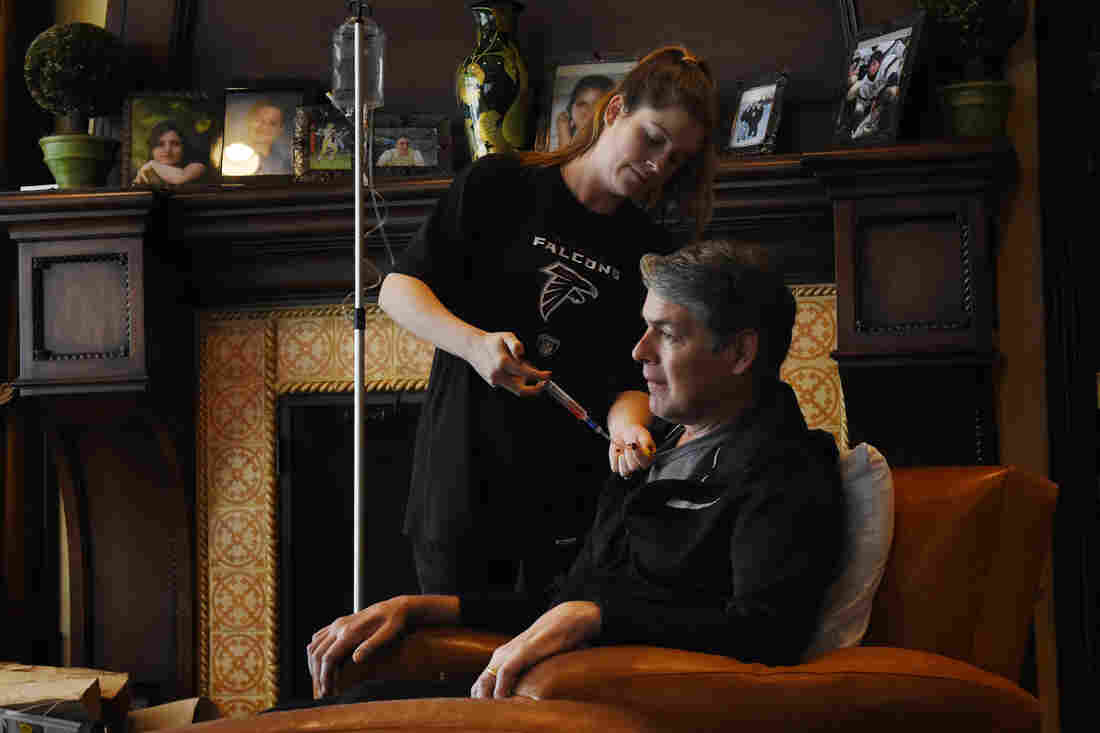
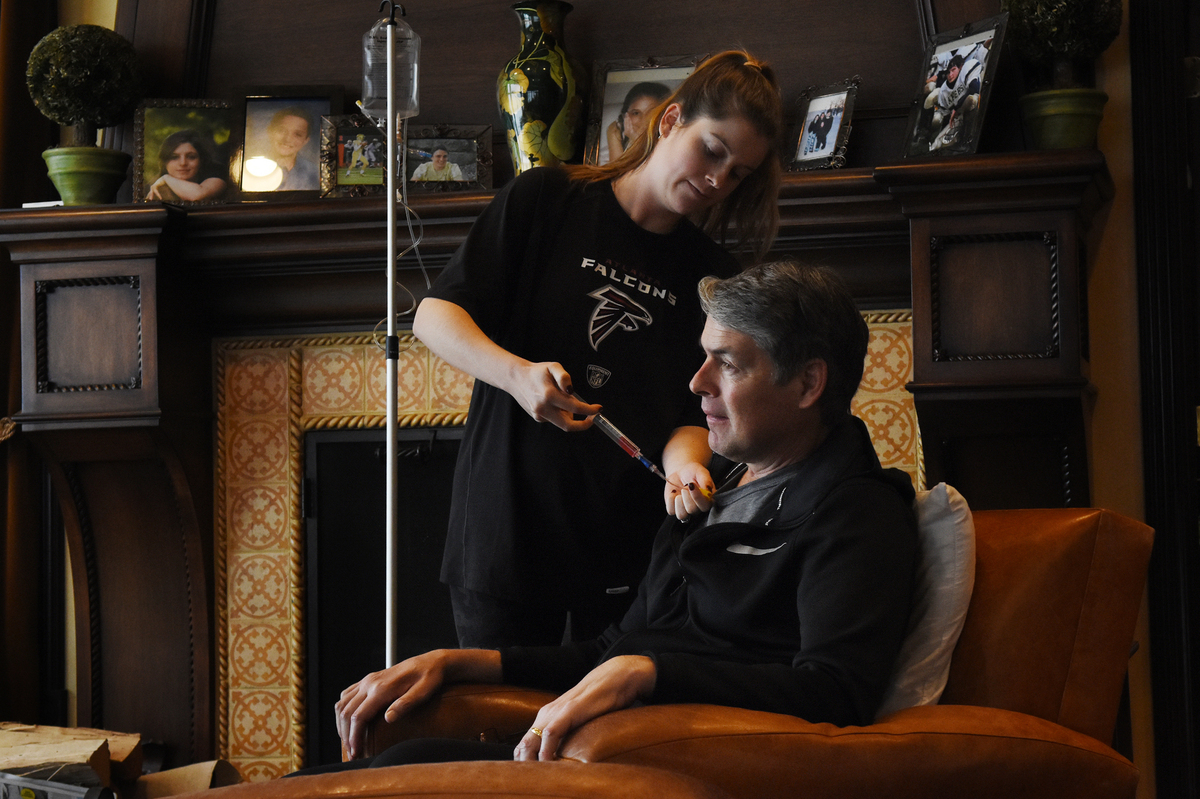
We sat down in a room with a huge picture window that normally offers a gorgeous view of Skaneateles Lake. On the day I visited, all you could see was driving snow. Troy Green sat next to his dad — Tim’s speech is slow and raspy and sometimes Troy helps repeat or reinforce Tim’s words. During our talk, a tube connected to a port in Tim’s chest provided an infusion of Radicava. Last year, the FDA approved the new drug, which has been shown to slow the progress of what’s currently a fatal disease.

Green’s daughter-in-law, Jessica Green, gives him an infusion of Radicava. Last year, the FDA approved the new drug, which has been shown to slow the progress of what’s currently a fatal disease.

Heather Ainsworth for NPR


hide caption

toggle caption

Heather Ainsworth for NPR

The history Troy encouraged Tim to write is positive and hopeful. They stress that ALS can be cured, it’s just underfunded.

The history certainly includes family. Tim and his wife Illyssa have been married for 29 years. They have five kids — all with first names starting with “T” — that’s Illyssa’s doing, Tim says. And the family is incredibly close. Literally.

“My brother lives on the same lane as us. I’m their neighbor,” Troy says, adding, “my little sister’s at school, my little brother lives here and then my older sister lives the furthest away. She’s about a three minute drive.”

“We’re going to reel her in,” Tim laughs.

Football, a complicated love

Of course, any Tim Green history has to include football.

For better and worse.

Tim believes football gave him the disease. His eight years in the NFL in the 1980s and 90s, as a defensive lineman and linebacker, were before protective rule changes and concussion protocols.

There were “countless” head collisions, Tim says. I mention that he had decades of those collisions, from an early age through the NFL.

“But in the NFL,” he says, “the violence and the impacts are extraordinary. Every day.”

Troy adds, “when [Tim] played, practices were worse than the games. Because in the game, you typically would see 45 to 65 plays. In practice, you could run 100, 200 by the time you’re done with drills.”

Researchers say repetitive head blows may play a part in causing ALS. The recent NFL Concussion Settlement acknowledged a link by including payouts to former players with the disease, including Tim.

His Morning Edition commentaries regularly took listeners inside the violent game. In 1992, Tim wrote one about about a teammate, former Atlanta defensive end Rick Bryan, who’d had enough of the physical toll and was retiring.

The piece ended with this:

“Back at the locker room, I checked my protective neck padding and pumped some extra air into the padding of my helmet. Like a gypsy gazing into a crystal ball, I looked at my own distorted reflection in the glossy black surface of my helmet. The smile let me know I was glad to be there, but there was nothing I could see that told me how long it would last.”

Old uniforms and posters adorn the walls at Green’s home gym.

Heather Ainsworth for NPR


hide caption

toggle caption

Heather Ainsworth for NPR

Tim could articulate what many players couldn’t. Why, I asked him, with his insights, would he play a sport that had the potential to do permanent damage?

Tim says as a kid, he had two passions. Writing and football. From the earliest age, he says, he worked incredibly hard to succeed at both, and he did.

“I was just impassioned,” he says. “That’s what I wanted, and that’s what I got.”

“If [this disease] is part of the bargain, I don’t know,” he continues. But back then, he says, he had “no idea” of the potential long-term damage of football. “So the temporary pain and discomfort, I knew that was worth it. Some pain in the future with my back, neck, knees, I knew that was worth it.”

“Can I say getting ALS was worth it? I don’t know. I don’t know.”

His ambivalence illustrates Tim’s profound and complicated love for the game. Still. He says it gave him the disease. But it also taught him so many life lessons growing up. It allowed him to vent anger and violence in an acceptable way.

“I’m not indicting football or the NFL,” he says.

He passed on his love – his two oldest sons played football. His 12-year-old, Ty, plays now. And it has split the close-knit Greens. Illyssa doesn’t like it. Tim says he wants Ty to play if he wants to.

Troy Green helps his father on the computer. Tim can’t type, so he has a sensor on his glasses that highlights letters. Then he clicks a mouse with his right hand, and the letters show up on his laptop screen.

Heather Ainsworth for NPR


hide caption

toggle caption

Heather Ainsworth for NPR

Tim and Troy say the game now is different than it was. It’s much safer with less contact in practice. Both of them coached Ty’s junior team.

“We trained [so in] every tackling drill your head’s out of the play,” says Troy. “In practice we would penalize our players if they had their head in the drill. We really just encouraged the modern day football, not the 1980’s edition.”

Still, football is inherently dangerous, and so far Ty wants to play.

“I don’t want to wrap him up in a bubble,” says Tim, “because where do you stop?”

But there’s a deeper, more complex reason behind Tim’s support. Troy says his dad doesn’t want the illness to be a burden on anyone. So Tim doesn’t want Ty not to play, just because the game hurt him.

Translating science into treatment

“I do want to point out that most people who play football don’t develop ALS.”

So says Dr. Merit Cudkowicz, who treats Tim’s disease. Cudkowicz has researched ALS for nearly 25 years. She thinks football probably is a factor that led to his illness, but not the only one. The studies so far haven’t established a direct cause and effect.

“And that’s why we think there’s something else,” Cudkowicz says. “It’s a combination perhaps in someone’s immune system or something in their genetics that makes it more likely that if you also hit your head repetitively that you might come down with the disease.”

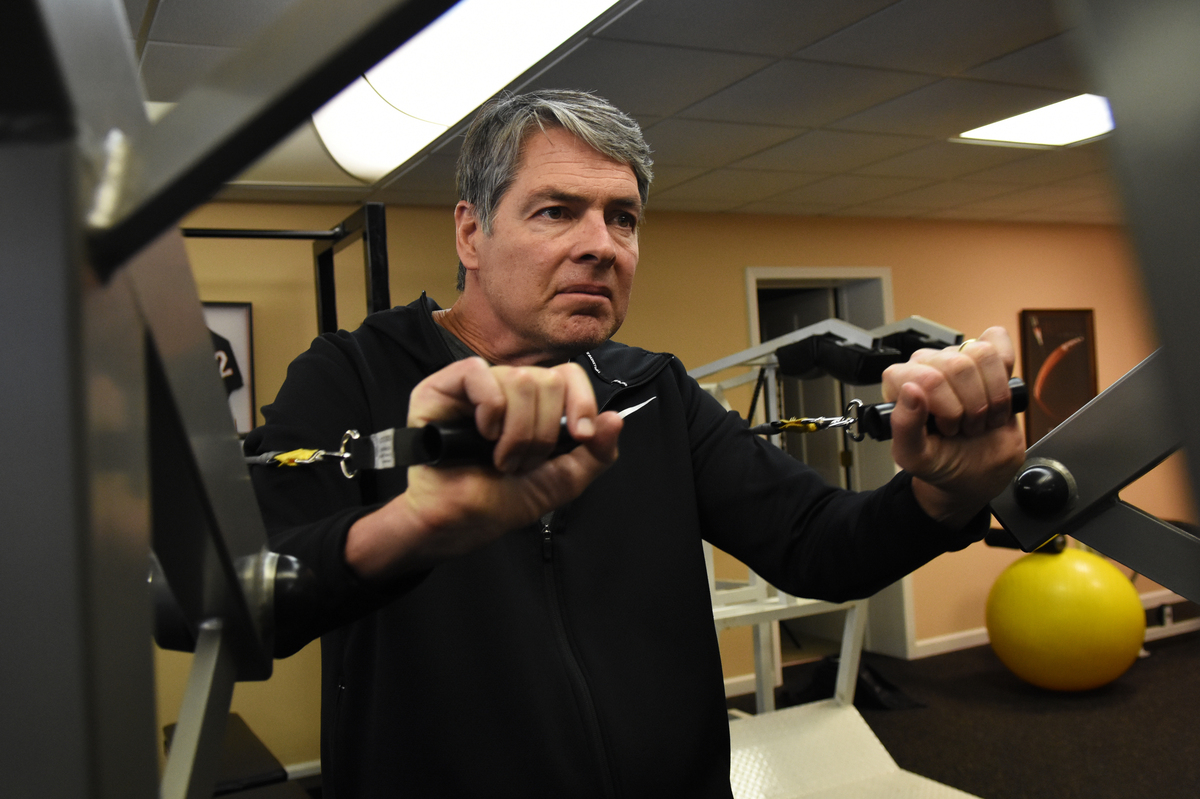
Green works out at his home gym. Studies of ALS patients suggest people who do stretching and toning function much better. There’s a concern if a patient does too much and tries to bulk up, he or she could tear the muscles. Green’s doctor advises more low weight, repetition, toning types of exercise.

Heather Ainsworth for NPR


hide caption

toggle caption

Heather Ainsworth for NPR

Cudkowicz directs the Healey Center for ALS at Massachusetts General Hospital in Boston. She says Tim’s and other prominent people’s involvement and publicity present a great opportunity, as a follow up to the viral ice bucket challenges that raised money for ALS a few years ago.

“Absolutely I think this is a huge next step,” Cudkowicz says. “The ice bucket challenge came at the right time. The science was exploding but there were no resources for it. And suddenly there’s this $220 million resource for ALS and it fed this great science and drew in all these new people and new companies for the field.”

“But there’s still a [funding] gap in getting that great science to patients. And that’s where Tim’s Tackle ALS initiative and the Healey Center are going to partner and hopefully with many other groups, translate that great science into treatment for people.”

“If you have a good life, it’s never long enough”

Later, on the day I visited, Tim sat down at a desk in a large wood-paneled den, indulging his other passion in life — writing.

He can’t type, so he has a sensor on his glasses that highlights letters. Then he clicks a mouse and the letters show up on his laptop screen. He’s working on a kid’s baseball book. It’s a third collaboration with former New York Yankees star Derek Jeter and Tim says they both provide specific areas of expertise. Jeter brings baseball realism to the book; Tim draws on his many years of being surrounded by young people. Disgusting young people, he laughs.

Green writes by clicking this mouse after a sensor on his eyeglasses has located letters. He clicks one letter at a time.

Heather Ainsworth for NPR


hide caption

toggle caption

Heather Ainsworth for NPR

“These are kids 10 to 14 years old. Tweens,” he says. “They think vomit is funny. [So] somebody has to throw up [in the book], and it’s best when they throw up on someone.”

“Writing [these scenes] is easy. It’s convincing Derek to keep them is where I earn my money.”

On cue, Troy looks up from his phone and makes an announcement.

“Just got an email that Jeter, and [his] Turn 2 Foundation donated $10,000 [to Tackle ALS]. His ears are ringing,” Troy says, laughing. “He heard about the vomit scenes!”

Tim says the fundraising is a chance to help others. He says he’s one of the lucky people with the disease. It’s relatively slow moving.

Green hugs his 12-year-old son, Ty. Green coaches Ty in football and insists his son is playing a much safer game than his father did in the 1980s and 90s. Still, Green and his wife disagree about Ty’s participation. Illyssa Green doesn’t want her son playing; Tim supports it as long as Ty wants to play.

Heather Ainsworth for NPR


hide caption

toggle caption

Heather Ainsworth for NPR

I ask Tim what keeps him positive through this time. He answers by recounting a period 12 years ago, when Illyssa was diagnosed with cancer.

“She was out of her mind,” Tim says, “and I remember saying to her, you’ve got great doctors, we’re gonna beat this and do everything we can. But in the meantime, I don’t want you to wallow in fear and anxiety and misery. I said, because we have a very good life and if you have a good life … and a lot of people do, maybe they don’t realize it, but they do… but if you have a good life, it’s never long enough. We all know it’s finite.”

“So whenever the end point is, I ask to be strong enough to maintain that positive attitude no matter what the challenges are.”

Today, Illyssa is cancer free. And it’s Tim trying to live by his own advice.

As I leave, I stop to look at two large sculptures outside their house. One is of five kids, playing. The other is a lone figure. A helmeted football player, running and catching a pass over the shoulder. Tim says it’s an homage to the game, that let him “buy this amazing property and build a comfortable home.”

A home, and family, that now mean even more than they have all along.

A statue of a helmeted football player, running and catching a pass over the shoulder. Tim says it’s an homage to the game, that let him “buy this amazing property and build a comfortable home.”

Heather Ainsworth for NPR


hide caption

toggle caption

Heather Ainsworth for NPR

Let’s block ads! (Why?)

Research Gaps Leave Doctors Guessing About Treatments For Pregnant Women

For years, pregnant women have been routinely excluded from medical studies, a practice that has left unanswered questions about how best to treat many health conditions during pregnancy.

Maria Fabrizio for NPR

Jenna Neikirk was nearing the end of her first pregnancy when her blood pressure shot up to dangerous levels.

“I started feeling splotchy and hot, just kind of uncomfortable, so I took my blood pressure at work and it was 160 over 120,” she says. Neikirk’s a physical therapist in Atlanta and knew that level was alarmingly high.

She left work and walked over to her obstetrician’s office, which was in the same medical complex.

“They took my blood pressure again and they decided to admit me to the hospital,” Neikirk, 29, says. “So I was actually in the hospital for a night monitoring my blood pressure, monitoring the protein in my urine.”

The doctors were making sure her blood pressure didn’t get so high as to cause a stroke and that she didn’t have symptoms of pre-eclampsia, a condition that can be fatal in pregnant women.

When she was sent home the following day, the doctor put Neikirk on bed rest and told her to stop working. She wasn’t offered any of the dozens of medications on the market that treat high blood pressure.

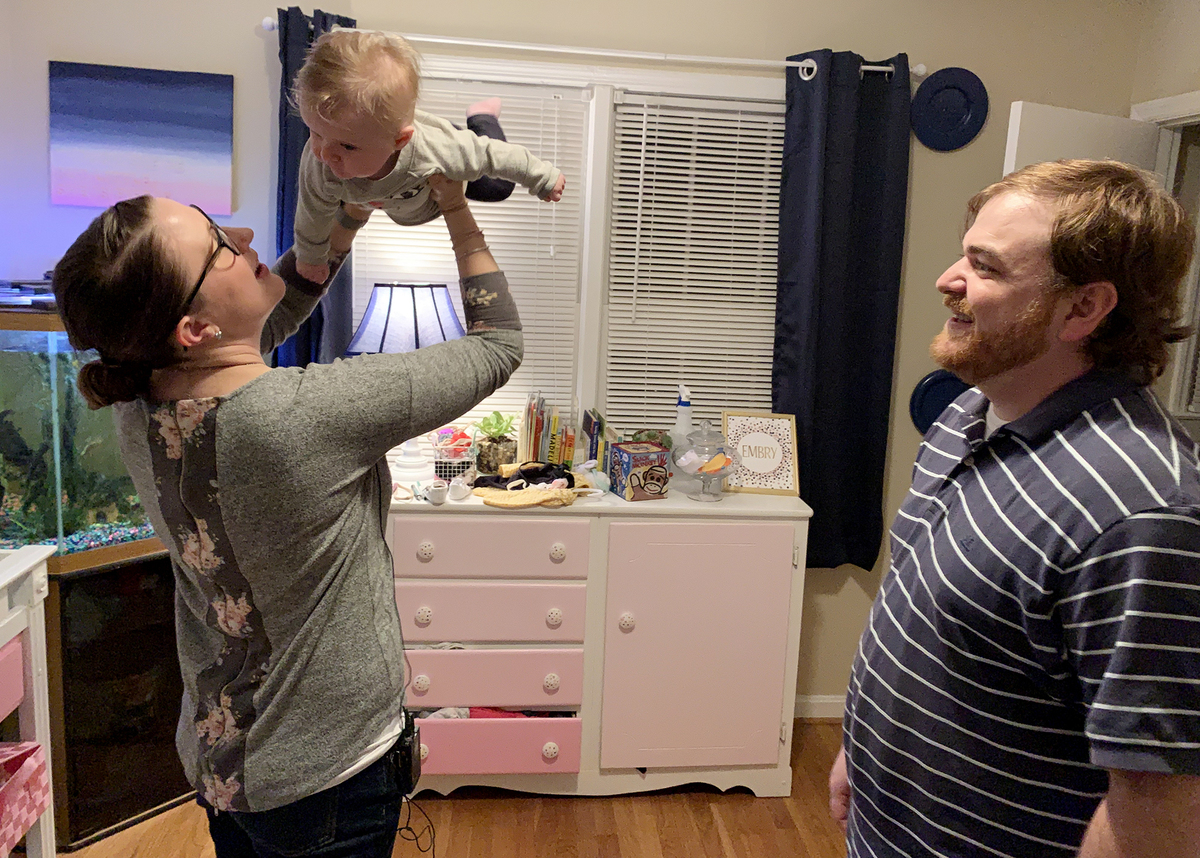
Jenna Neikirk and her husband, Zach, play with their 5-month-old, Embry, in their apartment in Atlanta.

Jim Burress/WABE


hide caption

toggle caption

Jim Burress/WABE

That’s likely because none of those drugs is explicitly approved by the Food and Drug Administration for treatment of pregnant women.

“Gestational hypertension itself is a separate condition, and we actually don’t have any medications that are developed specifically for that,” says Dr. Catherine Spong, chief of maternal-fetal medicine at the University of Texas Southwestern Medical Center in Dallas.

The American College of Obstetricians and Gynecologists recommends women with pre-existing hypertension continue to use some blood pressure medications. And the group says women who develop high blood pressure can receive “emergency treatment” with some drugs.

Still, bed rest isn’t recommended. ACOG cautions against bed rest because there’s no evidence that it helps pregnant women and it may even cause harm.

Neikirk’s doctor’s office didn’t respond to requests for comment.

Neikirk found herself in a situation that many pregnant women do today. They have a medical problem — either that existed before they were pregnant or was caused by being pregnant — and their doctors have to figure out how to deal with it without a strong foundation of medical research to help their decisions.

Historically, pregnant women have been excluded from medical research, because scientists and ethicists were concerned that experimenting on them could hurt them or their fetus.

“Pregnant women are considered a vulnerable population, so, in general, researchers aren’t permitted to experiment on pregnant women,” says Jacqueline Wolf, a professor of the history of medicine in the Department of Social Medicine at Ohio University.

Researchers have to take special precautions to do studies on vulnerable populations, including children, the mentally disabled, incarcerated people and pregnant women. So researchers typically exclude these groups to get their studies approved.

But one result is that doctors caring for pregnant women have fewer tools to care for them when they’re ill, Wolf says.

“That’s where the irony comes in,” she says. “Because researchers are hardly ever permitted to conduct trials on pregnant women, we end up experimenting on pregnant women all the time, because we can’t accumulate a solid fund of evidence. So we just stick with the old standards, or we introduce new things without doing trials on them.”

When a woman gets pregnant, her pre-existing medical conditions don’t disappear, says UT Southwestern’s Spong. She lists a litany of conditions — autoimmune disorders, diabetes, hypertension, infections, asthma, preterm labor, gestational hypertension or hyperemesis — for which there are few therapies that are specifically developed for or tested on pregnant women.

“If someone comes into pregnancy on anti-hypertensive medicines, commonly they will continue on some type of anti-hypertensive medicine during pregnancy,” Spong says. “However, we don’t have information about how that medicine should be dosed in pregnancy.”

She says when women are pregnant, their blood volume doubles and their liver and kidney function change. No one knows how that affects the medication.

So doctors across the country find themselves prescribing medications, or taking patients off them, without strong evidence either way.

By keeping pregnant women out of studies, Spong says, “You are putting them and their fetuses more at risk.”

Spong was chair of a federal task force, mandated in 2016 by the 21st Century Cures Act, that studied the gaps in health care knowledge about pregnant and lactating women. The group issued a 388-page report in September that recommends that pregnant women be routinely included in research studies, that the government devote time and money to studying existing drugs in pregnant women and that the government help develop new drugs to treat problems related to pregnancy and breastfeeding.

Health and Human Services Secretary Alex Azar is supposed to respond to the task force recommendations by the end of December. He didn’t respond to a request made through his spokeswomen for an interview.

Over the years, scientists have accumulated observational research on the safety and efficacy of some existing drugs, including blood pressure medications, says Dr. Alison Cahill, chief of maternal fetal medicine at Washington University in St. Louis.

And for those drugs that have shown themselves to be safe, she says, doctors usually recommend women continue to use them after they become pregnant.

But few studies compare a drug with a placebo in pregnant women, which is considered the gold standard, and few studies show how medications react differently after a woman becomes pregnant. Without that arsenal of well-researched medications, Cahill says she and her patients have to weigh the pros and cons of using a drug, or leaving an ailment untreated.

“I actually think that it’s one of the most important responsibilities of a physician,” she says. “There’s always things that we don’t know. And I think part of respecting patients’ autonomy, and their participation in medical decision-making, is to explain what we know but also to explain what we don’t know even if that’s hard.”

Let’s block ads! (Why?)

'We're Fighting For Our Lives' — Patients Protest Sky-High Insulin Prices

Angela Lautner who lives in Elsmere, Ky. has Type 1 diabetes and is an advocate for affordable insulin.

Maddie McGarvey for NPR


hide caption

toggle caption

Maddie McGarvey for NPR

Angela Lautner knew her thirst was unusual, even for someone directing airplanes, outside in the Memphis summer heat.

“We had coolers of Gatorade and water for people to always have access to,” Lautner remembers of her job as a ground services agent. “But the amount of thirst that I felt was just incredible.”

She had no appetite and she lost an unusual amount of weight. Then after a trip to the emergency room, Lautner, who was 22, was diagnosed with Type 1 diabetes. The diagnosis was life changing.

To start,it meant for the rest of her life she would require insulin injections every day to keep her alive. Unlike Type 2 diabetes, which can sometimes be controlled by diet, people with Type 1 diabetes need daily insulin injections to regulate their blood sugar.

Lautner’s diagnosis also meant she was no longer allowed to become a commercial airline pilot in the U.S. — a lifelong dream that she was training for in flight school at the time.

“I cried harder over losing my dream to fly than I did at the diagnosis of Type 1 diabetes,” Lautner says.

But after 18 years living with diabetes, Lautner now says the hardest thing about the diagnosis is accessing insulin — the expensive drug she needs to keep her alive. She’s had to borrow money from her parents to pay for insurance; she’s spent hours on the phone with drug companies; she’s switched brands of insulin to save costs; and she even moved to a new state, Kentucky, with a more generous Medicaid plan.

Last year, Lautner noticed other people with Type 1 diabetes tweeting similar stories under the hashtag #Insulin4All. She read the stories of Shane Patrick Boyle and Alec Raeshawn Smith, two men who died because they could not afford their insulin. It was an epiphany.

“I thought, ‘My goodness, there’s more people than me. I’m not the only one out here,’ ” she says.

Since then Lautner has joined a group of consumer activists, people who need insulin to live and are angry about the sky-high prices. They are putting pressure on the three main companies that make insulin: Sanofi of France, Novo Nordisk of Denmark, and Eli Lilly and Company in the U.S.

Taking on the drugmakers

The cost of insulin nearly tripled between 2002 and 2013 and has doubled again since then. The list price is over $300 for a single vial of medicine, and most people with Type 1 diabetes need multiple vials every month to live. That cost is typically lower with insurance or with discount programs. Still, for some people the price is unmanageable.

There’s been some action by lawmakers on the issue. In October Minnesota’s attorney general sued insulin manufacturers alleging price gouging, and a bipartisan caucus in the U.S. Congress issued a report in November urging action to bring insulin prices down.

Elizabeth Fiester, founder of T1International, addresses a crowd outside the Indianapolis headquarters of pharmaceutical giant Eli Lilly and Company in September.

Bram Sable-Smith/NPR


hide caption

toggle caption

Bram Sable-Smith/NPR

But prices are still going up, so consumer activists like Lautner are taking things into their own hands.

Nonprofit group T1International, which advocates for Type 1 diabetes around the world, with a particular focus on insulin prices has started holding rallies outside the Indianapolis headquarters of pharmaceutical giant Eli Lilly and Company. (Eli Lilly and Novo Nordisk have provided financial support to NPR.)

Lautner joined more than 70 people who came together to demonstrate there in September. They were asking for three things: transparency about how much it costs to make a vial of insulin and how much profit comes from each vial, and a commitment from the company to lower the list price of insulin.

There were protesters from at least 12 states, mainly Ohio, Illinois, Indiana and Kentucky, but also from as far away as New York. Lautner, who now lives outside Cincinnati, rented a school bus with a dozen others to make the 112-mile trip.

“Insulin is kind of the face of the drug pricing crisis in America,” says Elizabeth Fiester, founder of T1International who has Type 1 diabetes herself. “We literally die without it,” she says. “We’re fighting for our lives.”

This was the third time the group had protested at Eli Lilly headquarters. Last fall, when the group held its first protest there, Fiester says, as it was “the first time where people living with Type 1 were able to physically stand and show that people are angry enough to come out.”

If you can’t afford your insulin

The companies that make insulin offer resources for people having difficulty affording insulin. You can find more information here:

While there are cheaper versions of insulin available over-the-counter, they work differently than most insulin prescribed by doctors, and it can be difficult to guess at the right dosage and timing. If you are considering using an over-the-counter insulin you should consult with your health care provider.

Eli Lilly declined NPR’s request for an interview, but in statement a spokesperson said, “we understand why people are making their voices heard.”

Protesting is one arm of their advocacy efforts; the group is also lobbying at the state and national level, and conducting online awareness-raising campaigns under the hashtag #Insulin4All.

Advocacy at the state level

Last spring, the fight got even more personal for Angela Lautner. She got a letter from her insurance company stating they were no longer going to pay for the insulin she was taking, they wanted to switch her to a different brand.

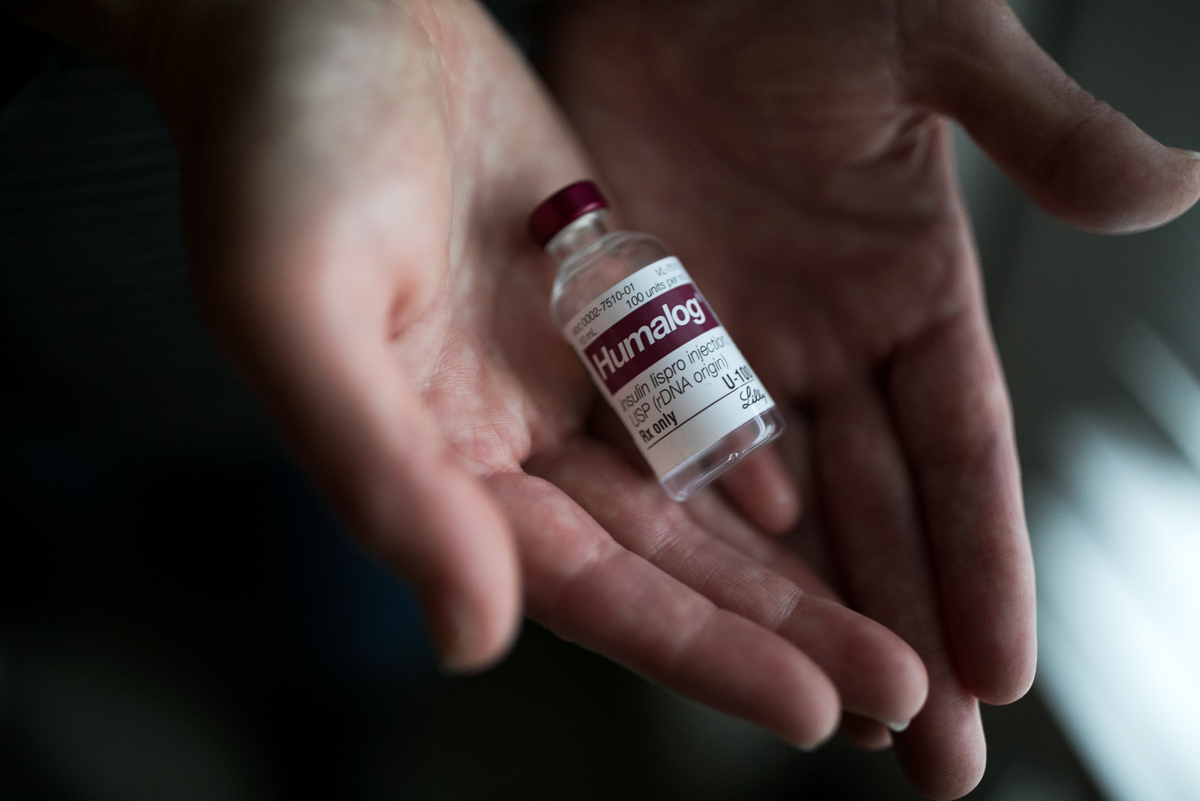
Lautner holds a vial of insulin she uses called Humalog, which is made by Eli Lilly, one of the companies Lautner has been protesting.

Maddie McGarvey for NPR


hide caption

toggle caption

Maddie McGarvey for NPR

Most people with Type 1 diabetes use two types of insulin: short-acting insulin to counteract the carbohydrates consumed with meals, and long-acting insulin to keep blood sugar stable throughout the day.

Lautner has found that the long-lasting insulin brand Lantus works best with her body; it keeps her her blood sugars low, but not so low that she becomes dangerously hypoglycemic, risking death. But her insurer was dropping its coverage of Lantus in favor of a different long-lasting insulin, Basaglar.

“The problem that I immediately saw was that [Basaglar] had not worked for my body,” Lautner says. “So I go into my doctor’s office with this letter and I’m like, ‘What am I going to do?’ “

Lautner’s doctor connected her to Sanofi’s drug discount program where she was able to get a month’s supply of Lantus for a couple hundred dollars. So she decided to pay for the insulin herself.

“I’m fortunate enough to have an emergency fund,” Lautner says.

But she knows others aren’t so lucky.

This year, Lautner organized her own group of diabetes activists in Kentucky, Ohio and Indiana, called KOI Insulin4All. They’ve met with legislators in all three states about establishing emergency insulin prescription refills and about making the cost of insulin more transparent.

There are similar groups starting up in Oklahoma, Pennsylvania, Minnesota and Illinois. In November, activists protested outside the Cambridge, Mass., office of Sanofi. All of them are pushing for the same thing — to make the voices of people with diabetes heard.


Bram Sable-Smith (@besables) is a health reporter based in Madison, Wis.

Let’s block ads! (Why?)

For One Rural Community, Fighting Addiction Started With Recruiting The Right Doctor

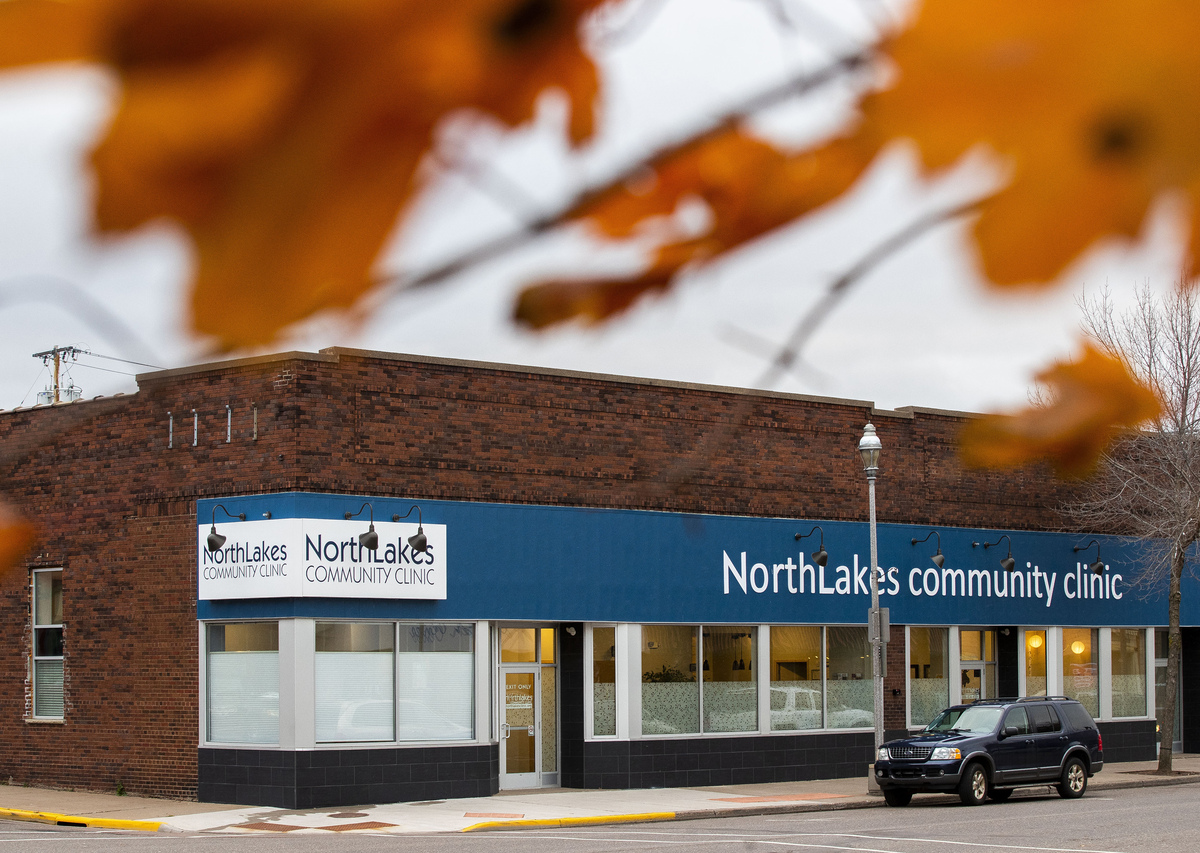
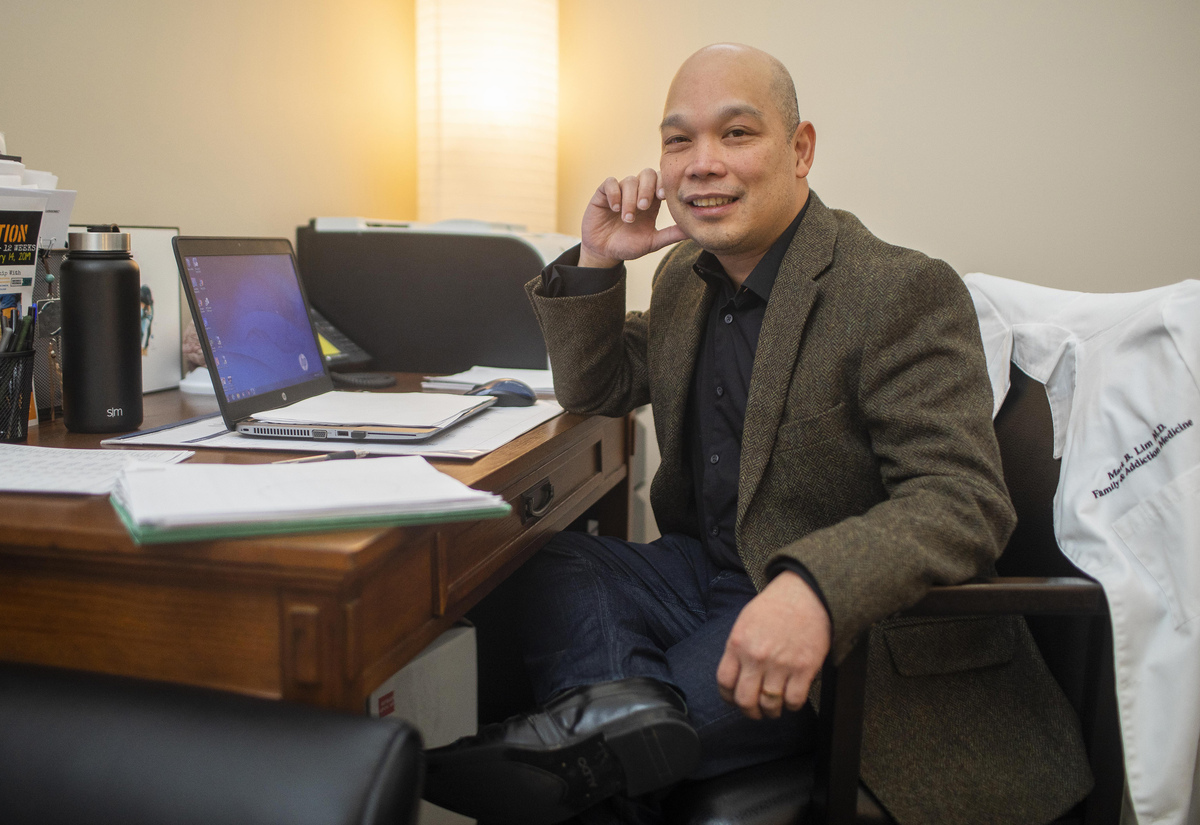
Located in Northern Wisconsin along the shores of Lake Superior, Ashland, Wis. has had enough of substance abuse issue. NorthLakes Community Clinic brought in Dr. Mark Lim to start a team providing substance abuse and mental health services.

Derek Montgomery for NPR


hide caption

toggle caption

Derek Montgomery for NPR

Lindsay Bunker woke up from a nightmare.

The 32-year-old lives with her sixth-month-old daughter on the Lac Courte Oreilles Indian Reservation in northern Wisconsin. She’s struggled with addiction for over 10 years, mostly to heroin. Then came the nightmare: She dreamt two men were attacking her baby while she could think only about drugs.

“In my mind I was thinking, ‘If I can just get one hit, if I can get one line, I can save her,'” she recalls, pausing before continuing, “I woke up and I was panicking. How can a mother think like that?”

It was a wake-up call. Bunker says she realized in that moment that heroin was “evil” and she resolved to get into treatment. In a lot of rural America, that’s where the story could have ended.

Many rural communities lack basic resources for substance abuse. There are fewer services available than in urban areas—as many as 82 percent of rural Americans may live in counties that lack detoxification services, for example.

Life And Health In Rural America

You can find the other stories in our series about life in rural America here.

But Bunker was lucky. She found a community health center only about an hour from her home that recently expanded its addiction treatment services.

The clinic, NorthLakes Community Clinic,serves Medicaid and Medicare patients, and offers sliding scale payments for those with low-income. It expanded its addiction recovery program with the help of state and federal grants targeting opioid use. Though rural communities across the country struggle with addiction, community health centers like this one are modeling an approach to managing — and funding — treatment programs.

“We were seeing substance use disorders killing our community and we felt it was our job to step up,” says Reba Rice, the clinic’s CEO. “We feel that all of our patients and community members deserve a life worth living.”

Not just opioids

Rice says addiction has torn apart rural communities in Northern Wisconsin in the last five years or so, with an increase in crime, problems in schools, trauma in families.

“It was amazing how many things we were seeing changed,” she says. “The way people looked at each other, the level people were willing to trust each other, and it was all about the changes that this disease makes on its victims”

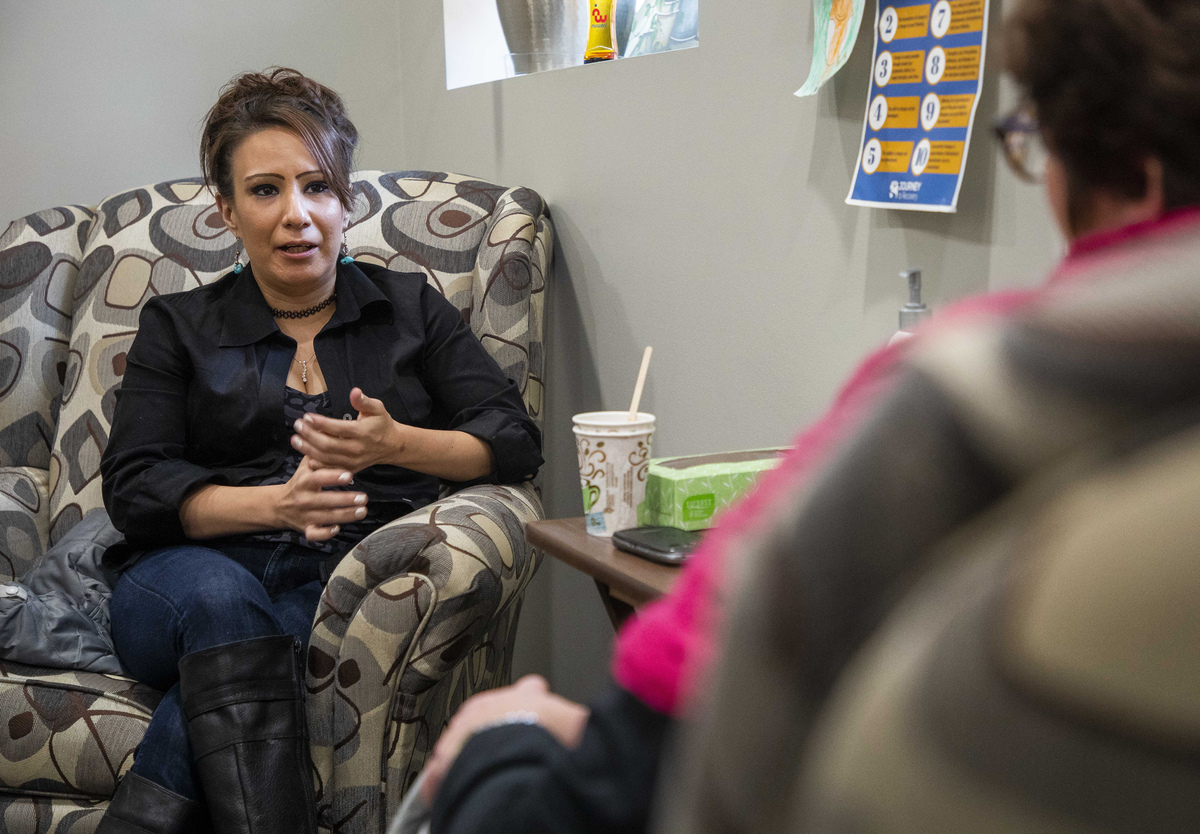
Lindsay Bunker (left) talks to her counselor Regina Fox (right) at the NorthLakes Community Clinic in Ashland, Wisconsin. Bunker is in treatment for heroin addiction. She says the clinic’s approach is helping: “I love being here. I feel safe. I feel strong. I feel supported.”

Derek Montgomery for NPR


hide caption

toggle caption

Derek Montgomery for NPR

A recent poll by NPR, the Robert Wood Johnson Foundation and the Harvard T.H. Chan School of Public Health shows that opioid and other drug abuse is the top health concern for rural Americans.

NorthLakes has long provided primary care, dental and behavioral health services for low-income residents in Ashland, Wisconsin, and in several nearby towns. But as the opioid addiction problem worsened, Rice says she felt a responsibility as a health care provider to do something about it.

“We contributed to the problem so we needed to contribute to the solution,” she says.Rice says opioids were just part of the puzzle: meth and alcohol were huge problems too. In fact, meth use in Wisconsin it has grown by 250 percent in recent years, according to the FBI. But new funds were becoming available for opioid treatment so the clinic applied for those — and is using them to build a comprehensive addiction treatment program that addresses all the substances people there struggle with.

To fund its expanded addiction treatment services, NorthLakes applied for and won a grant from the state of Wisconsin three years ago. It also got other federal grants intended for mental health and addiction. Central to their plan was hiring a physician who could lead the new program, and could prescribe the addiction treatment buprenorphine, known by the trade-name Suboxone.

Suboxone treatment is one of the most effective ways to treat opioid addiction. But it is hard to find in rural areas, because only providers who’ve received special training are allowed to prescribe it. One 2015 study found that more than 80 percent of rural counties in the U.S. do not have a single physician able to prescribe it.

NorthLakes found a physician who could prescribe it and more than that, who had a vision for a comprehensive addiction program.

Building treatment capacity

Dr. Mark Lim says he is surprised he’s here in this 8,000 person port-town on Lake Superior. He’d dreamed of living in a big city since he moved to the U.S. from the Philippines. When he got the call about the job, he was hesitant at first. “I didn’t know where that was on a map,” he recalls.

But he saw this part of Wisconsin, where the death rate from drug and alcohol abuse is nearly twice as high as the state average, as a place where he could make a difference.

Lim’s been board certified in addiction medicine since it was officially recognized as a subspecialty in 2016, but he’s been working in the field since about 10 years ago when he started working in an addiction practice in Maine.

Dr. Mark Lim moved from Maine to become the recovery program medical director at NorthLakes Community Clinic in Ashland, Wisconsin. He wanted to set up a comprehensive practice to treat a range of addictions.

Derek Montgomery for NPR


hide caption

toggle caption

Derek Montgomery for NPR

He took the Wisconsin job, with one stipulation: He would start a program to address addiction as a whole. His expertise would be just one part of the treatment approach.

“If I’m just going to be the Suboxone doctor I’m not doing the full practice of addiction,” Lim says.

Because while the medication can be effective for treating opioid use disorder, Lim says addiction is not just about opioids.

“Opioids are big right now,” Lim says. “But you have to work with alcohol too. You have to work with marijuana too. You have to work with methamphetamine, cocaine.”

Rice says she and Lim developed the program together with community partners including educators, law enforcement and tribal leadership. “We were successful because we had a vision for creating a program and so did he,” Rice says.

While it’s rare to have a doctor who can prescribe Suboxone in a rural area like this one, Lim says only about 40 of his more than 200 patients take it. For the rest, his program relies on a combination of counseling, group therapy for addiction and underlying mental health issues, and case management. Staff help to remove barriers to being successful in recovery, helping patients with things like, transportation to the clinic, daycare for parents during therapy, and even job placements.

This kind of recovery program that combines clinical and counseling services is exactly what rural communities need, says John Gale of the Maine Rural Health Research Center.

“That’s exactly the way it should be done. Because most people with a substance use disorder have co-occurring mental health and substance use problems,” Gale says. “If we take care of [a patient’s] heroin problems and we don’t treat the underlying mental health and substance abuse problems, they’re going to go to go to alcohol, they’re going to do something else.”

And while most of the attention and dollars are focused on opioid abuse right now, he says rural communities struggling to address addiction can use those resources to build a larger treatment capacity.

“They can use [those resources] to say, ‘Wait a minute, let’s build a treatment capacity for other people,’ ” Gale says. “And they begin to create a community where you can treat all sorts of substance use disorders.”

Lindsay Bunker gets a ride to and from the NorthLakes clinic from a medical transportation company — it’s about an hour’s drive each way from the reservation. The clinic has a baby sitter who looks after her daughter when Bunker is in appointments. She makes the trip nearly every day.

“I love being here. I feel safe. I feel strong. I feel supported,” Bunker says.

But she only sees Dr. Lim about once a week. Instead, like all of the patients here, she spends most of her time in one-on-one and group counseling sessions. There’s the early relapse prevention group (from which Bunker recently graduated), then there’s the relapse recovery group, the family group, the engaged-in-recovery group. There’ll be a trauma group soon as well.

Bunker says those group sessions are really important in helping her stay in recovery.

“I get cravings and the cravings are being taken away with that medicine [suboxone]. But being here with my peers, I love it. I really do,” Bunker says.

And she says, recovery agrees with her.

“I look good, I feel good, I’m taking care of my kid,” she says. “I’m doing very well.”


Bram Sable-Smith (@besables) is a health reporter based in Madison, Wis.

Let’s block ads! (Why?)