Chronically Ill, Traumatically Billed: $123,019 For 2 Multiple Sclerosis Treatments

Shereese Hickson was diagnosed with multiple sclerosis in 2012 and is unable to work. She supports herself and her son, Isaiah, on $770 a month.
Shane Wynn for KHN
hide caption
toggle caption
Shane Wynn for KHN
Shereese Hickson’s multiple sclerosis was flaring again. Spasms in her legs and other symptoms were getting worse.
She could still walk and take care of her son six years after doctors diagnosed the disease, which attacks the central nervous system. Earlier symptoms such as slurred speech and vision problems had resolved with treatment, but others lingered: She was tired and sometimes fell.
This summer, a doctor switched her to Ocrevus, a drug approved in 2017 that delayed progression of the disease in clinical trials better than an older medicine did.
Do you have a bill for us to look into?
If you have a billing experience that you’d like to share with NPR and Kaiser Health News, you can submit it here.
Genentech, a South San Francisco, Calif.-based subsidiary of Swiss pharmaceutical giant Roche, makes Ocrevus. The drug is one of several for multiple sclerosis that are delivered intravenously in a hospital or clinic. Such medicines have become increasingly expensive, priced in many cases at well over $80,000 a year. Hospitals delivering the drugs often make money by charging a premium on top of their cost or adding hefty fees for the infusion clinic.
Hickson received her first two Ocrevus infusions as an outpatient two weeks apart in July and August. And then the bill came.
Patient: Shereese Hickson, 39, single mother who worked as a health aide and trained as a medical coder, living in Girard, Ohio. Because her MS has left her too disabled to work, she is now on Medicare; she also has Medicaid for backup.
Total bill: $123,019 for two Ocrevus infusions taken as an outpatient. CareSource, Hickson’s Medicare managed care plan, paid a discounted $28,960. Hickson got a bill for about $3,620, the balance calculated as her share by the hospital after the insurance reimbursement.
Medical service: Two Ocrevus infusions, each requiring several hours at the hospital.
Service provider: Cleveland Clinic, a nonprofit, academic medical center based in Ohio. (Cleveland Clinic has provided financial support for NPR.)
What gives: Hickson researched Ocrevus online after her doctor prescribed the new medicine. “I’ve seen people’s testimonies about how great it is” on YouTube, she said. “But I don’t think they really go into what it’s like receiving the bill.”
That was particularly shocking because, covered by government insurance for her disability, she had never received a bill for MS medicine before.
“I have a 9-year-old son and my income is $770 a month,” said Hickson. “How am I supposed to support him and then you guys are asking me for $3,000?”
Even in a world of soaring drug prices, multiple sclerosis medicines stand out. Over two decades ending in 2013, costs for MS medicines rose at annual rates five to seven times higher than those for prescription drugs generally, found a study by researchers at Oregon Health & Science University.
“There was no competition on price that was occurring,” said Daniel Hartung, the OHSU and Oregon State University professor who led the study. “It appeared to be the opposite. As newer drugs were brought to market, it promoted increased escalation in drug prices.”
With Ocrevus, Genentech did come up with a price that was slightly less than for rival drugs, but only after MS medicines were already extremely expensive. The drug launched last year at an annual list price of $65,000, about 25 percent lower than that of other MS drugs, Hartung said. MS drugs cost about $10,000 per year in the 1990s and about $30,000 a decade ago.
“We set the price of Ocrevus to reduce price as a barrier to treatment,” said Genentech spokeswoman Amanda Fallon.
It was also probably a response to bad publicity about expensive MS drugs, Hartung said. “Now companies are very aware at least of the optics of releasing drugs at higher and higher prices,” he said.
Patients starting Ocrevus get two initial infusions of 300 milligrams each and then 600 milligrams twice a year. Cleveland Clinic charged $117,089 for Hickson’s first two doses of Ocrevus — more than three times what hospitals typically pay for the drug, said John Hennessy, chief business development officer at WellRithms, a firm that analyzes medical bills for self-insured employers.
As is typical of government programs such as Medicare, the $28,960 reimbursement ultimately collected by the Cleveland Clinic was far less — but still substantial.
“We kind of got ourselves in a pickle here,” he said. “We’re more excited about the discount than we are about the actual price.”
Hickson’s nearly $3,620 bill represented the portion that Medicare patients often are expected to pay themselves.
Last year, the Institute for Clinical and Economic Review, an independent nonprofit that evaluates medical treatments, completed a detailed study on MS medicines. It found that Ocrevus was one of three or four medicines that were most effective in reducing MS relapses and preventing MS from getting worse. But it also found that patient benefits from MS drugs “come at a high relative cost” to society.
At the same time, deciding which MS drug — there are about a dozen — would best suit patients is something of a shot in the dark: The science showing the comparative effectiveness of MS drugs is not as strong as it could be, researchers say.
“In general, there’s a real lack of head-to-head studies for many of these drugs,” said Hartung. The [Food and Drug Administration] has no required comparison standard for MS drugs, an agency spokeswoman said. Sometimes they’re rated against placebos. With everyone able to charge a high price, the companies have little incentive to see which works better and which worse.
Resolution: After Hickson questioned the charges over the phone, the billing office told her to apply to the hospital for financial assistance. Hickson had to print a form, provide proof of her disabled status, mail it and wait.
Hospital officials told her in October she qualified for assistance based on her income through a state program funded by hospital contributions and federal money. Cleveland Clinic wiped out the $3,620 balance.
“I’m grateful that they approved me for that, but not everybody’s situation is like that,” she said. She was worried enough about being billed again for her next Ocrevus infusion that she considered switching back to her old medicine. But her doctor wants her to give it more time to gauge its effects.
The takeaway: Always ask about charity care or financial assistance programs. Hospitals have different policies and wide discretion about how to apply them, but they often do not even tell patients such programs exist.
Because health care costs can be so high, you may be eligible even if you have a decent salary. Cleveland Clinic gives free care to everybody below a certain income, said spokeswoman Heather Phillips. But it wasn’t until Hickson called that the hospital agreed to erase the charge.

“I’ve seen people’s testimonies about how great it is” on YouTube, said Hickson about the drug Ocrevus. “But I don’t think they really go into what it’s like receiving the bill.”
Shane Wynn for KHN
hide caption
toggle caption
Shane Wynn for KHN
While there are multiple new drugs to treat serious chronic conditions, they have often not been tested against one another. Moreover, your doctor may have no idea about their prices. But he or she should.For newer drugs, all options may well be very expensive.
Keep in mind that drugs that must be infused often come with facility fees and infusion charges, which can leave patients with hefty copayments for outpatient treatment. Ask about oral medicines or those you can self-inject at home.
NPR produced and edited the interview with Kaiser Health News’ Elisabeth Rosenthal for broadcast. Marlene Harris-Taylor, from member station Ideastream in Cleveland, provided audio reporting.
Do you have an exorbitant or baffling medical bill that you’d like KHN and NPR to look into? You can tell us about it and submit a copy of the bill here.
KHN is a nonprofit news service covering health issues. It is an editorially independent program of the Kaiser Family Foundation that isn’t affiliated with Kaiser Permanente.
For Doctors Who Want To Provide Abortions, Employment Contracts Often Tie Their Hands

Dr. Kimberly Remski was told by a potential employer that she couldn’t provide abortions during her free time, something she felt called to do. “I realized it was something I really needed to do,” she says.
Kim Kovacik for NPR
hide caption
toggle caption
Kim Kovacik for NPR
Doctors who are opposed to abortions, don’t have to provide them. Since the 1970s, a series of federal rules have provided clinicians with “conscience protections” that help them keep their jobs if they don’t want to perform or assist with the procedure.
Religious hospitals are also protected. Catholic health care systems, for example, are protected if they choose not to provide abortions or sterilizations. Doctors who work for religious hospitals usually sign contracts that they’ll uphold religious values in their work.
But as the reach of Catholic-affiliated health care grows, these protections are starting to have consequences for doctors who do want to perform abortions — even as a side job.
Religious hospitals often prohibit their doctors from performing abortions — even if they perform those abortions at unaffiliated clinics, says Noel León, a lawyer with the National Women’s Law Center. She was hired about two years ago to help physicians who want to be abortion providers. They have little in the way of legal protection, she says.
“Institutions are using the institutional religious and moral beliefs to interfere with employees’ religious and moral beliefs,” León says.
This kind of legal argument, León says, may prevent doctors from providing care they feel called to offer. And since many clinics that provide abortions rely heavily on part-time staff, it may also prevent these clinics from finding the doctors they need to stay open.
Dr. Kimberly Remski sought help from León when she was job-hunting. She is a primary care physician but had always been interested in women’s health. When she first set foot in a clinic that provides abortions, she realized it was her passion.
“A lot of the things we spend our time doing in training are monotonous, or you’re getting swamped in work,” she says. “I just remember leaving the clinic feeling like I was doing something really important.”
She interviewed for a job as a primary-care doctor with IHA, one of the largest physician groups in Michigan in 2017. She says she was clear about her desire to work one day a week in an independent clinic that provides abortions.
Part-time work is common for outpatient physicians, and Remski says the doctors she interviewed with were receptive.
“I was very upfront. I told that them that was a special interest of mine. I wanted to be able to pursue it,” she says.
She signed a contract, and started preparing for her move. Then she got a call that the offer was off.

Noel León oversees a National Women’s Law Center program that provides legal support to doctors who want to perform abortions.
Mary Mathis for NPR
hide caption
toggle caption
Mary Mathis for NPR
Remski learned that her potential employer was actually owned by a larger Catholic hospital network called Trinity Health, and it requires physicians to “provide services in a manner consistent with the Ethical and Religious Directives for Catholic Health Care Services,” according to her contract.
And, she says, she was shocked to learn Trinity Health would also have had a say over how she spent her free time. IHA officials told her that she couldn’t work on the side as an abortion provider if she took the job, Remski says.
Trinity Health had merged with IHA in 2010, part of a wave of mergers that has led to a net increase in Catholic ownership of hospitals. According to a 2016 report from MergerWatch, an organization that tracks hospital consolidation, 14.5 percent of acute care hospitals are Catholic-owned or affiliated. That number grew by 22 percent between 2001 and 2016, while the overall number of acute care hospitals dropped by 6 percent.
And as Catholic-affiliated health care expands, says León, doctors increasingly encounter morality clauses that prohibit them from performing abortions.
León says she has worked with at least 30 physicians and nurse practitioners from 20 different states who faced problems similar to Remski’s when they disclosed to their employers, or potential employers, that they planned to provide abortions.
“They’re being told that, ‘We can’t provide the care we went into medicine to provide,’ ” León says. “We shouldn’t be putting providers in the position of caring for their patients or keeping their jobs.”
Representatives of IHA would not agree to a phone interview about Remski’s situation, but spokesperson Amy Middleton explained in an email that IHA “works hard with our physicians to enable them to pursue other positions.” But, she added, “outside work that interferes with a physician’s ability to serve patients or contradicts the organization’s practices could present a conflict of interest.”
IHA physicians follow Catholic health care guidelines, Middleton wrote, which requires that physicians “not promote or condone contraceptive practices.”
Dr. Barbara Golder, the editor of the Catholic Medical Association journal the Linacre Quarterly, says that language about morality is ubiquitous in contracts — and that it’s reasonable that religious institutions might not want to be associated with abortion providers.
“The person is seen primarily as Dr. X of Catholic hospital Y, and then it turns out that Dr. X of Catholic hospital Y is doing abortions on the weekends,” Golder says. “There’s sort of a cognitive dissonance about that. It’s in opposition to what Catholic health care is.”
According to Lance Leider, a Florida attorney who has reviewed hundreds of physician contracts, it is “exceedingly common” for contracts, not just at religiously-affiliated hospitals, to include language about the reasons an employer can fire a doctor, including but not limited to morality clauses.
“There’s always a laundry list of things the employer can terminate the contract for,” Leider says. “There’s usually a catch-all. Anything that calls into question the reputation of the practice.”
These clauses tend to be vague, León adds, which means employers can invoke them to prevent a wide range of activities, like political activity, controversial posts on social media, or, in religious hospitals, physicians spending time at clinics that provide abortions.
The restrictions may have ramifications not only for physicians, but for many clinics that provide abortions. Smaller clinics may be staffed almost entirely with part-time doctors, and when they can’t find enough, they’re sometimes left unable to meet the demand for services.
“We don’t have full-time doctors,” says Shelly Miller, the executive director of Scotsdale Women’s Center in Detroit, Mich., one of the clinics where Remski worked. “We really cannot afford to have a provider sit here all day and wait for patients to come in.”
Through her involvement with the National Abortion Federation, Miller often talks with other directors of small clinics that provide abortions, and sometimes other women’s health services. She says that many of her counterparts say they exclusively hire part-time physicians because they simply don’t need somebody full-time. If more physicians are prohibited from part-time abortion work, Miller worries it may put some smaller clinics out of business.
It’s hard to know exactly how many of these clinics primarily use part-time staff, according to Rachel Jones, who studies the demographics of U.S. abortion services at the Guttmacher Institute, a family planning research organization. Ninety-five percent of abortions take place in clinics as opposed to hospitals, Jones notes, which may be more likely to utilize a team of part-time staff.
León doesn’t have data to show how common it is for physicians to be threatened with termination for providing abortions. She guesses that doctors will either give up on providing abortions — or, like Remski did, look for a different job that allows them to. León spends much of her time speaking to groups of doctors about how to approach contract negotiation if they want to provide abortions.
Ultimately, Remski says she parted amicably from IHA, since “it felt like the wrong place for me.”
She ended up finding a job at an urgent-care clinic in Michigan, which allowed her to work part-time at three separate clinics that provide abortions. She has since moved to Chicago, where she also splits her time between providing abortions and primary care.
“I was providing a service that was needed and necessary,” Remski says. “I realized it was something I really needed to do.”
Mara Gordon is a family physician in Washington, D.C., and a health and media fellow at NPR and Georgetown University School of Medicine.
Rethinking Bed Rest For Pregnancy

Four-year-old Violet (right) supervises as her mom Margaret Siebers pours a first-ever spoonful of honey for 1-year-old Frances to try. Siebers spent much of the end of her pregnancy with Frances confined to bed rest at her home in Milwaukee.
Sara Stathas for NPR
hide caption
toggle caption
Sara Stathas for NPR
The couch is dark brown corduroy with lumpy cushions. There are a few telltale smears of food, maybe yogurt or a banana, and some crumbs here and there. It’s a well-loved piece of furniture.
Margaret Siebers plops herself down in the center and reaches out to baby daughter Frances, who climbs onto her mother’s lap to breastfeed.
“This is where I spent several months,” says Siebers, with a shrug. Her 4-year-old, Violet, runs around nearby. “I could come downstairs and sit on the couch.”
Siebers was about halfway through her pregnancy with Frances, when health professionals guiding her care told Siebers she should be on bed rest. And the subsequent months, spent confined to a bed and couch in her small home in Milwaukee, turned her family’s life upside down.
Please Tell Us What You Think About Shots
Help us make Shots more relevant for you by completing an NPR research survey. Click here to start the questionnaire.
“My husband immediately quit his full time job,” Siebers says, “and he took care of me. I wouldn’t even get my own glasses of water. So I like to say that ‘I was on bed rest, and he was on house arrest,’ because he really couldn’t leave either.”
Siebers is just one of thousands of pregnant women who are put on bed rest by their doctors, nurses or midwives each year. The stated reason: Going to bed will help prevent a premature birth, or worse, a miscarriage. But there’s a major problem with this advice — there is no solid, scientific evidence that bed rest improves outcomes for pregnant women and their babies.
“The bottom line is that there’s never been any proven benefit of bed rest,” says Dr. Anne Drapkin Lyerly, an OB-GYN and professor of bioethics at the University of North Carolina at Chapel Hill. Lyerly and colleagues in 2013 did a review of the scientific research on bed rest as it relates to a variety of conditions, from early contractions to high blood pressure to carrying twins. They found no benefit.
In fact, women put on bed rest can suffer harm — physical, psychological and economic. “It doesn’t seem like a dangerous intervention in the same way we think about surgeries or medications,” Lyerly says. “But in fact it can be very dangerous.”
Siebers was about 22 weeks pregnant when she visited a radiologist for a routine ultrasound. It was a standard screening at that point in her pregnancy — one that checks the baby’s growth, proportions and organs to ensure the fetus is developing properly. The baby was doing great, the doctor told her. The fetal heartbeat was strong and the ultrasound looked perfect. But there was one point of concern: Siebers’ cervix was ‘shortened,’ which can be a sign that a woman is at risk of preterm labor.
“So that was really scary for us,” she says. “We’re at this appointment and the doctor’s looking at the baby and saying, ‘You’ve got a beautiful heart.’ And I’m thinking, ‘Oh great, they’ve got a beautiful heart and they might die.’ “
Siebers’ health care team at that point included a midwife, who was her primary caregiver, an obstetrician consulting on her case, and the doctors who performed the ultrasound. Because she’d had a miscarriage the year before, the team recommended she undergo a procedure called a cerclage to help keep her cervix closed. And they wanted her to stay in bed.

Margaret and Alex Siebers say they struggled make ends meet during the weeks Margaret was confined to bed rest during her pregnancy with Frances, who is now 1 year old. Alex had to quit his paid job for a time to take care of Margaret and their older daughter, Violet, who is now 4.
Sara Stathas for NPR
hide caption
toggle caption
Sara Stathas for NPR
Deb Studey, Siebers’ midwife, had cared for her during her previous pregnancy, which had ended in miscarriage at the end of the first trimester. Studey says she believes the bed rest may have helped Siebers carry this second child — Frances — to term.
“I know that being on bed rest was hard for Margaret. But I also knew, on the flip of that, having a 24-week baby in an ICU wasn’t going to be an easy outcome either. So, in my mind,” Studey says,”bed rest let her get to term.”
Studey is aware that the research doesn’t show bed rest to be beneficial. In fact, a 2013 study that specifically addressed the issue of a shortened cervix found that women who were prescribed activity restrictions during their pregnancy were actually more likely to give birth early.
“I think studies are always of interest,” Studey says. “I guess I pay attention just as equally to how things are working for women — and that doesn’t always fit a study. I think we’re all different.”
But Lyerly, the UNC bioethicist, tells NPR bed rest is not a benign intervention, and doctors and others who work with pregnant women need to think hard before prescribing it. And the American College of Obstetricians and Gynecologists cautions against it, for several medical reasons.
“One of the most dangerous things that can happen when a woman is on bed rest is having a blood clot,” Lyerly says. “You can have blood clots in your legs or in your pelvis. And if those clots travel to your lungs, it’s life threatening.”
She says women also risk losing muscle tone, becoming weak — just before they’re about to go through labor and then care for a child. And lying in bed can weaken bones, and reduce lung capacity. Some women become depressed.
“Women who are pregnant are not just ‘women who are pregnant,’ ” Lyerly says. “They are oftentimes mothers of other children. They are senators; CEOs; journalists; professors. They work in restaurants. They have jobs and they need their jobs.”
On a mid-November evening, the Siebers family is celebrating Frances’ first birthday. Margaret and her husband Alex have come home from work, where Alex had just injured his finger with a miter saw and was trying to clean and bandage the wound. Margaret made popcorn and peeled mandarins for the kids, as 4-year-old Violet twirled around the house in a whirlwind of red sparkles, and Frances climbed everything she saw.
It wasn’t a scene that lent itself to quiet time on the couch.
That’s why, when Margaret Siebers was told to stop moving, to go to bed, Alex Siebers, 33, quit his job to care for the family for several months.

“It felt kind of like ‘knocked out of society’ for a while,” Alex Siebers remembers, of the time his wife was confined to the couch. “Our daily routine, our lives and our connections with people — we lost touch. Because we were, you know, trapped in here just trying to make it.”
Sara Stathas for NPR
hide caption
toggle caption
Sara Stathas for NPR
“Her mobility was extremely limited,” he says, “and the fact that we live in this house where the bathroom’s upstairs, you know, wasn’t helpful.”
His wife would get up in the morning, use the bathroom and go downstairs to the brown corduroy couch. She’d write letters, watch Netflix, read books.
“I could go upstairs to use the bathroom,” Margaret recalls. “I tried not to go too often, just because I didn’t want to be up and down the steps too much. I would sit on the porch sometimes. But whenever I moved, I would try to stay where I landed for hours, if I could.”
She was able to continue working from bed, 24-hour a week, for her family’s company, Bagtags Inc., which makes lanyards and custom name tags for big events. But that was hardly enough to make ends meet.
The Siebers went on Medicaid. They also qualified for FoodShare, Wisconsin’s food stamp program, and WIC, the federal nutrition program for women, infants and children. Friends from church got organized to bring the family meals. And their landlord gave them a break on their rent.
Margaret received a small inheritance of $1,000, along with a tax return of about $800 that gave her some unexpected money.
“All of those things together helped us to get through,” she says, “but barely. If any of those things were missing, I don’t really know what we would have done. Maybe move in with relatives.”
And the family became isolated, says her husband.
“It felt kind of like ‘knocked out of society’ for a while,” Alex Siebers says. “Our daily routine, our lives and our connections with people — we lost touch. Because we were, you know, trapped in here just trying to make it.”
Kelly Jones, an economics professor at American University in Washington, D.C., and a senior research economist at the Institute for Women’s Policy Research, says prescribing bed rest diminishes the role of women in society.
“If you’re telling a woman to undertake an activity that you’re not certain is going to be benefiting her, and yet it’s keeping her away from her job, what you’re saying to her is ‘Your participation in the economy is not important,’ ” Jones says.
The practice can also more generally harm the standing of women in the workplace.
“We know that the gender wage gap really starts when a woman has her first child,” Jones says. She says that’s partly because women take on more household work and child care. “But there are also aspects of that, that come from false assumptions, or [from] discrimination in the workplace surrounding childbirth and motherhood.”
Sending women to bed reinforces the notion that they are fragile or weak, Jones says. And those long-term absences from the workplace can have lasting effects on a woman’s earning power.
Siebers’ consulting obstetrician, Sheldon Wasserman, says he’s seen women and men make huge sacrifices to ensure a successful pregnancy — including people who mortgage their homes to pay for fertility treatments and women who spend months in bed.
“The pursuit of having a child is one of the most fundamental desires,” he says.
Wasserman is chair of the Wisconsin section of ACOG. He knows what the research on bed rest says, and knows about ACOG’s recommendations against it.
“I’m kind of torn between the art and the science of medicine,” he says. “Have I seen over the years patients who were on bed rest who were able to have children when their previous obstetrical history is very poor? Yes, I have.”
It’s hard to quantify just how many pregnant women are ordered to bed each year by their doctors. A widely cited study from 1996 found that about 20 percent of women were prescribed bed rest at that time. A study two years later found that as many as 90 percent of maternal-fetal specialists order bed rest for some patients in high risk pregnancies.
The practice dates back to the time of Hippocrates, but became widespread in the late 1800s, when a British anatomist posited that if immobility heals broken bones, it likely could heal other ailments. The “rest cure” became standard medical care, according to Jacqueline Wolf, a professor of the history of medicine at Ohio University, who has written books about the history of pregnancy and childbirth.
Prescribing bed rest for pregnancy persisted in part, she says, because there was a notion that pregnant women were vulnerable to getting upset and hysterical.
“So, prenatal care brought out [among] obstetricians — virtually all of whom were men in the U.S. until the 1970s — a very intense and pervasive paternalism,” Wolf says. “If a woman had any sign of preterm labor or bleeding, she was to get complete rest. No visitors. No conversations. Darkened room — shades drawn. Even earplugs.”
The depth of research on the topic has changed since the 1970s. But bed rest is still widely prescribed. Today, women’s magazines, consumer advice web sites and even major medical centers include information about bed rest as a common practice that anyone may expect to face.
When NPR asked listeners if they’ve been on bed rest in the last year, more than 200 women responded in just four days.
Some said they’d spent just a few days in bed, or were told simply to ‘lighten up’ on their physical activity. Others, like Margaret Siebers, were given strict orders to stay in bed.
Siebers says she was aware that the research showed little benefit to her staying in bed.
“You better believe I spent a lot of that time lying on my back reading articles about the effectiveness of it,” she says. “So that was that was something that came up a lot.”
She asked her doctors if she could travel to her family’s cabin, and lay on the couch there, just for a change of scenery. She questioned exactly how much she could do. Could she cook? Walk her daughter one block to the park? The caregivers didn’t always agree. But in general it came down to this: The baby is OK, so don’t change a thing.
That rationale is particularly troublesome to Anne Drapkin Lyerly with UNC, because it can induce unearned guilt in the mother if something goes wrong with her pregnancy.
“When bed rest is prescribed, the implication is that it is useful and that the immobilization is what is going to present prevent whatever dreaded outcome — whether that’s preterm birth or miscarriage or preeclampsia,” Lyerly says. “If it ends up that a baby is born prematurely, or a woman develops preeclampsia, she is going to worry that she didn’t adhere to the recommendation well enough and will blame herself.”
Lyerly says she prescribed strict bed rest to one of her patients early in her career, and the pregnancy ended in miscarriage several hours after the woman took a shower.
“There was no amount of argument I could do to make her think it wasn’t her fault,” Lyerly recalls. “Because, after all, we had prescribed bed rest and she had gotten up.”
When Siebers’ pregnancy reached 37 weeks, a time when doctors believe it’s safe to give birth, the stitch that doctors had taken to hold her cervix closed was removed. She was allowed to get up and return to normal activity.
It was then a full three weeks before she went into labor, and gave birth to Frances.
“So maybe it worked really well, or maybe it wasn’t necessary,” Siebers says of her time spent on bed rest. But after all the family went through, she says, she doubts she’ll want to have another child.
Now, a year after Frances’ birth, both her parents have returned to full-time jobs.

Margaret Siebers sings Happy Birthday to Frances on the baby’s first birthday.
Sara Stathas for NPR
hide caption
toggle caption
Sara Stathas for NPR
The family gathers around a table, with little bowls of ice cream – one with a single candle for Frances. They sing an extra-long version of Happy Birthday, Margaret Siebers’ family tradition, and mom blows out the candle as Frances dips her fingers tentatively into her first ice cream.
Alex Siebers ponders the whole experience.
“It would be very disheartening to learn later on in life — after there had been much more study and research done on this — to find out that that hadn’t been necessary,” he says. “Because that was a real hardship for us. I can’t, obviously, attribute the outcome to the bed rest completely. But, you know, there she is. You know — there’s the baby.”

The Siebers family, now relaxed, on the living room couch that limited their world for several months when Margaret was on bed rest. Today both parents have returned to full-time paid work.
Sara Stathas for NPR
hide caption
toggle caption
Sara Stathas for NPR
Dangerous Infection Tied To Hospitals Now Becoming Common Outside Them

Infections with Clostridium difficile can crop up after a round of antibiotics.
BSIP/UIG via Getty Images
hide caption
toggle caption
BSIP/UIG via Getty Images
Named from the Greek kloster, for spindle, a class of bacteria known as Clostridia abounds in nature.
Staining deep violet under the microscope, they appear as slender rods with a bulge at one end, like a tadpole or maple seed. They thrive in soil, marine sediments and humans. They live on our skin and in our intestines.
And sometimes, they can kill you.
Most strains are harmless, but tetanus, botulism and gangrene are caused by clostridial species. Vaccination, sanitation and improved medical care have made these infections less common, but one variety has been difficult to contain.
Clostridium difficile, or C. diff, can cause diarrhea and a life-threatening infection of the intestines. The bug was associated with nearly 30,000 deaths in 2011.
First seen as a problem mainly confined to hospitals and nursing homes, research suggests C. diff rates in the community are on the rise, and that traditional risk factors may no longer tell the whole story.
C. diff was discovered in 1935 by scientists in Denver in the intestinal flora of healthy infants. The bacterium was harmless to the infants but proved lethal when injected into rabbits, providing an early clue to its danger.
At the same time, scientists in the United Kingdom were pioneering the use of penicillin to treat bacterial infections. The drug’s efficacy was near miraculous, but some patients developed severe diarrhea as a side effect. As antibiotics became widely available in the 1950s, this adverse effect became more common.
Early researchers speculated that Staphylococcus aureus, a common pathogen, was the cause. The usual treatment for staph is the antibiotic vancomycin, and many patients improved. But the true cause was C. diff — it was a stroke of simple luck that vancomycin is effective against both.
In 1974, scientists in Cincinnati discovered a toxin in affected patients’ stool, and traced it to C. diff.
A surge of interest in C. diff followed, and investigators quickly determined risk factors for the disease. Antibiotic use was already known, but hospitalization emerged as another dominant factor — so much so that C. diff became known almost exclusively as a hospital-acquired infection.
Clostridial species can revert to hardy spores that resist disinfectants, which is why so many infections occurred in hospitals and nursing homes. Health care workers were unknowingly spreading the spores and inoculating patients.
Scientists also began to ask why antibiotics triggered the infection. The answer appeared to be simple ecology. In healthy intestines, the sheer diversity of bacteria meant that C. diff couldn’t establish a foothold for out-of-control growth. But once a round of antibiotics had purged the normal flora, C. diff could take over.
Improved infection control in hospitals began to cut infection rates, but a few studies suggested that the problem might be bigger than anyone realized.
In 1991, Australian scientists found that C. diff was responsible for 5.5 percent of outpatient diarrheal infections, and researchers in Boston published additional evidence of community-acquired C. diff in 1994. Subsequent work confirmed the existence of C. diff in the community but suggested that the prevalence was low.
Things changed in 2006, when a hospital in North Carolina reported that 35 percent of C. diff infections were occurring outside the hospital, and that only half could have involved antibiotic exposures. A Centers for Disease Control and Prevention investigation, using different methods, found that 20 percent of infections had no recent health care exposure and only half had antibiotic exposure.
Work published in 2011 found that 40 percent of all C. diff infections in southern Minnesota were community-associated. Even more concerning, the investigators noted a marked increase over time of community-associated C. diff.
The CDC estimated that nearly 350,000 C. diff infections occurred outside of hospitals in 2011, and found that 46 percent were fully community-acquired and 36 percent had no antibiotic exposure. And just last year, researchers in California found that 1 in 10 emergency room patients with diarrhea tested positive for C. diff, and that 40 percent had no risk factors at all.
Traditional risk factors — antibiotics and hospitalization — can no longer explain many infections. Scientists have long suspected that antibiotics trigger C. diff infections by disrupting the intestinal microbiome.
Could it be that other factors are having a similar effect? Is our microbiome growing more susceptible to these dangerous infections?
Dr. Alice Guh, a researcher with the CDC, thinks so. “There’s definitely something going on,” she says, “but we don’t fully understand what.”
Diet strongly influences the microbiome and could be an element, she says. A recent study found that trehalose, a common food additive, markedly enhances the virulence of C. diff, although Guh cautions that there have been difficulties replicating the findings.
Guh thinks some common medications could be involved, too. Popular drugs for heartburn that suppress acid in the stomach are associated with C. diff infections, and have been shown to disrupt the microbiome.
And in March a study in Nature evaluated the effects of a thousand non-antibiotic medications on friendly bacteria in the human colon and found that 25 percent had antimicrobial activity.
Rising rates of C. diff infection in the community are a major public health concern. But could they be a sign of an even larger problem—that our guts are becoming ever more fragile? Scientists have already uncovered links between changes in the microbiome and a slew of other human diseases.
Perhaps C. diff is just a canary in the mine.
Clayton Dalton is a resident physician at Massachusetts General Hospital in Boston.
Twin's Difficult Birth Put A Project Designed To Reduce C-Sections To The Test

Dr. Ruth Levesque (right) hands Shaun McDougall his newborn son Brady at South Shore Hospital in Weymouth, Mass. The birth of the second twin, Bryce, was much trickier than Brady’s. Good communication between the health team and parents was crucial to safely avoiding a C-section, obstetricians say.
Jesse Costa/WBUR
hide caption
toggle caption
Jesse Costa/WBUR
The tiny hand and forearm slipped out too early. Babies are not delivered shoulder first. Dr. Terri Marino, an obstetrician in the Boston area who specializes in high-risk deliveries, tucked it back inside the boy’s mother.
“He was trying to shake my hand and I was like, ‘I’m not having this — put your hand back in there,’ ” Marino would say later, after all 5 pounds, 1 ounce of the baby lay wailing under a heating lamp.
This is the story of how that baby, Bryce McDougall, tested the best efforts of more than a dozen medical staffers at South Shore Hospital in Weymouth, Mass., one day last summer.
Please Tell Us What You Think About Shots
Help us make Shots more relevant for you by completing an NPR research survey. Click here to start the questionnaire.
Bryce’s birth also put to the test a new method of reducing cesarean sections that has been developed at Dr. Atul Gawande’s Ariadne Labs, a “joint center for health systems innovation” at Brigham and Women’s Hospital and the Harvard T.H. Chan School of Public Health in Boston.
The story starts before Bryce’s birth, on the last day of August at about 9:30 in the morning.
Melisa McDougall has just checked into South Shore, after a routine ultrasound. She’s in her 36th week, pregnant with twin boys. The doctors have warned Melisa that her placenta won’t hold out much longer. She’s propped up in bed, blond hair pulled into a neat bun, makeup still fresh, ordering a sandwich, when her regular obstetrician arrives.
“How are you?” asks Dr. Ruth Levesque, sweeping into the room and clapping her hands. “You’re going to have some babies today! Are you excited?”
The first of the twins — Brady — is head-down, ready for a normal vaginal delivery. But his brother, Bryce, is horizontal at the top of Melisa’s uterus.
That’s one reason Melisa is a candidate for a C-section. Babies do not come out sideways. And there’s another reason most doctors would never consider a vaginal delivery in Melisa’s case, Levesque says. Four years ago, she delivered the twins’ sister by cesarean.
“[Melisa] has a scar on her uterus,” Levesque explains, “so there’s a risk of uterine rupture — very rare, but there’s always a possibility.”
And that possibility may be greater for Melisa because she’s 37 years old and having twins. But the McDougalls hope to have vaginal deliveries for both boys.
“I just feel like it’s better for the kids — better for the babies,” Melisa says.
How the Team Birth Project came to be
Avoiding C-sections is also better for many moms. With cesareans, there’s a longer recovery period, a greater risk of infection and an association with injury and death. And most are not medically necessary, says Dr. Neel Shah, who directs the Delivery Decisions Initiative at Ariadne Labs.

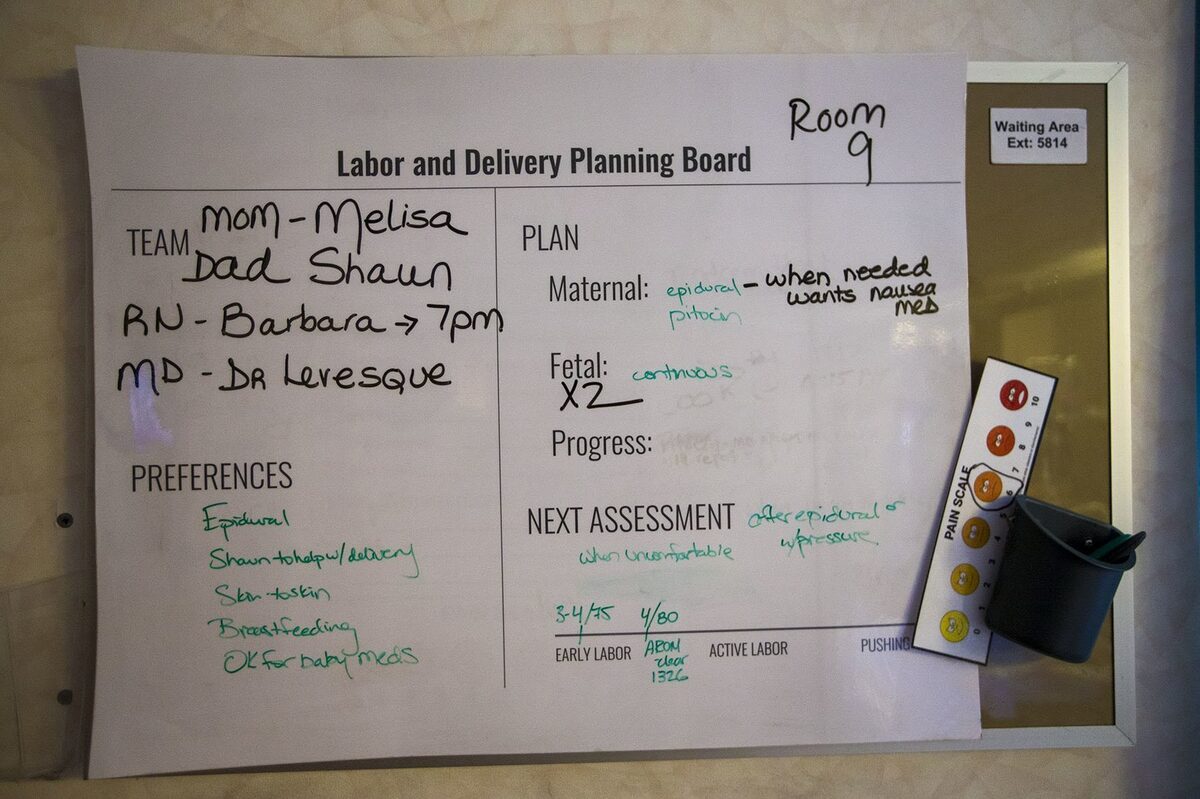
Low-tech, but highly communicative, a whiteboard in the delivery room made sure all members of the birth team were clued in to procedures and preferences throughout labor.
Jesse Costa/WBUR
hide caption
toggle caption
Jesse Costa/WBUR
“We’re fairly confident that, when you look nationally, the plurality — if not the majority — of C-sections are probably avoidable,” says Shah.
Those avoidable C-sections are the focus of the Team Birth Project, designed by Shah with input from roughly 50 doctors, nurses, midwives, doulas, public health specialists and consumer advocates who focus on childbirth. South Shore Hospital is one of the pilot sites for the project.
In describing the collaboration, Shah begins with an acknowledgement: Childbirth is complicated. You’ve got two patients — the mother and the baby — and an ad hoc, often shifting team that at a minimum includes the mom, a nurse and a doctor.
“So you’ve got three people who have to come together and become a very high-performing team in a really short period of time, for one of the most important moments in a person’s life,” Shah says.
And this team has to perform at its best during an unpredictable event: labor.
Shah says doctors and nurses generally agree about three things: when a mom is in active labor; when a mom can definitely try for a vaginal delivery; and when she must have a C-section.
“And then there’s this huge gray zone,” Shah says. “And actually, everything about the Team Birth Project is about solving for the gray.”
To avoid unnecessary C-sections when what to do isn’t clear, this hospital, in conjunction with the Ariadne project, has changed the way labor and delivery is handled from start to finish.
First, women aren’t admitted until they are in active labor. Secondly, the mom’s preferences — such as whether she would like an epidural or not and whether she wants to have “skin-to-skin contact” with the baby immediately after birth — help guide the members of the labor team. The team members map the delivery plan — including Mom’s preferences and the medical team’s guidance — on a whiteboard, like the one in Melisa’s room.
For the births of Bryce and Brady McDougall, the white erasable planning board gets a lot of use.
Under “team,” Dr. Levesque and registered nurse Patty Newbitt write their names. Melisa and Shaun McDougall are also listed as equal partners. The names of other family members or nurses may be added and erased as labor progresses. Shah’s idea is that this team will “huddle” regularly throughout the labor to discuss the evolving birth plan.
The birth plan itself is divided into three separate elements on the board: maternal (the mom), fetal (the baby) and progress (in terms of how the labor is progressing). A mom with high blood pressure may need special attention — and that would be noted on the board — but she could still have a normal labor and vaginal delivery.
Good communication is key
Dr. Kim Dever, who chairs the OB-GYN department at South Shore, highlights a section of the whiteboard called “Next Assessment.”
That category is included on the board, Dever says, “because one of the things I often heard from patients is that they didn’t know what was going to happen next. Now they know.”
Asking the mom — and the couple — about their preferences for the delivery is crucial, too, Levesque says.
“It forces us to stop and to think about everything with the patient,” she explains.”It makes us verbalize our thought process, which I think is good.”

It took a large team — including parents — at South Shore Hospital to deliver this baby, Bryce McDougall.
Jesse Costa/WBUR
hide caption
toggle caption
Jesse Costa/WBUR
Shaun McDougall walks across the room to get a closer look at the whiteboard.
“Honestly, it seems like common sense,” he says. “I would always think the nurses would have something like this, but to have it out where mom and dad can see it — I think it’s pretty cool.”
With Melisa McDougall’s plan in place, everyone settles in, to wait. About four hours later, Melisa isn’t yet feeling contractions. Levesque breaks the water sac around Brady.
“Looks nice and clear,” Levesque reports. “Hey bud, come on and hang out with us,” she says to the baby, tickling his head.
“So, you’re going to keep leaking fluid until you leak babies,” the doctor explains to Melisa. “Whenever you start getting uncomfortable, we’ll get you an epidural at that point.”
Levesque moves to the board and adds updates: Melisa is 4 centimeters dilated; her waters broke at 13:26; the next assessment will be after she gets an epidural.
The medical team insisted ahead of time that Melisa agree to be numbed from the waist down if she wants to deliver Bryce — the second twin — vaginally. Melissa agreed. The obstetricians may need to rotate the baby in her uterus, find a foot and pull Bryce out, causing pain most women would not tolerate.
One of those doctors — Marino — peeks into the room and waves.
“Just came to say hi,” says Marino, who has more experience than most obstetricians in delivering babies positioned like Bryce. Along with Levesque, Marino has been seeing Melisa regularly in office visits.
Shaun McDougall asks the physicians if they’ll pose for a picture with his wife.
“Can we make funny faces?” asks Levesque.
“I want you to,” says Shaun. “You guys are like her favorite people on the planet.”
As the hours tick by, there’s a shift change, and registered nurse Barbara Fatemi joins the McDougall team. She checks Melisa’s pain level regularly to determine when she’s ready for the epidural.
Melisa says she isn’t feeling much but adds that she has a high tolerance for pain. Shaun tells Fatemi he sees the strain on his wife’s face. Fatemi acts on Shaun’s assessment and calls an anesthesiologist to prepare the epidural, something Shaun later says reinforces his feeling that they’re a team.
Levesque soon arrives for the promised “next assessment.” Melisa is now 10 centimeters dilated and ready to deliver — but she must hold on until nurses can get her into an operating room.
Levesque will still attempt to deliver both babies vaginally, she explains, but in the operating room, Melisa will be in the right place if Bryce doesn’t shift his position inside the uterus, and the doctor needs to do a last-minute cesarean.
“I’ll see you in a few minutes. No pushing without me, OK?” Levesque says over her shoulder as she heads to the operating room to prep.
“I’ll try,” Melisa says, weakly. In a minute, nurses are rolling her down the hall, following Levesque.
Almost five years ago, two women who were wheeled into this hospital’s operating rooms during childbirth died after undergoing C-sections. Though state investigators found no evidence of substandard care, Dever says the hospital scrutinized everything.
“When you have something like that happen, that expedites your efforts,” she says. “Exponentially.”
Now, Dever says, she sees an opportunity, through the Team Birth Project, to model changes that could help women far and wide.
“I would love women everywhere to be able to come in and have a safe birth and healthy baby,” she says. “That’s why I’m doing it.”
“They did not flinch”
Dever is about to see her pilot study of the Team Birth Project pushed to new limits by little Bryce McDougall. First, though, Melisa must deliver Bryce’s brother, Brady. Even his birth, the one that was expected to be easier, is more difficult than anticipated.
Bent nearly in half, her face beet red, Melisa strains for five pushes. She throws up, then gets back to laboring. And suddenly, there he is.
“Oh my goodness, Brady, oh Brady,” wails Shaun. He follows a nurse holding his son over to a warmer.
Marino takes Shaun’s place next to Levesque, who has reached inside Melisa to get the next twin. Levesque’s mission is to grab Bryce’s feet and guide him out. But everything feels like fingers, not toes.
“That’s a hand,” she murmurs. “That’s a hand, too.”
Marino rolls an ultrasound across Melisa’s belly, hoping the scan will show a foot. But Bryce’s feet are out of sight and out of reach.
Marino has had more experience than most obstetricians with transverse babies, and this procedure, known as a breech extraction; she asks to try. She reaches into Melisa’s uterus while Levesque moves to Melisa’s right side and uses her forearm to shift Bryce and push him down. Dever, the head of obstetrics, has come into the room and takes over the ultrasound. At least six doctors and nurses encircle Melisa, whose face is taut. Shaun frowns.
“Babe, you OK?” he asks.
Melisa nods. Bryce’s heart rate is steady. But there’s still no sign of a foot. One little hand slips out and Marino nudges it back in.
“Open the table,” says Marino, her voice strained.
It’s open and ready, her colleagues say, referring to the array of sterile surgical instruments that Marino may soon need, to begin a C-section.
For 36 seconds, this room with more than a dozen adults grows oddly quiet. Everyone is watching Marino twist her arm this way and that, determined to find Bryce’s feet. Levesque leans hard into Melisa’s belly. Shaun bites his lip. Then Marino yanks at something — and her gloved, bloodied hand emerges, clenching baby Bryce by his two teeny legs.
“Oh babe, here he comes, here he comes — Woo!” squeals Shaun.
Shaun is overcome with emotion again. Melisa manages an exhausted giggle. Baby Bryce keeps everyone waiting a few more seconds and then howls.
Levesque starts to stitch up a small tear for Melisa, and Marino comes around to congratulate the new mom.
“He was fighting you, huh?” Melisa says, and laughs.
Outside the operating room, Levesque and Marino look relieved and elated. Both agree that most doctors would have delivered Bryce by C-section. But at South Shore, the McDougalls found a hospital that has challenged itself to perform fewer C-sections and a doctor with experience in these unusual deliveries — one who knew and respected the parents’ preference.
“They specifically wanted to have a vaginal delivery of both babies,” Marino says — and that was on her mind during the difficult moments.


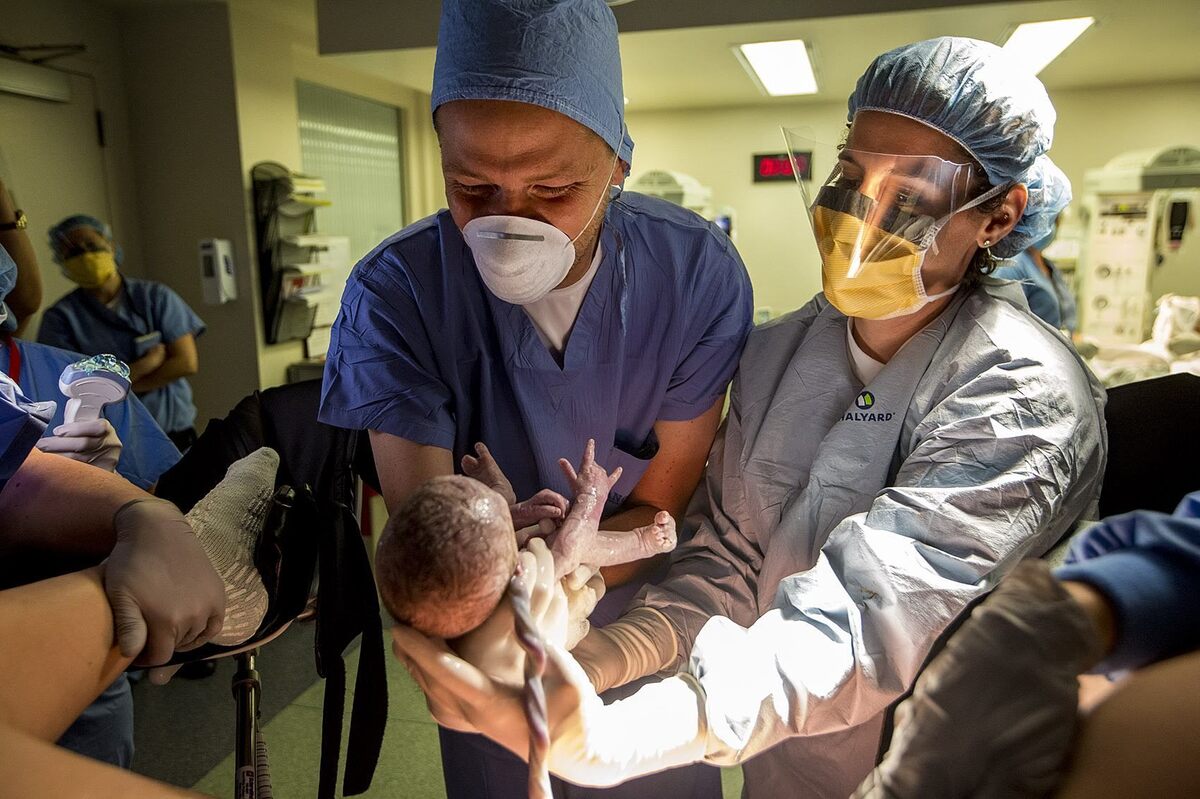


A nurse checks the breastfeeding progress with Melisa and Brady. Melisa says she’s grateful she was able to delivery both babies vaginally. “I did not want to have a natural birth and a C-section,” she says. “That would be a brutal recovery.”
Jesse Costa/WBUR
hide caption
toggle caption
Jesse Costa/WBUR
Bryce was fine, says Marino, so the deciding factor for her was that Shaun and Melisa did not panic.
“They did not flinch — they were like, ‘Keep going,’ ” Marino recalls. “Sometimes the patient will say ‘stop,’ and then you have to stop.”
The babies’ father says he came close to requesting that, in the very last minute before Bryce was born.
“That part with the arm — it was pretty aggressive,” Shaun says.
But in that moment, he adds, the feeling that he and Melisa were part of the team made a difference.
“It made us more comfortable,” Shaun says, and that comfort translated to trust. “We trusted the decisions they were making.”
Melisa says she’s grateful for the vaginal delivery.
“I did not want to have a natural birth and a C-section,” she says. “That would be a brutal recovery.”
Instead, 30 minutes after Marino pulled Bryce out of her, Melisa is nursing Brady and talking with family members via FaceTime.
Next assessment for The Team Birth Project
South Shore began using the Team Birth approach in April. Three other hospitals are also pilot sites: Saint Francis in Tulsa, Okla.; EvergreenHealth in Kirkland, Wash.; and Overlake in Redmond, Wash. The test period runs for two years. In the first four months at South Shore, the hospital’s primary, low-risk C-section rate dropped from 31 percent to 27 percent — about four fewer C-sections each month.
Experts who contributed to the development of the Team Birth Project are anxious to see whether other hospitals can lower their rates of C-section and keep them down.
“Once you get past the early adopters, how do you demonstrate the benefits for others that aren’t willing to change?” asks Gene Declercq, a professor of community health sciences at Boston University School of Public Health.
Declercq notes that a few insurers are beginning to force that question, refusing to include in their networks hospitals that have high C-section rates, or high rates of other unnecessary, if not harmful, care.
Declercq says the project’s focus on communication in the labor and delivery room makes sense because many physicians decide when to perform a cesarean based on clinical habit or the culture of their hospital.
“If you can impact that decision-making process, you can perhaps change the culture that might lead to unnecessary cesareans,” says Declercq.
The federal government has set a target rate for hospitals: No more than 23.9 percent of first-time, low-risk mothers should be delivering by C-section. The U.S. average in 2016 was 25.7 percent.
The target was put in place because research has shown that if a woman’s first delivery is a C-section, her subsequent deliveries are highly likely to be C-sections, too — raising her (and her baby’s) risk for complications and even death.
This story is part of NPR’s reporting partnership with WBUR and Kaiser Health News.
Opinion: Remembering A Victim of the Mercy Hospital Shooting


The shooting at Mercy Hospital & Medical Center took the lives of three people. One of them was a physician at the hospital.
Chicago Tribune/TNS via Getty Images
hide caption
toggle caption
Chicago Tribune/TNS via Getty Images
Tamara O’Neal grew up in La Porte, Indiana sang in her church choir and returned every weekend from Chicago, where she was an emergency room physician at a South Side hospital that cares for many who have been shot on the city’s streets.
The hospital is called Mercy.
“She loved the action,” her father, Tom O’Neal, told the Chicago Sun-Times. “She was in on a whole bunch of high-profile cases where people were shot and we’d see it on the news and she’d be treating the victims.”
She worked to save lives during the week, then drove back to Indiana to sing praises to God at the church in La Porte where her brother, LaShawn, is a pastor. She’d also scoop up her nieces and nephews and take them into the city to see shows and try new restaurants.
She played the piano. She made fabulous crab Rangoon.
Dr. Tamara O’Neal was in a pre-med class at Purdue University when she held a human brain in her hand. She felt what her family describes as awe to see such an intricate, powerful and fragile creation. That’s when Tamara O’Neal decided she could put her sharp mind and skilled hands where they would help the most people.
“She really stood out as someone very kindhearted,” Trevonne Thompson, an associate professor at the University of Illinois’s College of Medicine, where Tamara went to medical school, recalled this week. “She felt emergency care was where she had the most to offer to underserved communities.”
Dr. Breana Taylor, now at the University of Washington School of Medicine, said Tamara O’Neal was the force of gravity at the center of her and several other African-American medical students who coached, quizzed and supported each other through the exhausting and exacting demands of med school.
“She organized us,” Dr. Taylor told the Chicago Tribune, “and it was that bond that got us through.”
Dr. Tamara O’Neal was shot to death this week in front of Mercy Hospital & Medical Center. Police officer Samuel Jimenez also died, along with Dayna Less, who was training to become a pharmacist. Their killer, who also died, was once engaged to Tamara O’Neal. She had called off their engagement. He had a history of domestic violence.
Dr. Tamara O’Neal was 38 years old. But she had already saved and uplifted many lives, relieved suffering and gave joy. The people she touched with her hands and heart will go on to help many more. One of the tragedies of her loss is that, as has happened so many times this year, it took someone’s death to help us grasp how thankful we should be for their life.
Many Who Buy ACA Health Plans For 2019 Find Lower Prices And More Choice


More than half of all counties in the 39 states that rely on the federal HealthCare.gov exchange for ACA health insurance are experiencing a 10 percent price decrease, on average, for their cheapest plan for 2019.
Patrick Sison/AP
hide caption
toggle caption
Patrick Sison/AP
In recent years, some cities, including Memphis and Phoenix, withered into health insurance wastelands, as insurers fled and premiums skyrocketed in the insurance marketplaces that were set up under the Affordable Care Act.
But today, as in many parts of the U.S., these two cities are experiencing something unprecedented: Insurance premiums are sinking and choices are sprouting.
In the newly competitive market in Memphis, for example, the cheapest midlevel “silver” plan for 2019 health coverage will cost $498 a month for a 40-year-old — a 17 percent decrease compared to last year.
Please Tell Us What You Think About Shots
Help us make Shots more relevant for you by completing an NPR research survey. Click here to start the questionnaire.
And four insurers are now selling ACA policies in Phoenix. That’s the same market that then-presidential candidate Donald Trump highlighted in 2016 because all but one insurer had left the region — he called it proof of “the madness of Obamacare.”
Janice Johnson, a 63-year-old retiree in Arizona’s Maricopa County, which includes Phoenix, said her monthly premium for a high-deductible bronze plan will be $207 for 2019, instead of $270, because she is switching carriers.
“When you’re on a fixed income, that makes a difference,” said Johnson, who receives a government subsidy to help cover her premium. “I’ll know more in a year from now if I’m going to stick with this company. But I’m going to give them a chance, and I’m pretty excited by that.”
Looking across all 50 states, the premiums for the average “benchmark” silver plan, which the government uses to set subsidies, are dropping nearly 1 percent. And more than half of the counties in the 39 states that rely on the federal HealthCare.gov exchange are experiencing a 10 percent price decrease, on average, for their cheapest plan.
Loading…
In most places, the declines are not enough to erase the price hikes that have accrued since the creation of the health care exchanges in 2014.
Instead, next year’s price cuts help to correct the huge increases that jittery insurers set for 2018 to protect themselves from anticipated Republican assaults on the markets. While Congress came up one vote shy of repealing the federal health law in the summer of 2017, Trump and Republicans in Congress did manage to strip away many of the structural underpinnings that induced people to buy plans and helped insurers pay for some of their low-income customers’ copayments and deductibles. Insurers responded with a 32 percent increase, on average, for 2018 plans.
“Insurers overshot last year,” said Chris Sloan, a director at Avalere, a health care consulting company in Washington, D.C. “We are nowhere close to erasing that increase. This is still a really expensive market with poor benefits when it comes to deductibles and cost.”
For 2019, the average premium for the benchmark silver plan will be 75 percent higher than it was in 2014, according to data from the Kaiser Family Foundation. (Kaiser Health News is an editorially independent program of the foundation.)
When Republicans failed to kill the health law last year, they inadvertently may have made it stronger. Insurers banked hefty profits in 2018, and that attracted new companies to most ACA markets.
All these factors were especially influential in Tennessee, where the average benchmark premium is dropping 26 percent, according to an analysis by the federal government. That’s a bigger drop than in any other state.
Seventy-eight of 95 Tennessee counties had just one insurer for 2018. That monopoly allowed the insurer to set the prices of its plans without fear of competition, said David Anderson, a researcher at the Duke-Margolis Center for Health Policy in Durham, N.C. “They were massively overpriced,” Anderson said of all available policies.
But for the coming year, 49 Tennessee counties will have more than one insurer, with a few — like Shelby County, where Memphis is located — having four companies competing. There, Cigna dropped the price of its lowest-cost silver plan by 15 percent. Even then, Cigna was underbid by Ambetter of Tennessee, a company owned by the managed-care insurer Centene Corp.
“We’re finally at the point where the market is stabilized,” said Bobby Huffaker, the CEO of American Exchange, an insurance brokerage firm based in Tennessee. “From the beginning, every underwriter — [and] the people who were the architects — they knew it would take several years for the market to mature.”
Still, the cheapest Memphis silver premium is nearly three times what it was in 2014, the first year of the marketplaces. A family of four, headed by 40-year-old parents, will be paying $19,119 for all of next year unless they qualify for a government subsidy.
“The unsubsidized are leaving,” said Sabrina Corlette, a professor at Georgetown University’s Health Policy Institute. “They are finding these premiums unaffordable.”
The landscape in Phoenix is greatly improved from when Trump visited after the federal government announced a 116 percent premium increase for 2017; the number of insurers at that time had dropped from eight to one.
Now, three new insurers are entering Maricopa County. Meanwhile, Ambetter, the only insurer that offered plans for 2018, reduced its lowest price for a silver plan for next year by 12 percent — and it offers the cheapest such plan in the market.
Still, Ambetter’s plan is 114 percent above the least expensive silver plan offered there in the first year of the exchanges. And neither Ambetter nor any of the insurers coming into the market for 2019 offer as broad and flexible a choice of doctors and hospitals as consumers had back then, according to Michael Malasnik, a local broker.
Since the start of the exchanges, Malasnik said, insurers have “raised their rates by multiples, and they’ve figured out you have to be a very narrow network.”
Each plan in Phoenix for 2019 contains trade-offs, he said. Only Bright Health’s plan includes Phoenix Children’s Hospital. Ambetter’s plan includes the most popular hospital and doctor groups, Malasnik said. But those providers are not as conveniently located for people living in the southeastern corner of the county, and that makes other insurers’ plans more appealing for some customers.
“Geography is the name of the game this year,” Malasnik said.
Theresa Flood, a preschool teacher who lives outside Phoenix, said none of the provider networks of the plans she considered included her doctors, such as the specialist who treats her spine problems. She has had four surgeries, and a neurologist who monitors a cyst and benign tumor in her brain is also outside the network she ended up choosing.
“I have to establish care with a whole new spine doctor and establish care with a whole new neurologist if I want to follow up on these things,” said Flood, who is 59. “You’re going from ‘established care’ to ‘who in the heck am I going to see?’ “
The plan Flood ultimately chose would have been too expensive, except that she and her husband John, who is a minister, qualified for a $1,263-a-month subsidy that will drop the cost to $207 a month. That bronze plan from Ambetter carries a $6,550-per-person deductible; so Flood expects she’ll still have to pay out-of-pocket for her treatments and doctor visits unless she needs extensive medical attention.
“It’s gone from being able to have a plan that you could sort of afford and got some benefit from, to putting up with what you can afford and hoping nothing happens that you actually have to use your insurance,” she said. “At this point, I’ll take what I can get.”
Kaiser Health News, a nonprofit news service, is an editorially independent program of the Kaiser Family Foundation, and is not affiliated with Kaiser Permanente.
How Insurers Are Profiting Off Patients With Sleep Apnea

NPR’s Audie Cornish speaks with ProPublica reporter Marshall Allen about an investigation detailing how health insurers pass the high costs for sleep apnea breathing machines onto patients.
How Do Wishes Granted To Very Sick Kids Affect Their Health?


While recovering from treatment for aplastic anemia, Tiffany Rowe had her wish granted. She danced on stage with Michael Jackson during his Bad concert tour.
Courtesy of Tiffany Rowe
hide caption
toggle caption
Courtesy of Tiffany Rowe
Tiffany Rowe, a 46-year-old life coach in the San Francisco Bay area, still remembers how it felt as a teenager to be hoisted onstage to dance with Michael Jackson during his Bad concert tour.
She was 15 and recovering from an excruciating round of treatment for severe idiopathic aplastic anemia — basically total bone marrow failure.
She had met Jackson in his greenroom before the concert, but she had been told that dancing with him — her real wish — wouldn’t be possible.
Until it was.
“I was in front of all of those people, and I could hear the roar, and I was calm,” she recalls. “I was doing what I wished to do. I felt exactly the way I needed to feel, at home and confident in my body. There had been part of me that felt pretty betrayed by my body, and I felt very at peace in my own skin again.”
Please Tell Us What You Think About Shots
Help us make Shots more relevant for you by completing an NPR research survey. Click here to start the questionnaire.
The moment was transformative for Rowe, who credits the experience with aiding her recovery. A study published in the journal Pediatric Research suggests her experience may not be unique.
Researchers looked back at the cases of nearly 1,000 children with serious illnesses who were treated at Nationwide Children’s Hospital in Columbus, Ohio. Half the children had received wishes and the other half hadn’t.
The children granted wishes were substantially less likely to visit the emergency department or to have an unplanned hospital admission within two years as compared with children who hadn’t received wishes. (Researchers matched the children’s personal and disease characteristics in the study.)
“My hypothesis is that these kids, when they come back, are more engaged with their families and medical providers, and perhaps they’re more adherent to their treatment plan,” says the study’s lead author Dr. Anup D. Patel, section chief of neurology at Nationwide Children’s Hospital and an associate professor of pediatrics at Ohio State University College of Medicine in Columbus.
“What’s harder to quantify is this feeling of hope and having a break from your illness,” Patel says. “It gives them an ability to fight harder, and that’s harder to measure.”
That ineffable feeling is what mattered for Rowe. Her illness had been caught late. She likely wouldn’t have lived another month without treatment, she says. Even with treatment, her prognosis was three to six months.
She lacked a perfect match for a bone marrow transplant, and she was so sick that her doctors didn’t want to risk a potentially fatal transplant rejection. So she received a then-experimental therapy called antithymocyte globulin, today a common treatment for aplastic anemia.
“I remember my mom saying, ‘We don’t know how this ends, but we have to try,’ ” Rowe says. She received her first treatment in the fall of 1984 and entered remission, but she relapsed in the fall of 1987.
“For me, relapse had a deeper emotional toll. I understood what I was headed back into, the pain and uncertainty and fear,” Rowe says. “I felt a bit demoralized, like I had failed. I didn’t want to be sick anymore. I didn’t want to have to survive anything.”
It was around then that a volunteer who had read about Rowe in the local paper visited her and offered a wish. Rowe didn’t hesitate.
“When everyone else wanted to be an astronaut, I wanted to be a dancer and dance with Michael Jackson,” Rowe says. “When he moved, it just stopped time for me. As somebody who felt so passionately about dance myself and so elementally at home in my body while dancing, I just saw that in him and felt a kinship.”
Joining him onstage gave Rowe back ownership over her body — and her future.
“There was a sense that I was fighting for something, not just against something, and that was incredibly motivating,” she says. “I was surviving to go back and live a full and extraordinary life — not that I knew that would happen, but I could give myself permission to believe it was possible.”
To qualify for a wish, a child must have a life-threatening, but not necessarily terminal, condition, says Jamie Sandys, a spokesperson at Make-A-Wish Foundation. The foundation has more than 60 U.S.-based chapters and has granted more than 300,000 wishes since 1980.
The organization granted approximately 15,400 wishes last year, Sandys says. Still, an estimated 27,000 children are diagnosed annually with an illness that qualifies them, which concerns Sandys. “There’s a huge gap that we’re trying to fill,” Sandys says.
Many past wish recipients have said the wish was an important part of their healing process. “These wishes can really be a springboard to help these children in overcoming their illnesses and producing better health outcomes for them,” Sandys says.
But verifying and quantifying those outcomes is difficult.
“It’s wonderful to have randomized controlled trials and measurable outcomes, but when you’re looking at mind-body-spirit connection in medicine, we’re not going to have the luxury of those outcomes,” says Dr. James Fahner, a division chief for pediatric oncology at the Helen DeVos Children’s Hospital in Grand Rapids, Mich. Though not involved in the study, Fahner is the immediate past chair of the Make-A-Wish America Medical Advisory Council.
“I’m fundamentally a scientist, and I expect reasonable, reproducible metrics when I’m deciding on the validity of a particular cancer therapy, yet when I walk down the hall in that same clinic and see a child who has just returned from a wish, I see positive impacts like stronger adherence to therapy, family resiliency and hopefulness in the child,” Fahner says. “The connection of mind-body-spirit can be hugely important, especially in a child going through such a rigorous and long therapy.”
A previous study tried to measure the effects of wish-granting and found less distress, fewer episodes of depression and reduced anxiety symptoms among children expecting a wish in the near future compared with those placed on a waiting list.
This new study found more concrete differences, including cost savings. The average cost of a wish is $10,682, but multiple unplanned hospitalizations cost more. The study found that twice as many wish recipients had reduced health costs compared with people who didn’t receive them.
Patel was inspired to conduct this study after seeing changes in his own patients and before he joined the organization’s medical advisory council. He had one 15-year-old boy with intractable seizures return from meeting the Los Angeles Clippers and never have a seizure again — a dramatic if rare and unlikely outcome.
But Patel is also a scientist who believes in evidence. He knew his study would be scrutinized by others who doubted “that something as wishy-washy as a wish could make a difference.” He chose to measure use of health care services because it is quantifiable in a way that “wellness” isn’t.
All the children were treated at the same hospital by the same medical teams, though it’s unclear why some received a wish and some didn’t.
The researchers used medical records to identify 496 children who received a wish and compared them with 496 others with the same approximate age, gender, disease category and disease complexity. The distribution of private insurance, no insurance or Medicaid was also similar in both groups.
Cancer was the most common illness — at 45 percent — among the children studied. After that, the most frequent conditions were blood-related/kidney (16.5 percent), neurological (14.5 percent) or genetic (14 percent). The breakdown is consistent with national figures: 45 percent of Make-A-Wish recipients have cancer and 13.5 percent have a nervous system disorder, Sandys says.
The researchers found that wish recipients were 1.9 times more likely to have fewer emergency department visits and 2.5 times more likely to have fewer unplanned hospitalizations in the two years after their wish was granted, compared with matched children.
The study is observational, so it can’t show that receiving a wish caused better outcomes since other factors may have affected the results. But many health care providers see change in their patients after wishes are granted.
“More positivity can sometimes be correlated with treatment adherence,” says Ashley Andrews, a social worker at Children’s Mercy Hospital in Kansas City, Mo. Andrews wasn’t involved in the study but has connected children diagnosed with cystic fibrosis to Make-A-Wish.
The excitement of a wish can change a family’s and child’s outlook enough that they may work harder with their medical providers, she says. “If their adherence has improved, obviously that would decrease the emergency department visits and hospitalizations.”
But it’s also possible other factors affected emergency visits and hospitalizations in nonrecipients, such as the reasons some children didn’t receive wishes. Perhaps they weren’t well enough to travel and weren’t interested in nontravel wishes. Perhaps parents turned down a wish if they felt another family deserved it more.
Andrews also cautioned against too much optimism about the findings. “These kids still have a chronic illness and have to go through a lot of obstacles that you and I don’t have to go through,” Andrews says. “That’s their reality, so I don’t want people to think that just because these kids have Make-A-Wish that everything’s fine.”
Dr. Arthur Lavin, chair of the American Academy of Pediatrics Committee on Psychosocial Aspects of Child and Family Health, says the findings make sense to him, too. But he also cautions that a child’s worse health outcomes aren’t a “failure” of the wish or of positive thinking.
“We like to think you can only have improved health if you have an expensive medication, and those things can be critical to help, but being kind and caring to someone has an amazing impact on [their] health and well-being,” Lavin says.
But the measurement of the effect of kindness isn’t entirely clear or predictable, he notes. Even if such effects aren’t as quantifiable as other therapies, Patel sees their value in less quantifiable terms.
“I recognize on a daily basis that I’m not going to help get seizures gone in a majority of cases with traditional interventions, so I’m always looking for ways to help families beyond treatment,” Patel says. “Even if it’s just making a kid happy for a couple of weeks, that’s sometimes better than any medicine I can give them.”
Tara Haelle is a freelance health and science writer.
Rhode Island Prisons Push To Get Inmates The Best Treatment For Opioid Addiction


A view inside Rhode Island’s John J. Moran Medium Security Prison, in Cranston. Rhode Island is the only state to screen every individual who comes into the correctional system for opioid use disorder, and to offer, in conjunction with with counseling, all three medically effective treatments.
Andrew Burton/Getty Images
hide caption
toggle caption
Andrew Burton/Getty Images
In a windowless classroom at the John J. Moran medium-security prison in Cranston, R.I., three men sit around a table to share how and when they began using opioids.
For Josh, now 39, it was when he was just 13 years old. “I got grounded for a week in my house, so I grabbed a bundle of heroin and just sat inside and sniffed it all week.”
“I started using heroin at 19,” says Ray, now 23. “I was shooting it. It was with a group of friends that I was working with, doing roof work.”
“At 26 years old, I experimented with heroin,” says Kevin, 50. “I wasn’t the person that I wanted to be. Once I put that in my system, I felt like this is what I’m supposed to do and this is what I’m supposed to feel like.”
This group therapy session is part of a $2 million program the Rhode Island Department of Corrections launched in 2016. These men are all serving prison sentences for crimes driven by their drug addiction — including robbery, shoplifting and possession of controlled substances. NPR agreed to only use their first names so they could speak frankly about illegal behavior.
They are among the approximately 275 inmates and pretrial detainees getting medication-assisted treatment behind bars.
Please Tell Us What You Think About Shots
Help us make Shots more relevant for you by completing an NPR research survey. Click here to start the questionnaire.
The program is central to Rhode Island Gov. Gina Raimondo’s strategy to reduce opioid overdose deaths in the state. Today, Rhode Island remains the only state to screen every individual who comes into the correctional system for opioid use disorder, and to offer, along with drug counseling, all three types of drugs approved by the Food and Drug Administration to treat addiction — methadone, buprenorphine and naltrexone.
While prisons have long offered medication-assisted treatment to small subsets of inmates, such as pregnant women, many prisons in the U.S. do not offer it at all, despite the fact that it’s considered by physicians to be the most effective treatment for opioid addiction.
The criminal justice reform bill currently before Congress would require the Federal Bureau of Prisons to assess its capacity to provide medication-assisted treatment to inmates who are dependent on opioids, and to draw up plans to expand access to medically aided treatment “where appropriate.” But the bill leaves open who would determine when and where the medication is appropriate.
“It’s just ludicrous that we have a whole population of people who are by and large incarcerated because of their disease, and we have an effective medication treatment for the disease and we don’t give it to them,” says Dr. Josiah Rich, director of the Center for Prisoner Health and Human Rights at the Miriam Hospital in Providence.
Rich was one of the experts tapped by Raimondo to identify where best to direct resources to bring down the state’s overdose deaths. He made the case for a prison program, given the high death rate among people recently incarcerated.
“This is a population of the most severely impacted, the most advanced stages of opioid use disorder — the people who have taken the greatest risks and gotten caught up in the system,” Rich says. While in prison, the inmates’ opioid use usually ends, and so does their ability to tolerate high doses of the drugs without overdosing.
“Then you get released into a very stressful situation with a lot of triggers, and you typically relapse,” Rich says. “And if you relapse back to the same level you were using, you’re set up for overdose and death.”
This is what drove the Rhode Island Department of Corrections to offer medication-assisted treatment not just to people coming into prison, but also to those who began serving their sentences before the program existed. Eight to 12 weeks before their release, inmates with histories of addiction are offered methadone, buprenorphine or naltrexone to ease their transition back to society, beginning with very low doses.
“Even if somebody has not used in many years, they may still have changes in their brain,” says Dr. Jennifer Clarke, the Department of Corrections medical programs director. “The cravings are always going to be there. So, if somebody’s going back to the same old neighborhood, chances are they’re going to be exposed to the same people as when they were using drugs.
“So, providing the medication before someone gets out really helps to prevent a relapse,” Clarke says.
The possibility of relapse is top of mind for the men in group therapy. They have friends who have overdosed and died after serving time.
Kevin has just a few weeks left in his sentence, one of many that he’s served in his adult life. “It feels good, but I’m nervous. I always get nervous,” he says. “As soon as I walk out the gates — my feet, when they hit the pavement outside of here, I have to get busy immediately.”
“You worry about the drug aspect once you hit the street,” says Josh who has also served multiple sentences for drug-related crimes. “Many times, I’ve gone out of here and overdosed repeatedly. Not on purpose, just accidentally, trying to hide from the pain, hide from myself.”
This time, Josh says, the treatment program has given him a way to focus on a different way out.
“I still have to fight the other drugs,” he says. “But at least I have something to help with one of the ones that’s brought me closer to death than anything else.”
The program inside the prison is run by CODAC, a behavioral healthcare organization that also runs substance abuse treatment programs outside the prison, with locations across Rhode Island. Prisoners who enter the program remain clients when they exit prison, with treatment outside typically paid for by Medicaid. Discharge planners from CODAC help the inmates get organized for that transition.
“I already have counseling appointments lined up, doctors appointments lined up,” says Ray, who is scheduled to be released in December. In prison, he’s been taking buprenorphine, which he’ll continue the day he gets out. “I really don’t want to use heroin again.”
Early reports from the program are promising. In a study published in JAMA Psychiatry last spring, researchers found that overdose deaths among people who had recently been imprisoned dropped sharply in the first six months of 2017 as compared to the same period the year before — nine deaths, compared to 26.
Researchers continue to track outcomes and are interviewing inmates and correctional staff to learn more about how well the program is functioning.
There have been hurdles to overcome, says Lauranne Howard, substance abuse coordinator for the Department of Corrections, starting with resistance from security staff about the use of buprenorphine in the program. Buprenorphine itself is an opioid, though less potent than street drugs in many of its effects, and sometimes ends up sold or given to people outside its intended use.
“The reaction was, why are you going to bring in a medication that we’re working real hard to keep out? And that’s a legitimate concern,” Howard says.
In response, the program has made some changes. CODAC’s Leslie Barber, who directs the prison program and runs the group therapy sessions, says they launched the program using buprenorphine pills, which take awhile to dissolve.
“We compromised by switching to the films which, although more expensive, dissolve quicker,” she says. CODAC says the buprenorphine pills cost approximately $4 each, while the films cost approximately $8 each.
A number of other states have taken notice and sent corrections officials to Rhode Island to learn from their experiences. Clarke points out that Rhode Island has the advantage of being a small state with a combined jail and prison system, so that everyone who is incarcerated comes to the same campus.
“Places like Rikers Island [in New York City] have all three types of medication for opiate use disorder, but they can’t start people who might have a prison sentence, because they’re going to be sent to a different facility, and they don’t have the same opportunities to continue treatment that we have,” Clarke says.
Patricia Coyne-Fague, acting director of corrections for Rhode Island, recognizes that even with this program, people will stumble and make mistakes — even end up reincarcerated. Still, she defends the $2 million annual expenditure with the argument that the program saves lives.
“Sometimes there can be a negative attitude about whose lives we are saving,” she says. “But everybody belongs to somebody. And so, while they may have committed a crime and deserve to be incarcerated, they’re still human beings. And if we can keep people from dying, that’s a good thing.”