For Aspiring Doctors With Disabilities, Many Medical Schools Come Up Short

Feranmi Okanlami, now a doctor, became partially paralyzed after an accident in 2013. He says adjustments for his disability during his training, like this standing in frame chair, helped him succeed. A new report finds variability in medical institution culture and protocols when it comes to supporting aspiring doctors with disabilities.
Courtesy of Feranmi Okanlami
hide caption
toggle caption
Courtesy of Feranmi Okanlami
Being a medical student or resident is hard enough, but what if you have a disability that adds to the challenge?
One medical resident with a physical disability was about a year and a half into training when the medical institution finally installed an automatic door he needed. Another student faced frustrations when arranging accommodations for taking tests, with it seeming like the medical school was “making up rules along the way.” When another resident with a disability first sought support, the disability representative was allegedly unfamiliar with the Americans with Disabilities Act.
These firsthand experiences are documented in a report issued Tuesday by the Association of American of Medical Colleges and the University of California, San Francisco about the accessibility and inclusion of students and doctors with disabilities in the medical field. The culture and the environment surrounding disabilities varies across the board, it found, with some places doing far better than others.
About 1,500 medical students in the U.S. have disclosed a disability and receive formal accommodations. That’s about 2.7 percent of students, according to the report, and represents a lower percentage than other undergraduate programs, which average at about 11 percent for students who have disclosed a disability. The report found that in medicine especially, many students hide their disability out of a real “fear of judgment, bias, and skewed perception of ability.”
Medicine is an incredibly tough and competitive field where, historically, doctors have been viewed as superhumans, operating at the highest physical and mental capacity at all hours of the day and night, performing miracles and saving lives. There’s an expectation of perfection.
But doctors are human, too.
A lack of understanding about disabilities can create big challenges for otherwise qualified and talented future doctors, says Lisa Meeks, co-author of the report and a disabilities expert at the University of Michigan Medical School. Yet some schools may not even be aware of what they could be doing to foster a more inclusive environment.
“I don’t know of a school that doesn’t want to do the best practice,” says Meeks, who is also co-founder of the Coalition for Disability Access in Health Science and Medical Education, adding that schools might just not have the tools.
For Dr. Geoffrey Young, AAMC’s senior director for student affairs and programs, the nearly 100-page report is a much needed blue print for medical institutions to better understand policies and perceptions of those with disabilities, whether that be the easily identifiable physical kind or lesser seen invisible ones.
“I think we have to do a better job of educating those in the field about what the potential is for those with disabilities, verses what is consumed or assumed to be an automatic inability,” Young says, adding that the culture is shifting in medicine. “We are having this conversation in a very open way.”
The report identifies very clear barriers and considerations schools can take in response. That includes everything from the way disabilities are discussed in the admissions process to having a person within the institution who is well versed in both disability access issues and medical school requirements, to help future doctors better navigate their training.
For Dr. Lina Mehta, associate dean for admissions at Case Western Reserve University School of Medicine in Cleveland, improvements start with changing attitudes and approaches at the onset. Case was sited in the report as an example for the disabilities language it has adopted in its materials.
“In admissions, we sort of dictate the face and function of what medicine is going to look like by virtue of who we bring in,” Mehta says. Having a more diverse future physician population, one that includes those with disabilities, improves the field’s ability to understand and care for patients, she says. “It’s critical we bring in a group of learners and future practitioners who will mirror patient populations that they’re taking care of.”
This story is part of a reporting partnership with NPR, WHYY’s health show The Pulse andKaiser Health News.
Lifting Medicare's Annual Limits On Physical Therapy Helps Ease Patients' Pain

Leon Beers, a retired railroad engineer who lives near Sacramento, Calif., has a form of Parkinson’s disease. His live-in caregiver, Timothy Wehe, helps him get outside using a walker.
Bert Johnson for KHN
hide caption
toggle caption
Bert Johnson for KHN
Physical therapy helps Leon Beers get out of bed in the morning and maneuver around his home using his walker. Occupational therapy strengthens the 73-year-old man’s throat muscles so that he can communicate and swallow food, says his sister, Karen Morse. But in mid-January, his home health care agency told Morse it could no longer provide these services because he had used all his therapy benefits allowed under Medicare for the year.
Beers, a retired railroad engineer who lives outside Sacramento, Calif., has a form of Parkinson’s disease. The treatments help slow his condition’s destructive progress and “he will need it for the rest of his life,” Morse says.
Under a recent revision in federal law, Medicare patients who qualify for these services will no longer lose them solely because they used too much.
“It is a great idea,” says Beers. “It will help me get back to walking.”
It’s also one of several important provisions tucked into the federal budget agreement approved by Congress last month that could improve the health of 59 million Americans who have Medicare, the federal health insurance program for older or disabled adults. Here are three of the key changes, and a bit more about what each means for patients.
Expands Medicare’s coverage of physical, occupational and speech therapy
The two-year budget deal removes annual caps on how much Medicare pays for physical, occupational or speech therapy and streamlines the medical review process. It applies to people in traditional Medicare as well as those with private Medicare Advantage policies.
As of Jan. 1, Medicare beneficiaries are eligible for these types of therapy indefinitely as long as their doctor — or, in some states, physician assistant, clinical nurse specialist or nurse practitioner — confirms their need for therapy, and they continue to meet other requirements.
The Centers for Medicare & Medicaid Services last month notified health care providers about the change. And under a 2013 court settlement, patients won’t lose coverage simply because they have a chronic disease that doesn’t get better.
“Put those two things together and it means that if the care is ordered by a doctor and it is medically necessary to have a skilled person provide the services to maintain the patient’s condition, prevent or slow decline, there is not an arbitrary limit on how long or how much Medicare will pay for that,” says Judith Stein, executive director of the nonpartisan Center for Medicare Advocacy.

Beers relies on Medicare for physical and occupational therapy that helps slow the progression of symptoms of his Parkinson’s disease.
Bert Johnson for KHN
hide caption
toggle caption
Bert Johnson for KHN
The webpage for patients describing the changes in physical, occupational and speech therapy benefits was taken down for updating three weeks ago and was still missing, as of Tuesday afternoon.But patients and providers can find a CMS update posted last month for providers that explains the change. And information from the 800-Medicare help line (800-633-4227) has been updated with the new information.
Shrinks the “doughnut hole” a year earlier
Beneficiaries have long complained about a coverage gap in Medicare drug plans — what’s known as the doughnut hole.
That gap arises when the initial coverage phase of the plan ends— this year, that happens after the beneficiaries and their insurers have paid $3,750 for covered drugs. At that point, a patient’s share of prescription costs shoots up. This year, when people hit this stage, they are responsible for paying up to 35 percent of brand-name drug costs, until a higher threshold of expenses is reached.
When beneficiaries’ total yearly drug expenses reach a certain amount ($5,000 this year), they enter a new stage of coverage, paying just 5 percent of the costs after that amount. But studies have shown that fewer than 10 percent of beneficiaries spend enough to reach that last stage.
The Affordable Care Act had called for the patient’s share of drug costs in this “doughnut hole” gap to be narrowed to 25 percent by 2020; the budget deal moved that adjustment earlier, to 2019.
Much of the drug cost will be shouldered by pharmaceutical companies. And those payments by drugmakers will count as money paid by patients, which will help Medicare patients progress to the far side of the doughnut hole gap more quickly, according to Caroline Pearson, senior vice president at Avalere Health, a research firm.
The deal could have an added attraction. “Premiums will come down because the drug plans are not being required to cover as much as they used to,” Pearson adds.
Lower premiums will also save money for the government because it will spend less on subsidies for low-income beneficiaries.
Expands Medicare Advantage benefits
Another important change allows private Medicare Advantage plans in 2020 to offer special benefits to members who have a chronic illness and meet other criteria.
Currently these private insurance plans, which limit members to a network of providers, treat all members the same.
But under changes in the budget law, benefits in 2020that targetcertain memberswho have chronic diseases do not have to be primarily health-related and need only a “reasonable expectation” of improving health. Some examples that CMS has suggested include devices and services that assist people with disabilities, minimize the impact of health problems or help patients avoid emergency room visits.
This wider range of benefits might help some people remain in their homes instead of entering nursing homes, or could increasethe quality of life of some Medicare Advantage patients and help reduce unnecessary medical expenses.
“We’re really excited that the law is catching up with what plans have known for a long time,” says Mark Hamelburg, senior vice president of federal programs at America’s Health Insurance Plans, an industry association.
But the changes will affect only those beneficiaries enrolled in these private plans — about a third of the Medicare population.
“We would like to see some of these innovations happen in the traditional Medicare program as well, so that all beneficiaries would be able to reap these benefits,” says Lindsey Copeland, federal policy director at the Medicare Rights Center.
Kaiser Health Newsis an editorially independent part of the Kaiser Family Foundation. Find KHN’s Susan Jaffe on Twitter @SusanJaffe.
Fertility Clinic Says Failure May Have Damaged Thousands Of Eggs And Embryos

After a cryogenic tank like the one in this file photo lost a great deal of liquid nitrogen, a fertility clinic began the process of determining the damage to stored embryos and eggs.
Lluis Gene/AFP/Getty Images
hide caption
toggle caption
Lluis Gene/AFP/Getty Images
A San Francisco fertility clinic says that a problem with the liquid nitrogen in one of its storage tanks may have damaged thousands of frozen eggs and embryos, triggering calls and letters to more than 400 concerned patients of the Pacific Fertility Center.
The nitrogen level in one tank fell very low, according to Dr. Carl Herbert, the fertility clinic’s president. Herbert told ABC News that an “emergency filling” immediately took place, and that the tank’s contents were then transferred to a fully functioning tank.
The problem struck on March 4 — the same day that a similar cryogenic tank failure was reported in Cleveland, where the University Hospital Fertility Clinic is investigating “an unexpected temperature fluctuation” that jeopardized its tissue storage bank, where liquid nitrogen preserves eggs and embryos. That incident reportedly affected some 700 patients.
In San Francisco, Dr. Herbert said the clinic is working to determine the effects of the tank failure. Herbert said a “substantial number” of the clinic’s patients had stored embryos for around 8-10 years, according to ABC.
“The good news is, we have viable embryos — we’ve proven that from that tank,” Herbert said. “So my hopes are that for my patients, they’ll be OK. But because there’s an unknown, it’s extremely stressful.”
The clinic’s price for freezing eggs starts at $8,345, and in-vitro fertilization is $11,595, according to its website. The annual cost for tissue storage is $600.
Emotions have run high during calls with affected patients, Herbert told The Washington Post.
“Anger is a big part of the phone call,” Herbert said. “Our goal is to provide all the patients we see with some kind of a family. . . . We need to think: If this tissue doesn’t work, what are the next steps, and have you not feel defeated.”
The Pacific Fertility Center is located in San Francisco’s North Beach region; in the past, it has said that its patients include families of employees at Facebook and other tech companies, many of which pay the costs of fertility treatments as part of their health coverage.
After the Cleveland incident, the American Society for Reproductive Medicine released a statement saying that the cryogenic failure and “potential loss of eggs and embryos at University Hospitals Fertility Center in Cleveland is a tragedy.”
A family that lost embryos in the Cleveland hospital’s nitrogen tank failure has filed a class-action lawsuit, the AP reports.
The Mysterious Case Of 'Vanishing Bone' And Hip Replacements Gone Wrong

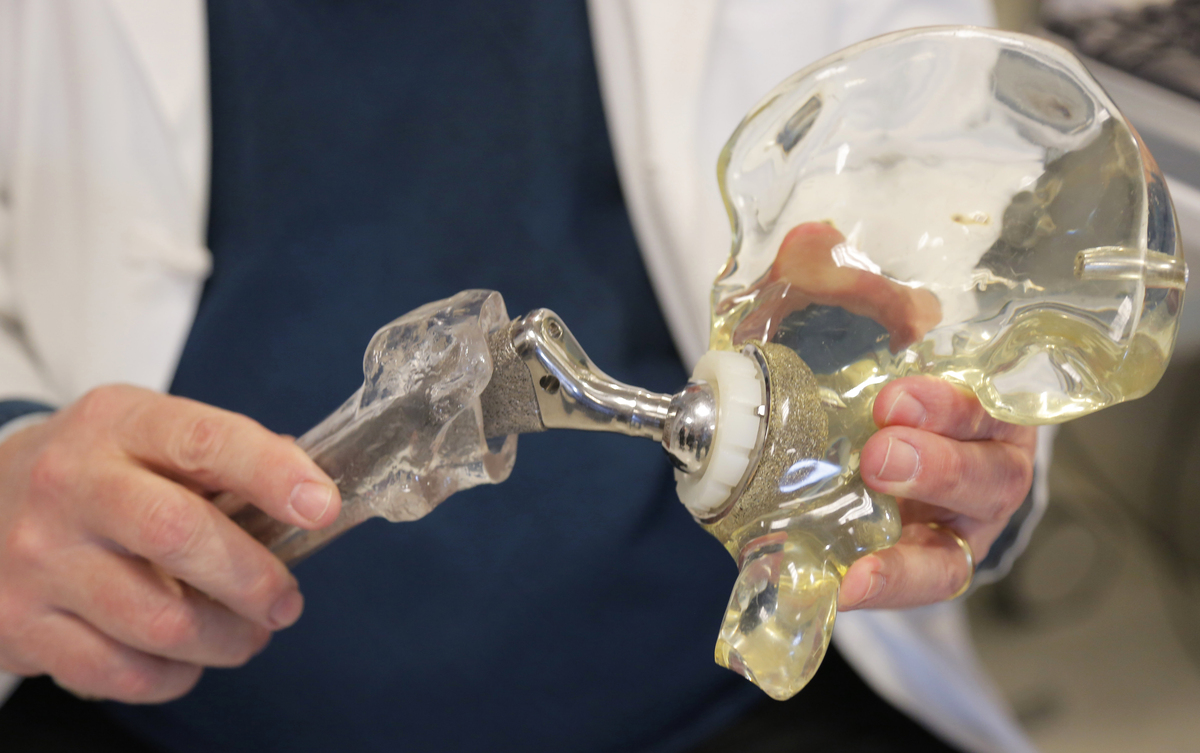
Dr. Joshua Jacobs, an orthopedic surgeon, displays a model of a cementless hip replacement in 2014.
M. Spencer Green/AP
hide caption
toggle caption
M. Spencer Green/AP
Please sign up here to subscribe to WBUR’s CommonHealth newsletter highlighting important stories about health and medicine.
It all began with a single X-ray.
It was 1974, and surgeons had been doing total hip replacements for a dozen years.
“Total hip replacement is an absolutely magnificent operation,” says Dr. William H. Harris, “and we were able to do remarkable things to restore mobility and relief of pain and the joy of life to countless individuals.”
As chief of Massachusetts General Hospital’s joint replacement surgery service, Harris was sent a mystifying patient, a prominent lawyer from San Francisco whose hip replacement had gone badly awry.
“I had never seen anything like this before,” he recalls. “The bone around his prosthesis, around his total hip, had been completely destroyed. It was just astonishing. And I thought it had to be cancer.”
But under the microscope there was no cancer, no recognizable disease of any kind. It was something much stranger.
So begins the twist-filled backstory of disaster averted that Harris tells in his new book, Vanishing Bone: Conquering a Stealth Disease Caused by Total Hip Replacements.
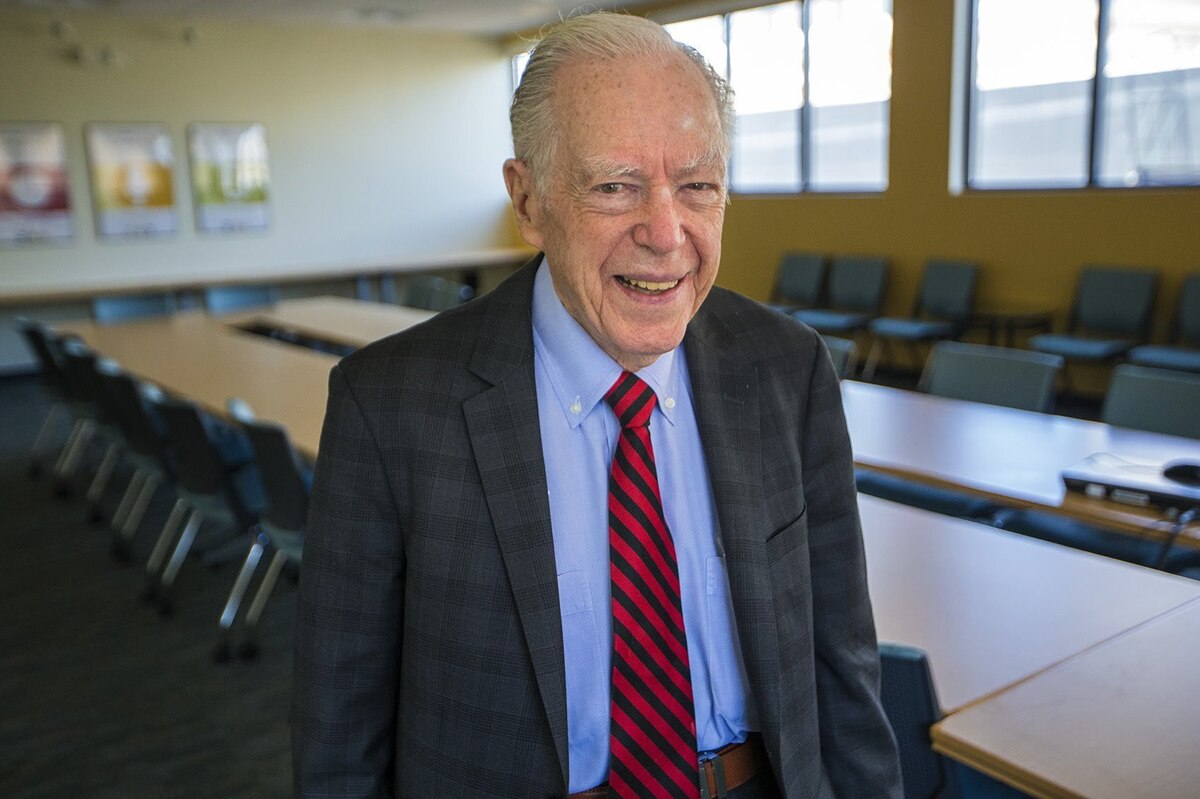
Now 90, Harris holds an endowed professorship of orthopedic surgery at Harvard Medical School. He was chief of joint replacement surgery at MGH for 30 years. And he’s one of the doctors and researchers that grateful recipients of artificial hips may want to thank.
Those patients are legion: At least 3 million Americans have artificial hips, and millions more around the world.
Back to his tale: No visible cancer. The only type of cells to be seen on the ruins of the bone were a sort of cleanup cells, called macrophages. And they were stimulating another kind of cell, called an osteoclast, which means “bone-eater.”
“This was the only cell in the body that could eat bone and it was actively and aggressively eating the bone,” Harris explains. “It became a medical detective mystery: What in the world is this disease and how does it come about? Why is it there?”
The question quickly became even more urgent, because soon it wasn’t just one patient or two whose replacement hips were being attacked by this bone-eating disease. It was thousands — then hundreds of thousands. The longer people had their replacement hips, the higher the risk. In some, their bones became so weak, just walking could make them snap.
“Over time, it began to involve so many people that around the world there were a million people with this condition,” Harris says. “By 1990 it was clear that it was the No. 1 problem in total hip replacement surgery and the No. 1 cause of failure.”
One of the first possible culprits to come under suspicion was the “bone cement” — the glue used to affix the artificial joint to the patient’s skeleton. Tiny bits of the cement seemed to be triggering the odd response by the cleanup cells and the osteoclasts.

One kind of cell “was actively and aggressively eating the bone,” says Harvard orthopedic surgeon Dr. William H. Harris. “It became a medical detective mystery: What in the world is this disease and how does it come about?”
Jesse Costa/WBUR
hide caption
toggle caption
Jesse Costa/WBUR
So Harris and others devised techniques to replace hips without using cement. And they heaved a sigh of relief, he says, thinking they’d solved the problem. Only to find, when he reviewed his first hundred cases of a cementless hip replacement — “Bingo, the very same disease.”
But they were on its trail. The problem wasn’t just the bone cement, they realized, it was that tiny bits of plastic could eventually trigger the osteoclasts to eat bone. And those bits of plastic were coming from the inevitable wear on the plastic at the replacement joint as the patient logged millions of steps.
“This caused a big shift in our thinking, and the problem shifted from being a problem of medical detective work to find out what in the world is going on, to innovation — material science,” Harris says.
Harris and other researchers needed to figure out how to make an artificial hip joint that could take a load of hundreds of pounds, for millions of steps, without wearing down enough to release the particles of polyethylene plastic. And to do that, he decided, he needed a machine that could simulate what happens to hips in the body.
It took three years and plenty of frustration to build an accurate hip simulator. Meanwhile, his team gained a pivotal insight from using a powerful scanning electron microscope to look at the replacement hips of patients who donated them back to his lab after death: It was the process of walking that modified the polyethylene.
The polyethylene plastic on the hip implants was an extraordinarily long molecule. Harris compares it to a very, very long, very, very thin string of spaghetti. And normally, the plastic is like a bowl of spaghetti that is unorganized, with the strands going in all different directions. But not in the hips from the deceased patients.
“We found that all of the strands of the polyethylene were lined up in a row,” he says. “The polyethylene molecules had been changed in their position. They’d been modified by the fact that gait simply goes back and forth, and forth and back. And that lines them up.”
Harris turned to his friend Ed Merrill, a professor emeritus of polymer chemistry at MIT, and asked if he could stop this reorientation from happening.
“He said, ‘Sure,’ and I said, ‘I love it, that’s wonderful, tell me about it. How are you going to do it?’ ‘Well,’ he said, ‘we do that for a lot of molecules. We get them to be fixed in their position by putting in energy, and that energy then links one of the molecules to the next one.’ “
It’s a process called cross-linking, used on many materials. Merrill suggested using an electron beam to cross-link the polyethylene in artificial hips. When Harris and his team tried it, they ran into a few problems at first, the most striking of which was that the plastic exploded.
“Sometimes it didn’t explode, sometimes it just caught fire,” Harris says. “And at other times it simply melted. But clearly we were in a difficult spot. It took a lot of work to figure out what that problem was.”
The problem turned out to be a matter of too much energy. They needed to slow the electron beam down so it wouldn’t “overcook” the plastic. Once they figured that out, they could test it. The results: “We could detect no wear at all. Zero wear. We thought it might reduce wear, it might make it better. It made it almost perfect.”
There’s a lot more to the story in Vanishing Bone. It wasn’t enough to invent the new plastic; it had to be patented and licensed, approved by the Food and Drug Administration, and manufactured — all of those steps involved additional challenges. But in late 1998, the first patient got a hip made with the new plastic.
Fast forward nearly 20 years, “and there are probably now 7 million people around the world walking on this material in total hips and in total knees,” Harris says. “The disease is virtually gone.”
So that’s certainly a happy ending, but what’s the moral of the story? For Harris, it serves as an example of contemporary medical science — “how it works, warts and all, the complexity, the need for persistence.”
And, he says, it highlights the special joy of being a doctor and a scientist: “I loved taking care of patients and I loved going to the operating room, but I also hate failure. And my own failures in the operating room would lead me to say, ‘Let’s take this failure up to the laboratory and see if we can’t unscramble it, unlock it, and find a way to do it better.’ “
So, at age 90, has he replaced a hip?
No, he says, but if he needed to, he’d feel quite relaxed about it. Because he’d know that his new hip could be made of cross-linked polyethylene.
The first version of this story appeared on WBUR’s CommonHealth. Carey Goldberg, who covers health and science, is the host of CommonHealth.
Medical Cargo Could Be The Gateway For Routine Drone Deliveries

The HQ-40 drone, made by Tuscon, Ariz.-based Latitude Engineering, can carry samples for medical testing in a refrigerated container.
Johns Hopkins School of Medicine
hide caption
toggle caption
Johns Hopkins School of Medicine
One shred of solace that surfaced as hurricanes and tropical storms pummeled Texas, Florida and Puerto Rico last fall was the opportunity to see drones realize some of their life-saving potential.
During those disasters unmanned aircraft surveyed wrecked roads, bridges and rail lines. They spotted oil and gas leaks. They inspected damaged cell towers that had left thousands unable to call for help. “Drones became a literal lifeline,” former Federal Aviation Administration chief Michael Huerta told the agency’s drone advisory committee in November.
The drones used needed a special exemption from a set of FAA rules, known as Part 107, that normally require small drones to fly below 400 feet, stay within the operator’s visual line of sight and avoid populated areas.
These regulations make it hard for commercial drones to operate in the United States. But last October the Department of Transportation took a big step: It invited state and local governments to partner with universities and companies on tests to speed the integration of drones into the national airspace. The FAA is reviewing 149 proposals and plans to choose five to 10 by mid-May.
The proposals cover a wide range of applications. Many of them are health-related. “I am confident that one-half or more of all the applicants have put some element of medical support in their proposal,” says John Walker, a Lancaster, Penn.-based aerospace consultant who spent 32 years at the FAA before co-founding the Padina Group, Inc in 2006.
Walker believes early public acceptance of drone delivery networks in urban areas will revolve around hospitals. And once drones can safely and reliably carry blood and medical supplies, that will pave the way to other kinds of drone deliveries. “That linear network where drones can operate between hospitals … would also have Amazon and anyone else that could meet the requirements to operate,” Walker says.
Several companies have approached governments in developing countries about performing medical deliveries in areas with great need, poor roads and less crowded skies.
In late 2016 Zipline, a San Francisco Bay Area-based robotics startup, set up distribution centers in Rwanda, where its drones had made more than 1400 flights carrying on-demand blood and emergency supplies over 62,000 miles as of last fall. This year the company will expand its medical delivery operations by launching a second base in Rwanda and new service in a larger neighboring country, Tanzania.
Last October Swiss Post launched a medical transport network in Lugano, Switzerland, using drones made by another Bay Area company, Matternet. So far the drones have made 350 deliveries, about 5 to 15 per day. Other groups have also brought aircraft abroad to attempt health-related deliveries, but those demo flights have not become sustained operations.
Such efforts face tougher hurdles here in the U.S. where regulations focus on safely integrating drones into already congested national airspace. “We haven’t seen [the FAA] be interested in a one-off approach,” says Susan Roberts, co-founder of AiRXOS, a General Electric subsidiary focused on drone infrastructure technologies. “It doesn’t do anybody any good for a delivery company to be able to fly from two specific points if they can’t then scale that over and over again.”
Beyond blood and medical supply deliveries, drones could transform another key component of healthcare — lab tests. Timely test results help doctors diagnose infections and reduce guesswork in prescribing medications. Some of those decisions have life-or-death implications. For example, newborn babies turn yellow from jaundice as their bodies make bilirubin, a byproduct formed during normal breakdown of red blood cells. But “very high bilirubin can be toxic to babies,” says Dr. Geoff Baird, a clinical pathologist at the University of Washington in Seattle.
Of the millions of blood samples, urine specimens and swabs his team processes each year, most reach central lab facilities by car. “We have cars going seven days a week, many times a day, up and down the state of Washington on freeways, across the passes, in the mountains,” Baird says. The university also does testing for out-of-state hospitals and several clinics in rural communities on the San Juan Islands off the northwest coast of Washington. Getting lab samples from the islands down to Seattle hospitals for testing requires multiple stops by car, plane and ferry — a journey of about 100 miles that often takes more than 24 hours, even longer on weekends.
But samples carried over the Puget Sound on a drone from the San Juan Islands could reach the main lab in Seattle in 90 minutes, Baird says. That’s why the university was eager to put in a bid for the FAA program.





A temperature-controlled container was designed by Johns Hopkins researchers to transport specimens, like these test tubes containing blood samples.
Johns Hopkins School of Medicine
hide caption
toggle caption
Johns Hopkins School of Medicine
The proposed medical deliveries are part of a larger application submitted by Washington’s Department of Transportation, which includes other companies such as Amazon and T-Mobile. If selected, Baird says the San Juan efforts will use drones developed at Tuscon, Ariz.-based Latitude Engineering. Latitude makes the military-grade aircraft that Johns Hopkins researchers used to set a distance record carrying refrigerated blood samples ~160 miles in a 3-hour flight across the desert.
North Carolina’s Department of Transportation also applied to the FAA program wanting to use drones for medical deliveries. Zipline and Matternet are on that application as well as several other undisclosed proposals. Matternet is also partnering with the city of Palo Alto on a proposal to shuttle blood to Stanford hospitals. Flirtey, a drone manufacturer in Reno, Nev., is focusing on using its aircraft for last-mile delivery of defibrillators — devices the company thinks could save hundreds of thousands of lives in America each year, by increasing the chance of survival from out-of-hospital cardiac arrest.
Ultimately, though, what makes or breaks a proposal isn’t likely the whiz-bang drones but rather the underlying infrastructure that ensures they can fly safely alongside commercial jets, helicopters, balloons and everything else in the sky.
Toward that end, at a drone symposium held earlier this week in Baltimore, the FAA stressed its interest in “sense and avoid” technologies to prevent drone crashes, and systems that allow drones to be identified and tracked remotely. GE’s projects cover both areas. “No one company is going to solve everything. We’re taking a holistic approach,” Roberts says. “We need to help the medical deliveries, we need to help the inspectors, we need to help people who are just taking pictures of houses.”
The United Nations Children’s Fund is working to foster this all-inclusive spirit at the global level. Last summer, UNICEF worked with local governments in the African country of Malawi to launch a drone corridor for companies, universities and nonprofits to fly test missions there.
More recently, UNICEF invited groups to transport vaccines in Vanuatu, the South Pacific nation made up of roughly 80 islands east of Australia. The drone corridors run on a barter system, says Chris Fabian, who leads UNICEF’s venture capital arm. “If you come and use our time, create something that’s open-source and useful for everyone else.”
Esther Landhuis is a freelance science journalist in the San Francisco Bay Area. Follow her on Twitter @elandhuis.
Angola Prison Lawsuit Poses Question: What Kind Of Medical Care Do Inmates Deserve?


Francis Brauner was instrumental in helping launch a class-action lawsuit on behalf of current inmates at Louisiana’s Angola prison, suing for care that allegedly caused them “needless pain and suffering.”
Charles A. Smith
hide caption
toggle caption
Charles A. Smith
In 2005, Francis Brauner was a quarter of the way through a 20-year prison sentence at Dixon Correctional Institute in Louisiana, when he had an accident.
Brauner was imprisoned for a rape conviction, which he maintains was wrongful and part of a setup by a corrupt judge.
His sentence involved hard labor, and one day he was out in the fields, cutting the grass and he bent over to pick something up from the ground. He felt a sharp pain in his back.
“There’s no words to describe how bad the pain was, really,” he says. A few days later, it got worse. “It felt like I was hit by a bolt of lightning or something, I mean the pain just shot from my head to my toes.”
Years before, he’d been in a car accident, so it was not the first time he had had back trouble. But this time, he could barely stand up.
Prison authorities rushed him to Charity Hospital in New Orleans, but then Hurricane Katrina struck. In the chaos, Brauner found himself re-routed to Louisiana State Penitentiary, better known as Angola prison. There he was told he’d find a larger facility with better resources to treat inmates needing medical attention. But he says he was denied the surgery that might have helped.
Instead, when he arrived he was left in a bed for a month, largely unattended. He developed wounds on his backside that became so infected, they nearly killed him.
“My wounds got severe,” says Brauner, showing a photo of a large, circular gash on his backside. “It actually ate all of my muscle tissue and left gaping open wounds.”
Brauner became paralyzed from the waist down and was stationed in the hospital ward of Angola prison.
Lapses in care
Angola prison is the largest maximum security prison in the country. There are over 6,000 men incarcerated there, most of them serving life sentences.
The prison is more than 130 miles from New Orleans. Because of its remote location, most of the medical needs of the inmates are met by a small team of doctors, nurses and EMTs who also live on the grounds.
Brauner started to notice that the medical staff were careless about their treatment. He decided to keep a journal to record what he perceived as lapses in medical care.
“I started documenting,” Brauner says. “Everything that they did, that they said, day by day. I documented every day.” If a nurse gave out the wrong medication, he wrote that down. If a doctor failed to order a biopsy, he entered it in his journal.
That documentation was shared with Nick Trenticosta, a lawyer who represents death penalty cases and was visiting Brauner for an unrelated case. Even though Trenticosta has been going to the prison practically every month for the past three decades, he didn’t recall ever seeing the hospital ward before. He was shocked.
“There were open garbage containers,” Trenticosta recounted. “Fly tape hanging from the ceiling with a lot of dead flies on it. Over men’s beds who had open bedsores.”
Taking legal action
Since then, the number of complaints about the medical care has increased. Then in 2015, a lawsuit was filed, Lewis v. Cain, accusing Angola prison of causing “needless pain and suffering.” Late last month, Judge Shelly Dick said the case could proceed as a class action lawsuit on behalf of Angola’s prisoners.
After repeated requests, the prison’s lawyers would not comment. So to understand how the hospital ward works from the inside, we contacted former employees like Sandy Netherland-Roberts, a paramedic at Angola prison who later ran the hospice.
“Budgetary wise, medical-wise, the place gives awesome care,” Netherland-Roberts says. “Do I feel that there is a better health care there than some people get in the outside world? One hundred percent.”
According to Dr. Tobe Momah, who worked there for a year, many challenges stem from how long the men stay at Angola.
“They’re going to be there for 40, 50 years, so they’re going to develop cancer, hypertension, diabetes…” Momah says. “So every time they have a need that is outside the scope of us five doctors, they have to leave the site.”
Leaving the site is prohibitively expensive. And it’s costing the prison even more since Louisiana overhauled its safety net hospital system. Momah says under the circumstances, the medical staff was doing their best to care for the prison’s 6,000-plus inmates.
“Well, I don’t know what he means by ‘the circumstances,’ ” says Nick Trenticosta, the lawyer, of Momah’s assessment. “If ‘the circumstances’ means, ‘We don’t have proper medication. We don’t have proper equipment. But we do the best we can,’ It’s like talking like a MASH unit. You know?”
Prisoners are the only group in the United States who have a constitutional right to health care. At the core of this lawsuit is the question of what quality of health care prisoners deserve. To Dr. Momah, that is not up for debate.
“The first law of medicine is, serve humanity irrespective of who they are,” says Dr. Momah. “So no doctor, as far as I know, will diminish care based on a person’s crime.”
As resources have dried up, however, the prison is struggling to provide even basic care. The lawsuit demands more oversight, reforms and a bigger budget for medical care.
As for Francis Brauner, he says that most of the men he was with on the chronic care ward at Angola prison have passed away. He was lucky.
“I mean… I’m not sentenced to death and that’s the bottom line,” Brauner says. “I’m not sentenced to death.”
Since finishing his sentence in 2015, Brauner has been living at a medical facility not far from the prison, waiting for surgery to help heal his wounds.
This story was produced in collaboration with In These Times, and Katie Rose Quandt’s reporting was made possible by a grant from theLeonard C. Goodman Institute for Investigative Reporting.
No Go For Idaho: State Will Have To Rethink Its 'Freedom' Health Policies


Idaho Gov. C.L. “Butch” Otter says Thursday’s letter from the Trump administration “was not a rejection of our approach,” but rather an invitation to keep talking about how to make Idaho’s state-based health plans pass muster.
Otto Kitsinger/AP
hide caption
toggle caption
Otto Kitsinger/AP
No, you can’t.
That’s what federal officials told Idaho regulators and the state’s governor late Thursday regarding the state’s plan to allow insurers to sell health plans that fall short of the Affordable Care Act’s requirements.
But the letter from the Trump administration did offer an alternative: Tweak your plan a bit to make them qualify as “short-term” policies. These alternatives, which offer coverage for a limited time, are exempted from ACA rules — including the rule that bars insurers from rejecting people who have pre-existing medical conditions.
“On the one hand, they’re saying they’re going to enforce the ACA,” says Sarah Lueck, a senior policy analyst at the Center on Budget and Policy Priorities. But, Lueck adds, the Health and Human Services Department also seems to say, ” ‘if you want to roll back protections for people with pre-existing conditions, we have some ideas for you.’ And that concerns me.”
Idaho’s approach, announced in January, would have allowed insurers to offer “state-based” insurance plans that did not include some of the ACA’s consumer protections. A few weeks later, Idaho Blue Cross jumped in with five “Freedom Blue” state-based plans it hoped to sell.
Regulators in other states were watching the Idaho situation. Its move was viewed either as a brazen effort to flout federal law or an innovative attempt to stabilize the market. Regardless, Idaho’s action meant the Trump administration had to take a position: Enforce the ACA or look away.
Here are four key takeaways from the administration’s response to Idaho, and how the ruling may play elsewhere.
States and insurance carriers can’t ignore federal law
Although Thursday’s letter from Seema Verma, head of the federal Centers for Medicare & Medicaid Services, commended Idaho’s effort to “address the damage” caused by the ACA, it said that, as proposed, the state-based plans would violate at least eight of the federal health law’s provisions. For example, the ACA forbids insurers from charging sick people more for a policy than it charges those who are considered healthy; it bans the establishment of annual or lifetime coverage caps; and it won’t allow insurers to reject applicants who have pre-existing conditions.
Verma’s letter noted that if plans that don’t meet ACA standards were sold in Idaho, insurance carriers might face significant financial penalties. Health policy specialists say they would be surprised if insurers would want to take that risk.
“It’s one thing for the state to take on the CMS, but quite another for carriers,” says Jan Dubauskas, general counsel for the IHC Group, which sells short-term health insurance nationally. “When I heard that, I thought, ‘This is the end for state-based plans.’ “
But Idaho Gov. Butch Otter, a Republican, has been upbeat, saying the letter from Verma “was not a rejection of our approach,” but “an invitation … to continue discussing … what can and cannot be included in state-based plans.”
Late Friday, Idaho Blue Cross issued a statement expressing disappointment in the CMS decision, but also echoing Otter’s willingness to move forward.
The timetable going forward is not immediately clear, although both federal regulators and state officials say they are willing to talk about alternatives to Idaho’s original proposal. Following Verma’s suggestion to get new short-term plans on the market would also require Idaho’s insurers to consider their options, modify the plans and come up with new premium rates — all of which takes time.
Short-term plans get another boost
Dubauskas and others say the Idaho decision could increase interest in short-term plans.
Such policies have been sold for years, meant as a stopgap for people between jobs. They are less expensive than ACA plans, mainly because they are allowed to reject people who have health conditions (or exclude coverage for such conditions) and have other limitations.
Most short-term plans don’t cover treatment for substance abuse or mental health issues; few cover maternity care and some don’t include prescription drug coverage. They generally can’t be renewed — meaning consumers must reapply and answer medical questions each time their policies expire.
The Obama administration, fearing that short-term plans would suck relatively healthy people out of the ACA market, limited such policies to 90-day terms. The Trump administration, however, has proposed allowing short-term plans to last for up to a year. These final rules aren’t expected for at least another two months.
Ironically, Idaho Insurance Director Dean Cameron had in January promoted the more robust “state-based” plans — like those the Blues insurer wanted to sell in Idaho— as an alternative to short-term coverage.
After getting the CMS letter, Cameron told the Idaho Statesman newspaper that short-term plans might be easier for the Trump administration to handle legally, but could cause consumers more problems than what Idaho had proposed.
Critics fear that consumers will buy such plans without understanding their limitations.
“They might think it’s health insurance like they’re used to,” Lueck says. “But it’s really not. It’s really very bare-bones.”
State reactions will vary widely, creating different rules around the country
Even if the Trump administration’s proposal to extend short-term coverage to a full year is finalized, states can set stricter rules.
A handful of states already do.
New York and New Jersey require many of the same rules as the ACA for policies sold in their states. But insurers won’t sell short-term plans there.
Four states — Arizona, Michigan, Minnesota and Oregon — limit the length of short-term plans sold in their states to 185 days, according to a survey by the Commonwealth Fund and researchers at Georgetown University.
“A small group of largely blue states have some regulation [of short-term plans], but not very many,” says Sabrina Corlette, a research professor at Georgetown University’s Health Policy Institute. “It’s possible that if this rule is finalized we will see more states start to step up and regulate short-term markets.”
Conversely, lawmakers in other states may promote short-term coverage as a lower-cost alternative to the ACA — although people with pre-existing conditions may not be able to buy such plans.
“Politically, short-term plans have some appeal because lawmakers can say now there’s a cheaper option out there,” Corlette notes.
The increased emphasis on short-term plans could increase premiums
Actuaries fear that short-term plans — or state-based plans like those rejected in Idaho — would drive up costs for people who remain in more comprehensive ACA coverage.
That’s because younger and healthier people might be tempted to drop their ACA coverage, leaving only those who are older, sicker and costlier in the remaining pool. That, in turn, drives up premiums — affecting millions of Americans who don’t receive subsidies and already struggle to pay for their health insurance.
But just how many people would jump to new, short-term coverage?
The Trump administration has estimated that about 100,000 to 200,000 people with existing ACA coverage would make the shift, while other specialists in health insurance suggest higher numbers.
Christopher Condeluci, a Washington, D.C., attorney who specializes in employee benefits and previously served as the tax and benefits counsel to the U.S. Senate Finance Committee, says it’s unclear which estimates are correct.
The real issue to keep in mind, Condeluci says, is that an increasing number of people who don’t get subsidies are already choosing to either forgo coverage or pick an alternative, such as a short-term plan.
“People are voting with their feet,” he said. “That cannot be overlooked.”
Kaiser Health News is a nonprofit news service covering health issues. It is an editorially independent program of the Kaiser Family Foundation that is not affiliated with Kaiser Permanente. You can follow KHN senior correspondent Julie Appleby on Twitter @Julie_Appleby.
Pain Specialist Doctor Discusses Different Ways To Treat Chronic Pain

In light of a new study that finds non-opioid painkillers are just as effective as opioids in treating certain types of chronic pain, Dr. Ajay Wasan, professor and vice chair for pain medicine at the University of Pittsburgh Medical Center, answers questions from listeners about opioids and chronic pain.
Workers' Comp Benefits For Florida First Responders To Include PTSD, Governor Says

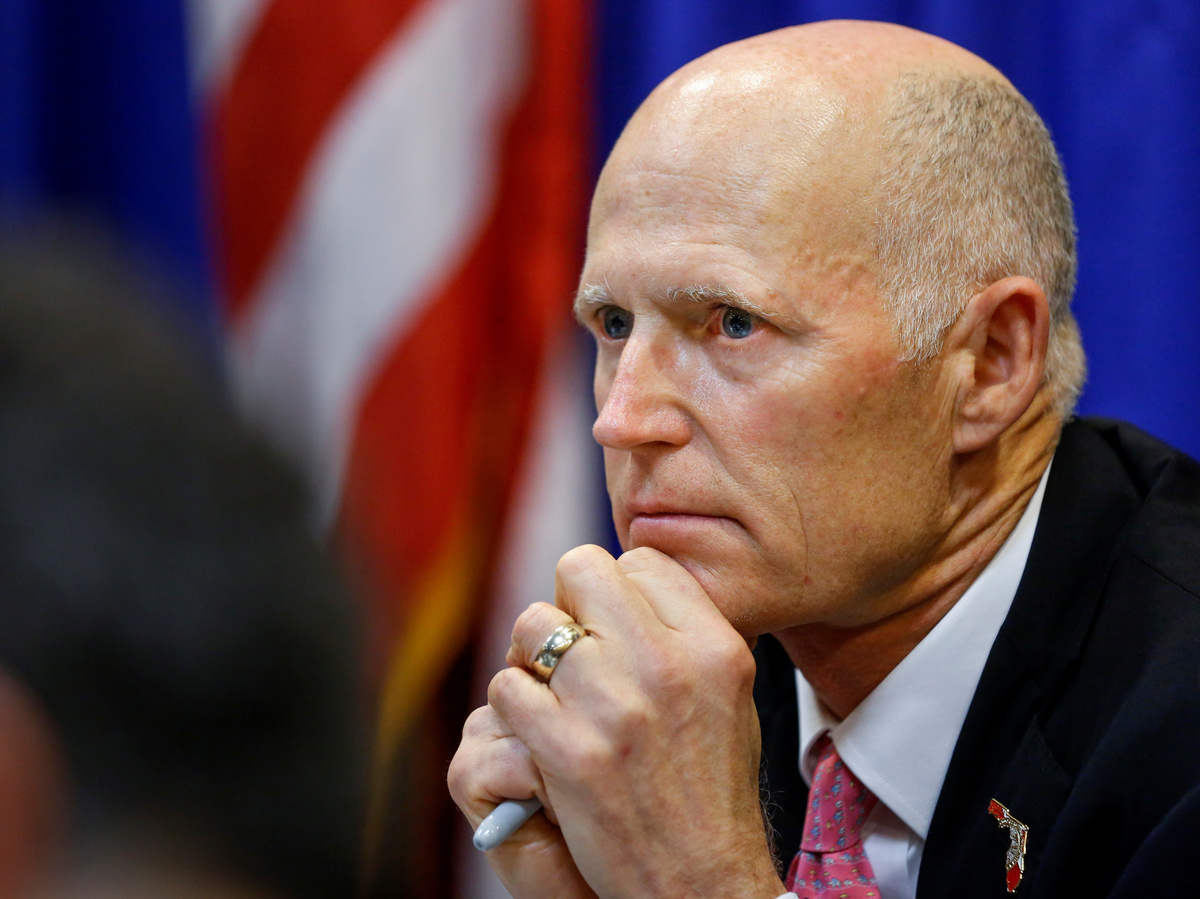
Florida Gov. Rick Scott during a meeting with law enforcement, mental health, and education officials last month.
Colin Hackley/Reuters
hide caption
toggle caption
Colin Hackley/Reuters
Right now, Florida first responders can get medical coverage under workers’ compensation, bot not lost wages, if they are diagnosed with post-traumatic stress disorder on the job. The Florida Senate approved a bill last weekend that would cover lost wages for first responders with PTSD, and the House followed suit on Monday.
Florida Gov. Rick Scott is now saying he will sign the bill.
“I intend to sign it as soon it makes it to my desk,” Scott said, speaking at an event to honor firefighters who died in the line of duty. “What this will do is ensure firefighters suffering from PTSD can receive workers’ comp benefits.”
About a third of states have similar laws. Florida Chief Financial Officer Jimmy Patronis, also the state Fire Marshall, called PTSD a “hidden killer.”
“This benefit is needed so we ensure that our firefighters don’t have this as their only option, our first responders don’t look to suicide as the outlet to sort through the demons they deal with and these horrific images,” Patronis said.
Changing the law has not been easy. Legislation was introduced after the Pulse nightclub shooting in Orlando two years ago. That shooting left 49 people dead. At least three first responders to the shooting have publicly disclosed that they have been diagnosed with PTSD.
The bill languished in Florida’s Republican-dominated legislature last year, and a related measure’s prospects had been uncertain this year. The Florida League of Cities, for example, raised concerns about the costs to local governments that pay for police and fire departments.
But after the Feb. 14 high school shooting in Parkland, in which 17 people died, opposition to the bill faded.
Before the final floor vote, state Rep. Matt Willhite looked up to the gallery where Linda Benoway was watching. Willhite told her he was sorry.
Benoway’s son Stevie LaDue, 55, committed suicide in September. Before his retirement after 30 years as a Tampa firefighter, he tried to get workers’ comp because of PTSD. When the state denied his claim, he had to go back to work and pay back the time he missed.
“Why I say I’m sorry to you is because the system failed you, and prior to today, we failed you,” Willhite said. “Your son, this may have saved his life.”
After Willhite spoke, the bill passed unanimously.
The bill also comes too late for Josh Vandegrift, a firefighter and paramedic in the city of Cocoa.
Vandegrift was just starting a 24-hour shift in July, 2016, when the call came in: A pedestrian had been hit by a vehicle about 100 yards from his station.
Vandegrift and other firefighter paramedics responded by ambulance, and Vandegrift cleared bystanders out of the way.
“I looked down and I saw my brother’s face on the patient,” he said.
Nate Vandegrift, his younger brother, had been hit by a commercial van crossing the street. Josh Vandegrift began to treat his brother before being removed from the scene by police officers. “I remember just absolutely losing it in the middle of the road.”
Nate Vandegrift died about eight hours after the accident. Since then, Josh Vandegrift has had nightmares and flashbacks. He avoids the intersection if possible.
Doctors diagnosed Vandegrift with PTSD. He took his sick time and vacation time, and when that ran out, coworkers donated their sick time to him. When that ran out in August, 2016, he applied for workers’ compensation. His claim was denied.
“I had to go back to work or resign, basically,” said Vandegrift, who returned to work. “I have good days, and I have really bad days, and everything in between. Every day, I walk through a different part of hell and have to figure out how to navigate it.”
Vandegrift, one of dozens of first responders who have answered WMFE and ProPublica’s request to hear from first responders suffering from PTSD, won’t benefit from the new law. The legislation will cover people who make a workers’ comp claim after October 1, 2018, as long as the triggering event was within the prior year.
That means Parkland first responders could be covered, but not Vandegrift and responders to the Pulse nightclub shooting. Vandegrift said he knew before he started advocating for the law that it likely wouldn’t apply to him.
“If anything happens in the future, something is in place now so nobody will have to go through what I went through,” Vandegrift said. “You know, to be able to get out of bed in the morning.”
WMFE and ProPublica are investigating PTSD and suicides in first responders as part of the ProPublica Local Reporting Network. If you are a first responder with PTSD, or if you’ve lost a first responder to suicide, visit ProPublica.
Tattoo You: Immune System Cells Help Keep Ink In Its Place


Make sure that tattoo is one you want to keep.
yulkapopkova/Getty Images
hide caption
toggle caption
yulkapopkova/Getty Images
Last Saturday, while I was visiting Fatty’s Tattoos and Piercings, a college-aged woman in a hoodie walked in and asked for a tattoo, her first, right on the spot.
“I want a red-tailed hawk feather,” she told the artist on duty at the Washington, D.C., tattoo parlor.
He peppered her with questions: How big? What style? She alternated between a blank stare and a furrowed brow: “I … have a photo on my phone of the feather that I like, I could show you that?”
The artist rubbed his beard and told her he didn’t do realistic tattoos. Maybe they should set up an appointment for her sometime next week, with another artist, he offered. Between the lines, he seemed to say, “This will be permanent, so I don’t want to give you the wrong tattoo.”
But considering how many changes skin weathers — burns heal, scars fade and wrinkles set in — it’s sort of unbelievable that tattoos do stick around.
Recently, a group of French scientists looked into how that works, hoping to use the knowledge to improve tattoo removal.
So, first, of course, they gave some mice tattoos.
The mice didn’t get Mom tattoos on their tiny biceps. Instead, they got tail tats — three stripes of green ink — for researchers to study.
“The thing is, the mouse skin can be super fragile, much more fragile than human skin,” says Sandrine Henri, an immunologist at the Centre d’Immunologie Marseille-Luminy.
If you zoom way in on any tattoo, it’s really just a bunch of cells holding tight to ink particles. From the mice’s tail tattoos, Henri and her colleagues identified one type of cell that captured ink particles and stayed in place, the dermal macrophage.
The researchers thought they might be able to disrupt the tattoos by destroying the macrophages that had locked up the ink. So they engineered mice whose macrophages — and only those cells — would shrivel in the face of a specific toxin, and then injected that compound into these special, tattooed mice.
But it didn’t work.
The messed-up macrophages released their ink particles, but the color persisted. It turns out that new macrophages quickly took over the job of holding the tiny flecks of ink in place, and the mice kept their sporty green-striped tails.
But if it were possible, Henri says, to use an ointment, or a drug, to delaythose replacement macrophages,it might improve tattoo removal for mice — and humans. The researchers’ fingings appeared Tuesday in the Journal of Experimental Medicine.
To think about removing ink from human shoulders, rather than mouse tails, it helps to know how tattoos appear. In broad strokes, we understand this process, says Bruce Klitzman, a biomedical engineer at Duke who once worked on creating an erasable tattoo.
As a tattoo artist outlines a yin-yang symbol on someone’s shoulder, a solid needle loaded with ink pierces the tattoo-ee’s skin, or epidermis, and the needle’s exit lets pigment flow into a second layer of skin, the dermis, Klitzman says.
But any self-respecting immune system treats all visitors — including the ink particles meant to create a wolf’s face on your forearm — as unwelcome. So skin cells mount a multilevel attack on the ink particles.
First, the cells that weren’t hit by the tattoo needle block out guests, Klitzman says. Only a fraction of the ink an artist lays down actually makes it into the dermis, and this is also why new tattoos tend to leak ink as they heal.
Newly tattooed skin swells, the same way it would respond to any other wound, and blood and lymph ferry away the smallest bits of ink. For the remaining pigment particles, the next order of the immune system’s business is consuming the foreign invaders, to try to destroy them.
That’s where the macrophages, the cells Henri studied, come in. They’re specialized immune cells — their name means big eater in Greek — and their job is to slurp up interlopers, says Klitzman. “Macrophages can basically swallow many, many tattoo pigment particles, almost like a vacuum cleaner, just go along and suck up all those particles,” he says.
Usually, a macrophage digests the invaders it devours, using acid to rip its enemy apart. It’s a good strategy for killing bacteria and viruses, but not for tattoo pigments. Acid has little effect on the ink ingredients.
That means a macrophage that has gorged on ink has no way to finish its job. Eventually, the pigment-filled macrophages dial back their attack, content to contain the threat, even if they can’t completely neutralize it. “They just sit there like a full vacuum cleaner bag,” says Klitzman.
Another type of cell, called a fibroblast, is also known to take in some ink particles in human skin. Together, the macrophages and fibroblasts bind enough ink for the image of, say, a carrot or feather to appear on your calf.
Those cells and the pigment inside them can hang around for years. But all cells die eventually, which brought Henri and her team to their question: How do tattoos stay put as individual cells die?
Their work confirms that even when macrophages die and release their pigment particles, other macrophages quickly gobble up the ink, keeping it in place.
Even when the researchers grafted one mouse’s tail tattoo onto another mouse’s back, the second mouse’s own macrophages carried the skin graft’s tattoo. “The cells from the graft died and released the ink, and the host mouse’s cells captured it,” Henri says.
All of that, basically, underscores why tattoo removal is really, really difficult.
Laser removal is an option, says Jared Jagdeo, a dermatologist at University of California, Davis. Tuned to a wavelength specific to a tattoo’s colors, “lasers are able to break apart tattoo particles,” he says. The bursts of energy bust ink “from larger boulders into smaller rocks, and then into fine pebbles which then can be swept away by the lymphatic system.”
But laser removal is far from perfect. The process of blurring ink beyond recognition can take many sessions, spaced weeks apart, at a couple hundred dollars a visit.
Laser pulses irritate skin, and people show re-uptake of ink similar to Henri’s mice, Jagdeo says. He uses anti-inflammatory drugs to help tame that response, but it’s really difficult to remove all evidence of a tattoo. “Tattoos are at their baseline permanent, so if [someone gets] a tattoo they should plan on having it for a while,” he says.
Back at the tattoo shop, I don’t know if the woman with the red-tailed hawk feather ever managed to get her tattoo. Either way, I hope she’s happy with her decision. For now, tattoo removal is still a challenge.