Nicola Cruz Merges Electronic And Folk Music With The Use Of Cave Acoustics

Electronic musician Nicola Cruz’s new album, Siku, releases on Jan. 25.
Hanna Quevedo/Courtesy of the artist
hide caption
toggle caption
Hanna Quevedo/Courtesy of the artist
Nicola Cruz is not afraid to experiment. Well-known in South America and based in Ecuador, the electronic musician released his latest album, Siku, on Jan. 25.
Not only does he mix in the folklore and roots from around South America, Cruz also creates vivid soundscapes using various instruments including wood flutes, percussion and small guitars.
“Living in a place like Ecuador, it just feels natural,” Cruz says. “All around, folklore and roots are quite present. You turn on the radio and you listen to folkloric music.”
When Cruz started to make techno music, he decided to slow down the BPM (beats per minute) and investigate music from there. Never thinking about whether or not it would sell, it led him to create a song called “Sanación,” which he released four years ago on his debut album, Prender el Alma.
“That really made me take a step back and realize what what I was doing,” Cruz says. “It really felt magical. It felt powerful.”
Now, he’s out with his second album Siku, which Cruz says is a reference to a wind instrument from the Andes. “But at the same time Siku means an Andean tradition which means playing in pairs,” Cruz says, “Not necessarily playing like in the physical form, but really being connected with one another while playing.”
Cruz tries to be as “experimental as possible,” which he believes is an advantage of electronic music. In many of his songs, he likes to record outside of a conventional studio where things can be “a bit more chaotic.”
YouTube
“So ‘Arka’ was recorded in this cave in this volcano near me,” Cruz says. “It’s not an active volcano, but pretty much all the mountains around here were once a volcano.”
“Arka” was done in collaboration with Esteban Valdivia, a specialist on the world’s ethnic flutes and the study of pre-Columbian aerophones.
“We always wanted to do a song together, and so we thought these caves which are near our homes was the perfect place to to experiment,” Cruz says.
By mixing electronic music with elements from his homeland, Cruz hopes to change the perception of pop music in Latin America. “I, at least, know I’m doing my music with quality and intention,” Cruz says. “I really hope it gets heard and it replaces our concept of popular music.”
Producer Monika Evstatieva assisted with the audio editing of this story.
Steep Climb In Benzodiazepine Prescribing By Primary Care Doctors

The drugs clonazepam and diazepam are both benzodiazepines — and better known by the brand names Klonopin and Valium. The drug class also includes Ativan, Librium and Halcion.
Bloomberg/Getty Images
hide caption
toggle caption
Bloomberg/Getty Images
The percentage of outpatient medical visits that led to a benzodiazepine prescription doubled between 2003 and 2015, according to a study published Friday. And about half those prescriptions came from primary care physicians.
This class of drugs includes the commonly used medications Valium, Ativan and Xanax. While benzodiazepines are mostly prescribed for anxiety, insomnia and seizures, the study found that the biggest rise in prescriptions during this time period was for back pain and other types of chronic pain. The findings appear online in JAMA Network Open.
Loading…
Don’t see the graphic above? Click here.
And while benzodiazepines are best for short-term use, according to physicians, the new study found that long-term use of these drugs has also risen. From 2005 to 2015, continuing prescriptions increased by 50 percent.
Long term use of the drugs can cause physical dependence, addiction and death from overdose.
“I don’t think people realize that benzodiazepines share many of the same characteristics of opioids,” says Dr. Sumit Agarwal, an internist, primary care physician and researcher at Brigham and Women’s Hospital in Boston, and one of the authors of the new study.
“They are addictive,” he says. “They cause you to have slower breathing; they cause you to be altered in terms of mental status. And then, eventually, [they] can cause overdose and deaths.”
Previous studies have shown a nearly eightfold rise in mortality rates from overdoses involving benzodiazepines — from 0.6 in 100,000 people in 1999 to 4.4 in 2016.
“That’s somewhere around 10,000 to 12,000 deaths at the hands of benzodiazepines,” says Agarwal. “This rise is happening quietly, outside of the public eye.”
And according to a recent report by the U.S. Centers for Disease Control and Prevention, the overdose mortality rate for women between the ages of 30 and 64 increased by 830 percent between 1996 and 2017.
“Women are more likely to be prescribed these medications,” Agarwal says. “Women are more likely to come in to the clinic to be treated for anxiety and depression, and benzodiazepines tend to be one of the medications we reach to.”
“The study highlights that we have a very serious problem with benzodiazepines,” says Anne Lembke, an associate professor of psychiatry and medical director of addiction medicine at Stanford University School of Medicine. She wasn’t involved in the new study.
“I am concerned that our national focus on opioids has hidden the problem related to benzodiazepines — that’s our next frontier,” says Dr. Joanna Starrels, as associate professor at the department of medicine at the Albert Einstein College of Medicine. She wasn’t involved in the new study, but co-authored a 2016 study that found a rise in prescription rates and overdose deaths from this class of drugs between 1996 and 2013.
Lembke notes that the biggest rise in outpatient visits that led to benzodiazepine prescriptions were from primary care physicians and not psychiatrists.
“I think the big message here is that primary care doctors are really left with burden of dealing, not only with chronic pain and opioid prescription, but also benzodiazepine prescriptions,” she says.
The trends, she adds, reflect “the incredible burden of care on primary care physicians, who are given little time, or resources” to handle a high volume of pain patients with complex conditions.
“That’s partly what got us into the opioid epidemic in the first place,” Lembke notes.
“Generally speaking primary care physicians have not received the training that they need to prescribe medications that have such high risk for addiction or overdose,” says Starrels.
“Primary care doctors,” she says, “are the frontline providers. “And in many settings, particularly in rural areas, we may be the only providers. So we end up needing to treat conditions where specialists may be better trained — like chronic pain, addiction and anxiety.”
Given the rise in benzodiazepine prescriptions for back pain and chronic pain, “it may be that benzodiazepines are taking the place of opioids,” says Lembke.
However, Starrels cautions that the new study couldn’t determine whether the patients who were treated for back or chronic pain were prescribed a benzodiazepine for their pain. It’s also possible they were prescribed these medications for anxiety or insomnia in addition to being treated for pain.
The new study also found that the co-prescribing of benzodiazepines with opioids has risen during this time period. But that’s not necessarily a bad thing, says Lembke.
Loading…
Don’t see the graphic above? Click here.
“What we don’t want doctors to do is cut patients off of opioids,” she says. “That’s neither humane nor medically the right path. Some of these co-prescribing may be because doctors are tapering patients off of opioids.”
But co-prescribing these two kinds of medications can be dangerous. “They both slow down the central nervous system in complementary ways [that] increase the risk of overdose deaths,” says Starrels. “It is dangerous — and generally advised not to prescribe together.”
In 2016, the U.S. Food and Drug Administration warned doctors about the dangers of prescribing opioids and anxiety medications together.
Agarwal says that warning may have had a positive effect on prescription rates of these anxiety meds. “Next couple of years of data will be very telling,” he says.
Starrels notes that benzodiazepines have not been shown to be effective for chronic pain. And there’s more effective treatment for insomnia, she says.
For example, a form of talk therapy has been shown to be one of the most effective treatments for insomnia. And simply practicing better sleep hygiene can make a big difference, she says.
Physicians who want to move patients off their long term use of benzodiazepines, should do it slowly over time, Starrels cautions. “It has to be slow and medically monitored over time,” she says, because “sudden withdrawal can be fatal.”
She says primary care doctors should get better guidelines for prescribing these drugs, just as there are CDC guidelines for opioid prescription.
“People have started calling this ‘our other prescription drug problem’ — the first one being opioids, but this one’s flying under the radar,” Agarwal says. “It would be great if we address it before it becomes an epidemic — if there isn’t already one.”
There's A Dee Ford On Twitter But It's Not The NFL Player

Dee Ford was getting angry tweets when the Kansas City Chiefs’ player drew a late penalty against the Patriots and his team lost. A woman named Dee Ford is on Twitter, she gets tweets meant for him.
RACHEL MARTIN, HOST:
Good morning. I’m Rachel Martin. Last weekend, NFL player Dee Ford of the Kansas City Chiefs was getting all kinds of angry tweets. He was hit with a late penalty, and his team lost to the Patriots. The thing is Dee Ford is not on Twitter, but a 47-year-old English woman also named Dee Ford is, so she’s the one who got the Twitter rage. It’s been happening for years, so the two Dee Fords have become friends. British Dee Ford said some of the tweets are quite nasty, and she is glad football Dee Ford doesn’t have to see them.
Copyright © 2019 NPR. All rights reserved. Visit our website terms of use and permissions pages at www.npr.org for further information.
NPR transcripts are created on a rush deadline by Verb8tm, Inc., an NPR contractor, and produced using a proprietary transcription process developed with NPR. This text may not be in its final form and may be updated or revised in the future. Accuracy and availability may vary. The authoritative record of NPR’s programming is the audio record.
The Super Bowl And Musician Protests Of Past
Numerous artists reportedly passed on the opportunity to perform at this year’s Super Bowl. DJs Stretch Armstrong and Bobbito Garcia look back at past musician protests.
Trump Seeks Action To Stop Surprise Medical Bills
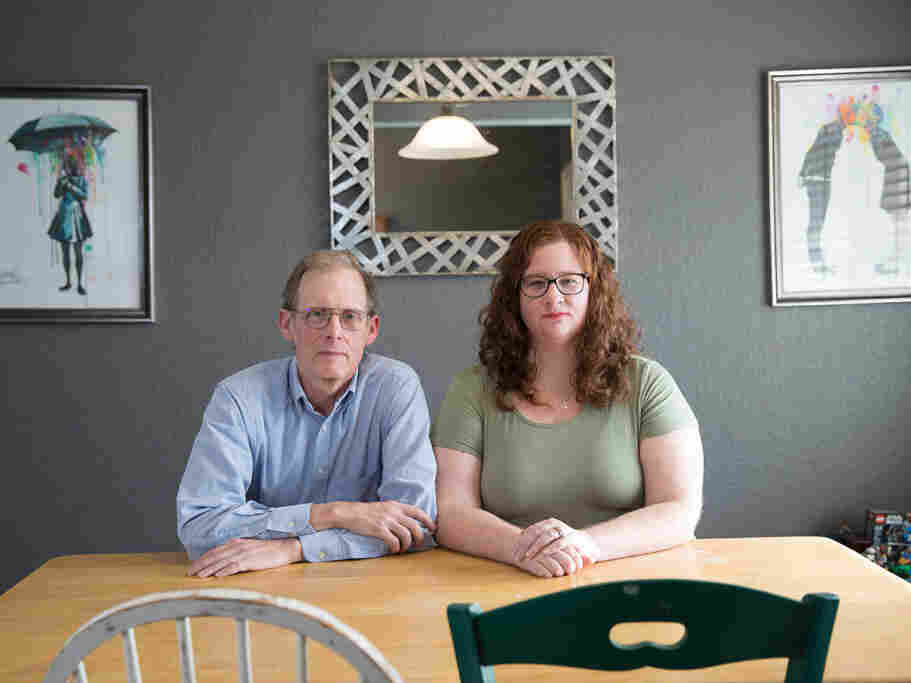
Dr. Paul Davis, whose daughter, Elizabeth Moreno, was billed $17,850 for a urine test and featured in KHN-NPR’s Bill of the Month series, was among the guests invited to the White House on Wednesday to discuss surprise medical bills with President Trump.
Julia Robinson for KHN
hide caption
toggle caption
Julia Robinson for KHN
President Trump instructed administration officials Wednesday to investigate how to prevent surprise medical bills, broadening his focus on drug prices to include other issues of price transparency in health care.
Flanked by patients and other guests invited to the White House to share their stories of unexpected and outrageous bills, Trump directed his health secretary, Alex Azar, and labor secretary, Alex Acosta, to work on a solution, several attendees said.
“The pricing is hurting patients, and we’ve stopped a lot of it, but we’re going to stop all of it,” Trump said during a roundtable discussion when reporters were briefly allowed into the otherwise closed-door meeting.
David Silverstein, the founder of a Colorado-based nonprofit called Broken Healthcare who attended, said Trump struck an aggressive tone, calling for a solution with “the biggest teeth you can find.”
“Reading the tea leaves, I think there’s big change coming,” Silverstein said.
Surprise billing, or the practice of charging patients for care that is more expensive than anticipated or isn’t covered by their insurance, has received a flood of attention in the past year, particularly as Kaiser Health News, NPR, Vox and other news organizations have undertaken investigations into patients’ most outrageous medical bills.
Attendees said the 10 invited guests — patients as well as doctors — were given an opportunity to tell their story, though Trump didn’t stay to hear all of them during the roughly hourlong gathering.
The group included Paul Davis, a retired doctor from Findlay, Ohio, whose daughter’s experience with a $17,850 bill for a urine test after back surgery was detailed in February 2018 in KHN-NPR’s first Bill of the Month feature.
Davis’ daughter, Elizabeth Moreno, was a college student in Texas when she had spinal surgery to remedy debilitating back pain. After the surgery, she was asked to provide a urine sample and later received a bill from an out-of-network lab in Houston that tested it.
Such tests rarely cost more than $200, a fraction of what the lab charged Moreno and her insurance company. But fearing damage to his daughter’s credit, Davis paid the lab $5,000 and filed a complaint with the Texas attorney general’s office, alleging “price gouging of staggering proportions.”
Davis said White House officials made it clear that price transparency is a “high priority” for Trump, and while they didn’t see eye to eye on every subject, he said he was struck by the administration’s sincerity.
“These people seemed earnest in wanting to do something constructive to fix this,” Davis said.
Dr. Martin Makary, a professor of surgery and health policy at Johns Hopkins University who has written about transparency in health care and attended the meeting, said it was a good opportunity for the White House to hear firsthand about a serious and widespread issue.
“This is how most of America lives, and [Americans are] getting hammered,” he said.
Trump has often railed against high prescription drug prices but has said less about other problems with the nation’s health care system. In October, shortly before the midterm elections, he unveiled a proposal to tie the price Medicare pays for some drugs to the prices paid for the same drugs overseas, for example.
Trump, Azar and Acosta said efforts to control costs in health care were yielding positive results, discussing in particular the expansion of association health plans and the new requirement that hospitals post their list prices online. The president also took credit for the recent increase in generic drug approvals, which he said would help lower drug prices.
Discussing the partial government shutdown, Trump said Americans “want to see what we’re doing, like today we lowered prescription drug prices, first time in 50 years,” according to a White House pool report.
Trump appeared to be referring to a recent claim by the White House Council of Economic Advisers that prescription drug prices fell last year.
However, as STAT pointed out in a recent fact check, the report from which that claim was gleaned said “growth in relative drug prices has slowed since January 2017,” not that there was an overall decrease in prices.
Annual increases in overall drug spending have leveled off as pharmaceutical companies have released fewer blockbuster drugs, patents have expired on brand-name drugs and the waning effect of a spike driven by the release of astronomically expensive drugs to treat hepatitis C.
Drugmakers were also wary of increasing their prices in the midst of growing political pressure, though the pace of increases has risen recently.
Since Democrats seized control of the House of Representatives this month, party leaders have rushed to announce investigations and schedule hearings dealing with health care, focusing in particular on drug costs and protections for those with preexisting conditions.
Last week, the House Oversight Committee announced a “sweeping” investigation into drug prices, pointing to an AARP report saying the vast majority of brand-name drugs had more than doubled in price between 2005 and 2017.
Kaiser Health News correspondents Shefali Luthra and Jay Hancock contributed to this report. You can follow Emmarie Huetteman on Twitter: @emmarieDC.
California Doctors Alarmed As State Links Their Opioid Prescriptions to Deaths

When a former patient died from a lethal combination of methadone and Benadryl, Dr. Ako Jacintho got a letter from the state medical board.
Whitney Hayward/Portland Press Herald/Getty Images
hide caption
toggle caption
Whitney Hayward/Portland Press Herald/Getty Images
About a year ago, Dr. Ako Jacintho of San Francisco returned home from traveling to find a letter from the state medical board waiting for him.
The letter explained that a patient he had treated died in 2012 from taking a toxic cocktail of methadone and Benadryl — and Jacintho was the doctor who wrote the patient’s last prescription for methadone. He had two weeks to respond with a written summary of the care he had provided, and a certified copy of the patient’s medical record. He faced fines of $1,000 per day if he didn’t comply.
“I was horrified,” Jacintho says. He hadn’t known that the patient had died. “I became overwrought with sadness. And I was really just surprised that this had happened to this patient.”
The letter was one of more than 500 sent to doctors in recent years throughout the state, all part of the California medical board’s Death Certificate Project. The board typically investigates doctors in response to patient complaints, but with this project, it proactively collected almost 3,000 death certificates of people who died of opioid overdoses, then cross-referenced those with the state’s drug prescription database.
Investigators are going back three years to identify any doctors who may have prescribed the drugs inappropriately, even if it was not the fatal dose, and send them letters. Doctors who are found to have violated state law face public reprimands, probation, or even revocation of their medical licenses.
When Jacintho received his letter, his first reaction was grief. But then he grew afraid, then indignant. The letter seemed to presume he did something wrong — it used words like “complaint” and “allegation.” But when Jacintho reviewed the patient’s medical charts, he was convinced he didn’t.


Dr. Ako Jacintho was horrified to learn that a patient of his had died of an overdose and was surprised when the state started investigating him.
April Dembosky/KQED
hide caption
toggle caption
April Dembosky/KQED
“This person had intractable pain,” Jacintho says, and at the time, methadone was a preferred treatment. Methadone is long-acting, and was considered to have less potential for addiction than other opioids. In particular, Jacintho says he takes issue with the board’s choice of words in the letter: “over-prescribing,” and “toxic levels.”
“Toxicity is a very subjective word,” he says. “What’s a toxic level for someone may not be a toxic level for someone else.”
It wasn’t until 2016 that the CDC issued guidelines for prescribing opioids, telling doctors to start with low dosages and increase slowly. And when possible, use ibuprofen instead.
But, back in 2012, doctors like Jacintho were being admonished to never leave a patient in pain. The California medical board’s own guidelines from 2013 advised doctors that for certain types of pain, opioids were the cornerstone of treatment and should be pursued vigorously.
“It actually says that no physician will receive disciplinary action for prescribing opioids to patients with intractable pain,” Jacintho says.
But now the medical board is using death certificates from 2012 and 2013 to discipline doctors.
The timing of the investigation really bothers Jacintho, because in the six years since his patient died, he’s totally revamped his practice. As a family doctor, he saw the opioid crisis coming. He had patients asking for more, stronger drugs, even though their pain stayed the same. So he switched gears, went back into training and got certified as an addiction specialist.
“If they’re looking for clinicians who are overprescribing, I’m the wrong doctor,” he says.
The executive director of the medical board, Kim Kirchmeyer says medical investigators take career changes like this into account, and they review medical records according to the standard of care that was in place at the time.
“We understand that just because a patient has overdosed that that doesn’t mean that the care and treatment provided was not appropriate,” she says. But anytime there may have been a violation of the law, she adds, “we do need to look into it.”
The board is only punishing doctors who actually broke the law, she says — those with a clear and repeated pattern of inappropriate prescribing.
“Individuals were prescribing drugs without even performing a history and physical exam,” she says. These doctors never did any kind of testing, they didn’t provide informed consent. “They don’t have a treatment plan or objectives. They just continue to prescribe and prescribe.”
Investigators have so far completed investigations for about half of the 500 doctors originally identified as possibly deviating from the standard of care. The majority were cleared of any wrongdoing, and the board filed formal accusations against 25 doctors.
But there are hundreds of doctors who are still waiting, more than a year later, to learn their fate.
Ultimately, the medical board is a consumer protection agency, Kirchmeyer says, and this is about patient safety, not doctors’ comfort. “If we save one life through this project, that is meeting the mission of the board, and that makes this project so worth it,” she says.
But it’s unclear if the overall effect of the project will be good for patients. Some doctors, including Jacintho, have been so frightened by the letters that they’ve lowered their patients’ opioid doses or cut them off completely. Some doctors are telling their chronic pain patients to find another doctor, according to the California Medical Association. This carries a whole new set of risks.
“It’s like leaving a pair of scissors in an abdomen after surgery,” says Dr. Phillip Coffin, director of substance use research at the San Francisco Department of Public Health. “If you’re just going to discontinue opioids, basically you’re ripping out the scissors and telling the person: ‘Good luck.’ Let them deal with the intestinal perforation on their own.”
The CDC’s 2016 guidelines on how to prescribe opioids are for patients who have never taken them before. But they include virtually no guidance on how to taper down doses for chronic pain patients who have already been taking high doses of opioids for many years.
Preliminary research from the San Francisco Department of Public Health suggests some patients who are weaned off long-term prescription opioids are twice as likely to turn to street drugs. That increases risk of overdose.
“Scaring providers into not prescribing opioids, I think that is not the ethically appropriate way to go forward,” Coffin says of the California Death Certificate Project.
Doctors in North Carolina reacted similarly — refusing to treat chronic pain patients — when the medical board there began proactively investigating doctors who had prescribed high levels of opioids, or who had two patients die of an overdose in the previous year.
A federal prosecutor in Massachusetts also sent letters to doctors who had prescribed opioids within 60 days of a patient’s death. While those letters were intended to be a “warning,” rather than notice of an investigation, they also sparked fear among doctors.
It was never the California medical board’s intention for doctors to simply stop prescribing opioids, Kirchmeyer explains, and it doesn’t want that outcome. She says board members have already learned some lessons on how to improve their approach: They’ve rewritten the letters so they’re less accusatory. And, they know they have to move faster with the investigations.
But the board is committed to the project. Kirchmeyer says after the board finishes examining the 2013 death certificates, it will start working on 2014.
Raging NFL Controversy Over A Blown Referee Call Turns Political
Louisiana’s governor sent the NFL Commissioner a letter complaining about a missed penalty that New Orleans Saints fans say cost their team a chance to play in the Super Bowl.
DAVID GREENE, HOST:
There has been a controversy raging in the NFL since Sunday that has now turned political. Louisiana’s governor, John Bel Edwards, has sent a letter to NFL Commissioner Roger Goodell complaining about a missed penalty that New Orleans Saints fans say cost their team a chance to play in the Super Bowl. This letter follows lawsuits, a petition and just general rage about this now infamous no call by referees in the NFC championship game. And let’s talk about this with NPR sports correspondent Tom Goldman. Hi, Tom.
TOM GOLDMAN, BYLINE: Hi there, David.
GREENE: OK. So for people who were not watching that game, remind us what happened and what is causing all this.
GOLDMAN: Only one of the most obvious cases of pass interference you’ll ever see, and it wasn’t penalized. It happened late in the game between the Saints and the LA Rams. A Rams defender blasted a New Orleans receiver before a pass reached the receiver, and there was no flag. And after the game, the Rams defender acknowledged he interfered. The NFL head of officials admitted they blew the call, which, under NFL rules, wasn’t reviewable, so they couldn’t check replays and see what everyone else in the world saw.
Now, as a result, the Saints lost a chance to run down the clock and kick a short field goal for the win in the final seconds. Instead, they were forced to kick a tiebreaking field goal with over a minute and a half left. That gave the Rams lots of time to get the ball back, drive down the field, kick the tying field goal, which they did, and then they won in overtime.
GREENE: So Saints fans are going to want you to answer yes to this question, but I’m going to ask it. Would they have definitely won the game if this penalty had been called?
GOLDMAN: (Laughter) Highly likely, Saints fans, but not certain, David Greene. This is just between you and me. Even if the Saints had run down the game clock and attempted that very short field goal for the win, the kicker could have missed or it might have been blocked. Even with the botched call, the Saints could have won. Yes, the Rams got the ball with lots of time after the Saints went ahead, but, hey, what about that great Saints defense? They could have stopped the Rams from driving down the field, kicking the tying field goal. And then in overtime, the Saints had the ball first and had a chance to win.
So now that all Saints fans hate me, I will say, yes, the odds were pretty good that had the penalty been called, the Saints would be playing New England in the Super Bowl February 3.
GREENE: All right. Well, sports fans like me, we just suffer and deal with a bad call. It sounds like in Louisiana I guess you could do lots of things like file lawsuits and get your governor involved. So what – tell us – tell me more about the response here.
GOLDMAN: The governor sent that letter to Commissioner Goodell to make rule changes that allow for expanding use of replay. Otherwise, he said, the integrity of the game will be called into question. Edwards also said Louisiana football fans will move on but will not forget. There are these lawsuits by fans. One of them alleges damages of mental anguish and loss of enjoyment of life. I know you’ve felt that as a Pittsburgh Steelers fan.
GREENE: Thanks.
GOLDMAN: (Laughter) Saints fan Matt Bowers has rented billboards in Atlanta, the host city for the Super Bowl, with messages like Saints got robbed. And there’s an online petition asking for a rematch this Sunday. As of early this morning, David, the petition had over 680,000 signatures.
GREENE: OK. There’s not going to be a rematch. I’m going to predict that right now. But what is the NFL going to do here going forward?
GOLDMAN: What should happen and probably will is replay needs to be expanded. That play should have been reviewed and the call corrected. The league has said subjective penalties like pass interference cannot be reviewed. The NFL, you know, worries that too much replay will slow down games. But if you watch the other conference championship game between New England and Kansas City, which I’m sure you did, there were a bunch of replays during a thrilling fourth quarter, and it didn’t take away the excitement at all.
GREENE: NPR sports correspondent Tom Goldman. Thank you, Tom.
GOLDMAN: A pleasure, David.
Copyright © 2019 NPR. All rights reserved. Visit our website terms of use and permissions pages at www.npr.org for further information.
NPR transcripts are created on a rush deadline by Verb8tm, Inc., an NPR contractor, and produced using a proprietary transcription process developed with NPR. This text may not be in its final form and may be updated or revised in the future. Accuracy and availability may vary. The authoritative record of NPR’s programming is the audio record.
Rivera, Halladay, Martinez, Mussina Elected To Baseball's Hall Of Fame


Former New York Yankees closer Mariano Rivera poses with his Monument Park plaque in 2016, at Yankee Stadium in New York.
Rich Schultz/AP
hide caption
toggle caption
Rich Schultz/AP
Updated at 8:21 p.m. ET
Mariano Rivera, the New York Yankees’ closing pitcher who posted a record 652 saves over his 19-year career, is the first player to be unanimously selected for Major League Baseball’s Hall of Fame.
Two other pitchers, the late Roy Halladay and Mike Mussina, and slugger Edgar Martinez were also elected.
Rivera received all 425 votes cast by the Baseball Writers Association of America. The stars all received at least 75 percent of the ballots cast. Players must be retired for five years to be eligible for the honor.
In 2014, Rivera told NPR that as he grew up in poverty in Panama, he had far different expectations from life.
“I wanted to be a mechanic. So I would have saved all the money that I make to open my own shop,” he said.
Roy Halladay, who won two Cy Young Awards and made eight All-Star appearances, played for the Toronto Blue Jays and the Philadelphia Phillies. Winning 203 games in his 16-year career, he was known as a workhorse, posting 67 complete games — the most in the major leagues — since 2000. He is also the third posthumous Hall of Fame inductee. Halladay died in November 2017 when he crashed the airplane he was flying into the Gulf of Mexico near the Florida coast.
Edgar Martinez was a .312 hitter in his 18 years with the Seattle Mariners. He hit 309 home runs, won two batting titles and was a seven-time All-Star. Martinez is also one of three inductees — the others were Frank Thomas and Harold Baines — who played most of their careers as designated hitters.
Mike Mussina played 18 years for the New York Yankees and Baltimore Orioles, winning 270 games, striking out 2,813 batters and posting a career 3.68 earned run average. He was a five-time All-Star who won at least 11 games every year from 1992 to 2008. He also won seven Gold Gloves — an award for the top fielding position players.
As baseball fans earlier in the day awaited the news of which past stars would make the cut and have his name officially ranked with the game’s immortals, ESPN reminded readers that there had never been a unanimous selection to the Hall.
“Among those who obsess about Hall of Fame balloting, there is a small subset who obsess over this twist of history: No Hall of Famer has received 100 percent of the vote. Somehow, 23 people didn’t vote for Willie Mays. Nine people didn’t vote for Hank Aaron. Imagine having a Hall of Fame ballot and not voting for Willie Mays or Hank Aaron. Twenty didn’t vote for Ted Williams, but, hey, a lot of writers despised the man. In the first election in 1936, 11 writers didn’t vote for Babe Ruth. The rules might not have been entirely clear: Ruth had just retired the previous year. Still, Ruth received just 215 votes out of 226 ballots.”
Barry Bonds and Roger Clemens, two stars tainted by the widespread reaction against performance-enhancing drugs in baseball, both fell short of the 75 percent vote threshold. Bonds received 59.1 percent and Clemens 59.5 percent. Both were in their seventh year of eligibility.
Rivera, Halladay, Martinez and Mussina will be officially inducted into the Hall of Fame at a ceremony in Cooperstown, N.Y., this summer.
Angry With NFL After No-Call, Saints Fans Resort To Lawsuits, Billboards


Saints fans aren’t happy with the NFL after a controversial no-call in Sunday’s NFC championship game. One fan took out several billboards around Atlanta with his message for the league.
John Bazemore/AP
hide caption
toggle caption
John Bazemore/AP
It’s a meeting of two truly American pastimes: football and lawsuits.
First, the football.
Late in regulation in Sunday’s NFC championship game, the New Orleans Saints were tied 20-20 with the Los Angeles Rams in pursuit of the Super Bowl.
NFL fans could not believe that this wasn’t called pass interference ???https://t.co/LoZ9fizn5jpic.twitter.com/fpRWNtD7YX
— For The Win (@ForTheWin) January 20, 2019
As the ball sailed toward Saints receiver Tommylee Lewis, Rams cornerback Nickell Robey-Coleman knocked into Lewis, appearing to make helmet-to-helmet contact. Officials called no pass interference or helmet-to-helmet penalties.
As a result, the Saints kicked a field goal, then the Rams tied it up, and the game went to overtime – where the Rams went on to win, 26-23.
“I don’t know if there was ever a more obvious pass interference call that … you know, that here it is, the NFC Championship Game. So, a tough one to swallow,” Saints head coach Sean Payton told reporters after the game. “We’ll probably never get over it,” he added.
Payton wasn’t the only one struggling with the outcome: Saints fans are taking their fury with the NFL to court.
Two Saints season-ticket holders are suing NFL Commissioner Roger Goodell and the league for a range of damages, The New Orleans Advocate reports, including mental anguish, emotional trauma, “loss of enjoyment of life” and “distrust of the game which has become the National pastime.”
The lawsuit, filed in Orleans Parish Civil District Court, also claims as plaintiffs “Who Dat Nation.”
The lawsuit is just one of many outlets for disgruntled fans.
One gambling outfit in New Jersey announced it would refund some bets made on the game.
Commentators started pointing to sections in the NFL rulebook that might theoretically be grounds for Goodell ordering a do-over of the game’s last minutes.
A Change.org petition attracting more than 600,000 supporters demanded a rematch: “It’s the only fair solution to this travesty of epic proportions.”
Even Harry Connick Jr. – Harry Connick Jr.! – was so upset about the treatment of his beloved Saints that he Instagrammed a letter he’d written to Goodell, pledging to watch neither the AFC championship game nor the Super Bowl.
Matt Bowers, a diehard Saints fans who owns car dealerships throughout the southeast, has rented billboards in seven locations in and around Atlanta with 16 placements to voice his displeasure with the NFL. “And I’m not done yet,” he told ESPN. pic.twitter.com/ZHh0un2Xie
— Adam Schefter (@AdamSchefter) January 22, 2019
And in Atlanta, where the Super Bowl takes place Feb. 3, Saints fan Matt Bowers bought a smattering of billboards to convey his hurt feelings.
“NFL Bleaux It!” proclaims one. “Saints Were Robbed,” cries another.
Have a penchant for Louisiana-style outrage? Get in touch with Bowers.
“I have 8 total so any suggestions are welcome,” he wrote on Facebook.
House Democrats' Focus On Abortion Could Stymie Work With Senate

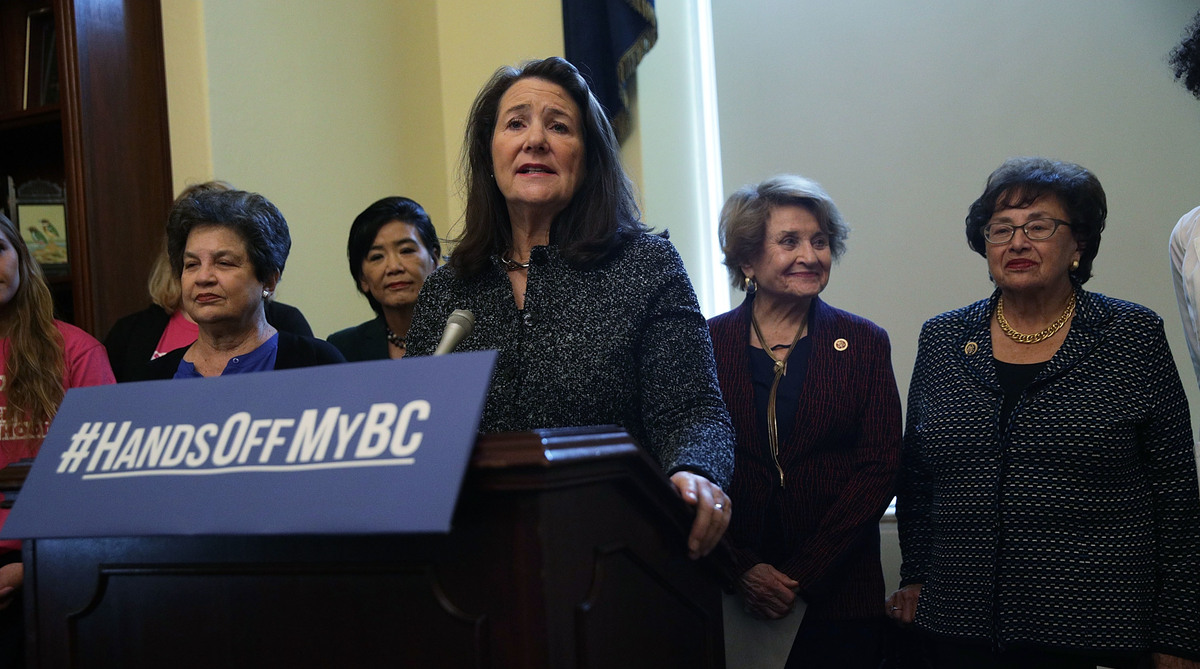
At an October news conference, the Congressional Pro-Choice Caucus called on President Trump to reverse the administration’s moves to limit women’s access to birth control. Rep. Diana DeGette, D-Colo., spoke at the lectern during the event on Capitol Hill.
Alex Wong/Getty Images
hide caption
toggle caption
Alex Wong/Getty Images
For the first time since the Supreme Court legalized abortion nationwide in its 1973 Roe v. Wade decision, the House of Representatives has a majority supporting abortion rights. And that majority is already making its position felt, setting up what could be a series of long and drawn-out fights with a Senate opposed to abortion and stalling what could otherwise be bipartisan bills.
Democrats have held majorities in the House for more than half of the years since abortion became a national political issue in the 1970s, but those majorities included a significant number of Democrats who opposed abortion or had mixed voting records on the issue. A fight among Democrats over abortion very nearly derailed the Affordable Care Act as it was becoming law in 2010.
This new Democratic majority is more liberal — at least on reproductive rights for women — than its predecessors. “I am so excited about this new class,” Rep. Diana DeGette, a Colorado Democrat and co-chair of the Congressional Pro-Choice Caucus, told reporters at a Jan. 15 news conference. “We are systematically going to reverse these restrictions on women’s health care.”
Indeed, the House has taken its first steps to do just that. On its first day of work Jan. 3, House Democrats passed a spending bill to reopen the government that would also have reversed President Trump’s restrictions on funding for international aid organizations that perform abortions or support abortion rights. As one of his first acts as president, Trump re-imposed the so-called Mexico City Policy originally implemented in the 1980s by President Ronald Reagan.
But the Senate, where Republicans still hold a slim majority, is not budging. If anything, Republican Senate leaders are trying to push further on abortion. On Thursday, Senate Majority Leader Mitch McConnell called a floor vote on a bill that would ban any federal funding of abortion or help fund insurance that covers abortion costs. Congress routinely adds the “Hyde Amendment” — a rider to the spending bill for the Department of Health and Human Services to bar federal abortion funding in most cases for Medicaid and other health programs — but McConnell’s legislation would have made the provision permanent and government-wide.
When the House was under GOP control, it passed similar measures repeatedly, but those bills haven’t been able to emerge from the Senate, where 60 votes are required. In the end, McConnell’s bill Thursday got 48 votes, 12 short of the number needed to move to a full Senate debate.
Organizations that oppose abortion were thrilled, even though the bill failed to advance.
“By voting on the No Taxpayer Funding for Abortion Act, the pro-life majority in the Senate is showing they’ll be a brick wall when it comes to trying to force taxpayers to pay for abortion on demand,” says a statement from the Susan B. Anthony List.
The Senate action Thursday was clearly aimed not just at House Democrats’ boast that they would vote to overturn existing abortion restrictions, but also at the annual anti-abortion “March for Life” held in Washington on Friday.
“I welcome all of the marchers with gratitude,” said McConnell in his brief
remarks on the bill, noting that they “will speak with one voice on behalf of those who cannot speak for themselves.”
But these first two votes are just a taste of what is likely to come.
At a breakfast meeting with reporters Jan. 16, DeGette, newly installed as chair of the oversight subcommittee of the House Energy and Commerce Committee, said that reproductive issues would be a highlight of her agenda.
Meanwhile, Rep. Barbara Lee, D-Calif., the other co-chair of the Pro-Choice Caucus, and Nita Lowey, D-N.Y., the first female chair of the House Appropriations Committee, announced they will introduce legislation to permanently eliminate both the Hyde Amendment and the Mexico City Policy.
In an odd twist, the abortion language in the Mexico City Policy bill passed by the House this month was taken directly from a version approved last June by the Senate Appropriations Committee. Republican Sens. Susan Collins of Maine and Lisa Murkowski of Alaska, who generally support abortion rights, joined with the committee’s Democrats to approve an amendment overturning the policy in the spending bill for the State Department and other agencies. The full Senate never voted on that bill.
Still, neither side is likely to advance their cause in Congress over the next two years. The Republican leadership in the Senate can block any House-passed bills lifting abortion restrictions. But the Senate, while nominally opposed to abortion rights, doesn’t include 60 members who would vote to advance further restrictions.
Where things get interesting is if either chamber tries to strong-arm the other by adding abortion-related language it knows will be unacceptable to the other side.
That is exactly what happened in 2018, when the Senate was poised to pass a bipartisan bill to help stabilize the Affordable Care Act‘s insurance exchanges. House and Senate Republicans proposed a version of the bill — but with the inclusion of a permanent ban on abortion funding. Democrats objected and the bill died.
Sen. Patty Murray,D-Wash., who was one of the senators engineering the original bipartisan effort, said at the time, “This partisan bill … pulled the most worn page out of the Republican ideological playbook: making extreme, political attacks on women’s health care.”
It is not hard to imagine how such an abortion rider could be used by either side to squeeze the other, as Republicans and Democrats tentatively start to work together on health issues such as prescription drug prices and surprise out-of-pocket bills.
Abortion-related impasses could also stall progress on annual spending bills if House Democrats keep their vow to eliminate current restrictions like those limiting self-paid abortions for servicewomen or imposing further limits on international aid.
Abortion fights on unrelated bills are almost a certainty in the coming Congress, said Ross Baker, a professor of political science at Rutgers University. He noted that abortion not only complicates health bills, but also sank a major bankruptcy bill in the early 2000s.
“The only question is how it will emerge,” he said. “And it will emerge.”
Kaiser Health News is a nonprofit news service covering health issues. It is an editorially independent program of the Kaiser Family Foundation that is not affiliated with Kaiser Permanente. You can follow Julie Rovner on Twitter: @jrovner.