Doctor In Louisiana Offers Free Eye Exams To NFL Referees

Many in New Orleans believe their Saints lost a trip to the Super Bowl because a referee missed a pass interference penalty Sunday. The Saints lost that game to the Los Angeles Rams.


DAVID GREENE, HOST:

Good morning, I’m David Greene. An eye doctor in Louisiana is offering free eye exams – well, to a select group – NFL referees. Many in New Orleans believe their Saints lost a trip to the Super Bowl because of a missed pass interference penalty on Sunday. Louisiana Family Eyecare posted their offer on Facebook saying they don’t want other fans to feel their pain. The Saints lost that game to the LA Rams. And listen to sports talk here in LA, and you’d think the ref’s eyesight was just fine. It’s MORNING EDITION.

Copyright © 2019 NPR. All rights reserved. Visit our website terms of use and permissions pages at www.npr.org for further information.

NPR transcripts are created on a rush deadline by Verb8tm, Inc., an NPR contractor, and produced using a proprietary transcription process developed with NPR. This text may not be in its final form and may be updated or revised in the future. Accuracy and availability may vary. The authoritative record of NPR’s programming is the audio record.

Let’s block ads! (Why?)

The Rams And The Patriots Will Face Off For Super Bowl LIII

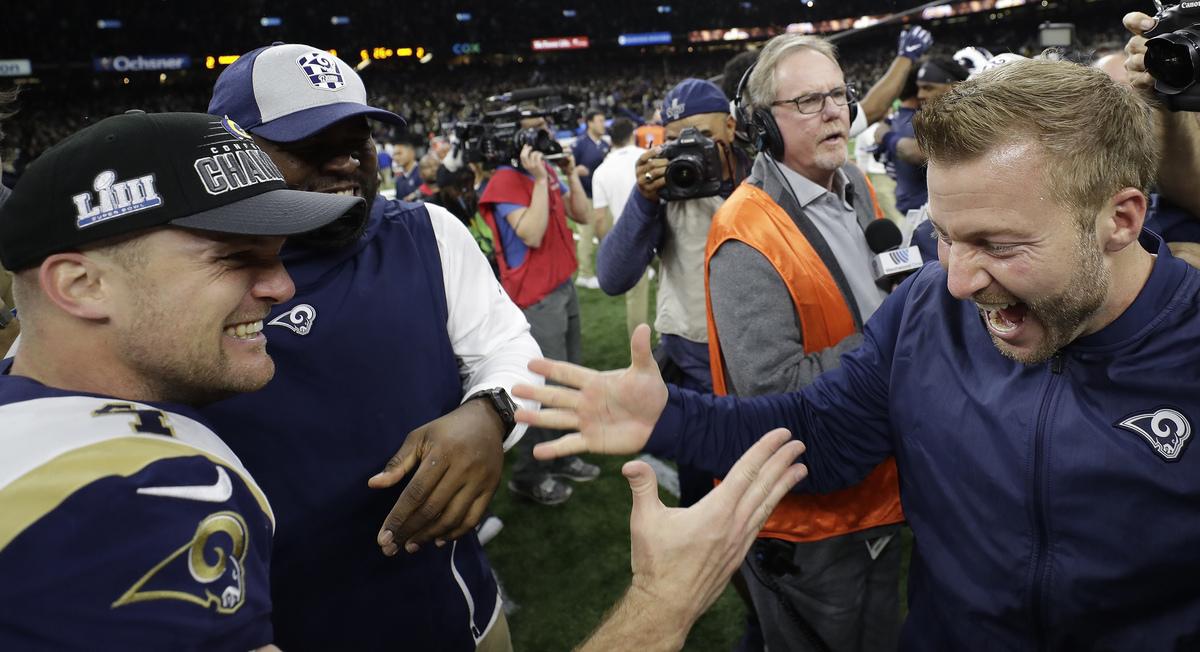
Los Angeles Rams head coach Sean McVay celebrates with Greg Zuerlein after a game-winning field goal during overtime of the NFL’s NFC championship game against the New Orleans Saints on Sunday.

David J. Phillip/AP


hide caption

toggle caption

David J. Phillip/AP

The Los Angeles Rams and the New England Patriots will face off in this year’s Super Bowl after winning the NFC and AFC conference championships, respectively, on Sunday.

The Rams, who overcame a 13-point deficit to beat the Saints, last played in the Super Bowl in 2002 — against none other than the Patriots. The St. Louis Rams won the NFL title two years before that.

The Patriots defeated the Chiefs to return to the Super Bowl for a third consecutive year.

Los Angeles Rams beat New Orleans Saints

Two field goals, a crucial interception and a widely contested pass interference call from officials, helped the Rams oust the Saints.

What the team lacked offensively, Greg Zuerlein made up for with timely kicking. In the final 15 seconds of regulation, the placekicker booted a tying 48-yard kick, sending the game into overtime. In the extra period, Zuerlein nailed a 57-yard field goal to seal a 26-23 victory.

On the first drive of overtime, the Saints lost possession after safety John Johnson III picked off Drew Brees’ lofty pass meant for wide receiver Michael Thomas.

“It’s unbelievable, man. I can’t put it into words,” Rams quarterback Jared Goff told The Associated Press. “The defense played the way they did to force it to overtime. The defense gets a pick and Greg makes a 57-yarder to win it. That was good from about 70. Unbelievable.”

One call cast a long shadow over the game. Referees failed to call what both Saints supporters and sports analysts overwhelmingly perceived as a pass interference penalty against the Rams. With the score at 20-20 in the fourth quarter, Drew Brees’ pass to Tommylee Lewis fell to the ground after he was hit by Rams defensive back Nickell Robey-Coleman.

“I don’t know if there was ever [a] more obvious pass interference,” New Orleans coach Sean Payton told reporters after the game.

After the game the NFL confirmed in a call to Payton that referees made the wrong call, according to USA Today.

As the AP reports, “It was the first home playoff loss for the Saints with Brees and coach Sean Payton, who had been 6-0 in those games since their pairing began in 2006.”

The Rams will now play against the Patriots for the NFL title.

New England Patriots beat Kansas City Chiefs

In another playoff game settled in overtime, the Patriots held off the Chiefs to grab a spot in the Super Bowl for the third straight season.

After New England dominated the first half in a frigid Kansas City, the Chiefs took the lead thanks to Damien Williams’ third touchdown run of the game, forcing a frantic fourth quarter.

With 39 seconds left, running back Rex Burkhead was able to lift the Patriots ahead 31-28 — the fourth lead change of the fourth quarter.

Down to 8 seconds, Harrison Butker wrestled back the points for the Chiefs with a 39-yard field goal, taking the rally into overtime at 31-31.

The Patriots then won the coin toss to start overtime. It was the final boost New England needed for a shot at defending their NFL title. Quarterback Tom Brady kicked off a game-winning drive as Rex Burkhead took the ball for a touchdown, sealing a 37-31 victory over the Chiefs.

“Overtime, on the road against a great team,” Brady told the AP. “They had no quit. Neither did we. We played our best football at the end. I don’t know, man, I’m tired. That was a hell of a game.”

The Big Game

The Rams and the Patriots will contend for the title of Super Bowl LIII champs at the Mercedes-Benz Stadium in Atlanta on Sunday, Feb. 3, airing on CBS.

Gladys Knight is scheduled to sing the national anthem. As for the intermission from nail-biting plays, pop band Maroon 5, rapper Travis Scott and Atlanta’s own Big Boi will perform at halftime.

Let’s block ads! (Why?)

Medical Students Push For More LGBT Health Training To Address Disparities

Sarah Spiegel, a third-year student at New York Medical College, pushed for more education on LGBT health issues for students.

Mengwen Cao for NPR


hide caption

toggle caption

Mengwen Cao for NPR

When Sarah Spiegel was in her first year at New York Medical College in 2016, she sat in a lecture hall watching a BuzzFeed video about what it’s like to be an intersex or a transgender person.

“It was a good video, but it felt inadequate for the education of a class of medical students, soon to be doctors,” says Spiegel, now in her third year of medical school.

The video, paired with a 30-minute lecture on sexual orientation, was the only LGBT-focused information Spiegel and her fellow classmates received in their foundational course.

“It’s not adequate,” Spiegel remembers thinking. By her second year, after she became president of the school’s LGBT Advocacy in Medicine Club, she rallied a group of her peers to approach the administration about the lack of LGBT content in the curriculum.

Spiegel and her friends created an LGBTQI health board of information which hangs in a hallway on campus at New York Medical College.

Mengwen Cao for NPR


hide caption

toggle caption

Mengwen Cao for NPR

Spiegel says administrators were “amazingly receptive” to her presentation, and she quickly gained student and faculty allies. As a result, the school went from one and a half hours of LGBT-focused content in the curriculum to seven hours within a matter of two years, according to Spiegel. Spiegel says she doesn’t think the change would have happened had the students not pushed for it.

According to a number of studies, medical schools do a poor job of preparing future doctors to understand the LGBT population’s unique needs and health risks. And, a 2017 survey of students at Boston University School of Medicine found their knowledge of transgender and intersex health to be lesser than that of LGB health.

Meanwhile, LGBT people — and transgender people in particular – face disproportionately high rates of mental illness, HIV, unemployment, poverty, and harassment, according to Healthy People 2020, an initiative of the U.S. Department of Health and Human Services. And a poll conducted by NPR, the Robert Wood Johnson Foundation, and the Harvard T.H. Chan School of Public Health found 1 in 5 LGBT adults has avoided medical care due to fear of discrimination.

“The health of disparity populations is something that really should be the focus of health profession students,” says Dr. Madeline Deutsch, an associate professor of family and community medicine at the University of California, San Francisco. Deutsch directs UCSF’s Transgender Care program, and she says medical schools already do a fairly good job of addressing some disparities, like those based on race, ethnicity, and socio-economic status.

But, she says, “Sexual and gender minorities have historically been not viewed as a key population, and that’s unfortunate because of the size of the population, and because of the extent of the disparities that the population faces.” (About 0.6 percent of the U.S. population – or 1.4 million adults – identifies as transgender.)

The extent of LGBT education medical students receive varies greatly, but a 2011 study found that the median time spent on LGBT health was five hours. The topics most frequently addressed include sexual orientation, safe sex, and gender identity, whereas transgender-specific issues, including gender transitioning, were most often ignored. And some medical students receive no LGBT education at all.

“There’s not really a consistent curriculum that exists around this content,” says Deutsch.

As a result, physicians often feel inadequately trained to care for LGBT patients. In a 2018 survey sent out to 658 students at New England medical schools, around 80 percent of respondents said they felt “not competent” or “somewhat not competent” with the medical treatment of gender and sexual minority patients.

Even at UCSF, which has long been at the forefront of LGBT health care, Deutsch says there’s still a need to insert more transgender health care into the mandatory curriculum. Right now, when medical schools teach about LGBT health issues, it’s usually through special elective courses or lectures taught at night or during lunch, and often by the students themselves.

“How do we take it out of the lunchtime unit?” asks Jessica Halem, the LGBT program director at Harvard Medical School. That question drives Harvard Medical School’s new Sexual and Gender Minorities Health Equity Initiative, a three-year plan to assess the core medical school curriculum and to identify opportunities to better instruct on the health of sexual and gender minorities.

“Students are getting the information. But some of them are having to do a lot of extra work to get that during their medical school experience,” says Halem.

The Harvard initiative, announced in December 2018, has been ongoing for about six months, says Halem, thanks to a $1.5 million gift from Perry Cohen, a transgender man. According to Halem, Cohen hopes that Harvard’s learnings will be shared with medical schools across the country, especially with ones with less robust LGBT health education programs.

Studies have shown that when medical students learn about transgender health issues, they feel better equipped to treat transgender patients. For example, when Boston University School of Medicine added transgender health content to a second-year endocrinology course, students reported a nearly 70 percent decrease in discomfort with providing transgender care.

And now, Halem says, each incoming class at Harvard Medical School is increasingly adamant that they learn about LGBT health.

“The main first driver truly was medical students organizing and saying ‘Hey, I need the curriculum to reflect the kind of medicine that I came here to study,’ ” Halem says.

The amount of LGBT education medical students receive varies greatly. A 2015 study found that, on average, medical students receive five hours of LGBT-focused education. The curriculum at New York Medical College went from an hour and a half of LGBT topics in health care to over seven hours.

Mengwen Cao for NPR


hide caption

toggle caption

Mengwen Cao for NPR

Those were the thoughts running through Spiegel’s head in her own preclinical years at New York Medical College. Shortly after becoming the president of her school’s LGBT health club, she joined The American Medical Student Association’s Gender and Sexuality Committee as the LGBTQ Advocacy Coordinator to bring curricular change to other medical schools in the New York area.

Conversations with her transgender partner also inspired Spiegel to introduce more trans-specific topics into her school’s curriculum.

“His experience definitely varied by how much providers knew,” Spiegel says. It was often as simple as getting his pronouns correct, she says, and even then, the same doctors’ office would mess that up again and again.

Spiegel says in the past couple of years, certain disciplines have added trans-focused topics into their specialties. In the school’s behavioral health unit, for example, professors have started to address how doctors can diagnose gender dysphoria – when a person feels their assigned gender does not align with their gender identity – in their lectures.

By contrast, some disciplines have been more hesitant to change, or add content to, their existing curriculum. Spiegel’s student task-force had more difficulty influencing the pharmacology department, for example. That’s the content area where hormone therapy might be taught, Spiegel says.

One course includes a lecture about the endocrine system, Spiegel says, when the professor talks about a drug to treat precocious, or early puberty. That drug can also be used for kids undergoing transgender hormone therapy. Therefore, Spiegel says, including transgender health in the lecture might be a matter of just saying an extra sentence.

“There’s an opportunity there – they would just have to mention that it could also be used for transgender kids,” says Spiegel.

But the professor says this secondary use of the drug was “off the book,” and thus, he wouldn’t include it in his lecture. So Spiegel researched the drug herself, and sent the professor the Endocrine Society’s guidebook that talked about how the drug can be used for transgender patients. He began including the information in his lectures.

Spiegel says her interactions with this professor exemplify the challenges that medical students all over the country face when trying to introduce changes to their schools’ curricula.

“We’re getting there, but it’s slow,” says Spiegel.

Let’s block ads! (Why?)

How Much Is That CAT Scan? Now You Can Check (If You Know Billing Codes)

Starting this month, hospitals must publish prices for procedures and services online. Dr. Elisabeth Rosenthal of Kaiser Health News tells NPR’s Lulu Garcia-Navarro it’s not very user friendly — yet.


LULU GARCIA-NAVARRO, HOST:

If you go to buy a car, there’s a good chance you’ll do some comparison shopping. But if you’re going into a hospital for a CAT scan or a hip replacement, for example, good luck. That is until this month, when all hospitals were required by law to make public a list of procedures and prices and post them on the Internet. The new requirement is meant to help patients navigate the nation’s confusing health care billing practices. So how well are hospitals doing? Dr. Elisabeth Rosenthal is the editor-in-chief of Kaiser Health News. And she has been advocating for something like this for a very long time. And she joins us in the studio. Welcome.

ELISABETH ROSENTHAL: Thanks for having me.

GARCIA-NAVARRO: So are hospitals complying with the new law?

ROSENTHAL: Well, yes. They’re complying. But basically, what they’ve done at this point is kind of a data dump. You know, here’s our price list. It’s hundreds of pages long. It’s in codes. It’s in abbreviations. So it’s not in a very user-friendly form, to say the least. But it’s an important first step.

GARCIA-NAVARRO: OK. Is it actually possible to comparison shop? And what are the pitfalls?

ROSENTHAL: I trained as a physician. I’ve spent, you know, decades covering health care. So I understand what these abbreviations mean. So I can decode some of them. And when you decode some of them, you see some crazy prices. Like, a bag of IV saline at one hospital could be $30 and at another $1,000. So I look through these all the time. And I see things that stand my hair on end.

GARCIA-NAVARRO: We had one of our editors who has been dealing with an ill relative – she went on the Washington State Hospital Association’s website. And she said it was quite easy to comparison shop. It is happening. What are the caveats?

ROSENTHAL: Well, the pitfalls – and I think the problem has been a lot of states have made efforts to say, you need to make it easy for patients to comparison shop. So they’ll say, OK, give us a price for an appendectomy – all in. The problem is that every hospital calculates that differently. Some will just say oh, well, that’s the OR fee. And the – and then you say well, you know, you said it was $4,000 on your website. And then the hospital goes, oh, well, that didn’t include the anesthesiologist or the scalpel. You know, it’s literally at that level.

So what we see at Kaiser Health News is that people are often caught in the dark with this. They say, well, I tried to comparison shop. And I went to this hospital. And they told me it was going to be $4,000. And then I get a bill for $25,000. So what gives? So I think the effort here is a starting point to say we need apples to apples comparisons.

Now, the data that’s been released right now is not very useful for patients generally for an appendectomy or for heart surgery because that’s a big procedure. And you’d have to add up hundreds of line items. But if you’re looking for something simple, like an MRI of your knee, you know, and you’re willing to put in the time to decode a chargemaster, that is pretty comparable – one institution to another. So it’s useful in a small way now. But I suspect having this data out there will make it useful in a much bigger way over time.

GARCIA-NAVARRO: Some hospital administrators have said that the new law makes things more confusing because the prices don’t account for a person’s health care insurance or the fact that insurers pay a discounted rate. What do you say to that?

ROSENTHAL: Hospitals have made every argument under the sun to not release these prices. They’ve said, well, nobody pays that. It depends on your insurance. You know – but it’s all kind of smoke and mirrors to me. You know, yes, maybe it’s not directly relevant. But show us your prices. Show us what you’re charging. When I go to a hotel, I may be only paying $100 a night. But I can see on every website that the normal price for that room, the list price, is $500 or whatever. So these are list prices. They’re not directly relevant. But we deserve to know them. And hospitals should not be trying to hide them.

GARCIA-NAVARRO: Dr. Elisabeth Rosenthal is the author of “An American Sickness: How Healthcare Became A Big Business And How You Can Take It Back (ph).” Thank you so much.

ROSENTHAL: Thanks for having me.

(SOUNDBITE OF D.P. KAUFMAN’S “BRAVERY”)

Copyright © 2019 NPR. All rights reserved. Visit our website terms of use and permissions pages at www.npr.org for further information.

NPR transcripts are created on a rush deadline by Verb8tm, Inc., an NPR contractor, and produced using a proprietary transcription process developed with NPR. This text may not be in its final form and may be updated or revised in the future. Accuracy and availability may vary. The authoritative record of NPR’s programming is the audio record.

Let’s block ads! (Why?)

Rams-Saints, Patriots-Chiefs Will Set Super Bowl LIII

Scott Simon speaks with sports correspondent Tom Goldman about the NFL conference championship games on Sunday, and how concussions are limiting insurance options in the league.


SCOTT SIMON, HOST:

Time now for sports.

(SOUNDBITE OF MUSIC)

SIMON: We are so close to the Super Bowl now that we can smell the nachos. The NFL’s conference championship games are tomorrow. We’re joined now by NPR sports correspondent Tom Goldman. Tom, thanks so much for being with us.

TOM GOLDMAN, BYLINE: Not eating nachos this early but hello, Scott.

SIMON: Let’s start with the early game – Rams-Saints. They met earlier this season. The Saints handed the Rams their first loss of the season. It was a high-scoring game – 45-35. But I gather tomorrow’s match, as so often happens in the playoffs, comes down to defense.

GOLDMAN: Yes, it may. And I’m going to throw out a couple of names of defensive players who could have significant impact. May and could, Scott. I’m feeling bold today.

SIMON: Yeah.

GOLDMAN: Aqib Talib – a veteran defensive back for the Rams who was missing from that earlier game you talked about, and the Saints had a field day throwing and catching the ball in his half since he’s back for this game. And then Sheldon Rankins for the Saints – he’s an excellent run-stopping defensive lineman. He’s out with an injury. The Rams have a great running attack that can only benefit from his absence. So I’m not going to say these situations the Rams win because of him, but they do help LA.

SIMON: Drew Brees, the Saints quarterback, is 40, and he has been so accurate this year. Tom, he could split an apple in two off of your head with the point of his football if he wanted to.

GOLDMAN: (Laughter) You know, that’s about the only thing he didn’t do this season. He set an NFL record, completing nearly 75 percent of his passes. Now, The Wall Street Journal studied all of his incomplete passes, and there weren’t many. And it found…

SIMON: Two.

GOLDMAN: Yeah, exactly. And they found most were not his fault, meaning receivers dropped them or caught them and then defenders jarred the ball loose. Only about 9 percent of Brees’ total passes were bad throws. So if the Rams want to beat New Orleans, put an apple on someone’s head. No, I’m sorry. They can’t rely on Brees beating himself.

SIMON: And then, of course, there’s Tom Brady. I’m not going to call him old. He’s 41. He’s a vet. Kansas City quarterback, a great one, is young – Patrick Mahomes. And last time they met, the Pats stole the game in the final seconds. You think tomorrow’s game going to be as close?

GOLDMAN: Absolutely, unless it’s not. Can you tell I’m hedging my bets this time, Scott?

SIMON: Time will tell. Time will tell, yeah.

GOLDMAN: Right, right. But both quarterbacks can create offense so well, so whoever falls behind, there’s a good chance of catching up. Mahomes is great at eluding pass rushers. He does amazing things when he’s forced to run for his life. Brady needs solid protection to do his thing because he’s not as mobile, and he’ll need that protection against a very good Kansas City pass rush. Scott, Kansas City is a slight favorite, and I think they win this one.

SIMON: All right, a prediction. I – news I have to ask you about this week around the NFL actually might be more important long term. We’ve actually got a film clip from the film “Concussion.”

(SOUNDBITE OF FILM, “CONCUSSION”)

UNIDENTIFIED ACTOR: (As actor) If just 10 percent of the mothers in America decide that football is too dangerous for their sons to play, that is it. It is the end of football. Kids, colleges and eventually, it’s just a matter of time, the professional game.

SIMON: May not be the mothers, though, right, Tom?

GOLDMAN: That’s right. Turns out, in this age of concussion awareness, it may be insurance companies that decide the fate of football. This week, a report by ESPN’s “Outside The Lines,” a comprehensive report, said insurance companies are getting out of the business of insuring football because they’re afraid, you know, they’re going to have to pay out billions in legal and medical costs. Already some programs at community colleges and city rec departments have been eliminated because of the lack of insurance or rising insurance costs. The head of Pop Warner’s youth football program is quoted as saying “people say football will never go away, but if we can’t get insurance, it will.” Scott, it’s a fascinating read and a scary scenario for those who love the game, which is still this country’s most popular sport. But the question is, for how long?

SIMON: And of course – but for those who love the players, it’s also important to read.

GOLDMAN: Absolutely.

SIMON: NPR sports correspondent Tom Goldman. Tom, thanks so much for being with us.

GOLDMAN: You’re welcome.

(SOUNDBITE OF MOE.’S “SILVER SUN”)

Copyright © 2019 NPR. All rights reserved. Visit our website terms of use and permissions pages at www.npr.org for further information.

NPR transcripts are created on a rush deadline by Verb8tm, Inc., an NPR contractor, and produced using a proprietary transcription process developed with NPR. This text may not be in its final form and may be updated or revised in the future. Accuracy and availability may vary. The authoritative record of NPR’s programming is the audio record.

Let’s block ads! (Why?)

South Korea's Sports Prestige Gets Eclipsed By Sexual Abuse Against Female Athletes

Two-time Olympic gold medal speed skater Shim Suk-hee revealed earlier this month she was repeatedly raped by her coach. Now, South Korea’s governing sports body has promised a crackdown on coaches.


MARY LOUISE KELLY, HOST:

From tae kawan do and baseball to skating and golf, South Korea has established itself in recent years as a sports powerhouse. Its medal counts have been in the Top 10 in recent Summer and Winter Olympics. But that glory and prestige has been eclipsed by the shadow of violence and sexual abuse against female athletes. NPR’s Anthony Kuhn reports from Seoul.

ANTHONY KUHN, BYLINE: With just weeks to go before last year’s Pyongyang Winter Olympics, short-track speed skater Shim Suk-hee went missing from the national team’s training camp. A sports ministry investigation found that Shim, a two-time Olympic gold medalist, was beaten by her coach, Cho Jae-bom, the day she went missing. Cho was sacked and convicted of abusing four athletes, including Shim. He was sentenced to 10 months in jail last September. Cho has denied the charges through his lawyer. Shim testified at Cho’s appeal hearing last month and spoke to reporters outside the courthouse.

(SOUNDBITE OF ARCHIVED RECORDING)

SHIM SUK-HEE: (Through interpreter) I mustered my courage to come here today because I hope there will be no more victims like myself in the sports world and because I want to do what I can, not just for myself, but for the future.

KUHN: This month, Shim went further, accusing Cho of repeatedly raping her since she was 17. She’s now 21. As the scandal grabbed headlines, a petition on the presidential office’s website calling for harsher sentencing of Cho got over a quarter of a million signatures. Government ministries and lawmakers promised to get tough on sexual abuse in sports. In a meeting with his aides this week, President Moon Jae-in called for thorough investigations and stiff punishment.

(SOUNDBITE OF ARCHIVED RECORDING)

PRESIDENT MOON JAE-IN: (Speaking Korean).

KUHN: Recent allegations of physical and sexual violence in sports, he said, reveal a shameful side hidden beneath the shiny facade of South Korea as a sports powerhouse. Also this week, a former judo athlete and a tae kwan do trainee stepped up to accuse their coaches of physical and sexual violence, but some observers say it’s just a drop in the bucket.

CHUNG YONGCHUL: Still, the numbers are low, and we all know why – because of all the threat they have. They’re afraid to talk about it.

KUHN: Chung Yongchul is a professor of sport psychology at Seoul’s so gone University and an activist against abuse in sports. He says the government’s been promising to crack down on cases of abuse for the past decade, but thanks to a stubborn culture of impunity, very little has changed. Some of that, he notes, has roots in South Korea’s Confucian traditions in which a teacher’s authority is just like a father’s. It must be obeyed and not challenged.

CHUNG: That’s part of the reason why this is so hard for the athlete to speak up because you’re actually accusing, like, a father-like figure – accusing him as an aggressor.

KUHN: That’s also why sports authorities who have the power to punish abusers often shield them, Chung says. And help centers and hotlines set up for the athletes often side against them. But Chung adds that the strength of public outrage in South Korea at the abuse of skater Shim Suk-hee could mean this time is different.

CHUNG: So I think this could be the last chance for the Korean sport to actually eradicate all the problems.

KUHN: And if South Korea comes home from next year’s Tokyo Olympics with a reduced haul of medals but an increase in athletes’ human rights, Chung says that’s definitely something Koreans can live with. Anthony Kuhn, NPR News, Seoul.

Copyright © 2019 NPR. All rights reserved. Visit our website terms of use and permissions pages at www.npr.org for further information.

NPR transcripts are created on a rush deadline by Verb8tm, Inc., an NPR contractor, and produced using a proprietary transcription process developed with NPR. This text may not be in its final form and may be updated or revised in the future. Accuracy and availability may vary. The authoritative record of NPR’s programming is the audio record.

Let’s block ads! (Why?)

Mike Robbins: What's The Difference Between Recognition And Appreciation?

[embedded content]

Part 2 of the TED Radio Hour episode Approaching With Kindness.

About Mike Robbins’ TED Talk

After a career-ending baseball injury, Mike Robbins had to learn how to appreciate his time on the mound. He’s found that making the effort to appreciate others has a real impact on their well-being.

About Mike Robbins

Mike Robbins is a former professional baseball player and author. His work focuses on appreciation, teamwork, leadership, and emotional intelligence.

Robbins has been featured on ABC News, Forbes, Fast Company, The Washington Post, and The Wall Street Journal.

His most recent book, Bring Your Whole Self to Work, was published in 2018. He is the creator and host of a podcast by the same name.

Let’s block ads! (Why?)

Even With Rappers Set To Perform, Super Bowl's Halftime Show Remains Tone-Deaf

Travis Scott performs in Austin, Tx. in October 2018. Scott is set to perform at the 2019 Super Bowl Halftime show.

Suzanne Cordeiro/AFP/Getty Images


hide caption

toggle caption

Suzanne Cordeiro/AFP/Getty Images

Normally, the bookers of the Super Bowl Halftime performance don’t have a lot of trouble finding talent for the big show. Superstars like Bruce Springsteen, Prince, Beyoncé have all performed. But for this year’s upcoming game, nailing down a halftime act hasn’t been so easy.

In the months leading up to the February game, one high profile act after another — Jay-Z, Rihanna, Cardi B — rejected the NFL’s offer to perform. Each artist rejected the gig to stand in solidarity with Colin Kaepernick, the former San Francisco 49ers quarterback who knelt during the National Anthem in 2016 in protest of racial injustice in America and subsequently filed a grievance against the NFL in 2017 alleging that they colluded to keep him out of the league because of his protests. The NFL confirmed on Jan. 13 that pop band Maroon 5 would be the halftime performers and would be joined by rappers Travis Scott and Big Boi.

NPR Music hip-hop journalist Rodney Carmichael points out that with the NFL is holding the Super Bowl in Atlanta this year, organizers lost out on a great opportunity to make the halftime performance an Atlanta-themed show because of the amount of hip-hop artists who stand in solidarity with Kaepernick.

“In a lot of ways, it says what we already know, which is that hip-hop is cooler than the Super Bowl,” Carmichael says. “Jay-Z made this point. He said now that rap is the most consumed genre in America, artists don’t really need the halftime show to play stadiums.”

Certain artists making the decision not to perform also shows that they know their core audience is rooting for Kaepernick as well.

“It’s not just a political play if you think about it,” Carmichael continues. “Playing that stage, it really has the potential to hit black artists in the pocket, especially if they lose cool points with their fans.”

A Change.org petition that started in November 2018 asked Maroon 5 to back out of the performance. That same petition has now been updated to ask the members of Maroon 5, Travis Scott and Big Boi to take a knee during the halftime show. To date, the petition has over 80,000 signatures.

Super Bowl LIII takes place Sunday, Feb. 3, 2019 in Atlanta, Ga.

Let’s block ads! (Why?)