Federal Shutdown Has Meant Steep Health Bills For Some Families


Demonstrators affiliated with the National Air Traffic Controllers Association protested the federal shutdown at a Capitol Hill rally earlier this month in Washington, D.C.
Alex Wroblewski/Bloomberg/Getty Images
hide caption
toggle caption
Alex Wroblewski/Bloomberg/Getty Images
Joseph Daskalakis’ son Oliver was born on New Year’s Eve, a little over a week into the current government shutdown, and about 10 weeks before he was expected.
The prematurely born baby ended up in a specialized neonatal intensive care unit, the only one near the family’s home in Lakeville, Minn., that could care for him.
But Daskalakis, who works as an air traffic controller outside Minneapolis, has an additional worry: The hospital where his newborn son is being treated is not part of his current insurer’s network and the partial government shutdown prevents Daskalakis from filing the paperwork necessary to switch insurers, as he would otherwise be allowed to do.
As a result, he could be on the hook for a hefty bill — all the while not receiving pay. Daskalakis is just one example of federal employees for whom being unable to make changes to their health plans really matters.
Although the estimated 800,000 government workers affected by the shutdown won’t lose their health insurance, an unknown number are in limbo like Daskalakis — unable to add family members such as spouses, newborns or adopted children to an existing health plan; unable to change insurers because of unforeseen circumstances; or unable deal with other issues that might arise.
“With 800,000 employees out there, I imagine that this is not a one-off event,” says Dan Blair, who served as both acting director and deputy director of the federal Office of Personnel Management during the early 2000s and is now senior counselor at the Bipartisan Policy Center. “The longer this goes on, the more we will see these types of occurrences.”
While little Oliver Daskalakis is getting stronger every day — he’s now out of the ICU, according to his father’s local air traffic union representative — it’s unclear how the situation will affect his family’s finances.
That’s because out-of-network charges are generally far higher than being in-network, and NICU care is enormously expensive,no matter what. Those bills could add up, especially as the family’s current insurance plan has an out-of-pocket maximum of $12,000 annually. Because Oliver was born before the new year, the family could face that amount twice — for 2018 and for 2019.
And Daskalakis still isn’t getting paid.
“I don’t know when I’ll be able to change my insurance, or when I’ll get paid again,” Daskalakis wrote to Sen. Tina Smith, D-Minn., who shared the letter on Facebook and before her Senate colleagues last week.
Other families are also worried about paperwork delays, and the financial and medical effects a prolonged shutdown could cause.
Dania Palanker, a health policy researcher at Georgetown’s Center on Health Insurance Reforms, studies what happens when families face insurance difficulties. Now she’s also living it.
After arranging to reduce her work hours because of health problems, Palanker knew her family would not qualify for coverage through her university job. No problem, she thought, as she began the process in December of enrolling her family in coverage offered by her husband’s job with the federal government.
But there was a hitch.
“We could not get the paperwork in time to apply for special enrollment through the government and get it processed before the shutdown,” Palanker says.
Georgetown allowed her to boost her work hours this month to keep the family insured through January, but Georgetown’s share of her coverage will end in February.
Palanker’s treatments are expensive, so she is likely to hit or exceed her annual $2,000 deductible in January — then start over with another annual deductible once the family secures new health coverage.
“I’m postponing treatment in hopes that it is just a month and I’m back on the federal plan in February,” says Palanker, who has an autoimmune disease that causes nerve damage. “But I can’t postpone indefinitely, as my condition will get worse.”
Overseeing federal health benefits programs is within the purview of the Office of Personnel Management, whose data hub is operational, according to a spokeswoman. But getting information to that data hub to make the kind of changes Daskalakis, Palanker and others need depends on the individual agencies that employ government workers.
The OPM has told government agencies “that they should have [human resources] staff available during the lapse, specifically to process” such requests, which are called “qualifying life events,” the spokeswoman says.
In a written statement Wednesday, Smith said: “Oliver’s story is a powerful reminder that hundreds of thousands of real families have had their financial and personal lives turned upside down by this unnecessary shutdown.” The Minnesota senator called on the president to come back to the negotiating table.
For Daskalakis, there’s been some recent good news.
His union representative, Tony Walsh, says both the OPM website and Daskalakis’ insurer now indicate that the family’s request to change to an insurance plan that classifies the hospital as “in-network” will be retroactive to Oliver’s birthday — so the out-of-network charges may not play a role.
Just to be safe, “Joe is currently working on an insurance appeal based on no in-network care [being available],” Walsh reports in an emailed statement.
Still, the family has already received an initial $6,000 bill from the hospital, Walsh notes. He says that $6,000 does not include costs associated with Oliver’s birth or his stay in the intensive care unit — those charges likely are still to come.
Walsh says the shutdown is affecting a broad swath of employees in ways many lawmakers never anticipated.
The workers “are essential to the system,” he says, “and it’s unfair they are being treated this way.”
Kaiser Health News, a nonprofit news service, is an editorially independent program of the Kaiser Family Foundation and not affiliated with Kaiser Permanente.
Politics Stay Off The Soccer Field As Qatar Plays Saudi Arabia


Saudi Arabia and Qatar face off during the AFC Asian Cup in Abu Dhabi, United Arab Emirates, on Thursday.
Hassan Ammar/AP
hide caption
toggle caption
Hassan Ammar/AP
Qatar beat Saudi Arabia on the field Thursday, in a resounding victory overshadowed by the significance of the meeting itself.
Surging off momentum built in the early rounds of the AFC Asian Cup, Qatar defeated the Saudis 2-0 . Almoez Ali, a 22-year-old forward, scored both goals for Qatar, holding his spot as top scorer in the tournament after a four-goal run against North Korea last weekend.
While Ali’s heroics captivated onlookers at Zayed Sports City Stadium in Abu Dhabi in the United Arab Emirates, geopolitics dominated the discourse around the game. It was the countries’ first match-up since Saudi Arabia severed diplomatic relations with Qatar more than 18 months ago. Just weeks ago, Qatar officially pulled out of OPEC.
22-year-old Qatar striker Almoez Ali has scored seven goals in three games at this year’s AFC Asian Cup.
It’s the first time a player has reached that total in a single tournament since Ali Daei’s record of eight goals in 1996.
— Scouted Football (@ScoutedFtbl) January 17, 2019
The tiny, oil- and gas-producing nation had announced last month that it would leave the cartel, digging its heels deeper into a dispute with Saudi Arabia and other Gulf states. Saudi Arabia broke off ties with Qatar in June 2017, alleging that it funds terrorist organizations, and the Saudis have maintained a boycott since then. Egypt, Bahrain and the United Arab Emirates joined the boycott, which has unfolded against a backdrop of longstanding tensions between Qatar and surrounding states.
In addition to its role as a key player in the blockade, the U.A.E. is also playing host to the Asian Cup, which has caused inconveniences for Qatari nationals travelling to the games, including officials, journalists and just a trickle of fans, The New York Times reports. On social media, some people called the Qatar-Saudi Arabia match-up the “Blockade Derby.”
Qatar win the Blockade Derby and secure top spot in Group E, while in the other group game, Lebanon beat North Korea 4-1 but miss out on a place in the knockout stages on disciplinary points… https://t.co/58Iso0oHiO
— Reginaldo Rosario ?? (@Regi1700) January 17, 2019
But representatives from both countries said before the match that the two sides would separate politics and soccer. “Football is a message of peace,” Qatar spokesperson Ali Hassan al-Salat told The Guardian.
Other countries locked in well-established political tensions have met in the tournament. Last week, Iran faced off against Iraq in a stadium in Dubai, in a match that ended with an anticlimactic 0-0 draw.
Qatar and Saudi Arabia will both advance to the final 16 teams. Qatar, which has maintained a perfect score in the tournament, is set to play Iraq on Tuesday.
Capitalist Greed Is Child's Play For Leyla McCalla In 'Money Is King' Video

YouTube
“It feels like everyone’s in a pressure cooker in this country,” says Leyla McCalla in her biography, about the themes she addresses on her new album, The Capitalist Blues. The upcoming album, out on Jan. 25, was produced by Jimmy Horn of the New Orleans band King James & The Special Man, and is the third release by the former cellist with the Grammy Award- winning Carolina Chocolate Drops.
McCalla has been living in New Orleans since 2010. For The Capitalist Blues, she fully incorporated recording with a band, a move she’s been inching towards since her 2013 debut. The album incorporates the sounds of the Big Easy with her interest in social justice. The title of “The Capitalist Blues,” says McCalla in this album introduction video, “is me thinking about a lot of the psychological and emotional effects of living in a capitalist society.”
Today, World Cafe premieres the music video for McCalla’s cover of the calypso song “Money Is King.” The song was originally recorded and popularized by Neville Marcano, under his stage name as The Growling Tiger, recorded in the early 1930s.
On the topical song, that fits perfectly in with the album’s theme McCalla sings, “If a man has money today / People don’t care if he has cocobey / If a man has money today / People don’t’ care if he has cocobey / He can commit murder
And get off free / Live in the governors company / But if you are poor / People will tell you “Shoo! A dog is better than you.”
“Money Is King” sways with delicious musicality. On it, McCalla’s voice sounds as strong as the message and social commentary of the song. McCalla plays tenor banjo, accompanied by a lilting arrangement of viola, bass, trumpet, guitar and a whiskey bottle, giving the song a measurable bounce.
“The first thought that I had upon hearing the song ‘Money Is King’ was, ‘I want to sing this song,'” McCalla wrote in a statement. “I had been exploring secular Haitian folk music that used metaphor and powerful poetic imagery to address social and political issues; I immediately felt a connection to this similarity in the Calypso songs of Neville Marcano A.K.A. The Growling Tiger. As I started to put together the songs for Capitalist Blues, ‘Money Is King‘ felt like such a natural fit. I hope you can see the fun that was had in making this video!”
Directed by Nisa East, the video opens with a shot of McCalla singing the opening verse, and cuts away to four men huddled around a table playing several board games including Monopoly and Hungry Hungry Hippos.
Throughout the visual, there are interspersed shots of McCalla and her band, her dancing with an older gentleman on the street, and a dog grabbing a raw steak. Towards the end of the video, the plastic Monopoly houses burn as the four players appear to get contentious with each other and the table is flipped over in anger.
The Capitalist Blues is out on Jan. 25 via Discograph / Jazz Village.
In Kansas City, Maybe Don't Use The Word 'Patriot' This Week

The Chiefs play New England for a ticket to the Super Bowl. A Kansas City amusement park has altered the name of its roller coaster The Patriot to The Patrick in honor of Chiefs’ QB Patrick Mahomes.
DAVID GREENE, HOST:
Good morning. I’m David Greene. Maybe don’t even use the word patriot in conversation this week in Kansas City. The Chiefs are playing New England for a ticket to the Super Bowl. And Worlds of Fun, a Kansas City amusement park, has gone so far as to alter the name of its roller coaster The Patriot. The Patriot is now The Patrick to honor Chiefs’ quarterback Patrick Mahomes. Chiefs fans, I hope Sunday’s game for you is less roller coaster and more world of fun.
Copyright © 2019 NPR. All rights reserved. Visit our website terms of use and permissions pages at www.npr.org for further information.
NPR transcripts are created on a rush deadline by Verb8tm, Inc., an NPR contractor, and produced using a proprietary transcription process developed with NPR. This text may not be in its final form and may be updated or revised in the future. Accuracy and availability may vary. The authoritative record of NPR’s programming is the audio record.
UCLA Coach Helps Star Gymnast Find Her Way Back To A Sport She Loves
A video of UCLA gymnast Katelyn Ohashi’s “perfect 10” floor routine went viral. Head coach Valerie Kondos Field remarks on the character, skill, and comeback of the her now-famous athlete.
Feast Fit For A Burger King: Trump Serves Fast Food To College Football Champs


President Trump talks to the press about the table full of fast food laid out in the State Dining Room of the White House for a reception for the Clemson Tigers.
Susan Walsh/AP
hide caption
toggle caption
Susan Walsh/AP
It’s a scene often observed in the White House. Men in bow ties light golden candelabras while the president of the United States stands behind a table containing small mountains of food on silver trays.
So far, so good.
But look closely, and you’ll see the labels on the packages: “Quarter Pounder.” “Filet-O-Fish.” Chicken nugget dipping sauces sit in serving bowls off to the side. Behind the current president, Abraham Lincoln looks down, his hand on his chin, surveying the scene.
If only paintings could offer witty commentary.
In this case, we’ll have to rely on late night comedians and Twitter observers, who roundly ridiculed President Trump for the feast he provided for the Clemson Tigers. Clemson beat No. 1 ranked Alabama to take the College Football Playoff National Championship and might have expected that a visit to the White House would command a dinner befitting a champion. Instead, the Tigers got a dinner befitting a drive-through customer — granted, on fancier plates.
Here’s a video I shot of President Trump showing off his 300 hamburgers. pic.twitter.com/P06S6I5w07
— Hunter Walker (@hunterw) January 14, 2019
“I think we’re going to serve McDonald’s, Wendy’s and Burger King with some pizza,” Trump told reporters beforehand. “I really mean it. It would be interesting. And I would think that’s their favorite food.”
Because of the shutdown, most of the staff in the White House residence had been furloughed, so Trump paid for the meal himself, he said.
Great being with the National Champion Clemson Tigers last night at the White House. Because of the Shutdown I served them massive amounts of Fast Food (I paid), over 1000 hamberders etc. Within one hour, it was all gone. Great guys and big eaters!
— Donald J. Trump (@realDonaldTrump) January 15, 2019
But Trump’s magnanimity did not spare him from the biting tongue of Twitter.
Cold McDonald’s on expensive plates could not be any more perfect a representation of Trump.
— Jill (@JillChristinaWV) January 14, 2019
Commenting on a picture of the president posing with his hands wide in front of the feast, television writer Jess Dweck said: “This is the news photo that would make a returning time traveler realize they f***** something up.”
Catering a White House event with 300 fast food burgers would be a setpiece in a movie where a kid becomes president
— Nick Wiger (@nickwiger) January 14, 2019
“Great American food!” Trump told reporters at an informal news conference before the meal. “And it could be very interesting to see at the end of this evening how many are left.” He declined to say whether he prefers McDonald’s or Wendy’s. “I like ’em all. If it’s American, I like it.”
Hey Clemson! Congrats on the game, AND the diarrhea!!
— Matt Braunger (@Braunger) January 15, 2019
Toward the end of his remarks, Trump pivoted to more traditional talking points. “We need border security,” Trump said. “We have to have it. No doubt about it. It should have happened 30 years ago, 20 years ago, 10 years ago. And it’s gonna happen now.”
Perhaps befitting Trump’s hard stance on the southern border, it is not clear whether tacos were served at the gathering.
Happy #CincoDeMayo! The best taco bowls are made in Trump Tower Grill. I love Hispanics! https://t.co/ufoTeQd8yA pic.twitter.com/k01Mc6CuDI
— Donald J. Trump (@realDonaldTrump) May 5, 2016
Kyler Murray Is Top-Notch. Will He Pursue: Baseball Or Football?
David Greene talks to ESPN’s Jeff Passan about Kyler Murray, a top-draft pick by baseball’s Oakland A’s. After a Heisman Trophy-winning year as a college quarterback, he’s entered the NFL draft too.
Clinics Struggle To Resolve Fears Over Medicaid Sign-Ups And Green Cards

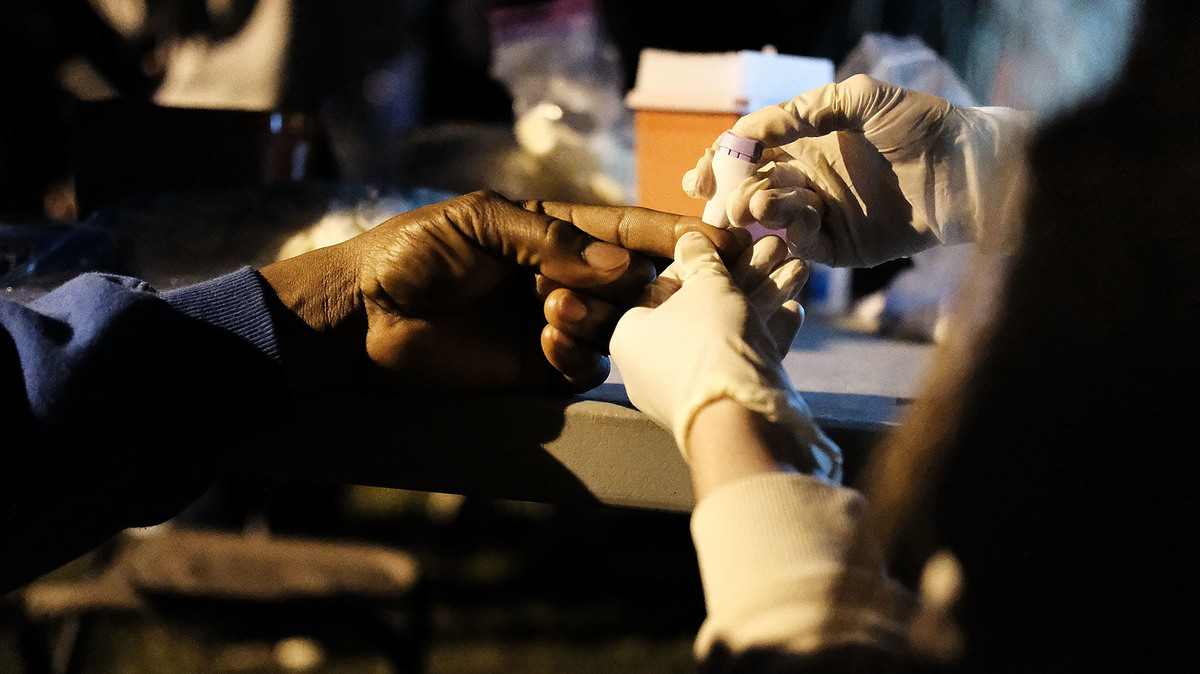
A migrant worker in a Connecticut apple orchard gets a medical checkup in 2017. A proposed rule by the Trump administration that would prohibit some immigrants who get Medicaid from working legally has already led to a lot of fear and reluctance to sign up for medical care, doctors say.
Spencer Platt/Getty Images
hide caption
toggle caption
Spencer Platt/Getty Images
Last September, the Trump administration unveiled a controversial proposal — a policy that, if implemented, could jeopardize the legal status of many immigrants who sign up for some government-funded programs, including Medicaid.
The Trump proposal is still working its way through the public comment and evaluation process, and could go into effect as early as this year, though some state attorneys general say they would challenge any such policy in the courts.
In the meantime, some doctors and clinics are torn: They want to keep patients informed about the risks that may be coming, but don’t want to scare them into dropping health benefits or avoiding medical care right now.
“We are walking a fine line,” says Tara McCollum Plese, chief external affairs officer at the Arizona Alliance for Community Health Centers, which represents 176 clinics in the state. “Until there is confirmation this indeed is going to be the policy, we don’t want to add to the angst and the concern,” she says.
However, if immigrants do come to a clinic asking whether using Medicaid now might affect their legal status down the road, trained staff members are ready to answer their questions, McCollum Plese says. (According to legal specialists, the rule would not be retroactive — meaning it wouldn’t take into account a family’s past reliance on Medicaid.)
Other providers prefer to take steps that are more proactive to prepare their patients, in case the proposal is adopted. At Asian Health Services, a clinic group that serves Alameda County, Calif., staff members pass out fact sheets about the proposed changes, provide updates via a newsletter aimed at patients, and host workshops where anyone with questions can speak to legal experts in several Asian languages.
“We can’t just sit back and watch,” says CEO Sherry Hirota. “We allocate resources to this, because that’s part of our job as a community health center — to be there not only when they’re covered,” she says, “but to be there always” — even when that coverage is in jeopardy.
Currently, people are considered “public charges” if they rely on cash assistance (Temporary Assistance for Needy Families or Supplemental Security Income) or need federal help paying for long-term care.
Trump’s proposed change to that rule, which is awaiting final action by the U.S. Department of Homeland Security, would allow the federal government to consider immigrants’ use of an expanded list of public benefit programs, including Medicaid, food stamps and Section 8 housing as a reason to deny lawful permanent residency — also known as green card status. Medicaid is the state-federal health insurance program for low-income people.
If the proposed rule change goes into effect, it could force patients to choose between health care and their chance at a green card, McCollum Plese says. “And most people will probably not take the services.”
Already, some immigrant patients are skipping medical appointments out of fear stoked by the proposed rule, according to providers and advocates.
“For now, our focus has been on correcting misinformation, not necessarily raising awareness among those who haven’t heard about the potential changes,” says Erin Pak, CEO of KHEIR Center, a clinic group with three locations in Los Angeles. “This is a proposal that thrives on fear and misunderstanding,” she says, “so we wanted to be thoughtful about how and when to engage patients on the issue, given that nothing has passed into law.”
The Department of Homeland Security is reviewing more than 200,000 comments from the public before it issues a final rule. And it’s still possible the department won’t adopt the rule at all, legal experts say.
At KHEIR Center, most patients are immigrants from Korea. Many are highly aware of the proposed rule because of the coverage it has received in Korean-language media, according to Kirby Van Amburgh, the center’s director of external affairs.
Other groups served by the clinic, such as Latino and Bengali immigrants, have tended to ask few questions, Van Amburgh says.
Trained staff address patients’ questions one-on-one, she says, and hand out a fact sheet when needed.
Last month, L.A. Care health plan, which covers more than 2 million Medicaid enrollees in Los Angeles County, hosted a webinar on the topic for about 180 providers. David Kane, an attorney at Neighborhood Legal Services of Los Angeles, led the webinar and urged doctors to tell concerned patients that nothing has changed yet — and that most immigrants would not be affected.
If the federal government adopts the rule, it would not be effective immediately, he notes; there would likely be a 60-day grace period before the changes take effect. After that, implementation could be further delayed or stopped in court.
John Baackes, CEO of L.A. Care, has been critical of the Trump administration’s proposal, and says his organization offered the webinar because of the estimated 170,000 clients — legal immigrants — who could potentially be affected.
“I think we’ve got to let people know what could come, and try to give them more accurate information so that they don’t act imprudently,” Baackes says. To do that, “we have to stay current.”
This story was produced by Kaiser Health News, which publishes California Healthline, an editorially independent service of the California Health Care Foundation. KHN is not affiliated with Kaiser Permanente.
Live From Los Angeles: Can Sports Make A City?

Los Angeles has a busy couple of years coming up. The city is slated to host the Olympics in 2028, potentially will hold some of the World Cup in 2026 and a second National Football League team now calls the city its home — the Chargers, formerly of San Diego.
Officials often claim sports are boons for the local economy, due to the influx of tourists and infrastructure improvements. But is that actually true?
From The New York Times:
But there is strikingly little evidence that such events increase tourism or draw new investment. Spending lavishly on a short-lived event is, economically speaking, a dubious long-term strategy. Stadiums, which cost a lot and produce minimal economic benefits, are a particularly lousy line of business. (This is why they are usually built by taxpayers rather than by corporations.)
However, Los Angeles has a history of making these events worth it. In 1984, the city avoided building new stadiums for the Olympics. And Curbed Los Angeles reports that those Games actually helped solve one thing that plagues Angelenos — traffic.
We’re weighing the costs and benefits of major sporting events, in a special edition of 1A, live from KPCC.
Why Kansas City Chiefs' Jeff Allen Nearly Missed Saturday's Game
The offensive lineman’s car got stuck in the snow, The Associated Press reports. Allen tweeted a “nice guy named Dave” rescued him. He asked for help finding Dave so he could get him playoff tickets.
DAVID GREENE, HOST:
Good morning. I’m David Greene. The Kansas City Chiefs won on Saturday, but as the AP reports, offensive lineman Jeff Allen nearly missed the game. His car got stuck in the snow. Allen tweeted that a nice guy named Dave rescued him. He asked for help finding Dave so he could get him playoff tickets. Allen said he tracked him down, despite all the people around town who suddenly changed their name to Dave. I’ll tell you, as people in our plight know, the world has plenty of Daves already. It’s MORNING EDITION.
Copyright © 2019 NPR. All rights reserved. Visit our website terms of use and permissions pages at www.npr.org for further information.
NPR transcripts are created on a rush deadline by Verb8tm, Inc., an NPR contractor, and produced using a proprietary transcription process developed with NPR. This text may not be in its final form and may be updated or revised in the future. Accuracy and availability may vary. The authoritative record of NPR’s programming is the audio record.