A Policy Knot Leaves Oklahomans From Marshall Islands Struggling To Get Health Care

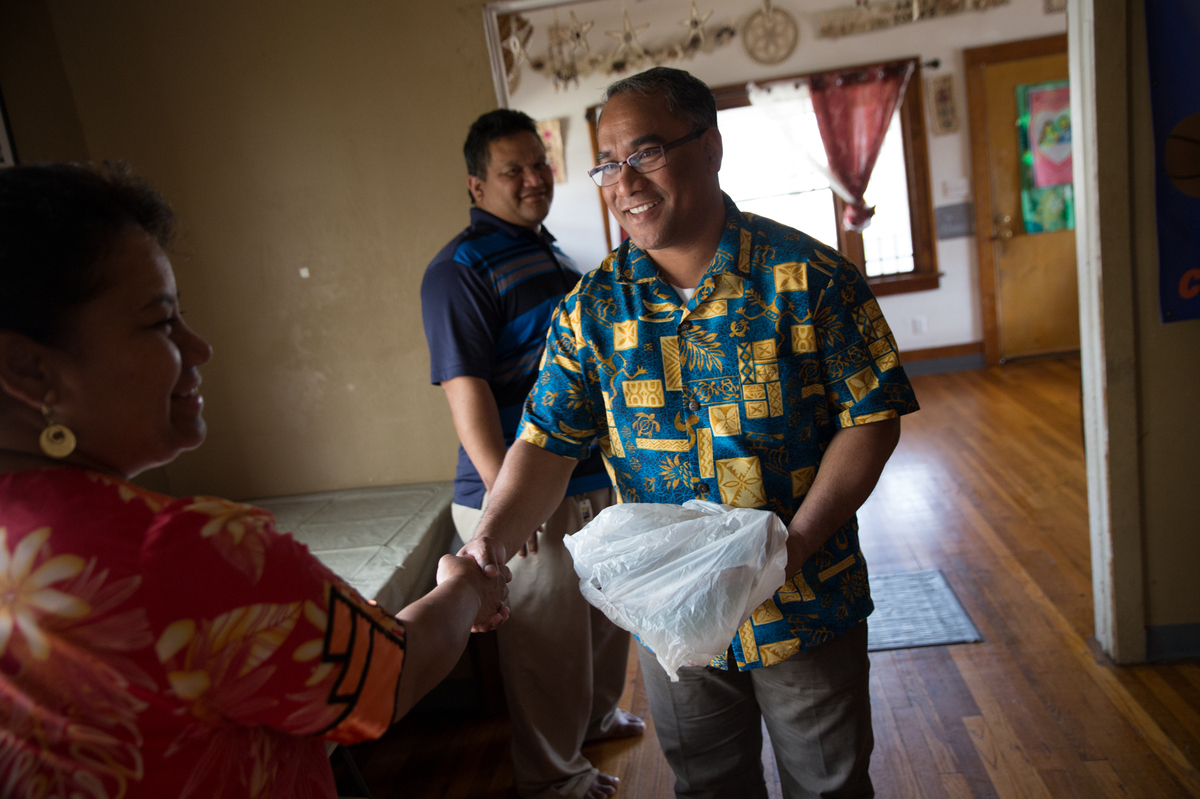
Terry Mote (right) visits the home of Stanley and Lorit Jamor in Enid, Okla. Stanley was born on Bikini atoll, and is a descendant of Chief Juda, who was told in 1946 by Commodore Ben H. Wyatt, of the U.S. Navy, to give up the island homeland “for the good of all mankind.” Bikini was a main site for U.S. nuclear testing and is uninhabitable to this day because of radioactive contamination.
Sarah Craig for NPR
hide caption
toggle caption
Sarah Craig for NPR
The prairie town of Enid, Okla. — population 50,122 — is best known as the state’s “wheat capital.” Enid is also home to a community of around 2,000 people who were born in the Marshall Islands. Most are low-income and struggling to get health care.
After WWII and until the 1980s, their homeland in the South Pacific was a U.S.-administered territory, and for a part of that time, Americans used some islands in the region as a bombing range for testing nuclear weapons. Partly because of that history, a treaty now allows Marshallese to live and work in the U.S, as “indefinite legal residents.”
But in Oklahoma, as noncitizens, the Marshallese aren’t eligible for many state and federal health services. And that’s a big problem says 42-year-old Terry Mote, who was born on the islands, but moved to Enid in 2007.

Daina Judah, 18, wheels her grandmother, Daina Joseia, out of an exam room at St. Mary’s Hospital in Enid, Okla. Joseia checks in at the clinic weekly, so a health care provider can tend to a chronic sore on her back that’s a medical complication of her diabetes.
Sarah Craig for NPR
hide caption
toggle caption
Sarah Craig for NPR
“I just want my family to be treated like the rest of those who are eligible for Medicaid, says Mote, who works as a Micronesian health adviser at the Garfield County Health Department, and lives in Enid with his wife, Lynn, and their five kids. His mom, Mojina, lives with them, too.
“Why the government came to our island to do [testing of] 67 bombs,” Mote says, “and then they are just going to let us die over this?”
Between 1946 and 1958, after relocating whole villages to other islands to clear the way for weapons testing, the U.S. detonated 67 nuclear weapons at sites across the Marshall Islands and other territories.
Enid resident Daina Joseia is in her 60s. She has a childhood memory of what she later was told was the test of the Castle Bravo thermonuclear device on March 1, 1954 — the biggest and most destructive nuclear bomb detonated — 1,000 times as powerful as the bomb dropped on Hiroshima.
“It’s like a real bright color, like a fire,” Joseia says through a translator.
Clouds of radioactive, pulverized coral dust drifted across the islands, coating homes and people. Joseia says that, in the aftermath of the test, she remembers seeing people whose bodies were covered in burns, and others with their hair falling out.
In the following years, some people from the affected islands developed thyroid problems and cancer. Babies were born deformed.
Joseia sees a direct connection between her diabetes and the nuclear tests — not because there’s a link between nuclear radiation and diabetes, but because the bombs contaminated the Marshall Islanders’ traditional foods, like coconuts, fish and breadfruit. When their traditional diet too dangerous to eat, she explains, the Marshallese started to consume processed, imported foods — like spam and white rice.

Enid has a population of 50,000 and may be best known as the “wheat capital” of Oklahoma.
Sarah Craig for NPR
hide caption
toggle caption
Sarah Craig for NPR
Terry Mote is too young to remember the bombs being tested. He does, however, remember what they ate in the decades afterward.
“We begin to be [thinking] eating canned meat is a good thing,” Mote says. “But then, at the end of the day, it’s not good.”
Today the Marshallese have among the highest rates of diabetes in the world.
Like Joseia, Mote’s mother Mojina has diabetes, too. And like Joseia, she’s uninsured. For Mote and his family, this became a huge problem when his mother had to go into the hospital for treatment and ended up needing to stay there for months.
“We had little knowledge on, you know, when you stay in the hospital for certain days — the bill is running,” says Mote. “So by the time she got out from the hospital, I was so surprised.”
The bill for treating the complications of her diabetes was $50,000, Mote says, and he could only pay part of it. It was only when he tried to enroll his mom in Medicaid or Medicare, that he found out Marshallese don’t qualify for these programs.
The special relationship between the U.S. and the Marshall Islands — now the sovereign Republic of the Marshall Islands — is complicated, to say the least.
In 1983 the Marshall Islands, the Federated States of Micronesia and Palau signed the Compact of Free Association with the U.S., which allowed people from these island nations to settle in the U.S. with limited legal status.
This means that while a path to citizenship is available to them, those who resettled in the U.S. under the treaty were not automatically made citizens. Instead, they were classified as “nonimmigrants.” At the time the Marshallese and other COFA communities in the U.S. were eligible for federal health programs.
But that changed in 1996, when Congress passed the Personal Responsibility and Work Opportunity Act. This major piece of welfare legislation effectively reworked the eligibility of people who came to the U.S. under the COFA agreement, stripping Marshall Islanders and other similar communities of their federal health benefits.
After the 1996 legislation was passed, some states, including California and Oregon, used state funds to continue to provide health care services to COFA migrants, according to the Asian and Pacific Islander American Health Forum.
The state of Oklahoma did not choose to do so, which means even longtime legal residents of the state are not eligible for Medicaid and Medicare in Oklahoma if they happen to be Marshallese.
“People turned to me and ask for help,” Mote says. “And they said, ‘Hey, can the church help me pay my bills?’ So I’m like, ‘Hey, you know what? There’s a lot of problem here.’ “
Mote spends much of his time these days thinking about health problems in his community. He’s reached out to lawmakers for help, but his attempts to get state legislation introduced that would get health coverage for Oklahoma’s Marshallese community have so far failed.
It’s a hard sell, he says, because Marshallese can’t vote. And the path to citizenship, he says, is tough for a myriad of reasons.
Mote says most Marshallese in his community find the citizenship application process intimidating — and unaffordable. There’s the language barrier, he says, and, maybe because the community is close-knit, there tends to be little sense of urgency to assimilate.
Plus, Mote says, most Marshallese believe it’s taboo to talk about being sick.
“I feel frustrated,” he says. “Because these people need to be healthy — need to be treated like human beings.”
He is not giving up.
Mote says he is now applying for citizenship — because he wants to run for City Council and help give Marshallese in Enid a voice.
As Partial Shutdown Continues, FDA Prepares To Furlough Employees

Many Food and Drug Administration activities will continue despite the partial federal shutdown.
Andrew Harnik/AP
hide caption
toggle caption
Andrew Harnik/AP
The partial government shutdown that started Saturday will affect quite a few activities of the Food and Drug Administration.
Although most of the agency’s employees weren’t working over the weekend and on Monday and Tuesday because of federal holidays, FDA will furlough some 40 percent of its staff starting Wednesday.
However, much of the agency’s workforce will continue through the shutdown, with more than 10,000 FDA employees — nearly 60 percent — reporting to work, according to numbers released by the agency Friday.
The majority of those people are doing work funded by user fees paid by pharmaceutical and medical device companies, according to an analysis by the Alliance for a Stronger FDA, an advocacy group representing patient and consumer advocates as well as trade associations.
Here is a quick breakdown of how the shutdown will affect the agency’s work.
Activities that will continue during the shutdown
The FDA will continue work that’s critical to public health and safety. It will be able to respond to emergencies, like the flu and foodborne illnesses. It will continue recalls of any foods, drugs and medical devices that pose a high risk to human health.
As FDA Commissioner Scott Gottlieb tweeted over the weekend, the agency will also continue to screen “food and drug imports” and inspect any facilities that might pose “an imminent threat to health and life.”
Some criminal and civil investigations where there is an immediate risk to public health will also continue through the shutdown, as will all of the agency’s work that is funded by user fees.
THREAD: During the lapse in federal funding, #FDA‘s ongoing work will fall into three key areas: emergency work to save lives and protect property, criminal and some civil enforcement work, and work funded by user fees. pic.twitter.com/fxCIGUZDtW
— Scott Gottlieb, M.D. (@SGottliebFDA) December 22, 2018
For example, the agency will continue to oversee the manufacturing and distribution of all tobacco products. “The tobacco program is 100 percent user-fee funded,” says Steven Grossman, deputy executive director at the Alliance for a Stronger FDA.
Similarly, much of the agency’s work with new products is funded by fees paid by industry, so the FDA will continue reviewing and approving drugs and medical devices where the fees have already been paid. It will also continue to review requests for clinical research and issue any necessary guidance.
Activities that will stop during the shutdown
Broadly speaking, all activities that are less likely to have an immediate impact on health and safety of consumers will come to a halt. For example, routine regulatory and compliance work for medical products, animal drugs and most foods will be paused, according to a contingency staffing plan put forward by the Department of Health and Human Services.
Routine inspections of facilities and all work related to cosmetics and nutrition will also be paused during this period.
And the shutdown may affect some aspects of the drug review process as an estimated 30 percent of that work is funded by appropriations, according to the analysis by the Alliance for a Stronger FDA.
Should consumers be concerned about food and drug safety during the shutdown?
Probably not, at least not for now, says Grossman. “In the short term, consumers should not see much of an impact,” he says. That’s because “anything that could affect human health and safety [in the near term] will be staffed.”
New York Jets QB Sam Darnold Poses As A Mall Santa Claus

Last week in New Jersey, quarterback Sam Darnold went undercover as a mall Santa. Kids asked for toys and pets. One young fan asked for a Saquon Barkley jersey. Barkley plays for the New York Giants.
NOEL KING, HOST:
Good morning. I’m Noel King. New York Jets rookie quarterback Sam Darnold went undercover dressed in a red-and-white suit and a beard at a New Jersey mall last week. Kids asked him to bring them puppies and skateboards.
And then, eek, two young football fans asked him for Saquon Barkley jerseys. Barkley plays for the Giants. Darnold slumped a little and asked one kid kind of sadly, Saquon?
But when he revealed his true identity, a bunch of young Jets fans went nuts, and he seemed to cheer up.
Copyright © 2018 NPR. All rights reserved. Visit our website terms of use and permissions pages at www.npr.org for further information.
NPR transcripts are created on a rush deadline by Verb8tm, Inc., an NPR contractor, and produced using a proprietary transcription process developed with NPR. This text may not be in its final form and may be updated or revised in the future. Accuracy and availability may vary. The authoritative record of NPR’s programming is the audio record.
If You Feel Thankful, Write It Down. It's Good For Your Health

Kristen Uroda for NPR
Over this past year, lifestyle blogger Aileen Xu has kept a monthly gratitude list.
Sometimes it was the big stuff: “I’m grateful that my family is so understanding. I’m grateful so many people care.”
And sometimes it was life’s little blessings: “July 2018: I’m grateful for good hair after I shower.”
Xu started making such lists when she was in college, “at a point when I was just not in a very good place in my life.” Now, the 28-year-old lifestyle blogger and YouTuber recommends the practice to her nearly 750,000 subscribers.
And it wasn’t a hard sell.
“I think just over the last few years there’s been more of a trend to focus on gratitude,” says psychologist Laurie Santos, who teaches a course on the science of well-being and happiness at Yale.
Gratitude is being endorsed by wellness blogs and magazines. You can buy different kinds of specific gratitude journals, or download apps that remind you to jot down your blessings.
“Those types of products can remind us to take time to be grateful,” Santos says. “But it’s also important to remember that gratitude is free.”
And noting your gratitude seems to pay off: There’s a growing body of research on the benefits of gratitude. Studies have found that giving thanks and counting blessings can help people sleep better, and lower stress and improve interpersonal relationships. Earlier this year, a study found that keeping a gratitude journal decreased materialism, and bolstered generosity among adolescents.
In another study from August, high school students who were asked to keep gratitude journals also reported healthier eating. There’s also some evidence it could lower your risk of heart disease and lower symptoms of depression for some people.
That’s why gratitude features heavily in Santos’ happiness class. “It’s one of the practices that really wins out from the field of positive psychology,” she says, because it takes very little time, and “the benefits are so powerful.”
Making gratitude lists is one way of accessing those benefits. You could thank God or the universe. You could keep your gratitude private, or share it with others. The best way of accessing and expressing gratitude may be different for each person.
Santos’ students, in addition to keeping gratitude journals, are asked to write a thank you letter, and then read it out loud to the recipient. “I can show measurable improvements in well-being even a month after you’ve done this,” Santos says.
What works for some people may not work for others. To find your best method, “[r]eally think about what feels right and what feels natural or meaningful to you,” says Sonja Lyubomirsky, a professor of psychology at the University of California, Riverside, who studies happiness and gratitude.
Some may find that a daily dose of gratitude in the morning can be transformative. “It helps me feel awake and abundantly joyful,” says Sam Khazai, a 38-year-old actor based in New York, who uses a journal that prompts him to list three things he’s grateful for each day.
“I know it sounds kind of meta,” he says. “But practicing gratitude, it brings me so much gratitude in and of itself.”
Although there have been times when he’s skipped a day or even several days when he’s felt especially down. “Or if I don’t skip those days, I’ve straight up lied to my own gratitude journal … I’ve filled it with things I hoped to be grateful for,” he says — but he didn’t feel grateful, and forcing it felt bad.
“Gratitude is a very rich emotion, but it’s also kind of a complicated one,” notes Lyubomirsky. “Sometimes when you express gratitude, you could also feel humbled or indebted or embarrassed. So it doesn’t always feel pleasant.”
In one study Lyubomirsky and her colleagues found that that counting blessings once a week boosted happiness, but doing so three times a week didn’t. “That suggests that for most people, at least on average, three times a week was too much,” she says. “And too much gratitude can sort of backfire.”
There’s also a lack of research on how gratitude exercises affect people with clinical depression, anxiety or suicidal tendencies, Lyubomirsky says. “If you’re depressed, and you’re asked to express gratitude … you might have trouble thinking of what you’re grateful for, or you may feel really guilty you haven’t paid back that person you’re grateful for.”
Indeed, for all the research on the broad benefits of expressing gratitude, there’s also evidence that it isn’t for everyone. And it isn’t a panacea — it can’t make injustice, loss, or pain disappear.
What gratitude can do is give us hope. “The research shows that focusing on the positive, in addition to the negative, can boost our mood more than we expect,” says Santos.
In Oakland, Calif., 31-year-old mental health counselor Zeyda Garcia agrees. During really tough times, like when she’d lost a job and was sleeping on her friend’s mom’s couch — she felt like she was reaching for reasons to be grateful.
But she still tried to find some. “Even if it’s just — I’m grateful for the sun that’s shining or being able to wake up,” she says. It felt hokey, and “kind of fake, a little bit.”
But ultimately, it helped. “It allowed me to ground myself,” she says. “It allowed me to remember what was going well, in a world full of chaos.”
N.J. High School Wrestler Told To Cut His Dreadlocks Or Forfeit Match
Noel King talks to Washington Post sports columnist Kevin Blackistone, who shares his take about what happened when a referee gave a high school wrestler in New Jersey an ultimatum.
Trinidad And Tobago Remixes Caribbean Christmas Traditions

During the months leading up to Christmas, parang music can be heard just about everywhere in Trinidad.
John Otis/NPR
hide caption
toggle caption
John Otis/NPR
The twin-island nation of Trinidad and Tobago is famous for calypso and soca, infectious music that takes center stage during the island’s annual Carnival. But during the Christmas season another type of music dominates.
At a sound check for a band that plays old-time instruments, musicians play cuatro, a small, four-stringed acoustic guitar. There are also mandolins, maracas and a box bass, Trinidad’s version of the washtub bass. These are some of the instruments that are used to make the religious folk music called parang.
During the months leading up to Christmas, parang can be heard just about everywhere in Trinidad. Most of the songs are about the birth of Christ. However, not everyone understands the lyrics. Parang was brought to Trinidad by migrant farm workers from nearby Venezuela. The songs are sung in Spanish even though the mother tongue on the island is English.
Some parang groups like Los Alumnos de San Juan pantomime to help audiences grasp the Spanish lyrics to songs. Alicia Jaggasar is the leader of Los Alumnos de San Juan and also heads the National Parang Association.
YouTube
“Parang music is our way at Christmastime to tell the story but in a different language and in a different musical style,” Jaggasar says. “So you wouldn’t hear it as the normal ‘Hark the herald angels sing, glory to the newborn king.’ You will hear: ‘Cantando gloria, gloria, gloria en el cielo. En un establo nació el Dios verdadero,‘” which translates to “Singing glory, glory, glory in heaven. The true God was born in a stable.”
Jaggasar’s group is booked until Christmas Eve. On that night, parang bands go house to house until the wee hours in an exuberant form of Christmas caroling. But they must adhere to some elaborate musical etiquette to gain entry.

Alicia Jaggasar is the leader of Los Alumnos de San Juan and also heads the National Parang Association.
John Otis/NPR
hide caption
toggle caption
John Otis/NPR
“You have to do a serenado from outside,” Jaggasar says. “And in that song, you have to actually say who you are, and what you’ve come to do. And it’s only when the host hears who you are, then the door is open. They don’t just open it just like that.”
But once inside, the party revs up.
“Christmas morning, I would hear the cuatros, the mandolins, as the groups went from house to house, ” Michele Reis, a Trinidad academic, says. “There is lots of rum flowing, there is food that comes. … And it’s just a really festive time, you know?”
To keep this tradition alive, high schools and colleges in Trinidad hold parang contests. Still, musicians are always tinkering with parang in an effort to reach a wider audience. One result is soca-parang, which is sung in English so more people will understand, and fused with the frenetic rhythms of soca.
Purists complain that the lyrics often glorify girls rather than the gospel. But Jaggasar endorses the hybrid. “Because we are land of calypso, soca and steel band, we like to mix things, that is just our culture,” Jaggasar says.
How Helping Patients Get Good Care At Home Helps Rural Hospitals Survive

Charlotte Potts, who has a history of heart problems, lives within sight of Livingston Regional Hospital. After a recent stint there, she was discharged into the care of a home health agency, and now gets treatment in her apartment for some ailments.
Shalina Chatlania / WPLN
hide caption
toggle caption
Shalina Chatlania / WPLN
Rural hospitals close when they don’t have enough paying patients to care for, but they’re also dinged when the same patients show up over and over again. That puts outlying medical facilities in the precarious position of needing to avoid repeat customers.
Charlotte Potts is the type of patient some hospitals try to avoid. She lives in Livingston, Tenn. — a town of 4,000, tucked between rolling hills of the Cumberland Plateau.
“I’ve only had five heart attacks,” Potts says with a laugh. “I’ve had carotid artery surgery. Shall we go on? Just a few minor things.” She jokes that she’s “a walking stent.”
The heart trouble has affected the way Potts deals with her health problems. She spends much of her day in a recliner in her apartment, tethered to a pulsing oxygen machine, and listening to the radio.
Fortunately, her apartment sits within spitting distance of Livingston Regional Hospital — a 114-bed facility large enough to have a dedicated cardiac unit. But the hospital doesn’t want to see her every time her heart flutters.
So last time she landed in the ER, they helped her connect with a few companies that could provide care at home.
“If I’m going to have certain things going on here in my chest, I call for help, and they’re there,” Potts says of the home care team she chose.





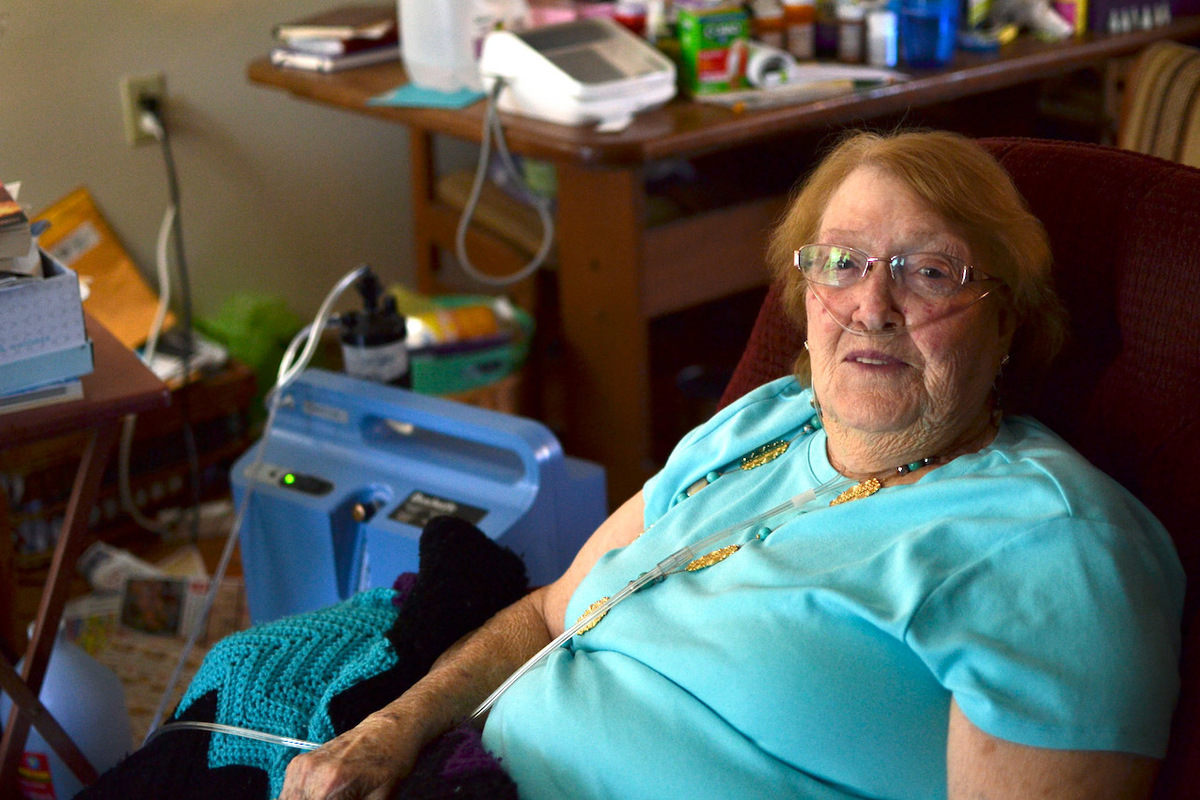
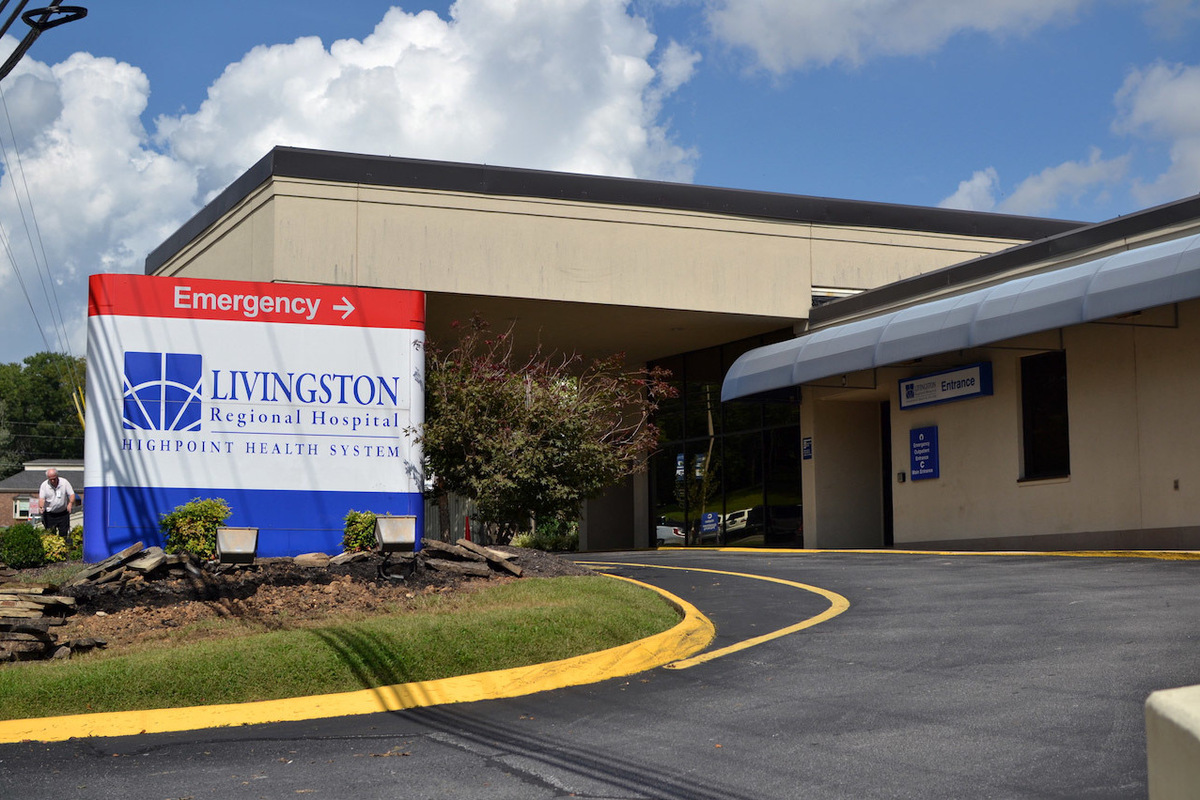
Livingston Regional Hospital has cut readmissions by more than four percent in the last five years — more than any other rural hospital in Tennessee.
Shalin Chatlani / WPLN
hide caption
toggle caption
Shalin Chatlani / WPLN
A new era in hospital management
There were days when the hospital might have viewed a home health agency as a competitor. Not anymore.
“When I started this almost 40 years ago, the mission was different,” says Tim McGill, CEO of Livingston Regional. “We wanted patients in the hospital. That was the incentive. We were paid for it. Now you’re not.”
Hospitals used to run on a so-called fee-for-service model with virtually no limit to how many times they could see a patient. But, under pressure from private and government insurance programs, that model is transitioning to one in which hospitals are rewarded for safety and efficiency — which often results in a patient spending less time in the hospital.
Under the Affordable Care Act, Medicare began to ding hospitals if too many patients are readmitted to any hospital within 30 days of discharge. The measure is broadly unpopular with the hospital industry, since so much falls outside a hospital’s control. Medicare has even walked back the rules for safety-net facilities, which tend to treat a sicker population.
The penalty is meant to encourage hospitals to get it right the first time. In Livingston, the hospital operates on the thinnest of margins — just 0.2 percent in the most recent figures. And “readmissions” have been a drag on the bottom line.
One in five patients with heart failure was back within the month. The hospital has paid the maximum penalty in some years — nearly $200,000. So leaders started asking a basic, unifying question of other providers in town, McGill says: “What can we do together so they’ll stay out of the hospital and stay healthier in their home setting? That’s where the work is.”
Collaborating instead of competing
The work took the form of quarterly lunch meetings at the local library.
Mary Ann Stockton, a nurse at the hospital, invites all the home health agencies as well as hospice providers and the leaders of nursing homes.
At one meeting, she applauds the other providers for increasingly meeting patients inside the hospital before they’re discharged. She says it helps patients and families accept these home health workers.
“We know in our area, people don’t like to have a total stranger come into their home,” she says.
The group brainstorms how to generate the same kind of acceptance for hospice care, which — as one doctor in the meeting puts it — some families view as assisted suicide.
And on this day, the groups spends much of its time reviewing the value of flu shots, especially for the staff in nursing homes. Stockton says elderly patients with bad lungs become a hospital emergency room’s “frequent fliers.”
“Flu starts off, goes into pneumonia, COPD exacerbation — and they are a revolving door in our hospital,” Stockton says. “They’re hitting that ER a couple of times a week.”
Advance directives are on the agenda for next time — another way to keep people near the end of life from becoming ER regulars.
Livingston’s parent company, LifePoint Health, is launching this community approach in many of its 80-or-so markets, which are primarily in the Southeast and almost all rural. LifePoint vice president Cindy Chamness helps hospitals find willing partners.
“We were very frustrated for many years,” Chamness says, “because we weren’t able to impact readmissions just working on it by ourselves, as a hospital.”
“Are we saving ourselves right out of business?”
The solution looks different from one town to another. In Lake Havasu, Ariz., paramedics now visit discharged patients to make sure they’re following doctors’ orders. The house calls also cut down on government-funded ambulance rides.
It’s not just rural hospitals — all hospitals can be penalized for readmissions now. And threatening the bottom line in that way does seem to be effective. Readmissions have been falling across the board, according to the latest research.
But rural hospitals, which already treat fewer patients than urban hospitals, wonder if they’ll have enough patients to survive, says Michael Topchik of the Chartis Center for Rural Health.
“[A] CEO from Montana said to me, ‘The problem is, when we do the right thing, are we saving ourselves right out of business?’ ” says Michael Topchik of the Chartis Center for Rural Health.
The focus on cutting readmissions — by definition — cuts overall admissions too, he notes.
“So, this is the real inherent tension and challenge: Hospitals get reimbursed for doing ‘sick care,’ ” Topchik says. “But more and more they’re being asked to do population health, and really focus on ‘wellness.’ “
To make up the volume, the Livingston hospital is expanding its maternity ward and general surgery offerings.
There is also some immediate financial upside to reducing readmissions: Livingston Regional has cut readmissions more than any other rural hospital in Tennessee and even the nation, according to data compiled by Chartis.
As a result, the hospital’s Medicare penalty in the coming year will be reduced to 0.3 percent of its reimbursements — down from the maximum of 3 percent, which was roughly $200,000 a year.
That’s all because patients like Charlotte Potts now can safely stay home.
“I got a real bad tightness in the chest,” Potts recalls about a recent episode. She’d questioned whether to call an ambulance. “I was very uncertain about what was going on.”
But she phoned her home health agency, took a nitroglycerin pill as the agency advised, and instead of going to the ER, was able to get back to sleep.
The Week In Sports: MLB, Cuba Reach Historic Deal
It’s time to reflect on the highlights of the week in sports, including an agreement that would allow Cuban athletes to play Major League Baseball without defecting from their home country.
SCOTT SIMON, HOST:
And now a couple of chestnuts roasting on an open fire (laughter) or, as we say around here, time for sports.
(SOUNDBITE OF MUSIC)
SIMON: There is a deal on the table between the U.S. and Cuba to allow the best baseball players in Cuba to play in the United States and Canada without having to defect. But it’s not as simple as just letting them sign. Here’s my fellow chestnut, Tom Goldman. How are you, Tom? Happy holidays.
TOM GOLDMAN, BYLINE: Smile when you say that when you call me a chestnut. Good morning.
SIMON: I said a couple of chesnuts. Some of the best baseball players in the world, obviously, are Cuban, but their government has not let them just sign a contract and play wherever in the world they want to – U.S., Japan, any place. What is in this new agreement?
GOLDMAN: Well, Scott, it would allow for easier signing of Cuban ballplayers and safer passage for players from Cuba to the major leagues. As you know, historically, it’s often a harrowing journey. The Cuban government hasn’t allowed players to leave, so they’ve had to defect, leave family behind, take big risks to get to the majors, you know, unscrupulous agents.
SIMON: And not be able to come back and see their family typically in the offseason.
GOLDMAN: Yeah, exactly, and there are unscrupulous agents and criminal elements, you know, waiting to extort players and kidnap them. This agreement, which grew out of more relaxed relations between Cuba and the U.S. during the Obama administration, would let players sign with MLB while they’re in Cuba, come to North America on a work visa and then return to Cuba in the offseason.
SIMON: Do they get to keep their salaries?
GOLDMAN: They do. They do. And this is an interesting point. You know, this is all going to depend on the Trump administration’s approval. And the White House sounds hostile to the idea so far. A statement from a senior administration official criticized the proposal because – and I’m quoting here – “a Cuban body would garnish the wages of hard-working athletes who simply seek to live and compete in a free society.” Now, a source in baseball I spoke to said wages will not be garnished. At most, the source says there will be, like, a 2 percent national tax. But other than that, the agreement guarantees no one’s going to touch the money players get from MLB. Scott, one other thing about money, which is always involved in baseball. Major League clubs that sign Cuban players will have to pay what’s called a release fee to a Cuban – to the Cuban Baseball Federation. There’s concern by our government that the money might end up in the wrong hands – the Cuban government. Now, there are no guarantees some of the money won’t go that way, but baseball officials in this country say while the proposed agreement isn’t perfect, it’ll be a lot better for Cuban players and a lot better for baseball to have this better pipeline to some of the world’s best players.
SIMON: I want to ask you about two American Olympians, both 23 years old, both women, at different points in their career. Mikaela Shiffrin won a slalom today in France, the great skier.
GOLDMAN: Right. Right. Yes, absolutely – breaking news. She won that slalom. It was her 35th slalom victory in her career, ties the women’s all-time record. Also at 23, she’s now the youngest skier ever, women or men, to have 50 World Cup races to have won them in all disciplines. We’ll have to wait till 2022 to watch her do her thing at the next Winter Olympics. But until then, watch her if you can. She’s really special.
SIMON: But there’s a 23-year-old swimmer who’s going to be saying goodbye to professional competition.
GOLDMAN: Yes, Scott, unlike Defense Secretary Mattis, Missy Franklin really is retiring…
SIMON: (Laughter) Yes.
GOLDMAN: …At the ripe old age of 23. Now, you have to go back a couple of Summer Olympics to remember her true greatness in the pool. In London 2012, she won four gold medals, five total, as a 17-year-old. At the World Championships the next year, she won six golds. And at that point, there was talk she was going to be a medal machine like Michael Phelps. She had a bubbly personality to boot. But then it all kind of crashed. Her body betrayed her with injuries. She battled depression. She had surgery on both shoulders last year. And she never could beat the pain. And it turns out, her late teenage years were her heyday, but she is ever-positive. She says she’s choosing to look at retirement as a new beginning, which one can realistically say at 23.
SIMON: Yeah. Well, NPR’s Tom Goldman, thanks. You know, we have run out of time before I could sing (singing) they’re the pride and joy of Illinois, Chicago Bears – bear down.
GOLDMAN: February, Scott, you’ll be celebrating.
SIMON: Oh, really? Tom Goldman, thanks so much.
GOLDMAN: You’re welcome.
Copyright © 2018 NPR. All rights reserved. Visit our website terms of use and permissions pages at www.npr.org for further information.
NPR transcripts are created on a rush deadline by Verb8tm, Inc., an NPR contractor, and produced using a proprietary transcription process developed with NPR. This text may not be in its final form and may be updated or revised in the future. Accuracy and availability may vary. The authoritative record of NPR’s programming is the audio record.
Parkour Resists 'Hostile Takeover' By International Gymnastics


Many in the parkour community are resisting attempts by the International Gymnastics Federation to bring the sport under its umbrella. Here, Johan Tonnoir practices parkour in Paris in May.
Philippe Lopez/AFP/Getty Images
hide caption
toggle caption
Philippe Lopez/AFP/Getty Images
Since its beginnings in the 1980s in France, parkour has been sporty – but not exactly Olympic sporty.
Parkour and its cousin freerunning involve scaling urban obstacles and using the city as a playground. Its adherents, called traceurs and traceuses, bound railings, climb walls, and leap across terrifying expanses.
But now parkour, emblematic of freedom and practiced risk-taking, is fighting for its autonomy — from the gymnastics establishment.
Earlier this month, the International Gymnastics Federation (the FIG, for its French appellation) voted to make parkour one of its official disciplines. The FIG has been moving quickly to make parkour its own. It staged two Parkour World Cup events this year in Japan and France, and announced plans for a Parkour World Championships in 2020. The group intends to lobby the International Olympic Committee to include parkour in the 2024 Olympics, as a discipline of gymnastics, The Associated Press reports.
All of this has sparked resistance among some of parkour’s founders and practitioners.
David Belle, considered to be the inventor of parkour, was recruited to be on the FIG’s Parkour Commission. But he soon quit, followed by four others who wrote an open letter complaining that the FIG is “trying to trying to go fast with very little or no transparency, no involvement of the international parkour community or national communities.”
The en-masse resignation of @gymnastics “Parkour Commission”
“The implementation is trying to go fast with very little or no transparency, no involvement of the international parkour community or national communities”
“We see problems that worries us for the future of parkour” pic.twitter.com/8iSjlPcakH
— Eugene Minogue (@EugeneMinogue) October 26, 2018
Members of the parkour community have been voicing its displeasure on Twitter using the hashtag #WeAreNOTGymnastics.
“Now THIS, Internet, is what cultural appropriation looks like,” wrote one. “Running and climbing and jumping is life, not ‘regulated’, corporate owned sport.”
“No other community has the right to make decisions for us,” tweeted New Zealand Parkour.
Last year, six national parkour associations came together to form Parkour Earth – a governing body founded with the specific goal of protecting “the sovereignty and autonomy of Parkour/Freerunning/Art Du Déplacement internationally.”
The group’s CEO, Eugene Minogue, called the FIG’s maneuvering “the equivalent of a hostile takeover.”
“They are completely whitewashing our sport, its integrity, its history, its lineage, its authenticity,” he told the AP — which notes that Olympic sports have absorbed their more youthful upstarts before, as skiing did with snowboarding.
Gymnastics’ governing bodies have been on the defensive after the drubbing they they took their handling of the Larry Nassar sexual abuse scandal. But the FIG’s aggressive attempt to bring parkour into its fold may not turn out to be as easy a win as they’d hoped.
Short-Term Health Plans Boost Profits For Brokers And Insurers


Selling short-term health plan is lucrative for brokers and insurers.
skynesher/Getty Images
hide caption
toggle caption
skynesher/Getty Images
Sure, they’re less expensive for consumers, but short-term health policies have another side: They’re highly profitable for insurers and offer hefty sales commissions for brokers.
Driven by rising premiums for Affordable Care Act plans, interest in short-term insurance is growing, boosted by Trump administration actions to ease Obama-era restrictions and possibly make federal subsidies available to consumers to purchase them.
Short-term plans can be far less expensive than ACA plans because they set annual or lifetime payment limits. Most of these plans exclude people with pre-existing medical conditions, don’t cover prescription drugs and exclude in fine print some conditions or treatments. Injuries sustained in school sports, for example, often are not covered.
These plans can be purchased at any time throughout the year, which is different than plans sold through the federal marketplaces. The open enrollment period for those ACA plans in most states ended Dec. 15.
The rising demand for short-term plans is boon for insurance brokers, who often see commissions on such policies hit 20 percent or more.
On a policy costing $200 a month, for example, that would translate to a $40 payment each month. By contrast, ACA plan commissions are often flat dollar amounts rather than a percentage of premium and can range from zero to $20 per enrollee per month.
“Customers are paying less, and I’m making more,” said Cindy Holtzman, a broker in Woodstock, Ga., who said she gets 20 percent on short-term plan sales.
Large online brokers also are eagerly eyeing the market.
Ehealth, one such firm, will “continue to shift our focus to selling short-term plans and non-ACA insurance packages,” CEO Scott Flanders told investors in October. The firm saw an 18 percent annual jump in enrollment in short-term plans this year, he added.
Insurers, too, see strong profits from plans because they generally pay out very little toward medical care when compared with the more comprehensive ACA plans.
Still, some agents like Holtzman have mixed feelings about selling the plans, because they offer skimpier coverage than ACA insurance. One 58-year-old client of Holtzman’s wanted one, but he had health problems. She also learned his income qualified him for an ACA subsidy, which currently cannot be used to purchase short-term coverage.
“There’s no way I would have considered a short-term plan for him,” she said. “I found him an ACA plan for $360 a month with a reduced deductible.” (A federal district court judge in Texas issued a ruling Dec. 14 striking down the ACA, which would among other things affect the requirements of ACA coverage and subsidies. The decision is expected to face appeal.)
Consequently, short-term insurers don’t have to pay as many medical bills, so they have more money left over for profits. In forms filed with state regulators, Independence American Insurance Co. in Ohio shows it expects 60 percent of its premium revenue to be spent on its enrollees’ medical care. The remaining 40 percent can go to profits, executive salaries, marketing and commissions.
A 2016 report from the National Association of Insurance Commissioners showed that, on average, short-term plans paid out about 67 percent of their earnings on medical care.
That compares with ACA plans, which are required under the law to spend at least 80 percent of premium revenue on medical claims.
Short-term plans have long been sold mainly as a stopgap measure for people between jobs or school coverage. While exact figures are not available, brokers say interest dropped when the ACA took effect in 2014 because many people got subsidies to buy ACA plans and having a short-term plan did not exempt consumers from the law’s penalty for not carrying insurance.
But this year it ticked up again after Congress eliminated the penalty for 2019 coverage. At the same time, the premiums for ACA plans rose on average more than 30 percent.
“If I don’t want someone to walk out of the office with nothing at all because of cost, that’s when I will bring up short-term plans,” said Kelly Rector, president of Denny & Associates, an insurance sales brokerage in O’Fallon, a suburb of St. Louis. “But I don’t love the plans because of the risk.”
The Obama administration limited short-term plans to 90-day increments to reduce the number of younger or healthier people who would leave the ACA market. That rule, the Trump administration complained, forced people to reapply every few months and risk rejection by insurers if their health had declined.
This summer, the administration finalized new rules allowing insurers to offer short-term plans for up to 12 months — and gave them the option to allow renewals for up to three years. States can be more restrictive or even bar such plans altogether.
Administration officials estimate short-term plans could be half the cost of the more comprehensive ACA insurance and draw 600,000 people to enroll in 2019, with 100,000 to 200,000 of those dropping ACA coverage to do so.
And recent guidance to states says they could seek permission to allow federal subsidies to be used for short-term plans. Currently, those subsidies apply only to ACA-compliant plans.
Granting subsidies for short-term plans “would mean tax dollars are not only subsidizing commissions, but also executive salaries and marketing budgets,” said Sabrina Corlette of Georgetown University Center on Health Insurance Reforms.
No state has yet applied to do that.
For now, brokers are focusing on getting their clients into some kind of coverage for next year. Commissions on both ACA and short-term plans are getting their attention.
After several years of declining commissions for ACA plans — with some carriers cutting them altogether a couple of years ago — brokers say they are seeing a bit of a rebound.
Among Colorado ACA insurers monthly commissions have ” gone from about $14 to $16 per enrollee to $16 to $18,” said Louise Norris, a health policy writer and co-owner of an insurance brokerage.
Rector, in Missouri, said an insurer that last year paid no commissions has reinstated them for 2019 coverage. For her, that doesn’t really matter, she said, because once carriers started reducing or eliminating commissions, she began charging clients a flat rate to enroll.
Norris noted that some states changed their laws so brokers could do just that.
At least one state, Connecticut, ruled that insurers had to pay a commission, which she thinks is protective for consumers.
“Insurance regulators need to step in and make sure brokers are getting paid,” said Norris, or some brokers, “out of necessity,” might steer people to higher-commission products, such as short-term plans, that might not be the best answer for their clients.
Her agency does not sell short-term or some other types of limited-benefit plans.
“I don’t want to have a client come back and say I’ve had a heart attack and have all these unpaid bills,” she said.
Kaiser Health News is a nonprofit news service covering health issues. It is an editorially independent program of the Kaiser Family Foundation that is not affiliated with Kaiser Permanente.