A Russian Fan's Perspective On A Most Unusual Gold Medal Ceremony In Pyeongchang
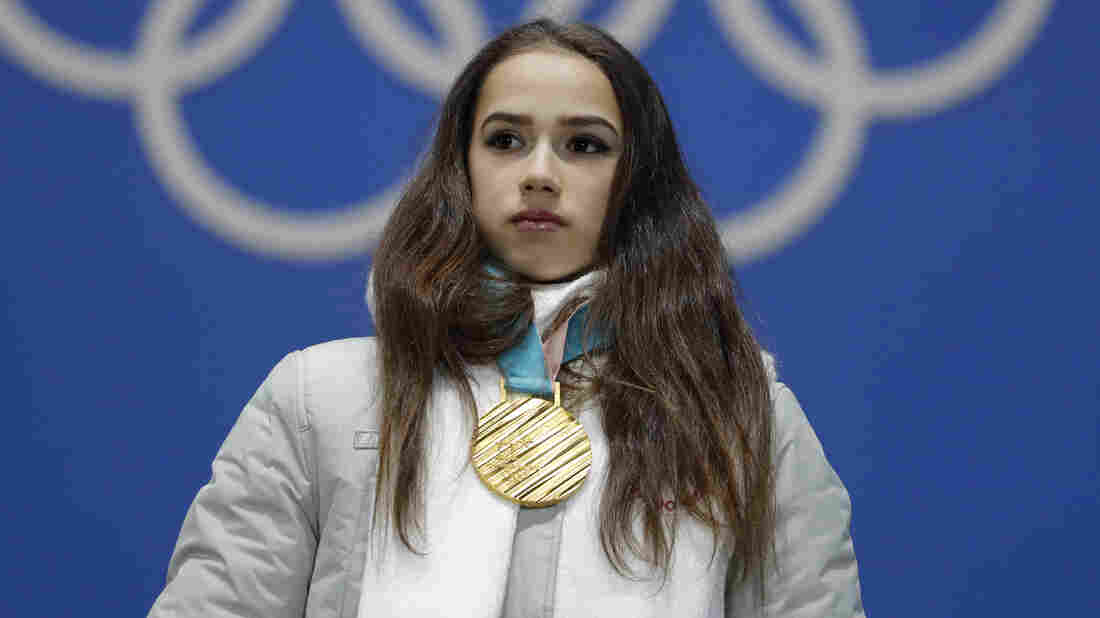
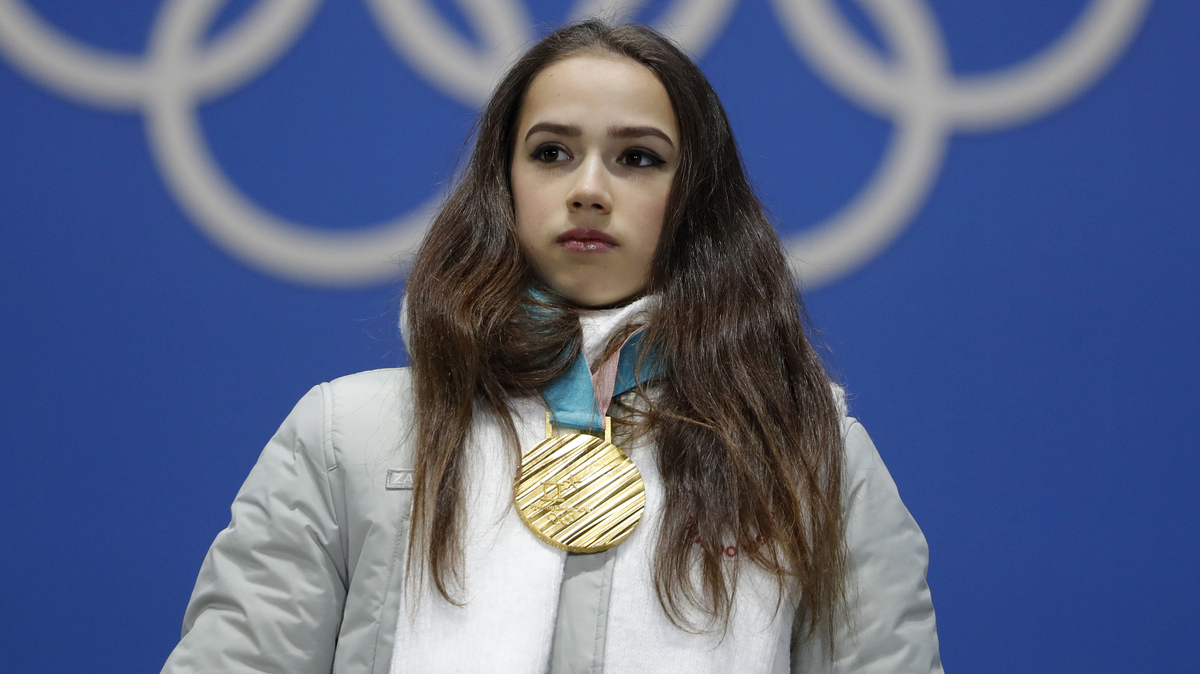
Gold medalist figure skater Alina Zagitova, an Olympic Athlete from Russia, heard the Olympics’ anthem as she stood on the podium for her medal ceremony.
Eric Gaillard/Reuters
hide caption
toggle caption
Eric Gaillard/Reuters
The only individual gold medal won by an Olympic athlete from Russia came in a ceremony that was different from others at the Pyeongchang Winter Olympics: Figure skater Alina Zagitova didn’t hear her country’s anthem or see its flag, as other medalists did.
Because of doping sanctions against Russia, the Olympic flag flew, and the (rather generic) Olympic anthem was played at the ceremony Friday night. The same procedure occurred on Sunday, when hockey players from Russia beat Germany for gold.
Zagitova gamely jumped upon the top spot on the podium, having realized her dream and beaten the world’s best. But later, she could be seen biting at the inside corner of her mouth, as the Olympic anthem played. Her teammate, silver medalist Evgenia Medvedeva, stood alongside her.
“I could see their faces,” said Natalia Kim, a Russian fan who attended the ceremony.
“They tried so hard for that kind of moment. And of course, they wanted to see our flag, and listen our hymn [anthem]. I felt like that too, I cried there, so… But it’s OK. We are looking for the future.”
The Olympic flag goes up for Alina Zagitova’s gold medal – and we hear the Olympic anthem. First gold for Olympic Athlete from Russia team #PyeongChang2018pic.twitter.com/Sh2Qv1daR5
— Bill Chappell (@publicbill) February 23, 2018
When asked about the restrictions on Russian athletes in the broader sense, Kim said, “It’s our pain now.”
“I think there is some strange things [that] happened in these Olympic Games,” she added. “I think that guilty persons should be punished, but people who are not evidently guilty – it’s not fair. They are working hard all their life.”
Among Russian fans, Kim has a rather unique perspective: She’s been living in South Korea for years, and she had long been hoping that the Winter Olympics would come to the country. She even admits to being upset when the 2014 Games went to Sochi rather than to Pyeongchang.
When Pyeongchang finally succeeded in its third bid to host the Olympics, Kim had been excited to see Russians come to Korea and compete for gold. But the doping scandal that hit the country’s sports program after the Sochi Games lingered — and in December, the International Olympic Committee suspended the Russian Olympic Committee. Many Russian athletes weren’t allowed to come to South Korea, including stars from its biathlon team – one of Kim’s favorite Olympic sports.
“I was waiting, really looking forward to these games,” Kim said, “and suddenly, I was greatly disappointed.”
With Zagitova and Medvedeva as the strong favorites to win the gold medal, Kim attended their three main figure skating events — in the team competition, the short program and the free program.
“During all these competitions we were sitting with Americans and with Canadians and today I was sitting near Japanese,” she said. “And people are really friendly… and they want to enjoy sport, they want to enjoy events” and celebrate, she said.
Tthese Winter Olympics have divided her emotions in a variety of ways, Kim said. She adores Evgenia Medvedeva, and is amazed by her talent. But she understands that Zagitova is a young and rising star.
She wept as she watched the medal ceremony, Kim said: “I was proud greatly. It was from one side, tears of pride and happiness. From another side, I regretted greatly we can’t see our flag.”
As the Olympic anthem played through loudspeakers in the Medals Plaza, Kim and her husband, Donald, and other Russian fans around them, sang Russia’s national anthem.
“We supported as we could,” she said.
After Going Shot For Shot, Olympic Athletes From Russia Win Men's Hockey Gold

David Wolf #89 of Germany attempts a shot against Vasili Koshechkin #83 of Olympic Athlete from Russia in the first period during the Men’s Gold Medal Game.
Harry How/Getty Images
hide caption
toggle caption
Harry How/Getty Images
The Olympic Athletes from Russia won 4-3 in a game against Germany where neither team had much to lose.
Germany had defeated hockey powerhouses Sweden and Canada in the semifinals, and the Olympic Athletes from Russia were highly stacked. Neither country had medaled in men’s hockey since 2002, when Russia won bronze.
With 0.5 seconds remaining in the first period, Russian Vyacheslav Voynov scored the first point of the match after an ambitious shot that made it past German goaltender Danny aus den Birken.
Germany brought the score to a tie with 10 minutes left in the second period, after a shot by Felix Schütz bounced off of goalkeeper Vasily Koshechkin and deflected off the body of Russian defenseman Bogdan Kiselevich across the goal line.
After review, we have a good #GER goal
Gold-medal game is now TIED at 1
WATCH: https://t.co/3vGgsIGxqxpic.twitter.com/0f1be8rijz
— CBC Olympics (@CBCOlympics) February 25, 2018
A steady back and forth continued, until Russian Nikita Gusev scored a point with 6:39 left in the third period. But the Russians relaxed — and just 10 seconds later, German frontman Dominik Kahun tied the game right back up, the stakes just as high as before.
With three minutes left in the third period, Jonas Müller broke the tie 3-2 with the cleanest shot of the game after a winning a puck battle against the Russians. This lead didn’t last for long; either: With less than 60 seconds to go, Gusev scored again, and the teams were back to a tie.
About 15 minutes into sudden-death overtime, Gusev scored yet another goal — and the Russians threw off their helmets in celebration of winning gold.
The match was guaranteed to be Germany’s best showing in men’s hockey no matter the outcome: The team had won bronze in 1932, and West Germany won bronze in 1976. Their silver medal is the strongest performance Germany has ever shown in men’s hockey, while Russia won gold in 1992 as the Unified Team.
Canada walked away with the bronze medal by beating the Czech Republic 6-4 after being knocked out for silver and gold by Germany.
The Russian athletes competed in neutral Olympic gear rather than Russian colors. The International Olympic Committee suspended the Russian Olympic Committee in 2017, citing a widespread culture of doping in Russia and alleged state-sponsored system of cheating.
Russian athletes were allowed to compete in the 2018 Winter Games under a neutral Olympic flag and were required to pass rigorous doping tests. Going into Pyeongchang, the IOC said there was a chance Russia’s athletes could march under their country’s colors at the games’ closing ceremony.
After two Russian athletes were disqualified over doping, the IOC voted to uphold the ban, meaning that athletes will once again leave their Russian colors at home in the closing ceremony.
Canada Has Best-Ever Winter Olympics Performance, Despite Unexpected Losses
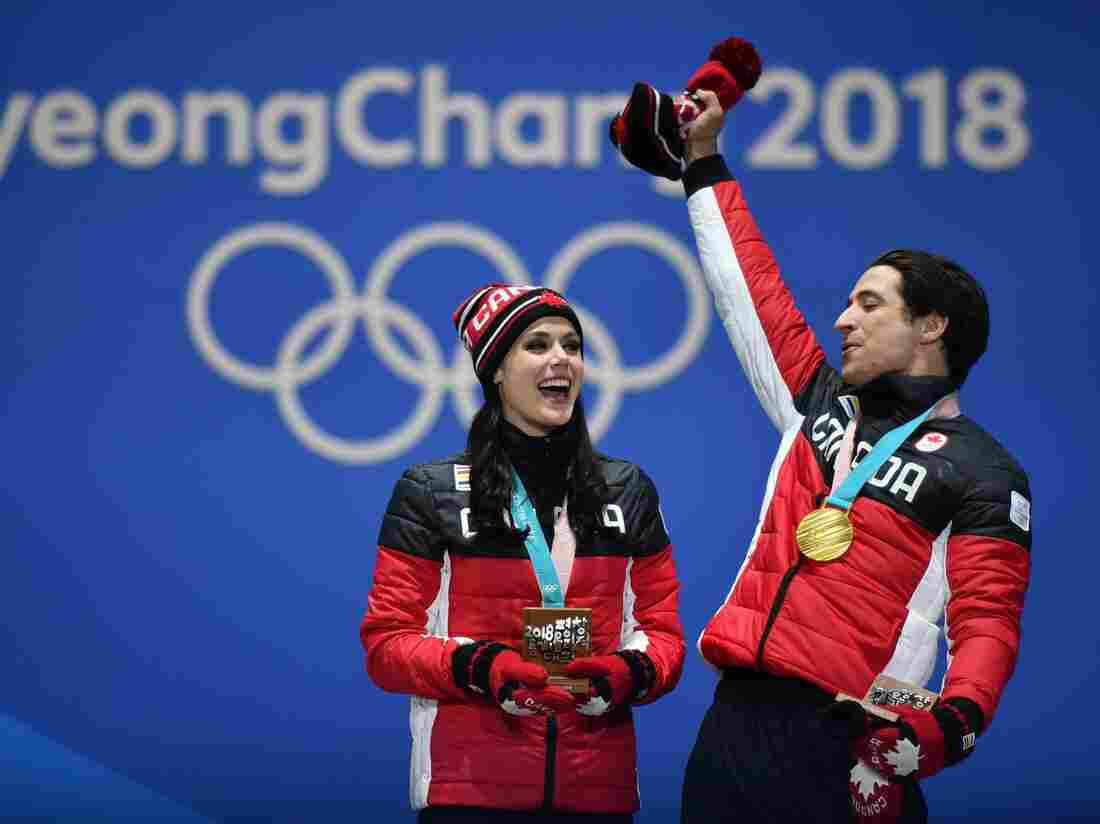
Canada’s gold medalists Tessa Virtue and Scott Moir celebrate on the podium during the medal ceremony for the figure skating ice dance. The 2018 Winter Games have seen the country win 29 medals.
Fabrice Coffrini/AFP/Getty Images
hide caption
toggle caption
Fabrice Coffrini/AFP/Getty Images
Canada had its best Olympic Games ever medal-wise in Pyeongchang, despite missing out on gold in men’s and women’s hockey and men’s and women’s curling — sports that country usually dominates.
The country has 29 medals, including 11 gold. Norway is leading the overall medal count with 38 medals, Germany is in second with 31 and the U.S. is in fourth with 23.
For the first time in this millennium, Canada didn’t take gold in women’s hockey. In the final game against the U.S. last week, standard regulation time had ended with a 2-2 tie. Neither team scored a sudden-death goal during a 20-minute overtime — and the resulting penalty shootout also ended in a 2-2 tie. That sent the teams to a high-stakes, sudden-death shootout, where the U.S. came out on top, breaking Canada’s 2002-2014 streak of four consecutive gold medals.
The women’s hockey record wasn’t the only Canadian gold streak broken in Pyeongchang. The men’s curling team won gold in 2006, 2010, and 2014 — but took bronze this year after the U.S. rose above them 5-3 in a late surge during a semifinals match. The country did earn one gold in curling: Kaitlyn Lawes and John Morris secured the medal in mixed doubles curling.
Canada won gold in the first men’s hockey event in Antwerp in 1920, and kept the gold streak up for the following three winter games. They would medal in every single winter games until 1964, and earned gold in 2010 in Vancouver and 2014 in Sochi. Men’s hockey was Canada’s third gold streak broken in Pyeongchang: The country settled for bronze after being knocked out of the finals by Germany.
And finally, Canada lost its streak of medaling in women’s curling, too. The country won gold in the first-ever women’s curling event in Nagano in 1998, and medaled in every winter games since then — until they came in sixth place in Pyeongchang after a series of tough losses. Sweden won gold, while the “Garlic Girls” of South Korea took silver and Japan took bronze.
Despite losing out on its traditional sources of gold, the country won its second-highest total of Winter Games gold medals in Pyeongchang, after winning 14 in its home-turf Vancouver games in 2010.
Canada secured 11 Pyeongchang gold medals in total this year: Four in freestyle skiing, two in figure skating, one in mixed doubles curling, one in men’s two-man bobsleigh, one in men’s long track speed skating, one in men’s short track speed skating and one in men’s snowboarding. The country has 8 silver and 10 bronze as well.
Among gold medal winners are fan favorite figure skaters Tessa Virtue and Scott Moir, the designated flag bearers for the 225 athletes who competed as part of Team Canada. Short track speed skater Kim Boutin will bear the flag in the closing ceremony, after earning two bronze medals and one silver.
Saturday Sports: Curling, Snowboarding And Doping In Pyeongchang

We have an update on the biggest stories in the 2018 Winter Olympics in the past week.
SCOTT SIMON, HOST:
And now it’s time for sports.
(SOUNDBITE OF MUSIC)
SIMON: The 2018 Winter Olympics are racing to a close. U.S. women won hockey gold over a country just over the Detroit border – the U.S. mira-curl (ph) on ice. Meanwhile, almost every citizen of Norway seems to have won an Olympic medal. NPR’s Tom Goldman is in Pyeongchang following all this. Tom, thanks so much for being with us.
TOM GOLDMAN, BYLINE: It is always a pleasure. And, Scott, how long did it take you to come up with mira-curl? That is awesome.
SIMON: Oh, I’ve been preparing for it for a couple weeks.
GOLDMAN: You just spit those out, OK.
SIMON: Couple of weeks. Ester Ledecka, the great Czech Olympian – not just a one-sport athlete. She’s amazing. Tell us what she’s done today.
GOLDMAN: What has she done today? She won another gold medal. You know, she – two weeks ago, Scott – a little over two weeks ago, who had heard of Ester Ledecka? Maybe if you followed women’s snowboarding, you would have because she was a 2017 world champion in the parallel giant slalom, which she won today. She was not a great alpine skier. But we were hearing at the beginning of the games that she was the first ever to compete in Alpine skiing and snowboarding in the same games. And then she goes out and she wins the super-G in Alpine, beating like Lindsey Vonn and all the other greats – and, you know, that classic blank stare at the finish line and her classic comment – how did that happen? And then today she wins in her stronger event, snowboard parallel giant slalom – so two sports, two gold medals. She’s a great Czech Olympian right now.
SIMON: Yeah, and to put this into perspective, this would be as if Michael Jordan had actually been not only good but great at baseball.
GOLDMAN: (Laughter) Not that extreme – now, baseball and basketball, you’re using skills – different kind of athleticism. Sorry, Michael. But both of the Ledecka’s sports are moving down a mountain around gates. You have different contraptions on your feet. Still, there are unique challenges to each discipline. So let’s not devalue what she did. It was quite impressive.
SIMON: I have to ask about what’s going on with the Russian team – or what do they call it? – the athletes from overseas – athletes from Russia or something.
GOLDMAN: Olympic athletes from Russia, OAR.
SIMON: Most of the team was suspended from these Olympics – a punishment over a long-running doping scandal. Nevertheless, two Russian athletes were caught with banned substances and sent home. But we hear the IOC may still allow Russians to march under their country’s flag during tomorrow’s closing ceremony. So this means – what? – Russia’s cleaned up the program, and all’s on the up and up right now.
GOLDMAN: Oh, yeah, right. Yeah, exactly. That’s what it means. What it means is the people at the beginning of all this – the hard-liners who said, at the start of the games, kick them all out, even the innocents – they may have been right. But that was too drastic measure for the IOC. You know, whether the IOC really wanted to protect innocent Russian athletes, as it’s said publicly over and over, or whether the IOC relented to the Olympic power of Russia, that question lingers. But, Scott, this issue bookends the games. We started and we end tomorrow debating Russians and doping. And Olympic sport is no closer to figuring out what to do about these issues. One wonders if there’s the will to do anything among the people at the highest level of sport.
SIMON: OK, every four years, the world sees curling and says, curling, that’s maybe one Olympic sport I could do. The U.S. men won their first gold medal ever over Sweden.
GOLDMAN: Yeah, and for all those who think it’s, you know, the easiest sport in the world, one of the Russians who popped for drugs this week, he was a curler. So it must be tough, right?
SIMON: He did that to stay awake. But go ahead, yes.
(LAUGHTER)
GOLDMAN: But, yes, today – I’m sorry. U.S.A….
SIMON: No, it’s a great – it’s a sport that requires finesse, skill, grace.
GOLDMAN: It certainly does. And today the U.S. had all of that. And they won the gold medal in the big play. Notice I’m going to use very general terms here. The big play was made by veteran John Shuster, who’s been through so many curling wars. He was on a team that won Olympic bronze in 2006. Now in his fourth Olympics, at the age of 35, he led the team to its first ever gold. It’s a great story.
SIMON: And great to look forward to the South Korean women’s team – the Garlic Girls, as they call themselves – that’s later today, right?
GOLDMAN: They should be fantastic tomorrow morning – later today to you.
SIMON: They’ve been great hosts in South Korea, haven’t they? I’ve been impressed.
GOLDMAN: They have been – yes, very gracious.
SIMON: Tom Goldman, at the Winter Olympic Games in South Korea, thanks so much for being with us.
GOLDMAN: You’re welcome, Scott.
(SOUNDBITE OF THE OMNIFIC’S “SONOROUS”)
Copyright © 2018 NPR. All rights reserved. Visit our website terms of use and permissions pages at www.npr.org for further information.
NPR transcripts are created on a rush deadline by Verb8tm, Inc., an NPR contractor, and produced using a proprietary transcription process developed with NPR. This text may not be in its final form and may be updated or revised in the future. Accuracy and availability may vary. The authoritative record of NPR’s programming is the audio record.
Olympians Are Using Nonalcoholic Beer As Recovery Drinks. Here's The Science
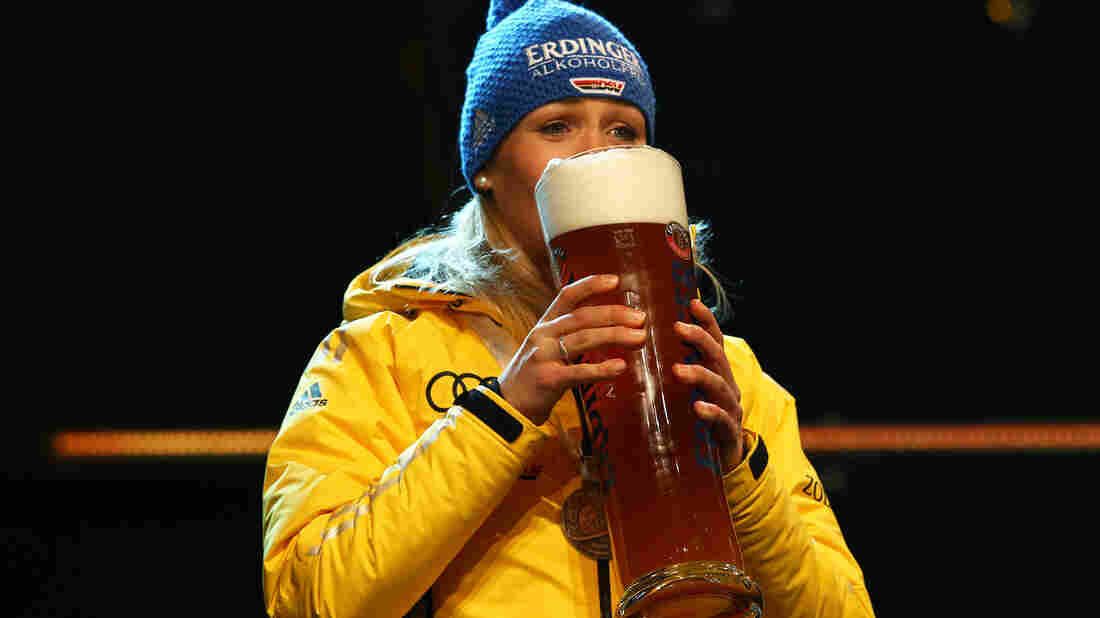
Magdalena Neuner of Germany enjoys a glass of Erdinger nonalcoholic beer after a medal ceremony at the biathlon world championships in Ruhpolding, Germany, in 2012. Today’s Olympians have been swept up in a new trend largely emerging from Bavaria: nonalcoholic athletic recovery beers.
Alexander Hassenstein/Bongarts/Getty Images
hide caption
toggle caption
Alexander Hassenstein/Bongarts/Getty Images
In Greek mythology, the Olympians were said to drink ambrosia, which bestowed upon them immortality. Occasionally, athletic heroes like Heracles were also gifted a sip. But the myths don’t say much about the golden-amber liquid getting them all drunk.
Today’s Olympians have been swept up in a new trend largely emerging from Bavaria: nonalcoholic athletic recovery beers. Over the past few years, a number of breweries, such as Erdinger and Krombacher, have expanded their offerings of sober sports beers. This year, beers from both brands are a common sight in the Olympic Village.
But how much science is there to support the use of beer as an athletic recovery drink?
Beer’s most oft-cited health benefits revolve around plant-derived compounds called phenols. These organic compounds often have defining tastes. The spice of peppers? That is the phenol Capsaicin. The pungent heft of oregano or the smoke in scotch? Carvacrol in the leaves and guaiacol from charred barrels.
Appalachian State University’s David Nieman has studied phenols’ health effects. On the whole, phenol-rich diets tend to lower inflammation and reduce the risk of sickness, he says. “[Polyphenols] have a very unique molecular structure that can actually regulate the genes that control inflammation,” in addition to general antiviral properties, says Nieman.
In 2011, Nieman and the University of Munich’s Johannes Scherr investigated the effects of beer, which contains around 50 phenols, on athletes — whose intense physical activity can compromise their immune activity. When marathon runners were instructed to drink 1.5 liters of nonalcoholic beer a day, their risk of upper respiratory infection was reduced. The activity of white blood cells, a good indicator of inflammation, was lowered 20 percent.
However, phenols aren’t the only health benefits beer has to offer — and not just any brew can be called a sports beer. For example, regular alcoholic beer is a diuretic, and having to urinate more dehydrates athletes, says biologist Mauricio Sepulveda of Chile’s Pontifical Catholic University. It also can disrupt crucial protein synthesis, says Ben Desbrow with Griffith University in South East Queensland, Australia.
What is more, beer is a uniquely social drink, notes Desbrow — a dietitian who has long studied the health effects of the brew and even engineered a version less likely to give tipplers a hangover. “In Australia, and I’m sure it’s the same in many places around the world, we’ve got a lot of people who, after exercise or exertion or maybe a hard day’s work, they like to drink beer,” he says.
That comes with a hydration dilemma. If athletes drink beer, they won’t get properly hydrated. That is because water, when drunk in large quantities, is quickly expelled without electrolytes. According to Desbrow, our bodies can easily hold water and properly rehydrate when we take in calories as we drink — but athletes can’t eat before every new match, round, bout or run. One of the benefits of sugary recovery drinks is that they restore athletes’ stores of glycogen — a sugar-based compound our bodies use to readily store energy. If an athlete needs something to drink between rounds of boxing, or innings of a baseball game, they’re going to want the sugar in most sports drinks.
But when the day is wrapping up, athletes don’t need to worry about replacing glycogen stores in a hurry. So a nonalcoholic beer and some water can help them recover — while also offering an opportunity to socialize with other athletes.
In 2013, Desbrow found that having athletes drink a reduced-alcohol beer with added electrolytes allowed them to retain more fluids. His original study had only seven participants. But since then, he and other researchers (including Sepulveda) have done severalfollow-up studies that have generally confirmed that light or nonalcoholic beer works well enough for hydration.
Desbrow’s specially formulated, electrolyte-rich beer wasn’t significantly more hydrating than regular light beer. Yet, several breweries are touting the added electrolytes in their sports beers. The added marketing appeal might make it worthwhile, but modifying the salt content of beer — without majorly disrupting the flavor — can involve some complicated and costly experimentation.
And removing alcohol from beer is already pretty complex. One of the most popular methods is to take advantage of the fact that alcohol’s boiling temp is lower than water’s by nearly 4 degrees Celsius. By applying heat and creating a vacuum (which further reduces the boiling temperature), brewers cook off the alcohol — but not without also altering the flavor profile of other compounds.
Other brewers use reverse osmosis to remove alcohol: They filter out most everything but the water and alcohol, leaving a syrupy concentrate. After distilling out the alcohol, they remix the concentrate and remaining water. Either way, the beer has to be recarbonated, either through adding yeast to the bottle or injecting carbon dioxide (which technically makes it a soda).
Other new methods of brewing nonalcoholic beer are popping up. Bravus has a sober IPA — long thought impossible because hop flavors are quickly disrupted by alcohol-boiling heat — by using what it will only call “biological wizardry.” There is also a growingarray of wild yeasts and genetically modified brewers yeasts, which can produce low-alcohol beers.
Ultimately, sports drinks are pretty darn good for replenishing electrolytes and spent sugar stores. But at the end of the day (literally), low-alcohol beers can provide a recovery beverage with two benefits relatively unmatched by other options: first, a host of extra healthy plant-derived compounds. Second, as Desbrow points out, people drink beer together over all the world (and have for much of the history of human civilization), so what could honor that spirit more than shared brews in a multinational village of Olympians?
Russian Bobsledder Disqualified For Doping, Court Says
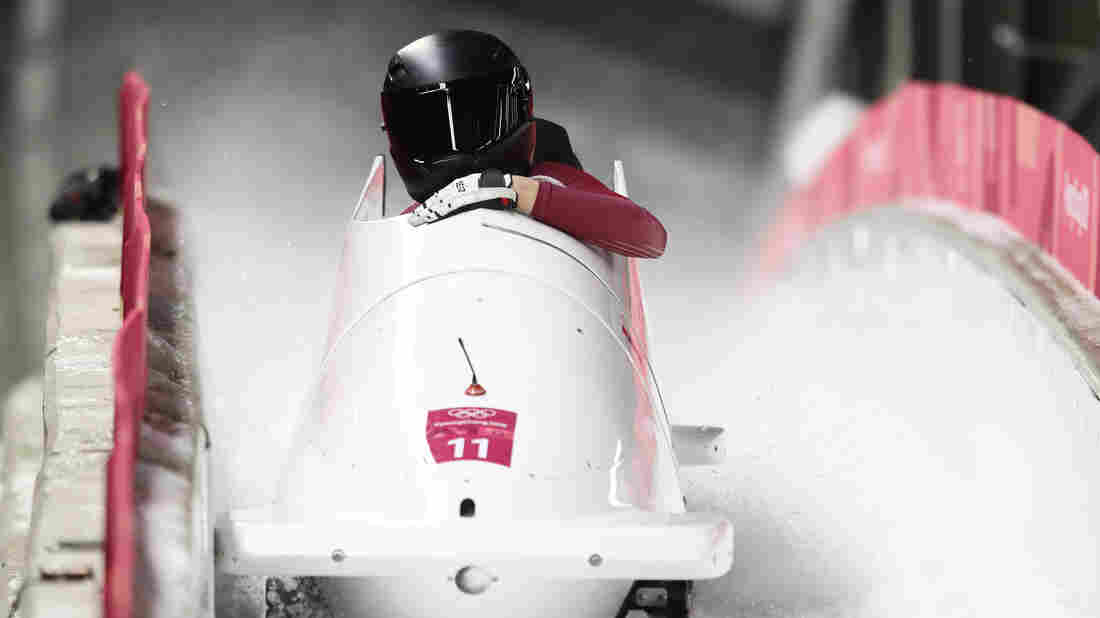
Nadezhda Sergeeva and Anastasia Kocherzhova, competing as Olympic Athletes from Russia, react in the finish area during the women’s bobsleigh heats on Wednesday in the Pyeongchang Olympics.
Clive Mason/Getty Images
hide caption
toggle caption
Clive Mason/Getty Images
Nadezhda Sergeeva of Russia has tested positive for a banned substance and has been disqualified from the Winter Olympic Games in Pyeongchang, the Court of Arbitration for Sport said Saturday.
Sergeeva was ranked 12th in the women’s bobsleigh, but is now disqualified from the event and “the results obtained” by her team “at the same event are disqualified with all resulting consequences,” the organization said in a statement.
The court said the 30-year-old tested positive for trimetazidine, a heart drug used to treat angina, and said she admitted to the violation. The drug affects metabolism, according to The Associated Press. The World Anti-Doping Agency banned it in 2014.
Sergeeva “accepted a provisional suspension beyond the period of the Games,” the court wrote, “and reserved her ‘rights to seek the elimination or reduction of the ineligibility period’ following the conclusion of the Games.”
Sergeeva is the second Russian athlete to fail a doping test at the Pyeongchang Olympics. As NPR’s Bill Chappell wrote on Friday: “The news about Sergeeva comes one day after a bronze medal was stripped from Russian curling athlete Aleksandr Krushelnitckii, who had tested positive for meldonium in Pyeongchang.”
The Russian Bobsled Federation announced on Friday that Sergeeva had failed the drug test.
Hockey player Ziga Jeglic of Slovenia and speedskater Kei Saito of Japan also tested positive for banned substances, the AP reports, and the two have left the games.
Athletes from Russia are competing under the Olympic — not Russian — flag, after authorities banned Russia’s federation from competing once they concluded that Russian athletes had engaged in systemic state-backed doping in the 2014 games in Sochi.
The International Olympic Committee is still debating whether to allow Russian athletes, now wearing uniforms labeled OAR (Olympic Athlete from Russia), to march under the Russian flag during the closing ceremonies on Sunday.
Czech Republic's Ester Ledecka Makes History With Golds In Snowboarding And Skiing

Ester Ledecka of the Czech Republic celebrates winning gold in the ladies’ snowboard parallel giant slalom at the Pyeongchang Olympic Games Saturday.
Clive Rose/Getty Images
hide caption
toggle caption
Clive Rose/Getty Images
With a gold medal in the snowboard parallel giant slalom, Ester Ledecka of the Czech Republic has become the first woman in Winter Olympics history to win a gold medal in two different sports at the same Olympic Games.
On Saturday she emerged victorious in the final run against Germany’s Selina Joerg, finishing just 0.46 seconds ahead. Joerg took silver in the event, followed by Ramona Theresia Hofmeister, also of Germany, who took bronze.
A week earlier, Ledecka surprised spectators and herself by taking a gold medal — in skiing. Ledecka finished first in the women’s super-G in Alpine skiing, finishing several spots ahead of the decorated American skier Lindsey Vonn.
But Ledecka is best known and has seen the most success as a snowboarder, where she’s won world titles and competed in the Winter Games in Sochi four years ago.
Ledecka is the third athlete to win gold in two events in the same Winter Games, according to analytics company Gracenote. The last time it happened was in 1928, with Johan Grøttumsbråten taking gold in the Nordic combined and cross-country skiing. Four years earlier, Thorleif Haug achieved the same thing, the company says.
The 22-year-old Ledecka earlier made Olympic history just by being the first woman to compete in both the Alpine skiing and snowboarding events.
She first skied at age 2 and snowboarded at age 5, according to The New York Times, but refused to follow the conventional wisdom of her coaches to give up one sport in order to specialize.
In the men’s snowboarding parallel giant slalom, Nevin Galmarini of Switzerland was the gold medal winner, besting his silver medal he won in Sochi in 2014.
Lee Sang-ho of South Korea finished 0.43 seconds behind to take silver, the country’s first medal in a snowboarding event. Zan Kosir of Slovenia was the bronze winner, beating Sylvain Dufour of France in the “small final,” which determines the contest’s overall third place.
U.S. Men's Curling Team Wins Gold, Beating Sweden 10-7 At Pyeongchang Winter Olympics




From 'Bonk' To 'Bombs' And 'Fly Swat': A Guide To Olympic Slang
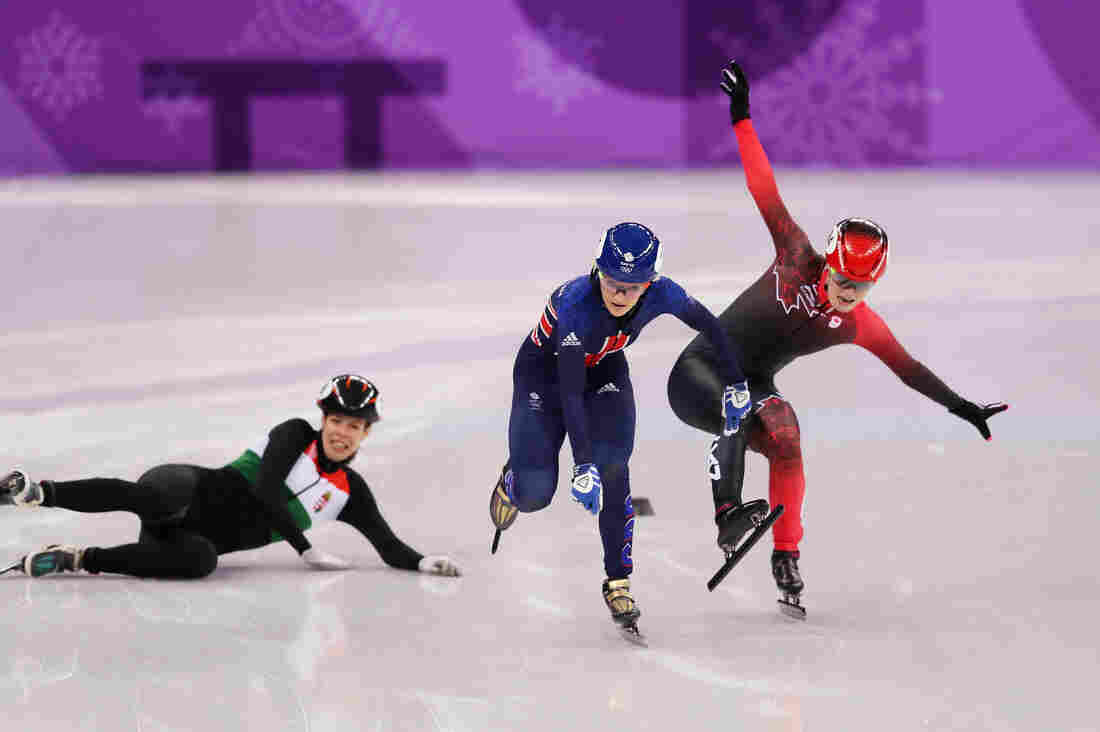

Speedskaters Elise Christie of Great Britain gets by Kim Boutin of Canada and Andrea Keszler of Hungary as they fall during the Ladies’ 500m quarterfinal on Feb. 13. “If the pass is gonna be close or tight,” says U.S. speedskater J.R. Celski, “we usually say ‘bombs,’ like ‘Uh-oh, something’s gonna blow up!’ So it’s like an explosion. It most likely means people are falling.”
Richard Heathcote/Getty Images
hide caption
toggle caption
Richard Heathcote/Getty Images
Olympic sports have their own special vernacular — colorful slang terms that are head-scratchers to an outsider.
Here in Pyeongchang, I’ve made it my mission to crack the code. So I cornered as many Olympic athletes as I could and asked them to divulge their terms of the trade.
When I asked U.S. biathlete Tim Burke for his best example, he didn’t hesitate.
“If you have a bad crash, a lot of times we call that a ‘yard sale,'” he told me.
Yard sale! I was intrigued.
He explained it this way: “You’re on a downhill, you fall, your skis and poles are all headed in different directions.”
And how would you use it in a sentence?
“‘I had a serious yard sale on that big downhill over there,'” he offered. “That’s never a good time. Except for your teammates and the camera crew.”
In truth, a lot of the lingo I’ve picked up has to do with disaster — spicy ways to describe when things go horribly wrong, as they often do in ultra-high speed, high-amplitude sports on ice and snow.
Take aerials, where skiers fly 60 feet in the air, flipping and spinning their way back to earth.
If you’re unlucky, you could end up crash-landing in what’s known as a “reverse suitcase.”
I asked U.S. aerials head coach Todd Ossian for a definition.
“The reverse suitcase is twisting past the flip and having too much rotation, so you land on your chest,” he explained. “So your head goes one way and your feet come the other.”
Like a suitcase flapping open too far.
And how about the “fly swat”?
“It’s kinda like catchin’ an edge,” Ossian said, “and the force makes you go to the ground quick. There’s a lot of impact there when you do that — slaps you down. And you don’t want that.”
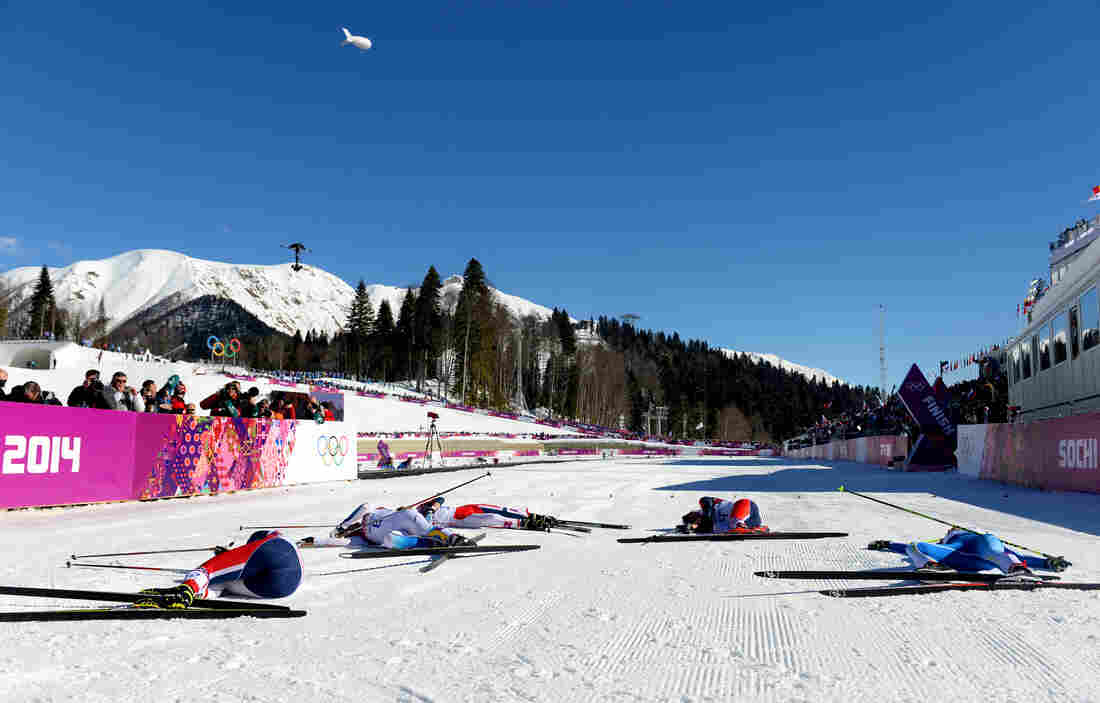
Cross country skiers lie next to the finish line after competing in skiathlon at the Sochi 2014 Winter Olympics. “If you ‘bonk,'” says gold medalist Jessie Diggins, “it means you’ve just run out of energy, there’s nothing left in the tank, and suddenly your body can’t go on anymore.”
Harry How/Getty Images
hide caption
toggle caption
Harry How/Getty Images
I figured short track speedskating would be a gold mine of cool lingo. It’s notorious for its chaotic collisions and spills, since skaters race in a tight pack and jockey aggressively for position, often crashing violently into the pads as they try to pass.
Short track skater J.R. Celski came through.
“If the pass is gonna be close or tight,” he told me, “we usually say ‘bombs,’ like ‘Uh-oh, something’s gonna blow up!’ So it’s like an explosion. It most likely means people are falling.”
Maybe you’ve seen what happens in cross country skiing, when the racers collapse on the snow, totally spent, as soon as they cross the finish line. They routinely work themselves to the point of exhaustion.
And of course, there’s a word for that, too.
“If you ‘bonk,'” newly minted U.S. gold medalist Jessie Diggins told me, “it means you’ve just run out of energy, there’s nothing left in the tank, and suddenly your body can’t go on anymore ’cause you’ve run out of blood sugar. So if you hear someone say, ‘Oh, I bonked in that race,’ it means they just, like, BOOM, hit the wall. They’re done.”
And it’s not just athletes coming up with creative turns of phrase. Turns out the guys who make the ice for various sports also have their own lingo.
Mark Messer, the ice meister at the Gangneung Oval, the venue for long track speedskating, grinned when he told me his favorite — the nickname for a patch of ice causing problems.
“We’re gonna go check on ‘bubble boy’ today,” he said, referring to a patch with too much air, creating a bubble.
And yes, the term comes from a Seinfeld episode (“probably my favorite ever,” Messer said) — the one about the boy who has to live in a sterile, plastic bubble and gets in a fight with George Costanza.
The ice crew is filled with “real good Seinfeld fanatics,” Messer explained. “So a lot of what we do here always goes back to a Seinfeld episode of some sort.”
And then there’s snowboarders’ lingo — a foreign language unto itself. The names of their tricks and grabs is a smorgasbord of wonder: Chicken salad. Stalefish. Tamedog. Bloody Dracula.
Freestyle skiers seem to share the same devil-may-care approach as their snowboard brethren (and sisteren). Freestyle skier Aaron Blunck boils his sport’s attitude down to four letters: “stee.”
“Stee is short for ‘steez,’ like steezy run, like style. It’s short for style,” he said. “We just say ‘stee.'”
As in: “‘Damn, that was a stee run, he showed style, he showed creativity, he flowed,'” Blunck translated. “That’s what it means. Pretty much whatever word you can think of, shortened into the shortest way possible, is what we like to say.”
And when things go wrong? Any colorful words for a bad crash?
“Typically, it’s just a swear word,” Blunck said with a laugh. “It’s just the f-bomb, straight up. All the time.”
What Parents Can Learn From The Larry Nassar And USA Gymnastics Case
What the parents of Larry Nassar’s victims want other parents to understand is the question “how could I have let this happen?” Many of their daughters were abused by the Olympic gymnastics doctor while they themselves were sitting there in the room. While they struggle with blaming themselves, they also want other parents to learn about how predators can gain your trust.